




Abstract
Background:
Central nervous system receives information from foot mechanoreceptors in order to control balance and perform movement tasks. Subthreshold random noise seems to improve sensitivity of the cutaneous mechanoreceptor.
Objectives:
The purpose of this study was to systematically review published evidence conducted to evaluate the clinical and biomechanical effects of subthreshold random noise on the plantar surface of the foot in diabetic patients and elder people.
Study design:
Systematic review.
Methods:
A literature search was performed in PubMed, Scopus, ScienceDirect, Web of Knowledge, CINAHL, and EMBASE databases based on population, intervention, comparison, outcomes, and study method. Quality of studies was assessed using the methodological quality assessment tool, using Physiotherapy Evidence Database scale.
Results:
In all, 11 studies were selected for final evaluation based on inclusion criteria. Five studies evaluated the effects of subthreshold random noise in diabetic patients and six in elder people. In seven studies, biomechanical (balance and gait parameters) effects and in four studies clinical (pressure and vibration sensations) effects of subthreshold random noise were investigated. All reviewed studies were scored fair (2) to good (9) quality in terms of methodological quality assessment using Physiotherapy Evidence Database scale.
Conclusion:
The results indicated that subthreshold random noise improves balance and sensation in diabetic patients and elder people. Also gait variables can be improved in elder people with subthreshold random noise. However, further well-designed studies are needed.
Clinical relevance
The previous studies reported that subthreshold random noise may improve gait, balance, and sensation, but more studies are needed to evaluate the long-term effect of subthreshold random noise in shoe or insole for daily living tasks in diabetic patients and elder people.
Background
Studies have shown that subthreshold mechanical or electrical noise may enhance detection of weak signals. The mechanism that improves signal detection by noise is termed as stochastic resonance (SR).1–3 SR is a phenomenon that adds random noise to the weak signal in non-linear system.1,2 The effect of SR was investigated in medical and biological systems such as rat cutaneous afferents, 4 crayfish mechanoreceptors, 5 human muscle spindles, 6 and tactile sensation.7,8 In humans, subsensory (weak) mechanical noise improved the sensitivity of the cutaneous mechanoreceptors9–12 and was reported to have an effect on the central nervous system (CNS). 13 The level of vibration which a subject just feels is defined as vibration perception threshold (VPT). Subthreshold or subsensory noise (low-level) concerns those stimulations below the VPT.9,10
Glabrous skin of the foot contains several mechanoreceptors. Foot cutaneous mechanoreceptors are sensitive to touch, pressure, and vibration sensation 14 and play an important role in gait15–17 and balance control.14,18,19 CNS receives information about plantar pressure distribution through foot receptors. 20 The CNS applies this information in order to control static and dynamic posture and to perform movement tasks.15,16,19,20 Impaired or reduced foot cutaneous sensation leads to skin ulceration, postural instability,17,19 and gait abnormality. 16 Previous studies have shown that reduced plantar cutaneous sensation in healthy subjects with ice or anesthesia may change the plantar pressure distribution patterns, 16 gait kinematics, muscle activity, 20 and postural sway. 19
Loss of sensation is one of the major problems in patients with diabetes mellitus. Peripheral neuropathy (PN) was reported in approximately 50% of type I and type II diabetic patients within 10–15 years of involvement. 21 PN results in reduced protective sensation (pressure, vibration, and pinprick sensation) and lower limb proprioception. 14 Decreased protective sensation in patients with diabetic neuropathy (DN) leads to changes in plantar pressure distribution pattern,22–24 gait variables,15,25,26 impaired balance control,14,17,19,27,28 and increased risk of diabetic foot ulceration.23,29
It was reported that cutaneous sensations decrease in elder people like DN patients30,31 and lead to increased risk of falling.32,33 Reduction in density and sensitivity of dermal mechanoreceptors, rigidity and inelasticity of the surrounding dermal tissue, and peripheral nerve degeneration may all contribute to age-related decreases in cutaneous sensitivity. 34 Postural stability is also impaired in elder adults during quiet standing and dynamic movements.33,35 Previous studies demonstrated that decreased postural stability in elder people will increase the risk of falling. 33 Falls may lead to traumatic fracture, limited mobility, increased hospital cost, and decreased quality of life in elderly.32,36
Several methods such as whole body vibration, 37 dynamic stability training, 38 texture insole, 39 and pneumatic insole 40 have been used to improve sensation, balance control, and gait in DN patients and elder people. Subthreshold mechanical or electrical random noise is a relatively new technique. Several studies investigated the effects of subthreshold random noise stimulation of the plantar surface of the foot on sensation, balance control, and movement tasks;9–12,41–47 however, there is no general consensus on the clinical and biomechanical effects of the subthreshold random noise in the diabetic patients and elder people. The purpose of this study was to systematically review published studies carried out in the evaluation of clinical and biomechanical effects of the subthreshold random noise on the plantar surface of the foot in diabetic patients and elder people.
Methods
Search strategy
In order to identify published studies carried out on the effects of random noise of the plantar surface of the foot in patients with diabetic mellitus or elder people, a literature search was performed in PubMed, Scopus, ScienceDirect, Web of Knowledge, CINAHL, and EMBASE databases from 2000 to March 2014. Free text words and MeSH terms were searched using the following appropriate keywords: “diabetic mellitus,” “elderly,” “vibration,” “random noise,” “foot orthoses,” “orthotic insole.” Only full papers that were published in peer-reviewed journals and in English language were studied.
Study selection
The title and abstract of each study identified from the search were assessed by two reviewers. Studies were eligible if information based on population, intervention, comparison, outcomes, and study design (PICOS) 48 appeared in the title or abstract. Inclusion criteria were as follows: (1) Population (P) included elder people or diabetic patients with or without neuropathy; (2) Intervention (I) included subthreshold mechanical or electrical random noise on the plantar surface of the foot, other types of vibration, or stimulation on the body or foot (i.e. whole body vibration, functional electrical stimulation, ankle, or dorsal foot vibration) were not considered as an intervention; (3) Comparison (C) included random noise on or off; (4) Outcomes (O) were not limited and evaluating any clinical (sensation test) and biomechanical (balance control, gait variables, and plantar pressure distribution) outcome measures relating to intervention; and (5) Study designs (S) were experimental trials including randomized controlled trials (RCTs), clinical controlled trials (CCTs), and controlled before-and-after trials. 49 Review articles, observational studies, conference articles, and abstracts were excluded. All initially rejected articles were checked by the third reviewer to ensure no article has been mistakenly excluded. The references of the selected studies were also checked and the related articles published between 2000 to March 2014 were added.
Data extraction and quality assessment
The level of evidence of each retrieved study was assessed according to the “Oxford Centre for Evidence-based Medicine Levels of Evidence.” 50 These criteria were chosen because it was suggested as suitable for the rehabilitation scientific literature. The full text of selected articles, based on title and abstract, was obtained and checked again by two reviewers independently, and then assessed for methodological quality using Physiotherapy Evidence Database (PEDro) scale. 51 This is an ordinal scale consisted of 11 items with each item scored 0 or 1, except the first item which needs “yes” or “no” answer. Higher scores represent higher methodological quality (9 to 10 = excellent, 6 to 8 = good, 4 to 5 = fair, and <4 = poor). 51 Disagreements on methodological quality were resolved with discussion or by the third reviewer.
Data analysis
Kappa statistics were used to assess agreement between the two reviewers on article selection and PEDro ratings. Kappa values less than 0.4 indicate low association; values between 0.4 and 0.75 indicate medium association, and values greater than 0.75 indicate high association between the two raters. 51 Selected articles categorized based on population, intervention, outcome, and study design. Population were divided into two groups: elder people and patients with diabetes. Biomechanical (balance control, plantar pressure, gait parameters, kinetic, and kinematic) and clinical (touch, vibration, cold, warm, and other sensation test) effects of subthreshold random noise were considered to be the primary outcomes.
Results
In total, 243 articles were recognized. A flow chart of the literature search is presented in Figure 1. In all, 14 papers were selected initially based on titles and abstracts. Six studies were added after checking the references of the selected articles. After reading the full text of each of study, nine more studies were excluded because of the following reasons: they were not experimental trials, the same study published in two different journals, editorial reviews, and stimulation without subthreshold random noise, resulting in 11 articles to be assessed.9–12,41–47
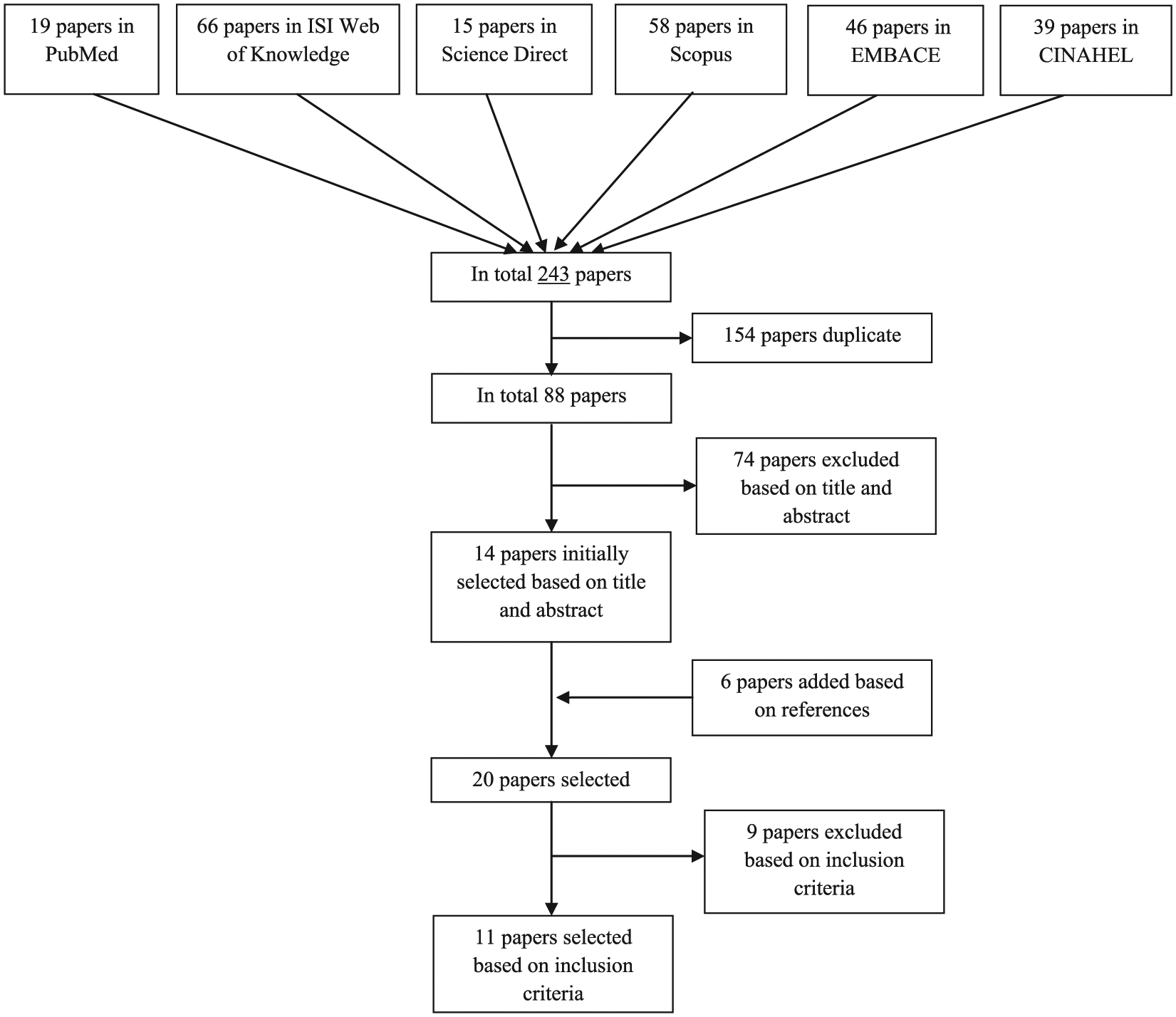
Flow chart of the literature search.
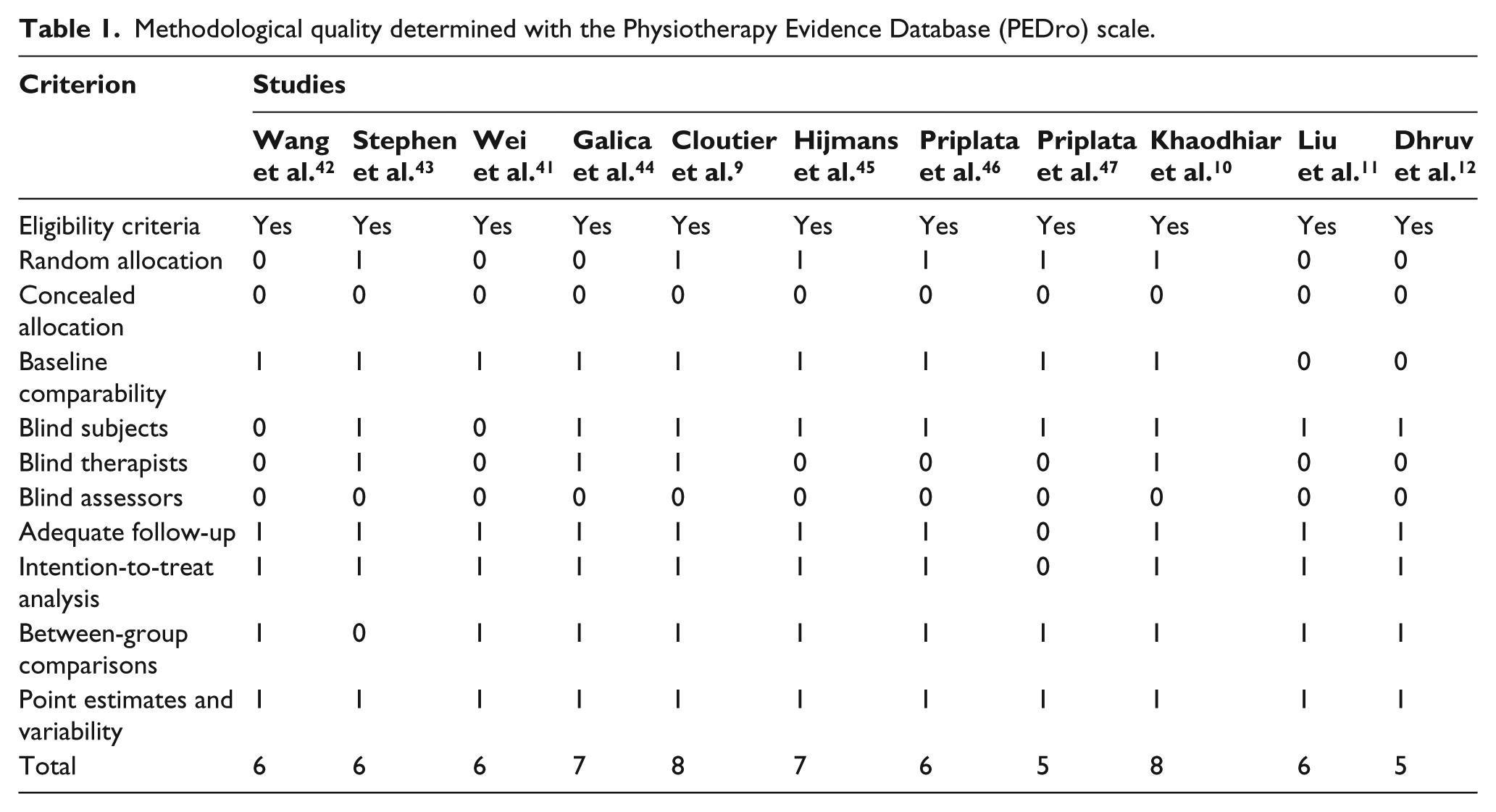
Methodological quality of PEDro was rated as good for nine studies and fair for two studies (Table 1). The level of inter-rater agreement on screening of the studies through reading of the titles and abstracts, and PEDro ratings was high (kappa = 0.78 and kappa = 0.89, respectively). There were discussions on two studies and the third independent reviewer passed a binding judgment about these studies. The characteristics of study population, methods, and conclusions of each study were summarized in Table 2.
Methodological quality determined with the Physiotherapy Evidence Database (PEDro) scale.
Characteristics of study population, methods, and conclusions.
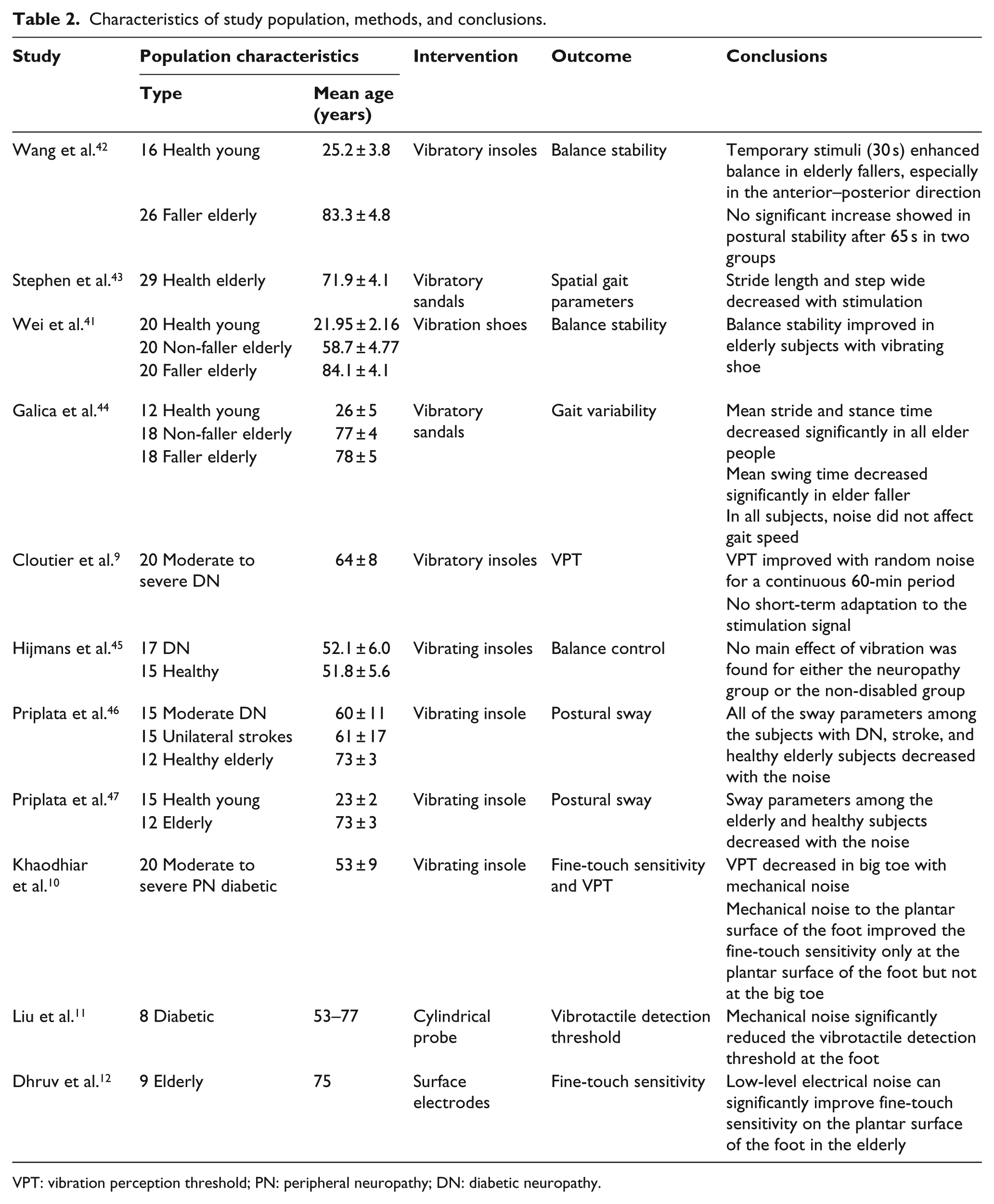
VPT: vibration perception threshold; PN: peripheral neuropathy; DN: diabetic neuropathy.
Population
Six studies evaluated the effects of subthreshold random noise of the plantar surface of the foot in elder people,12,41–44,47 and four studies in diabetic patients.9–11,45 The remaining study compared the effect of subthreshold random noise in elder people, diabetic, and stroke patients (Table 2). 46
Among the studies that assessed the effects of subthreshold random noise in elder people, three studies conducted on healthy elderly,12,43,47 one study on faller elderly, 42 and two studies on both healthy and faller elderly.41,44 The effects of subthreshold random noise were evaluated on protective sensation, gait variables, and balance control in elder people.12,41–44,47
Diabetic patients had moderate to severe PN9,10,45 except in Liu et al.’s 11 study. The effects of subthreshold random noise were evaluated on protective sensation and balance control in diabetic patients.
Intervention
In nine studies, random noise was applied through vibrating actuators or motor that was embedded in insole or shoe;9,10,41–47 in two remaining studies, random noise was applied by surface electrodes 12 and cylindrical probe (Table 2). 11 The material and structure of insole or shoe was not provided in reviewed studies except in studies by Hijmans et al. 45 and Priplata and colleagues46,47.
Tactile threshold for participants was measured in all selected studies. The stimulation level for the experiments was set at 90% of their sensory threshold level and therefore, patients were blinded to the intervention. Stephen et al. 43 and Galica et al. 44 have measured the tactile threshold for each foot in three positions for simulating gait phases.
Outcomes
In seven studies, biomechanical effects (balance control and gait)41–47 and in four studies clinical effects (sensation test)9–12 of subthreshold random noise were investigated. Among studies that evaluated biomechanical effects of random noise, in two studies balance was measured with force plate,42,45 in two studies using motion analysis,46–48 and in one study with the Danish Catsys 2000 system. 41 Two remaining studies evaluated temporal and spatial gait parameters with force-sensing resistor (FSR) or motion analysis.43,44 Four studies that evaluated clinical effects of subthreshold random noise have applied Semmes-Weinstein Monofilament (SWM) and biothesiometer for fine-touch sensitivity,10,12 and VPT9–11 measurement, respectively.
Results of studies indicated that following subthreshold random noise, balance control,41,42,45–47 pressure sensation, and VPT were improved in all groups.9–12 Temporal and spatial gait parameters were decreased in elder group.43,44
Study design
All reviewed studies were experimental and low-quality RCTs (level 2b) based on criteria suggested by the “Oxford Centre for Evidence-based Medicine Levels of Evidence.” 50 In five studies, participants and examiners were blinded,9–11,43,44 and in other studies only participants were blinded (Table 1).12,41,42,45–47
Discussion
The results of this systematic review demonstrated that subthreshold mechanical or electrical random noise stimulation on the plantar surface of the foot improved balance control41,42,45–47 and protective sensation9–12 and decreased temporal–spatial gait parameters43,44 in diabetic patients and elder people. CNS controls the static and dynamic balance via the information received from the foot mechanoreceptors. 20 It was reported that the function of the foot mechanoreceptors is impaired in diabetic patients 14 and elder people 30 which leads to a decreased postural stability and increased risk of falling.14,28,32 Improving the protective sensation through subthreshold random noise may consequently promote balance control in diabetic patients and elderly.45–47 The mechanism by which the subthreshold random noise improves the sensation is not well understood; however, a variety of mechanisms have been proposed. 12 First, it is suggested that the subthreshold random noise may enhance the vibratory stimulus energy improving the vibration transmission through the dermal tissue.10,12 Moreover, the subthreshold random noise would affect the permeability of ion channels by directly stimulating the nerve receptor ending such as muscle spindle. 52 Additionally, according to the gate-control theory of pain, 53 the impulse which is transmitted from the body to CNS is altered in spinal cord. The impulses transmitted through the large fibers tend to be blocked in the spinal cord. By contrast, the transmission of impulses by the small fibers is more facilitated. In patients with DN, large and small fibers are reported to be affected. 54 However, only in one study, the types of impaired fibers were investigated in patients with DN. 45
Population
In the current review, the effects of subthreshold random noise of the foot plantar surface were reviewed in diabetic patients9–11,45 and elder people.12,41–44,47 In the studies carried out by Wei et al. 41 and Galica et al., 44 elder population was divided into two groups: healthy non-fallers and recurrent fallers. Recurrent faller was defined as a participant who reported two or more falls in a year.41,44 They concluded that balance control and temporal gait parameters were more impaired in fallers compared with non-fallers.41,44 In most studies, the neuropathy and the conditions which could decrease the sensation and balance control (i.e. the medication, diabetic, stroke, etc.) were among the exclusion criteria.12,43,44,47 The effects of subthreshold random noise on the balance control,41,42,47 temporal–spatial gait parameters,43,44 and touch sense were also evaluated in elderly. 12
Type I or II diabetes, and moderate to severe PN without foot ulceration were the most common inclusion criteria in studies conducted on diabetic patients.9,10,45 However, in the study by Liu et al. 11 study, diabetic patients had mild PN (3.61 SWM). The PN condition has been diagnosed based on Neuropathy Disability Score (NDS),9,10 Neuropathy Symptom Score (NSS),9,10 SWM, and VPT test.9,45 The SWM and VPT tests were used to examine the plantar surface of the foot and pulp of big toe, respectively.9,10,45 VPT score of 20–45 V has been defined as the moderate to severe neuropathy. 10 Only the effects of subthreshold random noise on the balance control, 45 pressure, and vibration sensation were evaluated in diabetic patients.9–11
Priplata et al. 46 compared the effects of subthreshold random noise on balance control in patients with peripheral nervous system disorder (healthy elderly, diabetics) and patients with CNS impairment (stroke). The findings showed that the subthreshold random noise improved the balance control in all groups. However, it was more effective in patients with peripheral nervous system disorders compared to patients with CNS impairment.
Intervention
The insole material, structure, vibratory devices, and noise type were different in reviewed studies. Only Hijmans et al. 45 and Priplata et al.46,47 have explained the insole structure and materials. Hijmans et al. 45 applied cork material with 6-mm thickness that was covered with thin leather. Priplata et al.46,47 used viscoelastic silicone gel with 16 mm thickness (cork is hard and silicone gel is soft). Previous studies have shown that soft and thick materials decrease balance control in young and elder people.52,55,56,57 However, the results of these studies indicated that balance was improved in diabetic patients and elder people with both insole structures.45–47 It seems that random noise vibration had more effects on the balance control rather than insole hardness and thickness.
Three actuators were set under the heel and forefoot in studies that employed a vibratory actuator.9,10,41–47 Actuators were located in these positions in order to apply the subthreshold random noise to the anterior and posterior surface of the foot. In all, 8 of 11 studies utilized electromagnetic actuators (i.e. C-2 tactor) that were thick and expensive.9,10,41–44,46,47 The remained studies applied piezoelectric elements, 45 surface electrodes, 12 and flat cylindrical probes. 11 The results of all studies demonstrated that all types of stimulation devices improved balance, sensation, and temporal–spatial gait parameters in diabetic patients and elder people.
In all selected studies, the level of vibration was set individually for each participant.9–12,41–47 The amplitude of each foot was independently set but all actuators that were applied for one foot received the same noise signal.45–47 Participants were standing with their bare foot on the vibratory device and the noise level increased gradually until subjects felt the noise. The level of vibration that the participant could just feel, was determined as perception threshold. All the reviewed studies set the noise amplitude at 90% of participant VPT9–11,41–47 except Dhruv et al. 12 in which the noise threshold was set at 20%, 40%, 60%, and 80% of VPT. The outcome of studies confirmed that subthreshold random noise could improve sensation and balance in diabetic patients and elder people. In the study carried out by Hijmans et al., 45 the amplitude of vibratory system in 71% of participant was set below 90% of sensory threshold and was not sufficient to reach the VPT. In addition, the results of the studies in which the noise threshold was set below the 90% of VPT12,45 were similar to those studies that set the noise at 90% of VPT.9–11,41–44,46,47 Therefore, it seems that it is not necessary to set the noise threshold at 90% of VPT.
In the studies that evaluated the effects of random noise on temporal–spatial gait parameters, the noise threshold was measured and set in three positions for simulating gait phases.43,44 The level of noise was measured in standing on both feet such as double support phase, on one foot standing like stance phase, and sitting with foot off the floor like swing phase of gait. Two force sensors were placed under the heel and fore foot in order to detect the heel strike and toe off instant.43,44
In all reviewed studies, SR phenomenon was applied to stimulate the plantar surface of the foot.9–12,41–47 In SR phenomenon, subthreshold mechanical or electrical noise was added to mechanical sinusoid signal (vibratory signal). 8 Collins et al. 8 have shown that electrical and mechanical noise improved sensation and balance control in diabetic patients and elder people. Three types of noise including white noise,9,12,43,46,47 Gaussian white noise,11,44 and transistor-to-transistor logical noise 45 were added to sinusoid signal. In other studies, the type of noise was not defined.10,41,42 Consequently, all types of noise may have the same effect in improving sensation, balance, and gait parameters in elder people and diabetic patients.
Outcomes
The aim of this systematic review was to evaluate the biomechanical and clinical effects of subthreshold random noise of the foot plantar surface in diabetic patients and elder people. Among the biomechanical factors, only the effects of random noise on balance control41,42,45–47 and temporal–spatial gait parameters43,44 were evaluated. The other biomechanical factors such as plantar pressure, joint range of motion, moment, power, and ground reaction force were not evaluated. However, among the clinical effects of random noise only touch and vibration sensations were assessed.9–12 Pain, cold, and warm sensations, two-point discrimination, and other clinical effects of random noise were not studied.
The results of all selected studies indicated that subthreshold random noise improved balance control, gait parameters, and sensation in diabetic patients and elder people.9–12,41–47 In addition to insole and vibratory device characteristics, the different methods and measurement devices might have an effect on the results of studies.
Two systems have been utilized for assessing balance control. Force plate was used for evaluation of center of pressure (COP) displacement in medial–lateral (ML) and anterior–posterior (AP) direction42,45 as well as motion analysis system for the assessment of the excursions of a single shoulder marker.46,47 Shoulder marker excursions are not a common method for balance control measurement. However, according to Priplata et al. 58 shoulder marker excursion was correlated with COP displacements measured by force plate.
In the study by Hijmans et al. 45 participants were standing on the vibrating insole during five trials. In the first and the last trial, the eyes were open; in the second, the eyes were closed; in the third, the eyes were open and performed an attention-demanding task (ADT); and in the fourth, the eyes were closed and ADT was performed again. In half of each trial, the noise was randomly on or off. In Priplata et al.,46,47 participants were standing in vibrating insoles during 10 trials with closed eyes. Trials were performed with and without noise alternatively. The results of both studies showed that subthreshold random noise improved balance only in the closed eyes condition and when ADT was performed.45–47 These studies concluded that participants had less compensatory mechanism for balance control in the closed eyes and in ADT condition. Therefore, the information from foot mechanoreceptors was important for balance control.45–47 As a result, enhancing touch sensation via subthreshold random noise may improve balance control in diabetic patients and elder people. Balance control was improved significantly in the AP direction following subthreshold random noise. This might be due to the foot mechanoreceptors function which controls the COP displacement that is more in the AP than the ML direction. 59
Studies that evaluated the effects of the subthreshold random noise on pressure sensation and the VPT used a set of SWM and a VPT meter (i.e. biothesiometer), respectively. One study assessed the effects of subthreshold random noise on sensation for 60 min, 9 while the other studies evaluated the immediate effect of subthreshold random noise for 60 s.10–12 Using subthreshold random noise for 60 min demonstrated that sensation was enhanced only when the noise was on. Therefore, the VPT was similar at baseline evaluation and after the noise was off. 9 Results showed that subthreshold random noise can be used in daily tasks because participants were not adapted to the random noise. 9 If the interval between the stimulation and evaluation segment was minimal, random noise could also improve the function of nerve fibers that were not directly stimulated. 10 However, when the location of stimulation and evaluation was similar, the sensation was more improved. 11
Study limitations
Several limitations exist with this systematic review. First, as with any systematic review, it is possible that some related articles could not be identified, such as unpublished work or conferences articles. Second, our search was limited to English language journals, and studies using the other languages were not considered. Third, only the effects of subthreshold random noise on the plantar surface of the foot were evaluated and whole body vibration, functional electrical stimulation, and ankle or dorsal foot vibration were not reviewed. Finally, diabetic and elder people were included in this review and the effects of subthreshold random noise in other persons were not included.
Conclusion
The results of this systematic review indicated that subthreshold random noise stimulation on the plantar surface of the foot improved balance and sensation in diabetic patients and elder people. Also gait variables were improved in elder people with subthreshold random noise. Structure and material of shoe or insole, time of random noise stimulation, and type of noise appeared not to have an effect on function of the subthreshold random noise. As most studies investigated the immediate effects of subthreshold random noise on plantar surface of the foot, further studies are recommended to evaluate the long-term effects of subthreshold random noise in shoe or insole during daily living tasks in diabetic patients and elder people.
Footnotes
Acknowledgements
The authors would like to thank the Iran National Science Foundation (INSF), Tehran, Iran for the financial support of this study.
Author contribution
All authors contributed equally in the preparation of this manuscript.
Declaration of conflicting interests
The author(s) declared no potential conflicts of interest with respect to the research, authorship, and/or publication of this article.
Funding
The author(s) received no financial support for the research, authorship, and/or publication of this article.