




Abstract
Participating in sport at all levels is gaining a dedicated following and this is also apparent in individuals with an amputation. Currently, there is a wide variety of ankle prostheses available which attempt to provide function, control, and comfort, as well as good aesthetic appeal. Participation in sport, however, increases the demands placed upon ankle prostheses. This can compromise function and performance, and constrain the opportunities of participation in various outdoor and water sports. In acknowledging this limitation and the need to develop more versatile ankle prostheses, this article introduces the evolution of a prototype ankle prosthesis referred to as “Adaptive Sports Ankle.” The ankle prosthesis, which is compatible with any foot pyramid adapter, offers the same range of motion as the normal human ankle joint and is made up of components that are chemical and corrosion resistant. These design features that are specifically created to accommodate below-the-knee amputees provide an ideal prosthesis for those wishing to lead an active lifestyle and participate in aquatic (i.e. swimming, surfing, and scuba diving), snowboarding, and equestrian activities. Although it is acknowledged that there is a need to establish research on the Adaptive Sports Ankle, its introduction to the market will enhance and expand opportunities of those individuals with a lower limb amputation to lead an active and healthy lifestyle.
Clinical relevance
The introduction of the Adaptive Sports Ankle Prosthesis provides versatility in terms of motion of the device and robust material. Although in its infancy, clinicians should be aware of the potential of this product for individuals who have had a below-the-knee amputation and express a desire to participate in water sports and other outdoor activities.
Keywords
How did Adaptive Sports Ankle Prosthetics come about? Can you sum up its evolution in 300 words?
Well, the complete story is presented in the web site www.adaptivesportsankle.com under the tab “Why the Ankle Was Created,” but I’ll give you the 300-word version.
I am a below-the-knee amputee, active in all things fun and exciting, namely, activities in the water, snow, and saddle, notably in the world’s most interesting places. I travel the globe extensively in my profession, and I take my three daughters with me exposing them to as much activity and adventure in nature as they can stand. I had experienced prosthetic component failures, thus having to travel with spare parts. Frustrated, I designed my own ankle with the capability to adapt to various uses, dependent on the activity at hand, that is, aqua, snow, or equestrian use. I chose to make it from Grade 5 Titanium so that salt water, sand, dirt, mud, industrial chemicals, and whatever else wouldn’t affect the ankle causing corrosion or breakage. I designed the ankle, so that the rotating side elements could be interchangeable for specific use. My intention was to make an ankle for myself, so that I could keep up with my three daughters as they grew up. My wife and friends thought it was such a good design; it was suggested that I should share it with other amputees who desire an active lifestyle. I produced a prototype to confirm functionality, set up a web site to gauge interest, presented technical papers to the International Triathlon Union (ITU) and International Paralympic Committee (IPC), entered an international design contest, conducted a personal field trial, and cold-called on the US Military Wounded Warrior programs to launch the ankle product all accomplished in a 12-month period! The next steps are to discover the mystery of marketing and distribution. There you have it in 295 words.
In comparison to other prostheses, how is the Adaptive Sports Ankle different?
The Adaptive Sports Ankle is the only ankle in the market of its kind. There is no other ankle prosthesis that can be compared to it in like design, material, and features. For comparison, there is a plastic ankle in the market, designed only to achieve a 70° plantar flexion orientation, manually fixed in position, and designed for K1 (ambulation of level surfaces) activity only.
The Adaptive Sports Ankle is designed utilizing the Principles of Universal Design for activity K1–K4 (ambulation on level surfaces (K1) to enhanced levels of ambulation (K4)). All load-bearing components are made from Grade 5 Titanium, dynamic components from 300 series stainless steel, and the rotating bearings from thermoplastic polymer all parts are corrosion and chemical resistant. The Adaptive Sports Ankle is designed to provide the same range of motion as a normal ankle: 15° of dorsiflexion, 50° of plantar flexion, 15° of inversion, and 10° of eversion.
The Adaptive Sports Ankle is designed so that the initial ankle positioning is achieved by pushing the anterior pushpin button with the heel of the opposite foot or by lifting the posterior guide pin plunger with the use of a hand. Transition back to a neutral (walk) orientation is hands free and dynamic (accomplished without having to stop your activity). Activity-specific side elements are interchangeable about the ankle central core with the use of a hex-end wrench and simple removal of the base pyramid receiver mounting screws. The Adaptive Sports Ankle is designed to be top-mount compatible with a titanium 30-mm tube clamp pyramid receiver or a titanium 30-mm tube clamp pyramid receiver and bottom-mount compatible with a titanium four-hole female pyramid receiver with countersunk base. The Adaptive Sports Ankle is compatible with any foot with pyramid adapter (attachment component).
In terms of the Adaptive Sports Ankle, how have you applied the Seven Principles of Universal Design?
Table 1 provides an overview of the seven principles.
The seven principles of universal design.

Is it made for particular sporting activities?
The Adaptive Sports Ankle is designed to accommodate lower limb amputees with multiple activity interest, which require ankle movements in the dorsi, plantar, medial, and lateral orientation, such as aquatic activities (Figures 1 and 2) that involve swimming, scuba diving, surfing, snow ski and snowboard activities, and equestrian activities.
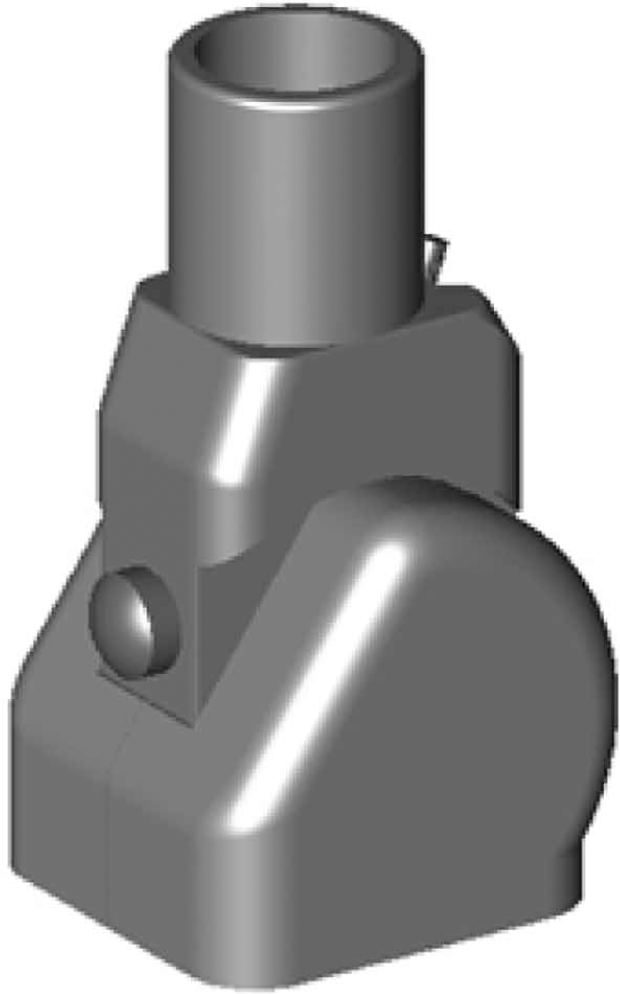
Aqua Sports Ankle, shown as a complete unit consisting of a central core, interchangeable rotating side elements attached. The central core top connection to the socket/leg is capable of utilizing either tube clamp pyramid adapter or tube clamp pyramid receiver. The side element pair base utilizes a four-hole rotating pyramid receiver compatible with any foot with pyramid adapter .
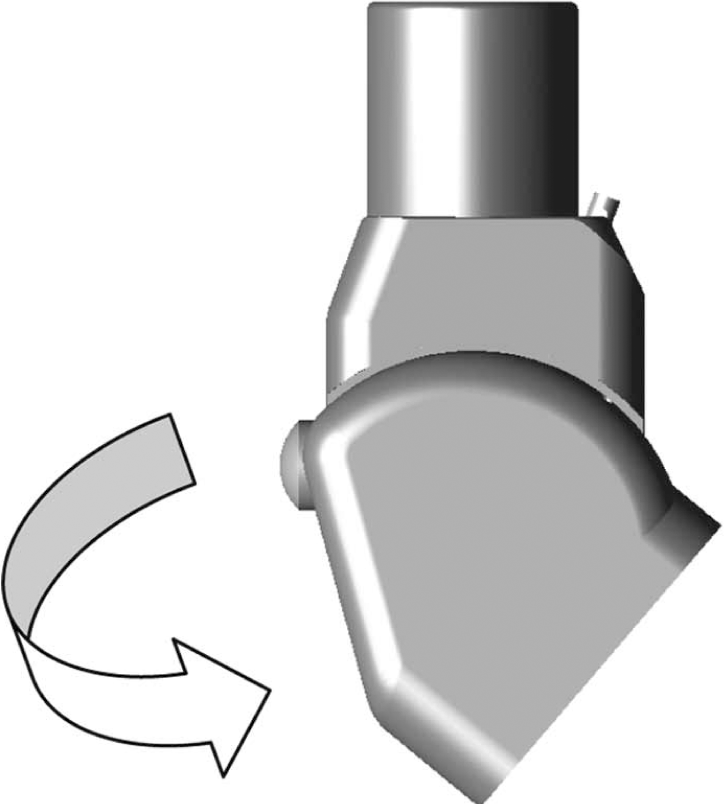
The illustration shown is an ankle prosthetic unit for the lower leg amputee triathlete during a swim event. The diagram shows an example of the ankle assembly in swim position (50° of plantar flexion). Transition back to a flat orientation is easily acquired; no assisted handlers would be needed, thus allowing the Paralympian to compete independently.
The Adaptive Sports Ankle comprises a central core with interchangeable side elements for specific sport use. The side elements offered are as follows:
Adaptive Sports Ankle Prosthetics has a global interest for use in Paratriathlon and Paraequestrian; do you have any scientific (and clinical) evidence to support such interest?
Interest is not evidenced by scientific/clinical data collection, the interest for using the Adaptive Sports Ankle in IPC events such as Paratriathlon and Paraequestrian is evidenced in the facts that Adaptive Sports Ankle Prosthetics was selected to be a speaker and presenter at the 2011 ITU First World Congress to initiate the prospect of changing the rules to allow use of prosthesis during the swim event, selected to be a speaker and presenter at the 2011 IPC VISTA Conference to feature the ankle use in aqua and Paraequestrian events, and from the direct correspondence I receive via web site email enquiries.
How is the Adaptive sports Ankle unique in its use by the Paraequestrian?
The most important aspect of achieving equestrian dressage performance excellence is maintaining postural alignment in the saddle and stirrup. The objective of the multiaxis ankle is to provide the rider with angular flexibility in a three-dimensional orientation, thus obtaining the balance of weight and pressure in the saddle seat and stirrups that are required to establish correct postural alignment such that the rider’s center of gravity passes directly through and works in conjunction with the horse’s. It is proper body angulations that establish the contact between horse and rider. The ideal riding position is with the body weight evenly distributed over the centerline of the foot, with the ball of the foot flat on the stirrup iron with heel slightly lower the foot transversely rotated in the same plane as the femur. It is critical that the rider keeps even pressure across the foot, rather than pushing on the inside or outside of the stirrup iron. Incorrect distribution of the rider’s weight may cause a miscommunication between horse and rider, and may disturb the horse’s balance and rhythm, thus creating a less than desired performance or an unsafe situation (Figures 3 and 4).
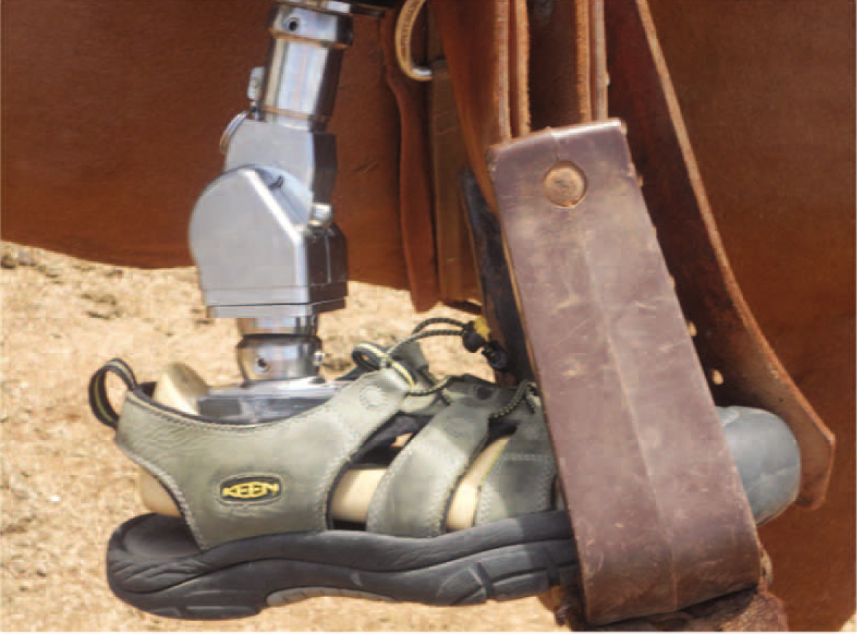
The Adaptive Sports Ankle is preride transverse aligned specifically for rider preference. It can either be manually placed in action (dorsiflexion/plantar flexion), ideal for trail riding, or can be dynamic, so that by pressing on the stirrup with the foot, the ankle will rotate to a “heels down” orientation. Remove pressure from the foot, and the ankle will rotate back to a flat position.
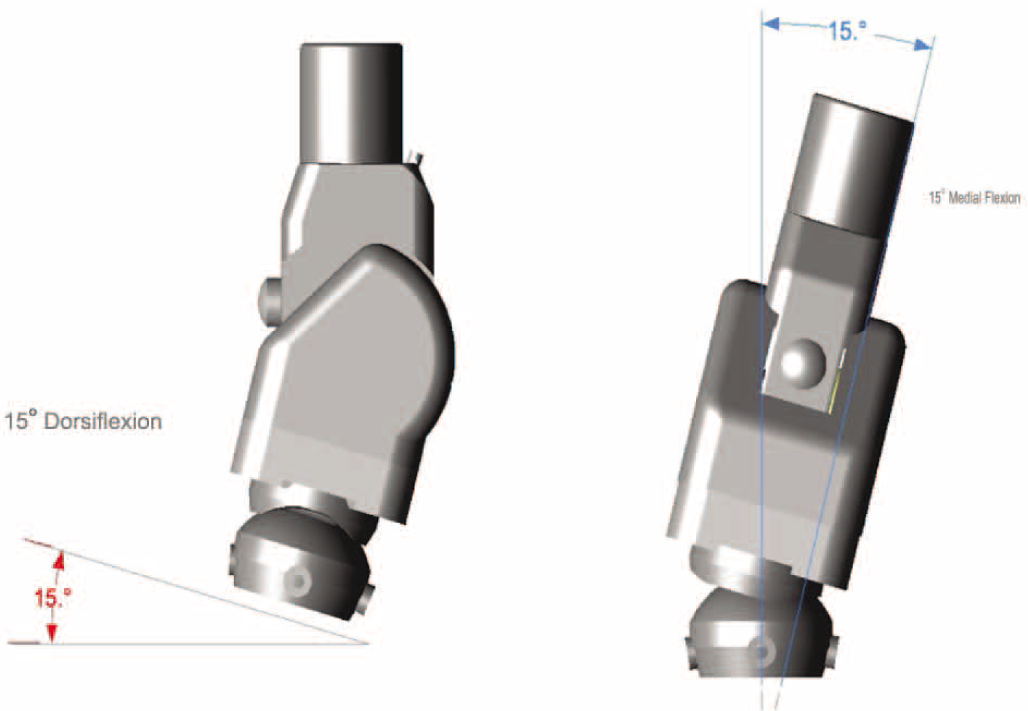
The multiaxis ankle prosthetic component is designed to allow for the following angular movements: dorsiflexion 15°, plantar flexion 50°, inversion 15°, eversion 10°, and transverse alignment ±15°.
Can you provide more information on Wounded Warriors at US Military for the rehabilitation programs you are currently involved in?
The attributes of the Adaptive Sports Ankle have been presented to the United States Marine Corps (USMC) Wounded Warrior Battalion Quantico, Walter Reed National Military Medical Center (WRNMMC), and the US Naval Medical Center San Diego. The Adaptive sports Ankle received a warm reception, and is currently supplying prosthetic ankle components to WRNMMC for military Wounded Warriors.
What advice do you give to researchers and clinicians seeking to use Adaptive Sports Ankle Prosthetics for a particular sport?
The side elements can be used in a manual or dynamic (hands free) mode, I like to know how the client wants to perform before supplying. For example, a scuba activity is better suited for a manual mode where the ankle is held in the 50° plantar position until released to the neutral (walk) orientation, the fin motion will not affect the ankle position. A dressage rider on the other hand requires a light pressure on the foot to acquire a 15° dorsiflex (heels down) orientation. For a swimmer, I want to know if they are using a pool or walking in from the beach, maybe the dynamic mode is better suited for the beach if the surf or landing is rough. Main advice, use it and abuse it, it will not break, enjoy.
Have you undertaken any research using the Adaptive Sports Ankle Prosthetics that involve elite level athletes?
None.
How does the analysis differ from the “everyday” analysis they may be performed on a more sedentary individual?
I wouldn’t test any differently. The International Organization for Standardization (ISO) testing protocol regarding external lower limb components is based on normal walking stride, heel-to-toe strike, for a certain weight over 2 million repetitions. There really isn’t a testing methodology or specification that is applicable to the loads and angles of pressure and torque that are experienced in sport use.
What do you think are the key challenges faced by Paralympians compared to the novice and evolving athlete with disability?
Obtaining sponsorship. I won a lotto entry to participate in the Ironman World Championships at Kona in 2011, but could not do it without a corporate sponsor, the equipment cost and time away from employment were financially overwhelming.
You state that you have “personal experience” of being an amputee, how does the knowledge and skills learned at Adaptive Sports Ankle Prosthetics assist training and performances of sporting individuals assist the everyday/recreational athlete?
I have learned how to avoid getting injured.
What features do you perceive as the “key” to determining optimal performance in terms of training and minimizing injury risk with Adaptive Sports Ankle Prosthetics?
I believe the key feature is the assurance that the ankle will not break. Confidence in your prosthesis components is key to mental performance. If I am worrying about the structural/mechanical integrity of my prosthesis, I’m not going to perform at the optimum level.
Footnotes
Funding
This research received no specific grant from any funding agency in the public, commercial, or not-for-profit sectors.