




Abstract
Background and Aim:
Dragon boating is a non-weight-bearing sport that requires strenuous and repetitive upper body movements. Athletes with lower limb and trunk weakness are unable to participate due to insufficient seating balance and are at an increased risk of injury. This technical note presents an innovative and successful design of an adaptive seating system for dragon boating.
Technique:
The adaptive seating system provided an optimal trunk support and required stability through an adjustable upholder and angled seat. It also facilitated the athletes to maximize their upper limb function. Specific design for safety measures and quick installation were also highlighted.
Discussion:
The adaptive seating system is functional, safe, and a universal design for physically disabled athletes with lower limb and trunk weakness in dragon boating.
Clinical relevance
The universal adaptive seating system facilitated the safe participation of athletes with lower limb and trunk weakness in international dragon boat racing. While further study is required, the system may be applied to other forms of boat racing.
Background and aim
Dragon boating, a Chinese traditional ritual and a realization of strength and team spirit, requires tremendous power of hands and legs. It places the upper body under strenuous and repetitive motions. The paddling movements of the paddler are emphasized in upper trunk function and involve active range of motion, power, and coordination of all upper limb joints. The stroke begins with trunk flexion, shoulder forward flexion, and slight flexion of the elbow. Athletes continue to flex and rotate their trunk as the blade of the paddle drives into water to propel the boat forward. Both legs and feet grip the boat to stabilize the body in the drive. In this 20%–40% of the stroke, the maximum speed of the boat will be achieved and maximum propulsion forces are generated. The blade of the paddle typically strikes the water in a horizontal position to achieve the high speed. A reduction of trunk flexion and shoulder forward flexion occurs during the period of recovery, whereby the blade comes out of the water.1–3 Approximate rate of strokes by professional paddlers is 70–80 stroke/min. 3
Prevalence of injury among dragon boat paddlers appears limited. 4 However, Zandi et al. 4 point out that the injury rate of dragon boat paddlers was 10.19 per 1000 training/competition sessions, which was higher than that of canoe and kayak (3.6–3.9 per 1000 training/competition sessions).5,6 The most common injured regions reported relate to the shoulder girdle (16.33% 4 to 40% 7 ), lower back (11.24% 4 to 37% 7 ), and pelvic region (10.43% 4 ). For the type of injury, joint pain and soreness (25% 4 ) and strain/sprain (17.21% 4 to 63% 7 ) were the most common in nature.
Athletes with physical disabilities, especially those with lower limb amputation and spinal cord disorders, still have difficulties in participating in dragon boating. They have excellent upper limb strength, but their sitting balance on the paddler’s seating board was easily lost. Without safety measures, their prevalence of injury is likely to be higher than compared to athletes.
According to the International Dragon Boat Federation, there are specifications of international dragon boat racing. 8 It was noted that there was no specific seat for individuals with lower limb disabilities to participate in dragon boating. The commercially available seat for rowing consists of a planar seat, waterproof canvas, and an adjustable aluminum frame fixed to the boat. However, this kind of design could not be adapted and fixed to the seating board of a dragon boat.
In 2011, the First International Para Dragon Boat Race was organized by the Hong Kong Dragon Boat Association and took place in the Hong Kong Dragon Boat Carnival. 9 The Department of Prosthetics and Orthotics, Queen Elizabeth Hospital, and Kowloon Hospital of Hong Kong Special Administration Region were invited to design an adaptive seating system (ASS) specifically in dragon boating.
The aim of this technical note was to describe an ASS for athletes with physical disabilities in the lower limb and lower trunk to safely participate in the dragon boating.
Technique
Design considerations
Pelvic stabilization
In paddler movement, it indicated that the pelvic stabilization played an important role for effective trunk and upper limb muscle coordination. Ho et al. 1 noted that “each paddler’s contacted with the boat at their feet and seats” was important to generate maximum power of propulsion. With lower limb weakness or lower limb amputation, the pelvic stabilization in ASS to the dragon boat was crucial.
Optimal trunk support
In order to facilitate trunk flexion/extension and rotation, seat angle and trunk support played a significantly important role. With weak trunk power, seat angle less than 90° and secured trunk support assisted trunk movement in the drive and recovery phases. Different physical disability levels of subjects required various seat angles along different phases of stroke.
Weight
The heavier the dragon boat weighed, the slower the steering rate it resulted. Weight of the adaptive seating affected the boat tracks for steering.
Quick installation to restore integrity
To restore the integrity of the dragon boat, noninvasive installation and removal mechanism should be considered.
Safety
Safety measures should be highlighted in the case of emergency, evacuation, and prevention of injury.
Components of the ASS
There were four components of ASS (Figure 1(a) and (b)).
Flexible polypropylene seat frame;
Adjustable fixation pole (upholder) and widened U-shaped bar;
Loop-like thoracic and thigh straps in fluorescent color for safety;
Contoured seat and waterproof cushion.
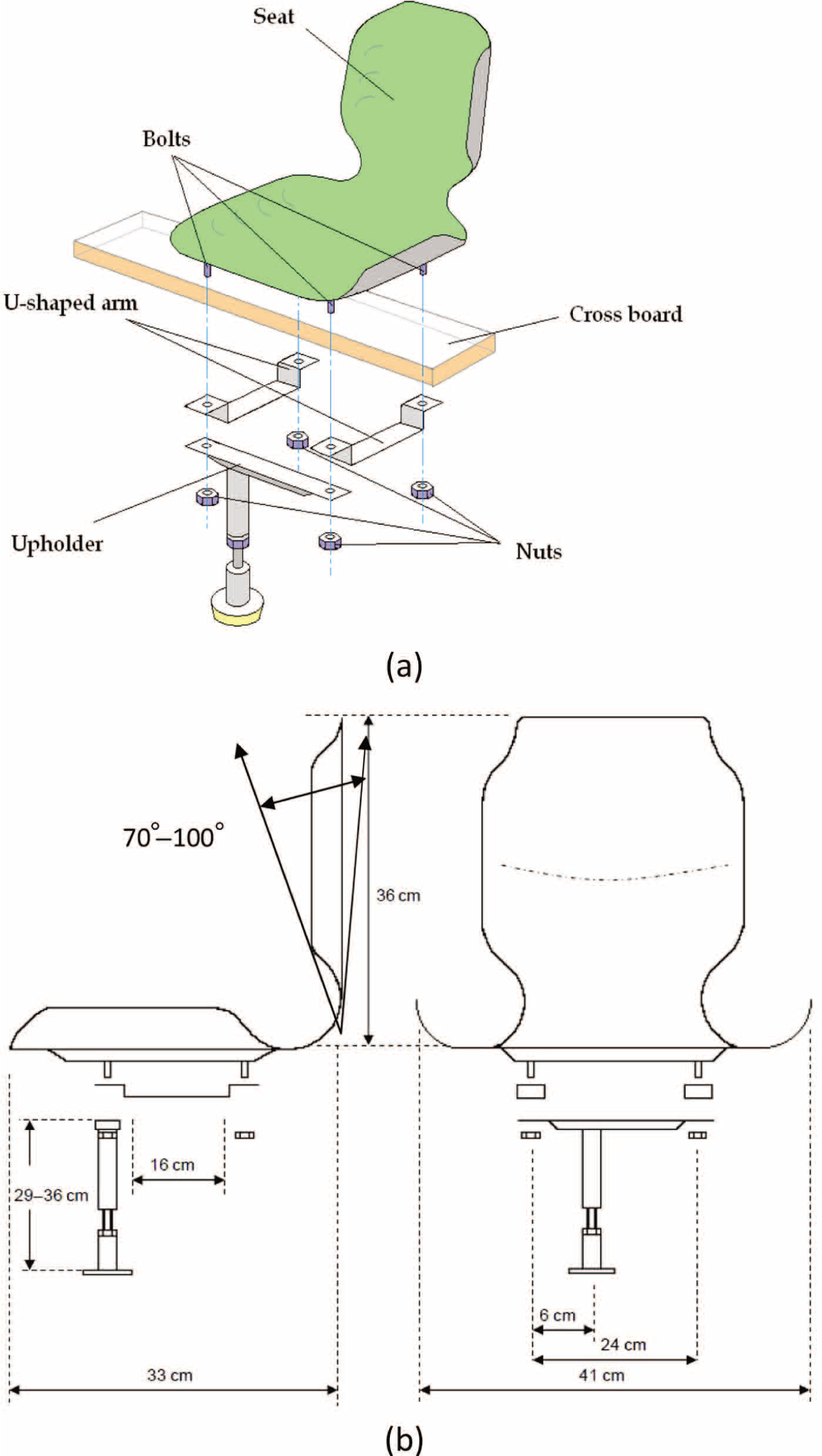
(a) Isometric diagram of adaptive seating system and (b) lateral view (left) and anterior view (right) of adaptive seating at seat angle 90°.
Refinement
The ASS was delivered to six athletes. The demographic data of the sample are given in Table 1. Feedback was collected from six athletes to refine the seats for specific needs. Ethical approval was granted from the author’s institute prior to the commencement of the study.
Demographics of athletes.
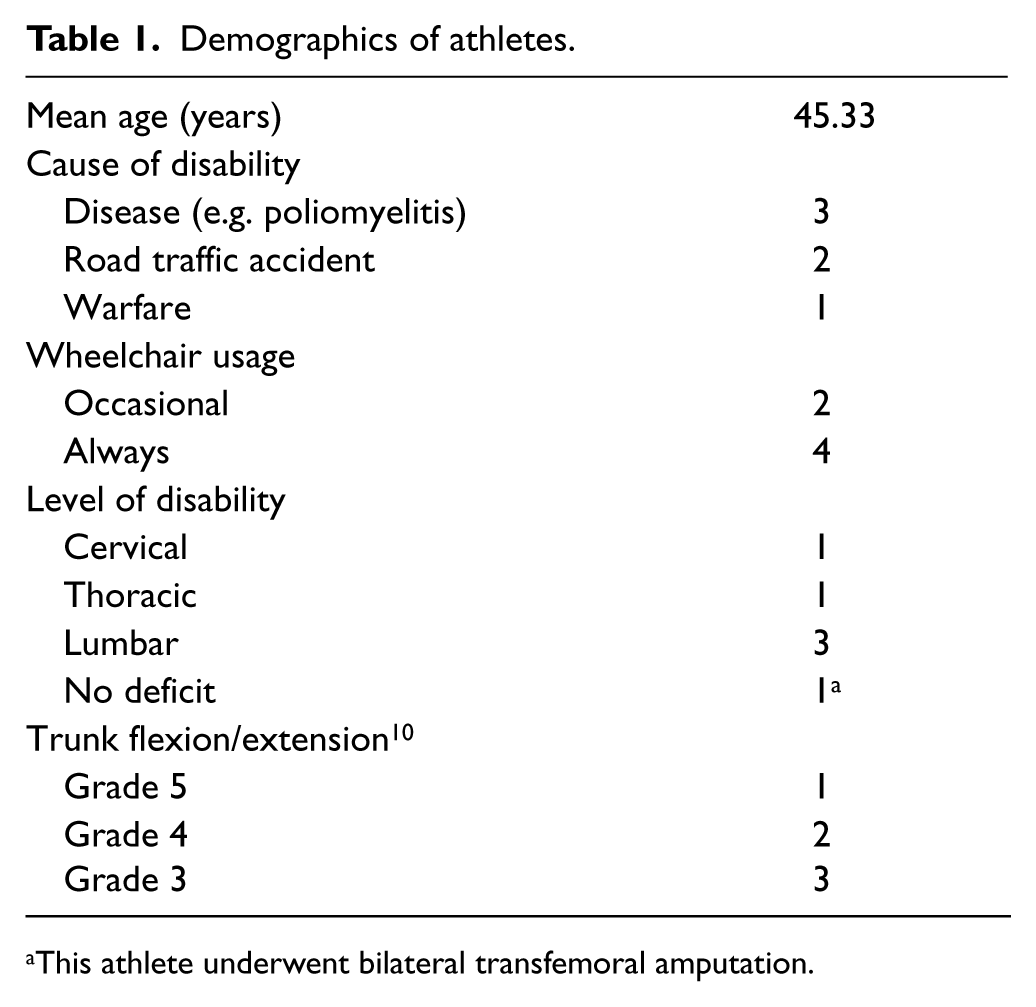
This athlete underwent bilateral transfemoral amputation.
With weak trunk extensor and flexor (grade 3 out of 5) in power, angled seat compensated the trunk weakness by keeping the trunk–hip–knee angle from 75° to 100° in the drive and recovery phases. Width, depth, and height of back support for the seat were measured and casting of the contour of the athlete was taken. The seat was fabricated by the method of polypropylene thermal lamination. The flexibility of polypropylene allowed the seat angles to be ranged from 75° to 100° to suit different needs of athletes in different phases of stroke.
In spite of full upper limb power, the functional performance was adversely affected by moving trajectory of center of gravity (CG) without lower limb support and pelvic stabilization. This was important for the upper limb and trunk to coordinately function in various strokes. In addition, the height of cross board to the floor of the dragon boat varied. The adjustability of upholder, maximally 5 cm of elongation to the floor of the dragon boat, allowed strategic planning of placement of disabled subjects to maximize their output to steering. A widened U-shaped bar provided the fixation of ASS to cross board without destroying the integrity of the dragon boat. This design facilitated quick installation and removal of ASS within 2 minutes of a tight race reschedule.
Safety was highlighted as an important issue. In the view of administration of straps and ease of identification in emergency, the design included a special loop-like handle of thoracic and thigh straps in fluorescent color. It allowed athletes with weak wrist flexion and extension power to use the strap by placing the finger into the loop-like handle with ease. The safety rescue team and dragon boat members would be able to identify these straps easily should the boat capsize.
Most athletes were wheelchair users; their gluteal muscle groups and subcutaneous tissue were relatively more atrophic than normal subject. Contoured seat with neoprene cushion provided extra support to the pelvis in vigorous movement during all strokes of dragon boating and prevention of abrasion of ischial tuberosity. Prevention of low-back or pelvis related injury can be further enhanced, along with the angled seat and straps.
The weight of the ASS was approximately 4.50 kg. Six ASSs contributed 0.012% of the dragon boat when it was maximum loaded to 2250 kg3. This minimal addition of weight was unlikely to influence the rate of steering.
Discussion
The ASS introduced in this technical note was adopted in dragon boat racing. The design of ASS in dragon boating for physical disability was new and innovative. The features of the ASS can be summarized as follows. From a functional perspective, the angled and contoured seats with straps facilitated the physically disabled athletes’ participation in dragon boating. In terms of safety, the loop-like thoracic and thigh straps in fluorescent color allowed easy identification and quick release from ASS in capsize. Along with angled and contoured seats, it can help with the prevention of skin abrasion and minimize the prevalence of injury. Finally, the ASS offers an universal application by providing an adjustable upholder and U-shaped bar, which can provide a quick and efficient installation to various sizes of dragon boats. The ASS may also be applied to other forms of boat racing – either from a competitive or recreational perspective.
For future designs, the above-mentioned features should be included and refined according to the athletes’ physical constraints. While this technical note has introduced and reported an innovative and successful design of ASS for dragon boating, no scientific analysis or study design was applied. Future work should therefore integrate a design such as that of a randomized controlled study that can explore muscle activity and change of trajectory of the centre of gravity.
Key points
This article described an ASS that was innovative and universal in design for international dragon boat racing in athletes with a disability. Its inclusion has the potential to increase participation in dragon boating and other forms of boating.
The ASS design provided lower limb and pelvic stabilization and lower trunk support to athletes, who maximally exercise upper limb functions in every stroke.
Loop-like thoracic and thigh straps in fluorescent color ensured the athletes safety in emergency.
Footnotes
Funding
This research received no specific grant from any funding agency in the public, commercial, or not-for-profit sectors.
Conflict of interest
The authors declared no conflict of interest related to this project.