




Abstract
Background and Aim: The custom-made finger prosthesis is aesthetically acceptable and comfortable for use in patients with amputated fingers, resulting in psychological improvement and physiological well being. The success of the prosthesis depends on the precision of planning the prosthesis, making the impression, carving the model and choosing the material that best suits the concerned circumstances. In this article a simplified method was used regarding an accurate impression of partially amputated fingers.
Technique: A plastic cylindrical small open container (impression cap) was used for making an impression of the fingers. A wax pattern of the missing part was made by replicating the same fingers of the other hand with melted modelling wax after slight modification. This pattern was finally cured with silicone material.
Discussion: In the present technique, a modified approach of impression making was used for getting an accurate fit of the finger prosthesis with improved aesthetics, which is one of the most important criterion for the success of any prosthesis.
The present article provides a simplified approach for fabrication of partially lost finger prosthesis.
Background and Aim
One common concern of partial-hand amputees is the disfigurement that an anomalous hand presents. It should be noted that the degree of physical loss is not at all indicative of the degree of emotional loss, which varies according to cultural and personal values. However, all of these may present similar clinical challenges. Creating a prosthesis, which has a realistic skin surface and seamless visual integration with the surrounding tissues, requires both artistic and technical skill. 1 Characteristics such as pleasing shape, thin margins, lifelike fingernails, and realistic colour, contours and details are essential for patient satisfaction, but to maintain all these qualities it needs good suspension. 2
Impression making techniques, including silicone impression material for the finger, differ throughout the literatures.3-5 The impression made in addition silicone involves mixing equal amounts of the base and catalyst on a mixing pad and applying it on the hand with a spatula to a thickness of about 2–3 mm. 3 Silicon can be additionally reinforced with plaster to support the impression material. 4 In another method, a cylinder of wax was used to make the silicon impression of the finger. 5 In the present article, an effort has been taken to simplify the impression procedure with addition silicone for getting an accurate impression, in which an impression cap has been used for carrying and supporting the impression material.
Technique
The first step involved in the fabrication of a finger prosthesis is to make an accurate impression. All the present impression materials require a rigid support for impression making. To fulfil this requirement, a plastic cylindrical small open container (alternatively a cap of suitable size of a box, known as an impression cap) having a diameter of 2–3 inches was used for making a silicone impression of the fingers. For an impression of the amputated finger, putty and then a light body addition silicone impression material was used, after making some escape way in the putty material. For fabricating a suitable wax pattern of the amputated part, an impression cap of increased length was used to record an alginate impression of the contralateral normal fingers.
Case Example
A 28 year-old male patient reported to the prosthodontics department for the reconstruction of the missing fingers of the right hand due to road traffic accident. On examination, wound contracture was seen on the dorsal and palmer aspect of the hand at the base of the amputated middle and index finger, with round regular margins and some crusting (Figure 1). The surrounding area appeared to be normal with no signs of any infection over the wound. After radiographic and clinical evaluation of the defect it was concluded that the surgical lesion was acceptable for prosthetic rehabilitation. Informed consent was taken from the patient before starting the treatment to ensure his willingness and cooperation. Approval of the Ethics Committee of the institution was also obtained.
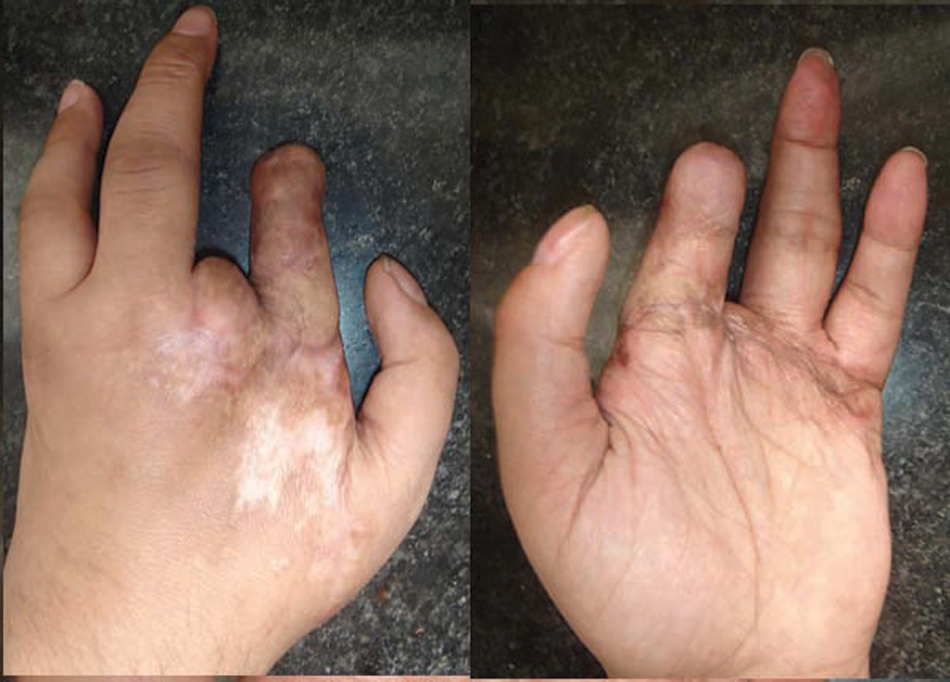
Pre-treatment dorsal and palmer aspect of the hand.
An impression cap was used to make the impression with addition silicone impression material (Express, 3M ESPE; St. Paul, MN) and then the cast was poured (Figure 2a). For the wax pattern of the missing part, an alginate impression (Zelgan, Dentsply India Pvt. Ltd.) of the same fingers of the other hand was made in a slightly flexed position for duplicating the natural relaxed posture of the finger. A larger impression cap was used, in which vent holes were made for retention and also for an easy route for the alginate material. Melted modelling wax was poured and after cooling minor modification of the wax pattern was done to simulate it according to the fingers of the right hand. The pattern closely resembled the shape and size of the missing finger and after hollowing with the wax spatula this pattern was properly fitted over the cast. Both patterns were joined to form a certain length for providing significant suspension to the middle finger. Extension of the pattern was also made on the palmer surface to obtain better retention and aesthetics (Figure 2b). The pattern was then properly evaluated on the patient’s hand and was flasked for curing with silicone material (bredent Multisil-Epithetic set, Senden, Germany). Care was taken to avoid undercuts for the counter flasking. The pattern was flasked, such that the dorsal and the ventral aspects of the finger were separable to enhance the accuracy at the stage of shade matching. Separating medium was applied between the two pours of dental stone for easier separation of the flask after dewaxing (Figure 3). Suitable quantity of Multisil-Epithetic transparent was first poured onto a mixing pad. Intensive stains were mixed into the epithetic transparent and direct colour comparison of the palmer and dorsal surface of the hand were carried out separately in natural daylight. Shade selection was performed in the presence of the patient in order to gain his approval. After all stains had been mixed, thickener was used to modify the consistency of the silicon to avoid running of the different stains while adding them into the flask. For the characterization of fingernails, palmer surface shade was used and it exactly matched the patient’s natural nails. Once curing was completed the final prosthesis was retrieved, the excess silicon material was trimmed using a sharp blade, extrinsic coloration was done and the final finishing was accomplished using fine sandpaper (Figure 4). A snugly fitted prosthesis with lifelike appearance was achieved. For an additional suspension the patient was also instructed to use Medical grade adhesive (Secure Adhesive; Factor II Inc), if needed. Further follow up was done and it was observed that the patient could also overcome the psychological burden of disability.
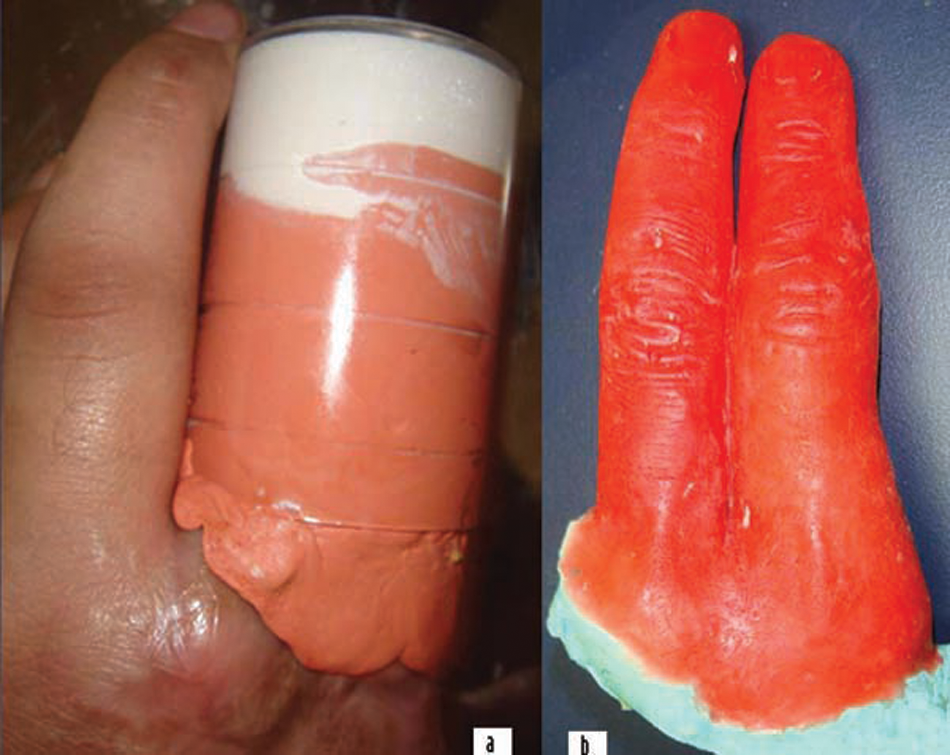
Impression making and wax pattern of finger prosthesis.
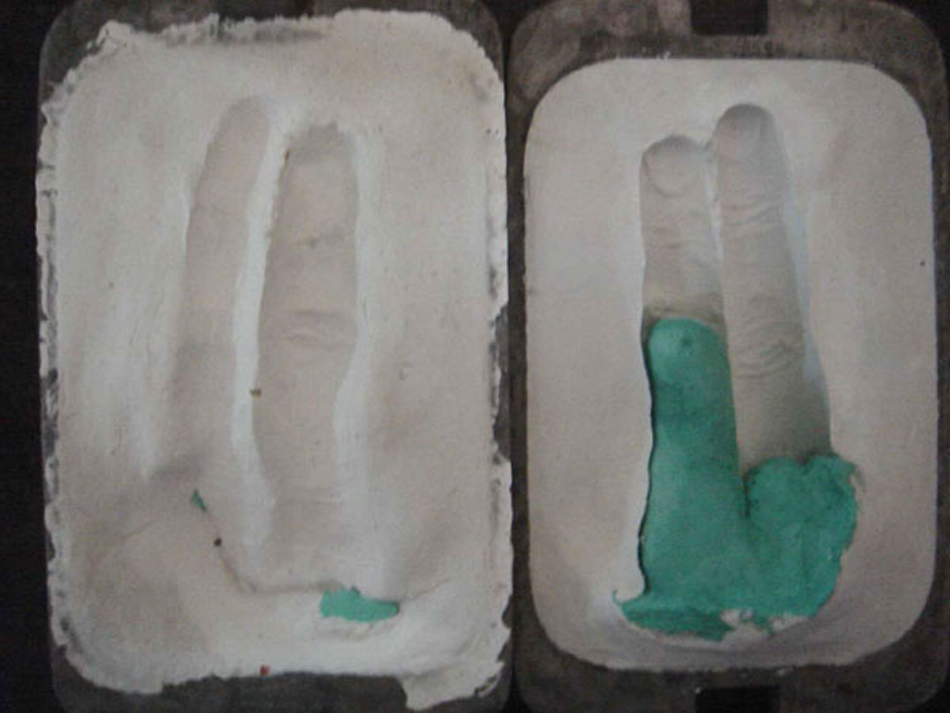
Mould after de-waxing.
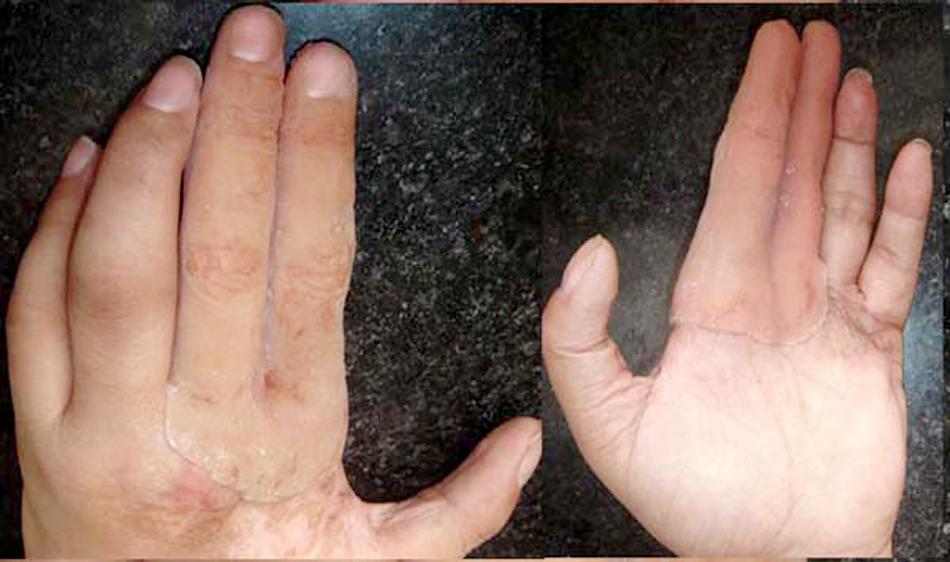
Post-treatment dorsal and palmer aspect of the hand.
Discussion
Silicone impression material was preferred for making an impression of an amputated finger over traditional alginate impression material as it provides better dimensional stability and accuracy. 6 The impression technique was simplified by using a plastic impression cap, so that less impression material could be used. Another advantage of the present technique was that a rigid container had been used for enclosing silicone impression material, which is an essential criterion for impression making. A cylinder of wax was also used to make the finger impression, 5 however lack of rigidity is found in wax. Leow et al. used plaster to support addition silicone which was found to be more time consuming and additional measures were needed to improve the bonding between the impression material and plaster of Paris. 4 The present procedure reduced the chances of voids as uniform pressure could be applied during insertion of impression cap (filled with impression material) into the defected finger as compared to previously described methods3,4 in which impression material was applied with a spatula. As the putty material was inserted and enclosed in a rigid container, the tissue was recorded in a somewhat compressed state due to material’s tissue displacive nature. However, this property was not obvious when the impression material was applied using the spatula or when enclosed in a wax cylinder.3,5 The cast obtained by this type of impression replicated the tissues within their compressive limit, which was beneficial for the flexible silicon prosthesis. Thus a tightly fitted prosthesis was obtained without performing extra scrapping of the cast as described by Michel and Buckner. 7
Alginate was preferred for making a wax pattern using a larger impression cap as the surface details and irregularities of the skin could be easily recorded with alginate which provided the external surface of the prosthesis. The internal surface of the prosthesis was guided by the cast of the amputated fingers which was recorded using the silicon impression material. A wax pattern made by using contralateral fingers (recorded in slightly flexed position) of the other hand, was an accurate replica of the missing part after performing minor sculpting of the nail and individual finger direction. This process reduced the additional time needed for sculpting the wax pattern and involved less artistic expertise while ensuring desirable clinical results.5,8 The pattern obtained by corresponding fingers of the other hand as wax replica, duplicated the original skin surface irregularities and anatomical details. It also maintained individuality and thus provided higher acceptance rate. 4
If at least 1 cm of mobile phalanx remains, the use of digital prostheses can provide excellent aesthetics and produce a stable point for light grasping. 7 Retention is an important determinant in the success of the prosthesis which depends on vacuum effect and length of the stump. A precisely fitting replica can improve function by restoring length, and providing opposition for the remaining digits, maintaining sensitivity through a thin lamina, protecting the sensitive stump and transmitting pressure and position sense for activities such as writing or typing. 9 In this case study, a very little part of the middle finger was present and, to provide additional strength and retention to the prosthesis, both fingers had been joined till certain length and some part of the palmer portion was also included to hide the defect. In that way the prosthesis covers up the missing part with significant retention and shows aesthetic balance without any additional surgery. The proximal edge of the prosthesis is thin and translucent, achieving a good visual blend with the surrounding skin.
Silicone elastomers are probably the most widely used material for prosthetic rehabilitation. A clear to translucent silicone rubber is compatible with all the intrinsic and extrinsic colouring systems available. 10 In producing prosthesis for the hand, the greater pigmentation at the joints of the digits, the eponychium, the pinkish tones of the nail and the difference between the hues of the dorsal and palmar skin are important considerations. The palmer shade was used for duplicating the nail, which gave the illusion of the natural appearance because the wax replica closely resembled the original finger anatomy. By restoring the missing part of the hand, the prosthesis eliminates the trauma caused by constant reminder of being handicap and offers true psychological therapy. 9 Prosthetic rehabilitation is quick, reversible, medically uncompromised and allows the surgical site to be closely monitored. 11 However, initial placement and adjustment of the prosthesis is certainly not the end of treatment of a prosthetically rehabilitated patient. Periodic re-evaluation of the patient is critical for early recognition of changes to allow appropriate steps to be taken.
Key Points
The present technical approach is an easy and cost-effective alternative for impression procedure of partially lost fingers by using a plastic impression cap.
A rigid container had been used for enclosing silicone impression material which is an essential criterion for impression making.
The procedure reduced the chances of voids as uniform pressure could be applied during insertion of the impression cap (filled with impression material) into the defected finger.
Footnotes
Funding
This research received no specific grant from any funding agency in the public, commercial, or not-for-profit sectors.
Conflict of interest
None.