




Abstract
The present study introduces a novel higher-order shear deformation theory for assessing buckling and free vibration characteristics in laminated composite and functionally graded porous beams. The proposed theoretical framework effectively considers three variables and eliminates the need for a shear correction factor. The governing equations are derived from the Lagrange principle, while Legendre-Ritz functions are utilised to solve the resulting problem. Various types of laminated composite beams with arbitrary lay-ups and functionally graded porous beams with symmetric or unsymmetric configurations are analysed. To validate the accuracy and efficiency of the proposed theory, several numerical examples are conducted and compared against the results of existing research endeavours.
Keywords
Introduction
Laminated composite (LC) and functionally graded porous (FGP) materials are widely used in engineering fields due to their exceptional properties, such as high strength, low weight, and good heat and sound insulation.1,2 Researchers have been keenly interested in these materials, developing many theories for analysing their mechanical responses.3–6 Elasticity theories, which describe LC and FGP structure’s behaviour accurately, have been commonly used in past studies; for example, Pagano’s elasticity theory 7 was presented for bending analysis of LC beams and plates, Sankar 8 proposed an elasticity solution for FG beams subjected to transverse load, while Wang et al. 9 invented an elasticity model for vibration and bending analysis of LC beams. Although the elasticity theory describes the beam’s responses precisely, it is computationally complex and difficult to apply to arbitrary boundary conditions or complicated geometries. As a result, several alternative methods have been proposed, including layer-wise theories,10,11 equivalent single-layer theories (ESLT),12–15 zig-zag theories,16–19 and Carrera’s Unified Formulation.20,21 Among these theories, the ESLT is widely utilised due to its formulation simplicity and programming ease. It can be classified into four categories: classical beam theory, first-order beam theory, higher-order beam theory, and Quasi-3D theory.
Classical beam theory (CBT) is one of the simplest forms of ESLT. Many studies have applied CBT to analyse the behaviours of beams. Özütok and Madenci 22 studied the free vibration of LC beams using the finite element method. Ghasemi et al. 23 examined the nonlinear vibration of LC beams. Baghani et al. 24 analysed LC beams’ free vibration and buckling. El Harti et al. 25 studied the dynamic control of FGP beams. Mutlak et al. 26 examined dynamic response of FGP beams on the foundation under a moving load. Sari et al. 27 analysed the free and forced nonlinear vibrations of FGP beams, while Mirjavadi et al. 28 analysed buckling and vibration of nano FGP beams. However, due to the neglect of shear deformation in the beam model, the CBT tends to overestimate natural frequencies/critical buckling load and underestimate deflection. To address the limitations of the CBT, first-order beam theory (FBT) was proposed to analyse beam’s responses. Several studies utilised FBT to examine the mechanical behaviour of LC and FGP beams are mentioned here. Jun et al. 29 analysed dynamic of LC beams based on FEM, while Zhang et al. 30 examined the mechanical analysis of FG graphene oxide-reinforced composite beams. Abramovich and Livshits 31 investigated the free vibration of cross-ply LC beams, and Fu et al. 32 presented LC beams’ thermal buckling and postbuckling behaviours. Bending behaviour of thin-walled LC beams was presented by Vukasović et al. 33 Fridman and Abramovich 34 studied the structural behaviour of LC beams under axial compression using piezoelectric layers. Vosoughi et al. 35 presented a hybrid numerical method for optimising of LC beams. Chen et al.36–39 analysed the buckling, free vibration and static behaviours of FGP beams, while Zhao et al. 40 presented free vibration of FGP straight and curved beams. Noori et al. 41 presented the dynamic analysis of FGP beams based on the complementary functions method in the Laplace domain, and Gao et al. 42 analysed the dynamic response of FGP beams. Notably, the FBT requires a shear correction factor to correct the strain energy under deformation, but selecting an appropriate value remains a challenging task for researchers. The limitations of FBT have spurred the development of higher-order beam theories (HBT). One such theory is the third-order shear deformation theory proposed for analysing the mechanical behaviour of laminated composite plates.43,44 Levinson 45 and Murty 46 introduced polynomial shear functions to analyse the behaviour of beams, and this approach has been adopted in numerous studies. For example, Nguyen et al.47–49 examined static, free vibration, and buckling behaviours of FGP beams, while Özütok Madenci 50 presented the static analysis of LC beams. Shi and Lam 51 analysed the free vibration of composite beams using FEM. Song and Waas 52 studied LC beams’ free vibration and buckling responses. Khdeir and Reddy53,54 analysed LC beams’ free vibration and buckling behaviours. Wattanasakulpong et al. 55 analysed the free vibration of FGP beams. In addition to polynomial functions, other shear functions such as trigonometric,56–58 hyperbolic functions,59,60 and exponential functions61,62 have also been developed for analysing LC and FGP beams. The accuracy of these theories depends on the specific shear functions utilised, making the development of suitable functions a topic of great interest among researchers, as noted in the review study. 63 It can be stated that the CBT, FBT, and HBT ignore normal transverse strain, which plays an essential role in thick beams. Therefore, to account for this effect, the Quasi-3D theory (Quasi-3D), which approximates axial and transverse displacements as high-order variations through the beam thickness, was proposed.64–68 Although Quasi-3D can predict the behaviour of LC and FGP beams more accurately than CBT, FBT, and HBT, it involves more unknowns, making it more complex.
This article introduces a novel seventh-order shear deformation theory for analysing the free vibration and buckling responses of LC and FGP beams, considering both symmetric and unsymmetric distributions. The displacement fields are described using Legendre-Ritz functions, which facilitate solving problems with typical three boundary conditions. The governing equations are derived using Lagrange’s principle. Numerical examples are presented to evaluate the accuracy and efficiency of the proposed method. Furthermore, the impacts of span-to-height ratio, distribution types, and fibre orientation on the critical buckling load and fundamental frequency of beams are considered in greater detail.
Theoretical formulation
Constitutive relations
Laminated composite beam
The strain and stress relation of

where the
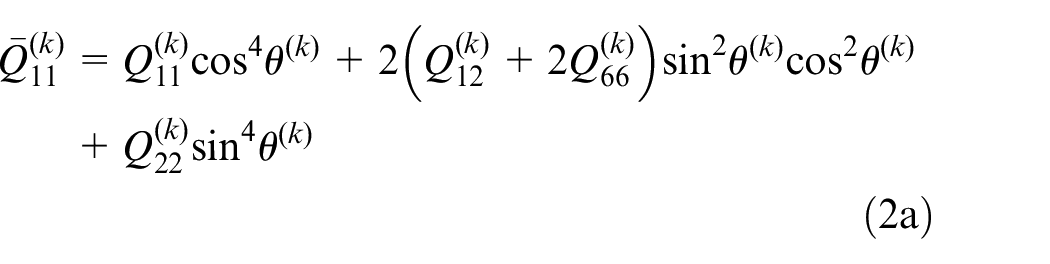

where
Functionally graded porous beam
The strain and stress relation of FGP beams are written as follows37,48:



where
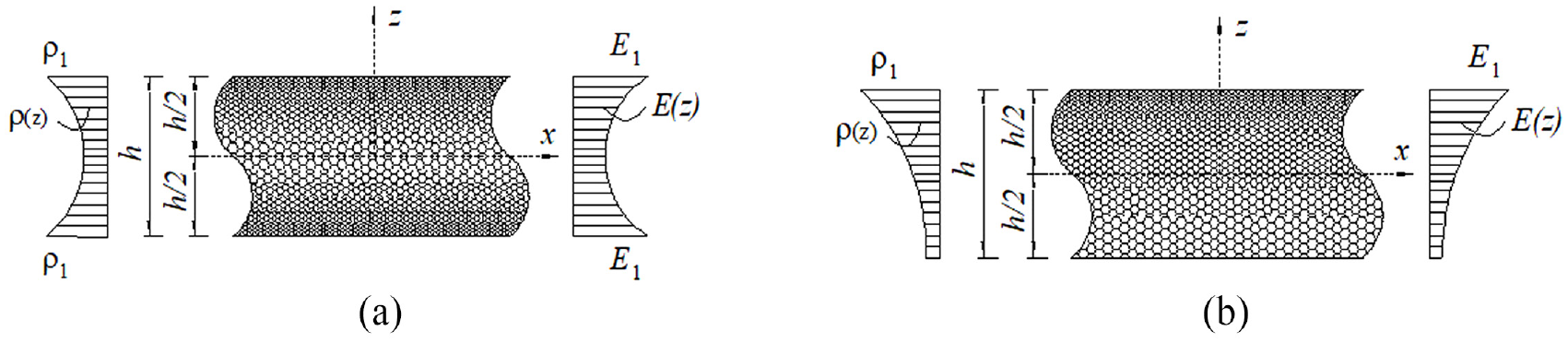
Two porous beams: (a) SPD: Porosity is symmetric distribution and (b) APD: Porosity is asymmetric distribution. 47
Symmetric porosity distribution (SPD)


Asymmetric porosity distribution (APD)


where:
Kinematics
Consider LC and FGP beams with height h, width b, and length L as shown in Figures 2 and 3. The displacement fields of beams based on the higher-order shear deformation theory are introduced as follows 44 :
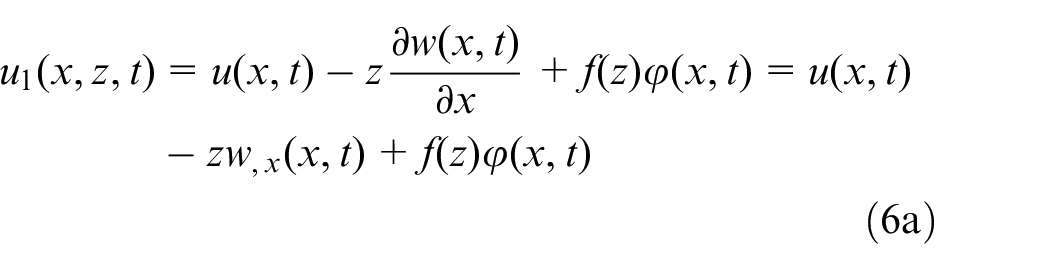

where
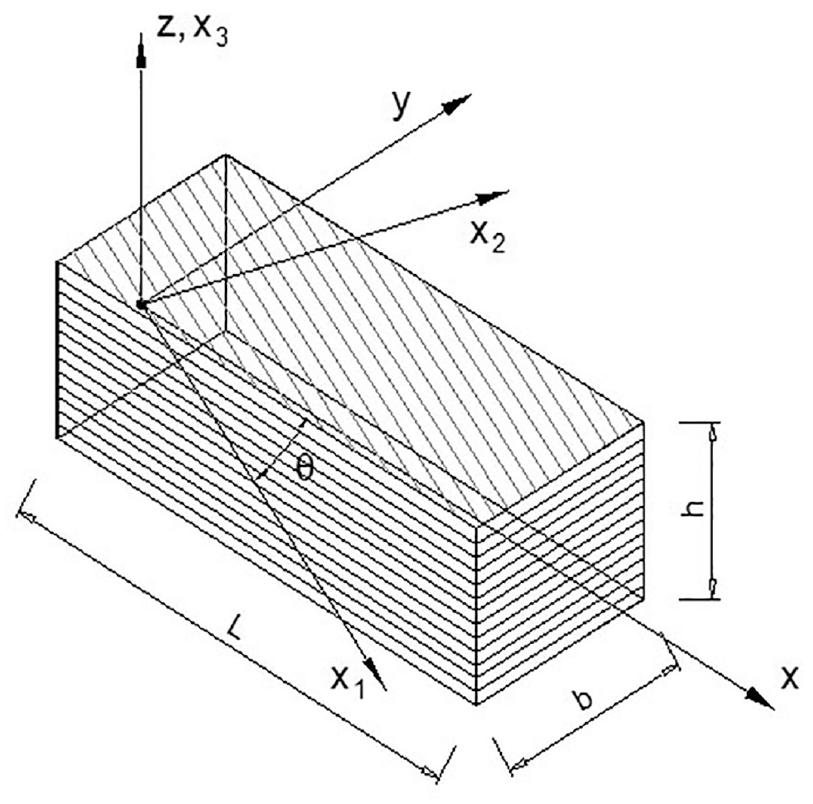
Geometry of laminated composite beams.
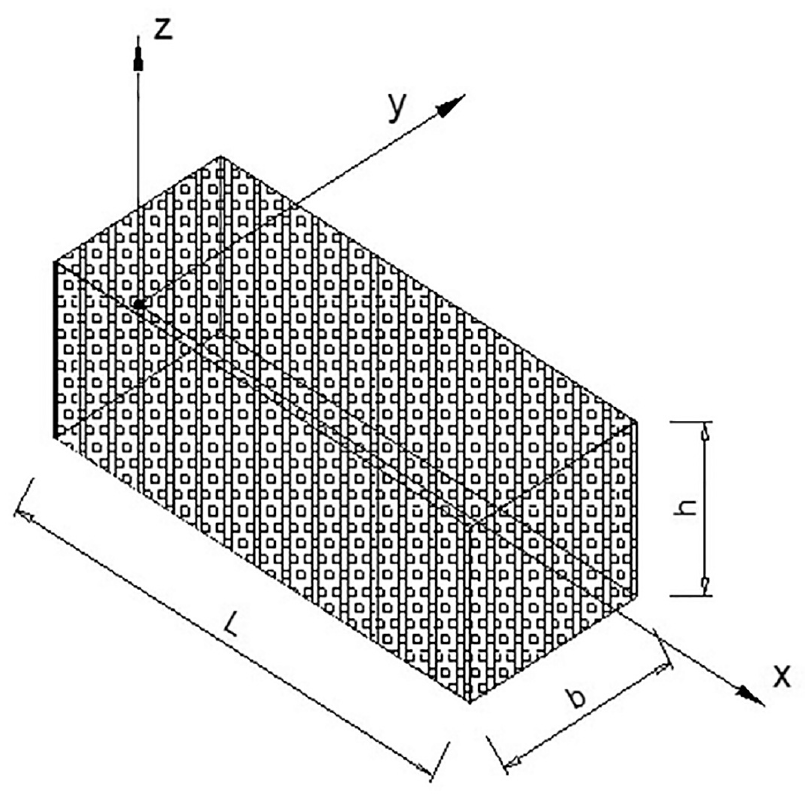
Geometry of functionally graded porous beams. 48
The non-zero strain of beams is written as follows:


Variational formulation
Strain energy
The strain energy of the beam is introduced 69 :
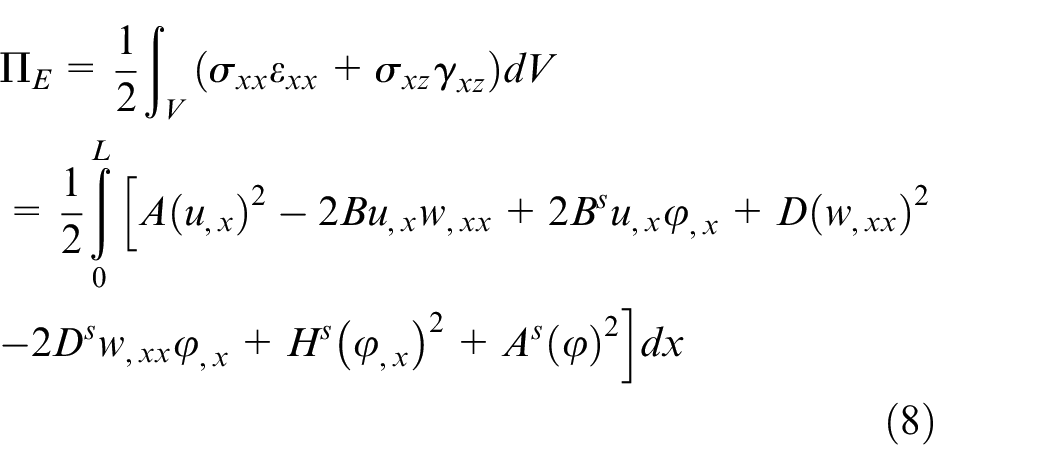
For laminated composite beam:
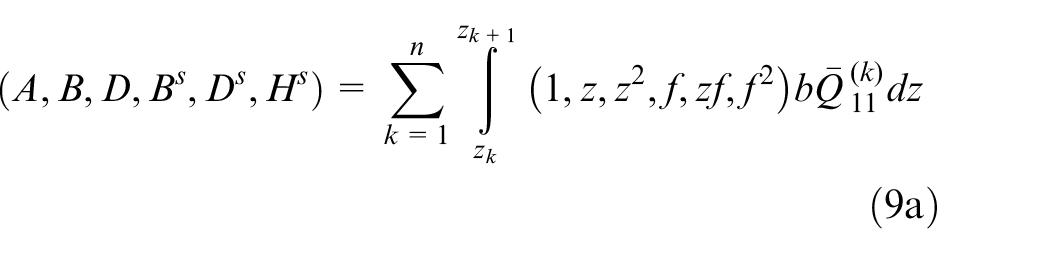

n is the number of laminates,
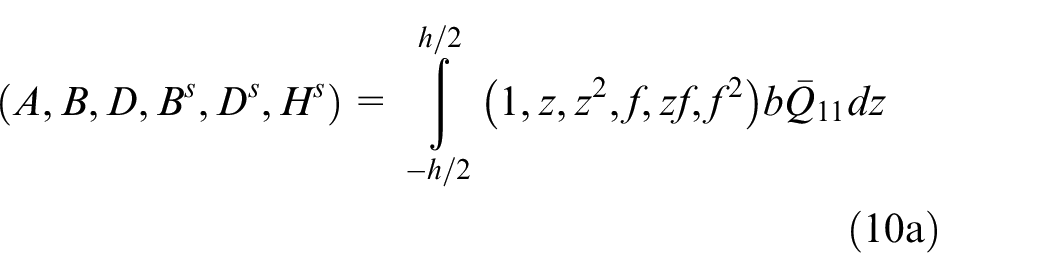
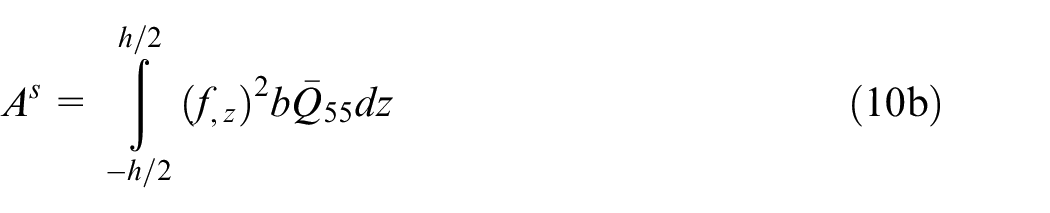
For functionally graded porous beam:
Work done by axial compression
The work done by axial compression force

Kinetic energy
The kinetic energy of the beam is written 69 :
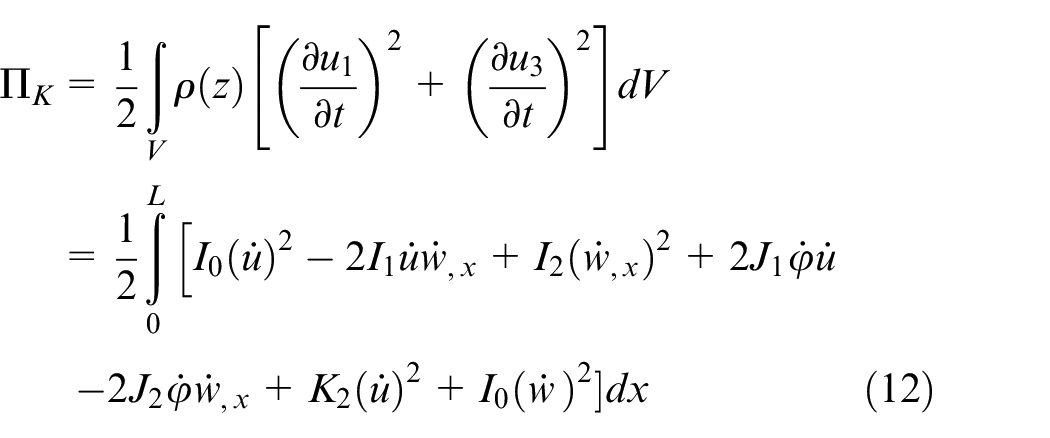
where (.) denotes the time derivative
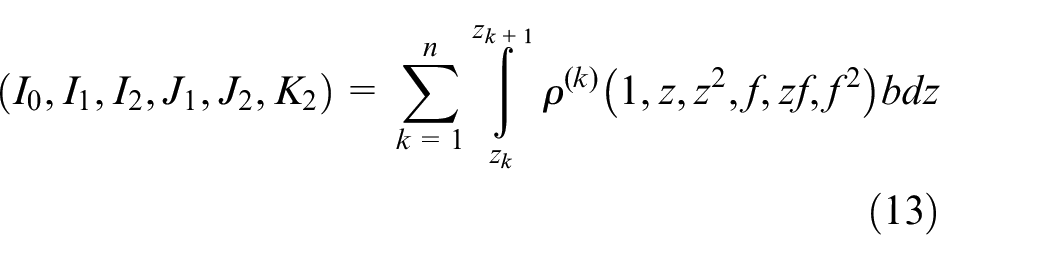
For laminated composite beam:
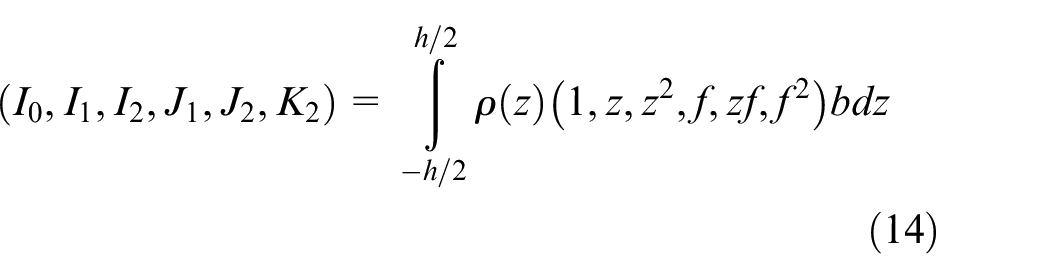
For functionally graded porous beam:
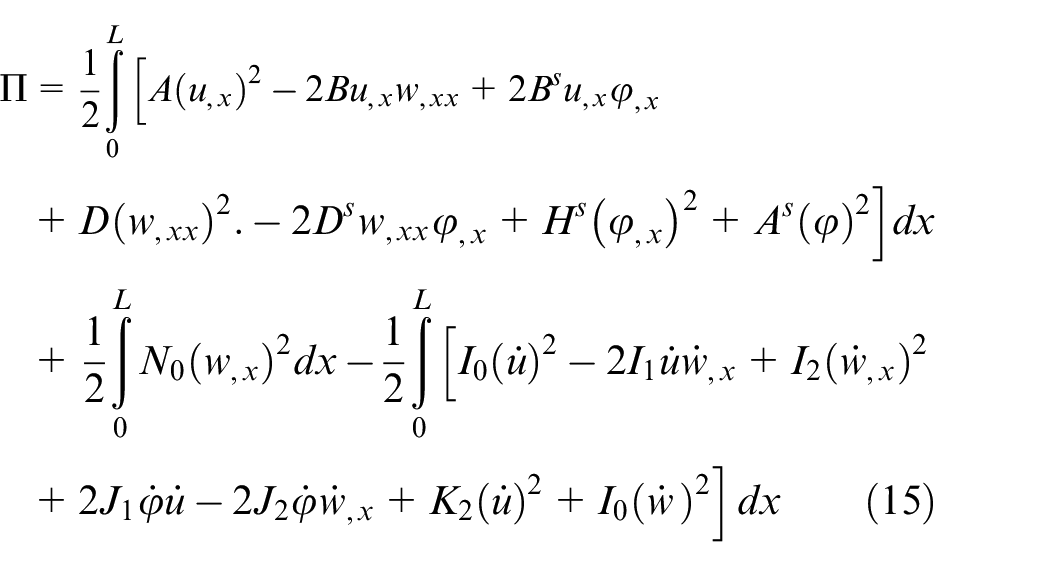
Total energy
The beam’s total energy is written 69 :

Ritz solution
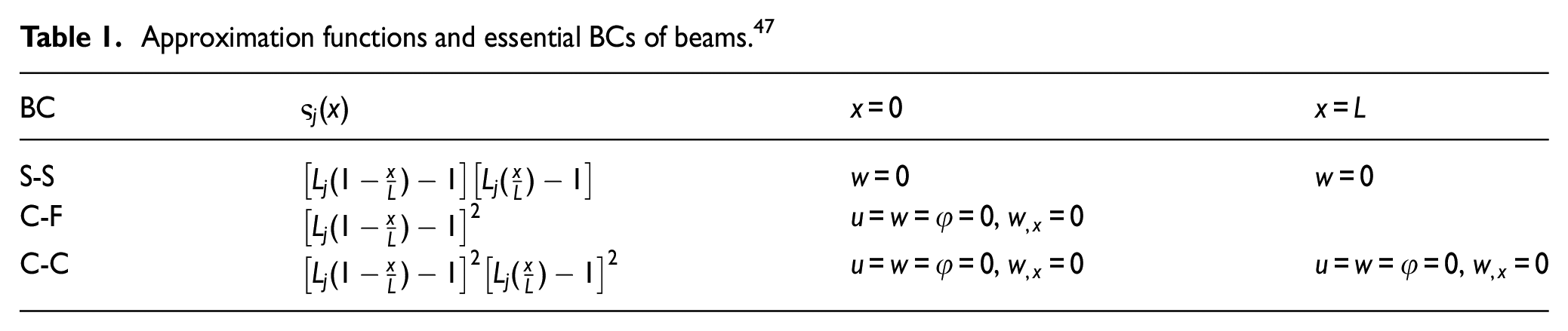
Ritz method is used to describe the displacement fields of the beam as follows47,69:



where
Approximation functions and essential BCs of beams. 47
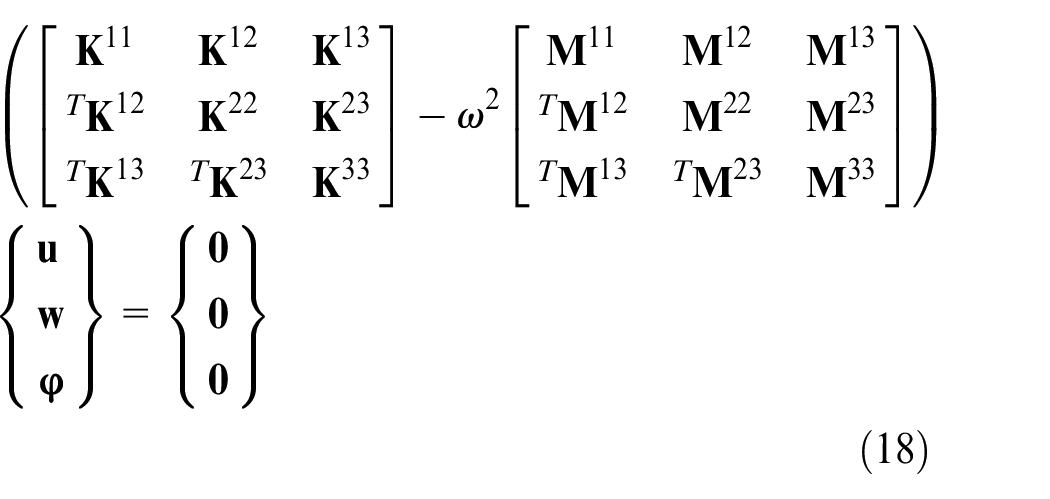
Substituting equation (16) into equation (15) and using Lagrange’s principle 69 :

with
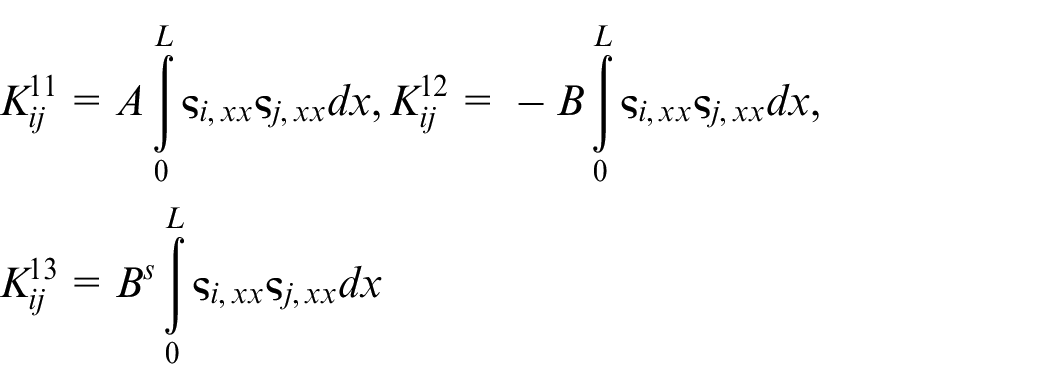
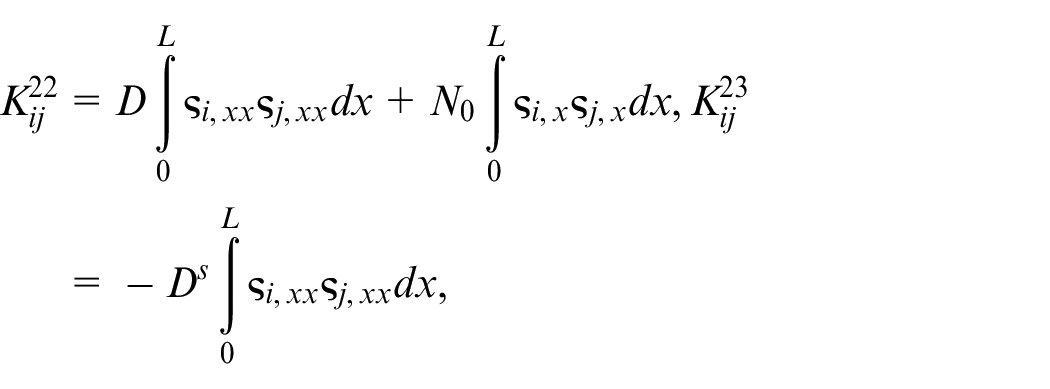
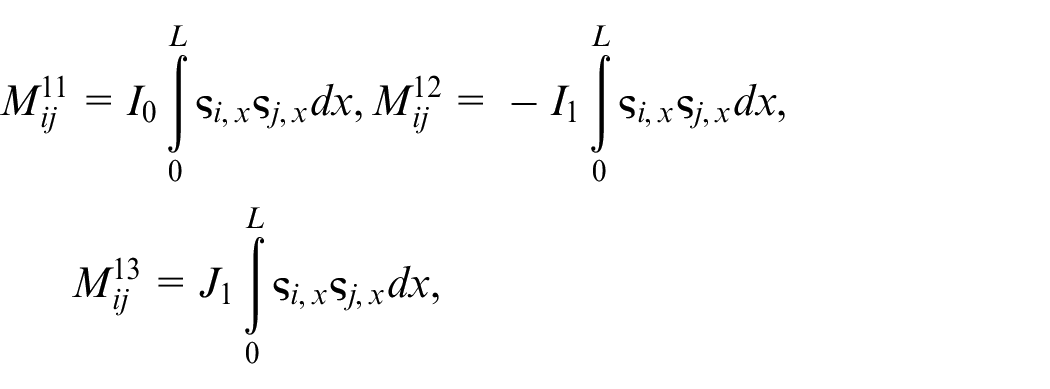
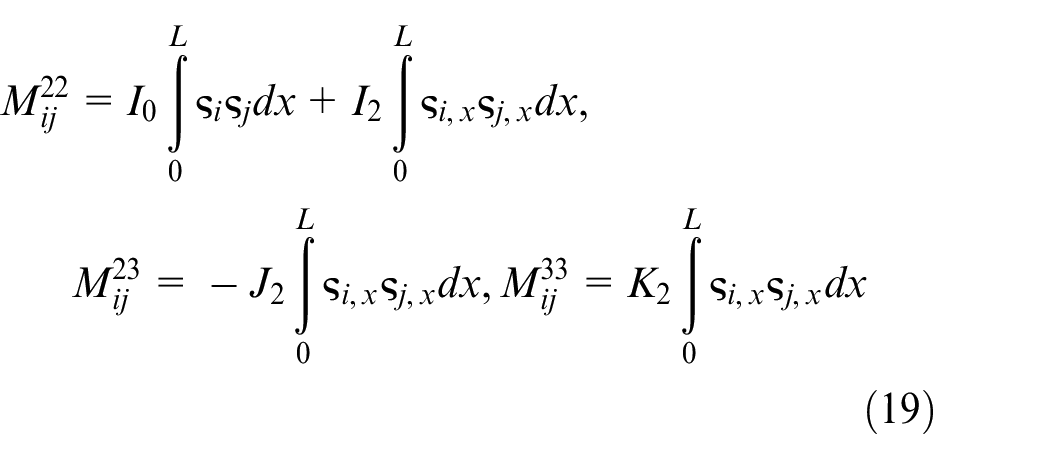
The components of stiffness matrix

Numerical results
This section presents numerical examples to evaluate the efficiency and accuracy of the proposed theory. The LC beams have equal laminates with material properties
a) LC beam:

b) FGP beam:

Convergence study
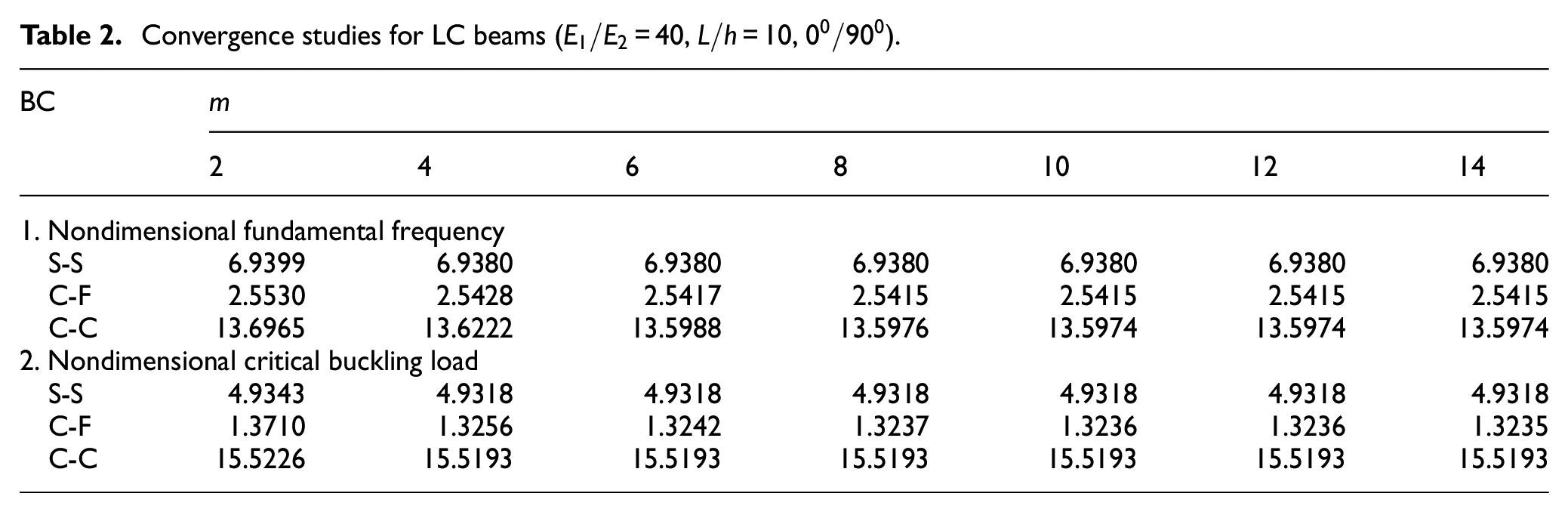
To examine the convergence of the proposed solution, LC beams (
Convergence studies for LC beams (
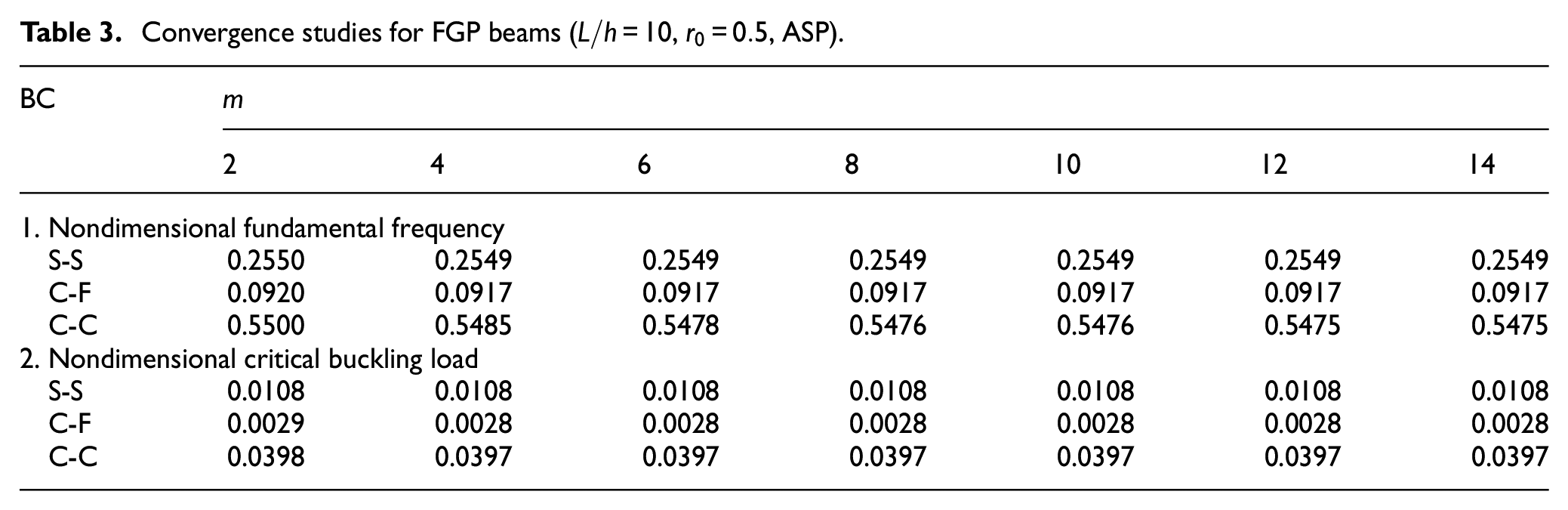
Convergence studies for FGP beams (
LC beams
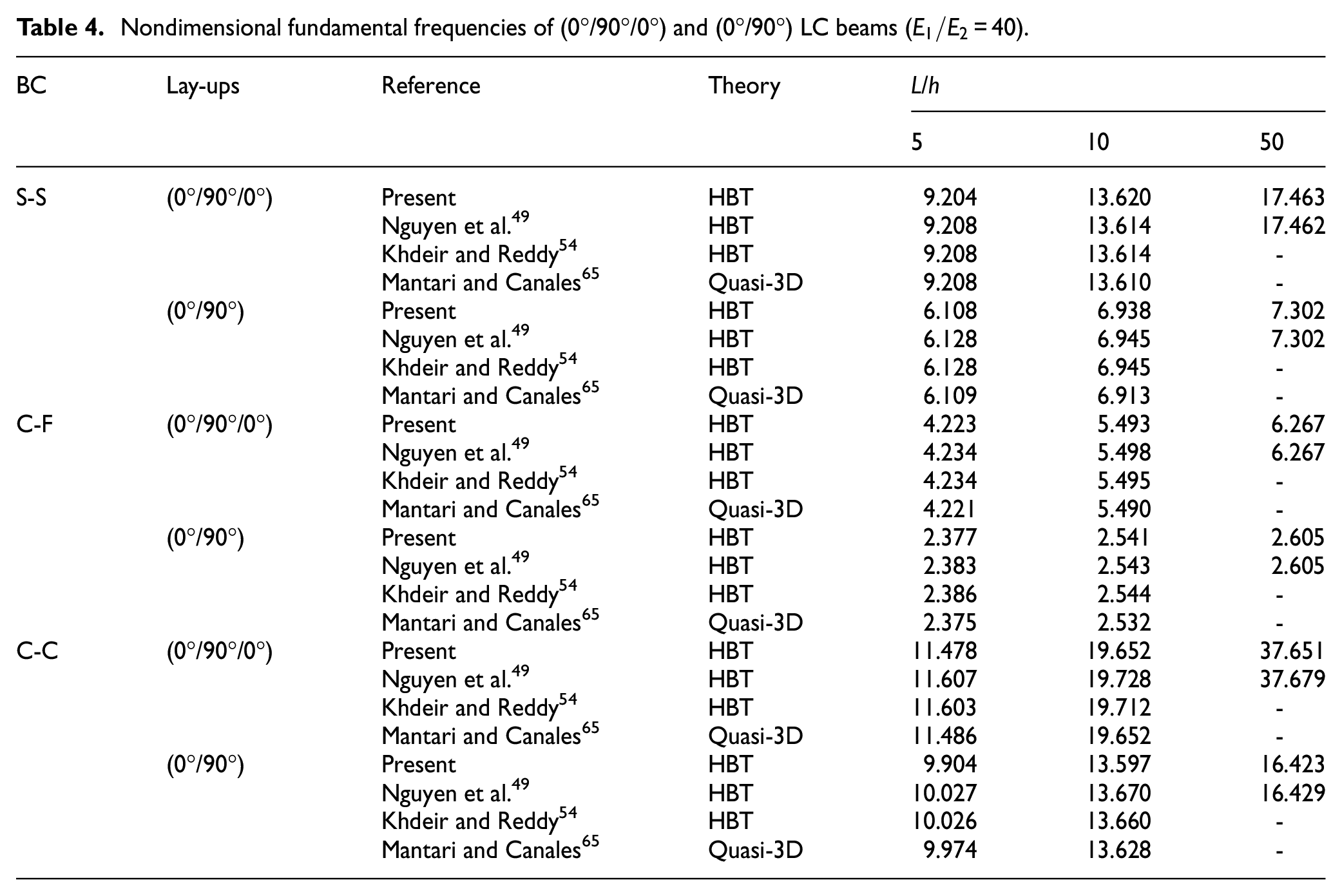
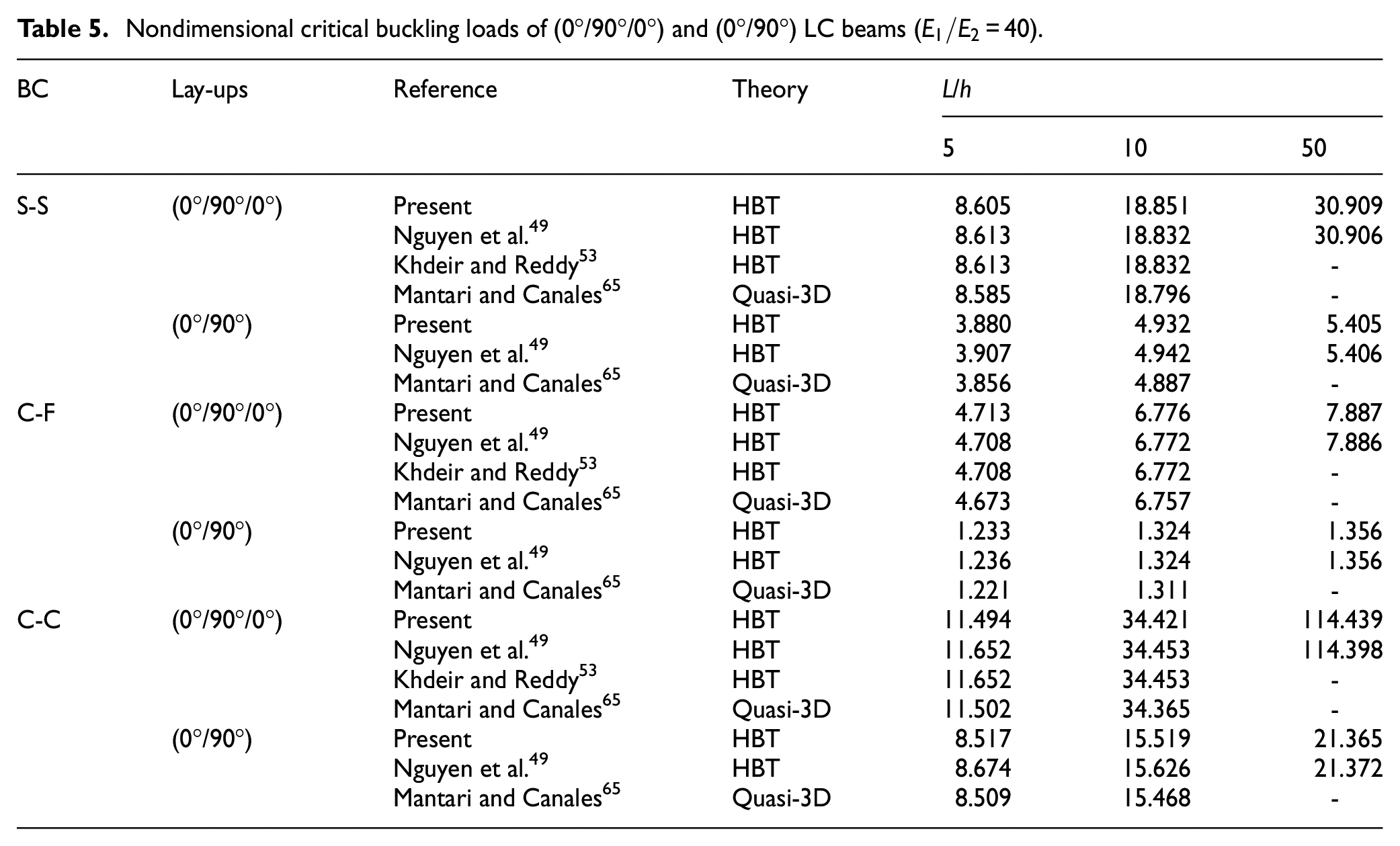
To verify the accuracy of the proposed theory, cross-ply (
Nondimensional fundamental frequencies of (0°/90°/0°) and (0°/90°) LC beams
Nondimensional critical buckling loads of (0°/90°/0°) and (0°/90°) LC beams
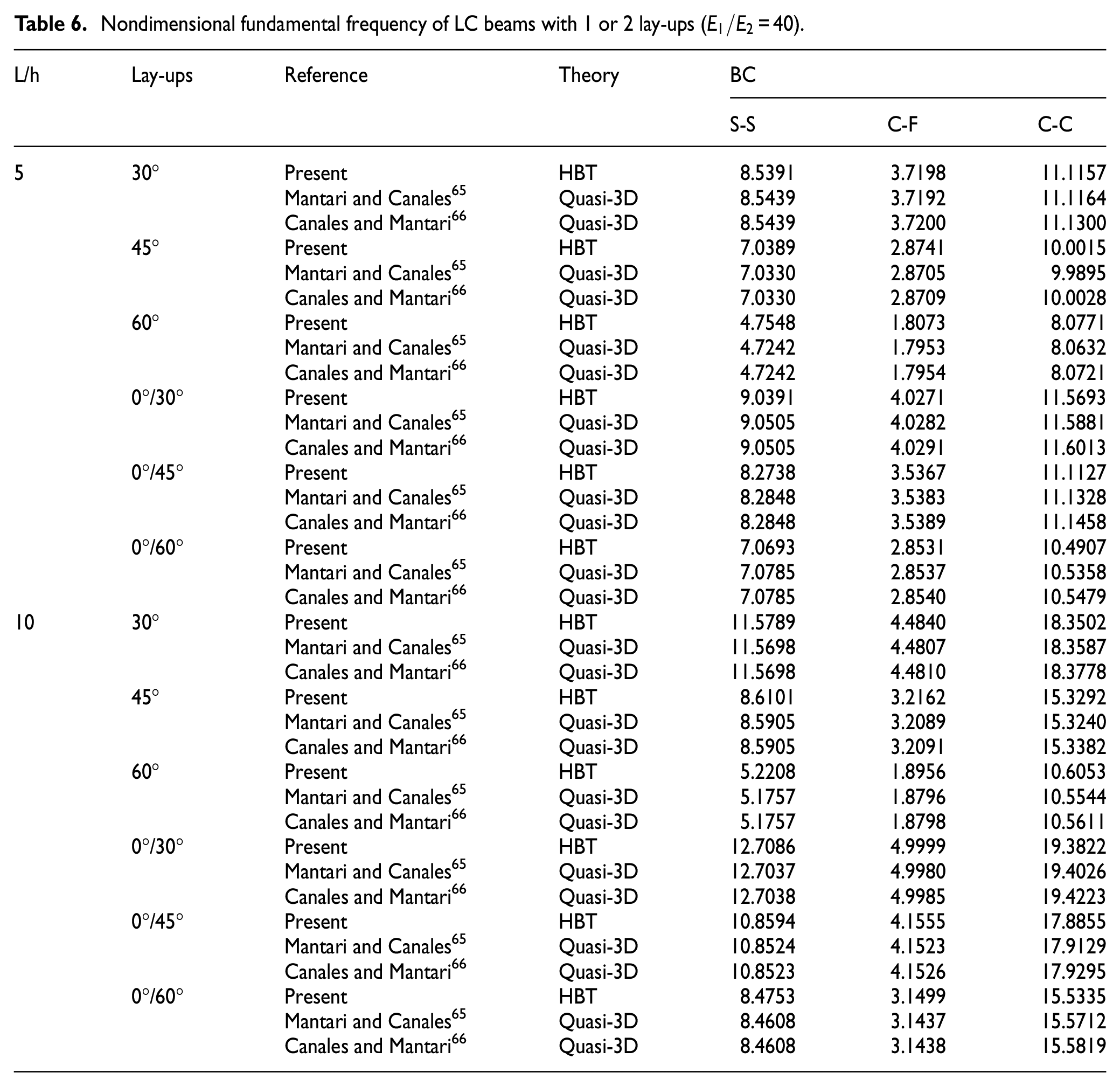
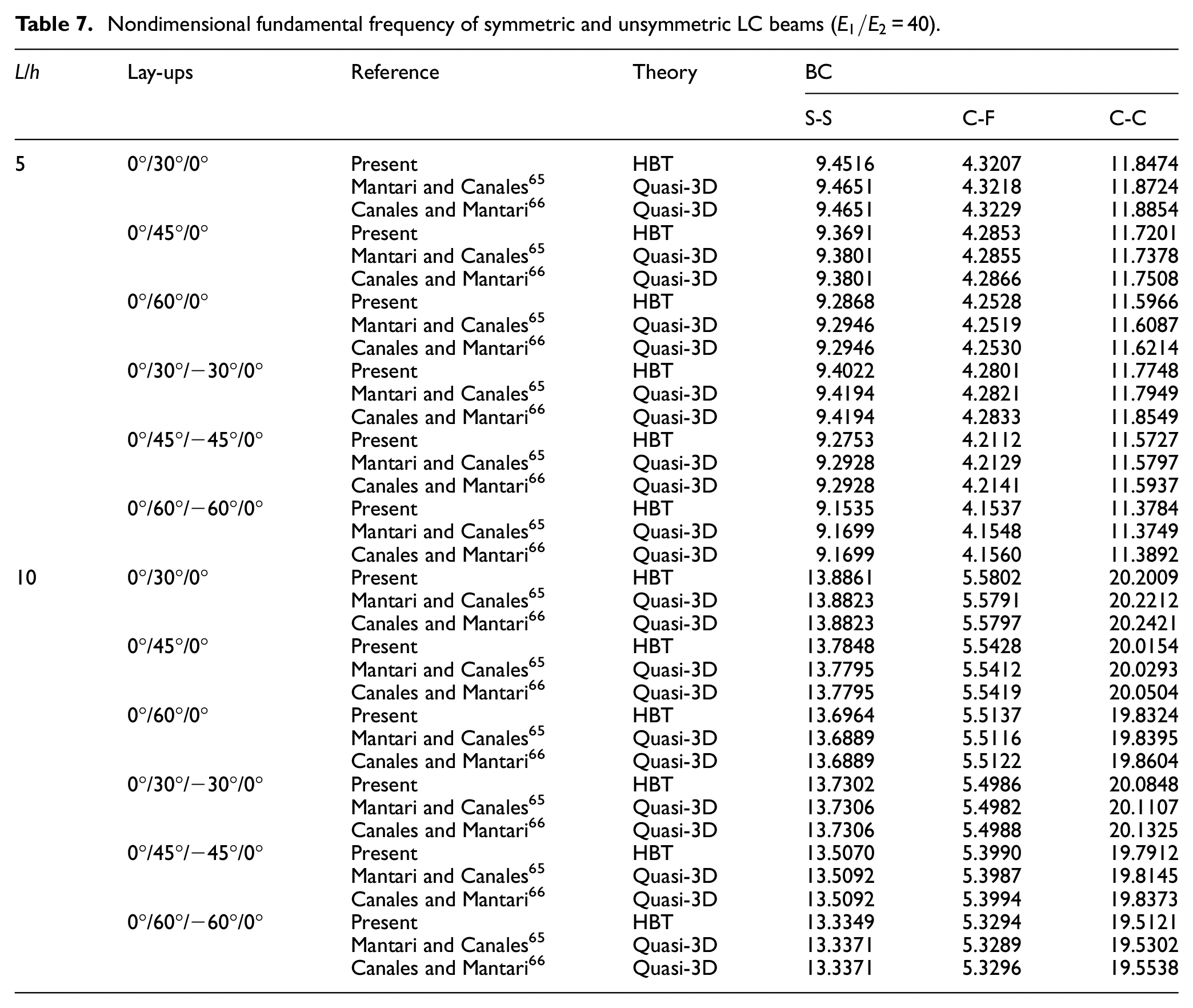
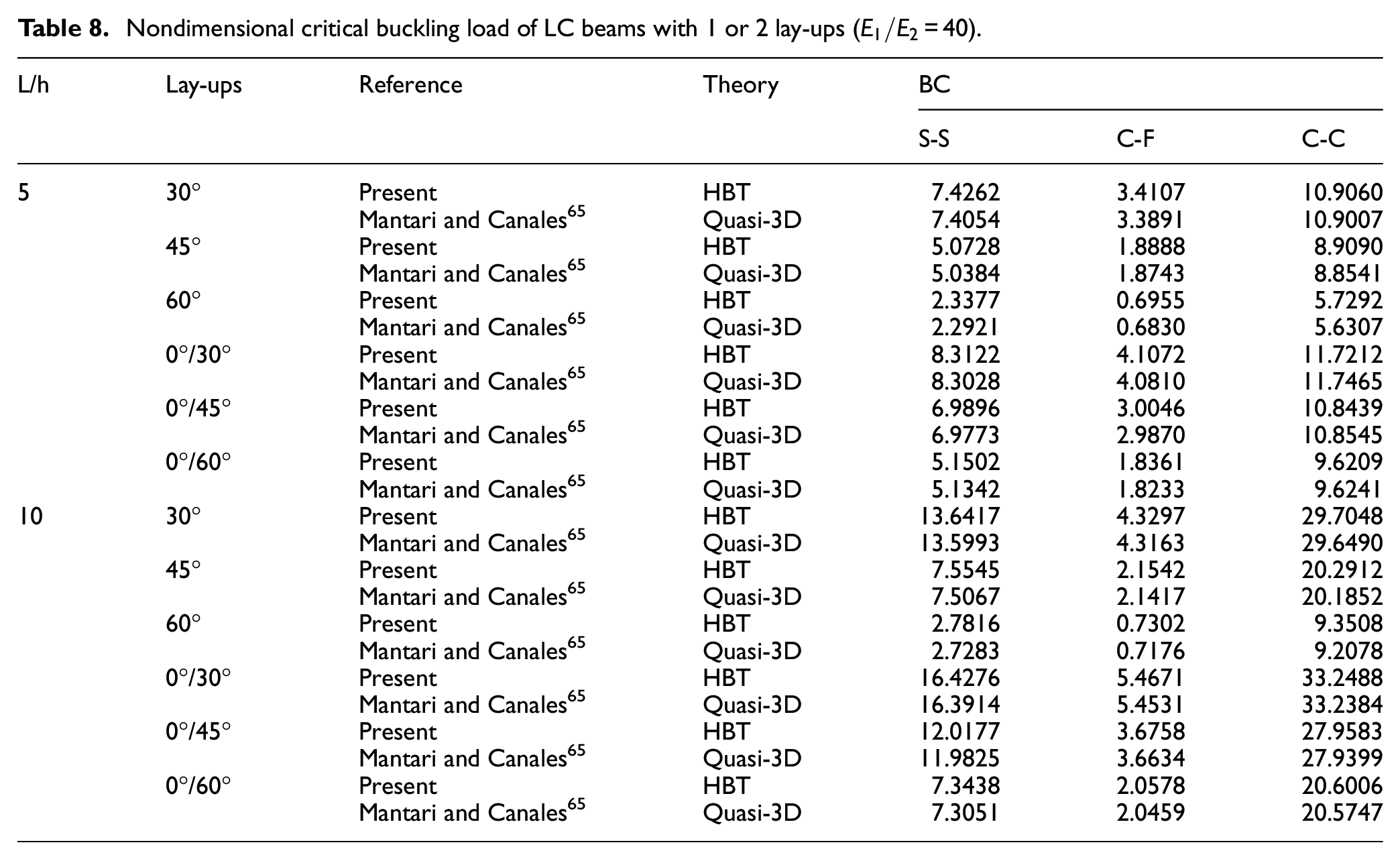
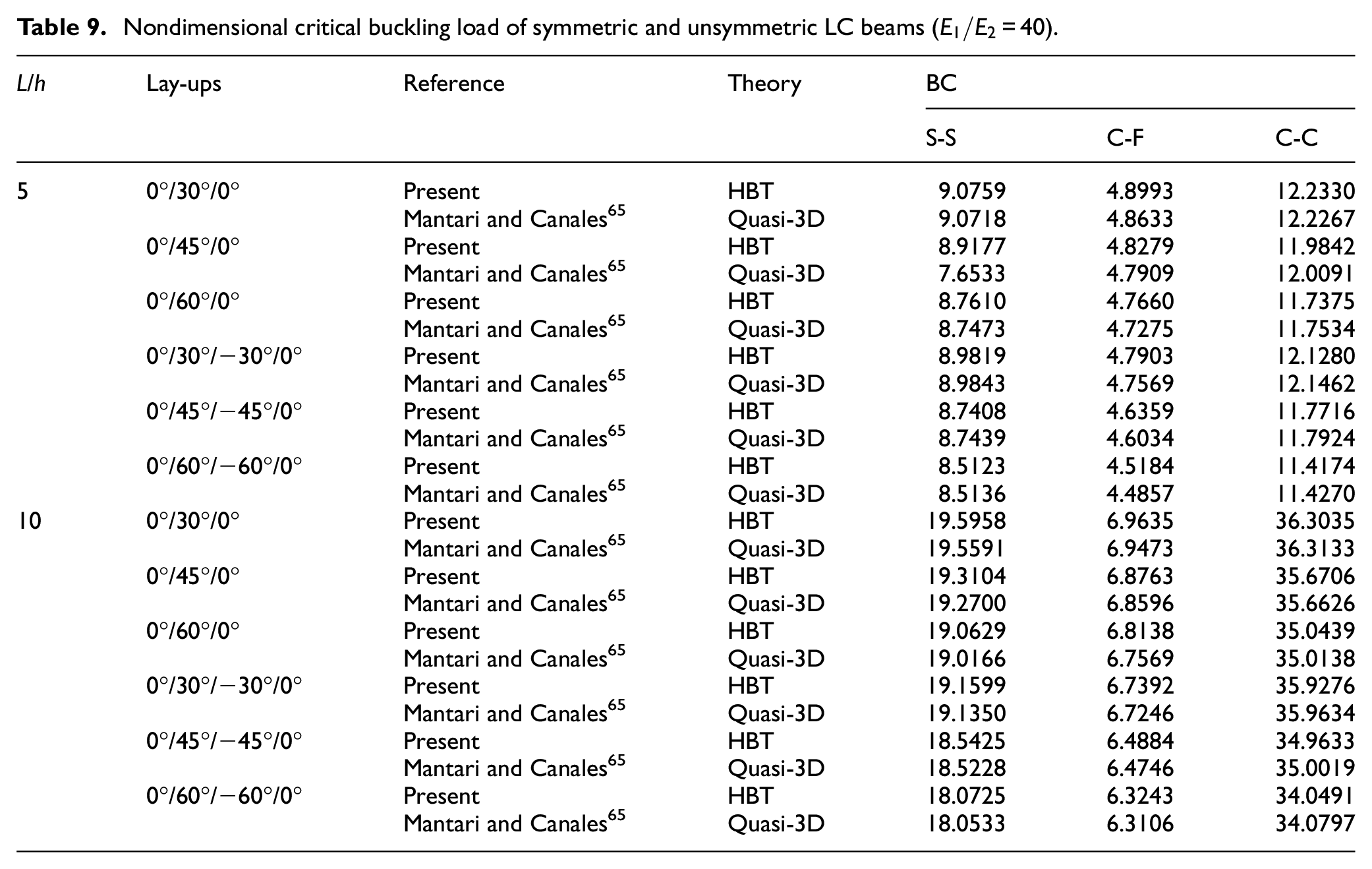
To further verify the proposed theory’s accuracy, symmetric and unsymmetric LC beams with arbitrary angle-ply are examined. Tables 6–9 present the NFF and NCBL of beams with various angle-plies, BCs, and L/h ratios. The results obtained from the proposed theory are compared to those derived from Quasi-3D of Mantari and Canales.65,66 The outcomes indicate the deviation between the proposed theory and Mantari and Canales
65
and Canales and Mantari
66
is negligible for all angle-plies, BCs, and L/h ratios. Additionally, as the angle-ply increases, the NFF and NCBL decrease for all BCs and L/h ratios. This phenomenon can be explained that an increase in angle-ply leads to a reduction in the beam’s stiffness. Figure 4 displays NFF of
Nondimensional fundamental frequency of LC beams with 1 or 2 lay-ups
Nondimensional fundamental frequency of symmetric and unsymmetric LC beams
Nondimensional critical buckling load of LC beams with 1 or 2 lay-ups
Nondimensional critical buckling load of symmetric and unsymmetric LC beams
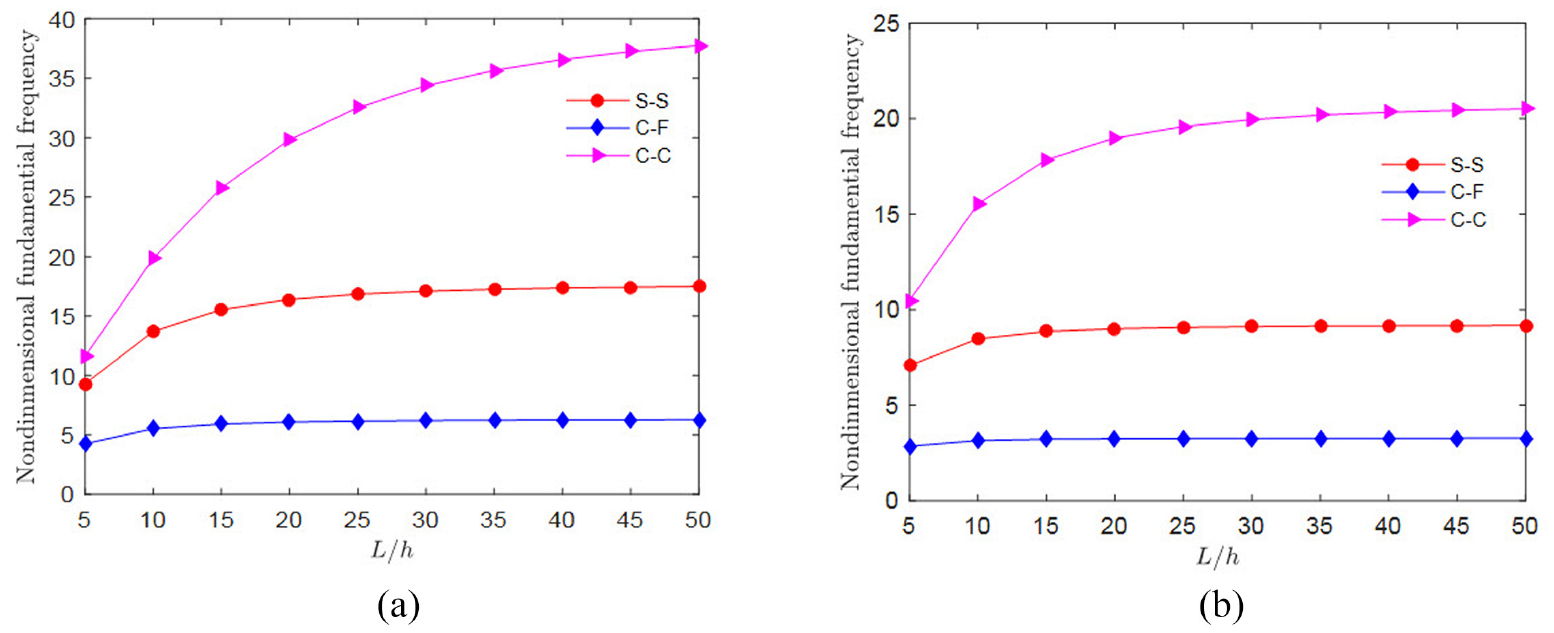
Nondimensional fundamental frequency of symmetric and unsymmetric LC beam
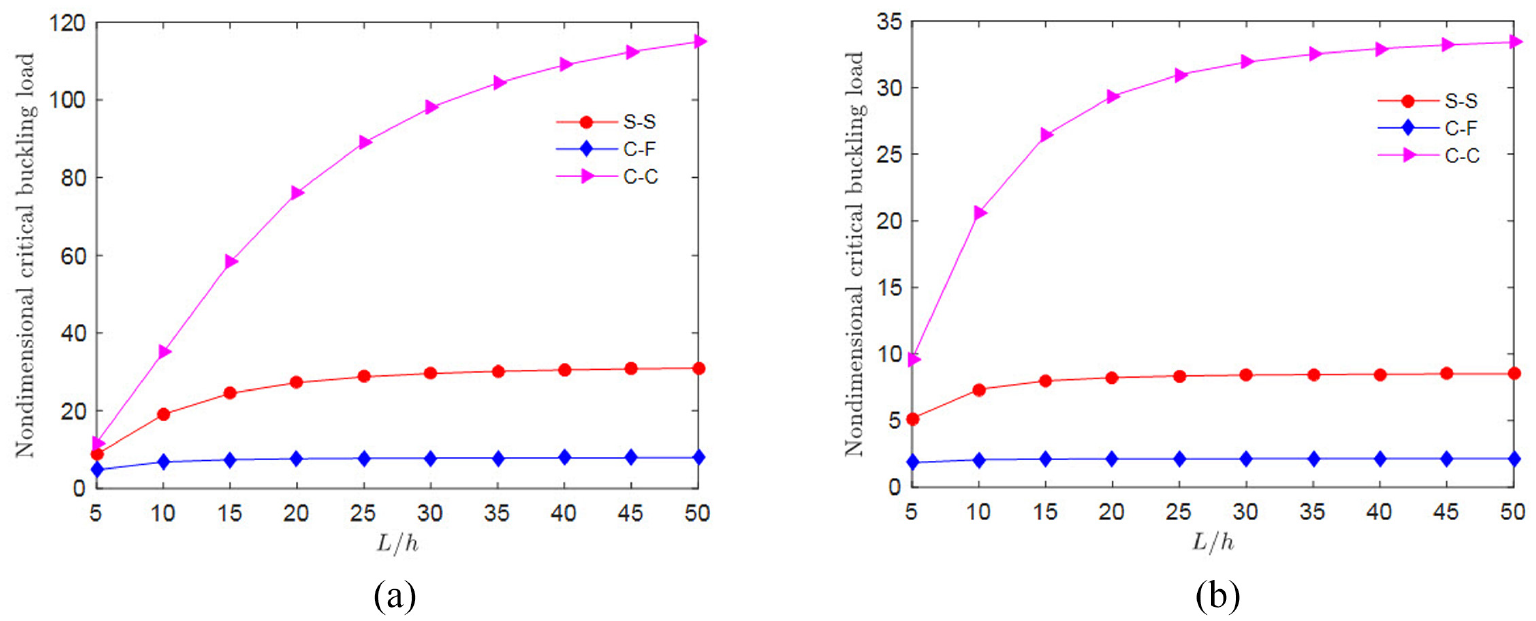
Nondimensional critical buckling load of symmetric and unsymmetric LC beam
FGP beams
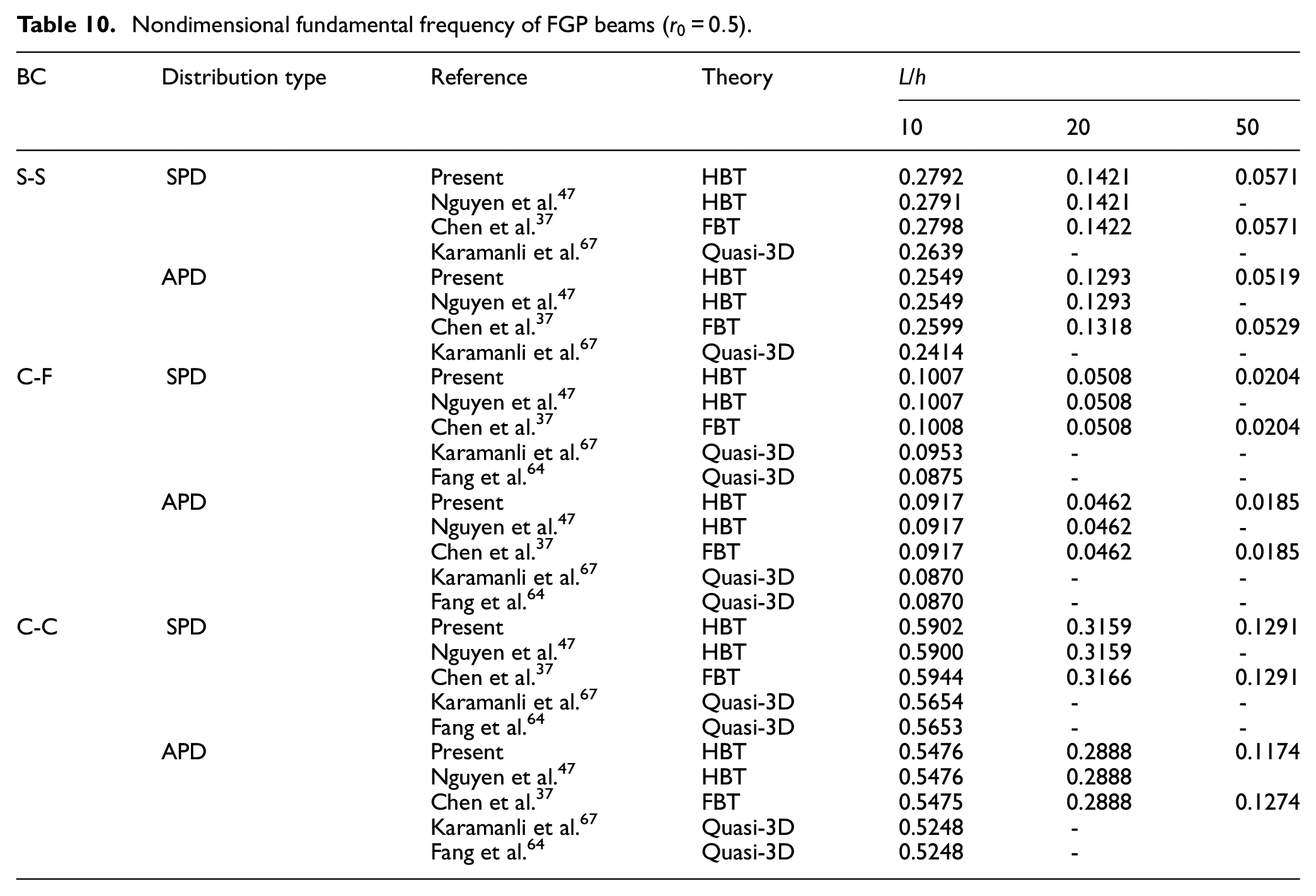
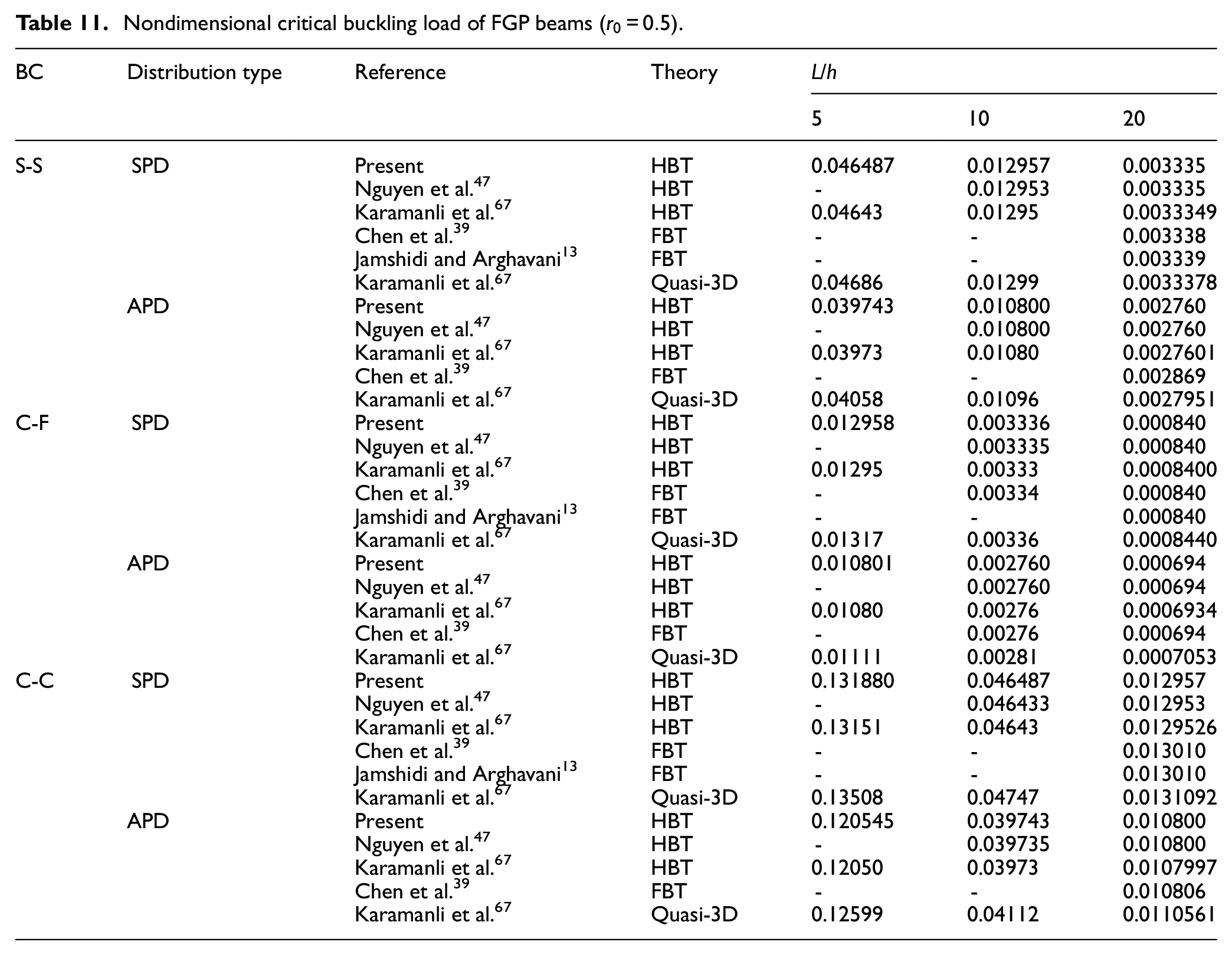
To assess the proposed theory’s efficiency and accuracy, symmetric (SPD) and unsymmetric (ASP) beams
Nondimensional fundamental frequency of FGP beams (
Nondimensional critical buckling load of FGP beams (
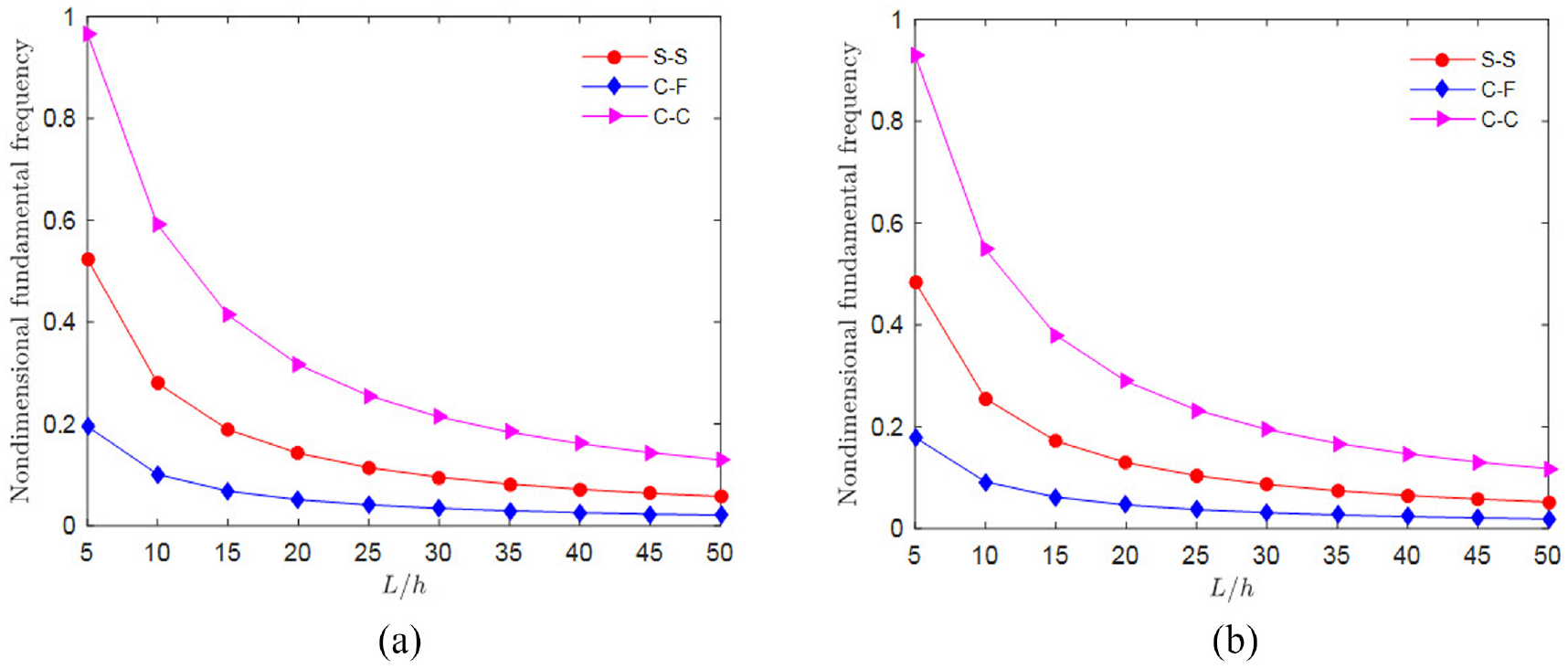
Nondimensional fundamental frequency of symmetric and unsymmetric FGP beam
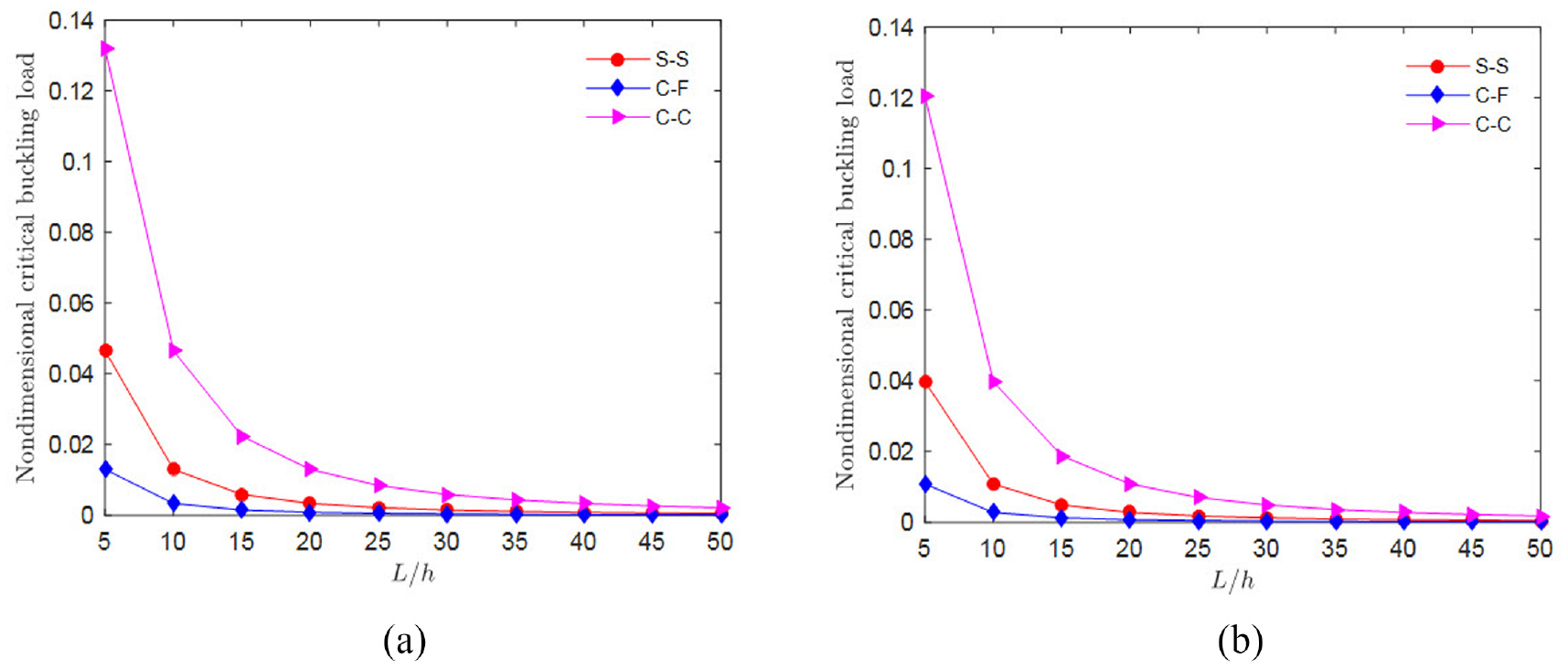
Nondimensional critical buckling load of symmetric and unsymmetric FGP beam
Figure 8 illustrates the NFF of beams as a function of the porosity ratio. As observed, when the porosity ratio increases, NFF increases for SPD beams but decreases for APD beams. This phenomenon can be explained by the decrease in both mass inertia and rigidity of FGP beams with increased porosity. However, the reduction rate in rigidity is more significant than that in mass inertia for APD beams, whereas the opposite is true for SPD beams. In addition, Figure 9 demonstrates that the NCBL decreases as the porosity ratio increases for both SPD and APD beams, as expected.
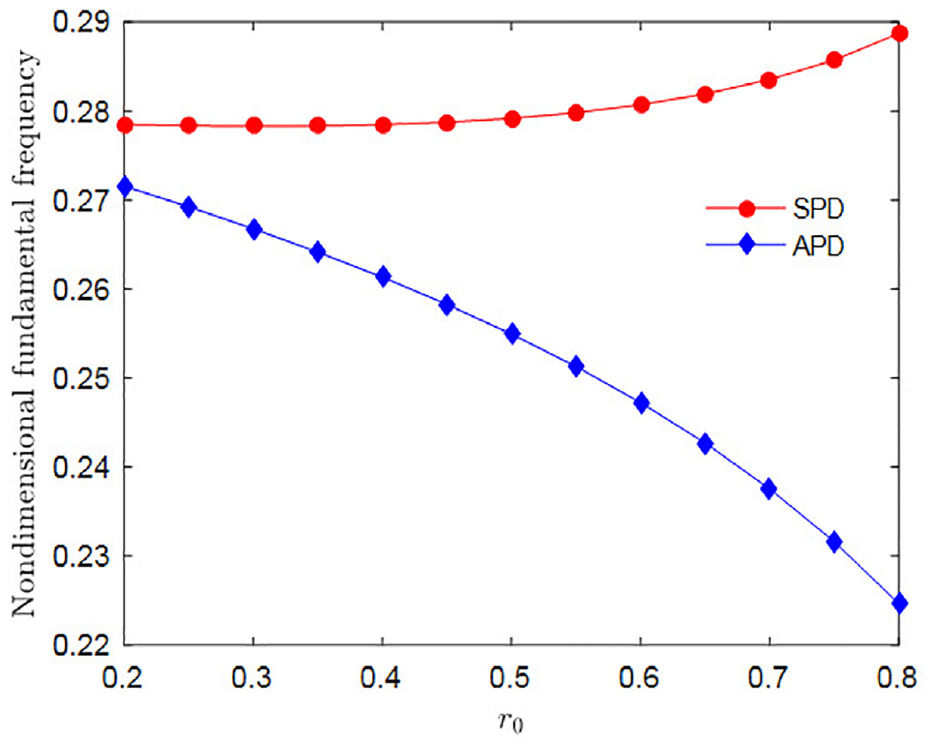
Nondimensional fundamental frequency of symmetric and unsymmetric FGP beam (L/h = 10) with respect to
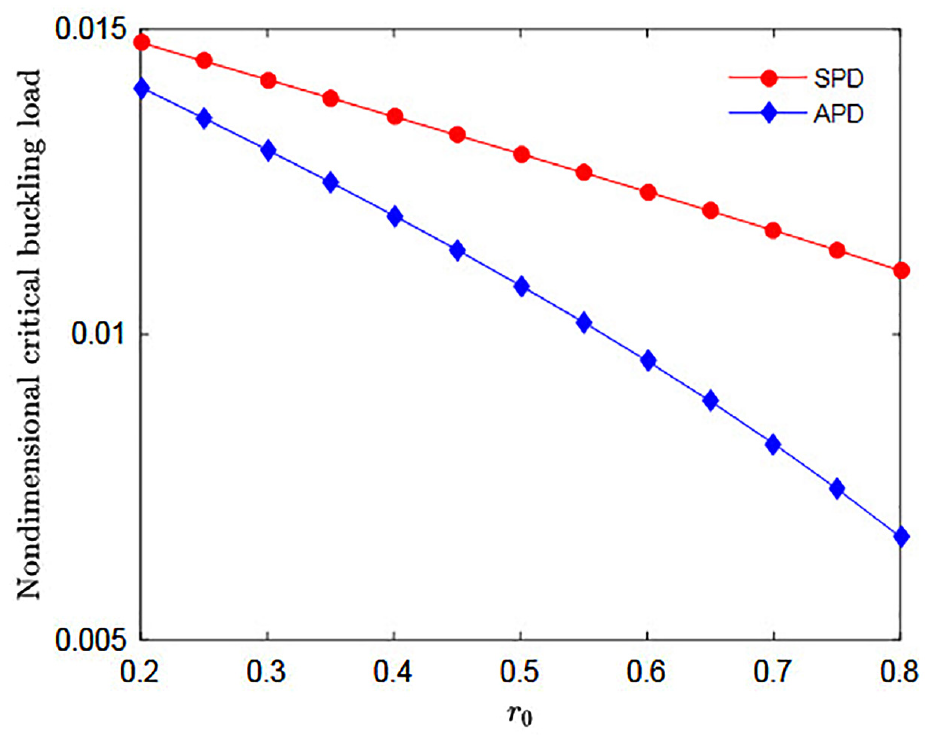
Nondimensional critical buckling load of symmetric and unsymmetric FGP beam (L/h = 10) with respect to
Conclusions
This study introduces a novel higher-order shear deformation theory to analyse the free vibration and buckling responses of LC and FGP beams. The proposed theory has three variables and satisfies the traction-free conditions at the top and bottom surfaces of beams. The governor equations are established by using the Lagrange principle. The Legendre-Ritz functions are utilised to solve the problem. Numerical examples are conducted to verify the proposed theory and investigate the impact of porosity distribution, boundary conditions, and span-to-height ratio on the critical buckling loads and frequency of beams. The following conclusions can be drawn based on the findings of this study:
- The proposed higher-order shear deformation theory demonstrates efficiency and accuracy comparable to those obtained from the Quasi-3D theory.
- An increase in the angle-ply angle of laminated composite beams leads to a decrease in the frequency and critical buckling load.
- An increase in porosity ratio has a detrimental effect on the critical buckling load of both SPD and APD beams. Additionally, there is a divergent impact on the natural frequency of the two types of beams, with an increase in porosity ratio resulting in an increase in frequency for SPD beams and a decrease in frequency for APD beams.
- As the same porosity ratio and slenderness, the frequency and critical buckling load of SPD beams are greater than those of APD beams.
Footnotes
Declaration of conflicting interests
The author declared no potential conflicts of interest with respect to the research, authorship, and/or publication of this article.
Funding
The author received no financial support for the research, authorship, and/or publication of this article.
