




Abstract
The temporal variability in sediment export yield from glaciers over a timescale of multiple glacial cycles (e.g. 1 × 10² − 1 × 10⁶ years) is of interest for a wide range of applications in glaciology, sedimentology, geomorphology, climatology and environmental engineering. However, the time required for the products of glacial erosion to be transferred through glaciated catchments and the extent to which glacially-conditioned sediment can be transiently stored within them are still poorly constrained and a matter of debate within the community. We propose a conceptual model of the variability in sediment exported from glaciers over multiple glacial cycles based on a literature review. Sediment yield is likely to be highly variable through a glacial cycle, notably between phases of glacier advance, retreat and re-advance due to changes in ice velocity and erosion rates, ice and meltwater transport capacity, and in glacially-conditioned sediment accessibility at the bed. Typically, early phases of glacier retreat and re-advance are expected to lead to the highest increase in sediment yield due to the ease with which the products of bedrock erosion can be accessed and reworked. In contrast, later phases of glacial (re)advance, once glacially-conditioned sedimentary sources become exhausted, may be characterized by intermediate rates of sediment export yield maintained through bedrock erosion. The latest phases of deglaciation, once glacially-conditioned sedimentary sources are either exhausted, stabilized or disconnected from active processes of sediment transfer, are likely to have the lowest rate of export. The conceptual model proposed in this paper fills a gap in the literature by developing a continuous pattern of sediment yield rate variability over the course of multiple glacial cycles, with wider implications for future research. However, its systematic applicability to various glacier settings and glaciations needs more field and modeling data to validate it.
I Introduction
The scientific community is increasingly interested in the reconstruction of sediment yield over long timescales (e.g. 1 × 10²–1 × 10⁶ years), (i) to help the interpretation of sedimentary records (e.g. Buechi et al., 2018; Dehnert et al., 2010; Evans et al., 2012; Marren, 2005; Preusser et al., 2011); (ii) to determine climatic, tectonic, biotic and anthropic controls on sediment transfer processes (e.g. Acosta et al., 2015; Church and Ryder, 1972; Cook et al., 2020; Cordier et al., 2017; Ganti et al., 2016; Herman et al., 2011, 2013, 2015; Jaeger and Koppes, 2016; Lane et al., 2019); and, ultimately, (iii) to deliver better modelling of future variations in sediment yield (e.g. Braun and Sambridge, 1997; De Winter et al., 2012; Egholm et al., 2012; Herman et al., 2013). As an example, companies and institutions currently working on the long-term storage of radioactive waste in previously glaciated temperate regions have to determine how sediment yield may vary during the next 1 Ma. This is needed in order to evaluate the potential for dispersion of radio-contaminated sediment in case of excavation of hazardous waste repositories during future glaciations (Fischer et al., 2015; Iverson and Person, 2012).
Most of the mid-latitude, high-latitude and high-altitude landscapes at the Earth’s surface were extensively influenced by glaciations during the Quaternary (Bingham et al., 2010; Patterson et al., 2014). Glaciers being efficient erosive agents, periods of glaciation can be imagined as sediment production “factories” because of the efficiency with which they can transform climate signals into bedrock erosion and sediment transfer. The result is that sediment yields are expected to be generally greater during glaciations as compared to non-glacial periods (Alley et al., 1997; Ballantyne, 2002a, 2002b; Bogen, 1996; Hallet et al., 1996; Herman et al., 2013; Hinderer et al., 2013; Sugden and John, 1976). However, it may take some time for the products of bedrock erosion to cascade through and to be evacuated from glaciated catchments. Such evacuation will depend on the ease with which glacially-conditioned sediment can be remobilized and transferred by ice and meltwater, or whether transient storage of glacially-conditioned sediment also occurs (Alley et al., 1997; Ballantyne, 2002a; Cavalli et al., 2019; Church and Ryder, 1972; Cook and Swift, 2012; Cordier et al., 2017; Fenn, 1987; Harbor and Warburton, 1993; Jaeger and Koppes, 2016; Perolo et al., 2019; Swift et al., 2002).
The extent to which glacially-conditioned sediment is transiently stored below and at the margins of glaciers, and the time required for it to be transferred across glaciated landscapes, is still a matter of debate within the community. The answer to this debate influences the interpretations made of the relationship between glaciation (e.g. glacier cover, sliding velocity, glacier thermal regime, glacier hydrology, subglacial and proglacial sediment cascade) and erosion rates (Bogen, 1996; Collins, 1990; Cook et al., 2020; Cordier et al., 2017; Ganti et al., 2016; Harbor and Warburton, 1993; Herman et al., 2013, 2015; Jaeger and Koppes, 2016; Koppes et al., 2015; Munack et al., 2014; Perolo et al., 2019; Riihimaki et al., 2005). There are two broad views on this relationship. Multiple studies have directly related exported sediment to bedrock erosion based on the assumption that storage below a glacier is negligible (e.g. Bogen, 1996; Cook et al., 2020; Cowton et al., 2012; Herman et al., 2015; Riihimaki et al., 2005; Swift et al., 2005). This assumption is notably supported by the possibility that sediment becomes exhausted through the melt season in some systems, and, hence, there is the onset of supply-limited, and so erosion-limited, conditions below the glacier (e.g. Herman et al., 2015; Mao and Carrillo, 2017; Riihimaki et al., 2005). In addition, the thickness of deposits needed to maintain reported sediment fluxes seems to be unrealistic (e.g. Koppes and Hallet, 2002). There is also evidence over the timescale of days that ice velocity and, hence, erosion rate variation can be related to measured sediment export (e.g. Humphrey and Raymond, 1994; Overeem et al., 2017).
However, research in glacial hydrology (e.g. Collins, 1990; Delaney et al., 2018; Gimbert et al., 2016; Mair et al., 2002; Nienow et al., 1998; Perolo et al., 2019; Swift et al., 2005) questions the extent to which this is always the case, notably because observed sediment exhaustion could also be related to the stabilization of the subglacial drainage system in channels that then inhibits access to newly eroded sediment sources. This hypothesis is supported by observed increases in sediment export from glaciers during high-pressure events associated with glacier uplifts – so-called “spring events” (Collins, 1990; Mair et al., 2002; Nienow et al., 1998; Röthlisberger et al., 1987; Swift et al., 2005). The latter appear to lead to the re-organization of the subglacial drainage network such that sediment can be accessed in new areas of the bed. Enhanced sediment export is then typically followed by a decay in sediment yield as the subglacial drainage system stabilizes and accessible sediment sources get exhausted (Collins, 1990; Gimbert et al., 2016; Lewington et al., 2020; Perolo et al., 2019; Swift et al., 2005). Evidence suggests that high-pressure events may not necessarily be limited to the spring, but may also occur in summer due to high-amplitude daily variation in discharge. Short-term pressurization of subglacial channels in summer periods has been observed during the daily melt peak, where the drainage system capacity is insufficient to convey the volume of meltwater (Davison et al., 2019; Hubbard et al., 1995; Swift et al., 2005). Pressurization was also observed at the onset of the daily melt, attributed to clogging of conduits by sediment at night is followed by an over-pressurization of the subglacial drainage system as discharge starts increasing on the following day (Gabbud et al., 2015; Perolo et al., 2019). In both cases, the pressurization of conduits was associated with an increase in sediment yield at the glacier outlet, either due to the enhanced transport capacity, or to the re-organization of the subglacial drainage network and the access to new areas of the bed. The idea that glaciers are not always able to evacuate their sediment is also supported by the thickness of angular glacially-conditioned sediment, which has not been reworked fluvially, that is found below glaciers once they retreat (Copland et al., 1997; Evans et al., 2006, 2012). Such sediment has been estimated to comprise up to one-third of the total amount produced by glacial erosion (e.g. De Winter et al., 2012).
Assuming that transient storage of glacially-conditioned sediment takes place, to some extent, within glaciated catchments, it should result in a delayed response (at least partially) between bedrock erosion and the export yield of glacially-conditioned sediment (De Winter et al., 2012; Delaney et al., 2018; Fenn, 1987; Harbor and Warburton, 1993). The volume and duration of this transient storage depends on bedrock geometry, sediment accessibility at the bed and on sediment transport capacity of both ice and meltwater. At the temporal scale of glaciations, those elements are likely to be closely related to changes in glacier mass balance, because oscillations between phases of glacier growth, decay and re-advance ultimately determine the flow patterns and velocities of the ice, the volume of melt and contact force between the ice and bed, the glacier erosion patterns, the transport capacity of ice and meltwater and the changes in sediment accessibility at the bed (Ballantyne, 2002a; Church and Ryder, 1972; Cohen et al., 2018; Cook and Swift, 2012; Cordier et al., 2017; Delaney et al., 2018; Egholm et al., 2012; Jaeger and Koppes, 2016). Variations in glacier mass balance are, therefore, expected to lead to changes in the sediment yield exported from glaciers (Alley et al., 1997; Cordier et al., 2017; Jaeger and Koppes, 2016; Patton et al., 2016a, 2016b). Those variations are expected to occur in the form of transient periods of intermittent enhanced and reduced sediment yield, also known as sediment “pulses” and “hiatuses”, respectively (e.g. Alley et al., 2019; Ganti et al., 2016), which have not yet been conceptualized continuously at the scale of multiple glacial cycles.
In this paper, we propose a conceptual model of the variation in glacier sediment yield during the initial phase of glacier growth (i.e. over a fluvially-shaped landscape), and subsequent phases of glacier decay and re-advance, and discuss its implications for current research in this domain. A broad compilation of datasets worldwide has shown that there is a fivefold variation (i.e. 10–4–10 mm yr–1; Bogen, 1996; Cook et al., 2020; Delmas et al., 2009; Hallet et al., 1996) in glacier erosion rates between different glacier settings, according to glacier shape (i.e. Alpine valley glaciers, ice sheets, ice caps), glacier thermal regime (i.e. temperate, polythermal, cold), climatic conditions (i.e. dry, wet, cold, mild), geological setting (i.e. lithology, uplift rate) and glacial geographical context (i.e. gradient, tidewater glacier). In this paper, while the focus is upon temperate Alpine glaciers when describing the processes of glacial erosion and sediment transfer, the extent to which the proposed conceptual model can be applied to other glacier settings is also considered.
II Initial glacier advance
The combination of efficient erosion with high transport capacity meltwater makes glaciers one of the most effective agents at the Earth’s surface for production and transfer of sediment (Alley et al., 1997; Hallet et al., 1996; Herman et al., 2015; Koppes et al., 2015). Thus, initial glacier advance over a fluvial landscape (Figures 1(a) and 2(a)) should, in most instances, lead to higher sediment yield as compared with pre-glacial conditions (Cordier et al., 2017; Egholm et al., 2012; Glasser and Hall, 1997; Hallet et al., 1996; Hjelstuen et al., 1996; Koppes and Montgomery, 2009). As a glacier first advances, it may access sediment accumulated during pre-glacial times (e.g. alluvial, lacustrine and mass movement deposits), resulting in enhanced sediment yield due to the relative ease with which a glacier can rework loose material until it reaches the bedrock (Figures 1(b) and 2(b), phase “b1”). Exceptions and more moderate erosion rates may be found when glaciers override sediment deposits that are particularly difficult to transport, such as coarse rock avalanches debris (e.g. Cook et al., 2013), or highly cohesive glacio-lacustrine deposits (e.g. Evans et al., 2012). Most commonly, bedrock erosion cannot commence until any accumulated sediment at its surface has been evacuated, although research has suggested that bedrock erosion could also take place, to some extent, through the deformation of subglacial sediment (Cuffey and Alley, 1996; Hart, 1995).
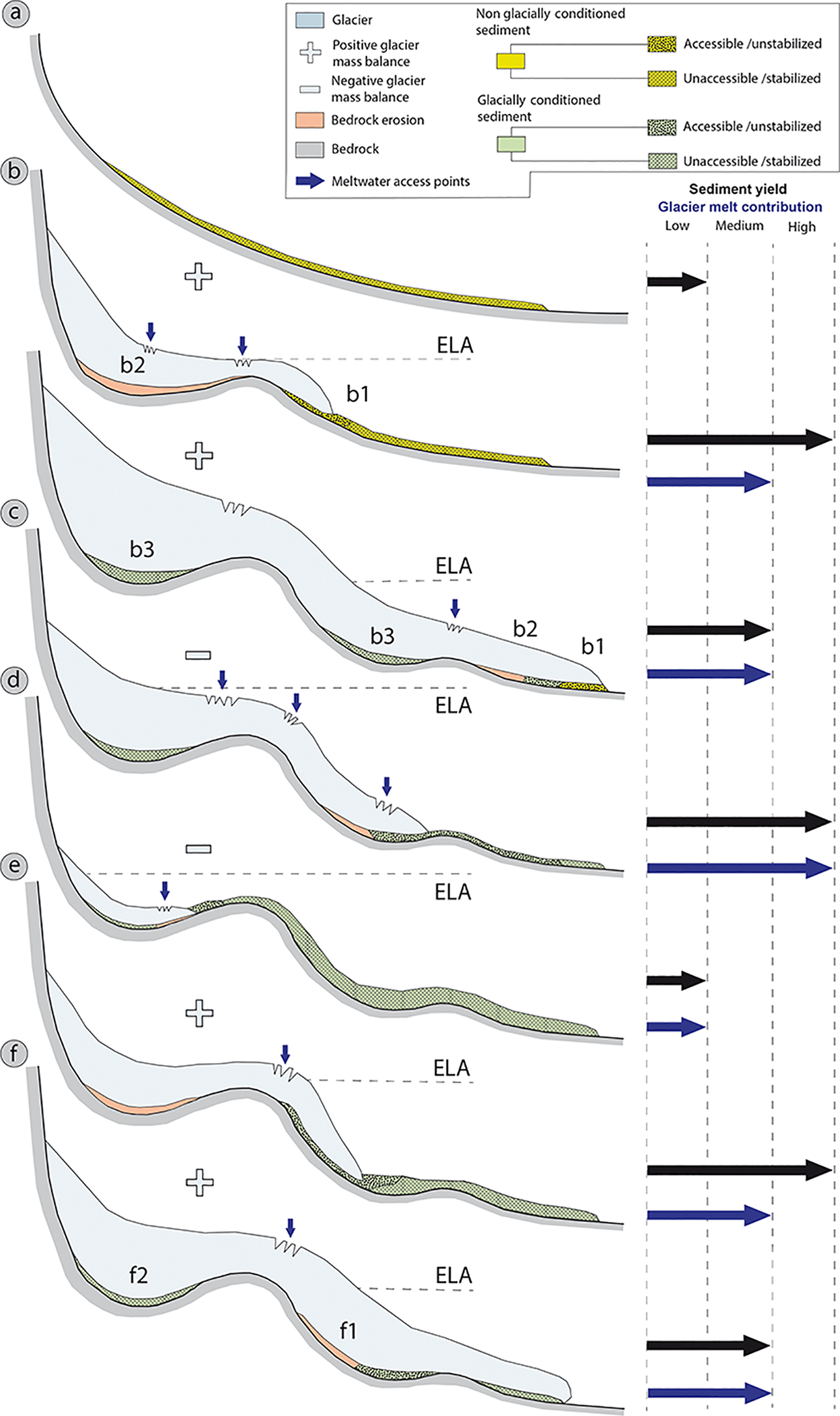
Glacier mass balance and sediment yield during multiple glacial cycles. Phase (a) shows the pre-glacial situation, when the landscape is fluvially-shaped and covered by non-glacial deposits. In phase (b), initial glacier advance produces high sediment yield on the one hand due to the relative ease with which the non-glacial sedimentary cover is reworked (b1, upper panel), and on the other due to the initial intensity of bedrock erosion incision into a fluvially-shaped landscape (b2, upper panel), associated with a substantial meltwater contribution. At a later stage of glacial advance, both the progressive exhaustion of non-glacial sedimentary stores and negative feedbacks in bedrock erosion tend to generate moderate sediment yield (b3, lower panel). During phase (c), glacier retreat and enhanced meltwater contribution, associated with large volumes of readily transportable glacially-conditioned sediment, lead to a high sediment yield. During phase (d), progressive exhaustion, poor accessibility and stabilization of glacially-conditioned material, associated with a decreasing meltwater contribution, lead to a decrease in the exported sediment yield. In phase (e), glacier re-advance over large paraglacial stores and enhanced meltwater contribution leads to a phase of enhanced sediment yield. In phase (f), bedrock erosion is first maintained at a moderate rate (f1), before negative feedbacks in bedrock erosion reduce sediment yield (f2). Note that the location of glacial erosion (red), glacial sediment (green) and non-glacial sediment are indicative and in no case absolute. They may, therefore, also occur in other parts of the bed, as does the location of crevasses at the glacier surface. The equilibrium line altitude (ELA) marks the limit between the accumulation and the ablation areas.
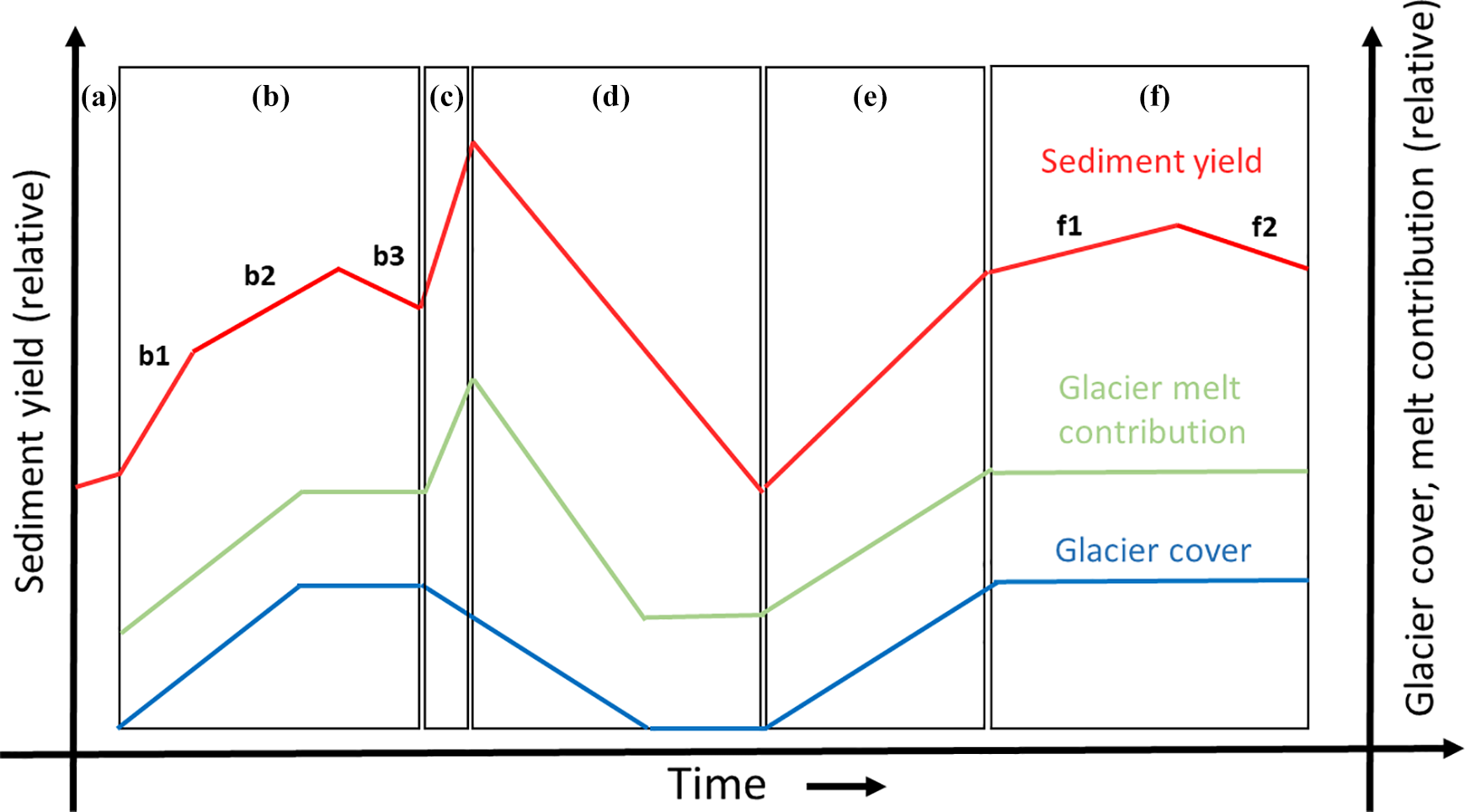
A conceptual model of change in sediment yield during phases of glacier advance, stagnation, retreat and re-advance. Phases (a)–(f) correspond to the six phases highlighted in the conceptual model presented in this manuscript (see also Figure 1). Sediment yield, glacier cover and glacier meltwater contribution are plotted together over a glacial cycle. Rates are relative and have been inspired from the quantitative data of Table 1. Nevertheless, rates are likely to vary (i) within a same glacier setting during multiple glacial cycles and (ii) between different glacier settings during the same glaciation.
Review of erosion rates that have been measured in a range of glacial settings worldwide. Particular attention has been given to erosion rates measured within the same glacier setting, and which can be associated to one or multiple specific phases (a)–(f) of the conceptual model presented in this paper. All data come from quantitative field datasets, except the modelling results of Egholm et al. (2012).
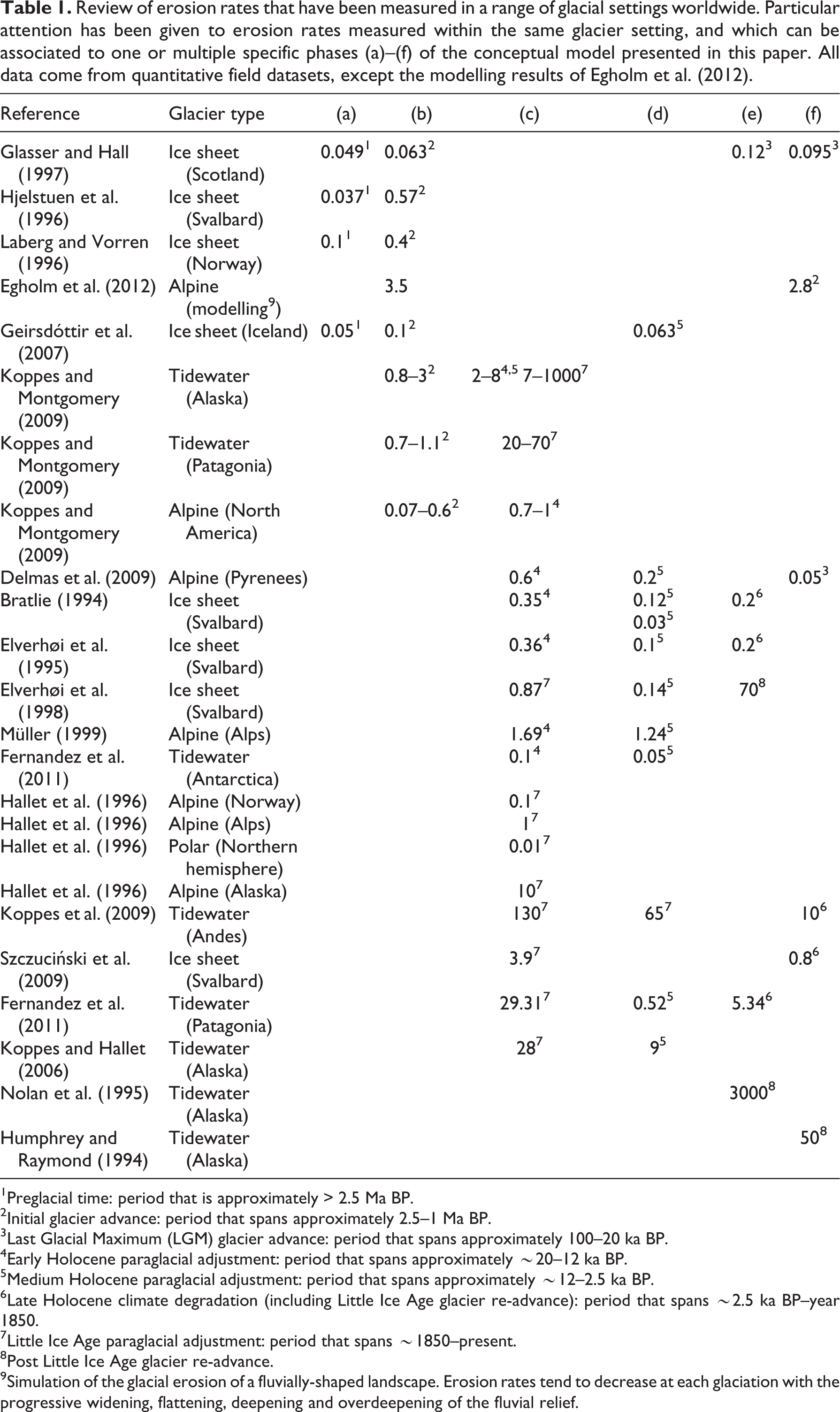
1Preglacial time: period that is approximately > 2.5 Ma BP.
2Initial glacier advance: period that spans approximately 2.5–1 Ma BP.
3Last Glacial Maximum (LGM) glacier advance: period that spans approximately 100–20 ka BP.
4Early Holocene paraglacial adjustment: period that spans approximately ∼20–12 ka BP.
5Medium Holocene paraglacial adjustment: period that spans approximately ∼12–2.5 ka BP.
6Late Holocene climate degradation (including Little Ice Age glacier re-advance): period that spans ∼2.5 ka BP–year 1850.
7Little Ice Age paraglacial adjustment: period that spans ∼1850–present.
8Post Little Ice Age glacier re-advance.
9Simulation of the glacial erosion of a fluvially-shaped landscape. Erosion rates tend to decrease at each glaciation with the progressive widening, flattening, deepening and overdeepening of the fluvial relief.
As the glacier continues advancing, exported sediment will result from a mixture of bedrock erosion over certain parts of the bed, and from the reworking of pre-glacial sediment in others, until the point at which pre-glacial sediment has been progressively exhausted and bedrock erosion becomes dominant. Because bedrock erosion is likely to be less effective than loose pre-glacial sediment erosion (e.g. Bogen, 1996; Hallet et al., 1996; Hinderer et al., 2013), a decrease in sediment yield is then to be expected (Figures 1(b) and 2(b), phase “b2”). Nevertheless, sediment yield remains high as glaciers are typically efficient at eroding their beds (Alley et al., 1997; Hallet et al., 1996; Herman et al., 2015; Sugden and John, 1976). This is true as long as meltwater can access the bed, typically through crevasses and moulins (Alley et al., 1997, 2019), and as long as the subglacial drainage network allows an efficient flushing of the products of glacial erosion (Alley et al., 1997, 2019; Cook et al., 2020; Hallet et al., 1996; Swift et al., 2002). In cases where meltwater cannot access the glacier bed, or the subglacial drainage network is inefficient at exporting eroded sediment from it, a protective layer of sediment tends to form, thicken and significantly reduce the erosive power of glaciers (Alley et al., 1997, 2019; Hooke, 1991). Glacial erosion rates may be particularly marked when glaciers first advance over a fluvially-shaped landscape in which valleys and relief have first to be widened, flattened, deepened and overdeepened in many instances (Braun and Sambridge, 1997; Egholm et al., 2012; Glasser and Hall, 1997; Herman et al., 2011; Hjelstuen et al., 1996; Hooke, 1991; Laberg and Vorren, 1996). This may lead to a phase of enhanced bedrock erosion during the initial phase of glacier advance (Egholm et al., 2012; Glasser and Hall, 1997; Hjelstuen et al., 1996; Laberg and Vorren, 1996) (Figures 1(b) and 2(b), phase “b2”).
Erosion rates should then continue to increase with glacier cover (Hallet et al., 1996). This may be because of the increase in the area over which erosion can occur (De Winter et al., 2012; Egholm et al., 2012; Hallet et al., 1996; Herman et al., 2013, 2015). It will also be due to the relationship between ice thickness, sliding velocity and erosion rates. Generally, it is assumed that thicker glaciers will move faster, and so are likely to produce more erosion. While the link between erosion rates and sliding velocity was first considered as linear (e.g. Humphrey and Raymond, 1994), subsequent research has shown that the relationship was better represented by a power law with an exponent close to 2 (Herman et al., 2015; Koppes et al., 2015). However, Cook et al. (2020) have shown over a broad range of glaciers that the exponent was actually smaller than 1 and related it to a reduction in ice–bedrock contact due to the increase in sliding velocity. As a consequence, thicker, faster glaciers are still expected to do more erosion, but the rate of increase in erosion is lower than the rate of increase in sliding (Cook et al., 2020).
Reduced sliding and reduced evacuation of sediment by meltwater tend to explain the lower rate of erosion recorded by cold-bedded glaciers (Bogen, 1996; Cook et al., 2020; Delmas et al., 2009; Hallet et al., 1996). In those systems, englacial transport through basal refreezing is dominant as compared to fluvial transport, and less efficient in terms of erosion rates (Alley et al., 1997; Cuffey et al., 2000). Cold-bedded glaciers have even shown erosion rates close to zero in some settings, with relict organic matter being found at the glacier bed when the glacier retreated (e.g. Lowell et al., 2013). At tidewater glaciers, flotation of the glacier front may in some circumstances increase sliding velocity and erosion rates, but complex feedbacks through changes in ice thickness, basal water pressure and advection of ice towards the glacier front may thereafter slow down glacier motion and erosion rates (Cassotto et al., 2019; Joughin et al., 2012; Nick et al., 2007; Shapero et al., 2016).
When an Alpine temperate glacier stabilizes (i.e. advance stops), efficient erosion is maintained as long as the products of glacier erosion at the bed are evacuated by ice and meltwater (Alley et al., 1997, 2019; Cook et al., 2020; Hallet et al., 1996). Transient stores of glacially-conditioned sediment may, however, form locally under glaciers (Figure 1(b)). Such zones may reflect inefficiencies (in time and in space) in the remobilization of the products of glacial erosion at their bed, and can be related to a wide range of processes (Cook and Swift, 2012; De Winter et al., 2012; Delaney et al., 2018; Jaeger and Koppes, 2016; Perolo et al., 2019; Swift et al., 2002).
First, the mobilization of sediment at the bed relies on ice pressure, water pressure and temperature conditions at the glacier bed, which will influence the efficiency of both glacial and fluvial sediment transport. In this context, the efficiency, distribution and spatial (re)organization of the subglacial drainage network through time, which depends upon on both inputs of meltwater and sediment, and on ice flow dynamics, will define the sediment transporting capacity of the subglacial drainage system and the access of efficient channels to the products of bedrock erosion (Collins, 1990; Delaney et al., 2018; Mair et al., 2002; Nienow et al., 1998; Perolo et al., 2019; Swift et al., 2002, 2005). Second, as glaciers erode bedrock they may flatten and widen the valley profile, which can provide large accommodation space and conditions for glacially-conditioned sediment to be stored subglacially (Alley et al., 2003a, 2003b; Bogen et al., 2015; Cook and Swift, 2012; Fenn, 1987; Harbor and Warburton, 1993; MacGregor et al., 2000). Such conditions may also be created when glaciers overdeepen their bed (Alley et al., 2003a; Cook and Swift, 2012; Hooke, 1991; Patton et al., 2016b). The ability of glaciers to overdeepen their bed is often related to a positive feedback between initial glacier bed irregularities, the creation of new access points to the bed for meltwater through the opening of crevasses, the efficient export of sediment at the bed by meltwater and the stimulation of bedrock quarrying (Alley et al., 2003a, 2019; Beaud et al., 2016; Hooke, 1991; Patton et al., 2016a, 2016b). The positive feedback is likely further enhanced by the steering of ice into overdeepened basins (Herman et al., 2015; Jamieson et al., 2008).
However, multiple authors have also emphasized the occurrence of negative feedbacks in glacier bedrock erosion (Alley et al., 2003a, 2003b, 2019; Cook et al., 2020; Herman et al., 2015; Koppes et al., 2015). First, adverse slopes of overdeepenings may decrease transport capacity and favor subglacial sediment storage (Alley et al., 1997, 2019; Hooke, 1991). Second, when the adverse slope of an overdeepening exceeds the ice surface slope by a factor ∼1.5 (Creyts and Clarke, 2010; Röthlisberger, 1972), glaciohydraulic supercooling may occur at the glacier bed. When this occurs, water flowing on the ascending slope has a rate of increase in its pressure melting point that is greater than that for water temperature due to flow viscous dissipation, resulting in refreezing of the water (Alley et al., 2003a, 2003b; Röthlisberger, 1972). The refreezing of the water tends to clog conduits of the subglacial drainage network and to inhibit fluvial sediment evacuation out of the overdeepening, which, in turn, likely reduces the intensity of bedrock erosion (Cook and Swift, 2012; Creyts et al., 2013; Swift et al., 2018). Such negative feedbacks in bedrock erosion are thought to stabilize the glacier bed (Alley et al., 2003a, 2003b, 2019; Cook et al., 2020; Herman et al., 2015), to favor the storage of material within overdeepenings (Cook and Swift, 2012; Swift et al., 2002) and, overall, to reduce the exported yield (Figures 1(b) and 2(b), phase “b3”). They are, however, counterbalanced by an enhanced rate of debris incorporation into the ice due to the occurrence of glaciohydraulic supercooling, which may help maintain the sediment connectivity over longer timescales (Alley et al., 1997; Cook and Swift, 2012; Cook et al., 2007, 2010, 2020; Hooke, 1991; Lawson et al., 1998; Röthlisberger, 1972; Swift et al., 2002, 2018). Yet, the absolute efficiency of englacial transport (i.e. in a sediment-rich basal layer) compared to subglacial fluvial transport is still poorly constrained, although it seems not to be as efficient as fluvial sediment evacuation (Alley et al., 2019; Swift et al., 2002, 2018). Note also that such negative feedbacks in bedrock erosion operate in relatively mature overdeepenings – a state that may require multiple phases of glacier advance to be reached (Alley et al., 2003b, 2019; Egholm et al., 2012; Hooke, 1991).
To summarize, even though advancing glaciers typically tend to be efficient erosive agents, transient storage may also occur at their base in a number of situations. The remobilization of material at the glacier bed notably depends on the geometry of the bedrock (i.e. accommodation space, overdeepened bed), the pressure fields and temperature regime at the glacier base, the distribution of the subglacial drainage network and its stability in space and time, and the variability in inputs of water and sediment (Alley et al., 1997; Cook et al., 2020; De Winter et al., 2012; Delaney et al., 2018; Perolo et al., 2019; Swift et al., 2002, 2018). Therefore, we expect the initial advance of a glacier over a fluvially-shaped landscape (Figures 1(a) and 2(a)) to be associated with (i) high erosion rates in the first instance due to the remobilization of a non-glacial sedimentary cover (Figures 1(b) and 2(b), phase “b1”), followed by (ii) moderate–high erosion rates once the sedimentary cover is exhausted, substituted by substantial bedrock glacial erosion of the fluvially-shaped landscape (Figures 1(b) and 2(b), phase “b2”). When the glacier stabilizes (i.e. advance stops) and does not access new areas of the bed, and negative feedbacks in glacier erosion take place, then (iii) erosion rates are expected to decrease (Figures 1(b) and 2(b), phase “b3”).
III Deglaciation: the “paraglacial” model
The evolution of sediment yield during phases of deglaciation was conceptualized by Church and Ryder (1972) in their paraglacial model. Glacial debutressing and the reworking of large volumes of oversteepened, unstable or meta-stable and unvegetated glacially-conditioned deposits and landforms leads to a period of accelerated geomorphological activity in the early phases of deglaciation. As glaciers retreat, freshly deglaciated areas (e.g. rockwalls and rockslopes, drift-mantled slopes, glacial forefield; Ballantyne, 2002a, 2002b; Carrivick and Heckmann, 2017; Cossart et al., 2008; Porter et al., 2019) readjust towards non-glacial conditions at different paces through debutressing of hillslopes (Cossart et al., 2008; Davies et al., 2003; Mancini and Lane, 2020; McColl, 2012; McColl and Draebing, 2019) and sediment reworking by water and wind (Beylich et al., 2009, 2017; Evans et al., 2012; Lane et al., 2017).
Enhanced runoff with high-transport capacity characteristic of the early phase of glacier retreat (Bogen, 1989), combined with large stocks of readily transportable sediment, leads to high rates of sediment yield in the early phases of deglaciation, potentially far greater than the rates that precede glacier retreat (Ballantyne, 2002a, 2002b; Bratlie, 1994; Church and Ryder, 1972; Delmas et al., 2009; Koppes and Montgomery, 2009; Figures 1(c) and 2(c)). This is notable during the melt period in which hydraulic gradients are steep and hydrograph “peakiness” increases (Lane and Nienow, 2019; Patton et al., 2016a, 2016b), enhancing dramatically transport capacity as the latter evolves as a non-linear function of water discharge, with coefficients up to 2–4 (Alley et al., 1997, 2019; Swift et al., 2005; Wolman and Miller, 1960). This may also include sediment flushing in areas of the bed where pre-glacial and subglacial sediment had resisted the previous phase of glacier advance (e.g. glacier margins, overdeepenings, inaccessible/inefficient sections of the bed; De Winter et al., 2012; Patton et al., 2016a; Swift et al. 2018). Recent studies of Alpine glacier recession, that span a period of glacier stabilization/advance in the 1970s and early 1980s through to rapid retreat since, confirm that the onset of recession leads to a significant increase in both bedload sediment (Lane et al., 2017) and suspended sediment yield (Costa et al., 2018; Lane et al., 2019).
Flow and transport capacity increases during deglaciation until reaching a maximum, or “peak water”, when the quantity of ice melt becomes sufficiently constrained by a decreasing catchment ice volume (Huss and Hock, 2018; Sorg et al., 2014), while an increasing debris accumulation on glacier surfaces reduces melt rates and leads to patches of buried or dead ice (e.g. Bosson et al., 2015; Gärtner-Roer and Bast, 2019; Kneisel, 2010; Schomacker, 2008). Simultaneously, glacially-conditioned sedimentary sources are progressively restored to non-glacial conditions (e.g. Ballantyne, 2002a, 2002b); become gradually exhausted (Church and Slaymaker, 1989; Cruden and Hu, 1993); are disconnected from active transport corridors (Baewert and Morche, 2014; Carrivick and Heckmann, 2017; Carrivick et al., 2013; Lane et al., 2017; Micheletti et al., 2015; Schrott et al., 2006); and/or subject to negative feedbacks that inhibit sediment mobility (e.g. sediment sorting, soil development, vegetation encroachment; Miller and Lane, 2019). The result is that sediment yield should reach a “peak sediment” (Lane and Nienow, 2019; Figures 1(c) and 2(c)).
From then on, decreasing meltwater-supplied sediment leads to a rapid decline in sediment yield (Bratlie, 1994; Church and Ryder, 1972; Church and Slaymaker, 1989; Cruden and Hu, 1993; Delmas et al., 2009; Elverhøi et al., 1995, 1998; Fernandez et al., 2011; Figures 1(d) and 2(d)). This decline may be temporarily disrupted by stochastic releases of sediment due to the reactivation of stabilized/disconnected sedimentary sources (Ballantyne, 2002a, 2002b; Cossart and Fort, 2008; Harbor and Warburton, 1993; Porter et al., 2019). Without reactivation, paraglacial deposits and landforms such as talus slope accumulations, valley fills, glacio-lacustrine deposits and alluvial fans may form major sedimentary stores that are disconnected, stabilized and restored to non-glacial conditions. These sedimentary stores may survive well beyond the end of the paraglacial period and may influence sediment export yield at larger temporal scales than the glaciation itself (Blum and Törnqvist, 2000; Ganti et al., 2016; Jaeger and Koppes, 2016; Preusser et al., 2010, 2011). If the paraglacial period reaches completion during the interglacial before a new glaciation starts, sediment yields are kept to a minimum by relatively low discharge and rates of sediment supply (Ballantyne, 2002a, 2002b; Bratlie, 1994; Elverhøi et al., 1995; Figures 1(d) and 2(d)).
IV Glacier re-advance
The processes constraining glacial erosion as a glacier starts re-advancing are expected to be comparable to those described earlier for the initial phase of glacier advance (Alley et al., 1997, 2019; Cook et al., 2020; Hallet et al., 1996; Humphrey and Raymond, 1994). However, surrounding conditions in terms of bedrock geometry and volumes of loose sediment will be different (Alley et al., 2003a, 2003b; Ballantyne, 2002a; Cook and Swift, 2012; De Winter et al., 2012; Egholm et al., 2012). As glaciers start re-advancing, the erosion and remobilization of large paraglacial stores originating from the previous glaciation, such as talus slopes accumulation, valley fills, glacio-lacustrine deposits and alluvial fans, is expected to lead to a rapid rate of increase in sediment yield (Figures 1(e) and 2(e)), possibly among the highest of the entire glacial cycle, due to the ease with which the glacier and relatively abundant meltwater can remobilize these sedimentary stores (Bratlie, 1994; Elverhøi et al., 1995; Fernandez et al., 2011; Koppes et al., 2009), and the large volumes they represent (e.g. hundreds of meters of glacial infills in most of the Alpine valleys; Buechi et al., 2018; Dehnert et al., 2010; Preusser et al., 2010, 2011). Exceptions, however, exist when the deposits are particularly difficult to mobilize, such as coarse rock avalanche deposits or highly cohesive glacio-lacustrine materials, in a similar fashion to during the initial phase of glacier advance (e.g. Cook et al., 2013; Evans et al., 2012).
As with during deglaciation, sediment yield increases until paraglacial stores become exhausted or inaccessible (Ballantyne, 2002a, 2002b; Church and Ryder, 1972; Cordier et al., 2017; Jaeger and Koppes, 2016). Once this occurs to a large extent, sediment yield due to bedrock erosion should increase together with ice cover, albeit at a lower rate than during the initial phase of glacier re-advance when glacially-conditioned sedimentary stores were abundant (Cordier et al., 2017; Hallet et al., 1996; Figures 1(f) and 2(f), phase “f1”). Bedrock erosion may also be less intense than during the initial phase of glacier advance, where the widening, flattening, deepening and overdeepening of the fluvially-shaped landscape was associated with particularly high rates of bedrock erosion (Braun and Sambridge, 1997; Egholm et al., 2012; Glasser and Hall, 1997; Herman et al., 2015; Hjelstuen et al., 1996; Hooke, 1991; Laberg and Vorren, 1996; Figures 1(b) and 2(b), phase “b2”). As the glacier stabilizes and negative feedbacks in bedrock erosion operate, the exported yield is expected to decrease (Figures 1(f) and 2(f), phase “f2”). As observed for periods of deglaciation, sediment yield during phases of glacier (re)advance is not usually constant in time and is characterized by periods of disruption to connection (e.g. formation of ice-dammed lakes) interspersed by stochastic re-connection and release of sediment (e.g. the sudden drainage of ice-dammed lakes; Scherler et al., 2014).
It is not clear yet in what proportion glacially-conditioned sediment that has been deposited during a given glacier cycle will be reworked by a subsequent phase of glacier re-advance. Recent efforts to core and to date Quaternary glacially-conditioned sediment have shown that sediment could persist through multiple glacial cycles in some instances (e.g. Buechi et al., 2018; Dehnert et al., 2010; Preusser et al., 2010, 2011; Figure 1(f)), which means that glaciers will not systematically erode to bedrock once they re-advance. From the literature, it seems that the conservation of glacially-conditioned sediment over multiple glacial cycles is less likely in trunk valleys as compared to unconfined plateaus or forelands. Glacier pathways may change from one glacial cycle to the other and erosion will tend to be less focused for plateaus and forelands (Buechi et al., 2018; Dehnert et al., 2010; Koppes et al., 2009; Müller, 1999). In addition, the persistence of glacially-conditioned sediment through multiple glacial cycles tends to be favored within overdeepened glacial basins, typically when their altitude lies below stream base level (Preusser et al., 2010, 2011). Major changes in drainage networks (e.g. stream capture; Claude et al., 2019; Willett et al., 2014) have also been found to be an efficient mode of isolating glacially-conditioned sediment from active processes of transport over the timescales of glacial cycles (Buechi et al., 2018; Dehnert et al., 2010; Preusser et al., 2010, 2011). The depth at which a re-advancing glacier will erode previously deposited sediment is also likely to depend on the magnitude of the glaciation, in relation to ice-thickness, sliding velocities and glacier erosion laws (Cook et al., 2020; Herman et al., 2015; Koppes et al., 2015).
Yet, the question of the extent to which glacially-conditioned sediment can persist through multiple glacial cycles is still not sufficiently constrained. There is a scarcity of geophysical, core-derived and dated information for Quaternary infills. The conditions required for preservation are poorly understood. The proportion of glacially-conditioned sediment that is stored as compared to being transferred to terminal sinks is poorly known (e.g. Buechi et al., 2018; Dehnert et al., 2010; Preusser et al., 2011). This question not only matters for developing a better understanding of the link between glacial cycles and sediment yield, but also for applied reasons, such as the long-term storage of radioactive waste. It notably affects the potential of dispersion of radio-contaminated sediment in case of excavation of waste repositories.
V Sediment yield over glacial cycles: a conceptual model
Changes in sediment yield during phases of glacier advance, retreat, and re-advance are summarized in the conceptual model proposed in Figures 1 and 2. The main contributions that inspired the proposed conceptual model are summarized in Table S1 of the Supplementary Material. For each phase (a)–(f) of the glacial cycle presented in Figures 1 and 2, the main driving processes, the most notable publications on the topic, as well as the type of evidence supporting them (i.e. field observation, field data, modelling) are summarized. Table S1 supports the basis of the conceptual model. The model suggests that the phases of transience in glacier mass balance generate enhanced sediment yield at the margin of glaciers, in the early phases of both glacier (re)advance (phases (b) and (e)), and in retreat (phase (c)). Generally, it is the remobilization of loose (glacially-conditioned or not) sediment that is the cause of enhanced sediment yield when a change in glacier mass balance occurs, emphasizing the delay that may arise between sediment production and sediment export (Collins, 1990; De Winter et al., 2012; Delaney et al., 2018; Mair et al., 2002; Perolo et al., 2019; Swift et al., 2005). Periods where bedrock erosion overtakes the remobilization of loose deposits are characterized by intermediate rates of increase in sediment export due to the relative resistance of bedrock as compared with the erosion of loose sediment (phases “b2” and “f1”). There is, however, the exception of the initial phase of glacier advance (phase “b1”), where the widening, flattening, deepening and overdeepening of fluvially-shaped landscapes may lead to higher rates of bedrock erosion. Negative feedbacks in bedrock erosion may also reduce erosion rates (phases “b3” and “f2”), as long as the glacier does not access new areas of the bed with higher erodibility. Late phases of deglaciation, when glacially-conditioned sedimentary sources are either exhausted, stabilized or disconnected from active processes of transfer, are characterized by the lowest sediment yields of the entire glacial cycle (period (d)).
Field data to assess the proposed conceptual model or to ascribe quantitative detail are unfortunately scarce in the literature. Whilst many erosion rates have been reported over a wide range of glacier settings worldwide (Alley et al., 2019; Bogen, 1996; Cook et al., 2020; Delmas et al., 2009; Hallet et al., 1996; Koppes et al., 2015), few can be specifically related to the different phases presented in this conceptual model. Erosion rates during periods of deglaciation under current climatic conditions have been better quantified, while periods of glacier (re)advance are much less well-documented (Jaeger and Koppes, 2016; Koppes and Montgomery, 2009). Datasets that attempt to quantify within the same glacier system subsequent phases of glacier advance, retreat and re-advance are even less common. Yet, they may be more informative for supporting the conceptual model presented in this paper because changes in erosion rates can be directly compared to each other between phases of glacier advance, retreat and re-advance. Such comparison may not be sensible between different glacier settings due to the expected fivefold variation in erosion rates (Bogen, 1996; Cook et al., 2020; Delmas et al., 2009; Hallet et al., 1996).
In Table 1, we report erosion rates found in the literature that could be specifically associated to one of the six phases (a)–(f) identified in the conceptual model presented in this paper. In general, we retained publications that presented, for the same glacial setting, erosion rates associated with two or more phases of the glacial cycle (a)–(f), so that they could directly be compared to each other. In some instances, we reported erosion rates for a unique period of the glacial cycle, either because they were representative of a broad range of glacier systems (e.g. numbers in Hallet et al., 1996), or because they were particularly insightful regarding the conceptual model (e.g. numbers in Humphrey and Raymond, 1994; Nolan et al., 1995). All reported erosion rates are based on field datasets (e.g. glacial stream gauging, sedimentological sequences, dating of Quaternary infills), except the modelling exercise by Egholm et al. (2012). Note also that following the argument presented in this paper, the reported erosion rates should be considered as an exported volume of material per unit time comprising a mix of bedrock erosion and reworking of loose sediment (glacial and non-glacial), and not as bedrock erosion only.
Over the last 2.5 Ma, several major glaciations took place at the Earth surface with a periodicity of ∼50–100 ka (Bingham et al., 2010; Ehlers et al., 2018; Fischer et al., 2015; Patterson et al., 2014), but current knowledge does not permit reconstruction of erosion rates for every specific phase of glacier advance, retreat and re-advance, notably because much evidence of former glaciations has been eroded by subsequent glacial cycles (Buechi et al., 2018; Cordier et al., 2017; Dehnert et al., 2010; Jaeger and Koppes, 2016). The phases that are best documented in the literature in terms of erosion rates are (i) the pre-glacial period, which spans a period earlier than the Pleistocene glaciations (> 2.5 Ma); (ii) the initial Pleistocene glacier advance over a fluvially-shaped landscape (∼2.5–1 Ma BP); (iii) the “Last Glacial Maximum” (LGM) glaciation (∼100–20 ka BP); (iv) the early Holocene paraglacial adjustment (∼20–12 ka BP); (v) the middle Holocene paraglacial adjustment (12–2.5 ka BP); (vi) the late Holocene climate degradation, including the Little Ice Age (LIA) glacier re-advance (2.5 ka BP–year 1850); (vii) the LIA paraglacial adjustment (1850–present); and (viii) short, post-LIA phases of glacier re-advance (1850–present). Note that available datasets do not allow us to make a quantitative distinction between the different rates of erosion suggested in the subphases “b1”–“b3” and “f1”–“f2” (Figures 1(b) and 2(b), (f)) and so we merged them together in Table 1 as phase (b) and phase (f), respectively.
However scarce they are, erosion rates reported in the literature within the same glacier setting for different phases of the glacial cycle (a)–(f) do generally align with the proposed conceptual model. Regarding phase (a), evidence of erosion rates 4–15 times greater between pre-glacial periods and initial glacier advance (phase (b)) have been reported (Geirsdóttir et al., 2007; Glasser and Hall, 1997; Hjelstuen et al., 1996; Laberg and Vorren, 1996). The modelling by Egholm et al. (2012) also confirms 20% higher glacial erosion rates during the initial phase of glacier advance (phase (b)) as compared to subsequent glaciations (phase (f)), likely due to the widening, flattening, deepening and overdeepening of the previously fluvially-shaped landscape. However, the field evidence of Glasser and Hall (1997) shows that later phases of glacier advance (phase (f)) can produce higher erosion rates than the initial phase of glacier advance (phase (b)), which may also be due to higher intensity of glaciation taking place in a given glacier setting.
Matching the conceptual model, multiple datasets have also recorded an enhanced sediment yield in the transition between late glacier (re)advance (phases (b) and (f)) and early deglaciation (phase (c)), of a factor between 5 and 13. This has notably been measured at the beginning of the LGM paraglacial adjustment (Delmas et al., 2009; Koppes and Montgomery, 2009), and at the beginning of the LIA paraglacial adjustment (Koppes et al., 2009; Szczuciński et al., 2009). Evidence of a reduction in sediment yield at a later phase of the paraglacial adjustment (phase (d)) by a factor between 2 and 12 has also been reported. This notably concerns erosion rates measured during the Holocene paraglacial adjustment (Bratlie, 1994; Delmas et al., 2009; Elverhøi et al., 1995; Fernandez et al., 2011; Müller, 1999) and the post-LIA paraglacial adjustment (Koppes et al., 2009). Enhanced sediment yield in the early phases of glacial re-advance (phase (e)) by a factor between 2 and 80 has also been reported in at least three instances: during the LGM glacial re-advance (Glasser and Hall, 1997), during the late Holocene climate degradation (Bratlie, 1994; Elverhøi et al., 1995; Fernandez et al., 2011) and during post-glacial LIA glacier re-advance (Elverhøi et al., 1998). Extremely high erosion rates (50–3000 mm y–1) have been measured for recent glacier re-advance over unconsolidated glacially-conditioned sediment (Elverhøi et al., 1998; Humphrey and Raymond, 1994; Koppes and Montgomery, 2009; Nolan et al., 1995). A reduction of 20% in erosion rates between early (phase “f1”) and later phases of glacier re-advance (phase “f2”) has also been reported (Glasser and Hall, 1997).
The erosion rates reported in Table 1 tend to align in many instances with the conceptual model presented in this paper. However, the scarcity of datasets measuring erosion rates within the same glacier setting during subsequent phases of glacier advance, retreat and re-advance precludes generalization of precise quantitative ratios between those phases, and the diversity of glacier settings and glaciations makes the sediment yield rates presented in the conceptual model of Figures 1 and 2 likely to be variable, such as seen in the diversity of reported erosion rate ratios between the different phases (a)-(f) of the conceptual model. Furthermore, it is probable that not every glacier setting and glacial cycle align to the proposed conceptual model. As such, the conceptual model presented in this paper should be perceived as a general tool to interpret temporal variations in sediment yield throughout glacial cycles, and not a precise predictive model. Sediment yield rates are likely to vary significantly (i) between different glacier settings within a glacial cycle and (ii) between different glacial cycles in the same glacier setting.
Previous research has shown that there is a fivefold variation in absolute erosion rates between different glacier settings worldwide (e.g. Alpine temperate glacier, ice sheets, ice caps, cold-bedded polar glaciers, tidewater glaciers; Bogen, 1996; Cook et al., 2020; Delmas et al., 2009; Hallet et al., 1996; Table 1), notably due to changes in the processes responsible for glacier erosion (e.g. topographic context, sliding velocities, flushing of the products of bedrock erosion by meltwater). Such differences in behavior are likely to drive considerable variability in the rates and feedbacks presented in the conceptual model of Figures 1 and 2. However, as long as a glacier erodes its bed to some extent (i.e. the exception of few polar systems; Lowell et al., 2013), we still expect the major phases of enhanced (sediment pulses) and reduced (sediment hiatuses) sediment yield to take place during the same phases of the conceptual model presented in this paper, across a variety of glacier settings and glaciations. Therefore, whilst absolute erosion rates are likely to vary considerably between different glacier settings and glaciations, the relative range of variations between the different phases of enhanced and reduced sediment yield are supposed to be comparable. However, the extent to which the conceptual model presented in this paper can be extended to a wide range of glacier settings and glaciation needs more field datasets and modelling exercises to be validated.
VI Implications for research
Despite the number of publications that have related glacier growth and decay to sediment yield (Ballantyne, 2002a; Church and Ryder, 1972; Cook et al., 2020; Cordier et al., 2017; Delmas et al., 2009; Ganti et al., 2016; Herman et al., 2013, 2015; Jaeger and Koppes, 2016; Munack et al., 2014), there is still debate within the community and future research may challenge the ideas of the conceptual model presented in this paper. The basic processes that drive glacier erosion and subglacial sediment export are still partially unknown. Notable examples include the negative feedbacks in glacial erosion that tend to stabilize the glacier bed (Alley et al., 2003a, 2003b, 2019; Hooke, 1991), the way meltwater can access and entrain sediment at the glacier bed (Alley et al., 1997, 2019; Perolo et al., 2019; Swift et al., 2002, 2005) and the respective contribution to sediment budgets of englacial versus subglacial fluvial sediment transport both below and at the margins of glaciers (Cook et al., 2020; Fenn, 1987; Harbor and Warburton, 1993; Swift et al., 2018; Warburton, 1990). In addition, the extent to which the products of glacial erosion can be transiently stored beneath glaciers is poorly constrained and requires more attention, whether through geophysical surveys of the subglacial sedimentary cover of current glaciers (e.g. seismic inversion; Killingbeck et al., 2019), dating of subglacial sediment series (Buechi et al., 2018; Dehnert et al., 2010), modelling of subglacial sediment transport (e.g. Beaud et al., 2018; Delaney et al., 2019) or adopting new methods for tracking sediment particles through the subglacial zone (e.g. Gimbert et al., 2016; Mao et al., 2017).
Assuming that transient storage of sediment takes place, to some extent, beneath glaciers, delayed response between bedrock erosion and sediment export may arise. In this context, we may question the extent to which bedrock erosion rates can be estimated directly from sediment yields measured at glacier outlets (Collins, 1990; Delaney et al., 2018; Harbor and Warburton, 1993; Mair et al., 2002; Perolo et al., 2019). This issue may be more problematic if only the suspended load is measured (e.g. Delmas et al., 2009; Hallet et al., 1996; Herman et al., 2015; Hinderer et al., 2013), especially given that bedload transport has been estimated to represent from 30% to 70% of the sediment budget of glacier-fed streams (Gurnell, 1987; Hinderer et al., 2013; Turowski et al., 2010). Research that measures simultaneously both the suspended and bedload discharge of glaciers (e.g. Perolo et al., 2019) is scarce in the literature and more attention should be given to acquiring such data. We stress the need to consider the type (bedload/suspended load) and the origin of materials (bedrock or reworked glacial/non-glacial sediment) when relating measured sediment export from glaciers to erosion rates. It is probable that continued innovation in sediment fingerprinting studies, such as using provenance data, will help considerably (Doncker et al., 2020), and also acoustic (Perolo et al., 2019; Rickenmann, 2017) and seismic (Burtin et al., 2008; Dietze et al., 2019; Gimbert et al., 2019; Roth et al., 2016, 2017) methods for measuring bedload transport.
The timescale of sediment storage below glaciers is similarly poorly known. As the export of glacially-conditioned sediment from glaciers is dependent on both sediment accessibility at the bed, and the transport capacity of ice and meltwater, changes in glacier mass balance are likely to lead to significant variations in sediment export, with both sediment pulses and sediment hiatuses (e.g. Ganti et al., 2016; Figure 2). If there is temporal variability, then biased estimates of erosion rates may result if these are determined over timescales that do not take into account the scales of variability present (Ganti et al., 2016; Koppes and Montgomery, 2009; Munack et al., 2014). For instance, enhanced sediment yield during phases of glacier re-advance may help to explain the inconsistencies that have been observed between Quaternary-averaged erosion rates (∼2 × 10⁶ years) and Holocene-averaged erosion rates (∼2 × 10⁴ years) due to the occurrence of a high-magnitude sedimentary pulse in the early phase of glacier re-advance (Ganti et al., 2016; Koppes and Montgomery, 2009; Munack et al., 2014). In this context, one may challenge the representativeness of the extrapolation to the entire Quaternary of modern glacier erosion rates, because those have been calculated for the current deglaciation, in a period where climatic conditions are out of balance and sediment yields are enhanced (Ballantyne, 2002a; Delmas et al., 2009; Elverhøi et al., 1995; Fenn, 1987; Fernandez et al., 2011; Harbor and Warburton, 1993; Jaeger and Koppes, 2016; Lane et al., 2017). As a consequence, the extrapolation of enhanced erosion rates to long timescales may lead to unrealistic estimates of erosion depth (Fernandez et al., 2011; Koppes and Hallet, 2002, 2006; Koppes et al., 2009).
Quantitative evidence of the link between glacier mass balance and sediment yield is needed, for phases of both glacier retreat and glacier re-advance. For phases of glacier retreat, making use of innovations in glacier remote sensing (Błaszczyk et al., 2019; Gindraux et al., 2017; Immerzeel et al., 2014) in combination with dye-tracing experiments to follow the evolution of the subglacial drainage network (e.g. Mair et al., 2002; Nienow et al., 1998) and a continuous monitoring of sediment transport at the glacier outlet (e.g. Delaney et al., 2018; Gimbert et al., 2016; Mao and Carrillo, 2017; Perolo et al., 2019) would likely increase our understanding of the relationship between glacier mass balance and exported sediment. This knowledge must then be further implemented in numerical models of glacial sediment production and transport during deglaciation (Beaud et al., 2018; De Winter et al., 2012; Egholm et al., 2012; Herman et al., 2015).
Periods of glacier advance are less well documented. Investigating the sedimentological record of glacially-conditioned sediment in terminal sinks may represent an interesting way of better constraining phases of glacier advance and their link to sediment export rates (e.g. Cook and Swift, 2012; Villaseñor et al., 2016). Running numerical models of glacier erosion over current deglaciated landscapes, which are composed of a glacially sculpted bedrock (trunk valleys, overdeepenings) filled by hundreds of meters of glacially-conditioned sediment, whose geometry is well constrained in certain areas (e.g. Swiss foreland) by geophysical surveys (e.g. Buechi et al., 2018; Preusser et al., 2010), could certainly also provide insight into the relationship between phases of glacier re-advance and the exported yield.
Progress in dating techniques has also shown that glacially-conditioned sediment could persist through multiple glacial cycles (e.g. Buechi et al., 2018; Dehnert et al., 2010). Yet, we know very little about the relative proportion of stored and exported material. A better quantification of the proportion of glacially-conditioned sediment that gets stored inland as compared to that which gets transferred to terminal sinks (e.g. continental basins, continental margins) over the course of multiple glacial cycles is needed. A combination of geophysical surveys (e.g. Killingbeck et al., 2019; Preusser et al., 2010) and dating of cores (e.g. Buechi et al., 2018; Dehnert et al., 2010) could better constrain the spatial extent and age of glacially-conditioned sediment stored inland. Comparing those volumes to erosion rates of glaciated areas (e.g. Herman et al., 2013; Hinderer et al., 2013) or to glacially-conditioned sediment deposited in continental margins (e.g. Villaseñor et al., 2016), could allow determination of whether or not the proportion of glacially conditioned sediment stored inland is significant or marginal, which matters, for instance, for quantifying the potential of dispersion into the environment of sediment contaminated during glacial excavation of radioactive waste repositories (e.g. Fischer et al., 2015; Iverson and Person, 2012).
Note also that the erosion rate and duration of the different phases presented in the conceptual model of Figures 1 and 2 is likely to be proportional to the magnitude of a given glaciation. Because the climatic variability of the Quaternary produced glaciations of varying magnitude at various temporal scales (Bingham et al., 2010; Patterson et al., 2014), it is likely that an observed sediment yield actually represents a mixed signal from different glaciations at different stages of adjustment, which combine together. For instance, the sediment yield that is measured now in Alpine catchments probably originates from a combination of the LIA paraglacial adjustment signal, which is still in an early phase (e.g. Lane et al., 2017; phase (c) in Figures 1, 2 and Table 1), together with the legacy of the LGM paraglacial adjustment signal. The latter is in a later phase of adjustment, but still supplies sediment to some extent through the legacy of glacially-conditioned deposits and landforms, in which processes currently active at the Earth surface may operate (e.g. Ballantyne, 2002a; Church and Ryder, 1972; period (d) in Figures 1, 2 and Table 1). Consequently, the conceptual model of Figures 1 and 2 also provides a key for unravelling the origin of the sediment signal of (de)glaciated landscapes.
Overall, the conceptual model proposed in this paper fills a gap in the literature through synthesizing a continuous scheme of the variation in sediment yield during multiple glacial cycles. This conceptual model may inspire researchers and engineers working with the measurement and modelling of sediment transfers below and at the margin of glaciers, with the interpretation of glacially-conditioned sedimentary records, with the conceptualization of the sediment cascade of glacially-conditioned material through multiple glacial cycles and with the computation of erosion rates within (de)glaciated landscapes.
Supplemental material
Supplemental Material, sj-docx-1-ppg-10.1177_0309133321997292 - Sediment yield over glacial cycles: A conceptual model
Supplemental Material, sj-docx-1-ppg-10.1177_0309133321997292 for Sediment yield over glacial cycles: A conceptual model by Gilles Antoniazza and Stuart N Lane in Progress in Physical Geography: Earth and Environment
Footnotes
Acknowledgements
We would like to thank the University of Lausanne and the Swiss National Cooperative for the Disposal of Radioactive Waste (NAGRA) for supporting this work, in particular Dr Urs Fischer and Dr Angela Landgraf. We thank Marius Buechi, Michael Schwenk and Maxime Capt for their fruitful discussion. We are very grateful to reviewers Simon Cook and Darrel Swift for the constructive, detailed and thoughtful comments on previous versions of this paper. We thank Louise Bracken for handling the editorial work around the manuscript.
Declaration of conflicting interests
The author(s) declared no potential conflicts of interest with respect to the research, authorship, and/or publication of this article.
Funding
The author(s) disclosed receipt of the following financial support for the research, authorship, and/or publication of this article: SL recognizes support from Swiss National Science Foundation (grant number 200021_188734).

Supplemental material
Supplemental material for this article is available online.
References
Supplementary Material
Please find the following supplemental material available below.
For Open Access articles published under a Creative Commons License, all supplemental material carries the same license as the article it is associated with.
For non-Open Access articles published, all supplemental material carries a non-exclusive license, and permission requests for re-use of supplemental material or any part of supplemental material shall be sent directly to the copyright owner as specified in the copyright notice associated with the article.
