




Abstract
Climate change is expected to modify rainfall, temperature and catchment hydrological responses across the world, and adapting to these water-related changes is a pressing challenge. This paper reviews the impact of anthropogenic climate change on water in the UK and looks at projections of future change. The natural variability of the UK climate makes change hard to detect; only historical increases in air temperature can be attributed to anthropogenic climate forcing, but over the last 50 years more winter rainfall has been falling in intense events. Future changes in rainfall and evapotranspiration could lead to changed flow regimes and impacts on water quality, aquatic ecosystems and water availability. Summer flows may decrease on average, but floods may become larger and more frequent. River and lake water quality may decline as a result of higher water temperatures, lower river flows and increased algal blooms in summer, and because of higher flows in the winter. In communicating this important work, researchers should pay particular attention to explaining confidence and uncertainty clearly. Much of the relevant research is either global or highly localized: decision-makers would benefit from more studies that address water and climate change at a spatial and temporal scale appropriate for the decisions they make.
Keywords
I Introduction
Observed change in the climate over recent decades has been linked with changes in the global hydrological cycle, including increased atmospheric water content and changing precipitation patterns (Allan, 2011; Bates et al., 2008). It has been suggested that many of the most severe global impacts of anthropogenic climate change may be mediated by water (Stern, 2006) and that rivers may be among the ecosystems most sensitive to climate change (Kernan et al., 2010; Millennium Ecosystem Assessment, 2005; Ormerod, 2009). It is also anticipated that further warming will intensify the hydrological cycle, leading globally to an increased risk of floods and droughts (Bates et al., 2008; Giorgi et al., 2011; Rockström et al., 2009) and increased exposure to water resources stress, even under the most stringent emissions mitigation scenarios (Arnell et al., 2011, 2013). According to the UK’s 2012 Climate Change Risk Assessment (CCRA), three of the six potential risks requiring early action are water-related: flood and coastal erosion risk management; specific aspects of natural ecosystems including the management of soils, water and biodiversity; and management of water resources (CCRA, 2012: 8). The Intergovernmental Panel on Climate Change (IPCC) is ‘virtually certain’ that global precipitation will increase with increased global temperature, and has ‘high confidence’ that the contrast between wet and dry regions and wet and dry seasons will increase over most of the world (IPCC, 2013b), with Europe at high risk from flooding and water shortages over the rest of the 21st century without further adaptation effort (IPCC, 2014).
Regionally, the impact of anthropogenic climate change on the past and future water cycle is less clear. Projections of climate change at a regional level show considerable variability, with disagreement even about the sign of change in variables such as precipitation in some regions and seasons (Bates et al., 2008). This is a particular problem for the UK, where weather patterns are strongly influenced by the North Atlantic Oscillation, storm tracks and blocking (Murphy et al., 2009), and where Global Climate Model (GCM) output needs to be downscaled to reflect local and regional scale weather and climate processes (Fowler et al., 2007a), making the direct use of global or continental scale studies problematic.
It is at the regional level that most steps towards adaptation must be taken. To develop and test adaptation responses, policy-makers and decision-makers require a good understanding of the scale and scope of possible change and the uncertainties associated with these regional projections. Lack of information, or perhaps just a perception of a lack of information, seems to act as a barrier to adaptation action (Moser and Ekstrom, 2010). Even when decision-makers consciously choose approaches that favour flexible or low-regrets solutions, such as scenario-neutral approaches (Wilby and Dessai, 2010) or robust decision-making (Lempert et al., 2006), they need a plausible range of context-relevant futures against which they can test solutions (Adger et al., 2009).
This paper aims to synthesize the available research on the impact of anthropogenic climate change on the water environment in the UK in a way that will help decision-makers understand the scale and possible direction of change. We assume that decision-makers, for example in water companies, regulators and government, are best placed to evaluate the impact of climate change on their own area of work, but that to do this they need clear information about the scale and rate of change. As part of this synthesis, we identify areas where further research could reduce uncertainties or improve understanding in a way that would help decision-making. While we focus on the UK, we expect that the construction of this synthesis and the identification of gaps will be relevant to others planning research to aid decision-making.
This paper is organized as follows. Section II provides a summary of the evidence of changes to the UK water cycle and water environment, focusing mainly on the second half of the 20th century and the first decade of the 21st century. Section III looks at projected changes through the rest of the 21st century. In Section IV we consider the implications for decision-making, identify research gaps and draw conclusions. To avoid any confusion, whenever in the paper we mention seasons, these are defined climatologically for the UK: winter is December, January and February; spring is March, April and May; summer is June, July and August; and autumn is September, October and November.
II Historical changes to the water cycle and water environment in the UK
1 Precipitation and evapotranspiration
The England and Wales Precipitation (EWP) series includes monthly totals from January 1766 (Alexander and Jones, 2001), and has been shown to be suitable for use in a wide range of studies across the UK (Croxton et al., 2006). Annual average rainfall has not changed significantly through this series, but there is an increasing trend in winter rainfall, although with little change over the last 50 years (Jenkins et al., 2008). More winter rain is falling in intense events (Burt and Ferranti, 2011; Jenkins et al., 2008; Jones et al., 2012; Osborn and Hulme, 2002), with the changes being most significant in long-duration events (5–10 days) (Fowler and Kilsby, 2003). Long summer events also show increased rainfall intensity (Jones et al., 2012). There is also some evidence that the within-year clustering of extreme rainfall events has increased in recent years (Jones et al., 2012). There is insufficient evidence to suggest a link between anthropogenic climate change and these changes in precipitation; it has been suggested that at the UK scale such a link may not be apparent until the 2050s in most regions (Fowler and Wilby, 2010).
Evapotranspiration includes both direct evaporation to the atmosphere from soil and water surfaces, and transpiration from trees and other plants. Potential evapotranspiration (PE) is an estimate of the maximum volume of water that could pass to the atmosphere if there is no limit to supply. Actual evapotranspiration (AE) is constrained by water availability (usually soil moisture), and cannot be greater than PE. Evapotranspiration is a function of the energy balance, humidity and wind speed (Allen et al., 1998; Monteith, 1965; Penman, 1948).
There are few studies of historical changes in evapotranspiration in the UK (Kay et al., 2013a). Burt and Shahgedanova (1998) calculate evaporation from 1815 to 1996 for a site in Oxford, finding increases in PE but decreases in AE. Kay et al. (2013a) find some signs of increasing PE since the 1960s across the UK. Temperature trends can be used to infer changes in PE as the two tend to be correlated (see, for example, Dai, 2011, and Sheffield et al., 2012, for a discussion of the impact of different PE formulations on drought indices), though it is not clear that the relationship will remain constant in a changing climate. Karoly and Stott (2006) conclude that it is likely that there has been a human contribution to warming in the Central England Temperature (CET) series. CET has increased by about a degree Celsius since 1980 (Jenkins et al., 2008). On this basis, it might be reasonable to hypothesize that UK PE has also increased over the same period, but there is no formal study to confirm this.
2 River flows and groundwater levels
The UK has an exceptionally dense river gauging and groundwater level network, essential for the detection of changes and trends in river flow and groundwater level (Hannah et al., 2011). However, there are few records from before the 1960s, catchment change and water use affects many of the sites, the uplands are under-represented, and poor-quality and missing data is a problem for the estimation of low and high extremes of both river flow and groundwater level.
Groundwater levels are highly variable in both space and time, and there have been no studies of historical changes in groundwater levels across the UK. No links have yet been made between UK groundwater levels and anthropogenic climate change (Jackson et al., 2014).
There are more large-scale studies of changes in UK river flow, mainly concentrating on the ‘benchmark network’ of sites where the net impact of human disturbance on flow regimes has been relatively minor (Bradford and Marsh, 2003). Hannaford and Buys (2012) find a high degree of spatial variability in seasonal flow trends from 1969 to 2008. Winter flows have increased in upland, western areas and autumn flows have increased across much of the UK. There is a weak trend towards decreasing spring flows since 1960, particularly in lowland England, and no clear pattern in summer.
A considerable effort has been devoted to detecting changes in flooding. Increases in high flow magnitude and duration have been found from the 1960s to the 2000s, especially in the north and west (Hannaford, 2014). However, there is little compelling evidence for any long-term increase in flooding, but pronounced interdecadal variability, with notable ‘flood rich’ and ‘flood poor’ periods in long hydrological records (Hannaford, 2014; Wilby and Quinn, 2013). In contrast, less work has addressed changes in low flows or drought: studies have generally been inconclusive, with marked spatial variations and high sensitivity to the period of study (Hannaford, 2014). As with floods, there is pronounced interdecadal variability in long-term records of low flow or drought, and Marsh et al. (2007) demonstrate that some of the droughts of the 19th century were longer and more severe than those of the 20th century.
These changes in flow have not been attributed to anthropogenic climate change (Hannaford, 2014). The only explicit flow attribution published is for the unusual flood event of autumn 2000 (Kay et al., 2011; Pall et al., 2011) which is thought to have been more likely as a result of greenhouse gas forcing, though even here the two different studies offer different assessments of the increased probability attributed to the forcing.
3 River, lake and groundwater temperature, water quality and freshwater ecosystems
Along with flow, water temperature is one of the most important influences on ecosystem state in surface waters (Caissie, 2006; Webb et al., 2008). Water temperature exerts a direct control on the metabolisms and lifecycles of aquatic organisms and affects water quality, with most chemical and bacteriological processes operating faster at higher temperatures, leading, for example, to increased occurrence of algal blooms (Whitehead et al., 2009). River water temperature is controlled by energy and hydrological fluxes at the air-water and water-riverbed interfaces (Hannah et al., 2008). River water temperature varies seasonally and diurnally in response to the dominant solar forcing, with day-to-day thermal variability in response to weather conditions and flow change. Lake surface water temperature is closely related to air temperature, with the nature of the relationship changed by lake area, volume, exposure to convective cooling by winds and, in summer, thermal stratification (George et al., 2007).
For the UK, there are very few studies of long-term changes in water temperature, though there is some sign of increasing water temperatures since the 1970s or 1980s in rivers and lakes (Durance and Ormerod, 2007; Foley et al., 2012; Hannah and Garner, 2014; Langan et al., 2001; Orr et al., 2014; Webb and Walling, 1992).There is very little information about changes in groundwater temperature in the UK.
River water quality is influenced by many factors including water temperature, hydrological regime, nutrient status, point source and diffuse discharges, mobilization of toxic substances and acidification potential (Whitehead et al., 2009), making understanding and attributing change difficult. Pollution from point source discharges and toxic substances has decreased in recent years, mainly as a result of tighter regulation and the introduction of tertiary treatment at sewage treatment works (Jarvie et al., 2006; Neal et al., 2010), but there is a long history of increasing nutrient levels in UK catchments (Whitehead et al., 2009), mainly related to changes in land-use and fertilizer application (Bennion et al., 2012; Whitehead, 1990). Upland catchments have begun to recover from acidification since the 1980s, as a result of reductions in anthropogenic atmospheric sulphur emissions (Battarbee et al., 2012; Monteith et al., 2012; Wright et al., 2005). Dissolved organic carbon (DOC) concentrations have doubled across the UK since the 1980s (Evans et al., 2001, 2005; Freeman et al., 2001; Monteith et al., 2000, 2001; Worrall et al., 2003, 2004), most likely in response to reductions in acid deposition (Monteith et al., 2007). Changes in UK river water quality have not been linked to anthropogenic climate change, with changes in the lowlands in particular being driven by changes in land-use and point sources (Howden et al., 2010).
The most significant impact on UK groundwater quality in the second half of the 20th century was the intensification of agriculture and the consequent impact on groundwater quality from diffuse pollution, in particular from nitrate (Shand et al., 2007). Such changes are thought to be greater than any direct effects from a change in climate (Stuart et al., 2011) and there have been no studies linking historical groundwater quality changes to change in climate.
Freshwaters are considered to be among the most sensitive of all ecosystems to the effects of climate change (Durance and Ormerod, 2007, 2009), partly because of the magnitude of possible changes in water temperature and flow, but also because most river animals are ectotherms (their body temperatures are controlled by their surroundings). However, establishing long-term climate effects on freshwater organisms and ecological processes is difficult. Detecting change requires long, systematic records. There are also many confounding factors that affect biodiversity and ecosystem form and function; these include flow variation, improving or declining water quality, habitat degradation and invasive species. Even where climate change is the underlying cause of local extinction, this may not occur as a direct response to climate forcing but to other related factors that have responded to climate forcing, such as loss of host or pollinator species or changes in pathogens or competitors (Cahill et al., 2013). Clews et al. (2010) suggest that warmer, drier summers may explain reductions in salmon and brown trout populations in the Welsh Wye catchment between 1985 and 2004, and a decline in Arctic Charr Salvelinus alpinus and increase in invasive Roach Rutilus rutilusin Lake Windermere, Cumbria, has been related to increased water temperature (Jeppesen et al., 2012). Increased spates may destroy habitats and extended low flow conditions can cause both scouring and siltation (Meyer et al., 1999; Wright et al., 2004). Altered environmental conditions may result in the loss of taxa allowing non-native species to enter freshwater ecosystems (Verdonschot et al., 2010).
4 Summary of impacts
Anthropogenic influences on global climate are clear (IPCC, 2013a), but the change in climate and its impacts in the UK are so far less apparent (Table 1). Air temperature increases have been attributed formally to anthropogenic climate change, and water temperature changes may be linked to the same processes that have changed air temperature, though water temperature is only partly dependent on air temperature. Changes in rainfall patterns have not been linked to anthropogenic climate change, and the impact of climate change on river flows and groundwater levels has not yet been detected. This suggests that adaptation to climate change will need to start before formal attribution of changes; for example, Fowler and Wilby (2010) estimate that it will be at least a decade before climate change induced changes in winter extreme rainfall can be detected in southwest England, with later detection for other seasons and regions of the UK.
Observed changes to water and the water environment in the UK.
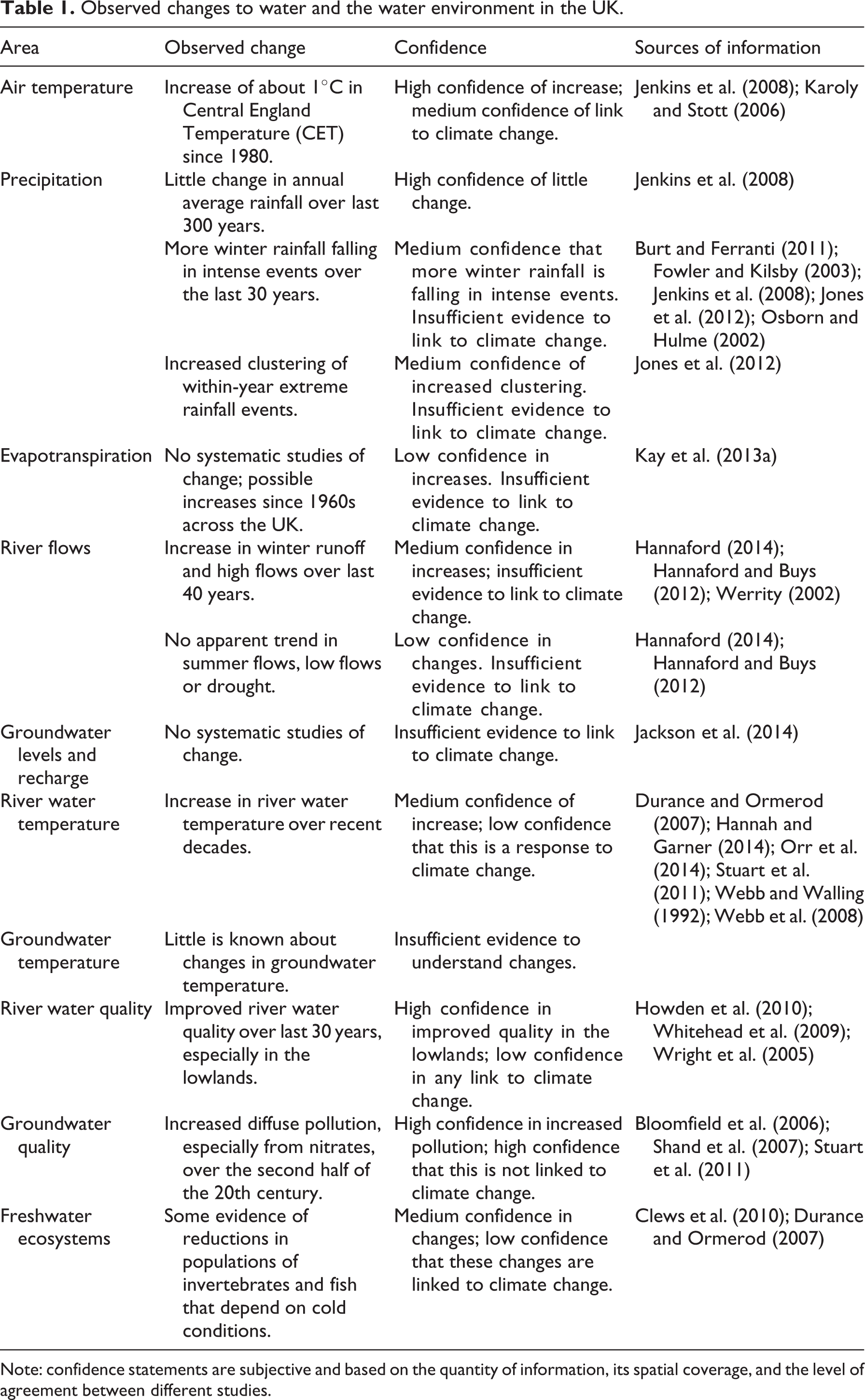
Note: confidence statements are subjective and based on the quantity of information, its spatial coverage, and the level of agreement between different studies.
5 Possible changes to the UK water cycle and water environment through the 21st century
In evaluating possible changes, it is essential to consider uncertainty in climate projections. Uncertainties in climate prediction come from three main sources: internal variability of the climate system, model uncertainty, and emissions uncertainty (Hawkins and Sutton, 2009). For many regions, including western Europe, natural climate variability is the biggest source of uncertainty for up to 30 years ahead, with greater uncertainty in precipitation projections than temperature projections (Hawkins and Sutton, 2011). Model uncertainty – the way that different GCMs simulate changes in climate for a given radiative forcing – then becomes the most important source of uncertainty (Hawkins and Sutton, 2011).
The UK has a rich and growing academic literature on the future impact of climate change, much of which covers some aspect of water or the water environment. UK-scale assessments of climate-change impacts have been conducted for river flows (Christiersen et al., 2012; Prudhomme et al., 2012), droughts (Blenkinsop and Fowler, 2007; Burke et al., 2010; Rahiz and New, 2013; Vidal and Wade, 2009), extreme rainfall (Fowler and Ekström, 2009; Fowler et al., 2007b) and floods (Kay et al., 2013b, 2013c).
6 Precipitation and evapotranspiration
The previous generation of UK climate projections, known as UKCIP02 (Jenkins et al., 2002), presented a relatively simple picture of increasingly warmer, wetter winters and hotter, drier summers through the 21st century, suggesting, for example, that by the 2080s virtually every summer may be hotter and drier than 2001. The UK Climate Projections 2009 (UKCP09; Murphy et al., 2009), on which many recent UK climate impact studies are based, generate a probabilistic ensemble of climate projections that combine climate variability and model structural uncertainty for three separate emissions scenarios (Murphy et al., 2008). The three emissions scenarios, called High, Medium and Low in UKCP09, correspond to the IPCC’s A1FI, A1B and B1 scenarios (IPCC, 2000). UKCP09 allows an explicit understanding of the possible range of climate change, though the range remains constrained by the processes represented in the climate models used in the assessment.
UKCP09 shows little change in annual average rainfall by the 2080s, with the 10th to 90th percentile range from a 16% reduction to a 14% increase for the medium emissions scenario. Seasonal precipitation changes may be greater. In winter, UKCP09 projects the biggest increases to be along the west coast, with a median change of +33% (10th to 90th percentile range +9 to +70%). In contrast, small decreases are seen in Scotland in winter (10th to 90th percentile range –11 to +7%). In summer, UKCP09’s biggest median change of about –40% is in southern England (10th to 90th percentile range –65 to –6%), with little change in northern Scotland (10th to 90th percentile range –8 to +10%). It will be noted that, by definition, there is a 20% chance of values being outside the ranges quoted. Fowler and Ekström (2009) examine changes in extreme rainfall using a range of Regional Climate Models (RCMs), finding increases in winter, spring and autumn extreme precipitation by the 2080s, with increases ranging from 5 to 30% depending on region and season. Summer changes are less clear, and changes in short-duration (sub-daily) rainfall events remain unclear, as current climate models are unreliable at these scales (Fowler et al., 2007b).
UKCP09, in common with most RCMs and GCMs, does not offer direct estimates of future evapotranspiration. It is possible to use output from climate models to calculate PE using one of the many formulae that exist, but this can be problematical. The more physically based methods are considered most accurate (e.g. Allen et al., 1998) but GCMs do not project all climate parameters with equal reliability, raising the question of whether it is better to use physically based methods with uncertain data or empirical methods with more certain data (Kingston et al., 2009). It is clear that different methods lead to different projections of potential evapotranspiration (Kay et al., 2013a), at scales from local (Kay and Davies, 2008) to global (Kingston et al., 2009).
For the UK, gridded Penman-Monteith estimates generally show increases in PE by the 2050s (Prudhomme et al., 2012) and the 2080s (Kay and Davies, 2008). Patterns of increase vary seasonally: Kay and Davies (2008) find that some months can show small decreases in PE using the Penman-Monteith formulation, but annual changes range from +6 to +56%. Temperature-based PE estimates for the UK show a similar range (e.g. Kay and Jones, 2012) but tend towards increases throughout the year (e.g. Christiersen et al., 2012; Kay and Davies, 2008).
7 River flows and groundwater levels
Much attention has been paid to possible changes in flow as a result of climate change. Most studies concentrate either on long-term changes in average flow or on changes in flood flow. A common approach is to scale historic rainfall and potential evapotranspiration time series, referred to as a perturbation or delta change approach (Fowler et al., 2007a; Prudhomme et al., 2002). This has the effect of maintaining current sequencing of wet and dry events but changing their magnitude. Identification of the scaling factors for a river catchment or other area of interest requires downscaling from a GCM, for which a variety of different methods exists, often giving different hydrological results (Fowler et al., 2007a). Combined with the uncertainty in hydrological modelling (e.g. New et al., 2007), this means that projections of changes in UK flow cover a wide range, though as the range of uncertainty is poorly sampled this is probably not the full range of possible outcomes (Arnell et al., 2013; Hall, 2008).
Two recent studies look at the impact of climate change on monthly and seasonal river flows across the UK. Christiersen et al. (2012) use the UKCP09 climate ensemble to model flows in the 2020s at 70 locations across the UK, choosing sites where the catchment is thought to be broadly undisturbed by artificial influences (Bradford and Marsh, 2003). The ensemble approach allows Christiersen et al. (2012) to draw conclusions about the range of possible changes in flow. The median projection is a reduction in spring and summer flows, a mixed pattern in autumn, and small increases in winter flows across the UK. The greatest reductions in flow are in August, with a median projection of up to 30% reduction compared to the 1961–90 baseline. For most seasons the 25th to 75th percentile range spans a range from lower to higher flows; the exception is for the summer where most sites have a reduction in flow even at the 75th percentile. This distribution leads Christiersen et al. (2012) to some confidence in a reduction in summer flows across the UK by the 2020s.
Prudhomme et al. (2012) use a different approach to examine changes in flow across Britain by the 2050s. Their model is a generalized rainfall-runoff model parameterized on catchment characteristics (Young, 2006) which means that it is possible to model natural flows at reach level across the country. Such a model needs spatially coherent climate projections; Prudhomme et al. (2012) use change factors derived from the 11-member perturbed physics ensemble of RCMs that form part of the basis of UKCP09, based on a single emissions scenario (UKCP09’s Medium scenario). These provide realizations of possible change to which it is not possible to assign probabilities, but which give some sense of spatial variability in change that cannot be gathered from the probabilistic approach of Christiersen et al. (2012). Prudhomme et al. (2012) find a mixed picture of changes in winter flow in England and Wales, with changes of –20 to +40%. In Scotland the changes in winter are smaller, in the range of ± 20%. In spring most of the ensemble has reduced flows across the UK, with reductions of up to 40%, but three of the 11 RCMs show increases in flow of up to 60% in central England. In summer, there is a more consistent picture of reduced flows with reductions of up to 80% especially in the north and west. However, even in summer in some ensemble members there are small increases in flow in some areas, most notably northeast Scotland in one scenario, and southeast England in another. Autumn changes, like spring, are mixed, with a range of –80% to +60%, with decreases appearing most frequently in southern England. Annual average flows change little across the century.
The results of Christiersen et al. (2012) and Prudhomme et al. (2012) are broadly consistent, given the different time horizons, but this is perhaps not surprising as both are derived from the same RCM results. Overall, summer flows are more likely to reduce through the century across Britain, but Prudhomme et al. (2012) demonstrate that increases remain possible.
Changes in drought frequency and severity are perhaps the most important question for water supply, but neither Christiersen et al. (2012) nor Prudhomme et al. (2012) are able to consider such changes, because the change factor approach can only scale historic weather sequences, while GCMs and therefore RCMs are not good at representing the processes (such as blocking weather patterns) that lead to the persistence of extended dry weather across northern Europe (Murphy et al., 2009). Long droughts lasting two years or more are particularly important for water supply in the UK (Marsh et al., 2007; Watts et al., 2012). Blenkinsop and Fowler (2007) consider precipitation deficit droughts in six different RCMs for the 2080s. Short summer droughts are projected to increase over most of the UK, though there is uncertainty about the sign of change in Scotland and northern England. The longest droughts are projected to become shorter and less severe in most of the RCMs. Blenkinsop and Fowler (2007) caution that climate models may not be able to simulate persistent low-rainfall events, making it difficult to draw conclusions about long droughts. In an apparently contradictory finding, Vidal and Wade (2009) use a slightly different definition of precipitation deficit drought, and find an increase in long droughts in southeast England by the end of the 21st century. Vidal and Wade (2009) agree with Blenkinsop and Fowler (2007) that disagreement between different climate models means that uncertainty is large, and that water supply planners need to consider a range of possible future droughts. Burke et al. (2010) look at droughts from three to 18 months’ duration and find an overall increase in droughts of all duration through the 21st century, though with a wide spread that spans decreases as well as increases in drought frequency. As an example, by the end of the 21st century a drought like 1976 (Doornkamp et al., 1980) could occur at anything from the current frequency (perhaps 1 in 100) to 1 in 10 years (Burke et al., 2010). Rahiz and New (2013) consider the spatial coherence of future droughts, showing that by the end of the century droughts may be more coherent, with a higher probability of droughts occurring in different areas at the same time.
Changes in flood magnitude and frequency are as interesting and important as changes in drought occurrence, and equally difficult to assess. There are two main approaches (Wilby et al., 2008): inference from projections of extreme precipitation, and downscaling from GCMs followed by hydrological simulation. Fowler et al. (2007b) use a multimodel ensemble to look at changes in extreme rainfall, dividing the UK into nine regions based on rainfall coherence. Changes in the ensemble median indicate an increase of 10–20% on 1961–90 extreme rainfall values by 2071, with more confidence about changes in 10-day values than in 1- or 2-day extremes, though the authors report considerable uncertainty in all of these changes. Fowler and Wilby (2010) confirm these projected increases in extreme rainfall across the UK in autumn and winter. Kay et al. (2013b, 2013c) use the UKCP09 probabilistic projections to estimate the range of changes in 20-year return period flood peaks for river basin regions across England, Wales and Scotland. Results showed the largest potential increases in northwest Scotland and southeast England, with the latter showing the greatest range of uncertainty, related to the balance of catchment types present as well as the range of climate change projections (Kay et al., 2013d). Bell et al. (2012) use a distributed hydrological model to examine changes in flood in the Thames catchment, southeast England, and report that for the 2080s the average estimated change in modelled 20-year return period flood peaks is +36% with a range of –11% to +68%.An emerging approach to determining the response of floods to climate change is to link synoptic features, such as atmospheric rivers, to flood occurrence directly and then determine how these features change in a warming climate (Lavers et al., 2011). For example, projections of future atmospheric rivers suggest that by the end of the century there could be a 50–100% increase in the frequency of the largest winter floods in upland Britain (Lavers et al., 2013).
Changes in rainfall and evapotranspiration will also affect groundwater recharge and groundwater levels, though there have been relatively few studies in the UK and, as yet, no national assessment. Jackson et al. (2011) use 13 different GCMs to investigate changes in recharge in a chalk aquifer in southeast England. The ensemble average suggests a 5% reduction in recharge by the 2080s, with a range extending from a 26% decrease to a 31% increase. In the projections that suggest more recharge, it may take place over a shorter period than now. There has been little work on the impact of climate change on groundwater levels, though reductions in recharge would be expected to lead to lower groundwater levels.
8 River, lake and groundwater temperature, water quality and freshwater ecosystems
Water temperature is expected to shift with climate change, but there has been little work to examine this in the UK. Worldwide, most projections are based on statistical relationships between air temperature and water temperature: these relationships are stronger at monthly resolution than daily, and weaker again at the annual resolution because water temperature varies much less than air temperature (Webb et al., 2008). George et al. (2007) suggest that in the English Lake District summer lake water temperatures may increase at a faster rate than air temperatures, with slower increases in winter lake water temperature. Van Vliet et al. (2011) demonstrate that, globally, changes in flow can be an important control on changes in water temperature, with reductions in flow leading to greater increases in river temperature; projections of predominantly reduced summer flow (Christiersen et al., 2012; Prudhomme et al., 2012) may imply enhanced increases in summer UK river water temperature through the 21st century. Future changes in groundwater temperature remain unclear.
Most chemical reactions and bacteriological processes are faster at higher water temperatures, and water temperature and light levels control the growth rate of algae and many aquatic plants (Wade et al., 2002; Whitehead and Hornberger, 1984; Whitehead et al., 2009) as well as the behaviour of aquatic animals including fish and insects (Durance and Ormerod, 2007). More intense rainfall could result in increased suspended solids (Lane et al., 2007), increased sediment yields (Wilby et al., 1997) and increases in some nutrients (George et al., 2004). Higher water temperatures may lead to increased growth of algae (Whitehead and Hornberger, 1984) and reduced flows may increase the impact of nutrients from agriculture (Whitehead et al., 2006). In the uplands, higher winter rainfall and increased storminess as well as increased summer drought could exacerbate the acidification of acidified but recovering streams and lakes (Curtis et al., 2014; Whitehead et al., 2009; Wilby, 1994). In urban environments, poorer water quality may be driven by short-duration high-intensity rainfall events (White-head et al., 2009). Groundwater quality will be affected by changes in temperature and the rate of recharge, as well as the availability of pollutants and nutrients (Bloomfield et al., 2006; Stuart et al., 2011).
What does this mean for UK freshwater ecosystems? Cold water fish species such as Arctic Charr may be threatened by increases in water temperature, with invasive fish species such as Common Carp Cyprinus carpio, European Catfish Silurus glanis and Roach Rutilus rutilus being more successful (Britton et al., 2010; Winfield et al., 2008). Similar changes already seem to be apparent in the upper Rhone (Daufresne et al., 2004). Ecosystem responses can be complex, and it is important to understand how other factors (such as water quality, light levels and flow) interact with changes in water temperature before making speculative assessments of possible change (Durance and Ormerod, 2009).
Few studies have tried to draw all these possible impacts together to understand their combined effects. Whitehead et al. (2006) use a coupled hydrological and nitrate model to investigate flow, nitrate and ammonia changes in a groundwater-fed river in southeast England, finding increases in nitrate and ammonia over the 21st century, mainly driven by higher temperatures and enhanced microbial activity. Johnson et al. (2009) bring together climate models, hydrological models and expert opinion to draw a picture of the British river of the future, concentrating on contrasting river systems in southeast and northeast England. They conclude that, with lower flows and higher temperatures, there may be more algal blooms and that ecosystems may change, with wetlands particularly vulnerable. These effects are greater in the river in southeast England. Moss et al. (2011) suggest that increasing water temperatures in shallow lakes may lead to complex responses including an increase in the abundance of planktiverous fish, increased predation of zooplankton, and increasingly severe algal blooms.
9 Summary of future impacts
It is clear that the impact of anthropogenic climate change on the water cycle and water environment in the UK could be significant (Table 2); changes in rainfall, evapotranspiration, flows and water temperature all affect water quality, ecosystem form and function, and the occurrence of droughts and floods. Approaches to understanding these effects vary greatly; rainfall, evapotranspiration and river flow have been the subject of detailed numerical assessment, but many studies tend to be either site specific or more conjectural. This affects confidence in the assessments. There is greatest confidence in the assessment of changes in air temperature, though the range of possible changes is great. Confidence in the impact on aquatic ecosystems is lowest, because of the multiple interacting drivers of change and poor understanding of the responses of and interactions between species.
Possible future changes to water in the UK.
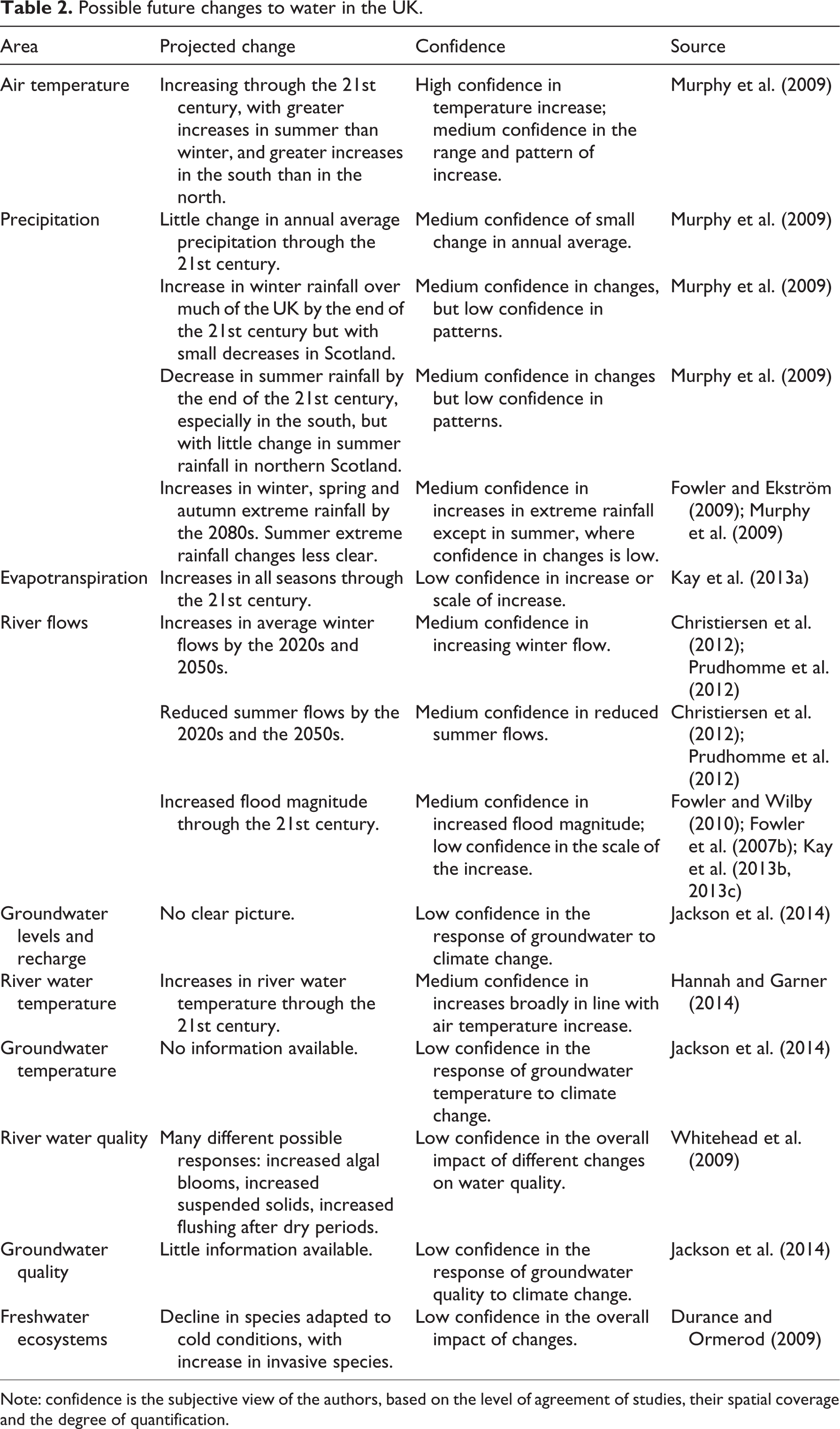
Note: confidence is the subjective view of the authors, based on the level of agreement of studies, their spatial coverage and the degree of quantification.
III Discussion and conclusions
In this paper we have summarized and synthesized research on the impact of anthropogenic climate change on the water cycle and water environment of the UK, with the aim of providing information that helps decision-makers understand and plan for the particular problems that they may face. We use the term ‘decision-makers’ in a wide sense to include all those who have a role in managing or planning water in the UK at a variety of scales; we know that these people are experts in their own fields but often lack access to credible or consistent information about how they may be affected by climate change. For this reason, our review does not try to anticipate the impacts of change beyond the natural environment or to identify the actions that should be taken to adapt to maintain water supply or to defend against floods. Decisions on such actions must take into account economic and social factors as well as other changes that affect the area in question; without in-depth analysis, recommendations for action can appear facile to the experts involved. We also aimed to identify areas where further research would be valuable, thus helping the research community meet the needs of decision-makers more effectively. Hence we divide our recommendations into two, reflecting the two different audiences for this work, though we note that many people work across science and practice, and that this apparent divide is often fluid. Indeed, this translator role is seen as increasingly important, with the IPCC noting that organizations that bridge science and decision-making ‘play an important role in the communication, transfer and development of climate-related knowledge’ (IPCC, 2014: 23).
We recommend that Work to understand how their decisions are affected by weather and climate, which may be sensitive to changes in climate and the projected changes in hydrological system response. Armed with such information, decision-makers should be able to interrogate climate change projections more effectively, understanding when and where climate change affects their work. Find ways to plan that accommodate the uncertainty in climate change projections. Uncertainties in future emissions and how the climate system will respond are accompanied by uncertainties in hydrological response. It is also important to set climate change in its wider context; where the planning horizon is short – perhaps 20 years or less – climate variability will dominate (Hawkins and Sutton, 2011) and for all time horizons other social and economic changes will always be of importance (Wade et al., 2013). Work with academics to set the research agenda (note that we mirror this in our recommendations for researchers). If decision-makers expect research to support their work, they should engage actively from the outset, identifying clearly how research can contribute to their planning and decisions. At the same time, decision-makers need to be realistic about how research can support their decisions, and in particular should not hope that research will solve all their problems; the expertise of decision-makers themselves will be vital in understanding and adapting to the impacts of climate change.
We recommend that Find ways to be clear about uncertainty and confidence, bearing in mind that the two are readily conflated by non-specialists trying to understand the relevance of research. While some papers have very good discussions of the two, others are less convincing and may leave the reader confused. Work to make sure that the main points of their work are accessible to non-specialists. There are still too many academic papers where important findings may be obfuscated by the language used or the way the results are presented. If researchers want their research to be relevant, they need to find ways to make sure that it can be understood by experts from other fields. This may include alternative presentations that complement the academic paper, though in preparing such alternatives academic standards and rigour must be maintained. Work with decision-makers to understand their needs and identify how research can help to meet these needs (note that this mirrors the equivalent recommendation for decision-makers). Engagement from the beginning to the end of a project will yield results that are relevant and have genuine impact, but this requires considerable time from both parties, and may be particularly difficult for decision-makers who are not funded for such activities. Researchers sometimes seem to disengage when the academic paper is submitted, but without continued involvement their research may never be embedded in practice.
We believe that scientific syntheses like this and the LWEC water climate impact report card (Watts and Anderson, 2013) play a valuable role in bridging the gap between research and practice, and indeed between researchers and practitioners. It would be valuable to expand this water review to cover other areas that have not been considered in detail here, such as snow and snow melt, estuaries, built environments and water use. It would also be useful to consider the specific questions of different geographical areas, such as the uplands and wetlands, and the impact of changes in freshwater temperatures, flows and quality on the marine environment.
Despite the growing body of literature on the impact of climate change on the UK water environment, there are several areas where more research would be of value: Changes in historical and future evapotranspiration are still poorly understood (Kay et al., 2013a); as different studies calculate evapotranspiration in different ways, it can be hard for practitioners to ensure consistency between baseline and future projections. Droughts are important for water supply, power generation and agriculture. As the droughts with the biggest impact in the UK tend to be both prolonged and spatially coherent, there are relatively few in the historical record (Marsh et al., 2007, provide a valuable catalogue). This means that historical droughts may provide a poor basis for future planning – even if (say) 1976 represents a difficult drought in one place, it may have been less severe elsewhere and planning for a repeat of this drought may be unnecessarily precautionary in some places but over-cautious in others. Projections of future drought are currently limited by the poor understanding of the drivers of long drought and the apparent inability of climate models to reproduce persistent periods of low rainfall in the UK. Improvements in climate modelling may lead to more reliable drought projections, but in any case it would be valuable both to improve understanding of hydrological response to historical droughts and to investigate the level to which systems, such as water supply systems, are resilient to drought. Future flooding also remains a difficult area; intense rainfall (particularly summer convective storms) occurs at scales that cannot readily be resolved by current climate models, which is particularly problematical where future flood risk in small catchments is in question. Improvements to climate models may lead to better projections of intense rainfall events, but it would be valuable also to continue work to understand how catchments respond to different events. Further work to understand the physical processes that lead to widespread flooding (e.g. atmospheric rivers; Lavers et al., 2011) could lead to improved understanding of future floods. The impact of climate change on groundwater levels and quality is unclear. Baseline groundwater temperatures are poorly understood but groundwater contributes much of the summer flow in some rivers and streams, directly influencing water temperature. The way that aquatic ecosystems respond to climate change remains uncertain, both because many ecosystems are robust to considerable climate variability and because of the complex relationships between flow, water temperature, light, water quality and ecosystem response. High-frequency monitoring (for example, hourly) may help to understand these complex interactions (Wade et al., 2012). High-quality, long-term monitoring programmes are essential in understanding and explaining change, and long records are especially important in detecting and monitoring change and evaluating the effectiveness of adaptation measures.
Perhaps most importantly, it is apparent that there are few studies of change in water and the water environment at scales that help policy-makers and decision-makers examine responses to the problems they face. Large-scale, regional or countrywide assessments are perhaps inevitably compromised by their general nature, but these are the studies that provide the picture of change that decision-makers find most useful. Consistent approaches applied across wide areas allow for comparison between places, identifying the areas at most risk from different water hazards: this is especially important when funds are limited and must be spent where they can deliver the greatest benefits. The next UK Climate Change Risk Assessment, due in 2017, may present a valuable focus for such work. By working together, decision-makers and researchers can identify targeted research that should have genuine impact in improving understanding of the potential effect of climate change on water in the UK.
Footnotes
Acknowledgements
This work was steered by the Living With Environmental Change (LWEC) partnership. An earlier, longer draft of this paper formed an LWEC working paper. The authors are grateful to Catherine Wright, Molly Anderson and Neil Veitch from the Environment Agency and to Nikki van Dijk from Atkins Global for their guidance and support. Many people provided helpful input to the approach, including the informal working group comprising Konrad Bishop, Jim Hall, Kathryn Humphrey, Hans Jensen, Nick Reynard, Andrew Wade and Steven Wade. Nigel Arnell, Hayley Fowler and Jason Lowe made valuable comments on an early draft. Thanks to Stephen Maberly for helpful comments on a later draft. Bloomfield, Jackson, Mackay and Stuart publish with the permission of the Executive Director of the British Geological Survey (Natural Environment Research Council). The views expressed in this paper are those of the authors alone, and not the organizations for which they work. We thank an anonymous referee for thorough and careful comments that greatly improved the final paper.
Funding
This work was funded by the UK Department for Environment, Food and Rural Affairs (Defra) (project WC1052) and supported by the Natural Environment Research Council and the Environment Agency.