




Abstract
Rural regions encompass a wide variety of contexts, often facing challenges such as population decline and ageing, or limited infrastructure and services. Yet, rural territories can also be unique places for experimentation and serve as sites of transformative, sustainability-oriented development. We contribute with a theoretical perspective on rural transition pathways that connects rural pre-conditions across industrial, social, and ecological dimensions with distinct varieties of innovation – technological, community-based, and nature-based – and with system effects achieved through two key elements: change agency and rescaling. We identify four archetypes of transition pathways grounded in theoretical differences in the processes leading to system change.
Keywords
Introduction
Sustainable and inclusive development of rural areas has become a key topic in the public and scientific debate. This has been prompted by the realization that many of the rural regions are becoming increasingly “left behind.” Growing socio-economic inequalities and exclusions affecting rural areas lead to profound social and political shake ups including voting for extremist parties, protests, and increasing sentiments of discontent (De Ruyter et al., 2021; Dijkstra et al., 2020; McCann, 2020; McGuinn et al., 2024; Pike et al., 2024; Tomaney et al., 2024). In this discourse, rural is often used interchangeably with peripheral, non-core, lagging, or left behind (Nilsen et al., 2023; Pugh and Ding, 2026; Pugh and Dubois, 2021). Yet, in contrast to the notion of “left-behind” and “lagging,” some rural regions have successfully developed transformative and sustainability-oriented pathways (Chaminade and Randelli, 2020; Chlebna and Mattes, 2020; Grillitsch et al., 2025b; Morales and Dahlström, 2023; Pinzón-Camargo et al., 2022; Sotarauta et al., 2023; Suitner et al., 2023). Furthermore, rural regions are not all the same. They display a wide range of differences in terms of their regional profiles, localized challenges, and pioneered solutions. Hence, rural regions are relative, evolving, and diverse (Nilsen et al., 2023; Pugh and Dubois, 2021).
It is this variety of rural contexts this paper steps into and asks: How can transition pathways in rural areas be conceptualized? Which forms of rural transition pathways exist? Why and how do they differ?
The notion of “transition pathway” depicts a process characterized by a sequence of events leading up to a system change. The logic of system change is that the complexity of required solutions to grand challenges transcends technological and market-oriented solutions and requires a “co-evolution of technologies, institutions and societal developments as sources for broader socio-economic changes” (Schwaag Serger and Palmberg, 2022, 150). Following this rationale, the focus of innovation and regional development policy is expanding to embrace a new paradigm that promotes green regional development (Tödtling et al., 2020), sustainable inclusive growth (Moujaes, 2023), and socio-technical change for addressing grand challenges through innovation policy (Isaksen et al., 2022). The aim of transformative innovation is to realize green and just regional path development (Eadson and Van Veelen, 2023). These optimistic perspectives, however, offer limited insight on challenges faced by many rural areas, including depopulation and “shrinking” (Syssner, 2023) or limited infrastructure and services.
It is important to note also that pathways are increasingly entering the regional development parlance and have a strong precedence in the field of economic geography in a theoretical sense (Henning et al., 2013; Pugh et al., 2024b). The concept of path development is concerned with processes and dynamics surrounding the emergence and growth of new activities and industries at the regional level (MacKinnon et al., 2019). Path dependence has been employed to understand dynamics of lock-in and economic decline (Hassink, 2005), but also renewal (Tödtling and Trippl, 2004). Contemporary work in this area places a focus on change and new paths (Grillitsch et al., 2018), but also on the interdependence between path evolutions (Frangenheim et al., 2020). From its more academic roots, the concept of pathways has been employed in policy terms, for example being used by the Directorate-General for Regional and Urban Policy (DG REGIO) of the European Commission in a toolkit “supporting sustainability transitions under the European Green Deal with Cohesion Policy” (European Commission, 2021). Pathways are herein used instrumentally: nations or regions should formulate a vision, operationalise a set of goals and then identify pathways to achieve these goals, translating pathways into a set of actions.
Against this backdrop, this paper contributes with a theoretical perspective on rural transition pathways, basing it on varieties of pre-conditions for transition pathways in rural regions, different types of innovation as drivers of change at the micro-level, and mechanisms for contributing to system change at the meso-level. To develop this theoretical perspective, we combine different streams of literature that help to identify broadly the conditions for sustainable development in rural areas drawing on insights from regional industrial path development (Hassink et al., 2019; MacKinnon et al., 2019), the foundational economy providing for the services and infrastructure covering basic human need (Foundational Economy Collective, 2022; Henderson et al., 2024), and literature on ecosystem services to cover the ecological dimension (Hasan et al., 2020; Millennium Ecosystem Assessment, 2005). As regards mechanisms of change, we take a bottom-up perspective introducing a broad view of innovation, including social innovation (Marques et al., 2018; Moulaert et al., 2013) and nature-based innovation, which is rooted in the literature on nature-based solutions (Cohen-Shacham et al., 2016; Seddon, 2022). We then argue that escalating such innovations to system effects in rural contexts and beyond necessitates a wider perspective on change agency (Grillitsch and Sotarauta, 2020; Kinossian et al., 2024) and rescaling dynamics (Grillitsch et al., 2025a; Miorner et al., 2025), including for instance institutional entrepreneurship (Battilana et al., 2009; DiMaggio, 1988) and leadership (Gibney et al., 2009; Sotarauta and Beer, 2021). Using these theoretical perspectives, the paper identifies four archetypes of rural transition pathways, which are based on fundamental differences in pre-conditions, innovation processes, and drivers of system change.
The paper proceeds with introducing the theoretical building blocks of rural transition pathways in section 2 and continues thereafter with identifying archetypes of transition pathways in section 3. Section 4 provides the conclusion reflecting on the scientific and policy relevance of the paper.
Theoretical building blocks of rural transition pathways
This section conceptualises rural transition pathways as theories of system change with three distinct elements that result from (i) rural pre-conditions, (ii) varieties of innovation, and (iii) system effects, each of which will be introduced below.
Rural pre-conditions for transition pathways
Typology of rural areas in relation to industrial, social, and ecological conditions.
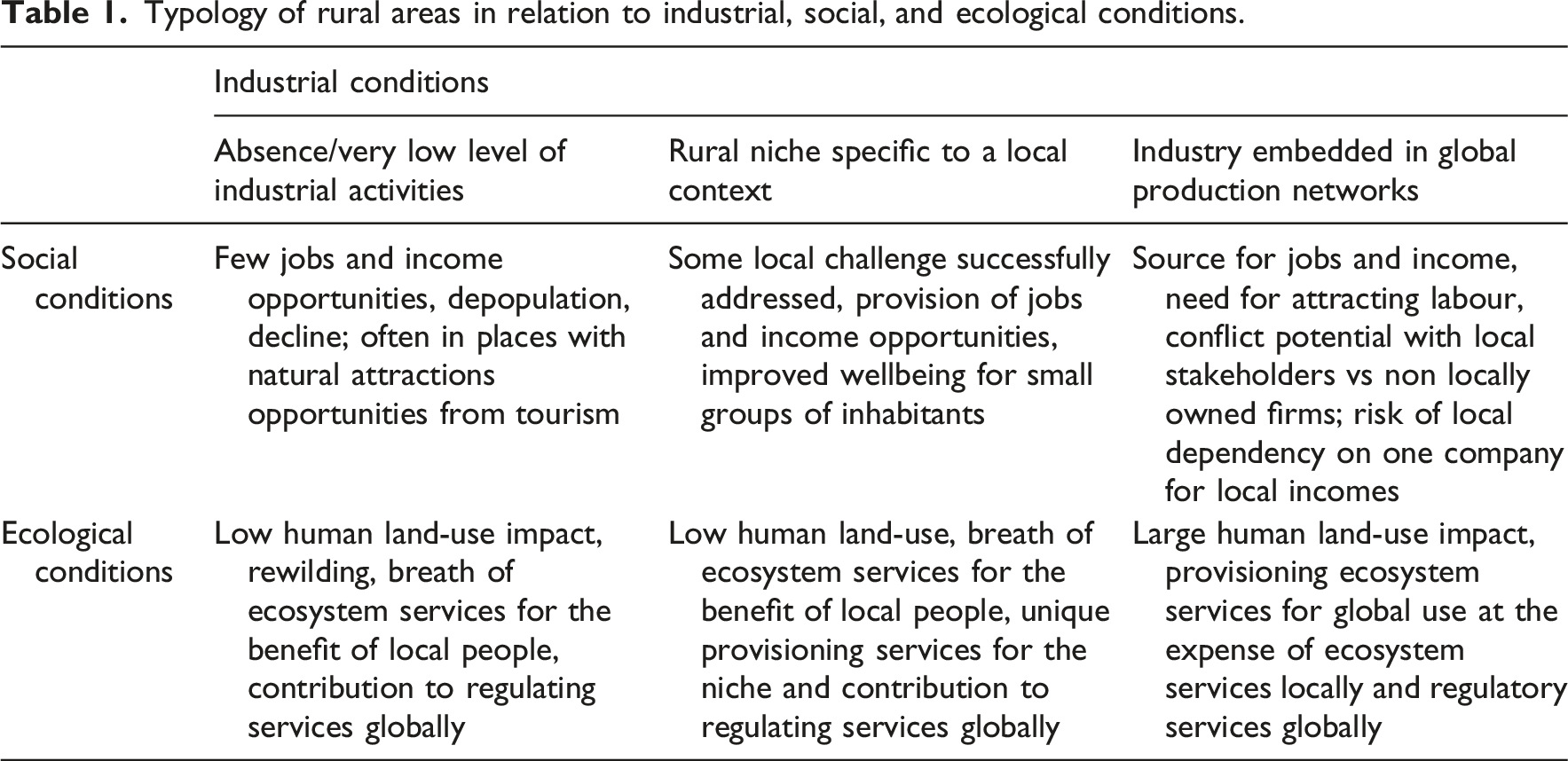
The industrial dimension encompasses the development of industrial paths in a particular rural context, which could range from manufacturing to service sectors like tourism, or extractive industries such as mining. Industrial paths capture processes of emergence, growth, renewal, and decline of industrial activities in regions (Blažek et al., 2020; Grillitsch and Hansen, 2019; Hassink et al., 2019; MacKinnon et al., 2019; Martin and Sunley, 2006). While covering sectors beyond manufacturing, the notion of industrial activities is here understood more narrowly than economic activities in general. This is to reduce the overlap with the foundational economy, which provides the services and infrastructure essential for the social dimension (see below). Furthermore, with the notion of industry, we also emphasise tradable economic activities, which tend to be embedded in global production networks and exposed to competition (Henderson et al., 2002; Yeung and Coe, 2015). Yet, rural contexts can also create conditions that protect tradable industrial activities from global competition. The latter would refer to a niche were some rural specificities created shielding conditions: for instance, the lack of infrastructure or connectivity can lead to local solutions for energy supply (e.g. Simmie, 2012).
The social dimension focuses on the wellbeing of people in rural areas. This encompasses the opportunities for jobs and income as well as the provision of foundational infrastructure and services that are important for wellbeing (Bentham et al., 2013; Hansen, 2022; Martynovich et al., 2021). Bernard et al. (2023) suggest that the wellbeing of people depend besides labour market opportunities on the provision of public and private services, the natural and built environment, and opportunities for community and civic engagement. This implies that the social dimension is linked to the presence of industrial activities because industrial activities are providing job and income opportunities, which in turn influence migration patterns and the demography of the place, and thereby also the tax income available to local governance to fund foundational infrastructure and services. Social conditions also relate to services and amenities provided that ensure health, wellbeing, and community resources to people living in rural areas.
The ecological dimension centres around the land-use in rural contexts and its effect on ecosystem services (Angeon et al., 2024; Collins et al., 2011; Hasan et al., 2020). The ecological dimension relates to the industrial and social dimensions from a land-use and ecosystem services perspective. Ecosystem services have been classified in four types (Millennium Ecosystem Assessment, 2005): (i) provisioning services which relates to tangible products such as food, fish, fibre, water, raw materials, minerals, etc. (ii) cultural services covering intangible benefits related to for instance recreational, spiritual, or aesthetic experiences and values, (iii) supporting services that are underlying functions enabling other services such as primary production (photosynthesis) or soil formation, and (iv) regulating services that are important for the long-term functioning such as ecological dynamics, purification, and decomposition, or climate regulation. The ecosystem services are multi-scalar with trade-offs and synergies where for instance provisioning services can serve a global industry/market at the expense of provisioning services locally.
Having defined the three dimensions of sustainability, we now frame typical rural pre-conditions for regional development in relation to these three dimensions. As we show below, industrial, social and ecological conditions in rural regions will often be interdependent. We first zoom in on rural regions that have lost industrial activities, have never had industrial activities, or only host marginal and isolated industrial activities. These industrial conditions imply that such regions lack jobs and income opportunities, which tends to lead to depopulation, decline, and a feeling of discontent, being “left behind” and not to matter for the city elites (Economist, 2017; McCann, 2020; Rodríguez-Pose, 2018). The social problems associated with such decline can be severe and aggravated by difficulties to fund the public services needed for an ageing population including health and elderly care. In addition, such regions will have low capabilities due to limited educational possibilities, outmigration and a lack of resources. As regards the ecological dimension, such rural areas will tend to have a low ecological impact. As people move out, depleted areas expand in such rural regions, which may lead to a rewilding of the ecological system. Due to the small human land-use impact, there is the potential for a breath of ecosystem services for the benefit of local people, which contributes also to regulating ecosystem services globally.
Second, we find rural areas that have developed a rural niche, related to the rural specificities of place. Hence, we are not talking about any niche but niches that emerge in the context of for instance the lack of connectivity, or specific rural social and ecological conditions. For instance, such niches may address local energy challenges facing a lack of connectivity to grids (e.g. Simmie, 2012) or may involve slow food where local ingredients and practices link local consumers and producers (e.g. Miele and Murdoch, 2002). Here, some local challenges are successfully addressed, and some jobs and income opportunities are created. Such rural regions could have an improved wellbeing as compared to the previous type of regions due to the successes of their developed niches. Industrial activities tend to remain, however, rather small scale and thus have a limited ecological impact both locally and globally. Ecosystem services will be relevant for local people but may also provide unique provisioning services for the niche and contribute to regulating services globally.
Third, there are rural areas that have a heavy industrial profile and are embedded in global production networks. Such regions often (but not always) extract and exploit natural resources such as in mining, agriculture, fishery, or forestry or are a location of energy plants (e.g. nuclear or renewable energy). These economic activities are often conducted at a large scale and the main companies are often not locally owned. The industry is a source of jobs and income often beyond what the local labour market can provide, necessitating efforts to attract and retain workers. Challenges such as the reliance on a fly-in fly-out workforce or the competition for residential space and local services can emerge (Morales and Atienza, 2022; Stihl, 2022), potentially leading to conflicts with local stakeholders due to factors like rising costs and repercussions on other local activities. However, such industries can also become part of the regional identity. The land-use impact of these activities tends to be large where provisioning services are extracted for global industry/markets at the expense of ecosystem services locally and regulatory services globally.
The conditions in the different dimensions do not necessarily coincide as suggested in the table. For instance, due to automation, it may be the case that a heavy industrial specialisation does not provide many jobs and income opportunities. Similarly, there could be instances of a strong industrial profile with limited ecological impact, or rural areas heavily affected by climate change or pollution without having an industrial profile. Yet, conceptualising the industrial, social, and ecological dimension in this way reflects interlinkages between the dimensions and will become useful to discuss specific types of transition pathways, recognising that in any region combinations of such pathways may be possible.
Furthermore, while the industrial, social, and ecological conditions anchor potential rural transition pathways in diverse structural materialities, this does not translate automatically in a set of actionable options. As Flanagan et al. (2023) elaborate, local actors engage in framing problems and solutions and evaluating options, which consequently legitimatizes certain transition pathways over others. Hence, even though sets of conditions may be similar across rural regions, there will be variation in how local actors perceive opportunities and challenges (Roessler et al., 2025). For instance, it might be that in some rural regions the local ecological impact of industrial activities is not perceived as a problem and thus won’t mobilise actors, while the opposite may be the case in other rural regions. Also, while local conditions may be similar, actor compositions are never identical, which means that actors’ interest and capabilities may differ, and consequently also the range of possible transition pathways. This also means that transition pathways cannot be predicted or explained from industrial, social, or ecological conditions but depend heavily on agency – varieties of innovation, and the involvement of actors in creating system effects as discussed below. As a result, similar structural conditions may give rise not only to different pathways, but also to tensions and trade-offs between co-existing or competing development trajectories.
Varieties of innovation
The idea that innovation can only strive in knowledge-intensive urban areas has been debunked (Eder, 2018; Pugh et al., 2024a; Shearmur, 2012). Embarking from the position that knowledge is the most fundamental resource and learning the most important process (paraphrasing Lundvall and Johnson, 1994: p. 107), firms located in rural regions often need to compensate for a lack of knowledge available locally (Johansson and Quigley, 2004). Establishing linkages outside the region is one mechanism to do so, which is accessible particularly for firms with strong in-house capacities (Grillitsch and Nilsson, 2015). Building such absorptive capacities in rural areas requires both retention and attraction of qualified staff from outside the region (Meili and Shearmur, 2019). Furthermore, in rural areas innovations tend to dominate in domains where information and knowledge decays slower (e.g. in engineering) than in domains where the decay is faster (e.g. in fashion) (Shearmur and Doloreux, 2016). Recent studies have gone beyond the idea of innovation “despite” being located in the periphery (emphasising compensation mechanisms) and suggest that the rural context can also have advantages for innovation (Eder and Trippl, 2019; Glückler et al., 2022). Among the advantages are that rural areas can protect firms from competition on labour markets and from knowledge leakage (Grillitsch and Nilsson, 2017). Yet, rural areas may offer also distinct advantages in terms of natural and cultural resources, giving room for creativity and experimentation (Grabher, 2018). Furthermore, a location in rural areas does not necessarily imply isolation as creative actors can engage in translocal processes connecting the urban with the rural (Mathisen et al., 2024).
To capture the full potential of innovation in rural development addressing all dimensions of sustainable development, we advocate for a broad conception of innovation. Even though much emphasis has been placed on technological innovations in the last decades, the original use of the term referred to bringing about social and cultural change (Godin, 2012; Moulaert et al., 2017). While any innovation concerns the implementation of new (combinations of) ideas or knowledge leading to improved or new ways of doing things, which add (economic or social) value, two necessary features distinguish technological from social innovations: the focus on a human need, and the promotion of inclusive social relations, often in the form of bottom-up collective initiatives. Furthermore, such initiatives often emerge because certain human needs are not sufficiently addressed by the market or public sector, and the initiatives therefore often target public domains like health, education, or care (Galego et al., 2022; Marques et al., 2018). Social innovations are considered important for development in rural areas (Castro-Arce and Vanclay, 2020). Rural areas often have a larger need for social innovation due to a relative scarcity of resources, and tighter social relations may facilitate the mobilisation of collective action and coordination between actor groups for social innovation (Steiner et al., 2023).
Besides technological and social innovations, we suggest that innovation addressing the ecological dimension needs to be explicitly considered to arrive at a comprehensive understanding of transition pathways in rural areas. The concept of nature-based solutions speaks to this end, defined as “actions that involve people working with nature, as part of nature, to address societal challenges, providing benefits for both human well-being and biodiversity” (Seddon, 2022, 1). It concerns the sustainable protection, management, and restoration of natural and modified ecosystems (Cohen-Shacham et al., 2016, 4). The concept is rooted in the ecosystem approach and operationalises how ecosystem services can be maintained and enhanced through innovative action (Faivre et al., 2017). These actions are thought to be “inspired by, supported by or copied from nature” (European Commission, 2015, 4). In a rural context, nature-based solutions have the potential to contribute to reducing people’s vulnerability to climate change (Woroniecki et al., 2023), and possibly also to providing sustainable economic opportunities (Maes and Jacobs, 2017). Putting emphasis on agentic processes designed to address societal challenges in rural areas, we slightly reframe the concept to “nature-based innovations.” Thus, while social innovations have the distinguishing features to (i) address a human need and (ii) entail inclusive social relations, we suggest that nature-based innovations (i) positively affect ecosystem services, and (ii) involve people engaging directly with nature.
System effects
In the theory of change proposed in this paper, innovation needs to be paired with other mechanisms to escalate into system change locally and beyond. In the context of local and regional development, Grillitsch and Sotarauta (2020) have argued that besides innovation, institutional entrepreneurship and place-based leadership are relevant types of change agency, which often complement each other. Institutional entrepreneurship is about changing existing or introducing new formal (e.g. laws and regulations) or informal (e.g. conventions and norms) institutions (Battilana et al., 2009; DiMaggio, 1988). It is widely acknowledged that institutions affect regional development processes (Rodríguez-Pose, 2013; Sotarauta and Pulkkinen, 2011) and the creation of new development paths (MacKinnon et al., 2022, Chlebna and Simmie, 2018). Changing narratives, mindsets and worldviews, and breaking-up old coalitions of power opens the possibility for new directions and momentum in rural development (Rekers and Stihl, 2021, Uyarra and Flanagan, 2022). Place-based leadership concerns navigating the interests of many actors, identifying and developing joint development objectives, and orchestrating and pooling competencies, resources and power to achieve these objectives (Gibney et al., 2009; Sotarauta and Beer, 2021). Place-based leadership makes collective action possible by bringing together the variety of actors relevant for regional development who operate under different institutional logics, have different interests, and capacities (Beer et al., 2019). The combination of the different types of change agency has turned out effective in a variety of global north and south contexts (Grillitsch et al., 2023; Hutchinson and Eversole, 2023; Pinzón-Camargo et al., 2022).
That said, change agency is a very specific form of agency where actors intentionally, purposively, and meaningfully engage to realise alternative futures (Grillitsch and Sotarauta, 2020). Agency is also the driver for maintaining or reproducing existing structures. Institutional work to maintain structures can play an important role for regional development, for instance, in terms of maintaining the community, uphold an entrepreneurial culture, or innovation systems (Henderson, 2020; Lawrence et al., 2009). However, maintenance or reproductive agency can also hinder change and produce lock-ins (Jolly et al., 2020). Change agency is more relevant in phases when new regional development paths are created while maintenance agency arguably dominates in the extension of regional development paths (Bækkelund, 2021). Hence, which transition pathways are possible will depend on the possibilities to mobilise change agency and the strength of maintenance agency, which in turn builds on the perception of opportunities, the framing of problems and solutions, the evaluation of options, and consequently, the legitimacy of certain transition pathways (Flanagan et al., 2023). The interaction between change and maintenance agency may generate tensions and conflicts between actors, reflecting differences in interests, power, and visions of regional development. In this sense, transition pathways are not only enabled by agency, but also negotiated and contested through ongoing struggles between competing actors and institutional logics.
To capture the mechanisms producing system change beyond the concrete rural context, we suggest using an agentic perspective on the notion of rescaling, where actors engage to change rationales, conditions and relationships beyond the local scale and thereby influence wider systems. Rescaling captures a complex process in which spatio-temporal, socio-institutional, and techno-economic dimensions are entangled (Grillitsch et al., 2025a). First, rescaling would entail a diffusion of the rural innovation in time and space, making the spatio-temporal dimension a necessary analytical angle. However, it also situates rescaling processes in a specific spatial and temporal context necessary to understand and explain a specific transition process (Asheim, 2020; Martin and Sunley, 2022). Actors and their possibilities to diffuse innovations are, however, constrained by technologies and institutional architectures (Hägerstrand, 1970), drawing attention to the other two dimensions.
Socio-institutional rescaling concerns the engagement of actors to un(structure) informal and formal institutions and to (dis)integrate social practices (Fuenfschilling and Truffer, 2014). Local actors may engage at different scales to create a more favourable socio-institutional environment for the diffusion of the innovation produced in a local context (Simmie, 2012). In the literature, different mechanisms have been identified such as translating workable solutions in a (rural) niche to workable solutions in other contexts and other scales (Smith, 2007), establishing conventions and standards based on the configuration that works in a local context (Roebke et al., 2022), or developing configurational templates that could be applied in other contexts (Miorner et al., 2025). However, while we foreground socio-institutional rescaling as agentic process, it is important to remind that external events outside the influence of local actors may shape the possibilities for rural innovations to diffuse (e.g. regulatory change at the EU level) (Coenen et al., 2014). Moreover, institutional change and discourses at or beyond the national scale can influence and actively be integrated by local actors to drive socio-institutional change and affect the direction of development (Roessler et al., 2025).
Techno-economic rescaling concerns changing the scale of economic activities, and economies of scale, which are based on choices of economic actors and the available technologies (Nelson, 1980; Perez, 2009). Relating this to the context of rural innovation, two main scenarios are thinkable: (i) that the rather small-scale rural innovation can be upscaled, which would require further innovation in the product design and production process, and (ii) that the configurations developed in the rural contexts are small-scale workable alternatives to other existing configurations, which are then replicated in adapted form in other contexts. In both cases, the techno-economic scale and potential rescaling would be a distinguishing feature of the transition pathway.
Figure 1 summarises transition pathways as theories of system change, which are rooted in a relational understanding between structure and agency. Following a critical realist approach (Archer, 1982; Grillitsch et al., 2023), we situate the interplay between structure and agency in a temporal dimension. Accordingly, structure – sets of rural pre-conditions in our case – always precede agency and are thus the starting point for rural transition pathways. Considering industrial, social and ecological dimensions of rural realities, we argue that different types of innovation can spark a rural transition pathway. From there, we see the necessity of change agency to create system impacts locally, for instance, by coordinating actors, mobilising resources, or legitimizing a certain path. By engaging in innovation and change agency, rural pre-conditions will be altered, which is why we also indicate arrows in the reverse direction. In the context of regional development, we also know that change processes do not necessarily start with innovation, but that innovation can also result from institutional changes, or place-based leadership (Grillitsch and Sotarauta, 2020; Rekers and Stihl, 2021). Rural transition pathways.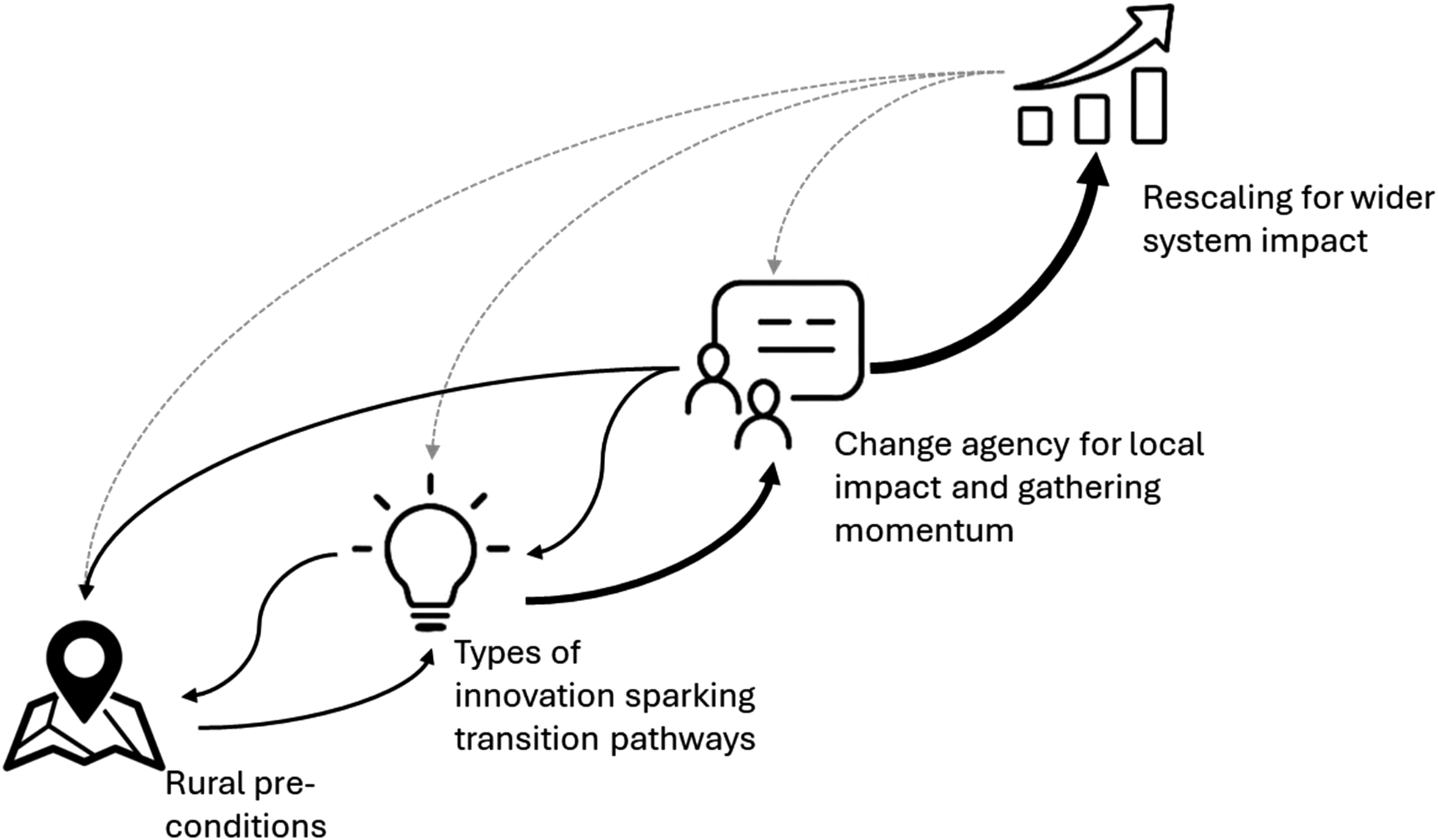
The scope of this paper is to focus on transition pathways sparked by different types of innovation. We argue that wider system impact spirals out from the rural dynamics through rescaling processes, which require actors’ engagement in different ways. A change of the wider systems in which rural regions are embedded (e.g. national, technological, sectoral, or global innovation systems), will then potentially also affect rural pre-conditions, and possibilities for agency. As these effects are less direct than the local processes, the feedback arrows are drawn in lighter colour.
Rural transition pathway archetypes
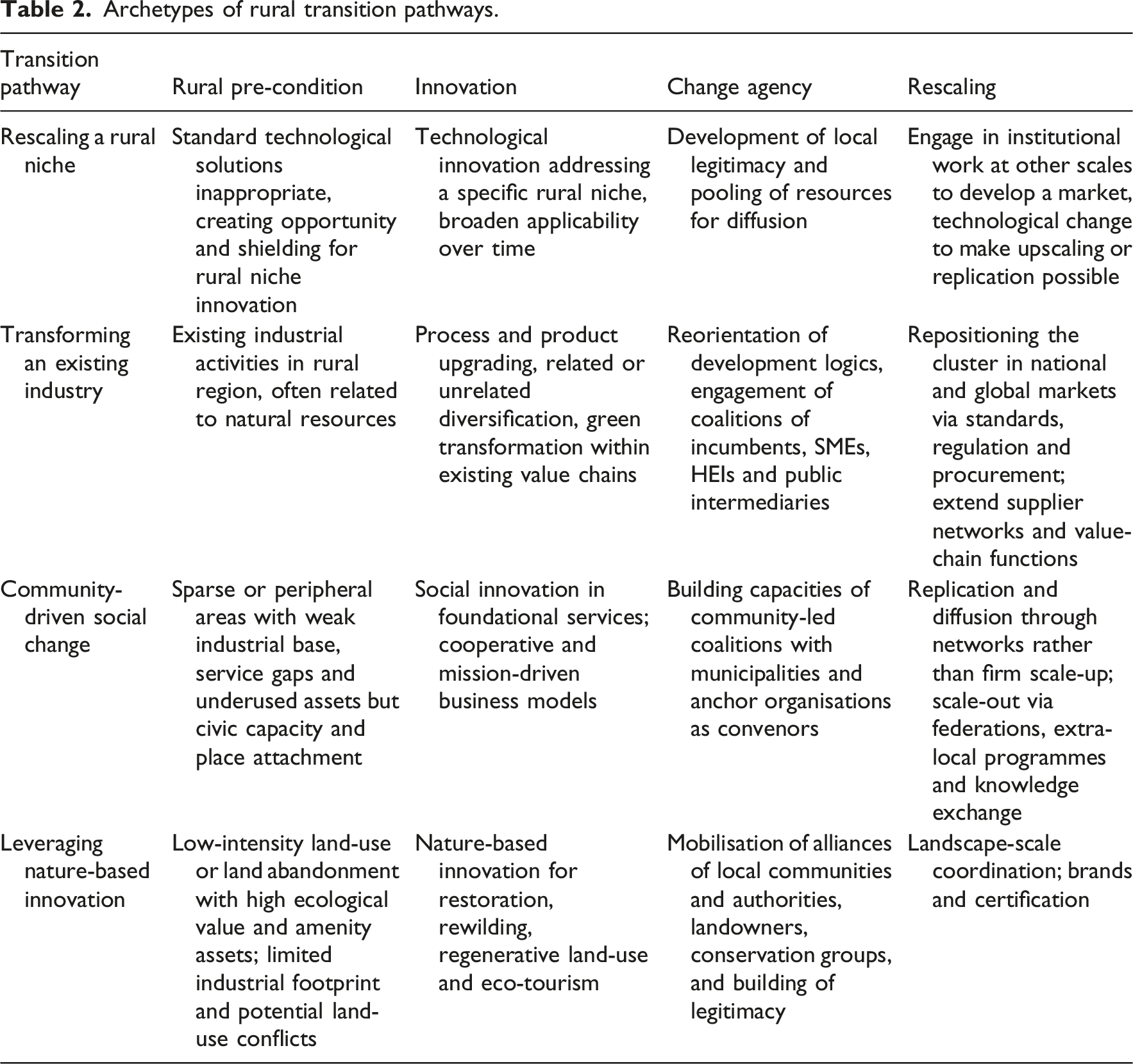
In this section, we elaborate on four archetypes of rural transition pathways, which are plausible combinations of industrial, social, and ecological conditions (see section 2.1), different types of innovation (see section 2.2), and mechanisms for driving system change within and beyond the rural context (see section 2.3). Each archetype is based on previous theoretical and empirical research and made tangible with an empirical illustration from the literature. We claim that the identified archetypes represent plausible but not necessarily exclusive theories of system change in rural regions. In particular, the literature is scarce about transformations of social and ecological conditions.
Archetypes of rural transition pathways.
Rescaling a rural niche
The starting point for this transition pathway is a rural niche (see section 2.1), which is based on a technological innovation tailored to a specific rural context protecting it from global competition because of, for example, shortcomings as regards connectivity, infrastructure, or agglomeration economies, or because of place-based community-driven dynamics. Rescaling can happen when an institutional change creates a larger market for the locally developed niche activities.
Empirical illustration
A case in point is the introduction of wind power technologies in Denmark (Simmie, 2012). Accordingly, many rural areas in Denmark lacked connection to grid supplied electricity in the beginning of the 20th century, and the supply of diesel for electricity generators was uncertain due to restrictions imposed after the Second World War. The lack of connectivity and infrastructure in the rural areas created both a niche and demand for local solutions to energy generation. In the early phases of wind power technology development, innovative entrepreneurs played an important role with a first windmill for electric power generation constructed in 1891. What follows are a series of improvements of the wind power technology by pioneers aiming to develop wind power generators that could provide electricity at a scale and at a price that energy companies utility companies could accept and was commercially viable. In this phase, the pioneers travelled and sought inspiration from outside the region and had university collaborations. Public funding was also important to realise the early attempts to develop wind power technologies.
According to Garud and Karnøe (2003) the Danish wind energy cluster grew through a gradual, hands-on process in which small firms, users, test engineers, and policymakers steadily improved simple early turbine designs through continual feedback and practical experimentation. Close collaboration among producers, owner-users, and the Danish Wind Turbine Test Station created shared learning, comparative testing, and incremental scaling that strengthened reliability and performance over time. Consistent but flexible state support helped stabilise this emerging system, allowing Danish firms to build strong capabilities and eventually dominate global wind turbine markets. Karnøe et al. (2022) show how reports, subsidy schemes, and grid-integration tools worked together to qualify wind power as socially legitimate, economically investable, and technically reliable, while recurring concerns such as subsidies, local opposition, and grid constraints repeatedly required reframing. Over time, these intertwined processes produced a market arrangement that continually adapted to overflows, allowing Danish wind power to evolve into a central and widely accepted part of the national energy system. However, taking a critical viewpoint of recent developments, Kirkegaard et al. (2023) show that the Danish wind energy market shifted from early local cooperatives to a system dominated by large private developers due to changes in support schemes, rising turbine costs, financial regulations, and the growing use of competitive tenders that favour actors with strong capital and scale advantages. This new market assemblage, built through devices such as tender rules, financial thresholds, algorithms, and planning instruments, has largely marginalised renewable energy communities by narrowing the space in which citizen-owned projects can compete. Through two failed intervention attempts by the NGO Wind People, the paper illustrates how activists lacked the calculative tools, capital, and institutional alignment needed to reframe the market, revealing how power increasingly rests with actors who control the dominant market devices. Hence, this case showcases a transformation from a small-scale niche market to a global industry, which also includes an increasing consolidation of power and control.
Stylized transition pathway
Innovation
The innovation process is characterised by introducing and improving a technological innovation, which solves a problem in a narrow and small rural niche (Garud and Karnøe, 2003). The further development to make the innovations viable and competitive on broader markets often requires combinatorial knowledge dynamics where local expertise is complemented with specialized knowledge from outside the region, which increasingly also may include research-based knowledge from, for instance, research institutes and universities (Strambach and Klement, 2012). In a later stage, when local actors work on expanding the niche, firms will engage in other innovation processes, for instance, process innovations to scale-up production, or market and organisational innovations when accessing new markets. This requires complementary competences that often neither exist within the local actors nor within the region.
Change agency
Niche expansion is expected to imply system change locally. Initially it may be a smaller number of inventive, innovative, and entrepreneurial actors who experiment with a local solution to the local challenge. However, very soon this endeavour will entail wider dynamics. This can relate to processes of gaining local legitimacy as well as mobilising resources to develop a local niche (MacKinnon et al., 2022). Further, if the local actors are successful, and expand on global markets, this will have profound implications not only on the firms but also the local labour market. It will be one of the key challenges to attract talent to the region and retain it as niche expansion will typically go hand in hand with growing companies. This would often necessitate investments in public services and infrastructure to make it more attractive for workers to move to rural areas (Grillitsch et al., 2022). The success of niche actors may be inspiring for others cultivating an entrepreneurial culture, and successful entrepreneurs may reinvest in other local initiatives and support new ventures with their experience and networks, possibly contributing to developing a rural “entrepreneurial eco-system” (Miles and Morrison, 2020). However, this success may also have downsides with rising labour costs and real estate prices. Local communities may feel marginalised and external actors may buy up local firms. External actors may come with fresh investments and new ideas but may also increase the risk of moving activities to other locations.
Rescaling
The rescaling process results from the interplay between local actors engaged in institutional work and a changed macro-institutional and economic context, which changes the conditions for expanding the niche to wider markets. Institutional work may target different actors at the national and international levels to enhance legitimacy, support the emerging industrial path, remove regulatory barriers, and create a market (Karnøe et al., 2022). With the pace that this is possible, firms will need to engage in scaling up production, possibly establishing new collaboration and sites nationally and internationally. The rescaling process in this later phase will include the imitation of the formally niche solution by other extra-regional players and potentially acquisitions of larger companies with resources for sale-up and distribution. It is worth adding that rescaling would also involve the discontinuation of unsustainable or untenable practices, so it is not simply a case of upscaling a promising niche but also involves downscaling other activities.
Transforming an existing industry
The rural pre-conditions for this transition pathway are established activities in globally connected industries, which are in the case of rural areas often but not necessarily related to natural resources, landscapes, and thereby to local ecosystems (see section 2.1). Examples of such industries are agriculture, forestry, tourism, mining, and fishing. Unlike rural niches that are shielded from global competition, actors in rural areas are in this case part of global production networks.
Empirical illustration
Jolly et al. (2020) investigate the ongoing transformation of the pulp and paper industry in Värmland/Sweden towards a more sustainable bioeconomy. Relatedly, Morales and Dahlström (2023) study how regional development strategies in Värmland affected innovation processes in this industry. Benefiting from a combination of forest resources, access to water resources and cheap energy, Värmland has an industrial history developing from sawmills to pulp and paper and recently to bioeconomy products. This industrial transformation resulted from a broader social change process, including institutional changes, efforts to reconfigure the local knowledge infrastructure, and rural innovation in new products and processes. The change process started in the late 1990s when local firms came under increasing cost pressure due to globalisation. The first step was a change in mindset from regional competition towards regional collaboration for global competitiveness, which manifested in the establishment of the cluster organisation Paper Province and subsequent initiatives aimed at fostering experimentation and testing. Also, local actors collaborated to strengthen the knowledge base by pooling resources to recruit professors to Karlstad University with the aim to enhance the contribution of higher education institutes to regional development (Morales and Dahlström, 2023).
This joining of forces enabled the mobilisation of long-term funding for new bioeconomy activities from the Vinnväxt programme of VINNOVA, the Swedish Innovation Agency. The more collaborative culture coupled with various initiatives such as the establishment of a demonstration plant, the reinforcement of the local university, and the bioeconomy programme stimulated innovation in new products and processes. These innovations contributed to technological upgrading where existing products and processes became more sustainable and diversified based on combinations of related and unrelated knowledge. An example is the large paper and packaging firm Billerud, which developed new renewable materials, semi-chemical fluting, liquid packaging board, and different waste streams to produce new materials. Another is Modvion, a firm that uses wood to build wind turbine towers instead of steel, thus reducing the emissions of new wind power installations.
However, the Värmland story is not a simple tale of successful innovation in a largely rural and peripheral region: there are profound weaknesses identified within the regional innovation system (Region Värmland, 2015). This includes low numbers of new businesses and start-ups, high cost of innovation, the lack of a skilled workforce, and an unbalanced business community (Morales and Dahlström, 2023). Challenges are highlighted around the lack of critical mass in terms of the number of qualified actors, overspecialization and overdependency on few industries, lacking budgets of regional authorities, and rules that inhibit sourcing funds form the EU (Morales and Dahlström, 2023; Paulsson, 2019). Hence, Värmland shares many of the challenges of rural regions. Even though efforts have been made to transform the pulp and paper industry towards a more sustainable bioeconomy, including some successful cases of diversification, it remains to be seen how successful the transformation will be, and what wider system effects it will have. In this sense, the case is better understood as an ongoing and contested transformation process, rather than a clear-cut or completed success, with elements of both path renewal and continuity co-existing.
Stylized transition pathway
Innovation
The innovation process underpinning this transition pathway typically results from combinatorial knowledge dynamics (Asheim et al., 2017). Firms and local industries build on existing capabilities and combine them with knowledge and insights from new domains. In the current transition towards green and digital industries, this often requires complementing industry-specific knowledge with knowledge about new generic technologies, such as digitalisation, automation, and carbon-neutral production processes. This knowledge often needs to be accessed from outside the region, which necessitates absorptive capacity of local firms (Grillitsch and Nilsson, 2015; Zaheer and Bell, 2005). The innovations in products and processes will then either upgrade existing products and processes or diversify from existing activities towards related and unrelated fields.
Change agency
The pursuit of innovation to change existing industries may need to be accompanied with a reorientation of development logics in the existing industry, the redesign of practices, and the development of new competences (Jolly et al., 2020; Rekers and Stihl, 2021). Firstly, it requires an awareness and acceptance that existing ways of working, which may be deeply rooted in the local identity, are no longer sustainable and need to be changed. Such a change in local mindset is typically resisted and requires institutional work to gain legitimacy. Secondly, to build up knowledge and learn for industrial transformations, it is often required to build new competence bases and create experimental spaces. Thirdly, the possibility to recruit and retain a skilled workforce often depends on building an attractive living environment and on providing some diversity in employment opportunities for men and women.
Rescaling
The rescaling process in this transition pathway relates to the green growth paradigm (Grillitsch and Hansen, 2019; Trippl et al., 2020). Local production processes with a low environmental impact may be a competitive advantage, allowing firms to grow while reducing the industries’ environmental impact. Another possibility would be the diffusion of the innovation so that production processes in other locations reduce their environmental impact. A prime example could be basic industries such as steel or chemicals, which are currently highly carbon intensive. Innovation to decarbonise these industries would play an important role in sustainability transitions. Yet, the levelling-up process is dependent on institutional conditions at the national and global scale.
Community-driven social change
The community-based transition pathway can be sparked with a social innovation tailored to the specific rural context, often related to the condition of sparsity and peripherality. Sparsity is a central issue in rural areas often leading to thin job markets, depopulation, and an ageing population. This makes it difficult to provide for wellbeing and access to public services such as education, health, or elderly care. These challenges are typically exacerbated if there is an absence or low level of industrial activities (see section 2.1). Social innovation, often associated with the notions of grassroots innovation or frugal innovation (Sheikh et al., 2024), contributes to solving the local challenges.
Empirical illustration
A case of social innovation for rural development has recently been presented in the Nordics, where artists cooperatives engaged in change agency to revitalise rural communities. In research presented by Coenen (2023) two projects spearheaded by artists collectives in rural locales – Bromölla, Sweden and Rjukan, Norway – are credited with leveraging social innovation to enhance environmental sustainability and revitalise place. Coenen couched these transformations in the language of responsible innovation (Schot and Steinmueller, 2018; Uyarra et al., 2019), seeing social transformation as a way in which local actors can take responsibility and take care of their place. Previously, a lot of the research around creativity and place development focused on cities as the nexus (e.g. Florida, 2003), however, what Coenen (2023), similarly to Hautala in the case of Finnish Lapland (2015), reveals is that the creative work of artists in rural areas can lead to profound place-centred development towards reimagined sustainable futures, with responsibility and care for a place at its heart.
In these cases, old industrial sites in areas that have experienced both industrial downturn and population loss are transformed to vibrant artistic and community spaces, breathing a new lease of life into them. Not only being artistic hubs, they also provide education and training, community centres, and suitability education, becoming local engines for different types of activities and knowledge transfer across the community. Partnerships between entrepreneurial actors (in these cases artists cooperatives), the public sector, and communities in rural areas led to transformations of rural areas in a social innovation mode. As Coenen (2023) explains, there are alternative ways in which innovation contributes to sustainable development in rural areas beyond green industrial transformations. Drawing on Morgan (2004), she posits that rural development in this case “can be considered intrinsically significant for place-based sustainability, such as education, well-being, sense of community, and care for environment, in contrast to development outcomes that are instrumentally significant, such as economic growth, business creation, and income.” Inherent in this formulation is a tacit critique of community-driven social change, in that economic development goals are not primarily addressed (Coenen, 2023). This means for rural areas struggling with structural conditions related to de-industrialisation or lacking job opportunities for residents that communicy-driven social change alone might not be able to address the most pressing concerns. The initiatives are also very local, or even site specific, which might limit their potential from a regional perspective.
Stylized transition pathway
Innovation
The community-based transition pathway is based on social innovation, which entails the development of inclusive social relations to address a human need (Marques et al., 2018; Sheikh et al., 2024). Inclusive relations typically entails that actors join from different groups within the local community. Local community members are best placed to know what the problems are for their area, and what the possible solutions might be. They might not have the resources to implement these solutions, but they contain the knowledge to find solutions in partnership. For social innovation to occur, there is often an organization (such as a collective, community group, event) to spark this work. Third sector organizations have been found to be key actors in providing economic opportunities and driving innovation in the Nordics (Lindberg et al., 2022) and this can be especially true in rural areas where there is a much thinner concentration of innovation actors, This could also be small business collectives, chambers of commerce, local schools and colleges, or any other organization that sees the need to act in an innovative and entrepreneurial manner to improve conditions in the region.
Change agency
The embedding of social innovation in the local context may require developing a sense of responsibility and a change in social practices and mindsets (Coenen, 2023; Stihl, 2022). Mobilising and pooling resources helps to create a wider benefit to the local community, such as improving the local area by renovating and upgrading underused spaces, providing new services and meeting places for the local population, having more events and happenings (Morgan, 2004), with a clear role for social entrepreneurship therein (Steiner et al., 2023). There can also be a knock-on effect whereby more people are attracted to come and visit the local area to attend events, exhibitions, frequent local cafes and shops, which spreads the economic benefits to other local businesses who benefit from more footfall and visitors to the area (Coenen, 2023). When local people see that it is indeed possible to get social innovations off the ground, this can create a positive spirit and more impetus to drive further community-based innovation, spreading alternative narratives for rural development (Marques et al., 2018). Social innovation thus becomes the “trigger” for regional transformation (Moulaert et al., 2017).
Rescaling
If we think about these social innovations in the wider geographical sense beyond the region in question, it is not as obvious to see rescaling dynamics as in the industrial paths. Social innovations are revolving around very local needs and networks, and stem from the local space and address the challenges and opportunities therein (Coenen, 2023). Rescaling of social innovation can take the form of social movements, pushing for socio-institutional changes (Lindberg et al., 2022). A fitting illustration is the slow food movement that took off first in Italy and is now popular across Europe with many different local and community-based structures and initiatives to try to support local producers and consumers (Miele and Murdoch, 2002). Similarly, examples like the one we give here might inspire similar groups in other regions when they see success in one place. Furthermore, in the European context, the LEADER programme could hold potential for promoting social innovation and linking up smaller scale initiatives to wider European scale, even though current implementation reportedly falls short in realizing this potential due to excessive centralisation and prioritisation of low-risk standard (agricultural) projects (Dax et al., 2016; Tirado Ballesteros and Hernández, 2019).
Leveraging nature-based innovation
The nature-based transition pathway aims to deliver positive environmental and social impact, typically also combined with some sort of niche economic activities. Considering the different types of rural areas, those with no industrial activities or where industrial activities have left, and which are faced with depopulation will have abandoned spaces that provide plenty of opportunities for nature-based transition pathways (see section 2.1), potentially leading to re-naturalisation as promoted, for instance, by the recently passed European nature restoration law. We find some illustrative examples where regions have approached development from a strongly ecological perspective, and some of these attempted pathways are quite radical and transformational in nature.
Empirical illustration
A case in point is the rewilding the Southern Carpathian Mountains, Romania. Romania is a country that has been suffering from large gaps between the richer urban core areas (especially the capital regions) and the poorer rural regions. Whilst European membership has been positive for the country’s economy overall, the gap between urban and rural has only widened, and there are significant challenges facing rural areas around stagnating economy, out migration, and ageing population. Many smaller settlements are being emptied, and small-scale farms being abandoned as the older generation disappears and the younger generation moves to cities or other countries for better work, study, and lifestyle opportunities, in a familiar process that has been witnessed in rural areas right across Europe (García-Cortijo et al., 2019). An interesting response to these intersecting problems for rural areas has emerged in the Southern Carpathians, hinging around a quite radical ecological approach of rewilding, seeing the abandonment of small farms and rural settlements as an opportunity to return the area to a more natural previous state and centre it in Europe’s conservation efforts. As Dunford (2023) explains, the planned new wilderness protected area in the region could be one of Europe’s largest, comparing it to Yellowstone in the US.
With support from the EU through the LIFE Re-Bison project (see https://life-bison.com/life-bison/), bison have been re-introduced to the region, as a keystone species which restores the landscape to a more natural state, thus fighting climate and environmental crisis (Kenny, 2021). In a classic case of change agency, the mayor of the town of Armenis saw an opportunity with the project to reintroduce bison and a wider ecological approach to regional development to bring tourism development and new ecologically focussed jobs to the area (Kenny, 2021). An integrated approach was needed because the region did not have a tourism industry and infrastructure previously, so locals needed help setting up accommodations, shops, restaurants etc. to serve a touristic population (ibid.). Matei et al. (2014) studied tourism in the region and their findings agree: in the post-communist era the demand for tourism businesses in the region has increased, including agritourism, requiring improvements in the quality of services provided there. Looking at the Carpathian Euroregion as a whole, not only Romania, Výrostová et al. (2021) do indeed see a positive economic impact of tourism development, but their data don’t cover the recent years of large ecological programmes in the area which are likely to push the industry’s development further. Not only local politicians, local residents started acting as philanthropists and set up a not-for-profit organisation (Foundation Conservation Carpathia) and started buying up tracts of lands in the area as part of an approach inspired by the famous Patagonia project of the Tompkins (Dunford, 2023).
Stylized transition pathway
Innovation
Nature-based innovation implies that people work with nature, are inspired by nature, and as part of nature strengthen ecosystem services, and contribute to human wellbeing (Cohen-Shacham et al., 2016; Seddon, 2022). While abundant literature documents experimentation and participatory governance of nature-based solutions in urban areas, we currently lack a thorough understanding of the processes leading to nature-based innovations in rural areas. As compared to the other types of innovation, knowledge about biological processes and ecological systems will be necessary, which need to be combined with other types of knowledge that allow for sustainable local livelihoods. This kind of knowledge and innovation might not fit our preconceived notions, which are often high-tech biased, and might instead involve more “frugal” and “mundane” forms of innovation based on historical local knowledges (Henderson et al., 2024; Sheikh et al., 2024). In the process of rescaling nature-based innovations, there might be couplings with other types of innovation, for instance, technological innovations may come to use for monitoring and tracking changes in wildlife (e.g. drones and satellite imagery).
Change agency
Leveraging nature-based innovations will often entail a quite radical change from previous social practices, requiring actors to engage as institutional entrepreneurs and develop ecological narratives (cf. Roessler et al., 2025). Such transitions demand careful attention to the diverse interests of stakeholder groups, including existing ways to make a living and traditional livelihoods. It also requires actors to coordinate and mobilise for nature-based development, a process in which social entrepreneurs can potentially play an important role (Steiner et al., 2023). If this is achieved, there is also potential to set up new niches and businesses related to the nature-based innovation, revolving, for instance, around eco-tourism or new nature-based products and services. The role of the third sector and charities could also be key (Lindberg et al., 2022). In areas that have been experiencing out migration of younger populations, farm abandonment etc. there may not be a large entrepreneurial and small business population existing, nor individuals with much experience or orientation towards this. This could be true of many of the peripheral regions in Europe that have experienced profound de-growth in recent decades (Pugh and Ding, 2026; Syssner, 2023). This may make it necessary for the municipality (or other public organisations) to step in and offer some training and support to locals to develop nature-based and complementary innovations and businesses, as part of the trinity of change agency through what is termed place-based leadership (Grillitsch and Sotarauta, 2020).
Rescaling
The rescaling dynamics to leverage nature-based innovations might be like rescaling community-driven social change because nature-based innovations also stem from very specific local circumstances, and usually impetus from the local level, which initiates the change. However, this is not necessarily the case, and it can be international actors who step in and initiate rewilding processes, such as in the Patagonia region where it was American businesspeople buying up large tracts of land that went into creating the largest existing wilderness protected area. This could cause resistance from local populations if it is felt a development path is being imposed onto the region from outside. Louder and Bosak (2023) critique this famous case for what they call the “heroic” positioning of conservationists form the Global North, obscuring the capitalist logics of the project and the local social tensions it has created.
International networks are an important channel for rescaling nature-based innovations as funding, expertise, and knowledge often needs to be attracted from outside the region when it comes to these very specialist efforts. Given the early phase of nature-based transition pathways in rural regions, there is a window of opportunity for rural regions to establish themselves as experts and later sell their expertise and solutions to more regions who wish to follow such a transition pathway.
Conclusion: Building a framework of transition pathways in rural areas
In the light of the pressing need for sustainable and inclusive development in rural areas, this paper contributes with conceptualizing rural transition pathways as theories of system change, which tie into different territorial contexts and reveal the variety and plurality of transition pathways available to different types of rural regions. Thereby, it brings the concept of transition pathway closer to empirical realities in rural regions and helps to strengthen the theoretical foundations for why, how, and under which conditions rural regions may develop in a sustainable and inclusive manner.
The paper is also relevant in the context of the call for a broader perspective for regional development beyond industrial dynamics and growth, to cover social and ecological dimensions (Grillitsch et al., 2025b; Miedzinski et al., 2022). The proposed framework captures comprehensively the industrial, social, and ecological dimensions and reflects on plausible combinations of pre-conditions rural regions may face along these dimensions. This comprehensive starting point reveals that transition pathways in rural regions may entail different types of innovation – technological, social, and nature-based, as well as different types of mechanisms to rescale innovations to generate local and wider system impacts. The explicit focus on scale and rescaling offers an important lens for thinking about place-based development that connects micro-, meso-, and macro-level development dynamics. Moreover, anchoring change and rescaling in an agentic perspective offers a valuable perspective on the role of local capabilities to realise different forms of rural transition pathways. In the paper, we thus explore variations of transition pathways in rural regions and identify four archetypes, which are summarised in Table 2.
It is important to note that we are neither claiming that these archetypes are exhaustive nor that the suggested differentiation is the only way possible to capture the variety of rural transition pathways. Furthermore, we foresee the possibility, and even consider it likely, that different types of transition pathways co-exist, interrelate or are combined in concrete empirical realities of rural regions. The aim of articulating archetypes is to unfold the variations of possible transition pathways grounded in theoretical differences in the processes leading to system changes. As such, the archetypes are propositions regarding why and how sustainable and inclusive system change can occur in rural regions. Our framework provides the opportunity to think about transitions regardless the normative or factual position of actors in concrete contexts. For instance, the industrial transition pathways tend to be aligned with green growth rationales, while the community-based and nature-based pathways are also in tune with de- or post-growth rationales. Furthermore, we acknowledge the fact that many rural regions experience shrinking and must cope with the consequences of such a development (e.g. reduced tax base and possibilities to provide welfare services) (Syssner, 2023). In such cases, where there are few opportunities for industrial transition pathways, community- and nature-based pathways may contribute to enhanced wellbeing of the local population. The paper is thus a point of departure for future theoretical and empirical studies that can validate, reject, develop, or identify other varieties of transition pathways in rural areas.
From a societal perspective, the paper is relevant for policy actors in rural areas as it increases awareness about the different possibilities how system changes can be achieved for the benefit of people and planet. It helps regional stakeholders focused on rural development to consider alternative rural transition pathways mobilising often unappreciated opportunities and address context-specific challenges. Including industrial, social, and ecological dimensions helps regional stakeholders to think about transition pathways in a systematic and comprehensive way (considering cross-sectoral links and wider implications of different paths). It helps demonstrate how different pathways can create different value streams for rural places, and through which mechanisms local and wider system impacts can be achieved. The approach does not predetermine a desirable pathway but rather invites a critical reflection on what is desirable by different groups and why. It helps create stronger shared understanding of rural development potentials and alternatives.
Footnotes
Acknowledgement
We thank experts at the JRC and representatives of the regions of Catalunya, Spain and Jämtland Härjedalen, Sweden for their input on draft versions of this paper.

Funding
The authors disclosed receipt of the following financial support for the research, authorship, and/or publication of this article: This manuscript resulted from work funded within the Exploratory Research Activity SINATRA (Sustainable Innovation and Transition pathways in Rural Areas) funded from the Exploratory Research programme of the Joint Research Centre of the European Commission.
Declaration of conflicting interests
The authors declared no potential conflicts of interest with respect to the research, authorship, and/or publication of this article.