



Abstract
Metabolism is witnessing a renewed interest in human geography and the social sciences. Although conceptual work has elaborated its chemical, political and economic dimensions, qualitative methods have not kept pace with the industrial reorganization of metabolism. This article advances a metabolic ethnography: a sustained inquiry into material transformation that traces social, spatial and economic processes from altered metabolic relations. Organized around three orientations – eating, substance and pathways – it argues that ethnography must be reoriented in response to regimes of exposure, incorporation and circulation that now condition life in an industrialized world - recasting what counts as method across the social sciences.
Method after the industrialization of life
Metabolism has become the focus of a renewed interest in geography and the social sciences. A phenomenon involving interlocking material and chemical processes through which organisms use and convert nutrients into different forms, and whose pathways cross porous bodies and environments, metabolism has been profoundly reshaped by a century of industrialization, chemical intervention and infrastructural reorganization. Under these conditions, metabolic processes are increasingly encountered through chronic exposure, diffuse incorporation and delayed harm (Barua, 2024a; Landecker, 2013), processes that are riven along the fault lines of capital, colonialism and race (Guthman, 2015; Hatch, 2016; Vaughan, 2019). While the industrialization of metabolism has led to conceptual advances in articulating the politics and dynamics of metabolism – and in a register that is material and chemical rather than metaphoric – it has also exposed a growing tension between these advances and the modes of inquiry through which metabolism is studied. This tension marks a shift not only in what metabolism is, but in how it can be known. This article argues that under such conditions, ethnography – and qualitative methods more broadly – cannot remain methodologically unchanged; it must be reoriented in response to the demands imposed by the industrial reorganization of metabolism itself. This is a reorientation that cuts across the social sciences rather than remaining a geographical adjustment alone, and it displaces a settled methodological comfort with objects, multispecies relations and proximate causality.
Transformations of epic proportions, witnessed over the last century, render this reorientation unavoidable. Unprecedented changes in agricultural landscapes spurred by the rise of an industrial grain-oilseed-livestock complex have resulted in a cascading cheapening of commodities, labour and the biosphere (Malhi, 2014; Patel and Moore, 2018; Weis, 2014). Contact zones between bodies and chemicals have expanded through atmospheric modulation (Murphy, 2006) and the industrialization of food, tightening the intimacy between metabolic processes and industrial systems. Exposure to thousands of food-contact chemicals now structures everyday metabolic life, with largely unknown effects (Geueke et al., 2024). The rescaling and reconstitution of metabolic relations reconfigure economic arrangements, opening up new frontiers of accumulation while producing landscapes of dysbiosis and toxicity (Landecker, 2019a). Here, life is chemicalized and mired in a world of industrial effluent and industrialized eating (Barry, 2017; Landecker, 2023; Romero et al., 2017; Shapiro and Kirksey, 2017).
These cross-cutting and interconnected processes, which unevenly distribute harms that exceed any one domain, whether pertaining to food, cities, climate, environment or health, constitute metabolism as an urgent concern of inquiry attuned to cumulative and temporally extended effects. It is this spatiotemporal organization of material transformation – indexed by metabolism – that has given the concept enduring traction in geography and the wider social sciences. The routes, territories and infrastructures through which substances travel, accumulate and differentially affect bodies and environments have been central to efforts to undo nature-society binaries and to the development of urban political ecology (Gandy, 2025; Swyngedouw and Heynen, 2003). By linking intimate corporeal processes to distant sites of extraction, production and disposal, metabolism has also been a concern at the cultural and environmental ends of the discipline (Searle et al., 2024; Stassart and Whatmore, 2003), while resonating equally with sociological analysis of capitalist natures (Foster, 1999) and anthropology's accounts of infrastructure and the body under late industrialism (Fortun, 2012).
While these developments have generated accounts of the politics and dynamics of metabolism, they have also exposed the limits of existing methodological repertoires. Greater investment in investigating how the metabolic is considered researchable, and accessible in ways that go beyond the visual, the discursive and the metaphoric (Barua, 2025), is required across the social sciences if inquiry is to remain commensurate with the conditions it seeks to apprehend. This means taking human geography’s enduring preoccupation with ‘earthy interests’ (Whatmore, 2006: 600) in new directions, a preoccupation that is reflected in scholarship this journal has cultivated for two decades or more (Crang, 2005; Davies and Dwyer, 2007; Yeung, 2024). These include, but are not limited to, methods that attend to the intersections of viscerality (Watson and Cooper, 2019), health and the environment (Guthman and Mansfield, 2013), and food (Cook et al., 2006), yet which remain unevenly equipped to apprehend phenomena ushered in by the industrialization and chemicalization of life.
Two distinct strands of work offer resources for methodological innovation. The first, which is about metabolism as a site of inquiry, expounds means to evaluate its socio-political and environmental consequences. Staple methods include ‘material flow analyses’ of industrial ecology which appraise metabolism, considered to be an energetic and material process mediating relations between economy, society and natural systems, by quantifying stocks and flows of substances and energy in a system or territorial entity (Fischer-Kowalski and Hüttler, 1999). Although insightful in eliciting patterns of resource use, such analyses, others argue, may become ‘accounting exercises’ that relegate dynamics of power (Castán Broto et al., 2012: 854; Gandy, 2015). In lieu, the emergent arena of political-industrial ecology, through methods such as life cycle analyses of substances that map supply chains, processes of land use and emissions, have begun to centrally address questions of social disparity and environmental injustice (Baka, 2025; Cousins and Newell, 2015; Newell and Cousins, 2014). Complementary, but more qualitatively inclined, methods in urban political ecology draw attention to the ‘complex configurations’ of bodies, space and infrastructure within which materials emerge, transform and move on (Marvin and Medd, 2006: 154). This field calls for forms of inquiry that situate material flows within ‘intimate, meaningful and power-laden embodiments’ of ‘differently situated groups’ (Doshi, 2017: 126), and to elicit bodies as ecological, ‘not separate from but ultimately a part of the socionatural environment’ (Guthman, 2012: 955-956), thereby foregrounding metabolism as a lived and processual condition rather than a bounded subject of analysis.
A second suite of overlapping, rather than distinct, methodological engagements begin from metabolism, where a stirring scene of material transformations becomes the basis for tracing out the politics and dynamics of the living and material world. This orientation is evident in Science and Technology Studies (STS) and its emphasis on the practices through which relations between bodies and materials are instantiated, aligned and stabilized (Mol, 2021; Vogel, 2025). A particular focus are explicitly the contemporary sciences of metabolism. These take the latter to be a biochemical phenomenon, rather than a metaphor for socio-ecological exchange. Metabolism is distinct from, and involves a wider range of substances, organisms and processes than what is indexed by the 19th century term Stoffwechsel, a concept mobilized by political ecology and which informed Marx’s analyses of soil degradation under capitalism (see: Landecker, 2023: 79). A further impetus is to interrogate how metabolism is known and contested across human and more-than-human, scientific and vernacular, divides. The ‘stuff’ of metabolism and its interlocking processes are followed as a ‘fleshy traffic in/through things’ not entirely reducible to their pliant animation by human intention (Stassart and Whatmore, 2003: 450), concerns shared by scholarship on visceral geographies (Hayes-Conroy and Hayes-Conroy, 2010b). Early urban political ecology likewise highlights how the biochemical, and its features of affinity, texture and reactivity (Swyngedouw and Heynen, 2003), become productive loci for tracing out relations and compartmentalizations in a world where materials move, transmute and alter other things along the way (Landecker, 2024a; also see: Guthman and Mansfield, 2013).
Drawing these strands together, this article furnishes outlines of a metabolic ethnography: a qualitative inquiry into the living and material world centred on processes of transformation that involve heterogeneous agents and traverse porous body-environment thresholds. Rather than adding a new thematic object to ethnography, metabolic ethnography reorients method in the social sciences: how inquiry itself must proceed when life itself has been industrially reorganized. The impetus for new methods arises from the demands that the industrial reconstitution of metabolism places upon modes of knowing, as exposure, incorporation and latent harm unsettle assumptions about bounded bodies, discrete sites and linear causality. What gives the approach its reach is not so much a readymade portability, but a historical condition: industrial metabolism has transformed the living and material world and its effects extend across bodies, environments and landscapes. Ethnography here becomes commensurate with these altered conditions: it proceeds through participant observation attuned to visceral (Hayes-Conroy, 2017) and chemical (Shapiro and Kirksey, 2017) modes of interlocution in geography and anthropology, with the aim of eliciting social, political and economic phenomena from the dynamics of material alteration and change.
Contours of a metabolic ethnography are developed in the article’s subsequent sections through three sets of orientations. The first, eating, and the manifold processes of ingestion, assimilation and absorption it summons, constitutes a fundamental – but not sole – means through which metabolism inheres. To grasp the latter, the article’s emphasis is less on the cultural politics of eating, on which there is extensive ethnographic work, and more on eating as exposure and as intimate ways of knowing the world (Landecker, 2014; Mol, 2021). The second set of orientations, which follow on from eating, focus on substance. If metabolism is centrally about ‘stuff’ and how the latter undergoes change, then developing accounts of the world from the generative effects of substances and the political contexts of their production is vital to empirical inquiry (also see: Abrahamsson et al., 2015). Furthermore, the circulatory dynamics of bodies and materials with distributed geographies are animated by metabolism. The third set of orientations therefore track pathways: the movement and mutation of things, bodies and substances as they cross diverse environments from which variegated timespaces of production, circulation and reuse are mapped.
Metabolic ethnography is an ethnography of process. It complements, rather than replaces, extant methods of appraising metabolism across the social sciences. The reason behind the choice of these orientations is that each furnishes means for knowing about metabolism, whilst individually, and as a triad, they generate accounts of the world from metabolism, in registers that go byeond geography to speak directly to sociological questions regarding nature and anthropological questions of world-making. If eating elicits how diverse bodies, human and other-than-human, get caught up in processes of material exchange, then substance enables querying what materials populate an altered metabolism. And if metabolism is a series of concatenated, interlocking and interdependent processes (Landecker, 2023), then pathways afford tracking their arrangements and reach. While ethnographic scholarship on capitalist agriculture and industrialized food guide the article’s empirics, the orientations advanced here follow from metabolic conditions that have been industrially reorganized across multiple sites, rather than from a single substantive domain. The literature drawn upon is not exhaustive; the aim is not to review the ambit and scope of contemporary work but to build on, and advance, its methodological impetus. A brief conclusion outlines what the three orientations offer as a whole and how metabolic ethnography can inform future geographical and social science endeavour as a reorientation of method rather than an elective add-on.
Eating
Eating and feeding, as the philosopher and STS scholar Annemarie Mol (2021) argues, invoke questions of being and doing, knowing and relating – questions at the heart of ethnographic inquiry – differently to those posed by representational models of thought. Here, eating is not treated as a cultural practice or dietary choice, which it certainly is, but as a paradigmatic mode of metabolic exposure through which substances are ingested, incorporated and absorbed across porous body-environment thresholds. Ingestion, assimilation and egestion are forms of ‘transformative engagement’ where both the eating subject and the consumed object undergo change. With eating, what was once environment becomes body, and with excretion, body becomes environment, returning altered materials to surrounding ecologies. Eating is therefore a metabolic activity and method in its own right, for it situates bodies as semi-permeable entities, porous to a suite of known and unknown substances, and enmeshed in a world of recursive exchange between inside and outside.
Semi-permeable implies that bodies are neither sealed off from the world nor borderless entities through which everything moves. Rather, eating draws attention to porosity: which substances are accepted, filtered, compartmentalized or ejected by a body, contingent on what comes into composition or what is at stake. Porosity is not given but produced through the differential organization of exposure. One task of ethnography is therefore to ask how porosity is enacted in practice. This includes distinguishing food from non-food and discerning what should and should not be allowed to cross bodily thresholds (Paxson, 2023), as well as interrogating the transition from production to consumption marked by processes of ‘things becoming food’ (Roe, 2006: 105).
These dynamics are examined by the anthropologist Harris Solomon in an ethnography of ‘metabolic living’ in Mumbai. Solomon asks how people open up to, or refuse, materials such as food, while attending to the social and economic arrangements through which materials are moved across uncertain boundaries – from body to home. Porosity here becomes distributed yet unevenly enacted, negotiated and politically charged. Decisions about what enters homes turn dwellings into ‘permeable’ sites: loci within the traffic of visible and hidden materials as food commodities are purchased and consumed. Gatekeepers – typically housewives in the context Solomon describes – decide which products to buy and remain vigilant about what is allowed to enter a home. These gatekeepers, in turn, become targets of food companies who market products with such thresholds in mind (Solomon, 2016). Domestic space thus emerges as a metabolic interface as much as a private interior. Porosity, then, functions as an analytic that emerges from metabolic processes themselves, opening new avenues for urban political ecology to re-engage questions regarding cities, bodies and material circulation.
Furthermore, porosity entails rights: the right to have a say over the extent of one’s exposure to a world of industrialized metabolism. Yet, ingesting, breathing and absorbing subjects do not know everything about the substances that transit into their bodies. It is from this gap – and negotiation – between knowledge and incorporation that a politics of metabolism is traced. For instance, there is growing evidence that with the rise of ultra-processed food, many new substances are beginning to reside within the human body, some of which have origins outside the food industry and not all of which are food (van Tulleken, 2024). The work of moving such substances across bodily thresholds extends beyond the eater. What people consume is often contingent on the food of our food, that is, the substances that industrially reared livestock and poultry consume. Human metabolism therefore becomes inexorably linked to that of a ‘voracious biomass’ that dominates life on the planet (Landecker, 2021).
Eating, however, exceeds ingestion alone. It involves incorporation – the process of forming into a body – and as Mol (2021) suggests, ingestion is simultaneously a form of ‘transubstantiation’, understood not in terms of the latter’s theological connotations, but as the conversion of one substance into another. Ethnographically attending to transubstantiation allows political economy to be read through metabolic conversion rather than having economy imposed from above. In industrial poultry and livestock production, feed is converted into protein, with transubstantiation as the pivot through which the living commodity is grown. The modulation of these conversions – their acceleration, optimization and standardization – shortens the turnover time of capital and has become central to post-war meat production and capitalist agriculture more broadly (Boyd, 2001). Future ethnographic work can elicit how accumulation and incorporation are co-produced and how valorization is contingent on transubstantiation. This approach furnishes situated readings of capitalist processes, speaking to wider calls to attend more carefully to how the material world has bearings on the ambit and scope of economic activity (Bakker and Bridge, 2021).
The specifics of porosity, incorporation and transubstantiation need to be understood through different ‘eating situations’ (Mol, 2021: 33), that is, the diverse sets of individual and collective circumstances, surroundings and social relations through which eating takes hold. An emergent ethnographic concern is how eating becomes a means of living with chronic metabolic conditions. Scholars increasingly employ visceral modes of interlocution, such as sharing food, to apprehend how interlocutors eat and how they feel when they eat (Poleykett, 2022, 2024), without presuming a normative digestive subject (Kolářová et al., 2023). Geographers Allison and Jessica Hayes-Conroy extend such methods by co-creating ‘sensory exchanges’ where researchers and interlocutors jointly produce eating situations in order to formulate questions of mutual interest. Inquiry is directed towards shared matters of concern (Hayes-Conroy and Hayes-Conroy, 2010a), underscoring how metabolic processes can become sites of ethical, political and epistemic negotiation.
Here, metabolic ethnography shifts from participant observation to ‘participatory sensation’ (Counihan and Højlund, 2020: 4). Taste, smell, absorption and digestion become analytic resources for apprehending social processes in emic terms. Although there are popular ‘auto-ethnographic’ accounts of living on ultra-processed and fast food diets, which offer insights into the quandaries of industrialized eating (Spurlock, 2006; van Tulleken, 2024), participant sensation situates experience within shared conditions of constraint rather than as individual experimentation. For instance, through participant sensation, the anthropologist Branwyn Poleykett learns how marginalized women in Dakar cook with industrial flavours in order to enhance taste, an activity that is the outcome of a steep rise in staples and a concomitant cheapening of industrial additives. The use of flavours is closely tied to social reproduction, even though people bear the brunt of bodily travails associated with eating such products (Poleykett, 2024; also see: Garth, 2022). Participant sensation therefore emerges as a visceral analytic for apprehending urban metabolism, furnishing methodological avenues for answering political ecology’s call to engage metabolic processes corporeally (Doshi, 2017).
Viewed metabolically, eating situations become contingent on how other bodies – including food animals and plants – are nourished. There are physiological barriers and ethical limits to participant sensation, since humans cannot readily ingest what other-than-humans consume. Experiments attempting to do so, however, do exist. The writer Charles Foster (2016) describes experiences of eating earthworms in order to invoke the earthy sensations of badgers, while the artist Thomas Thwaites (2016) consumed grass during months spent trying to live like a goat. The latter had to stop because of metabolic limits: humans are unable to digest cellulose because they lack the right gut bacteria. Such failures of digestion not only drive home metabolic difference, they point to how nutrition and eating are seldom individual acts. When microbes enter the frame, eating becomes ‘eating for billions’, undermining assumptions of a singular digestive subject (Landecker, 2014: 51-52). Experimental provocations aside, ethnographers are developing methods for understanding other-than-human sensations of food. Accompanying a farmer walking through a hay sale, the anthropologist Katy Overstreet describes how visual assessments of colour, haptic engagements with texture, and olfactory testing for mould all go into the purchase of cattle fodder. Farmers approximate the sensory experiences of their cows, and proxies for taste are cultivated through ‘careful practices of noticing’ how the animals they rear discern and make judgements about their food (Overstreet, 2020: 54).
If there is one thing a vast body of critical scholarship on food has taught us, it is that eating is not apolitical. The production of uneven bodies, and the maintenance of classed, casteized, gendered and racial fault lines, have historically been, alongside others, a nutritional process (Appadurai, 1981; Hatch, 2016; Otter, 2020). Metabolic ethnography therefore needs to flip the emphasis from eating to feeding: practices of provisioning and planned supply, which can extend beyond human consumption. Indeed, human consumption is not necessarily the ultimate pivot through which today’s industrial food system coheres, as indicated by the anthropologist Alex Blanchette’s ethnography of feeding practices that ‘ripple through’ the industrial hog. Once considered waste, hog viscera are redirected into the production of palatants – flavouring substances that enhance taste and stimulate consumption – for the cat food industry. Their newfound profitability has shifted viscera from being poorly valued byproducts to highly desirable coproducts for a billion dollar pet food industry, while feline consumption of viscera subsidizes the continuous supply of hog products as cheap food for people. By mapping economy from these metabolic processes – including the circuitous routes of byproducts, the phenomenology of animal gustation, and the distributed sites through which valorization proceeds – a nuanced, and often unexpected, set of insights into contemporary agro-capitalism emerges (Blanchette, 2023).
Feeding relations, however, are not unidirectional, nor are other-than-human eaters merely passive receptacles of food. Animals can undermine nutritional models through expressions of taste and acts of refusal. Ethnographic endeavour, therefore, ought to attend to how bodies and feed are actively aligned, a theme taken up by the STS scholar Else Vogel in an ethnography of ‘metabolic politics’ on a Dutch dairy farm. Vogel shows how farming practices centrally revolve around cultivating and negotiating agreements between eater and the eaten. Furthermore, communities of eaters are composed not only to sustain economic production but also to manage an intensifying nitrate pollution crisis, to which capitalist agriculture is a major contributor (Vogel, 2025).
Across this work, eating emerges as a form of dialogue or interlocution (Landecker, 2020), albeit of a specific kind in which the distance between the knowing subject and the known object collapses. The two interfere with, alter and intertwine with one another (Mol, 2021). Knowledge about metabolic processes can thus emerge through eating and, as the example of cattle cited earlier suggests, can also be inferred by observing others eat. These ways of knowing do not proceed solely from the human body outward but are transcorporeal, contingent on relations between people, other-than-human beings and the latter’s visceral proclivities (Overstreet, 2020). Such knowledge is also actively negotiated. As Solomon and Vogel show, the different sciences of metabolism – whether nutrition, biochemistry or veterinary care – alongside vernacular knowledge practices accrued in the everyday, ‘enact various versions of metabolism’ animated by divergent concerns (Vogel, 2025: 57; Solomon, 2016). Those living with chronic conditions, or who have ‘non-normative guts’, further unsettle assumptions of metabolic universality (Kolářová et al., 2023: 1242). What is at stake for further inquiry, then, is how these interlocutions redistribute expertise and reconfigure authority, and how they bear on political controversies in which the industrialization of metabolism itself becomes a contested terrain – a condition that demands not only new subjects of study, but a reworking of ethnographic method.
This orientation must also attend to temporality. In particular, it is crucial that ‘methodological approaches’ do not ‘privilege space over time’ (Guthman, 2012: 956; Guthman and Mansfield, 2013). Many metabolic harms are characterized by delays or lag times between the happening of events and the manifestation of effects. Ethnographers elicit these temporalities through life history interviews, focusing on how interlocutors articulate changes experienced over their lifetimes and the meanings they ascribe to past events. Such interviews reveal how chronic metabolic conditions reshape experiences of embodiment, ageing and time (Bunkley, 2022; Poleykett, 2022), and extend metabolic analysis beyond immediacy by opening onto intergenerational questions concerning the substances that come to constitute an altered metabolism. It is to these substances that the next section turns.
Substance
Metabolism, as its etymology from the Greek metabolē (to change) implies, is a phenomenon centrally constituted by the transformation of substances. Accounting for materials involved in processes of corporeal and environmental transformation and asking what articulations of the world look like from their effects is therefore central to ethnographic inquiry. Such endeavours demand relentless specificity and require taking seriously the obligations substances place on economic arrangements and political affairs (Barry, 2013; Braun and Whatmore, 2010). Substances are often ‘strangely elusive’ (Boudia et al., 2022: 4): their heterogeneity and ubiquity in industrial processes, and their presence as impurities, admixtures, composites or traces, make it difficult to formulate easy generalities about how substances act. Yet, attending carefully to their specificity can ‘jostle’ the researcher ‘out of [their] categories’ (Dumit, 2021: 177), compelling inquiry to proceed from metabolism rather than applying an off-the-peg theory to a particular case.
As the anthropologist Joseph Dumit (2021) argues, knowing from a substance is about learning what it does, how it relates to other materials and what it refuses to do. Such endeavours entail tracking chemicals as materials rather than matter, a distinction more consequential than a mere shift in terminology implies. Matter indexes properties or attributes that reside within things, whereas materials are defined by their qualities, that is, features that emerge as substances travel, mix, absorb or settle. This analytic shift is exemplified by the STS scholar Souraya Boudia and colleagues’ work on residues, described evocatively as substances ‘out of time’ (2018: 171; 2022), a phrase also used by William Viney to ground discarded materials in their temporality (Viney, 2014). Beginning from the remainders of chemical processes, Boudia and colleagues chart how industrialization sets in motion material dispersions and transformations whose effects are specific, situated and temporally extended rather than placeless or generic. Residues that appear harmless outside bodies can be metabolized into toxins within them; combinations with other materials – often structured by political and economic arrangements – can amplify potency; and effects may only emerge through slow accumulation and chronic exposure. What animates this approach is an ‘agitating empiricism’ (Dumit, 2021: 180): an insistence on asking what kinds of making the making of a substance entails, what kinds of edges constitute their animated edges and what sorts of disruptions do their disruptive effects entail.
The analytic force of such questions is illuminated by the geographer Julie Guthman’s writings on agricultural chemicals. In an essay on methyl bromide, a now banned substance once widely used as a fumigant in the American strawberry industry, Guthman shows how the substance’s qualities of dispersion, separation and volatility become analytics for a wider chemical geography. The industry misses methyl bromide ‘less for its killing efficacy and more for its ability to disperse the more pathogen-suppressive chloropicrin’. Methyl bromide’s weak bonding with chloropicrin produces a gaseous mixture, enabling chloropicrin to separate out and accumulate in low-lying areas where it can target strawberry pathogens. Here, efficacy hinges not on toxicity alone but on the spatial behaviour of a substance in motion. It is precisely this capacity for separation and movement that made the compound operationally valuable. However, methyl bromide’s volatility means that the same properties that enable its usefulness can also carry it into the upper atmosphere causing routine harm to workers in other fields (Guthman, 2017: 161). This doubleness – where the same substance generates value and harm – renders material qualities ethnographically generative rather than merely descriptive. Guthman’s work thus draws attention to texture and reactivity, both of which enable more precise and consequential inferences about material action than the broad mantra of recalcitrant matter often invoked by new materialist-inspired work. Such analytics direct inquiry towards asking where substances travel, why they end up in certain places and not others, what they do – or fail to do – along the way. Precisely because they track how effects emerge from specific material relations, they are ‘attentive to the singularity of the case’ and enable abductive explanations that seek to infer what a compelling cause for a situation or problem might be (Barry, 2020b; Barry, 2005: 52).
Singularity, does not imply an idiographic dead end, nor does specificity foreclose attention to the plurality of substances and their effects. Across the social sciences, the industrialization of metabolism is scrutinized for the ways it blurs boundaries between food and drugs (Solomon, 2016), ingestion and exposure (Guthman and Mansfield, 2013; Landecker, 2011), and nutrition and toxicity (Landecker, 2019b). Within industrialized food and agriculture, ingredients used in feed can perform ‘anti-nutrient’ activities, inhibiting growth or compromising animal health directly or via the byproducts formed once substances are metabolized. Mitigating these effects generates demand for additional substances – enzymes or biochemical catalysts – introduced to break down a substance or substrate or convert them into digestible forms. Their value lies precisely in their selectivity: enzymes accelerate some reactions while refusing others (Rose, 1979). Yet, such acceleration can also disrupt digestion or destabilize gut microbiomes, revealing how metabolic optimization produces new vulnerabilities.
The obduracy of materials and their unanticipated effects, cannot however constitute the endpoint of inquiry. Reiterating material resistance or the recalcitrance of matter alone risks analytical foreclosure. Instead, metabolic ethnography advances analyses of capitalist processes from the exigencies of the biochemical, while identifying faultlines from alternative, and more just, metabolic arrangements might be imagined. This entails revisiting political economy’s longstanding questions of why things as such are produced as they are and to whose benefit (Kirsch and Mitchell, 2004). Recent political-industrial ecology has reaffirmed the salience of such questions by demonstrating how capital wields and garners power through the production and extraction of materials while brazenly offloading harms (Baka, 2025; Cousins and Newell, 2015; Huber, 2017). These insights sharpen when read alongside the molecular, mechanical and enzymatic innovations through which metabolism itself is industrially reorganized (Landecker, 2023).
Attention to production also historicizes substances and their political agency. This is evident in Boudia and colleagues’ development of ‘legacy’ as an analytic for tracing histories from residues: sediments of chemical reactions that testify to the persistence of industrial pasts. Legacy pollutants linger long after their release, whether intentional or incidental, and whether their effects were known or unknown. Attending to cumulative impacts requires slow observation and brings ‘the long durée of industrialization’ into view (Boudia et al., 2022: 17, 46). For the geographer Austin Read, a combination of ethnography and archival research on legacy phosphate shows how colonial extraction operates as a duration. Ethnography becomes a form of material witnessing, expanding the archive beyond documents to landscapes where substances accumulate. Sediments function as ledgers from which to problematize the past (Read, 2024), while remaining attentive to the fact that ‘not everything that matters will sediment’ (Landecker, 2024b: 21).
The production, tinkering and modification of substances within industrial metabolism are accompanied by the generation of extensive information about materials. Substances thus become what Andrew Barry calls ‘informed materials’: entities constituted through relations with informational and regulatory infrastructures rather than closed objects (Barry, 2005: 52; Barry, 2017). Such information underpins the formation of markets and enables regulatory intervention, whether targeting substances themselves or the metabolic processes they animate (Barua, 2024a; Landecker, 2013; Vogel, 2018). This calls for ethnographic attention to how states define permissible thresholds, test for anomalies and negotiate uncertainty. In Barry’s work, metabolic politics crystallize when regulatory regimes shift or when new substances enter circulation, as illustrated by public outcry over the proposed introduction of chlorine-washed chicken into the UK market after Brexit. The problem of ‘the distribution and activity of chemical substances’ has thus become a ‘pervasive’ contemporary concern to which ethnographic inquiry must respond (Barry, 2020a: no page).
Elyse Stanes’ ethnographic work on plastic and textile waste further underscores how substances exceed the domains in which they are conventionally situated. Developing the analytic of ‘lingering’ materials, Stanes shows how synthetic fibres shed from clothing persist beyond disposal, fragmenting into microfibers that travel through aquatic systems and re-enter food chains in altered forms (Stanes, 2021; Stanes and Gibson, 2017). Attention to endurance, persistence, delay and accumulation ‘unsettle the material geographies of clothing’ by revealing how waste continues to act long after its presumed endpoint. This expansion of scope broadens metabolic ethnography beyond agro-food systems while remaining resolutely non-metaphorical: microplastics, per- and polyfluoroalkyl substances (PFAS) and other industrial compounds are not simply circulating but are ingested, incorporated and bioaccumulated (Stanes, 2021: 123). In this sense, lingering materials become metabolic substances. Industrial metabolism does not only reorganize what is eaten; it reorganizes the very conditions of ingestion, such that non-food enters bodies through the environment and via everyday commodities. The problem ethnography must confront, then, is not simply how materials move through bodies, but how bodies move through environments saturated with industrial materials – many of which exceed regulatory oversight or clear attribution.
Not all metabolic contexts, however, are regulated – and even where regulation exists, it rarely exhausts the uncertainties, opacity and partial knowledge that characterize industrial metabolism. In many cases, information about harmful substances is suppressed or obscured. Here, metabolic ethnography plays a pivotal role in ‘surfacing’ substances – that is, rendering visible metabolic processes and effects that remain hidden. Surfacing entails a material counter-politics grounded in the observations and experiences of those exposed to harm (Davies, 2019). It can involve assembling ‘evidentiary ecologies’ in which corporeal accounts of exposure become modes of evidence-making under contexts of uncertainty and duress (Lyons, 2018). Just as eating functions as a mode of interlocution, surfacing constitutes another – one oriented toward transforming lived exposure into political and epistemic claim-making. Many of the effects it evidences are outcomes of substances’ movements and transformations. To apprehend these dynamics, inquiry must turn to metabolic pathways.
Pathways
Besides processes of material transformation, metabolism also entails intertwined and interlocking pathways. These pathways are turbulent motions of substances and food, chemicals and bodies, folding one set of ecologies into another – a commotion in which things change while changing other things. Expanding the remit of multi-sited ethnography (Marcus, 1995), geographers have developed and refined methods that ‘follow the thing’ (Cook, 2004; Hulme, 2016), mapping constellations of people, organisms, documents and histories, whose ‘complex entanglements and disjunctures animate [the] “thing” and its travels’ (Cook and Harrison, 2007: 40). Such work demonstrates that the circulation of food commodities is not a linear transition from farm to fork. Instead, commodities compose and dissolve at different moments of their lifecourses, and their lively qualities actively shape production, distribution and consumption. Through these processes, the economic emerges not as an abstract logic but as a set of cultural and material practices through which global consumption is made possible (Cook and et al., 2006).
Ethnography here travels because industrial metabolism has already travelled, dispersing the relations that make metabolic life researchable. The journeys of things, appear differently when ethnography begins from the metabolic. As the historian of science Hannah Landecker argues, biographies of the single commodity have ‘provided many useful and narratively tractable routes for tracing the transformation of food over time’. A metabolic account, by contrast, reorients inquiry to ‘interlinked processes rather than things’ (Landecker, 2019b: 531, 542). This shift is exemplified in the sociologists Samantha King and Gavin Weedon’s (2019) ethnography of whey powder, a protein supplement produced from dairy effluvium and now enmeshed in a billion dollar industry. By following whey’s ‘metabolic lives’, King and Weedon furnish an account of a thing’s travels that exceeds its ‘commodity life’ (Bridge and Smith, 2003: 259). Whey powder takes ethnographers from livestock farms to retail shelves, into human digestion and onward into sewage systems. Metabolic journeys are ‘convoluted’ not only spatially and temporally, but also ontologically (King and Weedon, 2019: 83; Stassart and Whatmore, 2003: 449): movements entail rematerialization, while circulation generates new residues and less-mobile detritus. Rather than remaining a bounded object in motion, things become heterogeneous and fold into other things, revealing metabolic itineraries whose complexity exceeds what commodity biographies can conventionally apprehend.
For King and Weedon, metabolism is not metaphor but metamorphosis. Industrial dairy generates noxious effluent, which is processed and recomposed into profitable supplements, then metabolized into human tissue or fat, and expelled again as waste that industrializes aquatic ecologies as sewage enters waterways. Akin to timespaces summoned by eating, the near and the far, the inside and the outside, slowness and speed are pleated together. In these folds, whey becomes ‘multiplicitous’, placing ‘irreconcilable demands on the biological, ecological and technoscientific systems that it inhabits en route’ (King and Weedon, 2019: 96-97). Similarly, the geographers Hannah Dickinson and Elizabeth Johnson (2022) deploy digestion as an analytical pivot to follow economies of biomaterial repurposing, following circuits with no fixed centre as waste is rendered into nutrition and returns to waste while traversing in and out of human and other-than-human worlds. In both cases, the focus shifts from discrete materials to emergent constellations generated as substances mutate in motion.
The vocabulary invoked by this work is not that of ‘flows’ but of ‘routes’ (Cook, 2004) and ‘journeys’ (King and Weedon, 2019). This distinction is not semantic. In material flow analyses, flows denote movements between points (Fischer-Kowalski and Hüttler, 1999), rendering paths and events secondary. Routes and journeys, by contrast, foreground passage, interruption and eventfulness. What substances and bodies do – or fail to do – along the way becomes central to inquiry. Like metabolism, journeys are also inherently temporal. They include delay, stuckness and immobility, as much as movement, and these variegated rhythms become ethnographic means for mapping out economic processes (Achtnich, 2023). Journeys are also marked by breakdowns and blockages, producing aberrations and gaps that are ‘unfollowable’ (Hulme, 2016). The concept of pathways, as developed and deployed here, captures both the spatial cartography of routes and the temporalities of journeys, while also drawing on its biochemical meaning as a sequence of reactions by which compounds are transformed (Rose, 1979). Pathways index movements through which things transmute other things, and where substances ‘act both in space and within bodies’ (Guthman and Mansfield, 2013: 500). The wider point here is not to simply substitute ‘flow’ with another term. Rather, tracking pathways is a different kind of labour, concerned less with mapping inputs and outputs of materials and energy, and more with attending to the ways in which metabolic phenomena spatialize, the temporalities that their circulatory dynamics generate, and the uneven harms they distribute.
Ethnographies of the circulations of plastic waste further unsettle linear imaginaries of flow in ways that deepen a metabolic account of pathways. In work on textile waste, Stanes tracks synthetic microfibres not as smoothly circulating matter but as fragmenting, persisting and reassembling materials. Fibres travel in ways that elude containment and move from garment to wastewater, to oceanic ecologies, to seafood and ultimately into human tissue. These itineraries are marked not only by movement but by suspension, sedimentation and unpredictable activation, generating biochemical and metabolic effects long after disposal or escape (Stanes, 2021). Here, what appears as waste or recalcitrant material in one domain re-emerges as an active metabolic agent in another. Such trajectories underscore that pathways are not mere conduits between fixed points but eventful, transformative routes through which materials accumulate, mutate and re-enter bodies. Tracing these pathways becomes crucial, for the substances that configure contemporary metabolism – including those not conventionally associated with food or ingestion – exceed the sites in which they originate and cannot be spatially or conceptually contained. It is precisely this redistribution that becomes visible when pathways are followed across domains, and thus points to the value of this approach across processes and sites where life is mired in a chemicalized environment.
Following pathways entails tracking diversions and detours of products and byproducts alike, attending not only to movement but transformation along the way. Such work has proven generative in analyses of metabolic urbanization. By following the pathways of the industrial broiler trade into and out of the city of Guwahati in India, ethnography shows how the urban and the rural fold into one another (Barua, 2024b), rather than being separated by a town-country ‘rift’ (Foster, 1999). Feed constituents essential to broiler production possess distributed geographies that situate avian bodies within trans-territorial mobilities. Offal from birds slaughtered in the city is fed to another industrially reared commodity in the rural hinterlands: fish. These movements and mutations prompt a reading of capitalist urbanization from waste, rather than value, resonating with Southern urban theory’s prompts to analyse capital from its outside (Gidwani and Reddy, 2011; Turnbull and Barua, 2023). They also show how, within industrial food systems, it is often the heterogeneous trajectories of waste that underwrite the production of the homogeneous commodity (Landecker, 2019b). Capital-intensive aquaculture, into which byproducts of the poultry industry move, results in a rapid transformation of rural landscapes. This incessant traffic, however, does not stop here. What was once chicken – or even once soy, methionine and other constituents of poultry feed – returns to the city metabolized by fish, before re-entering food webs as landfill waste consumed by scavenging storks … (Barua, 2024b). Here, pathways function not merely as empirical tracks but as a heuristic for theorizing urbanization in a metabolic vein. Urbanization is thus followed in motion, neither resorting to a ‘methodological cityism’, where an overwhelming focus on the bounded city excludes other sites of urbanization (Angelo and Wachsmuth, 2015: 16; Tzaninis et al., 2020), nor drifting towards a ‘methodological globalism’ in which the heterogeneous textures of urban space are flattened or overlooked (Gandy, 2018: 103).
As this example suggests, the ceaseless churning that constitutes metabolism resists ethnographic containment. Where pathways begin and end often reflects narrative decisions or the limits of fieldwork rather than the termination of process. Metabolic ethnography, therefore, is about exercising cuts – decisions about where to draw lines and when to stop following. Such cuts are not claims to comprehensive knowledge, but acknowledgements of epistemic limits in fields marked by latency, technical opacity and forms of exposure that exceed perception. What is crucial is rendering such cuts visible and articulating the obligations and constraints for doing so (Strathern, 1996). In this sense, metabolic ethnography entails montage: in fieldwork, through the juxtaposition of sites, actors and processes; and in narration, through curated transitions and mise-en-scènes (Elhaik, 2016; Marcus, 1990). Here, thick descriptions of transmutations have to do with what is brought into focus and what is not, leaving edges deliberately open so that other metabolic stories remain traceable. Montage, however, is not about imposing a prefigured narrative upon processes and events. Rather, it follows from the excess and partiality of metabolic processes themselves, as material happenings place obligations and configure the scope of what can be revealed and how many stories may be told. When deployed creatively, montage affords a political aesthetic of narrating the metabolic otherwise – opening space for dissent and imagining alternatives to the rendition of metabolism into a productive force.
Orientations for metabolic inquiry
Contours of a metabolic ethnography. The three orientations are not discrete methods but interdependent ways of knowing that emerge from the demands posed by industrially reorganized metabolic relations. They overlap, as metabolism itself unfolds through entangled processes of exposure, transformation and circulation.
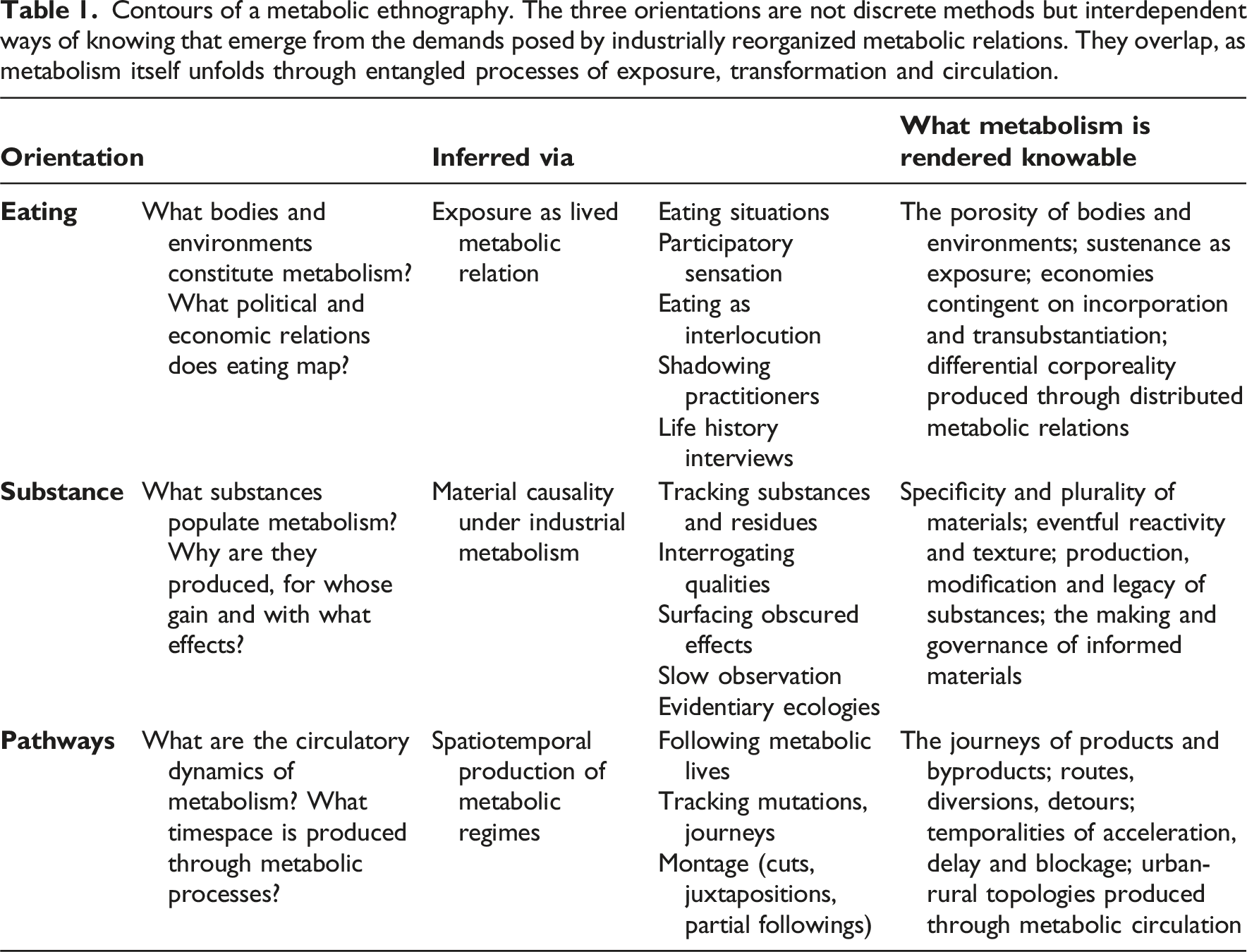
The term ‘combinatorial’ is crucial, for what eating, substance and pathways summon as a trinity is far more persuasive than what they do as isolated methods, especially for engaging a distributed and interlocking phenomenon whose effects are cumulative, delayed and unevenly borne. Eating advances embodied modes of inquiry, moving from views of bodies as bounded entities to loci in fields of conversion and change, while drawing attention to bodily difference and uneven capacities to transmute. With eating, participant observation becomes participant sensation, interfering with the hierarchy of senses that have disciplined the ethnographic tradition. Sustenance becomes a form of interlocution, where knowing is enmeshed with, not outside, the relentless stirring of the world (Counihan and Højlund, 2020; Mol, 2021). Eating is never achieved alone and cannot be reduced to mere absorption; it is contingent on how others eat, and it fosters mapping the assemblages of entities, organisms and materials through which metabolism inheres. Eating situations and life histories bring metabolic geographies into purview, summoning worlds at once distal and intimate, where action is distributed and unfolds through ensembles rather than contained within individual subjects.
As a form of interlocution, eating tells only one story of metabolism, for the latter is populated by an abundance of materials that configure metabolism’s scope and its disparate effects. The ethnographic sensorium therefore must shift from the eventfulness of ingestion to interrogating the ‘stuff’ of metabolism. Doing so embarks upon an ‘agitating empiricism’ (Dumit, 2021: 180): paying attention to where a substance begins and where it ends, what it draws into relation and what it thwarts, how it travels while transmuting, where it ends up and with what effects. This move advances how the social sciences might attend to materials in the aftermath of critiques of neo-vitalist accounts of matter (Barua, 2023; Gandy and Jasper, 2017; Lemke, 2021). Metabolic ethnography goes beyond new materialism and asks how the effects of substances are tied to the politics of their production, how material agency is historicized and witnessed in the social situations of their generation and use. Such endeavour requires relinquishing methodological closure and allowing inquiry to be abducted by materials themselves: to be guided along paths not pre-ordained by study design so that received categories can be unsettled. It asks what texture and reactivity – rather than all-encompassing new materialist terms like nonhuman agency – enable analytically. Metabolic ethnography also calls for surfacing materials: rendering legible fraught environmental and corporeal processes obfuscated by the industrial reshaping of metabolic relations. By doing so, it fosters other imaginaries of what metabolism might become (Heynen, 2018), without presuming such futures in advance. In practice, this might entail tracing how efforts to reconfigure feed regimes, reduce antibiotic dependence or redesign exposure infrastructures hinge on specific metabolic transformations and how such transformations redistribute risk and responsibility. The point is not to prescribe alternatives but to render the metabolic terms on which alternatives are pursued visible and contestable.
Pathways bring a geographical sensibility to the dynamics elicited through eating and substances. They prompt engagement with the where and the when of the uneven, and often unjust, effects of contemporary metabolism and the world of industrialized effluent it produces. By altering the focus from the single commodity to interlocking processes and the ways in which entities move and transmute, metabolic ethnography extends and modifies multi-sited methods of following the thing (Cook, 2004). Pathways, which are at once economic and visceral, spatiotemporal and biochemical, are not a replacement for analyses of material flow (Fischer-Kowalski and Hüttler, 1999). Rather, they perform a different kind of analytical labour: accounting for how space is produced from metabolism and how time is folded into circulatory dynamics marked by delay, acceleration and accumulation. As illustrated by extant work, such dynamics are rhythmed by different relations of slowness and speed, routes and detours, motives and harms, which become crucial for grasping the quandaries of an industrialized metabolism. Pathways pleat domains of food and industrial production, human and veterinary health, climate and environment into one another, demanding methods able to remain with complexity rather than resolve it prematurely along one specific axis.
When taken together, eating, substance and pathways provide orientations for a methodological practice centrally concerned with the messy, fraught and constitutive traffic between the living and material world (Table 1), where metabolism is neither solely energetics nor metaphor, but a biochemical and political economic condition of transformation and exposure. Metabolic ethnography responds directly to methodological invitations raised in human geography and the wider social sciences, including visceral geography’s emphasis on interrogating the world ‘from the body out’ (Hayes-Conroy, 2017: 51), political economy/ecology’s attention to health and environmental injustice through ‘the biochemical pathways by which chemicals act’ (Guthman and Mansfield, 2013: 500), and chemical geography's recent calls to illuminate ontology and epistemology from industrialized materials whose ubiquity is too pressing to ignore (Romero, 2025). It extends economic geography's efforts to follow things through ‘messier’ methods attentive to ruptures and gaps in commodity circulation (Hulme, 2016: 159), while expanding urban theory to situate urbanization across heterogeneous sites and processes (Bathla, 2024; Gandy, 2024).
Yet, metabolic ethnography is not a method that travels by abstraction or off-the-peg portability. Its reach derives from the historical and ontological spread of industrial metabolism itself, which reworks bodies, environments and landscapes to produce an aftermath neither fully anticipated nor legible from the logics that set it in motion. This is why the intervention is methodological rather than topical: it displaces reliance on bounded field sites, stable objects of analysis and explanatory sequences that presume proximate cause and immediate effect. Metabolic ethnography moves beyond multispecies relations, atmospheres and affect toward cross-cutting processes that reorganize life at scale. The application of such an ethnography to other domains – the study of infrastructure to take a topical example – means reorienting what is asked about the subject of inquiry across geography, sociology and anthropology alike. Like Stanes’ work on clothing (2021; Stanes and Gibson 2017), it implies taking infrastructure as an exposure architecture, as a site of particulate inhalation and vector of chemical persistence. It is in this sense that metabolic ethnography is a necessary response to altered metabolic conditions rather than a discretionary addition to existing methodological repertoires, for metabolism is not only an object of analysis now - it is a condition that reorganizes method.
The contours of metabolic ethnography will evolve as scholars interrogate, critique and extend what has been furnished here. There is ample scope to further this endeavour. Critical and nuanced, rather than naïve, engagements with the contemporary sciences of metabolism – from metabolomics (German et al., 2005) to geochemistry (Lollar, 2005) – offer one such avenue, as do dialogues with aesthetic practices attentive to metabolic transformations and their corresponding forms of visibility (Kelley, 2023). Human geography and the social sciences have much to contribute to situated understandings of the predicaments facing the world today, many of which, as Hannah Landecker presciently observes, emerge from – but are not entirely anticipated by – the wholesale reshaping of metabolism over the last century or more (Landecker, 2024b). If inquiry is to remain commensurate with these conditions, methodological innovation is not optional. Metabolic ethnography is a response to this demand: a way of thinking, sensing and narrating with metabolism as it is modified, lived and contested.
Footnotes

Funding
The author disclosed receipt of the following financial support for the research, authorship, and/or publication of this article: this work was supported by the H2020 European Research Council; uEcologies (Grant No. 759239) and the Canadian Institute for Advanced Research (CIFAR).
Declaration of conflicting interests
The author declared no potential conflicts of interest with respect to the research, authorship, and/or publication of this article.