




Abstract
Metabolic readings of urban space point in at least four different analytical directions: the organicist emphasis on cities and their agricultural hinterlands; the diagrammatic city of modelling and trophic imaginaries, extending to interest in material flow analysis, industrial metabolism, and neo-Luhmannian conceptions of socio-metabolic transitions; the neo-Marxian concern with metabolic rift and evolving intersections between capital, the human body, and a variety of material infrastructures; and the more recent interest in metabolic densities, occluded pathways, and multispecies metabolic entanglements. I suggest that an alternative conceptual synthesis might allow for a more embodied, multi-subjectival, and historically situated reading of urban metabolism.
Introduction
Metabolism is everywhere and nowhere.
The capitalist organisation of metabolism can be abolished, but metabolism itself cannot.
In 2004 I published an article entitled ‘Rethinking urban metabolism’ where I suggested that: ‘The idea of metabolism, whether used as societal metaphor or in relation to material processes, has emerged from disparate and often contradictory intellectual traditions’ (Gandy, 2004: 364). 3 If anything, this set of conceptual tensions has intensified since I wrote these words. Looking back, my perspective was framed very much by my engagement with the ‘first wave’ of urban political ecology literature and a series of insights derived from urban and architectural history. 4 Although interest in urban metabolism has surged since the early 2000s, bibliometric analysis does not track a similar rate of growth for the original term metabolism within the bio-physical and medical sciences. 5 This element of bibliometric divergence suggests that the metaphorical use of the term has been gaining some ground in relation to more precise scientific applications. In much of the urban literature, however, the material and metaphorical connotations of metabolic discourse remain extensively blurred.
Metabolism can be characterised as the ‘chemistry of life,’ residing in an intermediate zone between chemistry and biology (see Lauber et al., 2021). The Oxford English Dictionary defines metabolism as: ‘The chemical processes that occur within a living organism in order to maintain life’ along with ‘interconnected sequences of mostly enzyme-catalysed chemical reactions’ and the ‘overall rate at which these chemical processes occur.’ 6 The English word is derived from the Greek metabole (μεταβoλή) meaning ‘change’ and is first recorded in 1872. The German Metabolismus can be traced somewhat earlier to 1856, initially associated with theology, whilst the French Métabolisme is first used in 1858 to refer to a ‘change in the molecular nature of bodies’ (see Barles, 2020: 110). The etymology of metabolism is complicated, however, by the parallel existence of an earlier German word Stoffwechsel. Part of the reason that both Justus von Liebig in the 1840s and Karl Marx in the 1860s settled on the term Stoffwechsel is that the alternative word Metabolismus was not yet in general use (see Landecker, 2023). 7 Through the writings of Liebig in particular, the term Stoffwechsel acquires physiocratic connotations concerned with declining soil fertility, which would later become a significant point of departure for the analysis of metabolic rift (see later section on neo-Marxian perspectives).
From the middle decades of the 20th century metabolism acquired an extended range of figurative or metaphorical meanings, including an increased occurrence of specifically urban or architectural associations. A prominent example is the Japanese Metabolist movement, founded in 1960, whose manifesto regarded human society ‘as a vital process — a continuous development from atom to nebula’ in which the biological term metabolism underscores how ‘design and technology should be a denotation of human vitality’ (Kawazoe et al., 1960: 5). ‘A city,’ according to Kisho Kurokawa, ‘is eternally moving as a container of future life’ (in Kawazoe et al., 1960: 80). Intriguingly, the manifesto also uses the term metabolism in relation to the changing membership of the movement itself, as part of a wider emphasis on intellectual replenishment over time. The architectural critic Charles Jencks (1979: 745) notes how the movement altered ‘the way architects thought about the city and its constant “metabolism”, growth and decay.’ For Jencks, the movement formed a nascent element in the emerging critique of modernism, a significant forerunner for the later emergence of postmodern architecture. More recently, the design legacy of the metabolist movement has served as an intellectual bridge between the material and metaphorical dimensions to metabolism, including new conceptions of relations between architecture and infrastructure (see Šenk, 2023). 8
The key intervention in relation to the post-war emergence of urban metabolism as a distinctive field of research is marked by the engineer Abel Wolman’s 1965 contribution to a special issue of Scientific American devoted to the future of cities that also featured inputs from Nathan Glazer, Kevin Lynch, and others. Wolman opens his essay with the oft quoted statement that: ‘The metabolic requirements of a city can be defined as all the materials and commodities needed to sustain the city’s inhabitants at home, at work and at play’ (Wolman, 1965: 179). He notes that the: ‘Metabolism of a city involves countless input–output transactions’ (Wolman, 1965: 180) in an analytical formulation that has underpinned much of the evolving literature in relation to material flow analysis, industrial metabolism, and systems-based approaches to the study of urban space.
There is an oscillation in the metabolic literature between machinic and ecological conceptions of urban space: the former is driven by an engineering emphasis on forms of environmental control whilst the latter rests on a radical extension of the ecosystem concept as a distinctive analytical field. Chris Kennedy, Stephanie Pincetl, and Paul Bunje (2011: 1965) suggest that: ‘Cities are similar to organisms in that they consume resources from their surroundings and excrete wastes.’ Yet they urge a note of caution in terms of comparing cities with organisms: Of course, cities are more complex than single organisms – and are themselves home to a multitude of organisms – humans, animals and vegetation. Thus, the notion that cities are like ecosystems is also appropriate.
As in the case of metabolism, Pincetl highlights a tension between literal and metaphorical meanings of the term ecosystem (see Pincetl et al., 2012). 9 In any case, cities comprise multiple ecosystems and both cities and ecosystems are derived from multiple metabolic pathways. Unlike cities, however, an ecosystem is to some degree a scale-independent metaphor for diverse forms of relationality. In this sense, it is difficult to read what a city is or might become merely from the presence of multiple intersecting ecosystems.
More recently, Colin McFarlane (2023: 132) presents metabolism as a multi-scalar phenomenon. ‘Metabolism is not only an anatomical, biochemical, or functionalist self-regulatory system,’ notes McFarlane, ‘but also a set of distributed processes that connect bodies to material things, local and regional environments, changing economies, political priorities, cultural power, and global processes.’ Similarly, Jason Moore (2017: 286) observes that: ‘Metabolism has become a plastic category that can be moulded to serve diverse analytical objectives.’ Indeed, it is metabolism’s conceptual malleability that has underpinned its evolving relationship with ostensibly disparate fields ranging from systems theory to the neo-Marxian analysis of urban space, and even to recent developments in aesthetics and critical phenomenology.
Successive waves of interest in urban metabolism reflect not only changes in the wider intellectual field but also shifting research priorities promoted by funding agencies. In the 1960s, for example, new sources of funding became available for the nascent field of urban ecology in North America as a by-product of growing interest in cybernetics and systems theory (Kwa, 1987). In the 1970s, UNESCO funded support for urban metabolism research, as part of its Man and the Biosphere programme, led to a series of individual case studies for Hong Kong, Barcelona, Rome, and other cities (see Barles, 2020). From 1980 onwards, the US-based National Science Foundation has supported the Long-Term Ecological Research programme, which includes Phoenix and Baltimore among its 27 chosen sites, and illustrates a degree of overlap between ecological and metabolic research agendas (see Evans, 2019). And in the 2020s, there has been a new wave of funding for socio-ecological ‘transition studies’ such as the REMASS (Resilience and Malleability of Social Metabolism) programme supported by the Austrian government as the latest phase of research under the auspices of the Vienna school (see later section on heterotrophic imaginaries).
Metabolism also delineates different ways of seeing. Colin McFarlane, for instance, introduces the term ‘metabolic gaze’ as an alternative to more abstract variants of the ‘telescopic gaze’ in urban studies (see McFarlane, 2013). Media studies scholars Hannah Star Rogers and Adam Bencard, writing in the journal Leonardo, have also played with the notion of a ‘metabolic lens’ as part of the wider flourishing of the ‘metabolic arts’ that enable encounters with ‘life and life processes’ (Rogers and Bencard, 2023: 389). Similarly, the journal HUB has a theme issue devoted to ‘metabolic media’ where Louise Carver and Jamie Allen (2024) describe how ‘Metabolic processes, at almost every scale, go largely unnoticed through inattention and abstraction: beating hearts, water treatment plants, breathing, policy-making and other infrastructural processes.’
10
They continue: We seldom become aware of the myriad exchanges, transfers and transformations of materials and energy that occur, continuously, through environments, between beings and among political entities toward maintaining life and living, extravagance and impoverishment.
The media studies scholar Désirée Förster also extends the aesthetic scope of the metabolic to encompass a heightened series of sensory or affective encounters. She offers ‘an aesthetics of metabolism that accounts for phases in subjective experience in which processes of transformation, production, repulsion, and containment relate to sensual and emotional-affective experience’ encompassing both ‘bio-chemical activities’ within the body as well as a myriad of processes within the human environment (Förster, 2021: 169). Her reading of metabolic aesthetics is both porous and relational, connecting with feminist epistemologies, critical toxicology, and other fields.
The metabolic has also served as a mode of representation. The design scholar Anthea Oestreicher (2022) draws on metabolic insights to explore the aesthetic characteristics of microbiomes. Using what she terms ‘sympoeitic correspondences’ her cultural practice has focussed in particular on algae, phytoplankton, and other organisms that form an important element in new ecologies of sensing and sense making (Figure 1). Earlier metabolic imaginaries also persist through a variety of diagrammatic representations. In Deniz Ayaz’s depiction of Istanbul entitled ‘urban metabolism’ we encounter a corporeal cartography that ‘connects body parts and city parts,’ evoking the graphic art of Fritz Kahn and earlier organicist renditions of urban space (Figure 2). In some ways, Ayaz’s ‘metabolic imaginary’ is a throwback to 19th-century corporeal conceptions of urban space, including a gendered separation of the city along the Bosporus Strait. 11
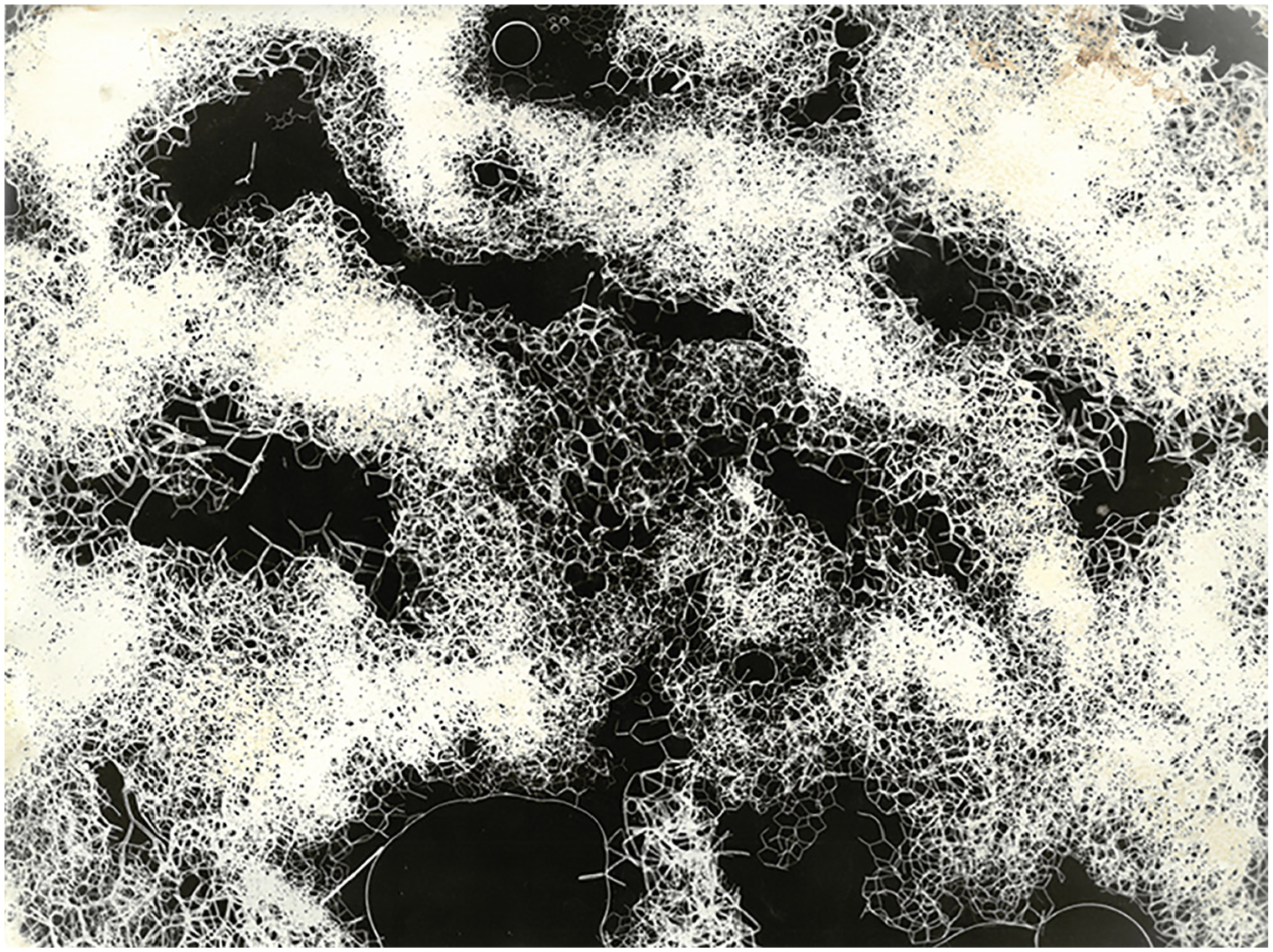
Anthea Oestreicher B(othering): a substrate of co-existence (2022). Courtesy of the artist.
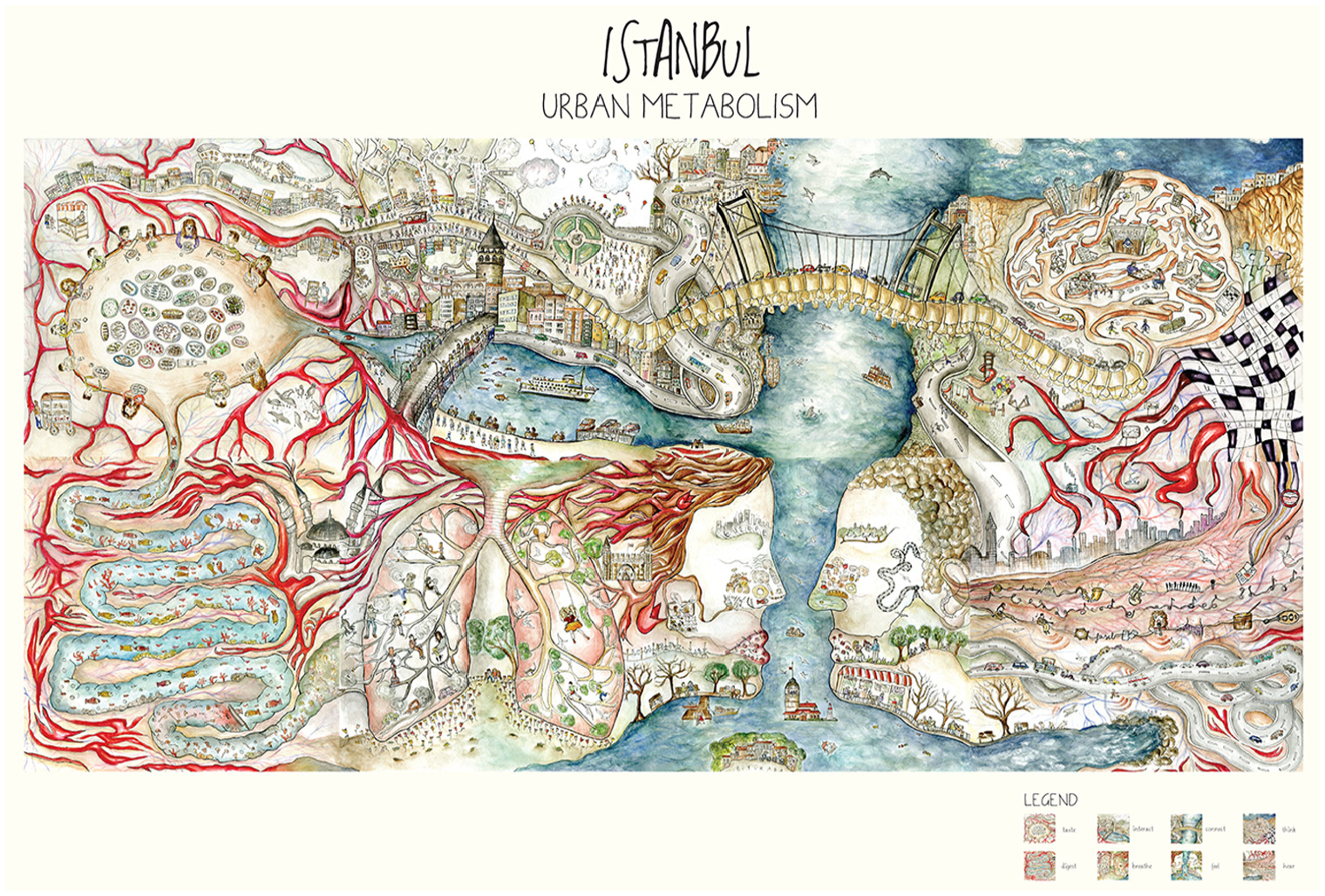
Deniz Ayaz Istanbul urban metabolism (2012). Courtesy of the artist.
I begin my article by focussing on transitional modernities, urban chemistry, and the zymotic city as part of the pre-history to contemporary interest in urban metabolism. I then turn to heterotrophic imaginaries and the neo-Luhmannian swerve towards ‘species history’ as part of a systems-based conceptualisation of socio-metabolic transitions. Next, I examine the shifting focus of neo-Marxian perspectives, drawing on recent engagements with metabolic rift, the technosphere, and cyborg urbanisation. Finally, I consider metabolic dimensions to the interstices and hinterlands of modernity as part of a multispecies reading of urban space.
Transitional modernities, urban chemistry, and the zymotic city
Although Wolman’s 1965 article remains the assumed point of departure for modern conceptions of urban metabolism in much of the literature we can clearly point to a series of earlier interventions. 12 Metabolic conceptions of the city are certainly present in the writings of Ernest Burgess, Patrick Geddes, Lewis Mumford, and Le Corbusier, and in earlier contributions from Edwin Chadwick, Baron Haussmann, and others (see, for example, Amati, 2021; Davison, 1983; Šenk, 2023; Sennett, 1996). In 1925, for example, Burgess uses the term ‘social metabolism’ within his studies of urban growth (even the word ‘growth’ has a metabolic connotation) (see Schalk, 2014). As for a quantitative emphasis on the functional dynamics of metropolitan space as a series of inputs and outputs there is a range of analytical precedents. In 1894, for instance, the chemist Theodor Weyl published an essay on the metabolism of Berlin (he uses the word Stoffwechsel) oriented towards a bio-political concern with health, nutrition, and the nitrogen cycle (see Derrible et al., 2021; Lederer and Kral, 2015). Weyl focuses his analysis on the provision of foodstuffs (Nahrungsmitteln) and nutrients (Nährstoffen) for the fast-growing city and makes a distinction between the inorganic categories of water and salt alongside a list of staple organic products such as bread, meat, fish, butter, sugar, and so on. His analysis is spatially demarcated by the regional canal network that connected Berlin to its agricultural hinterland. In his concluding remarks, Weyl calls for comparative studies of Copenhagen, Munich, Naples, and other cities (Weyl, 1894).
During the 19th century metabolic conceptions of the city became closely associated with the rise of ‘urban chemistry’ marked by a focus on the use of human waste in agriculture as part of the nitrogen cycle. Key figures in addition to Liebig include Jean-Baptiste Boussingault, Edwin Chadwick, and Jean-Baptiste Dumas (see Barles, 2020). As Hannah Landecker (2013: 202) notes: ‘Dumas saw “an eternally efficient world”, in which “air became plants, plants became animals, and animals rendered organic building blocks to the air”.’ The field of urban chemistry was framed by an analytical bond between the city and its agricultural hinterland. The functional dynamics of urban space were conceived in terms of an efficient flow of nutrients that could be guided by a series of expert interventions ranging from engineering to medical science. This growing coalescence between scientific and public health spheres in the 19th-century city rested on an expanding conception of the role of the state that emerged in tension with the prevailing laissez-faire ideology towards environmental conditions in the industrial metropolis (see La Berge, 1992). Miasmic conceptions of epidemiology had developed a variety of environmental explanations for ill health that focussed initially on the need for better circulation of air and the avoidance of malignant atmospheres but gradually expanded to encompass a wider variety of environmental conditions and processes. Of particular interest is the rise of a zymotic focus on active sources of contagion in the middle decades of the 19th century, even if they were yet to be precisely identified, which laid the basis for the eventual emergence of modern discourses of epidemiology and pollution control (Mårald, 2002). Leading proponents of zymotic epidemiology included the medical statistician William Farr, whose focus on disease as a form of chemical fermentation was clearly influenced by Liebig’s interest in processes of decomposition and putrefaction (Tulodziecki, 2016). The zymotic perspective signalled the culmination of the miasmic focus on environmental causes of disease marked by an emphasis on inorganic changes of state rather than living agents of transmission. 13
The reconstruction of 19th-century cities such as Paris, Barcelona, and Vienna was framed by an organicist conception of urban space as an interrelated set of flows. Baron Haussmann’s rebuilding of Second Empire Paris was strongly influenced by Saint-Simonian ideals concerning the territorial integration of urban space and the creation of a new kind of circulatory dynamics at the leading edge of engineering science (see Adams, 2019; Picon, 2002). Similarly, Ildefons Cerdà’s 1860 plan for the modernisation of Barcelona sought to reduce urban congestion and open up the city to air and light (see Neuman, 2011; Pallares-Barbera et al., 2011). These influential archetypes for the modern city emerged under the zymotic recalibration of urban epidemiology but their topographic legacy segued into the later emergence of the bacteriological city.
The 1860s marks the high-water mark for circulatory conceptions of the modern city and attempts to achieve a synthesis between modernity and the nitrogen cycle. In the case of Paris, for example, Sabine Barles (2007a) presents a metabolic reconstruction of the nitrogen cycle between 1869 and 1913 that extends to both people and horses (see Figure 3). What is especially interesting about her multi-species study is that it charts a transitional phase between the zymotic city, and its distinctive configurations of non-human labour, and the eventual reordering of space under the fossil-fuel based urbanisation of the 20th century.
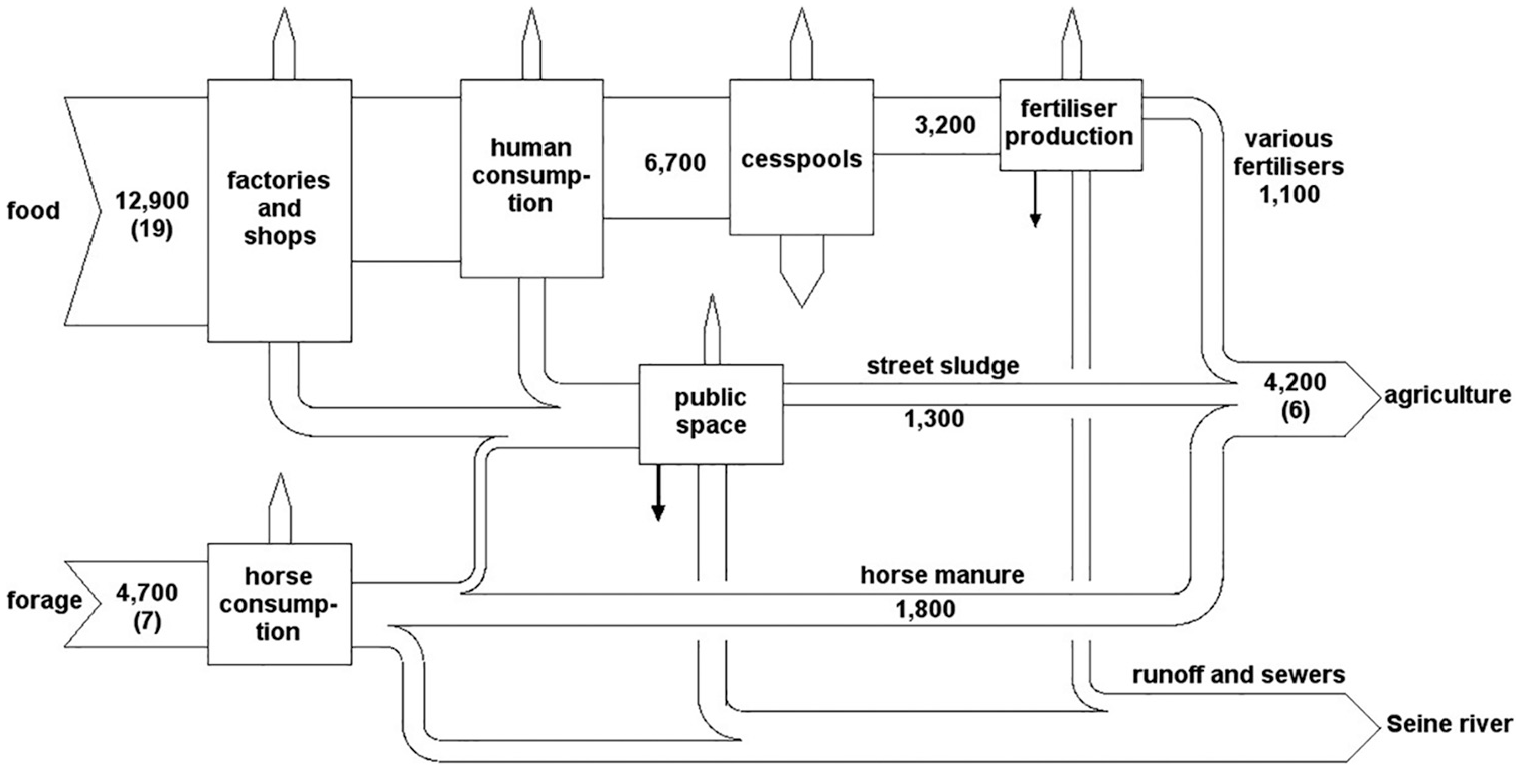
Sabine Barles’s depiction of the circulation of dietary nitrogen in Paris in the year 1869. Barles presents a multi-species conceptualisation during a transitional phase in the metabolic history of the city.
Elaborate 19th-century responses to the loss of nitrogen include Charles Liernur’s design for a pneumatic sewage system that separated human faeces from waste water yet this scheme was only ever adopted for Amsterdam, Dordrecht, and Leiden (Mårald, 2002; Waring, 1876). The economic case for the Liernur system rested on sales of the resulting ‘poudrette’ distributed via canals to farms in the surrounding countryside. Yet efforts to protect the urban nitrogen cycle faded away from the mid-1860s onwards due to a combination of factors: existing systems of collection for human waste could not compete with the mass production of synthetic fertilisers; the diffusion of new plumbing systems led to increased use of water for washing, thereby diluting the nitrogen content of human waste; rising levels of water use overwhelmed the existing reliance on cesspits; the ‘olfactory revolution,’ associated with the emergence of a more individualised human subject, led to a growing aversion to communal sanitary practices; and the rise of the bacteriological city transformed both the aims and scope of public health engineering (see Barles, 2007b; Corbin, 1988 [1986]; Gandy, 2014). The decline of the zymotic city and its miasmic predecessors marks a transition from labour intensive to capital intensive forms of urban metabolism associated with the wider dynamics of capitalist urbanisation (see Sert, 2024). ‘The industrial revolution,’ as Barles (2020: 120) notes, ‘has led to the (quasi) total externalisation of urban metabolism.’ At the same time, however, the metabolic capacities of the human body to carry out work formed part of the wider bio-political and socio-technical context for modernity (see Rabinbach, 1992). It is in a colonial context, however, that the underlying tensions behind this metabolic transition become most strikingly apparent.
The preoccupation with the nitrogen cycle in London, Paris, and other 19th-century European cities contrasts with colonial patterns of urbanisation that were steadily destroying alternative metabolic models in South Asia and elsewhere (see Ramesh, 2021; Rehman, 2020). The ‘planned violence’ of infrastructural erasure within colonial cities instituted a forcible socio-metabolic transition towards an unrealisable variant of European modernity (Boehmer and Davies, 2018). An ‘epistemology of progress’ (Vijay, 2023: 20) conflicted with the deteriorating living conditions and successive public health crises experienced by colonial subjects. In this sense, a series of metabolic transitions formed a counterpart to the imposition of engineered modernities within the colonial cities of the global South and their extractive hinterlands. 14 At the same time, however, alternative postcolonial readings of metabolism emerged that were oriented towards the eradication of hunger in a radical recalibration of metabolic discourse towards the corporeal realm of everyday life (see Davies, 2019). The global evolution of metabolism set in train a series of material processes that began to de-centre the concept of metabolism itself.
Alongside dominant conceptions of urban metabolism, that evolved in relation to the reconstruction of European and North American cities, a ‘colonial counter imaginary’ also persists into the 20th century that is indicative of forms of spatial experimentation undertaken under the guise of imperialist paternalism. Examples include Patrick Geddes’s concern with the preservation of a metabolic genius loci within his designs for Lahore, Madras (now Chennai), and other cities, that sought to retain specific elements of water conservation and other transitional metabolic features within a speculative urban arena (Geddes, 1947 [1917]; see also Hysler-Rubin, 2011; Vijay, 2023). Under the impetus of scientific racism, however, which emphasised specific modes of human contagion, there was an emerging bifurcation between the increasingly segregated colonial city and its ‘epidemiological other,’ as reflected in the cities of China, Japan, and elsewhere that experienced lower levels of mortality from infectious diseases (see, for example, Ferguson, 2014; Hanley, 1987; Joshi and Tewari, 2003). In any case, the promulgation of a certain kind of ‘metabolic universality’ associated with Euro-American variants of technocratic modernity has always contrasted sharply with colonial and post-colonial patterns of urbanisation in the global South (see, for example, Lawhon et al., 2023; Monstadt and Schramm, 2017).
From heterotrophic imaginaries to the neo-Luhmannian longue durée
Scientific conceptions of metabolism emphasise the enzymatic processes that underpin the possibilities for life. These chemical reactions that sustain living organisms in relation to their environment operate within a set of dynamic spatial and temporal parameters. The development of ecological science in the 20th century drew on both material and metaphorical aspects to metabolism in order to delineate the functional dynamics of diverse kinds of ecosystems. The ecologist Eugene Odum, for instance, characterised the entire city as an ecosystem in the early 1960s as part of his sustained effort to expand the scope and societal relevance of the ecological sciences (see Odum, 1975). For Odum, the city represented the most heterotrophic of all ecosystems in terms of its high level of complexity. The ecosystem concept provided an analytical framework for a variety of flows of energy, materials, and waste products passing through the urban arena (see Golubiewski, 2012). Implicit within these input–output models was a belief that the city could be handled as an analytical totality in the form of a spatially demarcated object of study.
Odum was clearly interested in using ecological science as a blueprint for urban planning, arguing that the ideal city ‘will come only when the city functions as an integral part of the total biospheric ecosystem’ (Odum, 1971: 512). He characterised the ‘fuel-powered city’ as having a parasitic relationship with its wider hinterland in keeping with the prevailing anti-urban sentiments within much of the environmental movement of the 1970s and 1980s (see Odum, 1971, 1975). Odum’s ambivalence in relation to the ecological role of cities is reflected in an emerging emphasis on ecological footprints and other measures of environmental impact within the metabolic literature. Yet the precise agency of the city remained obscure within a ‘parasitic imaginary’ derived from a reductionist emphasis on atomistic measures of consumption and other quantitative indices.
One of the first attempts to systematically apply the ecosystem concept to the study of urban metabolism is provided by Paul Duvigneaud’s analysis of Brussels in the 1970s (see Danneels, 2023). Duvigneaud’s twin focus on energy and materials generated a classic Sankey diagram in order to render the modern city a knowable object for ecological research (see Figure 4). His diagrammatic representation of the city as an ecosystem in itself, which he termed the écosytème urbs, is underpinned by a series of flows to maintain biomass and energy balance (see Duvigneaud, 1974b). Ultimately, however, his representation of Brussels as a ‘typical’ urban ecosystem could not be reconciled with the historical specificities of a divided postcolonial metropolis just as Wolman’s ‘generic city’ of 1 million inhabitants held little relation to the global complexities or regional specificities of capitalist urbanisation.
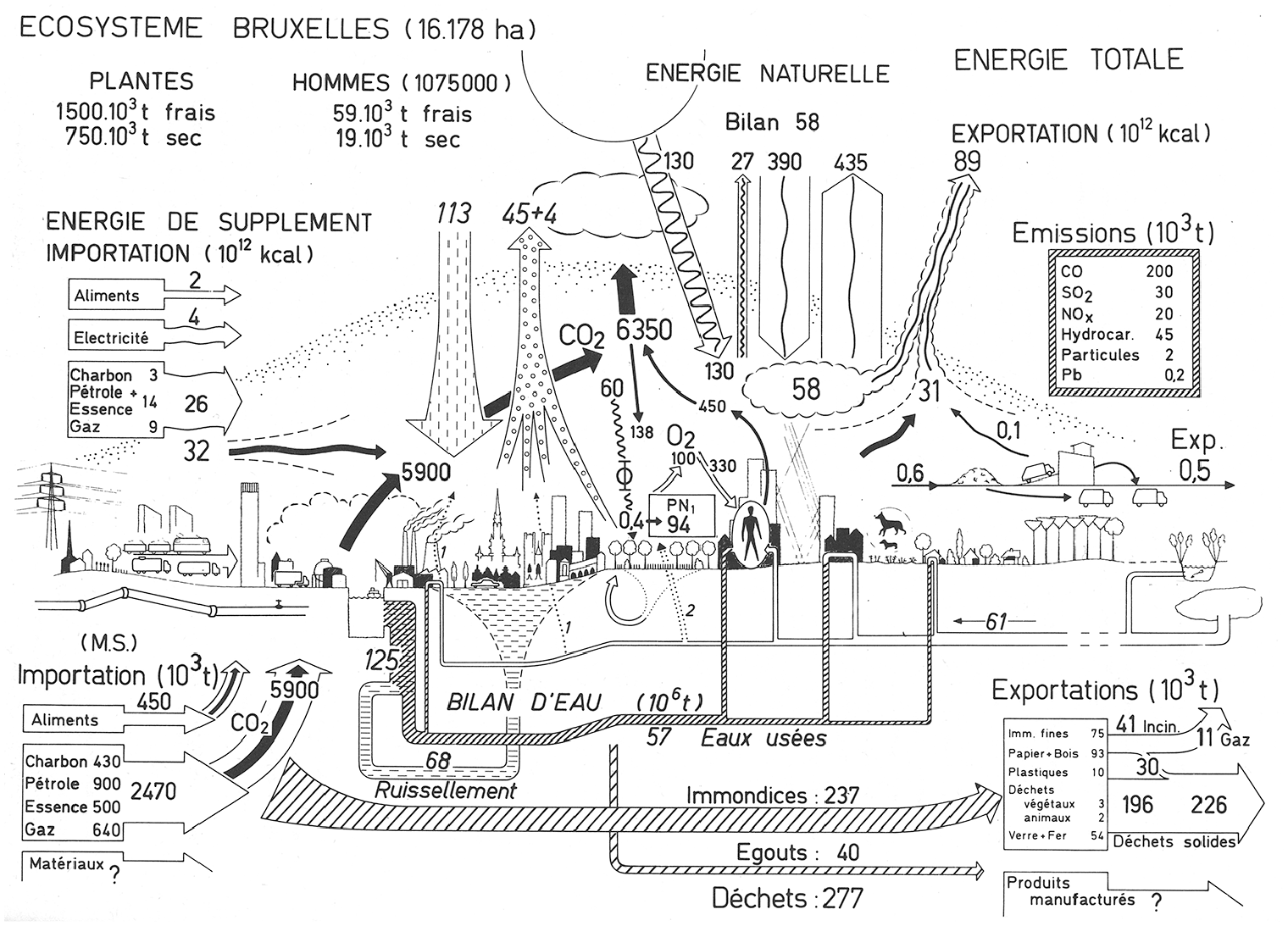
Paul Duvigneaud’s representation of the metabolism of the Brussels ecosystem. The diagram is featured in Paul Duvigneaud and Simone Denaeyer-DeSmet, L’écosystème urbs: l’écosystème urbain bruxellois (1977) and was first presented to an international conference in 1974.
During the 1970s and 1980s we can detect a degree of divergence between engineering and ecological perspectives on urban metabolism. 15 In essence the shift from ecology to engineering transposed the analytical ‘black box’ from outside the city to inside the city: the intricate metropolitan tableau of Duvigneaud’s écosytème urbs is replaced by a more abstract emphasis on the city as a space of flows. As Daniela Perrotti (2020: 18) notes, under the conceptualisation of space used by material flow analysis ‘only material input and output flows entering or leaving the system are considered, excluding in-boundary processes and dynamics associated with resource use. Hence the model results in a “black box” representation of the socioeconomic system itself.’ 16 This uncertainty over analytical boundaries held implications for wider attempts to theorise how one socio-metabolic system (or ‘regime’ to use István Mészáros’s term) might transition into another (see below).
Much of the urban metabolism literature has been framed by what we might term ‘normative quantification.’ In other words, emerging policy concerns with urban sustainability have generated specific kinds of data sets or modes of diagrammatic representation (see Woolf, 1989). The emerging focus on material flow analysis, industrial metabolism, and the measurement of energy use begins to elide with a wider policy context for urban sustainability.
17
In 2017, for instance, the UN Environment Programme commissioned a report entitled Urban metabolism for resource-efficient cities that effectively institutionalised the conceptual field as an analytical tool for global policy making (Musango et al., 2017). The development of urban metabolism methodologies has steadily evolved in relation to new forms of data analysis and visualisation techniques (see Otero Peña et al., 2022; Ramondetti, 2024b). Additionally, there has been a paradigmatic drive to standardise metabolic methodologies in order to facilitate comparative studies. Peter Baccini and Paul H. Brunner, for instance, provide a working definition of metabolism, in their attempt to systematise the field: Urbanization formed a global network of urban systems, including colonized terrestrial and aquatic ecosystems. This network is called the anthroposphere. The notion metabolism is used to comprehend all physical flows and stocks of matter and energy within the anthroposphere. (Baccini and Brunner, 2023 [1991]: 1, emphasis in original)
Note their use of the word ‘colonised’ here, in combination with a throughput-based model of urban space, which is framed by an extended zone of human activity that anticipates elements of the neo-Lefebvrian literature on operational landscapes and other more distant kinds of extractive frontiers (see, for example, Castriota, 2023).
A recent overview of the urban metabolism literature highlights a divergence between ‘temporal snapshots’ derived from single city studies and the more ambitious aims of the Vienna school to present a metabolic reading of human history (see Newell and Cousins, 2015: 708). The Vienna school, led by Marina Fischer-Kowalski since the 1980s, has developed a neo-Luhmannian emphasis on multiple sub-systems, in an important break from parallel research programmes underway in North America (see Fischer-Kowalski and Weisz, 1999). Whilst the sociologist Niklas Luhmann emphasises the centrality of communication for the functional dynamics of modernity the Vienna School shifts their emphasis towards a series of bio-physical systems (see Fischer-Kowalski, 2011). For Luhmann, any system has a reflexive relation to its environment, yet in moving from bio-physical kinds of open systems such as individual organisms towards a larger kind of social system, the question of death is superseded by an emphasis on continuity, the metabolic sustenance of a living cell is replaced by a focus on forms of socio-metabolic survival (see Luhmann, 1984). Under a neo-Luhmannian framework the social system emerges through a differentiation between system and environment so that modernity can be conceived as a process of radical divergence from earlier kinds of socio-metabolic transitions.
When we consider the shift of metabolic discourse from living cells to that of cities, societies, and the longue durée of human history there is clearly a degree of divergence from scientific understandings of metabolism. From a scientific standpoint, metabolic processes do not actually refer to the system as a whole but to a myriad of smaller processes that contribute to its on-going sustenance and replicability (see Landecker, 2013). The perpetuation of a socio-metabolic system is clearly very different from that of a living cell although both Luhmann and the Vienna school clearly draw on this analogy. Luhmann (2006 [1991]: 47), for instance, suggests that ‘“Communication” is the structural equivalent of biochemical statements by means of proteins and other chemical substances.’ He extends the idea of autopoiesis to include the self-organisational and self-sustaining dynamics of social systems, whereby ‘cells’ might be substituted with ‘action systems’ and other kinds of internally consistent communicative social phenomena (see Gandy, 2022). This metabolic analogy corresponds with the capacity for complex systems to reproduce themselves over time via language, organisation, or other means. In practice, of course, a complex system actually comprises many sub-systems, in a similar sense to the notion that large ecosystems actually contain many smaller ecosystems. Of particular concern, however, for the Vienna school, taking a historical perspective, is the means by which one form of ‘social metabolism’ or societal organisation might segue into another (Fischer-Kowalski and Erb, 2016). The socio-metabolic perspective rests on certain assumptions about the possibilities for self-reflexivity and control: in other words, there is an anticipation that societies might gain sufficient control over the evolution of complex systems to steer themselves in a particular direction.
The Vienna school presents human history as a series of metabolic transitions driven by changing sources of energy, technological innovation, and the diffusion of knowledge. It is changing patterns of energy use, however, that mark the analytical focal point for this perspective (see Fischer-Kowalski et al. 2014). ‘When an energy regime changes,’ argues Fischer-Kowalski (2011: 154), ‘society and its metabolism alter, and also the natural systems it interacts with.’ If we consider an energy-oriented history of urbanisation we can observe a shift from wood fuelled cities to a reliance on coal, oil, gas, and more recently, an increasingly diversified range of energy sources (see also Huber, 2009; Malm, 2016; see Table 1). The Vienna school identifies three key stages in human history marked by the impact of fire, agriculture, and industrialisation (see Barles, 2020; De Vries and Goudsblom, 2002; Haberl et al., 2011, 2016). At root, however, the Vienna school offers a ‘species history’ of metabolic transitions that is vaguely framed by a mix of technological determinism and cultural evolution (see Gandy, 2024b). This produces an analytical impasse in relation to capitalist urbanisation. The systems-based impetus towards epistemological unity holds parallels with the monist emphasis on forms of ontological holism à la Jason Moore (see below) although the analytical impetus moves in a very different direction.
The longue durée of urban metabolism
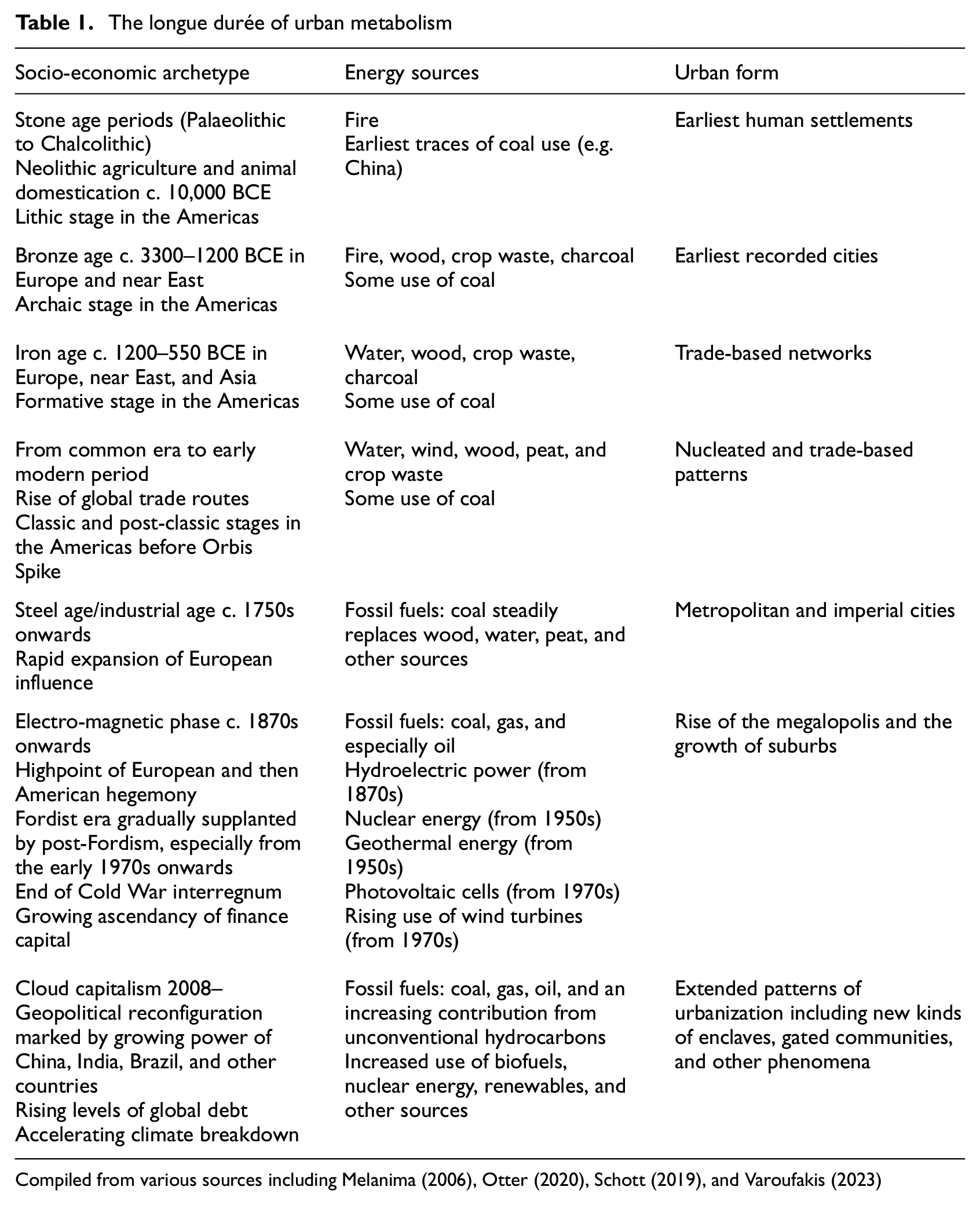
Compiled from various sources including Melanima (2006), Otter (2020), Schott (2019), and Varoufakis (2023)
The Vienna school’s elaboration of social metabolism can be compared with alternative historical models such as István Mészáros’s neo-Marxian framework, wherein each mode of production generates a distinctive ‘social metabolic order’ (see Clark et al., 2018). In contrast to the Vienna school, Mészáros (1998: 425) emphasises how ‘the fundamental metabolic relationship between socially produced needs and nature is articulated and reproduced in the course of historical development’: …the fundamental contradictions inherent in the growing structural dysfunctions of the social metabolism are amenable to a solution only in the event of a conscious control of the totality of the relevant processes, and not merely the more or less successful temporary management of partial complexes (Mészáros (1998: 425, emphasis in original).
Clearly, even if the policy orientation of systems-based models such as the Vienna school is ambitious in scope, framed by the transition to a post-carbon society, the analytical focus remains preoccupied with what Mészáros refers to as ‘partial complexes’ that encompass a variety of eco-spatial fixes rather than a concern with historically specific aspects to the transformation of nature under capitalist modernity.
Between metabolic rift and cyborg urbanisation
With its origins in Marx’s critique of capitalist agriculture, drawing on the insights of Liebig, the neo-Marxian term ‘metabolic rift’ brings a different emphasis to the meaning of urban metabolism as a set of critical tools for exploring the innate contradictions between capital and ecology (see Foster, 1999; Holmes, 1988; Napoletano et al., 2019). There has been a recent divergence, however, between monist and dualist conceptions of metabolic rift within the neo-Marxian literature. John Bellamy Foster (2013: 8), for example, draws attention to ‘the pitfalls of both absolute idealism and mechanistic science’ yet his insistence on an ontological separation of nature and culture is characterised by Jason Moore as a perpetuation of Cartesian dualism. However, Moore’s post-Cartesian conception of the ‘metabolism of humanity-in-nature’ has in turn been a focus of critique by Kohei Saito (2022: 104) who regards his framework as too reliant on constructivist accounts of nature that reject the existence of ‘natural limits.’‘Marx’s theory of metabolism,’ notes Saito (2022: 108), ‘negates the idea that nature is built by labour.’ Ultimately, Moore (2017: 313) presents a different kind of epistemological elision based on a ‘singular metabolism’ to that of the Vienna school and systems-based perspectives. But can Moore’s conceptual framework be extended to the role of evolution, epigenetics, or other kinds of biological time? A recognition of multiple temporalities requires a degree of epistemological nuance to distinguish between different kinds of agency, both human and non-human, and all of the myriad configurations that lie in-between.
The analytical significance of the city has been radically de-centred through an emphasis on extended patterns of urbanisation. The idea of the technosphere, for example, first mooted in the 1960s and 1970s, has been reworked by the historian Chris Otter as a conceptual field that can transcend the distinction between what is urban or ‘not urban’ or at least render concerns with the definition of the urban far less significant. In earlier formulations, such as that of Paul Duvigneaud in the early 1970s, we can see that the technosphère comprises multiple facets of the biosphere that have been transformed by human action (see Figure 5). For Otter (2020: 22) ‘the technosphere refers to the totality of human technologies’ within which the modern human being is itself a cultural artefact emerging from an amalgam of cultural and biological evolution. His conception of the technosphere holds parallels with the neo-Lefebvrian interest in complete urbanisation but has its roots in neo-Foucauldian studies of governmentality: A central feature of the technosphere is this process of enfolding, whereby human populations are able to withdraw into artificial, capsular forms of existence precisely by virtue of the technosphere’s capacity to absorb and direct materials into the densest urban areas (Otter, 2020: 24).
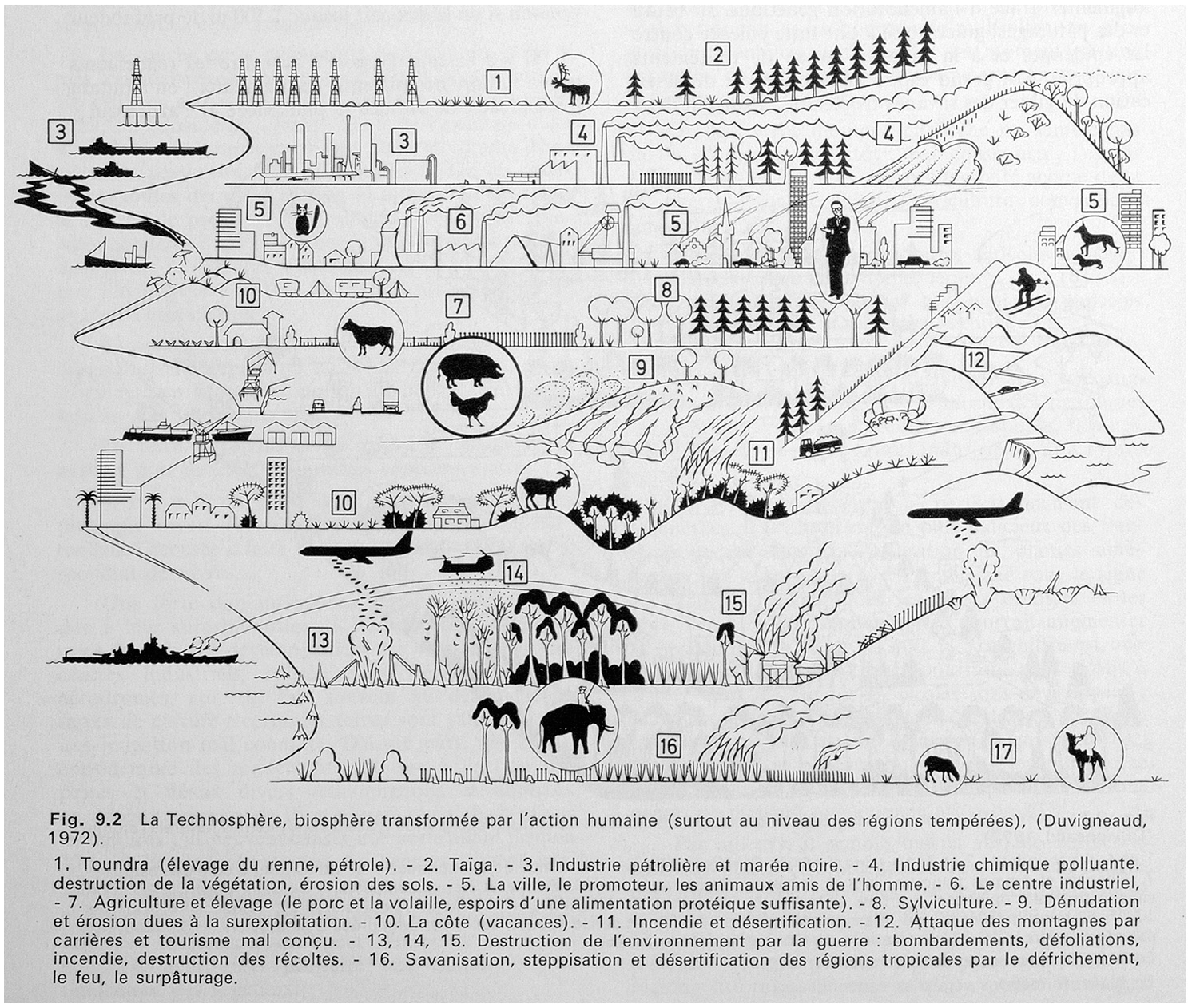
Paul Duvigneaud’s depiction of the technosphere. Note his depiction of the environmental impact of chemical industries, oil spillages, and war amongst other factors.
In the place of cities or a working definition of the urban we contend with different forms of socio-technological density that correspond with a topographic conceptual schema. Otter’s technosphere extends to the non-human as part of his re-interpretation of the global agro-industrial complex. ‘Domesticated animals also experience technospheric encapsulation,’ notes Otter (2020: 25), ‘albeit within the hyperdisciplinary spaces of byres, battery farms and concentrated feeding units.’ The focus on density, especially when extended to non-human others, highlights forms of metabolic propinquity that hold wider epidemiological implications in terms of zoonotic transfer zones and other ecological phenomena. There are intersections here between epidemiological risk and diverse kinds of metabolic landscapes. The emerging conceptual field of zoonotic urbanisation connects extractive frontiers and intensified modes of agro-capitalism with new kinds of urban health threats such as Covid-19, Mpox, Nipah virus, and other pathogens (see Gandy, 2023).
The reading of metabolism as a form of technological encapsulation also connects with the cyborgian emphasis on the role of the modern city as an elaborate prosthesis for the enabling of human life. The intellectual starting point here is not metabolic rift but Donna Haraway’s reworking of the post-war figure of the cyborg. In particular, the cyborg metaphor highlights the degree of corporeal dependence on fragile infrastructure systems. There is a double interiority that encompasses the human body and its architectural milieu. A neo-Marxian reading of cyborg urbanisation highlights the complex entanglement of capital, the human body, and a variety of material infrastructures (see Gandy, 2005). Erik Swyngedouw (2006: 106), for instance, has emphasised the ‘metabolic circulatory flows’ that underpin the production of space as a form of socio-ecological hybridity. Under cyborg urbanisation we move beyond concerns with ‘trophic displacement’ towards multiple corporeal interfaces with urban infrastructure.
A neo-organicist emphasis on the ‘thinking space’ of the city deploys a mix of rhizomatic and synaptic metaphors to portray late-modern patterns of urbanisation (see, for example, Huafan and Luarasi, 2023). 18 In the wake of smart city discourse, for instance, we encounter variants of ‘smart metabolism’ that seek to intensify the interface between real-time data analysis, energy efficiency, and urban governmentality (see Allam and Newman, 2018; Bibri and Krogstie, 2017). The rise of AI systems moves beyond existing conceptions of the smart city to include intensified forms of algorithmic governmentality, machine learning, and the ‘de-corporealisation’ of urban space (see, for example, Cugurullo et al., 2024; Solnit, 2024). Do these technological developments reinforce neo-organicist conceptions of the city as a kind of giant brain or emphasise the fundamental alterity of artificial intelligence? In relation to the development of AI, for example, we encounter not just one system but multiple competing systems.
The conceptual field of urban metabolism can be extended to new patterns of urbanisation associated with the growing ascendency of cloud capitalism. The material impacts include the emergence of new industrial zones, the construction of energy-intensive data storage facilities, the spread of immense warehousing districts, and the intensification of extractive frontiers for lithium, rare earths, and other resources (see Arboleda, 2023; Jung, 2023). 19 The global economic turbulence of 2008 marks a point of bifurcation, comparable with the early 1970s, in terms of the future trajectory of capitalism (see Varoufakis, 2023). The period since 2008 has been marked by a series of interrelated spatial developments including the rapid expansion of urban land cover (see Seto et al., 2012) and an enhanced role for large-scale infrastructure projects within urban development (see, for example, Apostolopoulou, 2023; Bathla, 2023; Schindler and Kanai, 2021).
Interstices and hinterlands of modernity
Modernity has been shaped by a variety of strategic interventions into the metabolic realm (see Heitger et al., 2021). Hannah Landecker (2019: 542), for example, emphasises the ‘governance of metabolic flows’ across multiple fields of industrial production. Similarly, Matthew Huber (2017: 155–156) asks: ‘How can reactions be conceptualised as productive forces somewhat distinct from the forces of labour and machines?’ Techno-managerial interventions include the speeding up or slowing down of ‘metabolic rhythms’ in the field of agro-capitalism (Cseke, 2024: 1940; see also Searle et al., 2024). The history of food preservation highlights the uneven metabolic processes involved in sustaining modernity, including patterns of resource extraction to produce tin cans, plastic packaging, and other mass-produced artefacts (see Marston, 2023). Other examples include the modification of circadian rhythms to enable continuous human activity through the night (see Crary, 2013) or even the use of hydroponic food production to sustain long distance space travel (see Carillo et al., 2020).
Different facets of metabolism are reflected in distinctive topographies of industrial production and materials recycling. An emphasis on metabolic landscapes highlights multisensory aspects to modernity ranging from the ecological effects of agro-capitalism to the construction of vast industrial installations. Consider Michelangelo Antonioni’s representation of the industrial port of Ravenna in Red Desert (1964) where we are immersed in the metabolic transformations that underpinned the Fordist reconfiguration of the post-war Italian economy (Figure 6). The film articulates a sense of affective estrangement from these unfamiliar new landscapes along with a proliferation of synthetic materials (see Gandy, 2003). This region is now the focus of an intensive transformation associated with the emergence of new energy landscapes and global logistics infrastructure (see Ramondetti, 2024a, 2024b). Similarly, in Port-Jérôme-sur-Seine in Normandy, the world’s largest plastics recycling facility is under construction as part of an accelerated investment in the so-called circular economy (see Desvaux, 2024b). Although the circular economy is now frequently posited as a solution to metabolic rift these diverse techno-scientific fixes mask the underlying productivist dynamics of global capitalism (see Elliot et al., 2024). 20
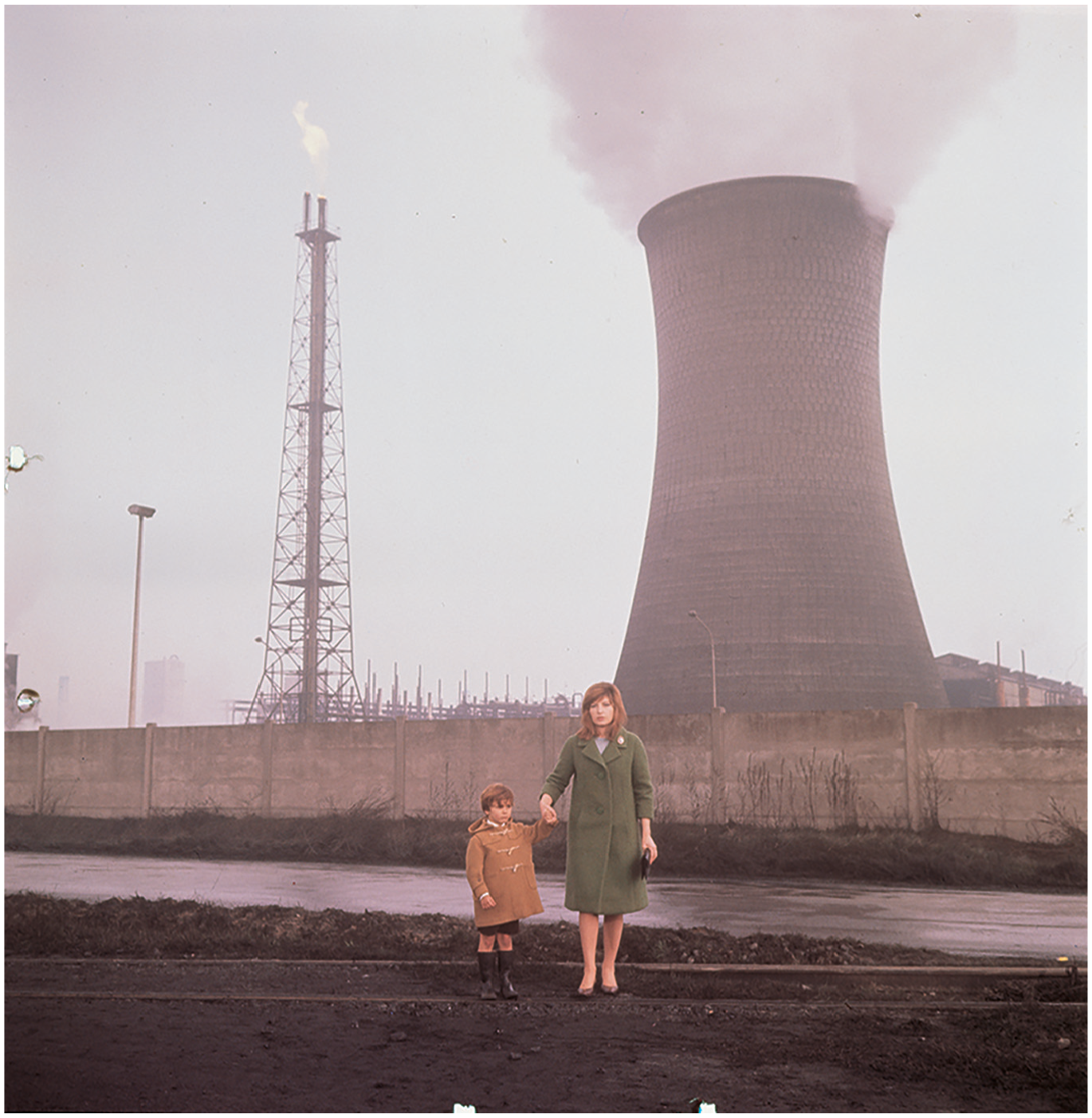
Michelangelo Antonioni, Red desert (1964). The industrial zone of Ravenna forms the focal point of the film.
The study of the metabolic realm poses an analytical challenge because many aspects of industrial production take place within ‘hidden abodes’ to use Marx’s original terminology (see Huber, 2017). A recent study of the energy sector for the Saint-Nazaire port region located on the French Adriatic coast, for instance, examines the ‘hidden flows,’ uneven power relations, and multi-scalar dimensions to fossil fuel use in order to synthesise elements of material flow analysis with neo-Marxian insights into ‘political–industrial ecology’ (Bahers et al., 2020). Similarly, Huber uses nitrogen as the analytical entry point for his study of industrial metabolism by focussing on the ‘vast and largely invisible middle ecologies’ that underpin modernity. He notes that an expanded reading of metabolism unsettles a zonal model of the urban hinterland à la William Cronon since ‘The ecological hinterland of cities includes not only primary commodities like wheat, lumber, and livestock … but also concrete, steel, and plastic’ (Huber, 2017: 155). Similarly, Brian Page and Richard Walker (1994: 156), in their response to Cronon, emphasise ‘the concurrent evolution of resource-extraction, processing and utilisation technologies.’ It is worth noting that around 80% of the ‘average city’ is built from concrete, with cement manufacturing responsible for as much as 8% of global carbon dioxide emissions (see Gandy, 2024a). These occluded dimensions to metabolism pose a challenge for cultural and political analysis, in part because the more mundane or hidden aspects to modernity are rarely a direct focus of social activism (see Huber, 2017).
As we extend the metabolic lens to ‘industrial political ecology’ the scope and complexity of the chemical realm comes into view: there are now more than 350,000 synthetic chemicals in circulation and the average human body contains at least 700 synthetic compounds that are not a usual component of our ‘body chemistry’ (see Persson et al., 2022). No toxicological studies exist for most of these synthetic compounds so that the epistemic politics of metabolism must contend with a series of regulatory and scientific lacunae. There are connections here between the field of critical toxicology and epistemological interest in the porosity of the body (see, for example, Alaimo, 2010; Nading, 2020). A critical metabolic discourse must also engage with Maximilian Hepach’s concern ‘if aesthetic experience of metabolic processes can ever be mistaken’ as part of a wider historiography of epistemic politics that extends to the miasmic and zymotic dimensions to the pre-bacteriological city (Hepach, 2024: 4, emphasis in original; see also Nieuwenhuis, 2019). Indeed, the transition from zymotic to bacteriological theories of disease includes complex lines of perceived causality and culpability where questions of practical efficacy blur any straightforward emphasis on the advance of what we might term realist conceptions of contagion, containment, and the rationalisation of urban space (see Tulodziecki, 2016).
We can draw a contrast between a metabolic focus on networks within the urban political ecology literature and an increased emphasis on ‘the visceral and biochemical dynamics of metabolism’ advanced within more process-oriented fields such as anthropology, history of science, and science and technology studies (Barua, 2023b; Van Oosten and Jaffe, 2024). Framed slightly differently, Olivier Coutard and Elizabeth Shove (2024: 213) ask whether ‘the metaphorical trope has often tended to supercede its material counterpart.’ With a shift of emphasis from network to process there is a reorientation of metabolic discourse from the metaphorical realm towards the bio-chemical maintenance of life.
An expanded conception of metabolism extends to multiple metabolic pathways and a variety of multispecies metabolic entanglements. A multispecies perspective offers a range of analytical entry points depending on the specific socio-ecological relations under investigation. Cities can be conceived as ‘metabolically dense environments’ (Barua, 2023a: 1) in the sense that metabolic pathways become closely entangled in urban space. It is instructive that much of the most insightful recent fieldwork on multispecies metabolism has taken place in cities of the global South, and especially in India (see, for example, Barua, 2024). 21 It is in these neglected contexts where there is a greater presence of multiple metabolic pathways that extend to diverse non-human actors such as cows, goats, and storks (see, for example, Doherty, 2019; Reddy, 2021). In some cases, however, it is guided rather than spontaneous forms of non-human labour that are incorporated into urban metabolic processes. Amy Zhang (2020: 76), for instance, describes how the labour of flies (or more precisely their larvae) has been used to ‘remedy a dysfunctional urban metabolism’ in relation to the treatment of organic waste in Guangzhou. Both human and non-human labour are integral components of urban metabolism, indeed the definition of labour widens if we enlist enzymatic processes and other bio-chemical reactions within our definition of work.
Conclusions
Metabolism remains something of a conceptual enigma marked by its simultaneous presence across diverse fields of enquiry ranging from biology, chemistry, and materials science to aspects of cybernetics, critical theory, and cultural practice. As metabolism has filtered through an ever wider set of analytical fields its metaphorical ambivalence has steadily grown. Indeed, the conceptual framing of urban metabolism, as a metabolic sub-field, operates simultaneously as a simple accounting framework, as a metaphor for living systems at different scales, and as a diagrammatic imaginary for future cities. In some cases, the material and metaphorical aspects to urban metabolism fold into each other, as in Simon Marvin and Will Medd’s examination of food, metabolism, and the accumulation of fat deposits within urban sewerage networks (Marvin and Medd, 2006). And as Hannah Landecker (2024) observes, it is not always clear that the metaphorical realm of contemporary metabolic discourse has kept pace with recent developments in the life sciences, in the sense that current elaborations of metabolic rift remain rooted in 19th-century conceptions of physiology, thermodynamics, and other fields.
Is there a distinctive urban metabolism or does a metabolic lens ultimately unsettle any attempt to define the urban? In the place of footprints and hinterlands we can reframe relations between metabolic processes and urban space as a series of zones or networks that operate at different spatial scales. Chris Otter’s elaboration of the technosphere, for instance, effectively replaces the city with an emphasis on forms of topographic density. Although the Vienna School moves beyond the city as a bounded object it does not offer a wider theory of capitalist urbanisation in its place. We need to consider the circulatory dynamics of cities within a longer time frame that predates modernity. Ross Exo Adams (2019), for example, conceptualises the circulatory dimensions to the longue durée of urban history as an alternative to the kind of ‘species history’ offered by systems-based interpretations of socio-metabolic transitions.
The conceptualisation of metabolism as the sustenance of life connects late 19th-century concerns with cell regeneration to diverse fields of human activity that underpin the functional dynamics of modernity, including the shift from labour-intensive to more capital-intensive modes of maintaining urban life. We can trace connections here with emerging interest in care, repair, and extended definitions of labour within the multi-species city: without incessant human activity cities fall quickly into a state of decay and dilapidation (see De Coss-Corzo, 2021; Enne, 2024). As a mode of maintenance urban metabolic practices extend to multiple configurations of human and non-human labour, including the use of plants and other organisms for the remediation of contaminated land and other specific dimensions to the production or revalorisation of space.
The experience of urban metabolism is highly uneven in space and time. Techno-managerial strategies to control urban space have often produced increased forms of economic precarity, metabolic displacement, and social marginalisation for informal sectors such as waste recycling (see, for example, Butt, 2023; Demaria and Schindler, 2016; Desvaux, 2024a; Giraldo Villamizar and Brito-Henriques, 2023; Wittmer, 2023). There are variations in the experience of metabolism that connect different forms of corporeal vulnerability with the functional dynamics of the city as a whole. Maria Rusca and her colleagues (2022), for instance, working in Maputo, stress the ‘spatial and temporal dimensions of urban metabolism’ that produce multiple and uneven forms of epidemiological risk across the city. Similarly, Maria Christina Fragkou (2024), drawing on research in Antofagasta, highlights metabolic inequities at the household scale in terms of the impact of gender, poverty, and power on differential access to water. 22
There are many dimensions to urban space that remain relatively underexplored within the urban metabolism literature such as phenomenological dimensions to urban experience that lie outside the scope of material flow analysis (see Perrotti and Stremke, 2020) or fields of human (and non-human) activity that remain neglected or little known within normative policy discourse (Kaviti Musango et al., 2020). In terms of future metabolic research Sabine Barles (2010: 451) calls for ‘the identification of the latent and remote effects of cities in time and space’ as part of an expanded analytical field. One possibility might be combining the insights of Barles and Huber into the nitrogen cycle to produce a multi-scalar analysis of metabolic rift. A key challenge, however, is whether insights from material flow analysis can be combined with alternative analytical frameworks. Perrotti, for instance, has explored potential connections between material flow analysis and radical conceptions of de-growth (Perrotti, 2022). 23 More recently, however, there has been a divergence of perspectives within the neo-Marxian literature around two main points of contention: the precise role of non-human agency within specific socio-metabolic regimes; and the implications of a de-growth agenda for class-based forms of political mobilisation. 24 Urban metabolic discourse hinges on matters of both maintenance and transition within a variety of material and metaphorical contexts. It is at the interface between conscious human agency and a nexus of metabolic entanglements that the next phase of urbanisation will take shape.
Footnotes
Acknowledgements
This article is based on my Urban Studies lecture delivered to the 2024 RGS-IBG annual conference in London. An earlier version was also given to the Infrastructural Geography seminar series at the University of Cambridge. I would like to thank my editor Jon Bannister and the referees for their helpful feedback. Thanks also to Koenraad Danneels, Jamie Dawes, Maximilian Hepach, Kumiko Kiuchi, and Ben Platt for assistance with tracking down some of the sources. I am also grateful to the CIVA archive in Brussels and the Gallerie d’Arte Moderna e Contemporanea in Ferrara for their help with sourcing images.
Declaration of conflicting interests
The author(s) declared no potential conflicts of interest with respect to the research, authorship, and/or publication of this article.
Funding
The author disclosed receipt of the following financial support for the research, authorship, and/or publication of this article: The research was supported by the Leverhulme Trust as part of the project Zoonotic urbanization.
