




Abstract
The global rise of non-communicable diseases (NCDs) presents an international public health policy challenge. Critical agents in this global trend are the activities and growth strategies of large transnational companies (TNCs) producing, selling and marketing unhealthy commodities including tobacco, alcohol and ultra-processed food. However, little geographical scholarship has considered the corporate activities of TNCs and the implications for global health. We utilise the ‘Commercial Determinants of Health’ framework to develop a cross-disciplinary agenda for geographical scholarship to deepen our understanding of how TNCs are drivers of global health geographies and implicated in the rise of NCDs and health inequalities.
Keywords
I Introduction
There has been a rapid global increase in non-communicable diseases (NCDs), particularly in low- and middle-income countries. Around 43 million annual deaths, representing 75% of all deaths, are attributed to NCDs including cardiovascular diseases, chronic respiratory diseases and diabetes. Further, almost ¾ of global deaths attributed to NCDs are in low- and middle-income countries (LMICs) (World Health Organisation, 2023). NCDs are not only a substantial health burden, but they are also a major driver of health inequalities within and between countries; have substantial implications for country and household finances; impact negatively on population mental health; and undermine progress towards the Sustainable Development Goals (Nugent et al., 2018). The rising prevalence of NCDs, and the absence of effective solutions to the high burden of NCDs, has coincided with deepening academic and policy attention to the role of corporate activities, particularly those of transnational corporations (TNCs), in accounting for these global trends (Baum and Anaf, 2015). Activities of the corporate sector including the lobbying, production, distribution and promotion of unhealthy products are implicated in shaping population health and health inequalities, particularly in LMICs.
The concept of ‘industrial epidemics’ – epidemics propelled by the producers of unhealthy commodities that are harmful to health – was first applied to tobacco-related diseases and later extended to other unhealthy commodities (Collin and Hill, 2015). Decades of research shows how the actions of the tobacco industry sought to undermine the scientific consensus on the harms of tobacco (Brandt, 2012). In recent years, attention has diversified to other unhealthy commodities and profit-driven diseases, most notably alcohol, ultra-processed foods and fossil fuels. These four unhealthy commodity industries (UCIs) account for more than one-third of annual global preventable deaths (Gilmore et al., 2023).
Whilst the importance of the commercial sector for population health has gained more prominence in recent years, research and policy have been hindered by a lack of conceptual clarity and a comprehensive assessment of the extent to which commercial activities are health relevant. The multilevel drivers of population health and inequalities are well recognised in social and health sciences research. Frameworks such as the Dahlgren and Whitehead model of health determinants (or the ‘Rainbow Model’) (Dahlgren and Whitehead, 1991) are increasingly integrated into policy frameworks including the World Health Organization’s ‘Levelling up’ strategies (Whitehead and Dahlgren, 2006). Critiques of the existing framings of the divers of ill-heath and inequity include arguments that commercial sector activities are rarely integrated into key conceptual models widely used to inform local, national and supra-national policy development (Maani et al., 2020). Whilst Dahlgren and Whitehead refute this claim arguing that commercial interests are a driving force of all determinants of health (with the exception of genetics) (Diderichsen et al., 2021), they also recognise a need to make these connections more explicit (Dahlgren and Whitehead, 2021). Addressing this important need, the Commercial Determinants of Health (CDOH) framework captures the breadth of commercial activities relevant to public health concerns and develops a more holistic understanding of the systemic drivers of health and inequalities (Mialon, 2020). The CDOH conceptualises the multiscalar influences on health, including micro-level drivers of behaviour and choice, alongside macro-level and structural factors relating to the political economy of globalisation.
The aim of this paper is to briefly introduce the CDOH framework before developing an agenda for how geographers – and other researchers with an interest in the connections between health and place – can engage with this framework to deepen our understanding of how the practices of commercial actors intersect with spatial processes to shape population health and inequalities. The focus of this paper is on NCDs given the extent of the global health challenge they pose, but the importance of infectious diseases is also duly recognised. We argue that there is an urgent need for human geographers from different parts of our discipline to interrogate the commercial influences on health and wellbeing in order to more fulsomely document the activities of commercial actors, particularly TNCs, and help identify effective policy responses amongst local, regional, national and supranational stakeholders.
II Commercial Determinants of Health
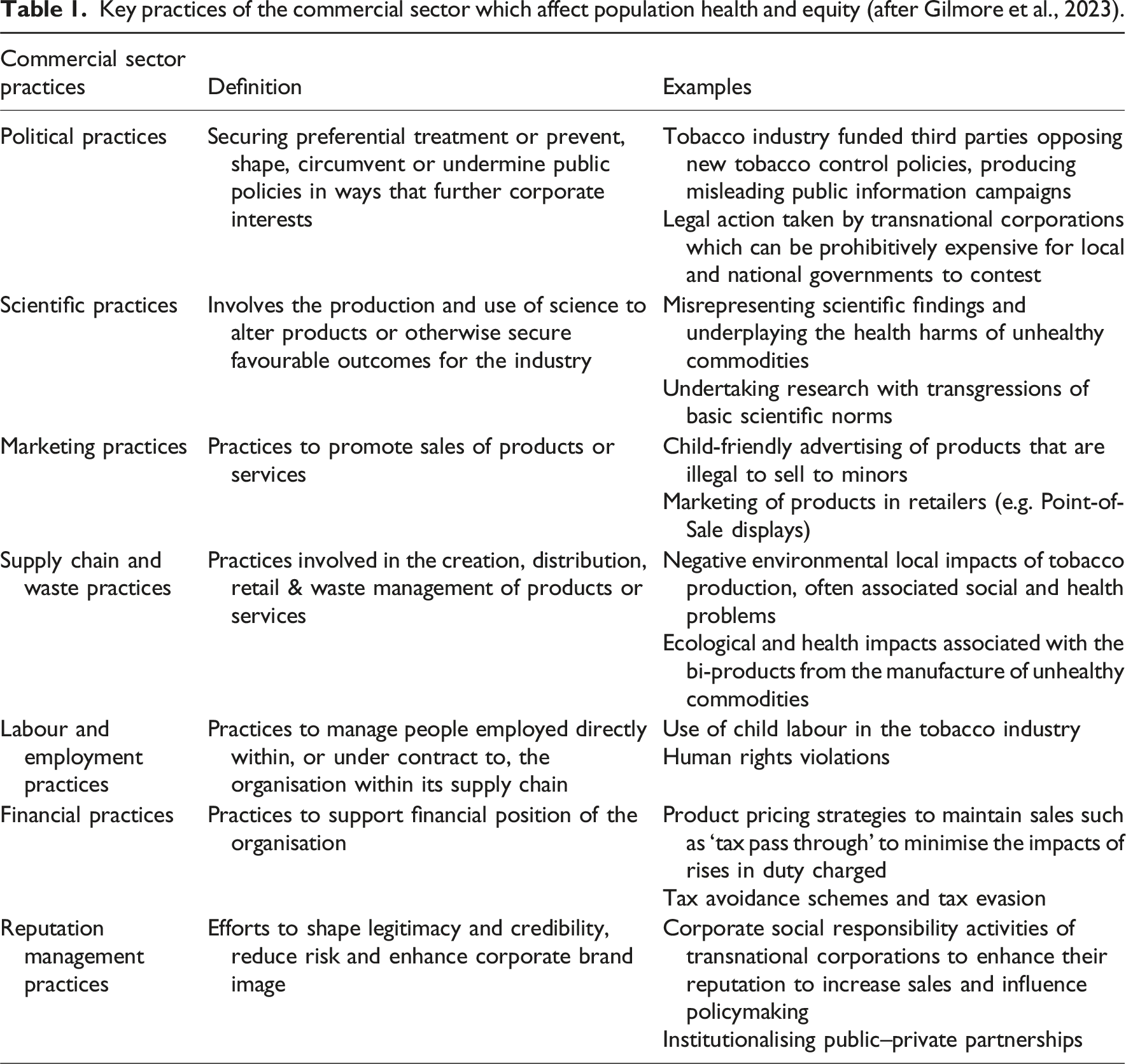
Key practices of the commercial sector which affect population health and equity (after Gilmore et al., 2023).
III Commercial Determinants of Health: An agenda for human geography
Over the past 15 to 20 years, there has been an emergence of work on ‘global health geographies’ which has applied a geographical framework to transnational health concerns, including the determinants and policy solutions (Brown and Moon, 2012). Global health themes receiving attention from geographers include critical challenges such as maternal and child health in sub-Saharan Africa, medical tourism and intra-state mobility relating to health care utilisation, postcolonial perspectives on health and international documentation of health (in)equity (Gatrell, 2023). However, there has been limited recognition of the importance of adopting a global health geography perspective to identify the global processes underpinning the consumption of unhealthy commodities (Brown and Moon, 2012). Important exceptions include work exploring the tension between UN support for private sector involvement in alcohol policy formulation and public health opposition to ‘harm industries’ (e.g. Herrick, 2016), and global-scale analysis considering the role of multinational tobacco companies and state tobacco monopolies in shaping the availability of tobacco products and driving the changing geographies of tobacco use (Barnett et al., 2016).
Rather, work on the commercial determinants of health has largely remained the domain of fields such as political science and public health. The dearth of geographical scholarship in this area is perhaps surprising given the highly spatialised nature of many of the key questions relating to the commercial drivers of NCDs, including themes identified in the Lancet series. A global health geographies perspective offers a multitude of opportunities for a richer appreciation of how commercial sector practices influence health at a macro-level. Scholarship in global health geographies has emphasised, for example, the significance of globalisation and the associated phenomenon of ‘time-space compression’ (Harvey, 1990) which, facilitated through the unequal power of poorly regulated trans-national corporations, has accelerated risk transition, including exposure to imported or adopted commercial products such as unhealthy commodities. The globalisation and rapid transfer of risk across increasingly porous borders helps to explain the transition in non-communicable disease prevalence to low- and middle-income countries (Brown, 2011). Indeed, it is argued that globalisation has undermined the capacity of the sovereign state to protect citizens from public health threats (Fidler, 2001), including the activities and reach of some agents in commercial sector.
In this section, we draw on Gilmore et al.’s framework to consider four of the seven practices: political, supply chain, marketing and reputation management. Whilst these themes are selective and not mutually exclusive, they represent areas identified in the CDOH framework that offer significant breadth to demonstrate the ways in which geographers can engage with this topic. By applying these themes to scrutinise the unhealthy commodities sector, we argue that this will help to deepen our understanding of practices of commercial entities that are relevant for public health and/or aid in elucidating the spatialised mechanisms by which these processes can affect the multilevel drivers of health and inequity. We consider how geographical scholarship can be applied to these four sets of practices to strengthen our understanding of the CDOH and how this can then translate to affect population health and equity through mechanisms operating across different levels. Throughout we provide some future direction for geographical work on the CDOH.
1 Political practices
The framework presented by Gilmore et al. (2023) emphasises political practices as expressions of power that enable TNCs to secure favourable treatment in policy development and implementation. This application of power highlights how corporate influence on policy enables TNC’s to reshape places and our interactions with them. Corporate power has deep historical roots in geographical scholarship, intertwined with politics, colonialism and trading geographies (Aguiton et al., 2021). While geographers have significantly advanced our understanding of globalisation, global inequality and trading systems (Hughes, 2006), the role of geography remains under-explored in commercial determinants. Since space and power are deeply interconnected, geographers, who often adopt a relational view of power, consider that ‘not only is space utterly imbued with and a product of relations of power, but power itself has a geography. There are cartographies of power’ (Massey, 2009, p.14). Building on the work of Wood et al. (2021), Gilmore and colleagues apply Fuchs and others’ three faces of power framework to understand global corporate power, framing political power as instrumental, structural and/or discursive. Below we explore how each of these ‘faces’ offers opportunities to explore the geographies of power and the construction of hegemony across and within spaces.
Instrumental power refers to the direct influence corporations can exert through targeted actions. One prominent example is lobbying, which involves efforts to sway decisions typically made by legislators or regulators. TNCs use lobbying to reshape discussions around health risks, regulation and public health initiatives in both national and international arenas. The significance of lobbying for harmful industries is evident in their substantial spending on these activities. From 1998 to 2020, four industries (tobacco, alcohol, gambling and ultra-processed food) collectively spent approximately $3.26 billion on direct lobbying in the U.S. alone, not including expenditures on think tanks or other forms of indirect advocacy, with spending surges aligning with key policy debates (Chung et al., 2024).
Despite assertions that ‘lobbying is a relational geography of power’ (Hofman and Aalbers, 2017), there has been little focus on the spaces of lobbying in the CDOH. Hoffman and Aalbers (2017) suggest three flows within spaces of lobbying: the flows of people between organisations, the flows of ideas between these people and the flows of resources between organisations. The first of these represents the ‘revolving doors’ between governments and corporations. Such a phenomenon refers to the movement of those with previous policy or legislator experience in the public sector to lobbyists within the private sector. Analysing the background of harmful industry lobbyists in the USA, Chung et al. (2024) estimate that between 1998 and 2020 62% were former government employees. Such personnel movements are inherently spatial with both power and knowledge situated in context. The second flow, that of ideas, can be extended into the spaces in which lobbyists and corporations compete and collaborate to forge networks, opinions and narratives. There is an opportunity here to consider the spatiality of these ‘fields of power’ to understand how the spatial concentration of these exclusive networks, in the control centres of the global economy, influences the formation of ‘elite constellations’ (Nichols and Savage, 2017). Such a concentration of power and knowledge is evident in ‘concomitant’ interlocking directorates (Kentor and Jang, 2004), fostering a select corporate community. Kono et al. (1998) argue that previous research on interlocking directorates may have been ‘seriously misspecified’ by failing to address their spatial structure and seeing space ‘as a stage upon which they unfold’ (p. 865) rather than interrogating the spatiality of these networks of ideas and knowledge. The third and final flow, the flow of resources, refers to the flow of money amongst and between lobbyists and organisations, including political funding and donations. Geographers have explored the geographic context of individual political donors in the past (Gimpel et al., 2006), but attention could usefully broaden to the corporate geographies of such donations within the unhealthy commodities industries.
The second face of power, structural power, includes the use of power by corporations in both direct and indirect ways. This can range from direct ‘rule setting power’ to more indirect forms of power such as that derived from ‘their position in institutional processes and from the dependence of politicians on private-sector profitability, investments, and jobs’ (Fuchs, 2013: 80). Exploring such forms of power will enable us to develop our understanding of what Fuchs refers to as ‘decision making and non-decision making’ within policy and regulatory frameworks. Geographers can usefully consider the ways through which the situational embeddedness of TNCs can challenge policy making and the regulation of corporations who are seen as ‘vital’ to local and national economies. This calls for closer attention to the processes that operate in regulatory environments locally, nationally and more globally that shape the ability of TNCs to wield material power. The relationship between states and TNCs is critical here and policies related to the internationalisation of trade, foreign direct investment and incentives to attract TNCs are all complex processes that require knowledge of the ‘whereabouts of power’ (Allen, 2004). Faulconbridge (2012) argues that such power relations are spatially heterogeneous with geography shaping ‘the assets available to construct power, the nature of interactions between contending parties, and ultimately the power relations produced’ (p. 736). Although geographical work in this area has explored this intrinsic spatiality of policy mobilities and assemblages when ‘elements of near and far are combined into a global–local policy formation’ (Temenos and McCann, 2013: 347), others have argued for greater attention to be paid to the spatially diffuse nature of policy as a geographical phenomenon (Peck, 2011). With a particular focus on UCIs, geographers can contribute to critical research that situates context as integral to actor-state relations, the inter-scalar activities of global corporations and the geopolitical practices of UCIs from the Global North in the Global South.
The third and final face is that of discursive power, with power seen as a function of knowledge and ideas that are then used to shape perceptions, values and identities that are inextricably linked to the legitimacy of various actors. Such discursive dominance allows actors to centre themselves in positions of authority, shape the public and political discourse on public health harm and solutions and situate themselves as essential to the formulation of policy within the political process. The strategies that are used to shape public and political discourse can include the funding of academic research, think tanks and participating in public debates (e.g. media interviews and responses to state policy decisions). Fuchs and Kalfagianni (2009) present three ways through which discursive activities take place in businesses: 1) the framing of policy issues, 2) the framing of actors (this could include public health actors) and 3) the influence of broader political and social norms. Think Tanks, private research organisations and social aspects/public relations organisations (SAPROs), may play a particular role in such framing drawing on discourses of individualism to shape narratives and norms through various strategies including denial/omission, distortion and distraction (Petticrew et al., 2018). For example, analyses of the activities of the alcohol industry-funded charity Drinkaware suggest that the organisation promotes behavioural change and ‘responsible drinking’ rather than the structural changes and regulation likely to be effective in addressing alcohol harms (Hawkins et al., 2021; Maani et al., 2024), a criticism rejected by Drinkaware (Hawkins et al., 2021; Sim et al., 2019).
Understanding the spatialities of the three faces of power is an intrinsically geographical challenge. The dominance of a neo-liberal ideology, that has focussed on defining the problem as one of the individual, has allowed a framing of behavioural health issues that focusses on moral failure. The behavioural thesis, supported by this discursive hegemony, is used by TNCs to deflect attention from the product as the disease vector towards the individual as the problem (Gilmore et al., 2011). The central message becomes one of partnership with TNCs seen as part of the solution constructed through a dominant discourse of the problem individual. This framing of the individual as the problem leads us to question what the problem is represented to be, how this representation came to be and what is left unproblematic (Bacchi, 2015). Questions that are fundamentally geographical locating the problem and solution in space and time.
2 Supply chain and waste practices
Since the 1990s, there has been interest amongst geographers in commodity chains as a means to ground the complex networks of production in the routine practices of states, businesses, employees, households and consumers. Research into commodity chains is well established in economic geography with the basic premise to track products temporally and spatially from their production to eventual consumption (Hartwick, 1998). The work tends to adopt a ‘vertical’ framing in order to preferentially consider the contextual or upstream determinants of consumption, rather than a more restricted assessment of the product at a single point in time (Leslie and Reimer, 1999). By tracing the linked processes and sites through the commodity chain – production, distribution, retailing, design, advertising, marketing and consumption – a commodity chain approach helps provide analytical purchase on the complex factors shaping the global economy and more precisely examine the practices shaping the flow of goods. Commodity chain analysis thus facilitates, for example, a better understanding of the networks of production, trade and consumption; who controls and benefits from different nodes in the international network; the international division of labour and their concrete historical and geographical relations.
Although commodity chain analyses have been regularly applied to certain foodstuff including coffee, meat and fruit/vegetables, the approach has rarely been considered in relation to unhealthy commodities per se, particularly alcohol and tobacco, and there is limited discussion of the NCD and public health implications of global commodity chains. Amongst the few studies to apply a commodity chain analysis to unhealthy commodities is work on the beer industry in Malaysia (Jernigan, 2000). The study demonstrates how TNCs use their powerful positions to strategically dominate key nodes on the commodity chain and secure significant influence over drinking settings and practices. It also reveals how the globally structured networks of production help to shape drinking patterns at different spatial scales, how power is conveyed in the commodity chain, and how and where profits are extracted. Whilst there is little geographical work on tobacco formally adopting a commodity chain approach, there is nonetheless aligned work in the public health and ‘tobacco control’ literature interrogating key components of the tobacco system. For example, there is research into farmers’ motives and incentives to cultivate tobacco (Rahman et al., 2020), and the role of market liberalisation and foreign direct investment in affecting cigarette production and consumption (Gilmore and McKee, 2005). Further, we also know much about the tactics of ‘Big Tobacco’ in opposing measures across the commodity chain that do not align with their commercial imperatives, from agricultural production (Jakpor, 2012) to retailing (Hoek et al., 2012). These findings from alcohol and tobacco research are important as they emphasise that TNCs and state-owned monopolies are fundamental to the economy of unhealthy commodities. In particular, the extensive global supply chains of TNCs affect the availability of unhealthy commodities around the world and in turn are likely to be shaping the changing geographies of NCDs. TNCs have been instrumental at all stages of the unhealthy commodity supply chain including the growing, manufacturing and retailing of these products. Through controlling these nodes in the network, it is likely they will disproportionately benefit from commodity production and therefore have abundant resources to invest in influencing governments, policymakers and the broader public discourse in how they relate to the products produced by the TNCs.
Commodity chain analysis thus offers several analytical possibilities in better understanding the commercial determinants of health, particularly in relation to alcohol and tobacco. A focus on the commodity chains and global networks of production of these products is likely to be fruitful in developing a better understanding of the vertical integration of the commercial sector (particularly TNCs and state-owned industries) and how the dominance of these organisations in agricultural production, manufacturing, distribution and retailing of unhealthy commodities affects product demand and consumption. With regards to agriculture, for example, it is important to track production levels and crop values of tobacco across the world in different national contexts, to understand the importance of the product to national finances and investigate the ways in which TNCs use this leverage to influence economic and social policymaking to align with their strategic and economic priorities. A commodity chain analysis would provide an even richer and holistic perspective on the actors involved in the journey from tobacco farm to smoker, connecting agriculture, agricultural product distribution, manufacture, wholesale distribution, retailing and illicit sales. In particular, it would help reveal the extent to which TNCs are embedded at every step of the journey.
3 Marketing practices
The marketing activities of unhealthy commodity industries strengthen their business, impact consumer choice, shape attitudes and behaviours and enable a small number of TNCs to dominate the market (Jernigan and Ross, 2020). Effective marketing strategies increase product desirability, drive sales, maximise profits for shareholders and may also contribute towards growing structural inequalities by targeting specific areas or population groups (Gilmore et al., 2023). Understanding the tactics, including marketing principles, used by global corporations to influence consumer behaviour is crucial and geographers can help uncover the ways in which ‘advertising is an inherently spatial practice’ (Jackson and Taylor, 1996) by exploring how place is commodified in the pursuit of expanding markets.
Two areas of marketing practice may be of particular interest to geographers: place in advertising and advertising in place. The first relates to the ways in which place is a representation or ‘how advertisers invoke real or imagined sites to create an appealing context for marketing a product or a service’ (Fleming and Roth, 1991, p.281). Places are used as a symbolic representation with campaigns that draw on landscape imagery connecting commercial products to the collective identity of place. Advertising in place on the other hand connects with how commercial entities use public space (e.g. billboards, transportation hubs and vehicles) to advertise their goods, speak to consumers and drive desirability. Commercial marketing in this sense is a form of materiality in place. Through both practices advertising can lead to a ‘commodification of particular aspects of place’ be that physical space, culture and/or identity (Pawson, 1997). For now, we will focus on the first of these two practices to demonstrate how such use of place can relate to the geographical imagination in subtle ways, but also be used to wield power by distracting consumers away from the knowledge of potential harm or inhibiting the development of regulation and policy.
The alcohol industry has strategically adopted place as a marketing practice, perhaps most obvious in the marketing of wine, but other alcohol products connect with place in ways that both commodify place and embed the industries in place. One such example is the perceived inextricable link between whisky and Scotland and the construction of Scottishness in the geographical imagination. Both the landscape and culture are used to symbolically construct a ‘sense of place’ that is marketed to drive the growth of the industry and related tourism whilst also ‘nurtur[ing] the notion that whisky is a necessary part of Scottish identity’ (Spracklen, 2014: 138). This centring of whisky sees the industry linked to local regeneration, employment and investment. In a sense, whisky has become a ‘territorial anchor’ (Pike, 2015) with the industry promoting the importance of Scotland’s landscape as an integral characteristic of place required in the production phase, not replicable elsewhere, thus limiting any spatial movement of the brand in a form of spatial ‘lock in’. Applying this idea through a CDOH lens leads us to consider ‘territorial anchors’ in relation to policy. For whisky, this anchor to Scotland may have helped to position the industry in the centre of a public health policy that aimed to tackle alcohol harm through the introduction of Minimum Unit Pricing (MUP). The Scotch Whisky Association (SWA), a trade association of Scotch Whisky producers, was at the forefront of opposition to MUP with McCambridge et al. arguing that the SWA leadership of the challenge against MUP was ‘primarily to take advantage of the particular economic importance of the whisky industry in Scotland and the status of its product as a cultural icon’ (McCambridge et al., 2014: 201). The ‘territorial anchor’ of whisky enabled the industry to position themselves as key economic actors with arguments around any potential negative impacts of MUP focussed on the ‘detrimental effect on the Scottish economy since whisky is such a vital component of the economy and a provider of employment’ (Holden and Hawkins, 2013: 260).
Landscape representation has long been a subject of geographical enquiry with studies of maps, images and paintings as a way of seeing the world. Whilst some geographic research has explored the use of place by commercial organisations (e.g. Castree (2001); Cook and Crang (1996); Jackson and Taylor (1996); Pike (2009)), geographers have engaged less with the ways in which the commercial industry has branded and commodified place to their advantage at the expense of population wellbeing. Writing on commodity fetishism, Jackson (2002) used the work of David Harvey who called for the need to ‘reveal the hidden geographies of production’. Such hidden geographies include the ways in which place is commodified and ‘the fingerprints of exploitation that are rendered invisible by the commodity form’ (Jackson, 2002: 8). Whilst such unveiling and unmasking in geography has tended towards a focus on labour, extraction and exploitation in the production of commodities, the commodity fetish of place and the implications of this remain under-explored.
4 Reputation management practices
Our final practice focusses on reputation management and in particular Corporate Social Responsibility (CSR) as a business model adopted by companies to integrate social, environmental and/or ethical concerns into their operations or interactions with stakeholders. Initiatives may include environmental sustainability efforts, philanthropy, ethical labour practices, educational scholarships, disaster relief efforts, community engagement, diversity and inclusion initiatives (Babor et al., 2018; Barraclough and Morrow, 2008; Fooks et al., 2011). Through such initiatives CSR represents, for some UCIs, one of the few remaining ways in which they can positively present their business practices and products and therefore furnish their reputations (Babor et al., 2018). Much of the broader CSR literature is dominated by an unproblematic portrayal of the process, depicting a ‘win win’ for both the business and society as reflected in a public narrative that neglects the political and structural power that CSR activities can embed and render invisible. Rather than describe such activities, we will instead turn our focus to the outcomes of CSR, seeing the practice as a legitimising framework to position TNCs as part of the solution, rather than the foci of the problem.
Within public health there is concern about the use of CSR activities, particularly on the ways in which CSR can be used as a legitimising framework allowing TNCs to shape blame and shift responsibility for harm from the manufacturer to the individual (Mialon and McCambridge, 2018). The concept of governmentality can be helpful in furthering our understanding of these activities, particularly in highlighting relationships between industry, the state and citizens. When applied to CSR, this lens of governmentality helps us to interrogate the relationship between knowledge and power as UCIs negotiate a position of authority in relation to policy and governance. This authority shifts the dynamics within these relationships in respect of the way in which individuals are governed; citizens are now deemed responsible for their health, including in the management of lifestyles and health ‘choices’ (Clarke, 2005). This forces us to consider the underlying tension between the state as a regulator and the state as an enabler of trade. Such responsibilised citizenship (Rose, 1996) also sees the division of the population into those who are able to manage their health, ‘active citizens’ and ‘targeted populations’ who require interventions’ (Dean, 1999: 167 cited in Henderson, 2015).
The move towards increased responsibilisation, with undertones of deviant populations, has been exploited by the UCIs particularly in the area of regulation. Using CSR in the form of voluntary interventions (e.g. food labelling) helps to shift the focus of interventions on to the ‘rational consumer’ using forms of self-regulation. This shift appeals to ideas of freedom and individual agency resulting in the erosion of the distinction between the state and the market. An example is the Public Health Responsibility Deal in England that aimed to engage the private sector as responsible stakeholders and promote a public–private partnership approach to health policy (Gilmore et al., 2011). In response, public discourse moves towards seeing public health interventions as actions of an interventionist ‘nanny state’ with initiatives, such as sugar tax, seen as a form of surveillance discipline. Governmentality can help us to explore how UCIs and related behaviours are problematised with norms shaped using indirect power within the public discourse. We can consider how UCIs position themselves, using tools such as CSR, to be part of the solution rather than the problem.
Geographical scholarship that has engaged with CSR and its role in furthering the commercial interests of TNCs has focussed largely on extractive industries or those industries that engage with fair or ethical trade. As an example, Mayes et al. (2014) focussed on the mining industry to explore the ways in which CSR has been used to embed the industry in local areas and claim the role of community agent. Examples of community-focussed CSR activities included funding of community groups, a community investment program, sponsorship and support for new businesses. This local embeddedness through CSR allows such companies to bring communities on board for support, rather than resistance thus ‘enabling a deepening neoliberalisation in terms of local community governance, constitution, and practice’ (Mayes et al., 2014: 411).
Geographical scholarship has potential to contribute towards our understanding of how global industries use CSR, or related activities, to manage their reputations and strategically position themselves as part of the solution. The voluntary code and the politics of governance within CSR remain largely underexplored by geographers with Sadler and Lloyd (2009) arguing that there is a lack of ‘sustained critical engagement with the wider implications of CSR as a set of [neoliberalising] activities in its own right’ (2009: 613). Calls in health geography for a more ‘critical rethinking of how the global health field itself shapes the way global health is imagined’ (Brown et al., 2012: 1183) can incorporate an analysis of CSR and the ways in which such initiatives shape public health responses globally. The authors also argue that global health discourse can often focus on the priorities of the Global North rather than the Global South, arguments that have been extended to a critical analysis of CSR (Brown et al., 2012; Lund-Thomsen, 2020). Research priorities for geographers interested in CSR and UCIs include Global South perspectives on CSR activities of TNCs, the power differentials between states, TNCs and publics and how this plays out in voluntary codes of CSR, how CSR is used to shape prevailing ideologies around responsibility and the role of CSR in positioning the industry within the governance of public health.
IV Discussion
There is emerging interest amongst public health researchers and some social science disciplines in the critical role of TNCs in driving the rapid rises in non-communicable diseases around the world. Whilst the activities of commercial entities can have benefits for population health, not least through the provision of essential products and services, there is overwhelming evidence that the largest TNCs are placing an enormous burden on health, social and planetary inequities (Schrecker et al., 2015). In particular, there is significant concern for how commercial actors externalise the health burdens of their damaging practices whilst at the same time overemphasising their contribution to economic growth and improvements in population health. However, to date, geographical scholarship on the role of corporate sector in affecting these global health challenges has been piecemeal; applying a multitude of spatial perspectives to these concerns is an important research priority. This paper has begun to develop this agenda through the utilisation of the commercial determinants of health framework as an alternate to the reductionist biomedical and behavioural paradigms and a focus on the key channels through which multinational corporations and associated institutions (e.g. lobbyists, trade associations, think tanks, media and many other aligned entities) exert considerable influence. In particular, we have drawn on the CDOH framework developed in a recent Lancet series to consider the practices of commercial sector actors, the ways in which they shape social norms and the multilevel pathways through which these processes shape health and inequalities. We have focused on how the CDOH framework has been operationalised to examine the market and non-market activities of the producers of harmful commodities – most notably tobacco, alcohol and food and beverage companies – which are key to understanding and addressing the growth of NCDs across the world. We have argued that geographers are well placed to further our appreciation of these complex pathways that give rise to the global prominence of UCIs, particularly the spatialized nature of many of the most critical drivers of NCDs. Here, we identify some key cross-cutting themes for a future research agenda where geographers’ insights are urgently needed to provide a fulsome understanding of the CDOH.
First, we encourage geographers to engage with debates on the power dynamics that enable TNCs to create the structural conditions which facilitate a market-dominated landscape that favours unhealthy behaviours. Public health and related government policy responses to such conditions have been largely individualised, people are expected to change their behaviours whilst their living context remains unchanged, the so-called lifestyle drift in public health policy (Katikireddi et al., 2013). This individualised focus has been referred to as global health’s ‘neoliberal deep core’ with health policy privileging market-based policy responses and the individualisation of risk and responsibility (Rushton and Williams, 2012). TNCs have framed ‘free choice’ and open markets as desirable, shaping the public discourse around health and responsibility away from regulation and state intervention thus concealing the arm of the market economy. The channels that have enabled this, including lobbying and marketing, are founded upon the power that is afforded to UCIs. Geographers are well placed to explore the shifting power relations between industries, governments and civil society. Examples here include research that explores governance and, as Bevir and Rhodes(2003) argue, the ‘shifting power from the nation state “upwards” to transnational companies’ where the power within states is undermined’ (Griffin, 2012: 210). UCIs could be explored in this context including how such companies have shifted the balance of power at global, national and sub-national scales, where power resides, horizontal power relations related to networks such as public–private partnerships, and how the spatial diffusion of power is related to global inequalities in governance and resources. Allen refers to power from a relational perspective noting that ‘power is not so much exercised over space or transmitted across it, as composed through the interactions of the different actors involved’ (Allen, 2009: 207). Such interactions relate to the CDOH framework and the expanding outreach of corporations through channels such as lobbying and corporate citizenship.
Second, we argue that geographers commit themselves to exploring alternative models of the ‘free market’ economy. As economic globalisation has gathered momentum, and its global reach extended across the world, for-profit activities have increasingly shaped spatial configurations of planetary and human health as well as health inequities (Freudenberg et al., 2021). Economic geographers have had much to say about the spatial configuration of industries and economic development and the relationship with globalisation. Less however has been said on how such spatial configurations can influence and damage public health. We have discussed how market liberalisation and foreign direct investment has facilitated increased production and consumption of unhealthy commodities through the liberalisation of the supply chain. The CDOH is a ‘blind spot’ in human geography as a whole, and in health geography in particular. Exploring the ‘free market’ will require a systems approach to consider the interactions between silos of influence; cultural, social, economic and political. There is an urgent need to explore alternative models for the economy that will allow us to move towards more sustainable practices where health and wellbeing (both population and planetary), and not the maximisation of profit for shareholders, is the key outcome. Geographers can bring fresh perspectives on planetary health to the study of the commercial determinants, alongside a fuller consideration of how economic and political arrangements from local to global processes can shape commercial activities and translate into population-level health and wellbeing outcomes.
Third, and related, there is an urgent need to better understand the multilevel processes connecting the activities of the commercial sector with population health and heath inequalities in order to develop robust, cross-national policy options to counterbalance the extensive resources of the commercial sector. This will likely involve methodological plurality and the innovative adoption of new forms of data. For example, the use of large, linked administrative datasets integrated with geographical information on the ecological context in which people live their lives is showing promise in understanding the role of place-based commercial processes in explaining health behaviours, outcomes and inequalities (Clemens et al., 2020). Other forms of ‘big data’ such as electronic retailer transactions have promise for examining the strategies of TNCs including product availability and pricing across different communities (Shortt et al., 2021) and spatially differentiated efforts to absorb changes to product taxation in order to maintain their customer base (Wilson et al., 2025). Electronic transaction data also offer opportunities to scrutinise wider commercial practices and strategies of TNCs, such as industry claims about the importance of unhealthy commodities to the ‘footfall’ and hence business models of smaller retailers (Tunstall et al., 2023).
Fourth, our focus has primarily been on the industries producing tobacco, alcohol and ultra-processed food products, yet it is important that the activities of other industries such as petroleum, firearms, gambling and pharmaceutical industries are interrogated, including rapidly evolving innovations in commercial sectors such as novel nicotine products. It is also imperative to consider the similarities and differences in the commercial practices of different industries in order to understand common strategies and to support policy coherence across public health challenges. Related, there have been calls to expand this framing even further and extend the purview of the research field to not only the producers of unhealthy commodities but also to capture the role commercial entities play in other sectors, including the privatisation of education and care services, and how this impacts on population heath and equity (Burgess et al., 2024). Similarly, the CDOH framework can be extended into other global health challenges including the pathways into mental health, occupational health, health care provision, medical supplies and infectious disease including the COVID-19 pandemic. Whilst NCDs have been the focus of this paper, a CDOH approach can be used to interrogate a multitude of health outcomes when profit and public health may be in conflict. The COVID-19 pandemic emphasised that infectious and non-communicable diseases are intertwined. For example, an increased risk of severe COVID-19 outcomes has been associated with underlying NCDs, such as cardiovascular disease and diabetes (Nikoloski et al., 2021). Further, the industries discussed in this paper responded to the pandemic in varying ways, including extensive efforts to expand corporate social responsibility actions to portray themselves as key contributors to the pandemic response such as the provision of medical supplies and personal protective equipment (PPE). Yet these pandemic activities also served as an opportunity for these industries to enhance their principal interests through raising the profile of their products, augmenting their reputation, and guiding public policy away from the fundamental drivers of poor health and inequity (Collin et al., 2020). Post-COVID-19, the literature focussed on commercial interests and infectious disease, particularly the pharmaceutical industry and the equity of vaccine provision, has emerged. Such commentaries include questions regarding the balance between public funding of science in developing the vaccine and the profit motives of industries selling the vaccine (Light and Lexchin, 2021), the gap between vaccine delivery in high- and low-income countries (Bajaj et al., 2022) and the potential use of legal frameworks to ensure universal fair vaccine access (Ekström et al., 2021). The interactions between NCDs and infectious diseases demonstrate the importance of considering their interdependencies and in particular the role of commercial actors in shaping the elements that amplify these connections and health outcomes. CDOH work investigating linkages across sectors and between the Global North and Global South would be particularly valuable.
Finally, we’ve focused on four sets of practices where we argue geographical work can be particularly productive in deepening understanding of the CDOH. Whilst all seven practices identified in the Lancet CDOH Framework are integral to our understanding, we focussed on the four key practices where geography can make a particularly substantive contribution. These themes were chosen for their breadth across the discipline and their wide engagement with arguments related to power, politics and place. Limiting the scope in this way allowed us to illustrate how geographers can engage with this area of enquiry whilst recognising that geographical scholarship on the remaining practices (labour and employment, financial and scientific) identified in the Lancet series can provide further productive insights. This includes, for example, the extensive literature on labour geographies (Bridi, 2013) covering relevant concerns such as the collective organisation of workers, the development of geographically specific local labour markets and employment relations (Coe and Jordhus-Lier, 2011) which can aid our understanding of how the labour and employment practices shape population health and wellbeing. Human right violations and the use of child labour in the production of tobacco products (Ramos, 2018) are examples where a spatially nuanced perspective would be valuable. Similarly, perspectives from economic geography are likely to be insightful in understanding the financial practices of UCIs including the shift of power between economic actors and states, regulation and taxation (Aalbers, 2018; Bertscher et al., 2024). The final practice not covered in this paper is that of scientific practice, which can include a misrepresentation of scientific knowledge by TNCs as well as funding of academic research (Chapman and Shatenstein, 2001). In the ‘post-truth’ era, when the public scientific discourse is becoming more divisive, research on the creation, circulation and protection of knowledge provides an opportunity for geographers to consider the ways by which definitive claims can be made or disinformation produced, consumed and resisted (Warf, 2021).
V Conclusion
In conclusion, geographers and other social science researchers have long sought to understand the multilevel, interrelated and complex factors shaping the health of people and places. The interactions across people, place and time are often conceptualised through frameworks that guide research questions, analytical plans and, on occasions, policymaking and interventions. Whilst the global significance and policy salience of NCDs is widely accepted, policy, and to some extent academic attention, has largely emphasised behavioural risk factors including diet, lack of physical activity and the consumption of alcohol and tobacco. Consequently, NCD management has tended to focus on the individual and to prioritise early detection, timely treatment and behavioural interventions. More recently, researchers have turned their attention ‘upstream’ and begun to interrogate the role of the corporate activities of large, TNCs. The emergence of a CDOH framework has offered a holistic and coherent way to examine the different actors involved and practices of the commercial sector in shaping population heath and inequalities. It has long been recognised that responsibility to address health and equity should not be the sole responsibility of those working in health policy. Similar to the Social Determinants of Health frameworks, a CDOH approach emphasises the need for public health and equity improvement that requires the joining up of cross-cutting portfolios including housing, education, business and trade, media, energy and climate, environment, finance and more. Further, a CDOH approach offers opportunities for policy innovation at a global level similar to developments in tobacco control where the WHO Framework Convention on Tobacco Control (FCTC), which came into force in 2005, has provided the coordinating structure for ratifying countries to develop consistent actions to address tobacco use (Paraje et al., 2024). Whilst it is also important to identify and mitigate against barriers to participation in new global public health treaties, particularly amongst LMICs, with continuing support and leadership from the WHO, UN agencies and member states, global frameworks in other areas of public health offer considerable opportunities to facilitate coordinated and robust action on the CDOH and provide a basis for legal defence from the actions of TNCs (Friel et al., 2023). In this paper, we have mapped out an agenda for geographical scholarship on the CDOH which we suggest is likely to be analytically productive in strengthening our understanding of the drivers of global health geographies. The discussion has included consideration of geographical perspectives of the key practices of the commercial sector, particularly the political practices, supply chain and waste practices, marketing practices and reputation management practices. The paper also examines the public health salience of these practices and therefore how the CDOH can be integrated into global health geographies to better appreciate a wider set of macro-level drivers of population health and inequalities. Importantly, we argue that there are also significant opportunities for geographers not usually engaged with public health concerns, including those from political geography, economic geography and those with interests in the geographies of knowledge to bring new perspectives to the role of TNCs in driving the global rise in NCDs and health inequalities. These new perspectives from across the discipline will be essential in developing a holistic and systems-level understanding of many of the most significant global health concerns as well as a robust transnational policy response.
Footnotes

Ethical considerations
This is a review article. Ethical reviews for both SPECTRUM Consortium and the ESRC funded project were approved.
Author contributions
JP and NKS conceived of the paper, reviewed the material, designed and wrote the paper and approved the final manuscript. Both authors contributed equally to the paper.
Funding
The authors disclosed receipt of the following financial support for the research, authorship, and/or publication of this article: This work was supported by the Economic and Social Research Council (Grant/Award Number: ES/S016775/1) and by the SPECTRUM consortium which is a UK Prevention Research Partnership (MR/S037519/1), funded by the British Heart Foundation, Cancer Research UK, Chief Scientist Office of the Scottish Government Health and Social Care Directorates, Engineering and Physical Sciences Research Council, Economic and Social Research Council, Health and Social Care Research and Development Division (Welsh Government), Medical Research Council, National Institute for Health Research, Natural Environment Research Council, Public Health Agency (Northern Ireland), The Health Foundation and Wellcome.
Declaration of conflicting interests
The authors declared the following potential conflicts of interest with respect to the research, authorship, and/or publication of this article: JP is a member of the NCD Alliance Scotland Advisory Board on the Commercial Determinants of Health.