




Abstract
The electromagnetic spectrum (EMS) underpins and informs everyday life. Foregrounding particular portions of the EMS (radio, gamma), geographers theorise spectrum as infrastructure, territory/resource to manage, non-human and material. Extending this, we think across spectrum while bringing it into novel dialogue with feminist geopolitics. Pursuing a feminist geopolitics of the EMS, we draw on examples of spectrum-reliant technologies (5G, drones) to outline a three-part agenda. Exploring EMS and the body, we reflect on diverse bodily interactions with spectrum. In more-than-human encounters, we attend to multiple non-human relations with spectrum. In Living with EMS, we explore EMS at home and everyday spectrum practices.
I Introduction
Everyday encounters with the electromagnetic spectrum (EMS) are expansive, and its enveloping presence was again underscored during the COVID-19 pandemic. Referred to as an ‘infodemic’, the pandemic saw conspiracy theories ‘proliferate’ as a means to explain ‘uncontrollable circumstances’ (Stephens, 2020: 276) alongside the pushing back of trust in scientific expertise (Stilgoe, 2016). Spectrum-reliant 5G, the fifth generation of wireless network, became enfolded in such claims, including that ‘waves emitted by 5G infrastructure weaken immune systems’ and reduce COVID-19 defences (Destiny, 2020: n.p.). Despite the World Health Organisation (2020: n.p.) stating that ‘viruses cannot travel on radio waves/mobile networks’, claims connecting 5G and COVID-19 nonetheless went viral whilst telecommunications masts were vandalised and telecoms engineers verbally and physically harassed (BBC News, 2020).
At the same time, civil and commercial actors turned to ‘inorganic’ robots such as spectrum-reliant drones to counter the vulnerabilities of our ‘fleshy’ human bodies to Covid-19 (Sumartojo and Lugli, 2022: 1231). In Connecticut, United States, the Westport Police Department (2020: n.p.) announced they would test a ‘state of the art technology’ in response to the pandemic. Collaborating with drone company Draganfly, the ‘flatten the curve’ programme involved two drone-related phases; firstly ‘monitoring social distancing’, and secondly ‘detecting Covid-19 symptoms’ (Draganfly, 2020: n.p.). Utilising drone-mounted biometric sensors to detect heart rate, coughing, sneezing and temperature (the latter mobilising infrared electromagnetic engagements), the programme failed to progress beyond the initiation of phase one following concerns around privacy and discrimination, with Draganfly’s CEO stating that testing the drone on ‘a variety of skin tones’ raised ‘some challenges’ (Jackman et al., 2024: 1189).
As researchers each interested in spectrum-reliant technologies (5G, drones), Covid-19 prompted us to revisit discussions about both how the electromagnetic spectrum (EMS) undergirds, interacts with, and informs everyday life, and how such engagements and relations sharpen in the context of geopolitical crises. Taking this dialogue forward, this article builds upon geographical work examining particular sections of spectrum (e.g. radio geographies, nuclear geographies) and engaging spectrum-reliant technologies (e.g. digital geographies) to move from geographical discussions of spectrum to spectrum geographies. In so doing, we also bring such geographical work into novel dialogue with feminist geopolitics. In outlining an agenda towards a feminist geopolitics of the electromagnetic spectrum, we think across the EMS by weaving together examples of spectrum-reliant technologies (5G and drones), while examining the geographies of the EMS relating to diverse actors and bodies (human and non-human), everyday sites of encounter (e.g. home), and the ways the EMS is mobilised and engaged with which exceed anticipated applications and norms. Collectively, we present a feminist-inspired agenda to alternatively explore, ask questions of, and interrogate the EMS, enabling us to extend our vocabularies of EMS’ multiple and diverse geographies, while reflecting on how such accounts of EMS might also feed back into feminist geopolitics.
The article proceeds as follows. We first introduce the EMS and undertake a review of existing geographical work exploring sections of the spectrum (e.g. radio geographies, nuclear geographies). Whilst such work diversely theorises spectrum as infrastructure, territory or resource to be managed, and as non-human and material, we assert both that geographical discussions of spectrum can be extended to develop spectrum geographies, and that developing a feminist geopolitics of EMS offers an opportunity to further think across the EMS in productive ways. Here, we urge further exploration of spectrum geographies as those punctuated by diverse bodies and everyday practices which raises questions of/for feminist geopolitics itself. In outlining our agenda, we begin with EMS and the body, exploring diverse bodily interactions with and responses to spectrum, from Stop 5G campaigners describing sensing the radio spectrum through Electro/Electromagnetic Hypersensitivity, to the sensory dimensions of drone flight. Second, we turn to more-than-human encounters of/with the EMS, widening questions of spectrum while drawing attention to diverse relations between multiple non-humans, including 5G, drones, and animals. Third, in Everyday sites and relations: Living with the EMS, we examine both the EMS in/at home, and everyday and ‘glitchy’ electromagnetic practices and engagements. We reflect on the use of devices designed to protect people and domestic space from the perceived ill-effects of 5G, as well as ‘glitchy’ everyday drone deployments beyond the state. We conclude by reflecting on these three frames as a starting point in the development of fuller accounts of the spectrum’s multiple and diverse geographies, while also offering further pathways for fruitful pursuit.
II Understanding the electromagnetic spectrum (EMS)
1 Introducing the EMS
The electromagnetic spectrum (EMS) is composed of electromagnetic waves, a naturally occurring form of radiation that surrounds us. The EMS is a framework mapping electromagnetic wavelengths along a continuum, which can be ‘decomposed into frequency components or bands’ (Sawchuck et al., 2010: 6). It is divided into seven sections –radio waves, microwaves, infrared, visible light, ultraviolet, x-rays and gamma rays. This division is based on frequency (oscillations per second), wavelength (distance between two peaks of an oscillation), and whether the wavelengths are non-ionising or ionising, that is, whether they have the energy to separate electrons from atoms and to cause harm as organs and body tissue absorb the radiation (Curtis, 2023: 53). This distinction between non-ionising and ionising radiation underpins how the EMS is understood, used, and managed as these ‘portions’ of the spectrum have different materialities, making them ‘suitable for different purposes’ (Sawchuk et al., 2010: 6).
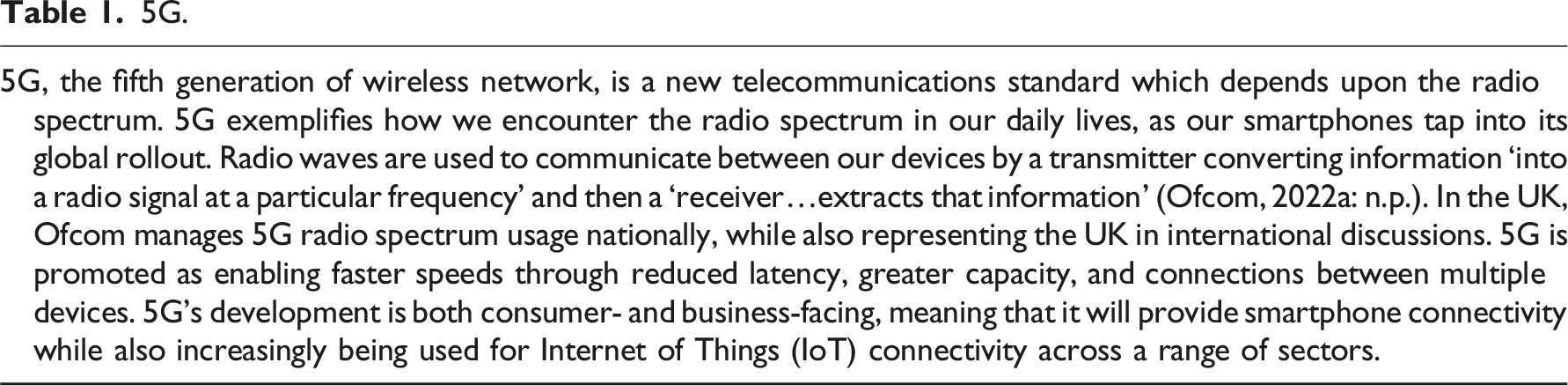
5G.
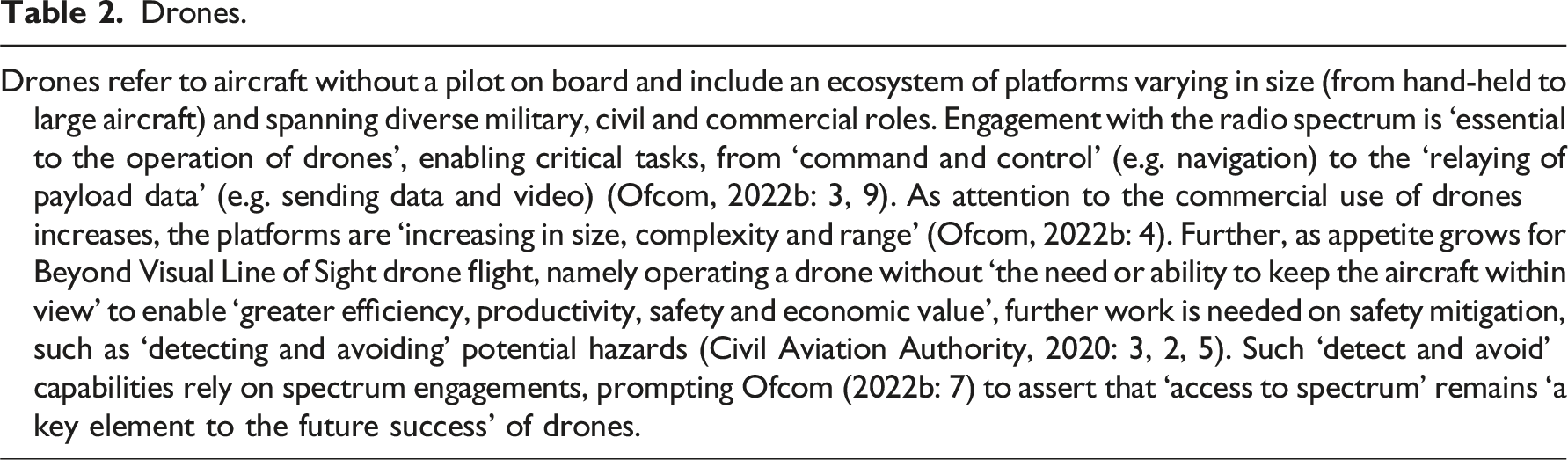
Drones.
2 Geographies of the EMS
Geographers, alongside scholars across diverse disciplines, have variously engaged with the EMS. Work has largely focused on two specific portions of spectrum, namely radio (in the non-ionising section of spectrum) and gamma radiation (in the ionising section of the spectrum). This work has drawn attention to different applications and ways of understanding spectrum. Our overview of such work below acknowledges the differences within the radiations themselves while also teasing out the relevance of thinking across, rather than within discrete sections of, the EMS.
2.1 Radio spectrum (non-ionising): Applications, infrastructure, territory and materialities
Situated in the non-ionising section of the EMS, engagements with radio spectrum inform our everyday lives and spaces. As geographers remind us, ‘radio waves are all around us’ (Peters, 2018: 10) and we routinely pass through a ‘vast ocean of electromagnetic waves’ (Weir, 2014: 84). Given our growing use of technologies ‘dependent on radio waves’, it is asserted that we are ‘living in the age of radioactive environments’ (Thrift 2004 in Weir, 2014: 849). Alongside highlighting diverse encounters with radio spectrum, from radio broadcasts and podcasts transmitted into, audienced in, and shaping ‘listeners’ geographical imaginations’ in and beyond domestic space (Watson, 2024: 775; see also Pinkerton and Dodds, 2009; Peters, 2018; Smiles, 2019; Weir, 2014, 2020) to ‘airspace alive with electromagnetic signals’ in contemporary battlefields (Adey, 2008: 1322) and policing with (sensing) drones (Jackman, 2023a), geographers have variously contributed to spatial theorisations of radio spectrum. Collectively, this has included characterising radio spectrum as infrastructure, territory or resource to be managed, and as non-human and material.
Geographical and wider scholarship has understood the radio spectrum as infrastructure and in infrastructural terms, namely as ‘socio-technical systems’ at once underpinning everyday life and enabling (uneven) ‘connection and circulation’ (Cowen, 2018: n.p.). Here, work characterises spectrum infrastructure as ‘hidden’ (Weir, 2014), ‘invisible’ (Au, 2024; Crow and Sawchuk, 2008), ‘inaccessible’ (Ash, 2013), ‘imperceptible’ (Mukherjee, 2020a) and ‘insensible’ (Weir, 2014). Yet, so too is it argued that spectrum infrastructure emerges as visible when it touches down as and relies upon ‘material objects of transmission and reception’ (e.g. masts, cables) (Weir, 2014: 850), ‘tangible’ through processes such as ‘protocols and standards’ (Au, 2024: 13; Easterling, 2014), and confronting when ‘reception or signal breaks down’ (Weir, 2020: 945).
Others understand radio spectrum as a ‘relational backbone to the devices and networks we build’, becoming infrastructure through the ‘political work’ of spectrum management and use (Tawil-Souri, 2017: n.p.). Alongside accounts exploring the geopolitical dimensions of ‘broadcasting infrastructure’ (Pinkerton and Dodds, 2009: 12), this is illustrated in Mukherjee's (2020a: 33) work arguing that ‘radiations by themselves are not enough to comprehend the epistemic and political order governing such infrastructures’. In other words, radio spectrum emerges as infrastructure in combination with other practices, processes and materialities. Several accounts of EMS thus remain united by a desire to ‘unearth’ spectrum through attention to the ways in which spectrum and spectrum-reliant technologies are ‘tethered to geographies and power relations’ (Au, 2024: 15). Geographical accounts turn to the conceptual framework of assemblage to interrogate radio as both ‘material’ and ‘discursive’ (Weir, 2020: 938; 2014). As ‘relational ontology’ and ‘mode of ordering heterogeneous’ human and non-human ‘entities’, such accounts foreground both the ‘material components’ and social-political dimensions of radio infrastructure (Weir, 2014: 850; Weir, 2020: 939).
Accounts of EMS have also centred on the management of radio spectrum. The spectrum is recurrently understood as a natural, ‘renewable yet finite resource’ necessitating management (Sawchuk et al., 2010: 7). It is described ‘territorially’, wherein ‘frequency is equivalent to geography; signals traverse space; [and] radios are agents operating in a terrain’ (Tawil-Souri, 2017: n.p.). While some accounts describe the spectrum-as-territory analogy as unhelpful, it nonetheless persists (Werbach, 2004). In response, critical interventions argue that to frame spectrum as territory is to present it as property and resource to be allocated, ‘colonised, owned, auctioned, and controlled’, at once shaping demand and access (Mattern, 2017: 9; see also Ash, 2018; Au, 2024; Weir, 2014). Geographers have thus traced a ‘politics of access’ informing who is able to ‘transmit and intervene in the electromagnetic landscape’ (Engelmann, 2021: 4), while raising critical questions regarding the ‘justification...for selling off frequency space...to private interests’ (Weir, 2014: 850). While reflecting on the geospatial consequences of radio (Pinkerton, 2014) and observing that ‘radio does not respect [territorial] borders’, geographers have also argued that radio can itself constitute alternative ‘spatial territories’ (Peters, 2018: 89, 14). This is particularly evident in Peters’ (2011: 282) exploration of pirate radio as circumventing (state) territory by broadcasting signals beyond the nation’s ‘control’ and ‘legislative domain’.
In otherwise examining EMS, geographers have also called for further attention to the ‘materiality of the radio spectrum in and of itself’ (Curtis, 2023: 55). Writing in the context of digital geographies, Curtis (2023: 55-56) highlights the materialities of different bands of spectrum, explaining that the 5G network has three dedicated frequency bands: low-band (around 700 MHz), mid-band (1–6 GHz), and high-band (24+GHz), with the low-band utilised for ‘coverage as it travels further but has a smaller data capacity’, in comparison to the high-band (also known as mmWaves), which has ‘higher capacity as it carries larger amounts of data but cannot travel as far without interference from objects such as buildings and trees’. This account builds on the work of digital geographers including James Ash (2013, 2018), who highlights the material agency of radio waves ‘outside of human interactions with them’ via ‘perturbations’, or the ‘capacity’ to ‘shape the conduct of other digital objects’, and thus to generate atmospheres independent of humans (Leszczynski, 2018: 20). Further, Ash (2013, 2018) reflects on how ‘phases’, namely imperceptible forces such as radio waves, generate relations that impact humans, from mast planning to anger when devices fail to connect. Radio waves, then, do ‘not only present themselves to other objects, but also organise space-times for human subjects’ (Leszczynski, 2018: 20).
Alongside the work of digital geographers, geographical accounts attentive to the radio spectrum’s coming together of diverse (non-)humans have also emerged from an ‘elemental’ lineage (Peters, 2018: 10). Returning to pirate radio, Peters (2012: 76) outlines how ‘other ‘worldly’ matter’ – such as fire, air and water – challenge geopolitical boundaries and necessitate more expansive approaches to EMS, attentive to fluid, shifting and voluminous materialities. More widely, in calling for alternative accounts of radio spectrum, Peters (2018: 90) urges attention to both ‘radio geopolitics’ (the ‘what’ of broadcast) and ‘wavelength geopolitics’ (the ‘how’ of spectrum). This is echoed in Della Dora’s (2021: 8) account of sound which asserts that in converting ‘human voices and other sounds’, radio’s electromagnetic engagements ‘expand the politics of sound to a matter of global geopolitics’ (see also Pinkerton, 2008). In this vein, geographers have also raised questions over the rights individuals might claim over radio commons (Weir, 2014). Here, Engelmann and Dyer’s (2023: 19) Open Weather project is particularly notable. A feminist-inspired amateur-radio initiative exploring efforts to ‘transmit signals into space’, Open Weather thinks wavelength geopolitics otherwise. While confronting the gendered dynamics of amateur-radio, Engelmann and Dyer (2023: 21) reflect on seeking, then creating, do-it-yourself resources designed to open access to the spectrum and ‘trace alternative genealogies of radio’ (see also Della Dora, 2023).
2.2 Gamma radiation (ionising): Boundaries, bodies and non-humans
Geographers have also turned attention to the opposite end of the EMS. In exploring the ionising section of the EMS, geographical work has focused upon gamma radiation. Spanning diverse nuclear applications, from nuclear power (accidents) to radioactive medicine, nuclear geographies highlight ‘the divisive nature of ionising radiation’, underscoring both ‘its capacity to enhance life and bring it to a swift end’ (Alexis-Martin and Davies, 2017: 3). Across nuclear geographies, key thematic focuses include attention to both the spatialities of the EMS, and to interactions between bodies and nuclear technologies and environments.
Writing of gamma radiation and nuclear landscapes, geographers have examined the spatialities of the ‘nuclear state’ (Pitkanen and Farish, 2018) and the spatial dimensions of disaster legacies. Turning to the Exclusion Zone implemented following the 1986 Chernobyl nuclear disaster in Ukraine, Alexis-Martin and Davies (2017: 3) understand the close association of nuclear technology with ‘zones’ as an ‘explicitly geographic aspect’ of the technology. Arguing that the ‘invisible nature of ionising radiation’ necessitates an active geopolitical ‘process’ of ‘designating and delineating’ nuclear space, they draw attention to mechanisms of spatial inscription and demarcation of risk (ibid: 4). In this vein, interdisciplinary scholarship in feminist STS has explored the representation and articulation of different layers of invisibility and risk post-Chernobyl, and how these are variously (re-)shaped by power relations (Kuchinskaya, 2014). Exploring spatialities of nuclear risk, geographers have also drawn attention to the ‘production and description’ of nuclear spaces ‘through extrasensory interpretations of landscapes’, including ‘monitoring and sensing’ practices that render visible the ‘invisible ionising radiation’ in nuclear landscapes (Alexis-Martin et al., 2021: 2, 3; Alexis-Martin and Davies, 2017: 3). Highlighting that nuclear geographies are ‘always more-than-human’ (Alexis-Martin et al., 2021: 6), such accounts foreground the role of sensing technologies such as Geiger counters and drones in ascribing and ‘making spaces nuclear’ (Alexis-Martin and Davies, 2017: 4; Jackman, 2023b).
Further, nuclear geographies have also thematically focused on interactions between bodies, nuclear technologies and environments. This has included attention to both ‘sensational’ nuclear accidents and the everyday ways nuclear technology remains ‘entwined’ in our daily lives, from the medicinal and the protective (e.g. x-rays, smoke detectors) to the violent (Alexis-Martin and Davies, 2017: 6). Tracing ‘nuclear geographies of the human body’, geographers reflect on diverse ‘biopolitical realities’ across ‘spectacular’ and mundane scales (Alexis-Martin and Davies, 2017: 6). This includes attention to bodily experiences of the ‘worldly force’ of radiation (Rush-Cooper, 2020: 219) and the ‘slow violence’ or ‘drawn-out effects and affects’ of inhabiting toxic environments (Bickerstaff, 2022: 955), that which unevenly impacts people along lines of ‘social difference’ (Davis and Hayes-Conroy, 2018: 722). Crucially, such work urges attention to the expertise of resident bodies and ‘local understandings of nuclear space’ (Alexis-martin and Davies, 2017; Davies and Polese, 2015: 34) and how these relate to, as well as resist, state-led responses (Cousins, 2024). Lastly, such accounts are not limited to human bodies, rather also draw attention to nuclear landscapes as inhabited and ‘reclaimed’ by non-humans – from plants to dogs (Alexis-Martin et al., 2021: 8; Turnbull, 2020), and as entangled in landscapes through concerns ‘about ingesting radioactive particles through foods’ (Davis and Hayes-Conroy, 2018: 727).
2.3 Extending geographies of spectrum
Above, we outline how existing geographical work explores spectrum through a focus on specific portions (radio, gamma). In what follows, we draw upon two spectrum-reliant technologies (5G, drones) to propose an agenda for a feminist geopolitics of the EMS. While the examples we engage with to illustrate and enliven our arguments utilise the non-ionising radio spectrum, we nonetheless argue for the utility of thinking further across the EMS in developing spectrum geographies. This is fruitful for several reasons.
First, while geographers and beyond have variously articulated understandings of the EMS, such accounts remain centred on specific spectrum portions (e.g. radio, gamma), emerge from diffuse academic lineages, and lack sustained attention or connection across the spectrum. Drawing inspiration from Mukherjee's (2020a) assertion that whilst distinct, radio waves and nuclear radiation remain variously entangled through their shared presence in, and informing of, everyday lives, in developing a geographical account of the EMS, we understand different parts of the spectrum as distinct yet related. Shifting from geographical discussions of spectrum to spectrum geographies, we seek to reflect and connect diverse themes and questions, spanning the territorial, infrastructural, bodily and non-human.
Second, while existing conceptualisations of (portions of) spectrum raise important questions (e.g. around territory, power, and embodiment) that resonate with feminist concerns, there nonetheless remains an opportunity to develop and deploy a specifically feminist geopolitical framework for understanding the EMS. Here we respond to calls for accounts of spectrum to further engage feminist geographies (Alexis-Martin et al., 2021), while drawing inspiration from work approaching portions of spectrum through a feminist lens. This includes feminist investigations of radio spectrum, such as Engelmann and Dyer’s (2023) embodied account of the Open Weather project and Della Dora’s (2023) attention to the multisensory dimensions of amateur radio, as well as wider work exploring nuclear radiation, including Cousins’ (2024) examination of the gendered labours and emotional work of living in/with nuclear aftermath, and Feigenbaum’s (2015: 271) work deploying ‘cyborg feminism’ as a lens to re-approach body-technology intersections to chart ‘alternative languages, images and myths’ in women’s anti-nuclear activisms (Feigenbaum, 2015: 271). We also find inspiration in feminist digital geographies, which variously implicitly apprehends the EMS and asks pertinent questions of embodied encounters and everyday practices with (spectrum-reliant) technologies and vocabularies of digitality more widely (see Elwood and Leszczynski, 2018 for a detailed overview).
We argue that a feminist geopolitical approach to EMS affords an opportunity to think across the spectrum, to facilitate dialogue across different branches of geography (and beyond) exploring spectrum and spectrum-reliant technologies, and to refocus from the EMS to spectrum geographies. As the following sections demonstrate, reapproaching spectrum geographies expands existing work through outlining an agenda attentive to the breadth of the spectrum which is punctuated by diverse actors and bodies (human and non-human), everyday practices and sites of encounter (e.g. home), and wide-ranging electromagnetic practices and engagements which variously exceed anticipated applications and norms. Lastly, in recognising the continual reworking and reimagining of the field of feminist geopolitics (Dowler et al., 2024), our analysis signals to where accounts of EMS might productively feed back into feminist geopolitics.
III Towards a feminist geopolitics of the electromagnetic spectrum
Emerging over two decades ago, feminist geopolitics blossomed into both ‘an analytic’ and ‘emerging subdiscipline’ (Dowler et al., 2024). Feminist geopolitics responded to critical geopolitics’ focus on discourse and elite politics by instead grounding ‘geopolitics in practice’ (Dowler et al., 2024). This involved a ‘reconceptualization of the geopolitical’ by tracing ‘power and resistance at and between multiple scales’ (e.g. global, national, local and bodily) (Massaro and Williams, 2013: 574, 567), while underscoring the ‘significance of ‘ordinary’ people and quotidian spaces and processes’ (Dowler et al., 2024). Working to ‘redefine’ and reimagine ‘what counts’ as geopolitical (Massaro and Williams, 2013: 567), feminist geopolitics has forged ‘distinct analytical, epistemological and methodological’ approaches (Hyndman, 2019: 8) and opened political geographical accounts to more diverse actors, practices, sites and scales.
While the previous section demonstrated the scope of geographical work on spectrum, we extend this through re-approaching the EMS in dialogue with feminist geopolitics. We proceed by outlining three lines of inquiry, bringing the electromagnetic spectrum into dialogue with key feminist geopolitical analytics of the body, more-than-human, and everyday life and practice.
1 The electromagnetic spectrum and the body
Driven by a desire to ‘decentre the nation-state’ (Massaro and Williams, 2013: 567), feminist geopolitics challenges ‘dominant and disembodied geopolitical discourse’ by diversifying the ‘subjects of geopolitics’ (Hyndman, 2007: 36). Pushing back against an over-reliance on the voices/experiences of elite actors, it advocates attention to ‘testimony of lived’ experience (Sharp, 2021: 991) and analysis at the ‘finest’ geopolitical scale of the body (Hyndman, 2019: 4). Examining the (uneven) impacts of expressions and circulations of ‘power as it unfolds’ (Massaro and Williams, 2013: 567), feminist work has ‘long-centred the body as subject and object of analysis’ (Mountz, 2018: 759). Recognising that bodies ‘frame our experiences of the world’, it foregrounds embodied experience while exploring ‘how space is both shaped by and shapes the body’ (Freeman and Calkin, 2019: n.p.). Further, following that the ‘human and technical are co-constituted’ and technology impacts how we ‘come to know the world’ (Kinsley, 2011: n.p.), feminist accounts of (digital) technology also explore how technologies variously ‘regulate, discipline and govern at the scale of the body’ (Cuomo and Dolci, 2021: 224), how devices ‘make us feel’ (Maalsen, 2024: 917), and how digitality differently (re)produces ‘socio-spatial inequalities along the lines of race, gender, class, sexuality, age, [and] ability’ (Elwood and Leszczynski, 2018: 630).
With regard to the EMS, feminist thought has been mobilised to push back against the dismissal of embodied experiences in typically ‘masculinist’ accounts of ‘techno-utopias’, drawing attention to the EMS as it envelopes ‘the body – flesh, skin, and senses’ (Hogan, 2018: n.p.). Open Weather, a ‘feminist artistic experiment’ underpinned by the principle that a ‘feminist history of radio is a history of the body’ (Engelmann and Dyer, 2023: 21), is a pertinent example of such work in Geography. Open Weather interacts with publicly available unlicensed spectrum to ‘map’ embodied experiences of participants undertaking DIY/amateur radio practice (Engelmann et al., 2022: 238). Descriptions of scrambling to a park and setting up radio equipment in search of an orbiting weather satellite, bodies ‘bracing against’ wind, and ‘feeling the weather on the ground’ (Engelmann, 2023: 524, 525), highlight how the ‘view from the body’ ‘collaborates’ with a satellite’s ‘view from above’ (Engelmann et al., 2022: 242) to challenge existing understandings of electromagnetic encounters and relations (Engelmann, 2021). This also resonates with work reflecting on the ‘sonic’ dimensions of ‘Earth’s first artificial satellite, Sputnik I’ to highlight the crucial role of ‘radio amateurs’ in receiving signals and ‘assisting professional scientists’ with satellite tracking (Della Dora, 2023: 123). Turning to amateurs ‘experimenting with different wavelengths’, Della Dora (2023: 130, 148) highlights how ‘disembodied signals’ emerge as embodied in/through home stations and how these signals and ‘invisible agencies’ touch down in the lives of such communities. Thinking with such work, we now turn to 5G and drone spectrum embodiments.
1.1 5G: Embodied encounters with spectrum
Exploring an ‘electromagnetic geography’, Mattern (2019: n.p.) argues that 5G is associated with a range of ‘imaginaries’, from promises of ‘progress and profit’ to 5G’s ‘invasion’ of landscapes and bodies. Whilst some of 5G’s frequencies were previously used by other communications technologies, the extension of mobile connectivity into mmWaves renewed concerns about bodily interactions with radio frequencies. Here it is useful to consider how our bodies encounter different portions of the EMS. Whereas cells in our eyes allow us to interpret the visible light portion of the spectrum as colours, and our heat-responsive skin detects infra-red, other parts of the EMS are more evasive. In the case of smartphone engagements with radio frequency (RF), while a slight heating may be noticed (Stilgoe, 2016), our bodies are normatively understood as unable to detect the radio waves constantly surrounding us, instead requiring devices such as RF meters to translate the frequencies (Mukherjee, 2020a). However, the ‘coupling and decoupling of radio waves’ with our bodies can prompt uncertainty and fear (Dunne, 2008: 107). Groups have campaigned to stop 5G’s roll-out over safety concerns, and individuals have both sought ‘not-spots’ (areas with no telecommunications connectivity or coverage) and turned to protective devices, crystals, and ‘negative ion’ jewellery to protect their bodies and shield themselves from 5G frequencies. While one such item of protective jewellery was recalled following concerns it was ‘continuously emitting ionising radiation’ (Boffey, 2021: n.p.), such actions remind us that bodies are ‘sites of performance’ rather than solely sites of ‘inscription’ (Dowler and Sharp, 2001: 169).
So too does feminist attention to the non-human remind us of the importance to ‘keep the socially-marked body at the heart of analysis’ (Sharp, 2023: 1655). In exploring embodied relations with EMS it is also important to consider that some people claim that they ‘sense the radio spectrum’ via Electro/Electromagnetic Hypersensitivity (EHS) (Curtis, 2023: 60). EHS embodiments can include headaches, nausea, tinnitus, heart palpitations, and depression. Many people with EHS use their embodied experiences, alongside tools such as RF meters, to guide them in everyday life decisions about which places to avoid or spend time in (Ash, 2018; Mukherjee, 2020a).
Here we might valuably engage with accounts in feminist technoscience exploring multiple chemical sensitivity (MCS) to expand our understanding of diverse relationships between body and spectrum. Like MSC, the condition of EHS is categorised by the World Health Organisation as an Idiopathic Environmental Intolerance, or in other words ‘non-specific medically unexplained symptoms that adversely affect people’ (Curtis, 2023: 1). Feminist work on MSC and chemicals underscores that bodies encounter and experience chemicals differently, and should be considered as ‘sites of knowledge’ (Balayannis and Garnett, 2020: 2). Such work highlights how, following both the repeated use of measurement meters and an awareness of bodily reactions, individuals interacting with chemicals can develop ‘body-meter-attunement’ whereby they can surmise ‘levels with extreme precision’ (Shapiro, 2015: 372, 378; see also Della Dora, 2023 on ‘skilled’ listening in the context of radio spectrum). Similar forms of ‘bodily reasoning’ (Shapiro, 2015: 377) arise through the use of RF meters as an embodied response or attunement to EHS. While cautious of binary categorisations of radio waves as ‘useful’ or ‘harmful’ in and beyond Stop 5G communities, attention to embodied relations with EMS demonstrates that such relations are neither solely nor simply connecting or disconnecting, but rather plural and diverse.
1.2 Multi-sensory consumer drone flight
Drone vision remains a central theme of drone geographies (Gregory, 2011). In exploring the ‘novel’ visibilities (Klauser and Pedrozo, 2015) enabled by more-than-military drones, scholars highlight that through the addition of sensors, drones exceed ‘visual perception alone’ (Zuev and Bratchford, 2020: 444), emerging as ‘more-than-optic’ platforms (Jackman, 2017). In attending to the drone’s ‘more-than-visual’ capacities (Garrett and McCosker, 2017: 16) geographers have examined the drone’s electromagnetic engagements (Jackman, 2017, 2023). In addition to the internal sensors enabling positioning, altitude, speed and orientation, drones can be equipped with external sensors (e.g. infrared and thermal, multispectral, hyperspectral) which engage different EMS portions to visualise various forms of data. Writing of a drone operator flying a drone as a policing tool to sense for signs of death following a homicide, Jackman (2023a) highlights the near-infrared drone sensor’s engagement with the spectrum as it renders visible potential areas of ‘ground disturbances’ (digging or dragging), while underscoring that the drone’s gaze is embodied, ‘almost transporting you to the time and place’ of the murder, thus ‘entangling’ operator and victim (Fish, 2022: 867).
In attending to the ‘multi-sensory’ dimensions of spectrum (Peters, 2018: 6), others reflect on how the ‘human and drone make and remake each other’ (Agostinho et al., 2020: 253) in flight. Beyond ‘embodied performances’ of drone flight, we can also consider those below drones and how the drone’s ‘noisy and unruly’ engagements with spectrum can raise embodied concerns (Hildebrand, 2021:101). For example, writing of an Indian State Government’s formation of a ‘drone security force’ designed to ‘counter big cat poaching’ in a reserve, Simlai (in Millner et al., 2024: 27) observes that such ‘conservation law enforcement’ prompted embodied reactions from members of local Indigenous communities who ‘lived in fear of being watched’ as the drone patrolled. Women who typically sang in the forest both to ‘feel closer to each other’ and to keep ‘wildlife away’ were deterred by the drone’s presence (Simlai, 2021: 122, 123).
These accounts underscore that lived realities remain ‘the result of the mutual co-constitutions of technology, sociality, and spatiality’ (Leszczynski, 2018: 19), and that electromagnetic encounters enact and prompt diverse bodily responses (Curtis, 2023). They also invite opportunities to feedback into feminist geopolitics. Highlighting diverse embodied relations of/with spectrum, the case of EHS invites attention to conceptions of embodiment and discussions of sensory awareness. While the non-human is discussed in the following section, differently approaching human-machine relations may warrant engaging concepts such as the cyborg, namely ‘machinic-organic life’ (Wilson, 2009: 499) that ‘transcends binaries of human/animal, [and] biology/technology’ (Wilcox, 2017: 14). Such an effort might draw upon accounts within and beyond feminist digital geographies and technoscience which have explored (spectrum-reliant) military drones ‘not as an other-than-human process’ but rather as a ‘posthuman’ reworking of embodiment attentive to ‘the entanglement’ of machines and humans (Wilcox, 2017: 11, 14). Further, attention to the varied dimensions of EHS embodiment might also extend responses to the ‘conundrum’ of conspiracy theories (such as those surrounding 5G and COVID-19), which at once represent ‘alternative geographic knowledges’ and raise (critical) questions of ‘truth’ more widely (Lizotte, 2021: 1), while also foregrounding different bodily dispositions and highlighting alternative, embodied, accounts of geopolitical narrative (see Jones, 2012).
2 More-than-human encounters of/with the electromagnetic spectrum
While feminist geopolitics has long-examined ‘relations’ operating ‘through and upon’ human bodies (Dixon and Marston, 2011: 445), feminist accounts increasingly attend to ‘non-human bodies’ in ‘analyses of power’ (Mountz, 2018: 764–765). Shifting from ‘an implicit, rather than an explicitly theorized, view of materiality’ (Dowler et al., 2024), a ‘feminist materialism’ has emerged (Hyndman, 2019: 9). Rather than considering human corporeality as the ‘be all and end all’ (Dixon, 2014: 147), feminist geopolitics turns attention to the diverse ‘matter’ of the geopolitical and the ways non-humans ‘negotiate and transform’ geopolitical worlds (Dixon and Marston, 2011: 445). While developing an analytic attentive to how we’re ‘embedded in the material world’ (Dowler et al., 2024) and ‘come into being relationally’ (Sharp, 2023: 1566), tension has nonetheless emerged around approaching the non-human (Mills et al., 2017; Sharp et al., 2019), prompting assertions that recognising ‘our embeddedness within networks of other agents does not mean we have to lose a sense of the body as a locus for social justice’ (Sharp, 2021: 994).
In this vein, geographical accounts of (digital) technologies also break away from ‘human-centric’ approaches to ‘technology-society-space relations’, theorising spatiality ‘beyond the preserve of the exclusively human’ (Leszczynski, 2018: 20). Exploring digital encounters as reconfiguring boundaries between the human and non-human (Elwood and Leszczynski, 2018), geographers draw attention to how non-humans such as algorithms and screens impact human experience in online apps (e.g. Koch and Miles, 2021). So too do they examine diverse relations between non-humans. Writing of relations between sensors and their wider environments, accounts demonstrate that radio frequency sensing devices are ‘fundamentally linked to the genesis of different environments’ (Ash, 2019: 117). Understanding ‘sensed’ environments as ‘far from passive’ (Gabrys, 2016: 274), such work unpacks political questions at the intersection and co-constitution of diverse non-humans, from spectrum and devices, to environments and regulations (Curtis, 2023; Mukherjee, 2020a; Stilgoe, 2016). Responding to calls for further attention to the geographies of diverse non-humans coming together (Leszczynski, 2018), geographical accounts exploring ionising radiation have also turned to the intersection of animals and spectrum. Writing of dogs inhabiting Chernobyl’s post-nuclear-disaster landscape, Turnbull (2020: 21) explains that while human evacuees were ‘instructed to leave their pets behind on the premise they would return within a few days’, Soviet soldiers were ‘sent to kill any remaining pets for fears they would spread radioactive contamination’. Nonetheless, an estimated 550 dogs, ‘likely descendants’ of those abandoned and ‘survivors of the cull’, roam the area (ibid), raising questions of non-human entanglements between animal, spectrum, and environment.
Such questions animate Mukherjee's (2020a) work, bringing together media, ionising and non-ionising spectrum in an account of cell towers and nuclear reactors in India. Mukherjee (2020a: 5,9) develops the concept of ‘radiant infrastructure’, namely electromagnetically enabled infrastructure associated with the radiant ‘symbolic glow of development and progress’ while blurring public/private and bodily boundaries. While underscoring the differences of ionising and non-ionising radiation, Mukherjee (2020a: 6) urges attention to the ‘material properties’ and ‘everyday encounters’ of/with spectrum. Alongside the diverse ways human communities and bodies are impacted by and respond to ‘useful and disruptive’ radiant infrastructures, Mukherjee (2020a: 14) also turns to non-human encounters. Recalling an account of the brother of a cancer patient in Jaipur who attributed the diagnosis to a nearby ‘cluster of cell towers’, Mukherjee (2020a: 25) describes efforts to remove the cell tower, which while first were resisted by authorities, later reached an agreement to ‘reduce the signal levels emitted by the towers’. Crucially, however, in not trusting the continuity of this reduction, the brother turned to the non-human, deploying a ‘radiation detector’ and only becoming convinced of reduced radiation levels ‘when he saw peacocks return to his garden years after the mobile towers had been erected’ (Mukherjee, 2020a: 25). Collectively, such accounts underscore that to attend to the EMS is to examine the coming together of multiple non-humans, from electromagnetic waves and monitoring devices, to animals and landscapes.
2.1 Drones: non-human agencies
Feminist geopolitics urges us to consider the agencies of diverse non-human bodies, including animals. Understanding animals as ‘geographical interlocutors and actors’ that (re)make our worlds (Oliver et al., 2021: 2), it argues that taking animals seriously enables the ‘telling of different and more complex’ geopolitical stories (Sundberg, 2011: 318). While questions are increasingly raised of the (potential) impact of growing drone noise on local residents (Cureton, 2022), we can also think beyond human ears to the impacts of spectrum-reliant drones on wildlife sharing and (co)constituting (air)space. Alongside wide-ranging (anti-predatory) responses drones can elicit (Millner et al., 2023), concerns have been raised about the impact of ‘high pitched’ drones upon birdcalls and vital species communication (Paine, 2019).
Yet, while the coming together of spectrum, device, airspace and animal can be disruptive, so too can it be disrupted (Jackman, 2022). After all, technologies are not ‘simply laid or spread on top of’ environments, rather environments are ‘techno-geographical’ (Ash, 2019: 115), emerging and unfolding through relations between environments and technical-objects (Gabrys, 2016). Just as some birds flee from drones, others remain ‘unwilling to cede their territory’, ‘ripping’ at drone-frames to down craft (Giggs, 2019: n.p.). Just as nesting ravens protecting their young have temporarily halted delivery drone trials (Mannheim, 2021), so too have neighbours become embroiled in legal disputes about drones ‘harassing’ pet dogs (Khaliq, 2024). Similarly, sensor-laden delivery robots also highlight collaborative human non-human negotiations of space. After all, delivery robots at once deliver food, require the assistance of passersby to right or clear a path for waylaid craft (Thomasen, 2020), and collide with, or can be urinated on by, pets (Jackman, 2024). To consider the EMS’ is thus to attend to ‘human-non-human entanglement’ and diverse materialities, encounters (Turnbull et al., 2023: 3) and the ‘multispecies reciprocities’ therein (Fish, 2022: 867).
2.2 5G: Animal adaptations
It is well-established that EMS objects and enabling-infrastructure such as masts change the ‘visual and material character’ of the environment (Mattern, 2017: 19). These changes are, however, far from solely experienced by humans, with scholars highlighting the impacts of 5G (masts) upon bird presence, reproduction, plumage, and health (Hernan and Ramirez-Figueroa, 2022; n.p.), and anti-5G protestors associating 5G with causing insect decline (Curtis, 2023). Yet, so too does EMS infrastructure emerge as a site of ‘nonhuman inhabitation’, with birds nesting and dwelling ‘atop 5G antennas’ (Hernan and Ramirez-Figueroa, 2022: n.p.). Similarly, 5G devices have been employed in granting cows greater autonomy over milking (Reuters, 2019). Such accounts echo the diversity of phases, namely ‘space-times’ around which (non)human ‘life is organised’ (Ash, 2018: 16), enacted and enabled by spectrum-reliant infrastructure.
Considering ‘entanglements’ of non-humans, digital geographies underscore the diversity, ‘complexities and messiness of (new) relations therein (Turnbull et al., 2023: 19). While emerging from different origins, this is echoed in Mukherjee’s (2020b, 2023) exploration of electromagnetic frequency sensitivity beyond the human. Turning to plants, Mukherjee (2020b: n.p.) engages the work of biophysicist Jagadish Changdra Bose who demonstrated how ‘sensitive plants were to external electromagnetic stimuli’. Mukherjee (2020b; n.p.) challenges ‘human exceptionalism’ and notions of plants as ‘passive’. Understanding electromagnetic energy as ‘running through both living and non-living entities’, Mukherjee (2020b: n.p) urges further attention to the multiple ‘imbrications’ of radio waves and diverse non-humans, from plants to animals utilising ‘electro-magnetic reception’ (Mukherjee, 2023: 482).
Collectively, in deploying a ‘materially-engaged feminist geopolitics’, accounts of spectrum foreground the place of agentive ‘material, non-human agents and technologies in the making of our worlds’, and the power relations they enacted and experience (Sharp, 2023: 1653, 1655). Such electromagnetic accounts also feedback into feminist geopolitics by sharpening attention to the convergence and ‘agentive capacities’ (Lynch and Del Casino, 2020: 338) of diverse non-humans, and encouraging further consideration of ‘relations between technical objects’ (Ash, 2019: 117) while raising and diversifying questions of power therein. Alongside challenging uneven power relations, this might also include reflecting on EMS and care. Here, feminist digital geographies are instructive. Following McLean's (2024: 7) observation that AI remains dominated by accounts of extinction, so too does ‘careful digital kinship offer another productive avenue for thinking differently about human–digital relations’ (see also Maalsen, 2023).
3 Everyday sites and relations: Living with the electromagnetic spectrum
At its core, feminist geopolitics ‘challenges the scales of geopolitics and refocuses on mundane, everyday reproductions of geopolitical power’ (Massaro and Williams, 2013: 567). Shifting attention from the global and grand to the everyday, and to their imbrication (Sharp, 2023), it pursues accounts of ‘supposedly non-political spaces’ and processes (Sharp, 2021: 991). Foregrounding geopolitical power as it touches down in ‘everyday life’, feminist geopolitics underscores the role of ‘real people’ in experiencing, ‘challenging and rewriting’ geopolitical power (Massaro and Williams, 2013: 567; see also Dyck, 2005), while working to expose the artificiality of divisions between ‘public’ arenas of geopolitics and ‘private’ spaces of home (Blunt and Dowling, 2006).
As the EMS is ‘embedded in manifold ways in our everyday lives’ (Shepard, 2009: 210), geographers exploring (ionising) radiation urge greater attention to the spectrum as it touches down in ‘everyday’ life (Alexis-Martin and Davies, 2017: 1). In relation to (spectrum-reliant) technologies more widely, feminist accounts in digital geographies and technoscience have foregrounded diverse everyday techno-practices (Elwood and Leszczynski, 2018; McLean et al., 2019), while also turning attention to the site of home as a ‘mundane space of socio-technical interaction’ (Schurr et al., 2023: 223; see also Della Dora, 2023; Lynch and Sweeney, 2024).
Further, in recognition that ‘geopolitical relations are dynamic, constantly shifting, opening and closing spaces of political possibility’ (Massaro and Williams, 2013: 571), feminist digital geographies have turned to the ‘minor’ and engaged ‘glitch’ thinking to foreground the ‘negotiations, reconfigurations and diffractions rooted in everyday digital practices’ (Leszczynski, 2020: 191, 189). At once responding to the ‘erasure’ of Black scholarship around digitality (Elwood and Leszczynski, 2018: 639) and pursuing a more ‘robustly intersectional’ approach to digital geographies, ‘glitch’ thinking is mobilised as a tool to examine creative and interruptive digital and technological practices that ‘refuse/elude normative digital-social-spatial orders’ and enable ‘other possibilities for doing, knowing and relating’, or ‘thriving otherwise’ (Elwood, 2021: 210, 217). While within techno-digital contexts, glitch commonly denotes ‘error, a mistake’ (Russell, 2020: 15), glitch feminism argues that ‘error’ exists simultaneously with the potential for ‘erratum’ (Maalsen, 2023: 207); that is, the ‘glitch’, as creative, care-full, or playful everyday techno-digital practice, is a potential ‘correction to the ‘machine’, and in turn, a positive departure’ (The Glitch Feminist Manifesto in Russell, 2013: n.p.).
Returning to EMS, we pause with work that has mobilised diverse understandings of spectrum as ‘real estate to be parcelled up and sold’, ‘territory to be fought for’, or ‘a commons’ (Mattern, 2019: n.p.; Tawil-Souri, 2017). The aforementioned Open Weather project on amateur radio notably mobilises feminist thought in encouraging a grounded understanding of everyday encounters with spectrum, while questioning what an ‘alternative’ and ‘more equitable’ ‘electromagnetic commons’ could look and sound like (Engelmann, 2021: 4). Staying with spectrum politics, they assert, offers opportunities to ‘rework and rethink’ spectrum relations, in the imagination and pursuit of ‘otherwise-worlds’ (Engelmann, 2021: 6; Engelmann et al., 2022: 239). So too is this approach underscored in della Dora’s (2023: 123, 142-144) exploration of amateur radio across scales, from the ‘macro-scale’ of the globe and outer space to the ‘intimate micro-scale of the domestic radio shack’, in which she outlines a multi-sited analysis of radio spectrum attentive to ‘basements, garages, [and] attics’, spaces at once domestic yet requiring the ‘secluded quietness of a dedicated space’ to ‘immerse’ and ‘ground’ amateurs listeners in ‘the signal from space’. In the stories of spectrum-reliant technologies that follow, we thus seek to develop spectrum geographies through mobilising a feminist geopolitics attentive to everyday sites and spaces, in order to highlight more diverse spectrum practices and to consider relations otherwise.
3.1 5G at/and home
Feminist geopolitics encourages attention to ‘hidden workings of power throughout the structures of everyday life’ (Dowler and Sharp, 2001: 167), drawing attention to the site of home. Whilst 5G may be seen as an ‘on-the-go’ technology, spectrum frequencies are increasingly present within homes; from the development of ‘5G at home’ broadband, to trials utilising 5G to support an individual to independently administer medication while a carer remotely monitors them. Yet, while some welcome 5G connectivity into their homes, those with EHS (see 3.1) endeavour to remove it. Rather than debating the validity of EHS, we follow work understanding EHS as revealing diverse relationships between people, technology, and spectrum (Ash, 2018; Curtis, 2023; Mukherjee, 2020a, 2023), while drawing particular attention to spectrum-at-home.
Alongside established practices designed to remove radio frequencies (e.g. faraday cages in MRI scan rooms, RF blocking wallets), a range of DIY practices have emerged in/at home. This includes people creating make-shift faraday cages via shielding materials such as 5G electromagnetic field (EMF) protection paints and wallpapers, window films, blankets, bedding, and clothing. Such practices underscore the home’s ‘micro-geographies of social and spatial uncertainty’ while demonstrating that the ‘personal relations it plays host to transect public and political worlds’ (Brickell, 2012: 226). Further, alongside ‘traditional’ approaches such as crystals designed to heal and cleanse (Crockford, 2021), EMS-focused economies continue to emerge. Based on a USB key design, devices such as the ‘5G Rezotone Shield’ and ‘5G BioShield’ claim to provide protection through holding/placing them ‘near to…any radiation or electromagnetic field emitting device’ (BBC News, 2020a: n.p.) and are marketed as similar to devices used for radiation protection following the Fukushima nuclear disaster. Such EMS-resistant practices highlight how non-humans such as 5G can at once ‘construct’ the home ‘and processes of dwelling’, whilst perceptions of 5G risk also contribute to home’s ‘unmaking’ (Harris et al., 2020: 1228). Further, both the sale and subsequent UK Trading Standards efforts to halt sales of ‘5G BioShield’ demonstrate the importance of feminist thinking between scales, as the domestic is ‘created through the extra-domestic and vice-versa’ (Blunt and Dowling, 2006: 27).
3.2 Everyday droning: Atmospheric politics and glitches
Feminist geopolitics refocuses attention to ‘everyday reproductions of geopolitical power’ (Massaro and Williams, 2013: 567). Writing of the Dakota Access Pipeline protests at Standing Rock, US, Kaplan (2020: 51, 53) demonstrates how the airspace is ‘co-constituted’ by actors including police and Highway Patrollers undertaking surveillance flights, as well as ‘contested’ by Indigenous communities using drones to ‘document everyday life at the protest camps’, irrespective of national aviation authority-issued temporary flight restriction orders. Kaplan’s (2020: 50, 51) account demonstrates that drones are ‘productive of’ contradictory ‘atmospheric politics’, and that citizen flyers play an important role in the production of ‘subversive’ digitality (Elwood and Leszczynski, 2018: 636); that is, the ‘everyday and the geopolitical shape each other’ (Freeman and Calkin, 2019: n.p.).
So too can we turn to glitch thinking in further considering everyday engagements with, or ‘minor narratives’ of (Maalsen, 2024: 917), dronified spectrum. Glitch thinking invites us to think with and beyond resistance, drawing attention to ‘reinventions’ of ‘digital systems’ (Lynch, 2022: 380). Alongside pandemic drone hype around symptom detecting, disinfectant-spraying, and curfew-enforcing, so too did citizens demonstrate glitchy drone mobilisations that ‘reimagined’ the digital and worked to ‘cultivate alternative relations and dispositions’ (Lynch and Sweeney, 2024: 8). From sharing glasses of alcohol with neighbours to dog-walking, drones were re-imagined and mobilised to increase social connection in playful ways in response to the isolating dynamics of the pandemic (Jackman et al., 2024). This underscores the potential of (spectrum-reliant) technologies to create alternative worlds and ‘politics of digitality’ (Lynch, 2022: 380) worthy of further exploration.
Collectively, such accounts highlight everyday EMS encounters and practices, and diverse ‘visions’ of what spectrum and spectrum-reliant technologies are, ‘who they serve and how’ (Mattern, 2019: n.p.). Further, we might reflect on what such accounts of EMS might mean for feminist geopolitics. Across geography, growing attention is paid to volumetric understandings of space, attentive as they are to complex heights and depths (Jackman and Squire, 2021). While thinking across spatial scales remains a crucial facet of feminist geopolitics, so too might conceptions of EMS in/as volume – that envelops, touches down, and (is perceived to) target(s) everyday life, travelling in wavelengths and passing through/spilling over from sites of home – raise interesting questions of the geopolitical spatialities of home.
IV Conclusions: Future pathways
Supporting Weir’s (2014: 856) argument that ‘questions raised by....spectrum politics are of profound importance to geographers’ and pursuing a shared interest in the ways the EMS undergirds, interacts with, and informs everyday life, this article thinks across the EMS to advance spectrum geographies, while bringing existing (geographical) work on portions of spectrum into sustained dialogue with feminist geopolitics to develop a feminist agenda of, and accounting for, spectrum. Following Massaro and Williams’ (2013: 572) argument that feminist geopolitics has ‘developed a new set of questions, answers, and possibilities for geopolitical analysis’ (Massaro and Williams, 2013: 572), and the assertion of digital geographies that ‘critical’ engagements with digitality ‘must necessarily be explicitly feminist’ (Elwood and Leszczynski, 2018: 639), we mobilised a feminist approach in seeking to ask different questions of the EMS and its multiple and diverse geographies, expanding electromagnetic vocabularies therein. While developing this paper through the lens of our research on spectrum-reliant technologies (5G, drones), we neither see these technologies as separate (after all, 5G is anticipated to open new possibilities for drone use), nor see the agenda as limited to specific devices or portions of spectrum. Rather we present a feminist geopolitics inspired agenda with the aim of informing, guiding and uncovering alternative geographies of and across the EMS, while remaining attentive to its different wavelengths and capacities. We see the agenda outlined as a starting point, thus close with some potential further pathways.
Returning to the body, while recognising that the entanglement of bodies in/with spectrum commonly provokes perceptions of ‘bad’ and ‘good’ frequencies, we encourage a reframing that thinks with bodily reasoning and how bodies diversely experience and encounter the EMS (Shapiro, 2015). Alongside attending to embodied accounts of spectrum-associated ill-health (e.g. Electro/Electromagnetic Hypersensitivity), we might further explore how individuals also seek healing and care-full capacities of spectrum. Prompted by nuclear geographies highlighting the everyday and ‘prosaic’ nature of nuclear healthcare (Alexis-Martin and Davies, 2017: 1) and calling for attention to the ‘micropolitics of nuclear medicine spaces’ (Alexis-Martin et al., 2021: 8), we might reflect on other health-full EMS engagements. Consider both ley-lines, namely ‘energy lines moving through’ and threading around the earth which have emerged as popular sites to experience different (electromagnetic) energies and engage in ‘healing’ practices (Jacobs, 2022: n.p.; Crockford, 2021), and the (contested) healing potential of (pulsed) electromagnetic therapy in seeking to reduce pain or promote joint healing. Mobilising a specifically feminist analytic to attend to spectrum recognises care as ‘inherently political’ (Hall, 2020: 244), while also extending/expanding ‘everyday accounts’ of care from ‘questions of who and where’ (Middleton and Samanani, 2021: 30) to consider non-human agency (Pottinger, 2020) alongside ‘social power’ and bodily difference (Sharp, 2023). An account of EMS as embodied wellbeing (Smith and Reid, 2018) and ‘healing strategy’ (González-Hidalgo et al., 2022: 1) thus opens us to more diverse experiences with spectrum.
With regard to the more-than-human, alongside attention to animal and plant life, in further developing the proposed agenda, we might also explore electromagnetic ‘territories and terrain in expanded and extended ways’ through attention to diverse non-humans, such as spirits (Jackman et al., 2020: 1). Here, work could build upon explorations of the radio spectrum which have urged further attention to ‘alternative histories of sensing and séance’ (Engelmann and Dyer, 2023: 21) and historical ideas about the aether, otherworldliness, and Electronic Voice Phenomenon, whereby voices of the dead were located between radio stations (Mattern, 2017). Inspired by the work of Mukherjee (2020b) exploring entanglements of spectrum and the Hindu faith in experiments with plants, in ‘reimagining and unsettling’ (Smiles, 2024: 217), as well as attending to ‘alternative imaginaries’ (Au, 2024: 14) of spectrum, future accounts might also further engage with Indigenous epistemologies and spatialities (Daigle, 2024).
Following calls across geography to engage a diversity of spiritual and ‘supernatural’ agents (Theriault, 2017: 114), feminist work urges an openness to ‘other epistemic worlds’ and ‘ways of worlding which do not presume political subjects as…solely human’ (Sundberg, 2014: 35, Sundberg in Sharp et al., 2019: 163) thus yielding alternative accounts of spectrum. Consider the 2022 ‘historic agreement recognising Māori interests in the radio spectrum’ in Aotearoa (New Zealand) (RNZ, 2022, n.p.). Designed in partnership with the Māori Spectrum working group, formed in 2019 to lead discussions with the government, the agreement establishes a ‘permanent Māori spectrum entity’ inclusive of ‘funding and long-term access to spectrum’ (RNZ, 2022: n.p.). The context of the 1840 Waitangi Treaty, which sought European settlers’ rights while detailing ‘promises to protect taonga, all things valuable to the Māori people’, is notable here (Wired, 1999: n.p.). This treaty formed the basis for (repeatedly rejected) Māori claims both that ‘the electromagnetic spectrum formed part of ō rātou taonga’ (Cameron, 2013: n.p) and that Māori should thus be entitled to ‘reserve a fair and equitable portion’ of radio spectrum as taonga (Wired, 1999).
Building upon indigenous accounts of radio (Smiles, 2019) and of nuclear radiation (Alexis-Martin et al., 2021), a further foregrounding of indigenous geographies of spectrum and forms of electromagnetic place-making (Daigle, 2024) could at once expand vocabularies of spectrum to recognise a greater diversity of (spiritual) non-humans constituting the same, while recognising that a feminist politics of positionality, namely that researchers ‘come to know and interpret the world from different social locations’ (England, 2017: 1), must remain attentive to the ways in which ‘how one is positioned’ and entangled in ‘grids of power relations’ impacts knowledge production (Sultana, 2017: 2; 2007: 376). Here, we, as white, British, academics, recognise our own positions and while encouraging the broadening of voices and worlds engaged in spectrum geographies, underscore that this is pursued in sensitive and careful ways, while working to challenge the ‘tacit Anglo-centrism of feminist geopolitics’ to variously and ‘provocatively extend’ it (Dowler et al., 2024).
Lastly, revisiting Everyday sites and relations, there remains potential to extend accounts of everyday and glitchy spectrum engagements through widening vocabularies of electromagnetic power, including thinking further with care. Here, Maalsen’s (2023: 197) work exploring care as a ‘means to reframe our relationships with algorithms’ is instructive. Understanding care as a ‘relational practice’, Maalsen (2023: 202, 198) urges attention to how care is composed/comprised by humans and non-humans alike, while also inviting consideration of what ‘caring for and with an algorithm’ could look like. Following feminist calls to widen existing geopolitical vocabularies (Jackman and Squire, 2023), future accounts might thus ask, what does it mean to care for, with, and through the electromagnetic spectrum? This could include attention to the intersection of technologies such as drones, 5G, and radio frequency identification (RDIF) deployed in practices of wildlife conservation, the use of the EMS in non-invasive treatments of severe depression and certain cancers, or opening entirely distinct accounts of spectrum-care altogether. There remain many more spectrum stories to tell.
Footnotes
Acknowledgements
The authors are grateful to both the reviewers and editors who took the time and care to provide detailed, constructive and kind feedback and guidance on the article.
Declaration of conflicting interests
The author(s) declared no potential conflicts of interest with respect to the research, authorship, and/or publication of this article.
Funding
The author(s) disclosed receipt of the following financial support for the research, authorship, and/or publication of this article: Daisy Curtis would like to acknowledge an Economic and Social Research Council Studentship (Daisy Curtis).

Data Availability Statement
Data sharing not applicable to this article as no datasets were generated or analysed during the current study.