




Abstract
Geographical perspectives can make distinctive contributions to how we understand, explain and investigate loneliness, and what we do about it. Conversely, loneliness can also open new windows on a range of geographical questions and concerns. This paper frames geographical perspectives on loneliness, reviewing and advancing upon conceptual and methodological first steps that focus upon tangible geographies and statistical measurement and mapping. It directs attention to less tangible geographies (such as feelings of belonging and localised relationship norms) and innovative qualitative methods, exemplified by storying. Stories – elicited, collected and interpreted – illuminate geographical experiences, qualities, causes and consequences of loneliness.
I Introduction
Imagine a bar on a side street in Tokyo. Two men, in their thirties perhaps, are drinking and chatting. They seem to be enjoying themselves. Now picture a church in what looks like an industrial estate. The congregation – bucking the trend of declining attendance in Ireland – is large. People are singing, some with arms raised and eyes closed. The worship team are wearing ‘WELCOME HOME’ T-shirts. Third, a much quieter scene, at a university in England. After making and missing a series of appointments with her tutor, a student turns up and plucks up the courage to say what’s been bothering her. She doesn’t fit in; doesn’t get invited; feels anxious and alone. The tutor hadn’t expected this; the student is well liked and usually seems confident. Finally, meet Olive, an older woman who has recently moved into an assisted living home. Alone in the communal dining area, Olive recognises a feeling that has been with her for much of her life.
These vignettes – sketches of scenes and events – are very different but common threads connect them. Olive is the most obviously lonely. She cannot always see this herself. But she is humiliated when an ex-student – she taught in high school – publishes a poem exposing her as ‘the lonely, terrified one’ (Strout, 2019: 214). The men in the bar seem anything but lonely. Appearances can be deceptive though; they are not friends. One is from an agency that provides social escorts for a night out … or to make up the numbers at a birthday party, a family gathering, even a funeral. Lack of companionship does not necessarily make a person lonely, but it can. Some of the those who attend Green Pastures – the church in Ireland – may be driven by similar needs: for human connection. Like their counterparts in some other places of worship and faith communities (Rokach et al., 2012), they have accepted an invitation to sit or stand with others. According to the pastor, ‘Jesus reveals himself to the lonely’ (Lanigan, 2023). The undergraduate addresses her loneliness more directly. She is ready to open up about it and seek help. These vignettes begin to illustrate the prevalence but also the diversity of loneliness, as it is experienced and expressed in different countries, cities and small towns, urban and rural areas, private and public spaces, institutions and homes.
Once seen as embarrassing and private, loneliness is coming into the open. People are increasingly talking about it, personally and publicly. The UK was the first country to develop a national loneliness strategy, appoint a ‘minister for loneliness’ and establish a ‘loneliness unit’ (DCMS, 2018), but other governments are making similar moves, concerned about the social and economic consequences of loneliness (Goldman et al., 2024). The COVID-19 pandemic, making this more visible and prolific, prompted Japan’s Prime Minister Yoshihide Suga to add loneliness to the portfolio of a senior minister, Tetsushi Sakamoto in 2021 (Kodam, 2021). In the United States, former Surgeon General Vivek Murthy (2020) highlighted medical effects of loneliness including anxiety and depression, heart disease, dementia and stroke (see also: Holt-Lunstad et al., 2015). Others point to social and political symptoms including populism and polarisation (Hertz, 2020). Hilary Clinton (2023) accused her opponent in the 2016 US Presidential Election of exploiting the loneliness and social disconnection of vulnerable people, luring voters with hollow promises of community and tradition. Businesses such as Airbnb, Amazon and L’Oréál are also getting involved, as are charities such as Age UK and the Campaign to End Loneliness (DCMS, 2020).
Loneliness is often portrayed as an epidemic (Pratt et al., 2023: 2051) or ‘plague’ (Franklin, 2009: 343) and compared with infectious disease (Blundell, 2015). It has been defined in equally singular and essentialist terms as a ‘cognitive discrepancy’ between the ‘social relationships that we have, and those that we want’ – a ‘subjective, unwelcome feeling of lack or loss of companionship’ (Perlman and Peplau, 1981: 31). This widely quoted definition provides useful points of departure but is too narrow to capture its subject. Alberti (2019) defines loneliness as an unstable blend of emotions, the ingredients of which vary and shift. Social psychologists distinguish between kinds of loneliness, for example, social and emotional variants in which a person either wants for a wider network or for close friends or a partner (Qualter and Munn, 2002; Weiss, 1973). The vignettes with which we began illustrate how loneliness varies from place to place: where it can be stereotypical or surprising, obvious or hidden, chronic or fleeting, problematic or manageable, pathological or situational.
By focussing on the varied settings in which it arises, it is possible to gain insights into contrasting forms and meanings, intensities and experiences of loneliness. Researchers are beginning to explore these subjects. As recently as 2020, Victor and Pikhartova (2020: 358) could find very little published research on ‘the geography’ – by which they meant the geographical distribution – ‘of loneliness’ (see also Smith, 2015: 7). In 2023, Holton et al. (2023: 1752) observed that loneliness ‘remained under-theorised from a geographical perspective’. But this is changing, with new research on loneliness in settings such as farms (Holton et al., 2023), universities (Holton and Riley, 2016) and homes (Kotila, 2024; Wilkinson, 2014). This emerging field has limitations. As with loneliness research more generally, it focuses mainly upon measurement and quantification, using data collected in questionnaires known as loneliness scales. This is illuminating spatial and other variations but reducing loneliness to a composite single variable, grouping the varied forms that loneliness can take. Another limitation of this research is that it has had much more to say about location and the physical environment than about intangible geographies such as attachment to and belonging in place, which also affect whether and how people feel lonely. This paper addresses both gaps – though qualitative geographical research, attentive to nuanced experiences and intangible as well as tangible spaces – to extend the scope of geographical perspectives on loneliness.
Developing understandings of loneliness, it is possible to speak to a range of geographical questions. Loneliness is present and significant but remains within the margins or between the lines of geographical research on subjects including: experiences of austerity (Hall, 2019); migrant work and life (Pratt, 2009; Pratt and Johnston, 2013); disability, illness and pain (Bissell, 2016); discrimination and hate, and experiences of being discriminated against and hated (Hall and Bates, 2019); friendship, intimacy and the shortcomings of these (Bunnell et al., 2012; Hall, 2019; Valentine, 2008); belonging and attachment to place (Antonsich, 2010; Brown et al., 2015; Diener and Hagen, 2022; Mee and Wright, 2009). Bringing loneliness into focus may deepen understandings of these wide-ranging experiences.
Charting advances within geographical research on loneliness but also addressing the limitations of this emerging field, this paper takes stock of published and ongoing work and looks forward, framing an agenda for further research. It begins by acknowledging how quantification and mapping have illuminated patterns and concentrations of loneliness before going on to explore avenues for qualitative research, illustrated through readings of stories about loneliness and place.
II Location and context: Scaling loneliness
Geographical investigations of loneliness – by government statisticians and researchers seeking to inform policy and practice, and by academic geographers and geographical researchers in cognate disciplines – have begun by asking where people are lonelier and why. Researchers begin by measuring levels of loneliness or, where these data already exist, obtaining published data. The next step is to explore the data, initially through maps and charts, then by examining correlations with spatial variables.
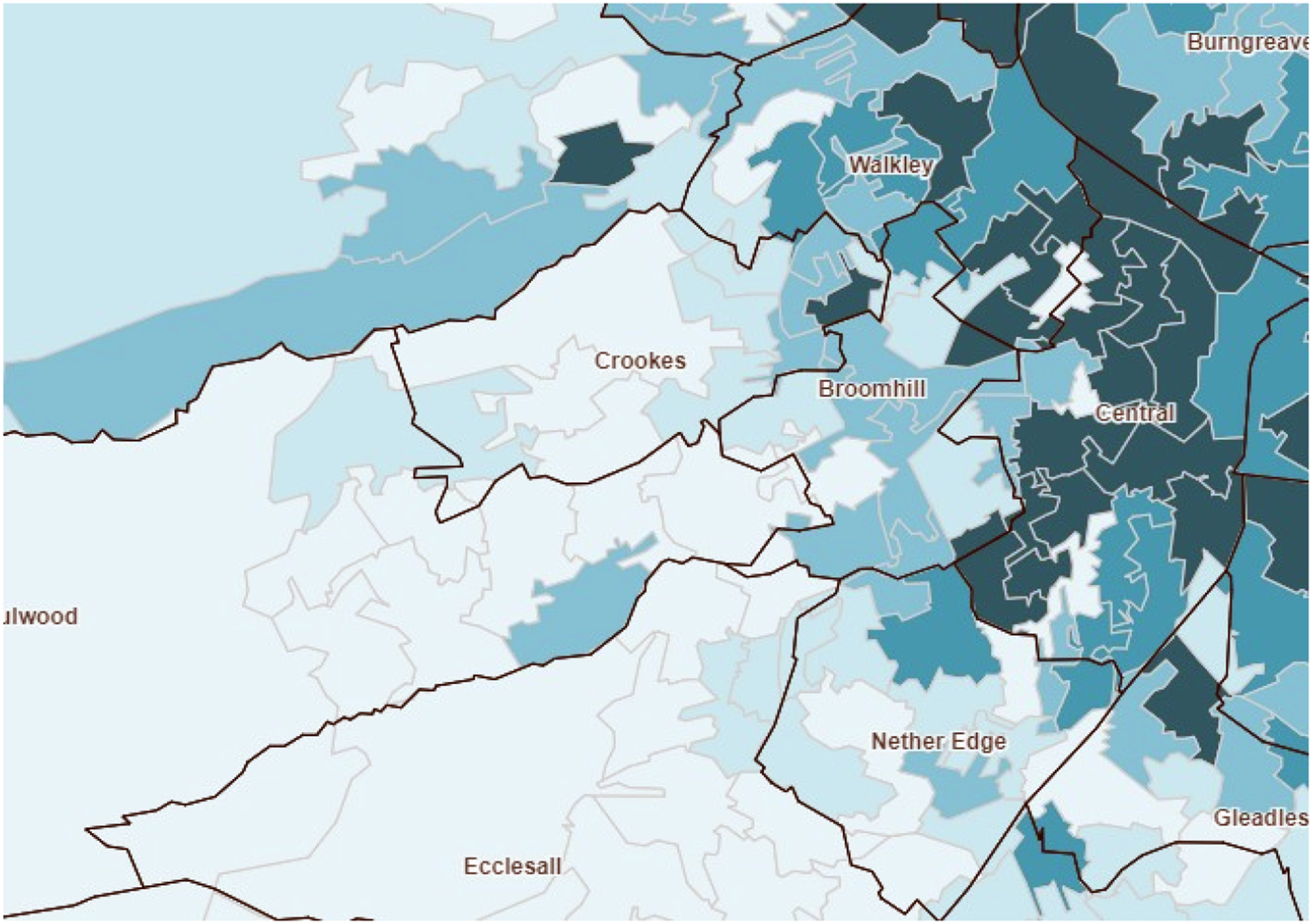
Geographical data on loneliness are widely available since standard questions are included in social, wellbeing, ageing and lifestyle surveys conducted by and for government statisticians and health authorities (Flood, 2005; Smith, 2015), and in smaller-scale studies by charities and non-governmental organisations (What Works, 2019). These surveys include questions taken or adapted from the two main loneliness scales – known as UCLA and de Jong Gierveld – asking how often a respondent feels lonely, misses the company of other people, feels left out and feels socially isolated (Goebel et al., 2019). These are supplemented by less direct questions that focus on surrogates and indirect measures of loneliness such as trust in neighbours (De Jong Gierveld and Tilburg, 2006). Data from these surveys have been used to map loneliness, identifying patterns and formulating hypotheses about their causes. Buecker et al. (2021) used data from the German Socio-Economic Panel Study, which puts questions from the UCLA Loneliness Scale to over 25,000 respondents, to map loneliness in Germany (Figure 1). Other researchers map the loneliness experienced by particular demographic and risk groups and/or the distributions of these groups. Risk groups include: the youngest and oldest adults (Batsleer and Duggan, 2021; ONS, 2020; Qualter et al., 2015); occupational groups including students (Bache and Burns, 2021; Holton and Riley, 2016) and lone workers (Holton et al., 2023); people who live in single occupant housing and those in overcrowded housing (Snell, 2017); those who experience socio-economic deprivation (Victor and Pikhartova, 2020) and/or discrimination such as racism and homophobia (Fish and Weis, 2019; Gorczynski and Fasoli, 2022); and those experiencing life transitions such as retirement, life-changing illness, bereavement, adolescence, sexual awakening, marriage and childbearing (Holdsworth, 2009; Thomas et al., 2020). Since the risk of loneliness is compounded by multiple factors (Marquez et al., 2023), researchers have also generated maps of multidimensional risk factors. Bache and Burns (2021) calculate and map a composite ‘Student Loneliness Index’ of the risk of loneliness among students, comprised of numbers of students in an area, also of those living alone, in poor health, with life-limiting conditions, unemployed and living in areas with multiple deprivation. Similarly, Age UK publishes ‘heat maps’ of the overall risk of loneliness among older people in England (see Age UK, 2010; Figure 2). Mapping Loneliness in Germany. Darker shades indicate higher loneliness scores; black lines indicate the borders of federal states. Source: Buecker et al. (2021). Reprinted by Permission of Sage Publications. Mapping the risk of loneliness in Sheffield, UK. Screenshot from interactive online map produced by Age UK: available here. Darker shading indicates greater risk of loneliness, revealing that risk is greater in the city centre (Central), moderate in student areas (Broomhill) and lower in affluent suburbs (Crookes) and rural villages to the west/left. Reproduced with Permission of Age UK. 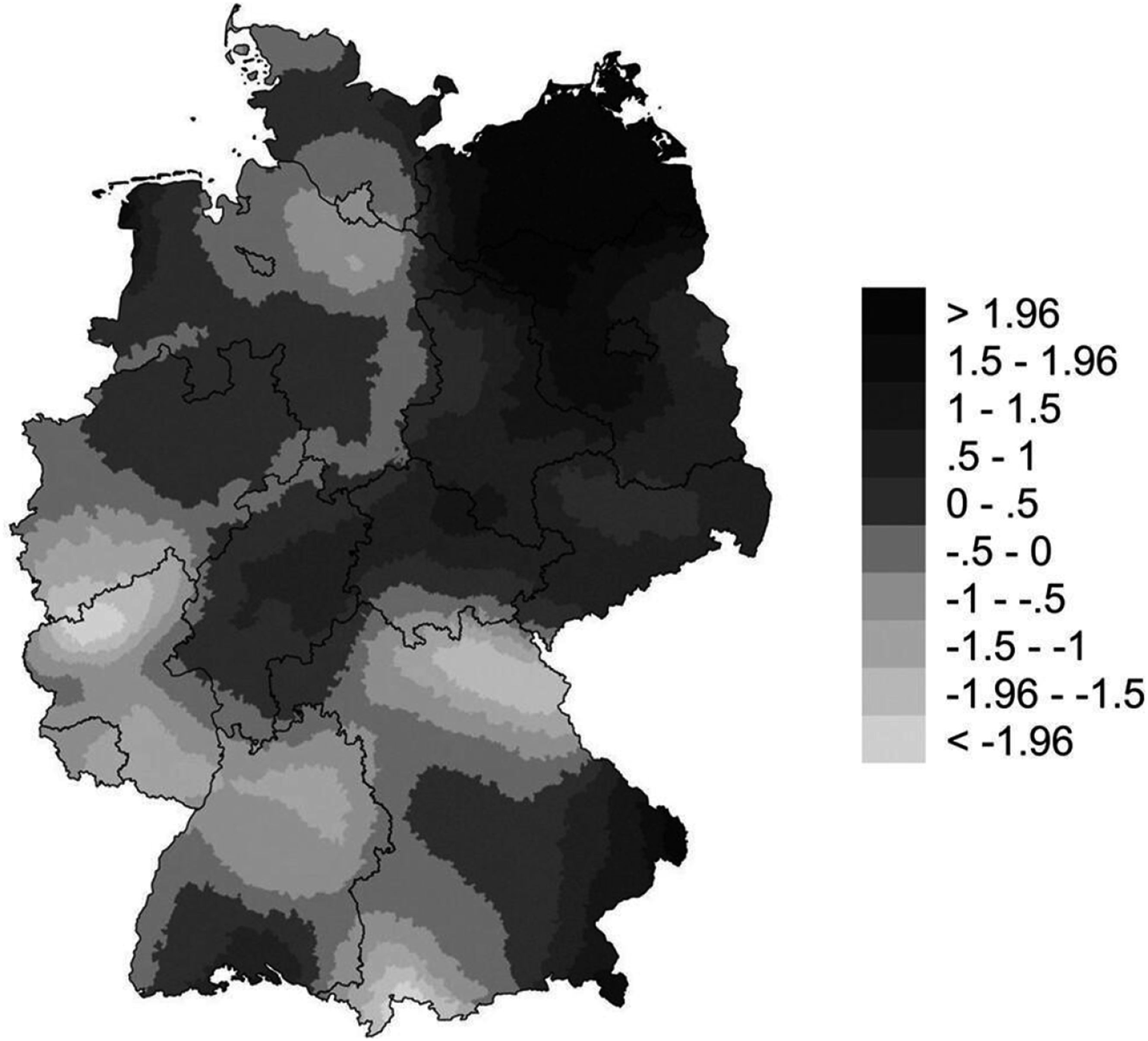
Revealing patterns and suggesting correlations, maps can do more than locate loneliness; they can help to explain it. Researchers do this in three ways. The first, touched upon already, is to map risk groups. This is not as straightforward as plotting where individual members of these groups live. Mapping is complicated by the transience of risk factors such as being young or experiencing a life transition and the mobility of members of risk groups (Victor and Pikhartova, 2020). For example, students tend to divide their time between their place of study and their family home, while some migrant workers also spend sustained periods of time in more than one location (Blumen, 2004; Neto and Barros, 2000; Ponizovsky and Ritsner, 2004). Ideally, maps of loneliness should identify these and other individuals and groups with more than a single residential location. And, while loneliness maps should be sufficiently dynamic to reflect the fluidity and mobility of real lives and the temporality of loneliness, they should also be multi-scalar, acknowledging the different sites that have a bearing on whether and how people experience loneliness. Examples include classrooms and libraries, streets and parks, cafes, pubs and clubs, places of paid and voluntary work, buses and trains, churches, mosques, temples and community centres; and micro-geographies such as corridors, homes and rooms.
A second way that maps can be used to explain patterns of loneliness is to explore correlations with geographical attributes such as provisions for public transport, cycling infrastructure and public space (Weijs-Perrée et al., 2015); other forms of infrastructure including workplaces and educational settings; and community assets like libraries, leisure facilities, cafes; and neighbourhood factors such as deprivation and crime (DCMS, 2023). Third, maps may identify patterns of loneliness, over and above identifiable causes such as concentrations of risk groups and geographical attributes. Marquez and colleagues (2023) conclude that, once all explanatory variables have been accounted for, a residual 5–8% of reported loneliness in any given area remains to be explained by the area or ‘geographic region’. This draws attention to the overall ‘quality of the locality’ as a holistic risk factor (Victor and Pikhartova, 2020) and to ‘types of area’ in which loneliness is most prevalent and/or intense, for example, whether the area is urban, town and fringe, rural or isolated (Figure 3). Oishi (2014) frames these holistic settings as socio-ecologies of loneliness. UK Office for National Statistics survey data showing ‘types of places where a higher proportion of people felt lonely often or always’. Source: Office for National Statistics – Opinions and Lifestyle Survey’, 2021.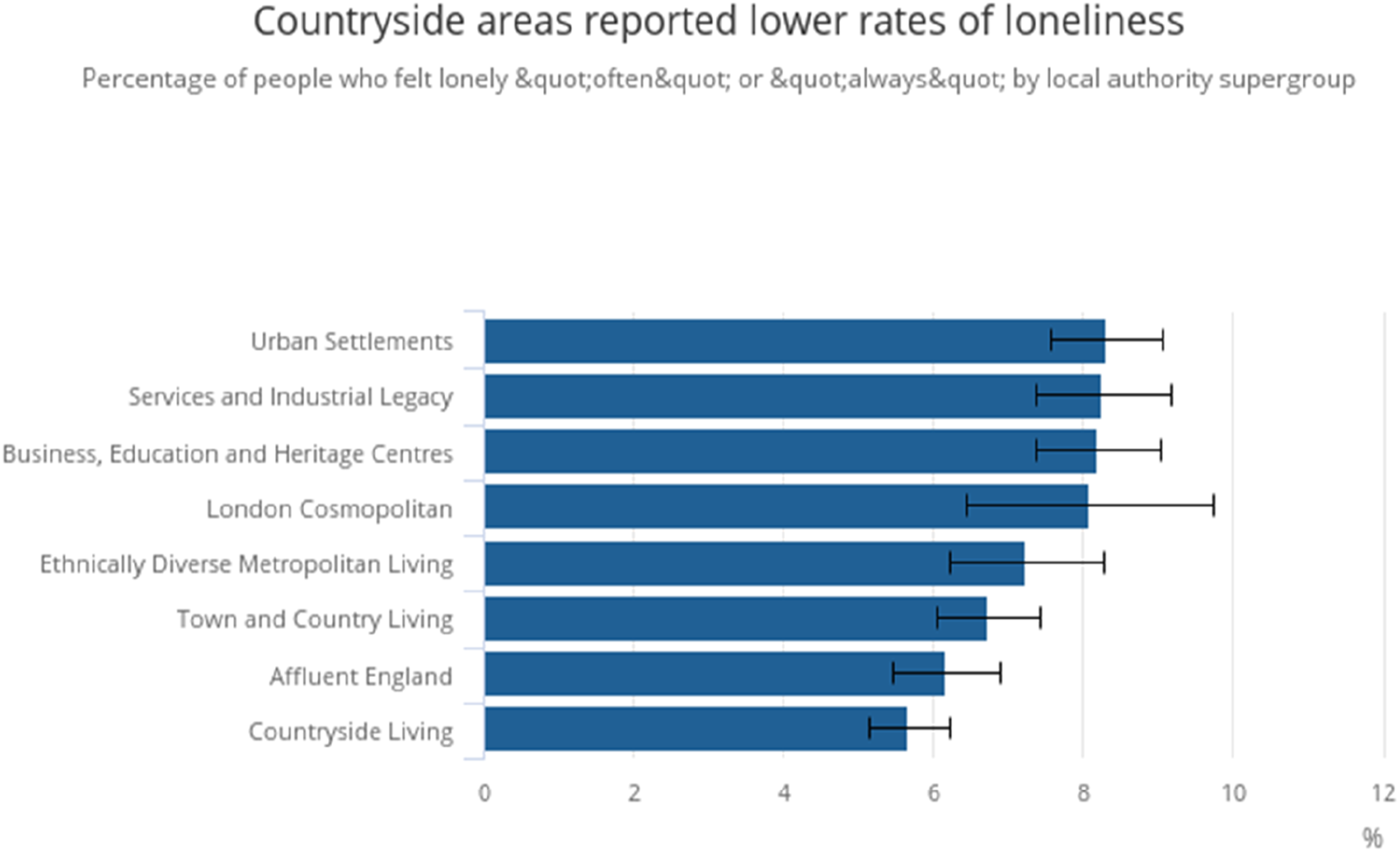
The locational analysis of loneliness – both by using secondary data and also by commissioning and conducting surveys – is work in progress. One way in which researchers are able to take forward this work is by accessing and analysing published secondary data, generated in panel surveys (Russell, 1982). Some – such as New Zealand’s YCP, which asks 2,000 respondents about their experiences of loneliness and their connections with family, school, peer group and community (Jose and Pryor, 2010) – allow geographical analysis. Some surveys are repeated periodically, affording temporal comparisons of groups (Menec et al., 2019), while others (longitudinal surveys) are sent back to the same individuals, tracking experiences over their lives (Victor and Bowling, 2012). Published data are relatively coarse-grained in the interests of anonymity and confidentiality (Victor and Pikhartova, 2020), but it is sometimes possible to gain access to finer-grained data, usually by paying for it and guaranteeing the anonymity of respondents. Alternatively, it is possible to commission questions in panel (‘omnibus’) or entirely new surveys targeting demographic and geographical groups (Victor and Bowling, 2012). The analysis of this spatial data, in line with previously published work but with an expanded range of explanatory variables, examines relationships between loneliness and geographical variables such as deprivation within an area (as a continuous variable or rank value), whether it is urban, town and fringe, rural or isolated (categorical variables), and environmental variables such as (measures of the quality of) public transport, cycling infrastructure and public space (Weijs-Perrée et al., 2015).
Measuring and mapping loneliness and explaining its spatial patterns is helping to establish the scale of this phenomenon, galvanising and cohering interest, while making recommendations for policy and practice. Loneliness maps speak to two sets of practical questions. By identifying concentrations of loneliness and/or risk factors, maps can inform decisions about where to intervene (Figure 2). They can also suggest how to intervene, tailoring responses to local circumstances and experiences through ‘neighbourhood approaches’ (Collins and Wrigely, 2014). The latter support localised relationships and networks, helping people to encounter and connect with each other, and invest in social infrastructure through improvements in public space and public transport, housing, workplaces and community centres (DCMS, 2023; Wigfield et al., 2022).
And yet, the advantages of loneliness scales and the numerical data they produce come at the price of simplification and completeness. Though scales are composed of multiple questions that explore loneliness from different angles, findings are typically collapsed into a composite measure. But loneliness is many things rather than one, with contrasting qualities (Ara et al., 2023; Qualter and Munn, 2002; Reese, 2022), assuming different forms in different times (Alberti, 2019) and places. A second limitation of loneliness maps, based on quantitative data, is that they privilege conventionally mappable locations and features such as residential areas, transport infrastructure and public spaces. They miss or de-emphasise less tangible geographies such as how people perceive and feel about places, which are also important to whether and how they experience loneliness (DCMS, 2023). These geographical intangibles are discussed in the next section, which argues the case for mixed methods – including qualitative – geographical studies of loneliness.
III Meaning and belonging: storying loneliness
The perceived environment – encompassing subjective neighbourhood characteristics – is important in shaping geographies of loneliness. Investigating patterns of loneliness in Germany, Buecker found that ‘the more positively individuals perceived their relation to their neighbours, the less lonely they felt’ (Buecker et al., 2021: 151). Researchers have shown that loneliness is inversely related to belonging and attachment to place (Vytniorgu et al., 2023). When we don’t feel we belong in a place, neighbourhood, city, institution or community, we are more likely to feel lonely there (Arslan, 2021; Asher and Weeks, 2013; DCLG, 2008; Smith et al., 2014). Localised barriers to belonging include discriminatory attitudes and prejudices such as homophobia, transphobia, ableism, and racism (Hall and Bates, 2019; Valentine, 2010). These barriers increase the risk that members of minoritized group will experience loneliness (Burholt and Martin, 2012; Red Cross, 2022; Shik, 2003; Vaccaro and Newman, 2017; Wilkens, 2015). In contrast, those who feel welcome in a place, community or institution are more likely to feel they belong and less likely to feel lonely there (Dahlberg, 2007; Tomaney, 2015).
Other intangible aspects of place with consequences for loneliness are shared understandings of personal and social relationships that prevail in an area or group. Localised social expectations and ideals are exemplified by social attitudes and expectations among students, which vary across schools and universities and between subgroups such as between international and home students (Wawera and McCamley, 2020). These include ideas about friendship: how many friends is enough; how often friends should see each other; what friends should talk about; what they should do together and for each other; whether this should be reciprocal; how permanent these bonds should be; and so on (Bowlby, 2011; Bunnell et al., 2012; Spencer and Pahl, 2006). These norms shape individuals’ social wants and needs, providing benchmarks against which they weigh up the quantity and quality of their relationships and interactions, affecting whether and how they feel lonely (Perlman and Peplau, 1981: 31; Wigfield et al., 2022: 17).
But how is it possible to empirically capture geographical intangibles such as the perceived environment and localised relationship norms? Survey researchers ask respondents how they feel about the areas and organisations where they live, work and study and the people they encounter there (De Jong Gierveld and Tilburg, 2006). Questions include: ‘How strongly do you feel you belong to your immediate neighbourhood?’ And ‘would you say that most people can be trusted, or that you can’t be too careful in dealing with people?’ Versions of these questions appear in national panel surveys on wellbeing, ageing and lifestyle such as the British Household Panel Survey (ONS, 2018). These questions can provide useful insights, but like other extensive surveys they offer breadth rather than depth, condensing textured experiences into tidy statistics. They stand to be complemented by intensive, qualitative research, which may take a closer look at a smaller number of people, exploring the nuances and particularities of their experiences and circumstances.
Qualitative methods, attuned to exploring loneliness and lonely places, include ethnography, interviews and arts-based research. Ethnography – including participant and non-participant observations and autoethnography – is suited to observing, describing, interpreting and contextualising emotions such as loneliness, whether directly or through behaviour that betrays or expresses these emotions (Muir and McGrath, 2018; Pile, 2010: 11). A second flexible, intensive qualitative method is the semi-structured or depth interview, and though loneliness can be too delicate a subject for direct questions, interviews can be adapted to explore this subject ethically, sensitively and searchingly (Tunstall, 1966), for example, through self and peer interviewing (Phillips et al., 2022). Ethnographic and interview research can also be used to investigate intangible aspects of place that have a bearing on loneliness such as localised relationship norms (Ozawa-de Silva and Parsons, 2020; Parsons, 2020). Third, arts-based research methods are also effective in broaching subjects that many people consider sensitive or private, awkward or uncomfortable – subjects such as eating disorders (Leavy, 2010), grief (Vickers, 2002) and loneliness. Arts-based studies of loneliness involve eliciting and interpreting textual and visual sources and data ranging from drawings and paintings (Le Brun, 2022) to objects (Phillips et al., 2022), and from literary works to performance art and storytelling (Branch and Latz, 2017; Mijuskovic, 2012; Pratt and Johnston, 2013).
To explore qualitative geographical research on loneliness in more depth, I will focus upon a specific method: storying. The vignettes at the beginning of this paper – a series of ‘small stories’ (Lorimer, 2003) – introduce the possibilities of storying loneliness and place. They range from news reports (on social escorts in Japan and churchgoing in Ireland) to distilled retellings of my own observations (the student visiting their tutor) and fiction (the older woman in an assisted living home). Rather than simply chronicling lives, stories are ‘equipment for living’ (Burke, 2023), exploring past experiences and future possibilities, making meanings. Opening windows on life, and part of life, stories are rich sources for geographical and social research (Hones, 2008; Phillips and Kara, 2021). Their applications include researching sensitive and stigmatised subjects and/or conducting research in cultural contexts where conventionally social scientific methods such as questionnaires and depth interviews may be experienced as intrusive and extractive (Smith, 2021). In these settings, listening to and reading stories may be a culturally appropriate and respectful way of conducting research (Phillips and Bunda, 2018).
Storying can involve eliciting, creating, collecting, interpreting and sharing stories. Methods include inviting interviewees to share stories (Hunt et al., 2024; Pratt, 2009), running workshops in which participants write and tell stories (Ali, 2021; Raynor, 2019), and using stories for the analysis and dissemination of findings (Barone and Eisner, 2011; Parr and Stevenson, 2014; Pickering and Kara, 2017; Pratt and Johnston, 2013). Researchers can also collect and interpret stories, examples ranging from published novels and short fiction to unpublished letters and diaries in archives, and material posted online. Interpretation includes reading and/or listening, paying attention to spoken and written words, to sounds and scripts, compositions and forms. Working with stories means listening and reading closely and contextually, and not always too literally.
To explore how stories can open windows on loneliness, I shall now turn to fiction (see also Chambers, 2024), focussing upon three well-known contemporary writers, selected because they highlight different aspects and geographies of loneliness. I begin by returning to a figure introduced in an opening vignette: Olive is the central figure of two works of fiction by Elizabeth Strout – Olive Kitteridge (2008) and Olive, Again (2019) – and a minor character in some other novels and short stories by the same author. I also introduce two other characters and writers. Eddy is the protagonist of Édouard Louis’s autobiographical novel about an unhappy childhood in a working-class village in northern France. According to Louis, The End of Eddy (2017) is all true (Jones, 2017), which is to say it speaks the truth in a way that only fiction can. Third, Tanimura appears in a number of short stories in which Haruki Murakami explores barriers to intimacy and connection through characters who are not only in but of Japanese cities. Each of these characters throws some light on loneliness, though Strout, Louis and Murakami all use this term sparingly. They dig beneath labels and stereotypes, reaching a depth of understanding that complements the breadth of statistics, situating loneliness in textured geographies, each bringing relationships between loneliness and place into focus.
IV Places of interest: bringing together scales and stories
Places that matter to loneliness take many forms: multi-scalar, material and metaphorical, bounded and relational. More than hotspots, they affect people differently, each leaving some people lonelier but having the opposite effect on others. This section brings together quantitative and qualitative sources and methods to introduce a series of places that matter to whether and how different people experience loneliness, developing Holton’s argument that loneliness is experienced and generated ‘in place’ (Holton et al., 2023: 1766).
1 Cities
Cities are prominent in statistical tables and heat maps of loneliness, and also in stories that are told about loneliness. The UK’s Office for National Statistics has found high levels of loneliness in ‘urban settlements’ (Figures 3 and 4) (ONS, 2020, 2021). Statisticians have broken down and analysed these figures, finding correlations between loneliness and urban conditions such as shortages of public space and affordable public transport (Weijs-Perrée et al., 2015) and concentrations of social and demographic risk groups including the youngest and oldest adults, those who are socio-economically deprived, and members of minoritized groups. To gain a more nuanced understanding of and feel for this urban loneliness, it also helps to turn to stories. If the formula for academic writing is arguments supported by evidence that for popular and creative nonfiction is facts fleshed out with stories, and this is borne out in Murthy’s well-received book about loneliness in the United States. Illustrating a broader argument about urban isolation and loneliness, he describes a heat wave in Chicago when death rates were especially high. Murthy (2020: 239) puts some of this excess mortality down to loneliness, explaining that many older people who died had lacked social contact and had nobody to check on them. Other writers explore urban loneliness through fiction. Murakami provides glimpses of cities where people have many encounters but few close relationships. Tanimura – a ‘writerly alter ego’ (Fielden, 2017) of the author – looks back on his student days in Tokyo as a lonely time. He has left a home, family, friends and lovers, arriving unformed in a huge city where he is anonymous and friendless. ‘But when I look back at myself at age twenty, what I remember most is being alone and lonely. I had no girlfriend to warm my body or my soul, no friends I could open up to. No clue what I should do every day, no vision for the future. For the most part, I remained hidden away, deep within myself. Sometimes I’d go a week without talking to anybody. That kind of life continued for a year. A long, long year. Whether this period was a cold winter that left valuable growth rings inside me, I can’t really say’. (Murakami, 2017: 75-76). Interactive map of loneliness rates by local authority, showing percentage reporting “often or always” feeling lonely, 14 October 2020 to 22 February 2021. Source: UK Office for National Statistics - Opinion and Lifestyle Survey, 2021. 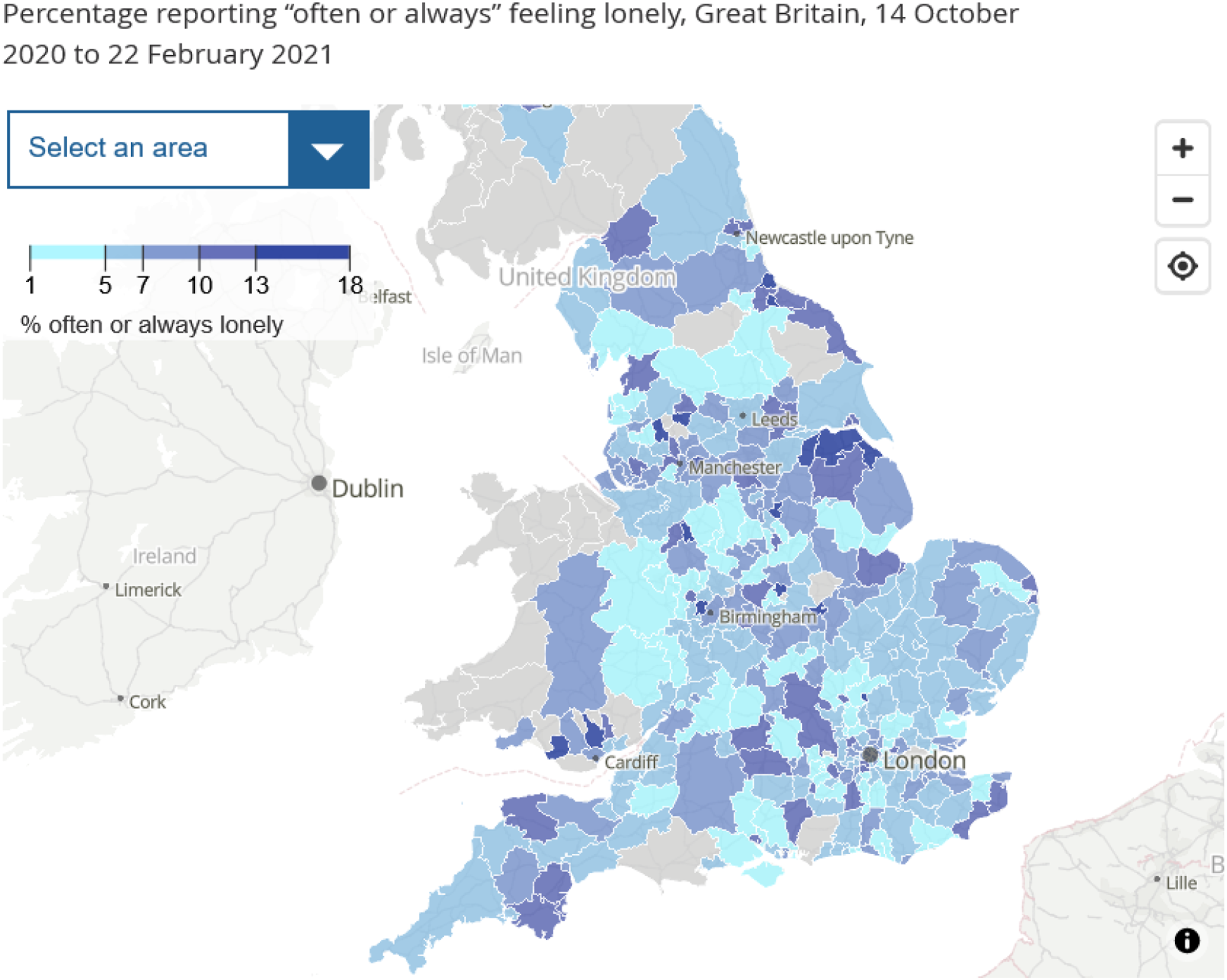
Though he was confused and overwhelmed by the loneliness he experienced as a student, Tanimura gained perspective as he grew older. He came to see his youthful loneliness as the price of the space he needed to grow. This was as much a function of where he was not (his childhood home) as where he was (Tokyo), though that great city played a part, swallowing him up in the crowd where he could pass his time unnoticed. Telling this story from the vantage point of his thirties, Tanimura has come to terms with being alone, and is now actively keeping others at a distance. When a squash partner reaches out to him, wanting to push their relationship to a more serious level, the older Tanimura is taken aback and withdraws. He prefers to keep the man he called Dr Tokai as an acquaintance, enjoying shallow post-match banter but nothing more. Later he finds that Tokai, struggling with an existential crisis, has taken his own life. Tanimura resolves not to repeat his mistake. ‘I generally play with hired partners’, he explains. ‘It costs money, but it’s easier’. (Murakami, 2017: 112–113).
Tanimura’s relationship with his squash partner resonates with the argument, put forward by the urban sociologist Georg Simmel in 1903, that people in large modern cities compartmentalise their lives at the expense of the quality and depth of their relationships (Simmel, 1980). Developing this insight, urban sociologists of the Chicago School argued that propinquity can be the enemy of intimacy, and that ‘social disorganization’ can make cities lonely (Jackson, 1984). Not knowing or recognising neighbours or fellow citizens, many people retreat into anonymous privacy (Havens et al., 2004). Japan’s thriving social escort agencies – with clients such as the man in the bar, glimpsed in the opening vignette, and Tanimura – take this to a new level. Some of those who use their services – and voluntary befriending and listening schemes – do so because they lack the quantity or quality of relationships or companionship they want or need – which is to say they meet one definition of loneliness (Perlman and Peplau, 1981; Shirota, 2023). For the mature Tanimura, loneliness was something of a compromise, the affordable price of freedom from responsibility to others. Between his student days and his thirties, his loneliness changed but remained connected to where he was – in a large city.
Simmel’s analysis and Murakami’s stories suggest how urban life can be lonely and why. But cities can also be liberating. For those who feel oppressed in places where everybody knows their name, the anonymity of urban life can be a source of freedom. This is true for the many members of cultural, sexual, religious and racial minorities who find rural areas and small communities homogenous and conformist, judgemental and even dangerous (Jones et al., 2015). For many members of these minoritized groups – which are not always communities, despite being labelled as such by others – friendship and community more readily available in towns and cities (Kathiravelu and Bunnell, 2018) than in the countryside and provinces.
2 Rural areas
Rural areas can be lonely too. According to some surveys, they are less lonely than cities. The UK’s Office for National Statistics reported that during the pandemic ‘countryside areas reported lower rates of loneliness’ (ONS, 2021). Olive’s story conveys some reasons for this. Many of her neighbours in Crosby, the small town where she lives in Maine, know Olive well enough to say hello, some as former students or parents of students at the school where she worked. She runs into neighbours at the donut shop, a craft fair, a waterfront café. This familiarity insulates Olive from some of the isolation she might otherwise feel. But there is another side to recognition. Olive’s reputation as a crank and a loner precedes her. Others notice her height and weight, find her gauche and are taken aback by her loud voice and direct way of speaking. And the idyllic rural setting brings Olive’s loneliness into focus. Sitting on a bench, eating a lobster sandwich and looking out to sea, she becomes self-conscious. Noticing ‘the sounds of her chewing – a loneliness that was profound assailed her’ (Strout, 2019: 24).
Statistics present a mixed picture of rural loneliness (Havens et al., 2004). Though reported levels of loneliness are often lower in rural areas, these differences tend to be limited to several percentage points. Research conducted in the UK during the pandemic found that 8.3% of urban residents said they often or always felt lonely, compared with 5.7% of those in the countryside (Figure 3) (ONS, 2021). Other surveys find loneliness higher in rural than urban areas (Buecker et al., 2021). Some rural communities acknowledge that they are not immune from loneliness. Facing this reality, residents of a seemingly idyllic village in Norfolk, England have designated a bench, inviting and permitting those who sit to speak to each other (Figures 5(a) and (b)). ‘Happy Benches’ or ‘Happy to Chat Benches’ (Murthy, 2020: 240; DCMS, 2020) were pioneered in urban settings such as large workplaces and shopping centres but are finding relevance in less obviously lonely locations such as this. (a) Happy Bench, Wighton, Norfolk, 2022. Source: the author. (b) Detail of Happy Bench, Wighton, Norfolk, 2022. Source: the author.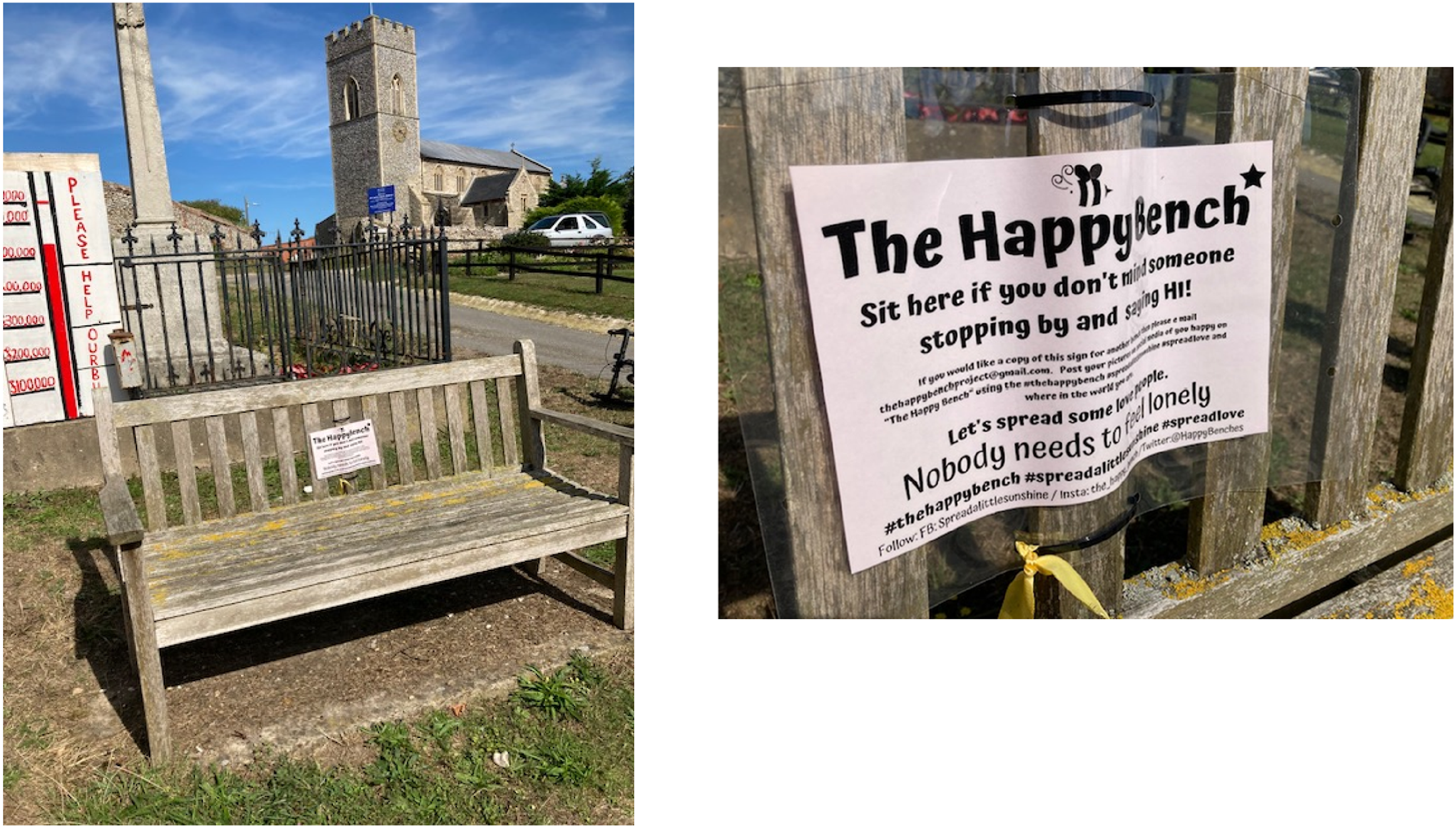
Because it is unexpected, going against stereotypes, rural loneliness is not always recognised (Griffin, 2010). A poster for a befriending scheme in another English village betrays incredulity about the possibility of loneliness there (Figure 6). Analysis of statistical data shows that loneliness is exacerbated by rural conditions that impede mobility such as poor public transport, long distances between neighbours, and difficult terrain (Tobiasz-Adamczyk and Zawisza, 2017). These risks disproportionately affect some groups who are already at risk of loneliness such as older people and those with mobility limitations (Burholt, 2011). Rural loneliness is also linked to the work people do there, particularly farm work, involving long hours with little human contact (Holton et al., 2023; McHugh Power et al., 2017). Less tangible risks include prejudice and discrimination. Minoritized groups who have been made to feel out of place in in socially conservative rural areas include lesbian, gay, bisexual and transgender people (Knocker et al., 2012; Wilkens, 2015). This was all too real to Eddy, growing up in a small community in northern France. The End of Eddy (2017) is set in and around an intolerant and seemingly homogenous village where fitting in means hiding difference. The oppressively cohesive rural community protects those who conform but excludes Eddy and the few other gay people he recognises but fails to connect with. Acceptance at a school (Lycée) in the nearest sizable town – Amiens – is a passport to freedom. The happiness and hope he finds in Amiens contradicts the generalisation that cities are lonelier than small towns and villages (Victor et al., 2005). ‘Nobody has to be lonely in Hathersage’. Poster for a local befriending scheme in a rural area of Derbyshire, UK, July 2023. Source: photo by the author.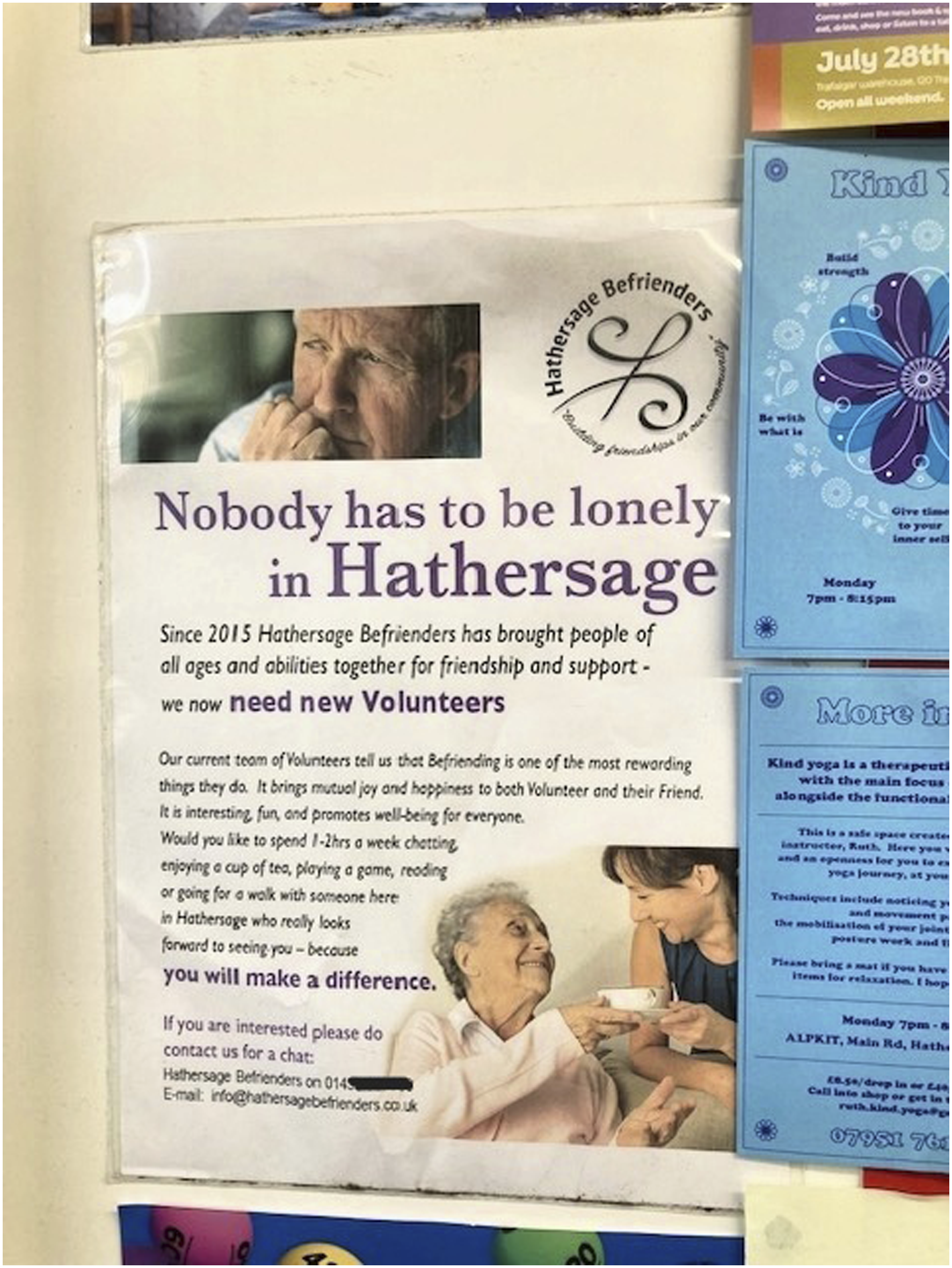
3 Homes
Another place that matters to loneliness is home. This is partly a matter of living arrangements: of who lives where, with whom, and in what kind of accommodation. It can be lonely to live alone (Snell, 2017; Wilkinson, 2014). Some people who live alone feel cut off from the world (Saari, 2010: 179). This experience was magnified when, during the pandemic, people were encouraged or required to isolate, shield or quarantine (Kotila, 2024). Living with others – family or unrelated adults – can be lonely too (Holton and Riley 2016). Those who live together for practical, economic or cultural reasons rather than out of choice are more likely to feel lonely at home, as are residents of overcrowded accommodation. Crammed into a tiny house with hostile and intrusive family members, Eddy knew from an early age what it can mean to be lonely at home. So, the same circumstances can be lonely for some people but not for others. And, while housing arrangements affect whether and how people feel lonely, different people experience the same arrangements differently and at different times (Lowe and DeVerteuil, 2022; Sawyer et al., 2022). Individuals tend to experience mixed and contradictory feelings about where they live, the same person feeling lonely some but not all of the time, and feeling lonely in different ways there (Pilkey, 2013: 162–163).
There is more to home than living arrangements, more to feeling at home than having secure accommodation (Blunt and Dowling, 2022). Hence the two-fold messaging at Green Pastures – the ‘WELCOME HOME’ T-shirts and the pastor’s conviction that ‘Jesus reveals himself to the lonely’ (Lanigan, 2023) – reaching out to people whose loneliness may be linked to feeling homeless. Home is a multi-scalar concept, reaching from living accommodation to places and wider regions, and from residential addresses to places of work and study (Brickell, 2011). Olive’s story explores relationships between loneliness and home. The loneliness she recognises in old age, first as a widow in her own home and then in the assisted living apartments, is prefigured by other scenes of lonely, silent houses and so-called care homes, inhabited by older people living too long in places they can’t manage, cut off from others and surrounded by decay. Some older people retreat into lifeless homes, buried in dust and layers of grime, which a teenager called Kayley is employed to shift in her weekend job as a cleaner. Olive is at home when, after the death of her second husband, she realises that she too is desperately lonely, and that this is partly a result of where she is living. ‘I hate it, I hate it, I hate this place’ (Strout, 2019: 259). The empty house reminds Olive of how alone she has become. Hating it, feeling she does not belong there, rekindles feelings that have always been with her, but which she has usually kept at bay. ‘Loneliness. Oh, the loneliness! It blistered Olive’ (Strout, 2019: 259). This feeling follows her to the Maple Tree Apartments. Her story explores how closely loneliness is related to home including the institutional homes many people experience in old age (Adams et al., 2004). At first, she is defensive. When her attempts at conversation are rebuffed in the apartment cocktail hour, she mutters to herself: ‘hell’s bells to all of you’ (Strout, 2019: 269). But she persists, confronting her loneliness. Doing so, she goes on to make a friend, perhaps the closest she has ever known. Her story illustrates how homemaking, accompanied by feelings of belonging, can reduce loneliness (Arslan, 2021; Holton and Riley, 2016; Pilkey, 2013).
4 Institutions
Eddy’s story, reaching its climax at the collège (middle school) he attends from age 10, illuminates another important place in the geography of loneliness. Like other institutional spaces – prisons, hospitals, armed forces, corporations, schools, colleges and universities – his collège is a bounded space, governed by formal and informal norms and rules. We don’t always choose to enter these institutions or to stay in them, though most people spend sustained periods in one institution or another. Though some thrive in these settings, enjoying what the writer Marina Keegan (2014: 1) called the ‘opposite of loneliness’, others struggle, feeling out of place and lonely (Arslan, 2021; Berguno et al., 2004). Some stay because they are compelled (as in Eddy’s school days), encouraged or pressured to do so (which is why some students stick with universities they are not enjoying) (Wawera and McCamley, 2020). Alongside the formal rules governing Eddy’s collège are unwritten codes, which can be equally oppressive for those who struggle or refuse to fit in: the heteronormative pressure for boys to be tough, hang around with other boys, and be sexually interested in girls from an early age. There is some respite in the classroom, where teachers speak about diversity and inclusion and explain that ‘differences should be accepted’ in keeping with the ‘discourse of the French educational system, that we were all equal’ (Louis, 2017). But these enlightened principles are not upheld anywhere else in the collège, especially not the playground (which the supervisor cannot control), nor the anarchic times before and after class. Eddy tries to conform but fails and is punished, first by children who refuse to play with him, then by the bullies who find him in the corridor, call him a fag, spit in his face and beat him. Eddy finally escapes – having won a scholarship to a residential Lycée (school) for the arts – but does not shake off the norms and social desires he has internalised in childhood and at the collège, continuing to hope for ‘friends who were boys, as a boy should have’ (Louis, 2017: 85). Though he is happier at the Lycée, norms he internalised at the collège perpetuate his ‘unwelcome feeling of lack or loss of companionship’ – which is how Perlman and Peplau (1981: 31) define loneliness.
Sometimes-lonely places including cities, rural areas, homes and institutions are cross-cut by more general characteristics and conditions, above all socio-economic deprivation including poverty (Livingston et al., 2010; ONS, 2020) and unemployment (ONS, 2021). Living in an area of multiple deprivation is a risk factor in its own right, over and above that which one might experience personally (Victor and Pikhartova, 2020). Eddy’s loneliness, like every other aspect of his life and story, is shaped by poverty, rooted in the rural industrial landscape in which he lives. His father was broken by low-paid and dangerous work in the local brass factory (Louis, 2019). His mother gave up on her own dreams to bring up children in a cramped, damp house (Louis, 2022). Though he tries not to repeat the violence of his own childhood, Eddy’s father forces the oppressive norms of this place and culture upon his son, pressuring him to fit in with its tough way of life, which begins with disadvantage and precarity and ends in loneliness. Eddy can smell poverty on the breath of the boys who bully him; he senses the terrible state of their teeth and their malnutrition; he knows when they’ve missed breakfast and come to school on an empty stomach; he even begins to worry for them. While these boys may be reacting to their powerlessness by bullying Eddy, channelling their anger and frustration into violence and cruelty, other characters in his story react in different ways. An old man in the village dies of ‘loneliness and hunger’ – a hunger both psychological and physiological (Louis, 2017: 39). Having given up on life, he ‘decided to stay home, never to go out again’ (Louis, 2017: 40) and neighbours only get involved when they smell his death and find his body decomposing.
Louis has often been asked about the backdrop to his story. Having learned the language of the cultural elite who have adopted him, showering him with literary awards and recognition, he has been called upon to explain the grievances and far-right sympathies of poorer members of society and the provincial settings and declining areas where many of them live (Jones, 2017). His answers in interviews and in book-length biographical essays about each of his parents’ struggles – precipitating the breakdown of their marriage (Louis, 2022) and his father’s early death (Louis, 2019) – throw some light upon the broader, intersectional, geographical, social and historical drivers of loneliness. They paint a picture of people who have lost out and fallen back as society and the economy have changed around them. Experiencing alienation and nostalgia, they increasingly look backwards and inwards, hostile to the outside world and to any form of difference. ‘My father always said, over and over, that there were lots of coloured people there, and that they were dangerous Amiens is full of black people, Ay-rabs, towelheads, you go there and it’s like being in Africa. Best to stay away, you’ll just get robbed if you go.’ (Louis, 2017: 71, original punctuation and emphasis).
Eddy’s story unfolds in a specific time and place – ‘Picardy (late 1990s–early 2000s)’ (Louis, 2017: 5) – but the poverty, violence, sexism, homophobia, racism and insularity of the setting have close counterparts in industrial villages and small towns across northern France, and beyond. It could have been his father – had he been more educated and articulate – who explained that: ‘We do not like outsiders or people who are different from us, whether the difference lies in how they look, how they act, or, most important, how they talk’. But these words were written by JD Vance (2016: 6), then-future Vice President of the United States, who was already claiming to represent a broad section of white working-class Americans, as well as his ‘hillbilly’ community and himself. Vance and Eddy’s father come from very different parts of the world – the Appalachians and provincial France – but they converge in tone and worldview. They portray people who, cut off from traditional livelihoods, react to an isolating and disorienting anomie (Dorling et al., 2008), retreating into their home ground. Though they appear to Eddy to belong in their communities, fitting in in a way he cannot, they are equally adrift in the modern world. Hannah Arendt (1958: 317) observed a similar pattern in interwar Germany, where a ‘highly atomized society’ with a ‘competitive structure’ left many people precarious and lonely. Desperate for human connection, Arendt argued, they were vulnerable to anyone who could offer them a home, something to belong to. The invitations that followed were mostly from political extremists. This was one step on a path to totalitarianism (Hertz, 2020). Similarly, the lonely people and places depicted in Eddy’s and Vance’s stories are fertile grounds for a new generation of populist and far-right politics (Clinton, 2023). These developments, explored here through small stories, spin out into larger historical processes and transformations, underlining the societal causes and consequences of loneliness.
Underpinning tangible correlates and immediate causes of loneliness, we can trace fundamental and structural social, economic and technological circumstances and changes. Thinking on this broad level, the UK’s Mental Health Foundation argues that a ‘modern way of life … isolates us from others’ and leaves us lonelier (Griffin, 2010: 9). Sociologist Zygmunt Bauman (2003) argues that in the modern world relationships are increasingly fleeting, shallow and non-committal, individualistic and atomistic (see also: Franklin, 2009). Other processes, reshaping and restricting human encounters, connections and relationships, include globalisation and neo-liberalisation, which are fuelling competitive individualism and ‘isolated privatism’ (Elliot and Lemert, 2009: 165), cutting people off from each other (Parsons, 2020) and giving rise to conditions that can draw voters to populist and far-right politics, which appear to offer a return to community and tradition (Clinton, 2023; Hertz, 2020). Concrete and mundane examples of these changes include shifts to online work, study and social life, facilitated by communications technologies that variously connect and divide users (Thomas et al., 2020), simultaneously proliferating and diluting relationships (Enez Darcin et al., 2016; Spencer and Pahl, 2006). We are beginning to understand how these developments can lead to loneliness in particular settings, though much remains to be done, with gaps in knowledge and questions that are not only unanswered, but in some cases unasked.
V Conclusions and next steps
Geographical imagination is opening practical, empirical and theoretical windows on loneliness. The first steps have been to measure and map, identifying hotspots where reported levels and risks of this experience are most severe, and tracing patterns and spatial correlations that can help to predict and explain these variations. Building upon this foundational, quantitative work, next steps include asking not just how lonely people are, but how they are lonely. Geographical perspectives help here because different people feel lonely in different ways in different places. To explore these geographies, ranging from physical spaces such as streets and houses to less tangible feelings of belonging and attachment to place, it helps to work with an expanded range of research methods and sources. Whereas scaling may be useful in identifying concentrations of (composite measures of) loneliness, qualitative methods such as storying may drill down into these experiences and settings. For example, alongside numerical data measuring loneliness in schools, it can be helpful to listen to stories by and about the children who study there, ranging from testimonies to works of fiction. Qualitative methods also have potential to contribute to evidence-based policymaking and evaluation, traditionally dominated by statistics (Kantar, 2016), where public and third sector bodies are signalling willingness to admit more diverse forms of evidence (HM Treasury, 2020: 55). This is welcome because mixed-methods research is capable of bringing a new depth and complexity to geographical understandings of loneliness.
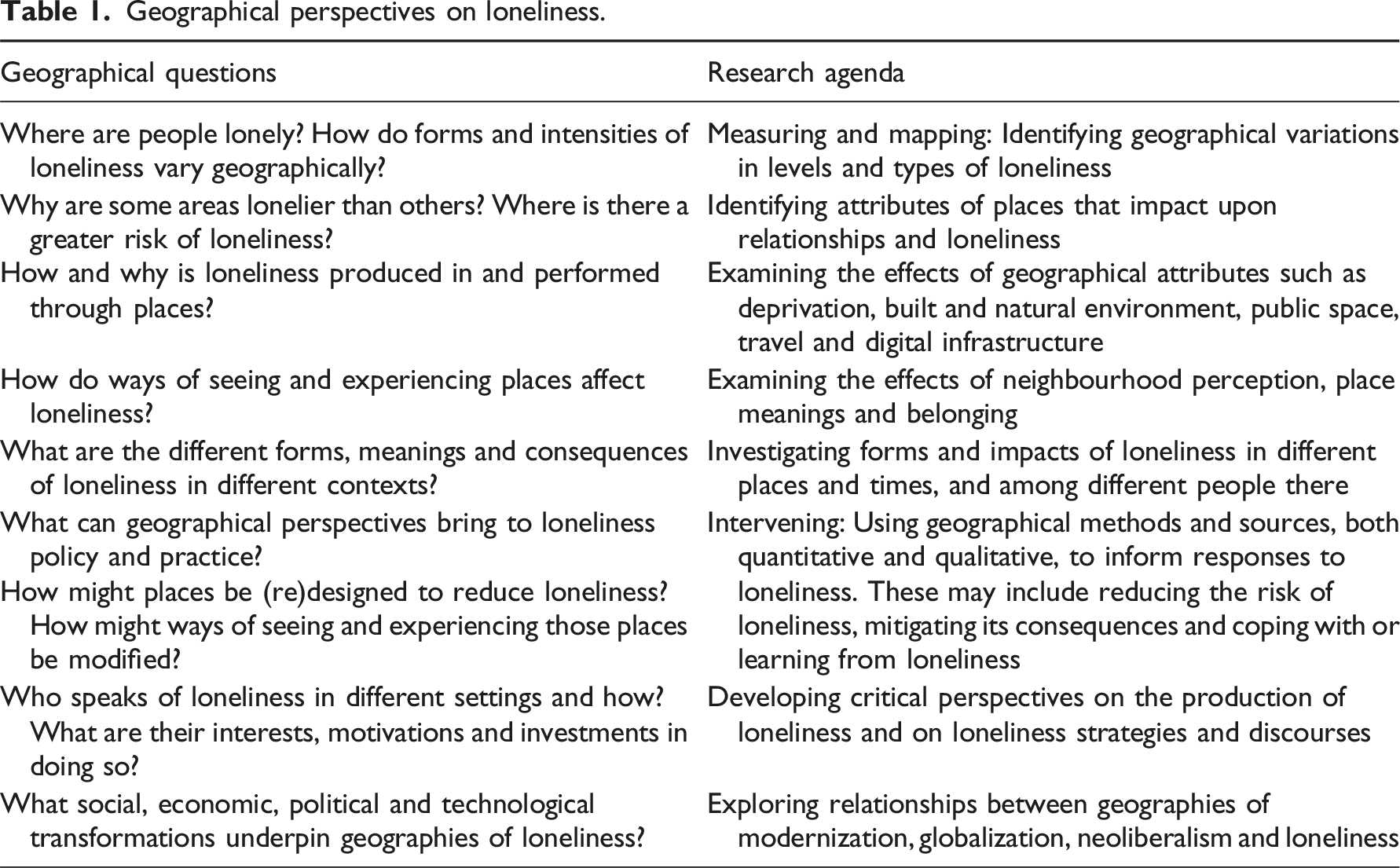
Geographical perspectives on loneliness.
Footnotes
Acknowledgements
I am grateful to friends and colleagues for conversations and suggestions, especially to Mary Evans, Peter Jackson, Alison Blunt and Charlotte Cory. Thank you also to two insightful and kind reviewers and to the editors at Progress in Human Geography for your formative contributions.
Declaration of conflicting interests
The author(s) declared no potential conflicts of interest with respect to the research, authorship, and/or publication of this article.
Funding
The author(s) received no financial support for the research, authorship, and/or publication of this article.
