




Abstract
Familiar strangers, individuals who are visually recognisable yet do not engage in verbal conversations, emerge in communal urban places on the way and in between regular daily activities in the home and workplace. Described as invisible social ties and light touch community, familiar strangers represent an understudied and untapped source of sociality that offer promise by way of an antidote to the global increase in reports of loneliness. In this study, we examine the extent to which familiar stranger encounters in communal everyday places might act as an important source of social identity, belonging and perceived attachment. We estimate regression models using data from a 2022 intercept survey of 278 residents in Brisbane, Australia conducted in situ at public parks, transit stations, retail environments, and thoroughfares to estimate the influence of familiar strangers and frequency of visitation on sense of belonging and place attachment. Our results show belonging emerges through familiar stranger encounters in everyday communal places outside of the residential neighbourhood and suggest that coupling urban design features that enhance visible proximity with scheduling that encourages repeated, synchronised visitation can contribute to bounded communities of belonging at everyday communal places.
Introduction
Lacking social connection can increase the risk for premature death as much as smoking up to 15 cigarettes a day (U.S.A. Surgeon General Advisory, 2023).
In May 2023 the United States Surgeon General declared loneliness a public health epidemic for which the only antidote is to ‘repair the social fabric’ through social connection. To date scholars, practitioners and policy makers alike have looked to the residential neighbourhood as the primary source of social connection beyond the home and workplace. Yet busier contemporary lifestyles, coupled with greater mobility and longer commutes, have seen an evolution away from traditional forms of conscious community, built solely around place of residence (e.g. community halls, neighbourhood watch, home-owners associations) towards communities of tectonic coexistence where individuals are linked via repeated encounters at physical locations (Blokland and Nast, 2014: 1144). These light touch forms of community emerge in communal places while individuals are on the way and in between primary places of activity during their everyday routines. While largely overlooked by social scientists and population health scholars, these social connections, referred to as familiar strangers, are a potential source of social identity, belonging and perceived social support (Behler et al., 2018; Browning et al., 2017). As such this mode of social connection may contribute to subjective wellbeing by satisfying the basic human need ‘to belong to the group’ (Felder, 2020; Maslow, 1943).
Familiar strangers emerge when regular intersections with the same people develop into invisible social ties (Felder, 2020; Granovetter, 1983). Regular intersections of same individuals commonly occur in urban environments because individuals consistently follow patterned paths of routine activities tethered to particular physical places at scheduled times (Blokland and Nast, 2014). The principles of time geography highlight how this tethering of activities to nodes at specific times constrains daily mobility in a way that reifies relative stability in use of time and translates into repetitive bundling of individuals at places (Hägerstrand, 1970; Miller et al., 2004; Schwanen and Wang, 2014; Thrift, 1977a), allowing familiar strangers to emerge.
While scholarly attention tends to focus on strong and weak ties (Goffman, 1963; Lofland, 1998; Simmel, 1903 [1997]; Wirth, 1938), there is evidence to suggest that social relations in urban contexts span a continuum ranging from complete anonymity to intimate bonds (Felder, 2020), with each incurring unique social benefits. The stranger in the urban environment can be completely unknown, categorical (Simmel, 1903 [1997]) or individually recognisable as familiar. Described as absent (Granovetter, 1973), invisible (Felder, 2020) or latent ties (Crow et al., 2002; Mann, 1954), familiar strangers developed through regular, fleeting interactions with the same people and can provide a sense of connection and belonging (Felder, 2020; Granovetter, 1983). Despite their apparent ‘absence’ (Granovetter, 1973), familiar stranger ties can be differentiated from mere social interactions with unknown or categorical strangers by their durability over time (Felder, 2020) and despite remaining impersonal they are not socially benign (Blokland and Nast, 2014; Felder, 2020; Zahnow et al., 2021). By making urban spaces feel less anonymous and more predictable, strangers who are encountered repeatedly and become familiar (Lofland, 1973, 1998; Milgram, 1972) enhance ontological security, encourage reciprocal trust and facilitate sense of belonging (Blokland and Nast, 2014; Browning et al., 2017; Felder, 2021). Repeated encounters provide a sense of trust, ease and predictability in daily place practices (Blokland and Schultze, 2017; Felder, 2020) which may translate into prosociality (Milgram, 1972; Paulos and Goodman, 2004) and crime control benefits (Zahnow et al., 2021, 2023). Blokland and Nast (2014: 1145) explain that familiarity with people and place provides a ‘comfort zone’ where one knows what to expect and can work things out with ease. Familiar stranger relations at places can also provide a sense of personal attachment and belonging, which is an important contributor to individual wellbeing (Allen et al., 2021).
While deliberate and intentional generation of community based on geography of residence (Putnam, 2000) has arguably declined, communal places create opportunities for social connection and belonging through shared experience and routine encounters (Aelbrecht, 2019). Everyday practices in communal spaces including shops, transit stations, restaurants, and cafes facilitate social encounters among individuals and routine users (Felder, 2020; Gehl, 2011; Jacobs, 1961). Studies show that social cohesion and trust are higher and crime is lower in neighbourhoods where there is a larger number and greater availability of communal places for social encounters (Corcoran et al., 2018; Wickes et al., 2019). Survey research in residential neighbourhoods has also shown that public familiarity is associated with a stronger sense of neighbourhood attachment and belonging among residents (Blokland and Nast, 2014; Blokland and Schultze, 2017). Research is yet to examine the extent to which routine encounters in communal places outside the residential neighbourhood facilitate familiar stranger ties. Research is also yet to objectively link repeated encounters in communal places outside of the residential neighbourhood with sense of place attachment and belonging. Thus, understanding of how regularised daily activities that take individuals outside their residential environment can support routinised encounters between urban dwellers and the implications of these encounters for individual sense of belonging and, in turn, wellbeing remains nascent.
As individuals engage in increasingly mobile patterns of everyday activities, they engage in numerous fleeting encounters with individuals both inside and outside their residential neighbourhood. While an isolated encounter may hold little value for sense of belonging, repeated encounters with the same individual can exert an important influence on an individual’s sense of social connection by facilitating familiarity, sense of attachment and feelings of ease (Felder et al., 2023). Sense of belonging achieved through social connection is a basic requirement for human wellbeing (Allen et al., 2021; Maslow, 1943). In this paper we examine the extent to which familiar strangers emerge at different types of communal places outside of the residential neighbourhood and the influence of familiar strangers on sense of place attachment and belonging. We draw on data from intercept surveys conducted with individuals while they were in communal places at two urban centres. We hypothesise that numbers of familiar strangers will be higher in communal places that have more distinct temporal and spatial structures, such as opening and closing times (associated principally with businesses), and physical boundaries that funnel individuals into close proximity with one another. We also hypothesise that individuals who report higher familiar stranger relations will experience higher levels of belonging. The findings of this research extend the literature by moving beyond the residential neighbourhood and focussing on the emergence of social connection and belonging through daily routines and communal co-presence that develops ‘on the way’ to routine activities and ‘in-between’ home and work at ordinary places including cafes, shops, parks, and transit stations.
Familiar strangers
Familiar strangers are individuals who are visibly recognisable but never formally address their copresence through verbal interaction (Milgram, 1972). Although familiar stranger encounters may be fleeting, the routine nature of activities that bring about their copresence leads to an enduring relation of repeated observations of the same person in a particular location. The durability of familiar stranger relations differentiates this form of social connection from mere social encounters. The repeated nature of these encounters can reinforce shared social norms and sense of connection and facilitate person and place familiarity. Familiarity is a sense of comfort and ease that is gained through regular exposure and routine encounter (Felder, 2021). Felder (2021) explains familiarity as comprising of two layers: typification and personalisation. Typification refers to a sense of general familiarity with new experiences based on previous experiences in similar situations (Schutz and Luckman, 1973). Not unlike Simmelian ties (Simmel, 1903 [1997]), this layer of familiarity is based on cognitive categorisation of people, places and situations that helps individuals to navigate the complexities of everyday life. While the first layer of familiarity facilitates knowing through previous experiences of similar situations, the second layer of familiarity is a sense of personal knowing developed through repeated experience of the same situation or with the same person. Second layer familiarity in encounters can provide a sense of ease and social connection during everyday life ‘on the way’ to routine activities at ‘in between times’ (Blokland and Schultze, 2017: 251).
Research shows that increasing familiarity among individuals at places can incur collective social benefits such as lower crime (Zahnow et al., 2021, 2023) through enhanced informal social control. For individuals, studies focussed on the residential environment show that familiarity enhances the sense of ease and comfort (Blokland and Nast, 2014). Felder et al. (2023) demonstrates that visible proximity and visible noticeability of fellow apartment dwellers is important for familiarity and in turn sociability between residents (Felder et al., 2023). Blokland and Nast (2014) and Blokland and Schultze (2017) suggest that sense of belonging and connection can develop in mixed neighbourhoods, where social homophily is absent, if public familiarity in communal spaces is present. They found that public familiarity influenced individuals’ sense of belonging and trust in fellow residents even though they didn’t know them. They suggest that public familiarity creates a zone of comfort in which individuals know what to expect and trust that others who repeatedly share that space will behave in a similar way (Blokland and Nast, 2014: 1156). Other scholars also suggest that familiarity supports a sense of identity and trust within communities and that tolerance of diversity requires routine encounters with difference (Gehl, 2011; Jacobs, 1961; Simões Aelbrecht, 2016).
Beyond the residential environment familiar strangers have been studied most extensively in the transit context. This is because familiar strangers are most likely to emerge at places where imposed scheduling constrains access or activities to a specific temporal window and physical structures funnel individuals into close proximity. This facilitates the bundling of individuals in time and space, making them visibly accessible to one another (Hägerstrand, 1970). Milgram originally conceptualised familiar strangers (Milgram, 1970; Milgram et al., 1992) after surveying commuters at a train station. In his original study, Milgram asked commuters to recognise individuals within a photographed group taken from the same station, at the same time the previous week. Eighty-nine percent of commuters recognised at least one individual in the photograph and on average, commuters recognised four familiar faces. Milgram hypothesised the importance of familiar strangers for social connection and prosociality and as symbols to connect individuals to places. Since Milgram’s original study, other scholars have hypothesised, but are yet to empirically examine, the social benefits of enhancing familiarity. Drawing on their observations of commuter recognition in Austria, Paulos and Goodman (2004) highlighted the potential for familiar stranger networks to provide a sense of belonging while enhancing feelings of safety and inclusion (Blokland and Nast, 2014; Paulos and Goodman, 2004). They suggested that familiar stranger relations facilitate a transitory sense of belonging in places where brief encounters with a large number of familiar faces have made it difficult to build social bonds. Contemporary studies of familiar strangers have also been conducted within the transit environment. To date these studies, facilitated by smart card transit data that enables the empirical analysis of repeated copresence of two card-holders over long periods of time (Sun et al., 2013; Zhou et al., 2018), have focussed on the spatial and temporal patterns of familiar stranger interactions with only limited concern for the social implications of these interactions. Zahnow et al. (2021, 2023) and Zhang et al. (2022) demonstrate an association between familiar strangers at transit stations and crime and fear of crime respectively. The authors suggest that because familiar strangers are associated with social connection, attachment and belonging, the presence of familiar strangers may have benefits for place-based social processes that motivate obligation to obey the norms and willingness act as a crime guardianship.
Place belonging
Belonging can be defined as the subjective feeling of being connected to other people, places and/or experiences (Allen et al., 2021; Hagerty et al., 1992). As the antithesis of loneliness and social isolation, sense of belonging is a fundamental human need (Allen et al., 2021). Sense of belonging can emerge across many social systems in which individuals’ conduct their daily lives including family, workplaces, physical places and communities. Sense of belonging at physical places is tightly coupled with place attachment and sense of place (Low and Altman, 1992; Proshansky et al., 1983; Tuan, 1980). All three concepts refer to affective ties at physical locations that develop through personal experiences at places and reflect a sense of shared identity or person–place congruence (Savage et al., 2004). Familiarity translates into place belonging and attachment because it enhances knowledge of norms, values and behaviours that contribute to the development of affect and a feeling of being ‘at home’, in ‘my place’ (Finlay et al., 2020) or being ‘in-place’ (Rowles, 1983). However, the extent to which this is achieved may depend on place type and its usage (Felder, 2021).
Felder (2021) argues that familiarity at functional places like train stations and retail outlets may be less likely to evoke a sense of belonging when compared to familiar stranger relations formed within the residential neighbourhood where desire for belonging and to be accepted ‘as local’ may be stronger. Outside of the residential neighbourhood, most research that examines place belonging and attachment focuses on traditional third places, such as greenspaces and cafes. At third places, individuals who have greater exposure to the site, established through more frequent and longer visits, express higher feelings of attachment and sense of belonging (Dasgupta et al., 2022; Romolini et al., 2019; Tumanan and Lansangan, 2012). However, other studies show that functional, communal places can also be important markers of place-identity (Di Masso, 2012; Gray and Manning, 2022). Di Masso and Dixon (2015) argues that sense of place belonging and urban related identity organise individuals’ relations to public spaces such that individuals can identify with ‘their station’ or ‘their streets’. Participating in social practices, including those of mutual recognition and civil inattention (Goffman, 1971), at places can evoke feelings of belonging and ‘being part’ of the social environment (Blokland and Nast, 2014; Kempe et al., 1962). Urban-place identity and sense of belonging develop through encountering and recognising fellow urban dwellers (Montgomery, 1998), knowing and abiding local norms and self-defining as aligned with the place-related social image and symbolic meaning of place (e.g. cultural practices, activities, norms; Di Masso and Dixon, 2015). From this perspective, familiar stranger relations can evoke a sense of belonging, not through social proximity with others, but through repeated encounters and trial-and-error learning through which an individual comes to know the social codes and consider the place congruent with their own identity (Savage et al., 2004). This does not require that familiar strangers share social characteristics beyond the routine intersection of their daily activities.
Communal places
Communal places are diverse and vary in form and function both within and across geographic contexts. Here we use the term communal places to refer to everyday settings that provide physical spaces where individuals can encounter other members of the community and be among people from different social groups (Klinenberg, 2018; Latham and Layton, 2019). This framing of communal places extends beyond Oldenburg’s original conceptualisation of third places, that has been applied to places such as parks and cafes (Oldenburg and Brissett, 1982), to include sidewalks (Goffman, 1959; Jacobs, 1961), supermarkets (Debenedetti et al., 2014; van Den Berg et al., 2015), public institutions (Latham and Layton, 2019; Mattern, 2014) and transit stations (Zahnow et al., 2021). From this perspective, communal places can emerge as parochial or public social realms depending on an individuals’ personal experience and understanding of the place and the social relations therein (Lofland, 1998). Lofland (1998) suggests that social encounters in public places tend to involve unknown individuals whereas parochiality is a unique characteristic that emerges at sub-sets of the public realm under certain social and physical conditions. Communal places can at the same time be experienced as familiar and parochial by one person and unfamiliar and public by a co-present visitor. The parochialisation of communal places can occur at regularly frequented locales through person-to-person connections (also referred to as quasi-primary relations) whereby individuals establish a sense of commonality with others who also visit the place, and intimate-secondary relations that develop when shared, consistent parochial understandings emerge at places between familiar strangers because they share a similar routine and occupy the same place at the same time. Communal places within the public realm emerge as parochial through repeated encounters with other people in that place (e.g. being recognised as a regular at neighbourhood establishment) and with the place itself, leading to a sense of connectivity and belonging (Lofland, 1998).
Communal places provide a social experience, but also have social histories and symbolic meanings and can acquire a ‘character’ or image that people become attached to (Low and Altman, 1992). Communal places can also provide necessary services, such as transport access, that can facilitate repetitive routines and serial encounters generating familiar strangers (Amin, 2008). Repetitive presence in place is central to building familiarity, sense of belonging and attachment over time. It contributes to the collective identity of communities and people’s sense of place in their communities (Carr et al., 1992; Hummon, 1992; Talen, 1999, 2000; Tuan, 1977). Francis et al. (2012) found that when individuals are satisfied with public places in their community, they express a higher sense of belonging. This is because public places are inherently social; they provide opportunities to interact with other individuals and form social connections.
While most research focuses on places within the residential neighbourhood, daily activities do not necessarily occur within the neighbourhood where an individual lives. Indeed, some research suggests that contemporary routine activity spaces are larger than in previous decades. A study by Li and Tong (2016) found that most individuals participated in daily activities outside of the home-based sub-activity area. Only 32.19% of their sample of residents from urban Tuscon, Arizona conducted all of their daily activities in the area adjacent to the home. Indeed, 39.92% of their sample conducted none of their daily activities within the area adjacent to the home; instead their activities were co-located with their workplace or along sub-activity zones associated with their daily commute (Li and Tong, 2016). This study demonstrates empirically what is anecdotally evident to many urban commuters, that daily life happens ‘on the way’ and activities such as shopping or physical exercise happen ‘in between’ home and the workplace, not necessarily in the residential neighbourhood.
Data and methods
We draw on a unique dataset collected through intercept surveys conducted in situ with 278 individuals aged over 16 years at places in two case study communities. We delineated a mixed-use zone of high foot traffic to conduct the surveys in each community. Each mixed-use zone comprised of public parks, transit stations, retail environments, plazas, malls, and thoroughfares. The surveys were conducted by trained interviewers. Surveys comprised 10 closed response questions and each took approximately 4 minutes to complete. Interviewers approached potential participants who were transiting through places or who were engaged is activities at places 1 (e.g. waiting at transit stations, sitting at cafes, shopping in malls, and having lunch in parks).
Data were collected over a total of 18 sessions across three months between May and July 2022. Data collection occurred at different times of the day and evening between 5 am and 6 pm (daylight hours) and on different days of the work week between Monday and Friday. The two case study sites were Brisbane City and Indooroopilly (see Figure 1). In situ, intercept surveys offer the unique benefit of allowing participants to provide responses about their place-based experiences in context. Mouratidis (2018) notes the importance of examining people’s experiences of places at micro-scales to assess their affect within the place-context. Intercept surveys can facilitate more accurate responses when compared to the more commonly used household surveys conducted at the residential address by reducing recall bias and eliciting responses while participants are within the context of a particular built environment. See for example studies by Mouratidis (2018) and Peters et al. (2010) that were concerned with attitudes, perceptions and interactions at urban places.
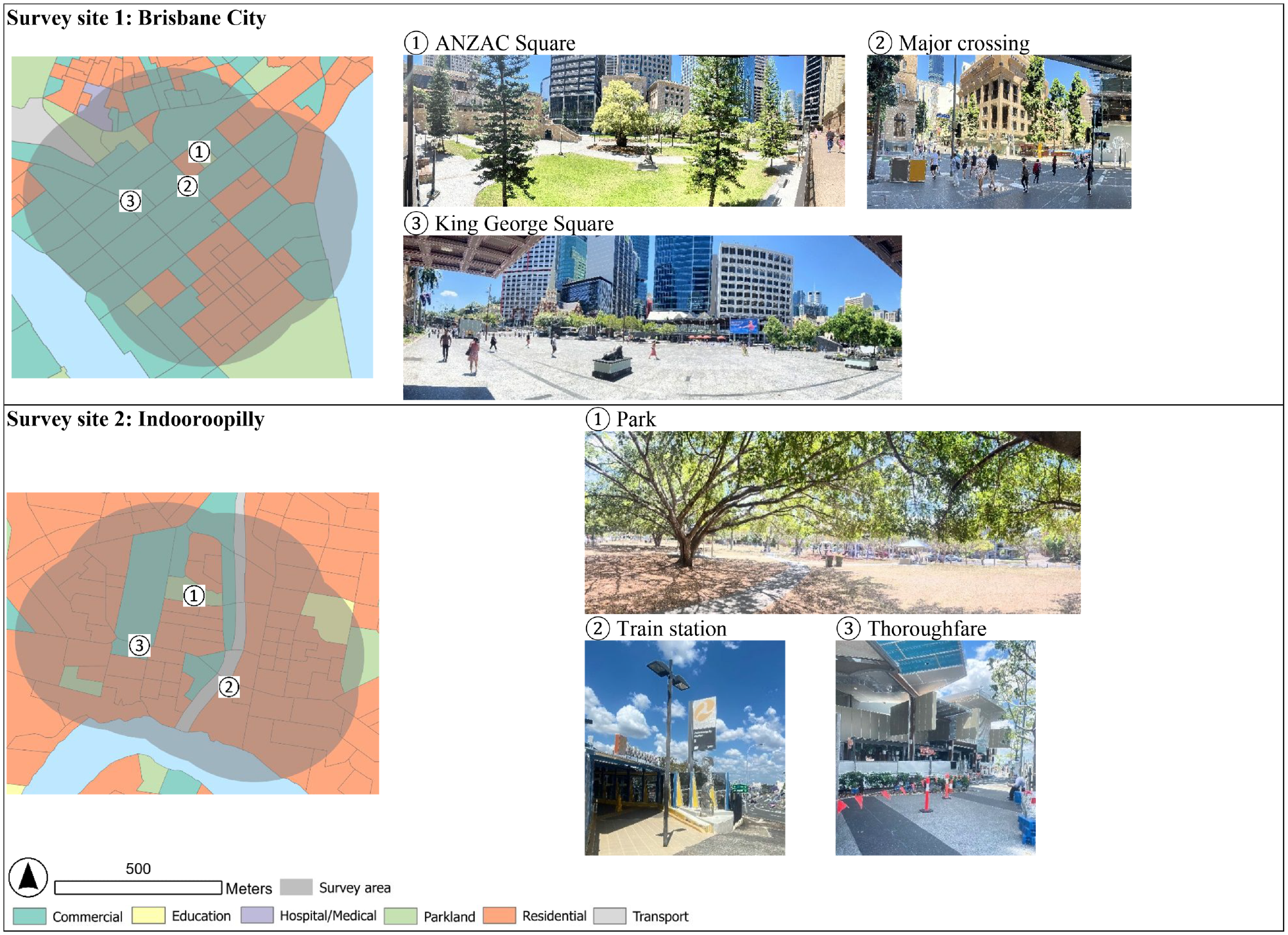
Boundaries of mixed-use case study survey sites and example photographs: (1) Brisbane City; and (2) Indooroopilly.
Dependent variables
Familiar strangers: our measure of familiar strangers draws on a specific item from the intercept survey asking participants to report their level of agreement on a scale of one (strongly disagree) to five (strongly agree) with the statement ‘I recognise other people at this place even if I don’t personally know them’.
Place attachment and belonging scale: our second dependent variable, place attachment and belonging, is the mean score of four survey items. Participants were asked to report their level of agreement on a scale of one (strongly disagree) to five (strongly agree) with the following statements: ‘The things I do at this place are fun’; ‘I feel a sense of attachment to this place’; ‘I identify with this place’; ‘The things I do at this place would not be as enjoyable at another place’. This scale has an alpha of 0.635. The scale was adapted from the abbreviated place attachment scale (Boley et al., 2021; Williams and Vaske, 2003). We utilised only four variables based on the intercept nature of the survey and the requirement to ensure survey brevity.
Independent variables
Frequency of visitation: frequency of place visitation is measured in three categories – (1) daily; (2) weekly; and (3) less than weekly.
Place type: place type comprises three categories – (1) open public space; (2) retail and consumption; and (3) socialisation places. Places were categorised based on three features: local versus regional catchment, accessibility (social and temporal) and typical duration of stay. Open public spaces include public parks, transit stations and streets that are open to all members of the public at all times of the day and night. In these places visits might involve passing through or engaging in exercise or activity on the move. Retail and consumption places tend to be semi-public; that is, they are open to everyone but are subject to rules of entry, opening hours and the main purpose is consumption. These places do not encourage lingering but instead involve walking, browsing or moving through stores and markets. Finally, socialisation spaces are those that encourage longer duration of stay such as cafes, fitness centres and churches and provide opportunities for longer engagements and may themselves represent a destination or place of shared activity. These places are akin to traditional third places and encourage repeat visitation by the same individuals.
Demographic characteristics: the capacity to collect data on social demographic characteristics during the 4-minute intercept survey is limited so we restricted our collection to age and gender. Age is a continuous variable and gender is dichotomous because we had no individuals identify as non-binary in the sample. We also include a control variable to account for study site.
Analytic strategy
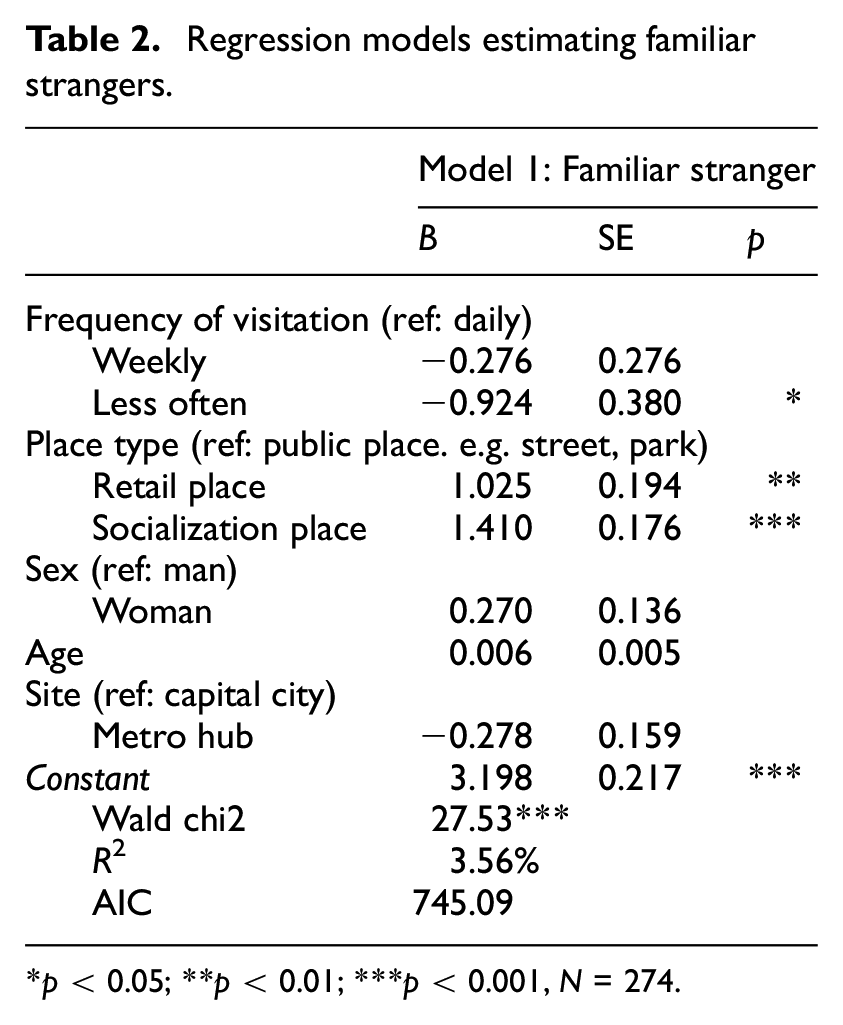
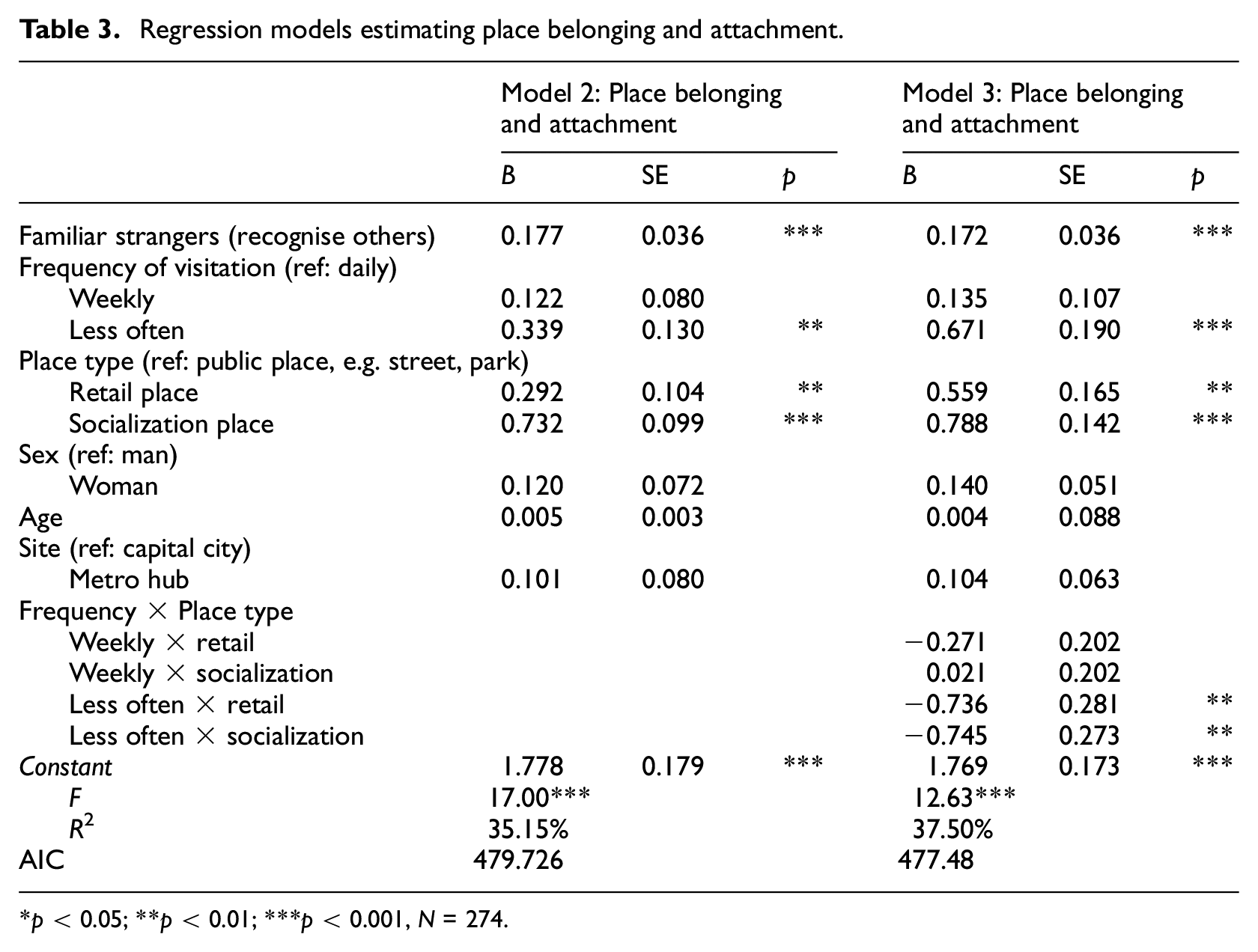
We conduct three regression models using data from the intercept survey. The first model is an ordered logistic regression model that examines the association between frequency of place visitation and familiar stranger relations. In Models 2 and 3 the dependent variable is place attachment and belonging. We conduct linear regression models with robust standard errors to estimate the influence of familiar strangers and frequency of visitation on place attachment and belonging. In Model 3 we include an interaction term to examine the moderating influence of place type on the association between frequency of visitation and place attachment. Sample descriptive statistics for all variables are outlined in Table 1. The results of the three regression models are presented in Tables 2 and 3.
Descriptive statistics: Intercept survey (N = 278).
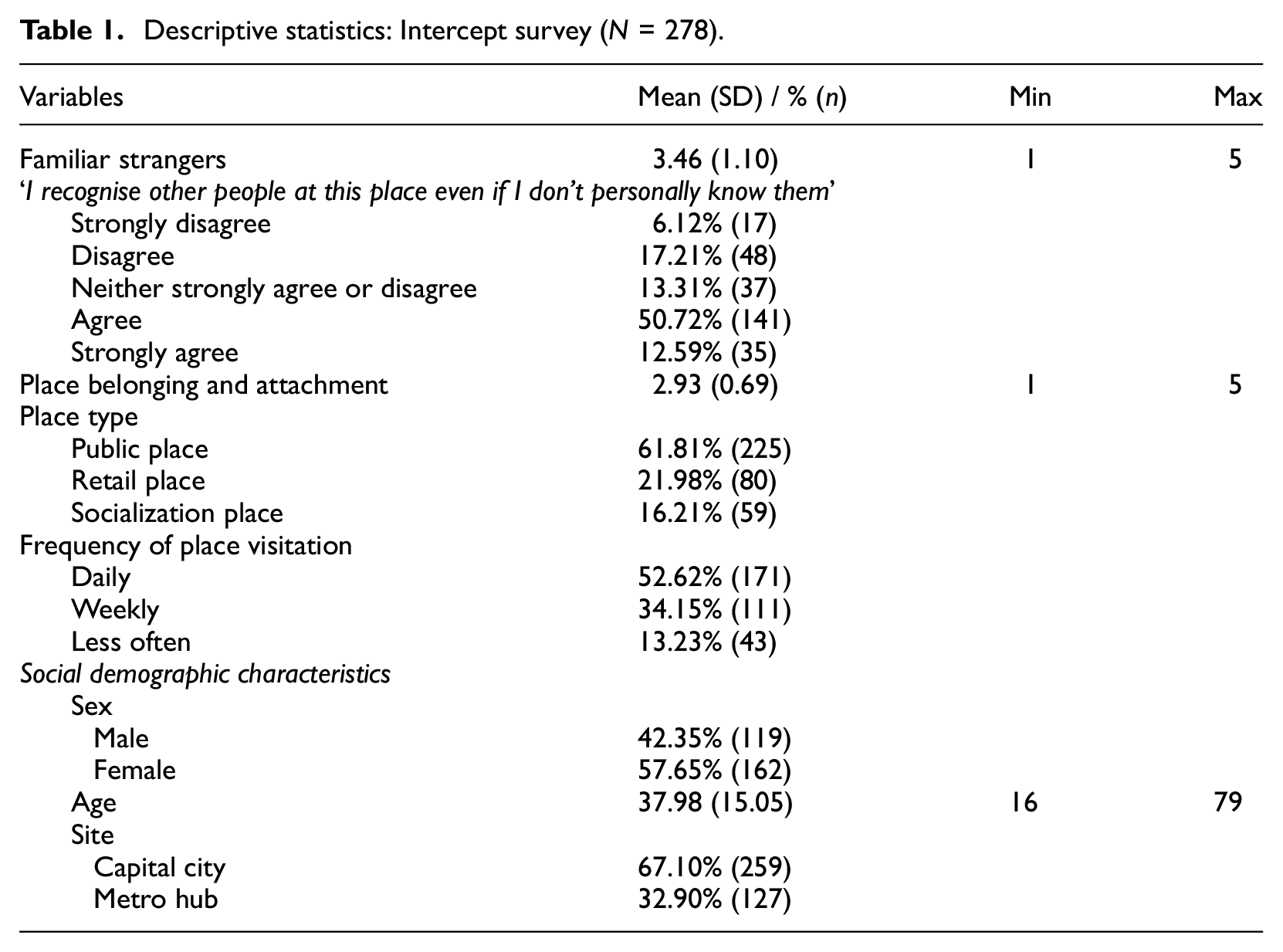
Regression models estimating familiar strangers.
*p < 0.05; **p < 0.01; ***p < 0.001, N = 274.
Regression models estimating place belonging and attachment.
*p < 0.05; **p < 0.01; ***p < 0.001, N = 274.
Results
Over 63% of participants agreed or strongly agreed that they recognised others at the place in which they conducted the survey; that is, they had familiar strangers in that place. We note that while Model 1 reaches statistical significance according to the fit statistics, it accounts for very little variation in the familiar strangers with an R-squared value of 0.035. However, the model demonstrates that individuals who visit retail or consumption places (B = 1.03, p < 0.01) and those who visit socialisation places akin to traditional third places (B = 1.41, p < 0.001) are more likely to report familiar stranger relations than individuals at open public places such as parks, transit stations and streets. Model 1 also suggests that familiar stranger relations are more likely to emerge when individuals visit places more frequently. Individuals who visited places less than weekly were significantly less likely to report recognising others at the place (B = −0.924, p < 0.05).
In Model 2, we examined the direct association between familiar strangers, place visitation frequency and place attachment. The results showed that our measure of familiar strangers was positively associated with place attachment and belonging (B = 0.177, p < 0.001), as was frequency of place visitation. However, the direction of the association between frequency of visitation and attachment was counter to expectation with individuals who reported visiting the place less than weekly also reporting significantly higher levels of attachment and belonging (B = 0.339, p < 0.01). Place type was also associated with place attachment with the results showing that compared to open public places, place attachment was stronger at retail/consumption places (B = 0.292, p < 0.01) and socialisation places (B = 0.732, p < 0.001).
In Model 3, we incorporated an interaction term between frequency of place visitation and place type to examine the unexpected finding of Model 2. The results demonstrate that visiting public open places such as parks, streets, and transit stations less than weekly is associated with higher levels of place attachment and belonging, while the opposite is true for visiting retail/consumption places or socialisation places. Indeed, in retail/consumption spaces (B = −0.736, p < 0.01) and socialisation places (B = −0.745, p < 0.01) visiting less than weekly is associated with significantly lower levels of attachment and belonging when compared to daily visitation.
Discussion
Scholars have long acknowledged the urban stranger in various forms. The familiar stranger emerges as a routinised relation, regulated by social norms and practices that reify civil inattention unless non-routine events require verbal engagement. Until recently, studies investigating this form of social connection outside the residential neighbourhood were largely limited to ethnographic case studies and theoretical contributions. In this study we extended on current knowledge by drawing on data collected from in situ surveys with individuals in communal places, while they were ‘on the way’ and ‘in between’ their routine activities (Blokland and Schultze, 2017: 1156). While small in scale, our study makes two important contributions to the literature: first, we demonstrate that familiar strangers emerge in communal places outside the residential environment and suggest that parochialisation can occur in functional physical places such as transit stations and shops; second, we provide empirical evidence to support the hypothesis that familiar strangers enhance sense of belonging and attachment. We discuss each of these findings in further detail below.
In this study, we demonstrate that familiar strangers emerge in a range of communal places previously reified to the public realm, including retail, socialisation (cafes, restaurants, fitness centres) and open public places, but that propensity for familiar strangers to emerge varies by place type. Previous empirical research on familiar strangers has focussed solely on transit environments (Milgram, 1972; Sun et al., 2013; Zahnow et al., 2021). The results of our study show for the first time that familiar strangers are not exclusive to transit environments, indeed familiar strangers emerge in other urban communal places despite less overt scheduling of place-based activities. This is likely due to the social, biological and structural rhythms that constrain and routinise temporal–spatial patterns of everyday life.
Rhythms of repetition and spatial convergence emerge in everyday urban life as a practical consequence of biological and social timescales (Hagerstrand, 1973; Lefebvre, 1992), social norms and the physical properties of the environment that funnel visitors through paths and facilitate or discourage encounters. Thus, the propensity for familiar strangers varies by place type dependent on their physical design and social function. Our results show that retail and socialisation places facilitate greater development of familiarity between users when compared to open public spaces like streets, footpaths, and greenspaces. This may be because access to retail and socialisation places is temporally confined and structured around specific, time-limited functions associated with the place. For example, individuals access a fitness centre for their afternoon workout or to attend a scheduled class or stop at a café for their morning coffee. While less overt, retail environments also adopt scheduling strategies that facilitate the synchronisation of shopping activities. Retail rhythms both effect and are affected by opening hours, workdays, holiday events and catalogue specials, leaving them busy at some times and deserted at others. Cronin (2006), for example, highlights how retail advertisers utilise workday rhythms to capture commuters by placing billboards and corner stores along commuter routes and near transit stations to encourage peaks in shopping on the way to and from work. This scheduling generates opportunities for repeated encounters and the development of familiar stranger relations.
These behaviours are routinised around shared biological needs and societal structures that result in the repeated convergence of individuals at places and the development of familiar strangers (Thrift, 1977b). Retail and socialisation places also differ from open public spaces in the presence of place managers such as paid staff. Staff provide a stable and visible familiar stranger within a communal place and their presence helps to establish a clear social hierarchy, social roles and ritualised practices associated with adopting social roles of, for example, ‘the consumer’ or ‘the regular’ at the cafes. Furthermore, activities conducted at socialisation places such as health centres and cafes are longer in duration than those conducted at a park or on the footpath which may be transient in nature and involve only a few moments of temporary dwelling.
Retail and socialisation places also have defined physical boundaries that may funnel individuals into close proximity and serve to increase the likelihood of incidental encounters between visitors. In his assessment of familiar strangers in apartment buildings, Felder et al. (2023) found that physical proximity, defined as visible, audible and accessible proximity to fellow apartment dwellers, was associated with co-presence and a greater likelihood of weak ties. Felder et al. (2023) suggests that proximity enhances visibility, making recognition possible and increases opportunities for encounters on shared, narrow paths. Retail and socialisation places are designed to funnel people into close proximity making repeat visible encounter and recognition more likely when compared to open places that lack physical boundaries.
Our second key finding adds to the literature by demonstrating that optimal patterns of visit repetition for establishing place attachment and belonging may vary across place type. While it seems intuitive to assume that more frequent visits would be associated with stronger sense of attachment and belonging, our results highlight that at public open spaces such as parks, walkways and transit stations less frequent visitation is more beneficial for belonging. A possible interpretation of this finding relates to the multifunctional nature of these places and the propensity for frequent use to be associated with transient dwelling (moving through) and/or obligatory activities such as travel to work. Alternatively infrequent use of parks or communal public places such as plazas and walkways may be associated with spending time in the place with others (socialising), relaxing or exercising. Attachment and belonging emerge through durable bonds and place meaning (Altman and Low, 1992; Zahnow et al., 2023). Therefore, conducting meaningful activities, less often, may be more important for establishing attachment and belonging in public places.
Taken together, our findings add to the literature by empirically establishing a link between familiar strangers and sense of belonging at places outside of the residential neighbourhood. Our results provide empirical support for Lofland’s concept of parochiality as an emergent property of communal places within the public realm, that develops as a function of an individuals’ interpretation of the social context therein. We make an important contribution by demonstrating that the connection between frequency of place visitation and attachment is dependent on place type and infer that at multifunctional public places durability of connection should be considered alongside the meaning of activities undertaken as important for accruing attachment. Our results provide empirical evidence to support the notion of communities ‘on the way’ and ‘in between’ and suggest that sense of belonging may emerge throughout the day, across a set of communal places that make up an individual’s ‘comfort zone’ (Blokland and Nast, 2014: 1144; Blokland and Schultze, 2017) through light brush, routinised social connection. This does not suggest that familiar strangers can take the place of social ties rather that social connection, even at a superficial level, can play a significant and important role in generating and maintaining a sense of belonging and attachment with consequences for wellbeing (Richaud, 2018).
Our results align with Blokland and Schultze’s (2017) findings associated with the concept of public familiarity within the residential neighbourhood which they find to be important for neighbourhood belonging. Our results also provide quantitative support for ethnographic and observational studies that have highlighted the role of encounter in public places for perceived social cohesion and more specifically how activities at places shape a social environment that enables over time the development of repeat encounters and the development of weak social ties. For example, after observing social life in three communal places in Lisbon, Aelbrecht (2019), noted that everyday places including a shopping centre and train station encouraged unplanned interactions between strangers that would over time develop into weak social ties.
While our study provides an important contribution to the literature, it is not without limitations. We acknowledge that taking a purely quantitative approach limits our capacity to establish nuanced understandings of individuals’ experiences of social relations across a suite of communal places and recommend future investigations apply mixed methods research design to understand class, race, and ethnic variations in experiences. We acknowledge that we were not able to investigate the role of class, race, or ethnicity in our study. However, we did not note any age or gender differences in reports of familiar stranger encounters or sense of belonging at the communal places we studied. Blokland and Schultze (2017: 1147) suggest that sense of belonging established through place-based encounters is not limited to one’s own group based on class or ethnicity, rather, belonging in ‘mixed’ places can be established through repeated encounters during which people demonstrate that they know and understand the local customs and ways of conduct by conforming to expectations. This establishes a comfort space in which individuals know others and they are known by others. Knowing and belonging in this sense results from mutual visible availability rather than verbal exchange and through place-based common knowledge (Richaud, 2018). However, a large body of research highlights the challenges of encountering difference in urban environments (e.g. see, Valentine, 2008; Valentine and Waite, 2012), and this is something that we wish to explore in future work.
The findings of this study are important for population health policy and urban design practices. The importance of social connection as the antithesis of social isolation cannot be overstated. The economic costs of social isolation are incredibly high. Beyond the direct cost to the health system, lack of social connection is associated with lower academic achievement, poorer workplace participation and performance. Designing communal public places to facilitate the emergence and maintenance of familiar strangers may be a cost-effective strategy for enhancing social connections and sense of belonging. Our results suggest that everyday communal places such as shops, walkways and transit stations can be nodes of sociability and connection. When considered alongside other research on life on the streets it is possible that manipulating and designing these spaces to further enhance interaction is a sustainable approach to improving individual wellbeing, at least to some degree. Resuming daily routines post covid, including regular office hours, to ensure individuals participate in the urban rhythms of the daily life, may also enhance sense of belonging. Other social interventions such as free commuter coffee or supervised childcare at shopping centres between certain hours to encourage time-consistent mingling could help to better standardise urban rhythms.
Footnotes
Declaration of conflicting interests
The author(s) declared no potential conflicts of interest with respect to the research, authorship, and/or publication of this article.
Funding
The author(s) disclosed receipt of the following financial support for the research, authorship, and/or publication of this article: This work was supported by the Australian Research Council [grant number DE200100359, 2020].
