



Abstract
Fluid metaphors describing “floods of migrants” or an “influx of migrant workers” are often used by journalists, politicians, and scholars to describe migration processes. While scholars have critiqued these metaphors as part of popular discourse, the roles fluid metaphors play in migration scholarship itself have received less attention. Through analysis of five academic journals, this article analyzes scholarly usage of fluid metaphors in contemporary migration research. We argue that fluid metaphors foster specific geographic imaginaries, which often run counter to otherwise complex theorizations of migration and mobility. In response, we call for practices of writing that center precision and care.
Keywords
I Introduction
Another year, another “surge of migrants” at the borders of Western states, or so we are told. On May 8, 2023, the New York Times sounded a familiar alarm about the number of migrants arriving at the United States–Mexico border. As signaled in its title “The New Surge at the Border,” the supposed “surge” of migrants indicates a “broader reality,” namely, that US border policy is increasingly driving said migration “surge,” rather than responding to it. As the article explained, “The current surge is largely a reaction to the looming end of Title 42, a policy enacted during the Covid pandemic that enables the authorities to quickly expel many migrants who enter the country without permission.” The tone of this article and its choice of the metaphor surge to describe human migration at the United States–Mexico border is neither rare nor incidental. Rather, it speaks to the ways that politicians, journalists, and other actors make use of a range of fluid metaphors such as surge, waves, flow, and stream toward political ends, often in ways that stoke anxieties and fears about migrants.
Even critical voices have turned to fluid metaphors in their engagements with contemporary migration. For instance, the artist Ai Weiwei titled his 2017 documentary Human Flow, documenting the mass scale of contemporary migration patterns and critiquing the devastating human toll of border regimes. In our collective discussion over the past several years, we have also remarked on how fluid metaphors show up in academic writing on migration. The presence of fluid metaphors in everyday politics and discourses of migration have led us to wonder about their roles in scholarship on migration.
Although scholars have examined the role of fluid metaphors in popular media, policy documents, political rhetoric, and legal arguments (Abid et al., 2017; Gorman, 2021; Petersson and Kainz, 2017; Santa Ana, 2010; van der Valk, 2003), little attention has been given to the use of fluid metaphors in scholarship on migration within geography and beyond. Responding to this gap, in this article we examine scholarly usage of fluid metaphors in contemporary migration research. Through critical discourse analysis of migration scholarship in five academic journals over the course of a decade, we document the prominence of fluid metaphors, explore how they are used, and analyze the work they do in shaping how scholars represent migration and migrants.
The ubiquity of metaphors in scholarship is not itself particularly noteworthy. We use metaphoric language—consciously and unconsciously—to make sense of the world. As a longstanding body of literature has argued, metaphors are fundamental to human cognition (Lakoff and Johnson, 2003). However, as we illustrate, fluid metaphors are never innocent. Their usage in scholarship does significant work for how we represent and come to understand migration. For Otto Santa Ana representing human migration through fluid metaphors “is to transform aggregates of individuals into an undifferentiated mass quantity” (Santa Ana, 2010: 76). Indeed, we argue that what makes the presence of fluid metaphors in scholarship significant and concerning is how such representations strip migration journeys of their texture, specificity, and lived experiences, thereby obfuscating how migration actually takes place and running counter to otherwise complex theorizations of migration and mobility.
Our analysis has compelled us to critically consider how to use metaphors in ethical and responsible ways in scholarly writing on migration. More specifically, how do we use metaphors in ways that do not erase the complexities of migration and that actively write against and upend the Othering and dehumanization of migrants? To borrow from Khosravi (2020: 294), how do we “write about migrants and migration so it cannot be used against them?” Drawing on insights from feminist, queer, and Black geographers as well as Black Studies scholars, we call for the importance of writing with precision and care. Within these bodies of work, there is a long tradition of using metaphors as analytic tools with profound political ramifications, rather than as mere descriptors. Moreover, these bodies of work provide insights into how we can actively and consciously put metaphors to work to challenge conventional ontologies and narratives of migration and migrants as well as the state, borders, and other political formations. As political tools, metaphors hold the potential to reach deeper understandings of migration and foreground the lived worlds of migrants. In doing so, this article contributes to longstanding conversations about metaphor in geography, particularly debates about how metaphors can be intentionally used to generate new theoretical understandings (Barnes and Duncan, 1992; Bok, 2019; Nelson, 2018; Smith and Katz, 1993) and imagining otherwise (Gieseking 2020; McKittrick 2021; Noxolo et al., 2008).
This article is organized as follows: In the next section, we establish a conceptual understanding of metaphor as a meaning-making tool in geography and migration scholarship. We then introduce our data set and describe our methodology, before we discuss our analysis of how fluid metaphors are used in migration scholarship. Focusing on the metaphors of migration as flow, stream, influx, and wave, our analysis highlights the impacts of fluid metaphors on scholarship and the kinds of geographic imaginaries they (re)produce. Even in the context of otherwise careful and critical work, we show how using fluid metaphors renders migrant journeys and experiences intelligible as a metaphoric fluid, dehumanizing migrants as a result. In the penultimate section of this article, we turn to the implications of our analysis for writing with and without metaphors about migration and migrants before concluding with an invitation to center precision and care in migration scholarship.
II Metaphors and geographic imaginations of migration
Metaphors have long served in the discursive construction of migrants or migration as threatening or dangerous. Scholarly analyses of media, policy, and visual representations across a variety of geographic contexts show how migration becomes a metaphorical threat. The European Union’s FRONTEX map of 2017, for example, uses cartographic representation to portray migration as risk to the EU through arrows that “exaggerate the threat posed by undocumented migrants in order to cultivate political support for even tougher borders” (van Houtum and Bueno Lacy, 2020: 201; see also Charteris-Black, 2006 on the 2005 UK election campaign). Titling a book Weapons of Mass Migration (Greenhill, 2010) explicitly alludes to weapons of mass destruction such as the nuclear bombs to convince readers that “refugees are dangerous weapons aimed at them” (Marder, 2018: 577). More broadly, metaphors evoke and structure political, emotional, and policy responses to migrants (Gorman, 2021; Marder, 2018; Santa Ana, 2010), for example, in cases where such metaphors depict geopolitical constellations (Ellis and Wright, 1998), reference natural disasters (Strobl and Hagen, 2020), invasion (van Houtum and Bueno Lacy, 2020), or invoke threat more broadly (Chavez, 2008).
In connecting different frames of reference, metaphorical connections between natural disasters and migration are particularly powerful in portraying migrants as a threat. Santa Ana (2010: 26) explains how this “semiotic association” between frames of reference works: a metaphor is a conceptual mapping from a semantic source domain to a different semantic target domain. The source of domains often, but not always, are those things humans can easily think about, the parts of the human physical world which are handy and familiar. The target domains are most frequently conceptual ones, hidden from the five human senses or otherwise unknown to them. People borrow the conceptual structure of the familiar to “get a handle on” or [...] to “embody” the target domains.
Here, fluid metaphors for migration—what he terms “immigration as dangerous waters”—link immigration to various environmental threats such as “surges” and “tidal waves” (Santa Ana, 2010: 69). These kinds of metaphors naturalize the notion that migration is unimpeded, smooth, and always ongoing, and they render entirely social (and political economic) phenomena as natural and linked to hazards and disasters. As a result, migration becomes metaphorically connected to an absence of control over the environment.
The metaphor of migrants as “liquid/water” emerged in the mid-19th century and has been used more than any other metaphor for migration since 1920 (Taylor, 2021: 470). Across a variety of geographic and geopolitical contexts, these metaphors frequently serve to dehumanize migrants in support of immigration restrictions, for example, in right-wing French parliamentary speeches (van der Valk, 2003), or in Swedish and German news coverage (Petersson and Kainz, 2017: 57). Likening international migration to water, Argentina’s former director of the National Directorate for Migration argued that “since they can’t be stopped, it’s necessary to channel them” (Domenech, 2013: 12). In China, both scholarly and official discourse often refers to internal migrants as a floating population (Chan and Zhang, 1999), and flow (liu) holds significant negative connotations of rootlessness, crime, and danger (Jacka, 2006: 43–44). Flood metaphors that link migration and (threatening) water, also continue to hold significant power in contemporary debates around political asylum in the United States (Gorman, 2021).
While there are exceptions to fluid metaphors evoking negative connotations of migration, these are less common. Salahshour, (2016) analysis of newspaper coverage for New Zealand finds that “drying up” of a (desirable) migration stream is an atypical usage of water-related metaphors compared to more common trends. Khosravinik (2009) shows how fluid metaphors were employed in pro-migrant contexts in British newspapers during the Balkan conflict, while Nguyen and McCallum (2016) analyze how Australian newspaper portrayals of asylum seekers use “water catastrophe” metaphors in both pro-and anti-migrant discourse in Australia.
As creative tools in the construction of new meanings, metaphors influence geographic imaginations and world-making (Barnes, 1991; Barnes and Duncan, 1992; Buttimer, 1982; Chilton and Lakoff, 1995; Ellis and Wright, 1998), and they “structure schools of thought” (Noxolo et al., 2008: 149). Feminist, critical, and Black geographers have reminded us that much of that world-making in the discipline of geography has been linked to colonial entanglements, imperialism, and ethnocentrism (King, 2019; McKittrick, 2021; Noxolo et al., 2008). (Byrd, 2011) examination of “the rhizome” as metaphor in Deleuze and Guattari’s A Thousand Plateaus points to dangers of colonial and white erasures of genocidal violence through metaphors in scholarly writing, a tendency that Black Studies and Black geographies scholars observe as well (King, 2019).
And yet, there are good reasons to insist on the use of metaphor (King, 2019; McKittrick, 2021; Smith and Katz, 1993). In their effort to reclaim the radical potential of postcolonialism for geography, Noxolo et al. (2008: 147) work through the metaphors “lactation” and “pregnancy” to explore “how the boundaries of geography may be altered and transgressed.” In order to be fully realized, such progressive politics needs to maintain “the interconnectedness of material and metaphorical space” (Smith and Katz, 1993: 67). Scholarship in Black geographies exemplifies such careful approaches. Take, for example, Tiffany Lethabo King’s (2019) The Black Shoals. King talks about “the pores of the plantation” in her discussion of the hands of enslaved people processing indigo. Considering pores as “a portal into other kinds of human and nonhuman relations” enables King (2019: 113) to “make space for alternative readings of representations of Black life in plantation landscapes as open spaces of transit, flux, and exchange.” For King and other scholars, metaphors are critical to imagining alternative worlds.
If we accept that the “creation and maintenance of metaphorical understanding is an inherently political process” (Cresswell, 1997: 333), then a careful analysis of how such metaphors create (geographic) knowledge is important. At stake is not only what counts as (geographic) knowledge, or who gets to produce it but also the question of how geographic knowledge can realize its emancipatory potential. Accordingly, we present our analysis of fluid metaphors in migration research and (geographic) knowledge production below with an eye toward how we may alter ways of knowing that–whether intended or not–frequently rely on the dehumanization of migrants.
III Analyzing fluid metaphors in migration scholarship
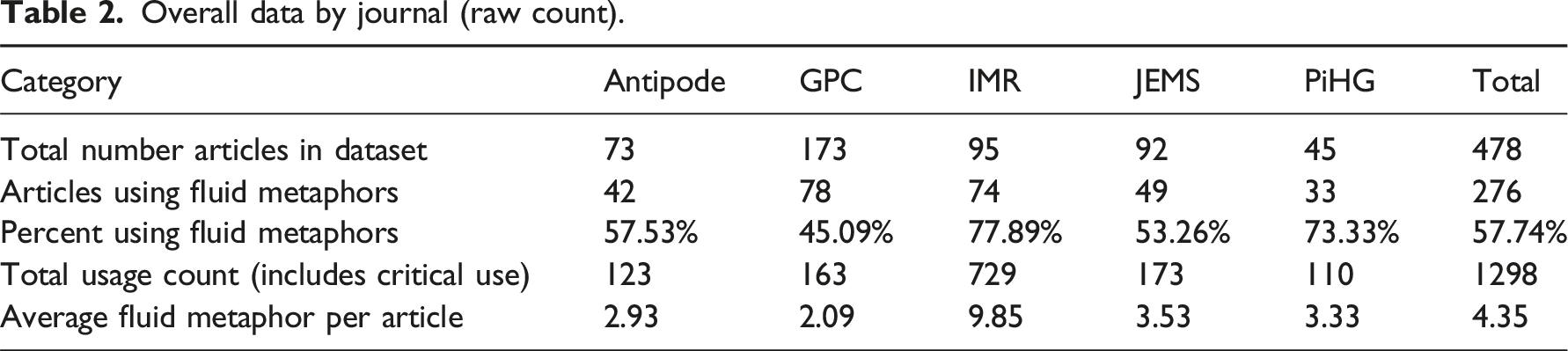
Our analysis of the use of fluid metaphors in contemporary migration scholarship is based on a sample of 480 migration-focused full-length academic articles published between 2010 and 2020 in five prominent peer-reviewed academic journals. Our purposive sample (Kuzel, 1999) includes three human geography journals publishing on migration: Progress in Human Geography (PiHG), Antipode, and Gender, Place, and Culture (GPC), alongside two long-established specialist journals focused on migration: International Migration Review (IMR) and the Journal of Ethnic and Migration Studies (JEMS). We selected these three human geography journals to investigate potential differences between a comprehensive geography journal (PiHG), a critical human geography journal (Antipode), and one focused on feminist geographies (GPC). Given our interest in the politics of writing, we expected differences in the approach to language across these sampled journals. For example, a feminist commitment to care might yield more attention to humanizing migrants, and a journal of critical/radical geography might lean toward social justice.
Our sample only contains articles that use terms related to (im)migration or migrant(s) in the title, keywords, and/or abstract, which we selected with our automated search for these terms. For the geography journals Antipode, PiHG, and GPC, we searched all issues published over the 10-year period, yielding a total sample of 294 articles (73 in Antipode, 176 in GPC, and 45 in PiHG). For IMR and JEMS, we used a random sampling method (Kuzel, 1999), selecting one issue per year at random. We included all articles published in that issue in our sample, resulting in a sample of 186 articles (94 in IMR and 92 in JEMS). In JEMS, five of ten randomly selected issues were themed special issues, while in IMR, none were.
Metaphor keywords (search terms).
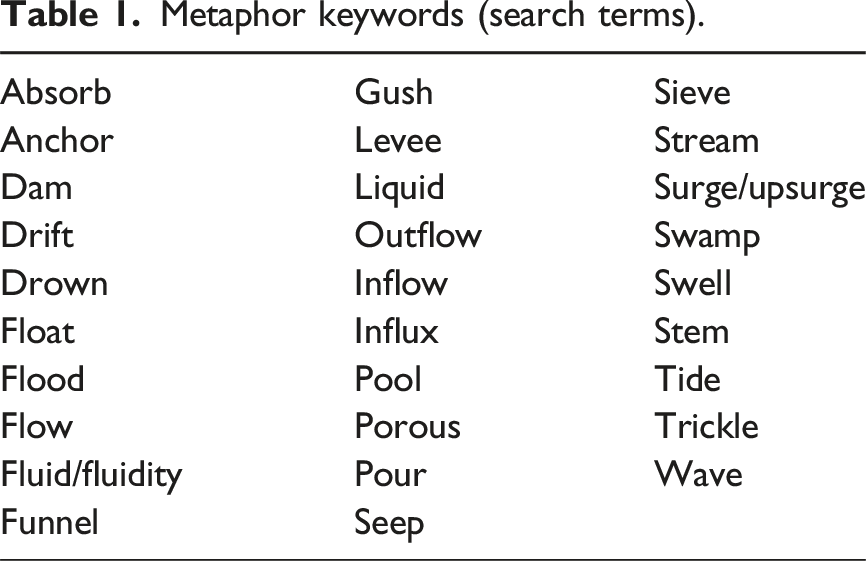
We cleaned our sample by manually sorting the results of automated full-text searches. This process removed instances where keywords did not explicitly refer to human migration or migrants. For example, “the flow of goods” did not make it into our count and analysis because it referred to globalization rather than human migration. We excluded non-metaphorical uses such as “a river flows” from our sample and also carefully noted instances where authors quoted sources that used fluid metaphors and/or critiqued fluid metaphors (we elaborate on this point in Section V). Following coding and analysis of data generated through scripted search functions, we conducted a second round of manual data validation on a randomly chosen sample of ten manuscripts per journal, or slightly less than one tenth of the total sample. This second round of validation revealed small but relatively even discrepancies between scripted and manual search outcomes, indicating that the data presented here represent a slight undercount of how often fluid metaphors appeared in our dataset, but that broad usage patterns are accurate.
Overall data by journal (raw count).
We then carried out critical discourse analysis (Dittmer, 2010; Santa Ana et al., 2017) of the articles to examine the role that fluid metaphors play in scholarly writing. Critical discourse analysis offers important tools to unpack and document how taken-for-granted essentialisms, geographies and concepts are discursively constructed and performed (Barnes and Duncan, 1992; Dittmer, 2010). Critical discourse theorists argue that social phenomena are discursively constructed (Fairclough, 1992; Laclau and Mouffe, 2014). As Dittmer (2010: 275) writes, “It is through the recognition and interaction of the various discourses in which we are embedded that meaning is created, power is conveyed, and the world is rendered recognizable.” Thus, fluid metaphors should not simply be understood as (mis)representation of “reality” but rather they produce their own “regimes of truth” as they fix the meaning around certain nodal points (Laclau and Mouffe, 2014).
Our critical discourse analysis involved a textual analysis of the language used by scholars to represent human migration and migrants. We first familiarized ourselves with each article for a general understanding of the article’s stated purpose and arguments. We recorded which metaphor(s) the author used before recording the frequency of each metaphor’s use within an article. We then examined where in the manuscript the metaphor(s) appeared, for example, in the introduction, in a conceptual framework, or in an empirical example. The location of metaphors within an article reflects their relative importance. As we worked across the different texts in our sample, we also took notice of which metaphors were most dominant in which contexts. Finally, we considered the broad arguments that the articles presented and closely examined the text and textual context surrounding each of the metaphors. For example, we considered which attributes were found in close proximity within the text to a metaphor, analyzing if a flow was large or small or undefined, and noting the direction of a stream. We considered whether or not such attributes produced positive, neutral, or negative connotations, as we discuss in detail in Section IV. This method enabled us to systematically document scholars’ use of fluid metaphors and examine how such usage contributes to particular conceptualizations and geographical imaginations of migrants and migration.
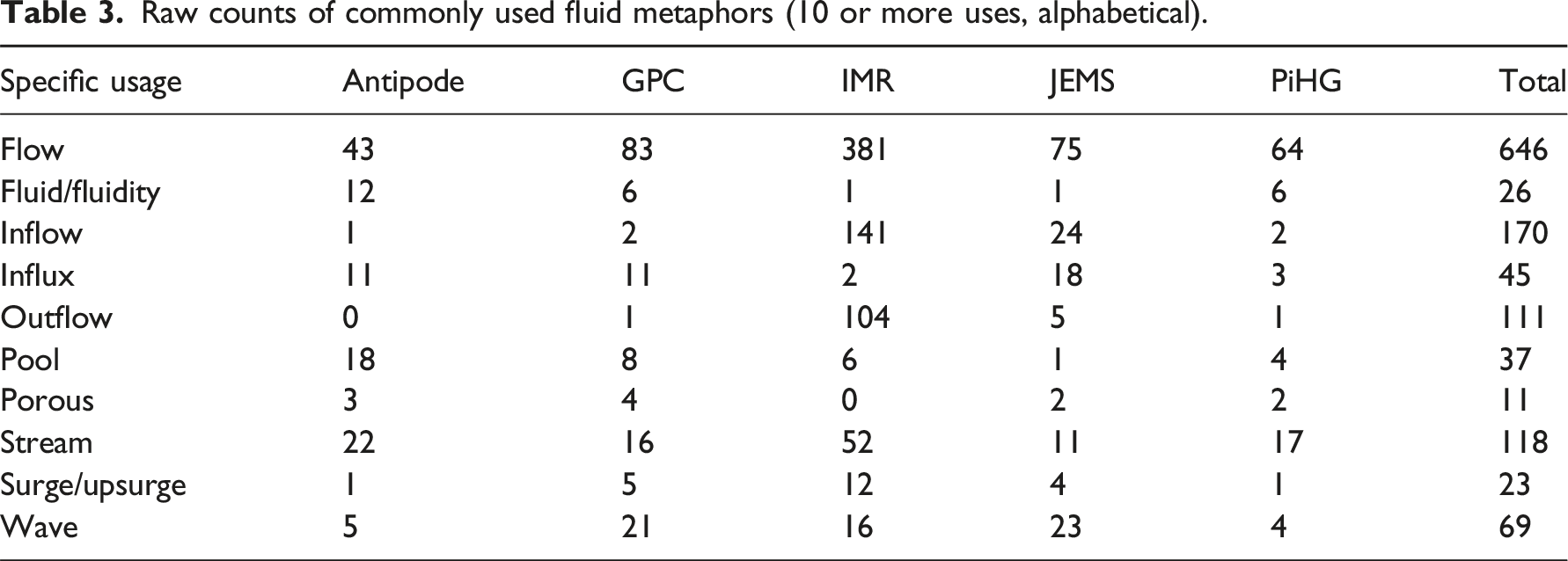
Raw counts of commonly used fluid metaphors (10 or more uses, alphabetical).
IV The work that fluid metaphors do in migration research
As Table 3 shows, the use of flow (including flow, inflow, and outflow) by far outnumbers all other metaphors in our sample, appearing 646 times (plus 110 as inflow and 170 as outflow.) Stream/s (appearing 118 times), wave/s (69 times), and influx (45 times) were the next most frequently used. We turn to each of these metaphors in more detail below.
We are heartened that contrary to their frequent appearance in popular media (Gorman, 2021; Santa Ana, 2010), metaphors associated with water disasters such as flood and tide appeared infrequently in our sample. Similarly, surge/upsurge was among the more rarely used metaphors. Overall, this finding suggests that scholars are much more careful in our use of some specific fluid metaphors than journalists and politicians. However, as is apparent from Table 3, representations of migrants via fluid metaphors remain widespread across migration scholarship.
1 What is a flow?
A quick glance at Table 3 shows significant differences between journals with regard to the metaphors that appeared in articles, with IMR accounting for the largest share in the use of flow, inflow, and outflow. Our analysis shows that much of this usage derives from traditions in demographic scholarship that define population movements across space, borders, and boundaries as flows while rendering populations in a given territory as stocks. These traditions are reflected in official demographic data and terminology used to distinguish mobile and motile populations. For instance, the United Nations’ Statistics Division defines international migration stocks and flows (UN SD, 2017: 9–15) and the OECD defines permanent immigrant inflows as a statistical indicator (OECD, 2022).
It is important to note that a few articles in our dataset accounted for a relatively large proportion of uses of the term inflow and outflow: A single article in IMR on immigration patterns (Kim and Cohen, 2010) accounts for 89 uses of “outflow(s)” and 102 uses of “inflow(s),” while other “flow(s)” show up 36 times. In aiming for conceptual consistency, authors often do not pay attention to the work these metaphors do. At the same time, however, this style of writing eliminates people from the migration process and smooths over friction and challenges of migration, whether rendered as emigration or immigration, by obscuring the existence of borders. In our sample, inflow and outflow also appear with neutral or positive connotations, such as certain immigration policy’s promotion of an “inflow of skilled workers” (Lee, 2013: 53) or criticizing attempts to curtail immigration, as in descriptions of “the United States and some European countries that seek to repress migration inflows” (Boyle and Ho, 2017: 593).
Beyond demography, metaphors of migration as flow also draw from literature conceptualizing globalization as the “space of flows” across geography and social sciences (Castells, 1996; see also Rockefeller, 2011). The New Mobilities paradigm has built on this literature, prompting some scholars to use flow metaphorically to describe movements of “people, images, information, money, and objects” (Sheller and Urry, 2016: 2). In this framework, however, the equation of movements of people with movements of goods, capital, or culture has the possibility of erasing the complexity of migrant experiences and rendering migrants as commodities. Although New Mobilities scholars insist that they are interested in “constellations of power” (Cresswell, 2011: 551) rather than a “‘grand narrative’ of mobility, fluidity, or liquidity” (Sheller and Urry, 2006: 210), flow language appears to such an extent that critics have pointed out the “nearly unaware fashion” in which these metaphors are used (Rockefeller, 2011: 558). In response, other scholars working with these concepts have made explicit efforts to distinguish their contributions from imaginations of “a liquid modernity in which everything flows” (Adey, 2006: 82).
What, then, is a flow? Our sample is short on clear answers or definitions, often leaving readers to their own devices as to how to interpret the term. Flow language tends to rely on assumptions about how readers understand flows of water. As a result, the flow metaphor can let scholars off the hook for the difficult work of description and definition, precisely because the metaphor is open to interpretation by the reader. At best, the use of flow as a metaphor is an imprecise and vague descriptor of human mobility: In our sample, flows often represent movements of people that are large enough to be significant, but whose size may not be specified. Moreover, in our sample, there was no threshold that determined, for example, the difference between a flow and a trickle. In fact, the metaphor trickle rarely emerged in our sample.
The power of the flow metaphor in migration research is linked to the ways that it abstracts specific circumstances and allows readers to join a shared, familiar imaginary, linking human movement to movements of water. Drawing from understandings of how water moves in the natural world (as per Santa Ana’s analysis), flow provides a source domain that evokes significant, unimpeded, smooth, or uncontrolled movement. Like water, the metaphor suggests, migration is a phenomenon that needs to be (and can be) directed, regulated, or stopped in order to assert control, authority, and create a sense of order. As with other fluid metaphors, authors who use flow in their writing on migration rarely interrogate the metaphor itself. One article in Antipode accounts for almost half the uses of flow in our sample (20 out of 43) even though the authors seek to discuss migrant routes and intentions (Casas-Cortes et al., 2015). In the process, flow becomes naturalized and normalized to describe and group together migrants moving between places, even if these migrants have no material or social connection to one another.
Of course, flow is far from the only metaphor that performs this kind of work when employed by migration scholars. Indeed, our analysis shows how fluid metaphors have become normalized into our language and shape our patterns of understanding the world (Ellis and Wright, 1998; Pratt, 1992; Santa Ana, 2010). In the following sections, we examine the imaginaries that are mobilized by other commonly used metaphors, starting with stream. These metaphors evoke similarly unimpeded movements across space, but nevertheless construct slightly different geographic imaginations of migration.
2 Stream
Originating from Proto-Indo-European word srew and the Proto-Germanic word strauma, the English word stream (as a noun) refers to a fluid—often, but not always water—that flows along a fixed route or a current. As such, a stream is associated with continuous and directional movement. As a metaphor, it is used differently from flow in our sample in that streams usually only appeared once or twice in articles where it was used. True to its linguistic roots, stream(s) in our sample usually indicated movement in a specific direction. In general, people were represented as moving across national borders from either south to north or east to west (see e.g., England, 2015; Ferguson et al., 2016; Tienda, 2017; Werner, 2010). In the cases where scholars addressed issues related to internal migration, the direction of the migration streams were most often from rural to urban areas or so-called circular migration from rural to urban to rural (see e.g., Choithani, 2020; Jongwilaiwan and Thompson, 2013; Rai, 2020; Tufuor et al., 2016). This writing practice often naturalized assumptions about a gradient of economic opportunities and desirability of the global north and/or cities. Yet, reasons for migration are often more complex.
With one exception, the articles in our sample used “stream” as a noun to group and categorize migrants, such as: a post-war stream of migrants, low-wage migration streams, skilled worker immigration streams, new feminized migrant labor streams, economic immigration streams, recent streams of Mexican immigrants, African migration streams, the migration stream of co-ethnics, and undocumented streams.
These depictions reproduce categories generated by nation-states, and mirror states’ efforts to categorize, measure, and manage migration while perpetuating the methodological nationalism that Wimmer and Glick Schiller (2002) have observed in previous migration research.
Across the articles in which stream appears only once or twice, we found that authors put the metaphor to work in order to underline the importance of their empirical study. In these articles, the stream metaphor appeared in the introduction or the background/context sections of the article and was immediately followed by statements justifying the author’s study or particular focus. For instance, authors regularly argued that a particular trend had received (too) little scholarly attention, that the experiences of a specific group of migrants had yet to be examined, or that the chosen migration destination was particularly critical to studying migrants or migration. For example, writing in JEMS, Pei-Chia Lan opens her article on the experience of Western high-skilled migrants in Taiwan by noting “the streams of North-to-South migration, which entail a growing number of Westerners working as managers, engineers, or language teachers in major Asian cities, are subject to much less academic scrutiny” (Lan, 2011: 1669–1670). Like others, Lan positions her research to fill this gap and does not use stream again. This trend was particularly apparent in the articles where stream metaphors appear, but we also identified it in relation to the use of other metaphors such as influx and flow.
3 Influx
Related to flows (in- and out-), influx is another directional metaphor that occurred often enough in our sample to prompt our curiosity. Through critical discourse analysis of the context employed when articles used this term, we found that although influx may seem innocuous on the surface, the metaphor is commonly used in ways that conjure up negative connotations to migration. Although it is also a synonym for inflow, in our sample, influx often appeared in the same sentence or otherwise in close proximity to words that denoted danger, lack of control, need for regulation, potential for conflict, the end of social cohesion, and/or disruption of an ethnic/national community. The introduction to a special issue in JEMS offers an example of the semiotic association of influx with threat: Parreñas and Kim (2011) summarize the papers’ contributions evoke the idea that “the increasing influx of migrants” creates “pressure for nations” (Parreñas and Kim, 2011: 1555), framing immigration as an “unavoidable influx of foreigners” (Parreñas and Kim, 2011: 1556). Similarly, other authors in this special issue discuss the “challenges of globalization” (Cheng, 2011: 1629) and the related threat to homogeneity and the fabric of societies alongside the influx metaphor: “An unforeseen consequence of the influx of these migrant workers and brides is that they bring their cultural traditions and practices with them, thus challenging the host society’s age-old beliefs about ethnic homogeneity and transforming the social and cultural fabric” (Kim and Oh, 2011: 1565). Publishing in Antipode, Arnold and Pickles (2011: 1615) highlighted how “fractions of Thai labor were united by anti-migrant sentiment, seeing in the migrant worker a threat […] (i.e., influx of drugs, disease, and violence).” In other cases, influx marks a point in time or a beginning. For example, Sumino (2014: 439) insists that “The influx of immigrants has increased the ethnic, religious, and linguistic diversity of populations, and has made well-consolidated nation-states less homogenous and more susceptible to external factors.” Given the article’s title “Does immigration erode the welfare state?”, this negative depiction of immigrants is not entirely surprising.
More rarely in our dataset, positive connotations of influx emerged in articles that advocated on behalf of immigration or immigrants, for example, in an article that criticized backlash against the arrival of migrant workers. “Discourses of racism and xenophobia have emerged to attack the influx of South-East Asian contract workers” (Lan, 2011: 1679). But even here, influx links migration to violent connotations of racism, xenophobia, and attack. In this context, the imaginaries constructed through the metaphor of an influx of migrants differ from the metaphors of flow and stream in their connection to risk or conflict, and in their indication of temporality. Similarly, the wave metaphor often denotes time-limited events or time periods, as we discuss in more detail below.
4 Wave
In our sample, the wave metaphor appears most often to periodize and point out cycles or sequences in historical migration trends. For example, Bastia (2013: 160) writes that “migration [from Bolivia] developed in cycles, increasing during the 1990s to the run up of the Argentine crisis with a new and larger wave developing in the early 2000s.” Similarly, Van Kerckem et al. (2013: 1009) describe “three distinct migration waves” from Turkey to Belgium. Others made use of the wave metaphor in similar ways to the stream metaphor to emphasize the importance of the phenomena they were studying. For example, Luthra and Waldinger (2010: 863) contrast “the current wave of mass migration” they study with “the smaller migration of the mid-20th century” that does not appear to merit metaphoric description. As such, the wave metaphor most often works to denote specific time periods, and a somewhat significant movement of people.
Only a few pieces in our sample connected wave metaphors to threat. For example, wave appears alongside discussion of illegality or criminality to emphasize that while “the first arrival of migrants into the Netherlands did not draw much attention, the second wave came under scrutiny because of concern over the immigrants’ often illegal status and perceived criminality” (Visser et al., 2015: 609). Although the authors of this piece focus on creating a detailed understanding of the life-worlds of Ghanaian migrants, this language recreates the frame in which waves of migrants are tied to an implicit threat.
It is important to note that our sample also reflects the period when it was produced. We are encouraged by the general denaturalization of the wave metaphor in the decade of scholarship we analyzed. Had we included articles from the 1970s, 1980s, or 1990s, it is likely that wave metaphors would have been much more prevalent; immigrants from Cuba and Cuban exiles, in particular, were frequently described as “first-wave” and “second-wave” immigrants to the United States (see e.g., Pedraza-Bailey, 1985). We also found that scholars in our sample often critically reflected on wave language and pointed out the negative connotations of “a shrill political rhetoric around global terror threats and the ‘immigrant wave’ [that] authorizes intensified border security” (Crane et al., 2020: 42, quotation marks in original).
Despite this level of restraint and critical reflection in scholars’ usage of metaphors, references to migrants as waves still work to conceal the individuality of (im)migrant experiences. While waves of water might crash to shore and quietly recede, the wave metaphor depicts migrants’ divergent experiences as a broad and undifferentiated movement across smooth space—one with mass and power that might overwhelm boundaries, territories, or managerial structures. We discuss the implications of using this and other metaphors next.
V Writing carefully with and about metaphors
The stories we tell about migrants and migration matter. What and how we write about migration and migrants conjures geographic imaginations, makes worlds, and, as our analysis shows, often dehumanizes migrants in the process. One of the key lessons from our analysis of a decade of migration scholarship is that writing carefully about migration and migrants presents a challenge. Critical Refugee Studies have long insisted that it is important to tell stories about refugees without reducing them to the trauma of displacement (Espiritu, 2014). Others grapple with the question of how to tell stories about migration without creating potential harm or discursive violence (Hyndman and Giles, 2016; Khosravi, 2020). Given the ubiquity of fluid metaphors in migration scholarship, and the ways that metaphors creep into our writing, these are tricky pitfalls to escape.
We could, potentially, try to avoid metaphors altogether, but given our understanding of how they operate, that seems undesirable, and essentially impossible. After all, as Smith and Katz (1993: 67) write “Metaphor is inseparable from the generation of meaning, from language, and thought. Any project to abolish metaphor is not only doomed to failure but is, literally, absurd.” More importantly, metaphors are central to imagining new worlds, livingness, and humanity, as Black Studies and Black geographies scholars have so beautifully demonstrated. Accordingly, in this section, we consider some of the ways that geographers and other scholars have previously grappled with the difficulties of metaphorical language. Building on these efforts, we call for writing that centers precision and care. This includes critical and careful attention to why we use a given metaphor and the kind of work it does for us as scholars.
While abandoning metaphors entirely is impossible, we contend that metaphoric language is not always needed. As our analysis shows, at times, fluid metaphors appear to simply describe particular migration trends. Rather than relying on such metaphors, for example, to establish the significance of a phenomenon or of an event, we encourage scholars to be more precise. At a very basic level, we can replace a claim to the importance of a particular phenomenon by stating the number of people that are moving. Is it one thousand, 90,000, or one million people? And we can talk about particular time periods without invoking a metaphor. Where and how people move, when and for what reasons, can be discussed without losing track of the people and their experiences. This move is not merely about providing an accurate account of a migration-related dynamic, in part because statistical data on migration can be incomplete. Rather, it is a matter of foregrounding the limits and inherent politics at work in the collection and representation of data on migration. Whether through metaphors or not, it is important to acknowledge that representations are bound up with and co-constitutive of the supposedly external realities that they purport to merely represent.
Some articles in our sample demonstrate the difficulties and dilemmas of writing with precision and care, dilemmas that we encountered, as well, while writing this article. Scholars in our sample called out fluid metaphors’ potentially problematic nature in multiple ways—often by either placing metaphors in quotation marks or italicizing them. For example, in her careful analysis of US migration control, published in GPC, Torres describes how a “highly publicized so-called surge of Central American and Mexican unaccompanied/separated children to the U.S. southwest border in 2014 represented one of [the] exceptional moments” (Torres, 2018: 15, italics in original). Similarly, Brachet describes how “Seeking to control population movements further and further ‘downstream’, the southern migration frontier of the EU has been progressively externalized” (Brachet 2016: 276, quotations in original). In both examples, quotation marks and italicization are intended to de-naturalize the fluid metaphors and signal to the reader that the author does not take the metaphor at face value. We have used similar ways of de-naturalizing metaphors in this article. But while we are sympathetic toward this strategy, we also encountered its limits, especially when authors provide little to no information about why they do not take the specific metaphor at face value. As a result, it is assumed that readers share the author’s understanding. Ultimately, merely placing a commonly used metaphor in quotation marks to highlight its problematic associations does not solve the problem of fluid metaphors, and their continued use runs the risk of reinforcing negative connotations even when an author seeks to make an argument to the contrary.
Another way forward is to critically engage with and unpack the political and geographical work that metaphors do. Our sample offered several examples of such analytical work. For instance, van Liempt and Sersli (2013) discuss how wave metaphors overstate the numbers of migrants arriving in Europe, while Mountz et al. (2013) call attention to how fluid metaphors referring to detained migrants impute mobility to people who are kept in place by the state. Kalir (2013: 314) argues convincingly that fluid metaphors “provide little insight for the lived realities of those who practice mobility in different positions, gradations and temporalities.” Such critical engagements illustrate fluid metaphors’ uneasy position as powerful and often unremarked descriptors, which are nonetheless commonly tied to anti-migrant politics in non-scholarly writing and erase the lived realities and infrastructures of migration. As Mayblin and Turner (2020: 3) have argued, there is a need to address how “dehumanizing phrases associated with racial science such as the animalistic ‘migrant stocks’ and the disaster-like migrant ‘flow’, ‘mass influxes’, and ‘waves’” are historically and culturally emergent, otherwise these commonly used terms will continue to appear objective. Hence, by critically engaging with how fluid metaphors emerge, as well as the political and geographical work they do, we as scholars can better address the politics of knowledge production within studies on migration.
Migration scholars seeking to unsettle the ubiquity of fluid metaphors have at times tried to develop metaphors with positive valences, or to write with what Santa Ana (2010: 295) calls “insurgent metaphors” that challenge conventional ways of thinking about migration. In a similar spirit, Petersson and Kainz, (2017: 59) argue that while scholars and journalists should be careful with their language, water metaphors might be valuable to highlight “[t]he influx of human capital, or the surge of solidarity,” alluding to watery understandings of migration while gesturing in a more humanized and humanizing direction. These struggles with fluid metaphors represent authors’ careful attempts at framing migrants and migration in a differentiated light. At the same time, they indicate the real difficulties presented by fluid metaphors for migration scholarship, as potentially positive fluid metaphors we can think of, such as “reservoirs of migrants” or “golden streams of migrants,” continue to represent individual experiences as aggregates that provide scant detail of migrants’ lives. Moreover, such positive valences attached to only some migrants may unintentionally play into binary narratives of “good” versus “bad” migrants that scholars have long criticized (Nagel and Ehrkamp, 2017; Wang, 2012).
Instead of replicating such problematic distinctions, we might emphasize the geographic imaginaries of capital and the state in causing, controlling, and shaping human migration. State power, for example, becomes evident through such metaphors as canalization, channeling, or funneling. Cages and walls are metaphors for border infrastructures and migration control as geographic research on detention and the carceral state has shown (Loyd et al., 2012). Such walls and cages operate both materially and metaphorically—to highlight, manifest, and reproduce state power (see Brown, 2010; Loyd et al., 2012), and to detain unaccompanied children migrants (Torres, 2018). The focus on state power and imperialism also figures centrally in Critical Refugee Studies scholarship that insists on the connections between refuge/e to highlight how geopolitics, and war in particular, cause migration (Espiritu, 2014; Nguyen, 2012). We might also draw inspiration from Gloria Anzaldúa’s work on Chicana/o struggle for land and community. Anzaldúa has used bodily metaphors to describe the United States–Mexico border as an open wound “where the Third World grates against the first and bleeds” (Anzaldúa, 1987: 2–3). Rather than describing migration through metaphor, Anzaldúa takes on the border and the territory. These are just some examples that may inspire us to think carefully about how we can create metaphors through which migration, migrants, and forms of state power can be imagined otherwise.
Of course, migration scholarship within and beyond our sample has also sought to work with different metaphors such as routes and journeys (Coutin, 2005), itineraries (Silvey and Parreñas, 2020), trajectories (Schapendonk et al., 2020), and paths and pathways (Riosmena and Massey, 2012). These metaphors emphasize migrants’ individuality, their experiences, motivations, and decision-making, thereby “placing the migrant” (Silvey and Lawson, 1999) squarely at the center of analysis. This is one writing strategy that shifts our analytical lens onto the “autonomy of migration” (Casas-Cortes et al., 2015: 905) and the people who are on the move to illustrate the complexities of migration, migrants’ lives, and the ways that mobility and immobility are intertwined. But, as Khosravi reminds us in his commentary on a special issue on migrant trajectories, highlighting itineraries or journeys may still yield unintended consequences as they (re)produce distinctions between migrants and non-migrants (Khosravi, 2020). One of the remedies Khosravi (2020) suggests is to refuse such a priori distinctions in favor of focusing on similarities, shared human experiences of life and emotions such as “love, sorrow, shame, courage, anxiety, fear, trust, kindness, and hope” (Campos-Delgado, 2021: 188).
Clearly, the struggle to develop new theoretical language is neither easy nor always effective. In this context, we particularly appreciate the careful use of metaphors for spatial theorizing that we see as central to much recent feminist, queer, and Black Studies research in geography and beyond. Brown’s (2005) “the closet” and Gieseking’s (2020) “constellations” are useful examples. Linking archival and ethnographic research, Gieseking’s (2020) metaphor of “constellations” as an explicitly queer urban spatial concept encapsulates the complex interactions between Lesbian New Yorkers’ emotions, memories, lived experiences, and their connections across time and space. Some stars in these constellations shine brighter at times than others, reflecting their changing importance as meeting places over time. This work provides a new understanding of how Lesbians have long been part of creating the urban fabric of New York City.
Scholarship in Black geographies and Black Studies offers further inspiration for using metaphors with care. Indeed, metaphors in this body of work hold the power to imagine otherwise in the midst of violence, antiblackness, and the afterlife of slavery—metaphorically represented by the wake of a (slave)ship on the ocean (Sharpe, 2016). Theorizing “being in the wake,” for Christina Sharpe, is “an insistence on being” (Sharpe, 2016: 11). As Sharpe (2016: 5) writes “I want to think “care” as a problem for thought.” Being in the wake, then, means to theorize processes of mourning and becoming conscious and to open new spaces for future Black livingness beyond what one might currently be able to imagine.
Critical reflection, an ethics of care, pause, and contemplation are at the center of working with metaphors in Black geographies. As a metaphor that allows her to bring Indigenous and Black Studies together to conceptualize liberation, Tiffany Lethabo King uses “the shoal” as a way to theorize how water and land, central concepts in Black and Indigenous studies, respectively, meet and rub against one another. The shoal becomes a place of encounter, pause, and reflection on how “to remake life in all its expansiveness on new terms” as King (2019: 209) pursues “new kinds of Black and Native futures.” This is what matters, then. As McKittrick (2021: 12) argues in her rich and important account of Black livingness and ways of knowing, “metaphors function to radically map existing useable (entwined material and imagined) sites of struggle and liberation and joy!”
These examples of using metaphors with care are all derived from book-length projects, and by no means do we want to suggest that all migration scholars follow such publication strategies. Instead, we ask that scholars practice care when writing, to “sit with metaphors” (McKittrick, 2021: 11), to “pause before proceeding” (King, 2019: 2), and to remember that metaphors structure thought and create geographic imaginations. Writing that centers precision and care, we suggest, helps to ensure that the metaphors we write with are used for a specific (political) purpose—often one that can be directly articulated by and is interlinked with migrants’ own material and imagined worlds.
VI Conclusion
In this article, we have shown that metaphors (re)produce particular ideas and perceptions about migrants, migration, and mobility. Analyzing a decade of migration scholarship, we find that while scholars largely avoid the uncritical use of metaphors that appear in politics and media to dehumanize migrants, fluid metaphors including flow, influx, wave, and stream remain quite common in migration scholarship. These metaphors convey simplified understandings not only of migrants’ complex experiences but also of the geographies and spatialities of migration itself. Through the use of fluid metaphors, authors run the risk of depicting migration in simplistic and unidirectional ways, for example, by making migration appear smooth and unimpeded by borders, migration controls, or financial hurdles. The resulting geographic imaginaries of migration have the potential to undermine decades of scholarship dedicated to providing more complex understandings of how, why, and where people move, and their experiences along the way.
Our analysis makes clear that some metaphors are somewhat standard language in demography and demographically oriented migration scholarship. In this context, inflow and outflow denote immigration into or emigration from a given country. Stream appears to differentiate groups of people making use of different legal pathways to mobility; or it indicates a direction. Elsewhere, migration is connected to other flows of capital or goods in scholarship that is theoretically linked with understandings of globalization and the New Mobilities paradigm. For some authors, using flow and stream language allows them to imply the significance of their research project by evoking the idea that a substantial number of people are on the move—without providing a precise description. Together, these uses of fluid metaphors potentially create geographic imaginaries of large, unimpeded movements of “dangerous waters” indeed (Santa Ana, 2010: 73), even in cases where authors seek to critically counter images and narratives of migrants as threat. Such geographic imaginaries tend to obscure that waters are indeed dangerous—for migrants who seek to cross the Mediterranean Sea or those who encounter sharp obstacles while trying to cross the Rio Grande.
Because fluid metaphors for migration are so pervasive and ready-to-hand, it can be difficult to write without them, as our study shows. We have suggested several ways of approaching this problem. While we may consider avoiding fluid metaphors altogether by writing clearly and non-metaphorically about the phenomena we study, we do not suggest that we should abandon metaphors altogether. Rather, we have argued that it is important to critically interrogate and unpack problematic metaphors rather than simply placing them in scare quotes. And it can often be constructive to replace naturalized metaphors with language that draws previously unforeseen connections or brings new voices and ideas about migrants and migration.
As we have emphasized throughout this article, our motivation for this analysis, and for a politics writing that uses metaphors with more precision and care, is driven in large measure by the concern and care for the people and communities that we work with and study. The stories that scholars tell about migrants and migration matter. Like Khosravi (2020), we are wary of writing stories that might get used against migrants. We are also aware that we are writing as part of the migration-industrial complex—as per Gilmore’s (2022) arguments; we are not outside the phenomena we study.
We have turned to feminist, queer, and Black Studies scholarships for inspiration. These bodies of work have provided rich examples of how to develop and use metaphors in theoretically productive and humanizing ways. Clearly, when we use metaphors consciously, they can help us to center the humanity and lived realities of migrants and allow us to draw previously unforeseen connections and develop alternative imaginations. As McKittrick (2021: 23) reminds us, such practices are necessary because “radical theory-making takes place outside existing systems of knowledge.” Hence, we invite other scholars of migration to join us in writing with precision and care and to develop metaphors that hold the power to imagine migration and migrants’ lives otherwise.
Footnotes
Acknowledgement
We would like to thank the three reviewers for their instructive comments and suggestions. Also thanks to Katharyne Mitchell for her editorial guidance. An earlier version of this article was presented at the American Association of Geographers (AAG) Annual Meeting in 2022. This paper has benefited from the engagement with session organizers and participants.
Declaration of conflicting interests
The author(s) declared no potential conflicts of interest with respect to the research, authorship, and/or publication of this article.
Funding
The author(s) received no financial support for the research, authorship, and/or publication of this article.
