



Abstract
According to some economic geographers, modern economic geography has been increasingly fragmented over the last twenty years, concerning both its themes and its paradigms. However, so far, no bibliometric analysis has been carried out to quantitatively measure the degree of fragmentation in economic geography concerning paradigms. In this paper, we therefore aim to analyze the state of the art in economic geography concerning paradigms and perspectives based on a combination of a bibliometric and qualitative analysis. We conclude that fragmented pluralism is less of a problem than stated in scholars’ qualitative judgments.
Keywords
I Introduction
Recently, there are increasing concerns in economic geography about intra-disciplinary fragmentation, particularly triggered with the proliferation of paradigms and perspectives 1 (Evolutionary Economic Geography, Relational Economic Geography, Institutional Economic Geography, Geographical Political Economy, and Alternative Economic Geographies), which renders economic geography pluralist and heterodox (Barnes and Christophers, 2018; Clark et al., 2018). First, Barnes (2009: 326) made a salient wake-up call: “economic geography’s future is not assured.” Subsequently, Barnes and Sheppard (2010) lamented that intra-disciplinary plurality and variegation in economic geography have resulted in fragmented pluralism in which a range of insular coteries mainly produce monologues and hence rarely engage in dialogue. This diagnosis of fragmented pluralism has been subsequently uttered by other economic geographers, as well (see Aoyama et al., 2011a; Clare and Siemiatycki, 2014; Muellerleile et al., 2014; Sheppard et al., 2012; Suwala, 2023). In a reaction, Barnes and Sheppard (2010) suggested engaged pluralism with the help of trading zones, and recently, Martin (2021) similarly suggested boundary objects and bridging concepts as a solution to fragmented pluralism.
Although pluralism as such has many positive sides and is hence applauded by most economic geographers, as it allows for studying a complex economic world, conceptual and explanatory innovation, and policy relevance (Martin, 2021), fragmented pluralism has been regarded by many economic geographers, us included, as a problem. However, the discussions about fragmented and engaged pluralism are based on qualitative and sentimental judgments of scholars but have not been, to the best of our knowledge, analyzed in a systemic, quantitative way.
Inspired by concerns, discussions, and proposed solutions for fragmented pluralism, this study has two aims. First, we aim to uncover the extent of economic geographers’ intra-disciplinary dialogue and conversation with the help of a bibliometric analysis. Although publications are not the only building blocks of science, they certainly are crucial elements in the process of intellectual communication. Therefore, bibliometric methods can provide a way to map the fragmentation and/or engagement in economic geography (Van Raan, 2004). Based on studies of interdisciplinary scientific research, we argue that with the help of the analysis of paradigm-specific citations pointing to other paradigms, we can indicate the level of dialogue between paradigms (see Glänzel et al., 2019; Moed et al., 2004; Wagner et al., 2011). By analyzing bibliographic coupling, direct citation, and keywords, we can reveal the extent of communication among economic geography scholars, since the breakdown of all publications cited or referenced in a specific paradigm cluster provides an interesting overview of its intra-disciplinary profile (Bordons et al., 2005; Leydesdorff et al., 2018; Leydesdorff and Amsterdamska, 1990; Weingart, 2010).
Our second aim is to identify, through a bibliometric analysis, potential bridging concepts as common communication points, permitting dialogical knowledge transfer between different paradigms, and hence contributing to engaged pluralism and to strengthening economic geography’s theoretical core.
In the following section of the paper, we first provide some context on economic geography, as well as on paradigms in general, then summarize the five paradigms and then review the discussion on fragmented and engaged pluralism in economic geography. Then, we lay out our bibliometric framework of analysis. In the next section, based on the results of our analysis, we discuss the implications for fragmentation and engagement in economic geography and show potential bridging concepts. We outline a brief conclusion in the final section.
II Economic geography: Debating pluralism
As a historically evolving and heterogeneous nexus of objects, problems, theories, and methods (Barry et al., 2008), each discipline consists of a unique set of institutionalized intellectual communities arising at a specific point in history, paying particular attention to pragmatic academic issues and wider political concerns (Scott, 2005). Economic geography is a discipline that currently blossoms and has moved beyond its original focus(es) on industrial location and/or trade routes and modes of transportation (Aoyama et al., 2011b; Barnes and Christophers, 2018; Leyshon et al., 2011; Malecki, 2015; Suwala, 2023). In fact, economic geography has become a vibrant and productive field having “an impact that resonates increasingly far beyond the discipline of geography itself” (Scott, 2000: 497), with its high-ranking academic journals (such as the Journal of Economic Geography and Economic Geography), conferences (such as the Global Conference on Economic Geography), workshops, and summer schools, and its powerful role as a supplier of scientific knowledge for analysis and policy-making (Asheim, 2020; Barnes and Christophers, 2018; Clark et al., 2018).
The consensus among most economic geographers is that economic activities across space are the discipline’s main research object (see Clark et al., 2018; Florida and Adler, 2020; Malecki, 2015; MacKinnon and Cumbers, 2019). According to the broad definition of MacKinnon and Cumbers (2019: 15), economic geography can be defined as a discipline that “… is concerned with concrete questions about the location and distribution of economic activity, the role of uneven geographical development and processes of local and regional economic development. It asks the key questions of ‘what’ (the type of economic activity), ‘where’ (location), ‘why’ (requiring explanation) and ‘so what’ (referring to the implications and consequences of particular arrangements and processes).”
Since the discipline focuses on contextual (time and place) analysis (Asheim, 2020; Coe et al., 2013; Gong and Hassink, 2020; MacKinnon, 2009) and is closely linked to its empirical object of inquiry, economic geography and its theoretical frameworks, topical research orientations, and practices have been incessantly renewing, diversifying, and variegating in order to examine the constantly transforming spatial and economic structures of capitalism (Barnes et al., 2007; Sheppard et al., 2004, 2012).
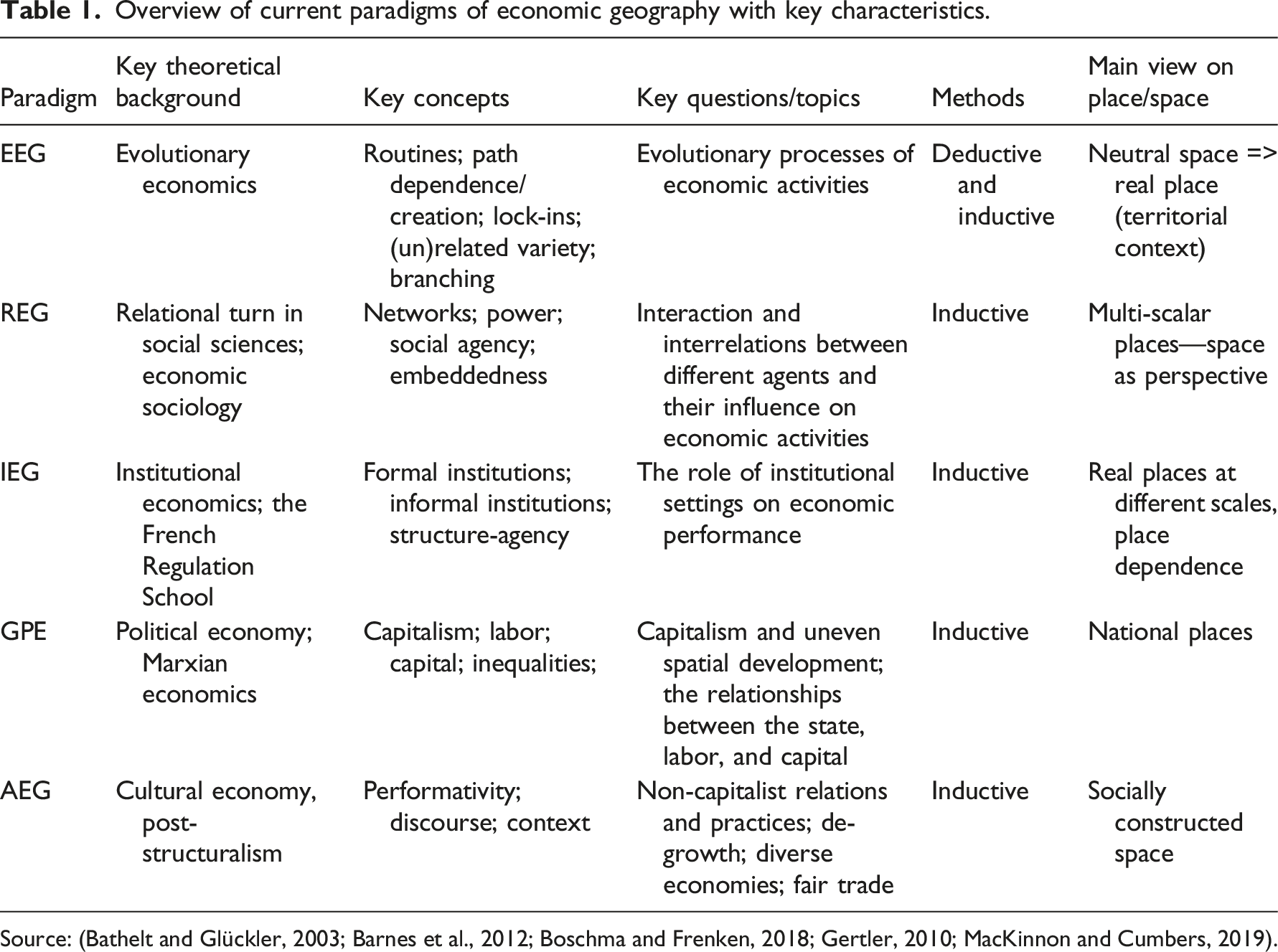
Overview of current paradigms of economic geography with key characteristics.
Even though we use paradigms as a proxy for any other similar term, such as schools of thought or perspectives 1 , it is worthwhile to briefly elaborate more on Kuhn and what he meant by paradigms, paradigm shifts, and the incommensurability between paradigms (for more detailed accounts, see Anand et al., 2020; Kuhn, 2012; Nickles, 2003; Weichhart, 2012, 2018), as it potentially has consequences for the question about engaged versus fragmented pluralism. According to Martin (2021: 5), “geographers do not often refer to the later Kuhn, but his ideas … seem much closer to how economic geography has developed in recent decades” (Martin, 2021: 5). In Kuhn’s original work on paradigms, defined as “universally recognized scientific achievements that for a time provide model problems and solutions to a community of practitioners” (Kuhn, 2012: xlii), normal science and revolutionary science were distinguished and one paradigm at the time would dominate, which is supposed to be incommensurable with a new paradigm because of methodological, ontological, and epistemological differences. Later on, Kuhn (1990) weakened his statements on incommensurability, confining it to semantic differences (Sankey, 1993). Particularly in social sciences, such as human geography, the co-existence of several paradigms (paradigmatic pluralism, Martin, 2021: 4) with only semantic incommensurability is common (Bassett, 1999; Weichhart, 2012, 2016). Concerning economic geography, Martin (2021: 5) rightly observes that “… the evolution of the discipline over recent decades would seem to be characterised by an increasing array of subfields … rather than any simple succession of one dominant or hegemonic approach or paradigm by another” (Martin, 2021: 5). It “… does tend to consist of numerous distinct ‘epistemic communities’ that subscribe to different paradigmatic combinations of ontology, theory and method” (Martin, 2021: 5).
As pointed out above, we currently witness a multi-paradigmatic situation in proper economic geography, without strong incommensurabilities, as the paradigms share a critical stance towards positivism and have other philosophies of science as their basis (Gong and Hassink, 2020). This makes engaged pluralism a realistic option and a gestalt shift not necessary. The situation differs, however, between proper economic geography and geographical economics, which is strongly based on critical rationalism and positivism, and which is therefore largely incommensurable to paradigms in proper economic geography. Sunley (2012) writes about critical or even antagonistic pluralism between geographical economics and proper economic geography. We therefore focus in the rest of the paper on the five paradigms within proper economic geography from which we can expect engaged pluralism and leave the discussion about dialogue and exchange between proper economic geography and geographical economics to others (Bathelt et al., 2017; Garretsen and Martin, 2010; Gaspar, 2021; Overman, 2004; Sunley, 2012).
In the remainder of this section, we summarize the five paradigms. We discuss both launching and core papers which define the paradigms, as well as some more peripheral literature which is also relevant for understanding their key aims, theories, and questions, but which might, in some cases, be less close their core. The purpose is not to critically discuss how close literature belongs to the core of each paradigm, which we leave to others, but to give an overview as a basis for discussing fragmented and engaged pluralism.
1 Institutional economic geography
Influenced by the French regulation theory and institutional economics, sociology, and political science, and nourished by the growing recognition of the “the socio-cultural” within economic geography (Martin, 2000), institutional economic geography (IEG) aims to explain the roles and impact of institutions on the way economic activities are organized across space (Gertler, 2018). Moreover, it illuminates why economic activities are organized the way they are by investigating the co-evolution of economic activities and institutions (Gong and Hassink, 2019).
According to IEG, actors are bounded rationalities and their economic activities are socially constructed and territorially embedded phenomena, and hence institutions either enable or constrain them (Gertler, 2010; Rodríguez-Pose, 2013). Therefore, IEG emphasizes that economic life in space and its changes can be uncovered by referring to institutions which surround economic actors and link “the economic” and “the social” (MacKinnon, 2020). Notably, since the substantive implication of institutions shaping economic processes varies due to broader institutional framework particularities of places, the analytical focus and geographical orientation of IEG are on the place(s) at different spatial scales and their institutional specificities.
Institutions comprise both formal institutions including codified rules, regulations, and arrangements (e.g., property rights) and informal ones including conventions, values, expectations, and norms (e.g., trust between actors) (Pike et al., 2015). Rather than separating them, IEG scholars analyze their complex inter-relationships (see Zukauskaite et al., 2017) and how they are related to the variation of institutional regimes across space shaping local economic outcomes.
Overall, even if conceptualizations of institutions differ, also between the paradigms in economic geography, IEG has been interested in understanding more broadly how institutions shape and constrain all forms of economic behavior and practices, from innovation, organizational change, and entrepreneurship to inter-firm relations and learning, from labor and capital markets to environmental responses to climate challenges (Gertler, 2018; Rodríguez-Pose, 2020). While this interest initially mainly focused on national institutions, influenced by neighboring disciplines, it has expanded to include interactions of regional institutions with national and supra-national institutions, as well (see Amin and Thrift, 1995; Gertler, 2004; Pike et al., 2015; Rodríguez-Pose and Di Cataldo, 2015; Rodríguez-Pose and Storper, 2009).
2 Relational economic geography
Influenced mainly by economic sociology and heterodox economics, REG assumes that the causal factors of socio-spatial changes in economic landscapes are created by, transformed by, and embedded in relationships and interdependencies between people, places, institutions, and firms, at local, regional, national, and global scales (Bathelt and Glückler, 2011; Rantisi and Boggs, 2020; Yeung, 2005). Space is seen “as a perspective” (Bathelt and Glückler, 2003: 124) for inquiring economic phenomena, rather than being an explanatory variable for economic actions and their consequences. Correspondingly, through the “geographical lens,” REG attempts to analytically trace and explain localized economic processes across places, spaces, and scales (Bathelt and Glückler, 2003; Bathelt, 2006).
Since micro-entities, such as firms and organizational structures and their actions, are not isolated atoms but closely linked to their suppliers, customers, and institutional context in which they operate, economic action and change are fundamentally contextual (Bathelt and Glückler, 2018). Therefore, REG highlights networks and relationships as analytical focus in which actors are embedded, without prioritizing a particular scale per se (Boggs and Rantisi, 2003; Murphy, 2018; Yeung, 2005).
Moreover, economic actions are considered having a path-dependent character, that is, economic action enables, constrains, and transforms the localized material and institutional conditions of future economic action (Bathelt and Glückler, 2003). Institutions centrally influence the evolution of economic landscapes as the socio-institutional context creates opportunities for economic action and interaction that would otherwise not exist (Bathelt and Glückler, 2003, 2011). However, institutions are not conceptualized as entities that structurally determine economic activities but rather as important mediators having top-down and bottom-up effects across scales, which stabilize economic relations (Bathelt and Glückler, 2011; Glückler and Lenz, 2018). The emphasis on path dependence and institutions shows how relational economic geography has been influenced by different parts of heterodox economics, namely, evolutionary economics and institutional economics, respectively.
Furthermore, the principle of contingency is emphasized, that is, the strategies and actions of agents can deviate from existing development paths (Bathelt and Glückler, 2011). Even if firms as economic agents operate under the same conditions, they may produce different outcomes in terms of specialization and competitive behavior (Bathelt and Glückler, 2003, 2018).
To understand how, why, and to whom/where resources flow, REG emphasizes “the ties or interconnections—their strength, density, symmetry, and range—between economic actors embedded in historically derived institutional environments as well as social networks” (Murphy, 2018: 162). With this emphasis, REG has been influential in research on clusters, networks, value chains, and global production networks, where tacit knowledge, social interactions, and/or interpersonal trust play a key role in determining who participates, innovates, and performs better or worse (Murphy, 2018: 162).
3 Evolutionary economic geography
Based on Darwinian thinking (biology) and guided by Schumpeter’s notion of creative destruction and informed by evolutionary economics (Nelson and Winter, 1982), EEG studies “how geography matters in determining the nature and trajectory of the evolution of the economic system,” as well as “the processes by which the economic landscape — the spatial organisation of economic production, circulation, exchange, distribution and consumption — are transformed from within over time …” (Boschma and Martin, 2010: 6, 7). Moreover, to analyze and understand the (uneven geographical) evolution of economies, EEG emphasizes historically acquired organizational routines determining the behavior and location of firms (Boschma and Frenken, 2006). Routines, as organizational skills and capabilities, play a vital and decisive role in the capacities of firms to adapt, survive, and compete in a dynamic environment (Boschma and Frenken, 2009).
Accordingly, the evolution of the economy, which is regarded as a dynamic, irreversible, and self-organizing system (Rafiqui, 2008), is understood as the result of the creation and retaining of new organizational routines, and of their selective transmission and diffusion (Boschma and Frenken, 2011; Kogler, 2015). Since economic actors and firms operate in territorial context (real places) (Boschma and Frenken, 2006), their activities are both path- and place-dependent (Martin and Sunley, 2006).
Therefore, drivers and mechanisms for evolution and change of the economy do not originate and operate evenly across space (Boschma and Martin, 2010). The bounded rationality and cognitive constraints of actors and firms as well as the existence of enabling or constraining conditions (such as institutions) in real places affecting the creation and diffusion of routines can make the routine transmission process imperfect. “This leads to uneven geographical patterns, as embodied in agglomerations, center-periphery patterns, clusters, and networks” (Boschma and Frenken, 2018: 214).
Evolutionary economic geography contributes to explaining and analyzing novelty (new products and technologies, new firms, and new industries), knowledge, and innovation emergence and diffusion, the emergence of spatial economic structures from the micro-behavior of economic agents, and differences in regional economic growth (Boschma and Frenken, 2018; Kogler, 2015; Martin and Sunley, 2015). EEG research is mainly carried out through three interrelated strands: First, path dependence (Martin and Sunley, 2006; Strambach, 2010), lock-ins (Grabher, 1993; Hassink, 2007, 2010), spatial evolution of industries (especially diversification, branching, and variety) (Boschma et al., 2013; Boschma and Wenting, 2007; Frenken et al., 2007; Neffke et al., 2011, 2018; Wenting, 2008), and path development (Grillitsch et al., 2018; Isaksen, 2015; Simmie, 2012; Trippl et al., 2018); secondly, clusters and their evolution (Martin and Sunley, 2003, 2011; Maskell and Malmberg, 2007; Menzel and Fornahl, 2010; Popp and Wilson, 2007); and thirdly, networks and their evolution (Balland, 2012; Broekel and Boschma, 2012; Giuliani, 2013; Morrison and Rabellotti, 2009; Ter Wal, 2014).
4 Geographical political economy
Emerged in the 1970s from the attempts in economic geography to address issues of urban and regional restructuring by getting insights from Marxist political economy and affected by economic sociology and economic anthropology (Bok, 2019; MacKinnon and Cumbers, 2019) as well as by seminal work of Harvey (1982) and Smith (1984), GPE’s core focus is on capitalism and its geographies, as a specific social, economic, and political formation. Their trajectories are formed by class and geographical conflict, as well as by the unintended effects of economic decisions and political actions (Sheppard, 2006).
According to geographical political economy scholars, “the economic” goes beyond simple market exchange, including capitalist commodity production having a spatial-temporal nature being far from equilibrium (Sheppard, 2018). The geography of capitalism is not assumed exogenous to the economy but actively produced through the development and restructuring of the economy (Lefebvre, 1991; MacKinnon and Cumbers, 2019; Sheppard, 2011). Moreover, space and place are transformed, the nature and significance of geographical scales are altered, and distance and connections are reconstructed through their fundamental relations with capitalism (Pike, 2020; Sheppard, 2018).
By analyzing relationships between the state, power, labor, and capital, GPE tries to capture the moving (unequal) spatial matrix of “the economic” which is affected by unstable and crisis-prone processes under capitalism (Hu and Lin, 2011; Jones, 2008). It is particularly interested in how labor processes, wage relations, regulatory architectures, and technological systems, which make up an historical regime of capital accumulation, enable, constrain, and influence the dynamics and interaction of firms, industries, labor markets, institutions, and regional patterns of development, which together make up the space economy of capitalism (Sheppard, 2011). Research topics vary from deindustrialization to financialization and the production of scale (see Brenner, 2004; Peck and Whiteside, 2016; Pike, 2005, 2006; Wainwright, 2012).
5 Alternative economic geographies
Influenced by post-structuralism stressing the social construction of meaning, identity, and representation and the cultural turn (MacKinnon and Cumbers, 2019; Sheppard et al., 2004), an alternative approach can be identified in economic geography, called “Alternative Economic Geographies,” by Barnes and Christophers (2018). It is “broadening out from Marxism and feminism and drawing eclectically on economic anthropology, economic sociology, institutional economics, area studies, and studies of the underground and informal economies” (Gibson-Graham, 2008: 615). AEG is a paradigm, a diverse economy research program, or movement (Smith, 2012), reframing both “the economic” and “the geography” of economic geography research (Gibson-Graham, 1996; Gibson-Graham and Dombroski, 2020a).
Challenging mainstream economy thinking, it signals “alternative,” previously neglected, marginalized, and non-capitalist economic activities, practices, and processes (Hudson, 2006; Sheppard et al., 2004). AEG attempts to open up to the capitalism’s others who also contribute to maintaining livelihoods alongside, supporting those who earn wages, and generate new wealth (Gibson-Graham and Dombroski, 2020a), by conceptualizing “economic geographies [that] are so much more than mere spatial manifestations of a singular and autonomous economic logic” (Lee, 2011: 378)
Since it is assumed that what counts as “the economy” is constituted in and distributed over space via a diverse and complex mix of social relations, understandings, representations and interpretations, and practices (Hudson, 2005), economic geographies are conceptualized as phenomena organized and driven in diverse ways, rather than a singular one (Lee, 2006, 2011). Across the socially constructed spaces, “the economy” diversifies with a complex interdependency of economic relations within the variously constituted households, volunteers, self-employed, family businesses, prisons, and illegals, as well as industrial markets and sectors (Gibson-Graham, 2003).
Overall, AEG tries to illuminate the alternative economic, social, and ecological practices in different aspects of the economy (Gibson-Graham et al., 2013). AEG arguably represents the most open-ended, context-dependent economic geography, with research on topics ranging from worker cooperatives, to anti-mafia enterprises, violent economies, precarious labor, to care-full economies (Gibson-Graham and Dombroski, 2020b; Leyshon et al., 2003).
6 Debating pluralism in economic geography
As mentioned in the introduction, particularly since Barnes and Sheppard’s (2010) article, pluralism has been debated in economic geography with different nuances concerning what is good and bad about pluralism, whether the discipline needs a core and if so, how it should look like, and what the consequences are of pluralism for the identity of the discipline.
On the one hand, some economic geographers argue in favor of the interdisciplinary structure and decentered and heterodox intellectual culture of economic geography, characterized by the existence of these five different paradigms. This culture reflects the discipline’s intellectual vitality and strength rather than being a problem or weakness (Barnes et al., 2012; Barnes and Christophers, 2018; Peck, 2005; Sheppard et al., 2004; Weichhart, 2018; Martin, 2021). For instance, Hudson (2006: 55) emphasized the necessity for plurality to deal with the complex and nuanced nature of the modern capitalist world, which would not be explicable by one all-encompassing theoretical position. Similarly, according to Agnew (2012: 567) the pluralist character of economic geography goes beyond “the idealized image of 19th Century physics as the ultimate model of knowing.” Moreover, in Markusen’s (2006) view, economic geography offers scholars, policy-makers, and students a remarkable arena for harnessing the best of sciences to understand change because it is not hindered by strict orthodoxies and limiting normative underpinnings. Indeed, these arguments in favor of intra-disciplinary plurality are quite justified. Because in the face of economic geography's context (place and space)-dependent nature, an intellectual lock-in induced by scientific monism would impede it in dealing with and understanding and explaining a multifaceted and complex reality.
On the other hand, as has been stated in the introduction, recently concerns have been rising in economic geography about the flip sides of pluralism. Barnes and Sheppard (2010: 193) argued that “economic geography has become increasingly fragmented into a series of intellectual solitudes that has created isolation, producing monologues rather than conversation, and raising the question of how knowledge production should proceed.” They called this situation fragmented pluralism. Moreover, according to Aoyama et al. (2011a: 111) “the increasingly specialized and fragmented nature of the discipline and the resulting ‘disappearing of the middle’ lead to fewer dedicated scholars, which, in turn, endangers the survival of the discipline.” Relatedly, this would lead to difficulties “to isolate a disciplinary core” (Muellerleile et al., 2014: 11), coming at “the expense of disciplinary cohesiveness, which is sorely lacking” (Clare and Siemiatycki, 2014: 6). Similarly, fragmented pluralism in economic geography led to the question of the raison-d’être of economic geography vis-à-vis geographical economics and other neighboring social sciences (Sheppard et al., 2012; Peck, 2015: 32).
In a reaction to these threats of fragmented pluralism and related specialization traps, Sheppard and Plummer (2007) and Barnes and Sheppard (2010) developed the idea of engaged pluralism, as a prescription for treatment. It has the potential to enable mutually productive exchanges, through “trading zones” in which different theoretical and intellectual traditions are brought together through intersecting research and discussion. Although there are some doubts about what engaged pluralism means in practice (see Simandan, 2011; Sunley, 2012), calls for engaged pluralism have until now resonated in the discipline (see Clare and Siemiatycki, 2014; Mann, 2012; Rosenman et al., 2020). Some initiatives explore ways in which some degree of combination, amalgamation, fusion, or synthesis of different perspectives and theories might be achievable (see Hassink et al., 2014; Hassink and Gong, 2017; MacKinnon, 2012; Martin and Sunley, 2015; Pike, 2020). For instance, MacKinnon (2012) proposed a geographical political economy of evolution (GPEE) approach trying to link EEG and IEG, incorporating a social and pluralist conception of institutions and agency, in order to be able to assess the evolution of economic landscapes. Hassink et al. (2014) followed the engaged pluralism argument in order to attempt to combine evolutionary, relational, and institutional economic geography in certain respects. Moreover, seeking to foster engagement, dialogue, and mutual learning, Pike (2020) outlined a geographical political economy approach to economic evolution and focus on geographically differentiated pathways and institutions.
Recently, Martin (2021) proposed the ideas of “integrative pluralism” and “boundary objects” to economic geographers, as ways of pursuing communication and knowledge exchange between different epistemic communities while nevertheless preserving the advantages of theoretical and perspectival pluralism. Inspired by Mitchell (2004), Martin (2021: 15) categorized the integrative initiatives in economic geography (such as Hassink and Gong, 2017; Martin and Sunley, 2015) as “local theoretical unification,” which explore possible overlaps and complementarities between different paradigms or propose “foundational” or “spanning” frameworks for uniting particular viewpoints. He labeled other attempts (such as Sheppard, 2016, 2018) as “foundational pluralism,” which propose one or more common “organizing principles” to which different perspectives can (or should) subscribe and under which they can be unified. Moreover, Martin (2021) proposed boundary objects and bridging concepts as ways to facilitate integrated pluralism across economic geography between different epistemic communities, while nevertheless preserving the advantages of theoretical and perspectival pluralism. Boundary objects refer to objects that are dynamic, egalitarian, and flexible concerning interpretations and have “… sufficient acceptance across different scholars and disciplines of the idea in broad terms … as to permit the exchange (‘trade’) of ideas between different perspectives” (Martin, 2021: 21). Bridging concepts go one step further and actually actively link “… fields and stimulates dialog” in an integrative way (Baggio et al., 2015: 2). Martin (2021) mentioned several examples of the latter, such as clusters, path dependence, resilience, sustainability, inequality, globalization, agglomeration, global production networks, and governance.
Overall, discussions about fragmented pluralism in economic geography and the proposals for engaged or integrative pluralism as well as for boundary objects and bridging concepts are mostly based on narratives of economic geographers, that is, their qualitative judgments (for an exception, see Rosenman et al., 2020). In our view, arguments for fragmented pluralism related to the communication structure of economic geography first need to be subject to empirical analysis. The bibliometric network of economic geography publications can help to learn more about intra-paradigm dialogue and communication patterns. The use of bibliometrics can quantitatively help to understand the research foundation, the current state of research, and the research trends in a given field (Boyack and Klavans, 2019; Van Eck and Waltman, 2014; Zupic and Čater, 2015). Therefore, based on three analyses, we tried to empirically explore the relationships and interactions among the five abovementioned paradigms in order to provide a solid basis for these discussions and to uncover both the extent of communication among paradigms and their communication points (as boundary objects and bridging concepts).
III Data collection and methodological approach
1 Data collection
Data collection and retrieval strings.
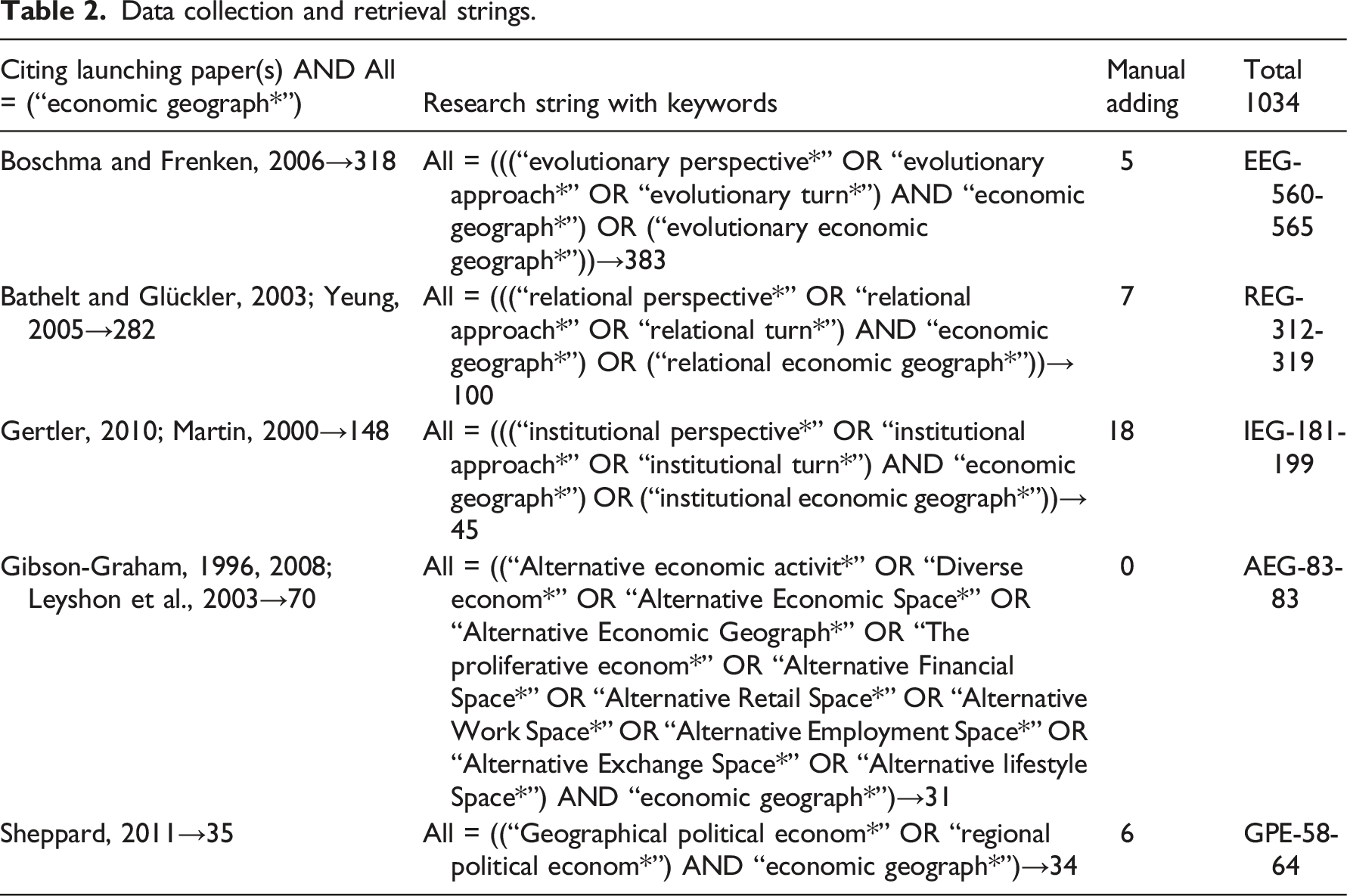
Since the data collected by these two methods will overlap, the final data will be less than the sum of the data collected by both methods. For example, although we collected 318 and 383 articles for the EEG literature by using “launching papers” and “keywords,” respectively, we only obtained 560 articles. Furthermore, we acknowledge that there might be some papers that did not cite the launching paper or use corresponding keywords, yet still belong to one or more of the paradigms. To prevent the omission of significant recordings, based on multiple rounds of data collection using several different search strings, we manually read some papers with high citations, but which are not included in this set of retrieval methods, and eventually added 5, 7, 18, and 6 additional articles for EEG, REG, IEG, and GPE, respectively (we put these manually added articles in Appendix I).
Finally, we obtained 1034 pieces of data. Due to the overlap of data obtained from searching through the five paradigms search strings in Table 2, 162 papers occupied 358 spaces among these 1034 pieces of data. This means that these 162 papers involved at least two paradigms. By manually reading these 162 papers, we eventually found 53 papers that take engaged pluralism seriously (we categorize them as EP a priori) and the remaining papers that simply referred to multiple paradigms. By referring to the Local Citation Score (LCS) 2 as well as manual checks, we assigned the remaining 109 papers into the paradigm with the highest LCS based on the different single paradigms. We acknowledge that not all papers citing a particular launching paper or using special keywords necessarily belong to, or are exclusively attributed to, that paradigm. However, as the subsequent analysis in this paper is mainly based on bibliometric analysis, such instances are not predominant and do not affect the main conclusions. Moreover, through the manual check process described above about the EP category, and the use of the LCS indicator, we are well positioned to identify papers that are widely cited and recognized within the paradigm, while excluding those that may not truly embody the core ideas of their respective paradigms (since such articles often do not have a high LCS).
2 Choice of bibliometric networks
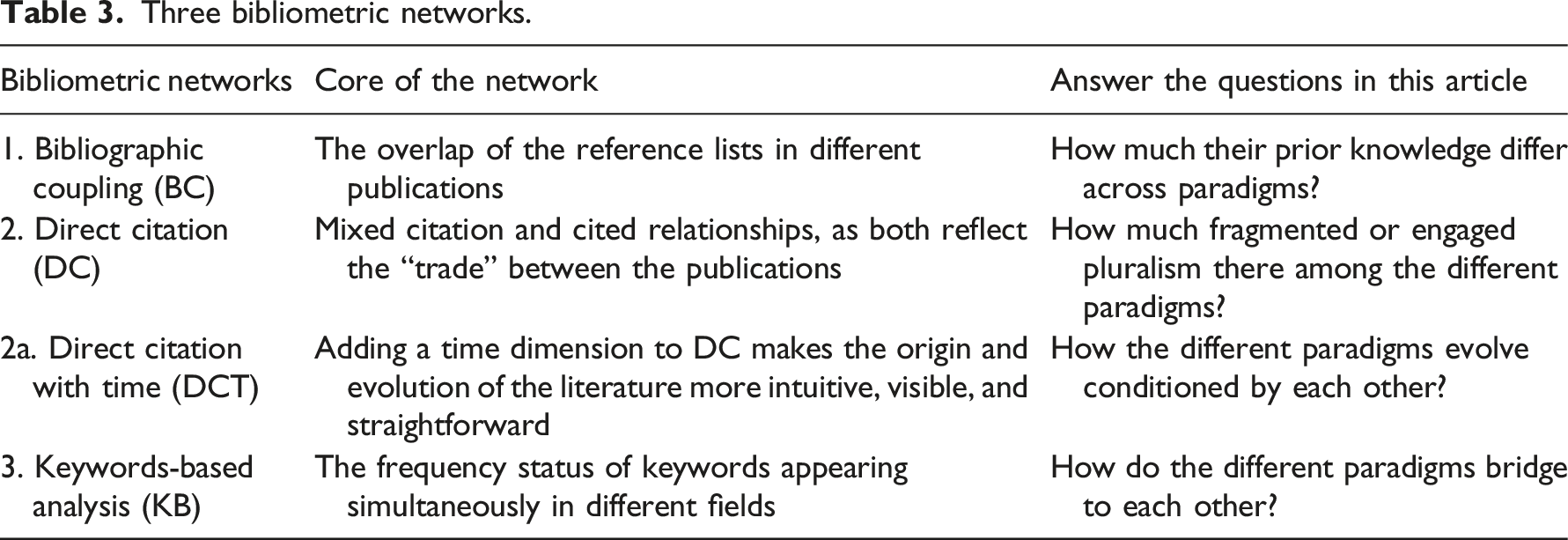
Three bibliometric networks.
IV Results of bibliometric analysis
1 Trend
Based on the data collected above, we counted the output of articles of different paradigms for each year and obtained Figure 1. Overall, we recently see an, in our view, worrisome overall trend of declining reference to current paradigms. Output trend of five paradigms.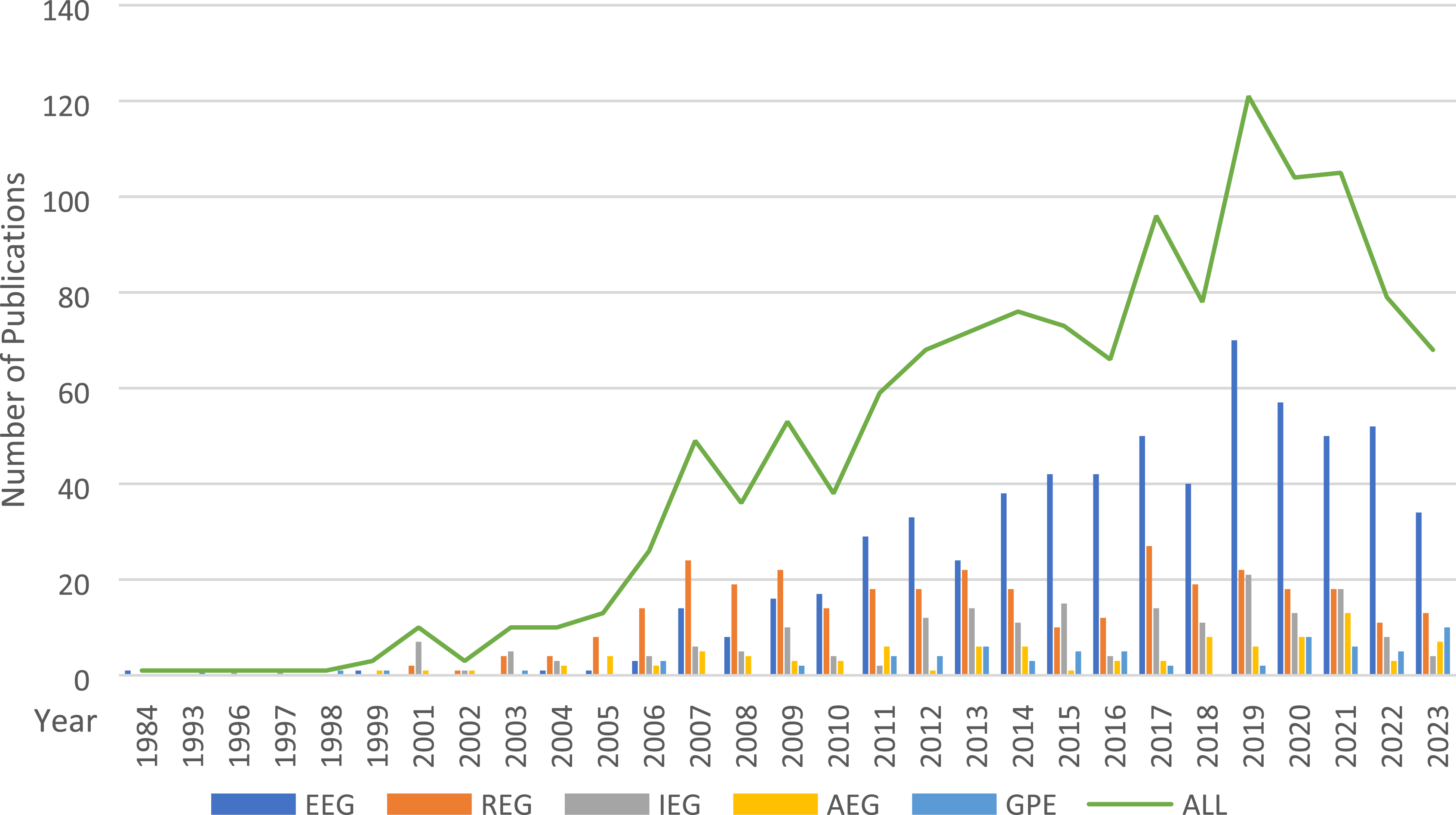
Figure 1 also shows that EEG is the largest of all paradigms. REG rose before EEG but did not do as well as EEG after 2009. Based on the year-by-year number of all paradigm papers, we roughly divided it into three phases: before 2007 (the start-up phase), from 2007 to 2017 (the rapid growth phase), and after 2017 (the fluctuating development phase). Figure 1 also shows that some paradigms, such as GPE and AEG, are not often referred to.
The popularity of EEG can be partly explained by the active role of its main scholars organizing special sessions at conferences, such as Dieter Kogler who organized during a long time successfully special sessions at the AAG Annual Meeting with EEG in its title, as well as special issues, such as in Regional Studies (Kogler, 2015) and the Cambridge Journal of Regions, Economy and Society (Kogler et al., 2023). The main scholars of the other paradigms have been less active in this respect. Other reasons for the waxing and waning of paradigms are generational transitions and related life cycles, empirical research showing the decreasing of their explanatory power, and a lacking fit to societal needs. Concerning the latter, arguably, given current crisis-ridden times, GPE might gain momentum in the near future, given its emphasis on the state and macro-scale analysis, as suggested recently by Essletzbichler et al. (2023). It would go beyond the scope of this paper to discuss these issues in much more detail here, but they need to be included in future debates about paradigms and pluralism in economic geography.
2 To what extent does prior knowledge differ across paradigms?
As stated in Section III.2, BC shows the relationship of a common reference between two papers (citing paper). The higher the number of the same references (cited articles), the more they share the same research base, the higher the similarity between these two papers (citing paper). When we analyze from the BC network perspective, the more links there are between two paradigms, the fewer differences or deviations there are between these two. According to the algorithm of VOSviewer, the closer the location of different nodes in the BC network in the visualization, the stronger the coupling relationship will be. In other words, paradigms that are close to each other tend to share common prior knowledge, which means they are more similar. Vice versa, paradigms that are far from each other usually do not cite the same publications, which means they are more different.
We have formed two BC networks based on different filtering criteria, which are visualized in Figures 2 and 3, respectively. Figure 2 shows the BC networks of the five paradigms (after deducting the 53 EP papers). We retained 183 papers according to the threshold of LCS no fewer than 5. Of these, EEG contributed 115, REG 47, IEG 16, AEG 3, and GPE 2 papers
3
. Through Figure 2, we can easily observe that the coupling relationships between EEG and REG are overall independent, indicating that they are overall distanced and dissimilar to each other. However, as the most and second most cited articles within EEG (identified by the node size in Figure 2), Boschma and Frenken (2006) and Martin and Sunley (2006) are, respectively, closely coupled to REG and IEG, which indicates that the important contributions of EEG are closely related to REG and IEG. Moreover, it shows that IEG is strongly coupled with both EEG and REG. In particular, example BCe1 (Grillitsch, 2015) and example BCe2 (Markusen, 1996), although both articles belong to the IEG paradigm, strongly share research foundations with EEG and REG, respectively (using the same principle, we have labeled 10 such special articles in Figures 2 and 3). In addition, although the coupling density is lower than the ones of REG, EEG, and IEG, GPE also is bibliographically coupled with IEG. Finally, AEG is only slightly close to REG and IEG and has almost no coupling relationship with EEG. Bibliographic coupling networks of five single paradigms (node size represents LCS, LCS ≥5,183 nodes). Bibliographic coupling networks of five single paradigms and “engaged pluralism cluster” (node size represents LCS1034, LCS1034 ≥ 7,209 nodes).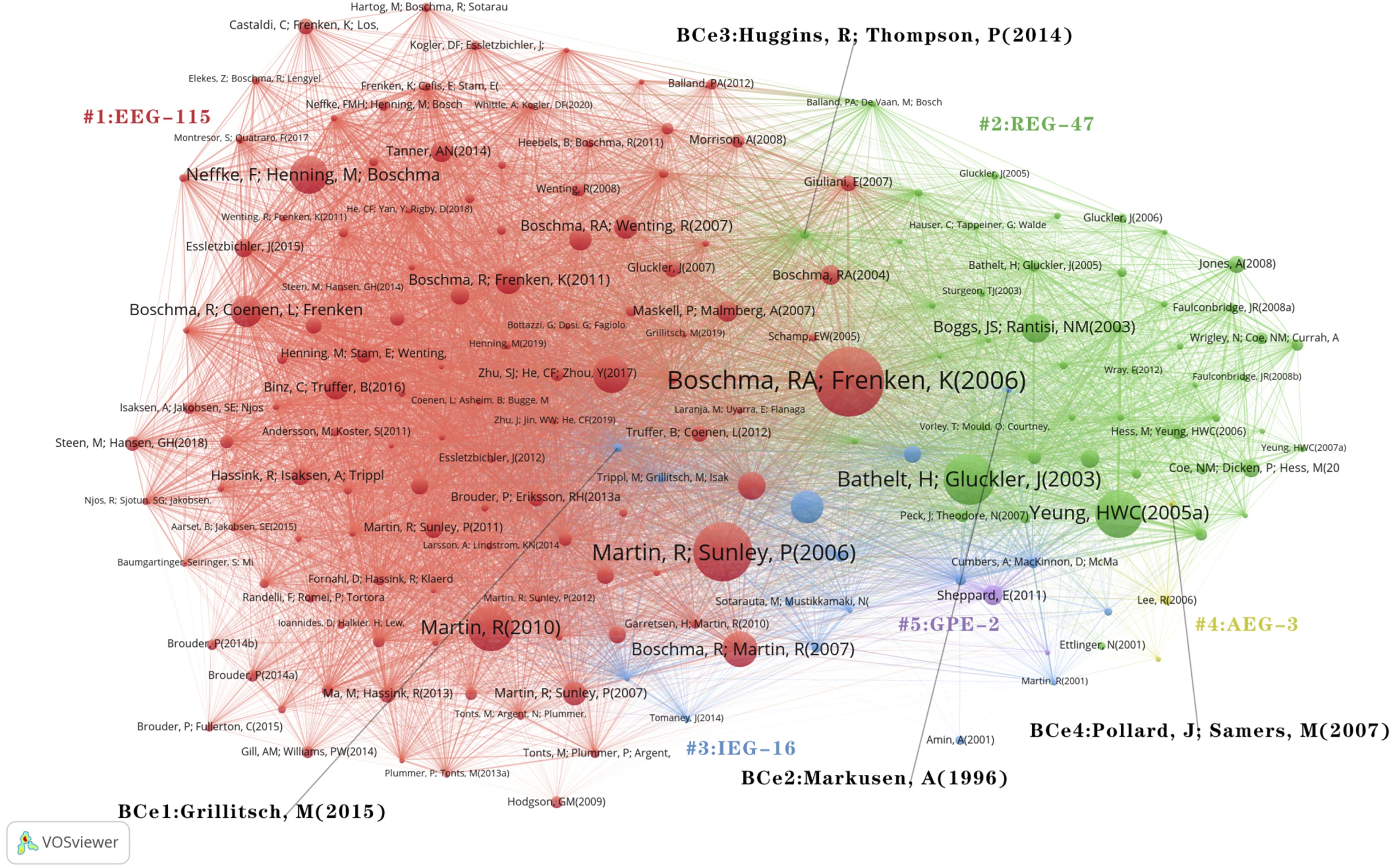
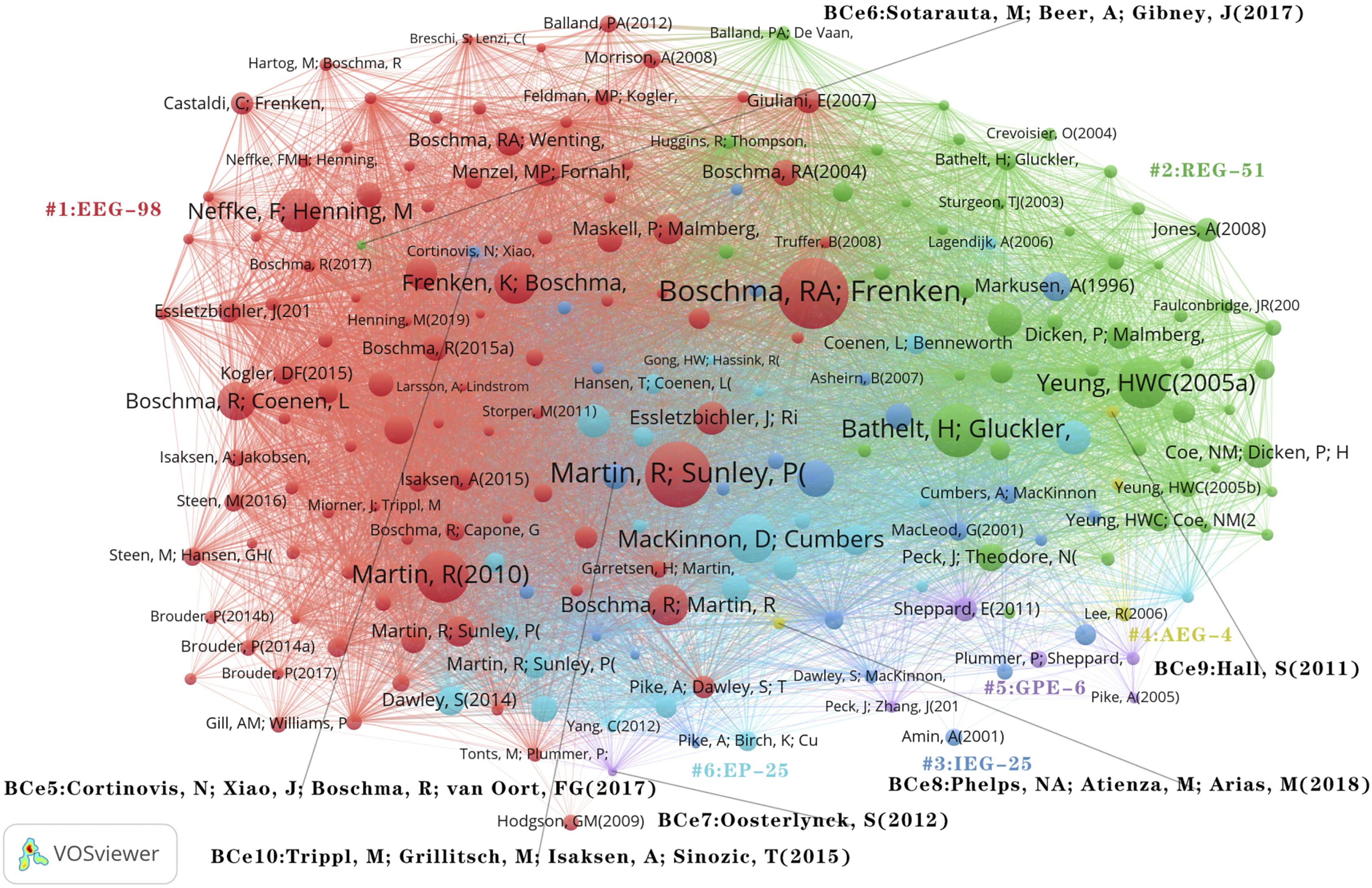
Figure 3 shows the BC networks of five paradigms and 53 EP articles. In this figure, we filtered out 209 articles using a threshold of LCS1034 no fewer than 7. Among them, we obtained 98 EEG, 47 REG, 25 IEG, 4 AEG, and 6 GPE articles. At the same time, the remaining 25 EP articles from the original set of 53 EP articles were added as the sixth cluster to the network. By examining the changes in the number of papers for different paradigms in Figures 2 and 3, we found that except for the EEG paradigm, which has decreased in size, all other paradigms have increased in size as the filtering criterion changed from LCS ≥5 to LCS1034 ≥ 7. This to some extent indicates that the EEG paradigm has a higher internal self-citation rate than the other paradigms. In other words, EEG has a more closely connected internal network, which validates our argument in Section IV.1 that the popularity of EEG is due to its active internal interactions, including conferences, special issues, and of course, internal self-citations. Figure 3 also confirms our interpretation of Figure 2, that IEG has the highest number of couplings with other paradigms because it has the most overlapping bibliography with EP. Finally, as the node size is represented by LCS1034, we can also identify articles that are important in all paradigms by the size of the node. This can help us to identify some articles that may not be very important in their own paradigm but are important in the overall paradigm research, or vice versa. For example, the LCS of BCe10 is 3, so the node in Figure 2 is very small. However, its LCS1034 is 13 (thus the node is larger). This indicates that although BCe10 (Trippl et al., 2015) is cited less in the IEG field, it is cited many times in other paradigm studies. Therefore, Trippl et al. (2015) is an important article for other paradigm papers.
3 How much fragmented or engaged pluralism is there among the different paradigms?
In fragmented pluralism, it is expected that self-referencing dominates, that the centrifugal forces are strong and communication is “closed” towards the other paradigms, and that evaluation of the relevance and quality of research are limited to the members of the respective paradigm (Bernstein, 2005; Weingart, 2010). However, this expectation is just a qualitative judgment made by scholars and should not be treated to be true a priori. Moreover, the engaged pluralism judgment in economic geography was made 10 years ago, and we hence urgently need to quantitatively verify it.
As mentioned in Section III.2, DC networks are helpful in clarifying the citation relationship between two articles and recognizing research direction (with time dimension). “As the authors referring to prior literature have to be selective as they cannot cite all relevant literature on the studied topic, direct citation link among two documents is created intentionally … reflecting which paper consider communication with another one as relevant and important” (Thijs, 2019: 216). In general, DC networks are depicted with arrows pointing from the cited references to the citing references. Alternatively, in the absence of arrows, the timeline can be used to represent the relationship between cited papers and citing papers, as it is not possible for past publications to cite publications that are published in the future. However, in this section, we will disregard the direction of citation arrows because from the overall thinking, no matter whether a reference is cited by or cites another reference, it reflects the “dialogue” and “trade” between paradigms. Therefore, in this section, we adopt a citation network without arrows (i.e., without a time dimension) to visually represent the dialogue between different paradigms. In the next section, we will use a citation network with a time dimension to reflect the evolution of the mutual influence between different paradigms.
Similar to the logic in section IV.2, Figures 4 and 5 show the DC networks of the 183 and 209 articles, respectively. Similarly, relying on the algorithm of VOSviewer, we can identify the strength of the dialogue between different paradigms (i.e., the amount of mutual citation) by the distance between their locations on the visualization map. Based on Figure 4, we can see that although there are a few citation relationships between paradigms, such as DCe1 (Balland et al., 2013) and DCe2 (Martin and Sunley, 2001), overall, the relationships between paradigms are very sparse. EEG is minimally associated with REG, and most of these connections occur after 2010 (e.g., Balland et al., 2013; Fløysand and Jakobsen, 2011). REG overall is almost unaffected by EEG, so there is still a strong separation between the two. AEG is mainly associated with REG and to a lesser extent with GPE, but not with the overall popular EEG. Direct citation networks of five single paradigms (node size represents LCS, LCS ≥5,183 nodes). Direct citation networks of five single paradigms and “engaged pluralism cluster” (node size represents LCS1034, LCS1034 ≥ 7,209 nodes).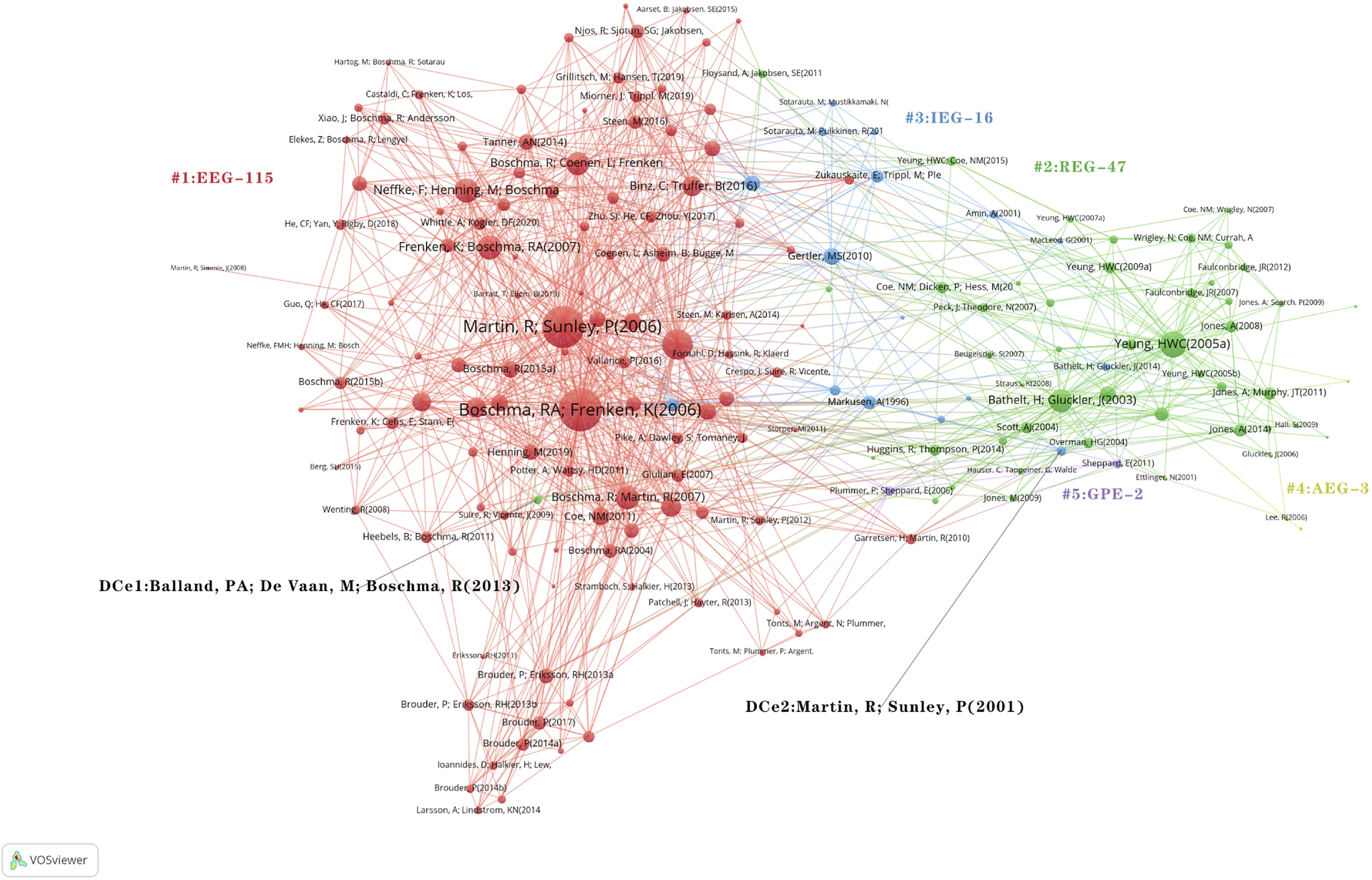
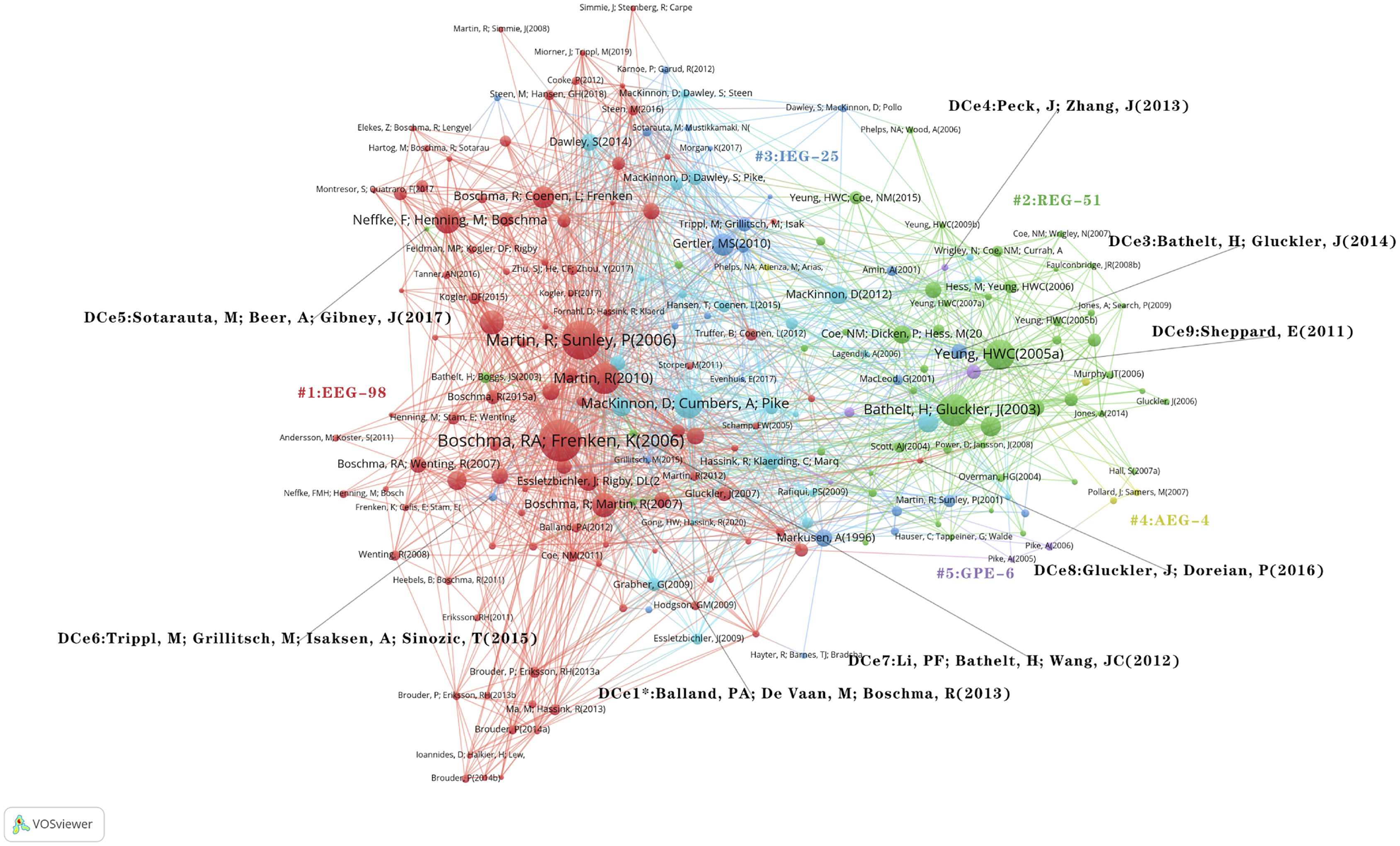
It seems that we may need to consider this as fragmented pluralism. However, Figure 5 seems to give us other evidence. First, “the use of direct citations often leads to very sparse networks (i.e., networks with only a very small number of edges)” (Van Eck and Waltman, 2014: 287). Secondly, Figure 4 was constructed by excluding 53 articles defined as EP. By comparing Figures 4 and 5, we believe that the fragmentation mentioned above may be due to the small number of articles in Figure 4. Through Figure 5, we found that except for AEG, each paradigm has the intellectual lending or borrowing with other paradigms, although the degree of interaction may be uneven. For example, although IEG has extensive dialogue with both EEG and REG, it has relatively more dialogue with REG than with EEG. In addition, there is a strong dialogue between GPE and REG, although the BC network in Section IV.2 did not find much overlap between them in terms of research base. Combining Figures 4 and 5, we have marked a total of nine papers (from DCe1 to DCe9) that clearly communicate with other paradigms.
4 How did the different paradigms evolve and affect each other?
Similar to the previous two sub-sections, Figures 6 and 7 show five clusters and six clusters including the “engaged pluralism cluster” for the DCT networks, respectively. It can be seen from Figure 6 that EEG, despite being launched later than IEG and REG, has developed into the largest paradigm since the publication of the two papers by Boschma and Frenken (2006) and Martin and Sunley (2006). It is worth noting that, although the development of IEG and REG predates the development of EEG, the earliest economic geography articles with an evolutionary perspective did not explicitly draw inspiration from these two paradigms. Instead, as can be seen from Figure 6, the development of REG was based on the foundation of IEG (Markusen, 1996), while the emergence of GPE relied on the foundation of REG (Scott, 2004). Direct citation networks of five single paradigms (node size represents LCS, LCS ≥5,183 nodes. The figure shows from the left to right the older and newer papers. In each cluster, papers with larger LCS are located at the top and bottom, and articles with smaller LCS are located in the middle.). Direct citation networks of five single paradigms and “engaged pluralism cluster” (node size represents LCS1034, LCS1034 ≥ 7,209 nodes. The figure shows from the left to right the older and newer papers. In each cluster, papers with larger LCS1034 are located at the top and bottom, and articles with smaller LCS1034 are located in the middle).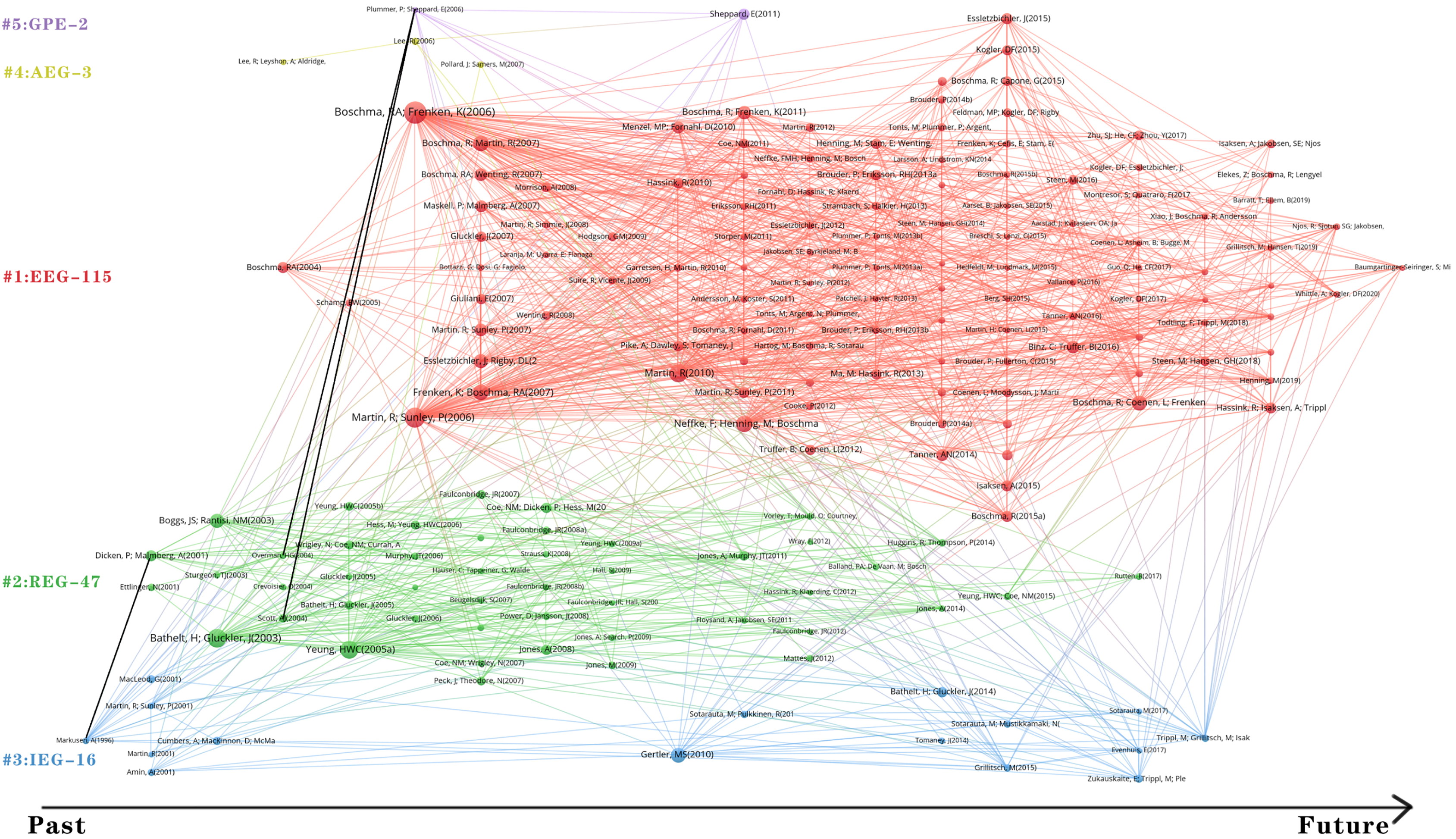
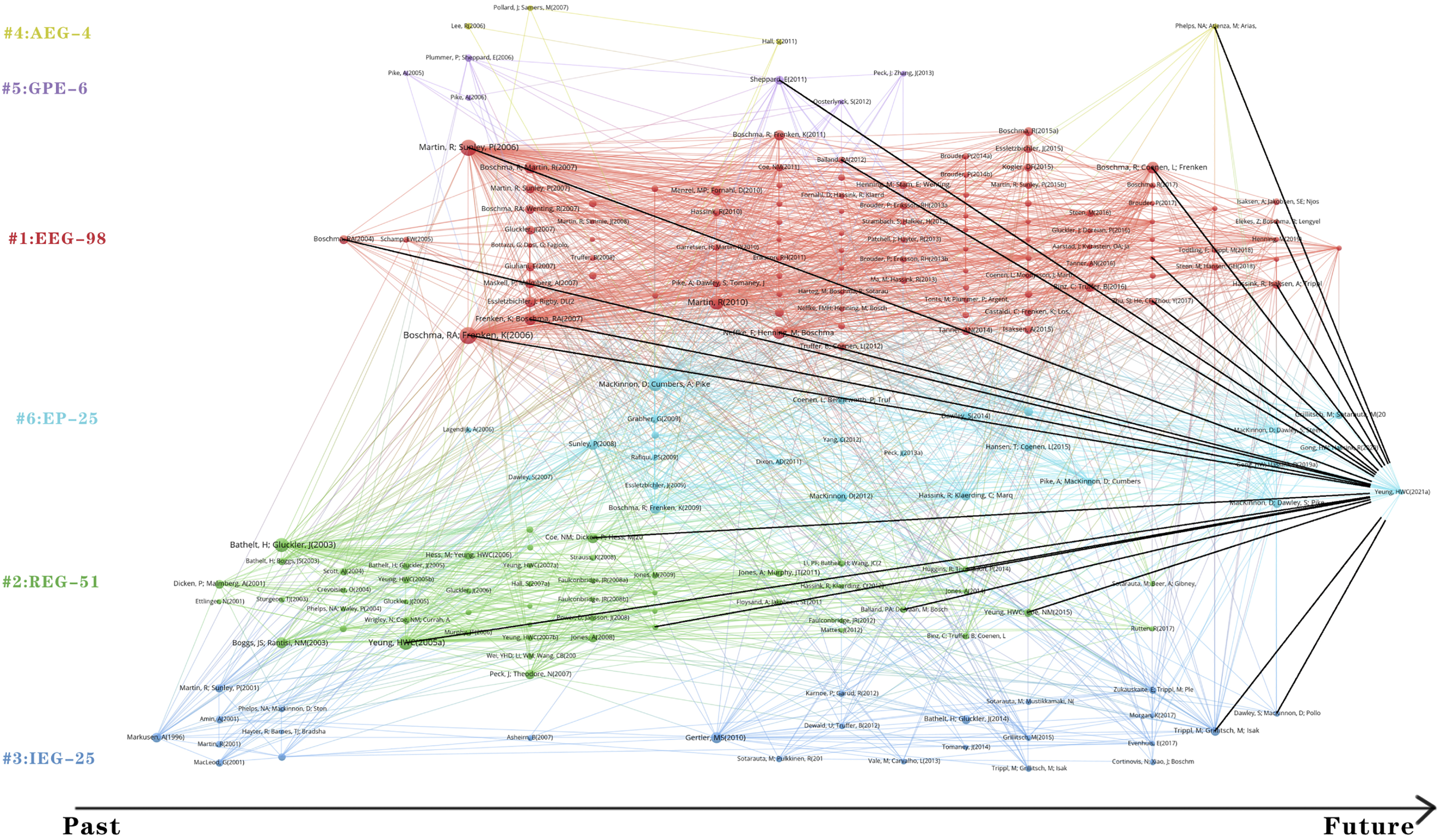
As can be seen in Figure 7, “Engaged Pluralism” has gradually emerged since 2009 and has become more common. More or less after the beginning of the debate on engaged pluralism and fragmented pluralism in the discipline, there has been an increasing number of articles from a multi-paradigm perspective that have reconciled with the limitations implied by using one paradigm in terms of object of study, research topic, explanatory strategies, methods, and tools. It clearly shows the increasing concern in the economic geography community about fragmented pluralism and the embodied practices of engaged pluralism. These studies have sought and considered ways of engaged dialogue, synthesis, or integration with the frameworks of other paradigms, clearly showing that communication is not “closed” towards the other paradigms. Taking the latest EP paper as an example (Yeung, 2021), it not only commonly involves EEG and REG but also includes considerations of IEG, GPE, and AEG.
5 How do the different paradigms bridge to each other?
After cleaning the keywords (in addition to the usual merging of singular and plural and keywords, such as “cluster/clusters,” or “catching-up/catching up”), we merged “policy/policies,” “economy/economics,” and “globalization/globalisation” in the field of economic geography. The keywords of all paradigms and the keywords of each paradigm were counted by year and then we filtered the keywords with frequencies greater than 20 in all paradigms and those with frequencies greater than 10 in a single paradigm. After deleting the retrieval keywords such as “economic geography” and “evolutionary economic geography,” we ended up with 29 important keywords, and the following keyword graph was obtained (Figure 8). Frequency of keywords (node size represents the number of keywords).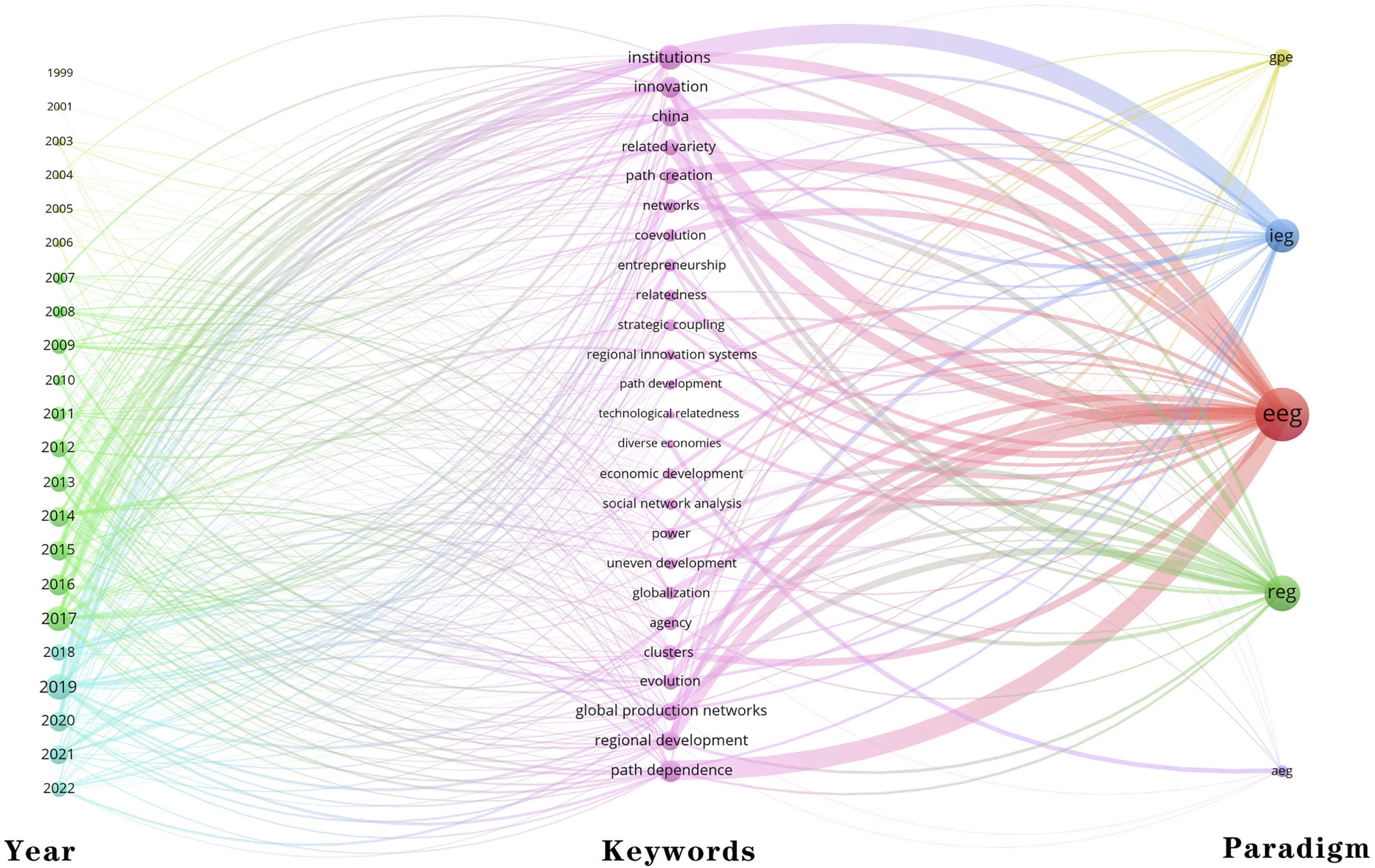
In Figure 8, the year is shown on the left (the three colors from the bottom to the top are the three phases of start-up-rapid growth-fluctuating development), the paradigms on the right, and the 29 important keywords mentioned above in the middle.
First, we can identify some of the most important keywords in the paradigm papers, which are ranked at the top and bottom of the middle column, such as path dependence, regional development, institution, innovation, and cluster.
Secondly, we can obtain information about timing, connection, and thickness. For example, institutions, clusters, path dependence, and evolution are developed in the initial phase, while relatedness, regional innovation system, related variety, agency, path creation, and co-evolution are developed during the rapid growth phase. Some words, such as globalization and networks, have become less popular in recent years. In the same way, we can find important keywords within each paradigm. For example, uneven development is particularly important for GPE, while diverse economy is particularly important for AEG, and technology relatedness is unique to EEG.
Last but not least, this figure allows us to identify some bridging concepts. For example, the cluster concept bridges EEG, REG, and IEG, and especially REG and EEG, institutions bridge EEG, REG, IEG, and GPE, and especially IEG and EEG, and the diverse economy bridges GPE and AEG.
These bridging concepts may have different functions in the paradigms, such as object of study, research topic, explanatory strategy, method, and tool. For example, globalization might be the object of study and social network analysis the method. However, the usefulness of these concepts for bridging paradigms needs to be debated on an individual basis. In our view, they are particularly useful, if they contribute to strengthening the core of economic geography, as a context- and place-sensitive discipline (Gong and Hassink, 2020; Chu and Hassink, 2023).
V Conclusions
Concerns about fragmented pluralism in economic geography, which we share, were the main motivation to write this paper. Like many other economic geographers, we are in favor of engaged pluralism. Moreover, we want to debate the discipline’s identity and core, without having a normative, politically driven agenda. We see the discussion about bridging concepts as an interesting way forward to achieve the aims of engaged pluralism and finding a theoretical core.
Although our bibliometric analysis showed a complex knowledge landscape in economic geography, it did not confirm the worries expressed in the economic geography literature about fragmented pluralism. First, through the BC network, we verified that there is a large amount of common use of prior knowledge between IEG and EEG, IEG and REG, and IEG and GPE. Secondly, we observe considerable direct citing among different paradigms by DC networks, pointing to interaction, intellectual lending, and borrowing among different paradigms. Thirdly, we could also observe an increasing number of papers arguing in favor of engaged pluralism, with concrete suggestions for complementarities between paradigms, particularly between EEG, REG, and IEG. Finally, therefore, although economic geography is pluralistic in terms of paradigms, networks of communication between paradigms point to a conversational community, with engaged dialogues and exchange between paradigms, rather than fragmented pluralism where intellectual monocultures engage only in self-validating research. A closer look at the individual scholars also reveals that not only do some scholars appear in several paradigms, such as Ron Martin, but they also play an active role as intermediaries in the engaged pluralism literature. This observed engaged pluralism is possible because of a high level of commensurability between the paradigms, as they share a critical stance towards positivism (Gong and Hassink, 2020), as some have critical realism as an underlying philosophy of science (Chu and Hassink, 2023) and as most draw on heterodox economics. Moreover, and related to the previous point, it arguably also shows that in fact some of the paradigms are more overlapping than their main protagonists make us believe, because they represent speciation, rather than radical new paradigms, with a high degree of commensurability.
We see the discussion about bridging concepts as an interesting way to further strengthen engaged pluralism and to debate about a theoretical core (Muellerleile et al., 2014), whether it is desirable and whether it should change, and see our first analysis as an invitation to contribute to these debates. In our view, criteria for proposing or selecting bridging concepts between paradigms should be their contribution to understanding and exploring the core questions of economic geography and they should bridge paradigms in such a way that the theoretical core will be strengthened. Such a theoretical core is by no means fixed and once-and-forever, and can change through time, as paradigms and bridging concepts change through time, as well.
However, our observed increasing engaged pluralism and the related debate about bridging concepts are no reasons for economic geographers to sit back and relax because our analysis has also shown a worrisome decreasing overall reference to paradigms in the literature (Figure 1), and there are arguably few alternatives to the currently existing paradigms on the horizon. In our view, existing paradigms need to be more challenged and criticized and potential alternatives, such as recently mentioned by Yeung (2023), need to be discussed. They could consist of environmental economic geography (Braun et al., 2018; He et al., 2022), the geography of sustainability transitions (Hansen and Coenen, 2015), financial geography (Gibadullina, 2021; Wójcik, 2022), global production networks (Coe and Yeung, 2019), and the platform economy (Kenney and Zysman, 2020). However, in our view, these alternatives could be regarded as topic-related “major research foci and communities” (Yeung, 2023: 1), rather than paradigms with theories that are helpful for generally understanding and explaining economic activities in space. Concerning the latter, one might, given the current crisis-ridden times in which nation-states play a key role, expect geographical political economy to become more important in the near future (see also Essletzbichler et al., 2023)
Using a bibliometric method analyzing paradigmatic pluralism, although promising, is not without limitations. First, we took launching papers as a starting point for demarking the paradigms, but maybe some of the influence is more indirectly and implicit without citing the launching literature and this might also differ from paradigm to paradigm. Secondly, we only use English-speaking literature. In some other main language areas, there might be influential paradigms that are slightly different from the internationally discussed ones, such as Raumwirtschaftslehre in Germany (Suwala, 2023), loosely translated with regional science by Bathelt and Glückler (2011: 22). Thirdly, due to the limited information that static pictures can reveal, we cannot distinguish between one-directional and two-directional engagement between paradigms.
However, despite these limitations, we are convinced that our bibliometric analysis provides a solid basis for a much-needed debate in economic geography about pluralism, identity, the theoretical core of the discipline, and about its paradigmatic future.
Supplemental Material
Supplemental Material - Fragmented or engaged pluralism in economic geography?
Supplemental Material for Fragmented or engaged pluralism in economic geography? by Han Chu, Robert Hassink, and Şükrü Yılmaz in Progress in Human Geography.
Footnotes
Acknowledgments
Preliminary versions of this paper have been presented in-person at the 6th Global Conference on Economic Geography, Dublin, in June 2022, at the Mini Conference of the International Geographical Union-Commission on the Dynamics of Economic Spaces, Osnabrück, in October 2022, at the 16th Rauischholzhausener Symposium zur Wirtschaftsgeographie in April 2023, and at a workshop in CURDS, Newcastle, in September 2023. We are grateful to participants of these events for their comments and questions after these presentations. We also thank Alex Hughes, the editor, and two anonymous reviewers for giving very helpful and constructive comments. Finally, we are grateful to Huiwen Gong, who was involved in earlier work that formed the basis of this paper (Hassink and Gong, 2017), provided  and some text, and gave some good comments on a previous version of this paper.
Declaration of conflicting interests
The author(s) declared no potential conflicts of interest with respect to the research, authorship, and/or publication of this article.
Funding
The author(s) disclosed receipt of the following financial support for the research, authorship, and/or publication of this article: This work was supported by the China Scholarship Council (No. 202108080164).
Supplemental Material
Supplemental material for this article is available online.
Notes
Author biographies
References
Supplementary Material
Please find the following supplemental material available below.
For Open Access articles published under a Creative Commons License, all supplemental material carries the same license as the article it is associated with.
For non-Open Access articles published, all supplemental material carries a non-exclusive license, and permission requests for re-use of supplemental material or any part of supplemental material shall be sent directly to the copyright owner as specified in the copyright notice associated with the article.
