




Abstract
Recent years have seen increasing experimentation with drawing as a first-hand method for observation, reflection, and analysis in critical geographical research. Interestingly, much of this work comes from scholars who in various ways are working from the margins, and use drawing in part to interrogate their own positionalities within the research environment. These experiments to date remain somewhat tentative and underdeveloped as methodological propositions. This article therefore reviews recent geographical use of observational drawing by situating it within a broader argument for ‘vulnerable’ methodologies in geographical research, to both amplify current innovative advances and offer direction to their future elaboration.
I Introduction: Drawing as a critical opening of space
This article reviews recent critical-geographical experimentation with observational drawing and proposes an argument for ‘vulnerable’ methodologies in geographical research. Vulnerability commonly holds two meanings; it names both a condition of susceptibility to harm or outside influence, and a quality of openness that facilitates meaningful and transformative encounter. Critical scholarship thus faces the paradox that in order to work against the harms of unevenly distributed vulnerabilities, it is necessary to cultivate forms of vulnerability that engender the possibility of radically transformative ways of knowing.
The practice of drawing manifests a similar paradox. Historically, ethnographic and cartographic drawing were key tools of indigenous dispossession and in many ways epitomise the discipline’s colonial gaze (Pratt, 1992; Schneider, 1995). 1 Drawing has served to incorporate spaces of the colonial ‘periphery’ into orders of knowledge, meaning, and value that were established by and for the colonial ‘centre’ (Bewell, 2004; Mukherjee, 2014; Said, 1978). At the same time, observational drawing has been valued by its practitioners as a means of de-centring the observing subject, of unlearning prior knowledge, and of cultivating an open, vulnerable orientation to encounters in the field (Brice, 2018; Causey, 2017; Clarke and Foster, 2012; Taussig, 2011). Clearly, these sensibilities of drawing as a skilled practice do not automatically safeguard against its deployment in service to colonial violence (see the histories described in Brand (2004) for an illuminating example of this problem). However, I seek here to show that through the deliberate exercise of drawing as a mode of critical and reflective vulnerability, these sensibilities can be conducive to the aims of critical geographical practice, precisely because of the ways that drawing embodies the paradox of vulnerability outlined above.
The work here discussed shows that drawing, far from being merely a technique of visual capture or representation, offers a practice-based approach to rendering political subjectivities fluid and permeable – a challenge that remains central in post-humanist, post- and de-colonial, and non-representational geographies (Anderson, 2019; Betasamosake Simpson, 2011; Braidotti, 2014; Colebrook, 2014; Giffney and Hird, 2008; Glissant, 1997; Saldanha, 2016; Schwanen, 2020; Simpson, 2017; Smith, 2021). For this reason, I argue first that the specific techniques and skilled practices of observational drawing hold pedagogical and methodological promise for geographers today, and second, that observational drawing elicits a set of sensibilities that can be usefully extended to other methods in geographical research. 2 In short, I make the case that geography today (and geographers, individually) would benefit greatly from sustained attention and experimentation with what observational drawing has to offer.
The French philosopher Nancy (2013: 1) highlights what he calls the open-ness of drawing: Drawing is the opening of form. This can be thought in two ways: opening in the sense of a beginning, departure, origin, dispatch, impetus, or sketching out, and opening in the sense of an availability or inherent capacity. According to the first sense, drawing evokes more the gesture of drawing than the traced figure. According to the second, it indicates the figure’s essential incompleteness, a non-closure or non-totalizing of form.
Drawing, here, is understood as process and practice rather than product or technique. This ‘open-ness’ of drawing can also be conceptualised as a form of vulnerability, where ‘vulnerability’ names not only a passive condition of susceptibility but an ontological orientation in research; one which renders vulnerable not only the researcher but the fixity and stability of being and self-identity as foundational concepts.
It is, I suggest, precisely for this strength of drawing – and vulnerability is in this sense a strength – that human geographers have recently turned to drawing to address such foci as the ambivalence of insider-outsider status in ethnographic fieldwork with a precarious workforce (Parikh, 2019), ‘ethico-political’ speculation in urban developmental skylines (Gassner, 2021), and the differential vulnerability of ‘trans’ subjects (in the dual sense of ‘transient’ and ‘gender-divergent’; Arun-Pina, 2021). In these examples, to which I return throughout this article, drawing is taken up by scholars who do not necessarily conform with conventional assumptions about researcher status and identity vis-à-vis ‘the field’ – namely that the researcher occupies a straightforwardly privileged and stable position relative to their research subjects and environs (Faria and Mollett, 2016; Maguire et al., 2019). Perhaps relatedly, these scholars seek not only to produce and record observable data but to interrogate both the nature of observation itself and the stability of subject/object relations, including the relation of the individual researcher to their field of enquiry.
Drawing is most commonly used in human geography today not for first-hand observation but as a creative participatory element designed to enrich or expand more conventional methods such as semi-structured interviews and focus groups. In this format, drawing has been helpful for geographers working with subjects perceived as vulnerable, for example, with children (Beneker et al., 2010; Hague, 2001; Literat, 2013), young people (Swords and Jefferies, 2015), and marginalised communities (Bertoncin et al., 2022; Eggleton et al., 2017; Hussain, 2021). Here drawings, sometimes in the shape of informal maps, form the raw data and/or the vehicle through which researchers and participants come together to explore a particular – often sensitive – theme or topic of interest. 3
In recent years, however, geographers have also begun to experiment with drawing first-hand, to facilitate and elucidate their own encounters with and in the field of research. This work sits on a spectrum from direct observation (Brice, 2018) to modes of introspection and retrospection, such as Cindi Katz’s (2013) comic book field journals, but shares two features. 4 First, the researcher (rather than participants or research ‘subjects’) is doing the drawing. Here I do not want to reinforce a hard distinction between the researcher and the researched – certainly the best of participatory research aspires to undo this binary. Rather, I want to emphasise how first-hand engagement with drawing practice enables the second feature, which is that drawing is used as a practice-based method to integrate observation, reflection, and analysis: three functions which are otherwise often considered distinct phases of research.
In other words, drawing here is an immersive process; a means both of seeing or recording and of critically examining and questioning phenomena encountered in the field. Importantly, I argue that drawing integrates these three functions in such a way as to offer up the process of observation itself to interrogation, so that this process remains vulnerable, contingent, and responsive to emergent relationships with and in the field. This methodological vulnerability foregrounds questions of positionality, relation, and spacing in research encounters. Drawing therefore holds promise both for researchers working with vulnerable sites or subjects, and those wanting to cultivate a more radically vulnerable orientation in and to the field than geography’s colonial and extractive heritage has historically encouraged.
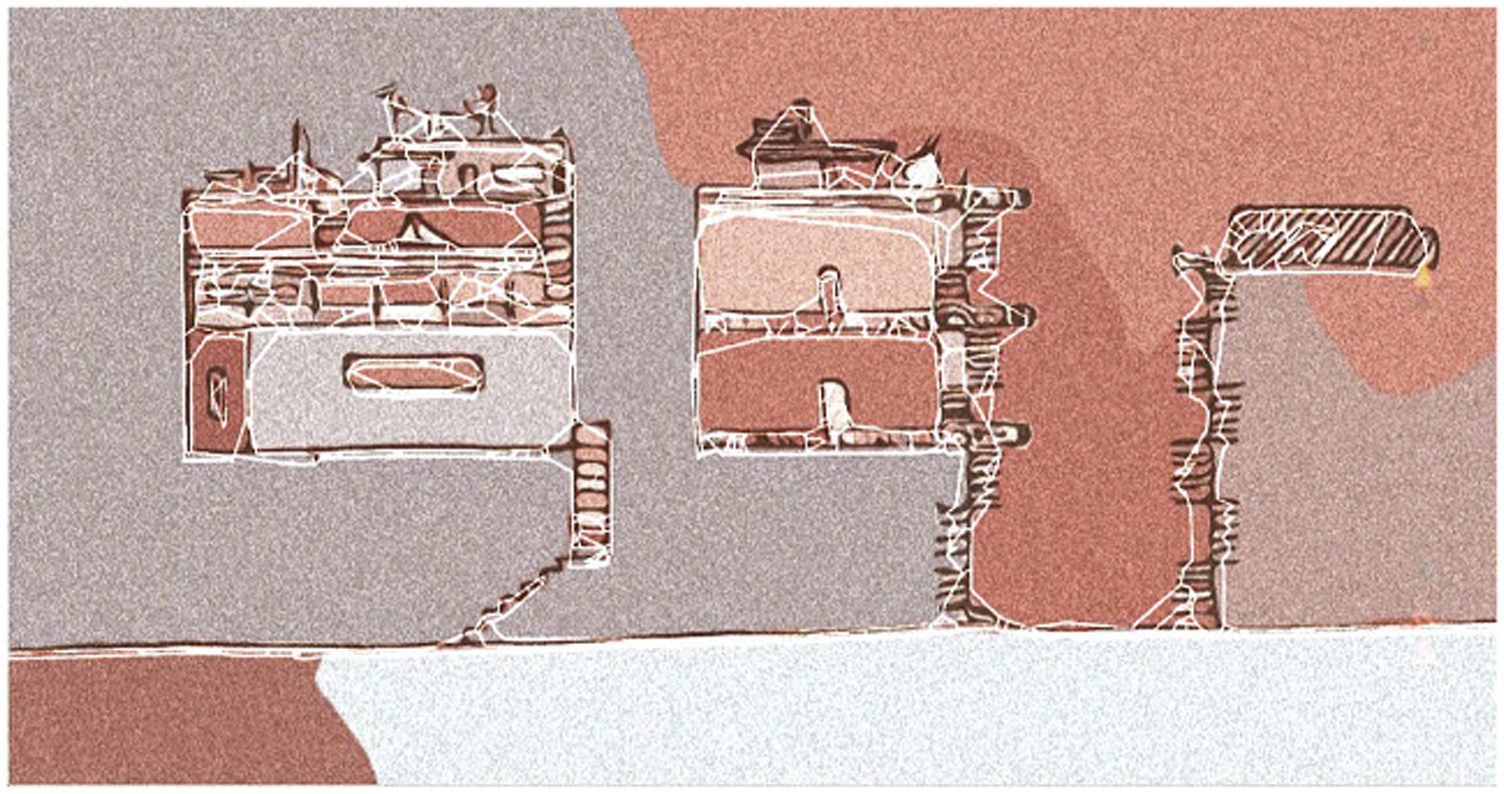
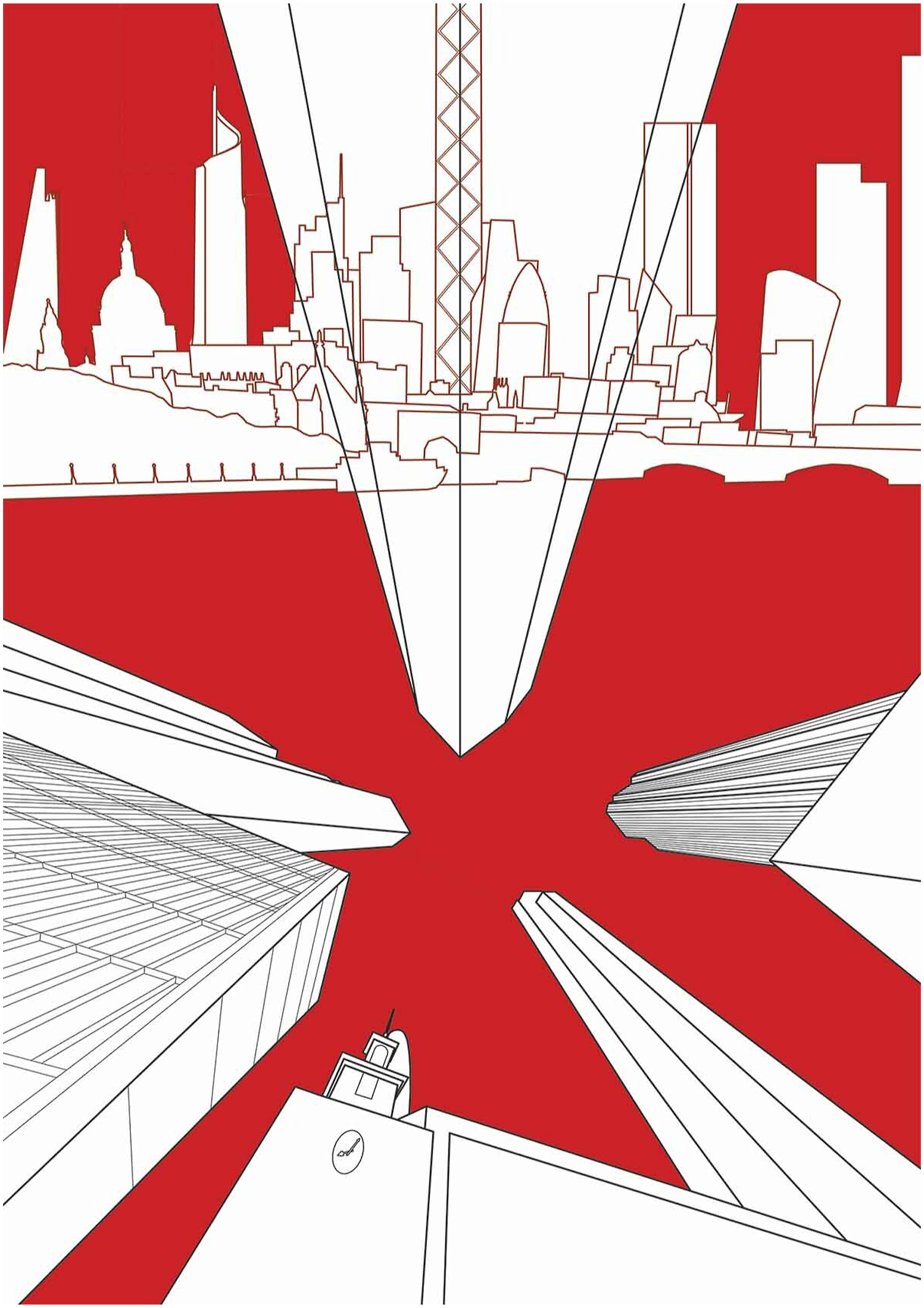
I discuss these ideas in relation to three examples of recent drawn work in geography. What sets these examples apart is that these are instances of geographers directly enlisting the practice of drawing to support an inquisitiveness about the nature of the relationship between subjectivity and representation as they are brought to bear in research. Aparna Parikh (2019) combines drawing with needlework in order to trace her shifting insider-outsider status in fieldwork outside call centres in Mumbai (Figure 1). Here, the stitching of thread, through its ambiguous relationship with the paper surface of the drawing, invokes the ephemerality, disruption, and intimacy that characterised her encounters with women call centre workers with whom she shared only a partial and inconsistent ‘insider’ relation. Chan Arun-Pina (2021) uses drawing to undo the apparent solidity of ‘floating’ homes in Bangalore, drawing on their own experiences of implicit heteronormativity in a precarious housing context to consider the architectural spacing of transient bodies and subjects (Figure 2). Finally, Günter Gassner (2021) develops an experimental drawing method that superimposes planning drawings and field observations, to interrogate the violence and commodification of speculative urban development in London (Figure 3). Here, drawing lines is both a means of identifying political lines that serve as a fascistic mode of capture, accumulation, and/or destruction, and a means of generating new ‘lines of flight’ that escape these micro-fascist tendencies. In all three cases, drawing is used to interrogate the stability of the subject in relation to its social field, rendering ideas of fixity vulnerable. Aparna Parikh, ‘Drawings emphasizing the street and showing the informal economy and transportation networks’ (source: the artist). As a researcher from similar linguistic, ethnic, and class background to her research subjects, but removed by migration, political perspective, and academic training from the world they inhabit, Parikh experiences an ambiguous relation with the field. The intermittent stitches used to mark out her location at research sites echo the language of graphic diagrams wherein a dashed line indicates that which is invisible, provisional, or a moveable part. At the same time, the thread both literally pierces the paper and exists outside of it in a third dimension. The stitched line thus invokes both the intimacy and the insurmountable distance of Parikh’s ambivalent insider-outsider status. See Parikh (2019) for additional images and discussion. Chan Arun-Pina ‘Floating homes - the suspended typology of urban rental housing in Bangalore, India’ (source: the artist). Arun-Pina’s work here adopts the language of architectural plans and sections, but imbues these with an ephemeral, floating quality that evokes the lived experiences and spatial precarity of trans and transient populations. This is achieved not only through the spidery, tentative qualities of the lines themselves which overlay movement and structure, but through literally omitting spaces of exclusion from their drawings, so that the marginal upper-story apartments appear to float above a void, only tenuously tethered by their narrow staircases to the solid ground below. See Arun-Pina (2021) for additional images and discussion. Günter Gassner ‘Drawing as Ethico-Political practice’ (source: the artist). Gassner’s drawing experiments by juxtaposing perspectives from different viewing points in the city of London, exploring the ways that planning and design direct lines of sight within urban space. They also combine observational drawing with the traced and sometimes doctored contours of planning illustrations, purposely colliding the detached viewpoint of the designer from the situated viewpoint of the observer in the field. See Gassner (2021) for additional images and discussion.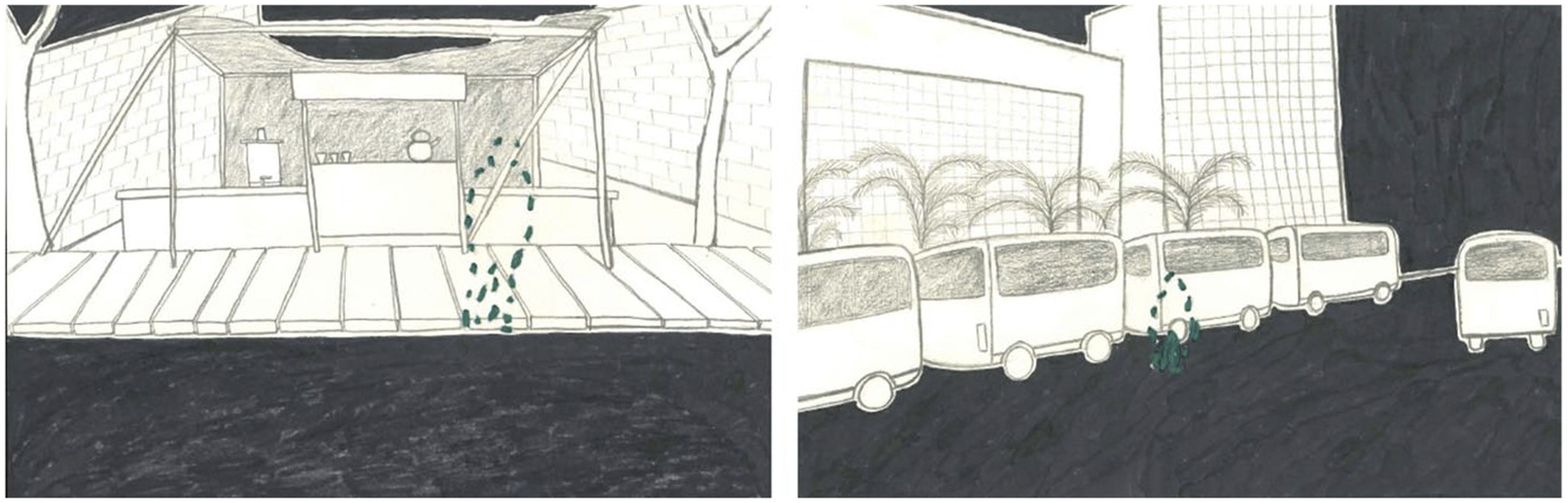
II Why vulnerability?
A reading of vulnerability as generative goes ‘against the grain’ (Oswin, 2020) of conventional usage in geography, which tends to cast vulnerability as a passive condition of susceptibility to harm or change by external causes – a framework principally utilised in geographies of hazard and risk (see e.g., Henricks and Van Zandt, 2021; Wang and Sebastian, 2021). Similarly, the phrase ‘methodological vulnerability’ is more commonly used in the negative to refer to problems of research design which might hamper the drawing of robust conclusions from particular data sets. This article directs attention instead to the methodological possibilities of vulnerability; that is, the ways in which practicing vulnerability in qualitative research may sometimes lead to higher quality, more meaningful research outcomes.
I aim to contribute thereby to a current geographical interest in vulnerability with wide-ranging implications: disciplinary, epistemological, and ontological. At the level of the discipline, a number of recent commentaries on the state of geography have called, with some urgency, for a stronger commitment to exercising kindness (Dorling, 2019), humility (Saldana, 2018; Saville, 2021), and solidarity (Oswin, 2020) in its practice. While varying in their particular focus, what these disciplinary interventions hold in common is that they identify a relationship between (1) the ways in which geographical researchers, researched communities, and systems of knowledge production can be rendered vulnerable to one another and (2) the quality of the research outputs (and the research cultures) that arise from our various and collective handling of these vulnerabilities. The gist of these calls is not that vulnerability is to be avoided, per se, but rather that vulnerabilities could be more evenly distributed across the discipline; kindness, humility, and solidarity not only help to render many of us less vulnerable (to exploitation, abuse, neglect, or fatigue, e.g.), but their exercise also requires the capacity to embrace a degree of vulnerability, especially from those among us in positions of (always-) relative power and stability. Importantly, these interventions suggest also that a deliberate exercise of vulnerability can be a good thing, where it enables geographers to work against the grain of colonialist, sexist, militaristic, and classist legacies (to name but a few) that still cast shadows over the discipline. 5
For similar reasons, recent years have seen some epistemological interest in the development of ‘vulnerable’ methods and methodologies that consciously address the ethical, political, and personal implications of researcher vulnerability when producing knowledge around violence, loss, and grief (Brice, 2021; Gillespie and Lopez, 2019; Heynen, 2018; Nagar, 2014; Page, 2017; Sherry, 2013). This work acknowledges the risks of harm to researchers and their subjects that can arise from engaging with sensitive topics, while also drawing attention to the ways in which vulnerability can be a necessary condition of responsible practice when researching violence experienced by others. Thus Page (2017) elucidates the importance of foregoing epistemological certitude when engaging with loss and alterity, while Gillespie and Lopez (2019) invokes the necessity of grieving and the politically transformative power of emotional enmeshment in the research process.
If these researchers emphasise epistemological vulnerability as an orientation which incorporates into processes of knowledge production a radical uncertainty and an openness to being affected, others have examined the ontological implications of vulnerability as a constitutive principle or condition. Harrison (2008, 2015) and Joronen and Rose (2020) have sought to foreground ‘an account of corporeal life as inherently susceptible, receptive, exposed, as inherently open beyond its capacities’ (Harrison, 2008; 423); a state of vulnerability that is unwilled, inescapable, and precedes concepts of power and identity. For Harrison, this is a necessary correction to recent geographical preoccupations with affirmation and ‘life’ (see also Dekeyser and Jellis, 2021). For Joronen and Rose, an important distinction between vulnerability as a structural effect of power and vulnerability as an existential condition yields a more precise politics, one in which power is in fact understood as a response to vulnerability and not the reverse. 6 In light of Harrison’s contention that ‘vulnerability cannot be willed, chosen, cultivated, or honed’, it might seem odd to advocate for a ‘vulnerable method’ and yet – if geographers are to avoid the sublimation or disavowal of existential vulnerability we can only do so by cultivating an orientation that foregrounds such vulnerability as a condition of possibility for doing research.
I therefore suggest we might argue (with Lorde, 1984: 42) that ‘that visibility which makes us most vulnerable is that which also is the source of our greatest strength’; our mutual susceptibility and interdependence makes us what we are. In this sense, vulnerability is not only constitutive but generative, not because vulnerability must be recast in the affirmative, but because vulnerability upsets any passive/active binary of negation and affirmation, thereby re-situating agency precisely within the space of relation. Bodies and ideas do not act upon but with one another, and it is that vulnerable action which is generative of political possibility. Lorde here names both an existential condition and the specific structural predicament facing black lesbian women poets; the one has no meaning without the other.
III Drawing as a vulnerable method
Practising vulnerability through drawing can be a powerful extension to post-humanist and non-representational experimental research methods that seek to decentre the rational human subject as the principle locus of thought and action (Bastian et al., 2016; Dewsbury, 2009; Vannini, 2015; Williams et al., 2019). Methodologically, drawing supports this project both because of the particular kinds of encounter it generates, and because it enables research to engage simultaneously with the discursive, performative, material, and affective dimensions of perceptual processes (Keating, 2019), without privileging one mode of sense-making or knowledge-production over others. In refusing the segregation and stratification of these registers, drawing opens a space of vulnerability across established orders of knowledge organised along lines of fixity and self-identity. Central to this proposition is the understanding that drawing is not only a means of representation but a mode of thought and of critical enquiry (De Brabandere, 2016; McCormack, 2004).
Drawing operates as a mode of thought in at least two ways. The first is that the practice of drawing entails a thinking engagement (Hawkins, 2015). The process through which visual information is transferred to the page or drawing surface directly involves the body-mind of the observer in its execution. This process is neither automatic nor purely cerebral, but implicates the observer in a process of embodied cognition that is both complex and iterative. For this reason, drawing has had a long history as a primary mode of enquiry in scholarly research (Hesse-Honegger, 2001). Thus Parikh, in her embroidery drawings (Figure 1), uses the process of stitching not only to communicate a sense of her ambiguous insider-outsider status but to think through that status in an embodied fashion.
The second, and related, sense in which drawing can be considered a mode of thought builds on a well-established distinction between thought and representation in current geographical theory, in which thought is understood as a generative process that is productive of worlds rather than descriptive of them. This distinction can be traced back to Gilles Deleuze (1995: 139, original emphasis) and the contestation that: “Something in the world forces us to think. This something is an object not of recognition but of a fundamental encounter.”
Drawing is thought because what the drawer comes away with is not merely a reproduction of something observed (a representation), but a deepened insight into and an intensified relationship with that something beyond themselves (Berger, 1988). Indeed, this is a mutually constitutive process; what Deleuze (above) calls an ‘encounter’.
To draw is to engage in a practice of ‘thinking-with’ in which the materials, techniques, and gestures of the drawing process, the space of the encounter, and the objects of observation are all implicated (McFadyen, 2011). In this sense, drawing is not simply a mode of thought but a mode of enquiry, in that through drawing the observer enters into an inquisitive and critical relationship with the observed. To put this in other words, drawing is used not merely to describe what is observed but to ask questions of it; to interrogate it. As I have noted above, however, this encounter operates in such a way as to open up the process of observation itself to interrogation, so that it remains vulnerable, contingent, and responsive. In doing so, drawing unsettles simple distinctions between researcher, researched, and the field of observation.
Archaeologist and curator Helen Wickstead (2008), following Badiou (2006), suggests that because drawing emerges in ‘inbetween’ spaces, it ‘offers a model for an alternative form of political subjectivity, one based on reciprocity and interdependency’. Drawing has therefore been celebrated by researchers in a diverse range of disciplines, not as a means of ‘representing’ or ‘documenting’ research subjects, nor even simply as a mode of critical analysis in its own right, but as a way of opening up a different set of relations within research encounters (Anderson, 2017; Causey, 2017; Ingold, 2007, 2011; McFadyen, 2011; Nancy, 2013; Taussig, 2011; Wickstead, 2008).
Attending to the process of drawing, rather than its product, foregrounds drawing’s operation as a generative mode of encounter, and of thinking, creative engagement with and in distributed ecologies of knowledge production. In their book Drawing Difference, Meskimmon and Sawdon (2016: 98) contend that drawing involves the artist directly in a co-constitutive process; a process whereby the individual entity and its environment or milieu emerge always in relation: Drawing remains an opening in the simultaneity of gesture and object and in the mutual emergence of mark/figure and ground; the opening of drawing materialises the pure potential, boundlessness and becoming of difference.
In a fieldwork setting, drawing thus supports an approach in which the researcher and the field are understood as co-constitutive rather than independent variables.
The open, playful, inquisitive, and speculative qualities of drawing as a mode of fieldwork are evidenced in the innovative collaborative work of Foster and Lorimer (2007), who set out to follow and map the bio-geographies of the elusive ‘Scottish’ crossbill. In their book Cross-Bills (Lorimer and Foster, 2005: 3), they note that ‘to do fieldwork is to accept a certain version of defeat’. Drawing acts here as a form of vulnerability, a capacity to be both impressed and frustrated in the pursuit of ‘identities’ which, they conclude, ‘are not designated, but emergent, always in flux’ (2005: 16). The spirit of this experimental art-geographical work prefigures that of the recent examples I discuss in this article, which use drawing to ask far-reaching questions about the nature of subjectivity and the spacing of subjects.
IV What is observational drawing?
A number of systems exist for categorising types of drawing process (Lyon, 2020). In this article, I distinguish between drawing that is investigative or speculative, and drawing that is intended principally to communicate, express, or convey already-formed ideas. It is the former category with which I am here concerned, and which I will refer to broadly as ‘observational’ drawing because it is concerned with gaining understanding by observing something more closely. I use this word cautiously, not least because of its potential association colonial or fascistic practices of surveillance and capture. Observation is also, however, the visual counterpart of listening; a practice of active attention that requires a degree of vulnerability on the part of the observer. The geographical examples examined in this article do not practice observation in the sense of a detached gaze but as a mode of vulnerable encounter that unsettles the line between interior and external contemplation. Though diverse in method and application, all employ drawing as a means of observation in this sense.
It is useful here to mark out a subtle and sometimes overlooked distinction in drawing terminology between observation, figuration, and representation.
Thus, in writing of observation, I do not wish to reinforce a representationalist assumption that observation is necessarily concerned with verisimilitude: the act of creating a semblance of something presumed to already objectively exist ‘out there’ in a given form. Rather, in stressing that drawing is observational I want to emphasise that drawing is usually, if not always, a process of directing concerted attention beyond the confines of the observing entity – that is, of entering into relational encounter (H Wilson, 2017).
I say a process rather than an act of drawing because ‘act’ implies something altogether too distinct and final. Indeed historically, the product of drawing has been understood as secondary to its function as a mode of research or inquiry. The words ‘sketch’ and ‘study’, used to denote drawing’s final product, imply a provisionality and inquisitiveness; an orientation towards ongoing or future projects, rather than closure or conclusion (Lyon, 2020). They double as both noun and verb. Admittedly, drawings are increasingly appreciated as artistic outputs in their own right rather than mere byproducts of a technical procedure. However, the ultimate aim of observational drawing as a practice is not to produce an image but to develop deeper insight, understanding, and familiarity of and with a particular phenomenon or problem, through a process of sustained investigation (Anderson, 2017). Indeed, the ‘subject’ of the drawing may itself be as much a product of the encounter as is the image.
‘Observation’ in the sense that I am using it here therefore need not entail a triangular geometry between the observer, the field of observation, and the drawing surface. Instead, it denotes a close attention, facilitated by a process of visual transcription, wherein the ‘object’ of observation might equally be an elusive power dynamic, a field of architectural possibility, or a pattern of distribution of bodies in space.
In the examples I discuss here, Arun-Pina’s work (Figure 2) is a clear example of this. Arun-Pina uses ‘autoethnographic re-drawing’ as a way of mapping what goes unobserved – the heteronormative spacing of trans subjects in the ‘floating homes’ of mobile populations in Bangalore.
Gassner’s work, while utilising both traditional observational drawing in situ and a practice of tracing or sketching from existing design documents, places its emphasis on speculation and the juxtaposition of ‘lines of sight’ with ‘lines of flight’. As noted above, Parikh combines line drawing with needlework as a means of reflecting on the fragile indeterminacy of her status within the social worlds of call-centre workers in Mumbai. In all three cases, drawing is used as a way of spending time exploring and interrogating a set of relationships, rather than simply as a means of illustration intended to communicate an a priori conclusion. As Gassner (2021: 6) points out, ‘a line draws distinctions and can draw connections’. Similarly, Arun-Pina (2021: 4) makes clear that they understand ‘sketching/drawing as both the product as well as the process of research analysis’. These researchers’ work thus uses drawing not only as a means of ‘representing’ spatial dynamics in fieldwork encounters but as a means to analyse (and even actively negotiate) social relations and researcher positionality.
V Drawing in practice
The revival of drawing in geography can be understood as one aspect of a much wider turn to performative and artistic methods in the social sciences, driven by calls within post-humanist and process-oriented research for methods that are both more inclusive (Hawkins, 2011) and generative rather than descriptive (Williams, 2016) in orientation. For these reasons, drawing has also enjoyed a revival in adjacent fields, including most notably in anthropology, where it is taken up for a range of purposes including participant observation and ethnographic fieldwork (Causey, 2017; Hussain, 2021; Ingold, 2011; Katz, 2013; Kuschnir, 2016; Taussig, 2011). Here anthropologists and artist-academics have tended to adopt a broadly phenomenological approach, understanding drawing as a mode of perception and embodied practice – the emphasis being on processes of dwelling and attunement (Ingold, 2011), or ‘teaching yourself to see’ (Causey, 2017: 16). While this framework might seem to reinforce the idea of a pre-given knowing subject, the critical insights formulated in this work regarding the function and operations of drawing as a skilled practice in fact foreground the contingency, relationality, and vulnerability of the drawing process. In doing so, they highlight three aspects of drawing practice which may not be self-evident to readers untrained in the art of observational drawing, and which I elaborate briefly here.
1 Spatiality and duration
Despite outward appearances to the contrary, observational drawing does not take place in two dimensions. While it is easy to think of drawing as an event unfolding on the flat surface of the page, this image omits important spatial, temporal, and corporeal dimensions of observational drawing practice, which necessarily confront the observer with the immediate and tangible ‘situatedness’ of the research encounter (Rose, 1997). Engaging in the skilled practices involved draws attention to commonly overlooked dimensions of the drawing process, including its spatiality, duration, materiality, performativity, and embodiedness (Patchett and Mann, 2018). Close attention to process thus makes apparent that drawing operates both as a mode of thought and as a space of encounter before it operates as a technique of representation.
At the most mechanical level, the spacing of observing and observed bodies becomes an evidently reciprocal relation through the process of drawing. The geometrical relations between these bodies and the lines of sight which inform the drawing process are highly contingent. Even a slight movement of these bodies can be sufficient to significantly reconfigure that relationship, immediately disrupting the apparent order and sense of marks placed on the page. Gassner (Figure 3) explores this quality of the drawing process, deliberately experimenting with the physical re-positioning of his standpoint in order to generate and juxtapose conflicting possible perspectives on the development of London’s cityscapes.
Drawing, in this process, graphically elucidates the difference that a change of standpoint makes. The sense of precarity which this brings to drawing makes matters of positionality immediately present and tangible as an integral part of the research process. Thus, while drawing does not enable the researcher to escape the constraints of positionality, it makes present to the observer the understanding that ‘all our visual behaviour is engaged, situated, context-bound, and interpreted, whether we are consciously aware of it or not’ (Causey, 2017: 27).
While I have focussed here on spatiality over duration, drawing even in its most rapid formats entails a slowing-down when compared to photography and other means of documentation (Brice, 2018; Causey, 2017; Kuschnir, 2016; Clarke and Foster, 2012; Taussig, 2011). As John Berger (1988: 43-4) observes, a drawing of a tree shows not the tree but ‘a tree-being-looked-at’. Drawing thus immediately confronts the observer with considerations of change and duration, as well as the necessity of compromise and ultimately failure attendant upon any attempt at visual capture of the object of observation.
These moments of incongruity and failure are precisely the moments through which drawing alerts the researcher to the space between states of fixity; that generative space which Bergson (1911; see also Williams, 2016) calls the interval. The technical inadequacies of drawing are therefore themselves important – it is in the struggle of trying to make drawing happen that a more nuanced understanding of observed bodies and relations is reached (Marr et al., 2022). Contour drawing, for example, immediately confronts the observer with the impossibility of any clean distinction between an entity and its constitutive milieu: ‘the edges of things seem to be certain, but as soon as we start to try drawing them, we realise that we make tremendous assumptions about where one thing starts and the other thing ends’ (Causey, 2017: 23; see also Brice, 2021). Drawing thus underscores the spatio-temporal contingency of material relations.
2 Materiality and performativity
Like the situated process of observation in the field, the process of making marks on the drawing surface is also a material, spatial, and durational process. This involves engaging with specific material media, and the particular kinds of marks and movements which these materials enable or preclude. Drawing media can drag or glide, can run and bleed or become fixed, can gather or disperse. Field conditions such as weather become incorporated into this process, and chance interruptions affect what takes place on the page. The material qualities of specific media also inflect the attention of the observer, drawing out those qualities of the encounter (movement, structure, texture, atmosphere) which they are most suited to express. By all these means, the materiality of the drawing process speaks back to the process of observation and orientates the researcher towards specific dimensions of the field observed.
In his book Six Drawing Lessons, artist William Kentridge relates the materiality of the drawing process directly to the problems of power, representation, and knowledge production implicit in any practice of image-creation. For Kentridge (2014: 106–7), one possible approach to these problems lies in developing and following through a method which allows the material to speak back to the process of making work: This giving over to the medium is crucial. Allowing a space for the medium to lead, giving yourself over to the play itself. Playing not in the sense of following rules known in advance, as in sport; but play in the sense of the play of light on water. Not a random activity, but giving yourself over to what the activity provokes, and then following these possibilities assiduously, as you would follow the irrational rules of any game.
Observational drawing entails a practice of putting aside existing systems of knowledge about what is being observed, becoming attentive instead to what is emergent in a singular spatial encounter (Berger, 1988; Edwards, 2001; Nicolaïdes, 1969). The play of material relations becomes a method for decentring human agency in the generation of knowledge-claims, or rather, of activating the continuity of human and nonhuman modes of thought by disrupting the body/mind dualism (Massumi, 2014). The ‘corporeal’ and ‘kinaesthetic’ qualities (Taussig, 2011: 23) of drawing practice aid in the displacement of rational and analytical tendencies that privilege cerebral thought, to enable a more vulnerable and open mode of engagement. Thus for Parikh (2019: 446), the process of stitching herself into the fabric of her drawings evokes the ephemerality of her positioning in the field; what she calls a ‘disruptive form of embeddedness’ in which her insider-outsider status both facilitates and obstructs meaningful interaction with the call-centre workers.
3 Embodied thought: Disrupting the mind/body dualism
That drawing offers a way of thinking that is not centred in either mind or body, but in fact disrupts any such binary distinction, is important because the dissolution of this binary is critical to unsettling the figure of the self-identical, unitary subject as the locus of thought. Meskimmon and Sawdon take up Grosz’s analogy of the Möbius strip to describe this process, arguing that drawing supports feminist concerns with the mutual constitution of bodies and ideas. As Grosz (1994: xii) writes: The Möbius strip has the advantage of showing the inflection of mind into body and body into mind, the ways in which, through a kind of twisting or inversion, one side becomes another. This model also provides a way of problematizing and rethinking the relations between the inside and the outside of the subject, its psychical interior and its corporeal exterior, by showing not their fundamental identity or reducibility but the torsion of the one into the other, the passage, vector, or uncontrollable drift of the inside into the outside and the outside into the inside.
Expressing thought as a material process, drawing unravels the binary logics of both mind/body and interior/exterior dualities, turning ideas of the (artist-)self inside-out. In place of identities expressed through traditional grammars of noun, verb, and object, drawing for Meskimmon and Sawdon enacts difference as a volatile process of becoming. In short, drawing operates as a mode of transformative encounter rather than simply a technique for the illustration of pre-formulated concepts. In order to draw, the researcher must not only attend to the object or field of observation but become involved in processing those observations using a range of sensory, cognitive, kinaesthetic, and affective faculties, and – perhaps most importantly – must commit themselves to composing and decomposing prior conceptions in the rigour of seeing that process through. To commit to drawing is to commit to a practice of vulnerability.
VI Drawing as individuation
From reflexivity through to speculation, drawing offers these researchers a set of capabilities for interrogating and destabilising spaces of subject-formation. This is what I mean by drawing as a method for practising vulnerability. Drawing can be used to attend expressly to questions of vulnerability to discrimination and harm, as in the work of Arun-Pina (2021: 2) whose research explores the ways in which precarious housing ‘compounds the vulnerability of [Bangalore’s] floating populations such as migrant students and workers, single working women, and [young adults of] non-normative genders and sexualities’. Crucially, however, drawing also renders vulnerable societal ideas of fixity and order. For Arun-Pina (2021: 5), ‘in reflecting various liminal/transient bodies and rental homes as trans subjects’, drawing ‘crucially complicates the cis/trans as well as the body/space divide’. Parikh, too, uses drawing to call into question the notion of a fixed and knowable relationship between ‘researcher’ and ‘subject’, and to explore the vulnerability and power of her own changing insider-outsider status in fieldwork. Gassner (2021: 9) finds in drawing a means of ‘destroying pre-defined standards and norms of knowing the city’. In all three cases, the vulnerability of drawing as a method becomes also a method for rendering fixity of identity ontologically vulnerable.
This practice of vulnerability thus has ontological implications, which can be elucidated as a problem of individuation; that is, of the differentiation of a subject from its field.
7
Drawing goes to the heart of this problem. According to Meskimmon and Sawdon (2016: 97–8), ‘the spatial logic of drawing as an opening of form, as a mode of becoming, manifests materially in the activation of the “white page” or “background” as an open surface, identity, or interminable potentiality’. The white page (which might equally be a canvas, tablet, or computer screen) is not seen as a pre-given reality distinct from the drawn subject, but as a space of potentiality constituted in the process of mark-making: Within the theoretical literature on drawing, the white page is understood, itself, to emerge from within the both/and of drawing as act or traced figure, rather than as a precursor or foundation/origin point before or outside drawing. In drawing, the mark and the ground are simultaneous, their emergence is mutual in spatial and temporal terms.
(Meskimmon and Sawdon, 2016: 98)
The co-constitution of the drawn figure or mark and its surroundings finds an analogy in Simondon’s theory of transindividuation, in which the subject emerges in the space of mutually transformative encounter between an individual and its attendant milieu (Brice, 2020; Combes, 2012; Sauvagnargues, 2012). What is at stake in the drawing is not just an act of representation, but of subject-formation as a provisional and relational individuating process.
The space of charged potentiality that is the unmarked page is expressable only through the process of drawing. Indeed, there is, for the artist/researcher, often something ‘frightening’ about that space of unindividuated possibility. To commit to making a mark on the page is to become implicated in a process of individuation, which is to say, in a process of knowledge-production (Clarke and Foster, 2012). Observation is, of course, never a ‘neutral’ or ‘objective’ process; drawing necessarily involves some form of abstraction, simplification, emphasis, and selection at every stage of the process. What is included or excluded, how it is arranged and composed, with what affective qualities it is conveyed, and even in what manner a drawing is reproduced or circulated, all inflect the participation, or intervention, of the drawing in the wider ecology of images, of bodies and ideas.
De la Bellacasa (2012: 93) suggests that ‘the attention required to keep knowledge aware of its connectedness and consequences inevitably lead[s] to anxiety’. Following this observation, I argue that the anxiety of this intervention hinges on the self-recognition of the individual subject, and on the individual’s turning-inward of a problem of collective existence upon itself (Krtolica, 2012). Drawing is only activated within this space of anxiety, and yet is also possible only through a process of expressly relinquishing attachments to self-identity, often framed in drawing pedagogy as an imperative to ‘lose your ego’ (Causey, 2017: 21). Too strong an attachment to the idea of the self as the observer forces the world into a perspective convergent upon the researcher’s own projected horizons; the researcher will simply (re)make the world in their own image. Drawing requires letting go of this attachment. That process involves a suspension of judgement, an opening up to ‘becoming-with’ what is beyond the contours of the perceived coherence of the self (Haraway, 2010: 53; De la Bellacasa, 2012).
Even as observational drawing directly involves the individual practitioner in its processes, it therefore demands a dissolution of the individual ‘self’ in order to open into relation: In the idea of drawing, there is the singularity of the opening—the formation, impetus, or gesture—of form, which is to say, exactly what must not have already been given in a form in order to form itself. Drawing is not a given, available, formed form.
(Nancy, 2013: 3)
The anxiety of the blank page thus simultaneously marks the space of possibility for practising vulnerability, and its space of foreclosure. The anxiety of drawing echoes the anxiety of subjectification in the field (Arun-Pina, 2021; Parikh, 2019), and becomes a practical guide to this process. Where observational drawing requires ‘staying with the trouble’ of anxiety (Haraway, 2010: 55), it thereby facilitates a practice of staying close to the problems of individuation and representation, and to their methodological implications.
‘Staying close’ in this way can be quite literal, as, for example, when Gassner (2021: 10) uses the tracing of existing design documents as a way of rethinking and reworking possible orders of spatial organisation in the city: I stay purposefully close to the visual practice of design-related professionals because I am particularly interested in the moment in which a line that draws commodifying categories can be deviated into a line that intervenes politically in a disruptive way; or the moment in which a line of creative productivity is in danger of becoming one of violence.
Significantly, Gassner (2021: 3) notes that drawing ‘draws attention’ to the fact that ‘different lines can be drawn’. That is, it highlights the fragility and contingency of positionality and perspective, but also the speculative quality of drawing as a practice: ‘lines can be drawn that open up the commodified cityscape to radical and imaginative critique’. Gassner asks explicitly what worlds drawing is implicated in creating.
VII Conclusion
This article was written in order to recognise and elucidate drawing’s considerable potential as a method in geographical research. Rather than seek to identify or demonstrate a gap in the literature, my aim here is to amplify something which I understand to be already tentatively present, and which deserves clear and emphatic articulation precisely in order to enable a proliferation of new and confident experimentation along (and beyond) existing lines. The precise nature of drawing practise is notoriously difficult to get down on paper. Thus, and in keeping with the ethos of practising vulnerability, I do not attempt to devise a ‘strong’ theory about drawing (Sedgwick, 2003), but to gesture towards the sensibilities which drawing can help to cultivate, and which I argue make a valuable contribution to what might, at a stretch, be termed geography’s ‘vulnerable turn’.
Despite its long history as an observational method in the social, natural, and physical sciences, drawing in the last century or so has been under-utilised in social research (Causey, 2017; Ingold, 2011; Kuschnir, 2016). More recently, however, there has been a renewed interest in the particular qualities of drawing to support a range of geographical research objectives including enhanced observation, critical reflection, cartographic experimentation, and participation (Foster and Lorimer, 2007; Wylie and Webster, 2018; on painting, see also Vickery, 2015). Some disciplines (archaeology and ornithology being two disparate examples) had continued to value drawing alongside photography for its precision and clarity of description, but what drawing further offers the researcher is a particular set of open, inquisitive, and even speculative qualities which make it useful as a mode of investigation, encounter, and critical reflection.
Drawing as a fieldwork methodology, then, operates here as something other than a technique of representation. This is already evident to some extent in Parikh’s work, which is described using the conventional language of ‘documenting’ and ‘representing’ but also proposes drawing as a method for feminist reflection and analysis. Gassner (2021: 1; 4), taking this point further, explicitly describes his method as ‘a nonrepresentational drawing approach’, by which he means that its logics are speculative, generative, and unsettling and do not presume the givenness of an observable subject. 8 Similarly, Arun-Pina (2021: 4) develops their method ‘…as an ongoing disruption to structures of permanence and stability [that] may crucially reveal compound spatial manifestations of heteronormativity and cisnormativity’. Both scholars locate in drawing a capacity to radically destabilise and transform orders of social value and identity.
The word ‘drawing’ thus gathers together a number of techniques and practices that combine observation with graphic expression. The techniques and the sensibilities of drawing can be distinct from one another, though they are also in many ways mutually contingent and mutually reinforcing. As just one example, the technique of positioning the body in such a way as to afford a clear view and a suitable composition alerts the observer to the contingence of lines of sight and relative position in space, and in the process encourages a very material sensitivity to the importance of positionality. At the same time, a sensibility to composition directs the technical process of positioning the observer’s body in space. In more general terms, many of drawing’s techniques are designed to elicit in the observer a set of open, inquisitive, and relational sensibilities; sensibilities which, in turn, are also requisite for good drawing technique. These mutually reinforcing techniques and sensibilities together form part of a practice that is developed and cultivated over time, a practice consonant with my call for a vulnerable methodology.
This does not mean that drawing always or necessarily engenders the kind of vulnerable orientation which I have outlined above; as noted, the art of observing and recording through drawing has historically served also as a means of capture, surveillance, and categorisation. Nor does it imply that such sensibilities are in some way unique or exclusive to drawing; I argue that a vulnerable orientation can equally be carried over to other methods and disciplines. What it does mean is that drawing provides conducive conditions for the development and cultivation of a practice of vulnerability – a practice which I consider characteristic of observational drawing ‘done well’.
Drawing is therefore both a method and something more than a method. If we consider the method of drawing to be a set of techniques which can be applied in a fieldwork situation, we might consider the sensibilities attendant upon those techniques as contributing to a methodology which informs and shapes fieldwork encounters. Thought and enquiry are not limited to research in the narrow academic sense of the term, and observational drawing is therefore not solely a method or even a methodology. It is, however, a practice with promising methodological applications.
To conclude, drawing is seeing a revival in geographical research today not simply as a means of recording and describing fieldwork data, but as a generative mode of enquiry which unsettles and interrogates the spatio-temporal ‘field’ of research. Researchers have found in drawing a set of sensibilities that are helpful in rendering vulnerable societal ideas of fixity and identity in fieldwork encounters.
One implication is that drawing could usefully be revitalised as a method in the social sciences – for both pedagogical and research purposes. Geographers stand to learn a great deal from sustained engagement with the practice of observational drawing. Practising drawing involves developing a capacity to embrace a degree of vulnerability in fieldwork situations which in turn can make possible a different kind of engagement with research subjects or participants. Even where drawing is not the method of choice for future research activities, the sensibilities which drawing helps to cultivate are important ones for geographical research and can usefully be carried forward from classroom to field.
A second implication, then, is that the modes of vulnerability which drawing makes available could and should be taken up and extended also to research by other methods. The combination of open, speculative, and relational sensibilities encompassed in the mode of vulnerability that I have outlined in this article is particular, but in no way exclusive, to drawing. Certainly, developing skill in observational drawing involves cultivating an orientation to this mode of vulnerability, and observational drawing in the field entails practising it. Drawing therefore presents a powerful and productive space in which to explore the possibilities and implications of that orientation. While drawing offers one practical method for implementing these possibilities, however, the orientation which it makes available can usefully be taken up in any medium.
The small but promising body of literature currently emerging in drawing geographies thus offers a useful provocation to the practice of geographical fieldwork more widely. This exciting development deserves to grow in both confidence and scope and will, I suggest, reward the sustained attention of scholars across human geography and beyond.
Footnotes
Acknowledgements
Many people helpfully commented on iterations of this article, including Ben Anderson, Elizabeth Johnson, and Scarlet Sumagr; Deborah Dixon, Joe Gerlach, Merle Patchett, and Angela Piccini. Hanna Ruszczyk organised, and Jeremy Schmidt facilitated, a Work-in-Progress session where I benefitted from the critical readership of Durham colleagues including Andrew Baldwin, Hannah Dickinson, Danae Kontou, Marijn Nieuwenhuis, Jeremy Schmidt, Anna Secor, and Bridget Shaffrey. Finally, the editor and four reviewers provided generous and insightful feedback, for which the article is much improved. Reviewer two suggested adding ‘critical’ to the title. Thank you also to Chan Arun-Pina, Günter Gassner, and Aparna Parikh for permission to include images of their work.
Declaration of conflicting interests
The author(s) declared no potential conflicts of interest with respect to the research, authorship, and/or publication of this article.
Funding
The author(s) disclosed receipt of the following financial support for the research, authorship, and/or publication of this article: This work was supported by the British Academy (PF21\210123) and Arts and Humanities Research Council.
