




Abstract
This report critically reviews developments in geographical education through the themes of anti-racism and decoloniality, reflecting on the silences around these issues across previous progress reports and arguing that the present moment might be understood in terms of a decolonial turn. Publication trends and increasing attention associated with the turn are unevenly distributed, contested and attenuated by structural issues surrounding the recruitment and retention of more diverse geographers. The report concludes with suggestions for developing anti-racist, decolonial futures through improving representation, addressing disciplinary fragility, and giving greater attention to nuance and singularity.
I Introduction
What do we do with the profoundly disturbing impossibility of black geographies that unfold into prisons, north stars, apartheids, and swaths of premature death? (McKittrick, 2017: 98)
What do we do? What have we done? What might we do? Who is ‘we’?
The relationships between geographical education and cutting-edge geographical research have frequently been imagined through metaphors that speak of gaps, chasms and divides between the production of research and its discussion in classrooms. School curricula are created in spaces that are often separated from the discipline and are shaped by other concerns including past geographies and political imperatives of the day. The gap between decolonial, anti-racist developments in the discipline (Barnes and Sheppard, 2019; Esson and Last, 2020) and the ‘deafening silence’ on issues surrounding empire, colonialism and race in school curricula means that Black geographies have often been excluded to the extent that ‘geography education…has a problem with race’ (Puttick and Murrey, 2020: 126). Reviewing national curriculum documents, examination specifications and professional journals, we made this argument about silences in the context of school geography in England, finding that school geography curriculum and examination specifications at GCSE (General Certificate of Secondary Education) and ‘A’ Level did not include any mention of race or racism, and that the professional journal Teaching Geography included just one mention of race across its entire back catalogue since 1975 (and that one lone article tellingly written by an author explicitly identifying as not-a-geographer). The argument urging greater attention to be given to these issues might be extended across other jurisdictions internationally, phases of education (Esson, 2020) and spaces (Daley, 2018).
This report offers a critical summary of recent work, interventions and provocations in geography education concerned with anti-racism and decoloniality. It builds on the conceptualisation of geography education developed in the first report (Puttick, 2022) which offered an expansive, optimistic understanding of the potential offered by productive interactions between the fields of (i) geography education research (teacher education), (ii) the geographies of education and (iii) geography education practice and scholarship. Attention to anti-racist and decolonial issues has grown in geographical education, accelerated in part by responses to the murder of George Floyd and to Black Lives Matter. Anti-racist, decolonial futures are also being imagined, called for as awareness of the discipline’s racist, colonial pasts grows. I say ‘growing awareness’, but maybe this softens the shocking ways in which geography was and is caught up with colonial projects, and ‘exposed as a handmaiden of empire, providing its experts, maps and institutions’ (Legg, 2017: 345). After sketching some of the educational silences around these issues I ask if the situation has changed: are we now in a decolonial turn in geographical education?
II Blindness and silences
In declaring Joseph Conrad a ‘thoroughgoing racist’, Achebe (2016) used the metaphor of blindness to draw attention to what seems to be Conrad’s inability to ‘see’ the complexity and sophistication of the civilisations along the banks of the Congo. While Conrad was ‘seeing’ incoherent masses, these same peoples were producing artwork of such profundity that when Picasso, Matisse and others saw it they were left speechless, and ‘the revolution of twentieth-century art was under way!’ (Willett, 1981: 36). Achebe also draws on Marco Polo’s journeys to China and the omissions in his accounts of the printing press (technology that did not exist in Europe at that point), and the great wall of China. He does not mention either. Were they not worthy of mention? Did he not ‘see’ them? There are parallels with the ways in which geographical education has dealt with issues around race, empire and coloniality: they have often not been ‘seen’. For example, across all previous progress reports on geographical education published in in this journal there is only a single sentence on race, coloniality or empire. Beginning with Walford (1977), their focus has been dominated by concerns about school curricula in Britain and student numbers, leading Graves (1980, 1981, 1982) to conclude that ‘there is plenty of evidence that the field in Britain is a vigorous one and that activity will continue in the years to come’ (1980: 566). The existence and survival of the subject, its continuing as a popular option for students is key. Where fewer students opt to study geography, evocative negative terms are used to describe the subjects’ experience; it ‘suffered a marked decline’, painting a ‘gloomy picture’ (Winter, 2009: 667). The main preoccupation was to ‘enhance and promote Geography’s status in schools’ (p. 674), and the judgement in Winter’s final report was that ‘A-level geography is currently attractive to a wide range of school students who enjoy its diversity’ (2012: 448). This concern with advocating for the subject generates a tendency for promotion over critical reflection, and silences over darker sides of the subject. The single mention of race, colonialism or empire across any previous progress reports on geographical education comes in Winter’s second report. It’s a citation of Martin’s (2010) critique of geography’s legacy of ‘imperial gaze’ which argues that ‘in some respects geography is part of the problem rather than the solution’ (p. 215). Geography being ‘part of the problem rather than the solution’ is a sentence that goes radically against the grain of all previous progress reports on geographical education.
The blindness of geographical education to issues around race and racism was expressed starkly in Lambert’s (1995) doctoral work in schools, finding that ‘although pupils were aware of racism…there was absolutely no link at all with the possibility that geography in the curriculum might have a role to play’ (p. 135, italics in original). Lambert’s (2002) article ‘Geography, “Race” and Education’ was then framed as a contribution, through geographical education, to ‘difficult but extremely important discussions about “racism” in English society’ (p. 297). Tellingly, the provocations that paper offers, along with the critiques it might attract (e.g. addressing the ways in which it offers: limited engagement with Black geographers’ work; naivety on issues of racist language by repeating offensive racialised terms; and a weak dismissal of anti-racism) remained absent from the field. Since publication over 20 years ago, the article has been cited just six times, and then only superficially. Historic exclusions and colonial legacies continue to be reproduced at a range of scales and phases of education, ‘in the Eurocentrism of curricula and through the silences around colonialism that haunt geography’s self-narration’ (Kinkaid and Fritzsche, 2022: 2473). This self-narration might be illustrated by the continuing uncritical citing of Mackinder’s role in geographical education, with critical reflection being obscured by marketing and subject promotion. For example, in arguing for geography’s role in responding to the climate emergency, Taylor and O’Keefe (2021) praise ‘Mackinder, a key pioneer of British university geography’ whose ‘geographical determinism enabled sweeping claims to be made about human practices’ (p. 397). Vague comments about ‘imperialism’ and environmental determinism are totally inadequate responses to Mackinder’s explicit racism and murder of Swahili porters (Kearns, 2021). Uncritical praise for geography here means that issues of coloniality and justice are side-lined and the climate emergency is framed and responded to in ways that reproduce colonial inequalities (Hickel and Slamersak, 2022; Sultana, 2023).
III A decolonial turn?
Addressing these silences and giving attention to decoloniality has grown in geographical education to the extent that the present moment might be described as a decolonial turn that is unevenly distributed and contested (Pirbhai-Illich and Martin, 2023; Wilmot and Goldschagg, 2023). This attention has come through grassroots collectives and increased publications, projects, calls and visibility (Anderson et al., 2022; Milner, 2020; Milner et al., 2021; Reilly, 2022). Lambert and Winter’s more recent work also speaks to this decolonial turn. In stark contrast to her previous progress reports, Winter’s interventions are designed to disrupt colonial discourses in the curriculum (2018) and criticise the English examination curriculum for being a white curriculum of deceit (2022). In the latter, she argues that technologies of dividing the world, race, whiteness and colour-blindness and performativity function to construct a deeply problematic curriculum engendering ‘the subject’s obstinate white epistemology and society’s systemic racism’ (p. 14). Similarly, Lambert and Morgan (2023) reflect that in their own writing, ‘issues of race and racism sometimes only had a walk-on part’ (p. 7). As Sammar (2022) points out, the luxury of choosing not to talk and teach about race and racism, and of giving them ‘only a walk-on part’ is connected to white privilege that does not exist for her. Esson and Last’s calls for anti-racist geographical education (2019, 2020) also make the argument that it is not possible to be neutral on racism because silence on the issue is itself a political statement. They examine how teaching and learning in higher education has often reproduced and reinforced racism, yet also has the potential to contribute to anti-racist futures, and in dialogue with Sammar have explored the ways in which their arguments about anti-racist teaching and learning in higher education might apply in the context of school geography (GEReCo, 2021).
Using the search terms decolo* and anti racis*, publications in the journal Environmental Education Research illustrate a decolonial turn through the notable increase in the number of papers using of these terms from 2017 shown in Figure 1. Instances of papers using decolo* or anti racis* in the journal environmental education research.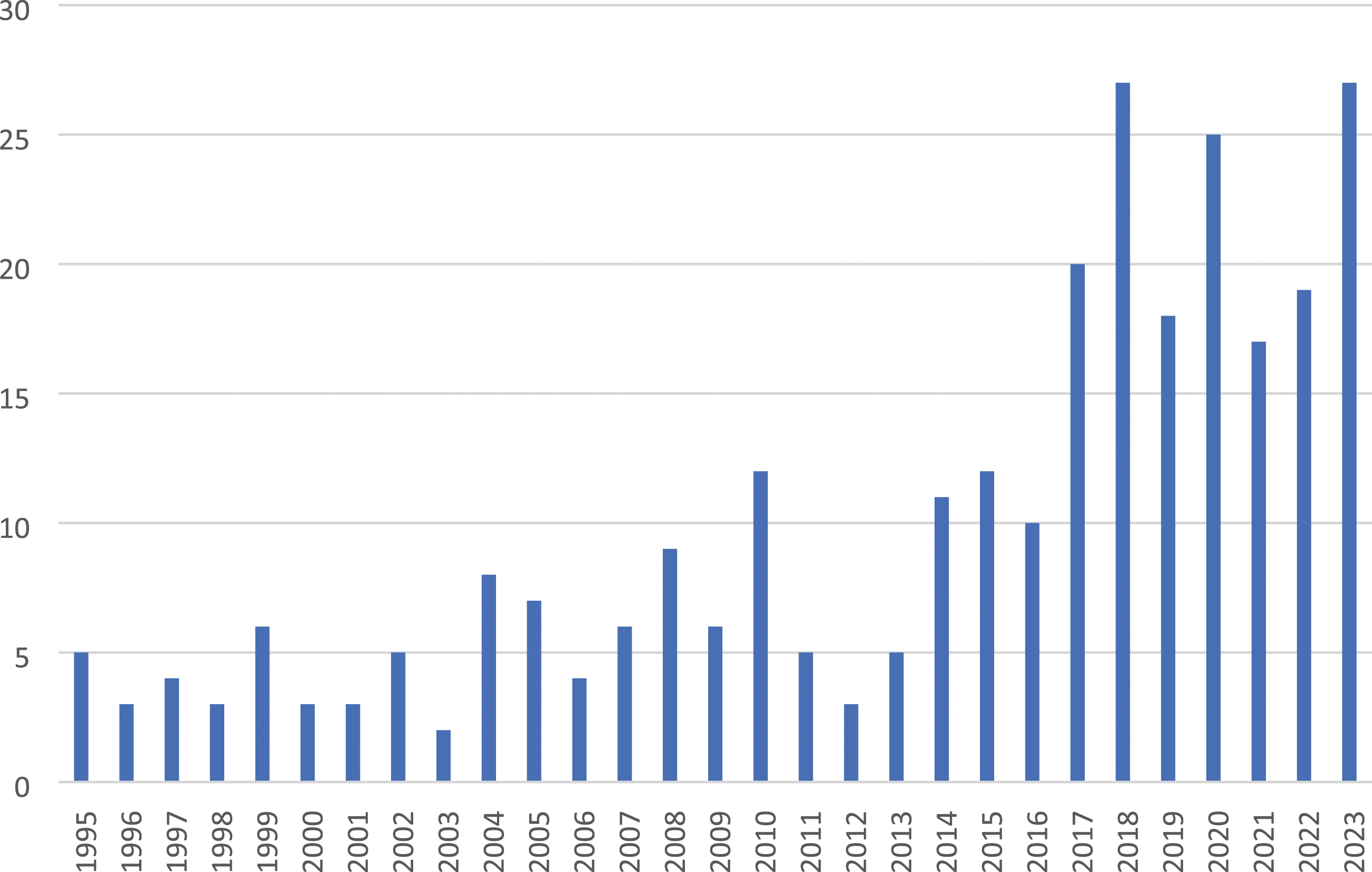
However, taking another example of a journal in geographical education, International Research in Geographical and Environmental Education (IGREE) (Figure 2), there is a very different profile with no indication of a decolonial turn. Instances of papers using decolo* or anti racis* in the journal IRGEE.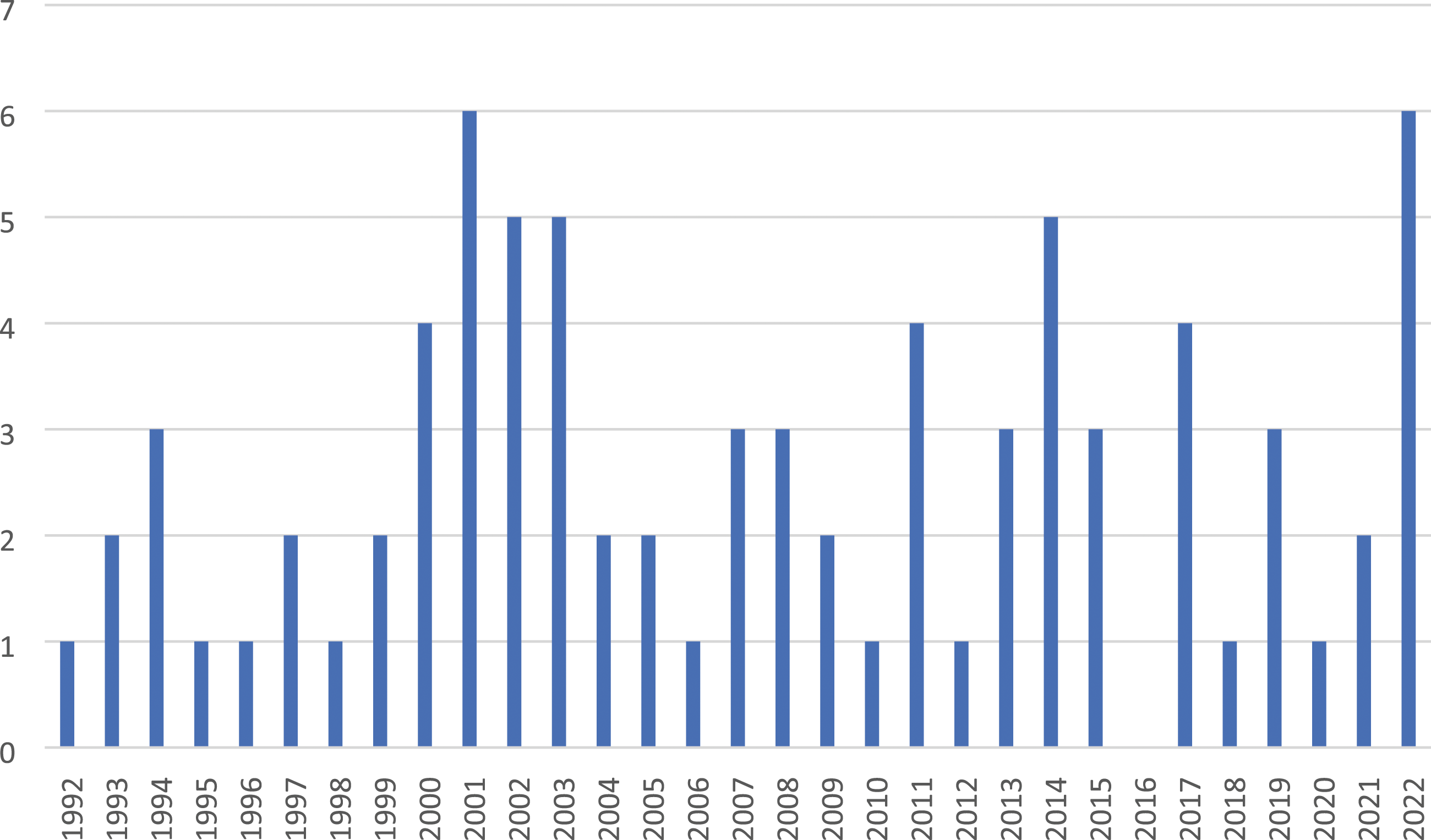
International Research in Geographical and Environmental Education is the journal of the International Geographical Union’s Commission on Geographical Education (IGU-CGE), and explicitly draws on their Charter on Geographical Education (Chew-Hung et al., 2022; IGU-CGE, 2016). The Charter promotes an exclusively positive account of geography, being ‘convinced that geographical education is indispensable to the development of responsible and active citizens in the present and future world’ (p. 1, emphasis in original), and universalising this: ‘the Commission commends the International Charter on Geographical Education to all people of the world’ (p. 1). The Charter’s silence on issues around race, racism, colonialism, empire and geography make this universalising problematic. However, it has been taken up in multiple contexts, and Wilmot’s (2018) inaugural paper in the Journal of Geography Education in Africa uses the Charter as the basis for the ‘key questions’ to be addressed by geographical education and so is largely silent on issues around race and decoloniality. Moving forwards 5 years – through the decolonial turn – Wilmot and Goldschagg’s (2023) analysis of an online teachers’ group in South Africa raises critical questions about teachers’ engagement with the ‘big questions’ of education, now foregrounding the question: ‘How do we decolonise the curriculum?’ (p. 94).
IV Challenges and bandwagons
The decolonial turn in geographical education briefly sketched above is fragmented, contested and visible to varying degrees in different contexts, echoing wider patterns of attention to and definitions of ‘decolonisation’ (Andreotti, 2015). One aspect of contestation comes from a tension at the heart of anti-racist and decolonial geographies that are conducted in formal settings of geographical education: conflicts between geography as emancipatory, and geography as a colonial discipline continuing to reproduce coloniality. This is part of the danger of ‘decolonisation’ highlighted by Esson et al. (2017) and through which they argue that a ‘pursuit of critical consciousness via decolonial thinking could do more harm than good’ (p. 384): decolonisation as an ‘ideological trope’ (Chan, 2023: 369) and a ‘marketable research niche’ (Izharuddin, 2019: 137) that has been swiftly appropriated, domesticated and commodified to ensure the endurance of the very structures it sought to challenge (Moosavi, 2020; Murrey and Daley, 2023; Pirbhai-Illich and Martin, 2023). ‘Decolonization itself becomes weaponized as an alibi to continue colonial business as usual’ (Stein et al., 2020: 44). The corporate university PR machine never sleeps, and critiques perceived as attacks that might harm student recruitment are robustly addressed. Dorling’s (2019) call for kindness as a new form of rigour for British geographers critiqued the whiteness and poshness of the subject, and attracted a public response signed by 89 others including 59 heads of geography departments. The response vividly conveys the corporate university’s demands to prioritise usefulness, career-relevance and marketability in order to satisfy its insatiable desire for student recruitment and growth targets. One paragraph touches on the potentially dangerous ground of decolonisation in ways that illustrate some of the trends discussed above: we recognise the importance of work that seeks to “decolonise” geography through the critical interrogation of the subject’s colonial past, the content, scope and methods of geographical teaching and research today, and the wider workplace culture of university geography departments. (Blunt and Evans, 2019)
Temporally separating geography from a colonial ‘past’, ‘decolonise’ is cushioned behind scare quotes, and the work is ‘recognised’ (rather than supported or resourced?). Yet ‘geography has a way to go before it can claim to have transcended its imperial histories’ (Jazeel, 2017: 334), and ‘the decolonisation of geographical knowledges cannot take place while racist and colonialist structures inherited from the discipline’s colonial and imperial past are maintained’ (Esson et al., 2017: 385). There are ongoing structural issues of representation across geography (Desai, 2017; Müller, 2021), and problematic lived experiences of these gendered, classed and racialised environments (Tolia-Kelly, 2017). School geography teaching similarly remains overwhelmingly white, with minority ethnic groups being underrepresented when compared to wider demographics (Gorard et al., 2023). In the same way that Noxolo (2022) argues that recruiting and retaining Black geographers is a basic requirement for realising the potential of the field of Black geographies, in geographical education there is an urgent need to increase the recruitment and retention of a greater diversity of teachers. These two trajectories are intertwined, with the profile of geographers in higher education having an almost direct impact on the profile of school geography teachers. Emerging efforts such as the Geography for All project (RGS, 2022) offer hope, and there are indications of increasing diversity of undergraduates (Dorling, 2020). Growing up beyond what Esson and Last (2020: 672) term ‘disciplinary fragility’ – which I am suggesting is in part is about marketisation and PR seeking to protect the subject brand – is an important task for geographical education: how might a decolonial turn negotiate and communicate the tension between geography as emancipatory and geography as part of the problem in the context of competition for student numbers?
V Decolonial, anti-racist futures
I began this progress report outlining some of the silences around race and coloniality that geographical education has reproduced, and then argued for understanding the present moment as a decolonial turn in the field, a turn that is contested, undermined by structural issues, and existing in tension with demands for marketisation and brand protection. I now want to finish with three suggestions building on the expanding body of work attempting to bring into being decolonial, anti-racist futures in geographical education; representation, disciplinary fragility, and nuance and singularity.
1 Representation
Representation is important because of the relational nature of learning, knowing and being (Sultana, 2021): ‘a non-hierarchical, non-oppositional, interconnected, interrelational, and interdependent understanding of the world is a necessary foundation from which it might be possible to de/colonise the curriculum’ (Pirbhai-Illich and Martin, 2023: 152). Who is included within ‘we’ is a vital question because a lack of representation restricts possibilities and shuts down opportunities for ‘unpredictably different kinds of geographical knowing’ (Noxolo, 2020: 511). Representation across all levels, phases and roles in geographical education should be prioritised to drive meaningful change for geography’s future, and addressing disciplinary fragility may be a useful lever to aid the recruitment and retention in support of these aims.
2 Disciplinary fragility
Addressing disciplinary fragility in the context of geographical education might involve holding geography more lightly and critically. In part this is about examining the stories we tell about the subject’s origins, nature and future ambitions (Puttick, 2024). Greater intellectual humility in these stories about the subject’s ‘shine’ combined with more transparency and less defensiveness over the subject’s ‘shadow’ might open more expansive possibilities, while also leading us to become ‘a little more ambivalent about our discipline in the process’ (Jazeel, 2017: 336). Desires to defend the brand are restrictive because of their inexorable drag towards omissions and silences. At a basic level, there is a need for Charters on geographical education to explicitly engage with race, empire and coloniality. Navigating these tensions offers scope to move beyond marketing devices and into more critical, intellectually stimulating resources through which decolonial, anti-racist futures might be brought into being.
3 Nuance and singularity
The final suggestion is about theorising decoloniality in ways that are nuanced and provincialized (Chakrabarty, 2000), inspired by Jazeel’s (2019) argument for singularity that pulls geographical education back ‘from an intellectual culture of subsumption that reduces examples and cases to exchangeable instances, or conceptual givens’ (p. 11). The strong normative dimension of the decolonial turn may obscure theoretical nuance. ‘It’ becomes a good to be defended and promoted as a moral cause, and challenges or critiques are framed as necessarily bad. Yet the points about fragility and humility stand: there is a need for nuance and plurality so that decoloniality is shaped by local political economies of knowledge, culture, power and histories. In Chan’s (2023) terms, my decoloniality is not your decoloniality. Calls for nuance and singularity have implications for the concrete ways in which pedagogies and teaching resources represent people and places, and there is exciting scope for, among many other things, developing the use of narrative tools (Alderman et al., 2019), ‘unlearning’ of coloniality (Murrey et al., 2023) and pedagogical disobedience (Murrey, 2019; Murrey and Daley, 2023) so that geographical education might play (even a small) part undoing and re-writing the injustices behind McKittrick’s words that opened this report: what profoundly inspiring possibilities might a more expansive, less fragile, anti-racist and decolonial geographical education flourish into and open opportunities for?
Footnotes
Declaration of conflicting interests
The author(s) declared no potential conflicts of interest with respect to the research, authorship, and/or publication of this article.
Funding
The author(s) received no financial support for the research, authorship, and/or publication of this article.
