




Abstract
Since the late 2000s, the concept of regional economic resilience has become the new buzzword in economic geography. Despite considerable attention, a common sentiment in the literature is that regional economic resilience is an underdeveloped and fuzzy concept. Therefore, this paper conducted a scoping review of 168 articles on the concept of regional economic resilience from 2000 to 2022 to assess its present conceptual state. The paper finds that the notion of regional economic resilience has become a well-developed concept and does not bear the markers of a fuzzy concept anymore. A conceptual framework is advanced.
I Introduction
Since the late 2000s, the notion of regional economic resilience (RER) has become the new buzzword in economic geography (Martin and Sunley, 2015). The increased attention paid to RER in academia and policy arenas is mainly due to the perception that regional economies have become more vulnerable to economic shocks in an increasingly integrated global economy and thus, there is a need to safeguard regions from such disturbances (Christopherson et al., 2010; Hudson, 2010; Martin and Sunley, 2015; Modica and Reggiani, 2015). Precisely, this perception was intensified after the 2008 Great Recession, the effects of which were widespread but geographically uneven (Sensier et al., 2016; Sutton and Arku, 2022b; Wolman et al., 2017). The heterogeneous effects of the recession on regions raised an important question that economic geographers and regional scientists aim to answer: why are some regions able to resist, recover from, and reorient their economies in the face of shocks while others are not? Attempts to answer this question have resulted in the rapid conceptual development of resilience and its determinants (Evenhuis, 2017; Hu and Hassink, 2020; Martin, 2012; Pendall et al., 2010; Pike et al., 2010; Simmie and Martin, 2010; Sutton and Arku, 2022a; to list a few). The notion of RER will undoubtedly attract even further attention due to the economic impact of the COVID-19 pandemic and the following 2020 economic crisis.
Despite the rapid conceptual development, a common sentiment in the resilience literature is that the concept is still underdeveloped, requiring further work to cultivate a comprehensive conceptual framework. At the heart of this critique is that RER is a fuzzy concept requiring greater conceptual clarity (Bristow and Healy, 2020; Dawley et al., 2010; Hassink, 2010; Pendall et al., 2010). Markusen (1999) characterizes fuzzy concepts as those that possess various definitions and are difficult to operationalize. As such, fuzzy concepts have weak analytical rigour and explanatory power and are largely detached from policy advocacy. This critique is, however, not uncommon for relatively new and developing concepts. Lagendijk (2003) notes that new and fuzzy concepts, such as resilience, become mature and rigorous over time as researchers and scholars engage with the concept in academic conversation and debate, as well as through in-depth conceptual review. These types of scholarly engagement has been abundant with the concept of RER. Yet, the sentiment of RER possessing an underdeveloped conceptual framework and being a fuzzy concept persists. For instance, Crespo et al. (2017:271–72) argue that ‘the conceptual framework behind regional resilience is still underdeveloped’. Martin and Sunley (2015:1) note, ‘There is still considerable ambiguity about what, precisely, is meant by the notion of regional economic resilience’ and ‘about how it should be conceptualized’. Also, Hu and Hassink (2020: 56) state that ‘Despite a few insightful conceptualizations, the notion [of resilience] has suffered from fuzzy definitions and incoherent understandings’.
The resilience literature would greatly benefit from a more coherent and comprehensive understanding of the current conceptual state of RER. 1 In providing such an overview, the sentiment that RER is underdeveloped and is a fuzzy concept can be evaluated. Therefore, this paper conducts a scoping review to systematically assess the existing literature on RER and provide a synopsis. To undertake such a task, the scoping review is guided by the following research questions: What is resilience in the context of regional economies? What are shocks? What are the determinants of regional economic resilience? What are the methodological challenges to examining regional economic resilience? What is the value of examining regional economic resilience? What are the critiques of regional economic resilience? In answering the research questions, the paper’s objective is not only to provide a comprehensive and in-depth overview of RER but also to develop a robust conceptual framework.
The conceptual framework advanced in this paper is grounded in critical realism – ontologically and epistemologically – advocating the incorporation of regional context in empirical studies of RER as well as the identification of underlying causal mechanisms (Gong and Hassink, 2020). Context is considered the bedrock of economic geography, being at the very root of the subdiscipline (Asheim, 2020; Rodriguez-Pose, 2011; Sunley, 1996). As such, critical realism is typically implicitly or explicitly employed as the underlying paradigm of empirical and conceptual work in economic geography as it is context-sensitive while acknowledging reality exists independently of human consciousness (Gong and Hassink, 2020; Sayer, 1992; Yeung, 2019).
The following paper is structured as follows. Section 2 presents the paper’s methodology. Section 3 gives an overview of the results. Section 4 provides a comprehensive and in-depth overview of RER. Section 5 discusses the current conceptual state and presents the conceptual framework advanced in this paper. Section 6 offers a research agenda and concludes.
II Methodology
Scoping reviews differ from traditional literature reviews as they attempt to identify all articles on a topic through a systematic process. This process minimizes selection, publication, and data extraction bias. Scoping reviews are conducted for various reasons but with the overall intent to provide a synopsis of a topic (Munn et al., 2018). The methodology for this review follows the framework provided by the Joanna Briggs Institution, and the reporting guidelines follow the PRISMA-scoping review guidelines (Peters et al., 2020; Tricco et al., 2018). The systematic process underpinning the scoping review consists of three main steps – establishing inclusion and exclusion criteria, identifying data sources and conducting a search strategy, and screening articles – which will be discussed in the following subsections.
1 Inclusion and Exclusion Criteria
Inclusion and exclusion criteria were established, a priori, to identify and include the most relevant articles on RER for review. There are three inclusion criteria. First, only peer-reviewed published articles are included in this review, excluding books, newspapers, grey literature, and other sources. Second, articles need to focus specifically on regions’ economic resilience. Third, only articles that focus on the spatial unit of regions, defined as functional geographies that operate under the national government but across municipalities or include the greater area of municipalities (i.e., suburbs and surrounding rural areas, towns, and cities), were included. 2 The only exclusion criterion for this review is that policy-oriented articles on RER are excluded because the paper’s objective is to examine the overall conceptual state of resilience as it pertains to regional economies and not in regard to resilience policies.
2 Information Sources and Search Strategy
This scoping review conducted a sensitive search strategy to identify peer-reviewed articles on RER from the following six databases: Geobase, Scopus, Web of Science, EconLit, Oxford Bibliographies, and Google Scholar. The search strategy has three parameters. First, the search date is restricted to articles published between 2000 and 2022. The lower limit of 2000 is chosen because the concept of resilience did not gain considerable attention in the literature until the early 2000s (Martin and Sunley, 2020). Second, the search was restricted to articles published in English due to language barriers. Third, due to the sheer volume of articles that incorporate the concept of resilience (i.e., initial search results of 17,000), the databases searched were limited to journals that are ‘regional’ in nature, such as Papers in Regional Science, Regional Studies, Economic Geography, and the like, as determined by the authors in consultation with a librarian.
In particular, a three-step search strategy was employed following Peters et al. (2020), which was initiated on 31 July 2021. The first step was a limited search of Web of Science and Scopus databases to identify key search terms used in articles’ titles, abstracts, and standardized index terms. The key search terms identified were ‘regional economic resilience’, ‘economic resilience’, and ‘regional resilience’. The second step was a search of articles’ titles, abstracts, and standardized index terms for all six databases specified above, using the key search terms identified in step one. The second step was conducted to identify all relevant peer-reviewed published articles. The third step is a hand search of the reference lists of all identified, relevant articles to comb for additional articles not found via the six databases.
On 4 April 2022, a final search of the same databases (i.e., repeating steps two and three) was conducted using the same key search terms to identify any additional articles released since the initial search date. 3
3 Selection Process
The selection process for this review consists of three stages (see Figure 1). First, articles are screened for duplications (based on citation or title) and incomplete citations. Any duplicates and incomplete citations were removed.
4
Second, articles’ titles and abstracts are filtered based on the pre-determined inclusion and exclusion criteria. Articles that did not satisfy the criteria were removed. Third, the full-body text of articles underwent the same process taken in the second step, with ineligible articles being removed based on the criteria. The selection process was conducted using Covidence software. PRISMA flow chart.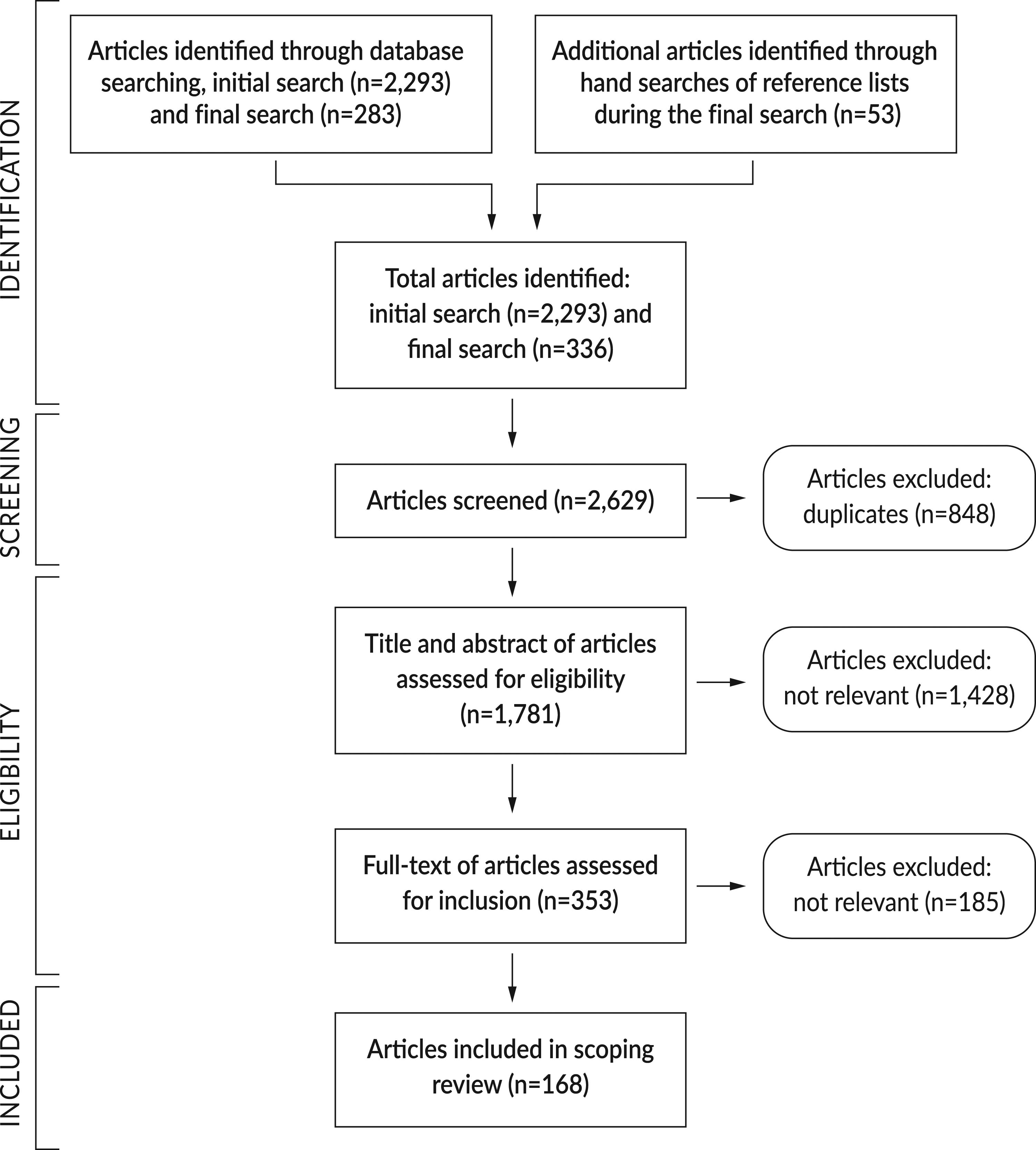
III Results
1 Study Search and Selection
The initial literature search on 31 July 2021, and the final search on 4 April 2022, of databases and reference lists using the key search terms, identified a total of 2,629 articles. Figure 1 illustrates the selection process for this review. From the identified articles, 848 duplicates were removed during the screening process. The 1,781 remaining articles’ titles and abstracts were screened for relevance based on the studies’ inclusion and exclusion criteria, in which 1,428 articles were excluded as they did not satisfy the criteria. Of the remaining 353 articles, the full text was filtered through the inclusion and exclusion criteria, and 185 were excluded as they did not meet the criteria. A total of 168 articles were identified that satisfied all the inclusion and exclusion criteria, and thus they form the base of this review.
2 Study and Methodological Characteristics
Study and methodological characteristics.
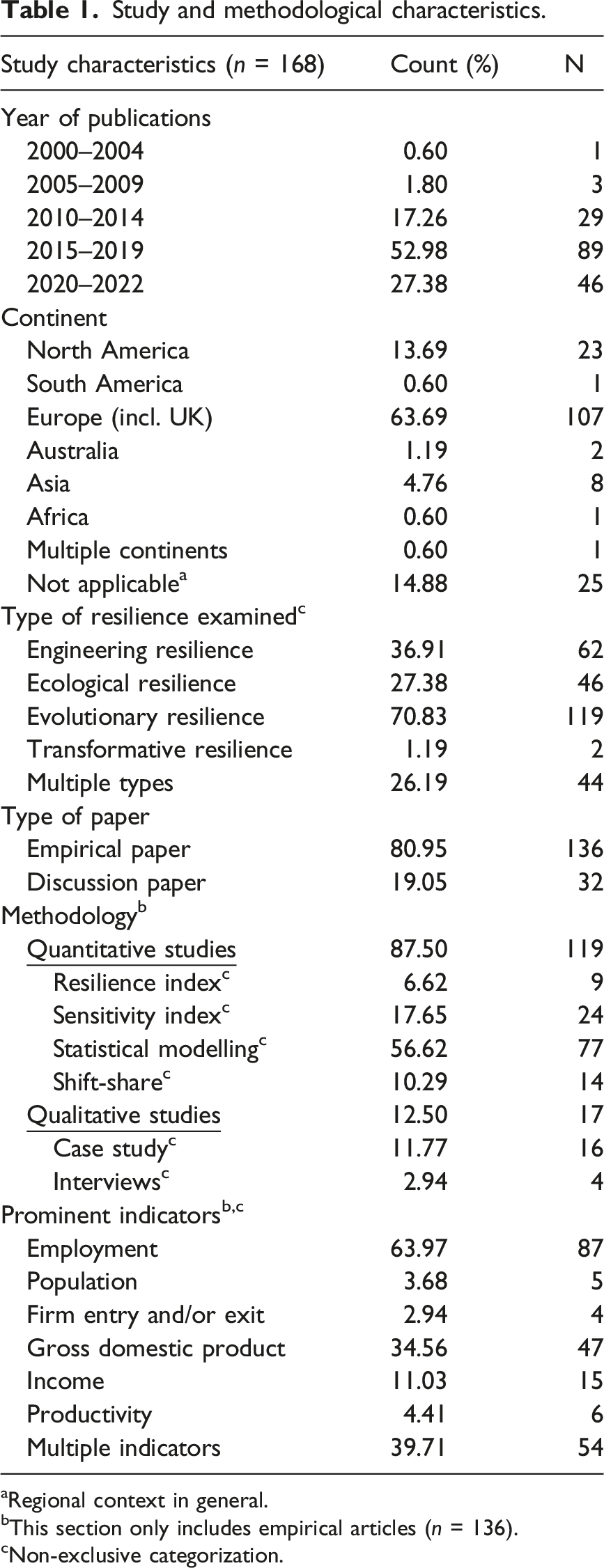
aRegional context in general.
bThis section only includes empirical articles (n = 136).
cNon-exclusive categorization.
IV Review
This section provides a synopsis of RER. The findings from the scoping review are structured around five major themes to address the paper’s research questions. The five major themes are RER (types of resilience, dimensions of resilience, and regions’ reaction to shocks), shocks (types, origins, and nature of shocks), determinants of resilience, methodological challenges for examining resilience, and the value of RER as a concept and common critiques. It is important to note that the synopsis provided is based on the reviewed articles.
1 Regional Economic Resilience
The notion of resilience was popularized by Ecologist C. S. Holling in 1973 (Martini, 2020a; 2020b; Rose, 2007). Since then, the concept has been adopted by many fields, such as psychology, environmental management, engineering, among others, to examine how systems, individuals, and objects respond to disruptions (Cellini and Torrisi, 2014; Martin and Sunley, 2015; Modica and Reggiani, 2015). Following suit, the concept of resilience has also been adopted into the subdiscipline of economic geography, becoming part of the conceptual and analytical lexicon in examining the geography of disruptions. The notion of resilience garnered great interest among economic geographers due to the heterogeneous responses of regional economies to the 2008 Great Recession; however, the notion has received continued attention due to growing socio-economic and environmental uncertainty. Specifically, scholars and commentators have become progressively concerned with regions’ resilience as regions have become more vulnerable to external shocks due to their heightened interconnectedness with the global economy (Christopherson et al., 2010; Hudson, 2010; Ostarkova and Stanickova, 2021; Ringwood et al., 2019; Stanickova and Melecky, 2018).
It is often remarked that there is no universal definition of RER (e.g., see Martin and Sunley, 2015). Based on the review, however, it is clear that RER has developed a general definition, frequently defined as the ability of regional economies to resist and adapt to or transform in the face of shocks and subsequently recover to maintain or improve their pre-shock economic performance. 5 This definition is either explicitly or implicitly employed by many studies investigating RER.
The increased focus on RER has produced a more robust and clear understanding of the concept. Scholars have found that RER possesses four main attributes: dynamic, multifaceted, multi-dimensional, and multi-factor. RER is a dynamic concept, which will be discussed below (subsection 4.4). Notably, however, regions’ resilience changes over time and depends on the shock experienced. Just because a region is resilient to one shock does not guarantee that it will be resilient to the next or that it will be resilient to other types of shocks (Doran and Fingleton, 2018; Gong et al., 2020a; Sensier et al., 2016). Contributing to this dynamism, the determinants of resilience exhibit spatial and temporal dynamics, see subsection 4.6 (Annoni et al., 2019; Bishop and Shilcof, 2017). Thus, resilience needs to be contextualized within regions’ economic landscape and with respect to their position in the global economic hierarchy (Ray et al., 2017). Currently, this would require researchers and commentators to have an intimate understanding of the region(s) they are examining, including the type of economic activities they house and their current level of development within the global economy that is characterized, in a simplistic sense, by many advanced economies shifting towards the knowledge and service economy, and many developing economies industrializing.
RER is also multifaceted. That is, resilience refers both to regions’ performance in the face of shocks as well as their underlying capacity to resist, adapt to, or transform in the face of shocks (Evenhuis, 2017; Psycharis et al., 2014). The performance aspect of resilience focuses on whether regions were resilient (or non-resilient) to disruptions or how resilient regions are in comparison to one another. The resilience performance of regions is usually evaluated using a benchmark or counterfactual – that is, regional economies’ pre-crisis levels or rates (benchmark), or their national economy’s response (counterfactual). The empirical literature has primarily focused on this aspect of resilience as it enables scholars and commenters to rank and evaluate regions’ performance and identify empirical regularities among resilient economies. The underlying capacity aspect of regions’ resilience refers to how and why regional economies were resilient (or non-resilient) to shocks. Although this aspect of resilience has received little attention, it arguably provides the most insightful information on RER – identifying causal mechanisms – and policy implications for regional economies.
In addition, RER is multi-dimensional. Due to its cross-fertilization across many fields (Frohlich and Hassink, 2018), scholars have teased out and highlighted the various dimensions of resilience: preparation, vulnerability, resistance, robustness, and recovery (Foster, 2007; Martin and Sunley, 2015; Masik and Grabkowska, 2020; Pendall et al., 2010; Sanchez-Zamora and Gallardo-Cobos, 2019). The multi-dimensional aspect of RER will be discussed in more depth in subsection 4.3. Finally, RER is multi-factor in that a wide array of determinants influences regions’ resilience. 6 In subsection 4.6, the determinants of resilience will be examined in greater length.
2 Types of Regional Economic Resilience
Types of regional economic resilience.
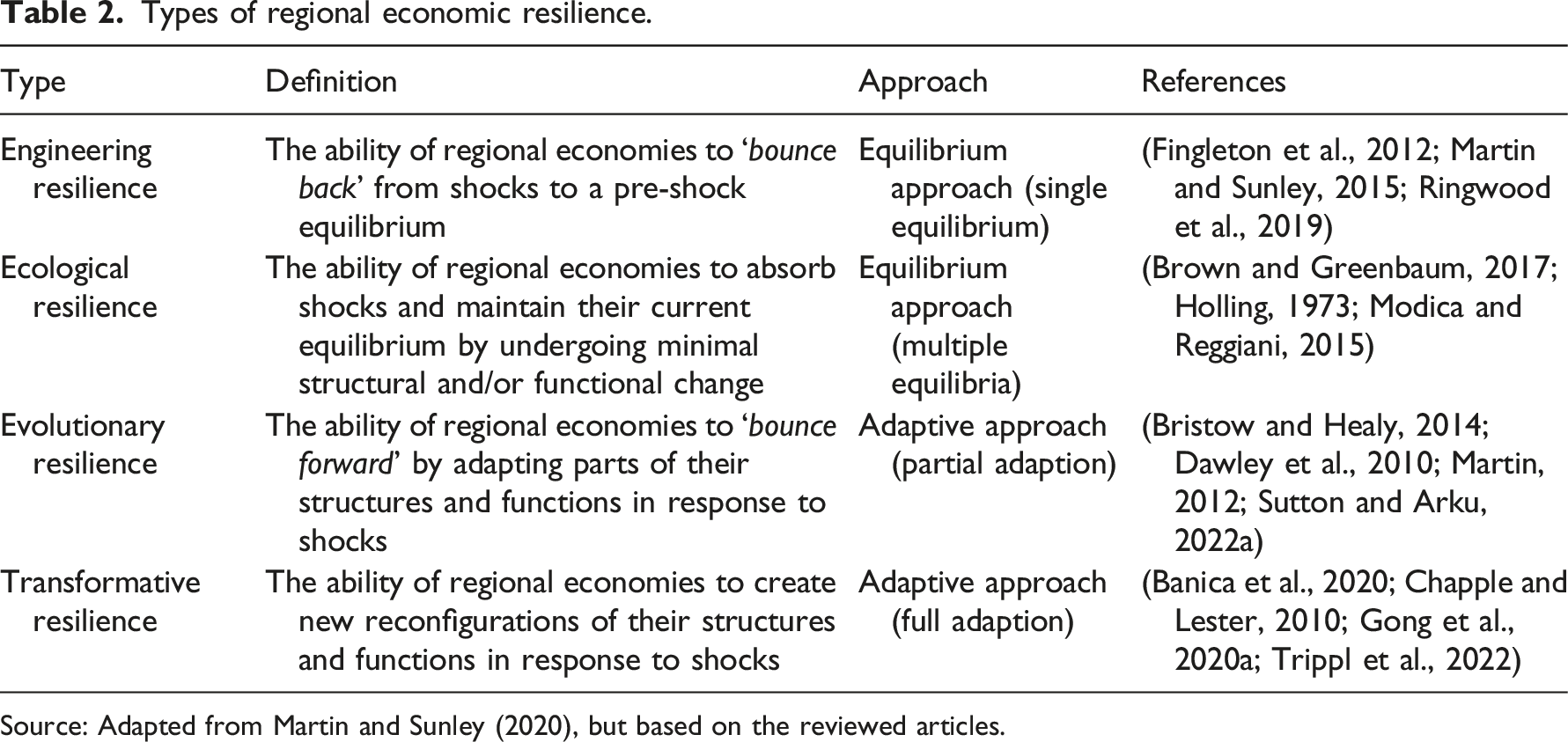
Source: Adapted from Martin and Sunley (2020), but based on the reviewed articles.
The first type of resilience is engineering resilience and stems from resilience’s etymology. Engineering resilience refers to the ability of regional economies to ‘bounce back’ from shocks to a pre-shock equilibrium, emphasizing the speed at which they recover (e.g., see Hundt and Holtermann, 2020; Wang and Wei, 2021; Zhou et al., 2019). The second type of resilience is ecological resilience, which refers to regional economies’ ability to absorb shocks and maintain their current equilibrium by undergoing minimal structural and/or functional change. This type of resilience emphasizes the stability of systems in the face of shocks. However, once the magnitude of a shock surpasses the threshold a regional economy can absorb, which is unique to each region, the economy will be shifted to a new and typically less favourable equilibrium (Capello et al., 2015; Wang and Scorsone, 2020; Wilson, 2018; Yamamoto, 2011).
The third type of resilience is termed evolutionary resilience and focuses on the notion of adaptability. This type of resilience emphasizes the ability of regional economies to ‘bounce forward’ by adapting parts of their structure and functions when experiencing shocks, resulting in economies either maintaining their current growth path or developing a new and more favourable one (Bristow and Healy, 2018b; Reggiani et al., 2002; Webber et al., 2018; Wink, 2012, 2014). The fourth type of resilience is transformative resilience, which refers to regions’ ability to create a new reconfiguration of their structure and functions when they become untenable due to a shock, resulting in regional economies developing a more favourable post-shock growth path (Banica et al., 2020; Chapple and Lester, 2010).
Simply put, the first two types of resilience employ an equilibrium approach, suggesting that regional economies are in an equilibrium state and that they return to that state (i.e., single equilibrium) or shift to a new equilibrium state (i.e., multiple equilibria) following a shock. This equilibrium approach to resilience has been heavily criticized by scholars, especially evolutionary economic geographers (Christopherson et al., 2010; Dawley et al., 2010; Gong and Hassink, 2017; Hassink, 2010; Pike et al., 2010; Simmie and Martin, 2010), who state that regional economies are marked by constant change and, thus, do not operate in any equilibrium state. Furthermore, scholars suggest that the equilibrium approach cannot explain uneven economic development. The latter two types of resilience employ an adaptive approach (i.e., evolutionary perspective) to resilience, suggesting that regional economies (i.e., the economic actors that comprise them) constantly adapt to their changing economic landscape and are never in a stable state. In short, the adaptive approach emphasizes how multiple elements interact to produce dynamic feedback effects making a system more or less adaptable. The adaptive approach is favoured among economic geographers because it more aptly characterizes the behaviour of regional economies (Bristow and Healy, 2014).
3 Dimensions of Resilience
Dimensions of regional economic resilience.
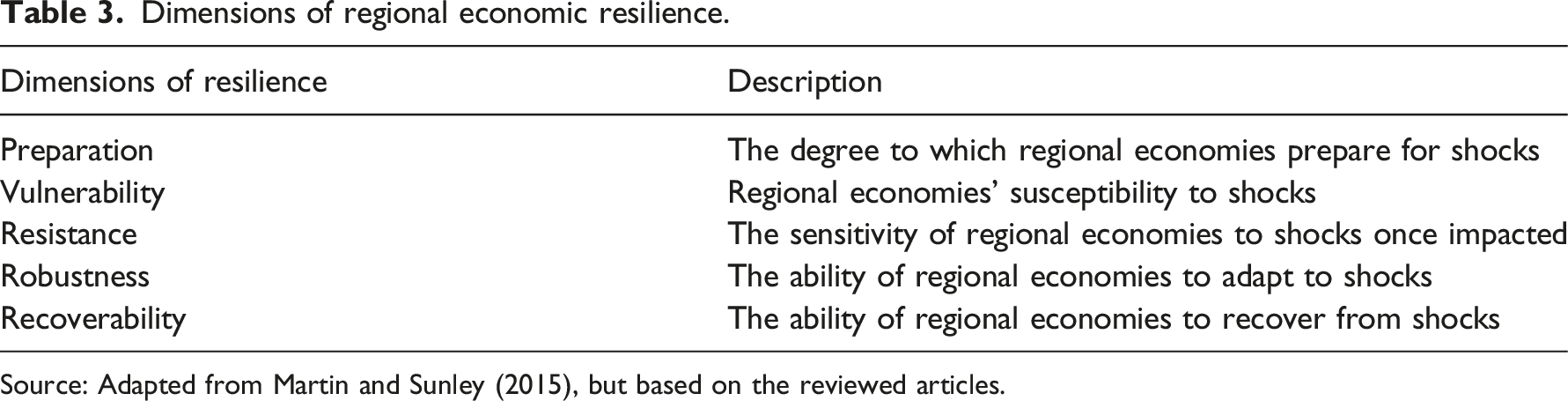
Source: Adapted from Martin and Sunley (2015), but based on the reviewed articles.
Although separate, the dimensions are interrelated as each influences the proceeding dimensions. For instance, regions’ preparation for shocks (i.e., to enhance their resilience) affects their vulnerability. Likewise, regions’ robustness influences their recovery. How regions progress through these five dimensions determines their resilience to shocks.
The robustness dimension provides a point of contention in the RER literature. Robustness is equated to regions’ adaptive capacity, referring to adaptation and/or adaptability. To differentiate between these two concepts, scholars typically rely on Grabher’s (1993) conceptualization and Grabher and Stark’s (1997) further elaboration. That is, adaptation is the ability of regions to adjust their current growth path in the short run, while adaptability is the ability of regions to create a new growth path in the long run. Scholars argue that there is a trade-off between these two concepts (Hu and Hassink, 2017), that engaging in one hinders regions’ ability to engage in the other (e.g., Pike et al., 2010). Furthermore, scholars typically conceptualize the relationship between these two concepts and their role in RER differently, creating conceptual ambiguity. To sidestep the tension between adaptation and adaptability and their conceptual ambiguity in the resilience literature, scholars either refer to these concepts interchangeably or mention one and not the other (e.g., Evenhuis, 2017). Put simply, the role of adaptation and adaptability in RER requires greater conceptual clarity.
4 Regions’ Resilience Performance and Reaction to Shocks
Research has found that regions exhibit heterogeneous resiliency to shocks (Groenewold, 2020; Ray et al., 2017; Ringwood et al., 2019; Sensier et al., 2016). The asymmetric resilience behaviour remains constant when comparing regions within and between countries. Scholars have characterized regions’ resilience performance in various ways, but at the core of all these classifications, regions have ultimately three outcomes: recovered, recovering, or declining. That is, regions can be (1) non-resistant but have since recovered; (2) non-resistant and in the recovery process; and (3) non-resistant and still declining. This classification, as well as others in the literature, are based on a pre-determined time frame in which regions’ resilience is measured against. As the length of time regions are examined is expanded, more regions will be categorized in the first category. In contrast, the shorter the timeframe is, the more regions will be categorized in the latter two categories. Therefore, the timeframe in which regions are examined is crucial for providing an accurate depiction of RER. However, no generally accepted timeframe exists for examining regions' economic resilience. Instead, scholars’ temporal analysis of regions’ resilience varies, with some examining resilience in the short-term and others examining resilience in the long term. Furthermore, the timeframe that constitutes the ‘short-term’ and ‘long-term’ also varies from study to study.
The spatiotemporal distribution of shocks (i.e., the time in which regions are affected by shocks) also varies (Sensier et al., 2016; Sensier and Devine, 2020). When deciding whether to account for the spatiotemporal distribution of shocks, scholars must consider the geographic scope of analysis. Assuming that all regions examined are affected simultaneously is more appropriate – for shocks of a global nature – if they are within the same country. This is because regions within the same country experience the same degree of economic openness to the global economy and, therefore, are more likely to be affected by exogenous shocks within a similar time period. However, if regions across different countries are being examined or when regions examined are in the country in which the shock originated, then it is more appropriate to account for the spatiotemporal distribution of shocks to provide a more accurate account of RER, especially as different countries experience varying degrees of economic openness due to different international trade agreements and tariff and non-tariff barriers. Simply put, some countries might be affected at different times by shocks, and thus, regions’ resilience in different countries will be categorized incorrectly if the spatial-temporal distribution of shocks is not accounted for, making some seem less (more) resilient when they are exposed to the shock later (earlier) than other regions.
Regions’ resilience to shocks also shapes their resilience to future shocks. This is known as the ‘recursive process of resilience’ in which regions’ past resilient behaviour influences their evolution and, subsequently, their ability to respond to future shocks (see Gong et al., 2020b; Martin and Sunley, 2015). The underlying logic is that more resilient regions typically exit the shock better equipped – through such mechanisms as institutional learning or adapting their structure and functions – and better positioned (i.e., more productive and competitive) to address future shocks when they arise. However, the recursive process of resilience is non-deterministic but is meant to illustrate how regions’ resilience can positively or negatively shape their internal characteristics (e.g., industrial structure) that influence their resilience to future shocks. Thus, just because a region is resilient to one shock does not guarantee it will be resilient to the next. Furthermore, regions’ reactions to shocks change based on the nature of the shock experienced, as they can be resilient to one type of shock (e.g., recession) but not another (e.g., pandemic). Regions’ resilience in this framework is not static but dynamic.
5 Shocks
Types of shocks.
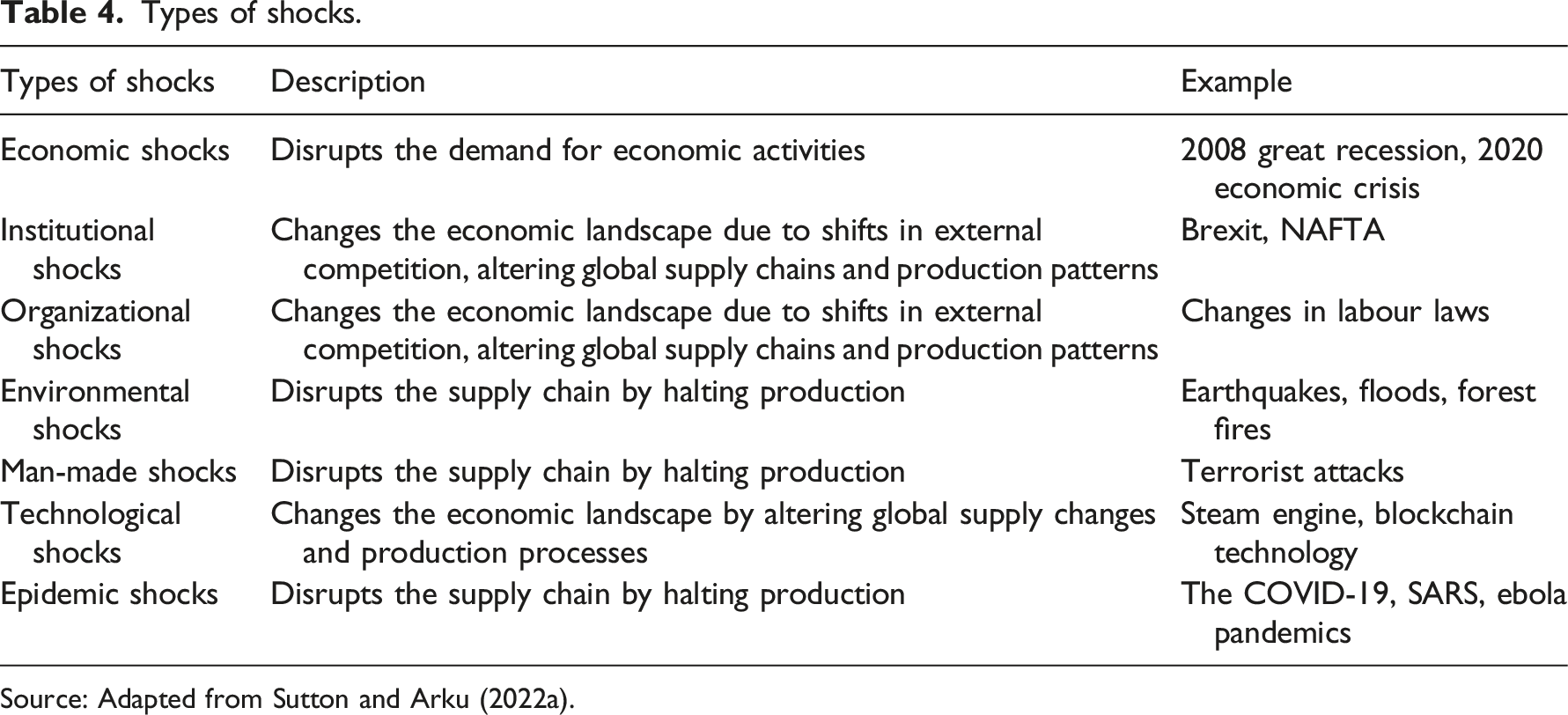
Source: Adapted from Sutton and Arku (2022a).
The global economy over the past three decades has had an increasingly turbulent economic landscape, forcing regional economies to contend with various shocks (e.g., major plant closures, Dotcom Bubble in the late 1990s, the 2008 Great Recession, and the 2020 Economic Crisis). However, shocks are not experienced homogeneously among regional economies, with some regions being more adversely impacted than others due to the nature of the shock and regions’ inherent and inherited resources and capabilities. The nature of shocks refers to the type of shock and its intensity and duration (Gong et al., 2020a; Sensier et al., 2016). When shocks hit regional economies, they have immediate negative effects, such as job losses, increased unemployment, business closures, decreases in output, lowered tax base, etc. In addition, shocks can have hysteretic effects on regional economies’ long-term growth path. That is, shocks can permanently alter regions’ growth trajectory, either positively or negatively, with some regions exiting a shock with a less (more) favourable growth path. Therefore, shocks and how regions respond to them contribute to uneven regional development.
Although shocks are typically thought of as a negative occurrence, the literature emphasizes that there are also positive effects, such as the previously mentioned positive hysteretic effects. Shocks, in this sense, are seen as ‘windows of opportunity’ for which regional economies can enhance their long-term growth trajectory if they are able to adapt their economic functions and structure (Banica et al., 2020). For example, a shock can de-lock a region (i.e., its economic actors) from outmoded forms of production, providing an opportunity for it to adapt its functions, by producing products that are higher up the quality ladder in its supply chain, and/or structure, by engaging in new and emerging markets, enhancing its long-term growth path. This window of opportunity is especially important for regions with a sub-optimal growth path prior to the shock or those locked-in to an outmoded form of production. The idea of shocks being windows of opportunity is akin to Schumpeter’s (1942) notion of gales of creative destruction. Furthermore, while shocks always have, to varying degrees, an immediate negative effect on regional economies, they can also have immediate positive effects, such as increased entrepreneurism, public investment, and intra- and interregional collaboration.
6 Determinants of Resilience
No regional economy is shockproof; however, there are a handful of determinants that influence the impact of shocks and how regions respond to them. The determinants of resilience refer to the myriad of underlying factors, including external forces, conditions, and relationships, that collectively influence regional economies’ resilience (Di Caro and Fratesi, 2018; Martin and Sunley, 2015). More precisely, the determinants of resilience are dynamic, multi-scalar, and spatially dependent, stemming from an array of socio-economic and political-institutional factors that vary depending on economies’ inherent and inherited resources, capabilities, and characteristics. Interestingly, the determinants that enhance regions’ resilience during turbulent times also tend to be the determinants that enhance their growth potential and/or competitiveness during stable times (e.g., human capital, agglomerations, entrepreneurism, and innovativeness). Thus, the determinants of resilience play a vital role in enhancing the overall economic well-being of regional economies. Furthermore, the determinants shine a light on why some regions are more resilient than others and also help explain the uneven development of regional economies.
The determinants of resilience are dynamic for several reasons. First, the dynamic nature stems from the fact that the determinants may differ depending on the type of shock experienced. For instance, the factors that enhance regional economies’ resilience to natural disasters may differ from those that enhance regions’ resilience to recessions. Second, the determinants of resilience will differ for economies based on their economic structure and functions. An exemplar is human capital, as it may hinder single-industry regions’ resiliency as these industries typically base their survival on low labour costs and, thus, have an economic landscape that may be hampered by greater portions of human capital as opposed to knowledge-based regional economies. Third, the determinants of resilience also evolve in concert with the global economic landscape. For example, the determinants prevalent during the industrial era, such as having a strong manufacturing base, are not the same during the post-industrial era (i.e., based on knowledge and specialized services). It is important to note that the set of factors, including inherent and inherited resources, capabilities, and characteristics, present in a particular region, which influences its resilience, tends to develop in a place- and path-dependent manner. Hence, regions’ local factors will differ, partly explaining the varying resilient and developmental behaviours.
However, regions’ resilience is not solely determined by endogenous factors but is also influenced by the larger socio-economic political-institutional landscape in which they are embedded (e.g., see Giannakis and Papadas, 2021). In other words, the determinants of resilience are multi-scalar. Specifically, institutional settings, governance structures, and policies that are cultivated, developed, and established, respectively, by upper-level governments and organizations, such as national governments or international organizations, affect regional economies’ resilience. Further, economies’ resilience is also influenced by broader macroeconomic processes (e.g., currency value, interest rates, and foreign direct investment) as well as global value chains and global production networks.
To further complicate the matter, regional economies’ resilience is influenced by spatial spillovers from neighbouring regions due to spatial dependencies (e.g., see Pontarollo and Serpieri, 2020b). Thus, regional factors can enhance or hinder the resilience of other regional economies nearby – in either relative or absolute terms. For example, one economy may benefit from the high proportion of human capital in an adjacent economy due to the interregional mobility of the labour force and experience increased resilience. In some instances, larger regions may drain smaller regions’ human capital (i.e., backwash effect) through interregional mobility by providing greater employment opportunities, thus, hindering smaller economies’ resilience. Another example is that a regional economy may benefit from knowledge spillovers from neighbouring economies, especially those specializing in knowledge-based activities, such as the technology or finance sectors. What defines spatial factors, in comparison to endogenous factors, is that they have spillover effects on neighbouring regions. That is, any endogenous factor can be considered a spatial factor as long as it has a spillover effect; however, the spatial effect may differ from the effect of the endogenous factor (i.e., localized effect).
Both the multi-scalar and spatial aspect of the determinants of resilience demonstrates that economies are not contained or isolated entities but are marked by their openness and interconnectedness, influenced and affected by external forces and actors (as argued by Jacob, 1969; Martin and Sunley, 2007; Massey, 1993). Additionally, these aspects underscore that location matters (as discussed in Florida, 2016; Glaeser, 2011). In summation, the dynamic, multi-scalar, and spatially dependent nature of the determinants of resilience emphasizes that they are temporally and context-sensitive and should be examined as such.
Determinants of regional economic resilience.
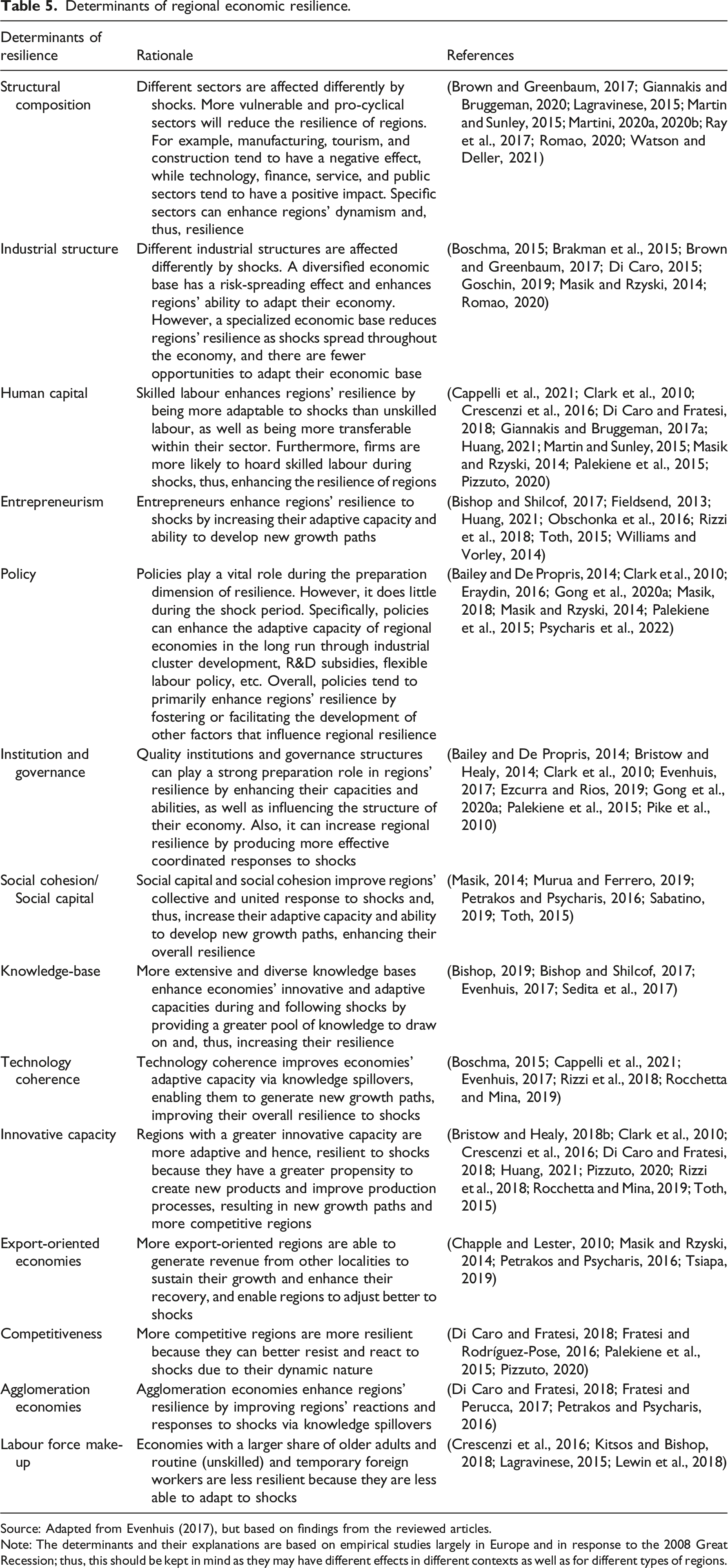
Source: Adapted from Evenhuis (2017), but based on findings from the reviewed articles.
Note: The determinants and their explanations are based on empirical studies largely in Europe and in response to the 2008 Great Recession; thus, this should be kept in mind as they may have different effects in different contexts as well as for different types of regions.
Due to the complex nature of regional economic systems, their interconnectedness, and their embeddedness in multi-scalar structures, local actors’ ability to engage in resilience-building behaviour is difficult. In fact, many factors that enhance regions’ resilience tend to be out of local actors’ control, determined at multi-scalar levels (e.g., upper-level policies and global actors), by neighbouring economies (i.e., spatial dependencies), or by external agents (e.g., international corporations). Further, there is no silver bullet to the determinants of resilience due to its dynamic (i.e., context-specific) nature; rather, there is a broad group of regularities that generally enhance regions’ economic resilience. Local actors (e.g., economic development partitioners, local officials, and policymakers) in regional economies need to take stock of their resources and capabilities and then identify where they need to, and are able to, develop their economy to be more resilient. At the risk of oversimplification, regions in mature economies should aim to foster a conducive economic landscape that enables them to thrive in the ‘New Economy’. To do so, local actors should focus on enhancing their knowledge base, technology coherence, innovative capacity, human capital, and entrepreneurism, as well as diversifying their economy into higher-value and specialized activities. In contrast, regions in developing economies should generally aim to identify their competitive position and build on it, especially in more resilient and high-growth sectors, while simultaneously trying to diversify their economic base.
7 Methodological Challenges for Examining Regional Economic Resilience
Various methodological approaches have been implemented to investigate the resilience of regions (Martin and Sunley, 2015; Toth, 2015). 11 Although this is not an exhaustive list, common methods include case studies, indices, and statistical models (Modica and Reggiani, 2015). 12 In particular, economic geographers advocate the coupling of comparative case studies and quantitative analysis when examining RER. However, there is a general lack of qualitative research in the resilience literature, resulting in a heavy quantitative focus.
Major methodological challenges to examining regional economic resilience.
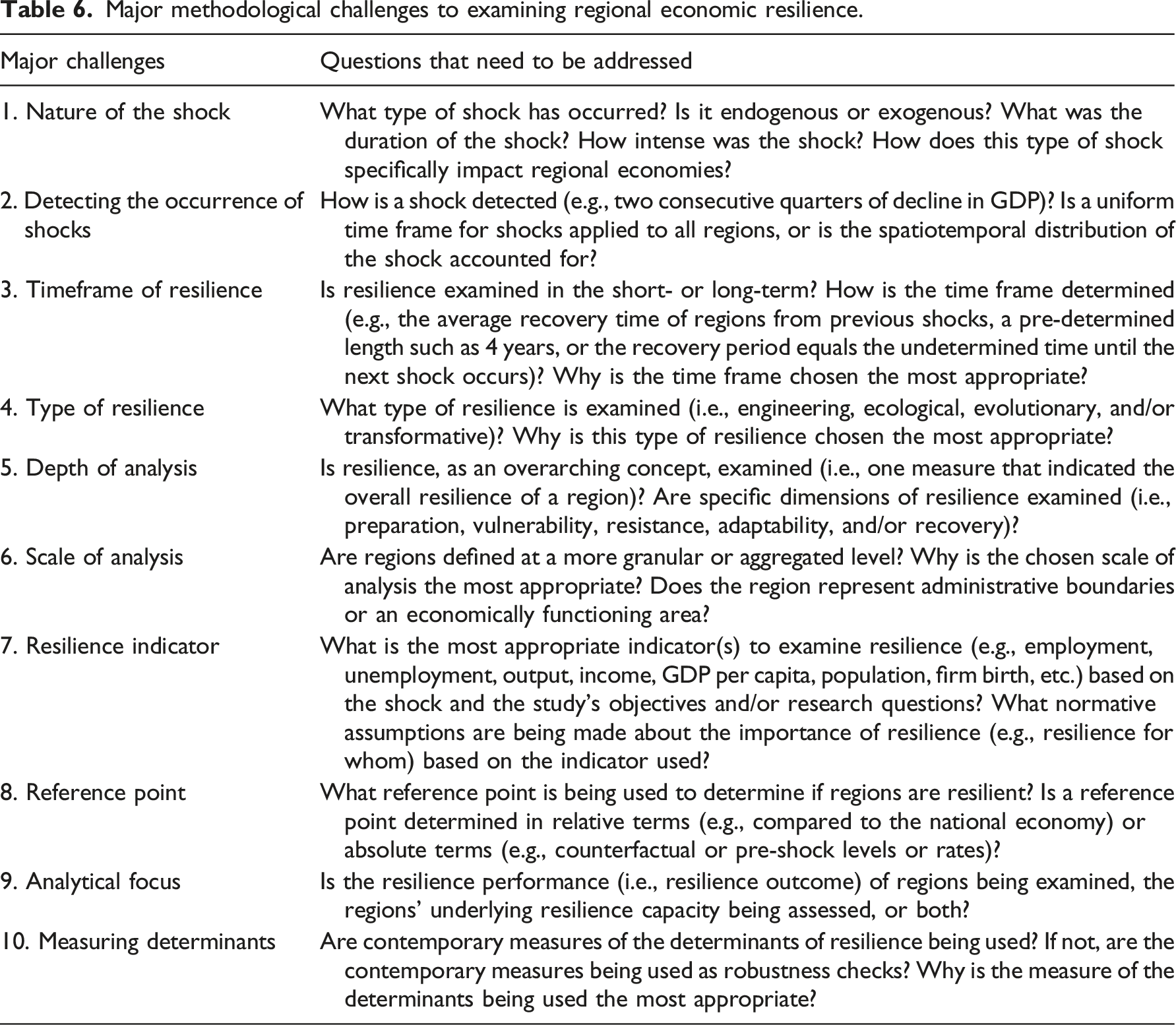
Certain methods might prevail depending on the type of resilience (i.e., ecological, engineering, evolutionary, and transformative) examined (see Evenhuis, 2017). Indeed, for the equilibrist approaches (i.e., ecological and engineering resilience), quantitative methods might be more appropriate as they focus largely on the resistance and recovery dimensions of resilience. In doing so, equilibrist approaches concentrate on resilience’s performance aspect. Regarding adaptive approaches (i.e., evolutionary and transformative), mixed methods might be more appropriate. In particular, qualitative methods (e.g., case studies and interviews) are important for uncovering the exact mechanisms underlying regions’ robustness, which are not readily observable through quantitative methods. In this sense, adaptive approaches focus on the underlying capacity of regional economies to be resilient to shocks and regions’ resilience performance. In summation, the type of resilience examined naturally calls for certain methods to be employed.
8 Value and Criticisms of Regional Economic Resilience
The adoption of the concept of resilience in economic geography has provided greater insight into regional economies. The concept focuses our attention on a “different aspect of the performance of regional economies, compared to other aspects such as growth, competitiveness, or sustainability” (Evenhuis, 2017: 10). In particular, the concept of resilience holds particular interest for economic geographers and regional scientists for five main reasons. First, regional economies experience the brunt of shocks. That is, the effects, both negative and positive, are worked out at the regional level. Second, shocks have adverse direct and long-lasting impacts on the livelihood of regional residents, such as increased homelessness, job loss, mental illness, reductions in wages, reduced standard of living, amongst others. Third, shocks can have severe and permanent impacts on regions’ long-term growth trajectory (i.e., hysteretic effect), resulting in permanently lower growth levels or rates. Fourth, shocks and regions’ responses to them, contribute to the uneven development of regional economies. Fifth, the concept can support the development of robust policy interventions aimed at safeguarding regions from the adverse effects of shocks in an increasingly volatile and shock-prone landscape. In short, the concept of resilience focuses our attention on the heterogeneous impacts of shocks and regional economies’ varying responses to them, all of which help explain uneven economic development – which lies at the heart of economic geography (James et al., 2018; Martin, 2021; Yeung, 2019).
Despite the growing popularity of the notion of resilience in economic geography since the late 2000s, it has also been heavily critiqued (e.g., see Hassink, 2010; MacKinnon and Derickson, 2013). Specifically, the literature highlights six main critiques. First, RER is critiqued as being an underdeveloped and fuzzy concept that requires further conceptual clarity and development. Second, scholars argue that the concept of resilience is ill-suited to be incorporated into the analysis of regional economies as socio-economic systems are fundamentally different from ecological and physical systems from which the concept originates. Third, the concept of resilience has been criticized as being a neoliberal construct, promoting self-reliance and the need to accommodate market forces, thereby neglecting the state’s accountability when examining regional economic issues. Fourth, the concept is criticized as being more descriptive than explanatory (i.e., there is a lack of rigorous explanations behind regions’ responses to shocks). Fifth, some scholars criticize the concept as being useless, stating that economic geography already has concepts that can explain regional resilience, such as path dependence, variety, and lock-in. Sixth, some scholars argue that the concept has primarily focused on the economy’s industrial structure and generally neglects the role of agency, such as that undertaken by the state as well as internal and external economic actors, coming close to structural functionalism. The purpose of this subsection is to highlight the value that RER brings to economic geography, as well as the main critiques against it. Martin and Sunley (2017) have addressed most of these critiques. The present paper aims to investigate the validity of the first critique noted, that resilience is an underdeveloped and fuzzy concept.
V Discussion
1 The Current Conceptual State
Over the past two decades, the notion of resilience has gained a steady foot-hold in economic geography. Scholars have conceptually advanced the notion of RER, creating a well-developed concept with almost every aspect of resilience being clearly conceptualized. This is not to say that more work is not needed, but the sentiment of being underdeveloped does not hold. Likewise, it is apparent that RER no longer bears the markers of a fuzzy concept, according to Markusen’s (1999) definition (i.e., possesses various definitions and is difficult to operationalize). First, the concept possesses a common definition. Scholars generally define RER as the ability of regional economies to resist and adapt to or transform in the face of shocks and subsequently recover to maintain or improve their pre-shock economic performance. The common definition demonstrates that researchers are examining the same phenomenon. The confusion typically stems from discussions surrounding the four types of resilience (i.e., engineering, ecological, evolutionary, and transformative resilience), as each has its own interpretation. As reflected in the common definition of RER and will be further discussed below, the four types of resilience bring analytical focus to specific types of resilience employed by regions (i.e., the encompassing economic actors) (Sutton and Arku, 2022a). Therefore, the four types of resilience should not be misconstrued as RER possessing various definitions but indicate the types of resilience regions employ.
Second, RER is not difficult to operationalize, as evident by the number of empirical articles that make up the bulk of this review. Most articles reviewed measured regions’ resistance and recoverability to shock in a similar fashion, that is, by investigating whether regions were resilient to a shock based on benchmarks or counterfactuals. Despite fewer studies measuring the preparation, vulnerability, and robustness dimensions of resilience, mixed methods, such as descriptive statistics and case studies, are generally employed or advocated to operationalize these dimensions (see Evenhuis, 2017). For notable examples of case studies, see Cowell (2013), Simmie and Martin (2010), and Wolfe (2010). In addition, Sutton and Arku (2022a) emphasize that the robustness dimension can be measured by examining the degree of structural and functional change that occurs in regions over the shock and recovery periods, which in turn identifies the type of resilience regions employed.
Fuzzy concepts have difficulty answering the question, “How do I know it when I see it?” (Markusen, 1999: 870). RER, however, does not have such identity issues, being readably observable empirically. In other words, (non)resilient regions are easily identifiable. In summation, criticisms of fuzziness are no longer valid for the concept of RER. The conceptual development of RER has grown due to continual academic engagement, debate, and critical review and retheorizing over the past two decades, as Lagendijk (2003) suggests typically characterizes the conceptual development of new concepts. Although RER does not possess the markers of a fuzzy concept anymore, this does not suggest that there is no room for conceptual advancement. In fact, ‘good’ concepts are constantly retheorized in an iterative manner, improving our conceptual understanding based on new evidence and information (Gong and Hassink, 2020).
Furthermore, the iterative process of retheorizing RER has been and will continue to be an enduring theme in the resilience literature. This is because resilience is a boundary concept, facilitating the exchange of knowledge across disciplines (Brand and Jax, 2007; Martin, 2021). Due to its interpretive flexibility, resilience is able to maintain a strict definition and core identity in each discipline while being commonly discussed in sufficiently vague terms to allow scholars from different disciplines to exchange and combine knowledge (Star and Griesemer, 1989) through sharing common syntactic, semantic, and pragmatic boundaries (Carlile, 2004). The interpretative flexibility of resilience is evident in the concepts use in various disciplines (e.g., engineering, ecology, economics, and so on), yet each discipline (or subdiscipline) holds its own definition. Figure 2 on page 1769 of Frohlich and Hassink (2018) perfectly visualizes resilience as a boundary concept, illustrating its interpretative flexibility. Overall, such boundary concepts allow for greater knowledge integration from other subdisciplines and disciplines. As knowledge is imported, new insights can potentially lead to further conceptual developments of RER. In fact, the integration of resilience thinking from other disciplines, such as the idea of complex adaptive systems from ecology (Pendall et al., 2010), has already greatly aided the conceptual development of RER in economic geography over the past two decades. In short, one should expect RER to continue experiencing conceptual advancements and, thus, retheorizing. The process of resilience.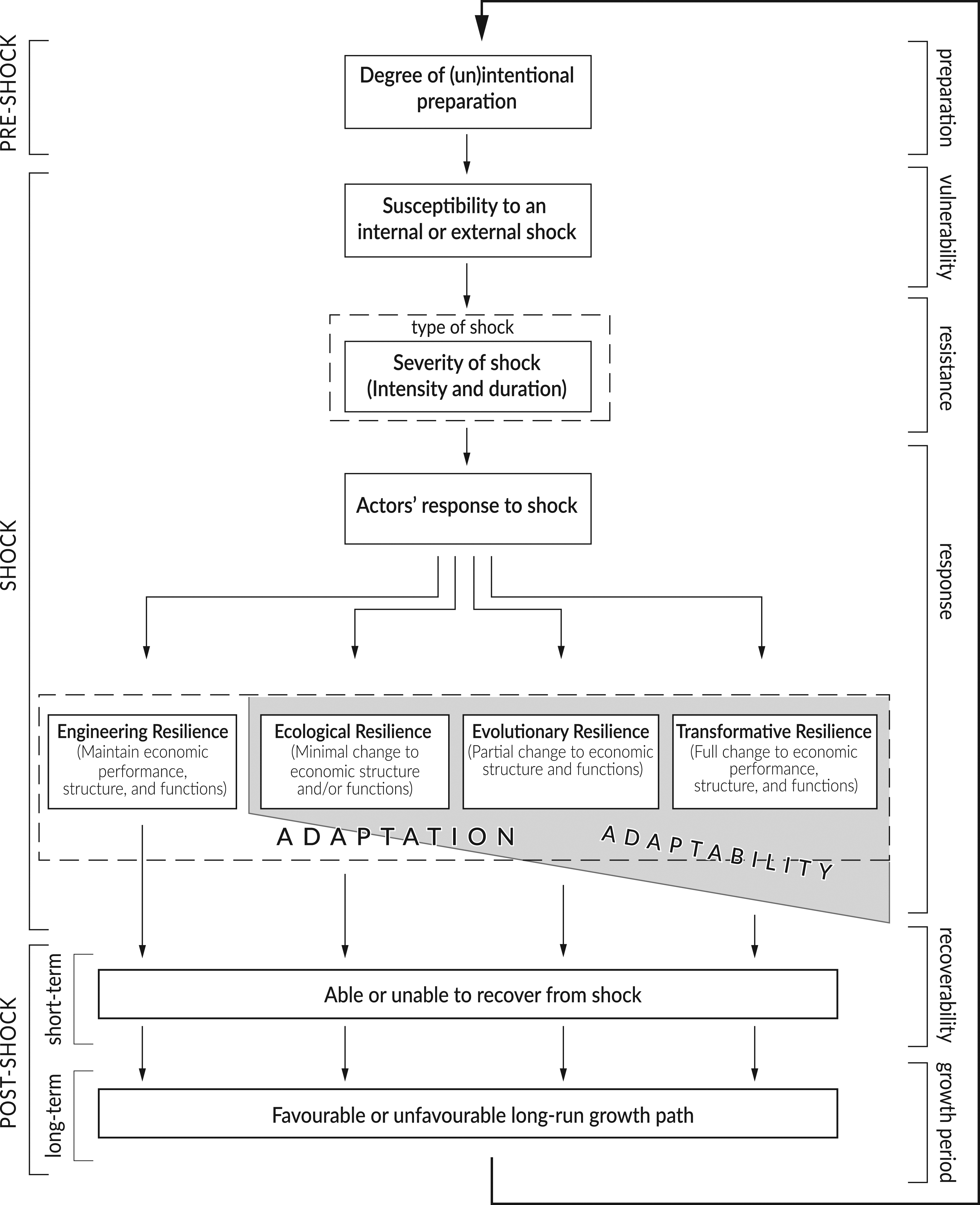
2 A New Conceptual Framework
The conceptual framework advanced in this paper is grounded in critical realism. The framework only illustrates the resilience process and how it shapes regions’ long-term growth paths and resilience to future shocks. Such a framework should be applied to specific regions, incorporating local context and uncovering underlying causal mechanisms (Sayer, 1992; Yeung, 2019).
Furthermore, the conceptual framework employs an evolutionary perspective of RER, emphasizing that regional economies are in a constant state of uncertainty and change, rejecting equilibrist notions (Dawley et al., 2010; Hassink, 2010; Simmie and Martin, 2010) that cannot account for uneven economic development (Pike et al., 2010). Thus, engineering and ecological resilience hold an evolutionary interpretation in this framework and are redefined below. Incorporating concepts from other theoretical frameworks (e.g., mainstream economics) into an evolutionary perspective has value as it can drive theoretical and explanatory innovation, as noted by scholars calling for integrated pluralism in economic geography (Barnes and Sheppard, 2010; Hassink et al., 2014; Martin, 2021; Sheppard and Plummer, 2007; Van Meeteren et al., 2016). Moreover, the conceptual framework presented in Figure 2 builds on the scoping review above and, in particular, on several notable conceptual papers, such as Bristow and Healy (2014), Hu and Hassink (2020), Martin and Sunley (2015), and Sutton and Arku (2022a). The framework does not deviate from the review in regard to conceptualizing shocks or the determinants of resilience. How this framework diverges is outlined below.
Resilience is a dynamic, multifaceted, and multi-factor process that refers to the ability of regional economies to resist, adapt to, or transform in the face of shocks and subsequently recover to maintain or improve their post-shock economic performance. Further, the resilience process is also multi-dimensional, consisting of five interrelated dimensions: preparation, vulnerability, resistance, response, and recoverability (Figure 2). Preparation refers to the intentional or unintentional efforts exerted (or lack of efforts exerted) by economic actors to shape the determinants that influence their resilience to future shocks (Cowell, 2013; Davoudi et al., 2013). Vulnerability refers to the susceptibility of regional economies to shocks. Resistance refers to the sensitivity of regional systems to economic shocks and the extent of the impacts (Martin and Sunley, 2015). Response refers to the type of resilience that regional economies employ during shocks. Recoverability refers to the extent regional economies recover from shocks. How regions progress through these five dimensions determines their resilience to shocks (Martin and Sunley, 2015).
In response to shocks, regional economies can employ four types of resilience: engineering, ecological, evolutionary, and transformative (Sutton and Arku, 2022a). The type of resilience employed is determined by the collective but uncoordinated actions and behaviours of internal or external actors that operate in the region (Bristow and Healy, 2014). Specifically, the degree of structural and functional change actors produce determines the type of resilience employed. Engineering resilience occurs when actors (i.e., as a collective whole) do not adapt their regions’ structure and functions to any significant degree but rather anticipate that the region will simply ‘bounce back’ from a shock. Ecological resilience occurs when actors attempt to absorb shocks by engaging in minimal structural and/or functional change. Evolutionary resilience occurs when actors attempt to ‘bounce forward’ by adapting a portion of their structure and functions to enhance their overall competitive position in the global economy. Transformative resilience occurs when actors create new reconfigurations of their structures and functions in response to shocks (Sutton and Arku, 2022a).
The type of resilience employed by actors is influenced by the nature of the shock, specifically its intensity and duration (Martin and Sunley, 2020). The less severe and the quicker a shock is felt, the less impact that the shock will have on a regional economy, reducing the need for actors (i.e., firms, institutions, political leaders, and so on) to adapt. Regional economies will likely employ engineering or ecological resilience for shocks that are less severe and shorter in duration. In contrast, the more severe and longer the duration a shock is felt, the more impact that the shock will have on a regional economy, forcing actors to adapt to their changing economic landscape. Regional economies will likely employ evolutionary or transformative resilience for shocks that are more intense and longer in duration.
Although it is influenced by the nature of the shock experienced, the type of resilience employed ultimately depends on the overall response of actors that operate in the region (Bristow and Healy, 2014; Martin and Sunley, 2015). As in any aspect of the economy, actors play a central role, as they ‘are the conscious agency whose action – intentional or otherwise – can produce concrete outcomes’ (Yeung, 2019: 236). Or, as simply noted by Cox (2013: 11), ‘Change occurs because people act’. Actors’ ability to respond to shocks is determined by a variety of endogenous factors (e.g., regional resources and capabilities) that characterize their economic landscape as well as various spatial relations. The spatial relations refer to the multi-scalar factors (e.g., international institutions, multinational corporations, and free trade agreements) and spatial factors (e.g., outmigration and knowledge diffusion) that influence regional activities and conditions. In short, actors interact with their economic landscape, building on local resources and capabilities and introducing external resources to shape their regions’ structure and functions, all while being aided or constrained by spatial relations (Bristow and Healy, 2020; Sutton and Arku, 2022a).
The collective response of actors operating in a region can result in the region maintaining or (minimally, partially, or fully) changing its structure and/or functions. These responses can result in adaptation and/or adaptability. Although adaptation and adaptability have traditionally been conceptualized as separate processes in constant tension, with regions engaging in one or the other (e.g., see Grabher, 1993; Grabher and Stark, 1997; Pike et al., 2010), Hu and Hassink (2020) demonstrate that these processes co-exist and co-evolve. As such, Hu and Hassink (2020: 59) redefined adaptation as ‘an ongoing and never-ending process, by which a regional economic system responses to a succession of challenges and disturbances, in order to fit to its varying environment’. Adaptation in this framework focuses on maintaining the current structure and functions while allowing opportunities for regional dynamics. Adaptability is redefined as ‘the ability to create new and/or change old actors, institutions and resources in a regional economy, which involves an action of innovation. It is a result of adaptation in which some actors intentionally or unintentionally adapt to environments’, striving ‘for alternative modes of doing things, rather than maintaining the existing functions and structures’ (Hu and Hassink, 2020: 59).
When regions employ engineering resilience, they solely engage in adaptation, while regions that employ ecological, evolutionary, and transformative resilience engage in adaptation and adaptability, yet to varying degrees in regard to the latter. Although the full outcome of these processes will be realized over the long term, adaptation and adaptability (when they ensue) influences the recoverability of regions in the short term but do not guarantee their resilience. This creates a paradoxical situation for regional economies as regions can be considered non-resilient yet, through the processes of adaptation and adaptability, create a new and robust growth path in the long run. Similarly, regions can be considered resilient but not adapt their structure and functions, reducing regions’ ability to develop an optimal growth path in the long run. This paradoxical situation highlights potential tensions that can arise between adaptability and resilience (Bristow and Healy, 2018a; Martin et al., 2015).
To complicate the matter further, just because regions engage in the process of adaptability does not automatically guarantee they will develop an optimal growth path in the long run. Adaptability can occur, for example, with the emergence of a new industry in a region, but if the industry does not take root and grow significantly, the region will not develop a new growth path. Moreover, the relationship between adaptability and adaptation is also important for regions’ resilience and long-term growth trajectory as they can be hindered or enhanced by an oppositional or complementary relationship, respectively, (see Hu and Hassink, 2020). The importance of adaptability is not so much that adaptability occurs but the type of adaptability that occurs and if it creates robust and substantive change.
It is important to note that there is no correct type of resilience that regions should employ to be resilient and develop an optimal growth path. The appropriate type of resilience for regions to employ depends on their current economic landscape. For instance, it might be more appropriate for regions engaged in outmoded forms of production to employ evolutionary or transformative resilience, while it might be more appropriate for regions engaged in knowledge-based industries to engage in engineering or ecological resilience. In short, the most appropriate type of resilience for regions to employ is context-sensitive.
Overall, due to the differences, particularities, and variations in regions’ endogenous factors and spatial relations, as well as the varying responses of actors that operate in each region to shocks, regions experience heterogeneous resilience. Further, the varying responses of regions in turn shape their long-term growth trajectories and resilience to future shocks (Boschma, 2015; Doran and Fingleton, 2018; Martin and Sunley, 2015; Sutton and Arku, 2022a; Webber et al., 2018) in a non-deterministic and dynamic manner (Supplement Online).
VI Research Agenda and Conclusion
1 Research Agenda
To continue the conceptual development of RER, this paper proposes a research agenda. First, research on RER has to move past examining empirical regularities and overemphasizing processes to uncover the underlying causal mechanisms of regions’ resilience, which are not readably observable through quantitative approaches. In the resilience literature, this will require scholars to employ mixed methods, especially incorporating case studies, to reveal regions’ resilience capacity, shifting attention away from primarily assessing regions’ resilience performance. In addition, the overemphasis on processes in the resilience framework (e.g., recursive process, adaptation, and adaptability) obfuscates the causal mechanisms of its encompassing phenomenon (Markusen, 1999). Particularly, there remains ambiguity surrounding the underlying causal mechanisms (i.e., specific actions of agents and institutions that led to concrete outcomes) that result in adaptation and adaptability in the context of RER. This process-based focus is, however, not unique to the resilience literature but has been rampant throughout economic geography and regional studies (Markusen, 1999; Yeung, 2019).
Second, empirical inquiry into RER has been typically acontextual. That is, regions tend to be treated homogeneously regardless of their size, economic performance, and industrial structure, thereby neglecting the different inherent and inherited capabilities, resources, and limitations of regions being assessed. The acontextual focus of research on RER is surprising given that much work, implicitly or explicitly, in economic geography is underpinned by critical realism, which emphasizes the importance of context (Gong and Hassink, 2020; Sayer, 1992; Yeung, 2019). A consequence of the typical acontextual examination of RER is that the determinants of resilience are implicitly suggested to uniformly influence all types of regions, ignoring the fact that some determinants may be more applicable to certain types of regions than others. Therefore, more attention needs to be paid to the type of regions being examined by such means as categorizing regions by their internal capacity and resources (e.g., urban and rural regions). Such categorizations, using meaningful criteria, can help identify the set of determinants that enhance the resilience of particular types of regions. Building on the first point of the research agenda, categorizing regions when empirically examining their resilience can uncover demi-regularities, which are causal mechanisms that explain outcomes in specific contexts (Lawson, 1997).
Third, empirical investigation into resilience tends to be aspatial, despite some notable exceptions (see Ezcurra and Rios, 2019; Pontarollo and Serpieri, 2020b, 2021). 14 A key focus of economic geographers is to account for place, space, and scale in various regional phenomena (Gong and Hassink, 2020); however, in most statistical models of RER, regions are often treated as contained and closed systems through employing aspatial models. Thus, spatial and hierarchical models must be employed to investigate the multi-scalar and spatial factors underlying RER. In doing so, researchers can provide greater insight into regions’ resilience and other regional phenomena. Currently, there is a limited conceptual understanding of the factors that exert a spatial and hierarchical influence on regions’ resilience as well as the nature of these influences.
Fourth, more empirical studies on RER need to examine regions’ resilience in the continents of North America, South America, Australia, Asia, and Africa. Currently, most research in the resilience literature is Eurocentric. Investigating the resilience of regions outside Europe can provide a more holistic understanding of RER and its determinants, as these regions possess unique socio-economic and political-institutional landscapes as well as comprise varying positions in the global economy. The narrow focus on European regions in the resilience literature reflects a general trend in economic geography, which James et al. (2018: 1363) suggest ‘has seemingly weakened the wider analytical purchase of [economic geography]’. Furthermore, embedding the concept of RER into new local contexts globally can help advance the conceptual development of resilience by providing novel insight (Gong and Hassink, 2020).
2 Conclusion
Despite the common sentiment among scholars that RER is an underdeveloped and fuzzy concept, its current conceptual framework does not validate these criticisms, as illustrated through the scoping review and the advanced conceptual framework. RER has developed into a more rigorous and mature concept as scholars have critically engaged with the notion. However, more work still needs to be done (see research agenda). As scholars continue to critically engage with the notion of RER, the conceptual framework presented in this paper should be updated or retheorized in an iterative process to continually develop a more rigorous and refined concept (Gong and Hassink, 2020).
Overall, this paper has provided a much-needed synopsis of the RER literature over the past two decades, offering an analytical and conceptual base for future research to build upon. The paper has addressed its six research questions in each section of the scoping review. The first question asked was, ‘what is resilience in the context of regional economies?’ to which the review found that RER has four main attributes – it is dynamic, multifaceted, multi-dimensional, and multi-factor – and refers to the ability of regional economies to resist, adapt to, or transform in the face of shocks and subsequently recover to maintain or improve their post-shock economic performance. The second question asked was, ‘what are shocks?’ The review found that shocks are inherent aspects of economic systems, referring to sudden major disruptions to localities’ economic activities that can either originate endogenously or exogenously. The third research question was, ‘what are the determinants of regional economic resilience?’ Stemming from the review, the paper found that the determinants of resilience are dynamic (i.e., temporally and context-sensitive), multi-scalar, and spatially dependent and refer to the underlying factors that collectively influence regional economies’ resilience. The fourth research question was, ‘what are the methodological challenges to examining regional economic resilience?’ The paper found 10 methodological challenges to examining the resilience of regions that scholars should consider (see Table 6). The fifth research question was, ‘what is the value of examining regional economic resilience?’ Stemming from the review, the paper found that the concept of RER focuses our attention on the heterogeneous impacts of shocks and regional economies’ varying responses to them, all of which help explain uneven economic development. In addition, the review highlighted five reasons why RER is important for economic geographers and regional scientists to examine. The sixth and last research question was, ‘what are the critiques of regional economic resilience?’ The review found that there are six main critiques of RER in the resilience literature, with the primary critique being that RER is a fuzzy concept requiring conceptual development. However, as illustrated in this paper, RER no longer bears the markers of a fuzzy concept.
Supplemental Material
Supplemental Material - Regional economic resilience: A scoping review
Supplemental Material for Regional economic resilience: A scoping review by Jesse Sutton, Alessia Arcidiacono, Gianpiero Torrisi and Robert Nutifafa Arku in Progress in Human Geography
Footnotes
Acknowledgements
We gratefully acknowledge the support of Judith Sutton and Godwin Arku in developing the ideas advanced in the conceptual framework of this paper. We thank three anonymous reviewers and the editor, Alex Hughes, for their constructive comments and suggestions that greatly improved the final version of this paper. We acknowledge Karen Van Kerkoerle for the preparation of the figures. The usual disclaimer applies.
Declaration of conflicting interests
The author(s) declared no potential conflicts of interest with respect to the research, authorship, and/or publication of this article.
Funding
The author(s) received no financial support for the research, authorship, and/or publication of this article.

Supplemental Material
Supplemental material for this article is available online.
Notes
Author biographies
References
Supplementary Material
Please find the following supplemental material available below.
For Open Access articles published under a Creative Commons License, all supplemental material carries the same license as the article it is associated with.
For non-Open Access articles published, all supplemental material carries a non-exclusive license, and permission requests for re-use of supplemental material or any part of supplemental material shall be sent directly to the copyright owner as specified in the copyright notice associated with the article.
