



Abstract
Despite the rapidly expanding literature on agency in regional development, the methodological approaches available to study it have not followed theoretical development and empirical studies. This article aims to shed light on methodological issues related to the study of path dependence, path creation and agency. The article’s main purpose is to construct a methodology - path tracing - that would allow studying path development by scrutinising how structures constrain actors and how actors work to shape the very same structures in which they are embedded. Path tracing draws on critical realism, process tracing and structured narrative analysis.
I Introduction
This article aims to shed light on methodological issues related to the study of path dependence and path creation, structure and agency. We draw on critical realism, process tracing and structured narrative analysis and label our construct as path tracing. This paper’s starting point is the recognised methodological challenges in the authors’ empirical domain – economic geography and regional development. However, we develop path tracing as a methodology by drawing on social science theory and thus consider it relevant for human geography beyond specific economic and regional development applications.
Economic geography and regional development studies scrutinise dynamic issues; path development (Hassink et al., 2019), sustainability transitions (Binz et al., 2020), the spatial evolution of innovation networks (Boschma and Frenken, 2009) and the evolution of regional planning (Friedman and Weaver, 1980) to name a select few of the obvious candidates. A long-standing interest in the dynamics of regional development provided evolutionary economic geography with fertile soil to emerge and strengthen the theoretical and conceptual basis for this line of research (Boschma and Martin, 2007). According to Martin and Sunley (2022, 1), evolutionary theory gives primacy to ‘forces that determine nature, pace and directions of change in economic landscapes over time’, and therefore, as they also maintain ‘… to understand how a specific spatial economic configuration has evolved requires tracing the causal history of that evolution’ (Martin and Sunley 2022, 3).
However, studies that rapidly followed the evolutionary tradition have mainly focused on human capital, infrastructure, resource endowments, institutions or support structures for entrepreneurship and innovation, leading to an overemphasis of structural explanations. More detailed investigations of agency and micro-level processes have been left in the shadows (Grillitsch et al., 2021). Consequently, scholars have recently begun to argue for the need to focus more systematically on agency in regional development studies and economic geography (Boschma et al., 2017). The number of studies focussing on system and firm-level agency (Isaksen et al., 2018), trinity of change agency (Grillitsch and Sotarauta, 2020), place leadership (Collinge and Gibney, 2010; Beer et al., 2019), agency and resilience (Bristow and Healy, 2014), or institutional entrepreneurship (Benneworth et al., 2017) has been mounting.
In the words of Hassink et al. (2019: 1637), we need to construct ‘(1) a multi-actor approach that also directs due attention to the critical role played by agency at different levels; (2) a multi-scalar view that takes non-local sources and influences on new industrial paths seriously; (3) the integration of expectations and visions in analyses of new regional growth paths to acknowledge that not only the past but also the future can shape their development; and (4) broader conceptualisations of inter-path relations and dependencies’ (Hassink et al. (2019: 1637). We aim to contribute to their call by focussing on methodological questions of such a research agenda.
Despite the rapidly expanding literature on agency in an economic development setting, the methodological approaches available to study agency in path development or path creation have not followed theoretical development and empirical studies. Following Beer and Irving’s thinking Beer and Irvin (2021), we argue that the research on agency needs to reach beyond the search for new conceptual frameworks. The literature on path development does not pay adequate attention to the ontological issues that Garud et al. (2010) have pointed out, and thus has resulted in a thin understanding of ontology. Path development is to be approached as part of the ‘ongoing, never-ending interplay of path dependence, path creation and path destruction’, as Martin and Sunley (2006: 407) argue. However, path development studies have struggled to explain the interdependencies of structure and agency. It is not clear if and under what conditions structures prevail in path development or whether human agency can overcome structural constraints. While path dependence explains how paths become structured, it does not add analytical leverage to the understanding of the ways paths are created (Martin, 2010). So, to add analytical leverage in regional (path) development studies, we need a well-developed ontology and epistemology, which keeps the concepts of structure and agency, and thus also path creation and path dependence, conceptually distinct.
The main purpose of the article is to construct a methodology that would allow us to study path development by scrutinising how structures constrain actors, and how actors work to shape the very same structures in which they are embedded. Consequently, path tracing is constructed to capture the relations between structure and agency. For analytical purposes, it is built on the critical realist distinction of the ‘real’ world and the ‘observable’ world (Archer et al., 1998).
Interestingly, many studies on regional development treat the conscious efforts to build or enhance regional development and related systems as if things happen without much organising, wheeling, dealing and instituting in many policy and other arenas. Thus, we specify path tracing by our learning from other disciplines, as the new fire and methodological inspiration may be found, after proper critical scrutiny, also from organisational studies, management and leadership studies, or political sciences. Of course, methodologies used in other disciplines are not applicable as such. Instead of operating in the context of one organisation, regional development scholars aim to reveal the secrets of multi-scalar processes, to connect different types of actors from business, public sector, higher education institutions and civil society in cities and regions and external to them. We do not argue that economic geography and regional development studies should become a spatialised form of political sciences, organisational studies or management studies. Still, we argue that in our efforts to connect agency better to structure and vice versa, we could learn a lot from these fields of enquiry, having a long tradition of studying micro-level processes.
We first frame our effort by discussing methodological roots of path tracing. Second, we introduce the basic tenets of a process tracing approach, and third, we discuss the structured narrative analysis. Fourth, we summarise our argument by discussing theory-building.
II The methodological roots of path tracing
1 Path creation and agency
The quest of path tracing is to understand why and how paths evolve and actors’ role in directing them.
Path refers to a temporal sequence of events, it is the course or direction in which, for example, a region or an industry in a region is moving. Path tracing aims to identify and explain the causal powers linking the events, on the one hand, and agency and structures, on the other. In addition, it is interested in identifying the mechanisms and conditions that make the observed sequence of events possible. However, as the basic assumption is that only through action can individuals and groups of individuals influence events in regional development, the focus of path tracing goes beyond structures and preconditions to investigate the role of human agency in shaping development pathways.
Studies of paths are commonly associated with the notions of path dependence and path creation. Path dependence explains how structures conserve what is, thus slowing down economic restructuring, while path creation incorporates a more agentic view. Importantly, we caution using notions related to path dependence and path creation lightly, as they may mislead the focus of path tracing. To elaborate on this and to simplify one of the core dimensions of the wide literature, we briefly discuss two opposing positions; Mahoney’s (2000) strict theoretical definition of path dependence and Garud et al. (2010) more agentic approach to the study of path creation. There are a variety of alternatives to these definitions, sometimes integrating some elements of both, which risks mixing different ontologies (Garud et al., 2010). Building on this discussion, we elaborate on how we perceive the ‘paths’ we aim to trace.
Mahoney (2000) defines three key features of path-dependent processes: 1. ‘First, path-dependent analysis involves the study of causal processes that are highly sensitive to events that take place in the early stages of an overall historical sequence’. (Mahoney 2000: 510) 2. ‘Second, in a path-dependent sequence, early historical events are contingent occurrences that cannot be explained on the basis of prior events or “initial conditions.”’ (Mahoney, 2000: 511) 3. ‘Third, once contingent historical events take place, path-dependent sequences are marked by relatively deterministic causal patterns or what can be thought of as “inertia”’ (Mahoney, 2000: 511)
As opposed to a loose definition of path-dependency in terms of ‘history matters’ or the past influences future events, Mahoney (2000) highlights the importance of contingent occurrences, marking the beginning of a path-dependent process. For an occurrence or an event to be contingent, it must deviate from theoretical expectations. Mahoney (2000: 514) argues that ‘most sociologists will treat as contingent both small events that are too specific to be accommodated by prevailing social theories, such as the assassination of a political leader or the specific choices and “agency” of particular individuals and large, seemingly random processes such as natural disasters or sudden market fluctuations’. In path tracing, it would be problematic to consider the agency of individual actors as non-theorised, contingent and random. Instead, we treat human agency to have causal power explaining temporally sequenced events. When considering human agency in our methodology, contingent events reside outside the sphere of control of the agents. Furthermore, it is also problematic to perceive the development of paths as ‘relatively deterministic’ and that paths should be traced back to a contingent event, not constituting human agency. Such a view downplays (or even removes) the role of human agency, that is, the capability of actors to influence the course of events through purposeful, intentional and meaningful actions and the intended and unintended consequences of such actions.
Garud et al. (2010) contrast the idea of path dependence with the concept of path creation, which rejects the idea that small, contingent events set largely deterministic processes in motion in some moments in history. The authors, drawing on Stacey (2007), foreground the continuously emergent nature of paths, where the future is forged in the presence by combining and mobilising elements created in the past. For Garud et al. (2010), the role of human agency in path creation is central, and they have a contrary perspective on the key features of path dependence as presented by Mahoney. According to them, the initial critical incidents are not given and contingent but continuously emerging and constructed by agents, meaning that these conditions rest on agents’ perceptions and interpretations of their environment, the future possibilities, key events in the past and the resources available for mobilisation. The critical incidents and key events are emergent as they are shaped by negotiations (and the rivalry) between actors and the interplay of actions and intended and unintended consequences. Furthermore, Garud et al. (2010) do not consider the chain of events triggered by the initial conditions as predetermined, leading to a particular path or lock-in. Instead, they argue that strategic agency plays a role in shaping processes related to path development.
The theory of path creation has inspired a process-oriented research agenda, zooming in on sequences of events and related actions and narratives of individual actors. Being mainly interested in how and why paths develop, focussing on human agency, our view on paths is relatively close to Garud et al.’s interpretation of path creation. Human actors perceive opportunities differently, make deliberations and develop different strategies and actions (Grillitsch and Sotarauta, 2020). Hence, we agree with Garud et al. (2010) that narratives are essential to understanding human agency. They provide insights into what actors have done, with whom, why and what they consider these actions have led to. We also accept that narratives motivate action and thus allow us to understand something about agency as a causal power connecting different events along a path. However, the narratives per se are not the units of analysis; they are considered together with other quantitative and qualitative data and theoretical expectations to understand the causal mechanisms that explain the development of a path.
2 Critical realism providing path tracing ontological roots
The primary purpose of this section is to continue the discussion initiated in the previous section by focussing on meta-theoretical issues that are crucial in studies of path creation and agency. It sheds light on the ontological assumptions when studying structure and agency in the context of path development. We root path tracing in critical realism, which initially emerged as a response to constructivism (at least partly) (Newton et al., 2011).
The critical realist accounts (Archer et al., 1998) approach (a) structures (‘real’) as something existing independently from human perceptions, theories, and models, and thus being beyond human capacity to directly observe. Additionally, critical realists argue that (b) the human actors’ understanding of the world is constructed drawing on experiences and perspectives, filtered by what is observable (Archer et al., 1998; Bhaskar, 1997; Sayer, 2000).
Critical realism understands social and natural reality as open stratified and differentiated systems, consisting of the domains of the real, actual and empirical – the three strata of critical realism. ‘Real’ includes the mechanisms generating the actual events; ‘actual’ includes events, whether observed or non-observed, generated by the mechanisms; and ‘empirical’ includes observable experiences of events (Bhaskar 1997). Critical realism does not argue that causal explanations are about stochastic or deterministic associations of event patterns. Instead, they are seen as the ascriptions of causal powers to structures (Tsoukas 1989: 533). In this way, critical realism serves path tracing by providing an ontology to understand what roles agency plays in path creation by acting on existing structures.
Critical realist approaches to structure and agency make a clear (ontological) distinction between structure and agency (Archer, 1982, 2003; Bhaskar, 1998; Jessop, 2005a). This differs from Gidden’s perspective, which considers them mutually constituting in his famous duality of structure and agency (Giddens, 2007 [1984]). Critical realism suggests a perspective where ‘[s]ocial change does not happen to us, it is made by us – although not in the conditions or with the resources of our own choosing. Some of those conditions are natural ones, beyond our control, but others are the (often unintended) consequences of earlier human actions’. (Sayer, 1992, 134). Accordingly human actors intervene in the world by making use of causal powers residing in natural and socially produced objects. For instance, water has specific causal powers that, through human intervention, can be used to produce electricity. Socially produced objects such as language, knowledge and institutions require human action to become effective, to be maintained and sometimes transformed. Importantly, language, knowledge and institutions make certain actions possible but do not determine what people say, how they combine knowledge or behave in an institutional context. In the domain of actual, the power of objects is activated, understood as their tendency or liability to cause an event or action, acknowledging that not all tendencies or liabilities are activated. Citing Sayer (2000), says ‘to ask for the cause of something is to ask what “makes it happen,” what “produces,” “generates,” ‘creates” or “determines” it, or more weakly, “what enables” or “leads to it?”’
Lagendijk (2007) maintains that structural analysis would examine how ecological, economic, political, and social trajectories and institutions privilege some regions but not others. It would approach path development as essentially an outcome of structures, production systems, state restructuring and globalisation, for example (Grillitsch et al., 2021). Conversely, an agency-oriented study would approach regions as constructed through myriad processes, each reflecting their logic and practices (Lagendijk, 2007: 1194). A critical realist approach to path development thus aims to clarify the relationship between the engagement of many actors and exercising causal powers in pursuing of their interests (micro-level). Additionally, it aims to clarify how such actions’ intended and unintended consequences and intervening conditions lead to path development, which is a meso-level outcome. Accordingly, any actual outcome is always a contingent phenomenon, which depends on the interplay of an array of real causal powers. A critical realism rooted path tracing would aim to identify what causal powers are in play in the context of path development, how human agents are conditioned, enabled and constrained by existing structures, how social engagement of actors change over time the very structures they are embedded in, how the interplay between causal powers produce certain outcome, and by comparing various cases of path development identifying what the necessary and sufficient conditions for certain outcomes are. The proposed perspective of path development thus embraces causal complexity (Furnari et al., 2020) and methods such as qualitative comparative analysis to investigate necessary and sufficient combinations of conditions (Ragin, 1998; Rutten, 2021). Critical realism is a meta-theory providing ontological roots for an empirical study. Therefore, it is crucial to construct or utilise middle-range theories on agency in the analysis (e.g. Grillitsch and Sotarauta, 2020; Beer et al., 2021; Moulaert et al., 2016).
III Process tracing and organisational change analysis informing path tracing
1 The premise
In this section, we continue the discussion initiated in the previous sections by answering ‘how we come to know when studying processes’ (Bennet and Checkel, 2017, 35).
Ontologically, we see path creation as an open-ended, complex and unpredictable world of becoming. We consider how the material and social worlds change for real; natural, and built environments for the former, and actor compositions, networks, knowledge and institutions for the latter. Path tracing applies appropriate instruments to identify such changes. Tracing how material and social worlds have changed does not unveil why they have done so; an additional step is needed to move from empirical observations to mechanisms and causal powers – to theorisation. Moreover, it is essential to notice that while material and social worlds are perceived as continuously changing, in the analysis, the causal powers are not – even though they might be activated sometimes but not in others.
Consequently, it is central to investigate the main phases in path development processes, the key actors in different phases of development, and their strategies (Grillitsch et al., 2021); how agency is activated (or de-activated). Periodisation is central for contextualisation; it is crucial in path tracing. Without a profound identification of main phases and critical junctures defining them – periodisation – it would be difficult to attribute causal relationships or meanings to the analysis (Martin and Sunley, 2022). A qualitative analysis methodology known as process tracing may serve well in these efforts (Bennet and Checkel, 2017; George and Bennet, 2005). The main purpose of taking inspiration from process studies is to gain analytical leverage by focussing on patterns of agency and relations (necessary and contingent) among objects in time. The main difference between path tracing and process tracing (or analysis of organisational change) is that path tracing expands process tracing to cover changes in material and social worlds (see Grillitsch et al., 2021). It is central to remember that path tracing operates in a multi-process context. For this purpose, we need to identify sequences of events, phases of change, intentional activities and events by which paths unfold for developing or testing propositions about causal mechanisms (Bennet and Checkel, 2017; Van de Ven and Poole, 1995). As Kay (2006) argues, there are recurring causal tendencies in the processes that may be formulated into general mechanisms of change. Thus, to explain how something came about, we need to connect an outcome, after its occurrence, to a set of initial conditions and causal powers (see also Kay 2006).
Path tracers, being influenced by critical realism, focus on actors’ experiences, observations and measurements (‘empirical’) to identify the relevant events (‘actual’) and the mechanisms generating them (‘empirical’). Yet, we also caution that a recurrent sequence of events is neither sufficient nor necessary for the workings of causal powers due to the open nature of regional development processes (Bhaskar, 1997). Hence, the main ambition is to move beyond sequencing events and identifying or demonstrating what potential causes influenced specified changes and outcomes. Instead, path tracing shows whether something changed and how and why changes occurred. In addition, path tracers identify and examine intermediate steps for making inferences on how a process unfolded (George and Bennett, 2005; Beach and Pedersen, 2019).
In our thinking, path tracing is a mixed-method approach to investigate changes in time. In this article, we focus on the qualitative side and propose process tracing in conjunction with structured narrative analysis as a way forward in linking agency and micro process-centric studies into the portfolio of regional development studies. This combination might allow us to avoid the trap of methodological collectivism, which does not leave much space for voluntaristic action (Hodgson, 2006: 100–101) but would lead us to a strict understanding of path development (Mahoney, 2000). We are not advocating methodological individualism either. Path tracing should not deal with path creation regarding mainly individual actors (Hodgson, 2006). Methodological collectivism or individualism would not fully allow us to examine the interaction between structures and agency.
2 The nature of change and key concepts
The primary purpose of this section is to discuss how path tracers see change and what are the key concepts when studying processes.
Until the development of evolutionary economic geography (Boschma and Martin, 2007), temporal issues were not discussed as explicitly as today. But, Storper’s, Scott’s and many other’s work paved the way for this line of research (e.g. Scott, 1988; Walker and Storper, 1989). Path tracers work to explain or understand how regions – the paths they evolve on – emerge in the complex pressure field of many actors and structures, constituted by the constrained interaction of several actors, having more or less coherent tendencies. Path tracers investigate the many processes through which collections of actors work to transform regions but simultaneously are transformed by themselves. They work to make unfamiliar causal powers, shaping path development, more familiar and predictable.
Path tracing to succeed calls for a clear ontological understanding of the concepts of process and change. Drawing on ‘process philosophers’, Langley and Tsoukas (2017: 3) categorise process conceptualisations into two (see for other process types, Van de Ven 1992). First, a synoptic perspective approaches time chronologically, assuming actors or ‘things’ retain their identity over time. Hence analyses focus on connecting what was before to what is today. In other words, change happens to subjects or objects of change. In contrast, second, the performative approach sees the world as constantly becoming, focussing on activities actors perform over time. Change is thus not something that happens to actors and things, but a process in which the real is generated over time (Langley and Tsoukas, 2017: 3). Path tracing is more interested in performative than synoptic change, acknowledging the importance of identifying the sequence of events for performative analyses. Therefore, we see a process as (i) a sequence of main phases, critical junctures and key events, and (ii) individual and collective actions and activities unfolding over time with a recognisable storyline in a specific context, (iii) potentially changing the actors as they go.
The main phase is an identifiable and distinct period between critical junctures, which may be distinguished by interlinked institutional changes, economy, agency or structures (Figure 1). Being a particular period in a sequence of events, a critical juncture is an analytical device allowing us to focus on turning points in path creation. According to Pierson (2004: 135), critical junctures are ‘critical because they place institutional arrangements on paths or trajectories, which are then very difficult to alter’. In a critical juncture, the balance between structures and agency changes, allowing deep scrutiny of agency roles in path creation. Bennet and Checkel (2017) maintain that studies focussing on critical junctures have been criticised for detecting junctures only in retrospect. But, that is what path tracers do, analyse path creation backwards in time. Illustration of main phases, critical junctures and key events.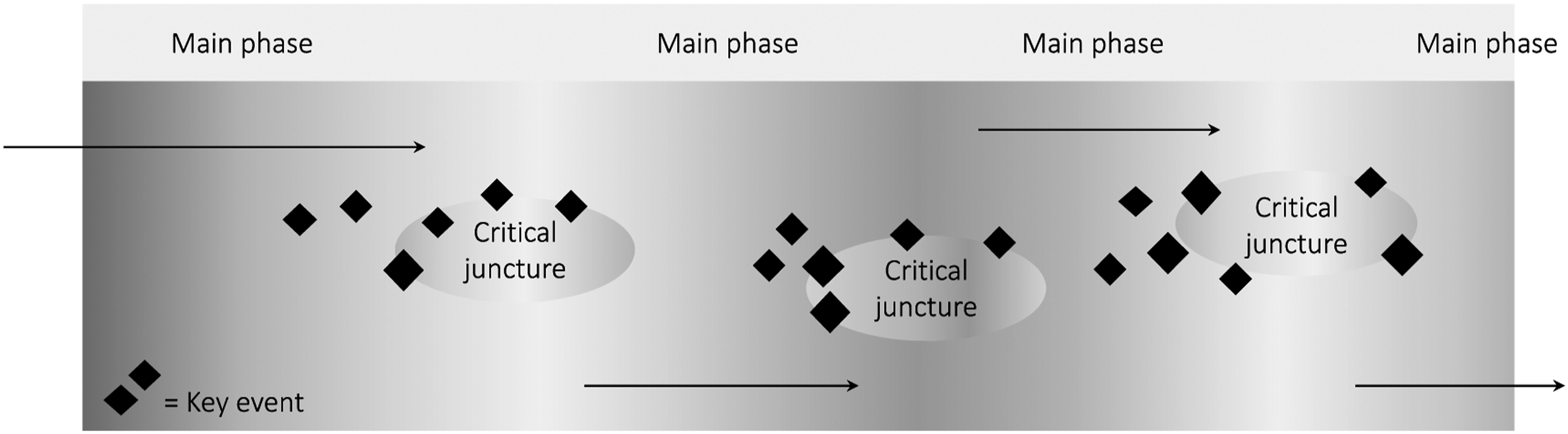
Identification of critical junctures is essential, as they suggest change processes opening to alternative paths. However, the concept of critical juncture is not suggesting that change should be approached as abrupt or synoptic. On the contrary, change is seen as gradual in path tracing, acknowledging that incremental modifications may lead to considerable discontinuity. We draw on Streeck and Thelen’s (2005) position that the most promising way to study change is to see it as gradual transformation (creeping change). But, of course, the actors often perceive change as dramatic and abrupt, not detecting the effects of slowly accumulating incremental changes, culminating in critical junctures. In some cases, it may be possible to identify critical junctures. Still, in other cases, a creeping change pattern may make it more challenging to detect them, incremental changes cumulating slowly in time, main phases sliding into each other and transforming regions gradually. One of the most intriguing questions in path tracing is how actors or extra-regional events orient paths towards something different. In path tracing, one of the main ambitions is to explain why and how a path pivoted in a critical juncture. To answer questions related to a pivoting path, we need to investigate the relationships among objects to see whether they are necessary or contingent, whether an object cannot exist without other objects or whether an object may arise with a particular event (Sayer, 1992).
Pierson (2004: 5) introduces four criteria to identify whether a system is at a critical juncture or not: (a) multiple equilibria – a variety of outcomes are conceivable; (b) contingency – several future events are possible, which cannot be predicted precisely; (c) timing and sequencing – temporal order of events is identifiable; (d) inertia – a new main phase is more resistant to change efforts than during a critical juncture (Pierson 2004: 5). Key events constitute processes, and identification of them is central in path tracing, as they either redirect a process or maintain the past path. Multiple key events lead to a critical juncture, some occurring before or after a critical juncture. A key event is an identifiable activity that allows predictions and inferences to be made about the actors performing the act (Makkonen et al., 2012).
3 Where to start, who the actors are?
This section continues the elaboration initiated in the previous ones by discussing two of the trickiest questions in path tracing: where to start the analysis and how to identify influential actors.
Obviously, path tracers need to decide the starting point in time and justify it (Bennet and Checkel, 2017), depending on what they attempt to explain. Path tracing may begin from a single critical event in time visible in the domain of empirical, something investigators or informants have perceived. Importantly, starting the analysis from an observed key event, a critical juncture or a main phase is just a starting point in the analysis; a proper path tracing exercise generates knowledge about the temporal dynamics in the domains of actual and real. In other words, it is not possible to begin the analysis from the domain of real. For example, in their analysis of the evolution of regenerative medicine in Finland, Sotarauta and Mustikkamä ki (2015) traced the path back in time starting from a key event, the clinical treatment applying for the first time in the world radically new technology. Another option would be to begin from a visible critical juncture, opening alternative paths (Pierson, 2004), for example, closure of an industrial plant in a specific location (e.g. Beer et al., 2019) or identification of main phases between observable critical junctures (e.g. Sotarauta et al., 2022).
One of the central questions in path tracing is who the actors on which to focus are. The assumption is that in regions and cities, and external to them, there are actors who have capabilities to, one way or another, work to break away from the past path and search for desired futures. Actors should not be selected based on the office they hold or high prestige in a region or decision-making bodies (Selznick 2011: 24). The key actors ought to be identified through the process; the influential agency may go beyond the formal positions (Sotarauta and Pulkkinen, 2011). Instead of focussing on individual actors, it is central to ask who influences whom and thus the sequence of events, and also, what are the relationships between key actors (key objects in the words of critical realism). As Bennet and Checkel (2017) remind, in the first phase of the analysis, there is a need to gather as much as possible data on observable activities, events and actors to outline the probable sequence of events. Drawing on the literature, path tracers may also hypothesise who the core actors might be in a specific context; it is possible to ask who should have been active, in what ways, allied with whom, and which actors should have known about the issues on the table (Bennet and Checkel, 2017). And then, in interviews, using a snowball method, it is possible to identify additional key actors, being aware of the biases of the method. Moreover, analysing secondary data is crucial to get a good initial grasp of the contexts. Again, a path tracer should not assume a priori what the context might be, as in many cases, the sequence of events is embedded in several contexts: political, business, academic and civic, crossing several administrative levels and spatial scales.
In sum, path tracing ought to (1) gather and triangulate experiences, observations and measurements of the empirical domain to (2) identify key events and critical junctures and construct event sequences to open a view to the domain of the actual; (3) identify dependencies in temporal sequences to add a temporal aspect to the domain of actual; (4) evaluate whether the relations between objects in different phases and critical junctures are necessary or contingent using substantive interpretation combining empirical, context and theoretical knowledge, and thereby gain insights about the causal powers and structures in the domain of the real; and (5) make a plotline visible, presenting a coherent temporal pattern integrating various causal powers and different forms of agency and explaining the outcomes of the identified process (integrating Poole et al., 2000 to critical realist thinking). This is a way to find sequential patterns, identify the (general) causal mechanisms at work and explain the particular outcome concerning the most plausible and coherent interplay of causal forces, thus embracing causal complexity (Furnari et al., 2020). Moreover, comparing several traced paths allows knowledge about the necessary and sufficient conditions for specific outcomes.
The observable narrative voice from the domain of empirical and thus details of moral context ought to be integrated into the analysis. Narratives essentially provide information on how actors see the world, how they perceive opportunities and limitations, and how they motivate their actions. As Langley and Tsoukas (2017) say, sensitivity to processes calls for capturing and understanding evolving experiences of many actors. The narratives capture experiences; a ‘common’ knowledge or understanding of what has happened and are therefore essential. Despite acknowledging the importance of narratives, path tracing does not subscribe to a constructivist perspective. Quite to the contrary, following a critical realist perspective, we differentiate between the real structures and causal powers, the actual flow of events resulting from exercising combinations of powers, and the experience of these events. As Jessop (2005b) reminds us, there is a difference between the ‘real’ material relations in the economy (and society) and our understanding of it. Our knowledge (common and scientific) is always limited and fallible. One outcome of path tracing is to ‘discover’ when narratives are out of sync with the ‘real’ causal processes or ‘actual’ events.
IV Structured narrative analysis informing path tracing
Being a mixed-method approach, path tracing draws on quantitative empirical evidence but is also dependent on bringing actors’ voices and experiences into the analysis. This section integrates structured narrative analysis into the toolkit of path tracing.
Narrative analysis is based on the notion that a story is a universal way for people to level with other people and expose their views to others; the narrative is the primary way humans process and convey information and their understanding in various collectives (Pinnegar and Daynes, 2007). Stories revolve around ‘and then what happened?’ (Herman, 2009). The ordinary life in regions, change processes in firms and other organisations and the academic literature on path development are filled with stories on innovation processes, creative individuals, successful organisations, groups, communities and leadership. In their way, stories reflect actors’ experiences, central features in a study of agency. Yet, despite stories’ power and imaginaries’ acknowledged importance in path creation processes (Miörner, 2020), economic geography or regional studies have not taken full advantage of narratives in empirical studies.
Narratives connect events, actors and actions meaningfully, revealing relations between them. They allow us to identify how actors make sense of the observable and make the process and the actors visible in the empirical domain. Consequently, we propose using structured narrative analysis to surface actors’ voices and experiences, connecting actors through their narrated experiences to an evolving path under scrutiny. A narrative analysis aims to render a sequence of events intelligible in one way or another. It conveys not just facts and information but also understanding and meaning to make a series of events into a temporal and intelligible whole (Kay 2006: 23).
Narratives are powerful forms of giving meaning to experience, but events do not present themselves as narratives. Through a series of experiences, a sequence of events becomes a narrative on path creation. All this reminds us that experiences are a central part of an evolving path manifested in the domain of actual, or as Herman (2009) puts it, a story-world-in-flux in the domain of empirical. Experiences provide the analysis with meanings to pressures of events for those actors undergoing disruptive experiences. The key events and critical junctures demonstrate disruptions in a story world, be it presented as fictional or actual, fantastic or realistic, fabricated or remembered, that is, world-making of actors (Herman, 2009). Consequently, narratives present the complexity and dynamics of path creation and causal powers directing them at their best. Also, they should identify how key actors act on generative mechanisms, construct them and adapt to them.
Narrative studies have evolved from using narratives as substantial resources to studying texts and storytelling as polymorphous phenomena in specific contexts (Hyvärinen, 2007). However, the ontological and epistemological commitments continue to divide scholars, including what is a narrative and what is not (Clandinin, 2019). The term ‘narrative analysis’ remains filled with inherent tensions in social research (Hyvärinen, 2008), which allows us to find our pragmatic way of using it. Usefully, Kay contrasts chronicle to the narrative, maintaining that chronicle is the primary material of narrative, chronological order of actions, events, critical junctures and main phases. In contrast, narrative reasoning produces a coherent story (with subplots) drawing on a chronicle or chronicles (Kay 2006). In both, chronicles can be used as data, sources of information being embedded in a particular context (Pinnegar and Daynes, 2007). When constructing chronicles, stories are used as data and analysed for thematic descriptions holding across stories or in taxonomies of types of characters, stories or contexts (Polkinghorne, 1995). In path tracing, it is possible to construct chronicles drawing on data from several sources, including subjective narratives, minutes from core meetings, development programmes and plans, numeric data, earlier studies, etc. The analysis moves from stories to themes and thus towards theoretical reasoning. In narrative reasoning, descriptions of events are collected and synthesised through a plot into stories or a story. This type of inquiry moves from themes to stories.
Applying Pentland (1999) and Herman (2009), we summarise, from the perspective of path tracing, the key features of a narrative analysis, which may be used as indicators in an empirical analysis. Situatedness – a mode of representation to be interpreted as a specific context for stories revolving around a structured sequence of given events Sequence in time – An indicator for patterns of events, using newspaper articles, policy documents, public sectors policies, minutes, other studies, etc. Key actors and their relationships – provide a thread by connecting agency to unfolding sequence of events and change in structures. An indicator for roles, networks, strategies of change and influence tactics. For this, there is need to identify key actors without a focus on formal positions or any pre-assumptions Identifiable narrative voice – It is central to identify a dominant coherent narrative and thus also core narrators, appreciating the fact that also other voices representing multiple points of view need to be identified and respected. An indicator for a perspective, social relationships and power Prevailing frame of reference, in other words the shared moral context. Narratives carry, explicitly or implicitly, standards against which actions and strategies are judged. Meaning and cultural value are the cornerstones of narratives, being consisted of narrator’s beliefs what is right and wrong, functional and suitable or dysfunctional and inappropriate. An indicator for cultural values and assumptions. This might also refer to the rationale(s) of the change agency and strategies Disruptions and complicating events are indicator for change. They are central in the telling a story, exposing both the normal and the conflicting modes of action. Disruptions reveal the patterns of path creation. (Applying Pentland 1999: 712–713; Herman, 2009)
Additionally, other indicators of content and context need to be analysed, containing different sorts of information that are not utilised in the actual analysis but point to contextual factors providing additional insight for path tracing. Additional pieces of information and indicators do not advance the identification of the plot but provide information that may be crucial in its analysis.
The stories we hear in interviews when studying path creation often comprise the central elements of a narrative: a plot, characters, theme, text, unexpected events, goal orientation, denouement, protagonists and antagonists. In addition, a narrative involves archetypal characters, decisive moments and symbolic markers (McBeth et al., 2005), usually culminating in broader learning, a moral of a story (Verweij et al., 2006). It is essential to keep in mind that narration is not driven by accuracy but plausibility. In subjective narratives, what becomes accurate is what makes sense, in other words, what is plausible in the light of earlier knowledge and experience (Weick, 1995). Therefore, we should not believe the stories or fragments presented to us during interviews as facts without verifying them with other sources of information and cross-analysing them with other narratives. Furthermore, it is important to remember that the analysis focuses on a sequence of events and actors central to them instead of individual facts or subjective narratives of individual actors.
A structured narrative to serve path tracing should specify structures, institutions and actors in each change process, identify the opportunities and constraints, and thus create explanations linking the causal powers of agency and structures to processes under scrutiny. Importantly, to secure the validity of a study, it is of utmost importance to carefully triangulate various sources of empirical evidence, integrating narrative data with other types of textual data (policy reports, media outlets, etc.). In this way, by collecting a variety of subjective narratives complemented with the facts and contextualised carefully, it is possible to come up with a valid and credible account of what happened, why, when and how, and which actors influenced the course of events. The primary purpose of a narrative analysis is to generate a coherent and logical narration of the sequence of events and related actions, not excluding the critical views pivoting from the mainstream interpretation. Additionally, it is central to describe the data collection and analysis process for a reader to assess the reliability and validity of a study.
In path tracing, the analysis of narratives is a methodological tool to learn more about the real structures and causal powers (mechanisms) explaining regional development processes. To be sure, we are not using narratives to examine how actors construct reality, as we do not subscribe to constructivism. In critical realist tradition, the main ambition is to identify what we can learn from actors’ stories, their constructions about process dynamics, structures and different forms of agency. Path creation is not a narrative, but there are many narratives in the context of a specific path creation process. Aggregating them unveils the collective bounded rationality framing change agency.
V Building theory from path tracing
The primary purpose of this section is to examine the central issues when building theory from path tracing.
Theory-building rests on substantive interpretation considering all empirical, contextual and theoretical knowledge (Rutten, 2021), and, therefore, path tracing potentially identifies many causal powers, not all anticipated, drawing on prior knowledge of the case and the theory. For this purpose, in constructing a theory, it is essential to cultivate the feeling of surprise to theoretically explain all sorts of facts (Bennet and Checkel, 2017). Alternative explanations encourage investigators to challenge their assumptions and theoretical constructions. In this regard, it is crucial to differentiate between explaining a particular regional development outcome, which is the focus of tracing particular paths, and the more generic structures and causal powers (mechanisms) making such an outcome possible (Bhaskar, 1997). Rutzou and Elder-Vass (2019) call the former stories of formation and the latter stories of causation. Drawing on critical realism, path tracing provides an approach to move from formation to causation, from identifying idiosyncratic stories to theory-building.
Formation stories explain a particular outcome in a specific temporal and spatial context. Such formation stories are often idiosyncratic as they describe why particular actor constellations emerge, what they did and why, the circumstances under which agency emerges and unfolds, as well as the outcome (the path) as a conjunction of events, including events on which local actors had no or little influence. Causation stories are about general causal claims that are not particular to the path traced. Instead, they refer to the real structures and causal powers (mechanisms). Moving from a solid formation story of an individual path to a causation story requires an interpretation of the findings concerning collected empirical material but also an existing theory and the existing body of knowledge. In that way, analytically traced paths can illustrate a (combination of) causal power(s) at work. This can be useful for theory-building if limited knowledge exists about the object of study (see for more, Rutzou and Elder-Vass, 2019).
Hassink et al. (2019) highlight the multi-scalar nature of path development and related multi-level governance, which led us to seek a methodology acknowledging causality does not operate only on one level. Meso-level theorisations are insufficient if they do not include a micro-level analysis revealing causal powers shaping the development patterns under scrutiny. Better integration of the analytical levels would serve us well in the efforts to theorise from case studies with causal complexity. In other words, to understand or explain meso-level phenomena, it is necessary to provide detailed accounts of micro-level agency, by which the interests and intentions of influential actors are imposed on path development. As Langley and Tsoukas (2017: 20) put it: ‘finding ways to dynamically explore the micro-foundations of meso- or macro-level phenomena, such as, respectively, for example, organisational capabilities and global changes in the form of the developments of standards, sustainability, community decline and regeneration, social movements, risks, etc., will add value to our search for a more holistic understanding’. We need to find ways to identify the routes connecting micro-level and short-time-span phenomena with higher-level and long-term evolution (e.g. industrial path development). In this way, path tracing supports configurational theorisation (Berg-Schlosser et al., 2009; Furnari et al., 2020), constructing theories on how combinations of structural and agentic factors come together in time and give shape to regional development patterns. Eisenhardt (2021) highlights the importance of explicit theoretical arguments (i.e. causal mechanisms or powers) answering to ‘why particular emergent relationships between constructs are likely to hold’. Constructing such arguments are the core of the theory-building, as they address the internal validity and logical coherence of the emerging theory.
Consequently, path tracing aims at constructing theories that capture the core features of the phenomenon under scrutiny, potentially being relevant beyond their immediate settings, and of course, are logically coherent (Eisenhardt, 2021). At its best, path tracing should serve assumption-challenging research, revealing and providing the regional development community with fresh conceptual lenses to approach familiar and still-unknown issues, reaching beyond formal policies or smart specialisation processes, for example. In assumption-challenging or path-setting scholarship mode, investigators need to span across analytical levels and theoretical frameworks in their search for new insights (Alvesson and Sandberg, 2013: 148).
As Alvesson and Kärreman (2011: 4) maintain, empirical material is a ‘resource for developing theoretical ideas through the active mobilisation and problematization of existing frameworks’. For them, ‘to problematize means to challenge the value of a theory as well as to explore its weaknesses and problems concerning the phenomena it is supposed to explicate’ (p. 15). In this way, empirical material serves as a ‘critical dialogue partner’ (Ragin, 1998) to construct logically structured, internally coherent and plausible theories (Astley, 1985, cited by Alvesson and Kärreman 2011: 26). Hence, path tracing points towards abductive reasoning, which enables us to simultaneously ask how the empirical data supports existing theories and how the data calls for modifications in them. Abductive reasoning relies on constantly bouncing between data and theories in searching for novel explanations or understanding of the issue under scrutiny (Kennedy and Thornberg, 2017).
A successful path tracing aiming to reveal the hidden order of path development calls for using a series of narratives in combination with other empirical material related to the processes under scrutiny. Nevertheless, it is essential that the objective of path tracing is not to explain the narratives per se. Instead, the analysis of narratives is a methodological tool to learn more about the real structures and causal powers (mechanisms) explaining regional development processes. Importantly, real structures and causal powers, and the actual events their interplay produce, may not be in sync with the narratives of local actors and discovering such discrepancies between narratives, real structures and causal powers, and actual development outcomes would constitute an advance in knowledge. For instance, before the Copernican revolution, the dominant narrative about the earth being at the centre of the universe was clearly out of sync with the real structures (cf. Bhaskar, 1997). Moreover, the 2010–20s politics have been flooded with fabricated stories, reminding us about Flyvbjerg's (1998) observation that power defines what is rational, not vice versa. Therefore, it would be an advance in knowledge to identify the causal power of narratives. For instance, the church used the Ptolemaic model of the heavens to underpin its authority. Narratives also enable and constrain action, regardless of who creates and tells them (Pentland, 1999: 721).
Path tracing is dependent on a diverse and independent body of evidence, a triangulation-based approach (see Bennet and Checkel, 2017). Therefore, the epistemological commitment of path tracing is that (a) by collecting a variety of subjective narratives, (b) triangulated with complimentary secondary and primary data, and (c) contextualised carefully, it is possible to strive to generate valid diagnostic evidence, demonstrating the qualities of a path. Triangulation allows cross-checking the causal inferences constructed on distinct data sources (interviews, media reports, policy documents, annual reports of organisations, minutes of public authorities, etc.). It is also important to acknowledge that some pieces of information are more probative than the main bulk of evidence; therefore, theorisation may be understood as disciplined imagination (Mills, 2000; Weick, 1995; Alvesson and Kärreman, 2011).
Path tracing serves individual case studies that are necessary as they cumulate our understanding of various development paths in different times and places. But, notably, individual case studies of paths are not suitable to build knowledge about the necessary and sufficient conditions making a particular outcome (e.g. diversification of the regional economy, integration of the housing market) possible. For this, comparative research designs are required, including several paths traced with variation in the outcome. Qualitative comparative analysis is one way to deal with a more significant number of comparative cases, each ideally studied in-depth (Rihoux and Ragin, 2009; Rutten, 2021; Grillitsch et al., 2022). The move from a set of formation stories to causation stories using comparative design typically requires a solid theoretical understanding of identifying the key structures and causal power for an outcome of interest. This is necessary for specifying the conditions entering the analysis and for the analysis of the results. Bringing insights from traced individual paths and comparative analysis across set of paths in a dialogue with existing theories and bodies of knowledge is a promising way to develop further theories and knowledge about real structures and causal powers, that is, advance causation stories and build theories of them.
VI Conclusion
The increasing number of path development and path creation studies indicates a collective effort to move towards more dynamic ways of understanding regional development phenomena and their temporal and spatial interconnections (e.g. Martin and Sunley, 2022). The proposed methodological approach – path tracing – is a process-oriented way of enquiry aiming to reveal the dynamics of evolving sequences of events and related narratives, thereby developing an understanding and explanations of the causal powers through which agency affects development at the meso-level, for example, regional development. Even though path tracing is looking back in time, its goal is to produce dynamic models and theories that would provide additional analytical leverage to understand future-oriented development processes – path creation here and now.
Importantly, exercising agency makes specific outcomes possible, yet it does not necessarily lead to aspired outcomes because regional development, as any social process, is an open process influenced by many potentially influencing conditions (Storper, 2011). Path tracing is thus a methodology that aims to create knowledge about agency as a causal power, scrutinising its intended and unintended outcomes. Path tracing considers intervening conditions, such as specific regional preconditions or extra-regional forces, as well as the conditions that tend to promote the activation of agency; this is to say, make people act. Path tracing is geared to support enquiry of structures and agency in time instead of studies focussing on single policies, institutions, organisations or actors.
Path tracing takes time seriously, aiming to reveal how myriad intentions and associated contradictions and tensions shape and drive patterns of change over time. Therefore, by sharpening the empirical focus on the focal phenomenon, mitigating alternative explanations and enhancing generalisability (Eisenhardt, 2021), the primary purpose of path tracing is to make sense of a complex configuration of actors and conditions, which in combination cause the development of a path. For this purpose, path tracers systematically operationalise and theorise processes. They segment and stabilise them for empirical analyses. Path tracing is by nature ‘configurational’, as it explores paths and related processes after the fact, typically starting with a particular outcome and going back to seek how it emerged (see for other types of process analysis, van de Ven et al., 2000).
Most importantly, path tracing is developed to assist theory-building and move beyond developing a conceptual framework at the outset of a study and then accommodate empirical findings accordingly. Path tracing is an approach for carefully documenting the data and thus revealing theoretical gaps and inconsistencies, a significant step in revising theories or building new ones. The value of richly theorised mechanisms of change is central in path tracing as multiple causal pathways may lead to the same outcome (Bennet and Checkel, 2017). Furthermore, activating the same causal powers may lead to different outcomes due to non-observed intervening conditions (Bhaskar, 1997). Consequently, a sense of possibility is one of the cornerstones of this type of analysis (Kay 2006: 60). In other words, path tracing tries to uncover which combinations of human agency, structural preconditions and intervening conditions make an outcome possible and, in this way, it embraces causal complexity and configurational theorising (Berg-Schlosser et al., 2009; Furnari et al., 2020).
We add to the literature on path creation and change agency, economic geography and regional development, and more broadly on socio-economic development in a temporal and spatial context, by focussing on methodological advancements required to study the role of human agency, and the causal powers at play in change processes. We explored the understudied links between structure and agency by opening one potential methodological avenue for a study of it. The novelty of this contribution is that it brings together process tracing and structured narrative analysis embedded in critical realism, in conjunction constituting what we labelled as path tracing. We drew from organisational and management studies and political sciences to advance it.
But, we need to be precise; we are not advocating that agency at a particular scale (e.g. local) is the sole cause of changes or the determinant of path creation. Instead, we argue that by studying unfolding processes and focussing on the interplay between agency and structure, we may gain additional analytical leverage in our efforts to understand the dynamics of development across spatial scales and governance levels. The better we understand continuously evolving paths and process dynamics, the ways agent-based and structural explanations come together in time, and the more we will be empowered to shape our future. In other words, we will increase the agency of policy makers and practitioners at multiple levels through an understanding of process dynamics.
Footnotes
Declaration of conflicting interests
The author(s) declared no potential conflicts of interest with respect to the research, authorship, and/or publication of this article.
Funding
The author(s) disclosed receipt of the following financial support for the research, authorship, and/or publication of this article: This work was supported by the Länsförsäkringar Alliance Research Foundation, Sweden (No. 2017/01/011).
