



Abstract
Place is a concept that can hardly be formally captured at the moment, as it is unclear how instances of places can formally be represented and how conclusions about places can practically be drawn by technological means. Geographical Information Science scholars hence tend to use the term ‘Place’ even when, in fact, they presume a paradigm similar to the one assumed for Geometrical Space. As a result, Space and thematic information is mostly treated separately, and the richness and variety of Place descriptions in terms of identities, affective states, affordances, and further aspects that have been discussed in Geography since a long time are not (yet) reflected well in corresponding discussions in Geographical Information Science. This article reviews the ongoing debate and outlines directions of how to extend it much beyond the currently assumed spatial paradigm towards platial information. Thereby, possible approaches and future prospects as well as limitations of Theories of Platial Information and Platial Information Systems are explored. The agenda laid out and discussed in this article aims to set a frame of reference for a re-focussing of the ongoing discourse on platial information and stimulate future developments towards a Platial Information Science.
Keywords
l Introduction
The various geographical Place 1 concepts seek to capture how we ‘live’ Space. While some disagreement in what makes a place exists, most of these concepts describe places by the integration of the individual perception and action with societal influences and beliefs. Thereby, places are often characterized in terms of routines and recurring patterns, in terms of the sense of being in a place, and in terms of the identity of a place. These characterizations are closely linked to everyday geographies and appear relevant even far beyond the realm of scientific discourse. Especially in times of ubiquitous Internet access and mobile devices, which offer automated ways to deal with data at a large scale, the formal representation of and reasoning with places deserves attention.
Scholars in Geographical Information Science and cognate fields have explored approaches to represent places in diverse ways. Among others, several workshops and symposia about platial 2 information are taking and have taken place, 3 and several Special Issues have witnessed lively activity in the context of Place concepts and the representation of Place. 4 Yet, these activities restrict to a limited set of characteristics and have not yet led to a sufficient, holistic understanding of how to deal with platial information, as becomes apparent at the example of the Café Central, a Viennese coffee house, which is discussed in a later section in more detail. How can the particular atmosphere and spirit of this coffee house and thus the way it is different to all other coffee houses be captured by formal means? What is the sense of place we get when being in the Café Central? While the gap between what we know about Place concepts in Geography and the Social Sciences and the way we are able to capture these concepts by formal means becomes obvious in the light of this simple coffee house example already, it needs to be acknowledged that attempts to formally represent places are necessarily limited due to the complexity of Place concepts. Still, in view of the many Geography and Social Science publications in the context of specific places and Place concepts in general, it seems surprising that Geographical Information Science scholars have not yet developed stronger ties to the concepts of these disciplines.
In the light of the discussed gap between the geographical Place concepts and the formal means to represent places and their qualities, 5 the question arises as to how future attempts could successfully approach this issue. When accepting that such attempts should be considered a pragmatic endeavour, it suggests itself that they should be guided by the questions we target to answer in real-world situations, and that the lack of progress is due to the fact that we are not yet able to formulate the right questions. The currently ongoing discourse is for the most part guided (and thus limited) by the concepts that currently dominate in the context of Geographical Information Systems (GISs; for currently dominating concepts, cf. Kuhn, 2012). A re-focus on the geographical concepts of Place can help widening the ongoing discourse about platial information and guiding it towards a better understanding of which questions and qualities are relevant.
This article aims to set a frame of reference for upcoming attempts to represent places by formal means and to operationalize these representations. After highlighting the societal relevance of platial information as a motivation for the further discourse (Section II), existing approaches to platial information are discussed. More specifically, the concepts of Place that have been introduced in the context of Human Geography are briefly summarized (Section III.1) to then set into context the various research directions related to platial information (Section III.2). Subsequently, the gap between the geographical concepts of Place and current approaches to platial information is illustrated at the example of the Viennese Café Central (Section III.3); and current approaches to platial information are critically reflected to understand better what is yet missing in the ongoing discourse (Section III.4). Then, the basic notions of Theories of Platial Information and Platial Information Systems are introduced; how they relate to and build on geographical concepts of Place is discussed; and it is outlined how these theories and systems must be set apart from existing approaches and paradigms (Section IV). Based on the concepts of Theories of Platial Information and Platial Information Systems, the various challenges associated with their development are examined. In particular, it is argued that they have to deal with the high complexity inherent to platial information, reflect intrinsic and emergent qualities in multifaceted ways, and suffer from not being able to adequately convey embodied experience (Section V). In favour of this critical discourse, we deliberately refrain from pointing out possibly premature solutions for the representation of places and corresponding reasoning in the course of this article. Instead, ways to classify and assess such theories and systems are explored (Section VI). Finally, future research questions are discussed based on the work presented, and future prospects are outlined.
ll The importance of platial information
This section addresses the social and individual relevance of Place, because it is this relevance that motivates the study of platial information. Places are virtually everywhere. They constitute geographies and shape our everyday life. They are referred to in mundane language and are relevant to many practical tasks. We organize life by thinking and feeling about places. They are idiosyncratic in general but can be shared or even emerge through societal action. They are identity-forming, but can also lack an identity. The list of examples could be continued indefinitely.
The ubiquity of places illustrates their importance for many of our mundane and non-mundane activities. However, the high relevance of platial information does not follow from this fact alone, because the necessity of a formal representation is not only based on the importance of places themselves. Rather, the strong demand for such information is the main reason, which is evident in written and artistic communication and in the use of substitute concepts. Examples for the former are travel guides and travelogues, mundane narratives at the lunch table or in the bar, coffee-table books, and holiday photos; while examples for the latter include geometries represented in a GIS, places and routes in maps or in the timetable, place-name signs and addresses, which stand for places without being places themselves. These are some of the many examples.
When places are designed, as is common in urban and spatial planning, geometries are often used as a proxy for them. This often works surprisingly well but can only be an approximation of places. If we used representations of places instead of geometries together with corresponding software, the result could be expected to align better with human thinking and the planner could receive more support. This is symptomatic and could easily be applied to further examples, such as a person planning a route and route planning software, the parking spot seeker and the parking spot app, and so on. In the end, however, it is the societal developments that significantly improve the possibility of representing places and thus render replacement concepts superfluous, significantly simplify the use of these technologies, and ultimately create ever new application scenarios. In the following, we will briefly discuss these developments.
Our societies strive for more and more individuality and an ever-increasing range of information in our everyday lives (cf. Graham and Shelton, 2013; Kitchin, 2013; Miller and Goodchild, 2015). Mobile devices and, to a certain extent, wearables such as digital watches and glasses play an increasingly important role. Also, software is increasingly expected to provide personalized responses, not least in the case of Intelligent Virtual Assistants (IVA) and maps adapted to the purpose of its use. In the context of these technologies, there is a growing need for human-centric solutions rather than those that are adapted to the machine. It is not humans who should adapt – according to the currently prevailing opinion – but the machines as technological possibilities increase. This is not least evident in Smart Cities, which adapt to humans and their expectations. As humans are strongly oriented towards place and because the latter aligns well to individualized and personalized needs, place-related aspects become increasingly important and have, at least to a certain extent, found their way into the technologies mentioned.
The desire to understand ever more complex circumstances of mundane life is growing, and so is the complexity of the data available. The data collected by mobile devices and Big Data illustrate this well, because they relate to places in diverse ways. Not only the available data but also societal views and actions reflect the important role of information in the understanding of the complex circumstances of mundane life. Volunteered Geographic Information (VGI) and Participatory Geographic Information (PGI), Citizen Science, and further types of crowdsourced information show how strong the interest is not only in consuming but also in contributing to place-related data both on the individual and the collective level (cf. Mocnik et al., 2019). Similar reasons propel the study of digitization in the Social Sciences as well as the Digital Humanities.
In the long term, platial information is of great importance for addressing the Sustainable Development Goals (SDGs), because they are expressions of experienced and often socially constructed space. Without a good understanding of how we organize our living together in terms of place and place making, sustainable urban environments with respect to climate change are, for instance, hard to achieve. Climate change will alter existing places and their perception, and it can be expected that rising sea levels and climatic conditions will have a greater impact on the design of places. Generally, mental health and well-being strongly depend on the way we shape places and our spatial environment. Further, places are often abused to create barriers between people, but they can also be used to shape our society towards equity and equality in various aspects. The coexistence of different religions in Jerusalem, for instance, leads to conflicts the peaceful solution of which strongly depends on how people live together in one place – think of places like Mount Zion, the Temple Mount, or the Chapel of Ascension. These examples demonstrate well the impact places as geographical features have on the progress towards the SDGs and why corresponding information is relevant to the design and transformation of places in relation to the SDGs.
lll Existing approaches to platial information
The nature of platial information and the way it can be used has been subject to many research activities. In this section, we discuss such past and ongoing approaches to Place via the lens of Information Theory and cognate fields. First, we briefly summarize the geographical concepts of Place to then review related research in Geographical Information Science. As we then illustrate using the example of the Viennese Café Central, places are complex entities and their representation challenging, which is why current means of representation quickly reach their limits. To explain this, we critically examine the scientific discourse and identify corresponding flaws.
1 Geographical concepts of Place
Place as a concept has long been investigated by Geography scholars, such as Hettner, Vidal de la Blache, and Hartshorne. While, in particular for Hettner (1905), Place (‘Örtlichkeit’) served merely as the minimal geographical unit that represents sufficiently well geographical context, later scholars have built a more detailed understanding of Place. Based on the wide range of characteristics inherent to places, a number of
In Humanistic Geography, places are conceptualized as self-contained geographical entities that shape our lives and render possible the way we live them in our contemporary societies. Tuan (1977, 1979), one of the pioneers in this school of thought, discusses the ways individuals feel about and build personal relations to places. The ways we experience these feelings and personal relations (‘sense of Place’) and the resulting emotional bond (‘Place attachment’) were discussed by many and in various contexts (e.g., Agnew and Duncan, 2015; Duncan and Ley, 1993; Kyle and Chick, 2007; Low and Altman, 1992; Smith, 2017; Tuan 1977), as well as the opposite, the absence of a sense of Place or of Place attachments (‘placelessness’; Relph, 1976). The sense of Place is thereby considered to be based, among other things, on the daily routine and behaviour patterns in a place (‘Space ballet’; Seamon, 1979; Seamon and Nordin, 1980). This understanding of Place has even influenced scholars beyond Humanistic Geography, such as the philosopher Malpas (1999) with respect to the experience of Place, the architect Dovey (2010) with respect to places as socio-spatial assemblages, and environmental psychologists (see Lewicka, 2011; Scannell and Gifford, 2010).
Critical Geography scholars have criticized the humanistic concept of Place. Harvey (1994, 1990) questions any absoluteness of the concept of Place and shifts the focus to the social construction of places and their resulting relational nature greatly influenced by capitalist mechanisms in Western societies. Thrift (1999, 2008), in turn, focusses on the embodied experience of places rather than their representations, a position common in Non-Representational Theory and Poststructuralism in general.
Due to the succinct nature of this text, the diversity of Place concepts cannot be presented in detail. The esteemed reader is referred to works by Cresswell (2004) and Agnew (1993) for a more thorough overview of these concepts, as well as to a work by Couclelis (1992) for a discussion of how Place relates to cognate concepts, including location, region, and space.
2 Research on platial information
Current approaches to formalizing Place and gaining a corresponding conceptual understanding of platial information can be found in Geography, Geographical Information Science, and cognate disciplines, such as the Cognitive Sciences, Environmental Psychology, and Linguistics. In this section, we summarize about the progress being made in these fields and set the various approaches into a common context.
The existing research can broadly be divided into three research strands.
6
The first of these strands deals with the
Further research has explored the wider context of the concepts of Place with the aim of establishing more comprehensive means to deal with these. To establish such a way of thinking, Hamzei et al. (2020) and Wagner et al. (2020) have reviewed the various concepts that are borrowed from Geography and re-used by Geographical Information Science scholars in many different ways. In addition to these concepts and by referring to existing vocabularies and ontologies, Ballatore (2016) has explored future prospects of ontologies of place, that is, the semantic setting in which Place representations operate. Acknowledging the variety of shortcomings that current means to platial information have, Purves et al. (2019) propose to re-use existing concepts of Place.
Another research strand focusses on the
Qualities of places have been considered not only individually, but also in context. The number of publications that treat such combination of aspects is, however, yet modest. For instance, Vasardani and Winter (2016) and Vasardani et al. (2016) have explored how previous works of Christopher Alexander can be utilized to understand which qualities of a place are specific to it. Besides the description of existing places, Iosifescu Enescu and Hurni (2018) and Iosifescu Enescu et al. (2020) have focussed on the qualities places can have in dreams.
In contrast to intrinsic aspects of places, also the relations to other places or geographical entities have been examined with the hope to understand the place itself better. As an example, Richter et al. (2012) have explored hierarchical, sequential, and other relations between places, which they extracted from Place descriptions. Likewise, Wu et al. (2019) have investigated hierarchical relations of places based on their location in Space; and Acedo and Johnson (2020) have approached the description of a place by investigating its relation to regions. This is in contrast to other scholars like Chen et al. (2018a,b), Hamzei et al. (2018), Kim et al. (2015, 2017a,b), Kremer (2018), and Zhu et al. (2020), who have examined how similarities between places in terms of their qualities can be used to represent and describe a place, thereby often employing a relational language. The resulting networks, often referred to as ‘Place graphs’, consist of places as nodes and spatial and thematic relations as edges. Winter and Freksa (2012) have even taken another approach to representing and characterizing places: instead of examining similarity relations, they describe places in contrast to other ones.
A third research strand investigates
Besides the text medium, visual media have been investigated. As places comprise spatial aspects, it suggests to explore in which ways places can be represented in a map. As traditional cartography is, however, more suited for conveying spatial phenomena, new cartographic means have been explored by Harvey (2020), Westerholt et al. (2018a), Vaughan (2018), and Gröbe and Burghardt (2018). As places are an essential part of stories and narratives, Mocnik and Fairbairn (2018), Caquard and Cartwright (2014), and Tateosian et al. (2020) have specifically investigated how cartographic means can be adapted to better reflect the ways places make a story. To set textual and cartographic representations in a common context, Mocnik and Fairbairn (2018) have even discussed their structural commonalities and differences. As an alternative to media that aim to convey factual knowledge, more artistic approaches to Place representation have been examined by Smith et al. (2019) and Casey (2002). Finally, the possibilities opened up by Volunteered Geographic Information and User Generated Content have been explored by Mayer et al. (2020), Ballatore and De Sabbata (2020), and Calafiore et al. (2018).
Remarkably, there are surprisingly few publications that provide a broader overview of existing research and future prospectives about platial information. Even if some of the publications referenced before touch upon different aspects related to platial information, they usually put a particular focus on one of these. An early overview of research perspectives has been provided by Goodchild and Li (2011) and Goodchild (2011). A review of existing means to address platial information has been published by Merschdorf and Blaschke (2018).
Besides the three research strands outlined, research about platial information reaches far into fields cognate to Geographical Information Science, such as Psychology and Cognitive Science. For instance, Davies (2020a,b, 2018) has approached conceptual aspects of platial information from a cognitive perspective, including ‘Place-based information systems’. In addition, several scholars have discussed aspects of Place from a cognitive perspective. Among these are Stedman (2002) who has explored how to measure the sense of Place in a survey; and Gao et al. (2017), Montello et al. (2003), Hobel et al. (2016), and Jones et al. (2008) who have approached the spatial aspects of places by Cognitive Science methods, because these aspects are often hard to capture. Further, Twigger-Ross and Uzzell (1996) have discussed how places can support the formation of a social identity, which is in addition to the identity of the place itself. Also, Cognitive Science aspects reach far into Linguistics. As part of the ongoing discourse, Tenbrink (2020) has outlined current opportunities and future prospects of linguistic platial cognition research. Finally, Mayer et al. (2020) have discussed the impact shared mental models have on how we represent places.
3 The example of the Café Central
The question of whether current approaches to platial information provide adequate means for representing places is pivotal for the nature of the future discourse. Current approaches often fit well the notions used in Geographical Information Science (cf., e.g., Purves et al., 2019), but it remains unclear how well they are able to capture the quality and essence of places in terms of the geographical Place concepts. This section addresses this question by investigating the example of coffee houses, a particular type of Place that illustrates well the gap between what we know about places and about Place concepts, and how we are currently able to formally capture places. It should be noted that due to the complexity of such places only selected aspects can be discussed here.
After their emergence in the 17th century in Europe, coffee houses have served several roles in society. They have been places of encounter and encouraged the exchange between intellectuals, writers, painters, and other artists time and again. Thereby, coffee houses did and still do facilitate the spread of information, for example, through offering newspapers and magazines as well as through discussions taking place. Coffee houses can thereby act as ‘third places’, that is, places, besides one’s home and workplace, often visited and accommodated to (Oldenburg, 1989; Tjora and Scambler, 2013). Influential traditions of coffee houses can be found in England (Clayton 2003; Cowan 2005; Ellis, 2004; Grafe and Bollerey 2007), Paris (Grafe and Bollerey, 2007; Rittner et al., 2013), Italy (Rittner et al., 2013), and Vienna (Ashby et al., 2013; Grafe and Bollerey, 2007; Rittner et al., 2013; Segel, 1993). The complexity of how we conceptualize coffee houses as places, including their societal role, becomes apparent at the example of the Viennese Café Central (Figure 1). In 1926, one of the pioneers of the Wiener Moderne, Alfred Polgar (1983),
7
described the social meaning of this particular coffee house in his own subjective view: The Café Central is indeed a coffeehouse unlike any other coffeehouse. It is instead a worldview and one, to be sure, whose innermost essence is not to observe the world at all. […] there is nobody in the Café Central who isn’t a piece of the Central […] Whether the place adapted to the individual, or the individual to the place, is a moot point.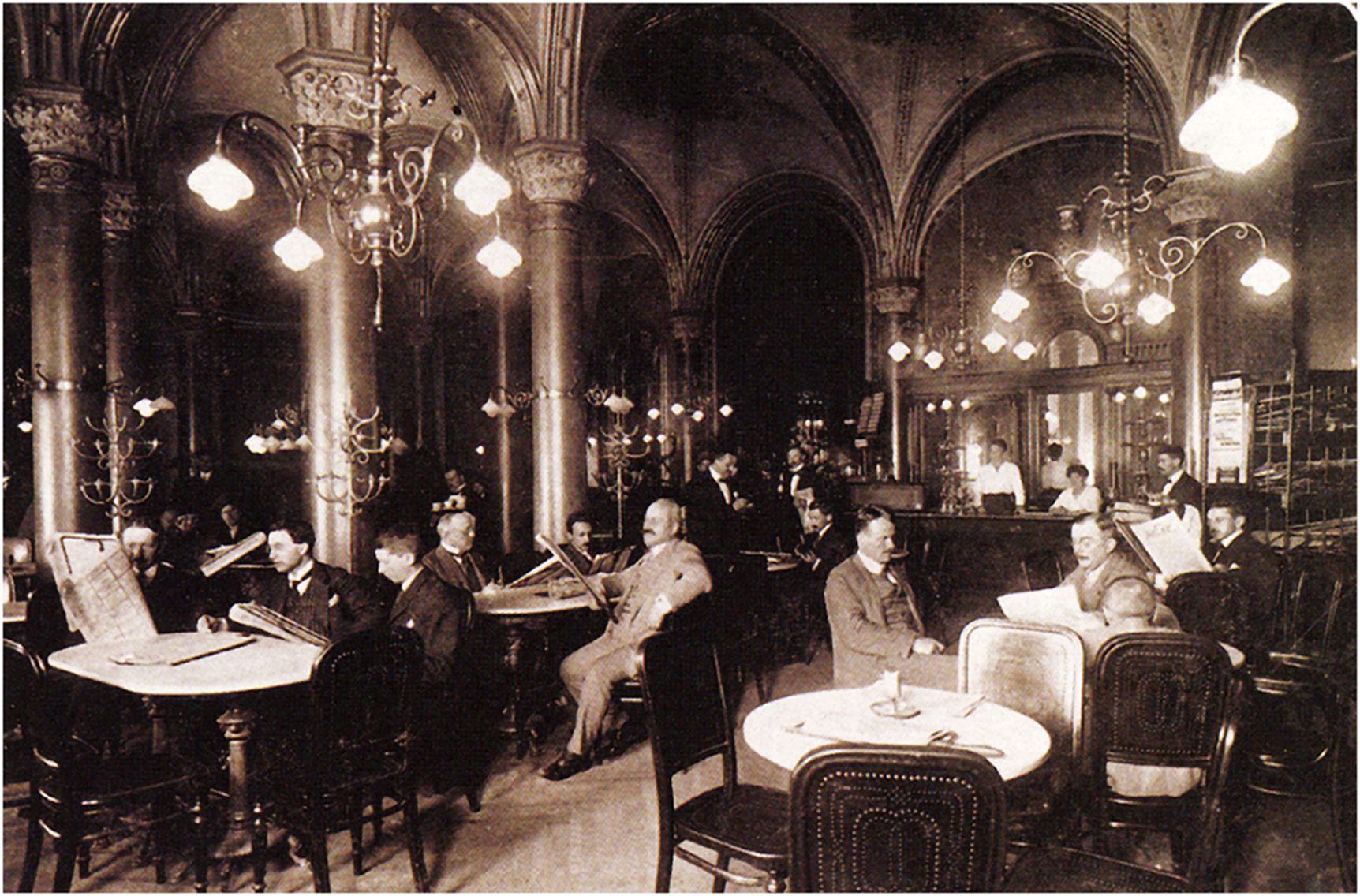
Despite the richness of this description, it starts with two aspects that appear familiar in the context of Geographical Information Science: a toponym as a reference to the particular coffee house, which could be stored as a text or as a (unique) identifier in a database, and the semantic category of a coffee house (cf. Jones et al., 2008; McKenzie et al., 2018). However, the substantial elements of this description can currently not be represented. This can be seen by the fact that the uniqueness, here described as ‘unlike any other coffeehouse’ (Polgar, 1983), can only be formally enforced by the identifier but not be substantiated in terms of a representation of the place’s qualities.
Interestingly, this first part of the description lacks any kind of reference to the location of the coffee house. At least the association with the place of Vienna becomes obvious when Polgar (1983) later speaks of the ‘Viennese latitude at the meridian of loneliness’, without, however, naming the exact location and the layout of the coffee house in more detail. Spatial aspects thus seem to play only a subordinate role in the characterization of this coffee house. This is despite the fact that existing Geographical Information Science literature puts a major focus on abstract space and locational aspects.
In a later part of the description, in which the location of the coffee house is indicated as discussed previously, Polgar (1983) goes on to describe the particular atmosphere of this coffee house, thereby capturing how deeply rooted the role of the Café Central is in its visitors’ lives: If all the anecdotes related about this coffeehouse were ground up, put in a distillation chamber and gassified, a heavy, iridescent gas, faintly smelling of ammonia, would develop: the so-called air of the Café Central. This defines the spiritual climate of this space, a quite special climate in which unfitness for life, and only this one, thrives in full maintenance of its unfitness. […] The Café Central lies on the Viennese latitude at the meridian of loneliness. […] Helpfully, the coffeehouse steps in as an ersatz totality, inviting immersion and dissolution. […] It is a place for people who know how to abandon and be abandoned for the sake of their fate, but who do not have the nerve to live up to this fate. It is a true asylum for people who have to kill time so as not to be killed by it. […] The Café Central thus represents something of an organization of the disorganized.
This section of the description conveys a vivid impression of what defines Café Central at its core. In contrast to the ostensible function of being able to have coffee at one of the tables, perhaps in company, and thus to enjoy a few minutes of peace in a social atmosphere, a more complex picture is provided here, which refers to characteristics that go well beyond the self-evident. The formal representation of the function and the affordances of the coffee house may be possible to a certain extent (cf. Papadakis et al., 2020; Purves et al., 2019), but it will not be able to explain why Polgar preferred this particular coffee house. Most notably, the description given is more than a list of objects, functions, and affordances. It conveys an identity that is obvious to the visitor of the coffee house but yet so complex and unique that it eludes a short and formal description. It refers to emotional and affective states such as ‘loneliness’ and explains their role in the being of this particular coffee house. And it describes Polgar’s individual experience of this place, which is even difficult to put into words. Only the context of metaphors and seemingly insignificant facts seems to provide an accurate description of this particular coffee house.
The description, like the coffee house itself, is characterized by an idiosyncratic point of view. The individually experienced sense of place and corresponding Place attachments, which are portrayed as particularly intense with the help of the metaphor of the gas, could with current means formally be represented in its strength but not in its nature. Also, hierarchical relations could reference similarities in the sense of mereology, for example, by forming part of Wiener Moderne and its in many respects socially constructed modes of creating, but it remains unclear how the essence of this place – what distinguishes the Café Central from other coffee houses – can ultimately be captured to a sufficient degree without iteratively explaining it through further mereological relations.
Going beyond these previous considerations, the Café Central can be described relationally in further ways. It would be plausible to name the visitors of this coffee house in the above description, as well as to record their presence in the coffee house in detail by means of personalized Space–Time prisms and their interaction by means of sketched seating arrangements in order to then represent human interaction as a network (cf. Miller, 2007; Tang et al., 2020). It does not seem impossible to grasp the existence of a social identity by means of such a network, but the possibilities this opens up seem limited as they do not do due justice to the complexity of Polgar’s description. Personal recommendations to visit this coffee house can be generated from the knowledge of the circle of friends of the person in question, but the question arises to what extent this characterizes the Café Central per se.
Social Media may provide access to a rich text and image-based description of a place, but this description is not readily available to methods of formal inference. The similarities and contrasts between the Café Central and other coffee houses described in Social Media provide context to the Café Central (cf. Hollenstein and Purves, 2010; Westerholt, 2019; Comber et al., 2018). Until these similarities and contrasts can, however, be fully represented and analyzed by formal means, the essence of the Café Central remains yet hidden from formal views.
Already this short excerpt of Polgar’s description contains a multitude of concepts that cannot be represented in GISs and that currently used means of formal representation cannot capture, as has been argued. Any attempt to do so would hardly do justice to the true essence of this place as described by Polgar, especially because the description is rooted in the societal climate of Vienna at that time. This impression is reinforced through studying books (Ashby et al., 2013; Clayton, 2003; Cowan, 2005; Ellis, 1956, 2004; Grafe and Bollerey, 2007; Tjora and Scambler, 2013; Rittner et al., 2013; Segel, 1993) and further publications (e.g., Bar-Tura, 2011; Broadway et al., 2018; Montgomery, 1997; Sadler, 2011) about the role of coffee houses, and it also applies to many further examples of places.
4 A critical reflection of current approaches to platial information
The example of the Café Central illustrates well how challenging it is to represent places in appropriate ways, as has been discussed in the last section. This is despite the progress that is being made in Geographical Information Science and cognate fields towards a conceptual understanding and formal description of places. The present section ties in with this observation by being dedicated to the question of why there is this gap between the current means to represent places and what is needed to represent places in more adequate ways. To identify corresponding reasons, we critically reflect the predominant lines of thought in the ongoing discourse and their limitations, without, however, critiquing single publications.
The approaches to platial information referenced in Section III.3 provide solutions only within the context of their respective domains. It remains unclear to what extent the flaws outlined above can be addressed to eventually better understand and represent places as well as be able to draw appropriate conclusions about places. At the very least, a general strategy seems to be lacking and it appears questionable whether the approaches pursued so far can, in their current form, jointly lead to a suitable treatment of platial information.
lV Theories of Platial Information and Platial Information Systems
After the critical review of existing approaches to understanding platial information, the following sections are committed to future research perspectives. To provide the necessary framework and thus create common grounds for the intended discourse, we discuss in this section how theories and computational systems related to platial information can be conceptualized and integrated into the broader context. In particular, we define the notions related to theories and systems in the context of platial information and discuss how these build on the geographical concepts of Place.
1 Theories and systems
The treatment of platial information in Geographical Information Sciences is currently still contradictory. Geographical views of place require holistic approaches that reveal the essential of a place in the interplay of its various qualities, while current approaches deal with individual qualities and often with respect to geometrical concepts. To resolve this dichotomy, it seems paramount to be clear about the conceptual objective. What should our means to treat platial information then look like?
The starting point for corresponding considerations could be the observation that places, like other geographical concepts, afford mental reasoning. We are able to argue which place we are in; we are able to describe in detail what is characteristic for a particular place; and we are often able to outline what distinguishes two places. Such mental interpretation, reasoning, and inquiring is possible because places are fundamental to our lives, making it necessary to argue about places with ease and adapt our mental reasoning capabilities to this context. The geographical discourse goes far beyond such ‘naïve’ approaches of everyday life. It is able to reason about a large number of places and in more complex ways by doing field work, conducting surveys, and carrying out interviews. Formal and computational approaches to Place are certainly limited in many aspects, but they can potentially support in drawing conclusions when the number of places or their complexity exceeds what we can handle with existing geographical methods.
Can and should future considerations, therefore, focus on solving practical problems? Based on the fact that the discourse is in the field of Information Science, this question needs to be answered in the negative, because first and foremost the discourse should also be about what constitutes the nature of platial information. However, since information serves the genuine function to convey mental concepts, a theory about the nature of platial information must also describe process-related aspects. In the context of formal means to address platial information, we thus introduce the term
The practical implementation of a computer-based information system based on a ToPI should be distinguished from the latter. For both sometimes have different intentions and possibilities at their disposal. The theory lays theoretical foundations and facilitates formal considerations, whereas a system supports the practical processing of large amounts of data and thus provides answers to complex questions based on heterogeneous data. The question arises whether Geographical Information Systems are able to serve for that purpose already.
In its current form, Geographical Information Systems focus on spatial aspects and their attached thematic information, 8 which is why it would make sense to term them Geo-Spatial Information Systems instead. These do not only handle geometries with attached attributes at first hand, but also the operations implemented in these systems target geometries and spatial aspects for the most parts. The literature provided in a review article by Merschdorf and Blaschke (2018) demonstrates well that basically the same concepts found in a GIS are re-used to address platial information practically. It summarizes that ‘[…] place incorporates not only spatial aspects, but it is also invested with meaning’ (Merschdorf and Blaschke, 2018). Further, place ‘is still anchored within a spatial definition […], making it inherently derivative of space’ (Merschdorf and Blaschke, 2018). Space seems to be the grounds on which current approaches to practically deal with platial information are usually build (cf. Section lll.4).
In order to demarcate the perspective of an information system for platial information presented here from such previous mostly space-emphasizing approaches, we will employ the term
2 Place concepts in Information Science
While the existence of Place is beyond question – they are among the fundamental units of both our lives and of modern Human Geography – there exist a number of concepts to understand these. Among the fields of enquiry that naturally engage into such concepts are Geography, because places constitute geographies; Geographical Information Science, because it concerns formal representations of geographical entities; Linguistics, in particular the Philosophy of Language and Computational Linguistics, because it reflects the way we create and use concepts; Psychology and Cognitive Science, because they examine how we react to our environment; Sociology, because it attempts to explain the social construction of places; and Philosophy, because it reflects about the fundamental units a place is constituted of. In the light of the various coexisting concepts of Place that dominate the scientific discourse, this section discusses their role with respect to ToPIs and PISs. For ultimately, these theories and systems facilitate different types of insights and task-related inferences depending on whether they are based on the sense of Place, Place attachment, or Space ballets. The same applies to the conceptualization in terms of the experience of a place, socio-spatial assemblages, and non-representational views.
Prior to proposing a ToPI, a choice needs to be made as to which concept of Place (or a combination thereof) is considered appropriate and on which concept the theory will be founded accordingly. Such a choice is crucial for the success of the theory, for it determines which qualities are reflected in it in the first place. This concerns both the qualities we need to survey in order to then make inferences by means of the theory, and the qualities about which the theory can ultimately make a statement. And it concerns the ontological and epistemological assumptions made and can lead to very different types of formal means. After a ToPI has been developed, the implementation in form of a PIS then relies on the ToPI and thus indirectly on the choice of the concept of Place. While the classical concepts of Place in Geography lend themselves – these were not proposed without reason – deviating choices might also be meaningful as long as they relate to Geography. In the end, it seems important to choose a concept that describes well what distinguishes places from other (geographical) entities and what makes places unique as a semantic category. Without assuming any particular concept of Place, approaches to platial information seem impossible, thus highlighting the need to clearly state which concepts of Place a ToPI refers to.
Different ToPIs and PISs may be developed, in particular, since different concepts of place can be assumed. The question, therefore, arises as to what extent these potentially developed theories are compatible and in which aspects they differ. Even if several theories are founded on a single concept of Place, there is no reason not to believe that these potentially differ strongly, not least because different perspectives can be assumed with regard to semantics. Despite of this, such theories can be expected to share the epistemological foundations that the corresponding concept of Place makes. When theories, however, depend on different concepts of Place, they might reflect the similarities and differences between these concepts.
Even though the existing geographical concepts of Place partly contradict, especially with respect to their epistemological assumptions, many of these concepts can be considered being rather complementary. In that sense, they form part of a larger spectrum that focusses on different qualities of Place – they do not stay unconnected and it is often hard to demarcate them. This is why it can be conjectured that corresponding ToPIs reflect this spectrum well and are thus complementary in many cases. The analogy with vector and raster GISs is perhaps not far-fetched here, because these two flavours of GISs are fundamentally different and yet can be considered to form part of a larger conceptual framework, and the same can be expected for ToPIs.
Geography scholars often take a holistic view on Place to address its complexity. To take a similarly holistic view on platial information and ultimately be able to address places in their full complexity, a ToPI might accordingly be founded on a combination of Place concepts. In practical terms, this means that consideration must be given to which geographical and other concepts of Place can be aligned and, potentially, combined to then build theories and systems on the resulting multifaceted concept. Alternatively, several ToPIs that are founded on different concepts of Place might be combined at the level of Information Science. Yet, such an approach presumes the involved concepts of Place to be compatible with respect to their epistemic assumptions. This raises the question what the effect of such epistemic assumptions is on a ToPI and its several functions. Even more, it seems necessary to support our understanding of ToPIs by investigating how platial information is constituted and argued with, for instance, through frequent and thorough observation as is common in Human Geography, and through experiments as is common in other empirical disciplines.
3 Establishing Place as a new paradigm in Information Science
The various concepts of Place emerged as a natural necessity of the geographical discourse. Yet, they have only gradually found their way into Geographical Information Science. By that time, 10 geometrical concepts were already well established and widely used, often without questioning their limitations. In the spirit of Kuhn (1962: 43), geometrical concepts have formed a dominant paradigm that fundamentally influences the way Geographical Information Science scholars address platial information. Significant progress seems thus to be possible above all if the prevailing school of thinking is abandoned and a new paradigm established. In the following, therefore, several controversial questions will be outlined where such a new paradigm can and must set apart itself from established patterns of thought. 11
The dichotomy of Space and Place can be understood in at least two ways.
14
First, when talking about individual places, these are often contrasted by geometries. In this case,
V Challenges to the development of Theories of Platial Information and Platial Information Systems
Obviously, it is far from trivial to develop a ToPI and establish a PIS – otherwise, they would already exist. This section reflects about the challenges such theories and systems are facing. We touch upon the complexity of platial information, intrinsic and emergent characteristics, and embodied experience.
1 Coping with the complexity of platial information
Places are complex geographical entities, and in a sense they are more complex than geometries, even if the latter are endowed with attributes (cf. Malpas, 1999: 157ff). This has many reasons. First, places emerge naturally by living them, while geometries of human-made features are, in many cases and especially in the urban context, planned and then translated into physical features, such as in the case of squares, buildings, and roads. How such planned features are perceived, evoke emotions, create identity, and are lived in everyday life cannot be fully planned due to the nature and complexity inherent to such questions, but will only appear once the planning has been executed and the place has come alive. Secondly, geometries tend to refer to individual geographical features, whereas places typically provide reference to a collection of features and their collective characteristics. To deal with the complexity of the features involved and their mutual relationships, places are often described in more holistic ways. Thirdly, places are often to some degree idiosyncratic and individually shaped, while geometries are usually much less. All these factors contribute to the fact that geometries can be represented sufficiently well by existing means, while places tend to elude such representation.
Following this line of arguments, the complexity of places poses major challenges to the way we conceptualize Place. This complexity can be attributed in part to the number and diversity of the qualities of a place, but also relates in large part to the operations we can mentally perform with platial information. Current approaches to platial information, however, lack corresponding operations. In the light of places currently usually being represented as geometries with attached thematic information, the example of Central London and Brighton illustrates well how poorly geometrical operations such as the union operator fit approaches to platial information. The former of these places is a city global in nature facilitating a distinct urban mindset, the latter is a relatively quiet Victorian seaside resort. They differ in terms of their stress and noise levels and their man-made landscapes; as in how we experience them; and which memories we create about them. Even if the union of two geometries can easily be defined as the set of all points that are contained in either of the geometries, it is unclear what the ‘union’ of these two places could be. In particular, the question arises as to what constitutes ‘a point in a place’. One might approach this question through the qualities of the two settlements, since they are much more than just geometries. The ‘union’ could be defined in reference to all locations that share qualities with either Central London or Brighton (existential quantifier), or, in analogy with the geometrical intersection, in reference to all locations that share the qualities of both Central London and Brighton (universal quantifier). Obviously, neither of these two possibilities would yield a (meaningful) place. When taking the ‘union’ with further places, one might, however, end up with Greater London as a metropolitan and strongly interconnected area, a place widely referred to. Intuitively, one might ascribe those qualities to Greater London that are typical for Central London or some of its neighbouring places, such as Brighton. It is, however, unclear whether Greater London can be described as some combination of Central London and its neighbouring places at all. This shows that the ‘union’ of two or more places is, if it can be defined in a meaningful way at all, more complex and not necessarily determined by the constituting places themselves. Such argumentation demonstrates that the structure of spatial information, including its operators, does not fit well the one of platial information, and that more sophisticated approaches are necessary to address the complexity inherent to platial information.
2 Reflecting intrinsic and emergent qualities
Places, like other entities, can in principle be represented in two ways: by external relations or internal qualities. The former refers to both mutual relationships between places and relationships to other entities, such as relations that compare. How useful this can be even in the context of internal qualities, is evident in the questions we typically ask to learn about a film: does the title remind of another film?; is the cast or the plot of the film similar to another film?; what genre is the film?; et cetera. As a result and similar to the example about films, one might expect at least some internal qualities to be encoded in external relations.
One of the reasons why external characteristics capture only a limited number of internal qualities is their large and practically unknown quantity. Relations are comparably simple to formalize, but internal qualities seem to be necessary to capture how we cognitively relate to a place. As places are a product of human thinking and have meaning to people, it is these internal qualities that matter. Only if our representations of places include some notion of their identity and other qualities that manifest themselves in the broader context of meaning and personal importance, such representations become powerful. It is yet unclear how to represent qualities like the sense of Place, because they can, for instance, not be well reflected on a numeric scale.
Intrinsic qualities may, in turn, be explained by the interplay of the entities that constitute a place. Such strategies can, for instance, approach a characterization of the affordances and functions a place has through its relevant POIs. In the case of other internal qualities, however, it is to be assumed that these only become evident in the overall context of the place and cannot be readily explained on the basis of its individual constituents. Such emergent qualities play a role, for instance, in the context of shared identities, the latter of which can often only be explained by complex dynamics rather than single constituents. Also, qualities that are mainly explained by the emergence of a place are often emergent in nature, as is the case when two almost identical places develop in different ways over time.
3 Representing the multifacetedness through multiple dimensions
Places are characterized in diverse ways in mundane life and in the geographical literature. Yet, current approaches to formally represent places ignore many of its qualities but tend to focus only one of these, thus falling short of the way a human is able to reason about places. This is no coincidence, because a single dimension of characterization (apart from identifiers) is neither sufficient to uniquely identify a place nor to gain a more complex understanding of it. This raises the question of how a multifaceted representation can be achieved.
The conceptual spaces as introduced by Gärdenfors (2000) are an obvious solution to the more multifaceted representation, as they allow for the flexible combination of a host of dimensions. Other solutions of reflecting the multifacetedness in the representation might expose the single dimensions to a lesser degree and represent the various aspects only in combination, as often happens when conveying a place through the use of language – textual descriptions tend to refer to a number of aspects, which, however, only become meaningful in combination. Regarding both possibilities, one has to ultimately ask oneself how the different aspects and relations stand in relation to each other. It is only by integrating the various aspects that they can be used efficiently to draw complex conclusions. Can, for instance, a meaningful concept of distance between two places be introduced for a conceptual or abstract space? And are there ways to draw conclusions based on a combination of aspects only, rather than referring to them individually?
4 Embodied experience and an epistemic critique to the formalization of Place concepts
The fragrant grass of a freshly mown meadow, where you sit watching the sunset towards the night. The place that means freedom and lets you feel yourself in every fibre of your body. The place where the sun on your body during the day makes you forget your rain-soaked hair and puts a smile on your face, knowing that you can retreat from mundane life here and only here in this my favourite place, and unfold in a way that is not possible anywhere else. I can experience and savour this atmosphere, but it is hard to put into words. Ultimately, it can be doubted whether this facet of the place can be represented by formal means at all, for instance, in the sense of being able to answer all relevant questions about this place, because it is about embodied experience.
If places only become meaningful by interacting with and experiencing them, a position favoured by many Critical Geography scholars and poststructuralists, does this not prove formal representations of places to be nothing more than an empty shell, given that embodied experience cannot be represented sufficiently well? Such thinking implies that formal representations of places are not only incomplete but also insufficient. They only represent what is obvious or not needed, but the essential characteristics of Place, that is, what makes a place, might be missed. Based on this way of thinking, it can be claimed that the currently predominant conceptualizations of Place prevailing in Geographical Information Science are in part incommensurable with those found in Geography, which makes the establishment of new perspectives indispensable.
These arguments are opposed by the fact that even a chain of arguments that refer to formal symbols, acting as references, can lead to meaningful conclusions. Consider the example of web search engines. Without understanding the content of the searched websites, these engines can identify the websites that are of interest to the user solely by matching the contained text fragments, 15 which act as references to real entities. The query ‘coffee house in Vienna’ returns, for instance, text extracts from websites about coffee houses in Vienna, including corresponding links. Since the texts offered on the websites have been written by humans, we can, as humans, interpret them in a meaningful way, even if they are only shown in fragments on the result page of the search engine. This illustrates well that this process of grounding symbols (like text in the above example) in meaningful entities can attach meaning to the symbols. The same mechanism applies to geometries processed in GISs. Aalbers (2014a,b,c) has indeed argued that maps can convey places to some extent, and that they have, besides descriptive and prescriptive qualities, also performative ones. Further, the success of such groundings is in line with empirical studies that have investigated the entanglement of abstract knowledge and practical experience in the context of Space and Time (Boroditsky and Ramscar, 2002).
The argument about abstract knowledge and practical experience being entangled appears, however, flimsy in that personal experience and idiosyncratic feelings do not seem to be readily inferred from the interpretation of formal symbols. Would we read only the names of the songs at a party instead of playing the music? This question demonstrates well the difference between experience and representation. Nothing stands in the way of a formalization of the concept of Place, but it needs yet to be explored to which degree in-place feelings can, if at all, be replaced by reference to prior experience or even to more abstract knowledge. Acknowledging the universal incompleteness of platial and geographical information (Couclelis 2003), it thus needs to be examined in more detail which of the many facets of the Place concepts in general and of individual places in particular elude a formal representation, and which ones can be conveyed this way.
VI Classification of Theories of Platial Information and Platial Information Systems
Now that we have introduced the notions of ToPIs and PISs as well as summarized the challenges we face when implementing such theories and systems, this section reflects how they can be put into the wider context. More specifically, we discuss ways to classify these theories and systems to then reason about how to assess their success.
1 Complexity and strength
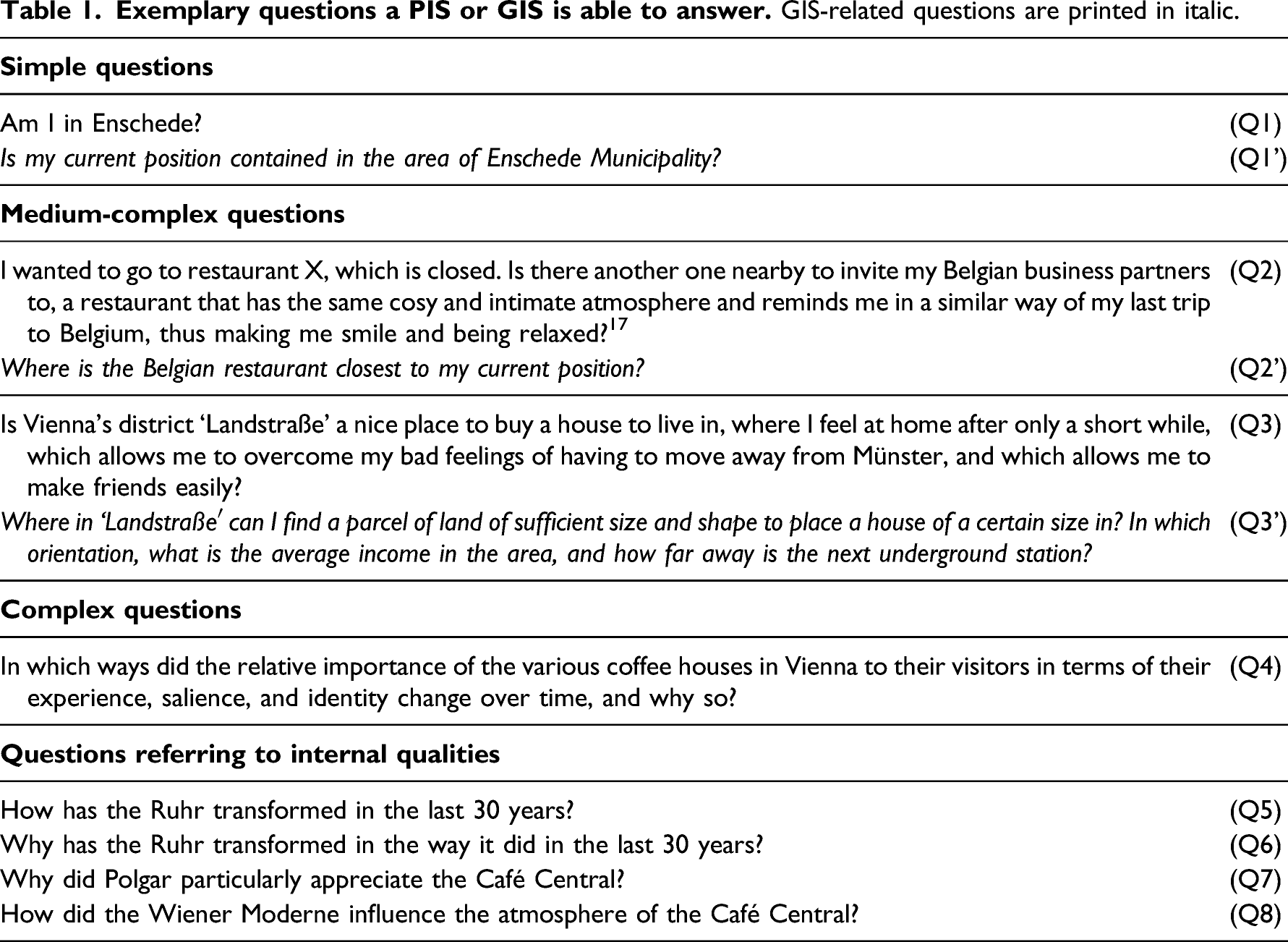
Besides the varying complexity of questions, PISs also vary with respect to the type of questions they are able to answer. In particular, some systems may be able to answer questions about external qualities only, that is, about mutual relations between places and relations to other entities represented. When two places shall be set into their mutual context, for instance, such questions arise naturally, such as the question how two coffee houses spatially relate, whether they are similar as places, or how a coffee house relates to Vienna as a place. These questions are in contrast to those that refer to internal qualities explicitly, such as many questions about changes of a place itself or about its identity (cf., Questions Q5 to Q8). While knowledge about internal qualities of a place can be helpful even in case the question refers to external qualities of the place only, such knowledge is obviously required if the question refers to internal properties. To indicate the level of representation and reasoning of a PIS, we call the PIS
Following the terminology introduced above, only strong PISs are able to answer questions about internal qualities. It seems, however, to be less clear at first hand whether weak and strong PISs are equally powerful in the context of questions about external qualities. 19 That is, whether weak PISs exist that are able to answer questions about external qualities equally well as strong PISs. A positive answer to this question is tantamount to the existence of translation mechanisms between two different descriptions of a place in the following sense: If places can be uniquely 20 represented by two different sets of aspects, this would mean that there exists a (unique) translation mechanism between these two sets of aspects with respect to places. Assuming that one of these sets contains internal qualities while the other does not, the PISs dealing with the respective sets are potentially equally powerful if they provide sufficient means to reason with the aspects contained in these sets. If, however, such a unique translation mechanism and thus such equivalence in the described sense does not exist, weak and strong PISs would be differently powerful. An answer to this equivalence question might not exist in general. Rather than focussing on the general situation, one might ask whether equivalences exist with respect to certain aspects only. Is it possible, for instance, to guess, at least to some degree, the sense of a place that we know the affordances of (cf. Raymond et al., 2017)?
2 Comparison to current implementations
Current implementations of information systems can manage representations of places to some extent and answer questions using these (Figure 2). Among these are GISs, which are typically only able to answer simple questions about external qualities of spatial aspects of places. This is because they lack suitable representations of the internal qualities of places as well as more complex reasoning mechanisms. Qualitative Spatial Reasoners (QSR), in turn, provide the means to answer more complex questions based on the description of external, that is, relational, qualities of places (cf. ‘Place graphs’; Chen et al., 2018a, 2018b; Hamzei et al., 2018; Kim et al., 2015, 2017a, 2017b; Kremer, 2018). However, they focus on spatial qualities and have to deal with high computational complexity (cf., e.g., Fogliaroni, 2013). Linked Open Data (LOD) is able to, in principle, provide reference to internal properties, such as formal reference to a limited set of emotions and sentiments (Sánchez-Rada and Iglesias, 2016; Westerski et al., 2011), and makes possible to draw conclusions about these by the use of formal reasoners. Despite of these theoretical capabilities, existing vocabularies and inference rules are rather limited, in particular, because theoretical foundations of how to represent and reason about places in a way compatible to the geographical concepts of Place – central aspects of a ToPI – are yet missing. In its current form, LOD seems at best to be appropriate for medium-complex questions only.;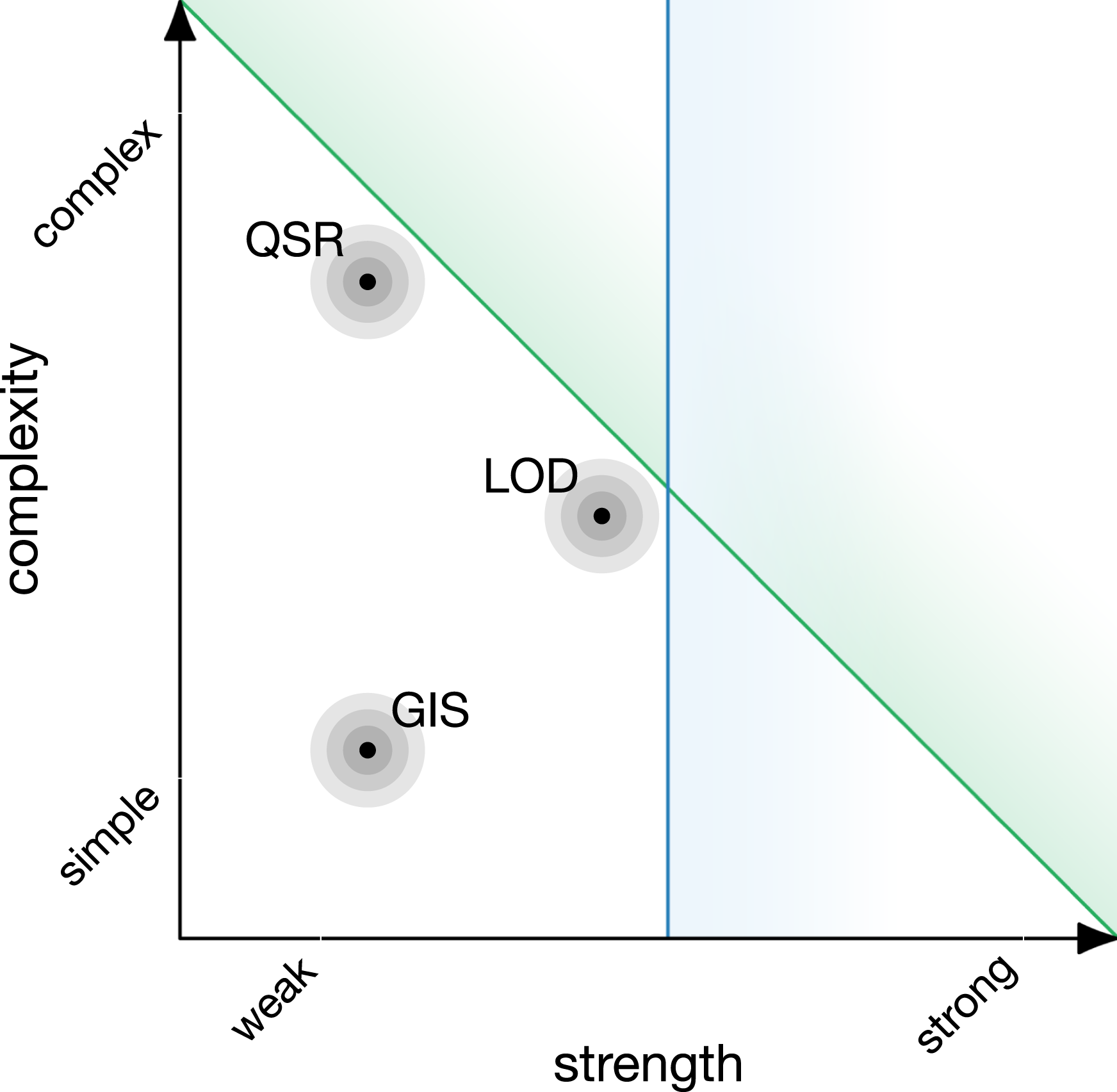
It becomes apparent from these examples that simple, weak PISs should easily be possible because they only need to offer reference to places. What turns out to be more difficult are approaches to enable a complex understanding, especially of individual places. Current implementations of information systems are still no PISs as they do not specifically relate to a geographical concept of Place, as has been argued. Extrapolating from previous and current developments, future efforts towards ToPIs and PISs thus face, besides relating to a geographical concept of Place, two main challenges: first, how to improve the representation of intrinsic qualities; and secondly, how to combine these with complex reasoning (Figure 2).
3 Assessing the success
Finally, the question arises how a ToPI can be evaluated and what it must ultimately achieve in view of such an evaluation. The simplest level of checking how powerful a ToPI is could be to examine the answers generated by this theory for given questions (cf. Hamzei et al., 2019). The more questions can be answered in a meaningful way and the more precise and appropriate these answers are, the more powerful the ToPI. Answers alone might, however, not provide suitable means to evaluate a ToPI because the understanding of places seems to be more complex than being able to find suitable answers to questions that involve places. Another less simple test might be whether examples of special places with partly uncommon characteristics can be represented and discussed, such as places described in dreams, computer games, in TV or radio, and in books. One might even ask whether ‘nowhere’ has some characteristics of a place and can be approached accordingly.
Theories often provide more than predictions and answers. For instance, they can, to a varying degree, provide an understanding of why something is the case. This difference reminds of the thought experiment of the Chinese room (Searle, 1980) if applied to a theory instead of a human being: can the semantic and syntactic richness and corresponding abilities of a theory be understood only by answering questions? An evaluation of a ToPI should, among others, test which more complex issues the theory is able to address, such as feedback loops in the context of places and platial information. These occur, for instance, if the identity of a place highlights the importance of the place, which then makes the place become socially more salient and, in turn, strengthens the identity of that place. Can such self-enforcement of an identity be understood by means of a particular ToPI? In view of these and many other complex aspects of platial information, a ToPI faces the question of whether it can adequately deal with this complexity. Future developments will show whether ToPIs are able to address these issues in meaningful ways.
In view of a ToPI as a mediating instance between the place representations we create and the conclusions we derive from these by the means of the theory (and possibly with the help of a PIS), it seems rather complex to evaluate the theory. This can be seen by the fact that a ToPI (and a corresponding PIS) must relate to the fundamental characteristics of places – hence the central role of Place concepts – but that it can also be tested on such characteristics, especially if it is not directly based on them. For instance, one might expect that a theory provides an understanding as to which places are perceived as salient. Is there a need to provide such information to a corresponding PIS, or can the ToPI infer salience from other human-related aspects of a place? In the context of a particular ToPI, can we, for example, conclude that if slightly different places are linguistically referenced in a similar way such as with the same Place name by different people, this already indicates a higher probability that these places or their common core have high social salience?
Furthermore, a ToPI can be assessed by checking to which degree it is able to explain why some places form part of mundane life and are socially embedded while others might be irrelevant for many people except for a few due to their idiosyncratic character. Such a question might, again, relate to the characteristics we provide to the theory, or they might be inferred from the theory. In the latter case, the theory might, for instance, discuss whether some places are on the ‘basic level’ of cognitive classification, in the sense of Rosch (1978). Such thinking is at least suggested by Smith and Mark (2003), who describe how ‘the child conceptualizes the geographic world’, thus gaining an understanding of ‘the environment […] that allows him or her to get from place to place’. If a ToPI refers to the dichotomy of primary and secondary theory in the sense of Horton (1993), can this even explain why some places form part of our mundane life while others do not? For instance, ‘a primary theory of mountains may be absent or underdeveloped in isolated flatland communities’ (Smith and Mark, 2003), which suggests that an understanding of a place and whether it is described well by primary or secondary theories depends on where people live and which culture they have. A ToPI can accordingly be assessed by checking whether it enables such lines of thought, whether these are coherent and align well to the considered concepts of Place, and what type of information a ToPI is able to infer.
VII Conclusions
How can we develop a theory that is adequate for the treatment of platial information, including formal means expressive enough to represent places? Some solutions have been proposed in the literature without actually going beyond the status of a proposal – they do not align well with geographical concepts of Place but rely on well-established Information Science concepts and thus do not reflect what is specific to Place. More profound theories and corresponding knowledge about the nature of platial information, including the representation of places and their various qualities, appear to be still far away. The central problem seems finding a suitable language. This does not only concern the (partly known) elements of which this language should consist, but it must also describe their interrelationships, the ‘inner mechanics’, in a suitable way. As a result of an expressive and efficient language, Theories of Platial Information (ToPI) and corresponding Platial Information Systems (PIS), two concepts introduced in this article, might be developed.
The Café Central in Vienna is an example of a place that demonstrates well how complex a place can be, as has been discussed in this article. Not without reason is the geographical understanding of places multifaceted, a fact that is reflected in the existing variety of Place concepts. A proper understanding of places by means of a few basic properties seems therefore impossible. The situation is rather complex. Several Place concepts form part of the geographical discourse, which seem, in parts, to be incommensurable. The question therefore arises as to which geographical concepts of Place a formal representation should take into account. In view of the many good reasons to have several concepts of Place in the geographical discourse, it is difficult to imagine that a formal representation limited to only one geographical concept can be meaningful alone. At the same time, it is unclear how a formal representation can focus on several concepts if these appear to be partly incommensurable. How can corresponding ToPIs that describe places in a meaningful way and render complex considerations possible then look like? When such ToPIs have been found, they might even help to uncover epistemological contradictions when assuming several concepts of Place at the same time.
In this article, current approaches to platial information have been set into context, to then conclude why future approaches can and should be more than what is currently being discussed. In particular, it has been argued why future approaches need to re-focus on the geographical concepts of place, thus making a paradigm shift from spatial towards platial information necessary. Besides such re-focussing, there are many further challenges that need to be properly addressed to eventually establish ToPIs and PISs, as has been outlined. The success of such efforts can finally be assessed in terms of complexity and strength, two dimensions of such theories and systems.
Future developments will show whether a ToPI can be meaningfully established at all and which combinations of geographical Place concepts are most adequate to build a theory on, or whether it is even more suitable to employ several such theories side by side to answer all relevant questions. Following on from this, the question arises as to which aspects of Place a ToPI needs to refer to in order to align well with the geographical concepts. For instance, does such a theory need to capture in detail how people think about places, or is it sufficient to understand which affordances a place has or how people actually act in a place? Particular attention should thereby be paid to the quality and clarity of the conceptualization of these aspects and whether it allows for hypothesis testing and empirical studies. The latter seem to be a particularly suitable means to establish firm grounds for ToPIs, because these studies are a bridge to lived Place and thus our thinking about Place. In the optimal case, ToPIs could deepen and make more detailed our understanding of the concepts of Place themselves, and, in turn, lead to a better understanding of platial information. From this, ToPIs can be expected to even lead to the implementation of PISs, allowing practical questions about places to be answered and everyday problems to be solved. In the end, the success of PISs must be judged by our human understanding of places and by how they can increase our understanding thereof. Through the effect they may have on personal life, PISs could even gain societal relevance.
Footnotes
Acknowledgements
The author expresses his sincere thanks to René Westerholt for fruitful discussions on the topic of Place, and to René Westerholt and the anonymous reviewers for their detailed comments that greatly improved the manuscript.
Declaration of conflicting interests
The author declared no potential conflicts of interest with respect to the research, authorship, and/or publication of this article.
Funding
The author received no financial support for the research, authorship, and/or publication of this article.
