



Abstract
A dialectical relationship between ‘big D’ Development (broadly, the formal interventionist, international Development sector) and little ‘d’ development (the immanent structures and processes of capitalism) is a concept widely invoked in Geography and Development Studies. In this paper, we ask how the d/Development dialectic is evolving under current conjunctures of emergent state capitalism(s). We suggest that, going beyond ‘containment’, Development is ever more deeply inhabited by (capitalist) development; with implications for its palliative and restructuring roles, and for praxis, contestation and transformation.
I. Introduction
A number of critical development theorists have elaborated on the idea of ‘big D’ and ‘little d’ d/Development (e.g. Cowen and Shenton, 1996; Hart, 2001, 2009; Lewis 2019; Rigg 2004), and it is widely referenced within Geography and Development Studies teaching and research (e.g. Horner, 2019; McLennan and Banks 2018), albeit as Lewis (2019) points out, often in ‘shorthand’ ways. We suggest that the d/D dialectic – always dynamic, variegated and complex – is in a period of discernible change. Hart (2009: 120) analyses ‘how the instabilities and constant redefinitions of official discourses and practices of Development since the 1940s shed light on the conditions in which we now find ourselves’; and in this paper, we seek to show that current Development ideologies and approaches reveal and reflect the new conjuncture of state capitalism. Where we differ from Hart is in our analytical emphasis. She proceeds as a scholar of political economy, providing a deep analysis of the capitalist crises of the 1970s and beyond. We approach the evolving d/D dialectic primarily as scholars of ‘big D’ Development, situated in particular research and professional histories.
Our focus is on how the d/D dialectic
1
has unfolded since c. 2008, the end date of Hart’s well-known schematic (Figure 1). The d/D dialectic shows continuity – Development continues to act in service of development; and Development persists as a discernible (although, we will argue, less distinct) project of intentional intervention. However, we contend that the constitutive goals, actors and logics of Development are increasingly those that have been more commonly associated with (capitalist) development, more specifically, this currently evolving iteration of ‘state capitalism’ (Alami et al., 2021). We propose that in the present conjuncture, Development is not just being ‘contained’ by (capitalist) development, but is ever more deeply inhabited by its actors, discourses and agendas. Hart’s (2009: 122) periodisation of the d/D dialectic.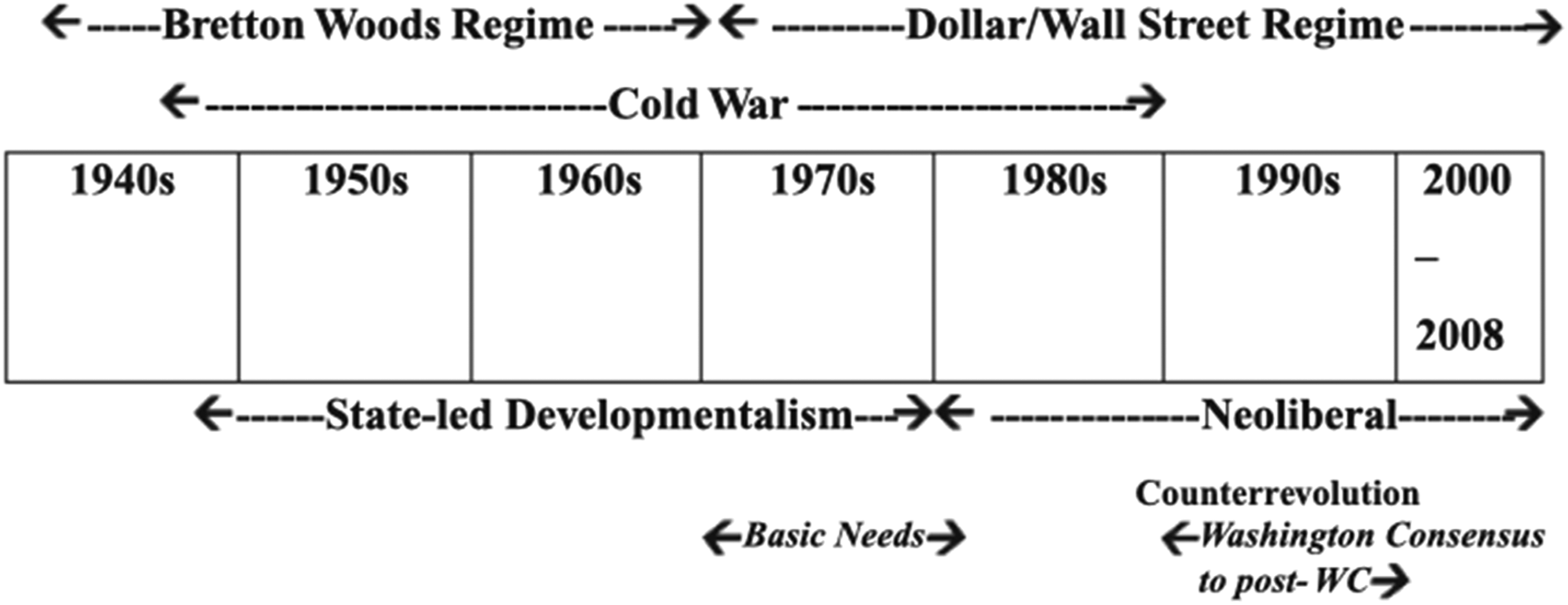
The paper is a synthesis of research work conducted over the last decade and more, which between the two authors has included research in France, India, Kenya, the USA and the UK. An important empirical and theoretical foundation is that the research includes both ‘South-South’ and ‘North-South’ development ideologies, narratives and practices (noting the reductive nature of these designations), and the profound shifts produced within an increasingly polycentric development landscape. The paper is indebted to collaborations with colleagues from Brazil, China, Germany, India, Korea, New Zealand, Poland, the UK and elsewhere, seeking to maintain the rigour and reflexivity of this earlier research, while making a novel contribution to theorising the evolution of the d/D dialectic. But, to pause for a moment, inspired by Hitchings and Latham (2021), we acknowledge that this paper does not include a methodological description. There is some leeway for this, in that its identified purpose falls somewhere between their categories of ‘making an argument’ and ‘applying or developing theory’; but in the spirit of explicit transparency, we recognise that we are effectively asking our readers to proceed on trust in our methods and interpretive integrity. Moreover, the intention of the paper is to set out a ‘grand generalisation’, in which the arguments are synthesised to produce those classic academic devices of periodisation, claims to novelty, and even new notations (see our proposal of d-D and d/(d-D) below). These reflections are not intended to undermine the paper that follows, but we agree with Hitchings and Latham that these (and other issues like ‘forbidden failures’) are all too often absent and/or assumed. We came to Hitchings and Latham’s paper late in the review process, 2 and too late to elaborate further, but their thoughtful analysis is well taken.
Following this introduction, the next section provides an overview of the origins and nature of the d/D dialectic as articulated by Hart and others. Section three sets out the immediate context for the current period through an analysis of the MDG and Aid Effectiveness years. The fourth takes us to the crux of the argument, examining four deepening trends in the practices and discourses of intentional Development which indicate a new conjuncture in d/Development. The final section concludes.
II. Origins and conceptualisations of d/Development
Theorists differ on the nature and origins of the d/D dialectic. Cowen and Shenton (1996) argue that d/D can be traced to the antecedent concept of ‘trusteeship’, dated to the birth of industrial capitalism in Britain, as intentional measures were taken to offset the dislocations of land enclosures and marketization, and the industrial revolution that followed. Cooper (1997), on the other hand, focuses on a series of imperialist crises in the 1930s and 1940s, as colonised workers and subjects protested their exploitation, driving rather than following nationalist elite calls for independence. In some cases, colonial officials responded with more integrative policies and welfare programmes to try to ameliorate pressures and produce more docile populations, yet they were ultimately unable to co-opt nor halt decolonising forces (for a fuller discussion, see Lewis 2019).
Gillian Hart (2001, 2009), a distinctive and prominent theorist of d/D, recognises affinities with these colonial lineages. However, she specifically sets up her analysis around the mainstream Development ideologies and architecture that emerged in the post-1945 era in the context of decolonisation and the Cold War. Here she invokes Sachs (1992) and other post-development scholars in their identification of President Truman’s 1949 inaugural speech that signified the birth of the ‘modern’ Development era. In this formulation, Development - as a distinct project of intervention - initially began as a means by which Britain and France sought to retain their African colonies, something that was superseded by the US-led post-war liberal project. ‘Development’ is conceptualised as constituting the ideologies, institutions and practices associated with the distinct project of intervention in the South. Its actors include parts of the United Nations system, the World Bank, the OECD Development Assistance Committee (DAC), bilateral donor agencies, NGOs, foundations, think tanks and orthodox scholars. While they may differ in important ways, their primary (stated) rationale is that of intervention to improve welfare, growth and ‘progress’, overwhelmingly directed towards the ‘underdeveloped areas’ in the Global South (Sachs, 1992: 2). On the other hand, ‘development’ refers to the geographically uneven, but spatially interconnected, and unfolding capitalist processes of creation and destruction. States, international organisations, the private sector and civil society (Mitlin et al., 2007: 1701), are all embroiled in ‘development’.
Drawing on Gramsci’s (1971) attention to relations of force at different levels, and Polanyi’s (2001 [1944]) conception of the double movement, Hart argues that Development is not oppositional nor external to (capitalist) development. Rather, it is contained within it. While Development’s intentional interventions can in certain cases engender transformative outcomes in opposition to the processes of capitalist development, Development has acted for the most part in support of hegemonic social and economic objectives in line with the dominant ideological orthodoxy present within a given conjuncture. Hart argues that Development serves development in two intertwined ways (which are neither frictionless or entirely hegemonic: the dialectic also generates tensions and contradictions in specific circumstances). The first is palliative, as Development interventions work to provide temporary, uneven and partial redress of the dislocations caused by the creative destruction unleashed by capitalism. Second, and where Hart places her emphasis, is the role that Development simultaneously plays in ensuring and enhancing the ongoing process of uneven capitalist accumulation: that is, the Development sector has been key in restructuring polities, economies and societies in response to moments of substantial capitalist crisis. For example, the shift from the Bretton Woods regime towards the ‘Dollar Wall Street Regime’ (Gowan, 1999) in the late 1970s was serviced by the ideological transition within the mainstream Development industry from state-led Developmentalism towards neoliberal logics, ideologies and practices. The debt crisis of the late 1970s/1980s gave actors such as the International Monetary Fund (IMF) and World Bank expanded powers to drive this shift. The former was responsible for international financial ‘stabilisation’, while the latter primarily focused on expanding conditionality-laden Structural Adjustment Programmes in the global South, and in doing so contributed towards the opening of Third World states and markets to financial speculation and international capital at a time when capital accumulation in the ‘core’ was stalling. This is not simply an abstracted concept of ‘neoliberalism’, but as Hart shows, was located in the conscious re-engineering of US geoeconomic hegemony in very specific circumstances, including the debt-fuelled financing of the Vietnam War, and the economic and political consequences of the OPEC-led oil price rises (see also Corbridge, 1992), as US administrations sought to break free from the restrictive Bretton Woods arrangements and efforts to assert the dollar’s monocratic dominance in international monetary affairs (see Gowan, 1999).
Structural Adjustment was a brutal process, and the impacts on hunger, poverty, disease and dislocation are widely documented (Babb, 2005; Benería, 1999; Federici et al., 2000). As this became unavoidably obvious to the architects of the Structural Ajustment Policies (SAPs) – for example, through IMF hunger riots around the world – over the later 1980s and 1990s they conceded room for the Development community to provide some amelioration. Pressures and contestations against the Development regime and its arsenal of SAPs came from both within and without, prompting the need for ‘adjustment with a human face’ (Cornia et al., 1989), and an agenda to instil more ‘participatory’ approaches to Development interventions (Chambers, 1995). Demonstrating the insight and value of Hart’s analysis, it is clear that although the Development regime managed to very partially and unevenly mitigate some of the worst aspects of SAPs, the post-Washington Consensus also acted to embed neoliberal governmentalities more firmly and deeply into lives, livelihoods, economies and processes (Gill, 1998). For Carroll (2009), the Development regime’s discursive recourse and implementation of the ‘good governance’ agenda, and the onus placed upon progressive terms such as ‘participation’, ‘ownership’ and ‘partnership’, functioned as a second wave of structural adjustment. The macroeconomic neoliberal principles and underlying intentions remained the same, but these reforms and conditions were ‘dressed up’ in a more palatable language of participation and partnership. Furthermore, throughout the 1990s, a ‘new transnational orthodoxy of power [emerged which] encompassed both neoliberal economics and liberal human rights’, and thus enabled a dramatic burgeoning of NGOs as core Development actors under the aegis of ‘global civil society’ (Hart, 2009: 129–30).
It is important to note that Hart (2009: 121) cautions against overly mechanistic or entirely pessimistic readings of this d/D relationship, and points to the limitations of the excessively top-down and disciplining reading of Development. Development, she says, ‘can operate as much as a discourse of entitlement as a discourse of control’: it can both result in and be co-opted by social forces towards more progressive outcomes and distributional benefits in some cases (see also Cooper, 1997). Thus, while Development is inextricably tied to both the dislocations and reproduction of capitalist development in the South, this d/D dialectic is open ended: Development interventions may also open up new possibilities of transformative praxis and activism. We return to this in our conclusions.
Conceptualising such a vast, multi-scaled and sited set of institutions, narratives and practices is at risk of reductionism and tendentious arguments: porosity and complexity abound in the ontologies and interplays of d/Development. Moreover, binary categories risk the tacit or open tendency towards essentialisation and homogenisation – neither of which sit easily with the evident multiplicities and interpellations of both d/Development. Rigg (2004: 328), for example, nuances Hart’s dialectic by distinguishing between superscript Development (Dd) and subscript Development (Dd). The former (Dd) denotes interventions undertaken by actors such as developmental states in South East Asia, while the latter (Dd) refers to actions on behalf of NGOs and civic actors in promoting change. This understanding, he notes, differs from Hart’s conception of Development, emphasising divergent tendencies, intersections and variegated interfaces that exist within the d/D dialectic. Lewis (2019) also provides a detailed and thoughtful analysis of the various conceptualisations of d/D, noting how different scholars have found utility in the concept, notably those who refuse technocratic narratives to expose the histories, politics and contexts of d/Development. He also observes the conceptual ambiguities of some macro-level theorising, and the difficulties of empirical application. As with this paper, Lewis questions whether and how conceptualisations of d/D remain relevant to current conditions, and provides an extensive analysis of the Bangladeshi garment sector to prosecute the concept. 3
In the following section we briefly reprise the MDG/aid effectiveness era, from the late 1990s/early new millennium, as the context for our core arguments regarding current conjunctures of Development and state capitalism (section IV).
III. The MDGs and aid effectiveness era through a d/D lens
The d/D relationship took a distinctive turn around the new millennium. In the late 1990s, a confluence of events and actors provided a window through which poverty reduction moved to become the ‘central analytic’ of Development (Hulme and Fukuda-Parr, 2011). An ‘inclusive’ Development agenda consolidated under the Millenium Development Goals (MDGs) (2000-15), which articulated more focused and to some extent interventionist approaches to combat poverty in particular (Hart, 2001, 2002; Ruckert, 2008). In Polanyian terms, the MDGs can be regarded as an evolving Development movement to contain the destructive forces wreaked by the expansion of neoliberal capitalism in the 1980s and 1990s (outlined above). Framed by the MDGs and related initiatives such as the Aid Effectiveness agenda, donors claimed to put poverty reduction at the very heart of their Development aims and interventions (Sachs, 2005). While poverty reduction had always previously been assumed or implied in the pursuit of economic growth, the MDGs moved it front and centre. The first and foremost goal was to eradicate extreme poverty and hunger, and the emblematic first target was to halve the proportion of people living on less than $1.25 a day. The MDGs attracted attention from critical scholars in a variety of registers (Antrobus, 2005; Easterly, 2006). Here though, we want to specifically place several features of the MDGs as archetypal of Hart’s thesis on the dialectical nature of Development vis-a-vis capitalist development.
Firstly, the MDGs were ameliorative rather than structural in intent. The eight MDGs and their 18 targets represent a hallmark attempt by the Development community to ameliorate the dislocations of poverty and growing inequality under expanding neoliberal globalisation in the 21st Century. Whatever their achievements, they were functionally palliative: they were not rights-based, and they did not entail nor imply the structural re-working of the economic and political conditions that create and deepen poverty and inequality (Ziai, 2011). As a heavily negotiated product of an uneven global system, the MDGs did not address critical issues like capital flight, transfer mispricing, fossil fuel divestment, commodity price stabilisation, food sovereignty, indigenous and/or collective land rights, or rights-based welfare.
Second, while there were certainly efforts to draw in different funding streams, including from the private sector, the financing debate was primarily around a closely defined and designated form of finance: Overseas Development Assistance (ODA) or foreign aid. The focus was on efforts to persuade donor countries (and public consent within those countries) to increase their commitments to meet the 0.7% GNI target; as well as to ‘reform’ aid through the Aid Effectiveness agenda. The focus on foreign aid, charity and philanthropy, acts to buffer the construct of Development from the contradictions of development. In most if not all western donor states, foreign aid, philanthropy and individual charity have strong connotations of morality and altruism, whether or not these attributes are interwoven with other discourses of self- or national interests. The tight discursive stitching between foreign aid and Development augments the symbolic boundaries, identity and claims of intentional intervention (Kapoor, 2008): working with women and girls, education, humanitarianism, hunger and famine, disease and so on. The distinctiveness and positivity of the MDGs, expressed and augmented the power of the idea of Development as ‘good’ and able to accelerate the journey of poorer peoples and poorer countries into the ‘virtuous’ realms of development. Development not only palliates the pathologies of transformation in place, but also donor country/public desires to ‘do good’ (or be seen to be ‘doing good’), or anxieties about distant need, while turning knowledge/attention away from the more structural causes of power inequalities.
Third, the dynamics underlying the MDGs were very clearly predicated upon the long-standing geographical binaries and imaginary of North/South, developed/developing, donor/recipient and so on (Six, 2009). Development has traditionally produced and been produced through this spatialised power geometry – who gives to whom, where expertise resides, and where poverty is located. In such an imaginary, it is the North where the dominant actors primarily preside, and where ideas and ‘solutions’ are produced. In contrast, the South serves as the object and space where intentional interventions of Development are directed. Hart’s schematic shown above (Figure 1) does not set up a simplistic ‘North-South’ imaginary, but the model’s visual narrative focuses on the hegemonic (Northern) Development ideologies – Bandung, the demands for a New International Economic Order, and the 1978 Buenos Aires Plan of Action, for example, are missing. The long-dominant North-South spatial demarcation finds its institutional expression most clearly in the Organisation for Economic Cooperation and Development (OECD) Development Assistance Committee (although this is now changing), and the MDGs themselves find their origins in the International Development Targets of the OECD-DAC’s (1996) flagship Shaping the 21st Century Report. The MDGs thus contributed further to the North-South imaginary in that they tended ‘to ghettoise the problem of development and locate it firmly in the third world … [thus functioning as] merely ‘our’ [Northern donor] agenda for ‘them [Southern recipients]” (Saith, 2006: 1184).
Fourth, the MDGs and aid effectiveness agendas were entirely framed by market logics, and precisely sought to open up new scales and sites of accumulation. ‘Underdevelopment’ was conceived as a lack of inclusion within and access to commercial markets. ‘Solutions’ thus included the extension of enhanced and increasingly commercialized microfinance and property rights via, for example, land-titling to the poor. Moreover, these Development agendas were steeped in consumer-driven economic imaginations (e.g. the ‘new middle classes’), and the opportunities that were proffered to exist in ‘frontier economies’. The Development regime’s broad emphasis upon ‘Making Markets Work for the Poor’ (M4P) was just one emblematic construction of both the ‘problem’ and ‘solution’ (DfID/SDC, 2008). Development thus served development through re-working the conditions for capital accumulation, as financial and other actors sought to enter the ‘emerging markets’ of the global South under conditions of an early new millennium commodity boom, and the shift east in the global economy (O’Neill 2001).
However, over the latter years of the MDGs, a bundle of changes was emerging that began to redefine the d/D relationship in new ways; and it is the deepening and consolidation of these that lead us to point to a new d/D conjuncture. Traces and earlier iterations of these logics, practices and narratives can be clearly identified in both the MDG era, and indeed in far earlier decades – they are not entirely novel. Even so, we propose that it is possible to identify a confluence of events, actors and ideational shifts which have enabled and driven a discernible shift in the d/D relationship. As in previous eras, the larger conjunctural forces continue to be a blend of capitalist crises and security threats. These forces precede and were accentuated by the effects of the Global Financial Crisis that resulted in austere policy prescriptions by many governments in the North. In combination with geopolitical instability and conflict-accelerated migration, such conditions have proven amenable to the rise of reactionary nationalistic populism in the US, Europe and beyond. These contradictions of capitalist over-accumulation in the North were starkly contrasted to the rise to economic prominence of China and the ‘global economy’s shifting centre of gravity’ towards East Asia (Quah, 2011).
In essence (and as explained above, only briefly touched upon here), the last decade or so has been characterised by more visible, proactive and explicit roles for the state across the world capitalist economy; a global phenomenon referred to under the apparent ‘return of state capitalism’, and the growing agency of state-owned enterprises, Sovereign Wealth Funds, and policy and development banks (Alami et al. 2021). As Sandbu (2021) writes in the Financial Times, ‘a new Washington Consensus is born … the conversion by the IMF and World Bank to support the activist state would put Saul of Tarsus to shame’. There is a growing normalisation by hegemonic actors that the state ought to and does play a strong role in organising the economy, and in owning, controlling and ensuring the accumulation of capital. The past decade or so has seen industrial policy, classical liberal notions, and modernisation principles resume a central stage within policy debates, critically, in the context of deepening and encroaching financialisation (Chang and Andreoni, 2020; Murray and Overton, 2016). It is against these broader reconfigurations in state-capital relationships and hybridity that we situate and discuss the shift in the d/D relationship.
In the following section we set out four arguments regarding the deepening insertion of private sector actors, logics and agendas into Development. They are: the shift from aid to ‘development finance’; the turn to private sector partners not only as funders and implementers but increasingly as the core architects of global development policy; the ongoing rise and influence of the South; and the downgrading of bilateral Development agencies. As might be expected, they overlap in various ways.
IV. A dialectical gear change: How (capitalist) development has increasingly inhabited Development
1. From aid to development Finance
The last decade has seen a huge turn to the concept and tools of ‘development finance’. In this ‘new development financing landscape’ (OECD, 2014), aid is regarded as just one form of Development finance amongst a potpourri of other flows. The concept of ‘foreign aid’ as the financing modality with a specific Developmental purpose emerged in the 1960s and was institutionalised along with the OECD’s creation of the DAC (OECD, 2006). The reason for this was primarily geopolitical-commercial rather than ethical, driven particularly by the US, which wanted to prevent European powers from using ‘aid’ to leverage competitive advantage with their former colonies (for a critical history of the DAC, see Ruckert, 2008). Over time, the rules of aid evolved and the regulatory infrastructure consolidated. This includes the DAC Peer Review process; national White Papers, and aid and development policy and legislation; the establishment and professionalization of bilateral agencies; increased scrutiny and involvement of civil society partners, and so on. Although there have long been other financial flows supporting international Development – including private giving from individuals, foundations and Non-Governmental Organisations – ODA has been the emblematic form of official financing. In the late 1990s/early 2000s, champions of the UN’s MDGs sought to encourage increases in foreign aid (see Clemens and Moss, 2005; UN, 2015, UN, 2015b), including through dedicated initiatives such as the UN’s MDG Gap Task Force. Relatedly, the Aid Effectiveness agenda sought to distil and promote a set of key principles for donors and recipients, such as: a commitment to recipient ownership; a focus on results; inclusive development partnerships; and mutual accountability and transparency (OECD, 2005). However, support for this agenda appears now to have run into the sand due in part to the shifts described next (Brown, 2020; Lundsgaarde and Engberg-Pedersen, 2019).
Although efforts to maintain aid contributions following the global and Eurozone financial crises appear to have been successful (OECD, 2019), and COVID-19 spending has lifted net aid spending to an ‘all time high’ (OECD, 2021), insidious changes have been taking place that are more important than headline figures. Over the last few years there has been a growing debate over the definition and ‘value’ of foreign aid. In 2016, for example, the DAC began a series of discussions on the need to ‘modernise’ aid (OECD, 2020b). Many DAC member states are warily watching large Southern powers deploy a variety of development finance instruments to promote their businesses, investments and trade in external markets. Brazil, India and above all China are not inhibited by DAC rules on the use of export credits or other forms of soft ‘Development’ financing (Fritz and Raza, 2014; Mwase and Yang, 2012). Whereas in earlier decades DAC members had ‘gentleman’s agreements’ to not use aid as an export credit, South-South Cooperation (SSC) actors are not bound by such conventions. DAC members are therefore looking to change the rules, and there are moves to dismantle or certainly downgrade the importance of ‘aid’ towards a greater variety of more openly commercially blended ‘Development financing’ instruments (OECD, 2018), accompanied by narratives of mutual prosperity, and the centrality of growth-led d/Development (Besharati, 2017). This is allowing DAC members to better compete with Southern actors – and each other – and attempt to persuade increasingly sceptical publics of the national benefits of ‘donorship’. These instruments include various forms of bonds, loans and ‘leveraged’ private finance, and can be traced in the growing importance, numbers, membership and capitalisation of regional development banks and national development finance institutions (DFIs) (Lonsdale, 2017), and the wider ‘financialisation of development’ (Jakupec and Kelly 2015: Mawdsley, 2017).
Such shifts are visible across ‘traditional’ Development institutions. The World Bank (2021) affirms that its core business is now not to directly lend through its various arms, but to instead use its public funds to leverage larger flows of private finance. Carroll and Jarvis (2014) provide a detailed exposition of the ways that ‘development finance’ is being used to ‘de-risk’ investments, and ‘escort capital’ into risky but profitable ‘frontier economies’. Gabor (2021) contends that a new (developing) state form has emerged in response to this development financing landscape, and as a consequence of efforts to reorganise Development interventions around partnerships with global finance: that of a ‘de-risking state’. Bilaterally, Andrew Mitchell – former Secretary of State for the UK Department for International Development (DFID) – mused that he wanted DFID to act less like an aid agency and more like a Sovereign Wealth Fund. Although aid still performs multiple tasks through multiple vectors, there has been a shift away from funding project and programme implementation towards aid acting to lure in and subsidise private investment. Many DAC donors are allocating ever greater shares of their aid towards their DFIs 4 (Mitchell and Ritchie, 2018), while officials at various levels are quickly becoming proficient in the jargon of investment banking – or rather, at outsourcing the development and implementation of these instruments to management consultants like PricewaterhouseCoopers, and the financial sector. While there were efforts during the MDG era by hegemonic Development actors to ‘render technical’ Development issues and discussions that were fundamentally political (Ferguson, 1990; Murray Li, 2007), today – with greater private sector engagement at the helm of global development governance – we see a clear movement within discourse and practice to ‘render investible’ Development projects and interventions across the Global South.
There are several drivers towards the – euphemistically termed – ‘modernisation’ of ODA or foreign aid. As mentioned, the aid budgets of many DAC donors face enhanced public and political scrutiny, and governments are shifting practices and discourses to make aid work more explicitly in ‘national’ interests (Barder, 2018; DFAT, 2017; Treasury, 2015). Helping to provide a seemingly just and desirable rationale for these shifts is the presentation of the Sustainable Development Goals (SDGs) as requiring ‘not billions, but trillions’ (Mawdsley, 2018a). As the SDGs coalesced in the run-up to 2015, their ambition and scale rendered aid grossly inadequate. Central to the SDG narrative is a funding gap so massive that it can only be met through partnerships with (global) institutional investors’ (Gabor, 2021: 5). Foreign aid continues to be an important resource, especially for the poorest and most fragile and conflict-affected countries. However, even if all donors met the 0.7% target 5 it would barely touch the sides of what is projected as required for meeting development financing gaps. For Goal 13 alone (Urgent action to combat climate change), an estimated $100 billion is required annually (UNDP, 2020). Furthermore, an extra $2–3 trillion a year is required to pursue all 17 Goals in developing countries (UN, 2019), while the OECD (2020a) suggests that this figure could jump 70% to $4.2 trillion as a consequence of COVID-19. Various sources of SDG finance are under discussion, such as raising levels of domestic resource mobilisation. Combatting tax evasion and limiting capital flight, for example, were discussed at the 2015 UN Summit on Financing for Development, but this failed to produce an international tax body, or to bring any new money to the table (Montes, 2016). Rather, the energy and emphasis reside with the private sector. Debates and initiatives around SDG financing are stimulating, deepening and consolidating trends that position private finance as the sine qua non of Development funding.
2. Putting the private sector at the helm of Development
Alongside being solicited for ‘development finance’, in recent years, private sector representatives have been invited to drive and shape global, regional and national development policy to an unprecedented extent. Private sector actors are not confined to the provision of employment, goods and services: rather, mainstream private sector actors from the financial, consultancy and commercial sectors are increasingly core architects of Development policy (Blowfield and Dolan, 2014). The UN and others are ‘promoting and supporting market-based approaches and multi-stakeholder partnerships as the new business model for solving global problems’, introducing a ‘pay-to-play’ dimension to global development governance (Barbara and Martens, 2015: 111). Despite frequent reference to Micro, Small and Medium Enterprises, and crumbs of participation here and there, private sector voices are dominantly those from transnational corporations and the financial sector. In what (Gabor, 2021) terms the move to a new ‘Wall Street Consensus’, Development institutions are seeking deep partnerships – including at policy and planning tables – with venture capital, hedge funds, investment banks, sovereign wealth funds, credit rating agencies, global accountancy firms and corporations – that are governed by financial logics (Krippner 2005) – to open up new circuits of financial investment, speculation and extraction.
Multilateral Development Institutions and their private sector partners all talk the language of sustainable growth ultimately serving poverty reduction – for example, of aligning the global financial system to ‘long term’ perspectives (although ‘long term’ can be as short as one year for many investors); or of building green economies and infrastructure; with labour protected by renewed commitments to corporate social responsibility (Awe, 2012; McLennan and Banks 2018; UNEP, 2014; Zadek and Kharas, 2018). The SDG framework provides a normalising narrative and, through the UN and other Development organisations, the institutional interfaces for deepening state-private capital hybrid formations. These new modes of consensus render the SDGs a form of anti-politics, for example, in aligning Development to extractive capital and extractive-led Development, while neutralising and depoliticising opposition in Bolivia (Hope, 2021). Critical academic and practitioner voices such as Tiwana (2014) and Gleckman (2018) contend that the movement to ‘multi-stakeholderism’ as the guiding principle underlying 21st century global cooperation equates to the ‘Davos capture’ or ‘privatisation of global governance’. ‘Multi-stakeholder partnerships’ are the new phrase of choice to normalise increasing private involvement in development agenda-making, as well as activities. For example, Development actors (which now include corporations at the policy table) are promoting and doing the work required to increase the digitalisation of poor people’s money in the pursuit of ‘financial inclusion’ (Mader, 2016). Here, an earlier emphasis upon microfinance has yielded to significantly scaled-up programmes to extend financial markets into and within the global South (Cull et al., 2013). Leading the way is the ‘fintech-philanthropy-development complex’ comprised of actors such as the World Bank, US aid agencies, the Gates Foundation in collaboration with corporations like Mastercard and Citibank (Gabor and Brooks, 2017). But while financial technology may have ‘the potential to liberate enormous value… the bulk of this value [may] not go to the poor’ (Bateman et al., 2019: 489). As Mader (2018: 478) cautions, there is very limited evidence to suggest that financial inclusion has and can generate ‘development’ (which we distinguish from headline growth): but can instead be seen as ‘a contested and contestable enterprise of granting financial capital more power over markets and policy agendas’. Moreover, the shift towards financial inclusion has further diluted the ‘promises of development … from broad-based transformative change, to merely mitigating the symptoms of poverty, to increasingly just extending services (for sale) as a goal in itself’ (ibid.: 480). Whatever the (de)merits of financial technology and inclusion, the point remains that private sector actors are increasingly taking a commanding role within the governance and institutions of Development.
3. The rise of the South and convergence with more blended concepts and approaches
Many of the shifts analysed above have been influenced by the increasing material and ideational influence of Southern development partners. In important ways, the discourses and practices of Southern providers (SSC) do not fit neatly into distinctions of d/D as set out by Hart (and, with variations, others). In recognition that some comparisons between SSC and the North-South regime are misleading, and that their histories, definitions and relationalities are different, we notate the Southern dialectic as d-D rather than d/D. That is to say, the same sort of definitions and distinction between d/Development has not been apparent in Southern conceptualisations or practices, with implications for understanding Southern d-D dialectics. Southern partners have long pursued commercial-capitalist development objectives through, within, and alongside what could be regarded as their (international) Development interventions. 6 The relationship between them is blurred and blended in different ways, based on different historical experiences and principles.
As SSC has grown in scale and impact, many commentators observe trends towards what could be termed ‘two-way socialisation’ and mutual convergence between Northern and Southern Development approaches (Fejerskov et al., 2016; Kragelund, 2015; Li and Carey, 2014; Xiaoyu, 2012). With the blurring of North-South boundaries and with the move towards state-capital hybridity, mutual convergence has both deepened and consolidated the inhabitation of ‘Development’ by ‘development’. Indeed, in contrast to early assumptions that the Development regime would ‘socialise’ Southern partners into Northern norms and practices, DAC Development approaches have increasingly mimicked Southern discourses and practices (Patrick, 2010). Southern partners such as China, India, Brazil and others reject the applicability of the ‘donor’ label 7 and the DAC’s concept of ‘ODA’ 8 with regards to their finance and have instead sustained and defended the idea and practice of d-D as a blurred and blended set of flows and practices. They have had strong state-market hybridity in their d-D planning and interventions, with mutually beneficial economic growth a long-held principle (if not always outcome) of SSC. The OECD (2016: 25) has now openly acknowledged that the concept of ‘mutual benefit’ that now features prominently in DAC Development approaches is derived from various UN conferences on SSC. In what has been termed the ‘Southernisation of Development’ (Mawdsley, 2018b), Northern donors have, to some degree, adopted the discourse and practices of certain Southern partners.
Convergence and influence are not uni-directional. Southern partners are institutionalising/consolidating their approaches and practices, in some cases in hybrid forms which reflect or borrow from DAC approaches. Most visibly, Southern partners are institutionally consolidating their d-D administrations, including the creation of Mexico’s Agency for International Development Cooperation in 2011, India’s Development Partnership Administration in 2012, and China’s International Development Cooperation Agency in 2018. Multilaterally, there has been the creation of new DFIs, such as the BRICS New Development Bank in 2015, the Asian Infrastructure Investment Bank in 2016 (Wang, 2019), and a host of others. Growing convergence – or hybridity – between Southern and Northern approaches to d-D is evident in that the former are facing similar challenges/contradictions that would commonly be associated with the ‘traditional’ Development regime (Kragelund, 2015). Furthermore, there is an increasing awareness of the challenges and difficulties of working within recipient country contexts, and Southern partners are embarking upon greater interventionism in their d-D activities (Dye, 2016).
In essence, in contrast to earlier assumptions that SSC might challenge the hegemony of neoliberal capitalist ‘development’ (Amin, 2014; Panda, 2013), recent shifts suggest that such claims are unfounded. SSC ‘should not be understood as an unproblematic unitary force’ and the distinctiveness of various Southern partners, discourses and practices need to be taken seriously (Gray and Gills, 2016: 564). However, much of the political and emancipatory zeal associated with earlier iterations of SSC are giving way to a more pragmatic framing of their d-D interventions (Mawdsley, 2019). From the critical perspective of Gonzalez-Vicente (2017: 882), ‘what we encounter under the veneer of “South-South” relations is a reality of variegated capitalist states pursuing accumulation within the familiar – if ever changing – rules and contradictions of globalised markets’. For instance, Jain and Marcondes (2017) note how India’s longstanding ‘Third World-ist’ rhetoric has been softened as it more deeply embraces neoliberal globalisation. Southern partners are active and influential in the gear change we describe, directly servicing (Southern) capital – not by necessarily ameliorating the dislocations caused by d-D, although this seems to be a growing concern – but by furthering capital’s extension into low and lower middle-income partners. The impact upon the increasingly convergent and hybridised dialectic is that both ‘development’ and ‘Development’ are no longer dominated the North. What we see is the emergence of polycentric, variegated, global capitalist d/(d-D)evelopment regime (Gonzalez-Vicente, 2017: 882; Horner and Hulme 2017), characterised by greater state-market hybridity, to which we return in the conclusions.
4. The downgrading and reconfiguration of bilateral development agencies
While we are witnessing the creation of new Southern d-D institutions, Northern Development agencies are being merged (Prime Minister's Office and UK (PMO), 2020; Sharma, 2014), down-sized, and often command a smaller share of ODA budgets (even where headline figures remain the same or are rising). Ostensible justifications include efficiency gains, policy coherence and performance enhancements (Gulrajani, 2018; Troilo, 2015). However, a strong motivation is to ensure that Developmental and commercial objectives are more closely aligned. Following Canada’s merger of its aid, foreign affairs and trade administrations in 2013, for example, the majority of countries addressed in its 2014 aid report were ‘promoted as destinations for Canadian aid in part because of the commercial benefits [that] they can offer to Canada’ (Mackrael, 2014). With the most recent merger between the UK’s DFID and Foreign and Commonwealth Office in 2020, Philip Barton – Under-Secretary of the newfound Foreign, Commonwealth and Development Office – affirmed that the raison d’être of the merger was to: ‘broadly support British business, but also … [to] create new markets [in partner countries] and make sure that as we help countries with their own economic development that [doing so] leads to British business opportunities’ (Worley, 2020). Australia’s dwindling ODA budget is now managed by the Department for Foreign Affairs and Trade – which absorbed AUSAid in 2013 – and is being increasingly channelled through various commercially oriented departments and strategic initiatives in the Indo-Pacific (Clare, 2019). Relatedly, neither the UK’s FCDO (or erstwhile DFID) has a monopoly upon ODA allocation, with DFID’s ODA share declining from 80.5% in 2015 to 73.1% in 2019 (DFID, 2021). In the UK, ODA has been increasingly siphoned into other departments such as the Department for International Trade, and the Department for Business, Energy and Industrial Strategy, all of which have seen their ODA spending triple over the period between 2017 and 2019 (National Audit Office, 2019). Rather than ODA being the purview of a single Development agency, ODA is being transformed into a versatile financing modality used by a range of governmental departments towards commercial, d-D objectives.
We also see an amplified role for management consultancies – although one that is not without contestation. Taking the UK again as an archetypal example of these trends, from January to September 2019 three private consultancy firms alone – PWC, Mott MacDonald and Crown Agents Bank – received over £230 million of ODA between them as ‘private-implementing partners’. 9 This figure dwarfs the amount allocated to Non-Governmental and Civil Society Organisations with the top three partners receiving £140 million in the same period (DevelopmentAid, 2019). Adam Smith International received £90 million in 2014 alone, nearly twice what DFID spent on HIV and AIDS. This agency specialises in advisory services that focus on ‘market development’ in developing countries and they support ‘business advocacy development programmes’ (Provost, 2016). Private contractors are engaged in policy formulation, programme and project design and implementation, monitoring and evaluation, and framing, communications and messaging (IDC, 2017). Whether it be direct mergers, ODA being increasingly spent by trade and business-related departments, the use of private contractors, or indeed, the increasing employment and/or secondment of private sector professionals within agencies, public Development funds are being increasingly serving the interests of capital, and diluting Development as a distinct project of intervention.
V. Conclusion
Gillian Hart’s formulation of d/Development makes an incisive contribution to theorizing the uneven geoeconomics of capital accumulation. Specifically, Hart theorises how the Development industry has historically served capital by responding to different conjunctural crises in specific ways; and centrally, to ongoing capital accumulation. This paper offers the next chapter in this story, founded in our work on the global Development sector.
Specific elements of the ‘old’ Development project of intervention persist. As recent Neo-Gramscian works argue, the Development regime faces a liminal condition of ‘interregnum’ (Taggart, 2020) similar to that experienced in the late 1970s (Stahl, 2019) 10 : old Development institutions such as the DAC, IMF and World Bank retain a position of dominance, but they face severe challenges to their legitimacy and effectiveness, and these ‘dying but not yet dead’ Development institutions now operate within an increasingly plural and balkanised global Development landscape. Development continues to serve (capitalist) development in both palliative and restructuring forms, while the Development sector persists as a discernible (yet we suggest, less distinctive) project of intervention, albeit now as an ostensibly global effort towards ‘Sustainable Development’ (Horner, 2019; Horner and Hulme, 2017). But by focussing on contemporary shifts in what we argue is an increasingly hybridised d/(d-D)evelopment relationship, we argue that under conditions of deepening and evolving state capitalism, little ‘d’ development is no longer merely contained by Development. Rather, the actors, goals and logics that constitute ‘development’ now also inhabit the Development sector, including its governance, institutions, narratives, personnel and agendas.
Our analysis points to a re-casting of Development, which both serves, and is inhabited by, more hybrid state-capital development forms. This has implications for how we research and theorise Development; and for those actors, within and outside of the ‘establishment' who seek to improve on, and/or hold ‘d/(d-D)' to account. They include liberal voices within the Development ‘mainstream’, through to the radical and alternative activists and social movements taking on, for example, Chinese and World Bank d/(d-D) projects, and the financial and state-capitalist interests that stand behind them. But what the emergence of this d/(d-D) dialectic infers for a possible Polanyian countermovement to contain contradictions remains unclear. In contrast to the flawed yet progressive elements contained within the MDGs and related Development agendas that emerged to contain the dislocations wrought by neoliberalism in the 1980s and 1990s, Development is now more completely inhabited by the actors, logics and goals of development. Development has thus lost some of its distinctiveness – and accountability – as a project of intervention. One avenue for future research is to explore the implications of this shift for transformative praxis and activism. The elevated role of state-capital or private finance and (capitalist) development actors, logics and goals does not foreclose progressive outcomes nor new forms of resistance. But with more aggressive efforts to ‘bring-in’ elements of (capitalist) development, whether from The Netherlands or China, we must also attend to what (and who) is being ‘pushed out’ 11 ; for instance, the shrinking of civic space nationally, globally and within the Development sector are closely wedded to the shifting dynamics that we have described. Opportunities lie in the renewed energy, vigour and resources that these new d/(d-D)actors bring to the sector, and perhaps their particular vulnerabilities to pressures for change. Contesting the current conjuncture of d/(d-D)’s shifting palliative and restructuring functions, 12 and moving towards structural and sustainable transformations of societies, economies and ecologies (just transitions to degrowth, for example; or pathways to donut economics), remains paramount.
Footnotes
Declaration of conflicting interests
The author(s) declared no potential conflicts of interest with respect to the research, authorship, and/or publication of this article.
Funding
The author(s) received no financial support for the research, authorship, and/or publication of this article.
