




Abstract
The rise of digital platforms as a new form of business organisation concentrates power in the United States and China. Platform capitalism further intersects with and reinforces pre-existing trends towards state capitalism, where states more actively direct economies in response to economic turbulence and heightened geopolitical tension. The concentration of global business power within two states, combined with the increasing capacity for these states to leverage and direct platform activities for their own geopolitical–economic ends, has catalyzed the rise of ‘state platform capitalism’ (SPC). This paper develops the notion of SPC as an emergent logic of competition for both states and firms – in particular, the ways in which Beijing and Washington instrumentalise and mobilise domestic platform firms in pursuit of geopolitical–economic objectives, while platforms become increasingly interdependent with their home state institutions. Competition in the global political economy is increasingly centred on the recruitment of users and nations to these rival state-platform nexuses (national ‘stacks’) as a means of establishing and exercising extraterritorial economic and political power. Empirically, we identify variations between American and Chinese modes of practicing state platform capitalism, and we examine three axes within which this competition unfolds internationally: currencies, standards and cybersecurity.
Introduction
Although the American and Chinese economies remain deeply integrated and interdependent, US–China relations are increasingly characterised by competition and confrontation across a range of fields, from intellectual property rights and trade to foreign aid and technological mastery. In contrast to earlier great power competitions such as the Great Game and the Cold War, the United States and China are not in direct competition to control territory. 1 Instead, they compete to orient territory into their respective spheres of economic and political influence (Schindler et al., 2021). The seemingly incompatible nature of these objectives – i.e., to compete while locked in a state of interdependence – has given rise to scholarship examining how international competition is increasingly pursued in non-military spheres such as infrastructure and the digital economy, through the geopoliticisation of socio-economic interdependencies (Drezner et al., 2021, Galeotti, 2022, Leonard, 2021). However, the literature examining new realms of geopolitical–economic competition suffers from a paucity of theoretical engagement in investigating how paradigm shifts in the capitalist economy relate to geopolitical transformations (e.g., such work in other contexts, see Jonas and Moisio, 2018, Lee et al., 2018, Moisio and Paasi, 2013, Sparke, 2018).
This contribution draws on the growing body of research on state capitalism theorising the expanded role of the state as an owner of capital and dynamic actor in markets. In doing so, we seek to situate the burgeoning US–China rivalry within the context of shifts in the political economy of state-firm relations. We emphasise how the deepening US–China rivalry in turn reciprocally drives the growing role of the state (albeit in distinct configurations) in both Chinese and the US economies. We further argue, however, that state capitalism scholarship should pay greater attention to the interdisciplinary literature on digital platforms, the rise of which represents a paradigm shift in the form of capitalist business organisation. Platforms combine hard infrastructure, hardware and software into ‘stacks’ (Bratton, 2016) that intermediate and orchestrate socio-economic relationships. Although the most globally significant platforms emerged as private-sector enterprises in the US and China, they are increasingly animated by the imperatives of states which seek to influence platform governance for national political and economic ends. Platforms are rendered increasingly interdependent with states, through lucrative contractual incentives and punitive regulatory interventions. As ‘programmable digital infrastructures’ (Grabher and König, 2020: 104), their instrumentalisation affords governments the ability to leverage indirect and structural forms of power, through exercising control over markets and critical infrastructural systems. As such, platforms constitute a new arena for extraterritorial power projection, exercised through ostensibly private sector firms.
This article consists of five sections. After bridging contemporary scholarship on state capitalism with literature from platform studies, we show how the US–China rivalry is driving the emergence of logic of competition we term ‘state platform capitalism’ (SPC). The third section outlines the core features of US and Chinese SPC by drawing on a range of policy documents and secondary sources. The fourth section identifies three fields beyond the direct inter-firm competition in which SPC competition is operative – currencies, cybersecurity and standards. These cases illustrate how inter-stack rivalry is driven by a heterogeneous mixture of commercial and (geo)political imperatives, while the success of any actor is a potential boon to the total national stack of which it forms a part. The fifth section concludes and suggests avenues for further research to examine how national governments adapt to SPC-based competition.
Emergence of state platform capitalism
State capitalism and geopolitics
During the past decade, states’ economic roles have expanded in manifold ways – from regulating markets and supporting national champions, to participating directly in markets as producers and financiers. The return of ‘muscular’ statism can be explained in part by the lacklustre results of neoliberal reforms in generating growth and development (Schindler et al., 2022), combined with exogenous shocks – namely the 2008 crisis and Covid-19 – that forced states to rescue failing firms, shore up demand and enact expansive monetary policy (Tooze, 2018, van Apeldoorn and de Graaff, 2022). The IMF (2020: 93) charts this trend as it pertains to the growth of state-owned enterprises (SOEs): Over the past decade, the share of SOE assets among the world's 2000 largest firms has doubled to 20 percent. At $45 trillion in 2018, these assets are equivalent to 50 percent of global GDP.
Private investment is increasingly interdependent with state capital. The IMF (2020: 49) notes that ‘[m]any SOEs are no longer wholly owned by the government. Among the largest SOEs in the world, almost 60 percent have a mix of public and private sector owners’ (Musacchio et al., 2015). Furthermore, a variety of non-ownership modes of control are increasingly evident in, for instance, state-private innovation collaborations, politicised board appointments, regulatory interventions/capture and ‘golden shares’ granting states veto power (Dolfsma and Grosman, 2019). Thus, contemporary state capitalism exhibits significant heterogeneity (Alami and Dixon, 2020a, Haberly and Wójcik, 2017) with public ownership of private firms, private investment in SOEs (Babic et al., 2020, Dixon and Monk, 2017) and new non-equity forms of exercising state power over corporate governance. These trends are evident worldwide, but they manifest in diverse ways (Babic, 2021). Nevertheless, questions continue to surround what exactly is ‘new’ about the new state capitalism – not least given (a) the long history of (naturalised) statist economic practices in the global north (Whiteside, 2021), and (b) the term's politicisation by upholders of neoliberal orthodoxy (Alami and Dixon, 2020b).
Alami and Dixon (2021) emphasise that contemporary state capitalism is best conceptualised systemically: as a world-historical, variegated and mutually reinforcing dynamic of proliferating state economic interventions aimed at fulfilling economic and (geo)political goals. The intensifying rivalry between the United States and China crucially connects state capitalism with geopolitics. China's party-state has deepened its expansive reach across its political economy as competition has intensified, both through the growing share of SOEs in the economy and in deepening control over the private sector (Liu and Tsai, 2021, Pearson et al., 2021). Meanwhile, the United States has moved in a similar direction, albeit within pre-existing ideological constraints of its political system. Starrs and Germann (2021) observe sweeping changes in (1) the US tariff regime, designed to target Chinese imports in particular; (2) the inward investment regime, aimed restricting Chinese firms’ access to high-tech US companies; and (3) export regulations, through the use of technology export bans to target Chinese firms like ZTE and Huawei. Baltz (2022) similarly discerns heightened local procurement requirements enacted through the reformed implementation of the Buy American Act, alongside evidence for a growing consensus on the value of state-led investments in strategic technology development and mission-oriented development projects in areas such as supply-chain reshoring and 5G provision.
Despite these profound shifts, the depth of Sino-US economic integration renders the cost of complete decoupling prohibitive for both the United States and China (and for third countries, many of which conduct a majority of trade with China but rely upon US security guarantees) (Rosen and Gloudeman, 2021). The geopolitical economy of the ‘new state capitalism’, then, far from generating autarchy, is instead ‘characterized by geopolitical-economic competition to integrate territory’ into respective spheres of influence via connective infrastructure and logistics networks (Schindler et al. (2021: 2) and to exert greater control over cross-border economic integration (Liu and Dixon, 2021, Liu and Lim, 2022). The most significant project in this regard is China's Belt and Road Initiative (BRI), which has extended China's reach across Eurasia, Africa and Latin America through a sweeping range of state-backed infrastructural investment and development financing (Gallagher, 2016, Jepson, 2020, Lampton et al., 2020). The BRI has in turn prompted the entry of the US government directly into the infrastructure financing space with its Development Finance Corporation (Schindler and Kanai, 2021) and the nascent US-led G7 ‘Partnership for Global Infrastructure and Investment’ (PGII) infrastructure financing partnership. In this way, the Sino-US conflict generates state capitalist imperatives far beyond the borders of its two protagonists.
A critical component of the BRI is the ‘Digital Silk Road’, the objective of which is to expand the influence of Chinese hardware and software platform firms overseas through the provision and financing of digital infrastructures. The DSR has completed projects valued at US$79bn as of 2019, a mixture of the Chinese state capital and investment from its private platform firms (Cheney, 2021: 89). American commentators have begun to raise the alarm at the speed of China's technological catch-up, asserting that Silicon Valley's global leadership in digital technologies is under direct threat. In language that echoes the hyperbole surrounding the Cold War's supposed ‘missile gap’ and the space race, Hillman's (2021: 9) analysis is illustrative: While American leaders were busy singing the praises of connectivity, the United States was not investing enough in actually connecting the world, including rural and lower-income communities at home… But as Western firms raced to roll out high-speed internet, they focused primarily on larger, richer markets, creating digital divides… China turned these fault lines into runways for its tech giants. Now they are cleared for takeoff.
Until recently, Hillman's notion that this competition represents a ‘network war’ that the United States may lose would have been met with scepticism, given the global reach and dominance of the United States ‘digital empire’ (Nieborg et al., 2020). But recognising the growing presence and prowess of Chinese platforms, the United States has rapidly entered into direct competition with these firms to secure the dominance of its own national stack in third countries. Understanding the significance of the ‘network war’, however, requires close attention to the novel business form at its centre: the platform.
Platforms
In this section, we demonstrate empirically how platforms have become increasingly important to the US–China rivalry and argue that they should be at the center of analyses of the ‘new state capitalism’. For Alami et al. (2022), state capitalist practices are driven at the most fundamental level by state responses to technological upheavals in the context of long-run macroeconomic and geographical shifts in the world economy. Expansive state interventions are effectively necessitated by the demands of ‘competing in sectors at the technological and productivity frontier (5G technology, big data, the internet of things, artificial intelligence and robotics)… [and] ensuring the favourable participation of firms in global value chains’ (Alami and Dixon, 2021: 18). Expanding on this insight, we assert that state capitalism is animated not only by the rise of frontier technologies which compel more intensive forms of state economic activity but also that this technology-state relationship is (as it has historically been) mediated by changing forms of business organisation (Bodrožić and Adler, 2022). Crucial in this regard is the emergence of the platform as a novel form of business organisation (Davis, 2016, Vergne, 2020). Platform studies have largely – and erroneously, in our view – conceived of platforms as effectively beyond the reach of, and oppositional to, states. By contrast, we argue that platforms are amenable to state oversight, that they possess distinctive affordances that make them geopolitical agents, and that both China and the United States do indeed seek to instrumentalise and mobilise platforms for geopolitical–economic ends. We refer to this growing fusion between states and platforms in the context of geopolitical rivalry as state platform capitalism (SPC).
Platforms are organisations that combine digital and physical infrastructure to intermediate and facilitate commercial, social and informational exchanges (Narayan, 2022). They integrate the broader technology ‘stacks’ that Bratton (2016) describes as layered, modular and partially integrated computational architectures cutting across both firm and national boundaries. Digital platforms constitute ‘interface layers’ for navigating a subterranean ‘infrastructural complex of server farms, massive databases, energy sources, optical cables, wireless transmission media, and distributed applications’ (Bratton, 2016: 70). Platform ‘users’ – individuals, firms and states – engage in a range of activities (e.g., market and social exchanges, media production and communications) from which a mass of data are extracted, codified, analysed and marketised. 2 Platforms display a ‘nested’ architecture, often seeking to expand control upwards or downwards through the stack. For instance, Apple's general-purpose App Store platform hosts multitudes of use-specific platforms such as Twitter and eBay from and for which it claims revenue and establishes broad oversight – but is in turn itself hosted largely by Amazon Web Services’ server platform. 3 Furthermore, platforms typically have exclusive access to the data flows they facilitate in their entirety – while they are programmable to favour one set of users over another, operating as ‘non-neutral intermediaries’ (Saadatmand et al., 2019). Thus, platforms are by design not free markets, but ‘walled gardens’ or ‘fiefdoms’ (Peck and Phillips, 2020), fuelled by vast sums of speculative venture capital aiming to reap the rewards of future market dominance and exclusive access to streams of data (Cooiman, 2021).
Platforms have boomed in the context of slow global economic growth due to their low start-up costs, scalability and limited assets and liabilities beyond intellectual property and a small pool of full-time workers (Davis, 2016, Pollman, 2018). According to one estimate and highlighting the rapid ‘platformisation’ of much of the global economy, one-third (around US$60tn) of all global economic activity could be directly intermediated by platforms by 2025 (Dietz et al., 2020). The largest digital platforms are overwhelmingly concentrated in the United States and China (Kenney and Zysman, 2020a), with the seven ‘super’ US and Chinese digital platforms (Apple, Amazon, Microsoft, Alphabet, Meta, Alibaba and Tencent) capitalised at US$8.3tn at the end of 2020 (UNCTAD, 2021). Despite their rapid growth, Chinese platform firms are not as powerful as their Silicon Valley counterparts and remain far more dependent on their domestic economy. But recent data reveal that Chinese firms have made significant strides in competitiveness. Tencent, a communications platform and owner of WeChat alongside a large video gaming portfolio, generated profits of US$23.3bn on sales of $70bn in 2021, comparable to those of Facebook (now Meta) which earned $29.1bn of profits on $86bn of sales. In e-commerce, Alibaba Group generated a larger volume of profits (US$23.3bn) on a smaller volume of sales ($93.8bn) than Amazon ($21.3bn on US$386.1bn). 4
Much of the scholarship on digital platforms views them as oppositional to states, the governance capacities of which they are understood to threaten or even absorb according to a zero-sum logic (Gorwa, 2019, van Hoboken and Fathaigh, 2021). For example, Kenney et al. (2021) describe platforms as, ‘in effect, private regulatory systems that exercise power’ independently of states. But this focus on the domestic state-business conflicts over regulatory capacity obscures a significant and growing alignment of interests between national states and digital platforms. In particular, the colossal economic significance, geographical concentration and governance affordances of digital platforms render them both attractive and amenable to both the oversight of and instrumentalisation by the US and Chinese states (Flew, 2021, Jansen, 2021).
Platforms’ ubiquity and criticality in a growing range of sectors (from communications, banking and finance, and manufacturing, to navigation systems and logistics) imbue them with the characteristics of critical infrastructural systems (Plantin et al., 2018, Plantin and Punathambekar, 2019). Platforms represent less a distinctive ‘digital sector’, and more the critical infrastructure underpinning large swathes of global economic activity across sectors. Platforms’ infrastructuralisation is in large part due to what Williamson et al. (2022: 5) describe as a ‘cyberdelegation’ of hitherto state functions such as ‘social welfare allocation, healthcare services, crime detection and prediction, national security, intelligence and defense, and education’ to private technology companies. Domestically, platforms generate flows of data that states can and do access – using both legal and explicit methods (e.g., municipalities purchasing traffic data from Google Maps) or tacit and at most semi-legal means (the NSA's PRISM mass surveillance program). Although certainly a source of considerable tension between states and platform firms, American and Chinese platform firms increasingly participate with Washington and Beijing in lucrative activities such as surveillance and policing (Bhagat and Phillips, 2021).
Platforms’ economic significance and distinct organisational (and infrastructural) characteristics are furthermore rendering them central to great power rivalry (Gray, 2021, Shen and He, 2022). The concentration of power and geographical dispersal of activity that characterises the platform business form (Kenney and Zysman, 2020b) permit platform governance and authority to be exercised in a uniquely extraterritorial fashion. Precisely because ‘platform ecosystems are not simply commercial mechanisms or state-controlled entities… they are becoming more and more part of a global geopolitical contest, in which states (governments) and companies are interdependent and interacting to keep control of that infrastructure’ (van Dijck and Lin, 2022: 65). Decisions taken by private firms in Silicon Valley and in Shenzhen (e.g., a decision to censor certain keywords or ban user groups) now reverberate globally and instantaneously. As such, territorial authority is increasingly exercised through ‘operational practices specific to [digital] infrastructural systems’ (Rossiter, 2017: 2). For most countries, this authority resides largely externally, at the interface between platform giants and their host governments in the United States and China (Weber, 2017). Thus, third countries’ technology sectors are increasingly absorbed into the geographically extensive national stacks of the United States and China and governed by a mixture of public and private actors residing principally within the two digital superpowers.
In summary, platforms integrate users into nested digital ecosystems underpinned by hard infrastructure. Their ubiquity and criticality alongside their sheer scale make them central to the international political economy, while the largest platforms in the world are overwhelmingly concentrated in the United States and China. Both countries have pursued a range of strategies to leverage control over their domestic platform firms and render them increasingly structurally interdependent with state interests. Meanwhile, many platform firms are increasingly willing to accede to a measure of interdependence with states in exchange for support overseas and privileged access to data and markets at home. As such, the fusion of the broader dynamics of state capitalism with the rise of digital platforms has animated the emergence of state platform capitalism (SPC). Ultimately, SPC affords the United States and China with new potentialities for carving out nationally centred digital empires and leveraging extra-territorial power. However, there is considerable variation in the way in which Beijing and Washington instrumentalise domestic platforms. In the next section, we explore these differences, before turning to examine the contours of digitalised great power rivalry.
Chinese and American varieties of SPC
This section presents cross sections of Chinese and the US varieties of SPC, which are formed by distinct alignments of (1) state institutions, (2) transnationally oriented but domestically focused platform firms, and (3) relationships with domestic and global finance capital (Rikap and Lundvall, 2021, Tang, 2020a). China is characterised by tightening domestic regulation of platform firms, combining transnational with state-backed financing and a commercially driven overseas expansion strategy incorporating public–private partnerships. The United States combines relatively lax regulations and incentive-driven state-platform cooperation with significant private venture and finance capital, while overseas it employs increasingly forceful political interventions to support its platform firms in global markets.
The red stack
Chinese digital technology conglomerates such as Baidu, Alibaba and Tencent (BATs) have grown into globally significant platform firms by leveraging (1) the possibilities for leapfrog development (Davis and Xiao, 2021); and (2) the idiosyncrasies of China's state-dominated domestic business environment (Jia and Kenney, 2022). Although tied closely to their domestic political economy, the BATs are also ineluctably global firms, with spatially extensive reach into global user bases, sources of capital formation and innovation and R&D networks (Rikap and Lundvall, 2021). The Chinese state – and Communist Party – has been instrumental in establishing both the domestic power and the burgeoning overseas expansion of these and other domestic platforms through industrial policies, subsidies, bundling policies and – most recently – a radical set of regulatory interventions.
There are three primary mechanisms by which the Chinese party-state has become entangled with the country's digital giants. Firstly, a powerful and evolving security policy from which cohered what de Seta (2021) refers to as a nationally contiguous ‘red stack’. This was initiated by the de facto infant industry protection policy represented by the Great Firewall, which – alongside its arduous licensing requirements for overseas firms in the services sector – made it near-impossible for foreign platform firms to gain a foothold in Chinese markets (Foster and Azmeh, 2020). This led to a ‘Galapagos effect’ in which internet firms emerged, largely disconnected from the US-centred stack (Bratton, 2018). Weak corporate governance including an absence of concerted private sector competition policy encouraged internet firms to develop sprawling cross-equity holdings across multiple product segments. Consequently, Chinese digital platform firms increasingly exhibit the horizontal integration characteristic of East Asian business groups (Jia and Kenney, 2022). Intense domestic rivalries combined with a vast local base of operations (900 m internet users in 2019) enabled the emergence of highly competitive internet giants that could realise substantial revenue streams and finance significant innovation. Meanwhile, network effects and incumbent lock-in have long since positioned platforms BATs at the centre of China's digital ecosystem.
Second, China's platform economy is characterised by state-led financialisation (Jia and Winseck, 2018). State-backed venture capital and guidance funds characterise the high-tech and digital economy (Economist, 2021, Zhao and Jiang, 2021), with TechNode (2020) reporting that state-led venture capital managed nearly two-thirds of all capital in the VC market in 2019 (including the prominent China Internet Industry Fund). China was home to 227 unicorns – billion-dollar tech start-ups – as of late-2021, second only to the US's 233 (which collectively accounted for 79% of the world total). Alongside domestic state and private funds, China's government has facilitated a highly open investment regime for foreign portfolio investment, precipitating a flood of overseas venture capital into Chinese platforms (Shen, 2020). For instance, Japan's Softbank (which owns c.25% of Alibaba Group), South Africa's Naspers (which owns c.30% of Tencent Holdings), Yahoo! and JP Morgan Chase all have significant stakes and board involvement in China's major internet firms. Accordingly, China's platforms are amongst the most leveraged in the world, with extraordinarily high price-to-equity ratios (Xia and Fuchs, 2016). However, overseas investment is channelled through Variable Interest Entity (VIE) structures so it does not significantly compromise the party-state's control over the platform economy. VIEs establish subsidiary holding firms in third countries which enable foreigners to bypass stringent government limits on ownership in strategic industrial sectors like telecommunications. These complex and precarious legal foundations render VIE investments highly susceptible to Chinese regulators, both directly and through the agency of lead domestic shareholders (cf. Chen, 2022, 16–20). The prominent role of owner-shareholders such as Jack Ma and Ma Huateng also renders Chinese platforms vulnerable to direct political exertions (Jia and Winseck, 2018: 44), as became evident during the former's temporary disappearance during late 2020.
Third, a traditional industrial policy that includes widespread government contracting facilitated the growth of Chinese platform firms (Kubota and Lin, 2019). Subsidies for R&D and innovation serve to embed Chinese platforms within Chinese state structures. Industrial policies such as ‘Internet Plus’ and successive Five-Year-Plans (particularly since the Twelfth FYP of 2011–16) alongside the 2016 National Innovation-Driven Development Strategy firmly established private internet sector development as a national priority (Shen, 2020). These plans amount to subsidies for technology acquisition, infrastructure provision, fostering (and funding) collaborations with science and technology institutes and universities, government procurement and support for industrial clustering (Gao and Yi, 2021). And in 2017 and 2018, Baidu, Alibaba, Tencent, iFlytek and Sensetime were assigned privileged roles in the state's ‘New Generation Artificial Intelligence Development Plan’. As Roberts et al. (2021: 61) observe, this designation ‘involves a deal whereby private companies agree to focus on the government's strategic aims. In return, these companies receive preferential contract bidding, easier access to finance, and sometimes market share protection’.
Since ‘military-civil fusion’ (MCF) was adopted as official policy in 2015, military procurement and R&D funding has become an especially important part of the Chinese platform ecosystem. Kania and Laskai (2021: 8) estimate that US$68.5bn worth of investment funds have been jointly established for this purpose. Creemers (2019) details the example of the Joint Laboratory for Intelligent Command and Control Technologies, established jointly by Baidu and the state-owned defence firm the China Electronics Technology Group (CETC) aimed at upgrading the Chinese military's information warfare capabilities. More significant than direct military involvement in the platform economy, however, is how MCF signals an increasing expectation that platforms cooperate with state agencies for purposes of economic statecraft – with broad applications from urban and transport planning to personal security measures (e.g., Bloomberg, 2021, Martens and Zhao, 2021). Indeed, this expectation underpinned an industry-wide regulatory storm following the decision to block Ant Financial's US IPO in November 2020. In this fluid and evolving situation, a new configuration of state platform capitalism characterised by the increasingly visible hand of the party-state in regulating and directing platform business strategy and structure, alongside a more open appropriation and control of privately generated data, appears to be emerging (McKnight et al., 2021, Zhang, 2021).
Chinese overseas platform expansion effectively integrates state support with private-led investment (Oh and No, 2020). This symbiosis is visible where China's overseas digital activities have been most successful so far – in developing and middle-income economies in Southeast Asia (Jia et al., 2018). There, an existing Overseas Chinese population with connections to the mainland, has meant a ready user-base for Chinese e-commerce platforms, digital payments systems and apps like WeChat, while regional governments are often open to collaboration with Chinese state infrastructure providers. In Malaysia, for example, Alibaba's collaboration with local development institutions in establishing the Digital Free Trade Zone from 2017 brought together the Malaysian state-backed Malaysia Digital Economy Corporation with Alibaba's Cainiao logistics platform and Lazada e-commerce system (Naughton, 2020). This signalled the first major project involving the Alibaba-led electronic World Trade Platform (eWTP), a digital logistics platform initiated by Jack Ma which had won the backing of the 2016 G20 summit in Hangzhou, while Alibaba collaborated with Chinese ministerial heads to obtain permission for private provision of customs checks through online verification and clearance mechanisms (Wang and Yu, 2022: 143). In Indonesia, Huawei and ZTE continue to provide extensive physical networking infrastructure, software solutions and cybersecurity training packages to local and national governments (Priyandita et al., 2022).
Chinese platforms have begun to reach beyond East and Southeast Asia as the Digital Silk Road (DSR) initiative has grown in scope and ambition (e.g., Tugendhat and Voo, 2021). The programme aims to consolidate and expand China's existing commercial prowess as a provider of digital infrastructures such as fibreoptic and undersea cabling, 5G cellular networking equipment and services and data storage. Cheney (2021) estimates that over US$79bn of DSR investments has already been committed, much of which targets the filling of digital ‘infrastructure gaps’ in developing economies from Africa to Latin America and beyond. Disparate sets of commercial and diplomatic initiatives, many of which predate the formation of the DSR, are (re-)classified as DSR-relevant by multiple levels of the bureaucracy eager to tap into its funding and leverage its ‘brand’. For external observers and governments, this makes it difficult to disentangle geopolitical strategy from purely commercial behaviour, bolstering US voices that interpret the DSR as a carefully orchestrated Chinese grand strategy (see below). One study (Nouwens et al., 2021) claims to show 137 countries with DSR-linked projects in progress or planned by early 2021, but it is unclear how significant these projects are.
Analysis of major policy documents and public announcements regarding DSR (see Table 1) makes clear that it is principally commercially driven (Jones and Zeng, 2019). Public–private partnerships are the dominant form of engagement with host countries, with the emphasis on SOEs and bilateral agreements (where they are present) following in the footsteps of private sector initiatives (while private firms also reciprocate in following the lead of SOEs). Much of the diplomatic ‘plumbing’ of the DSR is articulated in 16 memorandums of understanding signed with host governments (Creemers, 2021). Compared with the hard infrastructure of the BRI proper, DSR objectives can be achieved with relatively small capital outlays: China's spending on digital infrastructure in Africa from 2015 to 2017 was higher than any other state, yet amounted to just US$2.5bn (Arcesati, 2020).
Significant policy documents and announcements regarding China's ‘digital silk road’ initiative.
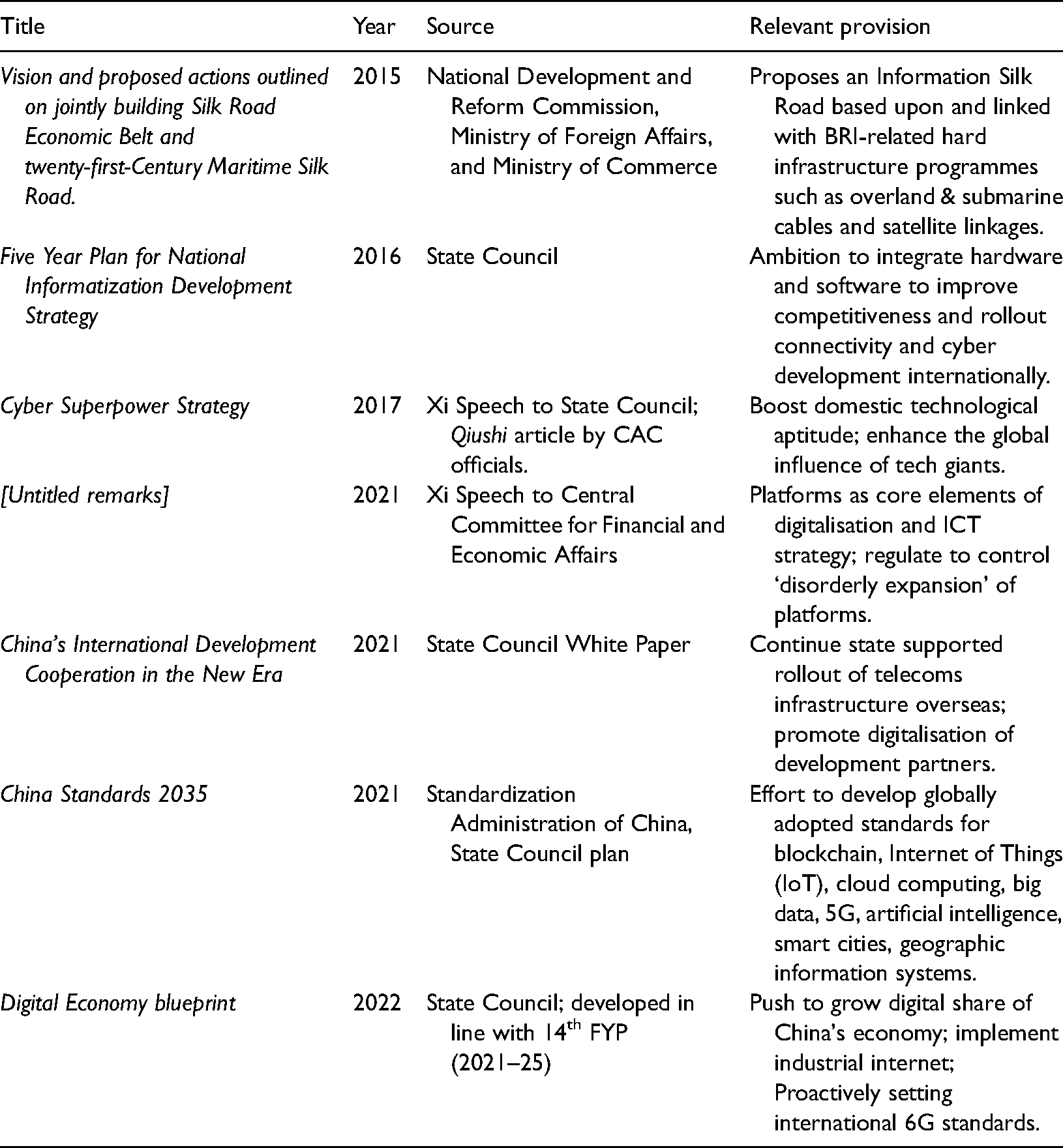
Despite this predominant commercial imperative, there is a latent geostrategic logic at play across the DSR. Documents display a tacit acknowledgement of the scale of US stack dominance, alongside its transnational scale of operations, and official references to the DSR highlight several means through which this could be undermined – such as establishing data localisation norms – which are grouped under the concept of ‘cyber sovereignty’. DSR participation is typically presented throughout policy documents as a means of networking societies without necessitating their sacrificing of control (e.g., ‘Jointly build a new order over international networks [and] [p]ersist in the principles of respect for cyber sovereignty’ (Central Committee General Office, 2016). But despite frequent references to ‘partnership’ and ‘sovereignty’, poorer economies rarely possess the technical or regulatory capacity to significantly intervene in platform or stack governance. Instead, DSR partner countries remain users of Chinese technologies, while China is effectively positioned as the developmental agent (Fischer, 2022).
Military-civil fusion… with American characteristics
The United States is home to most of the world's largest platforms and most advanced digital technology sector, whose outsized global role for some amounts to a world-spanning ‘digital colonialism’ (Kwet, 2019). The U.S. approach towards its digital platforms until recently amounted to ‘industrial policy at home, free trade abroad’ (e.g., Chang and Andreoni, 2020). The US high-technology sector and Silicon Valley have a long (often overlooked) history of significant business-state collaboration (O'Mara, 2020, Weiss, 2014). This encompasses both widespread government contracting and an emphasis on public–private partnerships (Weiss and Thurbon, 2020). Substantial funding for basic research critical to the US digital economy is routed through federal institutions such as the National Science Foundation, NASA, DARPA, the SBA and National Labs (Mazzucato, 2013, Tassinari, 2018, Wade, 2017). Allen et al. (2022: 22) point to a ‘large, decentralized apparatus for innovation within the US federal government, in which scores of agencies, often working in a largely unco-ordinated fashion, engage with private firms to promote innovative breakthroughs in a wide array of sectors’.
Military and national security interests play an outsized role in the US platform economy, even in comparison with China. Although Amazon Web Services (AWS) signed a $600m contract with the CIA in 2013, a decade-long contract for its Commercial Cloud Enterprise cloud computing system (worth ‘tens of billions of dollars’) was awarded to AWS, Microsoft Azure, IBM, Google and Oracle in 2020 (Konkel, 2020). Furthermore, state-sponsored venture capital firms such as the CIA's In-Q-Tel receive well over US$100m annually in tax revenues (Weiss, 2014: 69, Paletta, 2016). Beyond direct contracting and capital investments, the US national security state can be viewed as a ‘vast technology enterprise spanning R&D, seed funding, commercialisation, and both spin-off and spin-on of new technologies’ (Schwartz, 2017: 327). Following in the wake of national security investments, private equity in the form of hedge funds, mutuals and institutional investors have been willing to advance substantial capital to unlisted, unprofitable technology firms in the hope they are able to establish market dominance (Kenney and Zysman, 2019). Through these mechanisms, as Robinson (2020: 40) explains, the ‘Silicon Valley-Wall Street nexus becomes in turn interlocked with the military-industrial-security complex’.
The US government is currently further increasing control over its platform firms through regulatory instruments and financial incentives, framed as an issue of national security in response to the Sino-US rivalry (Gertz and Evers, 2020). For instance, the Trump administration's national cyber strategy published in 2018 labelled China a ‘strategic competitor’, and it stated that American economic security is dependent on the tech sector. The report concluded that the ‘vitality of the American marketplace and American innovation’ in the tech sector is a matter of national security (The White House, 2018: 14). The strategy envisions a symbiotic relationship between the state – namely its defence-related organisations – and American tech firms. This was echoed by the DoD's (2018: 7)'s Cyber Strategy, which, in short, is to: defend forward, shape the day-to-day competition, and prepare for war by building a more lethal force, expanding alliances and partnerships, reforming the Department, and cultivating talent, while actively competing against and deterring our competitors. Taken together, these mutually reinforcing activities will enable the Department to compete, deter, and win in the cyberspace domain.
A contemporary Defense Innovation Unit report identifies that US platform giants outspend its top defence contractors (e.g., Lockheed Martin, Raytheon) on R&D by 11-to-1 (Brown, 2021: 13). As such, it acknowledges that achieving security objectives necessitates deepening collaboration with the platform giants. The National Cyber Strategy states that the US Government will ‘use its purchasing power’ to shape innovation and influence firm behaviour in support of defence goals (The White House, 2018: 8). Moreover, the principles of the ‘third offset’ – a military strategy aiming to leverage private sector innovations for defence purposes – became embedded in the 2018 National Defense Strategy (Gentile et al., 2021). This explains the explosion of military contracts with Amazon, Google, Microsoft, Facebook and Twitter from 2017,
6
such as the National Security Agency's (NSA) US$10 billion contract for its cloud computing services awarded to Amazon in 2021 (Gregg, 2021), and Google's close collaboration with the CIA, US Navy and Air Force, alongside its upcoming bid for the Joint Warfighter Cloud Capability contract with the Pentagon (Simonite, 2021). The NSA's Cybersecurity Collaboration Center (2022) further illustrates the increasingly close ties between US Government agencies and tech companies: This groundbreaking hub for engagement with the private sector is designed to create an environment for information sharing between NSA and its partners combining our respective expertise, techniques, and capabilities to secure the nation's most critical networks. These collaborative relationships leverage the unique strengths of both government and industry and represent a vital part of a whole-of-nation approach to cybersecurity.
Furthermore, lawmakers developed the United States Innovation and Competition Act and the Endless Frontier Act, both aimed at supporting research and development of technologies critical to competition with China (Sevastopulo, 2021). Aspects of these bills were incorporated into the CHIPS and Science Act, passed into law in August 2022. Finally, the new non-profit public–private VC vehicle America's Frontier Fund (2022), promises to ‘leverage private capital as a force multiplier for government investment in deep technologies’ in order to secure US technological leadership.
US digital foreign policy was until recently defined by persistent efforts to construct a ‘free’ global digital trade regime. Upholding the overwhelming incumbent power of US digital platforms was pursued through efforts to resist data localisation, internet filtering and third-country attempts to transfer technology through securing access to source code and encryption keys (Azmeh et al., 2019). The use of multilateral trade institutions alongside large bi- and multilateral trade agreements – albeit hampered by the temporary failure of TTIP and TPP – embedded internet ‘openness’ and reduced protections for third countries by upholding IP claims (Rikap and Lundvall, 2020).
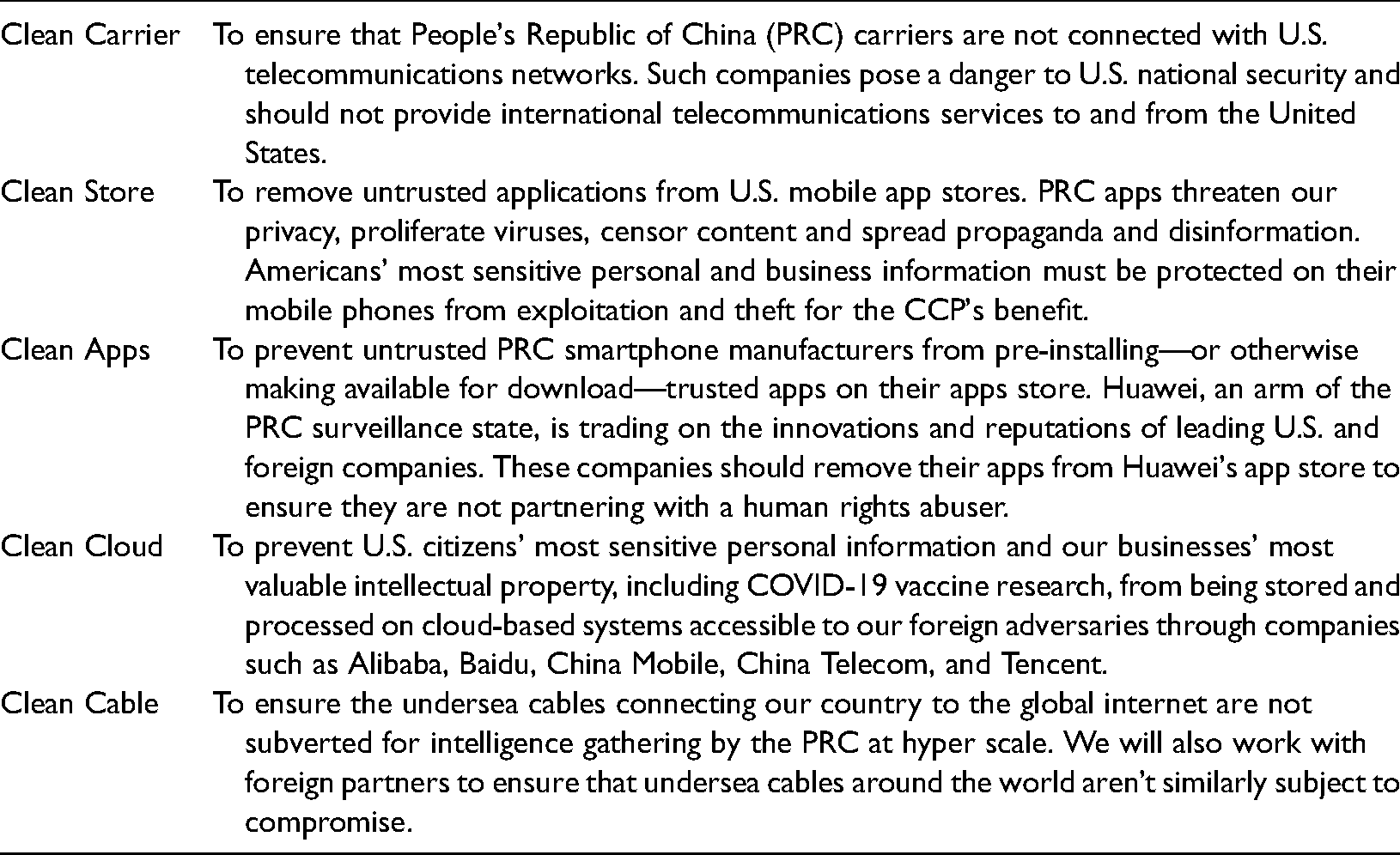
However, a focus on a strong IP environment and limits to tax and regulation has shifted recently towards more aggressive forms of upholding US digital supremacy, specifically in response to the challenge from Chinese platform firms. One key component of Trump's policy towards China was to limit the market share of Chinese tech firms abroad. Secretary of State of Pompeo's (2020) bellwether speech at the Nixon Presidential Library entitled ‘Communist China and the Free World's Future’ was followed by a major expansion of the so-called Clean Network Initiative (U.S. State Department, 2021). Firms or countries seeking to join the Clean Network were forced to ban Chinese operators from domestic communications networks, and thereby inhibit the formation of stacks that combined Chinese hardware with American software. Many advanced economies supported the initiative, which, according to one commentator (Braw, 2021), ‘could turn out to be the Trump administration's most enduring foreign-policy legacy’ (see Table 2).
The Biden administration has largely embraced the contours of Trump-era foreign policy, albeit alongside an attempt to restore America's traditional alliances. Kurt Campbell, Biden's Asia foreign policy chief, confirmed that the Biden administration has largely maintained Trump-era policy regarding technology diplomacy.
7
Washington has signalled that it would like to establish a regional trade deal that would inhibit the operations of Chinese platforms, particularly in Asia, yet this plan has been met with scepticism (Crabtree, 2021). The much-vaunted Indo-Pacific Strategy unveiled in February 2022 committed the US (with scant detail on how) to: [P]romote secure and trustworthy digital infrastructure, particularly cloud and telecommunications vendor diversity, including through innovative network architectures such as Open RAN by encouraging at-scale commercial deployments and cooperation on testing, such as through shared access to test beds to enable common standards development. We will also deepen shared resilience in critical government and infrastructure networks, while building new regional initiatives to improve collective cybersecurity and rapidly respond to cyber incidents (The White House, 2022: 17)
A strategy document leaked by AXIOS news agency in January 2021 revealed the existence of a China Strategy Group, co-chaired by former Google CEO Eric Schmidt and Jared Cohen (former Hilary Clinton adviser), that produced a briefing for the US Government containing a series of recommendations to inhibit Chinese tech ascendancy (Allen-Ebrahimian, 2021). These included developing a ‘new plurilateral coalition of ‘techno-democracies’ to strengthen cooperation’ and ‘protect and preserve key areas of competitive technological advantage’. It further proposed an ‘International Technology Finance Corporation… to extend loans and loan guarantees to developing nations for tech infrastructure buildout consistent with liberal values, to counter the Digital Silk Road’, alongside a ‘Global Body for Standard-Setting’ and ‘multilateral trust zones to achieve global integration that promotes American values’. The objective is to ‘incentivize collective innovation against China in AI, quantum computing, 5G, etc… To gain access to the benefits of the Trust Zone, countries would have to commit to a Huawei-free zone’. Ultimately, the United States increasingly seeks to (1) instrumentalise platforms by incorporating them into governmental institutions (particularly the defence sector) and (2) force third countries into an exclusive relationship with American (and US-aligned) platform firms at the expense of their existing relations with Chinese platforms.
Fields of competition
The previous section elaborated on how the United States and Chinese variants of state platform capitalism vary internally with regards to state-firm relations, and their grand-strategic initiatives. This section explores how SPC competition unfolds in three discrete fields of the global system: the drive to establish digital currency supremacy, safeguard cybersecurity and employ surveillance techniques, and to establish technological standards which underpin platforms’ dominance and exclusivity. The discussion is not comprehensive, but rather illustrative of the diverse range of spheres in which SPC competition is unfolding. 8
Digital currencies
As the world's predominant monetary power (see Fichtner, 2017), the United States already operates a largely digitalised currency in the global dollar system – which can itself be understood as a platform. The dollar remains the most widely used currency for cross-border payments and represents 62% of global monetary reserves, while only around 10% of US dollars exist in physical form with the remainder being electronic deposits (Black, 2020). The dollar system is beyond the full control of the United States, but the US government nonetheless enjoys privileged control through the Federal Reserve's autonomy over broad money creation, interest rates, swap lines, etc. Some economies use the dollar in lieu of their own currency, and more peg their currencies to their value. The stability and liquidity of the dollar grant the United States the ‘exorbitant privilege’ of the ability to run seemingly endless deficits.
The global monetary architecture – consisting principally of the SWIFT network, the Clearing House Interbank Payments System (CHIPS) and the Fedwire Funds Service for central bank transactions – is deeply dependent upon American regulatory institutions (Carter and Farha, 2012). Even SWIFT, despite being formally overseen by the Belgian central bank, is vulnerable to US financial sanction and thus typically falls in line with US demands (Goldberg, 2018). Collectively, this financial infrastructure provides the United States with extraordinarily valuable instruments by which to police global currency flows, target and isolate geopolitical rivals (Venezuela, Iran and Russia), and force compliance from allies such as the EU (de Goede, 2021). Resultingly, there exist strong incentives exist for US rivals and even allies to bypass the dollar system. Mark Carney, former governor of the Bank of England, in 2019 floated the possibility of a ‘synthetic hegemonic currency’ replacing dollar dependency in the near future (Michaels and Vigna, 2021), while the Sino-US rivalry and increasingly expansive reach of US sanctions create pressures to hasten dollar replacement. As Fantacci and Gobbi (2021: 24) argue, in an ‘international multipolar context characterized by a sort of new cold war, it is possible that we will witness processes of re-localization of production chains and strategic assets… [t]his could strengthen the gradual de-dollarization of the payment system’.
China's Cross-Border Interbank Payment System (CIPS) – established in 2015 – poses a potential long-run threat to both SWIFT and the dollar system by combining messaging services with clearing and settlement functions, bypassing entirely the dollar and existing US-centric payments systems (Nölke, 2022). Moreover, the digitalisation and platformisation of money more generally threaten the dollar's power. Here, China has a strong first-mover advantage in the rollout of a digital currency. Its principle private digital currencies (operated by AliPay and Tencent's WeChat) already accounted for around US$2tn of transactions in 2020, with their payments cleared by the central bank's Netsunion system which captures detailed, real-time transaction data. The People's Bank of China has also developed a sovereign CBDC (a ‘Digital Currency/Electronics Payments’ [DCEP] system), interoperable with existing private digital currencies (Kynge and Sun, 2021). The DCEP is currently being piloted, while a cross-border, real-time and ledger-based payments system is being developed in tandem with the Hong Kong monetary authority and the Thai central bank (John, 2021) – raising the possibility of a multi-central bank digital currency anchored in China's digital infrastructure (Nölke, 2022). There is already evidence of the adoption of WeChat Pay and Alipay across some DSR economies (Hillman and Sacks, 2021), while Huawei's Mobile Money service underlies most significant mobile payments systems used on the African continent such as M-Pesa and Telebirr (Adeyemi, 2021). Losing out to such firms is of serious concern to the United States, which – using legislation such as the Bank Secrecy Act and the Patriot Act – is presently able to obtain data from US-based financial intermediaries operating in third countries (Ferrari, 2020).
However, China's closed capital accounts and inconvertible (hard) currency mean that the DCEP does not appear a viable candidate for replacing the dollar in terms of reserve currency or financial investments. Nor would the present role of the United States as a consumer of last resort be upset by the rise of DCEP alone (Eichengreen, 2021). This role as a deficit-running backstop consumer, alongside its deep and liquid financial markets, creates an ‘organic’ demand for dollars which is not likely to be displaced in short order by a surplus-generating economy like China's (Schwartz, 2019). Although Chinese imports and exports might move to DCEP denomination where viable, ‘China's DCEP cannot be expected to help China challenge the US dollar outright unless China significantly reforms and liberalizes its financial system’ (Knoerich, 2021: 161). Moreover, China's advances are hastening US innovation. In response to both Chinese advances and the emergence of Diem (Facebook/Meta's ultimately failed digital currency), Janet Yellen, Treasury Secretary, promised to ‘curtail’ the use of Bitcoin in early 2021, shortly thereafter suggesting the rollout of a US CBDC – FedCoin (Light, 2021). An open global trading and financial system will continue to favour the dollar, but to the extent that it becomes splintered by superpower rivalry, China's technical capacity might increasingly begin to displace a substantial share of the dollar's usage.
Cybersecurity
The materiality of cyberspace permits both ‘physical’ and digital forms of surveillance – for instance, the wiretapping of copper and fibre-optic cables pioneered by the NSA (as captured in Trevor Paglen's photography). 9 The fact that virtually all major platform firms remain domiciled within the United States renders them near-defenceless against National Security Agency (NSA) claims upon their data (Tréguer, 2018). The US CLOUD Act of 2018 permits access to any US-domiciled multinational's overseas data servers if not contested by a court – effectively formalising (a weaker version of) the clandestine activities of the NSA's PRISM program exposed by Edward Snowden (Lyon, 2015). Moreover, the United States exerts authority over its firms to uphold its hegemony over the physical plumbing of the internet. In 2021, for example, the US government withdrew permission for Google and Facebook to activate their Pacific Light cable running between LA and East Asia due to its passage through Hong Kong (FitzGerald and Purnell, 2021). Furthermore, information sharing under the ‘five eyes’ network (the United States, Canada, UK, Australia and New Zealand) is now supplemented by a cloud-based multiagency real-time intelligence sharing platform named ICITE, developed by IT contractor Booz Hamilton (Amoore, 2018).
Despite its prowess, persisting US concerns about election interference, industrial espionage and cyberattacks (such as the Solarwinds hack) have led it to seek further enhancements in cyber capabilities by deepening the incorporation of American platform firms into the military-industrial complex (Gordon and Rosenbach, 2022).10 The United States historically viewed cyberthreats as ‘technical problems to be solved primarily with a combination of defensive and limited deterrence measures’ (Alperovitch, 2022: 46) rather than a field of geopolitical or geoeconomic competition. Although Obama hesitated to confront Beijing over industrial espionage for fear of disrupting economic relations, Trump, by contrast, has reorganised US Cyber Command within the military and established the Cybersecurity and Infrastructure Security Agency in the Department of Homeland Security (DHS). And as Aggarwal and Reddie (2018: 454) observe, Washington has increasingly ‘sought to play a market facilitation role with the broader internet technology sector to encourage [state-firm] cooperation’ on cybersecurity – through the creation of bodies like the DHS's Innovation Programme and its Science and Technology Directorate.
Beyond the implementation of the Great Firewall, the Chinese state has developed a complex assortment of internet management tools and mechanisms to assert control over domestic internet content. President Xi formed the Cyberspace Administration of China (CAC) in 2014 to integrate cyber security policy with the development of the digital economy. The CAC formalised state control over the domestic internet with the National Cyber Security Law of 2016, which formally grants the state substantial legal authority over online content, cross-border flows and jurisdiction over foreign cyber operations inside China (Hong and Goodnight, 2020). China has moved to restrict usage of US technologies across swathes of the Chinese technology stack by developing greater indigenous capacities – an urgent task given that Creemers (2020: 116) cites Chinese research claiming that in 2014, ‘82 percent of servers, 73.9 percent of storage equipment, 95.6 percent of operating systems and 91.7 percent of databases’ employed in China were provided by foreign, principally US-based, firms (e.g., Microsoft, Cisco, Apple). Precisely because of its stringent new data localisation requirements, significant stores of data have been shifted from foreign servers to Chinese joint-ventures – such as Apple's Chinese user data, formerly hosted in the United States and now by Guizhou-Yunshang's servers, a firm backed by the Guizhou provincial government (Kokas, 2018).
In part for these reasons, the overseas advance of Chinese platforms is causing consternation amongst American politicians and security services and those in US-allied states. Although the case of Huawei (discussed above) is well known (Liu, 2021), more recently digital platforms such as Bytedance's TikTok and the fast-fashion platform Shein have penetrated Western markets. TikTok became the world's most downloaded app in 2020 and remained so in 2021, including within the United States. Shein, meanwhile, was the second most downloaded shopping app in the United States in 2021 – second only to Amazon and beating Walmart and Shop's offerings (Apptopia, 2022). Despite finding no evidence of ‘backdoors’ being designed into such digital technologies by the Chinese state for surveillance purposes (Gray, 2021), policymakers have aimed to curtail the influence of such platforms by raising dubious security concerns. For example, US Senator Ted Cruz has cast aspersions on TikTok's parent company ByteDance for potentially sharing US user data with the Chinese state (Bartz and Dang, 2021). And the chair of the UK Parliament's Foreign Affairs Committee, Tugendhat (2021), warned of Shein's recommendation algorithms as a ‘sinister cross between surveillance and capitalism… [deploying] a data collection network to rival many of the world's intelligence agencies’. Such hyperbolic rhetoric is intelligible, however, if ‘cyber security’ is interpreted to mean control by the United States and its allies over critical stack infrastructures into the future, which growing Chinese commercial prowess is beginning to threaten (Tang, 2020b).
Standards
The United States has long dominated internet standards-setting bodies, with its firms establishing formal technical standards and informal adoptive standards for a swathe of internet industries. A recent Atlantic Council study demonstrates the United States retains overwhelming dominance across international standards developing organisations (SDOs) (Neaher et al., 2021). The role of Microsoft, Apple, Cisco and Google in providing vital networking and digital infrastructure is well known. But to take two lesser-known examples, feature phone internet access across much of the African continent is dominated by Facebook's Free Basics internet service (banned by India, however, on the grounds of its violation of net neutrality). And Google, through its Google Station program, sought to embed itself in India and other developing countries’ software stacks by rolling out free WiFi at over 5000 locations worldwide (Oyedemi, 2021).
China has made concerted attempts to establish formal and informal standards of its own since it successfully developed a domestic standard for 3G mobile communications (TD-SCDMA, which was accepted as one of three viable standards at the International Telecommunications Union [ITU]) (Gao, 2014). As Malkin (2020) observes, China has explicitly sought to create IP at least as early as 2015 with the publication of Made in China 2025 strategy by the Ministry of Industry and Information Technology. This strategy expressed the strategic intention of setting global industrial standards and explicit targets for advances in software, operating system and AI development (amongst many others). During the race to develop 5G technology, China moved to achieve ‘technical leadership and the first-mover motivation’ (Kim et al., 2020: 6). Indeed, China is amongst the most active members of the International Standards Organisation (Seaman, 2020) and has Huawei been the top filer of standard essential patents (SEPs) for 5G to the standards body 3GPP, ahead of Ericsson and Qualcomm (Ryugen and Hiroyuki, 2020). One survey estimates Chinese firms leading US competitors in filing next-generation 6G patents (Watanabe, 2021).
Beyond this drive into de jure global standards, China has also sought to establish de facto standards. The China Standards 2035 plan aims further mobilise China's private internet players in their efforts to embed digital technologies in technology stacks. These may sometimes be behind the technological frontier, but their adoption is encouraged either directly by lower costs or contractual stipulations bundling them with hardware where China is cost-competitive (Seaman, 2020). Tencent's Wechat, a superapp encompassing many third-party apps, is increasingly used to bypass Android and Apple stores (which suffer restricted access within China) as the principle interfacing mechanism with the internet (Thun and Sturgeon, 2019). Using similar logics, Chinese players are also expanding their reach into third-country technology stacks where they form increasingly foundational infrastructures. The 20% cost competitiveness in telecommunications hardware offered by Huawei, for instance, strongly incentivises integration both into its software ecosystem and associated technical systems, such as China's BDS-3 satellite navigation system, an alternative to US-operated GPS (Ghiasy and Krishnamurthy, 2020). Huawei's HarmonyOS mobile operating system is displacing Apple and Android where it comes preloaded on Chinese handsets and in Chinese-produced electric vehicles (Lan et al., 2022). Inroads into software provision as a standard can be more easily made where Chinese internet cabling, data centres and cloud storage facilities are established (Munn, 2020, Shen, 2018). China's CITCC recently constructed Tanzania's upgraded broadband network to be compatible only with Huawei routers (Agbebi, 2022, 5). The rollout of smart city technology often boosts Chinese software embeddedness across technology stacks (Feldstein, 2020) and allows for the assembly of data from social media and payment apps WeChat and Alipay (Ekman and de Esperanza Picardo, 2020). Similarly, SinoPharm and SinoVac's vaccine provision under the ‘health silk road’ is predicated upon cold-chain storage and delivery of vaccines provided for by Alibaba's Ali Health platform (Habibi and Zhu, 2021).
Conclusion
The post-Cold War unipolar world was underwritten by the United States's role as ‘liberal Leviathan’ (Ikenberry, 2011), pursuing an expansive (rhetorical, if inconsistent) commitment to free market capitalism. As this system gives way to a multipolarity structured at its apex by Sino-US competition, two convergent political–economic trends are shaping the two superpowers’ grand strategy. First is the decline of ideological aversion to states playing active economic roles, leading to complex new entanglements of state and private capital transgressing national borders. Second is the rise of a new mode of business organisation – the platform – which vastly extends the spatial reach and governance potential of platform owners and operators compared with traditional multinational firms. This paper has drawn attention to the significance of this paradigm shift in economic organisational form (so far neglected by state capitalism studies) as a critical mediator between (macroeconomic and technological) drivers of and evolutions in state capitalist practices.
We have argued that the emergence of platform capitalism does not augur a purely private form of business power, but rather a major new opportunity for states to exercise extraterritorial governance in idiosyncratic ways (insofar as they successfully mobilise platform governance for geopolitical–economic ends). Throughout the history of capitalism, lead economic sectors have often become deeply imbricated with states (Aiginger and Rodrik, 2020). But scholarship recasting platforms as infrastructures (rather than simply large multinational firms) points to the distinct affordances platform power offers states. Most critically, here is the extent to which platforms underpin and facilitate increasing swathes of global economic and social exchanges. If Dietz et al.'s (2020) aforementioned prediction of platforms intermediating one-third of all global economic activity by 2025 bears fruit, then Van Dijck et al.'s (2018) hypothesis of a ‘platform society’ will truly have come to pass, as platforms’ programmable infrastructures (Gillespie, 2017) will underpin economic activity in virtually every other sector. Under such circumstances, it is unthinkable that states should not seek to harness such vast power for their own ends. Intensifying geopolitical rivalry provides Beijing and Washington with an added incentive to instrumentalise their largest domestic platforms.
Indeed, as we have demonstrated, the emergence of hyperscaled platforms has already led China and the United States towards extensive and multifarious international engagements aimed at securing the success of ‘their’ domiciled platforms – while platforms in turn are variously encouraged or disciplined to align their behaviour with those of states. The notion of state platform capitalism encapsulates this increasingly deep structural interdependency between hyperscaling platforms and geopolitical superpowers. We point to the heightened significance of areas of competition and conflict in the contemporary global political economy beyond traditional economic and military contestation where SPC plays out: support for platforms’ overseas activities (including attempts at stack rationalisation by the United States), competition over digital currencies and payments systems, cybersecurity and over formal and informal industrial standards. Although the United States and its allies plainly remain dominant across these fields, there is also no question that Chinese capacities are developing rapidly and in some areas displacing US platform power.
Further research in this vein is urgently required to better understand the varied mechanisms by which states are able to mobilise platforms alongside the limits to these strategies. Moreover, the viability of hedging strategies for third countries without substantial technological power of their own remains poorly understood. Whether European plans for extensive digital regulation will be successful given its dearth of significant homegrown platforms is a major question. Moreover, the extent to which smaller countries can continue to successfully hedge between the United States and China remains unclear. Finally, there is a significant need to rethink platform studies to account for platforms’ growing geopolitical–economic role as privately owned, state-influenced business infrastructures, which can be mobilised as weapons in the global political economy.
Five components of the clean network introduced by U.S. Secretary of State Mike Pompeo.
Footnotes
Acknowledgements
The authors thank Yujia He, Ilias Alami and Jeff Henderson for generously commenting on drafts of this work, and to the guest editors for the invitation to contribute. The authors also like to acknowledge incisive comments and criticisms from four anonymous reviewers, and Jamie Peck's expert editorial guidance. Errors remain our own. Steve Rolf would like to acknowledge that, as part of the Digital Futures at Work Research Centre (Digit), this work was supported by the UK Economic and Social Research Council [grant number ES/S012532/1], which is gratefully acknowledged.
Data Access Statement
No new data were created during this study.
Declaration of conflicting interests
The author(s) declared no potential conflicts of interest with respect to the research, authorship, and/or publication of this article.
Funding
The author(s) disclosed receipt of the following financial support for the research, authorship, and/or publication of this article: This work was supported by the Economic and Social Research Council (grant number ES/S012532/1).
