



Abstract
The management of remittances represents a multi-billion industry that is concerned with how these flows can be tapped into by a wide range of institutional, state and private sector actors. This article advances the concept of remittance-scapes to signal the extensive work that is implicated in constructing remittances as development finance across four relational spaces of remittance management, namely, remittance preproduction-, production-, circulation- and reception-scapes. While human geographers have played a key role in unpacking many of the geographies of remittance management, I argue that thinking of remittances through the -scape provides new theoretical and empirical avenues to researching remittances.
Introducing remittance-scapes
Geographers and scholars in cognate disciplines working in the emerging field of migration industries have provided theoretically informed and empirically driven accounts of ‘the social, economic and geographical complexities of migration processes’, and how these processes have become an economy that involves a wide-ranging ensemble of actors and actions (e.g. Cranston et al., 2018: 543; Gammeltoft-Hansen and Nyberg-Sørensen, 2013; Schapendonk, 2018). While the global management of migration – that is, how people move – has long attracted policymakers, states, businesses as well as researchers, Lindley (forthcoming) rightfully argues that the global management of remittances – how people’s money move – has also expanded dramatically over the past 40 years (see also for instance Bakker, 2015a; Datta, 2017; Kunz, 2011). Dilip Ratha, lead economist in Macro Economics and Fiscal Management at the World Bank and the head of the Global Knowledge Partnership on Migration and Development (KNOMAD), argues that at least US$100 billion could be raised annually by tapping migrants as a source of finance (Ratha, 2014). By mobilising diaspora savings and giving, reducing remittance and recruitment costs as well as using future remittances as collateral to lower borrowing costs and linking remittances to financial products and services, this global agenda on remittances is deemed to constitute a major, albeit still largely untapped, avenue to finance development. Arguing that the management of remittances represents a multi-billion, multi-sited, multi-scalar and constantly evolving industry that is fraught with asymmetries and unequal power relations, this article takes stock of the rich albeit fragmented literatures on the topic and outlines several research themes for geographical inquiry.
Remittances underpin the livelihood and survival strategies of over 1 billion people. In 2019, an estimated 200 million migrant workers sent home US$551 billion – three and a half times the total size of development aid in the same year (US$144 billion) – supporting up to 800 million people living in countries of the Global South (KNOMAD, 2019). At best, these cross-border data paint a partial picture, failing to account for domestic remittances despite the continued significance of internal migration, estimated at 740 million migrants in 2017 (IOM, 2017). Remittances, therefore, constitute a major issue in both development and economic geography, and remittance-related policy agendas, which have a major impact on the lives of hundreds of millions of people worldwide, deserve continued critical attention.
In this article, I argue that geographical thinking offers scope to further uncover the spatial dynamics of power and flow that are so inherent to remittances. In contrast to narratives that portray remittances as a direct payment that bypasses inefficient bureaucracies and structures of management (e.g. Adelman, 2003 in Grabel, 2009), this article develops the notion of ‘remittance-scapes’ to show the extent to which remittances are actually managed and their circulation regulated. Deriving from Appadurai’s (1996) concept of ‘financescapes’ which focuses on the flow of currencies, securities and capital, remittance-scapes enable an articulation of the diversity of social, material, financial and cultural relations that underpin the construction, maintenance and expansion of the remittance industry. Remittance-scapes constitute the socio-economic and financial institutions, physical structures and cultural practices through which the production, circulation and reception of remittances are accomplished across multiple scales and spaces. 1 In other words, remittance-scapes are to be understood as an intertwining of remittance markets (Guermond, 2020a) with variegated remittance actors – including migrants, recipients, remittance agents, regulators, states, financial institutions, remittance service providers (RSPs), fintech companies and global investors – and the remittance ‘infrastructure’ (Schrader, 1997 in Green, 2020). The remittance infrastructure refers to all the physical (e.g. brick-and-mortar microfinance agencies), regulatory (e.g. anti-money laundering and counter-terrorism financing), communicational (e.g. cross-border digital transactions through electronic platforms) and human (e.g. network of money transfer agents) institutions which provide remittance- sending, -receiving, -using facilities as well as the political, legal, cultural and moral norms and modes of behaviours related to remittances understood as social practices (Schrader, 1997; see also Rodima-Taylor and Grimes, 2019). While the definition of remittance-scapes is left purposely broad, the main purpose of this article is to propose new avenues of research under the heading of remittance-scapes. In fact, and drawing upon the literature on policy mobilities (e.g. Délano, 2014; McCann, 2011; Peck, 2011a; Peck and Theodore, 2010), I advance that the growth of remittance-scapes is indicative of remittances as a ‘highly energetic policy field (…) associated with a complex innovation landscape’ (Peck, 2011b:168). In other words, remittance-scapes are not only reliant upon extensive financial, material, technological, legal, discursive, regulatory constructions as well as behavioural engineering. They are also underpinned by the rapid translocal and transnational proliferation of remittance-linked ‘best practice’ policies and ‘scale up’ programmes. As I’ll show in the second section, such policies and programmes are in constant evolution and contribute to shape, and are shaped by, a globalising but contested arena of poverty management (ibid). 2
More specifically, this article shows how remittance-scapes conjure up four key evolving spaces of management that contribute to this expansion and the further commodification of remittances, namely remittance preproduction-scapes, remittance production-scapes, remittance circulation-scapes and remittance reception-scapes. 3 While remittance production-scapes depict spaces of management where remittances are produced through waged and unwaged migrant labour, preproduction-scapes are these spaces where the necessity of migration and the structural reliance upon remittances as social reproduction strategies are constructed. As for remittance circulation-scapes, they constitute these arenas of management focusing on how and through which channels remittances travel. Finally, remittance reception-scapes are concerned with how remittance are received and used in remittance-receiving countries. Crucially, these spaces of remittance management are developed across multiple scales, ranging from supranational financial and development organisations, to states, households and individual bodies. Remittance-scapes come to represent an ‘archipelago’ that is patchy, uneven and asymmetrical but always contested and in need of re-negotiation (Lepawsky, 2018).
The geographical characteristics and conceptual values of the scape when thinking of remittances are manifold. First, key institutional and private sector actors in each space of remittance management are different – and increasingly distant – from the people and communities actually sending and receiving remittances. For instance, while states play a central role in preproduction-scapes (Pratt et al., 2017), transnational financial and development organisations have long been interested in regulating and formalising the domestic and cross-border circulation of remittances (Datta, 2017). Global investors, microfinance institutions and fintech companies are now key actors in the remittance industry, involved in not only the facilitation of remittance circulation but also in the ways remittances can/should be saved, loaned and invested in remittance reception-scapes. For this constellation of actors, remittances are understood in very different ways and from variegated positions, from simply sums of money (Kunz, 2011), foreign currency receipts (Maimbo and Ratha, 2005) and ‘cost-free’ incomes (Hernandez and Coutin, 2006), to entry points for further profit (Guermond, 2020a), to social practices embedded in specific economic, social and cultural contexts (Åkesson, 2011; Carling, 2014). The suffix -scape and its associated conceptual underpinning facilitates understandings of different ‘imagined worlds’ of remittances; it indicates that remittances do not embody ‘objectively given relations that look the same from every angle of vision but, rather, that they are deeply perspectival constructs’, subject to the historical, socio-economic and political situatedness of different sorts of actors (Appadurai, 1990:7). As such, remittance-scapes tie emerging geographies of migration and finance to social and cultural geographical imaginaries that influence how remittances are understood and what they should be used for. From this perspective, tensions and conflicts over the meaning and value of remittances that arise in the scape are to be conceived as not only economic and financial but also cultural and symbolic (Baviskar, 2007).
Second, the scape unites various spaces and situations of remittance management, which are all too often thought of, and studied, as discrete and fragmented (Porst and Sakdalporak, 2018). On the one hand, migrants and remittances are portrayed as agents and tools of development (Faist, 2008). On the other hand, constructed precarity is what facilitates mass emigration and the reliance upon remittances as collective survival strategies (Cross, 2013; Pratt et al., 2017). Drawing upon the ‘follow the thing’ approach rooted in social and cultural geography (Cook et al., 2004, 2017), this conceptual use of the scape reveals the often-hidden geographies of remittance production, circulation and reception and understands these spaces of management as co-produced and relational. In other words, remittances, and the industry underpinning these flows, can only be understood as arising from these spaces dialogically and collectively (Peck, 2011b). As such, the concept of remittance-scapes suggests the necessity to engage in work that focuses on ‘the complexities of the geographical biographies’ of remittances and of their management by a wide range of actors (Crewe, 2017:7; see also Crang et al., 2020). Only through a translocal and transnational understanding of remittance biographies can remittance households’ livelihood strategies be located within international migration regimes that create conditions of oppression, exploitation and inequality (Cole, 2012). The adoption of the scape as a geographical lens allows to bring into view relations between cross-border movements of capital, labour and wages in the context of the social reproduction of class relations at a global scale and the central role of imperialism in the (re)production of these social relations (Ferguson and McNally, 2014; Grosfoguel et al., 2014).
Finally, thinking of remittances through the -scape and mapping the variegated inter-connected spaces of remittance management across multiple scales provide new avenues to researching remittances. I argue that some of the theoretical and empirical issues arising from the concept of remittance-scapes could benefit from the combined insights of geographers that are not only interested in exploring geographies of migration and development but also: (1) (behavioural) geographies of finance and market making, (2) labour geographies of remittance households and (3) geographical political economy of financial subordination.
I proceed in the second section by synthetising research on the multi-scalar management of remittances across four different spaces. I take up the task to bring these literatures into a productive dialogue through the concept of remittance-scapes in order to provide a unitary account of the past, current and possibly future efforts and constructions to manage remittances. In the third section, I consider how geographers might contribute to further research the consolidation and expansion of remittance-scapes within and across the four identified spaces of remittance management. The conclusion summarises the geographical and political stakes of these debates.
Remittance-scapes and the multiple spaces of remittance management
There still is a tendency among state, commercial and financial actors as well as policymakers to treat remittances as if they are simply an aggregated sum of money – an almost inherent financial worth that should be unlocked and transformed into new development finance (e.g. Fleury et al., 2018). Remittances are often depicted as a ‘free foreign exchange earner’ and ‘a transfer without quid pro quo that helps to reduce the gap of the current account balance’ (Guermond, 2019: 114). The costs of migrating, and the risks taken up by migrants, are often not accounted for. It is almost as is remittances are placeless flows that are not contingent upon anything; they are detached from the cumbersome and complex realities of not only their production but also their circulation, reception, utilisation and transformation. By using the concept of the scape, this section seeks to both cohere the literatures on remittances and place these flows and the efforts at managing them in their variegated and inter-connected geographies of labour, precarity, regulations, finance and social reproduction.
Remittance preproduction-scapes
A prominent space of remittance management that is often not accounted for when discussing the linkages between remittances and development is what I term ‘remittance preproduction-scapes’. I argue that by re/producing and naturalising the necessity in remittance transfers for the reproduction of both remittance-receiving households and states, these spaces contribute significantly to the emergence and expansion of remittance commodification. In their examination of the production of ‘lifetimes of disposability’, Tadiar (2013: 38) and Pratt and colleagues (2017: 170) show how decades of neoliberalism in the Philippines have created the conditions for the persistent reproduction of precarity across generations. Rather than being abandoned, parts of the surplus population are used as valuable assets through an innovative labour export programme that the state put in place several decades ago. Through their remittances, temporary labour migrants not only sustain their families but also support the Filipino state that has become structurally reliant upon remittances, one of the largest sources of foreign currency (see Section ‘Subordinated financial geographies of remittances'). Crucially, this on-going labour migration organised under the auspice of the Overseas Filipino Workers scheme needs to be understood as constructed by the state. In effect, the reliance of the latter on remittances is being re/produced ‘policy by policy, law by law, presidential decree by presidential decree, broken promise by broken promise’, through ‘the continuous system of “liquidation” of the potential capital of the urban poor’ (Pratt et al., 2017: 186). This labour export programme – which many other labour-exporting countries are learning from 4 – fosters a state of permanent precarity among the urban poor which, in turn, facilitates the reproduction of both chosen and forced mass emigration as collective strategies for survival. In other words, migrants’ remittances ‘sustain the conditions for a constantly self-renewing “stagnant surplus population”’ (see also Ferguson and McNally, 2014; Tadiar, 2013: 35 in Pratt et al., 2017: 180).
More recently, state-facilitated loans have been put in place in countries such as Bangladesh in order to facilitate the migration process (Moniruzzaman, 2016). This comes in tandem with the multifaceted phenomenon of ‘migra-loans’ – that is, loans sourced from formal microfinance institutions that are used to support household strategies of international migration (Bylander, 2014). One specific form that migra-loans take are loans that directly finance the costs of undocumented migration (Berg, 2012; Stoll, 2013). While officially prohibited by microfinance institutions, Bylander (2014) suggests that these loans are nonetheless known by microfinance officials to occur frequently in Northwest Cambodia. Households with migrants who remit regularly are increasingly targeted by microfinance institutions due to their capacity to reimburse (Lawreniuk and Parsons, 2020; Parsons et al., 2014).
The re/production and management of precarity in remittance preproduction-scapes as well as the development of labour export programmes and multiplication of debt relations – with not only states and financial institutions but also wider communities (Datta and Aznar, 2019: 304; see also Baey and Yeoh, 2018) – lead (indebted) migrants to move across space, hence permitting the possibility of remittance production in the future. The remittance industry in such preproduction-scapes is concerned with governing what makes remittances possible and necessary in the first place.
Remittance production-scapes
A second important space of remittance management is what I term ‘remittance production-scapes’. Within such spaces where remittances are produced, institutional, state and private sector actors attempt to turn migrants into ‘professionalised partners in development’ and leverage their remittances and investments (see also Délano, 2014; Mullings, 2012; Pellerin and Mullings, 2013: 89). 5 This much-celebrated migration-development nexus has been called into question for its very narrow notion of development as well as for paying little attention to the conditions under which remittances that sustain it are produced (Castles and Delgado Wise, 2008; Datta et al., 2007; Delgado Wise et al., 2013; Glick Schiller, 2010). 6 Instead, and in response to early concerns about the ways in which remittances were allegedly being carelessly consumed on unnecessary and luxurious consumables (Abbots, 2014), global policies and initiatives disseminated by international organisations and relayed by states both in the Global North and Global South consistently sought to encourage a more ‘productive’ use of remittances away from consumption by (1) providing investment opportunities in different types of assets (e.g. housing) to migrants (Kunz, 2011; Levitt, 2001; Zapata, 2013); (2) establishing fund-matched programmes for hometown associations’ development initiatives (Duquette-Rury, 2014; Kunz, 2011; Smyth, 2017); and (3) developing small and medium enterprises schemes by offering tax breaks on imports of capital goods (Gamlen, 2005). For instance, Zapata (2013:99) shows how active the Colombian state is in promoting remittances-for-housing programmes, supporting international property and housing fairs for Colombians abroad, as a way to ensure that remittances sent to families do not ‘get lost’ in consumption.
The aim of rendering remittances more productive is also implied in the broader efforts to formalise and use remittances as a key entry point to integrate ‘unbanked’ and ‘underbanked’ migrants into the formal banking system (Datta, 2017). At the heart of these efforts to govern how remittances are sent, and for what, in remittance production-scapes is the positioning of finance ‘at the centre of households’ socioeconomic reproduction’ (Zapata, 2013: 99). Crucially however, as a growing number of studies has started to show, the everyday construction of migrants as financialised subjects is neither a linear nor uncontested process that can be generalised across place and space. For example, Zapata (2013) demonstrates how the Colombian government has mostly failed to shape the everyday identities and practices of migrants by solely focusing on migrants and not accounting for the importance of remittance recipients in any remittance investment decisions (see also the forthcoming Theme Issue on remittances and financialisation in Environment and Planning A).
A distinct but overlapping development that is concerned with harnessing the developmental contributions of migrants in remittance production-scapes as part as states’ diaspora policies is related to what is often called ‘diaspora savings’ or ‘diaspora investment’ (African Development Bank and Making Finance Work for Africa, 2020; Frimpong Boamah et al, 2017). 7 While remittances are private funds that cannot easily be (re)directed for specific purposes, international financial and development organisations make the case that diaspora savings are rather different. They constitute large amounts of savings accumulated by recent and long-term migrants and invested in bank deposits in destination countries (Pellerin and Mullings, 2013). By technically and financially assisting diaspora individuals and groups for projects implemented in countries of origin as well as issuing financial instruments such as diaspora bonds, it is argued that developing countries could raise significant amounts of money to finance long-term development projects (Ketkar and Ratha, 2007). While the success of diaspora bonds has been rather uneven and limited in countries such as Ethiopia (Pellerin and Mullings, 2013), the World Bank’s promotion and work on diaspora bonds continues to gain prominence with many countries of the Global South, such as El Salvador and Bangladesh (Johnson, 2019).
Remittance circulation-scapes
Although complementary to, and not easily differentiated from, the aforementioned spaces of remittance management, I conceptualise ‘remittance circulation-scapes’ as those spaces of management that are concerned with how and through which channels remittances travel, and how these flows are captured and represented discursively and statistically. In fact, over the years international financial institutions, private sector actors and policymakers have shifted their efforts, from trying to directly influence how remittances should be used to focusing on the ways in which remittances circulate (Horst et al., 2014). At the core of the global remittance policy agenda, therefore, is the building of a competitive remittance marketplace that aims to broaden the choices migrants and members of remittance households in home countries have (Cross, 2015). Among key initiatives that have attracted a broad consensus within policy circles are calls for (1) constant improvements in the monitoring, analysis and projections of remittance flows; and (2) safe, competitive and efficient international remittance services (BIS and World Bank, 2007; FSB, 2019).
Taking these in turn briefly, particular accounting practices have been deployed in order for remittances to be considered as national incomes and foreign currencies that can be capitalised for development (Hernandez and Coutin, 2006). In fact, Bakker (2015b: 32) demonstrates that the supposed dramatic increase in remittances flows over the past two decades is mostly due to better reporting, that is, better data-collecting procedures and improved measurement practices and graphic representations of these flows (see also Clemens and McKenzie, 2014; Raghuram, 2009). International institutions, including the World Bank and its ‘Migration and Remittances’ team, have played a pivotal role in constructing remittances as a financial flow that is highly visible and attractive to development policymakers (Carling, 2014; Kunz, 2011). Such perspectival constructs within remittance circulation-scapes often go alongside the allegedly better stability and even counter-cyclicality of remittances in period of crisis as opposed to other resource flows. While the representation of remittances as stable, homogeneous flows, with major emphasis on their aggregate volume, has played a significant role in the growth of remittance-scapes and continues to be widely reproduced, remittance scholars have demonstrated that these ‘dominant’ characteristics and representations are either false or based on inaccurate and unreliable data (see for instance Bakker, 2015a, 2015b, and Kunz, 2012).
For international remittance services to be safe and efficient, the World Bank and the Bank for International Settlements (BIS) – through a task force consisting of representatives from international financial institutions and central banks in both remittance-sending and remittance-receiving countries – have directed initiatives for greater formalisation, competition, transparency and accessibility among money transfer intermediaries, or RSPs (BIS and World Bank, 2007). 8 They have also sought to improve payment system infrastructures and regulations and promote appropriate governance and risk management practices (ibid). A core rationale behind the drive towards the regulation of ‘alternative’ money transfers is to be found within the fight against money laundering and terrorist financing in the context of post 9/11 terrorism concerns (de Goede, 2003; Farrant et al., 2006; Lindley, forthcoming). 9 As Horst and colleagues (2014: 517) argue, ‘the prevailing perspective on IVTSs (Informal Value Transfer Systems), namely that they have an inherent link with the threat of financing terrorism, money laundering and other criminal activities, became dominant in many countries’. Regulators have pushed for state licensing and registration by the state of ‘alternative’ remittance intermediaries as well as the enforcement and monitoring of strict practices with regard to customer identification (Lindley, forthcoming). As a result, banks have become particularly reticent to cooperate with not only ‘alternative’ but also formal money transfer intermediaries (Datta and Vicol, 2019). Concerned with the consequences of being issued heavy fines, banks have ‘derisked’ many money transfer businesses, especially small and medium size businesses which dominate specific remittance corridors, by making their accounts more expensive or even closing them altogether (ibid; see also Hammond, 2013; Lindley and Mosley, 2014). However, clear evidence contradicts the claims of money transfer organisations as well as alternative remittance systems being a privileged route for terrorist financing and money laundering (Lindley, 2011, forthcoming; Pieke et al., 2007). Moreover, the logic with regards to security concerns seems for many observers clearly counter-intuitive as ‘changes in legislation, registration practices, or requirements of records keeping’ may render some money transfer systems illegal, push them further ‘in the realm of the informal’ and subsequently lead to a black hole of accountability within remittance circulation-scapes (Pieke et al., 2007: 16).
Finally, the formalisation of remittances, through the liberalisation of banking regulations, the increased competition among RSPs and the fuller participation of microfinance institutions, fintech companies, credit unions and saving banks in remittance circulation-scapes, is expected to decrease the cost of remittances transfer (Cross, 2015). The reduction of the costs of remittance transfers from 10 per cent to 5 per cent, and now 3 per cent by 2030 (Sustainable Development Goal target 10.c), has long constituted a key priority for a broad coalition of actors, as it is commonly accepted that a small decrease in money transfer prices can result in significant increases in remittance receipts (Datta, 2017; World Bank, 2014). The creation of numerous remittance price comparison websites by organisations such as the World Bank (https://remittanceprices.worldbank.org/en) represents one of the most visible components of this set of policies within remittance circulation-scapes. However, despite a slight decrease, transaction costs have remained high – much higher than the 5 per cent target – in many parts of the world, especially in the African continent (KNOMAD, 2019).
Remittance reception-scapes
In recent years, the aforementioned aims for greater competition and formalisation have increasingly been attached to the financial inclusion agenda in remittance reception-scapes (e.g. Anzoategui et al., 2014; FATF, 2017; Global Migration Group, 2017; IFAD and World Bank, 2015; Isaacs, 2017; UNCTAD, 2015). I have demonstrated elsewhere that remittances now represent a key entry point to integrate remittance recipients into the formal banking system (Guermond, 2020a), hence contributing to the expansion of what Soederberg (2014) calls a ‘poverty industry’ (see also Aitken, 2013; Roy, 2010). Since collecting remittances may be one of the only forms of access a remittance recipient has to formal financial services (Isaacs, 2017), remittances are used as a tool to ‘help’ migrants and members of remittance households gain access to formal financial products and services, including financial accounts, insurance, consumer loans, mortgages and credit cards (Agunias and Newland, 2012; Ardic et al., 2012). More specifically, by putting in place incentives to encourage remittance recipients to keep part of the remittance they receive in savings accounts, it is argued that their savings behaviours will be fostered and lead to increased investment and higher expenditures (World Bank, 2014). This, in turn, would lead to economic growth and poverty reduction (Ratha, 2007, Terrazas, 2010). In a similar vein, initiatives to include remittances in the assessment of creditworthiness of remittance recipients and migrants have recently come to the fore (IFAD and World Bank, 2015; World Bank, 2014). Through regular remittance receipts, banks would be positioned to gain a better understanding of who their remittance customers are, enabling them to cross- and up-sell supplementary financial products and services. The development of such ‘remittance-linked’ and ‘remittance-backed’ financial products are considered to be crucial to leverage remittances for financial inclusion at a national level (Agunias and Newland, 2012:126), enhancing various actors’ ability to manage remittances in such remittance reception-scapes. 10 Yet, such attempts to format and align remittance recipients’ practices to specific behaviours deemed economically beneficial by proponents of the remittance-financial inclusion nexus have been sources of covert and overt contestation (e.g. Guermond, 2020b; Smyth, 2021).
On a different scale, it is argued that greater formalisation and financial inclusion could also contribute to help financial intermediaries and states raise development finance. Remittances understood as hard currency would, if properly accounted, improve developing countries’ creditworthiness and lower their borrowing costs in global markets (Ratha et al., 2011). Moreover, the securitisation of future remittances is presented as an alternative to Official Development Aid and Foreign Direct Investments to increase funds for development. Public investment could be financed via workers’ remittances as they represent a future-flow receivable that financial institutions can collateralise to access additional, stable and cheap capital (Agunias and Newland, 2012; Ketkar and Ratha, 2009, Mohieldin and Ratha, 2020). 11
In this section, I have sought to cohere the fragmented literatures on the management of remittances by identifying four relational spaces, which together constitute the global remittance-scapes. Table 1 provides a unitary visual account of the four scapes and describes the key initiatives, primary motives, actors and examples across each space. This new geographical framing to the study of remittances allows in turn for the development of a new agenda for research. In fact, while some of the recent developments mentioned earlier have attracted the attention of critical scholars, I suggest that more work is required to understand how the management of remittances across different but intertwined scales and spaces unfold in practice, and how this is experienced, accepted and/or contested by a variegated set of actors. In the following section, I consider how some of the theoretical and empirical issues raised by the concept of remittance-scapes overlap with several major streams of literature in geography and cognate disciplines.
Remittance-scapes.
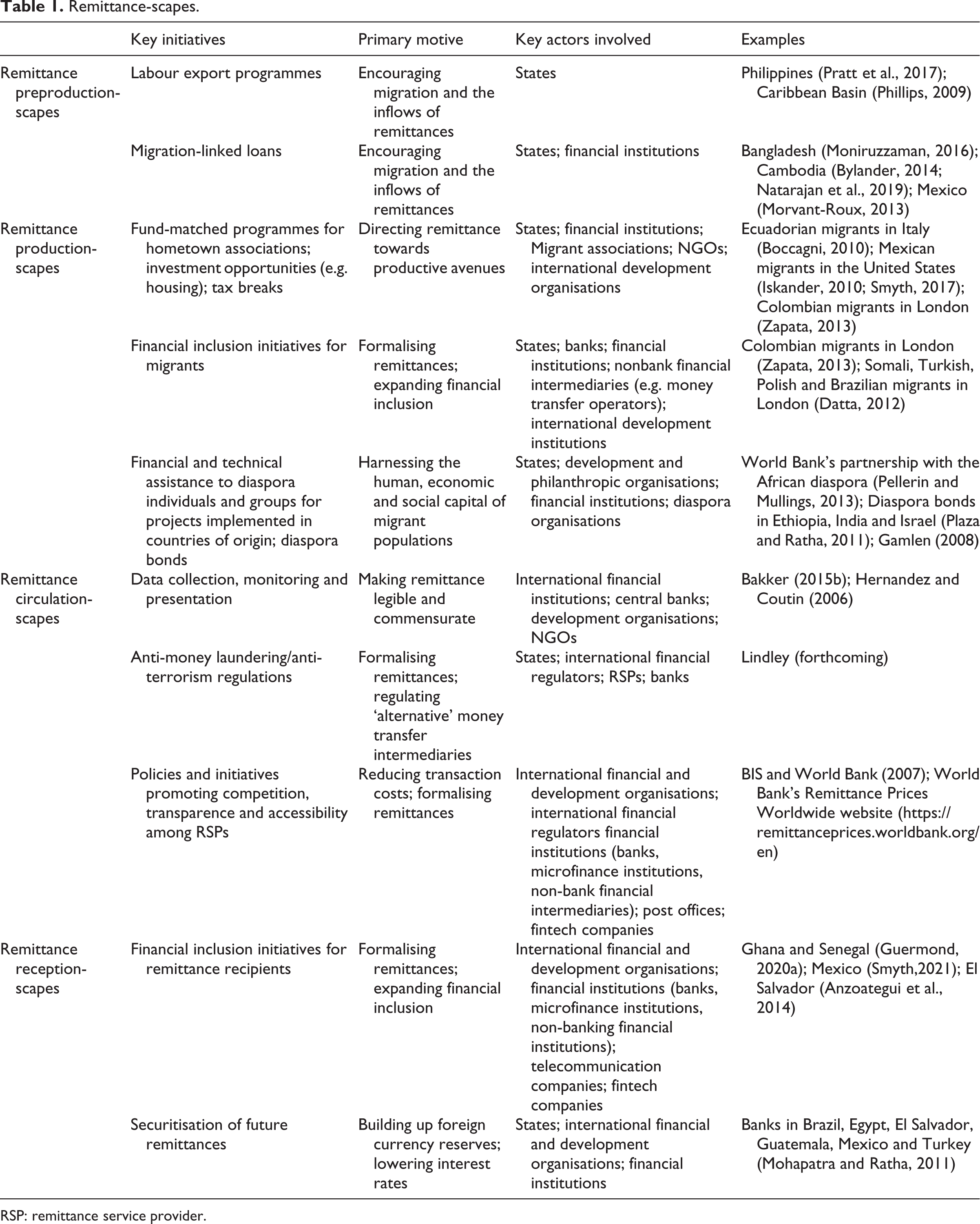
RSP: remittance service provider.
Potential geographies of the remittance-scapes
Geographies of remittance marketisation
Remittance-scapes draw attention to how multiple connections and mutual relations of dependency, but also asymmetrical relations of power, between migrants, remittance recipients, remittance market-makers, national governments and commercial and financial actors are constructed across multiple spaces and scales. Here, I argue that financial and economic geographers can help unpacking how the construction, maintenance and expansion of remittance-scapes through new regulations, laws, technologies and discursive constructions unfold concretely. The geographies of economisation and marketisation literatures consider the labour and efforts that underpin the processes of creating, maintaining and reinforcing the conditions and requirements that render things economic and realise markets in their idealised forms (Berndt and Boeckler, 2009, 2012; Çalışkan and Callon, 2009; Ouma, 2015a). In these literatures, markets are understood as socio-technical agencements that come to constitute a ‘combination of material and technical devices, texts, algorithms, rules and human beings that shape agency and give meaning to action’ (Berndt and Boeckler, 2009: 543). Scholars working in this tradition are well-equipped to examine the work and investments required to make remittance markets work.
At the macro-level, the geographical marketisation approach could be productively employed to study the political and discursive extension of the market domain to remittance practices and corridors across the four spaces that constitute the remittance-scapes. For instance, the construction of so-called ‘informal’ remittance-sending practices and corridors as ‘traditional’ within remittance circulation-scapes as well as the narrative around the necessity to formalise and link remittance to financial products and services to make them ‘more productive’ in remittance production- and reception-scapes could be situated within such practices of boundary-making between the market and its constitutive other, the non-market and the incorporation of the latter into the former (Berndt and Boeckler, 2012). Crucially, scholars could examine how these processes are underpinned by classed, gendered and racialised constructions of what constitutes the ‘informal’, ‘unproductive’, ‘non-market’ other, whether it be remittance flows, corridors or subjects (Bhattacharyya, 2018; Sanyal, 2007).
At the micro-geographical scale, the different ways remittance flows and the agencies of remittance senders, receivers and intermediaries are ‘reframed’ to realise remittance markets could be investigated through fine-grained, multi-sited empirical research across the four spaces. Particular attention could be paid to the ways in which laws, regulations, technical devices, informational and financial infrastructures, calculating systems, texts, discourses, scientific knowledge are arranged and put to work concretely in order to manage the ways in which remittances are pre/produced, circulated, used, saved and invested (Berndt and Boeckler, 2012: 204). Moreover, geographers have recently taken up the task of bringing science and technology studies-inspired and political economy approaches to markets and global finance into a productive dialogue (Bernards, 2019; Bernards and Campbell-Verduyn, 2019; Fields, 2018; Ouma, 2015b, 2016). This recent literature could be employed in looking into whether and how the grounded construction of remittance markets and the financial incorporation of remittance flows and households into global finance sustain processes of capital accumulation. More specifically, detailed analyses of the concerted efforts across the four scapes to construct financial instruments that rely upon continuous and stable remittance-based incomes could be linked to recent techniques of financial valuation and intermediation, which have started to facilitate the conversion of these income streams into sources of financial profit, and remittance customers into investable assets for private investors (Aitken, 2015).
A nascent literature within economic geography has started to explore the rise of behavioural economics in development, noting that it constitutes a shift of focus from the market to the market subject or, in other words, from market regulation to behavioural engineering (Berndt, 2015; Berndt and Wirth, 2019; Boeckler and Berndt, 2013; Mitchell and Sparke, 2016; Webber and Prouse, 2018). Several scholars have begun to examine this behavioural turn in relation to microfinance policies and programmes (Gabor and Brooks, 2017; Mader, 2016, 2018), signalling a shift from microfinance to financial inclusion, and even digital financial inclusion, which corresponds to the development of a whole apparatus of training and initiatives that aim to transform and/or enhance poor people’s calculative behaviours and practices (Mader and Sabrow, 2019). Such analyses could also be useful for exploring complementary sets of devices as well as the whole apparatus of training and initiatives that act as nudges and prompts that, in turn, encourage migrants, recipients as well as remittance intermediaries to alter their remittance-related behaviours. In fact, the ‘digitalisation’ of remittances – the use of digital remittance channels, including mobile money, as opposed to ‘bricks and mortar’ RSPs – constitutes a key priority for the remittance industry to not only lower average transaction costs but also, and perhaps most importantly, promote broader financial inclusion and render remittances more ‘efficient’ and ‘resilient’ (IFAD, 2020a). These links between digital remittances and financial inclusion have attracted heightened levels of interest from not only the international development community but also the commercial and financial sectors, from small blockchain technology firms and other types of fintech companies to international banks, social media giants such as Facebook, and giant incumbent companies such as Western Union (IFAD, 2020b). I argue that a geography of marketisation approach that is sensitive to this behavioural turn – or what Kear (2018: 317) calls a ‘behavioural geography of marketisation’ – is well placed to emphasise the complexity, fragility, contingency and limits of the formation of digital remittance-scapes on the one hand, and the construction of remittance senders, recipients and intermediaries as market subjects on the other (Berndt and Wirth, 2019). In fact, at the core of such approach is the acknowledgement that these processes of market construction are by no means frictionless; they are contested and require constant renegotiations. Callon (2007) uses the concept of ‘overflows’ to account for such fragility and messiness as one set of practices, identities, desires, norms, rules, customs and logics attempts to impose itself upon others. In other words, the production of the Homo economicus – that is, the self-managing, rational and entrepreneurial subject – rarely is a stable accomplishment. In effect, the formatting of agencies among remittance senders, receivers and agents is not a frictionless process but does take place in the context of competing regimes of value (Kear, 2018). Attention to moments of overflow and limits of specific market devices (e.g. a credit-scoring algorithm that struggles to contain the capacity of human actors to ‘game’ it) would need to be complemented by accounts of more fundamental limits that have to do with ‘the dynamics of “real economies” themselves’ (Bernards, 2019: 821). In a context of precarious, irregular and low-incomes economic activities, the accumulation of assets (e.g. savings) and the stable production of remittance-linked income streams (e.g. loan repayments) upon which financial accumulation is dependent may just not be possible, despite all the financial, material, legal and behavioural engineering that contribute to the formation and expansion of (digital) remittance-scapes.
Furthermore, the marketisation approach could be employed to explore how the incorporation of remittances into global finance through financial inclusion is portrayed not only as a ‘development’ enterprise but also a market-led ‘humanitarian’ intervention. In Rwanda for instance, online money transfer service providers Worldremit and Useremit are now offering mobile-based remittance services to refugees in the two longstanding camps of Gihembe and Kiziba (Pistelli, 2018). UNCDF (2018: 6), in a report entitled ‘Accessible and affordable remittance services for refugees: A toolkit’, promotes the use of mobile money as affordable remittance channels that can ‘further link remittances received by forcibly displaced people and host communities with broader financial services’. Development and economic geographers working in this tradition could empirically investigate the ways in which remittance-linked financial inclusion is constructed, how it extends the remittance-scapes to places such as refugee camps as well as the limitations and fragilities of such projects.
Crucially, the role that the articulation of emotions play as part as broader processes of ‘nudging’ is a further avenue of research that could be taken up by geographers interested in the cultivation of new market subjectivities (Mitchell and Sparke, 2016). Important work has been done on the affective significance of remittance practices for cementing family relationships across borders (Bonizzoni and Boccagni, 2013; Huennekes, 2018; Parrenas, 2005) and on how concepts of gender, relationships and emotions underpin ‘care chains’ approaches (McKay, 2007). Such perspectives on remittances – as collective practices embedded in specific economic, social and cultural contexts – are essential to understand some of the challenges faced by states and development and private sector organisations to formalise them (Boccagni, 2010; Zapata, 2018). Yet, there is a relative dearth of studies investigating how in turn emotions have been used by the remittance industry and international community to nudge remittance practices and flows (although see Kunz, 2015; Kunz et al., 2020; Trotz and Mullings, 2013). Cultural economy approaches through discourse and visual analyses could be used to further understand how practices of remittance sending and receiving are intertwined with ideas of the heteronormative family, love and care as well as territory, citizenship, sovereignty and identity, and how these are spatially and socially brought about by, among others, state, financial and commercial institutions in the attempts to formalise and marketise them.
Labour geographies of remittance households
The predominance of the ‘migration-development nexus’ when thinking, researching and conceptualising remittances has led to an emphasis on the potentiality of remittances to produce development and enhance resilience (Porst and Sakdapolrak, 2018). As mentioned earlier, human geographers have been at the forefront of a critique that unpacks this over-optimism and the problematic nature of building development policies on the back of migrants’ labour in host countries (Datta and Guermond, 2020; Datta et al., 2007; Ferguson and McNally, 2014; Gamlen, 2014).
However, while labour geographers have long highlighted the increasing precariousness of living and labouring conditions of international and domestic migrants (e.g. Lewis et al., 2015; Schwiter et al., 2018; Strauss, 2018), more attention needs to be given to how precarity travels with movements of workers and remittances, from places of origin to places of destination, and back (Porst and Sakdapolrak, 2018; see also Green and Estes, 2019). Scholars working on translocalism and transnationalism are well-equipped to articulate the forms of precarious labour and life bound up across the remittance-scapes (Brickell and Datta, 2011). This would enable the exploration of not only the physical and emotional labour undertaken by migrants in order to send remittances from remittance production-scapes, but also the kind of work, activities and sacrifices by the latter as well as members of remittance households in remittance preproduction- and reception-scapes (Lawreniuk and Parsons, 2017; McKay, 2007).
The literature on the ‘left behind’ has long unpacked the assumptions of idle and passive recipients within the literature on migration and remittances (Kunz, 2011; Toyota et al., 2007; Yeoh and Huang, 2014; Yeoh et al., 2002). Yet, recent remittance policies and initiatives that aim to make remittances and recipients more ‘productive’ by incorporating them into global financial circuits still implicitly portray remittance households as merely sites of consumption (Abbots, 2014), within which remittances are at risk of being wasted (Guermond, 2020b). These processes of invisibilisation (of social reproductive labour) and devaluation (of self-employed, insecure, non-waged but income-generating activities that are conducted by so many remittance recipients) have been shown to be underpinned by economistic and gendered constructions (Åkesson, 2011; Carling, 2014; Levitt, 2001; van Naerssen et al., 2015). Attention to how racialised assumptions and constructions are also at play within these interventions could help making the socio-economic and financial practices and arrangements of remittance households more visible. Building upon the work of scholars on social reproduction and racial capitalism (Bhattacharya, 2017; Bhattacharyya, 2018) and the ‘need’/informal economy (Sanyal, 2007), such approaches could allow de-centring analyses from the role of migrants and their wage remittances. A fixation on the wage relation – and an understanding of the household as always in service to the waged (market) economy – overlooks significant human activity often performed by women and ‘non migrants’ (Winders and Ellen Smith, 2018). Instead, a social reproduction lens could help us understand how members of remittance-receiving households secure their own present and future means of life as well as that of migrants through unwaged, income-generating activities, subsistence and reproductive work as well as emotional labour here, with the support of the outcomes of often precarious, hyper-exploitative waged work there. Indeed, as remittances are projected to decline in many parts of the world due to the Covid-19 pandemic (World Bank, 2020), recipients’ responsibilities for processes of transnational social reproduction will increase and intensify. While it is undeniable that wage remittances play an essential role in the production and reproduction of life within remittance households, more work is necessary to shed light on the work and labour of members of remittance households that play an equally important although often ignored part in this process. In other words, and building upon the work of feminist geographers who have demonstrated how remittance flows transform and produce new social and gender norms within the household (e.g. Blumtritt, 2013; Conradson and McKay, 2007) as well as physical landscapes (e.g. McKay, 2005) in remittance reception-scapes, there is a need to further understand the labour that is required to transform remittances. (e.g. making sure all members of remittance households are fed and clothed, paying fees on time for the children to go to school and organising the (re)distribution of remittances to the elders as well as members of the extended family and other friends). Such approaches could examine not only wage remittances as a ‘currency of care’ that predominantly focuses on migrants (Singh et al., 2010: 245) but also the work of members of remittance households in home countries that is necessary to care for remittances.
Importantly, this could also provide more theoretically informed analyses of the rather under-explored phenomena of ‘reverse remittances’ (Mazzucato, 2011; Mobrand, 2012), that is ‘a practice where family members and friends in the home country provide services, send goods and/or money to their migrant relatives abroad’ (Adiku and Anamyoza, 2016:200). Drawing upon this work, geographers working in the tradition of carework and an ethics of care (e.g. Bittman et al., 2004; England, 2010; Lawson, 2007; McDowell, 2004) could seek to further understand and de-invisibilise reverse remittances as the varied types of work and activities that are required to care for remittances. This, in turn, would allow for a more complex understanding of the multi-directionality of remittances to/from/within remittance households and place remittance households as the enabler and unifier of both production and social reproduction (Winders and Ellen Smith, 2018). A key dimension that could be further investigated in this regard is the role that circuits of informal finance and gift exchange play in processes of social reproduction and strategies of ‘future-making’ (Green et al., 2012: 1641; Roberts and Zulfiqar, 2019) and the significance of remittances within these circuits. Such analyses could investigate how attempts to channel remittances away from these already-existing arrangements and towards, for instance, formal financial circuits face differentiated forms of acceptation, domestication and/or contestation.
Subordinated financial geographies of remittances
Remittance inflows have long been understood in the mainstream academic and policy literatures as a tool to improve sovereign creditworthiness. From the perspective of such actors, remittances come to be understood as foreign exchange receipts. In many developing and emerging economies, remittance flows are ‘used to service debt, and increase foreign exchange reserves’, as a way to cushion the impact of external economic shocks (Das and Serieux, 2010:16; UNDP, 2011). For instance, remittances reached a record high of US$33.5 billion in the Philippines in 2019. As argued in a recent piece in the Financial Times, ‘for a country that runs persistent trade and current account deficits, and attracts only modest amounts of foreign direct investment, the money sent home by Filipino builders, nurses and carers has been a vital source of foreign exchange’ (Reed and England, 2020). Without the inflows of remittances, some developing countries, it is argued, would either have to import less or run much larger current account deficits, hence incurring higher levels of indebtedness (Ratha et al., 2011). As such, increasing the level and stability of remittances (i.e. foreign exchange) receipts is deemed a priority for institutions such as the World Bank to boost developing countries’ access to international capital markets. An important mechanism to improve evaluations of developing countries’ external debt-sustainability is to include remittances in the calculation of the debt-to-exports ratio. With better credit ratings, as the argument goes, market access for banks and firms – whose foreign currency borrowing is usually subject to the country’s sovereign ceiling – would be greatly enhanced (ibid). What’s more, remittance securitisation could also be used as ‘collateral to improve the rating of commercial (sub-sovereign) borrowers’ by ‘mitigating currency convertibility risk’, a key component of sovereign risk (Ratha, 2007: 10). In other words, international capital markets would be accessed at a lower interest rate and longer maturity.
Over the past 10 years, a small but growing critical literature on remittances has engaged in debates around contemporary geographies of financialisation and/of development through a remittance lens (e.g. Bakker, 2015a; Datta, 2012; Kunz, 2018; Zapata, 2013). Several of these studies have focused on the macro-links between remittances, the global financial architecture and global neoliberalism (e.g. Cross, 2015; Hudson, 2008). Hudson (2008) for instance understands the establishment of a discourse linking migration, remittances and development as a way to tap into one of the main sources of finance for developing countries, that is, migrants’ remittances, in order to respond to the crisis in development financing. However, structural analyses of why developing countries have to rely upon the inflows of hard currencies, including remittances, to operate within the global financial and monetary system are lacking. Here, financial and economic geographers as well political economists and critical development scholars could help situating remittances and diaspora capital and the attempts to encourage migrants to ever increase and formalise their ‘developmental’ contributions in hard currencies, within the existing and emerging literatures on currency hierarchies and financial subordination in the international monetary and financial systems (e.g. Alami, 2018; Kaltenbrunner and Painceira, 2018; Koddenbrock and Sylla, 2019; Naqvi, 2018).
At the core of these perspectives is the argument that ‘the structure of the current global monetary system is ridden with power relations and is underpinned by the international hierarchy of national states and imperial power’ (Alami, 2019:14). As a result, the contemporary international system is made of a ‘built-in structural and spatial asymmetry’, which makes it difficult for developing countries to attract global money-capital flows (ibid). In fact, developing countries are largely subordinated to ‘push factors’ (e.g. global liquidity, monetary choices in advanced capitalist economies, global market sentiment), which means that patterns of capital inflows/outflows to developing countries can be largely independent from internal dynamics and processes taking place within these developing countries (Alami, 2019). To adjust, prepare and adapt to ‘the volatility of capital inflows and outflows as well as debt service because of this dependency on foreign currencies and their flows’ (Koddenbrock and Sylla, 2019: 4), subordinated states have attempted to adopt policies that supposedly boost credibility and enhance investor confidence, including the accumulation of massive reserves in order to self-insure against sudden capital flight (Kaltenbrunner and Paincera, 2018). As the coronavirus pandemic has shown, this high vulnerability to external events and unequal capability of states in developing countries to attract and retain global money-capital flows is laid bare in times of crisis. Developing economies have been battered by unprecedented capital flight (Tooze, 2020). As a response, the World Bank affirms that despite their expected decline, remittances will become an even more critical source of external financing as foreign direct investment and portfolio flows to low and middle-income countries’ equity and debt markets decreased drastically in 2020, especially in Latin America, the Carribean and Africa, and future outlook remains highly uncertain (England and Alabi, 2020; UNCTAD, 2021).
While global remittances now surpass foreign direct investment as the largest flow of ‘capital’ into developing and emerging economies, it is striking to note that remittances have been largely ignored in the financial subordination literature, which has remained focused on so-called ‘hot’ money flows (i.e. portfolio investment, derivatives and bank loans) as well as, although much more marginally, foreign direct investments and foreign aid. If, as Alami (2019: 15) argues, capital flight constitutes ‘a key manifestation of contemporary imperialism’ and entails a ‘highly uneven spatial distribution of financial vulnerability’, it is urgent to explore whether and how concerted efforts by the international development and financial community to monitor, calculate and formalise remittance flows to improve sovereign creditworthiness are inserted in such global dynamics. Going one step further, scholars could research the extent to which these efforts in remittance circulation-scapes may actually contribute to consolidating the subordinate position of developing countries in global monetary and financial relations. More theoretically driven and geographically informed research is required to explore how the remittance-scapes and geographies of financial subordination feed into each other and, maybe, enter into tension at different scales. One concrete example to explore the very direct connection between the two sets of geographies could be the use of remittances as a tool of foreign exchange reserve accumulation. Furthermore, the financial subordination literature is well-positioned to deliver a critique of the mainstream agenda about remittances from a political/policy-oriented perspective, inasmuch as it is concerned with how financial flows and policies constrain or expand developing states’ room for manoeuvre to implement development policies.
Finally, analyses of scholars like Pratt and colleagues (2017) on labour export programmes in remittance preproduction-scapes that show how states in the Global South construct and facilitate the reproduction of mass emigration – and, ultimately, the inflows of global remittances – as collective strategies for survival need to be linked to developing countries’ position of structural financial subordination in the international monetary system. The social costs of harsh austerity and labour disciplining mostly borne by the working class in developing countries requires an understanding of this seemingly inescapable necessity to maintain foreign investors’ confidence (Alami, 2019; Koddenbrock and Sylla, 2019). Geographers could explore how processes of financial subordination shape, and are shaped by, the commodification of social reproduction through the rendering of familial and community affinities that underpin remittance practices as legible, commensurate and investable categories.
Conclusion
In this article, I have argued that the management of remittances constitutes an ever-expanding industry, concerned with the ways in which remittances circulate, how they are produced and used and what makes their production possible in the first place. This industry now constitutes a global multi-billion dollar phenomenon and this paper has sought to develop novel ways in which this can be considered a field of geographical enquiry.
The concept of remittance-scapes has been advanced to signal the extensive financial, material, technological, regulatory, discursive and, importantly, behavioural work of labour and capital that is implicated in constructing remittances as development finance. It comprises a wide range of transnational and translocal actors – from international financial institutions and state actors, to RSPs, fintech companies and microfinance institutions, to migrants and remittance recipients – that are all active in the re/making of the remittance ‘infrastructure’ across multiple scales and spaces. By identifying four key inter-connected spaces of remittance management that contribute to the extension of the remittance-scapes, I have provided an overview of the somewhat fragmented literatures on the management of remittances. In remittance preproduction-scapes, actors such as governments in countries of origin as well as financial institutions render necessary, if not facilitate, migration processes and the subsequent reception of remittances. In remittance production-scapes, efforts are made to harness the development potential of remittances. This includes providing cheaper transfer channels and ‘productive’ investment avenues for migrants as well as integrating the latter and their money into formal financial circuits. While institutional, state and private sector actors aim to formalise, regulate and render legible the ways in which remittances travel within remittance circulation-scapes, recent priorities within remittance reception-scapes have to do with the linking of remittance formalisation with the broader financial inclusion agenda.
Geographers have played a key role in unpacking many of the geographies constitutive of the remittance-scapes: geographies of migration and development, of precarity, of risks and regulations, of debt and investment. Yet, I have proposed that key theoretical and empirical research avenues that are geographically rooted remain largely unexplored within remittance-scapes. Geographies of marketisation approaches within financial, economic and development geography can explore how the management of remittances is maintained and extended in practice across the different spaces, and how these processes are always fragile and contested. Geographers working in the tradition of social reproduction, carework and an ethics of care can unmask how these frictions and struggles travel across sites and spaces, and unfold in everyday productive and reproductive work. Geographical political approaches can contribute an understanding of the macro structures of imperial power and capital that underpin states’ policies and initiatives around remittances. Together, these approaches can sharpen geographical understandings of the messy political, discursive and practical work that underpin the re/making of the remittance-scapes, and how these sustain uneven processes of capital accumulation.
Footnotes
Acknowledgements
I would like to thank the editors and anonymous reviewers at this journal for their comments, which have greatly improved the finished article. Thanks are also due to Ilias Alami, Katherine Brickell, Kavita Datta, Nithya Natarajan, Nithya Joseph and Laurie Parsons for comments on earlier versions of this article.
Declaration of conflicting interests
The author(s) declared no potential conflicts of interest with respect to the research, authorship, and/or publication of this article.
Funding
The author(s) received no financial support for the research, authorship, and/or publication of this article.
