




Abstract
This article conceptualises a mode of geopolitical ‘action’ based on the writings of Hannah Arendt. It does so to issue challenges to a hegemonic ‘artificial’ geopolitics characterised by the logics of ‘work’, and the material relations mistrusted by Arendt, which has marginalised ‘action’ as a basis for politics. While recognising that action and work are entwined, we draw attention to action-based geopolitical alternatives and the possibilities for new geopolitical publics to emerge which may defend speech, deeds and the places of human lives against the depredations of a geopolitics steeped in the material.
I Introduction
Critical geopolitical perspectives (e.g. Smith and Pain, 2016) widely acknowledge that geopolitics is neither the preserve of state power nor something impinging only on the lives of distant and unseen others in the name of sovereign wills. It is not simply death through a lens, machinic velocities, drones (Gregory, 2011; Shaw and Akhter, 2012; Williams, 2011), nukes (MacDonald, 2006) and bunkers (Klinke, 2015). Equally, those labelled as terrorists can ‘do’ geopolitics or anti-geopolitics as the discursive-material practices which challenge ‘the hegemony of the state and its elites by those who are dominated by it’ (Koopman, 2011: 275). Broadly, then, geopolitics is connected with power and violence, categories that are often equated. But what if violence is ‘politically null’ (Williams, 2006: 106)? Perhaps, ‘politically speaking,…[power] and violence are opposites; where the one rules absolutely, the other is absent’ (Arendt, 1970: 56). In this article, we derive a perspective on these questions from Hannah Arendt’s The Human Condition (Arendt, 2009a [1958]) and On Violence (Arendt, 1970) to isolate orthodox geopolitical assumptions about power and violence and to consider alternative framings for the geopolitical.
The orthodox geopolitical association of power and violence corresponds to spectacular topocidal logics of place destruction and alienation (Gregory and Pred, 2007; Mustafa, 2005). It bleeds into thanatopolitics (Murray, 2006) as sovereign authorities remake political worlds, reordering their human and physical materials, and fuse with institutions of the modern biopolitical state. Our central suggestions are that geopolitics represents a regime based in work (Arendt, 2009a [1958]) and that ‘violence…always needs implements’ (Arendt, 1970: 4, original emphasis). We suggest work is motivated by idealism and the possibility of worlds which – somehow – are better, purer or more useful. Implements/tools fulfil these utopian visions, often violently, and are themselves frequently ‘of greater relevance to the future world than the intended [political] goals’ (Arendt, 1970: 4).
Our criticism is directed towards a geopolitics-as-work, described below as an ‘artificial’ geopolitics, which offers only a limited niche for action. Like work, action is a component of Arendt’s (2009a [1958]) phenomenology of human activity, the vita activa, a discussion of which is central to this article. It is to give away only a little to suggest now that action offers a basis for the geopolitical that is not steeped in the future-oriented justifications offered by state elites. Rather, an action-based geopolitics is supported by popular and democratic accounts of legitimacy based in the past (and present) of political communities. We suggest that action and legitimacy must be imagined for their centrality to geopolitics if we are to temper the idealist excesses of geopolitics-as-work. Moreover, returning to our remarks on power and violence, we note that action supports a consideration of power and violence quite distinct from those inherited from Bodin and Hobbes, and Arendt (1970: 38) challenges definitions of ‘violence as the most flagrant manifestation of power’. So, in this article, we consider power’s relationship with action and the legitimacy that may support an Arendtian geopolitics. But it is important to note that this Arendtian geopolitics neither pretends nor aspires to resolve paradoxes in Arendt’s thought and recognises problematic ethical and intellectual positions developed in her work.
II Situating Arendt
The political theorist Hannah Arendt (1906–1975) was born in Hanover, Germany, into a left-leaning Jewish family. Arendt has been the subject of many biographical treatments (e.g. Young-Bruehl, 1982) depicting a paradoxical figure: her Zionism did not amount to support for a ‘unitary Israeli state’ and she not only forgave the Nazism of Martin Heidegger (with whom she was romantically involved in the late 1920s) but supported his intellectual rehabilitation (Baehr, 2003: vii–ix). After her detention by the Gestapo and flight to Paris (1933), Arendt moved to New York (1941). She spent the rest of her life in the US and in 1958 published The Human Condition (Arendt, 2009a [1958]) in English. The book is drawn out of lectures given at the University of Chicago in 1956 and is closely related to her earlier work The Origins of Totalitarianism (Arendt, 2009b [1951]).
Paradoxes inflect much of the argument we derive from Arendt’s ideas, many of which align – although never straightforwardly – with writings in critical and feminist geopolitics (Dowler and Sharp, 2001; Fluri, 2009; Hyndman, 2001; Massaro and Williams, 2013). There are many tensions. Arendt ‘never wrote systematically about feminism’ (Maslin, 2013: 586) and associated gender issues with the places of ‘private, domestic, intimate life’ (Frazer, 2009: 207). To politicise the private – a secluded realm of consumption and reproduction – would be to misread Arendt, who located politics in a distinct public sphere. Her intransigence is rightly a source of frustration to feminist scholars and given developments in contemporary geopolitical scholarship we cannot reasonably formulate an Arendtian geopolitics which does not admit ‘private’ scales of bodies and homes (e.g. Brickell, 2012; Pain, 2014), or the everyday (e.g. Massaro and Mullaney, 2011), alongside the regular geopolitical spatialities of region, state and bloc. Our consideration of Arendtian geopolitics proceeds assuming that we must give attention to the modern political conditions which have brought the ‘private’ into the geopolitical’s purview.
Arendt has received most attention from international relations scholars (Lang and Williams, 2005; Owens, 2007; Williams, 2003) and political theorists (Jurkevics, 2017). Notwithstanding a few exceptions (Cloke, 2002; Debarbieux, 2017; Dikeç, 2013; Mustafa et al., 2013), Arendt has received less attention in geography. However, Angela Last (2017) offers a particularly informative discussion of worldliness, the condition for work and therefore geopolitics as we know it. Elsewhere, Arendtian significations such as banality (Arendt, 1964) resound in geopolitical work (Ciută and Klinke, 2010; Ojeda, 2013; Sidaway, 2003, 2008). In contrast, this article offers a close engagement with Arendt’s writing on politics and violence to critique the geopolitical’s usual emphasis of work (over action) and social (rather than political) life. The article finishes with reflections on the possibilities for Arendtian geopolitics and an acknowledgement that an action-based geopolitics already surrounds geopolitical work. The challenge is how to consider this as geopolitics as such, rather than as expressions of protest and activism which Arendt (1970: 76) considered to be of limited political significance.
III Means, Ends and Violence in Geopolitical Worlds
For the ‘modern age’, since the 17th century, Arendt (2009a [1958]) offers an abstraction of ‘Man’ as a fabricator, homo faber. This sovereign figure works on the matter and people surrounding it, guided by ideals or the images of finished products or use-objects. Rendered politically, such ideals correspond to the stability and security effected by the fabrication of a durable backdrop for human affairs and indeed durability is an essential notion for Arendt’s (2009a [1958]) theory of politics. For reasons we describe next, the work of fabricating durable worlds is an activity constitutive of geopolitics although from an Arendtian perspective this is problematic.
The durable artifice of geopolitics encompasses the tools and fabrications of both great power and the agents who would contest it and is characterised by historical and technological variations. The artifice corresponds to the state’s means of violence, plus ‘what people can muster by themselves – from beer bottles to Molotov cocktails and guns’ (Arendt, 1970: 48). To these we would add the institutional arrangements – tariff regimes, international organisations and laws – which represent tools to realise particular visions of security.
A durable backdrop for geopolitics is not only matter in itself. Last (2017: 75) offers an Arendtian distinction: ‘the earth represents the material realm, whereas the world represents what humans do with it’. So the world is an artificial rather than natural ‘datum’ (Baehr, 2003: xxix) and geopolitical worlds – or the geopolitical worldings that are always becoming – represent the mediation of matter by tools and work. Often the violence this entails is justified by political goals, the means by the ends. But Arendt (1970: 51–56) argued contra Hobbes (etc.) that violence is antithetical to power and, on an Arendtian view, much of what we assume straightforwardly as ‘geopolitical’ is non-political precisely because of its violence and idealism. We will clarify this point in the following sections according to a relationship Arendt (2009a [1958]) established between action and work. First, however, we consider another relationship, between means and ends, which is often ‘too uncertain…for violence to become a safe and reliable instrument in politics’ (Finlay, 2009: 29).
Arendt (1970: 51) argued that use of the means of violence could be justified by ends that are immediate (e.g. self-defence). But too often ends are distant, utopian, their justness limited by the unpredictability of the means selected to achieve them. Means surpass ends; violence regularly ‘overwhelms its putative ends, undermining them, rendering them impossible’ (Finlay, 2009: 29; also Owens, 2007: 57). Further, geopolitics often connotes the tenuous strength of isolated leaders, which is supported and multiplied by the implements of violence (Arendt, 1970: 46). Strength is not power. It ‘can always be overpowered by the many’ (Arendt, 1970: 44, emphasis added) and indeed power, which protects politics, is exercised in concert and belongs to a group (see below). It is possible to challenge strength in geopolitics to recover democratic power, as recent efforts to reassert congressional war powers in the US have shown (Edmondson, 2020). But this is not only a matter for legislators and, as we suggest later, infusing the geopolitical with power and politics (in their Arendtian meanings) is a crucial matter for publics and public spaces.
Geopolitical worlds are not only about the material excesses of sovereignty. They also speak to fundamental geographical categories: an Arendtian concern for durability is also one for place. Sack (2001b: 119, emphasis added) has noted that humans ‘cannot be effective and undertake activities without place, for its effects as a tool or instrument are indispensable and irreducible’. To make place is to mediate a vision on how reality ought to be, a utopianism characterised by cycles of means and ends as place transforms reality over and again (Sack, 2001a). Further, it is ‘only in and through place that the world presents itself’ (Malpas, 2018: 12–14, 188–189), but if there are parallels with Arendtian ideas on nomos, a connection between earth and politics (Jurkevics, 2017), then caution is needed. Suspicious of worldly, material relations, Arendt’s politics privileges an immaterial sphere. There are important reasons for geopolitical thought to take this seriously to the extent that artificial geopolitics and geopolitical worlds are actually less political than social.
IV Fabrication and the Rise of the Social
In this section, we develop our argument through consideration of two entangled themes: the dominance of work and the rise of the social. These conditions are consonant with transformations occurring within Arendt’s (2009a [1958]) triptych on human activity, the vita activa (active life). Distinct from the vita contemplativa (contemplative life), the vita activa designates labour, work and action as the three fundamental conditions of human life. We discuss these categories below but, to sketch the path ahead, we illustrate work’s grip on politics to imagine a geopolitics infused with action. Action and work are not mutually exclusive; they overlap and necessitate each other and any ‘effort to secure action and politics against the imperial tendencies of homo faber’ (Markell, 2011: 34) is not straightforward. Moreover, ‘the artificiality of the world, for Arendt, is…the condition for having a self capable of political…concourse with other human beings’ (Baehr, 2003: xxix). Still, following Foucault, it is intriguing to consider ‘the development of a domain of acts, practices and thoughts…that pose problems for politics’ (Rabinow, 1984: 384) as generally conducted.
A few initial delineations are necessary. Action and labour depend on cyclical temporalities: labour – which we cannot consider at any length – fulfils basic needs of human survival (e.g. sustenance, shelter), while action defines a public, political realm of human interactions. The outcomes of both exist in their perpetuation. But work’s temporality is linear and processual (Braun, 2007). Work is strategic, mechanistic and based around the means employed to achieve certain ends, which – being of limited duration – become other means. Work is distinct from action and labour because it is focused upon the shape of things to come (Villa, 1995: 232); ideals – or images of fabricated products (i.e. use-objects) – direct repeatable fabrication processes. And, like the violence it entails, work is instrumental (Arendt, 1970: 46). In this article, we cannot adequately address a tension between work’s products and processes (Arendt, 2009a [1958]: 299), and our broader concern is with a ‘productionist’ (Villa, 1995) paradigm according to which work’s logics have displaced action for politics. We turn to action in the following section; for now we consider transformations corresponding to work’s modern ascendency.
Prominent within Arendt’s (2009a [1958]) thought is a dualism of ancient and modern worlds. In the modern age, ‘man’ [sic] is ‘defined…primarily as homo faber, a toolmaker and producer of things’, whereas in the ancient world of Greece ‘craftsmen [were] not even worthy of full-fledged citizenship’ (Arendt, 2009a [1958]: 229–230). The Greeks held contemplation – the philosopher’s way of life – highest among human faculties. They regarded politics – the citizen’s way of life in the polis, the Greeks’ public realm – with suspicion (Arendt, 1964, in Baehr, 2003: 168). Nonetheless, after Plato and Aristotle, Greek political philosophy enabled work to leapfrog action within the vita activa (Arendt, 2009a [1958]: 85, 314). When infused with work, politics could provide stability for the higher ends of philosophic contemplation; ‘political matters and ruling political bodies’ (Arendt, 2009a [1958]: 230) turned to fabrication to mitigate the frailty and unpredictability of human affairs. Concretely, this transformation has come to be expressed in modern statecraft, bureaucracy and administration which elevate the material relations of work, and the sovereignty of homo faber, over action’s immaterial relations. Arendt’s preference for the latter is evident firstly in her delineation between social and properly political life and, secondly, in her desire to recover ‘man as an acting being’ (Baehr, 2003: xiv–xv) who disclosed who ‘he’ was through action and who had been lost in the modern world.
To develop the first of these points, Arendt refused to equate political and social realms. Since the rise of city-states, public and private spheres were distinguished by reference, respectively, to political and household realms. In the latter, social life centred around natural (e.g. reproductive) processes. By contrast, politics pertained to ‘issues that [transcended], even [defied] nature’ (Frazer, 2009: 208) and so Arendt hoped to subtract material relations from politics. She saw that in the modern age there was no longer any significant rift between the political and social realms: now they flowed ‘into each other like waves in the never-resting stream of the life process itself’ (Arendt, 2009a [1958]: 33). This had transpired because the social, itself ‘neither private nor public’, had found political expression in the nation-state and society – ‘the facsimile of one-super human family’ and the associated private/domestic interests – assumed ‘public significance’ (Arendt, 2009a [1958]: 28–29, 35). Greek political philosophers had assumed freedom was located in the polis. But in the modern age it transferred to the social realm and society’s interests justified the restraint of political authority to the extent that ‘force or violence [became] the monopoly of government’ (Arendt, 2009a [1958]: 31) rather than its antithesis.
One consequence for modern societies (and here we address the second point) was for behaviour to replace action ‘as the foremost mode of human relationship’ (Arendt, 2009a [1958]: 41). This was problematic for Arendt because behaviour is automatic, unfree, alienable under capitalism, robotic and algorithmic, whereas action offers the possibility of beginning something new. As a basis for human relationships, work cuts against the condition of natality to which action is humans’ response (Braun, 2007). Because we understand novelty and ‘come into the world by virtue of birth, as newcomers and beginnings’ (Arendt, 1970: 82), action and natality function ‘to interrupt what otherwise would have proceeded automatically and therefore predictably’ (Arendt, 1970: 31). Action, alongside language, distinguishes humans from animals who also lack the reason which modifies life instincts (Arendt, 1970: 82). Leaving reason aside, this is problematic because the acting/behaving distinction supports the profoundly anthropocentric ‘severing’ of human and non-human (Morton, 2017: 80–84).
Arendt (2009a [1958]: 41) was sceptical about modern notions of equality based on conformism. These followed the rise of society and state and were distinct from the equality of citizens in the Greek polis. There were significant effects for politics: ‘distinction and difference [became] private matters of the individual’ (Arendt, 2009a [1958]: 41) and humans existed less as ‘men’ – individual people – than as ‘Man’. The specific ends of geopolitical work followed: ‘society as an agglomeration of people concerned with the maintenance of life [found] its political form in the nation state’ (Frazer, 2009: 211, emphasis added). The emphasis of social life undermined human plurality, particularly significant as Arendt’s condition for politics (see next section). In antiquity, ‘literally a wall’ produced the city-state as a political community (Arendt, 2009a [1958]: 63–65) and through its work the modern state retained the ‘fences inclosing private property and insuring the limitations of each household, the territorial boundaries which protect and make possible the physical identity of a people, and the laws which protect and make possible its political existence’ (Arendt, 2009a [1958]: 191).
We mean, therefore, that work and the prevalence of the social are integral to modern politics and to the rise of the state as a geopolitical actor par excellence. The ‘limiting and protecting principles’ upon which this process has depended are not intrinsic to human affairs (Arendt, 2009a [1958]: 191). Far from natural, they have arisen through material and institutional interventions, through work, and over the last few years have included ‘the razor wires rolled out along European borders…derived from nation-states, citizenships, bureaucracies, [and] perceptions of some humans as aliens without a right to protection’ (Malm, 2018: 145). Nonetheless, Arendt was a ‘theorist of the bounded community’ (Williams, 2002: 749). An Arendtian cosmopolitanism, based on human plurality, does not support claims for global citizenship; human dignity has required guarantees in the form of territorial borders (Williams, 2003: 39) and public spaces which may, or not, include the state. And so geopolitical work and the material relations of which Arendt was sceptical are necessary.
But if work is inescapable, then its destructive potential is also obvious. In Arendt’s modern world, the tools and fabrications of homo faber instigated scientific and epistemological revolutions (e.g. Galileo’s telescopes). By the 1950s, they underlined humans’ potential to escape the earth (e.g. Sputnik 1) (Arendt, 2009a [1958]: 230) as science accrued a status lost by philosophy. Fabrication now marginalised contemplation, material relations dominated human affairs, and ‘the progress of science ceased to coincide with the progress of mankind’ (Arendt, 1970: 30). Work’s rise bestowed existential risks for humanity: it is remarkable, for example, that a generation of people is now ‘approaching middle age who never knew what it was to live with the always astounding yet incontrovertible fact that life on earth could…be obliterated at any moment, not by the action of God or the gods, but by the handiwork of humankind itself’ (Banville, 2017, emphasis added).
By the detente phase of the Cold War (1967–1979), Arendt (1970: 10) recognised how nuclear and biological weapons had underscored ‘a complete reversal in the relationship between power and violence’. Warfare had become ineffective: the technical development of modern weaponry was such that political goals neither justified its use in warfare nor corresponded to its ‘destructive potential’ (Arendt, 1970: 3). The means/tools of violence are thus a liability (Arendt, 1970: 9); contra Clausewitz, and rather closer to Foucault, war does not continue politics but instead ‘complicates, forms, and deforms the political landscape of the planet’ (Grove, 2019: 109).
Arendt’s politics is no panacea for work’s problems. Participation in Arendt’s world is severely circumscribed (Last, 2017: 79). In Greek antiquity, a political humanity – the equal citizens in the polis – acted because they could. They were surrounded by non-political ‘unequals’: most people in the city-state (Arendt, 2009a [1958]: 32), including women, foreigners and slaves. The unequals toiled to reproduce economy and society surrounded by nature (rather than speech and deeds). Perhaps they prefigure the modern world’s unprotected aliens (Malm, 2018: 145), the ‘refugees and stateless people [who] disturb the world of “men,” because they have become reduced to “bare life”’, or the ‘tribal people’ who neither create nor partake in the human world (Last, 2017: 79). If we continue to advocate action for geopolitics, we do so critically and cautiously, aware of its paradoxical potentials to defer work’s violent logics and depoliticise people.
V Action, Speech and Deeds for Geopolitics
Through the rise of work, society and state, contractions of the public realm have occurred. Governments have transformed into administrations and republics into bureaucracies (Arendt, 1970: 81). Alongside its boundaries and institutions, the state’s bureaucracies have embodied the work of a geopolitical homo faber and the ends of security and social life. But the bureaucratisation of public life leads to the increasing attraction of violence: when bureaucracy is ‘fully developed’ (Arendt, 1970: 81) there is nobody left to act or to petition – or to argue with. How might action inform a geopolitical corrective?
‘What makes man [sic] a political being is his faculty of action’ (Arendt, 1970: 82). But what is action within the vita activa and its possible significance for geopolitics? Action is our ‘human answer’ (Arendt, 1970: 82) to the condition of natality, taking the forms of speech, deeds and doing (Braun, 2007; Vatter, 2006). Action supports humans’ ability ‘to get together with [our] peers, to act in concert, and to reach out for goals and enterprises that would never enter [our] mind…had [we] not been given this gift – to embark on something new’ (Arendt, 1970: 82). In acting and speaking we reveal who (rather than what) we are. So an Arendtian politics revolves around the ‘freedom to appear among, speak to and act in concert with plural equals’ (Owens, 2010: 76). But this has been undermined since antiquity: that ‘politics is nothing but a function of society, that action, speech, and thought are primarily superstructures upon social interest…is among the axiomatic assumptions…accepted uncritically from the political economists of the modern age’ (Arendt, 2009a [1958]: 33).
If action makes humans political beings, it is power, in Arendt’s (2009a [1958]: 204) meaning, that protects politics. Power ‘needs no justification, being inherent in the very existence of political communities’, and ‘springs up whenever people… act in concert’ (Arendt, 1970: 52). Therefore, power’s legitimacy is derived from prior acts of getting together and political life occurs through the ongoing preservation of the public realm and the spaces, or ‘world of appearance’ (Arendt, 1970: 52, 67), where we appear to others and they to us. Public, political space disappears as humans themselves disappear, or as their activities are ‘arrested’ (Arendt, 2009a [1958]: 199). Power therefore corresponds to our essentially human condition: plurality, ‘the basic condition of both action and speech, [which] has the twofold character of equality and distinction’. Without speech and action, life ‘is literally dead to the world; it has ceased to be a human life because it is no longer lived among [a plurality of] men [sic]’ (Arendt, 2009a [1958]: 176). So action is surrounded by the intangible, (inter-)subjective and immaterial ‘webs’ of human relationships that are neglected in materialist accounts of politics. When this subjective, intangible ‘in-between’ is lost, so are the conditions for politics (Arendt, 2009a [1958]: 182–183).
This immaterial in-between is no less real than an objective, worldly in-between which characterises a traditionally materialist geopolitics (Taylor, 1982). As we suggest below, politics needs both: the world (nomos) and immaterial human bonds (lex) (Jurkevics, 2017). Antiquity seems to have offered a precedent: mortality represented ‘the strongest motive for political action’ for the Greeks, who sought ‘immortal fame in deed and word and [which] prompted them to establish a body politic which was potentially immortal’ (Arendt, 1970: 68). But this required durability and therefore work. Indeed, while Arendt was concerned about the ‘thoughtless instrumentalization of things’ (or forms of ‘material excess’) in the modern age, she recognised the necessity of worldliness and work to avoid ‘social chaos’ and to stop people becoming ‘“worldless” or merely part of the natural world’ (Last, 2017: 78). In this light, the utility of the tools and things of geopolitics may be understood: fences, checkpoints, institutions and laws orient geopolitical calculations around more or less justifiable ends. But behind this work operates the ‘concept of rule’ (Arendt, 2009a [1958]: 222) which enacts depredations of freedom – no-rule – through displays of strength and violence.
A geopolitics of action would reject the seclusion of ruling/rulers and instead correspond to the human experience of togetherness. Indeed, Arendt (2009a [1958]: 144) notes that in work ‘Man’ is set up as ‘master of himself and his doings’, whereas a ‘man of action [is dependent] upon his fellow men’. Action celebrates the unexpected; interruption is its function, a contrast with the idealism and intended mastery (of things, nature and people) of homo faber. Little could be achieved without work, but there is a niche for a geopolitics of plurality, togetherness and (Arendtian) power nonetheless. Thus the Arendtian geopolitical challenge is not only to act to support new geopolitical communities, or publics, but to orient an expanded understanding of geopolitics as democratic, spontaneous practices of performance and participation in/of the geopolitical, over and above the formal processes of states and capital.
Therefore, an Arendtian geopolitics of ethical, democratic and peaceful imperatives is critical of ‘mechanistic’ (Latour, 2018: 69) conceptions of politics because it is lived, felt and experienced by groups. We recognise mechanistic politics in Hobbesian leviathans – external mechanisms which may hold together even the most lifeless of democracies (Jones, 2010: 8) – or the ‘planetary vision’ (Latour, 2018: 67) of homo faber, enacting an external gaze on space and nature from apparently nowhere. Here the universe is identified with a classical machine, ‘with primary qualities of mass, position, and velocity;…a passive transmitter of external forces, as a symbol of balance and eternal order…and an epistemology of rational, unfeeling detachment’ (Tresch, 2012: 12). But, as noted above, potentially never-ending scientific progress has outstripped human progress (Arendt, 1970: 29–30), and mechanistic visions on global space have proliferated not least through their connection to ‘the weird suicidal development of modern weapons’ (Arendt, 1970: 14). We reiterate that means can overtake ends: atomic masses and missile velocities may characterise the means of delivering atomic violence but weapons systems deployment and mutually assured destruction are too readily substituted for a global order of consent and togetherness. Therefore, while action cannot transcend matter and material relations, it can still render them the objects of ongoing criticism and democratic engagement. After all, ‘the world…is meaningless without the action that it houses’ (Jurkevics, 2017: 356), and in this sense Arendtian geopolitics is concerned with interrupting the lifeless, violent processes of geopolitical work.
VI Artificial Geopolitics
What does an Arendtian geopolitics share with classical and critical geopolitics? What might it offer on its own terms? Ontologically, through the separation of natural/material and social worlds, Arendtian geopolitics aligns with classical geopolitics. Epistemologically, and consonant with critical/constructivist perspectives, Arendtian geopolitical knowledges are not total and, via natality, are constantly becoming. But while foundational ontological assumptions are shared, an Arendtian perspective reveals the different relations between people, earth and worlds assumed in classical and critical geopolitics.
Classical perspectives have often considered the ‘impress of the earth on political thought, laws and institutions’ (Cohen, 2002: 679, emphasis added). They have offered ‘holistic examination[s] of the nature of the world’ which, supposedly, reinforce the boundaries willed by people as societies (Parker, 1998: 113–114). Nature and society are tightly bound, then, within a deterministic relationship. In contrast to this realism, for three decades critical perspectives have emphasised representation over and above early intentions to ‘critique…geographical discourses used in legitimizing violence’ (Dalby, 2010: 281). 1 On an Arendtian view, a focus on representation permits materially existing people to separate themselves from the world (Last, 2017: 82). This effects the delineation of human and natural spheres, casts representation and textuality as ‘things that mark humans and their societies out as extraordinary’ (Klinke, 2019: 3), and so avoids the realism of classical perspectives. But the critics’ focus on space as a facet of deeply social geopolitical worlds has possibly given inadequate attention to ‘the violence and transformations we have unloosed in the biosphere’ (Dalby, 2010: 286) – upon earth, matter and people (amongst living things) – through work.
Perhaps, then, classical and critical perspectives respectively offer a geopolitics of earth and worlds. We suggest this tentatively and in conjunction with the following consideration of major geopolitical ideas and voices. This establishes a position from which we suggest that geopolitics has engaged to a lesser degree with the public spaces which crystallise as groups engage with worlds, use-objects and fabrication processes by way of action and ongoing performances of togetherness and plurality (on non-ontological performativity, see Butler, 1990: 136).
1 Organicist Garb, Imperialist Idealism and Invisible Actors
Historically, geopolitical work has proceeded to define and make space useful to human groups (i.e. social life), often being justified through recourse to nationalist or racist discourses and on the basis of putative (e.g. primordial, tribal, national) connections to specific territories or homelands. Such life–earth nexuses have been interrogated in vital materialist writing (Coole, 2013; Whatmore, 2002, 2006) but are considered here for their relevance to the history of geopolitical thought. Ratzel (2018) conceptualised the nexus with the language of evolutionary biology. Subsequently, in the concrete spaces of camps and bunkers, life–earth nexuses have been revealed in ‘sovereign [decisions] over life and death’ (Klinke, 2015: 160) and have materialised around durable architectures of segregation and partition (Weizman, 2007) and border fences (Jones, 2009; Schofield, 2017). Through these mechanisms, social life is created and regulated with the fabrication, destruction and remaking of geopolitical artifices. Following Arendt (2009: 313) we suggest that geopolitics aims to secure (social) life as the ‘highest good’. But to this extent it has scant concern for either a plurality of lives or for action as the basis of geopolitics.
Arendt (1970: 82) argued that violence and power are not natural phenomena: ‘they belong to the political realm of human affairs’. But from orthodox geopolitical prospects, life is governed by natural (and historical) laws and a concern for organic development has underpinned ontology. Ratzel (2018), for example, riffed on evolutionary theory to formulate an environmentally deterministic, Lamarckian discourse wherein the equilibrium of life and earth was paramount. In 19th-century Germany, statements on an organic national unity had offered a frustrated nationalism a substitute for ‘political nationhood’, and the ‘lack of common history for the formation of the nation had been artificially overcome by the naturalistic concept of organic development’ (Arendt, 2009b [1951]: 166, 169). By the end of the century, with lebensraum, Ratzel specified ends associated with a ‘biological imperative for migration and colonization…manifested in the contemporary world in the form of an inexorable political imperative for state growth and territorial expansion’ (Klinke and Bassin, 2018: 56). If this image of internally driven life processes (i.e. growth, development) detracted from a mechanistic world view, still the state was a fabrication to regulate and organise the social (i.e. material, reproductive) life of the Volk according to potentials determined by resources, climate and available space. As such, there existed a ‘fundamental tension between the fixity of the earth and the becoming of life’ (Abrahamsson, 2013: 40). This was mediated by the geopolitical work logical within a cosmology wherein human and physical geography represented ‘two layers, one superimposed upon the other’ (Latour, 2018: 41).
On this view, organicist/naturalistic geopolitics is actually mechanistic and idealistic even if, for example, Hitler would later denounce both the state as the 'monster of human mechanism' and the 'state-focused historicism' of the old German empire which had elevated the state to end rather than means (Clark, 2019: 189). In Ratzel’s imperialist Europe, then, an organicist geopolitics could therefore advance imperatives of state including capital’s survival and the production of space (Brenner and Elden, 2009: 26). To ground geopolitics in life processes was to conceal idealism and the work corresponding to the state’s modern historico-political development (Hepple, 1992); evolutionary biology was ‘materialist garb’ and the state ‘the greatest achievement of man [sic] on earth’ (Agnew and Muscarà, 2012: 73–75, emphasis added). Arendt recognised the dangers of the organic metaphors: ‘Nothing…could be theoretically more dangerous than the tradition of organic thought in political matters by which power and violence are interpreted in biological terms’ (Arendt, 1970: 75). Biological discourse was powerful: the glorifiers of violence [could] appeal to the undeniable fact that in the household of nature destruction and creation are but two sides of the natural process, so that collective violent action…may appear as [a] natural…prerequisite for the collective life of mankind. (Arendt, 1970: 75)
To nation and state we now add a further geopolitical fabrication, empire, and its associated goal of expansion. 2 Mackinder (1904) posited the power of physical geography over political and economic life and ‘offered geography as a philosophic synthesis of other sciences, drawn around the hypothesis of environmentalism [which] kept physical and human geography together as cause and effect’ (Kearns, 2004: 344). This was tenable to the degree that geopolitical work permitted humans to master their environment. Mackinder’s geography offered a materialist base for British imperialist idealism, its means and ends. His essay on the ‘geographical pivot of history’ (Mackinder, 1904) is to some the ‘most incompetent and dangerous piece of atlas-gazing nonsense’ (Hewitt, 2001: 347) but still it represented the ‘highest water of the tide of imperialism within geography’ (Kearns, 2004: 344). Mackinder’s (1904) scientific posturing, developed further in the ‘heartland’ thesis (Mackinder, 1919), obscures an idealistic reliance on the work of a naval artifice protecting British imperial markets, capital exports and networked distances of maritime commerce.
The ‘pivot’ was consonant with contemporary logics of international relations and Prime Minister Balfour’s ideas (Venier, 2004: 334–335) although subsequently its significance as geostrategy (rather than historical geography) has been overemphasised. It used locational advantages (of seas and continents) to explain British maritime power’s dominance. But ‘sea power was always weaker than land power’ (Ashworth, 2011: 287), a ‘truth’ reasserted to British free trade’s disadvantage in the years around 1900 when continental states – Germany, Russia, the US – presided over expansive industrial economies. An artifice of steel, coal, rails and locomotives seemed to reassert a timeless geographical determinism favouring continental over maritime power (e.g. Gray, 2017). Mackinder, a ‘democratic idealist’ (Cohen, 1991: 555), advocated forms of work to mitigate the effects on Britain: he left the pro-free trade Liberals for the Conservative party in 1903 – the year Joseph Chamberlain left Arthur Balfour’s Conservative government – to back imperial preference, tariff reforms directed against German and American protectionism. This, ironically, would recast the British empire as a protectionist bloc. Later, by 1919, Mackinder’s realism was no obstacle to his idealistic support for the League of Nations and the ends of advancing collective security around a normative regard for the national self-determination (Ashworth, 2011: 290–291) of a tier of buffer states separating Germany and Russia. Like more recent rule-based formulations of international relations (see Ikenberry, 2011), the League and imperial preference represent external mechanisms supporting state or imperial interest: geopolitical leviathans if Arendt’s (2009: 299–300) mechanistic metaphor may be adapted.
Rosalind Williams (2013: 15) identifies the turn of the 20th century as an age of anxiety: ‘The earth [was] no longer a stable habitat for humanity, durable and predictable, but the site of dynamic processes driven by human goals and interests’. Geopolitical work was perpetually necessary and contested. George Scott Robertson, eventually a Liberal MP for the city of Bradford, described how the world as a whole [had] strangely contracted owing to a bewildering increase in lines of communication, to our more detailed geographical knowledge…the extension of railways, the increased speed and…number of steamships. (Robertson, 1900: 450–451)
In these geopolitical settings, we recognise the form of a geopolitical homo faber – ‘lord and master of the whole earth’ (Arendt, 2009a [1958]: 139) – working upon the matter surrounding ‘him’ to secure goals of social life, state/colonial expansion and economic growth. Whatever the form of specific artifices, geopolitical work has followed to deal with problems of matter, particularly the limitations putatively bestowed by ‘the permanence of landscape and climate’ (Dittmer, 2014: 384). In other words, geopolitical thought has regularly recognised nature (e.g. climate, geographical location, etc.) as a source of laws to determine appropriate forms of work. Arendt (2009a [1958]: 185) herself posited nature as an ‘invisible actor’ directing history, and as Parker (1998: 122) noted of Cohen’s theorisation of geopolitical development, ‘“Nature”…underlies the whole process and acts as a kind of Keynesian “hidden hand”’. 3 The Keynesian comparison is apt: Arendt (2009a [1958]: 185) identified the market’s ‘invisible hand’ as a further invisible actor (for political economy) and so we have at least two materialist imperatives driving geopolitical work.
But like homo faber itself, invisible hands correspond to no human experience in their own right; they represent constructions of geopolitical problems justifying work and violence. Equally, brute facts of nature and economy strip away agency, spontaneity and action to make humankind an abstract subject rather than active agent. A challenge from the critics to which Arendtian geopolitics may respond, then, is to ask how ‘supposedly timeless truths [are bound] to their contexts, and how [geopolitical] visions [are] contested by competing contemporary alternatives’ (Megoran, 2010: 187). We may ask, moreover, how these alternatives could come to be intertwined with the action of geopolitical publics?
VII Situating an Arendtian Geopolitics
First, however, we note what an Arendtian geopolitics cannot do. Arendt positions ‘human intentionality…as the most important of agential factors, the bearer of an exceptional kind of power’ (Bennett, 2010: 34). We recognise that matter fixes human relations in what is durable – such are the possibilities of work – and from here twisting Arendtian geopolitics to align with object-oriented ontology, and/or new/vital materialisms (Barry, 2013; Davison, 2015), is impossible. Arendtian geopolitics reserves a place for the human, not abstracted as ‘Man’ or on the basis of social life but on the grounds of plurality.
Nonetheless, Arendt anticipated themes taken up recently in geography. Discussions of the Anthropocene (Dalby, 2007, 2014; Kanngieser, 2015) are anticipated by Arendt’s (2009a: 231) suggestion that humans create natural processes ‘which earthly nature by herself seems incapable of accomplishing’. Margaret Canovan describes how Arendt understood the introduction of action (and its unexpected consequences) into scientific research, ‘[setting] off new processes that burst the bonds of nature’ and which seem to confirm ‘human transcendence’ (Arendt, 2009a [1958]: xvii). Even if Arendt sometimes separate humans and human intentionality, then still she elevates the human; and so if, for example, human geological agencies – or geomorphic potentials (Yusoff, 2013) – can be discerned, an effort to think with Arendt still draws a line between work and the nature surrounding it.
Given this anthropocentricism, what can Arendtian geopolitics offer political geography and as a source of action in its own right? One potential lies in offering ethical challenges (Cloke, 2002) to geopolitical artifices and processes of geopolitical worlding. Another consists in the pursuit of justice, as something to be secured politically rather than a metaphysical concern. Further, classical and critical geopolitics have reinforced the logics through which ‘the earth becomes a battleground’ (Jurkevics, 2017: 349). Might a geopolitics of action interrupt this? As such, although ‘plurality and sovereignty do not mix’ (Yacobi and Pullan, 2014: 532), we insist that an Arendtian geopolitics supports attempts to reconcile the logics of durability and artifice with an insistence on radical, non-sovereign, unpredictable politics (Jurkevics, 2017: 358).
An Arendtian geopolitics supports a novel nomos, effectively a statement on world order. Nomos originally meant the city wall bounding the law and guiding politics with the provision of a distinctive worldly spatiality. In the modern age, it took on further associations: the Arendtian nomos is distinguished in Jurkevics’ (2017) account from that of the Nazi jurist Schmitt (2006) who depended, imperialistically, on conquest and colonisation. And in Mackinder (1904, 1919) we recognise a related nomos, justifying colonialism and military aggression (e.g. Mackinder’s support for British intervention in the Russian civil war). But alongside nomos Arendt also recovers ‘the Roman conception of law as lex’ (Jurkevics, 2017: 356), a bond or contract between people. Whereas nomos ‘entails a connection between the earth and politics’ and represents a ‘topographical metaphor for the space of appearance’, lex is boundless (Jurkevics, 2017: 357). For the topographical, jurisdictional nomos ‘to be concrete, but not static, it must be balanced out by lex’; a wall does not become a border without the consent of law (Jurkevics, 2017: 358–359). Equally, we are reminded of Deleuze and Guattari’s (2013: xi, 412) consideration of ‘smooth’ nomadic space underpinned by a rather different nomos where people are unconstrained by the imperative of horizontal space to ‘hold the fort’ (or polis) and instead ‘hold the street’. As such, in the final section, we look to actually existing geopolitical expressions which reconcile a durable artifice with the freedom of action and which are supported by a concern for lex as much as nomos.
VIII For Arendtian Geopolitics
Custom House in East London exhibits many connections with regimes of geopolitical work. In the 19th century, the Victoria docks connected Britain to its colonies via an imperial artifice of sail, steam and rails; in the 20th, the area was damaged by Luftwaffe bombing. And today the ExCeL convention centre is the home of the Defence and Security Equipment International (DSEI) arms fair.
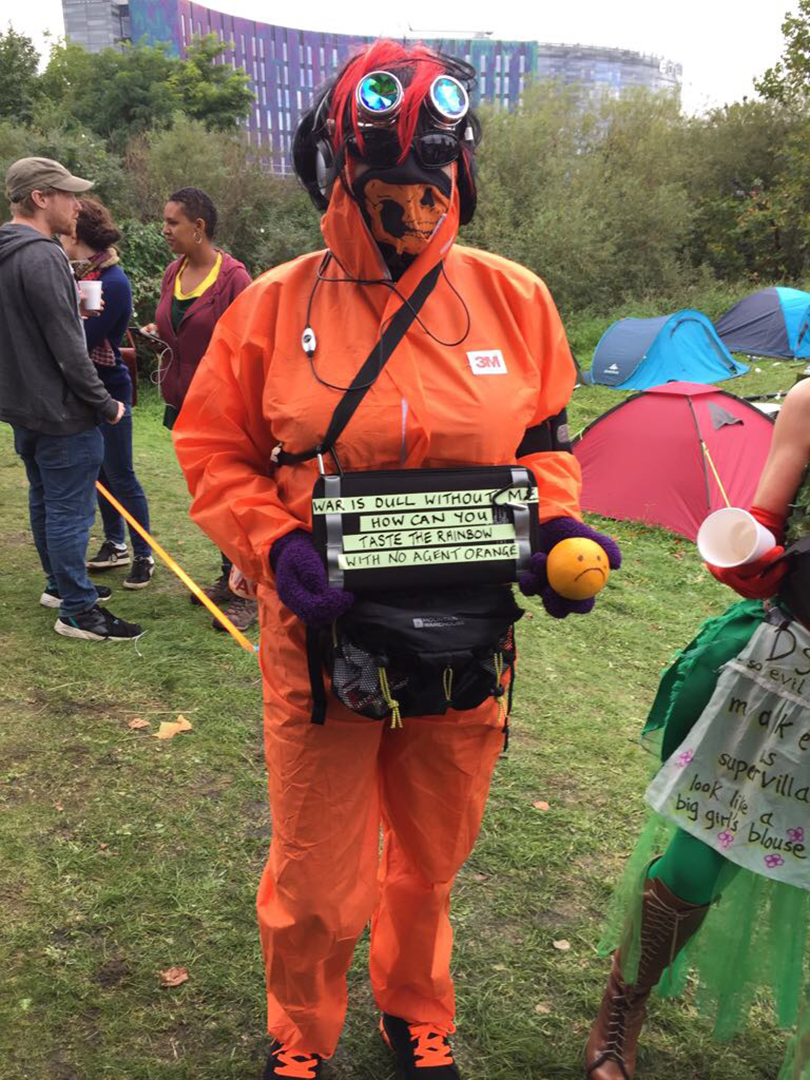
Agent Orange.
In September 2017, we travelled to Custom House for performances, flash mobs, vigils and a Day of Creative Action held outside DSEI. Here, a public space was lived and performed to contest a contemporary artifice of neoliberal geopolitics: action was entirely peripheral and joyously marginal. Possibly it was most visible to the sullen dozens of police who video-monitored protesters including a small group of women, dressed as superheroes and supervillains, and their children who moved between the protest site, a Premier Inn car park and the Thames riverbank. Agent Orange (Figure 1) could not hope to undermine the ends of the global arms trade that afternoon, but she expressed a participatory, performative politics as an ethical challenge to geopolitical work.
This is vital because work postpones ethics. At DSEI in 2019 the anthropologist Jonathan Newman suggested that: [ethics] are either deferred onto government regulations or processed privately with family and friends. Everyone here is just chasing numbers. We have become number people. Some of the worst horrors of the last hundred years have been projects driven by work targets. (Merat, 2019, emphasis added)
A question we cannot answer now is how to make this a popular and democratic (rather than activist) project. Particularly through capital exports, imperialism has long ‘spirited away all troubles and produced [a] deceptive feeling of security’ (Arendt, 2009b [1951]: 147). Expansion is useful for governments seeking to buttress outdated political structures and mobilise mass support. We mean, therefore, that an Arendtian perspective on the geopolitical requires the ongoing, collective critique of foreign policy, and crucially the democratisation of this critique, to ensure that ethics are reproduced as a concern of publics, and in public spaces, rather than as private matters of conscience. Ironically, there are echoes of Cohen’s (1991) concern for ‘equilibrium’, requiring opposing forces to be arrayed at different geopolitical scales. But this is now an invocation of the geopolitical status of the ‘private’ and ‘everyday’ - of city, street and home - rather than of states, shatter belts and blocs.
Localised protests and single-issue mobilisations are rarely congruent with actually existing global mechanisms of power. Arendt (1970: 76) recognised that in the 1960s ‘boycotts, sit-ins and demonstrations were successful in eliminating discriminatory laws and ordinances in the [southern USA]’ but failed when they brought irreconcilable interests ‘into the open, into the street’. And although action at DSEI is a vital response to specific issues, does it, or should it, suggest a model for a geopolitics of action? A model, after all, is inflected with work, the shape of things to come, and the concept of rule. But, to an extent, a model is essential: the benefits of plurality and of the temporal, spatial and conceptual immediacy of an Arendtian geopolitics are inadequate if action only interrupts strategic intent.
This article offers a provocation rather than an internally consistent ‘proof’ to validate an Arendtian geopolitics. We have thought with Arendt, and her paradoxes, to imagine the shape of a geopolitics that is more inclusively and pluralistically human. We welcome rejoinders and, notwithstanding our challenges to the critics, we feel an Arendtian perspective is a positive and supportive contribution to their own. Indeed, Simon Dalby (1991: 277) once noted that: Political geographers of whatever critical persuasion…have an obligation to contribute as global citizens to…attempts to remake politics…in ways that accept the inevitability of state structures, but explore the contemporary possibilities of political community in innovative ways.
Footnotes
Acknowledgement
The authors thank the University of Leicester’s Critical and Creative Geographies research group (particularly Gavin Brown, Ben Coles and Angela Last), Jay Emery and Richard Schofield for helpful suggestions on drafts of this article.
Declaration of conflicting interests
The author(s) declared no potential conflicts of interest with respect to the research, authorship and/or publication of this article.
Funding
The author(s) received no financial support for the research, authorship and/or publication of this article.
