




Abstract
This article offers an approach that helps geographers and others to carefully and critically reexamine prospects for diverse economies. We propose an interpretative institutionalist perspective is useful for elucidating overlooked opportunities for creating alternative economic visions and practices by revealing the process of ‘meaning making’ undertaken by actors in the process of developing policy responses to various dilemmas. We explore this notion in the context of de-growth or post-growth. De-growth is a way of thinking about the economy in ways that are not growth oriented, or fixated on GDP, but on the redistribution of wealth and living within the Earth’s ecosystems.
Keywords
I Introduction
This article offers an approach that helps geographers and others from related disciplines to carefully and critically reexamine prospects for diverse economies (Gibson-Graham, 2008). It proposes that an interpretative institutionalist perspective (Bevir and Rhodes, 2006) can be useful to elucidate opportunities for creating alternative economic visions and practices through revealing the process of ‘meaning making’ undertaken by actors as they develop policy responses to various dilemmas. We explore this notion in the context of an emerging alternative development discourse called de-growth or post-growth (cf. D’Alisa et al., 2015). De-growth is a way of thinking about the economy in ways that are not growth oriented, or fixated on GDP, but instead focuses on the redistribution of wealth and the need to live within the boundaries of the Earth’s ecosystems (Schneider et al., 2010). In particular we bring interpretive institutionalism to bear on the tensions between conventional economic institutions and alternative economies. We explore these ‘points of impact’ through the perspective of a transition to a post-growth economy.
Almost a generation ago ecological modernization was proffered as a panacea that would place global society on a sustainable trajectory (Spaargaren and Mol, 1992). Early efforts to articulate a theory and set of practices around ecological modernization held out the possibility of restructuring resource production and consumption, especially around technological fixes or innovations, though there were some questions around issues broader than technology (Gibbs, 2006). When policy makers adopted the rhetoric of ecological modernization into their practice of ‘greening the economy’, whereby we could produce more things with fewer resources, ecological modernization was solidified as a technological fix to the environmental problems of the previous generation (Bina, 2013; Spash, 2012; Hajer, 1995). Despite high hopes – ours included – that policy-makers would develop a ‘strong’ version of ecological modernization, which encompassed both ecological concerns and equity issues (Christoff, 1996), ecological modernization was largely incorporated by policy-makers into existing institutions and policies in the form of a ‘business-as-usual’ green economy approach (Bina, 2013). For many policy-makers and politicians, the green economy has frequently been seen as a vehicle for renewed economic growth and a new source of capital accumulation (Makower and Pike, 2009; Climate Institute and E3G, 2009). In the US, for example, the Obama Administration provided incentives for clean and green energy, with the aim of encouraging the development of green businesses, products and services, which in turn would create green jobs (ESA, 2012, cited in Caprotti and Bailey, 2014).
Government interest in the green economy also arose out of the financial crisis in 2008, which appeared to threaten the whole foundation of the capitalist system. A number of ‘Green New Deals’ were proposed as a way to: transform and re-regulate the international financial sector; provide an opportunity for state intervention to redirect, or at least encourage, restructuring towards new economic forms – i.e. a ‘green’ or ‘low carbon’ economy; and finally, to address issues of ‘peak oil’ or the ‘energy crunch’ associated with dependence on oil. ‘Greening the economy’ in this formulation was about doing more with less, particularly less energy and resource inputs. It did not, however, address the issue of growing consumption or rebound effects (Luke, 2008). While we recognize that ecological modernizing approaches have led to environmental gains and improvements (e.g. increased use of renewable energy, greater fuel efficiencies) this must be set against a continued trend towards ever greater consumption.
Today, this conceptualization of the green economy, in particular, and capitalism, in general, have come under scrutiny by a growing number of mainstream scholars, policy-makers, activists, and think tanks (Demaria et al., 2013). Calling for changes in the way we conceptualize the economy, these groups have challenged the centrality of economic growth as an essential part of capitalism (Kubiszewski et al., 2014; Jackson, 2009; Hopkins, 2013). They have also offered critiques of ‘capitalist’ measures of economic prosperity. Whether the focus is upon policy measures, such as how economic activity is measured, the need for substantial life style changes in the developed world, or upon the growth of new types of business, business organizations, and strategies, it is increasingly recognized that these require some kind of systemic change or transition. Such ‘deep’ transformations ‘will require far reaching innovations extending over long periods of time in the technical, social and institutional spheres’ (SRU, 2016: 3). This includes the claim for sufficiency as a trigger for social innovation that leads to ‘prosperity with less use of nature and materials’ (Schneidewind and Zahrnt, 2014: 20).
Geographers, too, have shown a keen interest in identifying and expressing new forms of economic activity. Indeed, some sub-disciplines of geography have commented on economic change for over a generation (cf. Harvey, 1973; Peet, 1977; Smith, 1990). Traditionally, these analyses focused on micro-level decision-making, economic sectors, regional innovation, and spatial systems (Hassink et al., 2014). More recently, economic geographers have developed their own ways of understanding social change and economic development and have drawn extensively from ideas related to cultural studies (Hassink et al., 2014; Boschma and Frenken, 2006, 2011). There has been growing interest in relational theories by economic geographers for the examination of economic and social organization. The departure from individualist (e.g. neoclassical and behavioral) and structuralist (e.g. institutional) approaches has been driven by a perceived failure of these approaches to capture the contextually situated social processes by which agents and structures co-constitute one another (Jones and Murphy, 2010). A related literature is geographical political economy, where adherents to this approach, or range of approaches (Sheppard, 2011), have distanced themselves from structuralist accounts of economy-society relationships (Amin and Thrift, 2007). Furthermore, proponents of this approach argue that capitalism is but one way to organize a society’s economy. Capitalism may be the dominant discourse, but it is not the only system capable of organizing society.
More recently, and building from this perspective, is another group of geographers, those who focus on diverse economies. In this literature, scholars not only believe that there are viable alternatives to capitalism, but that they actually exist today in practice. In other words, they examine economic change with a focus on finding alternative economic spaces within existing capitalist social relations (McLaren and Agyeman, 2015; Harcourt and Nelson, 2015; North, 2015; Gibson-Graham et al., 2013; Jonas, 2013; Jarvis, 2013; Gibson-Graham, 2008). For example, North (2015) shows how SMEs ought not to ‘be associated only with competition, economic growth, and profit maximization but also with other value systems: self-actualization, sustainability, and community’ (North, 2015: 14; see also Fuller and Jonas, 2002, 2010). Similarly, Lee (2006: 414) notes that: the purification of economic relations in some readings of framing and disentanglement of economy misses the inherent complexity of ordinary economies and thereby places limits on the economic geographical imagination – and hence on the possibilities of political transformation.
Gibson-Graham et al. (2013: xiii) sum up the common thread of this new generation of scholarship: [O]ur economy is the outcome of the decisions we make and the actions we take. We might be told that there’s an underlying logic, even a set of natural principles, that direct how economies operate, but most of us can see that the decisions and actions of governments and corporations have a lot to do with how economies shape up.
This article complements this sensibility in an effort to gain a sharper focus on the inner-workings of transitions within existing capitalist relations, and to explore the interstices between the adoption of alternative, de-growth development scenarios in existing institutions. In the quote above, Gibson-Graham et al. mention the role of government and corporations, and by extension small businesses and entrepreneurs. In terms of alternative economic spaces, where diverse economies can emerge, empirical focus is based almost solely on the grassroots movements in the Global North (but see Midheme, 2015; Midheme and Moulaert, 2013; Curry, 2003). What we offer here, through the lens of constructivist institutional theory (i.e. interpretative institutionalism), is an opportunity to explore the potential for alternative economic spaces within the formal structures of governance. Specifically, we make an argument for employing concepts from interpretive institutionalism as the basis for examining how, for example, these de-growth ideals and visions articulate with existing economic development strategies. We thus conceptualize institutional change/transition through a framework of ‘meaning making’ by agents who create and recreate their milieux as part of broader political-economic contexts. The growing discourse of de-growth provides an exciting opportunity to explore institutional issues related to economic transitions, in general, and to alternative scenarios in local and regional economies, in particular.
The structure of the article is as follows. First, we turn to an exploration of interpretative institutionalism in more detail, which we propose is a useful means to examine the motivations and drivers involved in de-growth initiatives. Following this, we evaluate de-growth discourses from an interpretive institutionalist perspective and then turn specifically to examine de-growth as an alternative economic narrative and as the development of a ‘counter-tradition’. In a subsequent section we outline de-growth as it is expressed in the form of local and regional development agendas. A final section provides a conclusion to the article and identifies two key questions for further research.
II Interpretative institutionalism as a lens for exploring diverse economies
Gibson-Graham (1996, 2002, 2008) sought to reveal the ideological commitments that underpin both capitalism’s modes of representation and our ability, as scholars, to apprehend them. She has recognized and exposed the role of ideology as it mediates both of these enterprises and thus broken the spell of invincibility by rendering it visible and present (cf. Althusser, 1971). Gibson-Graham (2008: 623) notes that while exposing the ideology of economic relations does not necessarily produce new ways forward, ‘it can generate new possibilities and different strategies’. It is through using this space of possibility that we offer an analytical approach to explore these alternative economic social relations from an institutional perspective.
To date, scholarly work within the economic geography paradigm has identified and characterized the factors driving innovation and the green economy(ies) through the lens of firms, sectors, systems of governance, and regions. However, despite a growing interest in both the development of the green economy and in de-growth initiatives, much less attention has been focused on how these initiatives are both shaped by, and impact on, existing institutional contexts. Here, institutions are both codified norms (e.g. laws, regulations, etc.) and all other societal framework conditions including beliefs, attitudes, and lifestyles, as they are inherent parts of a potential de-growth transition. Swyngedouw (2014: 92) comments that it is ‘“the political” that represents the core challenge if de-growth is intended to represent a more fundamental transformation of current growth logics’. From this perspective de-growth needs to be politicized in order to produce a ‘new common sense’ around the notion of finite resources and de-growth objectives such as social and environmental justice. This common sense can only emerge from a new symbolic order, the creation of which will be the result of both political and discursive articulation. The development of the new common sense therefore involves the ideological dimension of decision-making, i.e. the way in which individual actor behavior is simultaneously influenced by, and contributes to, the construction of prevailing/hegemonic reference systems. This means that we will tack back and forth freely between what some scholars call ‘formal’ and ‘informal’ institutions (North, 1990).
1 A constructivist framework for understanding institutions
In this section of the article we turn our attention to how actors frame and articulate alternative de-growth strategies within existing institutional contexts. Bevir and Rhodes (2001: 21) capture this notion in their general discussion of state actors operating in the face of change: …state-actors construct both their understanding of the pressures or dilemmas, and also the policies they adopt in response to them, in perhaps different ways depending on the background of which they do so. Proponents…rightly emphasize the unintended consequences of neoliberal reforms: they show how the outcome of the reforms depends on negotiations between different organizations. A decentered approach would add to this recognition of how the reforms and responses to them reflect a contest of meanings between different actors inspired by different traditions and responding subtly to different dilemmas.
Thus, these arguments render problematic the notion that institutions arise from given inputs, pressures and policies (Bevir and Rhodes, 2012). In the context of this article, ideologies are behind the appearances that correspond to representations of so-called capitalist realities. Opening up these representations is the hard work that has been accomplished by Gibson-Graham. In doing so this has cleared the way for exploring the role of actors working within institutions (see also the remarkably detailed work of Emilianoff and Stegassy (2010), who traced numerous actors across Europe in order to understand their motivation for, and contributions to, urban sustainability strategies).
In order to understand transitions beyond their objectified artifacts (e.g. GDP, defined roles of the state, sufficiency), therefore, and tangible outcomes (e.g. indicator-based monitoring), we argue that we need a conceptual framework to understand the actor-focused social processes that affect their material expression. For example, while de-growth strategies have notions of social justice as a stated goal, these goals do not have objective status – they do not apply equally across space and in place – and to understand how they are expressed in localities and regions we need a specialized analytical language and conceptual references. An interpretive institutionalist approach suggests that institutions are important analytical entry points for de-growth scenarios because they reveal the social and cultural embeddedness of our most tacit assumptions about relationships, as well as providing a key for understanding historical change. Douglass North (1990: 3) captured this notion well, when he suggested ‘institutional change shapes the way societies evolve through time and hence is the key to understanding historical change’. Yet, institutions are not objects without social origins or ideologies. A contemporary view of institutions that comes from post-structuralist and network theory posits that institutions are not just containers of historical perspectives and actions, rather they focus on the dynamic and contingent role of actors in shaping institutional responses (González and Healey, 2005). In particular, this view focuses on the social construction of networks and the ability of individuals to use these networks to create meanings contingently (Irazábal, 2005). For Irazábal (2005: 44), a common problem for institutional analyses is that ‘institutional analyses depict actors as if the people within them are bound to follow predetermined procedures or rules, rather than respond to them through their own contingent agency’.
However, ‘ideas on their own cannot influence the shape of institutions…ideas need carriers – individuals and interest groups – who advocate in their favor, and develop strategies for their promotion’ (Lowndes, 2005: 297). Outcomes and agendas will be shaped by struggles, conflicts, encounters and resistance (González and Healey, 2005; Lowndes, 2005). The interpretative institutionalist framework is able to address these issues through providing a rigorous and insightful analytical framework. In this manner institutional analysis is exposed to sources of power, gender inequity, politics of science and the like. Institutional analyses may also punctuate the permeable membrane that exists amongst the variety of actors involved in transitions towards de-growth strategies. There are conceptual differences involved in adopting this form of institutional analysis – while there is no space here to be exhaustive in our analysis, we will focus on two that are relevant. First, an interpretive analysis of institutions enables a shift away from a meta-narrative based on taken-for-granted assumptions about economic growth. Rather, the analytical entry point begins from a view that institutions are constituted by a discursive debate based on actors’ differing beliefs (Bevir and Rhodes, 2001). Second, an interpretive analysis therefore requires a closer understanding of those actors involved in the process of transforming institution-economy relationships. Both of these points reflect the epistemology of the geography of political economy (Sheppard, 2011) and the disrupted account offered by Gibson-Graham.
The analytical approach of interpretive institutionalism is framed by three key concepts – beliefs, traditions and dilemmas – which reflect a post-positivist sensibility that questions a priori assumptions about human behavior. The concept of beliefs allows researchers to explore and explain actions and/or outcomes by giving analytical priority to the ways individuals construct their world, ‘including the ways they understand their location, the norms that affect them and their interests’ (Bevir and Rhodes, 2006: 6). Second, tradition is the social context in which an actor exercises their own reason and acts (Bevir, 1999; Bevir and Rhodes, 2006). However, Bevir and Rhodes take care not to essentialize traditions and argue that such actors are situated agents in traditions. Their use of the concept of tradition derives from a rejection of positivism, which holds that individuals are transhistorical (e.g. utility maximizers). Tradition is thus seen as a concept that can both capture the unique perspective of actors (e.g. social heritage, particular inherited theories) and also provides the opportunity to measure linkages between ideas and policy outcomes. Traditions are themselves the construct of situated agencies (see Barnes, 1996). Bevir and Rhodes argue that the contexts that make up traditions do not determine outcomes, they only influence them. Indeed, ‘every time a person applies a tradition they have to understand it afresh in present-day circumstances’ (Bevir and Rhodes, 2006: 8).
Dilemmas are the final concept to be used, wherein ‘a dilemma arises for an individual or group when a new idea stands in opposition to existing beliefs or practices and so forces a reconsideration of the existing beliefs and associated tradition’ (Bevir and Rhodes, 2006: 9). Dilemmas require situated agents, or coalitions of them, to articulate and act upon them – they are not objective in the world. Changes in individuals’ beliefs, actions and social practices can only be understood by investigating the ways they respond to, and conceive, dilemmas (Bevir and Rhodes, 1999). Bevir and Rhodes also suggest that dilemmas arise out of both experiences and theoretical and moral reflection. Finally, Bevir and Rhodes argue that the solutions that arise from these dilemmas are often inconsistent with a tradition. Thus, traditions provide a guide as to what might happen, rather than what will happen. ‘Indeed, when people think they are merely continuing a settled tradition or practice, they might well be developing, adjusting and changing it’ (Bevir and Rhodes, 2006: 10).
Our main purpose in this discussion has been to argue for and propose an interpretive account of institutions as a way to explore the potential for the development of de-growth policies and actions within the realm of formal institutional structures (though the framework of interpretative institutionalism could also be used to explain the emergence of grassroots activities). Such an approach to the study of institutions ‘explores the way [an institution] is created, sustained or modified through the ideas and actions of individuals’ (Bevir and Rhodes, 1999: 225). The actions of individuals are therefore not governed by their institutional position or institutional rules, rather we need to look at ‘how meanings and actions, are created, recreated, and changed in ways that produce and transform institutions’ (Bevir, 2003: 460). Institutions, like economic actors or firms, are the creation of broader social processes as well as the agency of actors working to construct them and act through them. Institutions can be seen not just as administrative and political organizations but also as ‘the rules, norms and practices, which structure areas of social endeavor’ (Coaffee and Healey, 2003: 1982). Hence, ‘institutional rules may be consciously designed and clearly specified (as in structural plans and operating procedures) or take the form of unwritten customs and conventions (as in aspects of “professionalism” or “departmentalism”)’ (Lowndes and Wilson, 2001: 632). Similarly, DiGaetano and Strom (2003: 372) suggest that ‘political actors are the carriers of culture, and their understanding of the structural context and institutional milieu is affected by the values and beliefs that they hold’. Thus agency alone is not of much interest. An interpretivist account ‘encourages us to examine the ways social life, institutions and policies are created, sustained and modified by individuals acting upon beliefs that are not given to them by the institution itself or a universal rationality’ (Bevir and Rhodes, 2006: 461).
Interpretive institutionalism presents an opportunity to examine new sources of diverse economies, particularly those that come from within ‘formal’ and ‘informal’ institutions. The concepts of dilemmas, traditions, and beliefs provide a constructivist account of how different actors make meaning from perceived dilemmas that they face. It also allows for the deconstruction of actors along the lines of the traditions that they operate in, as well as their personal belief systems. We should note here that we are not interested in repositioning the state or formal institutions as the drivers of economic and social change. Rather, those spaces where actors struggle to construct meaning about the situations they find themselves in represent only one of many possible ways that alternative economic spaces could emerge.
III De-growth discourses as a catalyst for emerging diverse economies
In the previous section, we presented details of an interpretive institutionalist approach to understanding economies and actors within them. We now turn our attention to the emergent alternative form of economic activity of de-growth. This is a decentered grassroots movement, especially in France, Italy, and Spain, but it is also entering mainstream debates about changing the way we construct and measure value in the economy. The concept of de-growth has fascinating potential. It differs from both sustainable development and ecological modernization in that it sees limits to growth, both in terms of ecological limits as well as social limits. Further, it is reflected in a variety of discourses, not only through a growing number of grassroots initiatives but also amongst policy-makers and economic thinkers. In the discussion that follows we present de-growth as an alternative space for conceiving economic relations. We try to show how discourses around the notion of de-growth simultaneously contribute to the construction of dilemmas and to the exploration of new approaches, possibly replacing operant traditions and beliefs.
1 Constructing dilemmas
New visions for producing economic prosperity have emerged, especially around the relationship between prosperity and growth. Through the course of this process scholars and practitioners have identified new dilemmas such as social well-being. For example, in 2009 Tim Jackson developed a sustained argument regarding the spurious connection between economic growth and prosperity, whereby prosperity is not synonymous with income or wealth: Our technologies, our economy and our social aspirations are all mis-aligned with any meaningful expression of prosperity. The vision of social progress that drives us – based on the continual expansion of material wants – is fundamentally untenable. And this failing is not a simple falling short from utopian ideals. It is much more basic. In pursuit of the good life today, we are systematically eroding the basis for well-being tomorrow. (Jackson, 2009: 2)
In a similar vein, Kubiszewski et al. (2014) propose that Gross Domestic Product as a measure of prosperity is outdated and too narrow in its focus: GDP measures mainly market transactions. It ignores social costs, environmental impacts and income inequality. If a business used GDP-style accounting, it would aim to maximize gross revenue – expansionhe expense of profitability, efficiency, sustainability or flexibility. That is hardly smart or sustainable (think Enron). Yet since the end of the Second World War, promoting GDP growth has remained the primary national policy goal in almost every country. (Kubiszewki et al., 2014: 283)
They go on to note that we currently have access to more sophisticated indicators for measuring a prosperous and worthwhile life: The environmental and social effects of GDP growth can be estimated, as can the effects of income inequality. The psychology of human well-being can now be surveyed comprehensively and quantitatively. A plethora of experiments has produced alternative measures of progress. (Kubiszewki et al., 2014: 283)
Similarly, policy-makers at a variety of spatial scales are mobilizing new indices, such as the Human Development Index, the Index of Sustainable Economic Welfare, or OECD’s Better Life Initiative that privilege other non-growth aspects of prosperity (cf. Sen, 1999; Jackson, 2009; Stiglitz, 2012; Stiglitz et al., 2009). At the local and regional scales, the process of ‘EcoBudget’ has been employed as a process-oriented set of indicators designed to engage with thinking about the social and ecological consequences of local authority decisions (Elgert and Krueger, 2012). In total, then, the dilemma has shifted away from a concern with addressing the ecological impacts of economic development towards a broader focus on issues of well-being and social justice.
2 Operant traditions and beliefs
A growing number of economists, policy-makers, scholars, and many in civil society have increasingly provided a critique of our current economic system and its future course. A number of fundamental issues have arisen, or been revisited, in the light of the 2008 economic crisis and its aftermath. These include concerns over growing levels of inequality within and between nation-states and the seeming inability of the current economic system to deliver greater equity (Sen, 1999; Stiglitz, 2012). In terms of natural resources (e.g. peak oil, precious metals, water availability) and the productivity of human labor, several authors have questioned whether the current form of capitalism has reached its capacity for material growth (Daly, 1996; Sen, 1999; Jackson, 2009, 2011). Increasingly, in some quarters of civil society, there is also a perception that there are material and ideological limits to growth. In Germany, for example, a survey commissioned by the Bertelsmann Foundation reported that eight out of ten Germans would prefer an alternative economic order (Heflich, 2010, cited in The Guardian, 19 September 2012). According to the study, the proportion of Germans who believe growth to be very important was down 14 percent compared with two years before. In addition, the proportion of Germans who highly value money and possessions also dropped. Nearly two-thirds disagreed with the idea that a higher income could increase their quality of life. In addition, according to these findings, many Germans now value protection of the environment over material prosperity (The Guardian, 19 September 2012). This would suggest that at least some publics are revisiting the question of ‘growth’ for the first time in over a generation.
In France, Serge Latouche has popularized the concept of décroissance, or de-growth. Latouche’s work lays out a fairly coherent, if imperfect, strategy for achieving prosperity without growth, and in this article we use ‘de-growth’ as a collective term to refer to alternative paradigms (cf. Latouche, 2006, 2010). De-growth focuses on sustaining people, communities, and nature, and from this perspective these should form the core goals of economic activity and not simply be the by-products associated with conventional GDP. Similarly, for Speth (2009), de-growth means encouraging new business models, aimed at meeting social needs and rebuilding natural capital. Although Speth’s focus is on business, his view differs from the more conventional connotations in that it is focused on intensive rather than extensive growth. For example, one measure of growth would be the extent to which local businesses use local labor and raw/recycled materials. The notion is to explicitly couple economic activity with human well-being and environmental performance. Similar notions are captured by other approaches that echo the de-growth perspective, albeit that they may not share the more radical implications. For example, for Porter and Kramer (2011: 64), ‘shared value’ provides a conceptual framework for a form of de-growth capitalism: The concept of shared value – which focuses on the connections between societal and economic progress – has the power to unleash the next wave of global growth…Every firm should look at decisions and opportunities through the lens of shared value. This will lead to new approaches that generate greater innovation and growth for companies – and also greater benefits for society.
In outlining the rise of these dilemmas over the direction of capitalist development, we have shown how these are informed by a tradition of measuring policy failures. Indeed, the hegemony of GDP as an indicator has been challenged in a variety of quarters. Complementing this is the effort to determine how to redefine and reconfigure economic activity, how to create alternative de-growth scenarios, and how to utilize new definitions of prosperity (Bauhardt, 2014). These emergent alternative scenarios have an emphasis on spreading prosperity more equitably, and developing appropriate economic institutions and value structures to support this effort. It seems, then, that there is an emphasis on creating profitability or prosperity through the very production of benefits to society and the environment. Of course over the last 30 years we have seen and experienced other alternative scenarios which have appeared to challenge the direction and definition of mainstream development – indeed the initial enthusiasm over sustainable development and ecological modernization immediately come to mind. Yet, despite their different priorities, unlike de-growth critiques, advocates of ecological modernization and sustainable development largely shied away from challenging the growth ‘imperative’ (Schulz and Bailey, 2014; Kallis, 2011). In contrast, de-growth challenges the tradition of growth at all costs. In particular, scholars question the ability of technological innovation to overcome the Earth’s biophysical limits (Demaria et al., 2013). Furthermore, as we have seen in other sectors (cf. North, 2015; North and Nurse, 2014; Fuller and Jonas, 2010), the actually diverse logics of a growth-centric sector open up new opportunities to develop economic spaces that are more socially and environmentally just.
IV Constructing counter-traditions: De-growth as an alternative economic narrative
In this section we develop our argument further by examining how de-growth advocates are creating a ‘counter-tradition’. They are taking the dilemma that comes from conventional analyses (e.g. the perceived failure of the capitalist growth regime to redistribute wealth, how to care for host communities, how to maintain ecological integrity) and developing new traditions for understanding and reacting to them (Schneider et al., 2010). De-growth in the context of this discussion should not be taken to mean economic ‘shrinkage’ (e.g. as a result of demographic change) or recession (decreasing economic performance). Rather, it should be understood as a departure from dominant growth paradigms in the sense of Latouche’s décroissance, which rejects the maxim that private and societal prosperity can only be ensured via a continuous growth of materially and monetarily measurable economic performance – irrespective of negative externalities or the finite availability of resources and ecological sustainability. Thus ‘sustainable degrowth may be defined as an equitable downscaling of production and consumption that increases human well-being and enhances ecological conditions at the local and global level, in the short and long term’ (Schneider et al., 2010: 512). The formulation ‘prosperity without growth’ (Jackson, 2009) neatly captures the orientation of a transition towards sustainable lifestyles and economic systems envisioned by the de-growth concept. A core difference from its predecessor narratives is that de-growth places a strong emphasis on the issue of distributive justice in growth and wealth, both at the level of international and development policies and within individual national economies (see also related debates on ‘pro-poor-growth’; Rippin, 2012). De-growth is thus more than a simple ‘ecological limits’ or erstwhile ‘limits to growth’ debate; rather, it represents a re-framing of the very definition of economic prosperity towards enhancing well-being and human happiness (Whitehead, 2013).
Latouche has been particularly influential in developing the principle of décroissance and in promoting the rejection of growth-oriented forms of production and consumption patterns, a stance that has resonated particularly strongly with the Italian, Spanish and French sustainability movements (Latouche, 2006, 2010). The de-growth narrative includes developmental and global-political dimensions, i.e. viewing resource exploitation in relation to environmental justice and social equity on a global level, rather than just through an ecological lens. Indeed, Latouche (2010) has argued that the ‘Global South’ above all is capable of realizing breakthroughs into new economic systems and alternatives to the Western market maxim, and that the ‘Global North’, by reducing its claim on resources, could create maneuvering space for development in the south.
Latouche and the décroissance community explicitly disassociate themselves from other models of transition, such as ecological modernization, which consider a shift to sustainable economies to be possible within present market principles (Demaria et al., 2013). Indeed, ecological modernization has been roundly criticized by de-growth analysts for its belief in the viability of continuous – though decelerated or just different – growth (Kallis, 2011). Critical assessments of mainstream climate policies and the failures of carbon markets (Bailey et al., 2011; Böhm et al., 2012; Redclift, 2009) have also suggested systemic shortcomings in the kinds of reformed growth proposed by ecological modernization. Kindred concepts such as ‘smart growth’ or the ambiguous term ‘qualitative growth’ (increasing the profitability of enterprises without increased use of resources) are also widely criticized for taking insufficient account of the core problems of the current growth paradigm. In contrast, the décroissance approach posits a need for a more holistic view of the socio-cultural dimensions of growth that includes consideration of values, norms, consumption patterns and the like; décroissance is an ecological-democratic project. Here, the concept of efficiency can be contrasted with that of sufficiency, illustrated by Latouche’s variety of ‘Rs’ (e.g. réévaluer, réduire, recycler, réutiliser, restructurer, redistribuer [revalue, reduce, recycle, reuse, restructure and redistribute]). It deals with the question of how, particularly in the Global North, material consumption can be reduced without impairing the satisfaction and well-being of the population, while at the same time contributing to improved living conditions in economically underprivileged segments of the population and regions via a fairer distribution of resources. In this context, discussions over material property and the commodification or non-commodification of goods and services acquire particular importance.
The principle of sufficiency does not fundamentally question the necessity for growth but, rather, concerns itself with the question of which activities, product groups, services and forms of consumption are likely to generate future economic growth, and which segments of the population should benefit from growth effects, utilizing ideas of distributive justice (Princen, 2005). In contrast to the efficiency hypothesis, however, it is not assumed that such adjustments should occur exclusively according to the principles of the market economy. Instead, sufficiency seeks more profound social changes in terms of consumption preferences, lifestyles and political priorities (e.g. research policy, public procurement, fiscal policy and incentive tools) (for an overview see Schneidewind and Zahrnt, 2014).
It is important to be clear that the sufficiency approach should not be interpreted either as an attempt to generalize idealistic lifestyles of individual self-restraint (e.g. dietary, consumption or mobility behavior) or as top-down, state-imposed limitations on consumption. Rather, it holds some potential as a novel, paradigmatic model of future social and economic decision-making which can aid in assessing the long-term effects of investments and governance mechanisms on resource consumption and other negative growth externalities and social distribution. While analogies with some of the principles of sustainable development are evident in the sufficiency concept, it may prove less problematic to operationalize in some respects (assuming some agreement is possible on the definition and calibration of the term ‘sufficient’) and may offer fewer opportunities for one-sided interpretations that skew the concept towards economic concerns (Redclift, 2009).
With this important caveat in mind, Latouchian notions of de-growth signify a conscious departure from the traditional concepts of material and monetary issues within growth towards an orientation that emphasizes development strategies based on long-term viability and global distributive justice. The latter goes far beyond the mere redistribution of monetary wealth but, instead, comprises a more complex conceptualization of poverty eradication that includes, but is not restricted to, equal opportunities, health, quality of life and environment, and political participation. Finally, unlike its predecessors, de-growth is an explicitly state-centered approach to organizing economic activity. Of course, the assumption is that the people in the state will make better decisions than consumers, but the idea is that social justice and distributional equity are not left to the whims of the market.
1 Toward de-growth scenarios
We define alternative scenarios based around de-growth principles as those economic activities that bring the transformative promise of a truly different way of doing business as they dynamically engage with existing social relations. For example, O’Neill and Gibbs (2016) point to how some green entrepreneurs combine business and environmental goals in a drive toward greater sustainability, seeking to achieve the ethical transformation of their business sector (cf. Isaak, 1998; Tilley and Parrish, 2006). Similarly, the notion of ‘just sustainabilities’ provides another vision for a de-growth scenario as it adopts alternative indices for quality of life that redirect business-as-usual explicitly towards broader social goals (Agyeman, 2013; Agyeman and Angus, 2003). We must underscore, however, that for us de-growth scenarios need to include a much more explicit social component. While some elements of de-growth scenarios may seem similar to more mainstream conceptualizations (e.g. UNEP’s definition 1 of a green economy which focuses mainly upon carbon reduction, energy efficiency and resource management), de-growth scenarios must have goals or a policy statement that requires, for example, firms not to acquire materials from sources that unethically exploit human labor or place a higher burden of risk on those harvesting the materials. In other words, a true de-growth scenario must, from the outset, represent the ideal, not merely valorize one traditional form of capital over another. For example, research on sustainable cities has shown that while some cities are becoming ‘more sustainable’ in terms of a variety of green or environmental indices, they are becoming less socially just, and, moreover, these green benefits are accrued at the cost of someone else’s economic security and dignity (Mössner, 2013; Rosol, 2013). In many ways the rhetoric here echoes the calls for sustainable development and its implementation at the local scale through Local Agenda 21 from 20 years ago. De-growth scenarios, in principle, must adhere to the tripartite concerns of sustainable development: economic prosperity, ecological integrity, and social equity.
Financial shocks to the global economy in 2008 were understood as institutional failures that witnessed massive inequities in the redistribution of wealth, wholesale destruction of the Earth’s ecological systems, and increasing community vulnerability. They have inspired academics and policy-makers – instead of relying on traditional methods to measure the crisis – to begin adopting counter traditions to evaluate the extent of the dilemma posed by the financial crisis. This has given new momentum to discussions about de-growth scenarios – or alternative economic spaces – which we sought to describe above. To try and ground this further we now turn our attention to de-growth scenarios in local and regional practice.
V De-growth expressed in local and regional development agendas
Thus far we have defined the de-growth paradigm and identified its key components, outlining its potential for creating alternative economic spaces. However, we are also interested in examining how these de-growth ideals take on material form, particularly at the local and regional scale. Although de-growth proponents are aware that action is needed at all scales, many existing activities occur at the local and urban scales (Demaria et al., 2013). Amongst other things, we are interested in local and regional strategies for moving towards decentralized sufficiency, the de-commercialization of goods and services, and social enterprises and solidarity economies that seek to create synergies between local private and public actors to offer new services, workplace opportunities and proximity services (Schulz and Bailey, 2014). Such initiatives fit with a view of de-growth as being not just an ideological and economic concept, but one that articulates with political and radical action (Demaria et al., 2013).
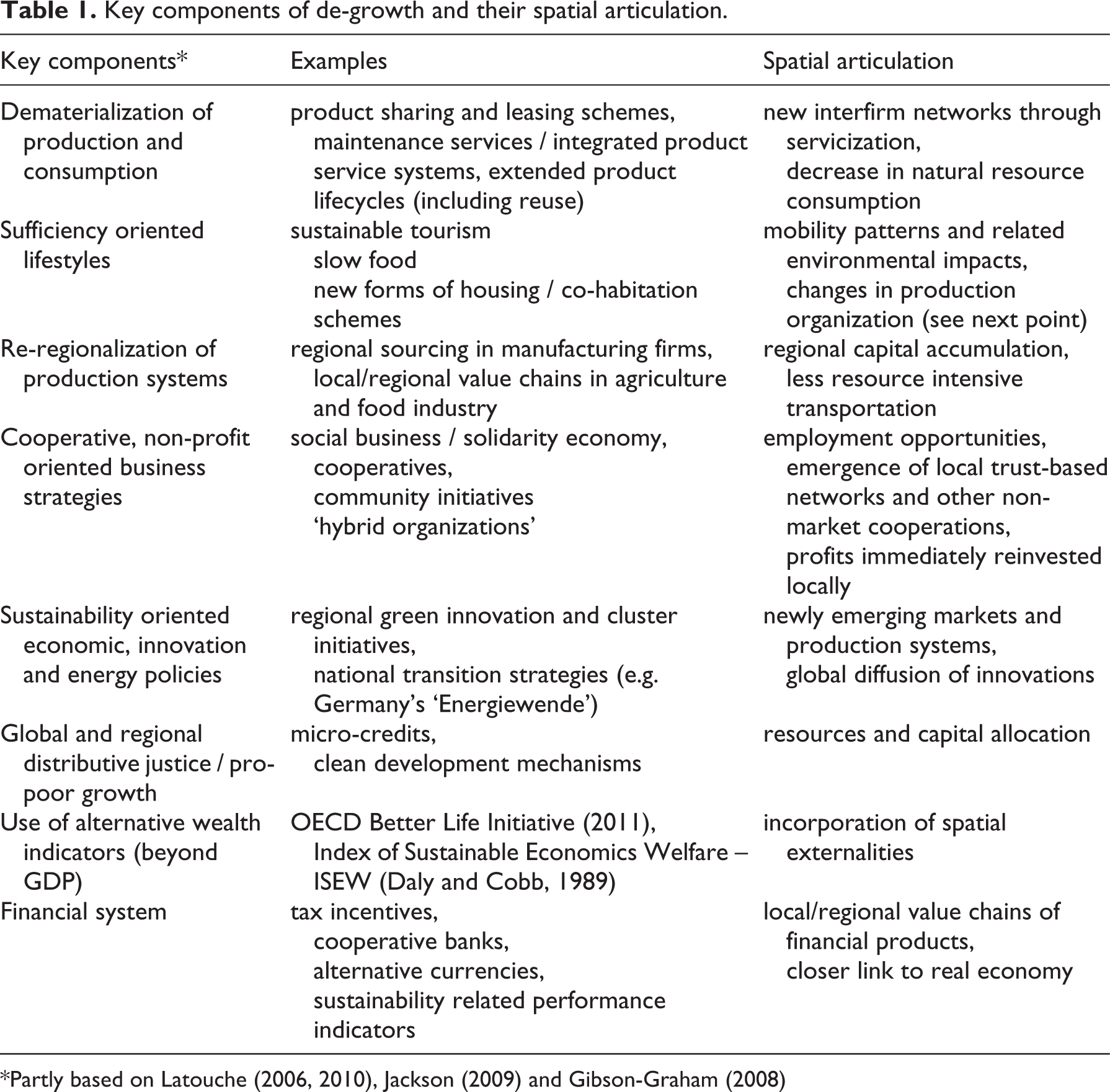
Table 1 provides an outline of the key components of a de-growth approach, gives some examples of the forms in which they might be implemented and details the spatial articulation of these. They range from alternative models of business organization (e.g. the renaissance of cooperatives in various sectors) and financial instruments to the crucial question of the way we ‘measure’ economic success and social welfare. Admittedly, not all of the listed activities may have de-growth principles as their core motivation or driver. The success of car and bike sharing systems around the globe, for example, initially launched as local community initiatives in a small number of cities, have subsequently turned this activity into an increasingly commercialized endeavor attracting large companies such as BMW (e.g. DriveNow). Micro-credits – initially applauded as the key to poverty reduction and symbolically crowned with the Nobel Peace Award assigned to Grameen Bank’s founder Muhammad Yunus – are today widely criticized for bad management, misuse, and a growing engagement of profit-oriented corporations in the microfinance industry. David Harvey cynically labeled them as the ‘subprime of all subprime forms of lending’ (2012: 86) both for potentially negative impacts for the mortgage holder as well as for the unequal distribution of benefits increasingly allocated in the industrialized world.
Key components of de-growth and their spatial articulation.
*Partly based on Latouche (2006, 2010), Jackson (2009) and Gibson-Graham (2008)
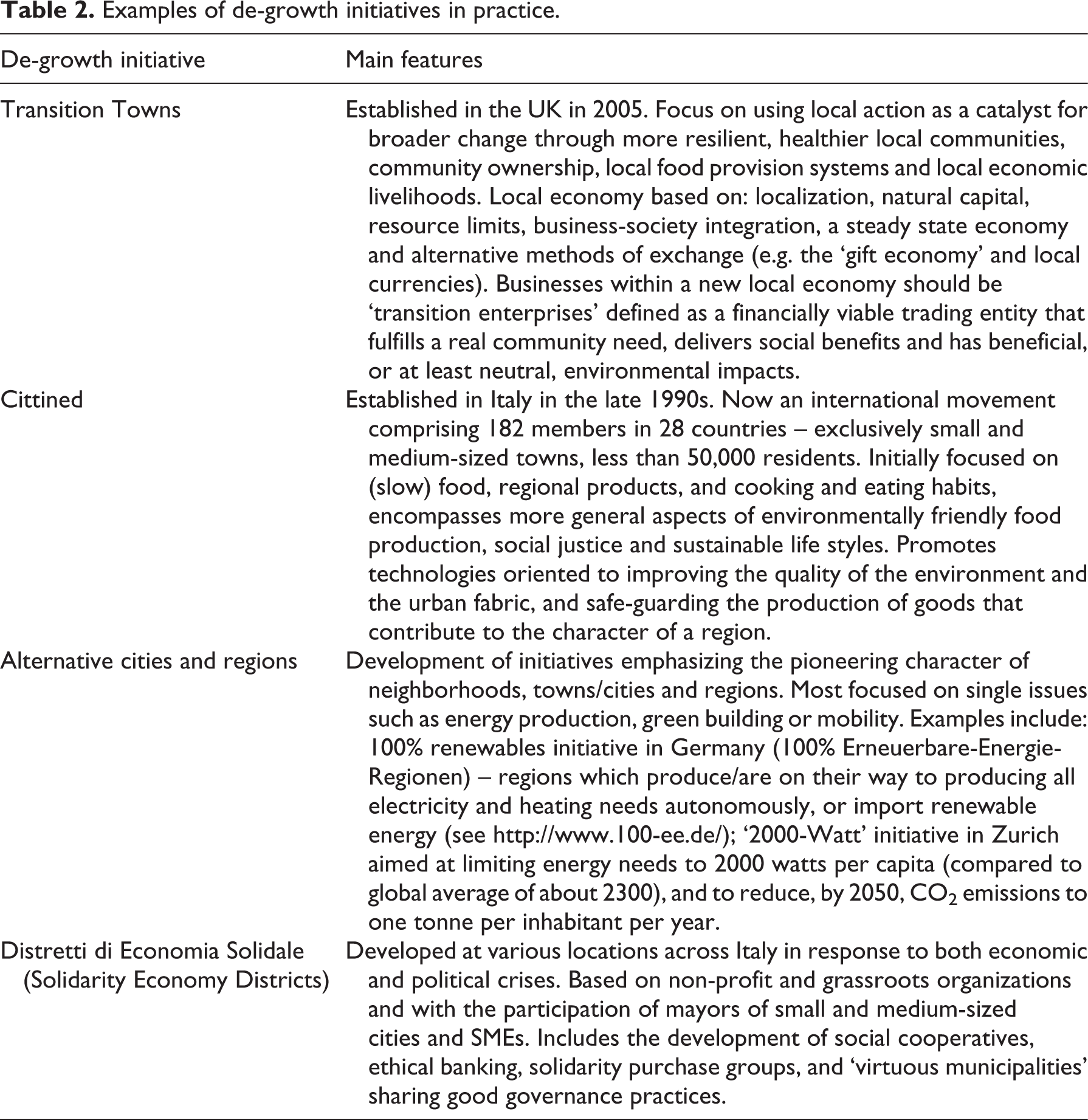
However, despite reservations over some, what all these initiatives have in common is that they – to some extent – try to uncouple economic success from quantitative growth and increasing resource intensity. In doing so, they not only attempt to transform established product life cycles, ways of production and their spatial organization, but also question the primary objectives of economic activities, i.e. the choice is between established and profit-maximizing approaches and alternative business models, which target welfare and distributive justice-oriented objectives. Very often, these alternative scenarios are initiated by local actors in distinct policy arrangements, and create niches at the grassroots level before gaining momentum by either disseminating to other places (e.g. the Transition Initiatives network; see Hobson et al., 2016) and/or by increasingly entering mainstream activities (e.g. successful local low carbon initiatives influencing fundamental shifts in national renewable energy policies) (Seyfang and Smith, 2007). Table 2 provides details of a number of indicative initiatives that have been developed at the local and regional scale based around de-growth principles. Here the de-growth movement has strong connections with other movements such as bio-regionalism, permaculture, transition initiatives, slow food, local currencies, voluntary simplicity and proponents of renewable energies (Whitehead, 2013). Many activities occur at the local scale, articulated through formal and informal networks, such as Transition Initiatives or the CittàSlow movement (Demaria et al., 2013).
Examples of de-growth initiatives in practice.
As both the preceding conceptual sections and these specific examples of de-growth scenarios in practice show, there is a need for regional analysts to not only join the respective scholarly debates, but also to recognize that they can enrich the latter with up-to-date conceptualizations of space, as well as with their methodological expertise in addressing local and regional contexts. Against the backdrop of de-growth imperatives, an adoption of concepts such as interpretative institutionalism is promising in its potential to better understand the underlying practices and decision-making processes involved, and how they are both highly contextualized and strongly embedded in societal debates and changes. Such an approach thus allows idiosyncratic in-depth studies, which may – to a certain extent – also lead to preliminary generalizations. The latter will not only be fruitful for international debates on appropriate concepts, but might also help to further theorize sustainability transitions. Utilizing an interpretative institutionalist approach allows us to explore the actual motivations, assumptions, and (if applicable) fears of individual actors and their performativity regarding institutional change.
VI Conclusion
In the discussion above we described how previous work sought to close the false dichotomy between specifically ‘capitalist’ social forms and ‘non-capitalist’ ones. In contrast to those neoliberal scholars who suggest that there are no alternatives, we would argue that there are plenty of actually existing alternatives. Indeed, following Gibson-Graham, the problem does not lie in the absence of alternatives. One of the key points of this work was to show that viable and principled alternatives to capitalist social relations, such as the many local and regional de-growth initiatives conceived worldwide, are not where the ‘transition’ problem lies. Instead, we argue that it is our analytical perspective that needs to shift so we can both realize the existence of these alternatives and understand them as they operate within a larger system of capitalist social dynamics. Building on our previous theoretical work, in this article we have presented an actor-centered approach, interpretative institutionalism, to examine these dynamics.
However, these principled ideas will be brought into a diverse array of social and policy milieux with different actors acting as ‘change agents’. Interpretative institutionalism can thus provide a framework for understanding how these ideas are woven together with existing policies from the perspective of the actors involved in that process. Understanding how this occurs could assist in the implementation of de-growth strategies and policies. For example, we can see it expressed in ‘Transition Initiatives’, which are emerging in Europe and North America (see www.transitionnetwork.org). What is less clear, and which the interpretive institutionalist approach can elucidate, is how these new alternative ideas are shaped once they arrive into an existing institutional milieu. Indeed, how these initiatives play out once they engage with existing economies may not lead to positive outcomes. One example of this is the so-called sharing-economy – an attempt to overcome traditions and beliefs. Although starting from a de-growth oriented search for equitable and resource-efficient co-use of infrastructures, goods, services and knowledge, the recent proliferation of certain parts of this sector risks creating a new dilemma while attempting to solve an existing one. This notably applies to internet-based peer-to-peer activities which, in shaping new, largely unregulated markets, have attracted investors following more traditional ideas of profit maximization and surplus allocation. Many of the big players in this so-called platform economy (e.g. Airbnb, Uber) thus tend to create what Martin has called ‘a nightmarish form of neoliberalism’ rather than a potential pathway to sustainability (Martin, 2016: 149).
Thus the ambiguity of activities such as the sharing economy approach gives an idea of the potential destinies of what seemed initially sensible de-growth concepts as they become subject to variegated interpretations. We argue that such outcomes call for a more differentiated and critical assessment. In this article we have argued that an interpretive institutionalist perspective can reveal new insights into how alternative development scenarios ‘map on’ to existing local and regional political and institutional contexts. It has the potential to complement existing political economic explanations by looking beyond institutional form and incorporating agents’ understanding of the ‘green economic opportunities’ in their own political and economic milieu. This work may thus produce a better understanding of the factors that influence moves towards a de-growth agenda in local and regional economies.
Finally, the variegated concerns over creating alternative development scenarios, in general, and de-growth, in particular, raise two important issues. First, it challenges a fundamental assumption of economics, and by scholars of economic systems in general and economic geography in particular – that there is a growth imperative (see Schulz and Bailey, 2014). As we have suggested, critical assessments of the green economy, green growth, and the like have shown that these new forms of economic development need not have a ‘de-growth’ sensibility. Rather, it’s old wine in new bottles. Caprotti (2012, 2016), for instance, observes that some of the green economy’s front-line actors, like the cleantech investment sector, utilize discursive logics that, although they focus on resource and energy efficiency and low carbon outcomes, also explicitly emphasize the potential for growth and profit maximization by investors and entrepreneurs. At the local and regional scale there have also been attempts by city-regions and whole countries to position themselves as leaders in green economy innovation as a means of stimulating growth (Davies and Mullin, 2011; Gibbs and O’Neill, 2014; McCauley and Stephens, 2012). 2
Similarly, urban sustainability initiatives, such as new urbanism and smart growth in the USA, have relied solely on the market, both as an initial rationalization and to subsequently address the distributional issues that emerge after these developments are completed. This further reinforces the view that while, in practical terms, the main currents of contemporary thinking about the green economy are increasingly flowing towards new conceptualizations (or at least portrayals) of economic growth, they remain focused on the potential for (renewed) economic growth. More fundamentally even, scholars in these fields not only need to reconsider existing conceptual approaches regarding their appropriateness to critically assess growth-related dimensions of their study objects. They might also need to reflect upon the foundational beliefs and traditions marking our disciplines which are also reflected by the terminology in use. Starting with operational terms such as ‘innovation’ or ‘organization’ which might be too narrowly defined, this terminological reflection should expand to key notions such as ‘development’ or ‘economy’. A broadened understanding of the latter seems to be a pivotal precondition for making the complexity of actually existing diverse economies accessible to research. Obviously, this would have strong methodological implications as to the data and indicators we use and the way we interact with the ‘researched’ to understand underlying motivations, framings and performative dimensions of practices.
The second issue relates to how alternative development scenarios are articulated in practice in localities and regions around the world. Obviously a first point to make is that there is currently no de-growth regime, in whole or in part, in place. While aspirations towards this might exist among certain actors in localities and regions as we outlined in the previous section, we have no sense of how these ideas, when introduced, become transformed by local and regional economic development politics. What seems obvious though is the fact that in many industrialized countries local de-growth initiatives have reached a critical number, resonating in the media and political sphere as a new social movement, currently trying to build up platforms, networks and umbrella organizations to strengthen their visibility and political weight. If not part of the movement themselves, an increasing number of scholars are attracted by the current dynamics of these initiatives (e.g. the Research and Degrowth network, see www.degrowth.org, or the De-Growth graduate school (Postwachstumskolleg) at the University of Jena, Germany) and have started to more systematically monitor this development. They hence contribute to what Gibson-Graham, when developing their work on diverse economies, claimed as a performative ontological project: ‘to produce a discourse of economic difference as a contribution to a politics of economic innovation’ (Gibson-Graham, 2008: 614).
Footnotes
Acknowledgements
We would like to thank Pauline McGuirk, an anonymous second editor at Progress in Human Geography, and the three anonymous reviewers who offered their comments. The article improved significantly with this feedback. Any remaining errors in the manuscript remain our responsibility.
Declaration of conflicting interests
The author(s) declared no potential conflicts of interest with respect to the research, authorship, and/or publication of this article.
Funding
The author(s) received no financial support for the research, authorship, and/or publication of this article.