




Abstract
Daniel sees Antiochus IV Epiphanes as a latter-day Alexander. When interpreting Antiochus’s death, the author draws on a Ptolemaic court tale of an animal prodigy that foreshadowed Alexander’s own demise (Liber de Morte Testamentumque Alexandri Magni). Extensive and specific commonalities between Daniel and Liber de Morte suggest that MT Daniel, no less than the OG version, originated in Egypt. Intended readers are the maśkîlîm who fled there during and after the Antiochene crisis. While the visions interpret the death of Antiochus, the tales speak to the maśkîlîm’s hopes for a new life under Ptolemy VI. This paper advances scholarship by proposing that inspiration for Daniel’s Babylonian court setting, and for its apocalyptic imagery, came to our author courtesy of the Ptolemies, a Greek dynasty who used a birth anomaly tale set in Babylon to drive their political agenda in Egypt.
Introduction
Scholars have long debated the origins of Daniel’s monsters in chapters 7 and 8. 1 While the author may have drawn from a variety of sources, we propose that an important antecedent can be found in an early Hellenistic tale about Alexander’s dying days. The tale weaves an unusually rich tapestry of themes and motifs that invite comparison with Daniel. These include Alexander’s death, his spurious Will, the division of his empire, a court dispute, and a prodigy in the form of a male human and five predators. According to Alexander’s senior diviner, this monster heralds the king’s imminent death and a profound shift in world affairs. 2
The tale has a convoluted transmission history. Most scholars (so Baynham, 2018: 191) believe that the primary version, originally written in Greek 3 at the end of the 4th century BCE, is preserved in a Latin document, known as De morte testamentoque Alexandri Magni liber or Liber de Morte (LM), which is appended to the Metz Epitome, a collection of fragments from the Late Antique period that detail Alexander’s conquests. Although the original text of the primary version has been lost, a later Greek version appears at the end of the alpha recension of the Alexander Romance, 4 a work which probably originated in Alexandria perhaps as early as the 3rd century BCE or as late as the 3rd century CE. 5 The Greek Alexander Romance was translated into Latin by Julius Valerius in the 4th century CE. Although these Greek and Latin witnesses of the alpha recension provide the earliest extant evidence of the tale, this paper, unless otherwise indicated, refers to the LM text (translated by Heckel and Yardley, 2004: 281–89).
The Daniel visions notably intersect with LM by highlighting the defeat/death 6 of Alexander (Dan. 7.11; 8.8, 21). The same visions, however, also culminate with Antiochus IV’s career and his eschatological demise (7.11, 26; 8.25). Taking this observation as our starting point, we show in part I that early Judaism (e.g., Daniel, Sib. Or. 3 and 1 Maccabees) saw Antiochus as an imitator of Alexander. In part II, we compare LM with Daniel and argue that Daniel’s monsters are, in fact, birth omens that collectively foreshadow Antiochus’s death. To bolster our case for Daniel’s literary dependency on LM, part III employs MacDonald’s criteria of accessibility, analogy, density, order, distinctiveness, and interpretability (2003: 147–48). In part IV, we conclude that Daniel’s overt use of pagan elements such as LM and the birth omens is more appropriate for a Ptolemaic Diaspora audience than for Jerusalem-based Jews.
I. Antiochus IV imitates Alexander
Alexander, his god and his imitators
The religio-political roots of the Antiochene crisis, infamous for its association with Zeus (2 Macc. 6.1–2), reach back to Alexander, the self-proclaimed son of Zeus-Ammon. The Macedonian and his god had sparked unprecedented interest in the ancient world, and in the wake of his death, both Ptolemy I Soter and Seleucus I Nicator saw in Alexander a compelling role model.
The Ptolemies
In the south, Ptolemy swiftly positioned himself as Alexander’s successor, having rerouted his body to Egypt (Diodorus Siculus, Bib. hist. 18.28.2–6), where it would find a permanent home in Alexandria. The tomb’s mystique, coupled with the veneration of Zeus, fueled Ptolemaic politics until the dynasty’s final days (Erskine, 2002; Holton, 2018: 96, 101).
The Seleucids and Antiochus IV
But in the north, the Seleucids progressively viewed themselves as a dynasty in their own right and, by the reign of Antiochus I Soter, had switched their devotion from Zeus to Apollo. Thereafter, every king from Seleucus II to Seleucus IV would adopt the image of the new dynastic god (Erickson, 2019: 159). 7 Imitatio Alexandri, however, made a stunning comeback with the arrival of Antiochus IV. 8 Zeal for Zeus defined his reign not only in Antioch, but also in Judea (2 Macc. 6.2). Comparisons to Alexander were perhaps inevitable, and early Jewish references to the Macedonian see the kingdom of Greece ushering in a final chapter in which Antiochus emerges as an ‘Alexander run wild’ (Bevan, 1902: 153).
Daniel, Sibylline Oracles 3 and 1 Maccabees
Unlike Josephus, who extols Alexander as the Lord’s anointed (Ant. 11.335), the Daniel visions, Sib. Or. 3 and 1 Maccabees all view the emperor as a forerunner of the reviled Antiochus. This unflattering image of Alexander is fed by a wider Eastern anti-Hellenic worldview (Rappaport, 1993) and, more importantly, by our author’s contempt for Antiochus IV.
The Daniel visions
Thus in Dan. 7, the fourth kingdom is unusually severe (7.7), 9 most likely because Antiochus attacked the Jews with peculiar ferocity (Gruenthaner, 1946: 207; Amitay, 2022: 116). 10 The synergy between the two actors is also underlined in 7.11, where the fourth beast itself is put to death because of the arrogant words of the little horn. Considered as metaphor, the text assimilates Alexander to Antiochus.
Confirming the link, Antiochus is also assimilated to Alexander. 11 This becomes evident in vv. 23–24, where our author summons ‘Alexander language’ 12 to describe the Syrian tyrant: just as Alexander replaces three kings/kingdoms and is different from all other kingdoms (7.17, 23), so Antiochus puts down three kings but is different from the earlier ones (7.24).
In Dan. 8, Antiochus’s career again mimics Alexander’s and interacts with it. Like the original horn, he grows ‘exceedingly great’ (8.8–9). 13 Also, the he-goat and little horn visions are linked by the verbs שׁלך (hif) and רמס. In 8.7, these verbs describe the action of the he-goat against the ram: he ‘threw the ram down (שׁלך) to the ground and trampled upon (רמס) it’. Then in 8.10–13, the expression is repeatedly extended to describe the action of the little horn against the host or stars, the sanctuary and the truth: all are either ‘thrown down’ (שׁלך, npl) or ‘trampled upon’ (רמס) in a manner clearly reminiscent of the he-goat vision. Antiochus, in other words, has become a synecdoche for Greece, in which the part (the little horn) represents the whole (the he-goat). Even in death, Antiochus is identified with the Macedonian: the expression ‘broken’ in the interpretation (Dan. 8.25) derives from the he-goat vision, where the horn symbolizing Alexander (but not Antiochus!) is likewise broken (Dan. 8.8, 22; cf. 8.7). 14
Dan. 11, however, abandons the symbolism of the animal visions in favor of a historical review cryptically conveyed as sibylline, ex eventu prophecy. The chapter is nevertheless framed by the disastrous careers of Alexander and Antiochus IV: both rulers act ‘as they please’ (vv. 3, 36) and both are summarily dispatched (vv. 4, 45).
Sib. Or. 3
In Sib. Or. 3.388–89, Alexander is the ‘faithless man clad with a purple cloak on his shoulders’ and lines 396–400, while cryptic, nonetheless hint at Antiochus IV in language that matches Dan. 7.7–8 (ten horns and an extra horn). While some have argued that lines 396–400 are a later addition (see below), we think it likely that the passage’s anti-Alexander stance stems from the memory of Judaism’s catastrophic encounter with Antiochus. (388) Also at a certain time there will come to the prosperous land of Asia (389) a faithless man clad with a purple cloak on his shoulders, (390) savage, stranger to justice, fiery. For a thunderbolt beforehand (391) raised him up, a man. But all Asia (392) will bear an evil yoke, and the earth, deluged, will imbibe much gore. (393) But even so Hades will attend him in everything though he knows it not. (394) Those whose race he wished to destroy, (395) by them will his own race be destroyed. (396) Yet leaving one root, which the destroyer will also cut off (397) from ten horns, he will sprout another shoot on the side. (398) He will smite a warrior and begetter of a royal race (399) and he himself will perish at the hands of his descendants in a conspiracy of war (400) and then the horn growing on the side will reign (Collins, 1983: 370–71).
Collins considers the older stratum of Sib. Or. 3 to be a mid-2nd century BCE Egyptian Jewish work but thinks the references to the root with ten horns and the shoot growing on the side are late (presumably anti-Roman) additions (1983: 359). However, Casey (1979: 117–19), Lucas (2002: 189) and Goldingay (2019: 373) all date lines 396–400 to ca. 140 BCE, which would make this passage the earliest known allusion to Dan. 7. A recent study by Piotrkowski specifically assigns the passage to the older stratum of Sib. Or. 3 on the following grounds: first, it makes better sense as Jewish anti-Hellenistic propaganda than as later anti-Roman propaganda; and second, Sib. Or. 3.767, which Piotrkowski assigns to the older stratum, refers to the book of Daniel (2019: 226–29). In our judgement, the passage may well date to ca. 140 BCE: it conforms to the language of Daniel and links Alexander to a horn power similar to Daniel’s eleventh horn.
1 Maccabees
While lacking the zoomorphic language of Dan. 7 and 8 and the sibylline allusiveness of Dan. 11, 1 Macc. 1.1–10 traces a clear line from Antiochus, the ‘sinful root’, back to the arrogant Alexander and his evil generals (see vv. 10, 9, 3). Emulating Alexander (Lorein, 2001: 163–64), Antiochus decrees that the inhabitants of his kingdom should be one people (1 Macc. 1.41). Later in chapter 6, after failing to plunder a temple rich in artifacts donated by Alexander (1 Macc. 6.2–4), Antiochus learns of the Maccabean insurgency (1 Macc. 6.5–7) and promptly dies in Babylon (cf. Josephus, Ant. 12.355), in a highly stylized passage that evokes Alexander’s own demise in that city (1 Macc. 6.8–16; cf. 1.5) (Williams, 1999: 112; Darshan, 2017: 604).
Comments
By identifying Alexander as Antiochus’s forerunner, the texts we have reviewed not only vilify Alexander and his generals but also expose the Syrian tyrant’s ill-founded claims to legitimacy and empire: the rule of violence, hubris and evil, which heralds the time of the end, also defines the Greek conquest (Dan. 7.7–8; 8.6; 11.3; Sib. Or. 3.390–93; 1 Macc. 1.2–3, 9–10).
Indeed, Antiochus’s death represents nothing less than the failure of Greece (Dan. 7.11). The defeat of Perseus, a contemporary of Antiochus IV, receives a similar treatment at the hands of Roman historians: commenting on the Battle of Pydna in 168 BCE, both Dio Cassius (Hist. rom. 20.24) and Livy (Ab urbe cond. 45.7.3) claim that in defeating Perseus (the last of the Antigonids), Aemilius Paullus had also defeated Alexander.
II. Omens of Antiochus’s death
In what way, then, might the beasts in Dan. 7 and 8 foreshadow Antiochus’s demise? Taking into account the Alexander-Antiochus connection noted above, we explore the similarities and differences between Daniel’s hybrids and the LM prodigy. Two observations guide our inquiry: 1) the author’s allusions to Alexander’s fictitious Will in Dan. 11, and 2) the prevalence of omens and divination in the Daniel tales.
The Will in Daniel
Alexander’s Will, a central feature in LM (see LM 115–23), was apparently known to both the author of Daniel and the author of 1 Maccabees. A pro-Seleucid 15 version is alluded to in 1 Maccabees (see 1 Macc. 1.6), demonstrating that ‘[a]lready in the second century BCE the Jewish vision of Alexander was influenced by legends and tales’ (Klęczar, 2017: 205). Confirming the allusion is the absence in the chapter of any mention of the Wars of Alexander’s Successors (322–305 BCE), which, according to mainstream ancient historians, preceded the dividing of Alexander’s kingdom. This orderly transition of power, 16 purportedly facilitated by the Will, distinguishes LM from the testimony of historians such as Diodorus, who reports that, when asked who his Successor would be, Alexander replied that it would be ‘the strongest’, that is, Perdiccas (Bib. hist. 17.117.3–4).
In Dan. 8 and 11, the tumultuous period between Alexander’s death and the division of his empire is likewise absent,
17
suggesting that Daniel too knows of the Will. Dan. 11’s knowledge of Hellenistic history, however, is superior to 1 Maccabees’s (Rappaport, 1992: 223n11), and therefore probably derives from an alternative (Koch, 2001: 424)—that is, pro-Ptolemaic
18
—source. We reproduce the 1 Maccabees and Daniel passages below, with the allusion to the Will in 1 Macc. 1 shown in italics: After this he fell sick and perceived that he was dying. So he summoned his most honored officers, who had been brought up with him from youth, and divided his kingdom among them while he was still alive. And after Alexander had reigned twelve years, he died. Then his officers began to rule, each in his own place. (1 Macc. 1.5–8) Then the male goat grew exceedingly great; but at the height of its power, the great horn was broken, and in its place there came up four prominent horns toward the four winds
19
of heaven. (Dan. 8.8) Then a warrior king shall arise, who shall rule with great dominion and take action as he pleases. And while still rising in power, his kingdom shall be broken and divided toward the four winds of heaven. (Dan. 11.3–4)
We hesitate, however, to ‘fill in the gaps’ in Daniel solely by recourse to 1 Maccabees, despite the shared themes that attach to all three passages. 20 Also, Daniel’s depiction of just four Successor kingdoms in Dan. 8.8, 22 is arguably at odds with the LM Will narrative, where Perdiccas appoints no fewer than 24 satraps. This discrepancy, however, may be more apparent than real: Cornelius Nepos (1st century BCE), a Roman historian who displays no knowledge of Daniel, states that Antigonus, Demetrius/Cassander, Lysimachus, Seleucus, and Ptolemy all took royal power immediately after Alexander’s death (On Kings 3; Eum. 13.2–3). A comparable viewpoint in Daniel, therefore, cannot be ruled out: our author may well be thinking of the Will even if his focus is limited to the major Successor kingdoms.
We are on firmer ground comparing 1 Macc. 1.5–8 with Dan. 11. Daniel 11 clearly intimates that we are dealing with a pro-Ptolemaic source, 21 which 1) emphasizes the extinction of the Argead dynasty, 2) highlights the rivalry of competing Successors, 3) damns Seleucus with faint praise, and 4) declares Seleucid expansionism illegal.
Let’s examine each point. 1) Failed Argead dynasty. Verse 4 alludes to a provision in the Will contradicted by facts on the ground, namely, that the kingdom of Macedonia, as a matter of priority, should be given to Alexander IV (LM 115; cf. Dan. 11.4: ‘his kingdom shall be broken and divided toward the four winds of heaven but not to his posterity’). 2) Succession rivalry. Verses 4–5 deny that Seleucus was an original Successor: it is only after the Successors are assigned their respective territories that Seleucus emerges in his own right (Scolnic, 2014: 166). 3) Faint praise. Verse 5 labels Seleucus as one of Ptolemy’s officers, implying that Ptolemy ‘owns’ Seleucus. 4) Illegal Seleucid expansionism. Verse 5 alludes to a provision of the Will that has been blatantly flouted, viz., that Seleucus be given no authority outside of Babylonia (LM 117–118; cf. Dan. 11.5: ‘Then the king of the south shall grow strong, but one of his officers shall grow stronger than he and shall rule a realm greater than his own realm’). 22
In our judgement, this thematic cluster represents a pro-Ptolemaic polemic against a rival, pro-Seleucid 23 interpretation of the Will. By highlighting Alexander’s ignoble end and by declaring the north’s expansionist ambitions illegal, Dan. 11 links the military exploits of the Seleucids, and of Antiochus IV in particular (see vv. 21–45), with the failure of Alexander.
Omens in Daniel
Also prompting us to compare Daniel’s beasts with LM is the structure of Daniel: the book’s fabled monsters, which require a celestial interpreter, come hard on the heels of a series of omens that each require a diviner—Nebuchadnezzar’s dream of an image (ch. 2), his dream of a world tree (ch. 4) and Belshazzar’s mysterious ‘writing on the wall’ incident (ch. 5). Given the centrality of Greece/Alexander in chapters 7 and 8, we might, therefore, expect the monsters to have a mantic connection with the Macedonian, especially considering the exceptional role that signs and premonitions played throughout his life and shortly before he died (see Di Serio, 2020).
The challenge of LM
But before we compare Daniel’s magic zoo with ‘the most striking omen of Alexander’s death’ (Ogden, 2017: 262), let’s briefly examine the current state of LM research—both its challenges and its promise. While the tale, as noted, revolves around the Macedonian’s demise and the provisions of his Will, a poison plot, the prodigy episode and Alexander’s suicide attempt all add to the drama (see Heckel, 1988: 5–18). Who wrote this material and how should we interpret it?
Authorship
Most scholars agree (so Baynham, 2018: 191) that the core version of LM was created for one of Alexander’s surviving generals: Perdiccas (Merkelbach, 1977: 161–92), Polyperchon (Heckel, 1988: 5) or Ptolemy (Bosworth, 2000; Baynham, 2000).
Bosworth’s study, which sees the Will as a product of Ptolemy’s court, is especially promising (Stoneman, 2002: 104; Fox, 2015: 185; Djurslev, 2021: 32). Bosworth shows that Ptolemy is the primary beneficiary of the Will: he appears as Alexander’s most trusted courtier and one of the few who knew nothing of the plot to assassinate their leader (LM 98). Conveniently, the Will requires Alexander to be buried in Egypt (LM 119), thus legitimizing Ptolemy’s interception of the king’s funeral carriage. The Will even specifies that Alexander’s sister Kleopatra should marry him (LM 117). And critically, the Will sees a leading role for the Rhodians (LM 107–8, 118), whose prominence makes little sense in the context of 321 BCE (Perdiccas) or 317 BCE (Polyperchon), but excellent sense in the context of Ptolemy’s efforts to win their friendship. Because the entire document serves Ptolemy’s purposes and regal ambitions ‘surpassingly well’ (Bosworth, 2000: 224), and because Ptolemy apparently asserted his royal title as early as 309/308 (p. 238), Bosworth concludes that the period provides a ‘pointed subtext to virtually every clause in the Will’ (p. 241). In our opinion, Bosworth’s hypothesis has strong explanatory power and offers a credible framework for Alexander/Daniel research.
The integrity of the text
But is LM made of ‘whole cloth’? Because we know next to nothing of the tale’s transmission prior to its debut in the extant sources, 24 a ‘maximalist’ researcher such as Baynham, who argues for the antiquity of the episodes featuring the prodigy (2000) and Alexander’s attempted suicide (2018), is nonetheless obliged to concede that elements of LM might have been interpolated years or even centuries after Ptolemy (2018: 192). 25 The silence of the centuries, however, equally frustrates a minimalist approach to LM: without hard evidence to the contrary, it is difficult indeed to dismiss components of the tale as interpolations if they already make sense in an early Hellenistic milieu.
Bayham compares the birth anomaly to those catalogued in the Babylonian omen series Šumma izbu (2000: 252). She also likens the predators to the five Diadochi who, she points out, were already emerging as clear contenders for the Succession by 309 BCE (2000: 256). While she fails to establish a compelling correlation between the individual predators and the five Successors (2000: 257–60), the attempt is unnecessary since the Šumma izbu apodoses typically do not offer this level of granularity.
A new solution
In our opinion, the antiquity of the prodigy episode is amply demonstrated by its oblique references to the deliberations and decisions of the Babylon Settlement (323 BCE) 26 and to the subsequent birth of Roxane’s ‘hybrid’ son Alexander IV.
In 323 BCE, Alexander had died without leaving a will, and in the same year, his main officers and friends gathered at the royal palace in Babylon to discuss the succession (Curtius, Hist. 10.6.1). Perdiccas, as Alexander’s second-in-command, had custody of Alexander’s body and a personal stake in appointing himself guardian of the pregnant Roxane’s baby should it prove to be a boy (Curtius, Hist. 10.6.21). The deliberations eventually centered on two rival ‘candidates’—the baby, whose birth was due in just a few months, and the late king’s older half-brother, Arrhidaeus (Curtius, Hist. 10.7.2). Many, not least Ptolemy (Curtius, Hist. 10.6.13–14), protested that Roxane was a princess from a Persian province, declaring that no Macedonian should be subject to a ruler with blood ties to a conquered power (Justin, Epit. 13.2.9). Others, however, questioned Arrhidaeus’s fitness to rule (Justin, Epit. 13.2.11), his Argead pedigree notwithstanding. The phalanx infantry, disgruntled with Alexander’s ‘Orientalist’ policies, 27 then gathered around Arrhidaeus, naming him Philip III (Curtius, Hist. 10.7.1–7), while the faction led by Perdiccas pledged allegiance to the baby, who would be named Alexander IV (Curtius, Hist. 10.7.8–9). Finally, Alexander IV and Philip were proclaimed joint rulers in the solemn presence of Alexander’s body (Justin, Epit. 13.4.2–4). The baby would have four guardians—Perdiccas, Leonnatus, Craterus and Antipater (Justin, Epit. 13.2.14; Curtius, Hist. 10.7.8–9). Not long thereafter, Philip was assassinated by Olympias (317 BCE) and Alexander IV and his mother were executed on Cassander’s orders (310–309 BCE).
By blending historical and mantic elements, the LM prodigy episode presents Roxane’s baby as a portent signaling the end of Alexander’s dynasty. It begins with Alexander III ‘taking a siesta’ (referring, we propose, to Alexander’s quasi-divine corpse) 28 in his palace bedroom when a ‘peasant’ woman, 29 having negotiated with the king’s chamber servants, secures a summons into the king’s presence. 30 She presents the king with her stillborn child, who is conjoined with the fore-parts of several living, wild animals 31 representing the barbarous (LM 92, 94) nations that Alexander had conquered. Four Chaldeans (cf. Alexander IV’s four tutores or guardians) 32 declare the child’s birth to be auspicious, while a late arrival, 33 an older man and a friend of Alexander’s named Phippus (cf. Philip III Arrhidaeus), bluntly states that the child’s birth foreshadows the death of the king and the triumph of the barbarians. 34 Phippus then burns the prodigy, doubtless indicating that, with the recent demise of Alexander IV, the Argead dynasty 35 has come to an end.
The choice to center the tale around a birth omen is pertinent to the narrative’s Babylonian setting and the widespread interest in Roxane’s pregnancy during the Settlement deliberations. Remarkably, the Late Babylonian astronomical diaries record that a terrifying izbu 36 (probably portending a failed dynasty) 37 was born in the first year of Philip III’s reign as king of Babylon. For Ptolemy, likening Roxane’s baby to an equally ominous izbu effectively marks the extinction of the Argead line, 38 opening the way for Ptolemy, who had proposed a system of collective leadership at Babylon (see Curtius, Hist. 10.6.15), to pursue his own ambitions unencumbered by the Argeads.
The prodigy episode’s anti-Orientalist bias, however, contrasts with the positive picture of Roxane and her son that emerges elsewhere in LM: as Alexander’s condition deteriorates, Roxane appears as an exemplary wife (LM 101–2; 110, 112), while the Will names her son as the preferred heir (LM 115). But, considering the rapidly shifting alliances that marked the era, these conflicting representations may well have originated from the same source and for independent reasons: the prodigy story allows Ptolemy to draw a line under the Argead dynasty, while his generous treatment of mother and son in the death and Will narratives is an opportunistic response to Roxane’s humiliation at the hand of Cassander (see Bosworth, 2000: 227). Antigonus had denounced her treatment as shameful (Diodorus Siculus, Bib. hist. 19.61.1, 3; Justin Epit. 15.1.3), and after her murder it was in the interest of Cassander’s rivals to ensure that the vile deed ‘would continue to blow in every eye’ (Bosworth, 2000: 227).
In sum, the prodigy episode’s historical allusions shed light on both the significance and origins of this peculiar legend. When viewed as commentary on the Settlement and its aftermath, the episode is seen to be clearly relevant to the era. And if, as we have argued, its content derives directly from these events, we have probably traced the tale to its source.
LM and Daniel compared
Let’s now proceed to the key section of this essay, which compares the LM hybrid, as described in the Metz Epitome, with Daniel’s monsters.
The prodigy episode: LM 90–95
The prodigy episode begins in Babylon, where news of the monster’s arrival reaches Alexander. The narrative leaves the Daniel scholar with a nagging sense of déjà vu. (90) Meanwhile, after spending several days in Babylon, Alexander was taking a siesta in his bedroom when a peasant woman came into the palace bringing with her in a blanket a [monster] to which she had given birth. This had the following shape: the upper part, down to the loins, was that of a boy; the lower was encircled by the fore-parts of wild animals—those of a lion, then a wolf, third a panther, fourth a dog and, fifth, a wild boar—so that the entire figure looked very much as <Scylla> does in paintings. (91) The animals, <however>, were alive while the body of the boy was completely dead and livid. When the king’s chamber-servants gathered around the woman, she asked them to report to him that she wished to bring him information about a miracle. The message was brought to Alexander and the woman was summoned to him. On entering, she asked him to tell <all who were present> to leave the room, and, when they were gone, she showed the king the monster, telling him that she was its mother.
The story continues: (92) The sight of it terrified Alexander, who had the magi and his Chaldean acquaintances summoned to him. Four appeared, but Phippus, who was older than the others and on very good terms with the king, was less prompt than they in coming to the meeting. Alexander then revealed the monstrosity to those who had come and threatened them with execution unless they gave him a complete account of what this creature portended. They replied that it was a very favorable omen, that, just as the human body grew above the wild animals, so he was to have under his sway the wild and barbarous tribes of the whole world. After saying this they left.
The king’s relief, however, is short-lived: (93) Not long afterwards the <Phippus> whom I have mentioned above arrived. At the sight of the [monster] he cried out at the top of his voice, at the same time ripping his clothes and tearing out his hair with both hands in lamentation at the sight of so great a king and a man of such qualities at the very end of his days. The sight of this made Alexander take notice and disturbed him. But still he urged Phippus to be resolute and tell him what he saw. He was a man, he added, and he could not alter what was fated to come to pass. (94) Phippus sighed deeply. ‘Ah, your Majesty’, he said, ‘one cannot count you among the living—your body has practically left the mortal plane’. Asked the reason for this remark, he replied: ‘Oh greatest of mortals, mark my words. This human portion which you see, that is you; the things you see which look like wild animals are the savage and barbarous peoples under your rule. Now, if the human part were alive, you would have power over them; <but ….> just as these animals are the enemies of mankind, so the people you have around you are <your> foes, and in a short while your death will bring about a change in the power structure of the world’. (95) So speaking he went outside and took the [monster] with him for burning. Then Alexander declared, ‘Oh Zeus, I wish you had permitted me to complete my undertakings, but since you have made this decision accept me as your third mortal in heaven’. Apparently, he meant by this that he counted Dionysus as the first to have been immortalized and Heracles second and, in placing himself third, that his achievements, not inferior to theirs, entitled him to sit at the tables of the gods. And so, despairing of his life after that, he awaited what was to come with resignation.
Comparison with Daniel
Turning to the book of Daniel, we find that LM is remarkable not only for the volume of its comparisons with the tales but also for the distinctiveness of its commonalities with the visions, a peculiarity which supports the view that the stories in Daniel are indeed integral to the visions.
Alexander’s court and the court tales of Dan. 2, 4 and 5
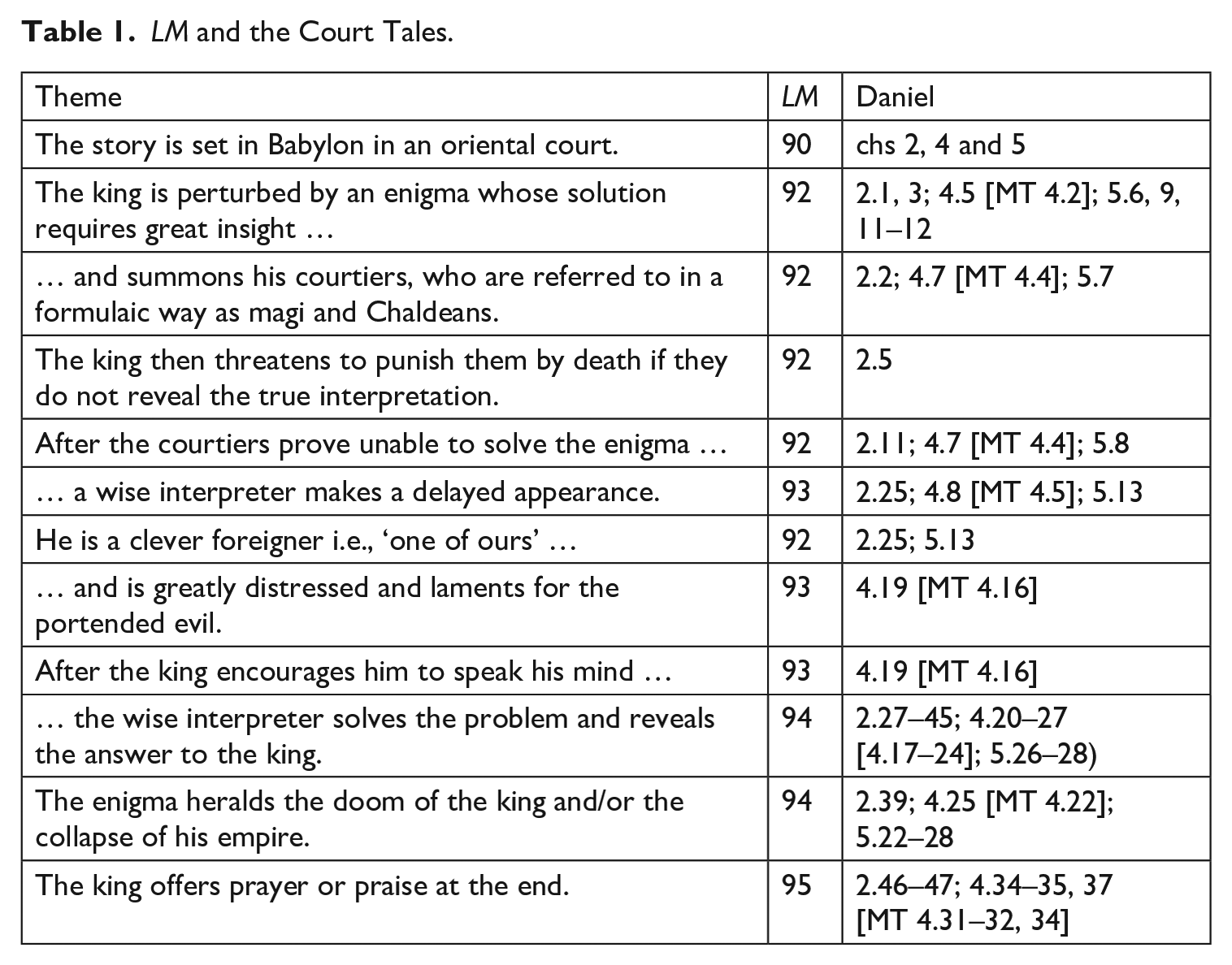
Parallels with the tales have already been noted by Konstantakos (2015: 259–68; 2017: 13–19). Our own comparisons, which largely follow Konstantakos, are in table 1.
LM and the Court Tales.
The prodigy and the visions of Dan. 7 and 8
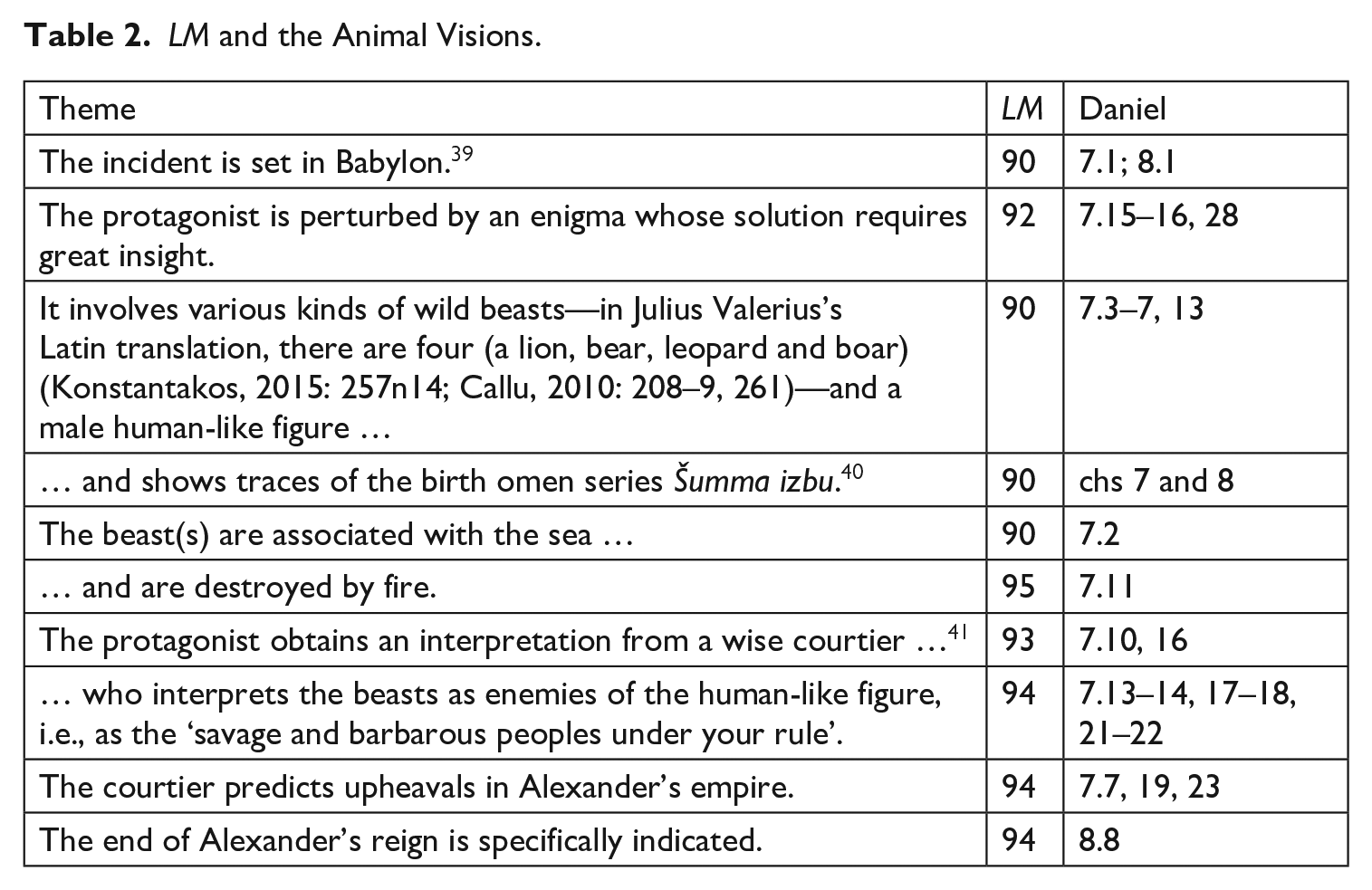
Similarly, Djurslev finds in Daniel’s animal visions ‘a compelling model for thinking about the function of the animals in the Babylonian omen story [in LM]’ (2021: 48). For our purposes, we find the LM tale equally useful for thinking about Dan. 7 and 8 and offer the commonalities shown in table 2.
LM and the Animal Visions.
Disjunctions with Daniel
Disjunctions between LM and Daniel should also be noted. The following, we suggest, testify to the author’s creative reworking of the LM analogue.
First, there is the difference in the king’s identity: the Daniel tales are dominated by the person of Nebuchadnezzar, not Alexander. According to Garstad, however, a close interplay between Alexander and Nebuchadnezzar can be traced to ‘the time of the Macedonian himself or shortly thereafter’ (2016: 43). Fostering this connection, Garstad contends, was ‘the association between Alexander and Babylon, the ill-omened site of his untimely death’ (2016: 36).
Second, there is the disjunction between the Greek 42 diviner Phippus and the Hebrew seer. While scholars have long understood Daniel to be a new and improved version of Joseph (Rindge, 2010), the LM tale brings to light a third diviner. In a world where Hellenic culture was ascendant, however, Jewish writings were often formulated in modes congenial to a Hellenistic setting (Gruen, 1998: xv), and the idea of a Babylon-based Joseph-Daniel who divines the fate of Alexander centuries before Phippus might well be intentional. 43
Third, in the visions of Dan. 7 and 8 it is Daniel, rather than a monarch, who is confronted by the mysterious omen. The same disjunction, however, is evident within the book of Daniel itself, where the puzzled seer in the vision reports resonates with the equally puzzled king in the tales. Similarly, Serapis speaks of Alexander’s death not only to the monarch (Alexander Romance I.33) but also directly to Python and Seleucus (Plutarch, Alex. 76.4).
Fourth, a formal difference distinguishes the vision reports of Dan. 7 and 8 from the LM court tale. Biblical writers, however, frequently repurposed old themes in new forms and genres (Hays, 2008: 20–21). In Dan. 2, for example, the Joseph court tale of Gen. 41 is transformed into an end-times prophecy (Machiela, 2014: 127), while Dan. 7 is still recognizable as a court tale of sorts with a heavenly assize, a ruler, court attendants, omens and a divine interpreter.
Fifth, new to Dan. 7 and 8 are three monsters that are noteworthy for their horns: the fourth beast in Dan. 7 has ten horns plus a little horn, the ram in Dan. 8 has two horns of uneven length, while the he-goat begins as a unicorn before it sprouts four horns and then a little horn. While the LM prodigy is apparently hornless, the Šumma izbu omen series, with which it evidently has some connection, also catalogues domestic beasts endowed with single, multiple, uneven, misshaped, and bifurcated horns (Porter, 1983: 15–29; De Zorzi, 2011a: 55). Similarly, the Animal Apocalypse, which features cows that give birth to birds and non-bovine animals (86.4; 89.10), mentions a unicorn ram (1 En. 90.9, 13), while in Testament of Joseph 19.6–8, a three-horned beast is present when a virgin gives birth to a lamb. Consequently, if Daniel’s horned creations have strayed from their LM counterpart, they have not strayed very far: the horns emphasize the superior power of the Persians, Alexander, and his successors (cf. Troncoso, 2014: 66), position them in the prophetic schema as anterior to Antiochus, and, as anomalous protrusions, label them not only as warriors but also as portents.
Djurslev (2021: 44) has identified several disjunctions of his own, which invite comment: First, it is problematic to compare mystic prophecy (Daniel) with the physical manifestation of a portent (omen story), although Daniel’s dreams may of course count as divine manifestations of a sort. Secondly, the occurrence of Daniel’s visions is not triggered by anyone’s birth or death specifically, as Alexander’s omen story is. The prophecies simply occur to Daniel during the Babylonian exile of the Jews. Thirdly, the animals that Daniel sees are not attached to a human being, as they are in Alexander’s case, but the beasts all emerge from a single point of origin, that is, the ocean. . . . Fourthly, the eschatology in both omen and prophecy suggests different endings: the omen story predicts the upcoming war, whereas the vision of Daniel promises a positive outcome of the earthly empire’s fall (Dan. 7.18).
Djurslev’s first discrepancy is accounted for when one considers the variety of royal death omens in the ancient world. The LM tale belongs to a tradition in which dreams and anomalous births are used with equal effect to alert the monarch to his impending demise. Once alerted, the king makes arrangements, where possible, for his successor(s). In Xenophon’s Cyropaedia, for example (see 8.7.2), a dream foretells Cyrus’s imminent death, prompting a smooth succession (Baynham, 2000: 244). In the case of his son Cambyses, however, the birth of a headless child, which Lenfant compares to the birth of three headless children in Šumma izbu I.111 (1996: 372–73), signals the king’s death without a successor (Ctesias, fragm. 14). For Alexander, the prodigy is a sign to summon his diviners, while in Dan. 7 and 8, the hybrids are lined up 44 against Antiochus. 45 Their placement within a dream (i.e., as omens within an omen) and their ‘accurate’ foretelling of the rise and fall of the nations, 46 make them especially threatening.
As to the second discrepancy, while the beasts in Dan. 7 and 8 are not explicitly labelled as birth omens, we can confidently identify them as such by comparing them with Babylonian, Egyptian, intertestamental and Christian ‘monster’ traditions, where anomalous births are clearly indicated. These include 1) the birth omen series Šumma izbu (Porter, 1983: 15–29); 2) the Bocchoris Lamb tradition; 47 3) T. Jos. 19.6, 8, where a virgin gives birth to a lamb in the presence of a three-horned bull; 4) the Animal Apocalypse (1 En. 89.10); 48 and 5) Rev. 12, where a birth sign (v. 2) introduces the conflict between a male child and a 10-horned water monster (Hamori, 2013: 498). And pace Djurslev, we contend that Daniel’s monsters are indeed triggered by a death, namely, the impending death of Antiochus (Dan. 7.26; 8.25). 49
The departure from the analogue in the third discrepancy is also unremarkable, given that the Šumma izbu omens include both individual and composite beasts. 50 Also noteworthy is the amalgamation of the discrete hybrids of Dan. 7 into a composite monster in Rev. 13.1–2. Furthermore, the fact that Daniel’s beasts in chapter 7 emerge from the sea compares well with the Scylla-like 51 appearance of the LM prodigy (line 90).
Finally, the contrasting eschatology in LM and Daniel, which Djurslev has rightly highlighted, is surely deliberate. Daniel’s expectation of a living, triumphant male personage rather than a dead child affirms a bright outlook for Israel, in which the Son of Man, in contrast to the hapless Alexander and his latter-day imitator, rules the nations in ‘an everlasting dominion that shall not pass away’ (Dan. 7.14).
III. Literary dependency
To what extent, then, has LM left its mark on the book of Daniel? We argue for literary dependence using MacDonald’s criteria of accessibility, analogy, density, order, distinctiveness, and interpretability (2003: 147–48).
Let’s consider each criterion. 1) Accessibility. The discovery of the late Ptolemaic fragment P.Vindob 31954 demonstrates that Alexander’s Will, which is central to the LM tale, was potentially known to 2nd century BCE Egyptian Jews. Many lived in Alexandria, which was the Ptolemies’ seat of government and a likely repository of LM. And given the probable Šumma izbu allusion in LM (see n. 40 above), we might reasonably infer that elements of this omen series were also known there. Supporting this inference is Alexander’s known reliance on Babylonian birth omen diviners (Plutarch, Alex. 57.4–5) and the lasting prestige that Babylonian seers enjoyed in the eyes of his Successors (see Naiden, 2023: 220, 234–236). 2) Analogy. Analogy asks if other ancient authors were influenced by the same tale. Reference to the Will in 1 Macc. 1, which presents Alexander as a forerunner of Antiochus, shows that this late 2nd century BCE Jewish author was also interested in the Will, and for parallel reasons. 3) Density. The volume of parallels between LM and Daniel is substantial, with both the Daniel visions and the Daniel tales apparently echoing LM. 4) Order. Both LM and Daniel relate similar, albeit stereotypical (Konstantakos, 2015: 262), court-tale sequences. Their similarity, however, is consistent with our assertion that Daniel evokes LM. 5) Distinctiveness. Highly specific elements common to both works include the death of Alexander, Alexander’s Will, a Babylonian court setting, a multi-animal prodigy, a binary opposition between man and beast, allusions to the omen series Šumma izbu, and an analogy between the prodigy and the affairs of men. Behind the LM tale we probably also encounter Ptolemy I Soter, who presents in Dan. 11 as Alexander’s primary Successor. 6) Interpretability. This criterion asks why our author targeted LM for imitation/transformation (MacDonald, 2001: 7). We have argued that Antiochus’s imitatio Alexandri, which is amply testified in the book of Daniel, provided the motivation.
IV. Provenance: Ptolemaic Egypt
So, where did this confluence of Hebrew and extra-biblical traditions take place, and under what circumstances?
Pagan imagery and the Ptolemaic Diaspora
Information about LM and the Mesopotamian birth omens could easily have reached Seleucid Palestine from Egypt 52 and there caught the eye of a local visionary. Moreover, the Animal Apocalypse, which shares many commonalities with Daniel’s animal visions, itself seems to echo the Šumma izbu birth omens (Porter, 1983: 24; Cryer, 1994: 320) 53 and is generally thought to have been composed in Palestine. It is also conceivable that a Palestine-based author borrowed pagan symbolism simply to polemicize against pagan worship.
These considerations notwithstanding, Daniel’s extensive and overt use of pagan elements drawn from LM and Šumma izbu seems better suited to the Ptolemaic Diaspora (cf. OG Daniel), and all the more if both sources were available in the Alexandrian Library. 54 Collins observes that ‘attempts to express the Jewish tradition in explicitly Hellenistic forms are relatively few in Palestinian Judaism, whereas they predominate in the Diaspora’ (2000: 18). Borgen dates such attempts to the period 181–145 BCE (i.e., the reign of Ptolemy VI), suggesting that they reflect ‘the tension within the Jewish communities with a wide range of attitudes from assimilation to separation’ (1996: 90). Common to many texts from this period, he continues, is ‘the attempt to combine distinctive Jewish observances with a fusion of Jewish and Greek ideas or Jewish and Egyptian ideas. The superiority of Jewish religion is stressed, and in the end time the Jewish nation will play an exalted role among the nations’ (1996: 90). 55 Certainly the book of Daniel shares these distinguishing characteristics: the notion of Jewish superiority without regard for orthodoxy is starkly expressed in Nebuchadnezzar’s ritualistic worship of Daniel in Dan. 2.46 (Collins: 1993: 172), while a common theme throughout the book is the end-time kingdom of God (Dan. 2.44; 6.26; 7.27).
Significantly, the ‘Daniel’ of the visions is addressed in Dan. 5.11 as ‘chief of the חרטמין’ (an Egyptian loan-word), 56 and Jewish writers in this predominantly pagan country 57 (e.g., those responsible for Sib. Or. 3), 58 did not hesitate to adopt mantic themes and motifs 59 to formulate their own point of view. Moreover, as noted above, behind the ‘Daniel’ persona we find a ‘Joseph’, whose positive relations with the Pharaoh served as a model especially for Egyptian Diaspora Judaism (see Ilan, 2022: 531).
While a Palestinian provenance for the visions is commonly inferred from the Aramaic and Hebrew languages employed and from the detailed references to the maśkîlîm and the Antiochene crisis, these factors equally favor a target audience such as the Jewish multitudes who fled Antiochene/Hasmonean Palestine for Egypt, 60 some of whom, like the wise Daniel and his Hebrew friends (Dan. 1.20), would assume high office in exile in the service of a Jew-friendly pagan king (cf. Sib. Or. 3.192–95). 61
Motive
As previously indicated, thinking about Antiochus’s imitatio probably piqued our author’s interest in LM. A narrative capable of galvanizing competing political claims in Ptolemaic and Seleucid circles 62 would have offered an attractive template for Jews wishing to stake their own claim for the kingdom of God. Skillfully reworked, the tale’s startling imagery was sure to capture the imagination, 63 while its focus on Alexander’s death and the question of succession provided a useful framework for interpreting the origins, legitimacy, and destiny of this come-lately imitator of the Macedonian. The tale’s Babylonian setting, moreover, could be repurposed to depict Antiochus’s own death as the denouement of Israel’s long exile, which itself had begun in Babylon (see Dan. 9). Finally, the assertion that a Joseph figure, reimagined as a diviner in Babylon, had foreseen Alexander’s untimely death and/or the breakup of his empire (Dan. 2.41; 7.11; 8.8; 11.4) long before Phippus did would allow Jews in the predominantly pagan culture that was Egypt to identify with Hellenism while maintaining a superior posture. 64
Concluding remarks
To sum up, we have identified three successive stages in the development of Daniel’s monsters. The creatures originate with Roxane’s culturally hybrid baby, the target of Ptolemy’s speech (323 BCE); they gestate as a mantic omen in the LM prodigy tale (309/308 BCE); and they mutate into the terrifying apocalyptic hybrids of Dan. 7 and 8 (mid-2nd century BCE). Each stage addresses Alexander’s death and the question of succession, while the Daniel visions also anticipate Antiochus’s latter-day demise (7.26; 8.25) and the kingdom bequeathed to the ‘people of the holy ones of the Most High’ (7.27). At each stage, we are transported to Babylon, where Philip Arrhidaeus, Phippus, and Daniel 65 each make their belated appearance. It is in this city that the narrative, which at each stage moves in an atmosphere of pagan wonder, is eclipsed by Daniel’s centuries-old foreknowledge of Alexander’s death and by his unwavering devotion to the living God. Yet despite their Babylonian setting, all three stages reveal a pro-Ptolemaic agenda: Ptolemy’s anti-Orientalist speech and the LM prodigy episode both serve his strategy to pursue his political ambitions unhindered by the Argeads’ rule (cf. Bosworth, 2002: 42), while the author of Daniel is shown in chapter 11 to have patently pro-Ptolemaic sympathies.
Daniel’s animal visions, moreover, highlight both the significance and the inevitability of Antiochus’s demise. The death is significant because it represents nothing less than the failure of Greece. The death is inevitable because the omens of Dan. 7 and 8, complemented by the successful passage of the ‘predicted’ empires, all conspire against the tyrant. Far from being mere ciphers for the successive monarchies, the monsters not only warn of troublous times but collectively herald the end of Antiochus. Pointing in this direction is the omen-succession tradition itself, which Xenophon invokes when narrating the death of Cyrus. Just as the gods announce through dreams and prodigies that succession will—or will not—flow from Cyrus to Cambyses and beyond, or indeed from Alexander to Ptolemy, so Daniel’s God announces through dreams, monsters, and the predicted passage of the four kingdoms, that ‘kingship and dominion and the greatness of the kingdoms under the whole heaven’ (7.27) should be given, not to Antiochus, but to the people of the holy ones of the Most High.
Finally, we note that scholars investigating the literary background of Daniel have repeatedly turned to Egypt in search of answers (Müller, 1972: 291; Gammie, 1976; Lebram, 1984: 19; Van Henten, 1993; Albertz, 2001: 181–83; Perdue, 2008: 361; Holm, 2013: 477–78; Korner, 2013; Scolnic, 2014; Porter, 2021). Holm observes that ‘we are continually gaining more evidence that in fact writers in first millennium Egypt, whether they were native Egyptians or Aramaic-speakers displaced from Syria-Palestine or Mesopotamia, sometimes did choose to place their compositions in Mesopotamia or the east … [but that] the reverse is not true; Mesopotamians seem not to have chosen western settings for their literature’ (2013: 472). Similarly, Merrill Willis wonders aloud whether Mesopotamian influences on the book of Daniel were mediated by the Land of the Nile rather than Babylon (2018: 120). Our paper, we submit, advances the conversation by proposing that inspiration for Daniel’s Babylonian court setting (chapters 2, 4, and 5), for its monsters (chapters 7 and 8), for its engagement with the Will and for its anti-Seleucid bias (11:4–5) came to our author courtesy of the Ptolemies, a Greek dynasty who used a court tale set in Babylon to drive their political agenda in Egypt.
