



Abstract
One of the most frequent cases of textual variance in the Hebrew Bible concerns the grammatical number of nouns with suffixes (e.g. ידך ‘your hand’ versus ידיך ‘your hands’). First, this article demonstrates the significant textual instability of the letter yod in the plural or dual morphemes of suffixed nouns and traces some reasons for that. Then, it presents exemplary cases of this variance and discusses some interpretive conclusions drawn from conspicuous grammatical numbers in the research literature. For instance, a widespread theory that distinguishes two kinds of hand imposition rites according to the number of hands used by the performing subject proves to be problematic for text-critical and philological reasons. Finally, the article discusses the appropriate text-critical handling of the problem in general, suggests some guidelines, promotes awareness of ambiguity, and pleads for restraint in drawing far-reaching interpretive conclusions from a specific grammatical number of suffixed nouns.
Keywords
‘For truly I tell you, until heaven and earth pass away, not one iota, not one stroke of a letter, will pass from the law until all is accomplished’ (Mt. 5.18). The Hebrew letter yod (י), the equivalent of the Greek iota, is not only the smallest letter of the (square script) Hebrew alphabet, but, as a glance at the textual history of the Hebrew Bible shows, it was also particularly subject to change and could easily become lost, replaced, or added. This reflects three facts in particular: 1 first, the yod – just like the waw – is affected by the difference between defective and plene spelling in its function as mater lectionis. 2 Second, due to its graphic similarity to the waw in the square script (in Paleo-Hebrew script with the letter he), the yod is susceptible to transcription errors. 3 The third factor concerns the occurrence of the letter yod in suffixed plural or dual forms of nouns. The presence or absence of a yod here affects the grammatical number of the noun and can thus result in textual variants with different meanings. This is the feature I will address in the present article. 4
1. The Problem
To illustrate this, let me first list the paradigm of the invariable nouns סוס and סוסה as found in common grammars of Biblical Hebrew – here, however, unvocalised and in the right-hand column (plural feminine) with the plural morphemes -ōt- spelled defectively.
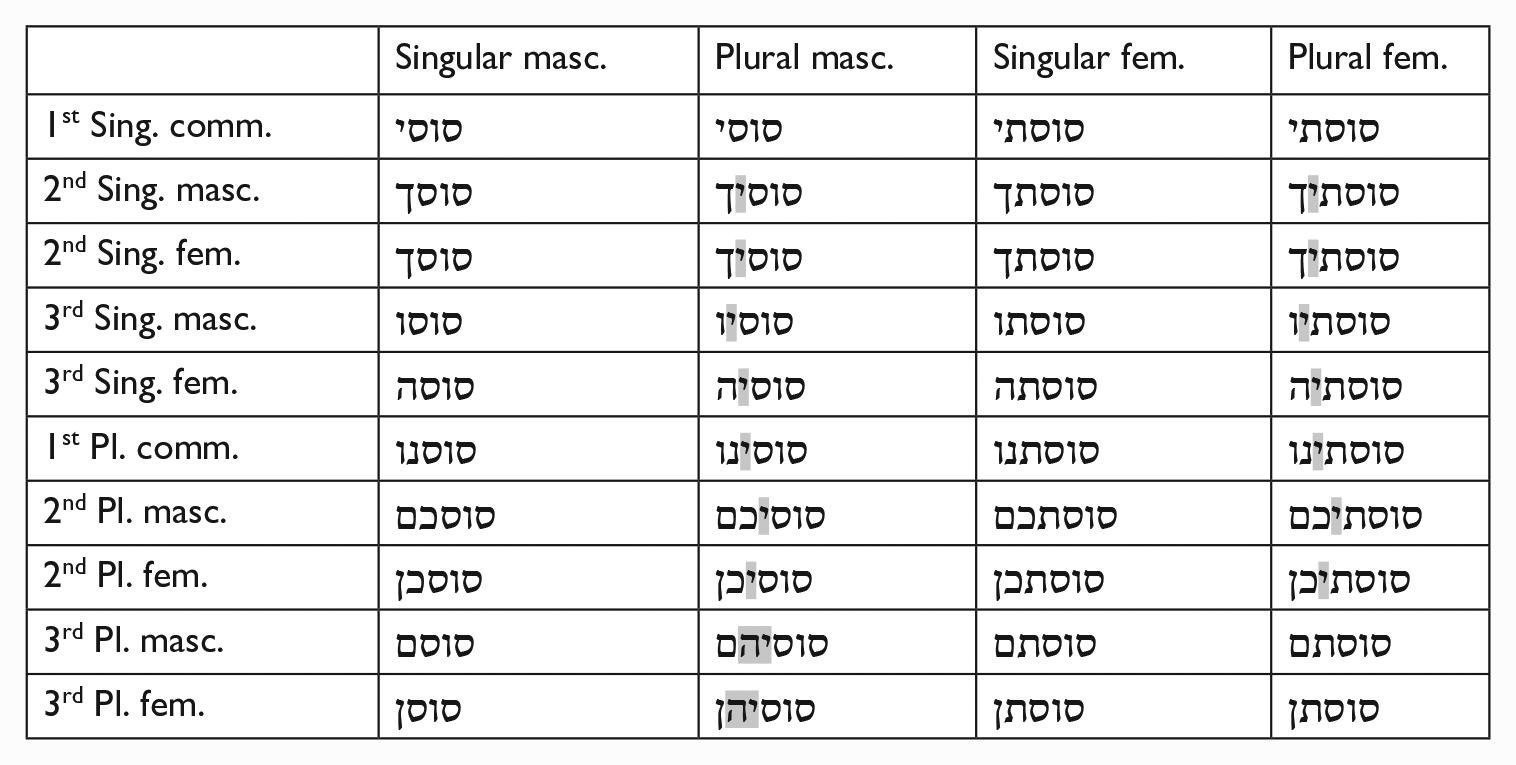
Shaded in grey are the respective variants between the singular and the plural form 5 of the noun. Here is what is noticeable: with the 1st person singular suffix, the consonants of the singular and the plural noun are completely identical (homographic), as is also the case with the 3rd person plural masculine and feminine suffixes on the feminine noun (at least in defective spelling). 6 There is a larger difference only with suffixes of the 3rd person plural masculine and feminine at the masculine noun. In all other forms, singular and plural differ orthographically only by an additional י in the plural 7 (going back to the original dual morpheme -*ay-). In addition to the orthographic similarity, some forms have a phonetic similarity: סוסֵנו and סוסֵינו are – at least according to the Masoretic reading tradition – homophonic, 8 as are the pausal form סוסֶֽך and סוסֶיך. 9
So much for the – standardised and unified – paradigm. In reality, however, the situation is more complex. This already becomes clear in the Masoretic Text (MT). The reading tradition reflected in the Masoretic vocalisation did not read every suffixed nominal form without י as singular and likewise did not understand every form with י as plural or dual. This can be seen in three phenomena: 10
(1) Ketiv and qere: in the Hebrew part of the Tanakh, there are 1132 instances of ketiv/qere in Codex L. Almost one in six of these (175 cases ≙ 15.5 %) concerns the number of suffixed nouns. 11 These cases are particularly frequent in the Book of Ezekiel (53 cases), in the Books of Samuel (33) and in the Book of Job (17). By far the most cases (141) refer to the suffix of the 3rd person sing. masc. on a ketiv form without י, which, however, is read as plural or dual according to qere (e.g. Exod. 32.19: ketiv מידו is read מידָיו). 12 The second most common case (19) is the suffix of the 2nd person sing. masc., but there with the reverse direction: a ketiv form with י is read as singular (e.g. Judg. 13.17: ketiv דבריך is read דברְך). 13
(2) Tacit correction: a spelling without י is understood as a defective spelling of a plural or dual form or, conversely, a suffixed noun with י is vocalised as a singular form without marking this by a qere. Only a few examples may be given: absent י as a defective spelling for the plural: 14 למינֵהם (Gen. 1.21), דְּרָכֶךָ (Exod. 33.13; Josḥ 1.8), מכֹתֶֽהָ (Jer. 19.8), מנחֹתֶ֑ך (Ps. 20.4). 15 Present י as plene spelling for singular: משנאָתֶיך (Ezek. 35.11), תהלָתֶיך (Ps. 9.15), בילדוּתֶיך (Qoḥ 11.9), באשמָתֵינו (Ezra 9.15). 16 In part, these spellings are noted in the Masora parva as חסׄ (= חסר ‘defective’) or as מלׄ (= מלא ‘plene’).
(3) Hybrid forms: there are a few examples of hybrid vocalisations of singular and plural: מכֹתְך (Deut. 28.59; hybrid of *מכָתְך and *מכֹתֶ(י)ך), עצָתָ֑יִך (Isa. 47.13; hybrid of *עצָתֵך and *עצֹתָ֑יִך). These hybrid forms probably combine different reading traditions that exist in parallel, thus leaving the grammatical number of the respective noun undecided.
These observations found in the MT show in many places a divergence between the consonantal text and the reading tradition with respect to the grammatical number of suffixed nouns. 17 Depending on the concrete form, the Masoretes handle this differently. 18 The presence or absence of a י is not as unambiguously a marker of grammatical number in the MT as it seems according to the paradigm. 19 Suffixed nouns without a י are clearly more often read as defective plural or dual forms than vice versa, but there are also dozens of examples of suffixed nouns that were understood as singular forms despite the presence of a י in the consonantal text.
In terms of linguistic history, this ambiguity is due to monophthongisation. The original morpheme -*ay-, which in dual and plural forms stands between the root and the suffix (e.g. *yad-ay-ka ‘your hands’, *yad-ay-hu ‘his hands’, 20 *yad-ay-kum ‘your hands’) 21 and is orthographically represented by the י, has been contracted to the monophthong -ē- in the course of the First Temple period. 22 The fact that the semivowel y was no longer pronounced had the orthographic consequence that the י was often omitted in spelling as well and became only optional. This is evident not only in the orthography of the MT described above but also in the ancient Hebrew inscriptions. 23 At least until well into the Second Temple period, the י to mark a plural or dual form was apparently not obligatory, at least not for all scribes. 24 Even in the Qumran manuscripts, which on the whole tend strongly towards plene spelling, there are some overt plural forms written without a י ; 25 conversely, a י occasionally appears as mater lectionis even in overt singular forms. 26
From the history of Hebrew phonetics and orthography, three reasons for the instability of the י as a marker of grammatical number thus emerge: (1) In a plural or dual form, the י was sometimes omitted because it was not pronounced as a result of monophthongisation. (2) In a singular form, a י was partially written because it could be used to indicate a long vowel (ē, æ-) as a result of the increasing use of the י as mater lectionis. (3) In some cases, the singular form and the plural or dual form are homophonic, leading to a strong possibility of confusion.
Consequently, it is not surprising that cases of number divergence are not limited to the Masoretic textual and reading tradition but also occur between different textual witnesses of the Hebrew Bible. The findings from Deuteronomy and the Book of Psalms may serve as a sample: 27 the text-critical apparatus of the BHS lists 92 instances in Deuteronomy in which at least one textual witness deviates from Codex L with respect to the grammatical number of suffixed nouns. Thus, such a case is found approximately every 10 verses. In the Psalms, there are 142 instances 28 (on average, every 18 verses). 29 If one additionally consults the BHQ (on Deut.) and the Dead Sea scrolls (especially on Psalms), one might come across several more occurrences. While the exact number is not important here, these numbers may give an approximate impression of the magnitude. If one extrapolates from them to the entire Hebrew Bible, one ends up with a total number of instances in the low four-digit range. From this it can be concluded that deviations in the grammatical number of suffixed nouns are among the most frequent types of textual variants in the Hebrew Bible and regularly demand text-critical decisions from translators and exegetes. This requires a general text-critical reflection on the problem.
Particularly frequently affected are, on the one hand, body parts that occur twice (רגל, יד, עין et al.) and, on the other hand, terms denoting divine commandments, attributes, or deeds (דבר, מצוה, חסד,גבורה, and others). As an example to illustrate the variance, I pick out the pairing of נעל ‘shoe’ + suffix and רגל ‘foot’ + suffix, 30 which occurs in nine places in the Hebrew Bible. It is found for the first time in Exod. 3.5 and has the following wording in the MT: של נעליך מעל רגליך ‘take off your shoes from your feet,’ with both nouns in question in the dual. The Septuagint (G) and the Vulgate (V), on the other hand, read נעל in the singular while rendering רגל as plural; many Hebrew manuscripts as well as five Samaritan manuscripts attest the singular for both words. In Exod. 12.11 (נעליכם ברגליכם), all textual witnesses agree on the dual, as they do in Deut. 25.9 (נעלו מעל רגלו) on the singular. In Deut. 29.4, MT reads singular (ונעלך לא בלתה מעל רגלך), whereas the Samaritan Pentateuch (SP), G, V, the Peshitta (S), and the Targum Pseudo-Jonathan (TJ) attest all components of the sentence in the dual or plural, respectively (ונעליכם לא בלו מעל רגליכם). In Josḥ 5.15, MT provides the same phrase as in Exod. 3.5 – the borrowing from this text is evident here – but with the nouns in the singular (של נעלְך מעל רגלֶ֔ך). 31 G and V, however, provide a dual for רגל, as in Exod. 3.5, and S – also as in Exod. 3.5 – for both nouns. In 1 Kgs 2.5, MT is now also inconsistent within the pairing for the first time (ובנעלוֺ אשר ברגליו); G, however, translates uniformly singular. Likewise mixed numbers are found in the MT of Isa. 20.2 (ונעלְך תחלץ מעל רגליך), whereas 1QIsaa as well as the ancient versions uniformly provide a dual or plural, respectively. In Ezek. 24.17, 23, again, all textual witnesses agree on the dual of both nouns. Thus, on the one hand, there is an internal inconsistency within the Hebrew Bible according to MT; on the other hand, there is also an inconsistency between the different textual witnesses: five of the nine instances of this pairing of terms have at least one text-critical variant regarding the grammatical number. This shows how easily singular and dual become mixed up here.
2. The text-critical handling in research and its exegetical consequences
Even though the number variation of suffixed nouns is a particularly common case of textual variation, it must be conceded that the decision between singular and plural or dual often has no or only a minor effect on the meaning. Whether Yhwh gives the enemy king into Israel’s hand (ידך) or into his hands (ידיך) (Deut. 3.2), whether the supplicant of Ps. 119 expresses his devotion to Yhwh’s word in its entirety (דברך) or to his individual words (דבריך), or whether the worshipper of Ps. 145.4, 11, 12 praises Yhwh’s power (גבורתך) or his concrete manifestations of power (גבורתיך) does not make much difference in terms of meaning. In some cases, however, the text-critical decision regarding the number does have interpretive consequences. The following three case studies from the exegetical research literature will show the criteria according to which text-critical decisions on the grammatical number are made and how they affect the interpretation of the text.
2.1 The rite of imposition of hands in Exodus to Deuteronomy: with one hand or both hands?
In the Pentateuch, it is mentioned 22 times that humans (shall) lay or press the hand on another human or an animal (סמ״ך + יד + suffix). The number of יד varies, however, so the question arises: how many hands are laid on in each case?
For the time being, those passages in which more than one person is the subject of the imposition of hands shall be left to one side (Exod. 29.10, 15, 19; Lev. 4.15; 8.14, 18, 22; 24.14; Num. 8.10, 12). The object ידיהם is not in dispute here, but it is commonly noted that the form gives no information as to whether the multitude of hands is composed of individual hands or pairs of hands. 32
Where an individual is the subject of the action, MT usually reads יד in the singular (ידוֺ or ידְך: Lev. 1.4; 3.2, 8, 13; 4.4, 24, 29, 33; Num. 27.18). Two observations, however, are noticeable:
(1) While in Num. 27.18, Yhwh commands Moses to press his hand (singular!) on Joshua (וסמכת את ידְך עליו), the report of execution in v. 23 states that Moses presses his hands (dual!) on him (ויסמך את ידיו עליו). MT thus contains a tension between commission and execution, that is made even more surprising by the fact that both before and afterwards the correspondence between commission and execution is explicitly remarked (ויעש משה כאשר צוה יהוה אתו, v. 22; כאשר דבר יהוה, v. 23). While SP, S, and two Hebrew manuscripts read singular in both places, G translates plural twice. According to the usual rules of textual criticism, the two MT readings, which together clearly represent the lectio difficilior (and are also supported by V), would have to be preferred; 33 by contrast, the divergent readings of other textual witnesses could be explained as harmonisations. However, it is hardly likely – especially against the background of the priestly scheme of commission and execution – that Moses is portrayed here as inaccurately executing the divine commission. 34 Thus there are two possibilities: either ידך in v. 18 is to be read as a defectively spelled dual form or an original ידו* in v. 23 has been misinterpreted as a defectively spelled dual form in the course of textual transmission and supplemented by a י. The number divergence also carries over to Deut. 34.9, a passage that clearly refers back to Num. 27.23. MT reads dual here (כי סמך משה את ידיו עליו), which is shared by G, V, S (different from Num. 27.23!), and Targum Onqelos (TO), while two Hebrew manuscripts and SP provide a singular.
(2) The fact that ידו can be a defectively spelled dual form is clearly shown in Lev. 16.21. In the context of the scapegoat rite, the MT reads: וסמך אהרן את שתי ידָו על ראש השעיר החי ‘and Aaron shall press his two hands upon the head of the living goat.’ The numeral שתי ‘two’ disambiguates the ambiguous noun ידו and makes it recognizable as a defective spelling of the dual form. In accordance with the common usage for nouns with the suffix -ו read as plural or dual, the Masoretes noted here the qere form ידיו. Since all scope for interpretation is removed by the numeral, there are no dissenting textual witnesses. 35 Even SP, which otherwise in all places with the phrase סמ״ך + יד + suffix 2nd/3rd person sing. masc. reads the object יד in the singular, attests a dual here. Thus, there is at least one secure instance of a hand imposition that is performed with both hands.
The defective spelling of the dual form ידו in Lev. 16.21 raises the suspicion that even more of the instances of ידו as an object of the verb סמ״ך may have originally been intended as dual forms 36 but were misinterpreted as singular forms due to the lack of syntactical markers disambiguating the form. MT reads singular throughout the sacrificial regulations in Lev. 1–4: וסמך (את) ידוֺ ‘and he shall press his hand (on the head of …)’. 37 SP, S, and TO agree unanimously with MT in this. 38 In Lev. 1.4, however, V translates plural (manus); in Lev. 3.2, 8, 13, a plural is found in G (τα`ς χει~ρας). One could argue here that the variation regarding the grammatical number reveals more about the translation technique than about the Hebrew Vorlage. 39 However, the inconsistency in G and V within the same syntagm and within adjacent chapters is most easily explained by the assumption that the translators found partly ידו, partly ידיו in the Hebrew Vorlage, and interpreted the different spellings as references to different grammatical numbers. The arbitrariness is more likely to be a function of the orthography than the translation technique.
The question of grammatical number is relevant here because the understanding of the function of the rite of hand imposition in different ritual contexts depends on it. René Péter (1977) has proposed to distinguish between two different forms of rites of imposition of hands with completely different functions according to the number usage of MT: the imposition of one hand symbolises the identification of the sacrificing person with the sacrificial animal in the sacrificial context; on the contrary, the imposition of both hands takes place outside the sacrificial context and signifies the transfer of a thing to a target object. 40 Many other scholars have adopted this distinction (and partly modified the determination of the function of the rite). 41 From this, it is commonly concluded that the imposition of hands on the scapegoat in Lev. 16 has a very different function than the imposition of hands on the sacrificial animal in Lev. 1–4, which has implications for understanding the conceptions of sacrifice and atonement in the Book of Leviticus. Text-critically, Péter does discuss Num. 27.18 (and understands ידך as a defective spelling for the dual), but he neither pays attention to the ambiguity of the other passages nor discusses the specific textual variants. Péter’s theory holds only on the basis of MT (with one emendation in Num. 27.18). 42 On the basis of other textual witnesses, a ritual-historical evaluation would look different: according to the SP, only the scapegoat rite in Lev. 16 demands the use of both hands, whereas only one hand is pressed on the sacrificial animal as well as on Joshua, and according to G and V, in Lev. 1–4, it depends on the specific type of sacrifice whether the imposition of hands is done with one or with both hands.
This is not to say that the distinction between two different hand imposition rites with two different functions is necessarily wrong. From a text-historical perspective, however, it is questionable to divide the passages on hand imposition into two groups according to the grammatical number provided by MT and then to draw ritual-historical conclusions from this. Just as it is conceivable that Lev. 1–4 originally referred to a two-handed rite (with ידו as a defective spelling as in Lev. 16.21), 43 Num. 27.18, 23 and Deut. 34.9 could originally have referred to the imposition of only one hand on Joshua (if SP preserves the original text). Péter’s distinction is consequently based on highly uncertain premises. A text historically sensitive and problem-conscious exegesis would approach the issue much more cautiously here.
At this point, the passages with plural subject and the object ידיהם already mentioned must be included for further clarification. Of the ten passages, one (Lev. 4.15) is found in the context of the sacrificial regulations in Lev. 1–7, and in several other passages, the imposition of hands on an animal also occurs in the context of a sacrifice. 44 As stated above, according to Péter’s theory, hand impositions in the context of sacrifice always take place one-handedly. Accordingly, Péter argues that the form ידיהם is not necessarily to be understood as a dual but can also be a plural (from יָדִים*) composed of many individual hands. 45 This is the case wherever the instance is found in the sacrificial context; especially in Lev. 4.15, ‘it is evident by the context (same rite as in 4:4, 24, 29, 33) that the Ancients place only one hand on the bull’s head.’ 46 Not only is the context by no means as evident as assumed, but also Péter overlooks the fact that biblical Hebrew does distinguish between pairs of hands in the plural and single hands in the plural: although the dual is used for the former, the singular (with plural suffix, e.g. ידם ‘their (respective) hand’) is used throughout for the latter. 47 With 3rd person pl. masc. suffixes, the singular (here: ידם) and plural or dual (here: ידיהם) are less easily confused by the additional ה. 48 Assuming that the number usage for יד is consistent in Biblical Hebrew, it is clear and unambiguous from the above passages that when the subject is plural, both hands are pressed on the sacrificial animal in each case (otherwise it would be ידם instead of ידיהם!) This additionally feeds the suspicion that in Lev. 1–4, the individual sacrificing person is also supposed to press both hands onto the animal. At least here it becomes clear that the number of hands to be laid on the animal as a criterion for the distinction between two types of hand imposition rites is difficult to maintain.
What follows from this for the understanding of the rite of hand imposition? To be sure, it cannot be excluded that the rite has different functions in different ritual contexts. But for text-critical and philological reasons, these can only be connected with difficulty to the number of hands used in the execution of the rite. With some degree of probability, the imposition of hands was originally performed with both hands in all contexts. But the textual history may show that the exact performance of the rite either changed over time or was forgotten in later times. For distinguishing different functions of the rite, the performing subject and the target object of the hand imposition along with the accompanying ritual acts could be the more crucial components than the (supposed) number of hands. 49 Perhaps the hand imposition within the scapegoat rite has more to do with the hand imposition in the context of animal sacrifice (and vice versa) than is often assumed.
2.2 David as Yhwh’s servant and anointed: individual or collective?
Another case of a suffixed noun whose grammatical number is of increased exegetical relevance is found in Ps. 89. In its overall composition, the psalm is a lament on the downfall of the Davidic dynasty (cf. especially vv. 39–52), which leads to a sharp accusation of Yhwh especially because it stands in stark contradiction to the dynastic promise, extensively quoted in vv. 20–38. Timo Veijola (1982), however, following earlier proponents, promoted the thesis that Ps. 89 does not actually speak of David and his dynasty but rather collectivises the Davidic promise by transferring it to the people as heirs of the promise. 50 The main weight of this thesis hangs on v. 51: while otherwise David is referred to as Yhwh’s עבד ‘servant’ (singular: vv. 4, 21, 40), in the concluding petition in v. 51, there is suddenly found a plurality of ‘servants’ (עבדיך) whose shame Yhwh shall remember. This group of ‘servants’ is, according to Veijola, identical to the ‘anointed one’ (משיחך) in v. 52, whom he consequently also understands as a collective entity. Starting from vv. 51–52, Veijola then discovers traces of collectivisation in other parts of the psalm, too. Numerous exegetes have agreed with Veijola regarding the collectivisation of the Davidic figure in Ps. 89. 51
However, the plural form עבדיך (so according to Codex L, G, Psalterium iuxta Hebraeos) in v. 51 is text-historically insecure. Many Hebrew manuscripts, some manuscripts of the Lucianic recension, and S provide a singular, which seems to indicate that already in the ancient Hebrew textual tradition, the readings עבדך and עבדיך coexisted. Veijola acknowledges this textual variation but argues strongly for the originality of the plural form: the reading עבדיך represents the lectio difficilior; in contrast, the singular form is an adaptation to the more frequent form as well as to the singular in the second half of the verse (שאתי). 52 However, it should be noted that the singular form fits better into the context of Ps. 89: it fits grammatically better with משיחך in v. 52 as well as with the references to Yhwh’s עבד in the singular in the rest of the psalm. 53 If עבדך* is the original reading, it could nevertheless be read as a defectively spelled plural form. That this was the case is even plausible because of the reception history of Ps. 89 with its collectivising tendencies (cf. the Septuagint, the Targum of Psalms, Isa. 53.3–5, and the Qumran fragment 4QPsx). 54
The text-critical decision depends on whether one gives greater weight to the lectio difficilior or the contextually more appropriate reading. In principle, both directions of textual change or misunderstanding are conceivable and possible. The collectivisation thesis, however, overlooks this uncertainty and ambiguity, relies solely on the plural form, and derives from it far-reaching consequences for the understanding of the whole psalm.
2.3 Abraham’s Curser in Gen. 12.3: one or many?
In the following example, the interpretive consequences are less far reaching, but in this case, too, we find occasional attempts to make a conspicuous number form exegetically fruitful. It concerns the promise of blessing in the context of the first promise to Abraham in Gen. 12.1–3: ‘I will bless those who bless you (מברכיך), but whoever curses you (ומקלֶלְך) I will curse’ (v. 3a). MT thus attests to a change in terms of grammatical number between the participle of בר״ך pi. and the participle of קל״ל pi. By contrast, a fragment of the Cairo Geniza, a few Hebrew manuscripts, and especially SP, G, S, and V read the second participle as plural, 55 which is thus much better attested, even into the (proto-) Masoretic textual tradition. From a poetological point of view, v. 3a can be described as an antithetical parallelismus membrorum with a chiastic structure (a–b–b’–a’). However, the change of the grammatical number disturbs the parallelism between the members b and b’. This makes the singular the lectio difficilior and thus, according to the established rules of textual criticism, a promising candidate for the more ancient reading. Some of those who text-critically decide in favour of the singular provide an explanation for the change of the grammatical number and deduce from this change the communication of yet another promise, which is subtly expressed between the lines. Matthias Köckert (2017), for example, concludes: ‘The double sentence brings into play the relationship between Israel and of those who do not belong to Israel. […] It dissolves the symmetry of blessing and curse by contrasting a disdainful behaviour towards Israel as an individual case with the many who bless Israel.’ 56 The cursing of Israel by its enemies ‘will be an exception in the future.’ 57 This interpretation of the change in grammatical number towards an intended asymmetry of blessing and cursing is not a modern invention but is already found in the Jewish exegesis of the Middle Ages. 58 It is undoubtedly creative and ingenious – but does it correspond to the original meaning of the text? The consonantal text מקללך can also be read as a defective spelling of the plural, which, following מברכיך, would be the more obvious reading. For a text-critical decision, the general rule lectio difficilior probabilior and the external attestation and the contextual appropriateness are opposed. In any case, it must at least remain unclear whether the original text really implies the additional promise that those blessing Abraham will outnumber those cursing him. The ambiguous Hebrew orthography allows this interpretation as a possibility – no more and no less.
3. General text-critical conclusions
Sections 1–2 have demonstrated the text-historical instability of the י as a plural or dual marker, presented case studies of number variation in suffixed nouns between different textual witnesses, and pointed out different causes for this. Finally, I will discuss in a general way what follows from this for the text-critical handling of the problem.
In principle, both directions are equally possible: a noun such as סוסו can be mistakenly 59 understood as a defectively spelled plural form and thus receive an additional י in the course of textual transmission; conversely, a noun such as סוסו can originally be meant as a plural form but be misunderstood as a singular due to a defective spelling, 60 which then could crystallise in an orthographic tradition that clearly distinguishes between singular and plural (e.g. in SP), and even more so in a translation (at least in a non-Semitic language like Greek). Misunderstandings due to homophony can lead to changes in both directions anyway. In the written textual tradition, however, once a י has crept into a suffixed nominal form, its grammatical number is thereby disambiguated. In transcription, therefore, a י is more easily added than omitted. For example, SP, which orthographically reflects a younger stage than MT, 61 reads the suffixed noun in the plural or dual, at least in Deuteronomy, in most places where it differs from MT in terms of grammatical number. 62 This does not mean, however, that the plural or dual forms tend to be secondary, as the singular forms of the Masoretic reading tradition can also be based on misunderstandings of the consonantal text (as, for example, is probably the case with ידו in Lev. 1–4, see above).
To clarify the criteria on the basis of which decisions can nevertheless be made, some of those passages will serve as a starting point wherein the grammatical number of the noun is disambiguated by the syntactical context – for example, by numerals (as in Lev. 16.21) or by the number of the verb, the predicate noun, the attribute, the personal pronoun, or the pronominal or object suffix syntactically linked to the noun. 63 Here are some cases in which the consonantal framework of the MT leads (or appears to lead) to an incongruence in number:
– Deut. 7.10:
– Deut. 21.10: כי תצא למלחמה על
– Deut. 32.27:
– 2 Sam. 1.11: ויחזק דוד
– 2 Sam. 3.34:
– Qoḥ 4.8: גם
These passages show that on the one hand, the absence of a י in the suffixed noun does not automatically mean the noun is a singular form; on the other hand, a י can also inappropriately enter the text secondarily. Several grammatical persons are involved (here 2nd person sing. masc., 3rd sing. masc., 1st pl. comm.). However, based on my findings, nouns with a 2nd person sing. masc. suffix seem more prone to having a י added secondarily than nouns with a 3rd sing. masc. suffix. 66 The absence of a י in the above cases is simply due to the defective spelling. A superfluous י can be explained by the fact that the plural or dual form is the more expected form, given the preceding context or the more frequent usage.
In most places where textual witnesses differ as to the grammatical number of suffixed nouns, the underlying form is probably one without a י, which was interpreted in the course of the copying and translation processes sometimes as singular and sometimes as plural or dual. Thus, it is a matter of the interpretation of an ambiguous defective consonantal framework. From a text-critical point of view, the general rule lectio difficilior probabilior has only a limited justification here: to be sure, sometimes the number offered by the syntax may be more difficult insofar as it differs from the preceding context or from the more frequent usage. Intra- and intertextual alignments and harmonisations – conscious or unconscious – must be reckoned witḥ Strictly speaking, however, the lectio difficilior applies to cases in which incongruity in terms of grammatical number occurs, and these forms are unlikely to be original. An erroneous interpretation of the defective consonantal framework is – at least in most cases – not an intentional textual change, and it is precisely in the case of unintentional errors in the textual tradition that the rule of lectio difficilior reaches its limits. 67 The most important criterion especially for the grammatical number of suffixed nouns must be the contextual appropriateness – and that in the broadest sense. 68 For example, someone who has to read and vocalise an ambiguous unvocalised form such as 69 וישב will not choose the most difficult reading but the one most appropriate in the context – and, if necessary, correct oneself in view of the subsequent context when reading on. The same applies to the vocalisation of an originally unvocalised defectively spelled nominal form with suffix. If then, in the case of text-critical variants, plausible reasons can be given which led to the deviating reading, the advocated reading can claim a certain degree of probability.
But in many cases, a conclusive decision is impossible; often both grammatical numbers are equally justifiable. A certain degree of ambiguity always remains with suffixed nouns. In general terms, every suffixed noun in the singular could theoretically be a defectively spelled plural or dual form. Conversely, for every suffixed noun in the plural or dual, there is the possibility the grammatical number results from a misunderstanding that occurred in the course of textual transmission. The presence or absence of a י in suffixed nominal forms is thus subject to a high degree of uncertainty. From a text-critical point of view, the י (present or absent) before pronominal suffixes does not enjoy the same status as full consonants do, but is rather on a par with the Masoretic vocalisation in that both are to be regarded as interpretations of the (defective) consonantal framework. The perception of the ambiguity prompts us, on the one hand, to question what seems to be self-evident and raises the awareness of the uncertainty of interpretations; on the other hand, it has also a constructive and productive effect by opening up a variety of interpretive options.
In any case, no far-reaching interpretive conclusions should be drawn from a conspicuous grammatical number of a suffixed noun because of a present or absent י alone, especially if the textual witnesses differ concerning the number. The examples documented above call for clear restraint in linking the understanding of weighty theological and religious-historical subjects, such as the meaning of sacrificial and atonement rituals or the handling of the downfall of the Davidic dynasty, to specific number forms in MT. Graphically, the י resembles a small hook, on which it is unwise to hang weighty exegetical conclusions.
Footnotes
Acknowledgements
I wish to thank Prof. Stefan Schorch (Halle) and Prof. Bernd Janowski (Tübingen) for giving me some helpful comments on this article and Dr. Stephen Long (Providence) for improving the English of the article.
1.
On these and other cases of errors in the textual tradition involving the letter yod, cf. classically (though partly outdated) Delitzsch (1920). Cf. also  : 227–236) with references to further literature.
2.
As is well known, the Samaritan Pentateuch (SP) tends somewhat more strongly, and numerous Qumran manuscripts even more strongly still, towards plene spelling than MT does (cf. Tov, 2012: 89–90, 101–102). In most cases, these are merely orthographic variants. Occasionally, however, a plene spelling in the form of an additional י also reveals a different vocalisation, resulting in some cases in textual variants that differ in meaning. For example: in Deut. 29.22, the verb תזרע is vocalised as Nif‘al in MT (‘it [sc. the land] will not be sown’), whereas SP provides a Hif‘il (תזריע) (‘it will not form seed’). In Ezek. 8.2, MT reads כמראה אֵש (‘as the appearance of fire’); the Septuagint, however, translates ‛οµοι’ωµα α’νδρο’ς and presupposes the vocalisation כמראה אִש (‘as the appearance of a man’). For vocalisation variants made visible by a ו as mater lectionis, cf. for instance Isa. 49.17 (בָניך ‘your sons’ (MT) versus בוניך ‘your builders’ (1QIsaa)).
3.
This is shown, for example, by the fact that among the ketiv-qere variants, there are a number of cases where the suffix of a noun varies between the 1st person singular (-י) and the 3rd person singular masculine (-ו) (cf. 1 Sam. 22.17; 2 Sam. 22.33; Isa. 46.11; Jer. 23.18; Pss. 59.11; 102.24; Job 30.11; 33.28; 1 Chron. 22.7, et al.) or the object suffix of a verb varies between the 1st person singular (-ני) and the 1st person plural (-נו) (cf. Jer. 2.27; 51.34; Pss. 17.11; 71.20). In many of these examples, this variance also exists between different textual witnesses.
4.
For a recent study which reaches similar conclusions to those arrived at here and about which I learned only after submitting this article, see Golinets, 2020: 45–53.
5.
What is said here of the plural applies equally to the isomorphic dual forms.
6.
This is true at least in the older form. The alternative plural forms סוסתיהם and סוסתיהן (see Rezetko and Young, 2014: 351–374; Qimron, 2018: 286–290), on the other hand, are clearly distinct from the singular.
7.
This does not include nouns with irregular plural forms (e.g. אישו ‘his man’ versus אנשיו ‘his men’) as well as nouns that have a feminine morpheme only in the plural (e.g. קרנו ‘his horn’ versus קרנתיו ‘his horns’ – but dual קרניו).
8.
9.
This does not apply to segolata, however, where suffixed singular and plural forms differ in vocalisation (מַלְכֵּנוּ versus מְלָכֵינוּ). Also, in certain forms of other nouns with changeable vowels, singular and plural forms sometimes diverge phonetically further than is the case for סוס (e.g. דְּבַרְכֶם versus דִּבְרֵיכֶם,שֹׁפֶטְךָ versus שֹׁפְטֶיךָ, but the latter is again homophonic in pausa).
In the orthography of Dead Sea manuscripts, a י is occasionally found before 2nd person sing. masc. suffixes even when there is obviously no plural form (cf. Qimron, 2018: 68–69). Qimron (2018: 68–69) infers a penultima stress (as in the Masoretic pausal forms). Correspondingly, homophony occurs with this suffix in any position in the sentence. Orthographically, it follows that a י is sometimes written in Qumran merely as mater lectionis for a long vowel, without being etymologically or morphologically conditioned. In the Samaritan pronunciation, homophony occurs in 2nd person sing. fem. Suffixes (דברך and דבריך are both pronounced dēbā°rək). On the Samaritan pronunciation of suffixed nouns, see : 298–304).
10.
One might also count the punctum extraordinarium in Gen. 16.5, by which the י before the suffix of וביניך is marked as questionable. But first, this is an isolated phenomenon; second, this is not a noun but a preposition; and third, the exact function of the puncta extraordinaria is not entirely clear (cf. Kelley et al., 1998: 32–34). While בין + suffix 2nd sing. masc. is usually written without י in the suffix, a form with י is also found in Gen. 13.8, but unlike Gen. 16.5, it was not specially marked by the Masoretes.
11.
Counted with BibleWorks 10. There is no guarantee that all numbers are exact.
12.
However, such cases are less often marked with a qere note in the Aleppo Codex than in Codex L (cf. Andersen, 1992: 64).
13.
This is due to the singular verb יבא. Cf. in contrast v. 12 (יבא דבריך), where no qere is noted – probably because in the pausal form, singular and plural are homophonic.
14.
Even more examples can be found in Delitzsch (1920: 25–26); Andersen and Forbes (1986: 137–138, 144–145); : 131–137).
15.
Cf. also the spelling of the prepositions אל and על, which in suffixed forms are regularly written with י (pseudo-plural), but in MT often occur also in defective spelling (cf. Barr, 1989: 134–137), e.g.:
אל + suffix 3rd person pl. masc.: אליהם (167x) versus אלהם ( 130x, majority in the Pentateuch).
אל + suffix 2nd person pl. masc.: אליכם (64x) versus אלכם (6x, only in the Pentateuch).
אל + suffix 3rd person sing. masc.: besides אליו, the spelling אלו is found three times (1 Sam. 22.13; Ezek. 9.4; Zecḥ 2.8, two of which are corrected by qere).
על + suffix 2nd person pl. masc.: עליכם (101x) versus עלכם (1x: Exod. 12.13).
על + suffix 3rd person pl. masc.: עליהם (232x) versus עלהם (10x, only in the Pentateuch).
16.
Possibly Ezek. 35.11 and Ps. 9.15 are to be placed in the next category (3): because the two forms are not pausal forms, the segol before the suffix actually makes no sense in a singular form.
17.
Cf. also the Masoretic list collection Okhla we-Okhla, §§ 112–115 (counting according to the Halle manuscript, edited by Díaz Esteban, 1975 (here: pp. 156–159)), where precisely such cases are listed.
18.
To generalise, it can be stated that for nouns according to the scheme סוסו (for example), which are understood as plural or dual forms, the qere form is mostly noted in Codex L (exception: Deut. 27.10, where G. Weil adds a qere in the BHS against Codex L), while this is never the case with nouns understood as plural or dual according to the scheme סוסך. But there the vocalisation is apparently considered sufficient as an indication of the grammatical number. The latter, however, makes numerous pausal forms with suffixes of the 2nd person sing. masc. ambiguous. סוסיו, read as singular, is always corrected by a qere (for which, however, there are only seven cases), while in the case of סוסיך understood as singular, the notation of the qere form depends on whether it is a pausal form or not (for סוסותיך (in plene spelling) in singular reading, however, a qere is notated).
19.
20.
Cf. the spelling ומצריה ‘and of his oppressors’ in the inscription Qom(8):3,3 (though the reading and vocalisation is not entirely certain) as well as archaizing forms in biblical poetry such as גבריהו ‘his heroes’ (Naḥ 2.4). The change in pronunciation from -ayhu to -āw in MT presents itself as more complex than with the other suffixes and is controversial. Cf. the proposal of Hutton et al. (2018 and ).
21.
22.
On the contraction of the diphthongs *aw and *ay, see Suchard (2020: 122–132). In Samaritan Hebrew, *ay has been contracted to ī in open syllables and before certain consonants (cf. Ben-Ḥayim, 2000, 65). This is evident in suffixed nouns at the plural/dual morpheme before plural suffixes (e.g. דברינו = dēbā°rīnu). For 3rd person sing. fem. and 3rd person pl. masc./fem. suffixes, the ה of the suffix is elided so that the י of the plural/dual morpheme is pronounced consonantally (e.g. דבריה = dēbā°riyya). See : 300).
23.
Cf. Renz (2003: 4–9) on the morphology of the suffixes to the noun in the ancient Hebrew inscriptions (with attestations). The following plural/dual forms without י are attested: ירחו ‘his months’ (Gez(10):1,1.2.6), אנשו ‘his men’ (Lak(6):1.3,18), עצמתו ‘his bones’ (Jer(7):2,2), possibly also בנכם ‘your sons’ (or singular, Arad(8):40,1); cf. also the prepositions אלך ‘to you’ (Arad(6):3,9) and אלו ‘to him’ (MHas(7):1,13). The omission of the letter י as a result of the monophthongisation of ay is also evident in the Samaria ostraca (1st half of the 8th century), where יין ‘wine’ is spelled ין throughout (cf. Renz, 1995: 79–110), suggesting the pronunciation *yēn.
24.
In Dan. 11.10 we still find a defective spelling of a plural form that is marked by a qere (ובנָו יתגרו ‘and his sons will arm themselves’). Forms of prepositions like אלהם (see n. 14 above) are still found several times in Chronicles and Ezra-Nehemiah, side by side with the corresponding plene spellings.
25.
Reymond (2013: 36) finds at least 50 cases of suffixes of the 3rd person sing. masc. where a plural noun is written without י (e.g. אבותו ‘his fathers’; cf. the list of further examples in Reymond, 2013: 144–147). In cases of other suffixes, the defective spelling occurs less frequently, but there is at least some evidence for it as well (cf. Reymond, 2013: 36 with n. 65).
26.
Cf. the evidence in Reymond (2013: 146, 156). On the problem of the orthography of suffixed nouns in Qumran Hebrew in general, see : 66–74).
27.
These two books were chosen because, first, they comprise different literary genres (narrative, parenesis, legal texts, poetry), second, they come from different parts of the canon, third, the Samaritan Pentateuch is another textual witness for Deuteronomy, and fourth, they are the two books with the most surviving manuscripts among the Dead Sea Scrolls.
28.
29.
Once again, it should be noted that counting errors and overlooked instances cannot be ruled out.
31.
Apparently the Masoretes understand רגלך here, and in Deut. 29.4, as a defective spelling of the plural (cf. the Masora parva).
32.
Thus Péter (1977: 52–53); Janowski (2000: 201); : 33) et al.
34.
Cf. however, the interpretation of Rashi, according to which Moses, by pressing both hands on Joshua, acted with the best of intentions even beyond what was commanded (וסמכת את ידך והוא עשה בשתי ידיו :בעין יפה, יותר ויותר ממה שנצטווה, שהקב״ה אמר לו, quoted from Katzenellenbogen, 1991: 252).
35.
However, it could be considered whether V, with the translation utraque manu, deliberately tries to render ידו singularly in form.
36.
Besides Lev. 16.21, there is still another instance of ידו in Leviticus corrected by a qere to ידיו, namely, in Lev. 9.22.
37.
Lev. 1.4; 3.2, 8, 13; 4.4, 24, 29, 33.
38.
This also applies to the (few) extant passages in the Dead Sea Scrolls.
39.
Cf., for instance, Gen. 16.12; 37.27, where an unequivocal singular form יד is rendered by χει~ρες ‘hands’.
41.
Cf. Janowski (2000: 199–221, 430–431); Wright et al. (2001: 884–887); Schäfer-Lichtenberger (1995: 156–157); Körting (1999: 179–185); Rendtorff (2004: 32–38). Hieke (2014: 166–169) rejects the idea of identification for the sacrifice, but he too assumes different functions of the one-handed (in the sacrifice) and two-handed imposition of hands (in the scapegoat rite and in the transfer of office) (cf. Hieke, 2014: 167).
42.
Schäfer-Lichtenberger (1995: 155–162) dispenses with an emendation and concludes from the number difference in Num. 27 that the action instructed in v. 18 and the action performed in v. 23 are two different actions. See, however, the critical objections of : 179–180).
43.
One could argue that the use of the numeral ‘two’ in Lev. 16.21 points to the fact that the explicit two-handedness distinguishes the hand imposition here from other hand impositions. However, it could also be argued the other way around that in Lev. 1–4 – unlike in ritual instructions such as Lev. 14.14, 16, 17, 25, 27, 28, et al. – any reference to the right hand is missing (so only TJ: יד ימיניה). The idea that the hand imposition rites in Lev. 1–4 are to be performed with both hands is also the position of the Mishnah and the Babylonian Talmud. The Gemara in b. Menaḥ. 93b states: ‘The mishna adds that the placing of hands is performed with two hands (בשתי ידים). The Gemara asks: From where are these matters derived? Reish Lakish said: As the verse states with regard to the Yom Kippur service: “And Aaron shall place both his hands [yadav] upon the head of the live goat” (Leviticus 16:21). The word yadav, meaning, His hands, is written without a second yod, and so if read without vowels it reads as: His hand. But it is also written “both,” which makes clear that the intention is that he must use both hands. This established a paradigm that in any place where it is stated in the Torah: His hand, there are here two hands (כל מקום שנאמר “ידו” הרי כאן שתים), unless the verse explicitly specifies that there is only one’ (quoted from Steinsaltz, 2018: 291).
44.
Exod. 29.10, 15, 19; Lev. 8.14, 18, 22; Num. 8.12 (cf. also 2 Chron. 29.23).
45.
Péter (1977: 52–53 (with n. 10)). Cf. also : 201).
46.
47.
For יד in the singular with plural suffix there are 129 occurrences in the Hebrew Bible. It is particularly clear, for example, from Gen. 19.10; Exod. 28.41; 29.20; Lev. 8.24, 33, and others that it refers to the respective hand of several people. The same applies analogously to רגל. Cf. regarding the grammatical number of body parts also Gen. 3.7 with Gen. 9.23: whereas in Gen. 3.7, the construct chain עיני שניהם ‘the eyes of the two’ implies two pairs of eyes by the dual form, the singular שכם שניהם ‘the shoulder of the two’ in Gen. 9.23 suggests that one shoulder of each of two people is meant. On the contrary, the form יָדִים* does not exist in Biblical Hebrew (only ידות, with figurative meaning), and the form רְגָלִים only occurs in the phrase של(ו)ש רגלים ‘three times’.
48.
In G, however, no differentiation is made between ידם and ידיהם, though the majority of translations of ידם are also plural. V also often handles the Hebrew original more freely in its rendering of ידם and ידיהם.
55.
56.
58.
Cf. Radaq: בקללה לא אמר לשון רבים, כי מעטים יהיו המקללים אותו ומבקשי רעתו (‘In the curse there is no mention of a plural, for/but few there will be who curse him and seek his calamity’), quoted from: Katzenellenbogen (1986: 152). Ibn Ezra (Katzenellenbogen, 1986: 151) also notes the difference in grammatical number.
59.
‘Mistakenly’ can mean both contrary to the author’s intention (intentio auctoris) and contrary to what the literary context demands (intentio operis).
61.
This is indicated on the one hand by the greater use of matres lectionis and on the other hand by the more uniform and consistent orthography of suffixed nouns and prepositions. Phenomena such as a missing י in overt plural or dual forms or in the suffixed prepositions אל and על, as found in MT, seem to be absent in SP.
62.
Cf. Deut. 2.7; 6.8; 7.10, 13; 8.2, 4; 9.18, 21; 11.10, 18; 12.7, 18; 15.10, 18; 16.10; 23.21; 26.13; 28.8, 12, 20, 29, 55; 29.4; 30.9; 33.3, 24, et al. Among the few counterexamples (singular in SP, plural/dual in MT) are: Deut. 32.27, 50; 33.11; 34.9. Possibly Deut. 23.15 and 29.10 can be added (MT: מחניך, SP: מחנך), where, however, the י in MT is possibly not a plural morpheme but belongs to the root (cf. Andersen and Forbes, 1986: 136–137, 141–142; Barr: 1989, 134 as well as Qimron, 2018: 69 on the orthography in Qumran).
63.
It should be noted, however, that number incongruence can also be regular in Biblical Hebrew, for example, in the case of collectives (constructio ad sensum) or in the case of verbs syntactically prefixed before compound subjects.
64.
The phrase ‘in his face’ (אל פניו) probably means ‘during his lifetime’ or ‘on his own person’ (cf. Levinson, 2012: 85–88).
65.
Cf. analogously 1Kings 8:29: להיות עינֶך פתחות.
66.
Cf. for the 2nd person sing. masc. also Judg. 13.12, 17; 1 Sam. 24.5; 1 Kgs 8.26; Jer. 15.16; Prov. 3.28; 24:17. This suspicion is also aroused by the fact that in the qere notes nouns with a suffix of the 2nd person sing. masc. are more often changed from plural or dual to singular (19 times) than nouns with suffix of the 3rd person sing. masc. (7 times) – despite the fact that in the case of pausal forms of the 2nd person sing. masc. (e.g. Deut. 21.10; Judg. 13.12) in principle no qere note is made.
68.
Cf. Tov (2012: 270, 280–81). ‘The quintessence of textual evaluation is the selection from the different transmitted readings of the one that is most appropriate to its context. Within this selection process, the concept of the “context” is taken in a broad sense, as referring to the language, style, and content of both the immediate context and of the literary unit in which the reading is found’ (Tov, 2012: 280).