




Abstract
Metaphors are not stand-alone units, but figure often in larger chains and regularly build upon each other. Yet, not all metaphors are the same. Some are very simple, such as the simile, while other metaphors require more active cross-domain mapping in thought. Still others are also context-dependent, deliberately used to convey new insights or used with a certain rhetorical intention. The study of various metaphorical clusters in Psalm 22 allows us to discuss the different types of metaphors and their distinct communicative functions. The most remarkable metaphorical cluster is based on the conceptual metaphor
Metaphors are not stand-alone units, but figure often in larger chains. Employed in written texts or in oral communication (together referred to as ‘discourse events’), metaphors regularly build upon each other. Yet, not all metaphors are the same. Some are very simple, such as the simile, which is a metaphor that is linguistically marked by terms such as ‘like’ or ‘a kind of’. This type of metaphor is directly accessible. Other metaphors require more active cross-domain mapping in thought, whereas still others presuppose cross-domain mapping but have become so conventional that we do not notice them anymore as metaphors (e.g. ‘Christmas is coming’). While metaphors are the result of linguistic and cognitive processing, some are purely conceptual and cross-linguistically recognizable, whereas others are also context-dependent, deliberately used to convey new insights or used with a certain rhetorical intention. Therefore, metaphors cannot be understood as processed in ‘thought’ only, but also in communication. This explains why the use of metaphors has at least three dimensions: the linguistic, the conceptual, and the contextual-communicative. In recent discourse event–based cognitive approaches to metaphors, these three dimensions take up a central position. 1 Such an approach includes three elements: a linguistic study that is directed towards the language system and regards the morpho-syntactic and semantic aspects of metaphors; a conceptual study that explores the language use, that is, someone’s employment of a language code such as English or Hebrew and regards the cognitive, cultural, and experiential metaphorical processes; and a communicative study that is aimed at the discourse event in which a metaphorical utterance is produced, received, and exchanged. Discourse events are, therefore, higher-level processes of verbal interaction than language use. Sermons, political speeches, advertisements, stories, religious texts, legal texts, and poems are examples of such discourse events. Literary texts make use of the language system, create new combinations in a textual edifice, and are parts of a connected line of argument aimed at persuasion or emotion.
The distinction between (1) linguistically fixed metaphors, such as simile and conventionalized metaphors; (2) conceptual metaphors that require active cross-domain mapping in thought; and (3) deliberatively used metaphors that are employed in literary, political, religious, rhetorical, or other communicative genres that are primarily applied for rhetorical or stylistic reasons lies at the heart of this article. In most discourse events, the distinct types of metaphors are used side by side. Often, they build upon each other, layer upon layer, from non-figurative descriptive language via the more conventional and slightly newer conceptual metaphors to the most innovative metaphors. Together, they create an entire discourse-based metaphorical network.
This study operates within the framework of a discourse-based, cognitive approach to textual metaphors. In it, I intend to offer an analysis of the metaphorical network of Psalm 22, mainly based on a cognitive linguistic approach in combination with Deliberate Metaphor Theory (DMT). The latter is a theory about properties of metaphor in language use and discourse which has emerged over the past decades in a series of publications by Gerard Steen et al. 2 Its central thesis is that in order to understand a literary metaphorical network, one should differentiate between the distinct types of metaphors briefly sketched above. As far as I know, DMT has so far only been applied in biblical studies by Hanneke van Loon in her excellent dissertation on the book of Job. 3
The structure of this article is as follows. It opens with a short introduction of DMT, which is followed by the body of the article. After a general study of Psalm 22 in its entirety and the metaphors in vv. 2–22, I pursue a more detailed analysis of the metaphors in vv. 15–16. A comparison of all these metaphors will allow us to differentiate between conventional and deliberate metaphors, and their distinctive roles in the psalm. Thus, I intend to show that out of these distinct metaphors, a metaphorical network emerges in which the sum is more than its parts.
1. Conventional and deliberate metaphors
Variation in metaphor processing stands at the heart of DMT. Many metaphors are conventional and do not depend on active cross-domain mapping, while other metaphors require more attention. Conventional metaphors have entrenched metaphorical meanings that are directly accessed. In contrast, deliberate metaphors concern the intentional use of metaphors as metaphors between sender and addressee. Not all discourse events are the same, and some genre events are more prone to deliberate metaphor use than others, like poetry. And Steen concludes, therefore, ‘It is one goal of DMT to highlight this variation in metaphor in language use from the perspective of discourse’. 4
The basic tenets of DMT are the following. Deliberate metaphors (1) are intentionally used as metaphors; (2) draw attention to their source domains as a separate detail for attention in working memory, whereas non-deliberate metaphors do not; and (3) have the communicative aim to change the addressee’s perspective on the topic, that is, they are perspective changers in the context of communication. According to DMT, non-deliberate metaphor ‘does not ask the addressee to pay conscious attention to the structure of an alien source domain that may be involved in the semantics of the words used’.
5
The communicative aim of the writer or speaker correlates with the linguistic and discursive use of metaphors. The writer who intends to cause a shift of perspective may employ grammatical and/or lexical means to signal the introduction of a source domain. The writer may employ deliberately used metaphors to shift the perspective of the addressee by choosing a source domain that fits her or his argument, to focus attention on aspects of the target domain that are specifically relevant for him or her, to modify the recipient’s action or conviction, or to evoke feelings of beauty. The latter metaphorical strategy depends on the textual genre: political texts and advertisements employ deliberate metaphors to modify the reader’s or listener’s conviction or action (buying); poetry, on the contrary, employs deliberate metaphors to create a concentrated imaginative awareness of language and a specific emotional response. One criticism, though, arises from the perspective of biblical scholarship. The communicative interaction Steen is talking about is exclusively individual-oriented: the parties involved in the discourse event are projected as individual persons, the producer/writer and recipient/reader are involved in an interaction process, and the reader reacts to (i.e. follows or rejects) the textual strategy. However, biblical texts such as psalms or laws are group-oriented: the intended audience is a collective, either the community of Israelites or a community of people worshipping
The distinction between deliberate and conventional metaphors as described and explained by DMT is very helpful indeed. To apply this theory in the study of metaphors in biblical texts, I propose the following three-step framework. 6 The first step is to identify linguistically marked similes and fixed or conventionalized metaphors. The similes are marked in Hebrew by the preposition כ ‘like’, and therefore, are easily accessible. Fixed metaphors are conventional in the sense of the ‘ordinary’ or ‘everyday’ way of talking and thinking about events; although a metaphor lies at the base of it, it is not experienced as such anymore, because it has become entrenched in the language system. Examples in English are as follows: prepositions (‘He was in a state of shock’, ‘It happened up to a year ago’) and metaphors in which time is primarily conceptualized in terms of space (‘The economy is going from bad to worse’). In the Hebrew Bible, one could mention various prepositions such as לפני, מלפני, על־פני, and מעל פני, which are conceptually related to ‘face’ but became conventionalized as prepositions that mark the spatial positioning of someone relative to someone/something else: ‘in front of’ or ‘before’.
The second step regards the conventional conceptual metaphors occurring in (biblical) texts, which are used more regularly and accessed without much cross-domain mapping, although they once did presuppose such activities. Examples in English are well-known metaphors such as
The third step is aimed at the unique discourse event in which a new metaphor or a deliberately used conventional metaphor is employed in a biblical text. This new metaphor or newly used metaphor asks the reader to pay attention to its form or content, to shift perspective, or to enhance their imagination and thought. The new idea expressed by the metaphor can be signalled by a simile, by a combination of linguistic signalling and a new conceptual content, or by a peculiar (peculiar in the sense of attention seeking) usage of a conventional metaphor that in combination with other textual units develops a new meaning dimension. These deliberately used metaphors construe a new layer upon previous figurative layer(s). The real task of a discourse-based analysis is not merely to catalogue the cases of metaphor, but to understand the dramatic and rhetorical effects of the implicit meanings of the text.
7
An example in the Hebrew Bible can be found in Job 3.21–22: ‘Those who expect death while it does not come, they search for it more than for hidden treasures; those who rejoice exceedingly would exult when they reach the grave’.
8
In v. 21, the source domain of treasure hunting is introduced, which is elaborated in v. 22 by picturing the successful outcome of the search. For treasure seekers, finding a grave is a promise for finding treasures; for sufferers, however, it implies that they have found death. The grave, therefore, is the place where the scenario of treasure hunting and having passed away come together. The grave functions as the unifying factor of the source and target domain in the new metaphor
Inspired by the studies of conventional and deliberate metaphors in DMT, and translating it into the above-described three-step approach, I will address the various fixed, conventional, and deliberately used metaphors in Ps. 22.13–23. Two aspects I will pay special attention to are the contextual and communicative aspect of metaphors and the metaphorical network in its interaction with the discourse event in a specific historical context.
2. A general overview of Psalm 22
Psalm 22 is a famous psalm, both in Judaism, because it became known as Esther’s prayer in Midrash Tehillim (a classical rabbinic commentary) and was later included in Jewish rituals on Purim, and in Christianity, because it became known as Jesus’s prayer at the cross: ‘My god, my God, why have you forsaken me?’ and was later included in the Christian liturgy for Good Friday. 9 Although Psalm 22 is often understood as an individual lament because of its prominent display of first-person expression, the many references to Israel’s community of faith seem to suggest otherwise. In fact, an analysis of the text will demonstrate the tight interweaving of the individual and collective strands.
Following John Kselman’s structural analysis and Davida Charney’s impressive study of the rhetorical structure of Psalm 22, this psalm can be divided into three sections: the Address (vv. 2–12), Complaint and Petition (vv. 13–22), and Proposed Action (vv. 23–32).
10
The opening verses 2–6 display an alternation of first-person and third-person expressions so that the speaker’s charge of abandonment by God in vv. 2–3 is merged with memories of God’s past deliverance of the people of Israel (vv. 4–6). The psalmist sketches that he experiences himself as a worm, the lowest of all animals (vv. 7–9), and not as a human being and complains that he is detested by other people who mock him for his trust in
The next two sections, Complaint and Proposed Action, elaborate on the two strands of the first section: in section 2 (vv. 13–22), the misery and desperation of the speaker is sketched in full detail against the background of opponents who are described as attacking the speaker like wild animals, while section 3 (vv. 23–32) offers a public declaration of praise and thanksgiving, both by the speaker and the descendants of Jacob who testify of their loyalty to
Section 3, the Proposed Action in vv. 23–32, is unusually lengthy. Charney argues convincingly that the length of this section is needed to balance the doubts and dehumanization of the equally lengthy Address and Complaint and the intense images of dehumanization: Rather than simply declaring his own praises of God, the speaker directs/predicts praise from widening circles of others, from his immediate family (the ‘brothers’ in v. 23), to the ‘great assembly’ (vv. 23–26), to other nations (vv. 28–29), to all mortal creatures and generations yet unborn (vv. 30–32). The initial doubt and dehumanizing isolation of the speaker are now reversed, with the speaker empowered to persuade others to remain as dedicated to God as he was even in times of despair . . . The covenant continues for as long as God responds to the faithful; those deserving of response are those who carry on with praising, calling, and reasserting their claims to be heard.
13
The reversal of the condition of the dehumanized speaker into a prominent member of a community of faith is exemplified in the metaphorical pattern of the heart. The shift from the melting of the individual heart (לבי) in v. 15 to the eternal living of the community members’ heart (לבבכם) in v. 27 demonstrates what the covenant actually entails, namely that dehumanization and isolation will turn into loyalty and life in community.
3. The metaphorical cluster of ‘humans and animals’ in verses 2–22
‘The direr the straits, the more God’s help is needed’
14
is a good summary of vv. 2–22. Both the threats and the physical condition of the supplicant are described in the most evocative images, among which are a number of metaphors and similes. The most obvious is the metaphorical cluster
In the next section, vv. 13–17 and 21–22, another group of metaphors imagines human beings in terms of wild animals. This time, they do not relate to the ‘I’ person, but to other people. It draws on the biological knowledge of wild beasts, because ‘lions’ are mentioned and three features of the behaviour of wild animals are implied in this metaphorical construction: wild animals act in troops surrounding their prey, open their mouths for roaring at and tearing their prey, and have the intention to attack. However, the actual animals mentioned are bulls (‘the mighty ones of Bashan’) and dogs.
The metaphor presented in vv. 13–14 is
Verses 17 and 21–22 introduce another instantiation of the same metaphorical cluster: this time, the enemies are compared to dogs and the conceptual metaphor involved is
The metaphorical cluster under discussion can be summarized as follows:
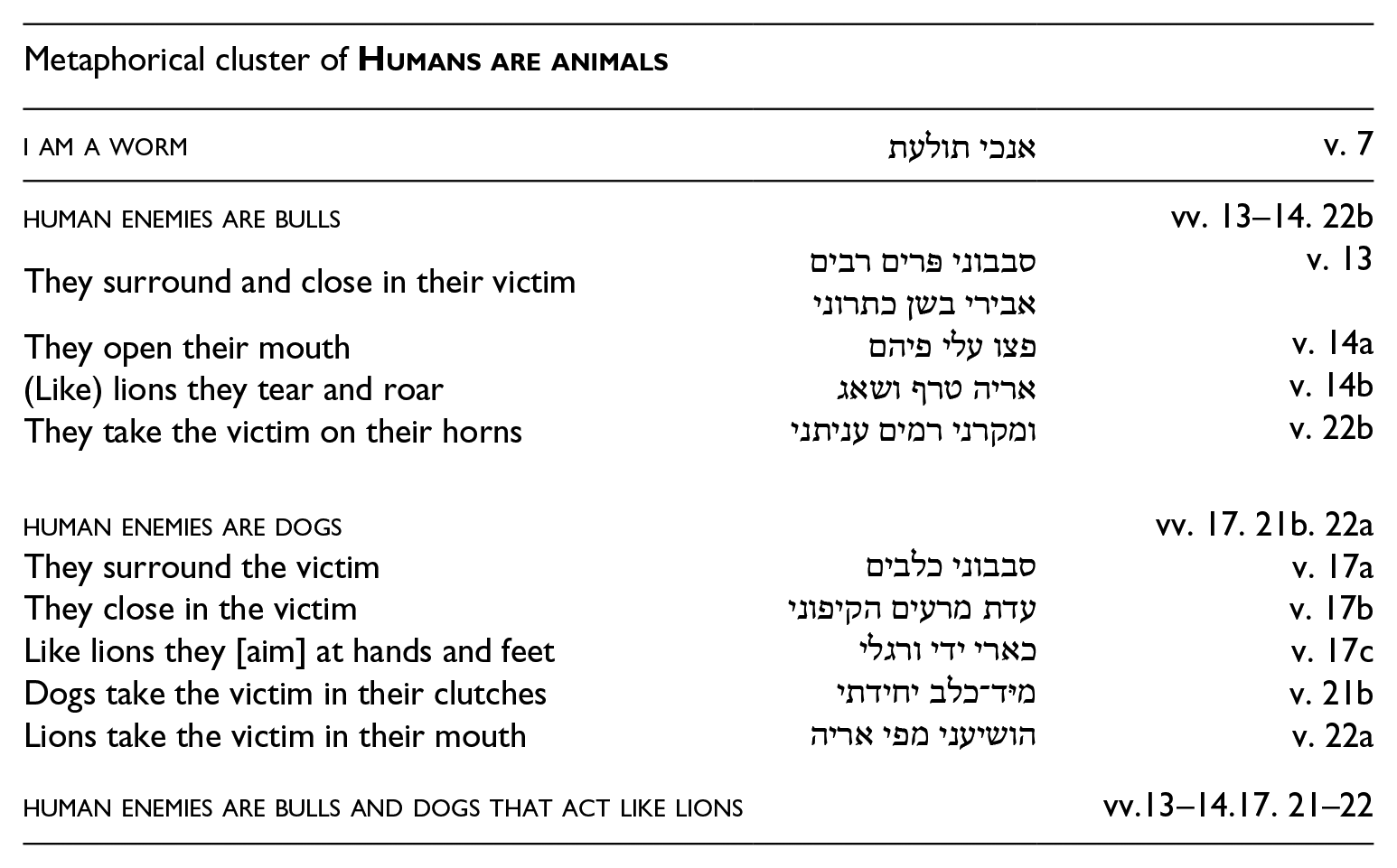
We can conclude that in Ps. 22.13–14 and 17–22, a distinction can be made between the various types of metaphors. The metaphor
4. The metaphorical cluster of ‘human body parts and non-animate entities’ in verses 15–16
The miserable state the psalmist finds himself in is pictured in evocative images and metaphors. In vv. 15–16, this description contains a series of metaphors which compare the psalmist’s body parts to water, wax, and a pot, respectively.
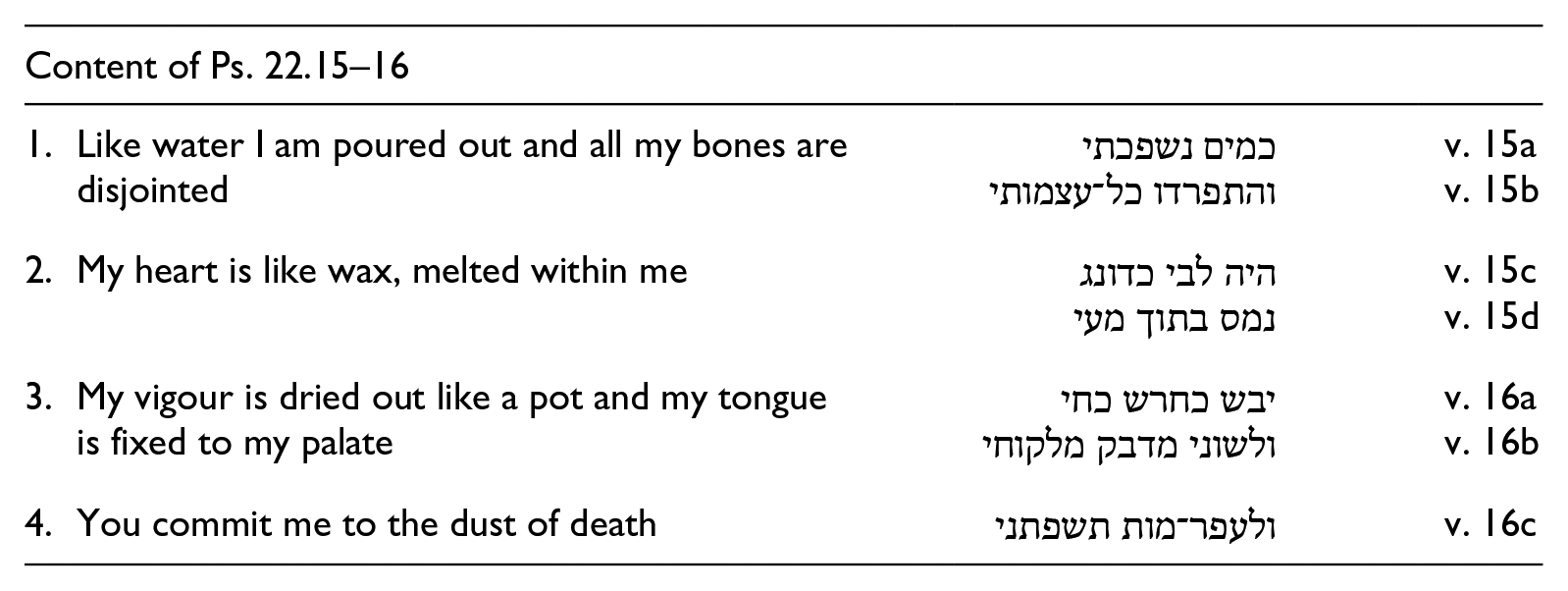
As shown in the table above, vv. 15–16 express four events. The first event is described by two clauses. Verse 15a opens with the simile כמים and the speaker compares the deplorable state his body finds itself in with that of ‘water’. This simile functions as the linguistic signal that points the reader to the metaphorical content of שפך: in using נשפכתי ‘I am poured out’, he conceives of himself as liquid. The Niphal of שפך indicates that a subject is involved in an action and at the same time is affected by the event. 20 Another feature of the Niphal is that it predominantly focuses on the resultative state, the disposition or modal conditions of this action, but not on its cause, source, or external agents. 21 Therefore, in Ps. 22.15a, the Niphal of שפך describes the speaker’s state as the result of a previous action, yet without mentioning the direct cause or acting agent. The simile כמים triggers the reader to understand the psalmist’s feeling that his body has lost its solidity, has flowed away like water.
Upon this metaphor the next metaphor builds in v. 15b. This time, the text focuses on the state of the body’s solid elements by employing the Hitpael of פרד, ‘separate’, ‘disconnect’. In all biblical attestations of the Hitpael of פרד, this verb designates a literal, non-figurative meaning of separation or disconnection. In contrast, Ps. 22.15b has a figurative meaning, since bones never get loose. In other words, while the metaphor (marked by the simile ‘like water’) in v. 15a activates the source domain ‘water’ and connects it with the target domain ‘human body’, v. 15b translates this metaphor into another metaphor in which the body’s most firm elements, the bones, are imagined as if they, as the result of the body’s fluid state, are flowing away from the solid bodily construction. The activated conceptual metaphor is, therefore,
The two clauses in v. 15cd show a similar metaphorical construction: on the simile ‘my heart is like wax’ builds the metaphor that indicates which of the characteristics of wax the heart is compared to, namely its being melted. Verse 15c contains the Qal of היה, which differs from the previous middle voices Niphal and Hitpael in that it is an active voice, and the verb היה is used for the purpose of describing a state.
22
In v. 15d, this wax is qualified by the Niphal participle of מסס, ‘dissolve’ or ‘melt’: the wax is transformed from solid into liquid. The state of the heart is, therefore, in v. 15cd, compared to melted wax, in which the simile כדונג linguistically signals and activates the conceptual metaphor
Verse 16a starts again with a simile, כחרש ‘like a pot’, which signals the metaphorical use of the verb יבש ‘drying out’, while the Qal qatal expresses the result of a previous action (‘my vigour has dried out’) or denotes a consequent state (‘my heart is dried out’). In the Hebrew Bible, the verb יבש is either used with plants, grass, or trees that dry out, or with waters or rivers that dry up.
23
This drying is the result of a lack of water and is always associated with death. The noun חרש designates a pot or vessel of earthenware.
24
Of this pot, it is said that it is or has dried out, which might refer to the state of the pot that has not yet hardened out or to the pot’s contents that have dried out. The metaphor activates the cross-domain mapping, in which draining of the strength or energy inside the speaker is compared to the drying out of the content of the vessel. The conceptual metaphors at stake are
The final consequence is expressed in v. 16c. The Qal yiqtol תשפתני and the second-person ‘you’ differ from the previously included first-person ‘I’ and indicate a different tense and aspect. The yiqtol might express a modal nuance (‘you may commit me to the dust of death’) or a future or not yet completed event (‘you commit me to the dust of death’). The verb שפת ‘to set’ occurs five times in the Hebrew Bible and is often collocated with the preposition of location or direction.
25
The place referred to לעפר־מות ‘dust of death’. The metaphors here are quite common and conventional:
Both figurative and non-figurative language in v. 16 express (along distinct lines) the same idea as v. 15. Yet, the movement depicted in v. 16 is opposite to that of v. 15, because in v. 15, the heart moves from solid to fluid, whereas in v. 16, the transformation is from flexible to dried out, from dynamic to stiff. Nevertheless, both verses express the end of a viable existence. Another remarkable contrast between the verses is the use of metaphors: in v. 16, the projected transformation is imagined in using conventional conceptual metaphors, while the metaphor in v. 15cd is different and, as will be argued below, is intentionally and deliberately used with a specific rhetorical function. In order to prove this statement, a comprehensive conceptual and discursive study of the metaphor in v. 15cd will be undertaken.
5. A conceptual analysis of the metaphor ‘my heart is like wax melted inside me’ in v. 15cd
The simile and metaphor ‘my heart is like wax melted inside me’ in v. 15cd consists of various components, namely the lexeme לב/לבב ‘heart’ and the lexical construction מסס + כדונג ‘melting like wax’, which will be analysed separately.
5.1. A conceptual analysis of לב/לבב ‘heart’ 26
In the classical 20th century approach, represented most prominently by Wolff and Fabry, to understand the meaning of ‘heart’, ‘mind’, ‘breath’, ‘liver’, and similar concepts, scholars concentrated on the study of the separate anthropological words, such as נפשׁ, בשׂר, רוח, and לב. 27 One of the conclusions of this research was that לב/לבב ‘heart’ in the Hebrew Bible is not simply a bodily organ, but represents the centre of the human being: לב stands for the inner world in which all kind of thoughts, feelings, emotions, wishes, and reflections are located. At the same time, it was noticed that these faculties were not linked to the heart alone, but also to נפשׁ, ‘vital power’, רוח, ‘breath’, and כבד ‘liver’ and that often these notions are interchangeable. 28 This classical approach became criticized as ‘reduction of anthropology to semantics’, that is to say, as an approach in which one studied words as if their meaning coincides with conceptual meaning. 29 However, the conceptual meaning of words is intimately linked to the world in which people live and to which they refer in their texts and to the way the world is viewed and structured in a culture, to the way the human body is understood, and to views of the individual, the family, the society, the deity/deities, and their relationships. New questions arose, such as: should not the study of לב be embedded in the wider discussion of the self and is it still true that the heart stands for the inner self? If one adheres to the view that ancient Israelites thought of themselves in terms of collectivity and heteronomy and not in terms of individuality and autonomy, does this affect their view of the heart? Three recent studies by Jan Dietrich, David Lambert, and Ed Greenstein have dealt with these kinds of questions and arrived at some new insights. 30
Jan Dietrich observes that in many texts in the Hebrew Bible, לב is often combined with verbs of hearing, speaking, impression of the senses, and experiences and that the heart is inspired by the outside world rather than by the inner world. 31 Another difference between the ancient view and our modern western (20th and 21st centuries’) view of the heart becomes visible as well. Whereas in our culture the ‘inner heart’ is judged positively, in the Hebrew Bible, the ‘inner heart’ is evaluated negatively, while the heart that is guided by the world outside is judged good and social. 32 In the Hebrew Bible, the term לב is used in such a way that it does not have a positive connotation when linked to the inner self, but it is only evaluated positively when it relates the human being to the world outside oneself. This is why in wisdom and prophetic literature, humans are called upon not to withdraw themselves into their inner world as behind walls, but to open their heart and to enter into contact with the world outside.
In another recent study of לב, David Lambert comes to similar conclusions, although he starts his analysis from a different perspective. He criticizes ‘the broad scale translation of biblical words into the terms of individual subjectivity’
33
and wishes to look behind the modern idealist view of the subjective psyche. Inspired by Vološinov’s conceptualization of the ‘subjective psyche’ as a ‘borderline’, defining the encounter ‘between the organism and the outside world’, Lambert makes a renewed study of לב and presents a series of examples of לב that mark the boundaries of the self. In his more extensive analysis of Deut. 6.5, he asks, ‘What does it mean that “You shall love
Most recently, Ed Greenstein presented an analysis of the ‘heart’ (לבב, לב) as an organ of speech. In the Hebrew Bible, in a number of passages, speech is attributed to the ‘heart’, using a number of verbs that denote vocalization. In these passages, ‘heart’ (לב) is a physical organ in the chest, and Greenstein dismisses therefore the proposal made by Lambert, according to whom the biblical ‘heart’ (לב) is not ‘a discrete entity’ but ‘a rhetorical mode’ that serves as a function rather than a physical location. 35 Of this heart, it is unambiguously said to produce speech, and not only thought. In addition, Greenstein makes a clear distinction between the heart as the organ of speech and the heart as the addressee of speech (‘to speak to one’s heart/to oneself’). In the former, the heart is the subject or agent of speech, whereas in the latter, the heart has an adverbial relationship to a verb of speaking, and the verbum dicendi is predicated of a subject who speaks.
The recent expositions by Dietrich, Lambert, and Greenstein account for aspects in the ancient conceptualization of the heart that have been neglected for a long time. Influenced by modern idealist views and maybe also by Christian views of individual subjectivity, the heart was either seen as an organ or as a (metaphorical) state, but always limited to the inner life of an individual. Their studies demonstrate that the heart is closely related to the outside world, that it represents a contact point or borderline where the outside and the inside world meet. The heart thus figures both as the access point of impressions and insights inspired by the outside world and as the point of departure of actions and speech. It is well summarized by Dietrich:
36
Vorherrschend ist allerdings nicht das Ideal, dass sich der Mensch in seine Innerlichkeit wie in ein Schutzwall zurückzieht, sondern vielmehr diejenige des immer schon auf die Außenwelt bezogenen ‘innengeleiteten Menschen’. Der hebräische Mensch als vornehmlich relationales Wesen soll sein Vernunft (לב) nicht etwa dazu nutzen, um sich selbst allein zu sein (secum esse) und sich in einer Art Selbstgespräch (secum loqui) den tiefen der eigenen Innerlichkeit zu widmen, sonder um von ihr ausgehend in der Welt entsprechende Worte und Taten folgen zu lassen.
This is visible, for example, in the prayer of Solomon in 1 Kgs. 3.9, where the king petitions God to ‘give your servant a listening heart to judge your people, to distinguish between good and bad’, and in Ps. 86.11 ‘let my heart be undivided to fear your name’. The aim of the improvement of the heart is to act as a better king or judge or to pay complete attention to and fear God. Based on these studies, we can formulate the hypothesis that the heart is conceived as the physical organ in the chest that functions as the contact point between the outside and inside world, where experiences, emotions, and thoughts amalgamate and spring into words and deeds.
Applying these insights to Psalm 22, we discover that the metaphor of the melting of the heart is not a reference to an interior organ as such, but presupposes the heart’s function as the contact point between the outside and inside world. This point of access must remain solid and empowered, precisely because of the attack by outsiders who blame him for putting his trust in
5.2. A conceptual analysis of מסס + כדונג ‘melt like wax’
The heart’s comparandum is דונג ‘beeswax’, and this term occurs four times in the Hebrew Bible, namely in Ps. 22.15, 68.3, and 97.5 and Mic. 1.4, and in each case, it is used with מסס (Niphal) ‘to melt’.
In Psalm 68, the simile כהמס דונג stands at the beginning of the psalm, in v. 3, and belongs to the prologue to Psalm 68 that introduces its theme: the fact that God consistently acts to put down opponents and gives the righteous reason to rejoice. The opening verse, v. 2a, contains the Qal yiqtol of קום and is followed by a subsequent series of yiqtol forms in vv. 2b–4c that point to a declaration about what God will do in the future: Psalm 68 (2a) God will arise, (2b) and his enemies shall scatter, (2c) those who are against him shall flee before him; (3a) You shall disperse them as smoke disperses, (3b) as wax melts before fire, (3c) the wicked shall perish before God; (4a) but the righteous shall rejoice, (4b) they shall exult in the presence of God, (4c) they shall be exceedingly joyful.
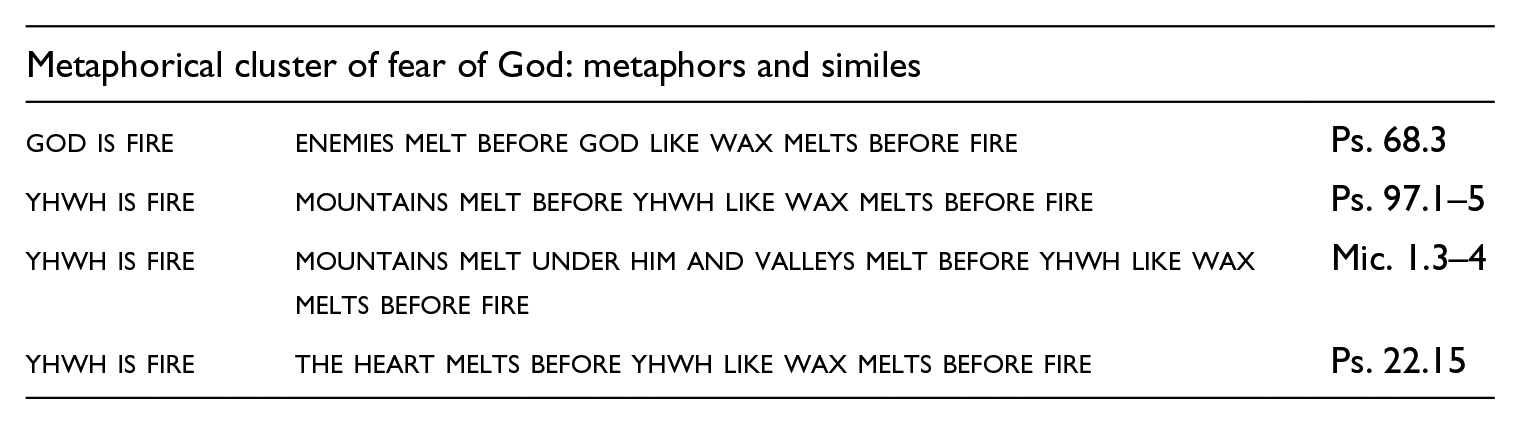
The fact that God will disperse his enemies and the nature of this dispersion is clarified by the simile of smoke that disperses. The nature of their perishing is expressed in the simile of the melting of wax by fire. A comparison of the two similes teaches us that in the smoke-simile, only the action of dispersion is mentioned, whereas in the wax-simile, both the action of melting (expressed by Niphal infinitive דונג כהמס) and the location ‘from before the fire (מפני־אש)’ is compared to the wicked’s perishing ‘from before God (מפני אלהים)’. Hence, in the latter simile, God and the fire are set on one line. The conceptual metaphor and simile presented in Ps. 68.3 are therefore
The next psalm, Psalm 97, opens with a picture of Psalm 97 (1a) (2a) Dense clouds are around him, (2b) righteousness and justice are the base of his throne (3a) Fire goes before him, (3b) burning his foes on every side (4a) His lightning light up the world, (4b) the earth saw and quaked (5a) Mountains melt like wax from before
Psalm 97 opens in v. 1 with an exclamation:
Mic. 1.2–4 present an even more severe portrait of Micah 1 (2a) Listen, all you peoples, (2b) give heed, O earth, and all it holds, (2c) Let my lord (3a) For (4a) The mountains shall melt under him (4b) and the valleys shall burst open like wax before fire, like water cascading down a slope.
The opening chapter of Micah starts in v. 2 with the metaphor
These occurrences of the lexical construction מסס + כדונג ‘melting like wax’ in Ps. 68.3, Ps. 97.5, and Mic. 1.4 show a similar train of thought. The melting act is expressed by the Niphal of מסס, the melting is associated with fire, and the fire is associated with the magnificent and frightening power of
6. Analysis of the usages of wax and of the metaphor ‘melted like wax’ in ancient Israel and the ancient Near East
The above-described conceptualization of the metaphor assumes that the metaphor as cross-domain mapping is an event that takes place in thought and emotion. Yet, there is more to it. In a world in which wax is unknown or in which mountains do not exist, a metaphor like this could not have originated or functioned. To figure in communication, to play a role in the exchange of notions and ideas, and to be used rhetorically require communication partners who are competent to interact with the proposed and presupposed lines of reasoning, persuasion, and emotion. This explains why two more aspects have to be explored, namely how was wax known and used in ancient Israel, and in which other texts or contexts reference is made to wax and wax melting in ancient Israel or in the ancient Near East.
6.1. Historical framework: wax usages in ancient Israel and the ancient Near East
The context for comparing and understanding the metaphor in Psalm 22 may best be explained by considering comparative examples in Egyptian wall paintings and ancient Near Eastern texts. These examples demonstrate that bees were kept for the large-scale production of wax and honey. However, actual evidence for beekeeping in ancient Israel had not been found before the recent discovery of what appears to be a well-organized apiary at Tel Rehov in the middle Jordan valley in northern Israel. 37 The apiary includes circa 30 hives (of 100–200 estimated) that were made as unfired clay cylinders. This apiary was located inside the town, dating to the 10th–early 9th centuries BCE. Because the Hebrew Bible does not mention beekeeping as an agricultural practice, and the term ‘honey’ commonly has been understood as sweet fruit secretion, 38 the ancient beehives found in Tel Rehov prove that ancient beekeeping was an important and well-developed practice in Israel during the 10th–9th centuries BCE. The location of such a large apiary within an urban area further suggests that the bees and the hive products were valuable and needed to be protected. The honey was a highly prized food ingredient. 39 The beeswax could have been used for a number of functions. The first function to consider is its application for candles. However, in ancient Israel and the ancient Near East, candles were unknown and only oil lamps were used for lighting. The second function frequently mentioned is that beeswax is used for writing tablets. It is indeed known from Assyrian and Babylonian texts that wax tablets were made and used, but no wax tablets have been found in Israel that date before the Hellenistic period. This may point at a later usage of wax for writing purposes or to the possibility that wax tablets were used, but have not survived through time. However, biblical texts never refer to wax as writing material. Another possible function, sometimes suggested, is that wax is used for imprints of seals. The common practice is, however, that seals were rolled on layers of clay; these imprints have been widely found, whereas imprints on wax have not been found. Still, two other options to consider are the function of wax in the so-called lost-wax technique of bronze melting and the reference to wax effigies in treaties. These two options will be briefly discussed.
Copper was mined in the east of the Arabah valley from the Late Bronze Age onwards, and the beeswax could have been used in the metal casting process. 40 The discovery in 1980 of the Nahal Mishmar hoard (10 km south of Ein Gedi) demonstrated that many artefacts made of copper or copper alloys showed skillful craftsmanship and technological sophistication and that these items must have been of local production. A distinction can be made between simple working tools (axes, adzes, awls, etc.), made of nearly pure copper by open casting, and elaborate items (maceheads, standards, crowns, etc.), made by the ‘lost-wax technique’ 41 in which the melting of wax is an essential element. Although many copper artefacts were used in the first millennium BCE and found in archaeological digs, it is questionable whether scribes, redactors, priests, court officials, and the like (in other words, those involved in producing biblical documents) had knowledge of this technique. Ethnographic data from metal-producing societies indicate that metallurgy was frequently practised by small groups of men in isolated locations. 42 Therefore, it seems unlikely that this technique was widely known.
6.2. Ancient Near Eastern texts referring to the melting of wax
The last option to consider are the Assyrian, Levantine, Hittite, and Greek treaty texts in which wax figurines are mentioned in pledges of loyalty to the suzerain. In an extensive study, 43 Christopher Faraone demonstrated how molten wax figures were used in the eastern Mediterranean basin in the first millennium BCE in three contexts, namely international treaties, special pledges of loyalty, and testamentary oaths sworn by individual litigants. Wax effigies appear in the context of oaths sworn over international treaties, in which the breaking of the pledge of loyalty is imagined by the destruction of the wax figures. References to these practices are found in many texts, of which the following are generally considered the most important:
The Sefire Inscriptions, Aramaic texts from the mid 8th-century BCE (found near Aleppo), are treaties between two minor kings, Barga’yah and Matti’el, living on the southwestern periphery of the Neo-Assyrian empire. The latter swears to the dire consequences which will befall him and his cities if he should violate the stipulations of the treaty: 44
As this wax is consumed by fire, thus Ma[tti’el] shall be consumed b[y fi]re. As this bow and these arrows are broken, thus Inurta and Hada (= names of local deities) shall break [the bow of Matti’el] and the bow of his nobles. As a man of wax is blinded, thus Matti’el shall be blinded. [As] this calf is cut up, thus Matti’el and his nobles shall be cut up.
The 8th- and 7th-century loyalty oaths imposed by Assyrian kings on other less powerful monarchs of the Levant. The so-called ‘vassal treaties’ of Esarhaddon (680–669 BCE) 45 close with a series of more than 70 curses, including one which specifies the destruction of wax and clay effigies (line 89): 46
Just as one burns a wax figure in fire, dissolves a clay one in water, so may they burn your figures in fire, submerge it in water.
Assyrian incantation series Maqlû, lit. ‘Burning [Rituals]’, offers abundant testimony for the rite of burning effigies of demons, ghosts, and living human enemies, for example, Maqlû 2.146–157: 47
Just as these figurines melt, run and flow away, so may sorcerer and sorceress melt, run and flow away.
Cyrenean Foundation Decree describes the oath of the 7th-century Theran colonists who founded the city of Cyrene in Libya:
They moulded wax images and burnt them while they uttered the following imprecation, all of them, having come together, men and women, boys and girls: ‘May he, who does not abide by this agreement but transgresses it, melt away and dissolve like the images, himself, his seed, and his property’.
48
The manipulation or destruction of wax in oath rituals is not limited to Assyria and the Levant. A Hittite military oath appears to enact a very similar series of destructive acts which will befall the soldier who breaks the pledge of loyalty to the Hittite king. Among them is the following: 49
Then he throws wax and mutton fat [on a pan] and says: ‘Just as this wax melts, and just as this mutton fat dissolves, whoever breaks these oaths, [shows disrespect to the king] of the Hatti [land], let him melt like[e wax], let him dissolve like [mutton fat]’.
This short survey of Levantine, Assyrian, Greek, and Hittite texts has clarified how wax figures are often mentioned in connection with loyalty oaths and sympathetic rituals and how the breaking of such loyalty bonds are represented by the destruction or melting of wax effigies. It is reasonable to take up the Aramaic and Neo-Assyrian documents (not the Hittite and Greek documents, due to distance from Israel in time and place) as reflections of covenantal practices and logics in ancient Israel and Judah. This is even more plausible, because it is well known that from the 8th century onwards, the Northern Kingdom of Israel was occupied by the Assyrians and that from the 7th century, Judah was forced to enter into an adê-treaty with the Assyrians. So, the Judean scribes would certainly have known about this type of covenant.
7. The metaphor ‘my heart is like wax melted inside me’ in Ps. 22.15
A discussion of the other attestations of מסס כדונג ‘melting like wax’ in Ps. 68.3, 97.5, and Mic. 1.4 demonstrated that they all figure in the framework of fear, or even angst, before the absolute king,
Various components confirm that it is a deliberately used metaphor, intentionally used to convey a certain meaning. In the context of the psalm, and in the immediately preceding verses (vv. 7–8 and 13–14) in which the human opponents scorn, menace, and frighten him to death, the psalmist is focused on the human foes, but by using this metaphor, the psalmist directs the addressee to change his or her focus from the human enemies to God: the psalmist’s human foes are not the biggest threat, rather
The study of the historical and communicative context taught us that wax was at the time available in ancient Israel and that in ancient Near Eastern covenantal texts, international treaties, and oaths of loyalty, wax effigies played an important role. A recurrent phrase in these texts is ‘As this wax is consumed by fire, thus [name of person under oath] shall be consumed by fire’, in which the wax effigy represents the partner in the covenant with the suzerain: when he breaks the covenant, he will melt before the fire like before the fire of the suzerain’s power. This may also explain the usage of the wax-simile in Ps. 22.15. In it, the breaking of the covenant or ‘de-covenantilisation’ is also represented by the melting of wax.
Because ‘My heart is like wax melted inside me’ is such an unusual simile plus metaphor, and unique to the Hebrew Bible, we can assume it is intentionally used. By using the term ‘heart’, the speaker depicts the relation that pertains to his being as a partner in the covenant and the outside world. It is very similar to the role of the wax effigies in the treaty texts or loyalty oaths: there, the effigies represented the covenant party, whereas here the heart represents the covenant party over and against the more powerful partner. Thus, the psalmist claims that he can stand up against enemy forces that would determine his actions, but that he cannot do so without the help of his suzerain. He offers a plea to
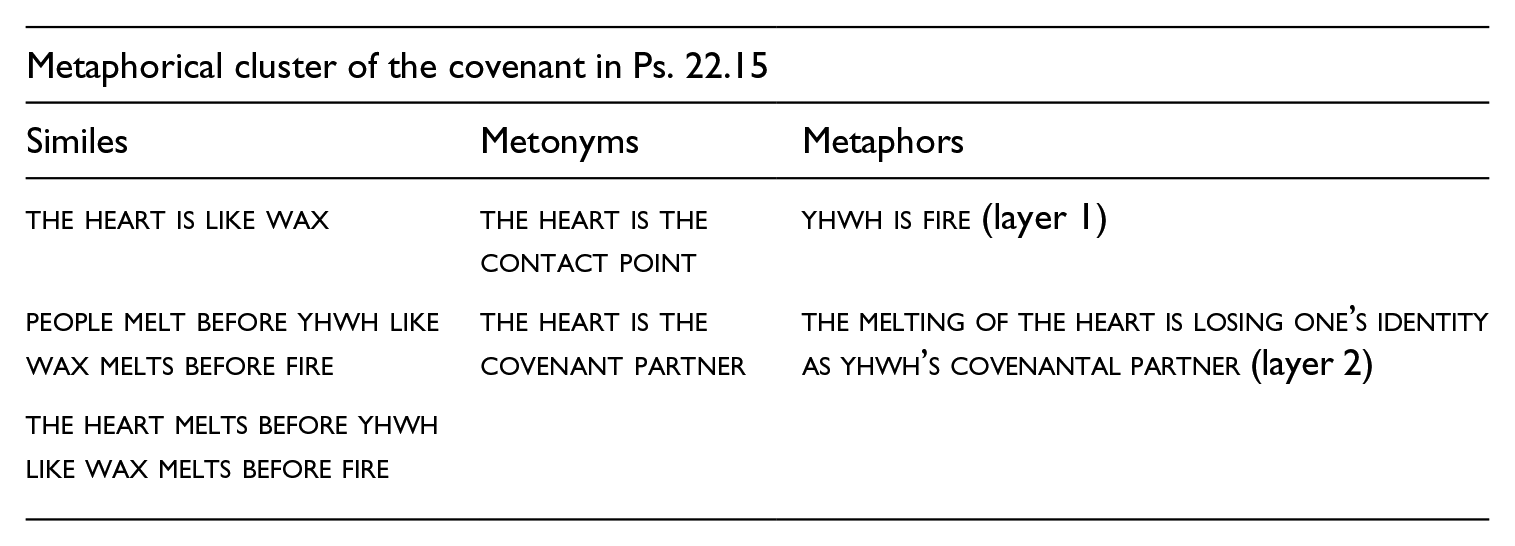
In the discourse event of Psalm 22, that is, in the entire poem, the lexeme לב/לבב is used twice: in the middle of the psalm in v. 15 in reference to the individual heart and at the end of the psalm in v. 27 in reference to the community members’ heart (לבבכם). In v. 27, the ‘heart’ is included in a compound sentence: ‘Let those who seek yhwh praise him and your hearts will live forever’ (יחי לבבכם לעד). In this case, the heart is not used in a metaphorical construction, but is a metonym. It stands for the descendants of Jacob, representing a pars-pro-toto metonym. In contrast to v. 15, the metonym of the heart in v. 27 does not figure in a metaphorical cluster, but expresses the following contents:
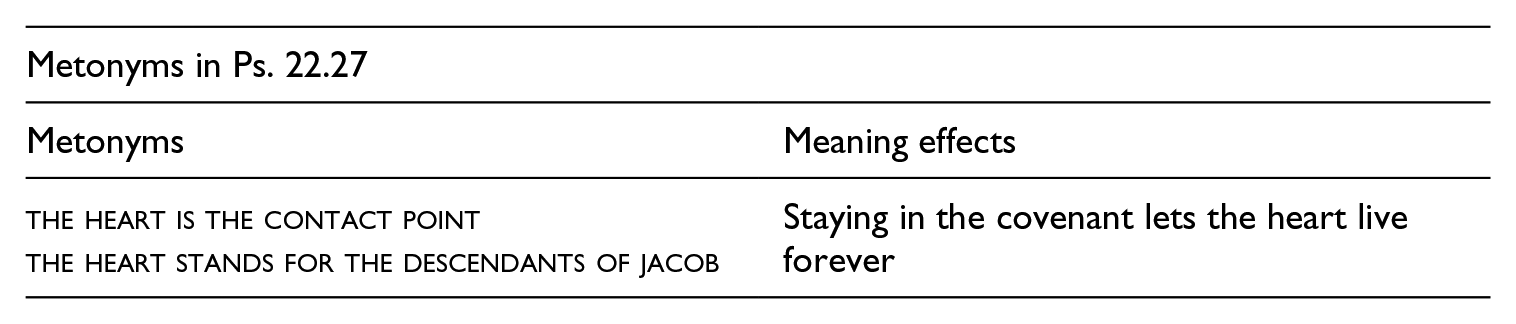
The shift from the melting of the individual heart (לבי) in v. 15 to the eternal living of the community members’ heart (לבבכם) in v. 27 marks the reversal of the condition of the desperate speaker who is afraid to lose contact with
8. Conclusion
The study of various metaphorical clusters in Psalm 22 allows us to discuss the different types of metaphors and their distinct communicative functions. The first metaphorical cluster of ‘humans and animals’ is built on the metaphor
The second metaphorical cluster of ‘human body parts and non-animate entities’ is a prime example of how layers of similes and metaphors build upon each other to form a complex network of metaphors, in which the whole is more than the sum of its parts. The starting points are the similes in vv. 15–16 ‘like water’, ‘like wax’, and ‘like a pot’, which are the linguistic signals for readers to shift from source domain to target domain: the fluids are mapped onto the solid body parts, and the inflexibility of a pot is mapped onto the body as a whole. Both opposing movements, from solid to liquid and from dynamic to inflexible, express the same conceptual idea, namely devastation and loss. The content of these emotions are further expanded through conventional conceptual metaphors, such as
The third metaphorical cluster of ‘the fear of God in combination with the melting of wax’ is linguistically signalled by the word combination מסס כדונג ‘melting like wax’. This collocation occurs in Ps. 22.15, 68.3, 97.5, and in Mic. 1.4, where it marks the introduction of the new source domain ‘fire’ and its link to the deity. It is based on the conceptual metaphor
Taken together, the conventional, conceptual, and innovative metaphors in vv. 15–16 that relate the human body to inanimate entities represent the end of a metaphorical trajectory along which the speaker’s misery is imagined. In addition, the reader is invited to align his own feelings along the same trajectory. It starts in v. 15 with the pouring out of the body’s liquid material and the disjunction of the bones, via the melting of the heart like wax and the drying up of the strength till, in the end, nothing remains but ashes. Again in v. 16b, it is
After this section, comes the last part of the psalm (vv. 23–32) with a public declaration of praise and thanksgiving, both by the speaker and the descendants of Jacob who testify to their loyalty to
Footnotes
1.
See G. Steen, “Deliberate Metaphor Theory: Basic assumptions, main tenets, urgent issues”, in: Intercultural Pragmatics 14 (2017) 1-24.
2.
G. Steen, The paradox of metaphor: Why we need a three-dimensional model of metaphor. In: Metaphor & Symbol 23 (2008) 213–41; G. Steen, A.G. Dorst, J.B. Herrmann, A. Kaal, T. Krennmayer and T. Pasma, A method for linguistic metaphor identification: From MIP to MIPVU. Amsterdam: John Benjamins 2010; G. Steen, From three dimensions to five steps: The value of deliberate metaphor. In: Metaphorik.de 21 (2011) 83–110; G. Steen, Developing, testing and interpreting Deliberate Metaphor Theory. In: Journal of Pragmatics 90 (2015) 67–72; N. Stukker, W. Spooren and G. Steen (eds.), Genre in discourse and cognition: Concepts, models, methods. Berlin: Mouton de Gruyter 2016; G. Steen, Deliberate Metaphor Theory: Basic assumptions, main tenets, urgent issues. In: Intercultural Pragmatics 14 (2017) 1–24.
3.
H. van Loon, Metaphors in the Discussion on Suffering in Job 3–31. Visions of Hope and Consolation (Biblical Interpretation Series, 165). Leiden: Brill, 2018.
4.
Steen (2017: 4).
5.
Steen (2011: 37). Steen (2017:6) criticizes his previous position in which he used the term consciousness as a synonym of deliberate. He explains why deliberate metaphor is not the same as conscious metaphor: “Consciousness is knowing that you are aware, while awareness itself is the content of what is in people’s window of attention. . . . One problem is that consciousness and awareness or attention are often conflated, both in metaphor studies (like the first version of DMT in Steen 2008, 2011) as well as in discourse studies... .”
6.
Steen (2011, 2017) proposes a five-step framework based on various linguistic schools and developments, which is, in my view, too linguistically (and insufficiently literary) oriented in scope for biblical studies. These steps identify: 1. words in a surface text; 2. concepts in a text base; 3. identification of open comparison; 4. referents in a situation model; 5. topics and perspectives in a context model.
7.
Cf. A. Weiss (2006: 33), Figurative Language in Biblical Prose Narrative: Metaphor in the Book of Samuel. Leiden, Boston: Brill.
8.
Example and explanation are from H. van Loon, Metaphors in the Discussion on Suffering in Job 3–31, p. 70.
9.
See E.M. Menn, “No Ordinary Lament: Relecture and Identity of the Distressed in Psalm 22”, Harvard Theological Review 93.4 (2000) 301–41, for an extensive analysis of the Psalm 22 in his Jewish and Christian reception history.
10.
J.S. Kselman, “‘Why Have You Abandoned Me’: A Rhetorical Study of Psalm 22,” in Art and Meaning (eds. D. Clines, D.M. Gunn, and A.J. Hauser), Sheffield: JSOT, 1982, pp. 172-198. D. Charney, “Maintaining Innocence Before a Divine Hearer: Deliberative Rhetoric in Psalm 22, Psalm 17 and Psalm 7,” Biblical Interpretation 21.1 (2013) 33–63.
11.
See Charney, “Maintaining Innocence,” 47.
12.
Ibid., 47.
13.
Ibid., 50.
14.
Ibid., 44.
15.
Numbers based on DCH. In addition, the noun תולע (without final he) occurs a further three times in the Hebrew Bible. When denoting “crimson” it is very often used in the fixed word combination תולעת שני or שני תולעת, “crimson of crimson”, that is, coloured with dye of Coccus ilicis (see DCH VIII, 606, also for its occurrences).
16.
Isa 41.14: “Fear not, O worm Jacob, omen of Israel, I will help you” and Job 25.6: “How much less man, a worm, the son of man, a maggot” (NJPS translations).
17.
Göran Eidevall lists the most significant connotations attached to the word תולעת “worm” as: 1. being small (on a size scale) and insignificant (on a value scale); 2. being weak and defenceless (placed at the bottom of the food chain); 3. being associated with the earth and the netherworld, with impurity and death. See: G. Eidevall (2005: 55–65, here 58), “Images of God, Self, and the Enemy in the Psalms”, in: P. Van Hecke (ed.), Metaphor in the Hebrew Bible. BETL CLXXXVII, Leuven: Peeters). I see no indication in the biblical texts of the second meaning of “being weak or defenseless” nor of its smallness (listed as no 1). The denotation Eidevall lists as 3 is predominant in the Hebrew Bible.
18.
Numbers and data based on DCH.
19.
In Isa 34:7, Jer 50:27, and Ezek 39:18
20.
In the last three decades a great number of studies on the Niphal have been published and at present a kind of consensus has been reached that the Niphal is considered not to express the reflexive voice, but the middle voice and medio-passive voice. See: Steven W. Boyd (1993). A Synchronic Analysis of the Medio-Passive-Reflexive in Biblical Hebrew (Ph.D. diss.). HUC, Cincinnati; Edit Doron (2003). “Agency and Voice: The Semantics of the Semitic templates.” Natural Language Semantics 11: 1–67; Holger Gzella (2009). “Voice in Classical Hebrew Against its Semitic Background.” Orientalia 78.3: 292-325; Ernst Jenni (2012). ‘Nifal und Hitpael im Biblisch-Hebräischen’ in E. Jenni, Studien zur Sprachwelt des Alten Testaments III. Stuttgart: Kohlhammer, 131-303.; Artemis Alexiadou, and Edit Doron (2012). “The Syntactic Construction of Two Non-Active Voices: Passive and Middle.” Journal of Linguistics 48: 1–34; Ellen van Wolde (2019). “The Niphal as Middle Voice and its Consequence for Meaning.” Journal for the Study of the Old Testament 43.3 (2019) 453-478.
21.
See van Wolde, “The Niphal” for an extensive discussion.
22.
Yet, the verb היה is not without verbal force, see Gesenius-Kautzsch-Cowley, § 141i.
23.
Examples of the former are Ps 102.12 “I wither like grass” and Lam 4.8 “their skin has shriveled on their bones; it has become dry as wood”. Examples of the latter are Gen 8.7 (Noah sent out the raven) “it went to and fro until the waters had dried up from the earth” and Jer 51.36 “I will dry up the sea and make her fountain run dry.” An example of another figurative use is Num 11.6 “our gullet (נפשנו) is dried out.”
24.
The noun חרש occurs 17 times in the Hebrew Bible: 7 times it is used in collocation with כלי (כלי־חרש) “vessel of earthenware,” and in these cases it denotes an earthen vessel in which one puts food, water, blood, wine or a document for safe keeping etc. Without כלי it is used 10 times: it is made of soil (Isa 45.9), covered with silver work (Prov 26.23), smashed (Isa 30.13–14; Jer 19.1), drained to the bottom (Ezek 23.34). Twice it is used in similes: the children of Zion are compared to precious pots (Lam 4.2) and the ground under Leviathan is compared to pots or earthenware (Job 41.22).
25.
Three times the verb is used without a preposition of place, although it is assumed that “on the fire” is implied (cf. in English “to put the kettle on”), see: 2 Kg 4.38 and Ezek 24.3 “set a pot [on the fire]”. In Isa 26.12 “
26.
This section on the heart is based on the present author’s study “A Prayer for Purification Psalm 51.12-14: A pure heart and the verb ברא,” Vetus Testamentum 70 (2020) 340-360
27.
On לב, see: W.H. Schmidt, Anthropologische Begriffe im Alten Testament. Anmerkungen zum hebräischen Denken (EvTh 24 (1964) 374-388); H.W. Wolff, Anthropologie des Alten Testaments (Gütersloh: Gütersloher Verlagshaus 19731, 20027), English translation: Anthropology of the Old Testament, Philadelphia: Fortress; F. Stolz, לב, THAT I (19752) 861-867; R. Lauha, Psychophysischer Sprachgebrauch im Alten Testament: Eine struktur-semantische Analyse von “lev”, “nefesh” und “ruah” (Annales Academiae Scientiarum Fennicae, Dissertationes Humanarum Litterarum 35;, Helsinki 1983); H.-J. Fabry, לב, ThWAT 4 (1984) 413-451 (English translation TDOT vol.7, 399-437); B. Janowski, “Mensch” in RGG4 Bd.V (2002) 1057-58; S. Schroer & T. Staubli, Die Körpersymbolik der Bibel (Gütersloh: Gütersloher Verlagshaus 20052); T. Krüger, “Das “Herz” in der alttestamentlichen Anthropologie” in A. Wagner (hrsg.), Anthropologische Aufbrüche. Alttestamentliche und interdisziplinäre Zugänge zur historischen Anthropologie (Göttingen: Vandenhoeck & Ruprecht 2009), 103-118. On רוח see: M. Dreytza, Der theologische Gebrauch von Ruah im Alten Testament. Eine wort- und satz-semantische Studie (Monographien und Studienbücher 358), Giessen/Basel: Brunnen 19901, 19922, 38; H. Schlüngel-Straumann, Ruah bewegt die Welt, Stuttgart 1992; A. Krüger, Das Lob des Schöpfers. Studien zu Sprache, Motivik und Theologie von Psalm 104 (WMANT 124), Neukirchen: Neukirchener Verlag, 2010.
28.
Wolff, Anthropologie, 29; Lauha, Psychophysischer, 148; Dreytza, Der theologische Gebrauch, 148.
29.
See, among others, J. Barr, The Semantics of Biblical Language (Oxford: OUP 1961), and A. Wagner, “Wider die Reduktion des Lebendigen. Über das Verhältnis der sog. anthropologischen Grundbegriffe und die Unmöglichkeit, mit ihnen die alttestamentliche Menschenvorstellung zu fassen”, in A. Wagner (hrsg.), Anthropologische Aufbrüche. Alttestamentliche und interdisziplinäre Zugänge zur historischen Anthropologie, (Göttingen: Vandenhoeck & Ruprecht 2009), 183-201.
30.
J. Dietrich, “Individualität im Alten Testament, Alten Ägypten und Alten Orient”, in A. Berlejung, J. Dietrich, J.F. Quack (eds.), Menschenbilder und Korperkonzepte im Alten Israel, in Ägypten und im Alten Orient (Orientalische Religionen in der Antike 9, Tübingen: Mohr-Siebeck 2012), 77-96; D. Lambert, “Refreshing Philology: James Barr, Supersessionism, and the State of Biblical Words”, Biblical Interpretation 24 (2016) 332-356; E. Greenstein, “The Heart as an Organ of Speech in Biblical Hebrew”, paper presented at the SBL-meeting, Boston 2017; to be published as “The Heart as an Organ of Speech in Biblical Hebrew” in Festschrift R.C. Steiner (ed. A. Koller), Yeshiva Univ. Press, Jerusalem, forthcoming.
31.
Dietrich, Individualität, 83: “Das Herz des Menschen ist hier im Wesentlichen nicht innen-, sondern außengeleitet. (. . .) Allerdings verhält es sich keineswegs so, dass das Herz im Alten Testament den Bereich der Innerlichkeit vollständig ausschließen würde.”
32.
Dietrich, Individualität, 84: “Der entscheidende Unterschied zur Moderne besteht darin, dass dieses “innerlichte Herz” keineswegs positiv gesehen, sondern in einen negativ konnotierten Gegensatz zum außengeleiteten Herzen gesetzt wird. Das außengeleitete Herz ist das gute und soziale, das innengeleitete das egoistische, das Täuschung, Treubruch und Heuchelei ersinnt.”
33.
Lambert, “Refreshing”, 348.
34.
Ibid., 346.
35.
Greenstein, “The Heart as an Organ of Speech”: ‘When the prophet describes the “heart” within a rib-cage (Hos 13.8) and a maiden asks to be placed over her beloved’s “heart” or bosom like a carved seal (Song 8.6), when the arrow shot by Jehu entered Jehoram in the back and protruded through the heart, in the chest (2 Kings 9.24), when the priest wears the breastplate over his heart, located in the thorax (Exod 28.29–30), when Jeremiah feels a throbbing (המה) within the “walls of my heart” (Jer 4.19), the heart clearly is a very particular organ within the chest cavity.’
36.
Cf. Dietrich, “Individualität,” 87.
37.

38.
Judg. 14.8–9, 18 and 1 Sam 14.25–27, 29, 43 refer to the honey of bees using the word דבש; they do not mention beeswax.
39.
M. Serpico: “Natural Product Technology in New Kingdom Egypt”, in: J. Bourriau and J.Phillips (eds.), Invention and Innovation. The Social Context of Technological Change 2: Egypt, the Aegean and the Near East, 1650-1150 BC, Oxford: Oxbow Books, 2004: 96–120, 103: “Honey was extracted by placing combs into bags, crushing them and then letting the honey run out. The drained combs can then be melted to produce the wax. This can be done over a direct heat, but is better done in water where the wax can be skimmed off as it hardens.”
40.
See, e.g., the reference in 1 Kings 7.46 to the bronze production that took place in the Jordan valley and is mentioned in relation to bronze vessels in Solomon’s temple in Jerusalem.
41.
In the traditional process of the lost-wax technique, a figure is first roughly modeled in clay. Next a model of the planned metal artifact is formed using beeswax mixed with tree resin over the core. Then a mold is created over the wax model by various layers of finer clay. When it has dried, the mold is heated until the wax melts and can be poured out. The molten metal is then poured into the mold using a crucible. When the latter mold is carefully chiseled off, it reproduces each detail of the original wax. See: Y. Goren, “Gods, Caves, and Scholars. Chalcolithic Cult and Metallurgy in the Judean Desert,” Near Eastern Archaeology 77.4 (2014): 260–66.
42.
Goren, “Gods, Caves”, 264.
43.
C.A. Faraone, “Molten Wax, Spilt Wine and Mutilated Animals: Sympathetic Magic in Near Eastern and Early Greek Oath Ceremonies”, Journal of Hellenic Studies 113 (1993): 60–80. The information in this section is, unless stated otherwise, based on this study.
44.
The translation is by F. Rosenthal, ANET, pp. 659–60. For dating, detailed discussion and bibliography, see: J.A. Fitzmyer, The Aramaic Inscriptions of Sefire (Biblica et Orientalia xix Rome 1967, reprint 1988) 52–58; A. Lemaire & J.-M. Durand, Les inscriptions araméennes de Sfiré et l’Assyrie de Shamshi-ilu (Geneva 1984), and S. Parpola & K. Watanabe, State archives of Assyria ii: Neo-Assyrian Treaties and Loyalty Oaths (Helsinki 1988) xxvii–xxviii.
45.
At present discussion continues regarding whether adê or Assyrian treaty texts are vassal treaties or parity treaties. In the former, the documents are loyalty oaths, whereas the latter (the proper vassal treaties) would contain explicit demands for full devotion and loyalty to a named suzerain, followed by a set of provisions and demands. See for a discussion: A. Altman, “What Kind of Treaty Tradition Do the Sefire Inscriptions Represent?”, in M. Cogan & D. Kahn (eds.), Treasures on Camels’ Humps. Historical and Literary Studies from the Ancient Near East Presented to Israel Eph‘al, The Hebrew University Magnes Press, Jerusalem, 2008, 26–40.
46.
Lemaire & J.-M. Durand and S.Parpola & K. Watanabe argue plausibly that the Aramaic treaty is in fact a copy of an extant Akkadian treaty between the same Matti’el (Mati’ilu in Akkadian) and the Assyrian king Assumerari V.
47.
For an edition of Maqlû, see G. Meier, Die assyrische Beschwörungssammlung Maqlû, Archiv für Orientforschung Beiheft ii, Berlin, 1937.
48.
The translation is by C.A. Faraone, “Molten Wax”, 61.
49.
Kbo VI 34.40-rev.5. It is a ‘New Script’ copy (1350-1200 BCE) of a Middle Hittite (1450-1350 BCE) text. Translation by A. Goetze, ANET, 353.
50.
Among others, in Exod 19; Deut 33.2–3; Judg 5.4–5; Ps 18.8–16; 77.16–19; Nah 1.2–5; Hab 3.3–4.