




Abstract
The central thesis of this article is that improved knowledge of the Niphal can offer us arguments in favour of (or against) certain meanings of verbs in biblical texts. Proceeding from general linguistic studies of middle voice to Biblical Hebrew linguistics, the differences between the active, reflexive, middle and passive voices are clarified. Subsequently, it is shown that the Niphal expresses neither the reflexive nor passive voice, but predominantly marks the middle voice. The Niphal describes an event in which the subject is concerned with itself, though not reflexively as a differentiated object, but as an undifferentiated middle, while reference to an external Agent is absent. These insights are applied to various texts and verbs in the Hebrew Bible, namely, 3 Niphals of the verb גמל (‘wean’), 7 Niphals (feminine singular) of the verb טמא (‘defile’), and 16 usages of אסף Niphal in contexts of dying.
1. Introduction
Why explore the Niphal in Biblical Hebrew? First of all, because I think grammar helps us to improve our understanding of verbal meanings and constructions. So with a better grasp of the Niphal, I hope to develop a better understanding of the conceptual meaning of Niphal verbal usages in the Hebrew Bible, and to ground word meanings on firm grammatical foundations. Second, although in classical grammars of Biblical Hebrew the Niphal is understood as expressing a reflexive and/or a passive voice (a view that is still accepted as the ‘standard-view’ because of the inclusion of the classical grammars in Bible software such as Bible Works, Accordance, or Logos), recent studies opt for a middle voice, in which a Niphal verb is considered to express a medio or medio-passive meaning. 1 In the last decade, some general linguistic studies have focused on Hebrew and Greek and improved our understanding of the middle voice and the passive voice. All these explorations allow us to better grasp what a middle voice is exactly and how it is possible to pin down the differences among reflexive, middle and passive voice.
For clarity’s sake, I will start with a preliminary characterisation of the middle voice. The middle voice is the verbal voice that expresses that the subject is affected by an action or state. Some examples of constructions that have been considered to the exemplify the middle voice are in Classical Greek ‘boúlo-mai’ (English ‘I wish’), in French ‘le ciel se fait sombre’ (English ‘the sky is becoming overcast’), in Russian ‘On utomil-sja’ (English ‘He grew weary’), in Latin ‘perluo-r’ (English ‘bathe’), and Turkish ‘giy-in’ (English ‘dress’). In contrast to English, these languages have a middle voice marker (visible in the morphemes in italics), whereas English does not mark middle voice morphologically and uses active voice morphology instead. It is well known that Biblical Hebrew and Modern Hebrew have middle voice markers, and the questions then arise: how can we understand the meaning of Hebrew verbs with a middle voice marker and translate them into languages that do not have middle voice morphology such as English or German and how can we discern the semantic categories they express?
First, I will further explain the middle voice and its difference from the reflexive voice (section 2) and passive voice (section 3), and then I will discuss the Niphal in Biblical Hebrew as presented in recent studies (section 4). In section 5, I will incorporate these insights into a comprehensive model of the Niphal in Biblical Hebrew. What are the consequences of these theoretical insights for exegetical praxis? That will be the topic of sections 6–8 in which attention will be paid to usages of Niphal verbs in various biblical contexts. Section 6 treats the notion of weaning expressed by the Niphal of the verb גמל. Section 7 discusses what the Niphal of the verb טמא in Num. 5 tells us about the notion of defiling with respect to the woman accused of adultery. Section 8 offers an extensive exploration of all Niphal singular occurrences of the verb אסף in the context of dying. Thus, I intend to demonstrate that an improved knowledge of the Niphal can offer us arguments to support our understanding of verbal meanings in biblical texts.
2. Middle voice and reflexive voice
In 1993, Suzanne Kemmer published her book The Middle Voice, which became the decisive typological study of the middle voice. 2 In this work, she analysed the reflexive and middle voice usages in 30 languages from all over the world; unfortunately, she did not include any Semitic languages. The bottom line of her approach is that clausal events should be analysed in terms of participants (the referential entities involved in the event) and relations (the relationships linking the participants in a given event), in which the term ‘event’ serves as a cover term for actions, processes, and states.
Central in Kemmer’s analysis is the notion of transitivity. Transitivity is a property of verbs and of clauses. Kemmer defines transitive verbs as verbs that involve two participants: the Agent or Initiator/Instigator who acts volitionally on another participant, and the Patient/Endpoint which is directly and completely affected by that event. In contrast, intransitive verbs involve only one participant. Many languages also know a middle voice of transitive verbs that involves one participant standing in an Initiator/Endpoint relation to itself. The main function of the middle voice of verbs is to code the affectedness of an initiating Agent. Passive forms of transitive verbs imply reference to an external Agent. This referent is conceptually present, but pragmatically de-emphasised. The main function of a passive construction is to ‘defocus’ the Agent. In the middle type, the dual roles Agent and Patient are conflated in a single participant, whereas in the active and passive type, the dual roles Agent and Patient are maintained.
Transitivity in a clause regards the profiled relationship expressed by the verb and the participants. To understand transitivity in a clause, three dimensions are to be distinguished: the syntactic, the semantic, and the discursive dimensions. (1) Syntactically, transitivity in a clause primarily indicates the asymmetry of the relation between the participants and the maximal distinctiveness between the participants, notably subject and object. In other words, in a transitive clause, a situation is viewed and expressed in such a way that one participant (the subject) is conceived as the entity that is acting on or with regard to another participant which in its turn is conceived as the object. (2) Semantically, transitivity is related to the semantic roles of the participants. Chief among these roles are Agent, Experiencer, Patient, Recipient, Beneficiary, Stimulus, Mental Source, Mover, Locative Goal, Location, Possessor, Force, and Instrument. An Agent is an individual who wilfully initiates and carries out an action, typically a physical action affecting other entities. 3 Diametrically opposed to an Agent is a Patient, narrowly defined as something that undergoes an internal change of state. Typically inanimate and non-volitional, a Patient usually changes as the result of being affected by outside forces. The semantic role of Experiencer alludes to mental experience, whatever its nature: cognitive, perceptual, or emotive. The semantic role of Mover is defined straightforwardly as anything (animate or inanimate) that moves, that is, it changes position in relation to its external surroundings. These and other semantic roles are mapped onto grammatical roles (mainly subject and object). 4 In the prototypical transitive clause, the subject receives the semantic role ‘Agent’ and the object receives the semantic role ‘Patient’, in which Agents are defined as the volitional instigators and Patients as the affected participants. (3) The discursive dimension regards the way that the participants and their profiled relationship in a clause function in the discourse situation or context of the clause. Prototypically, in passive clauses, reference is made to an external Agent.
This exploration of transitivity allows Kemmer to describe the middle voice as located on a gradient scale between two extremes, namely, the two-participant events (characterised by high distinguishability of the participants) and one-participant events (characterised by low distinguishability and usually expressed by an intransitive verb or by a nominal predication). The middle voice construction then is characterised by middle position and the relatively low distinguishability of participants. This is visualised in Figure 1, which displays the Scale of degree of distinguishability of participants: 5
Examples are given in (1): (1) a. ‘He opened the door’, ‘He wrote the letter’ (transitive active) b. ‘I saw myself’, ‘He washed himself’, ‘They blamed themselves’ (transitive reflexive) c. ‘She dressed’, ‘They united against the enemy’ (transitive middle) d. ‘The door opened easily’, ‘The lesson ended early’ (intransitive middle) e. ‘He is good-looking’, ‘They are lacking energy’ (intransitive) f. ‘The door was opened (by …)’, ‘The letter was written (by …)’ (transitive passive)
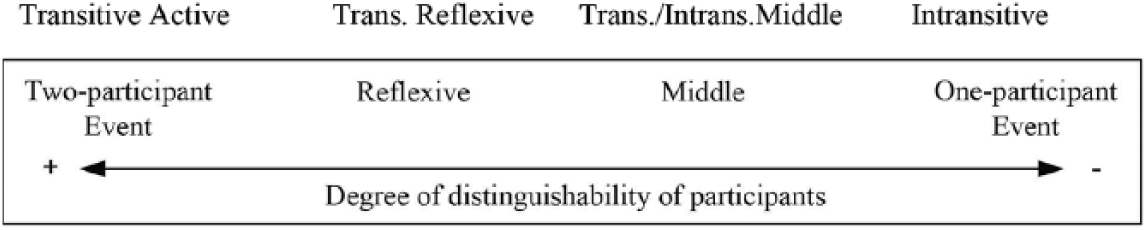
The two-participant event or transitive clause is located at one extreme of the scale. In such an event, the participants are maximally distinguishable in that the two participants, the Agent and the Patient, are completely separate entities. In the reflexive event, the distinguishability is lower, but the separation of the two participants is to some extent maintained. Prototypically, one participant is a human Agent or Experiencer and the other a Patient, while the two participants refer to the same entity (in 1(b) ‘I’ and ‘myself’, ‘he’ and ‘himself’, and ‘they’ and ‘themselves’). The essence of a reflexive is co-reference, 6 but at the same time the reflexive marker has the function of designating events in which the Agent and Patient participants are to some extent distinct. In the middle type, the dual roles, Agent and Patient, are conflated into a single participant: the middle marker indicates that the two semantic roles of Agent and Patient refer to a single holistic entity or a single configuration. This middle configuration does not consist of conceptually separable entities that have a semantic content in their own right. Figure 2(a) and (b) represents graphically the difference between the (direct) reflexive type and the (body action) middle type. In Figures 2 to 4, the Agent participant is labelled A and the Patient B. 7
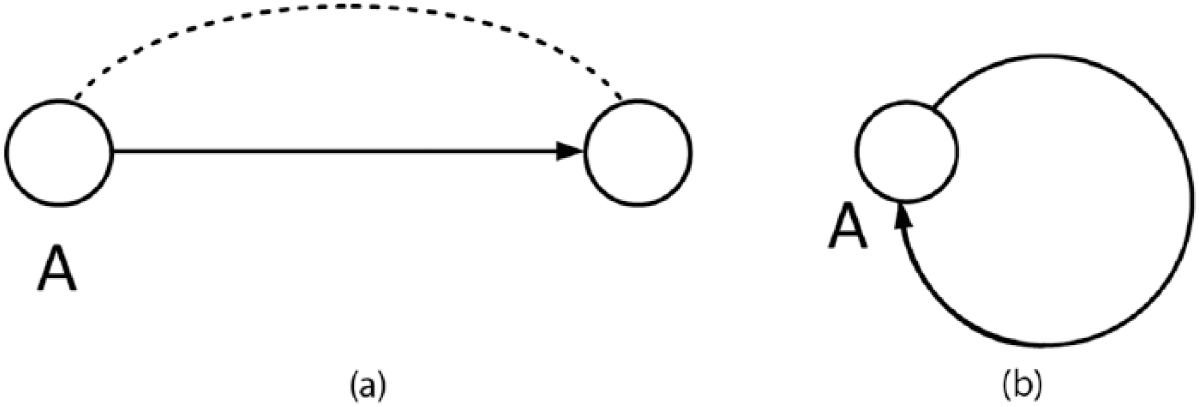
(a) Direct reflexive and (b) body action middle.
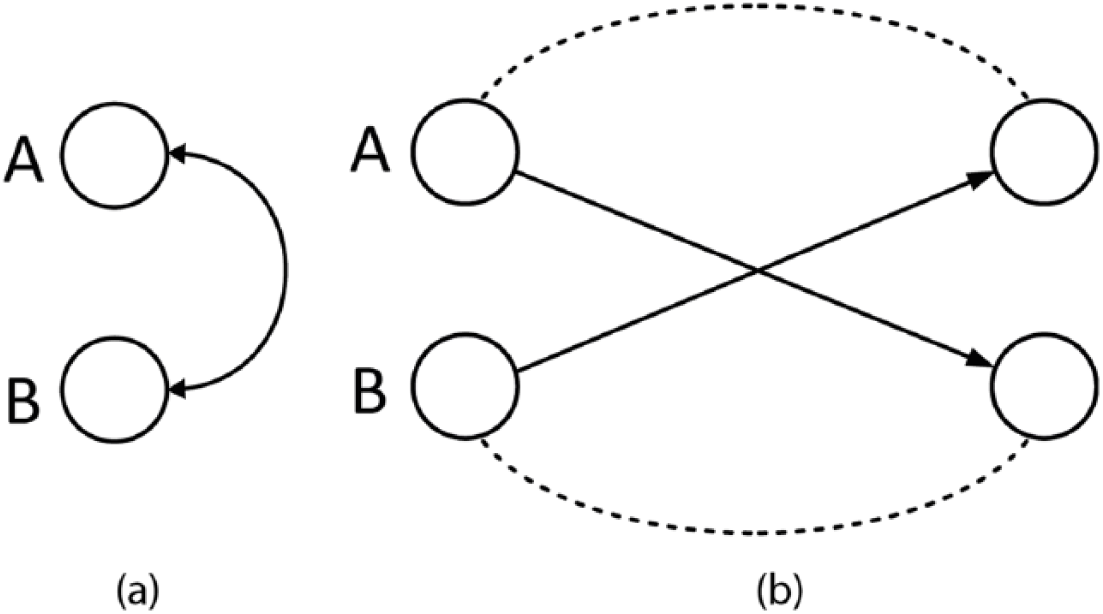
(a) Naturally reciprocal and (b) reciprocal proper.
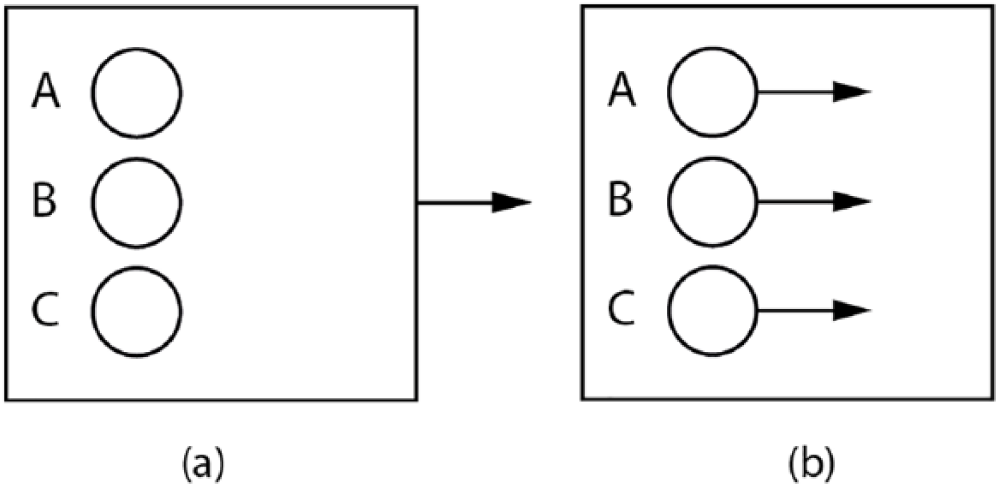
(a) Naturally collective motions and (b) collective motions proper.
It is the relative participant distinguishability that constitutes the semantic parameter which distinguishes a reflexive voice from a middle voice. The middle voice marks the single configuration of both participants, whereas the reflexive maintains the distinction between the participants. This single configuration expressed by the middle voice verb varies in distinct situations.
The first situation most often expressed by middle voice verbs is the body action domain, which comprises the type of situations in which a human being carries out an action on or through his or her own body (see Figure 2(b)). Body action middles are (1) verbs of non-translational motion (e.g. ‘bowing’, ‘turning’, ‘stretching’, ‘leaning’), which denote change in configuration of the body or a part of the body; (2) verbs of change in body posture (e.g. ‘sit down’, ‘stand up’, ‘lie down’, ‘kneel’), which make reference to the configuration of the body, but in addition require a change in position of the body with respect to a location; (3) verbs of translational motion (‘move’, ‘walk away’, ‘carry oneself’), which mark the movement of the self from one location to another along a path; (4) grooming verbs (‘shave’, ‘scratch’, ‘dress’), which designate body care. All these body action middles designate actions carried out on the body and through the body, in which the configuration is conceived as a whole. For this reason, these actions are different from reflexives of transitive events like ‘hit myself’ or ‘see myself’, in which the object is not really taking part in the action.
A second group of situations often expressed by a middle voice verb are mental events, which involve affectedness of a mental rather than a physical entity. The entity is both Initiator and Endpoint in that the mental event originates within the mind of the Experiencer, and an Endpoint in that the Experiencer is affected mentally. Thus, conceptual separation between Initiating and Endpoint entities in mental events is non-existent. This is in contrast to reflexive events in which the two positions are conceptually distinct. Mental events can be divided into three main types: events of emotion, cognition, and perception. In some languages, emotion events are expressed by transitive clauses (‘John feared the gorilla’), in other languages with a middle system the middle marker is used to show the affectedness of the Experiencer (Latin illacrimo-r ‘weep over’). Verbs denoting cognition events are expressed in languages that lack a middle morphology such as English by active intransitives (‘think’), but in languages with middle morphology a number of cognition verbs appear with middle marking. In Latin, for example, the verb cogitō, ‘think, cogitate’ describes an active volitional process, while medito-r, ‘think, meditate’ suggests that the Experiencer is more subject to the process of thought than actively pursuing them. Because perception is a type of mental event which involves the least degree of affectedness of the Experiencer (simply perceiving an object has a relatively small effect on the perceiver, as compared with thinking or being affected by emotions aroused by it), the middle marking is less likely to appear on perception verbs.
A third type of middle situation is expressed by reciprocal and collective motion verbs. In both middle situations, more than one participant is carrying out the action and each plays two roles (Agent and Experiencer) in the event. But whereas the prototypical reciprocal event is associated with two participants, the collective motion event is associated with multiple participants. 8 Reciprocal middles fall into a number of semantic classes, including antagonistic actions (‘fight’, ‘quarrel’, ‘wrestle’), affectionate actions (‘kiss’, ‘embrace’, ‘make love’), encountering and associate social actions (‘meet’, ‘greet’), and physical convergence or proximity (‘touch’, ‘join’), and verbs of exchanging (‘trade’), sharing (‘share’), agreement/disagreement, and similarity/dissimilarity. Kemmer makes a distinction between two types of reciprocal situations. 9 Naturally reciprocal events constitute a single configuration in which the participants are hard to distinguish (e.g. ‘they kissed’, ‘they fought’, ‘they met’), which are represented by Figure 3(a). Prototypical reciprocal or ‘reciprocal proper’ events have two participants and two relations, in which each participant serves in the role of Initiator in one of those relations and in the role of Endpoint in the other (e.g. ‘they saw each other’). The reciprocal proper is represented by Figure 3(b).
Two examples to clarify the distinction: (2) a. John and Mary kissed. / John and Mary argued all night. b. John and Mary hit each other. / John and Mary saw each other.
In the case of (2)a, with two examples of a naturally reciprocal event, there is almost certainly only one kiss involved, while the kissing actions of the two participants are simultaneous and virtually indistinguishable. Also in the arguing event, the two operate as one configuration, and the event is viewed as a single argument. In the case of (2)b, two examples of the proper reciprocal or prototypical reciprocal event are given in which the two participants remain distinguishable; the two participants might be hitting or seeing each other sequentially. What these examples show is that naturally reciprocal events are, in the unmarked case, simultaneous, and are characterised by a low degree of distinguishability of the two events that constitute the relations between the participants. In the prototypical reciprocal or reciprocal proper event, on the contrary, the actions carried out by the participants are relatively more distinguishable from one another. 10
In collective motion events, multiple participants are carrying out a single action, each playing the role of Agent and Experiencer, and each is also a ‘companion’ of the other participant(s). Here, too, a distinction can be made between naturally collective events and proper collective or prototypical collective situations. 11 Naturally collective events involve a conceptualisation in which actions carried out by the participants are not viewed as separate actions; the event as a whole is viewed as involving a single action carried out jointly by the group of participants. Gathering, for example, is not viewed as composed of individual gathering actions; the entire group performs a single gathering action. This is represented in Figure 4(a). In prototypical or proper collective situations, on the contrary, represented by Figure 4(b), the participants are conceived as forming a group of some sort (marked by the box in 4(b)), but each participant is associated with an arrow representing the action carried out by that participant; yet, these actions are not completely independent of one another, but occur in the context of a group action. For example, in ‘The guests left together’, the departure of each of the guests is assumed, while they are also conceived as a group, represented in English by the marker ‘together’.
An important group of collective verbs are collective motion verbs, such as ‘gather’ (Latin congrego-r, colligo-r, German sich sammeln, English collect, gather) and ‘assemble’ (Latin misceo-r, German sich sammeln). Other middle-marked collective verbs are ‘merge into’, ‘unite’, ‘divide’, ‘go apart’, ‘disperse’, and ‘spread out’.
The fourth and final group of situations expressed by the middle voice are spontaneous events and passive middles, also called medio-passives. 12 Spontaneous events designate physical processes that are typically perceived as occurring without direct initiation by a human Agent. They occur in physiological processes such as ‘dying’, ‘growing’, ‘ripening’, or for inorganic entities, physiochemical changes such as ‘bursting’, ‘melting’, ‘freezing’, ‘drying out’, or ‘evaporating’. In these events, there is a complete lack of volitional initiation by the Agent of the event. With regard to passive middles or medio-passives, Kemmer notices that in some languages, middle markers are used to express situations in which an external causal Agent (usually human) is understood to exist, but is pragmatically de-emphasised due to factors such as non-specificity or relative unimportance from the speaker’s point of view as compared to the Patient.
Based on Kemmer (1993: 243-47), the main results of her study of the middle voice can be summarised as follows. (1) A number of languages give grammatical expression to an ‘in-between’ category, the middle, which in its most basic uses (body action middles, emotion/cognition middle), has one participant, but one that is seen as internally complex. (2) The reflexive is semantically intermediate between prototypical one-participant events and two-participant events in terms of the number of participants involved. The conceptual distinction between Initiating Agent and Affected Patient in a reflexive situation type, despite their co-reference, ensures that some separation of both participants is maintained. (3) The middle is a semantic area comprising events in which the Initiating Agent is also the Affected Patient, and in which the event is characterised by a low degree of elaboration. The relative participant distinguishability constitutes the semantic parameter to distinguish a reflexive voice from a middle voice. The middle voice marks the single configuration of the participant, whereas the reflexive maintains the distinction between the participants. The way the single configuration is expressed by middle voice verbs varies in different languages.
3. Middle voice and passive voice
In Kemmer’s terminology, as well as in that of other general linguists, a distinction is made between the medio-passive voice and the passive voice. The term ‘medio-passive’ refers to a very specific group of middle voice usages, namely, those denoting a facility, disposition, quality, or impersonal situation type. Examples of medio-passive usages in French, German, English, Kanuri, and Spanish are the following:
13
(3) a. Le livre se vend bien (‘The book sells well’)
14
b. Dieses Buch liest sich gut (‘This book reads well’) c. ‘The branch breaks easily’, ‘The door opens easily’
15
d. T-âi (‘It is potable/drunk’) e. Se habla mucho aquí (‘One talks a lot here’).
In many languages, the facilitative, dispositional, qualifying, or impersonal situation types are expressed by medio-passive middles, but depending on whether or not a specific language has middle morphology, the medio-passive event types are expressed by middle markers (see example (3)d, reflexive markers (3)a, (3)b, and (3)e, or by active morphology (3)c). The medio-passive middles often have generic overtones, that is to say, the medio-passive uses are typically infused with special semantics of genericity or habituality. The precise relation between the medio-passive uses (as one of the middle voice forms) and the true passive voice is not further discussed by Kemmer. 16
Recently, in 2012, Artemis Alexiadou, and Edit Doron published a study of the middle voice as distinct from the passive voice 17 while focusing on differences among English, Greek, and (modern) Hebrew. 18 They explain how English has one active and one non-active form of the verb, namely, the active and passive voice. On the contrary, Greek and Hebrew have two separate non-active forms of the verb, namely, middle voice and passive voice, both morphologically marked. The great contribution of Alexiadou/Doron is that they are able to analyse the difference between the two non-active voices in Greek and Hebrew. What characterises the middle voice is that it does not require the participation of an external Agent, whereas the passive voice always requires the participation of an external Agent. In particular, this external Agent is non-co-referential with any of the other participants of the event (Alexiadou/Doron, 2012: 3).
Ancient and Modern Hebrew mark both agency (simple, intensive, causative agency) and voice (active, middle, passive voice). Doron (2003) distinguishes seven verbal templates (binyanim) marking voice in Hebrew:
19
The active forms are derived with the templates a-a (Qal), i-e (Piel), and h+i-i (Hiphil); the passive forms are derived with the templates u-a (Pual: u-a, Hophal: h+u-a); and the middle forms are derived with the templates i-a (Niphal: n+i-a, Hitpael: t+i-a).
20
The active binyanim Qal, Piel, and Hiphil are used with two arguments. The passive binyanim Pual and Hophal are used with an external argument (Agent or Cause). The middle binyanim Niphal and Hitpael that are related to active transitive verbs have, unlike the active binyanim, only one argument and are, unlike the passive binyanim, interpreted as lacking an external argument. See the contrasts in modern Hebrew example (4), in which (4)a and (4)c are in active voice, (4)b and (4)d in middle voice, and (4)e in passive voice. In (4)b, the middle template of the Niphal has an anti-causative interpretation, which explains why it cannot be used with an external Agent, see (4)f. In (4)g, the Niphal has a passive interpretation, marked by the non-co-referential external Agent:
21
(4) a. Qal ha-more gamar et-ha-ši’ur ‘The teacher ended the lesson’ b. Niphal ha-ši’ur nigmar ‘The lesson ended’ c. Piel ha-more siyem et-ha-ši’ur ‘The teacher ended the lesson’ d. Hitpael ha-ši’ur histayem ‘The lesson ended’ e. Pual ha-ši’ur suyem (al-yedey ha-more) ‘The lesson was ended by the teacher’ *f. Niphal ha-ši’ur nigmar (*al-yedey ha-more) ‘The lesson ended’ (*by the teacher) g. Niphal ktovet muzara nixteva al-yedey ha-mafginim ‘A strange inscription was written by the demonstrators’
In their article, Alexiadou/Doron refer to all binyanim in modern Hebrew, and, hence, with regard to the middle voice, to both Niphal and Hitpael. They show that the middle template (n+i-a or h+i-t+a-e) often has an anti-causative interpretation, that is, indicates an action that (1) is affecting its subject without indicating the cause and (2) is lacking an external Agent. This contrasts to the passive template (u-a) that requires an (implicit) external Agent. In other cases, the middle template can have a reciprocal, dispositional, or medio-passive interpretation. Moreover, the Niphal of transitive active verbs can express a true passive voice, but then the passive voice is clearly distinguished from the middle voice by introducing its own argument. This is an argument with independent reference, not anaphoric to any other argument of the verb. 22
In short, the Niphal in modern Hebrew often expresses a middle voice and then indicates an action that (1) is affecting its subject without indicating the cause and (2) is lacking an external Agent. The Niphal of active transitive verbs can allow a passive reading, when an external argument is introduced that is not occupying the syntactic subject position and is non-co-referential with any of the other arguments of the verb.
4. Niphal in Biblical Hebrew: middle, reflexive, or passive voice?
Traditional Biblical Hebrew grammars published in the 19th and 20th centuries (Gesenius, Ewald, König, Bergsträsser, Bauer-Leander, Brockelmann, Joüon, Meyer, Lambdin, Joüon-Muraoka, Waltke-O’Connor, Van der Merwe-Naudé-Kroeze) promulgate the reflexive or passive meaning of the Niphal. 23 In contrast to these classical Hebrew grammars, modern scholars began to doubt these standard views and started to explore the Niphal anew, either from a synchronic 24 or from a comparative/historical point of view, 25 with very comparable results. I limit myself here to a synchronic approach.
In 1993, Steven Boyd demonstrated convincingly that the idea that many Niphal verbs have a reflexive voice signification is based largely on the translation possibilities in the target languages of the grammarians (mainly German, but also French and English) and not on a precise definition of reflexivity. Based on an analysis of all occurrences of Niphal verbs in the Hebrew Bible, he was able to show that out of the 4135 Niphal constructions, there are only five semantic reflexive attestations (which amounts to a statistically insignificant 0.121%). And he concludes, Therefore, the traditional understanding of niphal as reflexive is incorrect: almost all the niphals thought to be reflexive are agentless middles, in which the subject of the niphal construction has only one semantic role, either Actor or Patient, not the two semantic roles of Agent and Patient, necessary for true reflexivity. (Boyd 1993: 274)
26
Boyd’s dissertation appeared in 1993, and he did not know (and could not have known) Kemmer’s work published in the same year. This is regrettable because it could have helped him to develop his view of the middle voice. Kemmer would agree with Boyd’s description of reflexivity, but would insist that in the middle voice the semantic roles of Agent and Patient both do exist, but are less elaborated and absorbed in one single configuration. In his explanation of the Niphal as agentless middle, Boyd’s conclusion that the subject in a middle Niphal construction fulfils the semantic role of Patient only, therefore needs correction: the subject of the middle Niphal fulfils both semantic roles of Patient and Agent, in a complex, but single configuration.
The very same misunderstanding returns in Holger Gzella’s study of voice in classical Hebrew, in which he tries to combine the works of Boyd and Kemmer. 27 On one hand, he agrees with Boyd that most Niphal forms do not express reflexive voice but can be analysed as agentless middles. 28 On the other hand, he follows Kemmer in her idea ‘of “middle” meanings in which the subject is both somehow in control of and affected by the action’. 29 However, this control-aspect does not return in Gzella’s explanation. He even states at the end of his paper that ‘plainly stated, the Agent does not matter, what counts is the affectedness of the subject’. 30 In fact, both Boyd and Gzella reduce the semantic role of the grammatical subject to that of Patient, in contrast to Kemmer, who pointed at the conflated configuration of the Agent and Patient role in the subject.
In his explanation of the Niphal, Gzella opts for the Niphal as a medio-passive voice which covers the widest semantic range of nuances regarding how the subject is affected by an action. A confusing element in Gzella’s study, which in other respects reflects an impressive knowledge of Central Semitic languages and their historical development, is his usage of the term ‘medio-passive’. It is not clear how he distinguishes middle from passive and how he sees Niphal middle versus Niphal passive. In Kemmer’s terminology, as also in that of other general linguists, medio-passive refers to a very specific group of middle voice usages, namely, those denoting a facility, disposition, quality, or impersonal situation. In Gzella’s study, the term medio-passive sometimes refers to middle voice, sometimes to (medio-) passive, but most often to the passive as such. 31
Most recently, in 2012, Ernst Jenni published a comprehensive analysis of the Niphal while taking into account the general linguistic study on middle voice presented by Kemmer. 32 He also presents in-depth analyses of hundreds of Niphal verb forms. Jenni’s extensive study can be summarised in five points:
Niphal and Hitpael do not express a reflexive voice, but predominantly express a middle voice in which the subject is concerned with itself, though not reflexively as a differentiated object (as is necessarily the case in German or French), but as an undifferentiated middle, in which the prefixes –n- and –t- act as middle markers. Thus, Jenni follows Kemmer in her distinction between reflexive and middle voice. 33 The question, then, is how Biblical Hebrew expresses a truly reflexive situation or event, in which the Agent subject acts upon itself as a Patient object. Jenni shows that these cases do not often occur in the Hebrew Bible. Out of 1000 transitive verbs, there are only 30 places in which the Agent subject has the coreferential object נפשׁ ‘life, soul, person’ > Self. Hence, the term נפשׁ functions as direct reflexive. Jenni (2012: 248-49) describes all these occurrences.
Jenni discerns three differences between Niphal and Hitpael: (1) the Niphal expresses the ‘letting happen’ of a verbal statement, and the Hitpael the ‘making happen’ of a verbal statement; (2) the Hitpael offers ‘new’ information, whereas the Niphal presents already known or ‘given’ information, that is, the Niphal is text-coherent; and (3) the Niphal indicates an attributive verbal happening, whereas the Hitpael indicates a predicative nominal statement. 34 This becomes especially clear in the many Niphal participles that are used as adjectives and nouns. Thus, Jenni extends Kemmer’s semantic approach with a (text) pragmatic dimension.
With regard to the passive function of Niphal and Hitpael, Jenni (2012: 302) concludes,
There is no passive hitpa‘el […]; the passive stem pu‘al serves this purpose. In the nif‘al, which expresses ‘letting happen’, a passive voice (* ‘being let to happen’) is not necessary. The semantic distinction between the active and passive, which is obligatory in German / English, can only be derived from the context in Hebrew.
If Niphal expresses a passive voice, then it is, according to Jenni, always a medio-passive voice, and this passive function can only be decided from the context. 35 In his terminology, Jenni differs from Kemmer, in that she considers the medio-passive as a subgroup of middle voice denoting facility, disposition, quality, or impersonal situation, whereas Jenni uses the term medio-passive to refer to a passive with an external Agent. This is visible in Jenni’s analyses of Niphal verbs, when he translates the medio-passives with German passives. 36
4. Because the Niphal in Biblical Hebrew does not express a reflexive or a passive voice but a middle voice, the question is what the range of meanings is that the Niphal denotes. Jenni describes how the middle Niphal expresses a broad range of events from volitive effecting and achieving, to permissive enabling and allowing and tolerative undergoing, from enduring to obligative hearing and suffering. In other words, in the Niphal, the event is often modally marked. In contrast, the Hitpael has declarative-estimative force.
5. The major part of Jenni’s study concerns detailed descriptions of various Niphal verbs and a survey of the domains in which they occur, mainly following Kemmer (Jenni 2012: 187-195).
5. Towards a comprehensive model of the Niphal in Biblical Hebrew
The typological study of the middle voice by Kemmer and the linguistic study of English, modern Hebrew and Greek by Alexiadou-Doron allow me to draw some conclusions with regard to the Niphal usages in the Hebrew Bible that are in many respects in line with the modern studies of the Niphal in Biblical Hebrew presented by Boyd, Gzella, and Jenni, but are in other respects more precisely demarcated and, in one aspect, corrective of their views.
The shared conviction is that the Niphal in Biblical Hebrew does not express a reflexive voice, but a middle voice. The Niphal indicates that the subject is concerned with itself, though not reflexively as a differentiated object, but as an undifferentiated middle. A point of difference between Gzella/Jenni and me is their use of the term medio-passive. In addition to the middle voice function of the Niphal, they consider the medio-passive an important aspect of the Niphal. However, their use of the term ‘medio-passive’ is confusing, because they do not demarcate it correctly from the passive. 37 From a general linguistic point of view, a medio-passive is only one of the middle voice types and it is distinct from the passive in that it does not include a reference to an external Agent. The medio-passive middle expresses a disposition, quality, facility, (modal) condition, circumstance, resultative state, and so on, without including a reference to agency. 38 Because Kemmer’s monograph does not include a study of the true passive, I follow Alexiadou-Doron in their very adequate and strict definition of the passive, in which the passive voice is clearly distinguished from the middle voice by introducing its own argument. In particular, this external argument is not occupying the syntactic subject position and is non-co-referential with any of the other arguments of the verb.
Although commonly the Niphal expresses a middle voice, sometimes active transitive verbs in Niphal can have a truly passive reading. Yet, this is only the case if (and only if) an external argument, coded as an external Agent, is present. In this respect, I differ from Jenni (2012: 302) when he states that ‘In the nif‘al, […], passive voice […] is not necessary’. His analyses show that the contrary is true. In what he calls the medio-passive functions of Niphal verbs, it is clear that a passive voice is sometimes necessary. I agree with him that the semantic distinction between the active and passive can only be derived from the context in Hebrew, but consider it, together with Alexiadou-Doron, necessary to specify this context further. An external Agent should be present in the context to discern a passive voice.
These insights lead to the following comprehensive view or model of the Niphal in Biblical Hebrew. The binyanim in Biblical Hebrew systematically encode two dimensions of verb meaning: (1) agency: simple, intensive, and causative and (2) voice: active, middle, and passive. The voice of a verb describes the relationship between the action, process, or state that the verb expresses and the participants involved in the event. Biblical Hebrew knows one active voice verb type (Qal, Piel, Hiphil), two non-active voice verb types: middle voice (Niphal and Hitpael), and passive voice (Pual and Hophal). Early on in the historical development of the language, the simple binyan (Qal) lost its passive form so that the Niphal came to express the passive voice of Qal in certain contexts of use and under strict conditions, namely, when reference is made to an external Agent.
In its function as a middle voice marker, the Niphal in Biblical Hebrew expresses that a subject is affected by an event while focusing on the action, the resultative state, the disposition or modal conditions of this action, but not on its cause, source, or external Agents. Niphal usages of verbs ensure that all attention is paid to the subject who (in the case of transitive verbs) is the Agent/Experiencer/Mover and the Patient at the same time, or who is (in the case of intransitive verbs) characterised by a circumstance, quality, probability, or modality, in which the roles of Agent/Experiencer/Mover and Patient merge into one configuration. A distinction can be made among six types of middle voice that the Niphal in the Hebrew Bible expresses, namely: (1) body action middles, (2) mental middles, (3) reciprocal middles, (4) collective motion middles, (5) anti-causative middles, and (6) medio-passive middles.
Ad (1). The Niphal frequently marks body action middles and then describes the type of event in which a human being, deity, or another actor carries out an action on or through his or her/its own body. It is distinguished from the reflexive in that the body is not viewed as an object or separate entity, but is conceived as both taking part in the action and as being affected by the action; thus, the subject has the semantic role of Mover. Various body-oriented actions belong to this group: body motions, change in body posture, body transformations, translational and nontranslational actions. Some instances of body action middles expressed by the Niphal in the Hebrew Bible are the following. The Niphal of the verb עלה (‘to lift up’) is always (18 times) used to express a middle voice; hence, Exod. 40.36 should not be read ‘to be taken up, be lifted up’ (so DCH), but ‘when the cloud lifted from the Tabernacle’ (so NJPS), and in Num. 16.24, the Niphal העלו indicates ‘to withdraw from the abodes of …’ In all these cases, the Niphal marks the event in such a way that the body of the subject is involved in and affected by the movement. Also Isa. 33.10 can be explained along these lines. Here, the vertical movement upwards is expressed by the Niphal of נשׂא: [
Ad (2). Mental events are also often expressed by Niphal forms. In this type of event, the acting agent is conceived as being affected by his or her emotion or cognition, or sometimes also by their perception, and in these events the subject therefore fulfills the semantic role of Experiencer. Some frequently occurring instances of emotions expressed in Niphal are: נחם (48×) ‘to regret, be sorry, to have compassion’, נבהל (24×) ‘to be dismayed, feel panic, feel terrified’, נחת (29×), ‘to be shattered, dismayed’, נורא (45×) ‘to make oneself feared’. A fascinating example of an emotion middle is the term שׂנא (146×) ‘to hate’. It is most frequently (131×) used in Qal and some 15 times in the Piel, yet it also occurs twice in Niphal, namely, in Prov 14.17 and 14.20. These two occurrences are commonly translated with a passive, for example, NJPS translates 14.17 with ‘An impatient man commits folly, A man of intrigues will be hated (ישׂנא)’ and 14.20 with ‘A pauper is despised (ישׂנא) even by his peers, But a rich man has many friends’. Various elements show that this is not correct. First, no external agents are mentioned, that is to say, no reference is made to the persons who are supposed to or are said to hate the man. Second, the parallelism of v. 17a and v. 17b, and of v. 20a and v. 20b, respectively, shows that the four described events of folly, hate (2×), and love have, respectively, an impatient, intriguing, poor, or rich man as subject. And third, and most importantly, the Niphal ישׂנא marks the middle voice and clearly indicates how this very subject is seen as both the initiating and the experiencing subject. ‘A man of intrigues is hateful’ and ‘a pauper is hateful’ are, therefore, the correct translations. 39
One of the most often (154×) used Niphals that marks a cognitive action is נשׁבע ‘to swear an oath’. In all these cases, the Niphal describes how either a person or God is both the initiating/instigating subject and the experiencing subject, in the sense that ‘someone or God binds himself through an oath’ or ‘commits himself to what is solemnly stated or promised’. Another often occurring cognitive middle is נודע (41×), ‘to make oneself known’, ‘to be known’, as in Exod. 6.3: ‘I appeared to Abraham, Isaac, and Jacob as El Shaddai, but I did not make myself known (נודע) to them by my name
Finally, a Niphal verb of perception that is found 101 times in the Hebrew Bible is נראה. It indicates somebody’s (often the deity’s) appearance to someone else. In the situation in which God or a person is said to נראה, this subject both performs the action of showing himself and of becoming visible to someone else. See, for example, Exod. 6.3 and 1 Kgs 3.5; 9.2. An appearance of God or of someone else is characterised by the fact that the agentive subject and experiencing subject are conflated into one single configuration, and as Kemmer would say, with a low degree of distinguishability of the participants.
Ad (3). Reciprocal constructions are often middle marked, very frequently by Niphal forms. They fall into a number of semantic classes, of which antagonistic actions such as ‘fighting’, ‘enter into controversy’, and ‘argue a legal case’ are among the most used Niphal forms in the Hebrew Bible. Kemmer’s distinction between two types of reciprocal events, namely, the naturally reciprocal middles and the prototypical or proper reciprocal middles, can also be easily distinguished in the Hebrew Bible. In the former type, the subject and Niphal plural constitute a single configuration in which the participants are hard to distinguish, see, for instance, Exod. 2.13: ‘When he (Moses) went out the next day, he found two Hebrew fighting (Niphal נצים)’. In the latter type of reciprocal event, the actions carried out by the participants are relatively more distinguishable from one another and is often marked by the adverb יחד / יחדו ‘together’. See, for example, Isa. 45.21: ‘Speak up, compare testimony, let them even take counsel together (Niphal יועצו יחדו)’.
Recent linguistic studies of Semitic languages have further explored different kinds of reciprocal events. 40 They show that when Niphal reciprocal middles are used with a plural subject without a preposition, they indicate a normal reciprocal event, that is, the participants have identical participation in the event. When the Niphal reciprocal middles are collocated with prepositions, such as ב, עם, את or ל, the plural subject of the reciprocal verb appears to be split between the syntactic subject and a comitative argument expressed by the preposition. This is called a discontinuous reciprocal event, that is, an event in which part of the plural subject is marked with a preposition. 41 An example is Gen. 32.25, ויאבק אישׁ עמו ‘a man wrestled with him (Jacob)’. The Niphal of אבק is a clearly a naturally reciprocal verb, in which the participants have identical participation in the fight, but the event is presented discontinuously: the two participants involved in the wrestling are still distinguishable, and the preposition עמו marks the event in such a way that it is viewed with ‘the man’ as landmark and Jacob as trajector. In other words, the participant Jacob (who is subject of the action of wrestling, too) is split off from the plural subject and this is marked with the preposition עם.
Ad (4). Collective middle situations are characterised by multiple participants who together, more or less jointly, execute actions. This is very often expressed by Niphal plural verbs of motion that mark the situation as a naturally collective event. The most used are the collective verbs אסף (81× Niphal, of which 49× plural) and קבץ (31× Niphal, of which 26× plural) both denoting ‘to gather’; the verbs פרד ‘to separate’ (12× Niphal, 6× plural) and בקע ‘to cleave’ (15× Niphal, 5× plural). For example, אסף Niphal is very often (40×) used with ‘peoples’ as multiple subject: Levites, Kings of Amorites, Lords of Sichem, Israelites, Philistines, Benjaminites, Ammonites, and so on, all are said to ‘gather’ or ‘assemble’, often in the context of warfare; cf. Gen. 34.30: ‘they (the Canaanites) unite against me’. In other situations, inanimate multiple entities occur as subjects of אסף Niphal. For instance, in Jer. 8.2,
Similar to reciprocal events, different kinds of collective events can be distinguished. Niphal collective middles with a multiple subject without a preposition mark a normal collective event; when collocated with prepositions, they mark a ‘discontinuous collective event’, that is, an event in which part of the multiple subject is split off. For example, the Niphal plural of בדל, נבדלו occurs six times in the Hebrew Bible, 1× without and 5× with a preposition. In Ezra 10.16, ויבדלו עזרא הכהן אנשׁים, ‘Ezra the priest and the men separated’ the Niphal marks the event in which Ezra and the men collectively sequester themselves. The English translation necessitates a reflexive marker, whereas the Hebrew Niphal expresses it as a middle voice: the subjects are both initiators and affected experiencers. However, in Ezra 9.1; 10.11; 1 Chron. 12.9; Neh. 9.2 נבדלו is used with the preposition מן: ‘separate from’, as in Ezra 9.1 ‘the peoples will not withdraw from the peoples of the land’ or in Ezra 10.11 ‘separate yourselves from the people of the land’. This is, therefore, a discontinuous collective motion, in which the subject and the situation are viewed from the perspective of the addressed Judahite people, while the other people are split off from the plural subject as is indicated with the preposition מן.
Ad (5). Anti-causative middles mark an action that is affecting its subject without indicating the cause. 42 It contrasts with other middles insofar as it designates the change of state of an affected subject without indicating the cause or origin of this affectedness. 43 It also contrasts with passives or medio-passive middles since it is lacking any reference to an explicit or implicit external Agent. The absence of a cause that brings about an event and the absence of agentivity are in fact the defining properties of anti-causatives, while the subject fulfills the semantic role of Experiencer. Examples of anti-causative events are ‘the glass broke’, ‘the sugar dissolved in the water’, ‘the boat sank’, ‘she became pale’, and ‘the door opened by itself’. In the Hebrew Bible, the Niphal verb forms of an anti-causative nature appear widely, but because Indo-European languages such as English, German, Spanish, or French would have set these types of events in reflexive or passive voice, they often escape our attention. Two examples of anti-causative Niphals in the Hebrew can illustrate this event type. In 1 Kgs 22.49, ‘He did not sail, because the ships נשׁברו “broke”’, no Agent is mentioned and the ship’s breaking is presented as an anti-causative event: the ships wrecked (vs NJPS ‘the ships were wrecked’). Similarly, in Gen. 3.5,7, it is said of the woman and man in the garden of Eden that ונפקחו עיניכם ‘your eyes will open’ and ותפקחנה עיני שׁניהם ‘the eyes of both of them opened’. Again, these Niphals are anti-causative middles and not passive middles, since no external Agent is mentioned.
Ad (6). The term ‘medio-passive’ refers to a very specific group of middle voice usages, namely, those denoting a facility, disposition, quality, quantity, condition, resultative state, or impersonal situation type. A first example of a Niphal medio-passive middle is 1 Kgs 3.8, ‘Your servant finds himself in the midst of the people you have chosen, a people too numerous ימנה “to be numbered” or יספר “to be counted”’. Both Niphal verbs characterise the generic condition or quantity of the people referred to. The Niphal נחשׁב ‘account for’ is another good example. It can, depending on the middle situation type in which it is used, express one or another middle event. In Josh. 13.3, ‘(all those) are accounted “Canaanite”’ and in Lev. 25.31, ‘houses in villages that have no encircling walls shall be classed as open country’, the Niphal נחשׁב is a medio-passive middle, marking the general disposition of the subject involved, respectively, the people and the cities, which can be translated as ‘to be regarded as, considered as’. In other cases, however, the perspective of a character is shared and the subject involved is affected by the evaluation expressed by the Niphal נחשׁב. In these cases, the Niphal expresses a mental middle, ‘to be counted as’. An example is Gen. 31.15, in which Leah and Rachel refer to their father Laban: ‘He regards us (נחשׁבנו) as outsiders’, the perspective shared is that of the daughters who are expressing their experience of their father’s negative evaluation.
A usage of a medio-passive that marks a resultative state is the Niphal נותר (of the verb יתר), which occurs 81 times to indicate that someone or some group remains behind or is left behind. Take, for instance, 1 Kgs 9.20-21: ‘all the people that were left (הנותר) of the Amorites […], those of their descendants who remained (נתרו) in the land’. Here, the situation is not presented from the perspective of those who are performing the transitive action of leaving others behind, but as a state or situation experienced by the people who remain behind. See also Gen. 32.25: ויותר יעקב לבדו ‘Jacob was left alone’, in which the Niphal of יתר does not mark the event with a passive voice, ‘Jacob was left behind by his wives and children’, but by a middle voice: ‘he stayed behind alone’. The Niphal ויותר describes the state in which Jacob found himself and is, therefore, a medio-passive.
In conclusion, the model of the Niphal in Biblical Hebrew presented here allows us to get a better picture of the events expressed by the Niphal verbs in biblical texts and can, therefore, have considerable consequences for our understanding of the texts’ meanings. In the last sections of this article, this model will be applied to three types of event expressed by Niphal verb forms. The first section considers three Niphal usages of the verb גמל (‘wean’) that are set in the semantic domain of childcare. The second concerns seven usages of טמא (‘defile’) Niphal in Num. 5.11-31 set in the semantic domain of purity and defilement. And the third and possibly most remarkable example of the use of the Niphal middle voice is reflected in the 16 occurrences of אסף Niphal in the semantic domain of dying.
6. Three Niphal usages of the verb גמל
The verb גמל is used 37 times in the Hebrew Bible, usually in the Qal (34×), but remarkably, three times it occurs in the Niphal. The Qal of גמל ‘wean’ expresses it as a transitive event in which a mother (the subject Agent) stops breastfeeding a baby (the affected Patient) and starts giving it other food. A clear example of such a transitive construction is depicted in 1 Sam. 1.23, where Hannah is the mother and Samuel the child: ‘Her husband Elkanah said to her, “Do as you think best. Stay home until you have weaned him (Qal: גמלך אתו).” […] So the woman stayed home and nursed her son until she weaned him (Qal: גמלה אתו)’. The nota accusativi את clearly marks the child’s Patient position. However, in 1 Sam. 1.22, the very same event is expressed by a Niphal of גמל: ‘And Hannah said to her husband “when the child יגמל (Niphal yiqtol 3 m sg), I will bring him”’. This time, the anti-causative Niphal presents it not as a transitive event in which the Agent subject ‘acts on’ the child, but from the perspective of the child who experiences the event; literally translated: ‘the baby goes/comes from the breast’. Here, the action of weaning is conceived as a middle situation, in which the anti-causative Niphal marks it as an event in its affect on the child, without indicating the cause: ‘when Samuel will have “gone off” his mother’s breast, Hannah will bring him up to the temple’.
The two other usages of Niphal of גמל are attested in Gen. 21.8 and involve Isaac. The text runs as follows: ‘the boy grew up (Qal wayyiqtol ויגדל) and ויגמל (Niphal wayyiqtol), and Abraham held a great feast on the day that Isaac הגמל (Niphal infinitive הגמל)’. In v. 8a, the event of the child’s growing up is narrated in the Qal, hence marked as active voice, whereas the event of his weaning is narrated in the Niphal, hence marked as middle voice. The latter describes it as an anti-causative situation, in which ‘the child’ is the experiencing subject, while no external Agent is mentioned. Thus, in v. 8a, the anti-causative Niphal presents the event off the perspective of the affected child similar to 1 Sam 1.22: ‘the boy grew up and came off the breast’. 44 In v. 8b, on the contrary, Isaac is marked as the object of weaning (see the nota accusativi את), while the infinitive Niphal marks it as the resultative state of a previously executed action of weaning: ‘on the day of Isaac’s having been weaned’. Here, the Niphal of גמל is a medio-passive middle, marking the event as a disposition of the child Isaac, comparable to what an adjective would have expressed. It is the result of a previously performed action which now qualifies him as ‘being weaned’.
7. Seven usages of טמא (‘defile’) Niphal in Numbers 5.11-31
Numbers 5.11-31 discusses two cases of a woman’s adultery, using the Niphal qatal 3rd person feminine singular of the verb טמא seven times (vv. 13, 14, 14 and 20, 27, 28, 29). In the first case, she is rightly accused of adultery, whereas the second case relates to a jealous husband who suspects his wife of adultery. The jealous husband has no witness or actual proof and brings her before the priest, who leads her into the presence of
Numbers 5
45
12 If any man’s wife has gone astray and broken faith with him 13 in that a man has had carnal relations with her unbeknown to her husband, and she keeps secret the fact that she has טמא (Niphal) without being forced, and there is no witness against her 14 —but a fit of jealousy comes over him and he is wrought up about the wife, who has טמא (Niphal); or if a fit of jealousy comes over one and he is wrought up about his wife, although she has not טמא (Niphal)— 15 the man shall bring his wife to the priest.
The seven occurrences of the verb טמא Niphal in Num. 5.12-31 do not express a reflexive voice, although all translations (including NJPS) render these verses with ‘she defiles herself’, and not a passive voice. Instead, the Niphal marks the action of the woman as a middle voice: the woman has let it happen that she became defiled or polluted. The text uses in v. 13 two Niphal feminine singular verbs, נסתרה and נטמאה, which both describe her own involvement: ‘she kept herself hidden’, 46 a middle voice that expresses a non-translational motion, and ‘she has allowed herself to become contaminated’, a body action middle, in which the subject, the woman, is both actively acting as an Agent and the Affected Patient. These two semantic roles are conflated in her person as one configuration. The Niphal נטמאה could be called a tolerative: the subject (woman) allows herself to become affected by the semen of someone who is not her husband. This is true for all seven occurrences in this chapter.
Still one other Niphal form in Num. 5.28 should be mentioned. It is the very remarkable collocation ונזרעה זרע. Commonly, the verb זרע (Qal) designates the human activity to sow seed on the land or in the field. The verb זרע in the Niphal occurs six times in the Hebrew Bible and designates seed fit to be sown or with which to fertilise the earth, land, or people (once in Nah. 1.14). Only here in Num. 5.28 is a woman related to this sown seed. Here, the female womb and the land are analogously construed, namely, as the recipients of (male) seed. This unique employment of ונזרעה זרע elucidates how sexual intercourse and defilement are conceived as related: if the woman let it happen that she became inseminated with her husband’s sperm, then she is called pure and the offspring is welcomed. If, instead, she allows her body to become inseminated with someone else’s sperm, the woman is called defiled and she and her body are cursed. Her punishment has the intention of eliminating a ממזר (child of a forbidden marriage) from the community. 47 A very recent publication confirms this reading and explains Num. 5.11-31 as the set of instructions administered during the early stages of pregnancy when doubts arise around paternity. 48 In it, it is suggested that the potion with עפר, to be identified as copper ore, gives the effect of abortion precisely as evoked in this text.
The way the sexual intercourse and procreation is represented in Num. 5.11-31 reflects culturally-bound ideas. The ancient patriarchal view of the anatomy of male and female bodies and their biological functions in which ‘semen’ and ‘seed’, on one hand, and ‘womb’ and ‘seed bed’ are set on one line, depends on the cultural categorisation of male as fertility and female as receptiveness. Illicit sexual intercourse is construed as the penetration by another man’s penis and infusion with his semen. And the affected womb is presented as defiled or polluted, comparable with the way the affected land is said to be defiled: she/it is not fit to be sown with seed or to produce offspring. Like the land, which once polluted, can become pure again, so, too, the woman can be purified.
In sum, many layers of meaning are presupposed as the conceptual framework in which the verb טמא Niphal designates its meaning. The correct understanding of the middle voice function of this Niphal enables us to discover that the woman’s permissive behaviour is criticised here, a criticism that figures in a larger culturally based network. In this network, notions of sexuality, the human body, social relationships between husband and wife, geographical and biological ideas of agriculture and fertility, and religious ideas about the deity, who is involved in human and vegetal reproduction and (in)fertility, are all intertwined. 49
8. Sixteen usages of אסף Niphal singular in the context of dying
The Niphal of the verb of unification אסף is used 49 times in the plural, and in these cases it marks the collective motion of gathering or assembling. However, the very same verb אסף is used 29 times in the Niphal singular, of which 13 are in the context of dying, almost always in a fixed word order or prototypical scenario.
50
The dying scenes of Abraham, Ishmael, Isaac, Jacob, Aaron, Moses, the king of Judah, and others are presented as follows: (1) he expired (2) he died (3) ויאסף אל עמיו—he אסף (Niphal) to his kin (4) his sons buried him (in a certain place).
The third step is of interest here. The Niphal of אסף is, as far as I can see, in all Bible translations, commentaries, and studies translated with a passive: ‘He was gathered to his kin’. However, in none of its contexts of use is an external Agent introduced, and the verbs do, therefore, not express a passive voice, but a middle voice. The question then is, who is the person who performs the action of gathering or collecting? Because the verb is in the masculine singular, it has to be the dying or dead person himself (Abraham, Ishmael, Isaac, Jacob, etc.). Also, the sequence of actions seems to present this dead person as Agent: the Qal qatal verbs describe how he first expires his breath, dies, and then follows the Niphal of אסף; the series of actions is then concluded with the actual burial of the bodily remains by the sons. What then is expressed by the Niphal as middle voice? The stem אסף denotes ‘gathering’, a bodily motion in which the subject moves from his previous location in his family to the assembly of ancestors, ‘his kin’ (וימע). The stem אסף also includes notion of adding or unification: the subject unites with the community of ancestors. In the transition from life to death, he becomes a member of a collective, the ancestor kin. This subject has therefore the semantic roles of Mover (as a subject he actively joins his ancestors) and of affected Patient.
Both the movement of someone after his death from one location to another and his union with its kinsmen expressed as a middle motion do occur in various other biblical texts.
51
In Gen. 15.15,
In his inspiring article on death, kinship and community, Stephen Cook recently presented a socio-scientific study of the view of death and ancestors in biblical Israel. 52 He starts with a reference to Hélene Nutkowicz who has suggested that the Hebrew people believed in a-mortality. 53 This term conveys that some part or facet of the human being (often referred to by the term נפשׁ) does survive death, but not in any positive or beatific condition, as might be implied by the term immortality. And Cook continues with a description of how in the old, village-period Israel and its family-based, lineage-based culture, ties of kinship are believed to bind together both the living and the dead. ‘For biblical Israel, family is the key to resisting death’ (Cook 2009: 111, italics original). This explains why proper burial is crucial. Interment in a family-tomb on family-owned land was of the utmost importance. Kin should be buried together. ‘This insured that after death family members would not be alienated from the insulating ties of communion with their kin’ (Cook 2009: 112).
The prototypical scenario described above and its third step expressed by the collocation ויאסף אל עמו fits very well with Nutkowicz’s notion of a-mortality, and with Cook’s idea of family communion after death. Even more so, it fits very well since the middle voice interpretation of אסף Niphal illustrates that the person who is in transition from life to death is thought to play an active role in his movement into the community of his ancestors. He, or at least some dislocated part of himself, joins the deceased ancestors. From a separated member, he becomes part of their community. He unites with them and this is expressed exactly by אסף אל עמיו. After this stage, his bodily remains can be buried by his sons in the family grave. 54 But in the grave, the kinship ties will continue to exist; the entire kin-group will be closely tied together as a community. 55 This conceptualisation of death is confirmed by studies of communal burial practices, as both Cook and Suriano have demonstrated. 56
Equally fascinating in this context of dying is the use of the verb קבר. It occurs 86 times in the Qal and 6 times in the Piel, both marking the transitive action of burying, and once in the Pual, indicating the passive. But it also occurs 39 times in the Niphal, always without an external Agent. In the majority of these 39 cases, the Niphal תקבר or יקבר (‘you/he will’ קבר) is set in collocation with the name or place of the location marked by the preposition ב, ‘in’ (27 times), by the locative שׁם, ‘there’ (3 times), or by another locative (‘under the oak’, once). These Niphal occurrences are commonly translated by: ‘you/he will be buried in …’ Following the line of reasoning presented above, the Niphal has to express a middle voice, that is to say, it designates an action that is affecting its subject without indicating its cause, in which the subject is both Mover and Patient. These 27 texts consider it important to recount explicitly both the burial and the locale and construe this event not as an activity performed by a still living family member, but as an action in which the deceased participates himself. In none of these texts are terms for grave or ancestors/fathers used. Only the place is mentioned: on the road to Efrata, in Bethlehem, in Samaria, in the house of David, in Jerusalem, and so on. If ‘burying’ can be defined as ‘putting a body in a grave’ or ‘being laid to rest in one’s grave’, the middle voice would be ‘find one’s final (resting) place on a certain location’ or ‘lie down on …’ Therefore, I am inclined to conclude that the verb אסף Niphal describes the dead person as an active participant in joining his ancestors and in unifying with the ancestor community, whereas it might be suggested that the verb קבר Niphal marks the dead person’s lying down on his final (resting) place, located on a specific spot. Further research is needed to test the latter suggestion.
9. Summary
The central thesis of this article is that improved knowledge of the Niphal can offer us arguments in favour of (or against) certain meanings of verbs in biblical texts. Proceeding from general linguistic studies of the middle voice to Biblical Hebrew linguistic studies of the binyanim, clear definitions are formulated of the active, reflexive, middle and passive voices. Subsequently, it is shown that the Niphal expresses neither reflexive nor passive voice, but predominantly marks the middle voice. Yet, the Niphal of transitive active verbs can express a true passive voice, but then the passive voice is clearly distinguished from the middle voice by introducing its own external argument. In other words, the Niphal of active transitive verbs can have a passive reading, if and only if an external Agent is coded.
In its function as a middle voice marker, the Niphal in Biblical Hebrew expresses how a subject is affected by an event while focusing on the action, the resultative state, the disposition, or modal conditions of this action, but not on its cause, source, or external Agents. Niphal usages of verbs ensure that all attention is paid to the subject who (in the case of transitive verbs) is the Agent/Experiencer/Mover and the Patient at the same time, or who is (in the case of intransitive verbs) characterised by a circumstance, quality, probability, or modality. These roles merge into one configuration: that of the experiencing subject. A distinction can be made between six types of middle voice that the Niphal in the Hebrew Bible expresses, namely: (1) body action middles, (2) mental middles, (3) reciprocal middles, (4) collective motion middles, (5) anti-causative middles, and (6) medio-passive middles.
These insights were applied to various Niphal usages in the Hebrew Bible. The first considers the three Niphal usages of the verb גמל, the weaning of a child, in Gen. 21.8 and 1 Sam. 1.22. The second example is found in Numbers 5, in which the Niphal feminine singular of the verb טמא occurs seven times and figures in the semantic domain of purity and defilement. These Niphal usages show that the woman who is accused of adultery is considered not to have defiled herself (which would have been a reflexive voice) or to be defiled by someone else (this would have been a passive voice), but the middle voice indicates that because of her permissive behaviour she had let it happen that she became contaminated with foreign semen. The third and possibly most remarkable example of the use of the Niphal middle voice involves the 16 occurrences of אסף Niphal in contexts of dying. Here, the medial meaning of the middle voice marked by the Niphal allows us to get access to a conceptual world of life and death that is completely different from ours today, because it shows that the person who has just died is conceived of as still playing an active role in his transition into the community of his ancestors. As a self, dislocated from his earthly body, he is able to join his ancestors, to unite with them and thus to become a member of the ancestor community.
Footnotes
Acknowledgements
I wish to thank the students of the specialisation course on the Niphal at Radboud University for their insightful comments and discussions, namely, Annelies Gelderblom, Martijn Beukenhorst, Camil Staps, Ruti Vardi, Lut Callaert, and Corrie Vervest. In addition, I am grateful to Ed Greenstein, Robert Rezetko, Lut Callaert, Camil Staps, and Ruti Vardi for reading and commenting on this article. Finally, I wish to thank Lut Callaert for discussing with me its content at various stages and Peter Hammer for producing the figures.
1.
Recent literature will be presented and discussed in section 4.
2.
S. Kemmer, The Middle Voice, Amsterdam/Philadelphia: John Benjamins (1993).
3.
In other words, an Agent is defined as being [+Volitional] [+Instigating] [−Affected] or [+VOL +INST −AFF], while a Patient is defined as [−Volitional] [−Instigating] [+Affected] or [−VOL −INST +AFF]. For an analysis of semantic roles, see A. Naess, Prototypical Transitivity, Amsterdam/Philadelphia: John Benjamins (2007).
4.
Kemmer prefers the terms Initiator and Endpoint over the terms Agent and Patient. The reason is that in addition to the prototypical semantic role of Agent, the Initiator/Instigator may also cover the semantic role of Experiencer or Mover. Similarly, the Endpoint refers prototypically to the Patient role, but the participant can also have the semantic role of Beneficiary, Instrument, or Goal. However, for clarity’s sake, in this article I will use mainly the terms (Initiating) Agent and (Affected) Patient, because they represent the prototypical Initiator and Endpoint positions.
5.
See Kemmer (1993: 73).
6.
The co-reference criterion was first formulated by Leonard Faltz, Reflexivization: A Study in Universal Syntax (PhD Dissertation, University of California, Berkeley, CA, 1977, p. 34 [Reprinted 1985 by Garland Publish. New York]), as cited by Kemmer (1993: 42-43). Kemmer (1993) then reformulates it as ‘The direct reflexive situation type comprises semantic contexts which involve coreference in an event consisting of a single event frame’ (p. 45).
7.
See Kemmer (1993: 71).
8.
Kemmer (1993) also explains the similarity and difference between reciprocal and reflexive middles: ‘It is well known that in many languages reciprocal and reflexive situations are encoded by the same marker. The similarity between the two uses lies in the fact that in both cases each participant is both an Initiator and an Endpoint. The difference is that in the case of the reciprocal, two separate entities are linked in a pair of inverse relations, whereas the reflexive involves a relation in which the Initiator and the Endpoint are the same entity’. (p. 98)
9.
See Kemmer (1993: 96-98, 109-22), for Figure 3(a) see Kemmer (1993: 117, Fig. 76), and for  see Kemmer (1993: 97, Fig. 62).
10.
See Kemmer (1993: 111, 114)
11.
See Kemmer (1993: 98-100, 123-27), for Figure 4(a) see Kemmer (1993: 124, Fig. 77), and for see Kemmer (1993: 99, Fig. 65).
12.
Kemmer (1993) says that ‘this fourth group will be treated relatively briefly, as they are semantically relatively distant from the middle types we have examined so far, which all involve events occurring in the mind and/or body of human or at least animate entities. Spontaneous and passive events, in contrast, prototypically involve purely affected, often, inanimate, entities’. (p. 142)
13.
Examples in (3) are based on Kemmer (1993: 147-48) .
14.
The ‘facilitative’ type represented by the examples (3)a and (3)b typically includes an expression indicating the ease or difficulty with which the event denoted by the verb takes place. Because French and Germain do not have middle morphology, the reflexive marker is used to express the facilitative middle event type.
15.
The examples in (3)c are from English, and therefore not morphologically marked as middles; but middle-marked correlates occur in other languages.
16.
Kemmer (1993): ‘The precise relation between the middle, passive, and related situation types […] will not be considered in any further detail here. I will simply term the uses described above the
17.
A. Alexiadou and E. Doron, ‘The Syntactic Construction of Two Non-Active Voices: Passive and Middle’, Journal of Linguistics, 48 (2012), pp. 1-34.
18.
In contrast to Kemmer (1993) who offers a semantic analysis of the middle voice, Alexiadou and Doron undertake a syntactic analysis of passive and middle voice verbs, which entails differences in terminology. Alexiadou and Doron describe the syntactic argument structure of verbs with passive and middle voice heads, whereas Kemmer refers to participants and their relations in events. For clarity’s sake, I will continue to use Kemmer’s terminology.
19.
E. Doron, ‘Agency and Voice: The Semantics of the Semitic Templates’, Natural Language Semantics, 11 (2003), pp. 1-67. The seven verbal binyanim presented here are Alexiadou and Doron’s (2012: 7) who base themselves on Doron (2003). Doron marks the template of the Hitpael in Modern Hebrew ‘t+a-e’ (not as ‘h+i-t+a, e’), as is typical in Hebrew linguistics (cf. also E.A. Bar-Asher Siegal, ‘The Semitic Templates from the Perspective of Reciprocal Predicates’, in J. Audring, F. Masini and W. Sandler (eds.), Quo Vadis Morphology. On-line Proceedings of the Mediterranean Morphology Meetings (MMM10) (2015, pp. 16-30, who also refers to the Hitpael as t-template). In what follows, I will change it, in accordance with usage in Biblical Hebrew linguistics, into ‘h+i-t+a, e’.
20.
Alexiadou and Doron (2012) define the term ‘template’ as follows: ‘As traditionally assumed, the Semitic stem consists of a root and a template. Templates are discontinuous morphemes that are intertwined with the root in the derivation of the stem; templates consist of a vowel pattern, but some include consonantal prefixes as well’. (p. 7)
21.
Examples taken from Alexiadou and Doron (2012: 10-12).
22.
‘According to our analysis, the syntactic structure underlying the passive contains a different functional head, the passive Voice head π. The interpretation of passive structures always includes an understood external argument, since this is a property of π independent of the root. The event described by the passive verb involves the same external argument as the corresponding active verb; the thematic role of this argument is the one required by the root: agent/experiencer/location/cause. But the presence of the passive Voice head π triggers the existential binding of the external participant in the morphology, which results in it not occupying the syntactic subject position […]. In particular, this argument is interpreted as non-coreferential with any of the other arguments of the verb’ (Alexiadou and Doron, 2012: 4-5).
23.
W. Gesenius (Ausführliches grammatisch-kritisches Lehrgebäude der hebräischen Sprache mit Vergleichung der verwandten Dialekte (1817), §68, §201) proceeds from German to Hebrew and considers the Germain reflexive pronouns mich, dich, sich selbst expressed in Hebrew by the Niphal and Hitpael. In his later works (W. Gesenius and E. Kautzsch, Gesenius’ Hebrew Grammar (translated from the 28th German ed. by A. Cowley; 1910), pp. 144-147, §51), Gesenius says that the Niphal resembles the Greek middle, but he continues to translate Niphals as reflexives. H. Ewald (Ausführliches Lehrbuch der hebräischen Sprache des Alten Bundes, 8th ed. (1870), p. 327) translates Niphals as German reflexives (in which he defines reflexive as the action of the subject returning on itself) and Greek middles. F. E. König (Historisch-kritisches Lehrgebäude der hebräischen Sprache, 2 vols, vol. 1 (1897), p. 181) also sees an original reflexive signification for the Niphal. G. Bergsträsser, ed. (Wilhelm Gesenius’ hebräische Grammatik, 29th ed., 2 vols (1918-1929; Reprinted, 1986, vol 2, §16b)) sees the Niphal as the reflexive of the Qal. H. Bauer and P. Leander (Historische Grammatik der hebräischen Sprache des Alten Testaments (1918-1920; Reprinted, 1991, §38) state that both Niphal and Hitpael are reflexive stems. C. Brockelmann (Grundriss der vergleichenden Grammatik der semitischen Sprachen, 2 vols (1908-1913; Reprinted, 1982, vol 1, §257), on one hand, calls the Niphal a reflexive stem, and, on the other hand, understands the Niphal to have replaced the actual passive, the qutal form, although it sometimes still has reflexive meaning (vol 2, §73). P. Joüon (Grammaire de l’hebreu biblique (1923), §51) assigns voice signification of the Niphal based on the translation possibilities in French and says that the first meaning of the Niphal, the reflexive, is often visible. R. Meyer (Hebräische Grammatik, 3rd ed., 4 vols, vol. 2 (Sammlung Göshen; 1966-1972), § 66) concludes that the Niphal is formally the reflexive form of the Qal and expresses in general a reflexive or passive. T. O. Lambdin (Introduction to Biblical Hebrew (1971), pp. 175-78) mentions four categories of Niphal use: (1) incomplete passive, (2) middle, (3) reflexive, and (4) resultative and draws the following conclusion on p. 177: ‘These four categories have been defined on the basis of English. In Hebrew, however, they are one: the medio-passive as expressed by the Niphal form’. P. Joüon and T. Muraoka (A Grammar of Biblical Hebrew, 2 vols (1991), § 51) consider the Niphal to be the reflexive conjugation of simple action (‘The characteristic of Niphal is a nun which expresses the notion of reflexivity’). The revised edition of Joüon-Muraoka (2006, §51c and p. 139, Note 3) only contains minor changes in this respect. B. Waltke and M. O’Connor (An Introduction to Biblical Hebrew Syntax (1990), pp. 378-95) consider the middle and passive the most common categories of Niphal usages (p. 381), and state that ‘The passive sense of the Niphal is arguably the most common. By “passive” we mean that the subject is in the state of being acted upon or of suffering the effects of an action by an implicit or explicit agent. As with the middle, so also with the passive the Niphal subject would correspond to a Qal object’ (pp. 382-82; italics original). Also in the most recently published grammar, the authors C. H. J. van der Merwe, J. A. Naudé and J. H. Kroeze (A Biblical Hebrew Reference Grammar (Biblical Languages, vol. 3; 1999), p. 78) conclude that the semantic contents most realised by Niphal are the passive and the reflexive (including reciprocal).
24.
P. A. Siebesma, The Function of the Niph‘al in Biblical Hebrew in Relation to other Passive-Reflexive Verbal Stems and to the Pu‘al and Hoph‘al in Particular (Studia Semitica Neerlandica, vol. 28; 1991); S. W. Boyd, A Synchronic Analysis of the Medio-Passive-Reflexive in Biblical Hebrew (PhD Dissertation, HUC, Cincinnati, 1993); S. A. Creason, Semantic Classes of Hebrew Verbs: A Study of Aktionsart in the Hebrew Verbal System, 2 vols (PhD Dissertation, University of Chicago, Chicago, IL, 1995); M. A. Arnold, Categorization of the Hitpael of Classical Hebrew (PhD Dissertation, Harvard University, Cambridge, MA, 2005); R. C. Benton, Aspect and the Biblical Hebrew Niphal and Hitpael (PhD Dissertation, University of Wisconsin–Madison, Madison, WI, 2009); H. Gzella, ‘Voice in Classical Hebrew Against its Semitic Background’, Orientalia, 78, no. 3 (2009), pp. 292-325; E. Jenni, ‘Nifal und Hitpael im Biblisch-Hebräischen’, in E. Jenni, Studien zur Sprachwelt des Alten Testaments III (2012), pp. 131-303.
25.
S. J. Lieberman, ‘The Afro-Asiatic Background of the Semitic N-Stem’, Bibliotheca Orientalis, 43 (1986), pp. 577-628; J. Retsö, Diathesis in the Semitic Languages: A Comparative Morphological Approach, Leiden: Brill (1989); W. R. Garr, ‘The Niphal Derivational Prefix’, Orientalia, 62 (1993), pp. 142-62; D. Testen, ‘The Derivational Role of the N-Stem’, Zeitschrift für Assyriologie, 88 (1998), pp. 127-48; H. Gzella, ‘Voice in Classical Hebrew Against its Semitic Background’, Orientalia, 78, no. 3 (2009), pp. 292-325; and most recently: Ø. Bjøru, Diathesis in the Semitic Languages: Exploring the Binyan System (Dissertation, Oslo, 2012), .
26.
See also Boyd (1993): ‘Finally, the analysis leads us to conclude that the niphal is a middle-passive construction, not a middle-passive-reflexive construction’ (p. 281).
27.
Gzella (2009), see Note 25.
28.
See Gzella (2009): ‘With transitive verbs, medio-passive meanings clearly dominate […], whereas reflexive ones seem to be rare at best and in any case controversial. Most of the allegedly reflexive Niphal-forms referred to in various traditional grammars can be analysed as agentless middles’ (p. 305).
29.
See Gzella (2009): ‘In Hebrew, too, the idea of “middle” meanings in which the subject is both somehow in control of and affected by the action (see Kemmer, 1993: 1-15), even though quite vague, can prove helpful. […] Perhaps due to the influence of European languages which lack proper forms for such a category, the concept of “middle” semantics does not feature prominently in twentieth-century Hebrew grammar. More often than not, it is confused with true reflexivity, i.e. with cases where the initiator of the action explicitly does something to himself instead of merely being affected by the action’ (p. 303).
30.
See Gzella (2009: 312).
31.
Gzella (2009) defines medio-passive as follows: ‘the N-stem serves as the medio-passive to the G-stem of fientic verbs. “Medio-passive” here implies that the focus always rests on the Patient or the action rather than on the Agent; there is thus no “middle” voice in the sense of an inflectional category as opposed to both active and passive on the formal level, i.e., Semitic languages by and large lack a true middle marker’. (p. 294)
32.
Jenni (2012), see Note 25.
33.
Cf. Jenni (2012): ‘Unter “medial” verstehen wir Handlungen / Vorgänge, bei denen das Subjekt nur mit sich selber beschäftigt ist […]. Das Subjekt ist zugleich Initiator und Endpunkt des Geschehens (“er schämt sich”; “er freut sich”), behandelt sich jedoch nicht reflexiv als zwar koreferentes, aber unterschiedenes Objekt (“er sieht sich, d.h. sein Spiegelbild, im Spiegel”; “er wäscht sich, d.h. seinen Körper”). Im Deutschen werden beim Nif’al aktive Handlungen mit “sich” (wie Reflexiva) übersetzt (nimkar “er hat sich verkauft”), passive mit “werden” + Partizip II (nimkar “er ist verkauft worden”)’ (p. 173).
34.
See Jenni (2012): ‘Als medial gelten Aussagen über Situationen, bei denen das Subjekt mit sich selber beschäftigt ist, indem es eine attribuierte Eigenschaft als Geschehen veranlasst (Nif ‘al), […] eine prädikative Eigenschaft als Resultat bewirkt’ (p. 287).
35.
Cf. Jenni (2012): ‘Das hebräische Nif’al ist dagegen einheitlich “medial”; aktive und passive Semantik kann nur aus dem Kontext erschlossen werden. Mit “passiv” ist daher beim Nif‘al immer “medio-passiv” gemeint’ (p. 173).
36.
E.g. in the medio-passives of אסף Ni ‘eingesammelt werden’, ‘versammelt werden’, and ‘aufgenommen werden’ of קבץ ‘versammelt werden’, נשׂא ‘getragen werden, weggenommen werden’.
37.
See Notes 32 (Gzella) and 34-36 (Jenni).
38.
To understand the difference between passive and medio-passive, some examples in English may be helpful. (Note however that English has no morphological markers for middle events, but only active and passive morphology.) (1) The clauses ‘the door closes easily’ (disposition), ‘the food eats well’ (quality), ‘the door had been closed’ (resultative state), and ‘he has not yet been buried’ (condition) do not include an external Agent and the events are, therefore, medio-passive middles. This contrasts with the clauses ‘the door was closed (by him)’ and ‘he was buried (by his sons)’ that include a reference to an external Agent, and the verbs are, therefore, expressing passive voice (also in English). (b) Or see ‘My daughter was severely beaten (by someone)’, which includes an understood external Agent, and the verb represents a passive voice. Compare this with the clause ‘My daughter has been beaten severely’, which expresses a resultative state and does not include a reference to an external Agent; the verb is, therefore, semantically a medio-passive middle. (c) And finally, compare ‘He was caught’ (passive) with ‘He got caught’ (middle voice: medio-passive).
39.
I wish to thank the anonymous reviewer for suggesting this English translation.
40.
See A. Dimitriadis, ‘Irreducible Symmetry in Reciprocal Constructions’, in E. König and V. Gast (eds.), Reciprocals and Reflexives; Theoretical and Typological Explorations, Berlin: Mouton de Gruyter (2008), pp. 375-409, who also gave the following examples in modern Hebrew: Hem hitnašku ‘they kissed’ and Hu hitnašek im Dina ‘he kissed with Dina’, in which the latter is discontinuous. Cf. E. Bar-Asher Siegel (2015; see Note 20).
41.
I like to thank Camil Staps for his exploration of reciprocals in Biblical Hebrew in general and of the verb לחם in particular, and for pointing me to the literature mentioned in the previous note. In C. Staps, ‘A case study of reciprocal middles in biblical Hebrew: The niphal of לחם’ (Orientalia 87(2018) 159–183), Staps makes an analysis of the 171 occurrences of this ‘fighting’ verb in the Hebrew Bible.
42.
Kemmer (1993) describes these middles as ‘spontaneous’ middles and admits that she does not deal with it thoroughly (pp. 142-47). In Alexiadou and Doron (2012) and other linguistic literature, this type of middle comes to be called ‘anti-causative’ to label the fact that it is the absence of an external cause and of agentivity that characterizes these middles best.
43.
Yet, the anti-causative belongs to the middle voice type, since it marks the event as a single configuration in which the subject is the affected Patient, while the event is characterised by a low degree of elaboration.
44.
Because English has no middle voice morphology, English may necessitate a translation using a passive voice: ‘the child was weaned’.
45.
The translation is the NJPS, with the exception of the Niphal of טמא, which has been left untranslated.
46.
Translated wrongly by NJPS as ‘without being forced’.
47.
I like to thank Prof. Ed Greenstein for his helpful comments on Num. 5 and the topic of ממזר.
48.
N. Amzallag and S. Yona, ‘The Kenite Origin of the Sotah Prescription (Numbers 5.11-31)’, Journal for the Study of the Old Testament, 41, no. 4 (2017), pp. 383-412.
49.
For an extensive discussion of the concept of defilement, see E. J. van Wolde, Reframing Biblical Studies: When Language and Text Meet Culture, Cognition, and Context Winona Lake (Ind): Eisenbrauns (2009), pp. 206-68.
50.
Gen. 25.8, 17; 35.29; 49.29, 33; Num. 20.24, 26; 27.13; 31.2; Deut. 32.50; 2 Kgs 22.20; 2 Chron. 34.28; Isa. 57.1.
51.
See R. Steiner, Disembodied Souls. Nefesh in Israel and Kindred Spirits in the Ancient Near East, with an Appendix on the Katumuwa Inscription (Ancient Near East Monographs, vol. 11), Atlanta: SBL Press (2015). See esp. chapter 10: ‘The reunion of the disembodied soul with its kinsmen’.
52.
S. L. Cook, ‘Death, Kinship, and Community: Afterlife and the hesed Ideal in Israel’, in P. Dutcher-Walls (ed.), The Family in Life and Death: The Family in Ancient Israel, London/New York: Bloomsbury (2009), pp. 106-21.
53.
H. Nutkowicz, L’Homme Face à la Mort au Royaume de Juda: Rites, Pratiques et Représentations (Patrimoines Judaïsme; Paris: Cerf, 2006), pp. 251-52, 88-89, Fig. 59 (as quoted by Cook (2009), p. 107).
54.
Recently, R. Steiner (2015) suggested that the nefesh is bipartite and separable from the body, and that this event ‘is to be understood, in the light of Job 34:14 and Qoh 12:7, as referring to the initial reunion of the nefesh with its kinsmen in heaven’ (italics his) (p. 102).
55.
It is possible that the Hebrew Bible reflects some developments of Judean attitudes towards death, as C.B. Hays suggested in his A Covenant with Death. Death in the Iron Age II and Its Rhetorical Uses in Proto-Isaiah, Grand Rapids / Cambridge: Eerdmans (2015).
56.
See the very interesting recent study by Matthew Suriano, ‘Sheol, the Tomb, and the Problem of Postmortem Existence’, Journal of Hebrew Scriptures, 16 (2016), Article 11. He shows, among other things, that the archaeology of the Judahite bench tomb, interpreted as ritual space, offers important insights into the cultural definition of death in the Hebrew Bible.