




Abstract
Drawing on grounded theory research with parents who brought children into their lives in non-traditional ways, this article considers how three UK-based single adoptive parents navigate a complex set of risks, benefits and limitations as they construct mutually beneficial connections, friendships and support networks online. The discussion draws on media scholarship suggesting that, in response to contemporary norms of constant connection, digital availability and online context ‘collapse’, many internet users appropriate the affordances of online platforms and technologies to maintain personal boundaries and keep social groups apart. I argue that such tight context control can be particularly important for single adoptive parents, whose children are often vulnerable in multiple ways, who continue to face social stigma and misunderstanding, and for whom privacy can be vital to their families’ safety and wellbeing. The article pays particular attention to single adopters’ strategic deployment of three interconnected practices for managing and curating their networks and information sharing: compartmentalisation, selective sharing and disengagement. As well as pointing to similarities between participants’ practices, the article considers how the nuances of their individual circumstances shape and influence their ways of both connecting with, and disconnecting from, a range of individuals, groups and networks.
Plain Language Summary
This article presents results from a UK study looking at ways in which single, LGBTQ+ and adoptive parents use digital media in their everyday lives. It uses three case studies to explore the experiences of single adoptive mothers specifically, as a group who make up a significant proportion of adoptive parents in the UK, and whose families may be vulnerable in more ways than one. The case studies show how single adopters can use digital media to nurture targeted connections that are intimate and supportive, in part through disconnecting from those that are counter-productive or unhelpful. The article concludes with some key recommendations for practitioners who work with adoptive parents, particularly those with additional vulnerabilities such as single adopters or adopters of disabled children. I suggest, on the one hand, that practitioners can facilitate personalised, targeted support by signposting carers to appropriate digital resources, or supporting the creation of social media networks, for example via Facebook groups. On the other hand, the case studies highlight some disadvantages and difficulties associated with community-driven support through social media platforms. I therefore suggest that some caution is needed around the recommendations that are made, depending on individual families’ needs and circumstances.
Keywords
Introduction
This article explores some of the ways in which single adoptive parents control and manage their levels of visibility, availability and privacy online. Drawing on grounded theory research with UK parents who brought children into their lives in a range of non-traditional ways, it uses three case studies to explore single adopters’ construction of mutually beneficial connections, friendships and support networks online, while accounting for a range of risks, benefits and limitations. In doing so, I elaborate the grounded theory of connected parenting, which concerns the ‘construction, negotiation and maintenance of parenting and family practices through mediated connections with friends, family members, groups and communities’ (Mackenzie, 2023a: 1). Following scholars such as Light (2014), Karppi (2014) and Sundén (2018), the article explicitly links participants’ practices of connection and disconnection as interrelated facets of the same phenomenon. I focus on single adoptive parents as a group who represent a sizeable proportion of parents currently adopting children in the UK (11% in England, according to the Department for Education [DfE] 2022), and for whom the double-sided coin of connection and disconnection is particularly relevant.
For single adoptive parents, social media can offer valuable mechanisms for finding support, solidarity and information, especially from other adopters in similar circumstances (Mackenzie, 2023a). Given the social, emotional and practical challenges they can face, including social expectations around ‘biological’ parenthood (Ben-Ari and Weinberg-Kurnik, 2007; Weistra and Luke, 2017), stigma against single mothers (Mackenzie, 2023b; Salter, 2018) and the ramifications of potential trauma suffered by their children (Adoption UK, 2023), together with the demands of being a lone parent, it is not surprising that solidarity and support from other adoptive families is particularly valued by single adopters; connections rooted in shared experience can help individuals feel recognised, understood and, ultimately, less alone (Miller et al., 2019; Weistra and Luke, 2017). Social media has the potential to bring such connections within easy reach, for example by bringing geographically disparate individuals together to offer meaningful, experience-based empathy, emotional support and practical advice where it is unavailable or limited at a local level (Hertz, Jociles and Rivas, 2016; Mackenzie, 2023a; Miller et al., 2019). Parents who face multiplex challenges may find social media especially beneficial, as it becomes increasingly difficult to meet families in similar situations by chance, or through local groups. For example, Hill and Moore (2015) showed that adoptive parents of children with disabilities placed particularly high worth on digitally mediated support networks to help them manage the complexities of their children’s needs alongside their everyday lives, access experience-based information and resources, and find emotional support and empathy.
Despite the value of social media for information-seeking, support and solidarity, online sharing and visibility can entail a complex blend of challenges and risks. For example, the ‘collapse’ of contexts on platforms such as Facebook, where social arenas often converge, may lead to the leakage of personal information beyond the intended audience (Marwick and boyd, 2010, 2014). Further, contemporary norms of constant connection and digital availability can precipitate an overwhelming pressure to be ‘always on’ (Baron, 2008; Gangneux, 2020). These socio-digital environments can present complex ethical dilemmas for parents, who must work to balance their desire to respect their children’s rights and autonomy with their own support and communicative needs (Autenrieth 2018). Blum-Ross and Livingstone (2017: 110, 120) describe this dilemma in terms of parents’ overlapping ‘spheres of obligation’ – towards their own social and emotional needs, their children’s rights, including what is their ‘story to tell’, and the online parenting communities of which they are a part. For adoptive families, the exposure and visibility associated with ‘collapsed’ social media contexts can lead, among other things, to unsupervised contact between adopted children and their birth families (Blum-Ross, 2015; Greenhow et al., 2017). Such digitally mediated contact can be positive and enriching, yet it can also have negative consequences, especially for children who have suffered abuse or neglect, who face heightened risk of emotional difficulties or re-traumatisation (Greenhow et al., 2017; also see Aroldi and Vittadini, 2017; Black, Moyer and Goldberg, 2016). Aroldi and Vittadini (2017: 747) point to specific risks around social networking sites like Facebook, noting that suggestions such as ‘people you may know’, which draws out potential similarities and latent relationships between users, ‘may suggest inappropriate contacts’.
In order to balance risks and challenges around digital visibility and availability, social media users have been shown to exercise a range of filtering and management strategies. For example, Light (2014: 4) has shown how people manage their networks and content through strategies such as friending and unfriending, hiding statuses, using private messaging as a backchannel, ‘tuning out’ certain individuals or content (also see Crawford, 2009), strategic omissions, selective sharing (also see Kendall, 2007) and tailoring content to different audiences (also see Dena, 2008; Kendall, 2007). Costa (2018) shows how Turkish social media users deploy similar strategies to keep social groups apart, including the use of multiple accounts, fake names and pseudonyms, closed groups within the same account, private chats and privacy settings. Costa’s (2018) work chimes with Tagg and colleagues’ (2018) discussion of how some UK participants ‘compartmentalise’ their digital media use to maintain boundaries between different spheres or identities. For example, they show how one charity worker ‘carefully separates’ her personal accounts on Instagram and Twitter (now known as X) from the accounts she manages for her employer (Tagg et al., 2018: 4). Continuing with the theme of ‘compartmentalisation’, Tudor (2018: 44) explains how queer digital media users in Russia live their online social lives as a ‘compartmentalized multiplicity’, whereby they bring geographically distant queer people into their ‘intimate everyday sphere’ through regular digital connection but keep proximately close non-queer others at a distance through a ‘complex layering of privacy and concealment’. Tudor (2018: 238) describes the relationships and communities that ensue as an intimate form of ‘global co-belonging’.
In each of these contexts, the multifaceted relationship between technological structures and human agency comes to the fore. Thus, while the affordances of social media platforms can limit what users do and how they do it, individuals retain the power to manipulate and curate different platforms, devices, channels and settings to fulfil a range of socio-cultural and individual needs (see Costa, 2018; Tagg et al., 2018; Tagg and Lyons, 2022). Although such strategies have been examined across a range of socio-cultural contexts, to date there has been little nuanced exploration of the way single adoptive parents, as a uniquely situated group, navigate complex issues of visibility, availability and privacy when using social media for support and information. This article aims to bridge that gap through a detailed exploration of the way three UK single adopters utilise social media in relation to their everyday family lives and parenting practice.
Participants, Data And Methodology
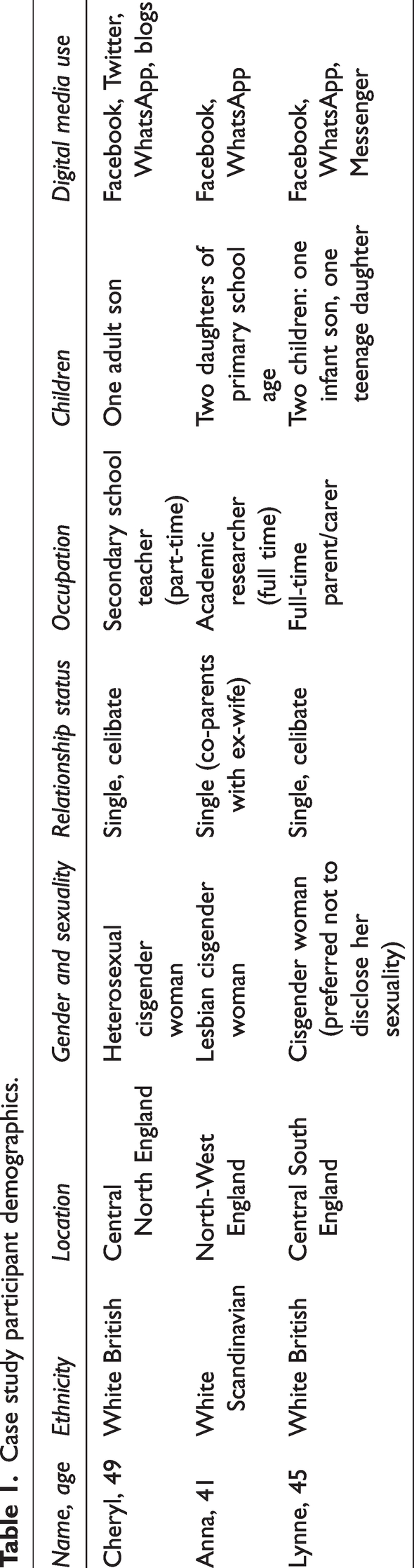
This article draws from my work with nine UK-based parents in single, same-sex and co-parenting families. For this research I sought parents who were single, adoptive, and/or LGBTQ+, and who regularly used digital media and technologies. Of the nine participants who came forward, four were single women who had adopted their children, three were single women who used donor conception, one was a man in a same-sex relationship who used donor conception and surrogacy, and one was a single man who co-parented with a lesbian couple. In this article, I spotlight three of the four single adoptive parents who took part in this research as case studies, selecting those with the most diverse range of experiences in terms of their relationship status, employment, sexuality and nationality, as well as their children’s ages, vulnerabilities and experiences. These participants used a range of digital media, but I focus here on their use of Facebook and its associated infrastructure of applications and affordances. These include Facebook’s central interface, the timeline (through which users can interact with a network of ‘friends’ via posts, replies and reactions), Facebook groups (through which disparate individuals can come together around a hobby, identity or set of experiences) and its instant messaging app, Messenger (which facilitates closed communication between Facebook contacts). Key demographic and contextual details about these participants’ lives are displayed in Table 1 and elaborated in the case studies that follow.
Case study participant demographics.
The study as a whole deployed constructivist grounded theory (Charmaz, 2014) to shape the research design and develop explanatory theory around parents’ use of digital media as it is embedded in their everyday lives. The design involved an inductive, iterative process of data collection, analysis and theory development, with each stage informing the others (Birks and Mills, 2015; Charmaz, 2008). To facilitate this process, participants were interviewed in three rounds, with each interview spaced four to five months apart. I also collected selections of participants’ digital media, focusing on their public, open and accessible media between interviews 1 and 2, and private or closed digital media between interviews 2 and 3. The data construction, coding and interpretative processes for this study are explained in detail in Mackenzie (2023a). The study was approved by the Faculty of Arts Research Ethics Committee at the University of Nottingham, and all participants freely gave their consent to participate. Given the relatively high level of commitment and information-sharing involved in the study, I implemented a multi-step recruitment process that gave interested individuals several opportunities to gather more information, ask questions, and become acquainted with me as a researcher before deciding whether to take part. All participants’ data were anonymised, with all identifying factors either removed or altered. This anonymisation extended beyond participants’ names; pseudonyms were also used for individuals, places and groups mentioned in their interviews or digital media data.
This article focuses exclusively on Cheryl, Anna and Lynne’s interview data. The interview protocol followed an ‘intensive’ grounded theory style (Charmaz, 2014), which supports the inductive and iterative research process. Intensive interviews have a flexible structure and employ open-ended questioning techniques that encourage the researcher to listen to participants on their own terms, value their experience and expertise, and relate to them as equals, as well as eliciting full and in-depth individualised responses. Following Cummings’s (2018) approach to interviewing parents and children who have had traumatic experiences, I began each interview with one central open-ended question. Table 2 offers an overview of the focus, core questions and timeframe for each set of interviews. In the final interview, I asked each participant to create a personalised network diagram, using a format adapted from the sociogram (Hogan, Carrasco and Wellman, 2007; Milroy, 1980; Sharma, 2017) and the closely related mediagram (Lexander and Androutsopoulos, 2021). This diagram positions the participant in the centre, in the ‘ego’ position, and can include concentric circles to visualise the relative importance of people and groups who are involved in their lives, their ‘alters’ (the most significant alters are positioned towards the inner circle). Diagrams adapted from participants’ original visualisations will be used in the case studies that follow, providing an impression at a glance of each individual’s social networks and support structures (for further examples and discussion of these diagrams, see Mackenzie, 2023a).
Interview schedule and key questions.
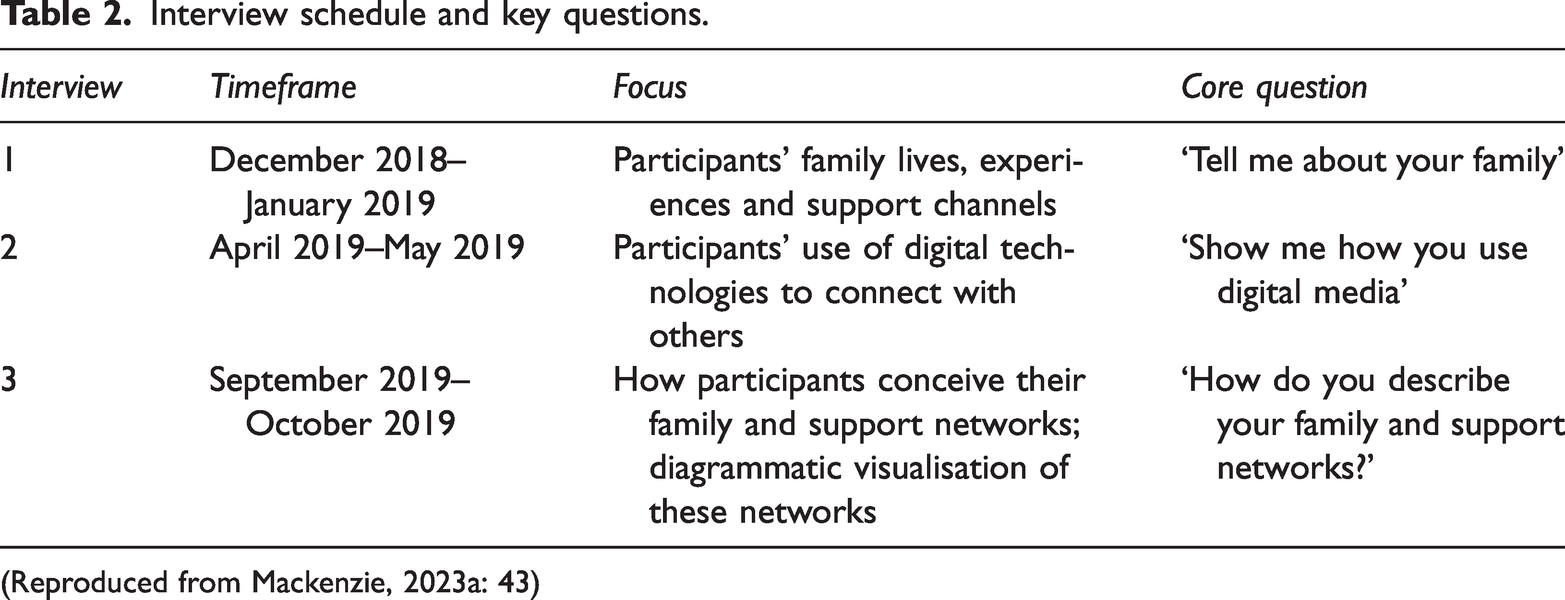
(Reproduced from Mackenzie, 2023a: 43)
The grounded theory coding and comparative analysis process ultimately involved weaving all codes together into a single theoretical category, connected parenting. At the final stage in the coding process, ‘connected parenting’ included four subordinate categories that group thematically related practices in the data. For the purposes of this article, I revisited the data associated with one of these subordinate categories: ‘building a (virtual) village’, which captures and describes participants’ construction and maintenance of supportive relationships and networks. In the case studies that follow, I focus on excerpts from Cheryl, Anna and Lynne’s interview data that are coded to this category, and which shed light on these participants’ management of their social media use in ways that are beneficial for their personal wellbeing and family life.
Findings
Case Study 1: Cheryl
The first case study focuses on Cheryl, who adopted her son Keir in his early primary school years. Throughout his life, Keir has faced learning and mental health difficulties, and during his teenage years became reliant on cannabis as a form of self-medication. This led to a series of negative outcomes, including criminal behaviour, aggression and vandalism. When Keir turned 18, he moved out of their family home into nearby supported living. Over the years, Cheryl has built and maintained a support network of fellow adoptive parents which has helped her manage these challenges alongside her own wellbeing. Her network diagram demonstrates the pivotal role adopters play in her life (see Figure 1). It shows that, apart from her immediate family members (mother, father and aunt), all the individuals and groups who play an important role in her life are connected to adoption in some way. For instance, Lane, Cheryl’s closest friend, is also a single adopter, and several of the groups to which she belongs specifically target adoptive parents. The diagram also illustrates that these connections are often constructed, sustained and mobilised through digital channels. For example, New Families, Parents of Adopted Adults, Keeping in Touch and Single Adopters 3 are closed Facebook groups. Adopter Network is the private forum associated with a UK adoption charity, and Adoption Twitter refers to the community of adopters who use Twitter (now known as X) to share information and support around adoption-related issues. Cheryl communicates with her close friend Lane almost exclusively via digital channels.
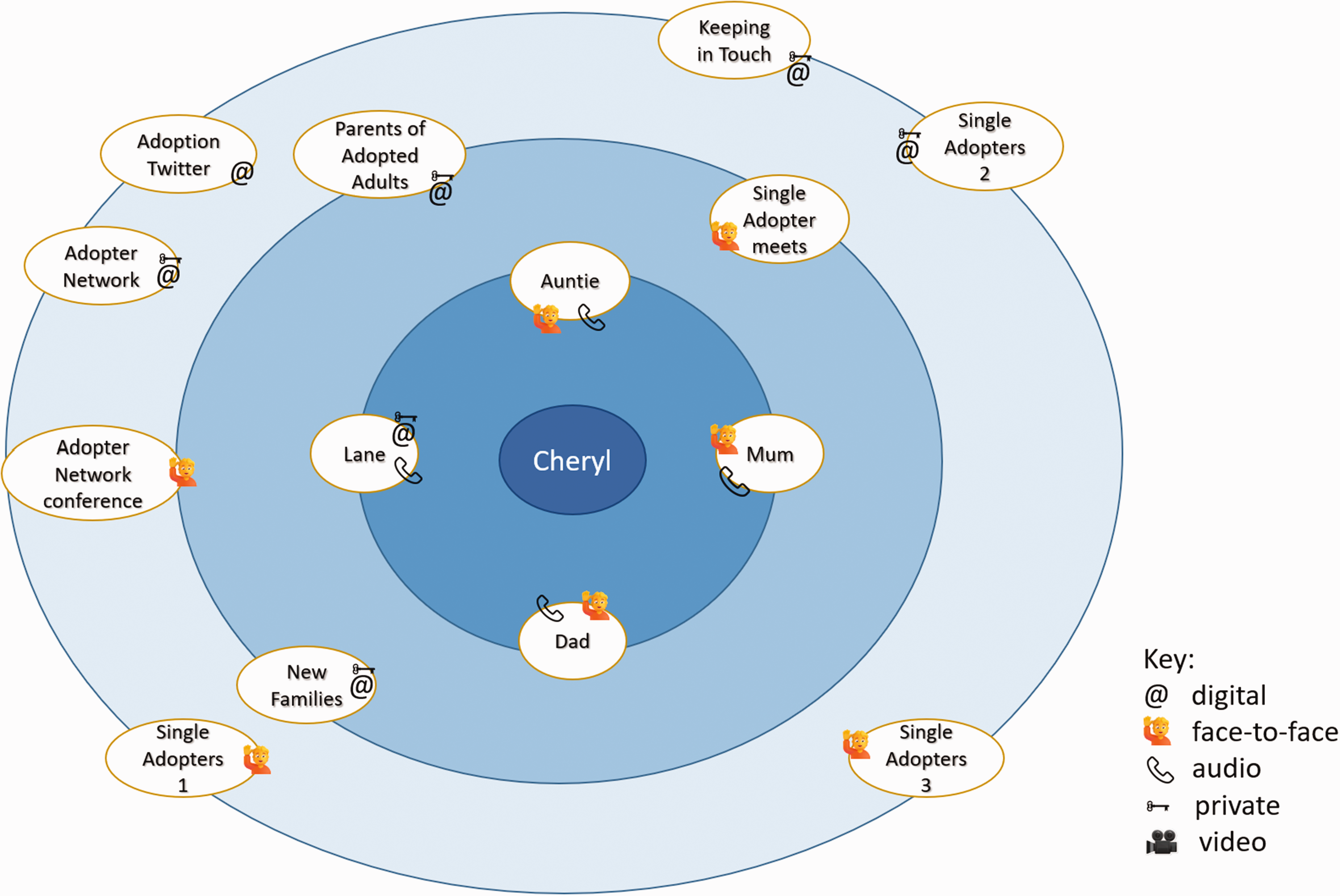
Cheryl’s network diagram.
It is clear from the outset that Cheryl is highly selective about who she involves in her family’s life and, specifically, who she will share her more negative or distressing experiences with. For example, she suggests in our first interview that she carefully ‘pick[s] and choos[es]’ who she confides in about Keir’s run-ins with the police; she feels that, while most adopters will understand the reasons behind her son’s behaviour, and not be shocked by it, non-adopters might be critical or judgemental: They don’t understand the issues around adoption … a lot of people just think, ‘Well, he shouldn’t have been doing that should he …?’ But another adopter understands that actually he might chronologically be 20 but emotionally he’s only 14 … so I wouldn’t tell my colleagues at work anything about [his trouble with the police]. It’s not fair on him. On here [the New Families group] I know that no one’ll judge him cos their kids are all doing the same and nobody will judge me cos they all know I’m an adoptive parent … But on Twitter [now known as X] I wouldn’t put anything because anybody could see that.
Cheryl often uses Facebook groups to access extraordinary levels of support and solidarity from other adoptive parents. This is particularly valuable to her as someone without a partner or co-parent to consult on a regular basis; as she puts it, ‘You do so much on your own but there does come a point where you just need someone else there.’ For example, she and a friend set up Parenting Adopted Adults (PAA), whose members are exclusively parents of young people aged 17 and above, with the specific aim of having ‘somewhere safe to talk’. As an administrator of this group, Cheryl uses Facebook’s settings to guard the group’s privacy, so members can feel free to discuss their lives without fear that outsiders, or even their own children, will find it: It’s only got 20 members cos we’re a bit careful who joins it. It’s secret, you couldn’t search for it and find this cos … you don’t want your kids finding it and seeing it. You’d get, ‘Oh, I understand that, we’ve been through that … this board isn’t for advice this is just so you can vent’ and someone can go ‘Yeah, I understand that’. I don’t post on the single adopters’ group anymore because they'd be terrified for one thing … they don't really get it y’know, they’ve got … children a good six years younger than Keir. I didn't want to put that on a board and tell the single adopters, ‘Oh, by the way I’m in the police station, Keir’s just been accused of an inappropriate conversation with a 15-year-old …’ You can't do it! So, then I was using Messenger … [and Lane] was sending messages, ‘Are you all right?’, ‘Don’t forget this, do that’, ‘Make sure he’s got a solicitor’, all those things. I knew in the middle of the night, if I was having a really rough time I could put something and people would reply to me … there’s always someone about. But the downside of it is you’re constantly checking your phone, y’ know, is everyone all right? … It’s like an extended family, so you feel like you've got to check up on people. I think at times you can be too available if you’re not careful. And in a small group, if people need support and you don’t reply to them, it’s really obvious. Occasionally on the singles’ board I’ll just put a post going, ‘I know I’m not posting much; things are really tough. Just want you to know that I’m still here and I’m thinking of you all’ – so people don’t think I’m ignoring them.
Case Study 2: Anna
Anna adopted her two children, Amelia and Hope, with her now ex-wife, with whom she co-parents and shares custody. Neither of Anna’s children have been diagnosed with specific needs or disabilities, but her eldest daughter Amelia has some socio-emotional difficulties around hyper-vigilance, anxiety and emotion regulation. In this respect, she shares some challenges with Cheryl around whether and how to share certain details about her children’s difficulties. Anna is originally from Scandinavia but moved to the UK over a decade ago. She is a regular user of digital media, especially Facebook and Instant Messaging apps. Like Cheryl, she belongs to many Facebook groups, three of which play an important enough role that she places them on her network diagram: Parenting with Connection, UK Scandi Mums and Caring for Elderly Relatives (see Figure 2). Anna’s diagram is mostly populated with friends and family members, including ‘Carol and family’, who were Amelia and Hope’s foster carers for a time, and with whom she maintains a very close relationship. The rest of Anna’s family live in Scandinavia, but she has a supportive community in her local area, with whom she connects both online and offline. This includes a large community of Scandinavian parents living in the UK.
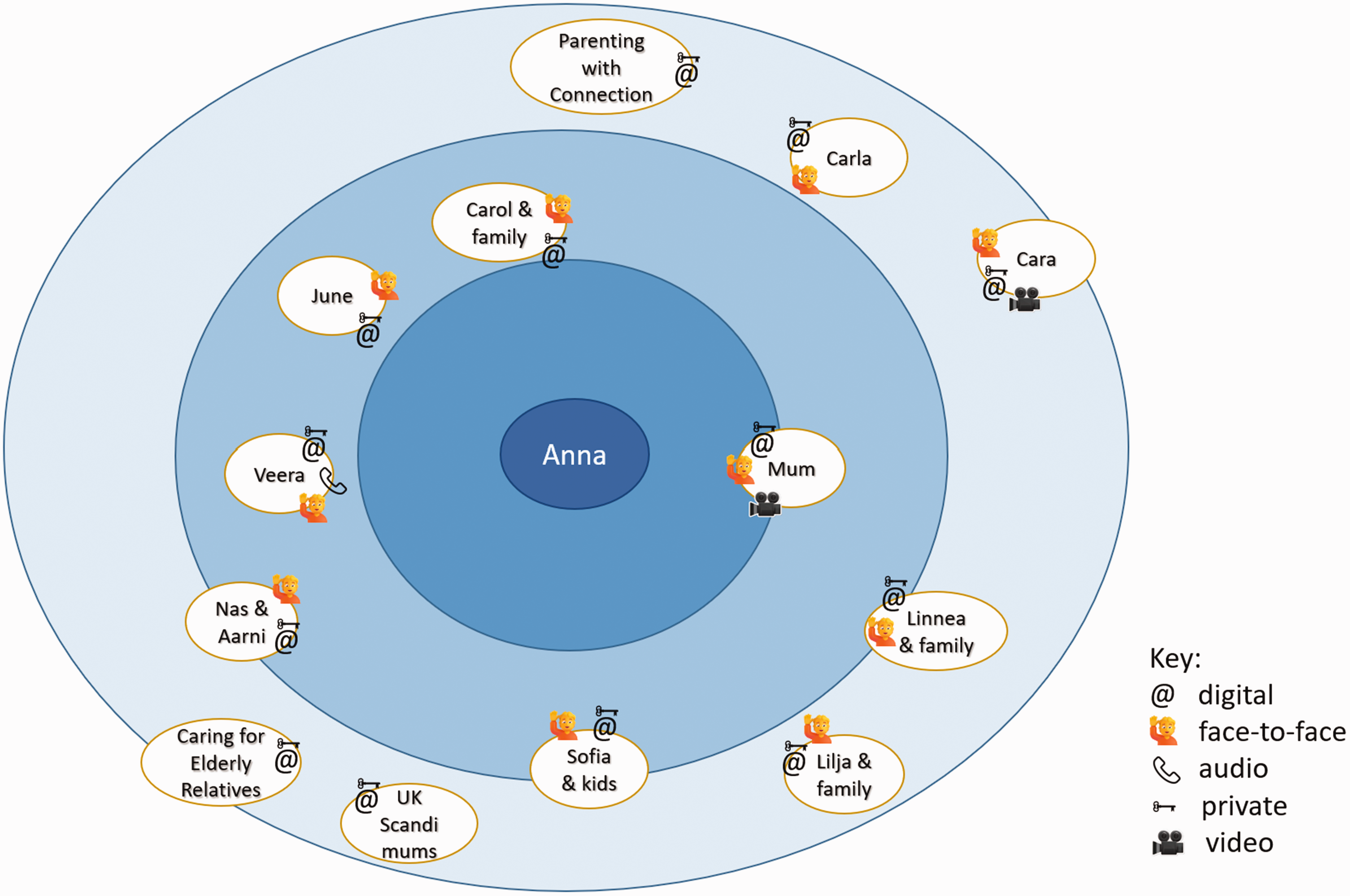
Anna’s network diagram.
Anna’s support network, like Cheryl’s, is quite compartmentalised. However, she curates her network differently: where Cheryl prioritises her connections first in terms of others’ status as adopters, then single adopters, and especially parents of adopted adults, Anna considers other dimensions when deciding who to connect with and what to share. For example, alongside being an adoptive parent, being a migrant in the UK is quite a significant part of Anna’s identity and experience. This is also a potentially isolating dimension of her life; while she has a co-parent with whom to share parenting responsibilities, she does not have access to regular, co-present support from her wider family. Anna therefore makes use of Facebook’s group affordances to find individuals with similar intersecting experiences who can offer meaningful advice or empathy around issues that specifically affect Scandinavian migrants in the UK. Unlike Cheryl, Anna does not usually draw existing contacts into ‘secret’ Facebook groups but uses searchable groups to make new connections. As a result, she is loosely connected with a larger number of people via Facebook groups, but most of these are not close ties. Nevertheless, Anna suggests that she finds the shared understanding between members of these groups extremely valuable. Like Cheryl, then, she finds that connecting with others who have similar experiences is hugely significant for personal wellbeing. As she puts it in our first interview: Being in the Scandi Mums group … people have more of the same experiences as you do in certain respects … I set up a group for Scandinavians living abroad supporting family members [back home] just cos I do find that kind of online support useful … that’s been a really nice group. I think in some ways Facebook is … good for the kind of fragmented support … for this issue I would go to this group, and this issue I would go to this group … I know that in some of them the answer will be either more useful, or more sympathetic or more the kind of answer I’m looking for … sometimes you just want validation, you just want somebody to hear you, and other times you want some idea of ‘What do I do with this situation?’.
Anna and Cheryl also share concerns around what details of their family lives they should share, and with whom. Throughout our interviews, Anna expressed conflicted feelings on this matter. For example, she was concerned with the relevance of certain ‘niche’ details of her life such as ‘personal budgets’ or ‘trauma parenting’ among relatively diverse networks such as her Facebook ‘friends’. She elaborates on the complexity of this issue in our second interview: On my main Facebook page … what I post goes out to everybody … I have relatives, mums from the school gate, friends who are kind of holistic friends and then work friends … a lot of the stuff I would post isn’t relevant for a lot of them, but then sometimes I think I often enjoy finding out something new about somebody else … especially living abroad and keeping in touch with friends from back home …
Concerns around her children’s privacy and autonomy further complicate Anna’s willingness to ‘collapse’ her sharing. There are some boundaries that she can draw quite confidently; for example, she never shares images of her children’s faces online, deploying strategies such as only posting photos taken ‘from behind or from the side’. This kind of protective practice, alongside similar strategies such as disguising faces in photographs and using pseudonyms, is increasingly common among parents who want to use social media in ways that are mindful and respectful of their children’s rights (see Autenrieth, 2018; Locatelli, 2017; Mackenzie, 2023a). However, she is less certain about what boundaries to draw around her children’s status as adoptees. Further, like Cheryl, she is reluctant to share details of the more personal or negative challenges they are facing, especially with a large audience. For example, in our second interview Anna grapples with the extent to which she should share information about her children with her wider network of Facebook friends: I’m very happy and comfortable sharing that my kids are adopted … but it’s getting to the borderline of whether it’s the kids’ choice and at what stage it’s going to be their choice who they want to share it with … with information about challenges they’re having. A lot of that I wouldn’t feel comfortable posting in a page with people who know them or who know their parents.
Another similarity between Cheryl and Anna’s use of social media concerns their strategic disengagement from certain groups when they become unhelpful or overwhelming. In our second interview, for example, Anna explains that she used to belong to a Facebook group for separated gay mums. Initially, she used this group as ‘an outlet to vent’ around some of her own negative feelings and experiences, in the early stages of her separation from her ex-wife. However, over time she began to feel overwhelmed by the group, finding that ‘there was a lot of posts coming through’ and ‘too much drama’. At first, Anna controlled the visibility of the group’s posts but maintained a latent connection, using Facebook’s settings to ‘hide’ them from view. However, she later decided to completely disengage by leaving the group. She describes this as ‘cutting out’ what isn’t helpful.
Case Study 3: Lynne
The final case study focuses on Lynne, who has been a full-time parent and caregiver to disabled children for most of her adult life. Over the years, Lynne has adopted or become special guardian to four children, two of whom passed away during childhood. Lynne now has two adopted children: Joel, a preschooler and Nadia, a teenager. Like Cheryl and Anna’s children, Joel and Nadia have experienced numerous difficulties but, in this case, they also have physical disabilities that are highly visible and affect their everyday lives quite comprehensively (Joel has suspected fetal alcohol spectrum disorder; Nadia has spina bifida).
As a long-term single carer of disabled children, Lynne has cultivated an extensive and robust support network for herself and her family (see Figure 3). This includes the carers who visit and assist Lynne’s children at home, the respite care centre Hope Hospice, local community groups such as MOVE and Lynne’s church. Other groups operate exclusively online, including several Facebook groups for carers of children with specific conditions and needs such as fetal alcohol spectrum disorder (FASD UK), spina bifida, a pureed diet, and other special needs (UKSC – UK Special Children). Lynne also has individual friends with whom she primarily communicates through digital means, particularly instant messaging, such as Trish, Phillipa and Terri. Like Cheryl (and to a degree, Anna), Lynne expressed a strong preference for connecting with other parents who have similar experiences, especially single adopters of disabled children. Her rationale for this preference is very similar to Cheryl’s; it’s easier to connect with these friends because they have been through the same things. They can therefore offer unconditional, non-judgemental support, without Lynne having to explain or justify the complexities of her life in detail.
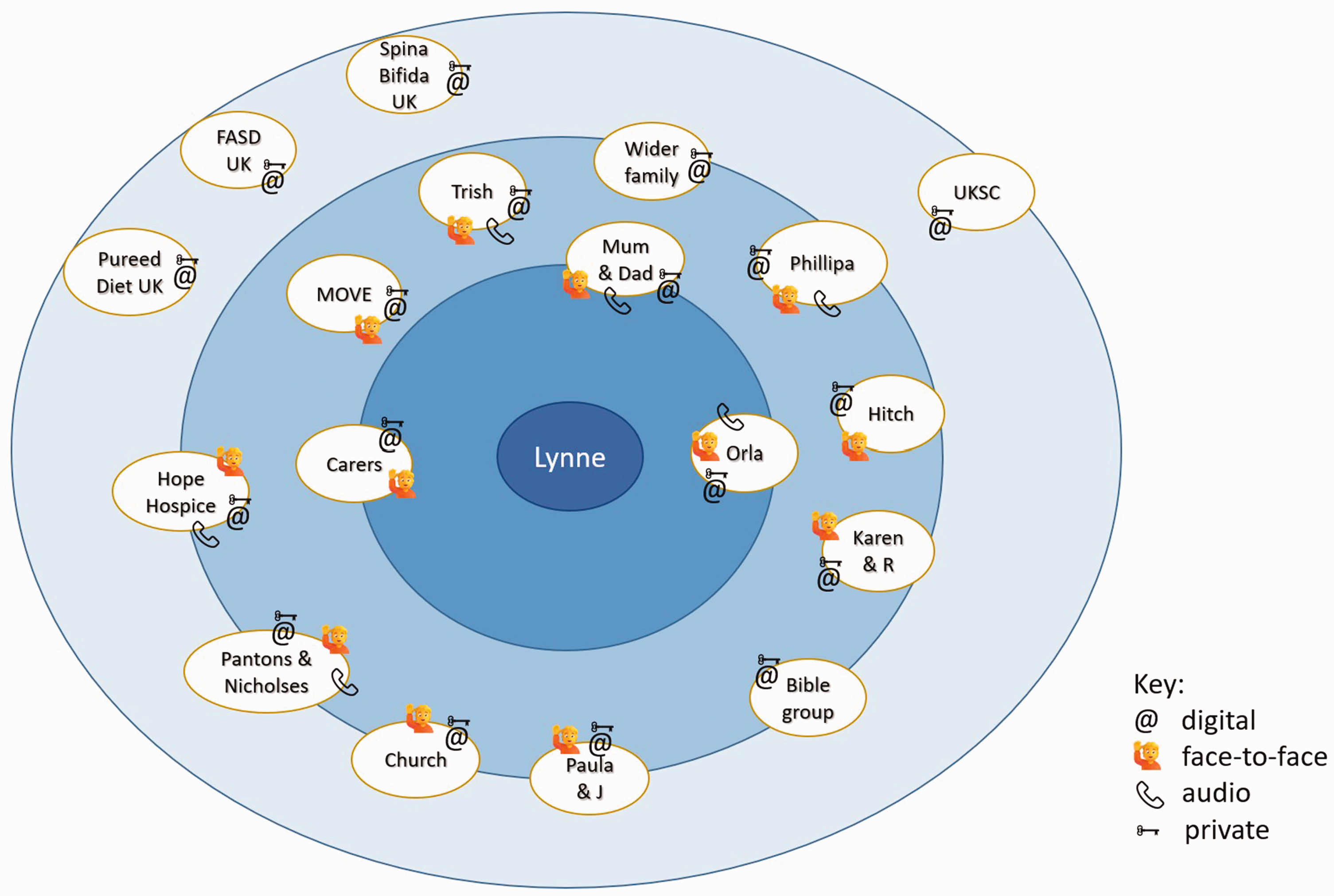
Lynne’s network diagram.
During our second interview, Lynne compared her local, in-person support with the support available to her via digital platforms. She suggests that, while local groups like MOVE are useful, they rarely meet her specific support needs. Online, however, she can connect instantly with single adopters of disabled children whose situations are more comparable with hers. As she explains: Primarily [MOVE is] people with … much more able children … and at that time my children were on ventilators and struggling to breathe and it was massively medical issues that I had the big problems with and they were not the right support. But online I could find other friends who had exactly the same things, you know?
While Facebook Messenger chats are a continual feature of Lynne’s everyday life, she suggests that she sometimes disengages from larger Facebook groups. Like Cheryl and Anna, Lynne uses this strategy to protect herself from becoming overloaded by the struggles of other parents and carers. As she explains in our second interview: Occasionally I read through all these posts on Facebook and it’s endless posts of the same thing … I feel myself getting very angry and frustrated, either with the situations people find themselves in, or with the people themselves for not taking charge of the situations they find themselves in – at which point I walk away from Facebook.
The ability to create niche, ephemeral Messenger groups is useful to Lynne as a single parent who, like Cheryl, doesn’t have a co-parent or partner with whom to discuss issues as they arise. They are also particularly useful to her as an adopter of disabled children because she is able to connect quickly and privately with others who understand her children’s specific and sometimes complex emotional, medical and mental health needs, some of which may require urgent attention. In our second interview, Lynne illustrates some of the complex and highly personal challenges she and her friends might discuss via Messenger groups: One of them popped up, tagged another couple of us at 11 o’clock at night … knowing we’d be around, to say, ‘Help! My six-year-old’s just started her periods. How do I explain this to her?’ She’s been abused … One of my friends put in a post the other day … her daughter who is physically disabled, she got her up in the morning and she got a great big mark just here and is this a pressure sore or is this a burn? … and there’s a photo. You can’t put that on Facebook, even in a closed group even in a secret group, but you can tag five people who you know and say okay what do I do with this?
Discussion
This article sheds light on the range of socio-digital strategies used by three single adoptive parents as they construct and maintain supportive friendships, groups and networks, while negotiating multiple challenges around visibility, availability and privacy. All three participants, Cheryl, Anna and Lynne, made it very clear that connecting with people who have similar experiences, most notably other adoptive parents, was hugely significant for their sense of wellbeing and security, as well as helping them to navigate practical challenges. They all made substantial use of social media platforms, most notably Facebook, to share experiences, offer information or advice, and most importantly, give and receive support and encouragement during challenging times. Above all, the participants underlined the importance of solidarity and validation from their peers, drawing comfort from the knowledge that they are not alone in their experiences and feeling assured that they have access to unconditional, non-judgemental support.
Creating and maintaining such groups, networks and friendships involved careful control and management on the part of each participant. For example, in order to keep different social spheres apart, each participant uses a range of strategies to compartmentalise their socio-digital networks. These strategies are comparable with those identified by Costa (2018), Light (2014) and Tagg and colleagues (2018). Cheryl, for instance, curates a ‘safe’ space for herself and her peers by inviting known contacts to a closed, secret Facebook group for parents of adopted adults. Anna, similarly, seeks information and support in targeted ways by creating a Facebook group for migrants who are caring for elderly relatives across geographical borders. While Lynne also uses Facebook groups to separate different aspects of her experience and needs, she deploys Messenger as a more precise and responsive tool for rapidly creating intimate, trusted but ephemeral micro-groups that are constructed around friendship and shared experiences, and tailored to specific situations. For Cheryl, Anna and Lynne, these compartmentalisation strategies can help them maintain clear boundaries between different spheres of their lives. For example, they are able to separate their experiences of being a single adopter of disabled children, a parent of an adopted adult, or a migrant parent from other aspects of their experience such as their work, relationships with extended family and friends, or their more universal parenting practices. These participants’ use of compartmentalisation strategies demonstrates the particular importance of support that is tailored to the specific dimensions and nuances of their circumstances, not just their status as adopters or even as single adopters.
Because they compartmentalise their networks, Cheryl, Anna and Lynne are also able to practise highly selective sharing. This involves drawing clear boundaries around where, and with whom, they share certain information. Selective sharing, as we have seen with Anna’s social media practice, is sometimes a matter of what feels relevant, or irrelevant, for different groups. However, it is also a matter of judging what is appropriate and inappropriate sharing, with due consideration of the individual, the child and the wider community. The latter concern is brought to the fore by all three participants, who each note that they (and others in their networks) are very careful about where they share the more personal, negative and potentially distressing details of their family lives. For example, Cheryl is reluctant to share details of her son’s activity that she feels are not palatable, or even comprehensible, beyond a specific audience (usually parents of adult adoptees). Lynne and her fellow adopters of disabled children are particularly aware of the sensitivities around their children’s physical needs, coupled with their experiences of trauma and abuse. All three participants note that they restrict their sharing on issues like these to very specific groups, so as to protect and show respect for their children. Further, Cheryl suggests that her selective sharing serves to protect other members of the adoption community, most notably adopters with younger children, from worry and fear around their own children’s futures. While Cheryl and Lynne both touch on the issue of respecting their children’s privacy and autonomy (and in Cheryl’s case, protecting her son from judgement), Anna addresses it head on through detailed reflections around to whom her children’s ‘stories’ belong. This is a difficult boundary to navigate since, as Anna explains, these stories are intimately entangled with her own. Her reflections chime with wider concerns around the overlapping ‘spheres of obligation’ that parents may navigate in relation to online sharing (Autenrieth, 2018; Blum-Ross and Livingstone, 2017). As adoptive parents, Cheryl, Anna and Lynne are sometimes required to exercise even more heightened levels of sensitivity, especially where their children have multiple points of vulnerability.
The third practice that Cheryl, Anna and Lynne deploy is disengagement. All three participants note that, as well as managing issues of visibility and privacy, they must also protect themselves from becoming overwhelmed, overloaded or simply distracted by the sometimes intense, triggering or irrelevant nature of online content and interactions. Cheryl suggests this is one disadvantage of belonging to intimate and supportive groups; sometimes she can make herself ‘too available’, because she feels a responsibility to ‘check up on people’. Lynne, similarly, suggests that she sometimes struggles to manage her own emotions when engaging with others’ lives via Facebook groups, and Anna notes that she is quick to ‘cut out’ anything that is unhelpful or obtrusive. When this happens, all three participants use similar strategies to ‘tune out’ certain individuals and content (Crawford, 2009; Light, 2014). For example, Anna uses Facebook’s affordances to either ‘hide’ or completely remove herself from certain groups, while Cheryl and Lynne take strategic breaks from Facebook groups, sometimes turning to alternative ‘backchannels’ (Light, 2014) such as Messenger. It is interesting to note that Cheryl sometimes excuses and mitigates her absence from small and intimate groups by leaving a ‘holding post’ that reassures members of her care and concern. Cheryl also makes the important point that, while closed and private channels are hugely beneficial, bigger and more open channels, such as Twitter (now known as X), also have their place, partly because they do not entail the same level of compulsory commitment and engagement.
As well as pointing to similarities and links across Cheryl, Anna and Lynne’s practices of connection and disconnection, it is also clear from these case studies that each participant’s identities, experiences and challenges are quite different, and that their socio-digital practices are closely shaped by these nuances. For Lynne, being the parent of disabled children has the most profound effect on her practices. The ‘inner circle’ of her network primarily includes other adopters of disabled children, where members are all alert to sensitivities around the physical needs and heightened vulnerabilities of their children, as well as the urgency of certain problems. For Cheryl, parenting an adult adoptee is particularly salient because, for her, this involves navigating issues around aggression, criminality and drug use that may be frightening, shocking or simply incomprehensible to others – even to some adoptive parents. For Anna, whose children do not have such intensive needs, being a separated migrant adopter drives her to seek connections with other Scandinavians in the UK, as well as other separated parents and other adopters.
Conclusion: Implications For Practice
The case studies explored in this article show how three single adoptive parents construct targeted connections that are intimate and supportive, partly through disconnecting from those that are counter-productive or unhelpful. The importance of creating compartmentalised, ‘safe’ spaces that are isolated from other social spheres is particularly apparent. When they have these spaces, participants can be selective about what they share, and with whom. Further, they can isolate and strategically disengage from content that is harmful or overwhelming. Through these interrelated practices of compartmentalisation, selective sharing and disengagement, participants can protect not only themselves, but also their children and their wider communities from unwanted interactions, upsetting or irrelevant information, or invasions of privacy. The support systems that arise from these practices can operate around the clock and across the globe. As such, they have the potential to revolutionise post-adoption support. Practitioners working with adoptive parents, particularly those with additional vulnerabilities, such as single adopters or adopters of disabled children, can facilitate personalised, targeted support by signposting carers to appropriate digital sources, or supporting the creation of social media networks, for example via Facebook groups.
Nevertheless, it is imperative that professionals recognise the complexities and pitfalls associated with community-driven support through social media platforms. To begin with, it is important to note that the case studies outlined in this article focus on a relatively privileged and well-connected group. These individuals have high levels of competence and confidence with digital tools and technologies, as well as experience across a range of social and institutional networks, systems and resources. Not all parents will have access to the same networks and technologies, and not all will be so adept at navigating the complex interplay between connection and disconnection. Issues of privacy and autonomy represent a second complicating factor, and these concerns are often heightened for both single adopters and adopters more generally. For these parents, the use of social media may be associated with greater levels of anxiety and concern regarding the safety and wellbeing of their children. Finally, it is important for practitioners to recognise the effort required to establish, manage and sustain digitally mediated connections that are both relevant to, and beneficial for, single adopters. Above all, they should be attentive to the potential for parents to become overwhelmed due to the intense challenges involved in establishing online connections with their peers and offering ongoing engagement and support. Thus, while social media networks offer a range of valuable apparatus in the toolkit of post-adoption support, some caution is needed around the specifics of their use, depending on individual families’ needs and circumstances.
Footnotes
Acknowledgements
I would like to thank two anonymous reviewers for their valuable feedback on an earlier version of this article. Special thanks must also go to Cheryl, Anna and Lynne, who gave their time generously and made this work possible.
Declaration Of Conflicting Interests
The author(s) declared no potential conflicts of interest with respect to the research, authorship and/or publication of this article.
Funding
The author(s) disclosed receipt of the following financial support for the research, authorship, and/or publication of this article: This article is based on research that was supported by the British Academy (PF2\180026).