




Abstract
This article explores how looked after children and young people experience social media and cyberbullying. Thirty-one young people, aged 13 to 20 from Wales, were recruited primarily via social media. They participated in semi-structured interviews sharing examples from their daily online lives, the types of social media they used and their experiences with cyberbullying. They also provided their opinions on social media and that of the adults in their lives. The analysis showed insights into their online lives but also highlighted the challenges of using social media to recruit interview participants. The findings of this study show that young people with care experience have similar rates of cyberbullying and social media usage as their peers, but questions remain. It is recommended that more research is needed in this area and that adults who engage with vulnerable populations, such as looked after children, should have access to training on social media and how to recognise cyberbullying.
Plain Language Summary
Thirty-one young people with care experience in Wales were asked their opinions on social media and the internet, as well as their experiences with cyberbullying. It was found that those with care experience have similar rates of cyberbullying as their peers. They also used and accessed social media in similar ways. The findings gave insight into their online lives but also drew attention to challenges in using social media to recruit young people with care experience. Ways to address this are highlighted.
Introduction
In Wales, there are 7,265 young people in care (Welsh Government, 2021). While there is international evidence about how young people engage in online spaces, little is known about the online lives of looked after children including those who are currently looked after or who have previously been in care. Given that looked after children are a vulnerable population in society, with poorer outcomes related to mental health (Tarren-Sweeney and Vetere, 2015) and education (Mannay et al., 2017; Sebba et al., 2015), it is important to understand how online activities impact these outcomes. This includes the benefits that looked after children may experience from online activity, such as socialisation and entertainment (boyd, 2014), as well as the risks, which include online harassment (Cowie, 2011; Sen, 2016) and child sexual exploitation (Hallett, 2015).
Looked after children and those with care experience are likely to be more vulnerable in regard to online activities by virtue of their involvement in the care system. They may experience difficulties accessing technology, due to financial issues or neglect, or be unaware of safe internet usage due to missing school on account of placement changes (Katz and El Asam, 2019). This increases their susceptibility to online harm (Cross, Richardson and Douglas, 2009; Guardian Saints, 2017) as well as making them outsiders within their wider peer group (Wang et al., 2010). Moreover, those in care may perceive that their status of being care experienced will manifest itself in terms of social exclusion and bullying by their peers (Dansey, Shbero and John, 2019). There are also concerns about connecting with birth families online (McDowell, McLaughlin and Cassidy, 2019), especially if the contact is not regulated or monitored. Despite these risks, there are positives, such as joining online communities that cater to those who are care experienced and maintaining existing friendships.
Increased understanding is needed regarding the online lives of looked after children as they are at higher risk of falling prey to online scams, cyber aggression and bullying, as well as being exposed to harmful content (Katz and El Asam, 2019), all of which is in addition to having poorer educational and mental health outcomes as stated previously. Insights into how they engage with social media and the challenges they face are instrumental for supporting these young people’s access to online spaces and social media. While we are aware of this increased vulnerability, we know little about what their online lives are like or how they engage with their peers and family in online spaces.
Ninety-seven percent of young people between the ages of 12 and 15 and 100% of those aged 16 to 17 have their own mobile phone (Ofcom, 2022). Overall, young people spend an increasing amount of time online, with 32% of this population spending up to three hours on social media per day and 35% spending over three hours engaged in online activities (Scott, Biello and Woods, 2019). The risks of spending this much time online include distraction from tasks and schoolwork as well as a decrease in happiness (Brooks, 2015). Social media can also be used for nefarious purposes including conspiracy theories, exploitation and pornography (Anderson, 2017) and cyberbullying.
Cyberbullying has been defined as ‘willful and repeated harm inflicted through computers, cell phones, and other electronic devices’ (Hinduja and Patchin, 2015: 11). Among other definitions, it has also been described as ‘… an aggressive, intentional act carried out by a group or individual, using electronic forms of contact, repeatedly and over time against a victim who cannot easily defend him or herself’ (Smith et al., 2008: 376). However, there is a lack of one agreed definition in research, which is problematic (Ybarra et al., 2012; Zhu et al., 2021): young people may have a different way of defining cyberbullying than adults and researchers. Issues range from challenges in comparing the definition of traditional bullying and cyberbullying (Olweus, 2012; Smith, 2012) to what exactly constitutes cyberbullying (Menesini, 2012), which are further confounded by new social media applications becoming popular and others becoming defunct. Indeed, the absence of one definitive definition ‘can lead respondents astray and invalidate subsequent findings since most people lack an even rudimentary understanding of cyberbullying … and [this] eliminates the possibility of drawing meaningful cross-study comparisons’ (Notar, Padgett and Roden, 2013:2).
In addition to problems of definition, there are also widely ranging numbers regarding perpetration and victimisation. In a review of 74 articles regarding the prevalence of cyberbullying, it was found that an average of 21.6% of young people were cyberbullying victims and 15.2% were instigators (Hinduja and Patchin, 2015). A recent systematic review found cyberbullying perpetration was between 6% and 46.3% and victimisation rates between 13.99% and 57.5% (Zhu et al., 2021). According to the Office for National Statistics (ONS), one in five children experienced online bullying in the year ending March 2020. In Wales, the School Health Research Network (SHRN) study for 2019–20 (which is administered in all secondary schools in Wales) found that 9% reported to be cyberbullies and 18% reported to be victims. Boys were more likely to be perpetrators and girls were more likely to be victims of cyberbullying (Page et al., 2021). Gender has long been a focal point in research into cyberbullying. Overall, the picture is mixed (Wong, Cheung and Xiao, 2018; Zhu et al., 2021) as to which gender is more likely to be victim or a perpetrator.
Cyberbullying can lead to various mental health conditions, including depression and anxiety (Patchin and Hinduja, 2016; Zhu et al., 2021), as well as a host of other issues, such as decreased school performance (Dansey, Shbero and John, 2019) and drug and alcohol misuse (Sabella, Patchin and Hinduja, 2013; Wölfer et al., 2014). While cyberbullying is a significant problem, the online lives of young people consist of substantially more than this: for instance, online learning, engaging with creative content and general communication, including direct real-time interactions or ‘looking at or reading another person’s social media postings hours or days later’ (Bonsaksen et al., 2021). It has been suggested that social media has become a distraction for young people as they receive frequent notifications on their devices that take them away from schoolwork or other aspects of their non-internet life (Siebers et al., 2021).
Notifications may come from public profiles on social media, including Facebook, Instagram and Twitter, as well as via private or secret accounts. Secret accounts are social media accounts that are set up for a variety of reasons and enable the user to hide their identity. On Instagram, they are commonly known as ‘Finstas’: ‘fake Instagram accounts that [don’t] show the user’s real name’ (Sales, 2016). They are also known as ‘secondary or secret accounts where users show their unattractive, humiliating, and embarrassing sides, ranging from facial imperfections, depression and struggles from partying habit[s] to love poems’ (Kang and Wei, 2020:58). They may also be set up as an alternative account for close friends or family whom they know in real life (Kang and Wei, 2020). Some have used them in order to facilitate activism and involvement in protests (Hensby, 2016), while others have done so to express facets of their personality which they keep hidden from their public accounts (Kang and Wei, 2020) or which are different from the personalities they present on other social networks (Choi and Sung, 2018).
Evidence in the literature has suggested that adults are often unsure about how to navigate online spaces due to the fast-paced nature of their development and may underestimate how much time young people spend online (Elsaesser et al., 2017). Their perceptions of how young people engage online include concerns around exposure to inappropriate materials (Ofcom, 2022), cyberbullying and risk-taking (Elsaesser et al., 2017). Adults, including teachers, have been found to have concerns about the use of social media and may struggle to understand their purpose and to recognise cyberbullying (Corliss, 2017).
Some research has been conducted in specific connection to how looked after children engage online. A small-scale, exploratory study by Sen (2016) found that participants’ (n = 10) use of digital media was not overly different to that of their peers. Additionally, findings from a study on the health and wellbeing of looked after children in Glasgow found that 17% of respondents (n = 130) had been bullied at school in the previous year (Vincent and Jopling, 2017). While both these findings align with the wider research, they should be taken cautiously given the small sample sizes. In contrast, in an online survey of foster carers (n = 329) in the UK, Guardian Saints (2017) revealed that 56% of young people in care have been put at further risk due to social media and online activities. However, this survey only captured the perspectives of foster carers on the online experiences of looked after children and not those of the children themselves.
The purpose of this present study, therefore, was to understand how looked after and care-experienced children and young people engage online and experience social media in their own words. Additionally, the study sought to understand the extent of cyberbullying encountered by this population.
Method
The research was a two-part mixed-methods study developed to gain a wider understanding of how young people with care experience engage online. The first part was a quantitative analysis of secondary data collected by the SHRN survey in 2017 on young people’s electronic media communication data and their wellbeing (Roberts et al., awaiting publication). The second part, upon which this paper focuses, consisted of qualitative semi-structured interviews with care-experienced children and young people. These interviews explored how this population engaged online, what types of social media they had used over the course of their lives and their opinions on social media, as well as the positives and negatives of their online experiences.
Ethical approval was provided by Cardiff University’s Research Ethics Committee for both strands of the study (in 2020 for phase one and 2021 for phase two). The qualitative portion was undertaken in the spring of 2022. The study design was developed with a focus on keeping those who were being interviewed safe and free from harm due to the vulnerability of this population (Shaw and Holland, 2014). A care-experienced peer researcher was also employed to assist the principal investigator in both creating the interview schedule and interviewing participants, where having someone with a similar shared experience was helpful for facilitating discussion (Taylor et al., 2013).
Participants were recruited through Welsh local authorities, universities and other third sector organisations, and social media. Young people were asked specifically, both at initial contact and prior to the start of the interview, to confirm that they met the criteria of being between the ages of 13 and 20, living in Wales and having care experience. In total, 31 young people participated in the study: 18 males (58%) and 13 females (42%). This is close to representing the proportion of young people who were in care in Wales in 2021, of which 54% were male and 46% were female (Welsh Government, 2021). One participant was under the age of 18, and the remainder were aged 18 to 20. Twenty-eight participants reported that they were currently in education, two were in employment and one was in both education and employment. All reported to be living in South Wales, despite the recruitment drive for participants across Wales. Some did not answer the questions asked; this is reflected in the number of responses in the following sections.
The interviews took place in March and April 2022 and were conducted remotely online via Zoom due to the continued concerns of the Covid-19 pandemic. Participants were provided with a £25 Amazon gift card for their participation.
The interviews were audio-recorded and transcribed verbatim. Data were then analysed and coded into themes using NVivo 12 software, and categories and themes were identified (Merriam, 2002). Thematic analysis, as described by Braun and Clarke (2006), was then undertaken.
Findings and discussion
This section presents the findings and analysis of the qualitative interviews and focuses on several key themes, among them internet and social media perceptions and usage habits, and negative experiences related to social media, including cyberbullying.
The online lives of looked after and care-experienced children in wales
All interviewees reported having access to the internet on a device of some kind, access to Wi-Fi and spending time on social media every day. Time online varied from two to 20 hours per day but despite this wide range, respondents were relatively vague about how they spent their time online. The following comments from one young person were representative of the majority of participants: In the morning I go through my phone [and the] news feed, looking for like updates on news. Reply to my chats. In a day I go to school, take some pictures, do some assignment, post it online. And in the night, I chat, I also do my assignments.
Facebook was the first form of social media the participants had used, followed by Instagram, Snapchat, Twitter, WhatsApp, TikTok and YouTube (see Figure 1). As far as current social media usage was concerned, all the interviewees had an online social media presence, with most respondents using Instagram (see Figure 2). All participants used at least two forms of social media alongside email and general web browsing. These findings are not surprising and correspond with the wider literature, especially with the recent Ofcom (2022) survey on social media usage by young people which found that 97% of those aged 12 to 15 and 99% of those 16 to 17 used social media applications.
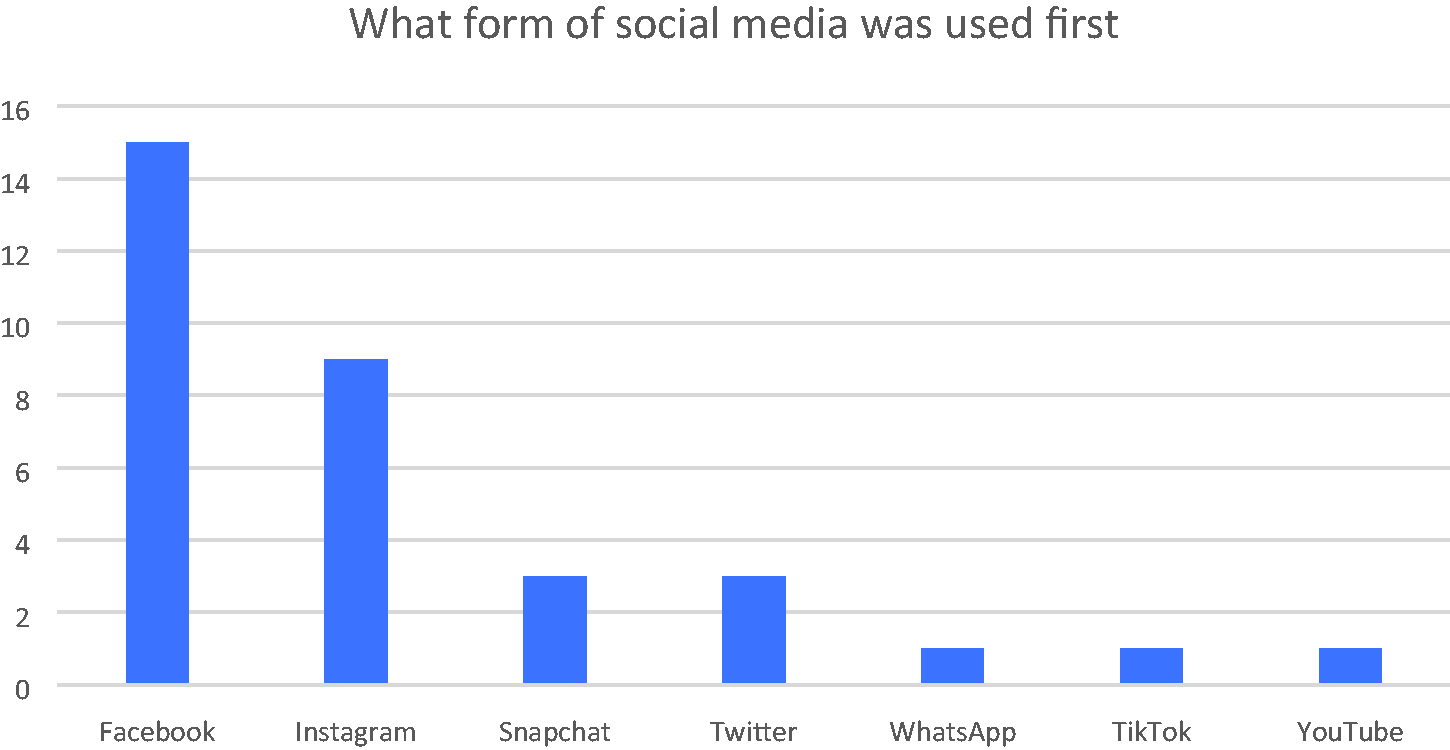
What form of social media was used first?
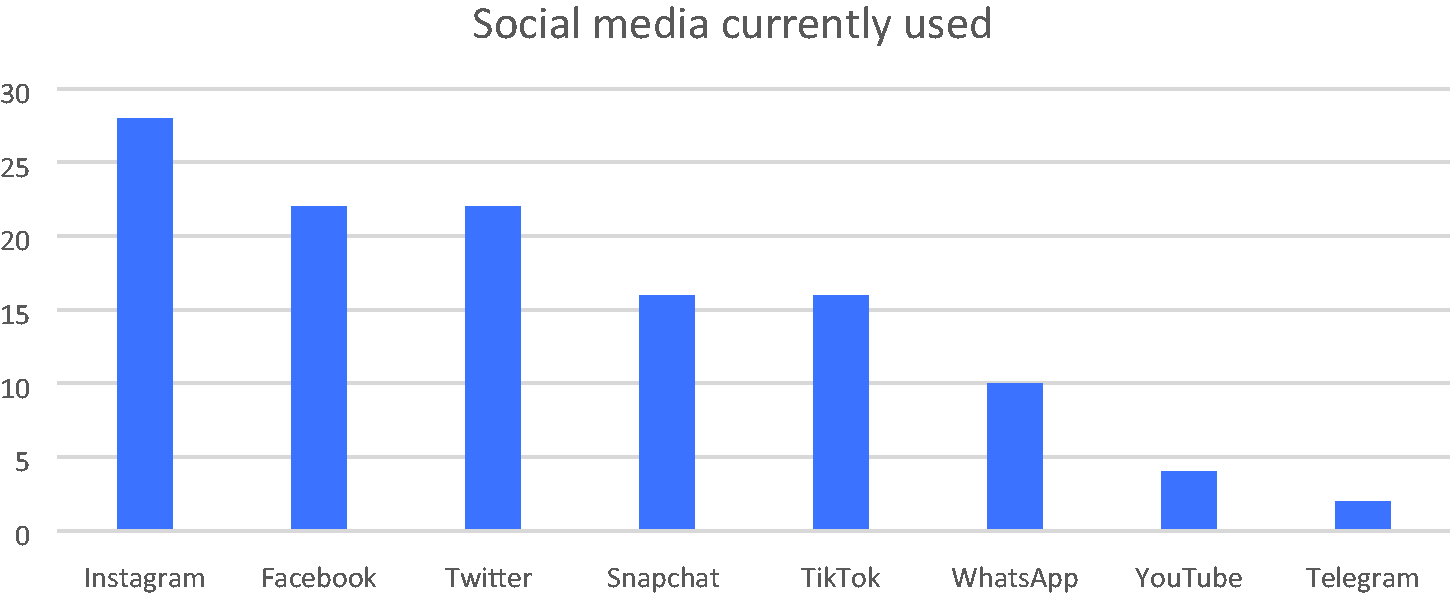
Social media applications currently used.
When asked if they had ever had any restrictions placed on their online activities while growing up, the majority responded that they had some type of restriction placed on their internet access at that time. These restrictions were put into place in order to allow them to focus on their studies and exams or because their social media usage was a distraction. Again, this is consistent with the Ofcom (2022) survey findings which identified that parents in Wales had concerns over social media usage.
Some respondents were self-aware enough to temporarily delete social media apps from their phones, for example, while undertaking exams. They understood that social media would need to be restricted to allow them to devote appropriate time and effort to studying and revising. One participant commented: ‘I don’t have people restricting it for me. I do it myself, just to make sure I’m focusing on things ’cause it does waste a lot of time.’ This is an interesting finding as social media has been proven to be a distraction (Siebers et al., 2021). This is especially the case for those who spend a significant amount of time online – in excess of 20 hours per day for many of the study participants. While participants weren’t explicit about the types of distraction that social media were causing them, it can be inferred that these could take the form of frequent notifications from social media applications, which led them to pause their studies and open the pop-up message. Being more preoccupied with their online lives could result in distraction (Johannes et al., 2019), but perhaps the stream of notifications has become the new normal for these digital natives.
Secret accounts
Nine respondents disclosed they had a secret account at one time or another or used an account with a nickname or alias. Interestingly, some respondents made a distinction between their public account and a separate one held under an alias, although they didn’t necessarily consider this to be a ‘secret account’: ‘I didn’t have any secret accounts, but what I did was to use a different … name so that my parents wouldn’t recognise it.’ Some chose to do this to keep their online lives private from family members while some used these accounts more frequently in order to keep their activities away from social services who were, as one participant stated, ‘always trying to catch you out’. Another shared that they used a nickname ‘so that they [parents] won’t recognise [me], but I can post any kinds of pictures and make videos’. Another respondent wanted to be free from parental control and censorship: Me and my friends, we set up a secret account, because our parents were so protective that they were pulling us up on everything we posted on social media, [so] that we had to open a secure account and [one] where we can at least do what we like without being scared.
Negative experiences and opinions related to social media, including cyberbullying
While many may fear that young people might come to harm online, it has been found that a relatively small percentage are actually at risk, and approximately 20% of young people may come to harm (Ballantyne, Duncalf and Daly, 2010). Thirty percent (n = 9) of the young people interviewed for this study said they had negative online experiences. Two (7%) said they knew of someone experiencing something negative online, while 19 (63%) said they had not had any such experience. Some participants stated that the reason they had not experienced anything negative online was because they did not speak to strangers or kept their online circles small. This is an interesting finding as they appeared to believe that online negative experiences would only come from those they did not know, when this is often not the case (Mishna et al., 2012).
Six participants (24%) reported that they had experienced cyberbullying themselves, whereas five (20%) said they had witnessed or knew of others being involved in it. Two (8%) didn’t know about cyberbullying and 12 (48%) stated they had no experience of such behaviour. Those who did say they had experienced cyberbullying often did not elaborate any further when asked about it. Given the challenges of defining cyberbullying in research, it was not surprising to hear that some young people were unsure about it or did not think they had experienced it. A few participants asked at the end of the interview if we could provide a definition for them to help further their understanding. Having a clear identification of the behaviour, what it entails and how it may be related to ‘banter’ or online drama (boyd, 2014) may assist future research endeavours.
A few participants did speak in greater depth about their experiences with cyberbullying, however. One said they had been cyberbullied, which had caused them to be depressed. The investigation involved the police, who, according to the interviewee, arrested the person responsible. Others mentioned incidents involving racism and sexual harassment online. Another individual shared that they had experienced a fairly significant amount of cyberbullying and explained that they had found it a difficult experience with minimal useful support to address the issue: I remember it being like, [I was] scared to tell someone just in case I had my phone taken off me, or just told, ‘Well, that was it.’ Even if I did tell someone, I was just told to kind of block them, shut the account down. But when it’s more than just one person, like I’ve had before, it does become a bit too much and you just kind of feel stuck … And even, like, going to the police, they can’t really do anything more. It’s [like] this, especially if it’s a fake account, if it’s a web person who can do all the IP address, I don’t know whatever, with specialist stuff. So yeah, I did really feel trapped and stuff, kind of and I went to like a few adults, but every [piece of] advice was the same. Just block them and delete your account. I know somebody close [to me] who was bullied. I see people using proxy accounts to try to, you know, just pull you into the ground and squeeze you down there and squeeze the pride out of you and really make you feel worthless by the amount of expressive junk they get out of the … vermin that they express, you will definitely feel like the world is no longer your place because of the despicability of the things you are told, and you just don’t like yourself anymore.
Participants felt that cyberbullying was a significant negative component of being online. When asked about their opinions on social media, they had strong opinions, both positive and negative. Negative online experiences are not limited to cyberbullying. They include cyberstalking, harassment, sexting, exposure to indecent and inappropriate images and text, fraud, ostracisation and alienation, and hacking. Negatives can also include the after-effects of online behaviours including depression and anxiety (McCrae, Gettings and Purssell, 2017; Zhu et al., 2021) and social isolation (Sen, 2016).
Participants showed concern about the risks of internet and social media use and were keen to demonstrate that they employed cautious behaviours in response to them. These included being safety conscious, such as not sharing passwords or important information due to the risk involved, and not texting someone they do not know. Participants also worried about the role of social media influencers and the impact that they might have on young people: My thoughts I feel about [social media influencers and celebrities] is really based on the … about the life you’re putting online; like the lies and the fake life of influencers. It’s kind of bad because everybody want[s] to look up to them and be like them. Certainly, I think there’s a level of peer pressure that is apparent on the internet and I think when you see other young folks doing things and you maybe were to indulge in them for the purpose of pleasure and maybe unwittingly, you actually know the extent and the depth of those things just get you beyond pleasure and you can get yourself hooked in things, you can get yourself developing perspectives that wouldn’t be helpful in terms of fulfilling life.
There was also a sense that the internet and social media were being used for nefarious purposes: It’s also kind of used to the point of misleading of information and also using it to bully other people. It’s [social media] advanced too much where there can be a lot of risk, especially to vulnerable children who will meet up with somebody online. It’s a danger for young folks who haven’t been educated about all these things, getting into social media and internet quite … at a very young age, it’s dangerous. Secondary, I think, we have things to do with offensive media. Some guys you may come across, things to do with pornography.
While participants found positives in social media for communication, knowledge and socialisation, these perspectives showed that many of those interviewed were quite risk averse, which complemented the findings regarding who these young people spoke to and engaged with online. However, it was unclear whether or not their aversion to risk was related to their care experience; this highlighted the possibility that some of those interviewed may not have been care experienced at all. Only one participant mentioned hiding their activities from foster carers and social workers, which was found to be a prevalent behaviour in previous research in this area (Sen, 2016).
Adult opinions on social media
Participants were asked to share what the adults in their life thought about social media. While a few positives were mentioned, such as ease of communication and educational benefits, their responses were overwhelmingly negative, which may have had an impact on their own attitudes. Overwhelmingly, participants shared that the adults in their lives felt that social media was a waste of time and that they had significant concerns around safety and cyberbullying: They only thought about the negative aspect. Most of them think social media is a very bad thing. The adults in my life think social media is a cause of a variety of issues, including emotional, mental issues, anxiety, depression and physical issues and yeah and [they think it] reduces sleep quality … They never wanted me to get or have any social media accounts.
The fear of social media and the focus on social media’s more negative aspects might also be related to a lack of familiarity with the various applications that are currently available (Cassidy, Brown and Jackson, 2012; Elsaesser et al., 2017). In a report issued by Ofcom in 2021 which focused on adult media usage and attitudes, it was found that adults who did not spend a lot of time online had a lack of critical understanding of social media (Ofcom, 2021). This lack of social media literacy may impact and influence the opinions of adults.
While there was minimal mention of foster carers and social services and their roles in the lives of the interview participants, the young people did share that if they expressed concerns about social media or cyberbullying, they were simply advised to block and delete accounts rather than deal with the root cause of the concern. There is little empirical evidence on how foster carers understand social media and the internet. The Guardian Saints (2017) report into foster carer online safety highlighted that carers needed additional guidance and training on social media and protecting vulnerable young people, and that this needed to be revised regularly due to how quickly social media applications were updated and changed over time.
In this study, we uncovered some partial evidence as to how some young people who claim to have care experience engage online. All participants used social media and most spent a significant amount of time online speaking with friends and family, monitoring the news and their personal chat feeds as well as using it for leisure and schoolwork. All used multiple social media sites in their daily lives. While they did report using social media quite extensively, evidence as to how they used it was rather limited as they chose not to elaborate on the details of their online lives.
Interestingly, the majority of participants declined to share the impact of their care experience on their online lives, which was unexpected. When asked for a follow-up on this and a more extensive breakdown of their online lives via email, there was no forthcoming response.
Limitations
The Covid-19 pandemic and the move to online interviews for this project brought up questions and challenges in relation to conducting research online. Benefits include that it is cost effective, easy to do and allows researchers to conduct research globally (Archibald et al., 2019) and to access harder-to-reach populations. It also allows for research to continue in the event of a global pandemic or even in the event of inclement weather (Lobe, Morgan and Hoffman, 2020; Lo Iacono, Symonds and Brown, 2016).
But there are also negatives to conducting research in this manner. There are challenges with technology, from poor quality connections (Lobe, Morgan and Hoffman, 2020) to ensuring that participants have access to mobile devices, the internet and the platform the researchers are using (for example, Zoom, WhatsApp or Microsoft Teams). Lack of access to devices may limit the potential participant pool (Mirick and Wladkowski, 2019). Other challenges include the absence or low levels of audio, and language and cultural barriers (Salmons, 2016). In addition, there may be difficulties building a rapport with interview participants or picking up on non-verbal cues due to inconsistent connectivity or the inability or lack of desire to turn on the video (Archibald et al., 2019).
In this study, the main challenge of conducting the research online, including participant recruitment, was that it was not possible to be entirely sure that the interviewees were who they said they were or to verify that they were indeed care experienced. While researchers are able to prove their identities, interviewees are not required to do this with the same rigour. While participants were asked to confirm their care status several times, the content of the interviews was lacking in key content, which was picked up by both the principal investigator and the care-experienced peer researcher. Once this situation had come to light, the research team amended the interview schedule by asking more probing questions related to care experience. However, it was still unclear as to whether or not all participants had this. This could have been mitigated by only accepting participants referred to the project by social workers and those in direct contact with those with care experience; this was only the case for one interviewee. However, it was a challenge to recruit participants in this manner due to the constraints of the Covid-19 pandemic and the backlog faced by social services during this period.
As researchers, we are trained to be sensitive when interviewing young people who are at risk, vulnerable and marginalised. This means not asking questions that could trigger or risk harm. In some instances, this requires having to ask general or vague questions on a more sensitive topic, which, in this case, made it difficult to ascertain whether an individual was in care. Before interviews with the second half of participants, they were asked to confirm a further time whether they were in Wales, were aged 13 to 20 and had care experience, and all replied ‘Yes’ to these questions.
Conclusion
The findings of this study suggest that those who are looked after or have care experience engage online in a similar manner to peers who do not have this experience. The findings also highlight that cyberbullying is prevalent among young people. There is a need for a more concrete definition of this behaviour and clarity on how it differs from online drama or ‘banter’ (boyd, 2014) so that both young people and adults have an understanding of what constitutes it. Training should be provided to those who work with vulnerable populations, such as looked after children, to aid knowledge and awareness of social media applications and how to recognise the signs of cyberbullying and online harassment.
The similarity of online experiences between looked after and care-experienced children and the wider population found in this study does raise questions about the identity of the participants. Further research is needed to determine whether there are no ostensible differences in online experience or if online lives are impacted by care status, and studies need to be designed carefully to ensure that the participants do have care experience, whether they are conducted in person or online. Continued gaps in the evidence have implications for those in care and care leavers, as well as social workers, foster carers, educators and anyone who works with this vulnerable population.
There are also wider implications for how research is conducted as we emerge from the Covid-19 pandemic and continue to use a variety of methods to speak to and interview people who may be cautious about sharing their experiences. The use of financial incentives may need to be amended and not used to recruit participants prior to setting up initial contact but, rather, after the contact has been made and it has been confirmed that they fit the criteria. The issue of confirming that people are who they say they are online is not just relevant to how children and young people with care experience or otherwise engage with digital media; it is something that needs to be addressed within research centres, universities and the wider research community.
Footnotes
Acknowledgements
The research team would like to recognise CASCADE Voices and Voices from Care Cymru for consulting with us. We would also like to thank the young people who spoke with us. The author would like to especially thank Sarah Crombie who was the peer researcher on this project. Her insights were invaluable.
Declaration of conflicting interests
The author(s) declared no potential conflicts of interest with respect to the research, authorship and/or publication of this article.
Funding
The author(s) disclosed receipt of the following financial support for the research and publication of this article: This research was funded by Health Care Research Wales.
