




Abstract
This article presents a synthesis of two PhD studies of Support Family Intervention (SFI) in Finland. This is a service in which volunteer families provide support and respite care to children and parents who are coping with a range of psycho-social challenges by looking after the children for one weekend a month. The aim of this article is to develop a child-centred programme theory (CCPT) of SFI that combines a meta-ethnography-based theory underpinning the use of SFI with evidence of participating children’s lived experiences. The CCPT that emerged is grounded on three elaborations of the programme theory currently informing SFI: a more nuanced description of the child as a stakeholder in the intervention, an investigation into the supportive properties of the environment and the activities provided by the support family to the child and clarification of the function of relationships as a central element of the intervention.
Plain language summary
Support Family Intervention is a social work service provided to children and parents in Finland and other Nordic countries. The child receives a voluntary ‘extra’ family whom they visit on a regular basis one weekend every month. At the same time, the parents get time for recovery and rest. In this article we present the results of two doctoral theses. Our focus is on how the support family can be understood from the child’s point of view. We summarise our results in a programme theory that can be used, for example, when the social worker introduces the service to the family. For the child, the home, the support family and the surroundings provide opportunities for many activities. The most important element is the relationship(s) to which the child gets access in the support family.
Keywords
Introduction
The Support Family Intervention (SFI) is a service in Finland in which trained volunteer families provide support and respite care to children and parents coping with a range of psycho-social challenges by looking after the children for one weekend a month. Its aim is to contribute to the child’s development and safety. While using volunteers to supplement social work with children and families has a long tradition in the Nordic countries (Andersson, 2003; Larsen, 2011; Moilanen, Kiili and Alanen, 2014), the knowledge base underpinning SFI has been limited throughout the 40 years it has been in use. SFI has mostly been guided by tacit knowledge (see Cheung, 2017; Roberts, 2015; Schön, 1983) in which learning-by-doing has been dominant (Avby, Nilsen and Ellström, 2017; Johnsson and Svensson, 2005).
This deficiency was the starting point for the PhD studies undertaken by the two authors. Both sought to strengthen the knowledge base of the intervention and develop related theoretical thinking (Blom and Morén, 2019). In the first author’s dissertation (Svenlin, 2020), the programme theory framework provided a tool and method for consolidating the tacit knowledge and assumptions that have been guiding the use of SFI. 1 The second author’s (Lehto-Lundén, 2020) research focused on children’s knowledge and experiences of the intervention.
SFI and similar interventions have been criticised for being strongly adult-driven and led by parents’ need of a break (see Lehto-Lundén, 2020; Regnér and Johnsson, 2007; Roberts, 2015). There are also indications that social workers do not approach SFI as a service for children themselves or from the child’s perspective (Larsen, 2011; Lehto-Lundén, 2020). Yet the nature of the service requires the child to move regularly between two homes. Hence, any evaluation needs to include the child’s perspective and an understanding of their views on and experiences of the intervention.
This article addresses the issues of the invisibility and lack of participation of the child raised in previous research (Larsen, 2011; Lehto-Lundén, 2020) and the need for more programme theories in child welfare contexts (see Aaltio and Isokuortti, 2021). Since the existing SFI programme theory explains how the intervention contributes to a chain of intermediate results, culminating in the intended or observed outcomes, we decided to explore how the intervention goals and logics could be clarified from the child’s viewpoint in order to strengthen their participation (see Funnell and Rogers, 2011). This article therefore presents a synthesis of the results of the research undertaken for the two academic dissertations cited previously and suggests that the programme theory of SFI needs to be complemented by a child-centred one if it is to be explanatory.
Definition of SFI
SFI can be perceived as a form of respite care (Andersson, 2003; Borenstein and McNamara, 2015) or other services used around the world, such as support care, short-term fostering, regular breaks and respite foster care (Roberts, 2015). Similar interventions are used in Sweden (where it is known as ‘contact family’) (Andersson, 2003), Norway (‘visiting home’) (Larsen, 2011) and Denmark (‘weekend care’) (Steenstrup, 2002) as well as in Flanders (‘family supporting foster care’) (Van Holen et al., 2015). Comparable programmes, usually run by non-governmental organisations (NGOs), are also provided in North America (Dougherty et al., 2002). All these interventions are applied in family settings (Aldgate and Bradley, 1999; Regnér and Johnsson, 2007; Roberts, 2015; Svenlin, 2020) and seek to provide carers with regular and temporary relief (Evans, 2013; Strunk, 2010). A distinctive feature of SFI is the volunteer and lay status of the support families; support families are ‘ordinary families’ not professionals (Moilanen, Kiili and Alanen, 2014; Svenlin, 2020).
SFI also resembles youth mentoring, especially in its aim of providing positive role models for at-risk children (Cavell and Elledge, 2014). Youth mentoring is an umbrella term that describes the involvement of children and adolescents in supportive relationships with non-parental adults (Cavell, Spencer and McQuillin, 2021). The relationship between the child and the support family can be classified as a formal mentoring arrangement, as the relationship is organised by social services.
SFI has been promoted by the Finnish Child Welfare Act since 1983 and has traditionally been implemented in municipalities and coordinated by social work professionals. Intervention is provided as part of child and family social work (Child Welfare Act, 417/2007) and, since 2015, has been defined as a social service (Social Welfare Act, 1301/2014). Finnish child welfare is a service-oriented system that provides services for families and is informed by a therapeutic view of rehabilitation. Child protection is part of this broader welfare system and the intervention threshold is low. Furthermore, a child-centric orientation is evident in policies and legislation, as children are regarded as individuals with independent rights and interests (Burns, Pösö and Skivenes, 2016).
SFI is widely used in Finnish child and family welfare services. The first nationwide questionnaire targeting social work professionals coordinating interventions was administered in 2021 (Kannasoja et al., 2022). At that time, approximately 3,700 Finnish children had a support family. SFI is a flexible intervention meaning it can involve both a single child or groups of siblings. Support families are typically arranged for three- to 12-year-olds. The mean duration of an SFI relationship is two to four years. Families receiving an intervention usually face challenges such as weak social networks and parental exhaustion and are mostly single-parent. In Finland it is rare that an SFI is provided for foster carers or adoptive families. Since 2015, families have been able to self-refer to get a support family.
The key strategy of an SFI is to provide support to the child and parent(s) simultaneously. This is achieved by providing the parent(s) with regular breaks and respite, possibilities for exchanging parenting experiences with the support family and educational support. This consists of providing trusting, safe and stimulating relationships for the child with adults outside the home. SFI has multiple aims, therefore. The primary one is ‘to support the parent’s coping and resilience’. Another is ‘to support the child’s development and to provide trusting and safe relationships with non-parental adults outside the home’ (Svenlin, 2020). In practice, there is always a tension between which of the goals is perceived as the most important.
The intervention creates a multi-local residency as the child moves on a regular basis between the support family and their permanent home (Forsberg and Ritala-Koskinen, 2017). The child usually spends one weekend per month (from Friday afternoon to Sunday evening) with the support family. The support family adults are provided with some training by social workers during the assessment process. There are also some families with PRIDE-training, 2 a pre-service training typically offered to prospective resource parents before they have children placed in their homes (Nash and Flynn, 2016). The support families are recruited, followed up with and reimbursed by local social services. Reimbursement varies between municipalities, covering expenses and a small remuneration.
SFI aims to prevent the deepening of family crises and out-of-home placement (Brännström, Vinnerljung and Hjern, 2015; Svenlin, 2020). Berg Eklundh (2010) sees the Swedish contact family service as offering tertiary-level preventative family support, i.e., interventions where problems have been identified but are of a limited nature and services are implemented on a voluntary basis. Finnish legislation does not provide clear guidelines for in which circumstances SFI should be provided, but the programme theory (Svenlin, 2020) provides insights into the eligibility criteria social workers use. By law, the intervention may not be implemented against the will of the parent or child (Moilanen, Kiili and Alanen, 2014). Previous research has not, however, indicated how or when a child could decline the intervention.
Previous studies
SFI and related interventions in the Nordic countries have been little researched, although multiple small-scale studies have affirmed that these programmes are popular with service users, social workers and volunteers (Andersson, 2003; Brännström, Vinnerljung and Hjern, 2013). A possible explanation is that these interventions are situated in ‘no man’s land’, as they are a unique mix of child welfare services, volunteer work and civil society (Andersson, 2003; Moilanen, Kiili and Alanen, 2014). The paucity of research in both Europe and the Anglo-American countries is surprising when contrasted with the amount conducted on services like youth mentoring (see DuBois and Karcher, 2014; Cavell, Spencer and McQuillin, 2021).
Qualitative studies on Swedish contact family intervention (CFI) have revealed variation in the scope and nature of the support provided by contact families, including the duration of the intervention, frequency of visits and aims (Andersson, 2003; Brännström, Vinnerljung and Hjern, 2015; Regnér, 2006; Svensson and Jägervi, 2020). Regnér and Johnsson (2007) found that many social workers consider the service to be vague and difficult to manage in that, although it is delivered to the child, social workers are aware that the underlying reason for the service is the parents’ need for relief.
The effectiveness of CFI has been appraised in two studies. Brännström, Vinnerljung and Hjern (2015) charted the long-term outcomes of CFI for children who entered the service between the ages of 10 and 13 and found no evidence that it reduced the risk for compromised long-term development or out-of-home placement. Outcomes for recipients were no better than those for age-matched non-recipients. In an earlier study, Brännström, Vinnerljung and Hjern (2013) found no evidence of long-term effects on outcomes for children who received SFI between the ages of two and five. The authors concluded that the intervention could be improved with knowledge-based components that target known risk factors, such as school success. The idea that giving a child access to an ‘ordinary’ family or adult will reduce the risks of compromised development was probably overly optimistic. These conclusions provide arguments for the further development of the programme theory of SFI and clarification on how the intervention is expected to affect the child.
A few studies (Berg Eklundh, 2010; Larsen, 2011; Lehto-Lundén, 2020; Steenstrup, 2002) have gathered children’s experiences of SFIs and CFIs and viewed children as actors, thereby highlighting the social worlds and relationships between adults and children and the challenges related to how the child is positioned within SFI. The need for a support family and the child’s positioning are both determined by adults. Larsen’s (2011) study of 32 Norwegian children (aged 6–11) showed that only a few of them were aware that they were receiving child welfare services or the reasons for this. This indicates that children’s involvement in such interventions should be strengthened and suggests that this could be achieved by explaining the role of the service to children, cooperating with them in setting intervention goals and tasks and making the context more child-friendly.
A programme theory of SFI
As the above review shows, the SFI knowledge base is limited, and the major shortcoming has been the lack of a programme theory that offers a holistic explanation of how SFI works. This limitation has been one of the reasons for the paucity of robust evaluations of SFI as an evaluation without such a theory is like a black box that analyses what goes in and what comes out, without exploring how it happens (Funnell and Rogers, 2011). Ideally, a programme theory consists of a theory of change and a theory of action, where the former describes the processes by which the change comes about while the latter draws on research-based or tacit understandings about how things work.
In her dissertation (Svenlin, 2020), the first author reconstructed an SFI programme theory based on focus group interviews with social workers, with their practice wisdom providing the starting point for understanding the intervention (see Figure 1). The upper part of the diagram summarises the theory of action of the intervention and the social workers’ key assumptions. The transformative power of SFI is deemed to be relatively weak. Therefore, the intervention is characterised as enabling and preventative and preferably implemented in combination with other services or measures, such as family work or counselling. From the social workers’ viewpoint, the intervention should be provided when the family situation shows signs of positive development and where no acute crisis exists.
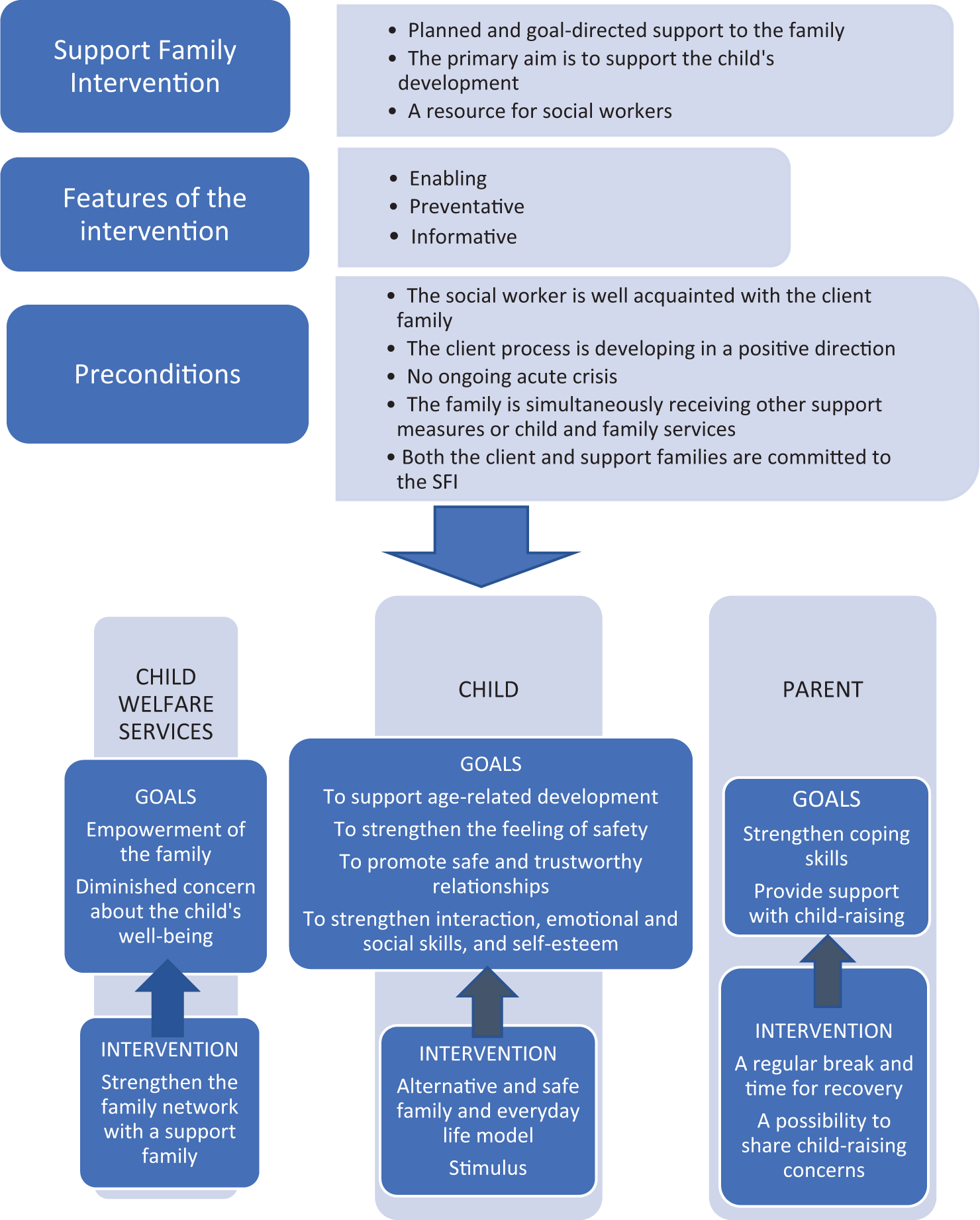
The programme theory of SFI (Svenlin, 2020).
The lower part of the diagram summarises the objectives of the intervention and the theory of change. The primary aims of the SFI are to support the child’s age-appropriate development and feeling of basic safety, provide safe and trusting relationships and strengthen self-esteem and social skills. The objectives for the parents are to strengthen their coping and parenting capacity and to provide educational support. From the perspective of the child welfare service, the aims are to empower the family and to reduce concern about the child’s wellbeing. The key strategy for achieving these objectives is to temporarily broaden the child’s network with a support family.
As the programme theory presented in Figure 1 is the first of its kind, it needs to be reviewed to ensure its validity and usefulness. Bearing this in mind, it is proposed that the SFI programme theory needs to be complemented by a child-centred dimension. Thus, we next evaluate it from the child’s perspective and focus on how the intervention is explained in relation to the child’s needs and wishes.
Methodology
Meta-ethnography was chosen as a synthesis method to evaluate the results of the two dissertations on SFI and to develop a child-centred programme theory (CCPT) of the intervention. The synthesis enables the building of a comparative understanding of the two studies, so that the result is greater than the sum of the parts (Noblit and Hare, 1988; Schick-Makaroff et al., 2016). We argue that by bringing the studies together, we can overcome the limitations of the individual projects and offer a fresh interpretation (Barnett-Page and Thomas, 2009; Bekaert et al., 2021; Sandelowski and Barroso, 2007).
Meta-ethnography
Meta-ethnography is an interpretive synthesis method first described by George W. Noblit and R. Dwight Hare, ethnographers in the field of education research. In their seminal work published in 1988, they proposed meta-ethnography as an alternative to meta-analysis. In brief, they developed a method for synthesising qualitative studies in a way that produces a new interpretation of results that is more than that obtained from simple aggregation. It provides an answer to the question of how to put together written interpretive accounts in cases where mere integration would not be appropriate (Barnett-Page and Thomas, 2009; Rocque, Brisset and Leanza, 2017). Strike and Posner define synthesis as ‘an activity in which separate parts are brought together to form a whole’ (1983: 346) accompanied by some degree of innovation. In qualitative synthesis, the units of analysis are generally themes, concepts or theories, whereas in meta-ethnography the units are qualitative research findings on a specific topic (Paterson et al., 2001; Schick-Makaroff et al., 2016).
Britten and colleagues (2002) and Campbell and colleagues (2003) conducted evaluations of meta-ethnography. They claimed that the method can produce theories with greater explanatory power than, for example, those obtained from a narrative literature review. One benefit of the method is the opportunity to regroup a multitude of qualitative studies exploring a similar topic. Synthesis also enables clarification of areas of research that are abundant and those where more research is needed. Meta-ethnographies have been conducted on various types of qualitative studies based on observations, individual interviews and focus group discussions (Rocque, Brisset and Leanza, 2017).
Data
The data included in this meta-ethnography comprise results from both the dissertations mentioned earlier. In Svenlin’s (2020) study, the starting point was to access social workers’ knowledge of SFI, as this was lacking in the existing literature, and to summarise it for incorporation into a programme theory. The aim was to strengthen the theoretical underpinnings of SFI and to enable its future evaluation. The reconstruction of the theory was based on a case study and focus group interviews with six social workers and two managers in a child welfare unit in a mid-sized Finnish city, undertaken in 2011 and 2014. In total, four focus group meetings with four to six participants were conducted. The managers were interviewed together twice, with one of them also participating in the last focus group session. The theoretical framework applied was critical realism, more specifically CAIMeR-theory, which aims to uncover generative mechanisms that explain how results in social work emerge from interventions and contextual conditions. CAIMeR is an acronym of five concepts: contexts, actors, interventions, mechanisms and results (Blom and Morén, 2019).
The second dissertation (Lehto-Lundén, 2020) focused on children’s experiences of SFI. The research question was: what meanings do children attribute to a support family? The research was anchored in research where the child is perceived as an active, experiential, informed and empowered individual. Furthermore, their experiences are valued as contributing to the formation of scientific knowledge (Qvortrup, Corsaro and Honig, 2009; Strandell, 2010). Existential phenomenology (Giorgi and Giorgi, 2003; Perttula, 1998) was the theoretical and methodological framework used. Data were collected using a five-step mosaic approach (Clark and Moss, 2001) during the years 2015–16. Children played an active role in gathering the research material and shared their experiences through interviews, drawings, taking photographs and making videos. In total, 43 research meetings were convened with 11 children aged three to 15, but mainly between seven and nine years old. All the children were clients of child welfare services (Child Welfare Act, 417/2007) in a large city in Southern Finland and all had been visiting their support family for at least a year. Consent was sought from the children themselves as well as from their parents, and a research permit was received from the municipality responsible for their welfare. Children were informed at each research meeting that the sessions with the researcher were confidential and that their participation was voluntary. For this reason, four of the children did not take part in all the data collection phases.
Given that the two dissertations differed in their theoretical frameworks and that re-analysis of the raw data was not possible, a decision was made to synthesise the results of the studies. We acknowledge that the findings are affected by the theoretical frameworks selected, but in our synthesis we perceive them as complementary. Phenomenology was the starting point for understanding the children’s experiences as it focuses on the individual’s perspective (Perttula, 1998). The CAIMeR-theory, as an application of critical realism, includes the actor’s perspective in identifying generative mechanisms (Blom and Morén, 2019). This ensured that the focus of the synthesis was the child, which deepens the knowledge about the most invisible actor in SFI.
Analysis
Our meta-ethnographic synthesis is based on the seven-phase model presented by Noblit and Hare (1988). The phases overlap and do not necessarily evolve in a linear fashion (Barnett-Page and Thomas, 2009; Noblit and Hare, 1988).
In Phase 1, ‘Getting started’, and in Phase 2, ‘Deciding what is relevant to the initial interest’, cyclic joint discussions between the authors were crucial in examining ideas on how to integrate the results of the two dissertations. In Phase 3, ‘Reading the studies’, the idea was to gain familiarity with the findings of each one and to clarify how they interrelated.
In Phase 4, we identified what types of relationship exist between the key phrases, ideas and concepts used to describe the child as a stakeholder in SFI. Here, ‘phrases’ refers to the results of the studies as worded by the original authors, which are thus second-order constructs (France et al., 2019). Noblit and Hare (1988) separate three types of meta-ethnographies (reciprocal translation, line-of-argument translation and refutational translation) depending on the type of relationship between the studies. At this point, to facilitate an understanding of the results across studies, we chose to use reciprocal translational analysis (RTA), which involves the ‘translation’ of phrases, metaphors or concepts from one study into another (Noblit and Hare, 1988; Rocque, Brisset and Leanza, 2017). This is a reasonable method as the phrases used in the studies aim to describe the key elements of the SFI from the child’s viewpoint.
In Phase 5, we translated the results of our studies into each other’s phrases (one case is like another, except that …). Interpreting meaning is key in RTA; in other words, translation is idiomatic rather than literal and should take each study’s context into account. In this instance, we made the translations by comparing our phrases describing the positioning of the child in the programme theory, the description of the context of the intervention and children’s experiences of the SFI. As a result, a list of phrases pertaining to children was extracted and is presented below (see Figure 2).
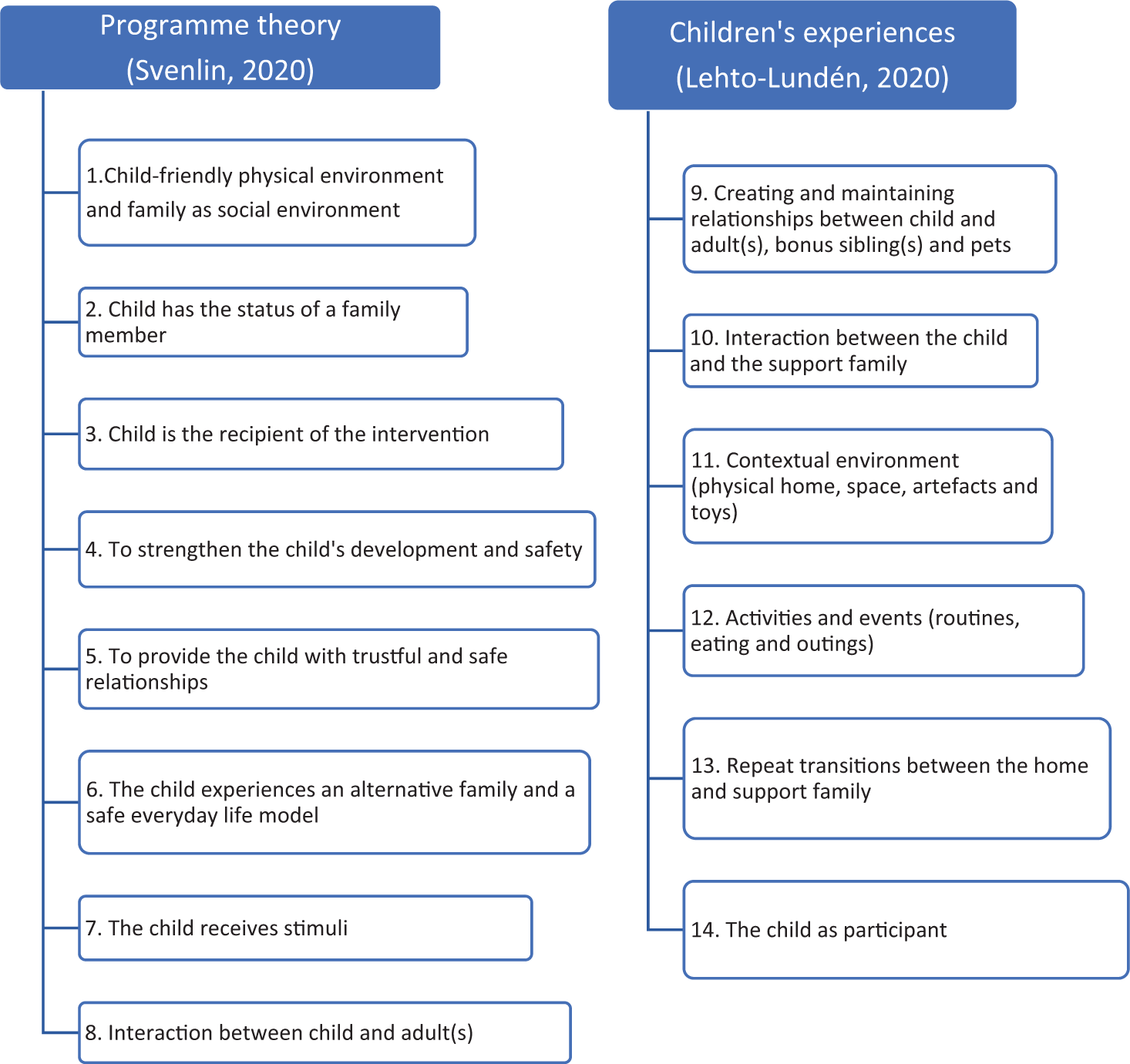
Phrases connected to the child in the original studies.
During Phase 6, ‘Synthesising translations’, the translations were synthesised into new entities. This is an inductive process in which an understanding is achieved by comparing it to what the researcher already knows or has experienced (see Turner, 1980). This sets off a process that goes beyond the findings of individual studies. It can be seen as ‘a second level of synthesis’ in which the translations from Phase 5 are compared to identify common or overarching phrases and develop new interpretations of them (France et al., 2019.) For example, ‘child as family member’ and ‘activities and events’ are related to each other as both depict child agency. In the last component, Phase 7, the synthesis is drafted and the results are disseminated, often in the form of a new conceptual and theoretical model (Rocque, Brisset and Leanza, 2017). We now summarise our results in a CCPT which explains how the intervention affects the child.
Results
In the SFI programme theory, the child is defined as the primary, but passive, object and receiver of the intervention. However, when children’s experiences of SFI are recorded, it becomes evident that they contribute actively to the programme. The intervention may be led by adults, but the child is at its centre. Next, we present the three categories of phrases yielded by the translational analysis. All three – activities, supportive environment and multiple relationships – illustrate how the intervention affects the child and how they act during weekend visits to the support family.
Activities
The first and largest category of phrases (see Figure 2: phrases 2, 3, 4, 7, 12 and 14) unites descriptions of the child as a stakeholder in the intervention. In the programme theory, the child’s concrete support during visits comprises stimuli, such as new experiences, joint activities and interaction with the support family. The child is also regarded as a family member with equal rights and the potential to influence and participate in family life.
The child as experiencer becomes visible in the descriptions of the different activities provided by the support family. For the children, routines and recurring events were the essence of being involved. Although support family weekends are outside of normal everyday life, continuity between visits, such as Saturdays being movie nights, was important for the children who reported many different activities not only inside but also outside of the support family home: [In the support family] I can just do a lot more, like, all fun stuff. We go fishing and bowling, as we don’t really go anywhere with my family. Well, it’s nice there [in the support family]. And there you can do little different things than here at home. (Child, age 10)
The children provided many examples of the stimuli they received in the support family, including physical activities like day trips and doing different things together with family members. The children visited places and engaged in various activities that differed from those in their everyday lives. An important aspect of outings with others is human interaction, which makes children feel that the relationship between them and the support family adult(s) is more equal. Being together in novel surroundings and exploring new activities flattens the power relation between child and adult (Lahtinen, 2018). The activities experienced with the support family also have added value for the children by, for example, introducing them to new hobbies and encouraging them to try new things and learn new skills. The time spent in a support family also includes routines which provide children with information and feelings of safety. Thus, the aim of strengthening the child’s development and safety is realised.
A supportive environment and relation to place
The phrases comprising the second category (see Figure 2: phrases 1, 6, 11 and 13) describe the quality of the support family context and its influence on the child. The main strategy in the SFI programme theory is to strengthen the family network, that is, to change the child’s physical and social environment during the weekend visit. Although this objective is not clearly expressed in the theory itself, the professionals saw the support family environment as displaying similar qualities. It should be supportive and activate the child in two ways. First, the physical environment should be child-friendly and safe as well as stimulating. Second, the social environment of the support family should provide the child with an alternative family and a safe model of everyday life. In social workers’ descriptions, both the physical and social environment of SFI represent the opposite of those inhabited by the child and birth family in their everyday world.
The children’s experiences indicate that the change of context and the support family environment have multiple meanings. The meaning of a new environment becomes visible in the repeated transitions between the everyday home and the support family. The journey to the support family is not insignificant for the child as it requires preparation (e.g., packing clothes and toys and waiting to depart), followed by the journey itself. This transition also evokes a wide range of emotions, such as excitement, anxiety and insecurity, in the child. The children’s experiences showed that such transitions are often related to adult decisions which assign the child a vicarious and outsider position. Almost invariably, the children reported that parent(s) and support family adult(s) organise matters relating to their visits and transportation. This suggests that adults may not fully recognise the multiple actions that transfers require of the child and the emotions they induce, as this interview with a nine-year-old child demonstrates: Researcher: Well, do you want to tell me what happens when you are going to your support family? Child: I’m always a little nervous about it before I leave. Researcher: Okay. Child: But then the nervousness goes away. Researcher: Mm, what’s so nerve-racking about it? Child: Hmm. I don’t know. It’s just nerve-racking. Researcher: And then it goes away or did you say that? Child: When I can get going.
Multiple relationships
The third category of phrases (see Figure 2: phrases 5, 8, 9 and 10) relates to the meaning and function the children and the SFI programme theory attribute to relationships. In this category, a safe and trustworthy relationship with a non-parental adult is specified as a goal. Thus, SFI can be defined as a relationship-based intervention. The need for a stable relationship with an adult is argued from the child’s perspective: the child often lacks relationships with safe adults and needs an adult’s attention and care. The relationship is presumed to emerge as a result of regular and active interaction between the child and the adult(s).
The children made multiple references to relationships as a fundamental part of the support. They described building relationships not only with the adults but also with the children in the support family who can thus become bonus sibling-figures. The quality of the relationships was highlighted in the way children talked about their feelings towards the support family, using words like care, trust, encouragement, safety and tenderness, for example: ‘Trust, yes … they [the adults in the support family] are trustworthy’ (child aged 10).
The children’s experiences also demonstrate that relationships are created with close others, such as the support family’s relatives and neighbours. The importance of pets was also emphasised. Indeed, in some cases, the child’s relationship with the pet was more significant than with people.
In the programme theory, a good child–adult relationship is the most important objective, so it is not essential that the support family has its own children. However, this is too narrow a view. A meaningful relationship can equally be formed not only with an adult, a pet or another child but also with the support family’s relatives or neighbours, or the location where the family lives. Thus, a more multidimensional understanding of relationships and their function can make professionals, support families and birth parents more sensitive to the potentially diverse relationships available to the child.
A child-centred programme theory
Addressing the question of how children’s experiences relate to the SFI programme theory was at the core of our synthesis. In Figure 3 below, we have visualised and summarised our proposal for a CCPT that describes the SFI and its logic from the child’s viewpoint. We use the concept child-centred to underline the value we place on including children’s experiences and knowledge. When CCPT is used side-by-side with the SFI programme theory, the implementation of the intervention becomes more sensitive to children’s experiences. The CCPT is visualised in a modified pipeline logic model which is a common way of representing programme theory as a linear process (Funnell and Rogers, 2011). The logic model is a simplification and an ideal model of how the support family impacts the child. This means there is always the possibility of unintended outcomes, and it is important to acknowledge that the relationships between the child and support family members are not always constructive.
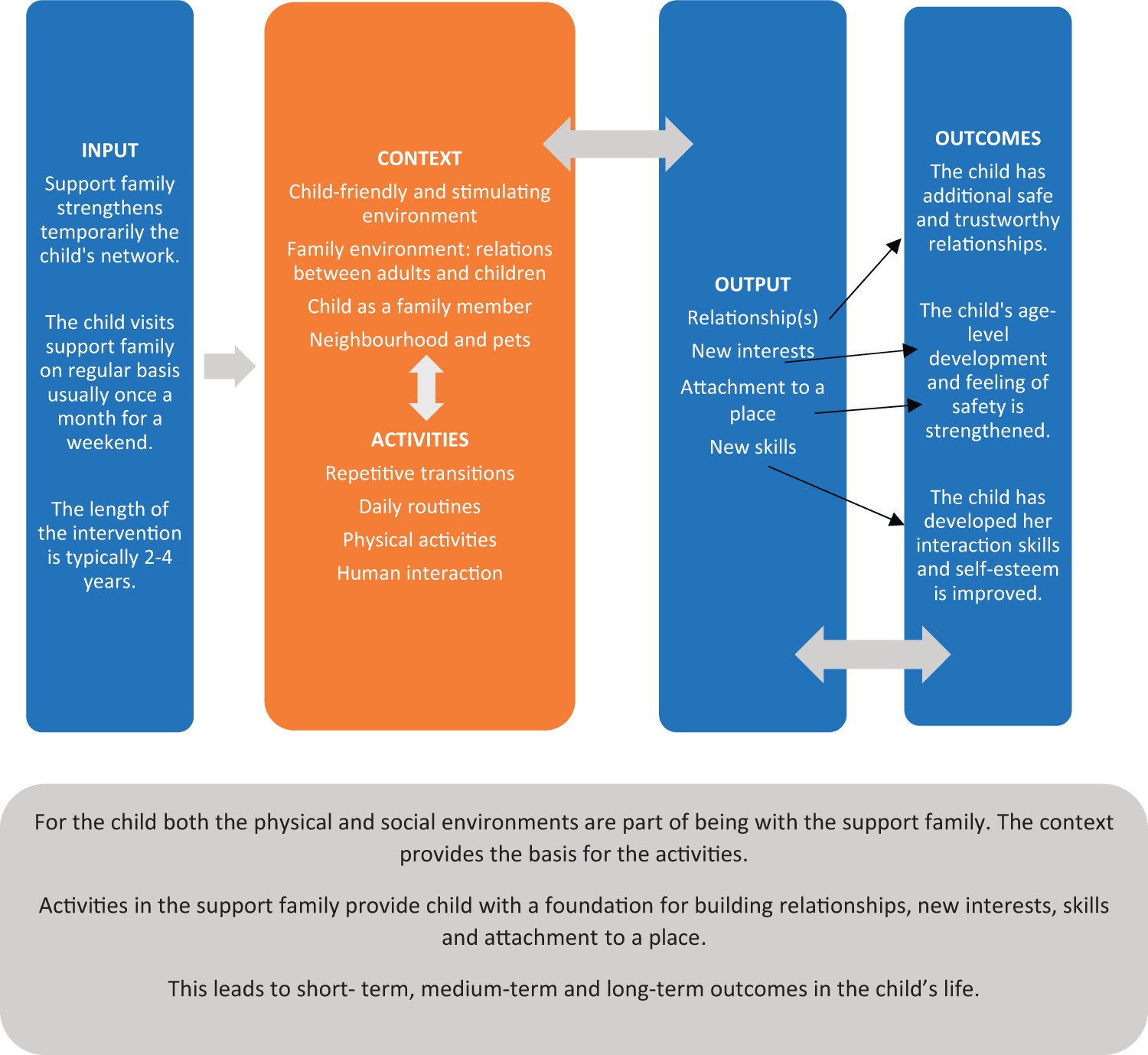
Child-centred programme theory (CCPT) of SFI.
In the CCPT context, activities and relationships are interconnected. This indicates that in SFI the relationship should be understood as a means to an end. It is a tool for achieving short-term outcomes in the child’s life (see Figure 3, ‘Output’) (Cavell, Spencer and McQuillin, 2021). We argue that conceptualising the relationship in this way makes for a more diverse picture of what the intervention can mean to the child. In the programme theory (Svenlin, 2020), the relationship between the child and the support family is primarily understood as an end in itself (see Figure 1, ‘Child’ and Figure 3, ‘Outcome’) as the relationship is considered to offer the basic conditions for the child’s development and feeling of safety (see Cavell, Spencer and McQuillin, 2021; Li and Julian, 2012). Since both perspectives are correct, a bilateral framework is recommended. This enables practitioners and researchers to specify in greater detail how time spent with a support family benefits the child and to identify the short- and long-term outcomes (Cavell, Spencer and McQuillin, 2021). This is important as it is difficult to distinguish the effect of a single intervention in reducing risk for compromised long-term development or out-of-home placement (Brännström, Vinnerljung and Hjern, 2015).
The CCPT also includes a description of the context, as for the child both the physical and social environments are part of being with the support family. The support family environment invites the child to explore and connect to a place (see also Christensen, 2004; Jack, 2015; Unrau, 2007). It is vital to understand the meaning of context to the child, as knowing what places are important to them supports the growth of identity, sense of security and feeling of belonging to the community. Place is a part of the child’s wellbeing (Chase, Simon and Jackson, 2006; Holland and Crowley, 2013; Jack, 2015). Finally, including context in the CCPT renders the child’s transitions visible to professionals and parents.
In conjunction with context, the activities specified in the CCPT indicate what happens during a typical support family weekend. A diversity of activities provides children with a foundation for building relationships in the support family. The key activities in CCPT represent children’s understanding of the support they receive. The activities are both concrete and observable and indicate ‘what happens’ in the relationship (Karcher and Hansen, 2014).
Discussion and conclusions
The aim of this study was to develop a CCPT that specifies SFI and its goals both from the child’s viewpoint and in relation to them. The CCPT clarifies the argument that the foremost aim of SFI is to support the child. It is a complementary conceptual model which describes the intervention from the child’s as well as adults’ perspective so countering the tendency for adults’ and professionals’ views to predominate (Aaltio and Isokuortti, 2021). It offers an example of how the child’s voice can be incorporated into a programme theory and increases the visibility of the child as both a service user and an actor who can impact the intervention.
Previous research has shown that it can be problematic if the child is unaware of the role and function of the support family (e.g., Larsen, 2011). Such uncertainty affects their ability, for example, to participate in negotiations on the continuance of the intervention, to be prepared for the transitions involved or to influence the activities pursued in the support family. Children who are aware of the goals and the purpose of the SFI and who have been involved in setting them seem to benefit more from the intervention (Larsen, 2011). The CCPT facilitates the child’s participation and understanding so these can be secured from the outset; it also makes it easier for professionals to explain to the child how the intervention works, reducing the power imbalance between children and adults. In practice, the CCPT can contribute to a more child-friendly implementation of child welfare services, starting from how interventions are introduced to children (Lucas, 2017) and strengthening their role in the welfare process (Berrick et al., 2015; Pert, Diaz and Thomas, 2017).
The CCPT would not have been possible without the link to childhood research (Alanen and Mayall, 2001) that Lehto-Lundén made in her study. Generally, when we seek information about a child’s life, we ask their parents or other adult experts familiar with them (Heimer, Näsman and Palme, 2018). The children themselves, especially those who are clients of welfare services, are easily bypassed, despite the importance of their inclusion stressed in child welfare research (Kiili, Moilanen and Larkins, 2021; Noble-Carr, Moore and McArthur, 2020). Genuine consultation with children and listening to their thoughts require the revision and re-evaluation of adult-centred thinking and action patterns, as well as changes in practices. Previous studies (e.g., van Bijleveld, Bunders‐Aelen and Dedding, 2020; Martins, Oliveira and Tendais, 2018), as well Lehto-Lunden’s (2020) study reviewed here, have demonstrated that when given sufficient opportunity, children generally have considerable capability to talk about themselves and their experiences.
Finally, we believe that it is important to examine how the change in physical environment affects a child in different respite care models and what place can mean to a child. While the idea of changing the environment can be traced as far back as Mary Richmond’s (1922) work, it has not, as Jack (2010; 2015) points out, been extensively discussed in relation to child and family services. Our results show that it is beneficial to conceptualise the context from the child’s viewpoint as this reveals new dimensions within the intervention. Today, in ‘a shrinking world of childhood’ (Jack, 2010: 761), children are likely to have much less contact with places (and people) beyond their immediate home and school than would be required for the development of their attachments to a place. The finding that the SFI provides children with activities and surroundings for outdoor exploration, play and other forms of social interaction is therefore important.
The possibilities for generalising the findings of this exercise lie in how children’s experiences can be embedded in the programme theory framework and inform professionals’ perspectives when they are tasked with explaining interventions to clients. A CCPT tells the story of a respite care intervention from both children’s and professionals’ viewpoints. It focuses on the child and enables a starting point for a practice-focused evaluation on the key question of what support families do with their guest children (Cavell, Spencer and McQuillin, 2021) and so prevents the risk of children’s experiences and voices being subordinated to those of adults.
Strengths and limitations
The CCPT presented here elaborates three key aspects of the theory currently informing SFI: a more nuanced description of the child as a stakeholder in the intervention, an investigation into the supportive properties of the environment and the activities provided by the support family to the child and clarification of the function of the relationships as a central element of the intervention. It also identifies processes and links factors that are unlikely to have emerged from roundtable discussion and connects them in a structured way.
However, the meta-synthesis was based on the results of two dissertations and the fact that the data were not collected directly for this study is a potential limitation. Nevertheless, the meta-synthesis covered research from Finland and elsewhere. The results are also potentially limited by the fact that the synthesis is based on a double interpretation where the same researchers reviewed their original research findings. To reduce this risk, a systematic and collaborative approach was followed but the influence of familiarity was ever present.
Finally, the value of the CCPT needs to be assessed by empirical testing of the hypotheses derived from it. As this evidence is not available, the hope is that its predictive value will be greater than what currently exists and that this will lead to better services for children and families.
Footnotes
Acknowledgements
We offer our thanks to Kerstin Svensson, University of Lund, Patricia McNamara, University of Melbourne, Johanna Kiili and Johanna Moilanen, University of Jyväskylä.
Declaration of conflicting interests
The author(s) declared no potential conflicts of interest with respect to the research, authorship, and/or publication of this article.
Funding
The author(s) disclosed receipt of the following financial support for the research, authorship, and/or publication of this article: This research was funded by the Ministry of Social Affairs and Health, Finland as part of Supporting the Child – support person and support family practice in child and family social work/SUSU research project 2021–22.
