




Abstract
Research reviews of the contact arrangements for children in care have highlighted gaps in evidence. Using data from 9,316 looked after children in England and Wales aged four to 18 years, the analysis aimed to gain an understanding of children’s views of their contact arrangements. Data came from the Your Life, Your Care wellbeing surveys distributed by 42 English and Welsh local authorities between 2016 and 2020. The analysis confirmed some previous findings but challenged others. While previous UK research has emphasised that the quality of contact is more important than frequency, from the young people’s perspective frequency was equally important. Most children wanted more contact with specific individuals (and their pets) to understand why decisions had been made and wanted contact to be normalised and in the community at times to suit their and their family’s circumstances. Children in kinship placements more frequently had contact, but a quarter of the sample had no parental contact. Being in residential care, male and of an ethnic minority background were associated with dissatisfaction. Life satisfaction was not associated with whether parental contact was or was not occurring but was statistically associated with whether young people felt their contact arrangements were ‘Just right’. Recommendations for improving practice and a tool to help agencies audit their services have been developed.
Plain language summary
Professionals and the courts determine how often children and young people in care see or speak to members of their family. This study used a survey to ask over 9,000 children in care (aged between four and 18 years old) whether they were happy with their contact arrangements. Most children wanted to see their family, including brothers and sisters, more often. They also wanted to see other people who were important to them and their pets. Many children felt they did not understand why decisions had been made and wanted to see their family in the community and not in contact centres. Children who lived with a foster carer who was also a relative more frequently had contact with their families. Those who lived in residential care, were male or were from an ethnic minority background more frequently reported that they saw their families too little. However, satisfaction with contact was not linked to whether it was or was not occurring but whether children felt the frequency was ‘Just right’. For some children this meant no contact at all. Ways to improve practice are described.
Keywords
Introduction
For many years there has been an interest in understanding the impact of birth family contact on children’s development and placement outcomes. Studies and research reviews have examined the relationship between family contact and the likelihood of reunification (Biehal, 2007), placements (Atwool, 2013; Wellard et al., 2017), mental health, child adjustment and wellbeing (Boyle, 2017; Geurts et al., 2012; Haight et al., 2001; Larkins et al., 2015; Poitras, Porlier and Tarabulsy, 2021; Sen and Broadhurst, 2011).
A recent rapid evidence assessment (Iyer et al., 2020) of the existing UK and international research examined what was known about the implications of contact for the wellbeing of children and young people who had been separated from their birth parents in public law contexts. It synthesised findings from 49 studies, including international academic and grey literature, published between 2000 and 2020. Most of these studies had small sample sizes, few included children’s views and none were able to demonstrate a causal link between contact and wellbeing. The authors noted that trying to establish causality is particularly difficult as wellbeing is made up of multiple domains and contact may impact differently on each of them, having simultaneously positive and negative effects (Iyer et al., 2020). Indeed, research on contact after adoption (e.g., Grotevant et al., 2011; Neil, Beek and Ward, 2015) has shown that wellbeing is associated with children’s satisfaction with their contact arrangements and not with whether contact is or is not occurring.
Across all the studies, the evidence is fairly consistent in that, generally, children wanted to see more of their families, be involved in contact decisions and have a choice about who they saw and when. Gaps in the evidence were also identified including the lack of younger children’s views, the views of those from minority ethnic backgrounds and a consideration of the implications of contact on wellbeing from the perspectives of children and young people. In this article, we aim to add to the evidence base on contact by reporting on the views of a large, fairly representative sample of looked after children and young people aged four to 18 years.
Method
The data for the analysis were drawn from Your Life, Your Care surveys completed by 9,316 children and young people from 36 local authorities (LAs) in England and six in Wales between 2016 and 2020. On average, the response rate to the surveys was 35% (range 15–84%) and all were completed before the first national Covid-19 lockdown in March 2020.
The surveys formed part of the Bright Spots programme, which is a partnership between the Rees Centre at the University of Oxford and Coram Voice (a children’s rights charity), with ethical approval from the ethics committee in the Department of Education at the University of Oxford. The programme uses three online surveys that have been co-produced with 140 care-experienced children and young people in care to capture the views of looked after children (aged 4–7 years and 8–10 years) and young people (11–18 years) on their wellbeing. The methodology to create the surveys has been reported elsewhere (Selwyn, Wood and Newman, 2017; Wood and Selwyn 2017; Zhang and Selwyn, 2020). Local authorities who use the surveys are supported by Coram Voice to distribute them to their care population. To ensure that children and young people are provided with the opportunity to take part, an initial working group meeting is held with key staff (and in some cases young people) to consider how lesser-heard voices (e.g., young people out of area, seeking asylum, in custody or with disabilities) can be included. Professionals are encouraged to support young people who need help completing the survey, but local authorities are also advised to avoid using foster carers or social workers as many of the survey questions ask about those relationships. Twice weekly response rates are shared with the local authority to make them aware of how effectively the survey is being distributed. Young people complete the survey anonymously: individual identifiers such as names and locations are not collected. Once the survey has closed and results analysed, each local authority is provided with a bespoke report on an analysis covering their local cohort. Follow-up meetings to disseminate the findings and explore how they can inform services are held. Further information on how the surveys are distributed and young people are supported can be found at: https://coramvoice.org.uk/for-professionals/bright-spots/bright-spots-programme/
The surveys contain four optional numerical questions on contact for children aged eight to 10 years and young people aged 11 to 18 years. The questions ask: ‘Do you see your mum?’ with response options of ‘Too much’, ‘Just the right amount’, ‘Too little’ and ‘I cannot/do not see her’. The same satisfaction question is asked about contact with dads and brothers/sisters. There is a further question that allows free comment: ‘Do you have any thoughts or opinions about how much contact you have with your birth family?’ An additional numerical response option, ‘Passed away’, was added during 2019–20. We had considered including that option when the surveys were first developed, but the children who co-produced the surveys felt that it could cause distress. However, young people who subsequently completed the surveys expressed irritation that the option was not provided and so it was added. Children aged four to seven years have a very short survey and are not asked about contact because court processes might still be ongoing and we did not want to cause distress. Their survey has a final free text question, ‘Anything else you want to say?’, and 50 children in this age bracket in our sample wrote a comment about contact arrangements in response.
Aims
Our analysis aimed to gain a better understanding of children and young people’s views of contact with their families. Research questions were:
Did children and young people express satisfaction with their contact arrangements? Were there differences in responses by age, sex, ethnicity, type of placement or length of time in care? What changes did children want to see in their contact plans? Was satisfaction with contact associated with their wellbeing?
Analysis
Data from the 42 LAs were merged and entered into SPSS v27 for statistical analysis. Analysis began with descriptive analyses (frequencies, means) on the numerical contact questions and cross-tabulations by sex, ethnicity and type of placement followed up with tests of chi-square independence with a Bonferroni correction to allow for multiple comparisons.
Text comments were entered into NVivo 12 software for a reflexive thematic analysis (RTA; Braun and Clarke, 2020). RTA was chosen because of its flexibility in allowing existing research to be the lens through which the data were analysed as well as enabling new themes to be conceptualised. The ‘No’, ‘Yes’ or ‘Nothing’ text responses were removed, as we could not be certain of what was intended by those comments. After removal, children aged eight to 10 years provided 1,137 text comments (47% of the sample) as did 1,947 young people of 11 to 18 years (40% of the sample). In total, there were 3,084 comments on contact arrangements with similar proportions of girls and boys providing text responses.
The RTA began with familiarisation by reading all the comments and making notes. Due to a large number of comments, deductive structural coding was used initially. Coding used the response options of ‘Too much’, ‘Just right’ and ‘Too little’. However, the organisation of codes, themes and subthemes was also conceptualised through the writing process, enabling a more inductive approach to examine, for example, whether boys and girls made sense of their contact arrangements in the same way. A key theme was satisfaction with the quality of contact with subthemes of context, feelings about contact and involvement in decision-making. The second main theme was satisfaction with the frequency of contact with subthemes of key relationships, no parental contact and reasons for satisfaction responses.
Following the RTA analysis, the 50 comments from children aged four to seven years were read. They were compared with the themes already identified to examine similarities and differences in their responses and are reported after the main findings.
Limitations
The Your Life, Your Care surveys have limitations. The age of respondents was not collected because the young people who co-created the surveys thought that such a question might reduce response rates for fear of identification. For the same reason, the surveys did not ask young people to identify as refugees or asylum-seeking young people. The question on satisfaction with sibling contact does not capture the complexity of sibling relationships. It was clear from the text comments that some siblings were seen while others were not. Survey data also provide limited information to understand the content of contact visits or whether any support was provided to make them successful.
The sample
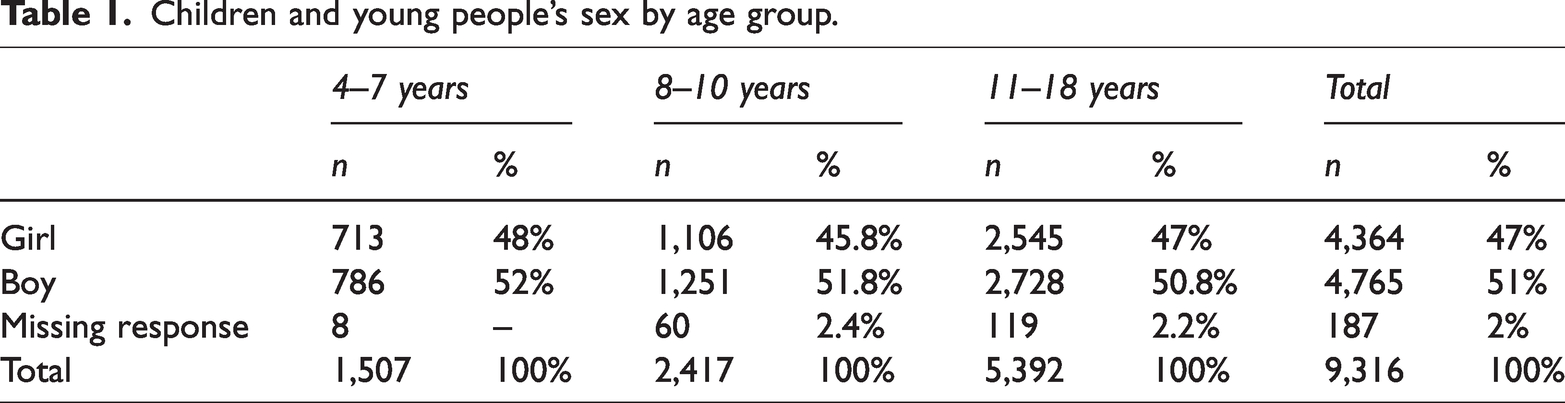
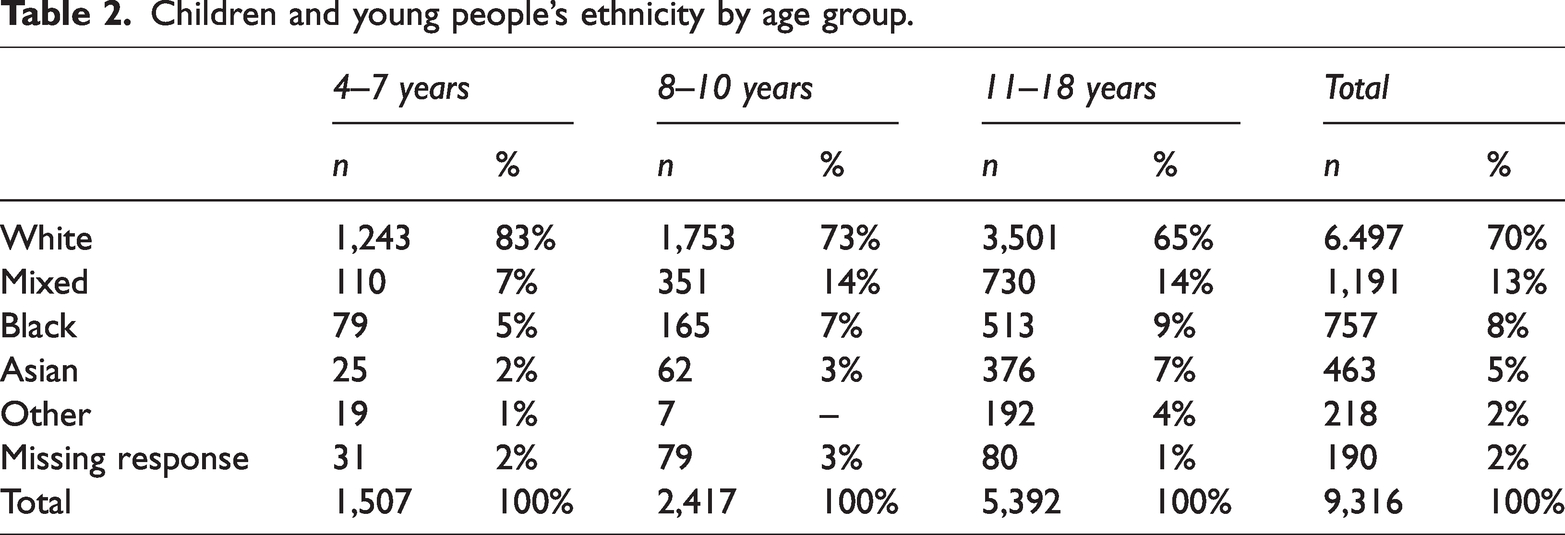
In total, 9,316 children and young people completed the surveys. The sex and ethnicity of those who responded are set out in Tables 1 and 2.
Children and young people’s sex by age group.
Children and young people’s ethnicity by age group.
Boys were slightly underrepresented in the survey responses (51%) as national statistics show that 56% of the care population are male (Department for Education [DfE], 2021).
Young people from ethnic minority backgrounds (28%) may have been slightly over-represented, as nationally they make up 26% of the total care population (DfE, 2021). Published social care data does not link age and ethnicity, but we would expect the proportion of young people from ethnic minority backgrounds to rise in the largest, 11 to 18 years sample group. Previous research (e.g., Bywaters et al., 2017) has found that Black children tend to enter care later than White children, and unaccompanied asylum-seeking young people mainly enter care during adolescence.
The ‘missing’ responses on ethnicity were not always missing, but children had responded in a way that did not match the categories that we, as researchers, had provided. For example, children (8–10 years) wrote in the text box that followed the ‘Other ethnicity’ option: ‘Olive’, ‘Cream’, and ‘Brown’. A few wrote, ‘Don’t know’. A few of the older group (11–18 years) also recorded their skin colour or wrote that they were ‘Muslim’ or ‘It doesn’t matter’, and more chose to leave the question unanswered. Some young people wrote they were from Afghanistan, Iraq or Iran and chose to categorise themselves as Asian when official DfE statistics record these ethnicities as ‘Other’.
Children and young people were asked how long they had been in care. Just over half (53%) of young people (11–18 years) had been in care for three or more years, as had 40% of those aged eight to 10 years and 21% of those aged four to seven years.
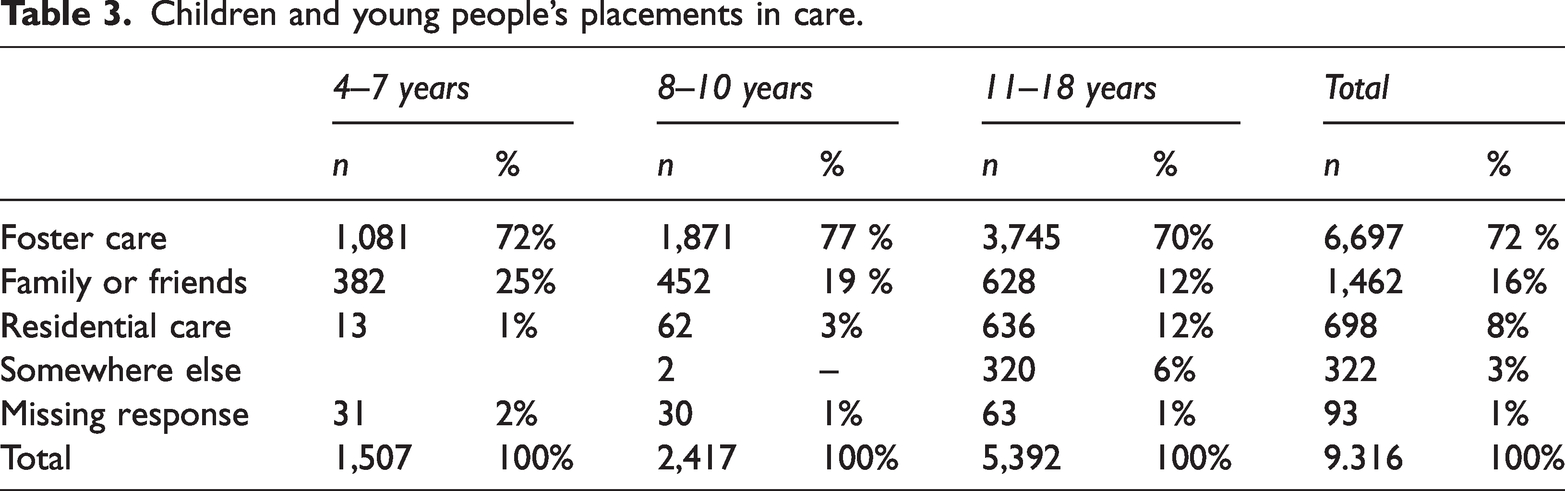
Children and young people also identified where they were living (see Table 3). The distribution of responses by type of placement was similar to the national care population statistics, with 72% in foster care and 12% of young people in a residential placement (DfE, 2021). Young people who responded that their placements were ‘Somewhere else’ were mainly aged between 16 and 18 years and in temporary or supported accommodation. Overall, the sample seemed to be fairly representative of the care population.
Children and young people’s placements in care.
Findings
In total, 2,391 children (8–10 years) and 5,289 young people (11–18 years) responded to at least one of the questions on contact (Figure 1) in the surveys, and 3,084 provided written comments. There were very few missing data: just 80 children and 103 young people skipped the questions on contact. For ease of reading, the age groups of children and young people are only repeated below when necessary for clarity.
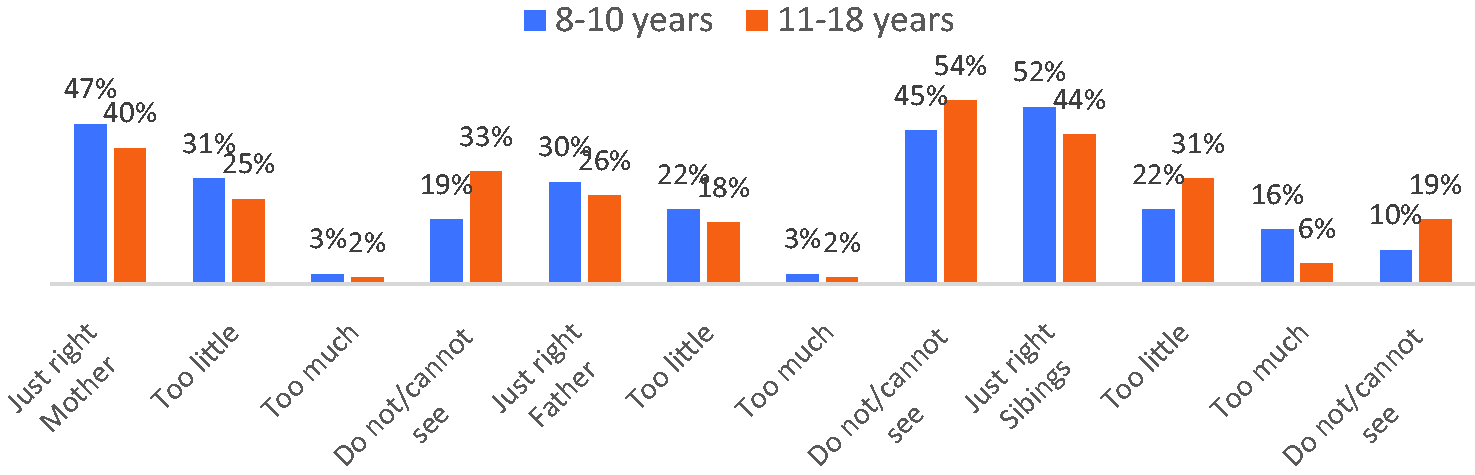
Children and young people’s satisfaction with family contact.See the online article for the colour version.
Satisfaction with the frequency of seeing relatives
Less than half of the children and young people felt that contact with a parent was ‘Just right’ (see Figure 1) or were satisfied with how often they saw their siblings. The majority of comments emphasised that more frequent contact was wanted.
Most children and young people wrote about wanting to see more of their parents and siblings but also wrote about wanting to see grandparents, great-grandparents, cousins, aunts, uncles, godparents, step-parents and their pets living at home. Text comments implied that extended family members often seemed to be omitted from children’s contact arrangements or to have contact limited to ‘special occasions’. Children and young people were very specific about the relatives they wanted or did not want to see, writing, for example: I don’t want to see my dad or my brother. I want to see my mom and granddad, grandma, uncle, my dog. (11–18 years) I’d like to see my dad sometime. I might see my auntie and uncle soon (dad’s cousin, I think). I’d also like to see my dad’s brother who has two sons. (8–10 years) When I meet my mum and dad it is a very happy thing and gives me a positive feeling that they are still there for me even though they can’t look after me. (11–18 years) I love to see my family. I love to go bowling. I am happy when I am with my family. (8–10 years)
Too little parental contact
A quarter of young people and nearly a third of children felt they were not seeing their mothers enough. Fewer (18–22%) felt they saw their fathers ‘Too little’, but children and young people also wrote about not knowing who their father was or never having had any contact with them and wanting information on their parentage. More than half (54%) of young people and 45% of those aged eight to 10 years had no contact with their fathers.
The majority of comments highlighted that either the frequency and/or the length of the visits were unsatisfactory. Children and young people who saw their parents six or 12 times a year wanted more frequent contact, with weekly or fortnightly being common suggestions, and longer visits: Would like more time, only have 2-hour contact. (11–18 years) I would like to see them every three weeks instead of every six weeks. (8–10 years)
Children and young people gave reasons as to why they thought contact was infrequent such as their own family’s circumstances, the long distance that they or relatives had to travel and feeling that their social worker had not made the necessary arrangements: I want to see my family more. My social worker is supposed to be doing police checks. I have been here since September and the checks have not been done. It’s not like I can just visit. I live five hours from home. (11–18 years) I wish my parents would always turn up. (8–10 years) [There is] Not enough [contact] because no one wants to fund it. (11–18 years) I’d like the contact to be in [my hometown] … Mum doesn’t have much money and it costs to get to [name of town]. (8–10 years)
The importance of the location and activities
Children and young people wrote about wanting contact to offer privacy, be easy to get to, to take place in large enough rooms or outdoors and for the visit to involve everyday activities, such as walking the dog, going for a meal and playing games. Children and young people were generally dismissive of child contact centres. These centres began in England in 1985 and were set up to support and promote children’s safe contact with relatives. However, children and young people wrote about small, drab contact centres with limited activities. They felt it was difficult to keep conversations going when there was no activity for everyone to engage in, especially if they were not allowed to use iPads or mobile phones. For example, one child wrote: ‘The place is too small, and so I would like it to be longer and outside. It feels more like a family day out that way.’
The need for supervision was also questioned, and some children commented on contact supervisors being too intrusive or tapping on their laptops during the visit: I would like to see my mum without social workers listening to everything. (11–18 years) I would like to see my mum without anyone being there because I feel like I can’t say … ‘I love you’ to my mum. (8–10 years) Can’t happen at the weekends. How stupid is that! I am told the ‘contact team’ doesn’t work at weekends. If that is their job, then they should work when I can have contact … not just business hours. It’s stupid, stupid, stupid. My mum works and so after school contact is difficult and only an hour! (11–18 years) I hardly ever get to contact my two youngest brothers … The contact times are all almost impossible for me to make it on time or get time off work. (11–18 years) I would rather go to my clubs after school than have contact. I like going to contact on Christmas, birthdays, and half term and when we have no clubs [after school]. (8–10 years) It doesn’t go well often because I lose it, or my dad loses it, and we argue. I would like to see my mum more often … she’s had knockbacks that made herself see us less … there also could be more help for the parents … more support.
Too much parental contact
A minority (2–3%) wanted parental contact to cease or be reduced. A few provided reasons why they felt it was too much and wrote about feeling unsafe: I’m scared of my dad, but I still have to have contact with him. I don’t want to. (11–18 years) I don’t want to see my parents until they stop taking drugs. (11–18 years) I don’t like going to dad’s. It makes me feel unsafe. (8–10 years)
Seeing brothers and sisters
The majority of comments from children and young people were about how much they enjoyed being with siblings and wanted to see brothers and sisters more often: I like living with my sister, but I don’t have enough contact with my other brothers and sister. (8–10 years) Only see my brothers and sisters at Christmas – want to see them more. (8–10 years)
While 9% of children and 19% of young people reported that they could not see their siblings, the proportion who were not in contact with all of their siblings was likely to be greater as 39% of written comments in the analytical theme of ‘No contact’ referenced siblings. Girls in both age groups provided more comments than boys on sibling contact, and most of these comments asked for more frequent contact.
The reasons given for the lack of sibling contact included: a younger sibling had been placed for adoption or parents were preventing contact with siblings who lived with them, difficult sibling relationships, distance from placements, siblings living in another country and, in a very small number of cases, the young person had been assessed as a risk to their siblings. For example: I can’t have contact with my young brother because he is adopted. I’m only allowed to write to him twice a year. (11–18 years) I would like more contact with my family – my sister does not want to see me, but I want to see her. (11–18 years) I don’t know how to contact my brother in [country]. I would love to see him, as he is the only sibling I have – our parents are dead. (11–18 years)
Sibling contact seemed to be particularly important for girls aged 11 to 18 years, with some writing that their contact with siblings was more important than contact with parents: I’d personally like more contact and time with my siblings. I currently feel like I never want a relationship with my mother. (11–18 years) I’d like to see my siblings more and my parents less, but I’m not allowed to see my siblings at all. (11–18 years)
No contact with parents
More than a quarter (1,313 or 26%) of young people and more than one in 10 children (299 or 12%) recorded no contact with either parent, with written comments provided by 441 respondents. In addition, 253 supplied the reasons why they had no contact with their father, and 68 commented on no contact with their mother. Children and young people reported that they did not have contact due to:
children and young people’s own decision to stop contact; parents not living in the UK (e.g., unaccompanied asylum seekers); parent’s substance abuse or mental health difficulties or parents refusing contact; bereavements; contact having been assessed as not in the child’s best interests.
Many young people wrote that they had decided to stop contact: ‘I’m allowed to see my mother but choose not to.’ They also wrote about their strong feelings that had led to them deciding that they did not want contact, for example: ‘I hate my mum’; ‘I want to kill my dad’; ‘I have given up on them’; ‘I do not see them and hope it stays that way’.
Children and young people also wrote about perceived parental rejection and differential treatment: I want to see more of them, but my family don’t really want to see me. (11–18 years) My mum doesn’t come. I don’t think she cares. (8–10 years) I don't want to see my dad because he says he loves my sister more than me and treats me differently. (8–10 years)
Young people wrote about their parents’ mental health problems and substance misuse preventing contact visits: I wish I could see my mum, but she has a lot of mental health problems such as bipolar and BPD [borderline personality disorder] and I know she has more but that’s all I know about. I can’t see my dad (11 to 18 years) I feel like social workers are keeping a big secret about my dad. (11–18 years) I’ve never had a dad and I really want to meet him. (11–18 years) I don’t know why I don’t see my dad. I worry about it because he might be dead. (8–10 years) The Red Cross are going to help me, but I have been waiting a long time. I feel very, very bad about not knowing if my mother or my sisters are even alive. I spend a lot of time worrying about them. (11–18 years) I sometimes worry about my mum because she has been deported from the country. (8–10 years)
Bereavements
In 2019–20 when a response option of ‘Passed away’ was added to the survey, 7% of young people (11–18 years) and 3% of children (8–10 years) recorded that their mother had passed away and respectively 9% and 5% their fathers. In comparison in England and Wales, just 1% of children in the general population experience the death of their mothers under the age of 16 years old (Office for National Statistics [ONS], 2019). A few children and young people wrote about the death of parents, siblings, step-parents and grandparents or seeing parents in their dreams and wanting to visit graves: ‘I would like to visit my mum and sister’s grave.’
Feeling included in decisions on contact
Young people wrote about wanting contact to be more responsive to changing circumstances and to their growing maturity. There were many complaints of contact arrangements being inflexible and unresponsive to life events such as grandparents who became ill: ‘I deserve to have more [contact] as my nan is poorly and this hasn’t been taken into consideration’ (11–18 years).
There were slightly more comments on feeling included rather than excluded from contact decisions from young people (11–18 years). They wrote about being listened to, their views respected and being given information. For example, a young person who had no parental contact wrote: ‘I am not pressured into seeing them … being listened to … is very good. It makes me feel significant.’
Children (8–10 years) more frequently wrote about being excluded and not understanding the reasons why decisions had been made: ‘It has been cut down to once a week and this makes me sad. I don’t know why contact was cut down.’ Children’s anxiety and worry were evident: ‘I don’t understand why my mum can’t keep me safe’; ‘I think my grandmother will die soon because she is old’.
Factors affecting satisfaction with contact
We examined factors that might be statistically associated with ratings of contact. Length of time in care, sex and type of placement were all statistically significant, although all associations had a small effect size. As the length of time in care increased so too did satisfaction with the frequency of contact. A third (33%) of young people who had been in care for less than a year recorded that contact with their mothers was ‘Just right’ compared with 44% of young people who had been in care for three or more years (d = .067; p < .001). There was a similar increase in satisfaction with sibling contact (d = .064; p < .001) and a smaller increase in satisfaction (not statistically significant) with contact with fathers (rising from 22% to 28% reporting ‘Just right’ after three or more years in care). Children (8–10 years) had the same pattern, with satisfaction increasing the longer the child had been in care.
Placements also affected ratings of satisfaction. Young people in residential care more frequently reported that they had ‘Too little’ contact with their mothers, fathers and siblings compared with young people in foster or kinship care. More than a third of those in a residential placement (35%) felt they saw their mothers ‘Too little’ compared with 25% in foster care and 24% in kinship care (χ2 = 166.103 [n = 5,077]; df12, p < .001).
While there was no difference in satisfaction with the frequency of maternal contact for young people in foster or kinship care, there were significantly more children (91%) and young people (87%) in kinship care having contact with at least one of their parents compared with children (87%) and young people (71%) in unrelated foster care (χ2 = 50.700 [n = 3,690]; df1, p < .001).
A statistically significant larger proportion of boys compared with girls aged 11 to 18 years had no contact with either parent (χ2 = 39.675 [n = 5,042]; df2, p < .001). The difference by sex may be because 62% of those in residential care were boys. There may be several reasons for the association between residential care and lack of contact. Residential units tend to be at a greater distance from the family home compared with foster placements (Ofsted, 2014), or residential placements may be needed if a young person has more challenging behaviour, and that may also lead parents or young people to reduce contact.
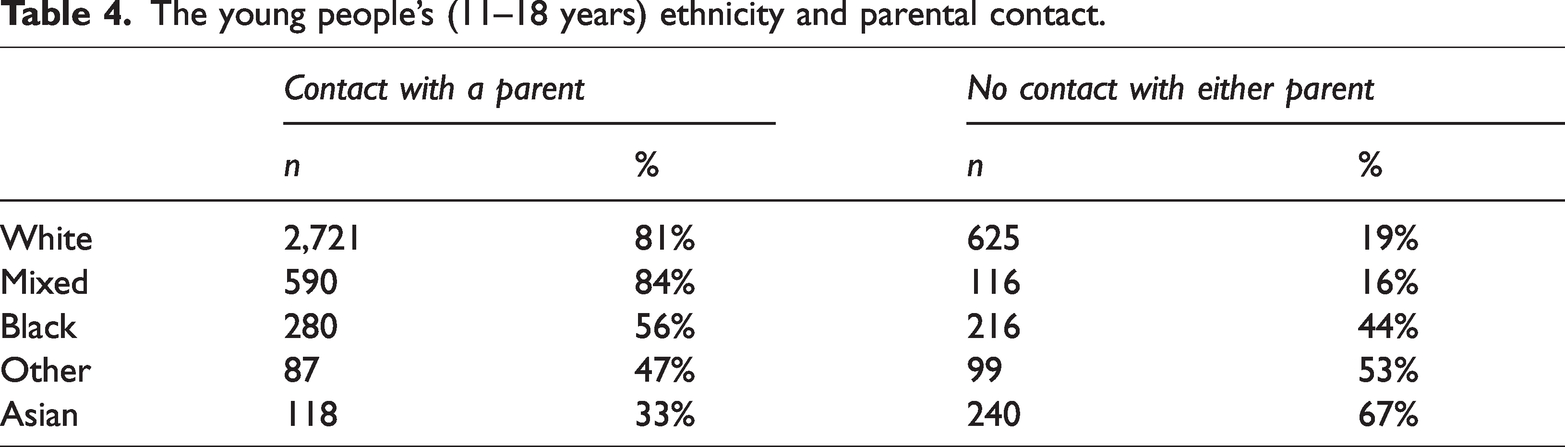
We also considered whether the child’s ethnicity was associated with whether contact was occurring. There was no statistical difference in the presence/absence of contact and ethnicity for those aged eight to 10 years but there were statistically significant differences and moderate effect size for those aged 11 to 18 years (χ2 = 603.15 [n = 5,100]; df4, p < .001; Cramer’s V.344). Post hoc analyses of pair-wise comparisons revealed that most White and Mixed ethnicity young people had contact with at least one parent (see Table 4). The Black and Other ethnic groups were statistically similar and had significantly less contact than the White or Mixed ethnicity young people. Young people who self-identified as Asian had the least and were statistically different from all the other ethnic groups. As noted in the method, information was not collected on whether young people were unaccompanied asylum seekers or refugees, but many of the Asian young people with no parental contact wrote that they were from Iraq, Iran and Afghanistan and a smaller group recorded that their parents lived in Bangladesh, Pakistan or Vietnam.
The young people’s (11–18 years) ethnicity and parental contact.
Young people’s wellbeing
The Your Life, Your Care survey for young people (aged 11–18 years) contains three personal wellbeing questions on a 0–10 scale, which are also asked of young people in UK general population surveys (ONS, 2018). The three questions ask:
Overall, how satisfied are you with your life as a whole these days? Overall, to what extent do you feel the things you do in your life are worthwhile? How happy did you feel yesterday?
Young people’s scores were placed into the same bands as those used by the ONS: low life satisfaction (0–4 score), moderate (5–6), high (7–8) and very high satisfaction (9–10 scores). Cochran-Armitage tests of trend were run to determine whether a linear trend existed between young people’s ratings on each of the wellbeing questions and the proportion of young people who felt contact with their mother, father and siblings was ‘Just right’. There was a statistically significant linear trend with higher scores on each question associated with contact being described as ‘Just right’. The trend was most marked (p < .001) in young people’s ratings of their life satisfaction and contact with mothers (see Figure 2).
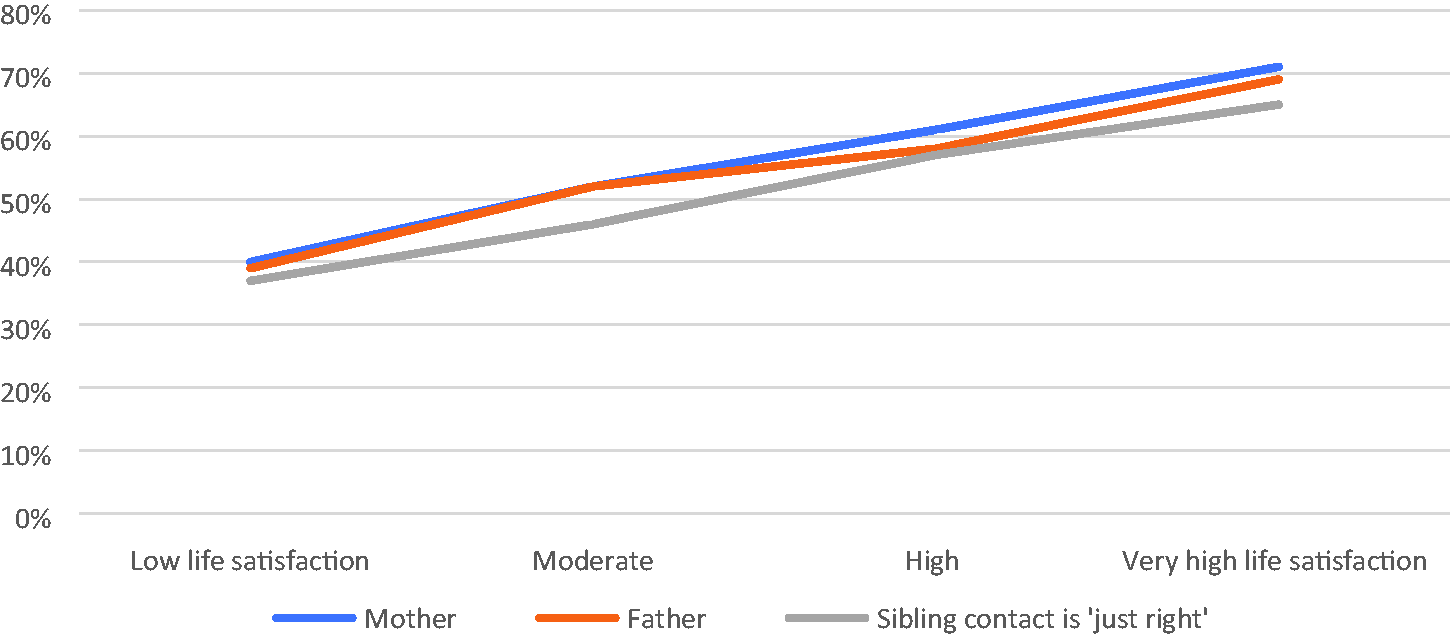
Life satisfaction: The percentage of young people within the four bands feeling contact was ‘Just right’.See the online article for the colour version.
In the wider literature, there is substantial evidence that higher life-satisfaction scores are correlated with happiness, academic attainment and better physical and mental health (Gutman and Vorhaus, 2012; Helliwell, Layard and Sachs, 2013; Huppert, 2014). However, the presence or absence of parental contact was not associated with life satisfaction in our study (χ2 = 5.990 [n = 4,899]; df3, p < .112). This statistical finding was also supported by the text comments provided by many young people who emphasised that they had decided to end contact. The finding also supports previous research on children adopted from care (e.g., Neil, Beek and Ward, 2015) which found that young people’s satisfaction with their contact arrangements was associated with better outcomes rather than the presence or absence of contact. It is, therefore, important to understand from children and young people’s perspectives who they want to see and how often.
The views of children aged four to seven years
The youngest children did not have survey questions asking about contact, but 50 (3%) chose to write about it when asked: ‘Is there anything else you would like to say?’ The themes in their text comments were the same as those identified for the older children, although their responses showed that they had little understanding of their contact plans and did not feel involved in or informed about decisions. A small minority wanted to stop seeing their families while the majority wanted to spend more time with their parents and siblings. Contact centres were unpopular because they were often some distance from placements, resulting in complaints about car sickness and tiredness. Children in this age bracket wrote: I would like my contact meetings to be more often as they are only every four weeks. I’m sad because I only get to see my mum a little. I miss my dad too. Can I see my sister more than I do? Is it the plan that I’m going to live with her? I was supposed to see mummy yesterday at the contact centre, but it was cancelled. I asked why, and nanny said she was ill. I am worried about her. [I would prefer] Not travelling to contact so much. It’s a long way in the car and it’s bedtime when we get back.
Discussion
More than 9,000 looked after children and young people gave their views on their contact arrangements, including 50 children aged four to seven years whose views are rarely sought. Many of the historical messages from children and young people on contact (e.g., Wilson et al., 2004) were repeated in this study, suggesting that for children little has changed. The findings also suggest that the weaknesses of an insufficient conceptualisation of contact and a low priority in social work practice, identified in Boddy and colleagues’ (2014) research with stakeholders in Children’s Services, continue to be an issue.
While previous UK research has emphasised that the quality of contact is more important than the frequency, from young people’s perspectives frequency was equally if not more important. Infrequent contact left children anxious about when the next visit would be and raised anxiety and expectations before meetings happened. Interestingly, an Australian study (Cashmore and Taylor, 2017) found that frequency of contact was the most significant predictor of whether children in foster, kinship and residential care reported positive relationships with birth family members. However, the study’s authors noted that it was likely that those with good relationships were more likely to have frequent contact and therefore the association between frequency and good family relationships was not causal. While our study cannot attribute causality, the evidence from children and young people suggests that the quality of relationships is associated with frequency and the frequency of contact is associated with the quality of relationships. It is bi-directional. If the frequency is set at once every six weeks or longer, it is easy to see how parents feel they no longer have a role, visits become more difficult and relationships deteriorate.
The survey could not provide information on why so much contact was happening in contact centres. It is not that long ago that most contact was managed by foster carers, allowing relationships to be built between the carers and the birth parents and enabling parents to know who was caring for their child. Recommendations in a review of foster care (Narey and Owers, 2018) and the recent Care Review (MacAlister, 2022) suggest a greater use of delegated authority for foster carers, which might enable contact to take place away from contact centres.
Some of the youngest children (4–7 years) complained about long journeys to centres and having to go straight to bed when returning to their foster carers. Good practice (e.g., Bullen et al., 2016) would indicate that children have time to talk with their carers about their visit rather than taking those feelings to bed. Children (8–10 years) also complained about tiring journeys, the timing preventing them from doing activities with friends and worrying about the cost for their parents. Teenagers also did not like the centres, as they felt they were set up for younger children and wanted to use their phones/the internet. Distances also made sibling contact difficult and the financial costs of travel acted as a barrier.
Contact plans are often prepared during the care order application. It is therefore incumbent upon the independent reviewing officers (who chair children’s care reviews) to thoroughly consider whether supervised contact is still necessary at every looked after child review. Findings from this study suggest that greater efforts should be made to enable contact to take place in the community, perhaps being overseen by members of the extended family.
About one in five young people had no contact with either parent, and this was particularly the case for those in residential care and boys. Our previous research (Briheim-Crookall et al., 2020) found that care leavers with no trusted adult in their lives more frequently had low wellbeing and were struggling. All young people need a network of adults to support their wellbeing but for those who have no parental contact, it is particularly important to identify adults who could provide support as the young person leaves care and moves into adulthood (see for example the Lifelong Links programme: frg.org.uk/lifelong-links).
Our analysis aimed to provide a better understanding of children’s views of their contact arrangements. Building upon these findings, recommendations for practice and an audit tool for agencies have been developed and can be found at: www.coramvoice.org.uk/staying-connected-report. There has been a renewed focus on relationship-based practice in social work, but the comments from the children and young people in this study challenge whether that focus has truly shifted to understanding the key relationships in children’s lives. The key relationships (and that includes pets) have often not been identified, and there has been a formulaic approach to contact. Many children reported the same contact plan of six-weekly visits with a parent, which from their perspective was inflexible and was arranged to meet the needs of the agency rather than the needs of the family and the child. Taking account of and acting upon young people’s wishes and feelings around contact, rather than having a fixed view on how often and with whom, is likely to be beneficial for young people’s wellbeing and to improve outcomes.
Footnotes
Declaration of conflicting interests
The author(s) declared no potential conflicts of interest with respect to the research/authorship, and/or publication of this article.
Funding
The author(s) disclosed receipt of the following financial support for the research, authorship, and/or publication of this article: The Bright Spots programme is funded by the Hadley Trust. The authors received funding to analyse the survey responses.