




Abstract
Children in care have consistently lower educational attainment than peers who live with their birth families. However, metrics often define ‘education’ narrowly, focusing on traditional in-school achievements with which this population typically struggles. In this study, interviews with current and former children in care (n = 7, ages: 11–59) revealed that they perceive education in a much broader way, occurring across their life experiences and encompassing both life and social skills. Regardless of their performance in school, participants storied themselves as achievers in the context of this broader concept of ‘education’ and described positive outcomes such as independence, agency, development of authentic identities and capacity to strive for and achieve goals. These reflections have implications for the provision of social support services and the evaluation of outcomes for children who are taken into the care of the state. For example, it may be valuable to redefine ‘education’ to include a wider range of activities and to therefore encompass a variety of potential interventions to support development and success. Additionally, there seems to be scope for working more closely with children in care when making decisions, centring their lived experiences and drawing on their insights so as to achieve a better balance of support for both formal and informal educational opportunities.
Keywords
Introduction
It is widely acknowledged that looked after children have consistently lower educational achievements than those young people who are brought up by their birth families (Department for Education [DfE], 2020). Analysis of national data shows that this gap is widening (Mannay et al., 2017). Existing research has focused on three main areas of endeavour: quantitative examinations of measured academic achievement (eg., Coulton and Heath, 1994; Essen, Lambert and Head, 1976; O'Higgins, 2018; O'Higgins, Sebba and Luke, 2015); the effects of specific interventions, such as the Letterbox Club (Griffiths, 2012); and outcomes for adults who have been in care (Bright, 2017). In addition, there has been a small body of sociological work undertaken which considers the overall life experiences of children in care, in which formal education is one element (Happer, McCreadie and Aldgate, 2006; Holland et al., 2008; Mannay et al., 2017; Renold et al., 2008). However, there has not been a study to date that allows participants to construe their own understanding of ‘education’. While some looked after children perform well in school, they are in a minority; this disparity has consistently been observed not only in the UK but also internationally.
There is not convincing evidence that educational interventions are successful in improving outcomes for looked after children (Mannay et al., 2015). The Children’s Commissioner in England commissioned a report into the life outcomes for vulnerable children. It identified poor outcomes across four key areas: educational, economic, social and behavioural (Bright, 2017). Poor educational outcomes have also been found internationally (Jackson and Cameron, 2011; Pecora, 2012). This could be a result of either measuring the wrong outcomes or because the interventions are not targeted to students’ needs. This begs the question: do we need to ask the young people themselves what would be helpful?
Jackson and Cameron (2011), in a study across five European countries (Denmark, Hungary, Spain, Sweden and England), suggest that only 8% of care leavers progress to higher education, a figure that is around five times lower than the average for all young people. In the current educational climate, where it is accepted that higher education leads to better life chances for young people, this apparent inevitability suggests that there are factors in the lives of children in care that promote weaker educational outcomes and that will affect their adult lives. A recent report from the Tony Blair Institute for Global Change (Coulter et al., 2022) predicts that jobs requiring high-level skills, of the sort gained at university, are likely to grow. It suggests that the UK should aim for participation rates that match high-innovation countries, namely between 60% and 70%. Without change there is a real risk that care-experienced individuals in UK society will become more disadvantaged over time.
While some studies have recognised that formal education is only one element of a child’s wider life experience (Happer, McCreadie and Aldgate, 2006; Hillman et al., 2008; Holland, 2009; Renold et al., 2008; Social Work Inspection Agency, 2006), this research has failed to sufficiently characterise and evaluate other sources of learning and development and, furthermore, has not given the looked after children themselves a chance to provide in-depth commentaries on their own experiences.
Selwyn and colleagues’ (2018) study of looked after children’s views on their wellbeing used anonymous questionnaires to gather information on how they felt about their lives. It touched upon attitudes towards education within its wider remit, finding that enjoyment of school decreased with age. However, the use of questionnaires did not allow any deeper understanding of these attitudes. So, to develop our understanding of the experience of education for a child in care, this article utilises biographical narrative interviews and a theoretical framework developed from the sociologist Bourdieu’s theory of practice.
McAdams (2008) suggests that in early adolescence, individuals begin to construct a narrative of their lives in order to make sense of who they are and how they fit into society. This ‘storying’ of life is compatible with Bourdieu’s concept of habitus (Barrett, 2015), being reminiscent of his notion of ‘social trajectory’, a consideration of positions occupied within a social space. By understanding the participants’ interview responses within the ‘fields’ in which they were recalled, i.e., the social fields of being ‘in care’, ‘in education’ and ‘a care leaver’, it was possible to focus on how education was understood by the participants themselves. While young people in care are used to having their behaviours documented by the adults around them, this study allowed the voices of the young people to be heard.
Research framework
This study was designed to examine the educational experiences of looked after children by gathering their stories, as told in their own words. A theoretical framework was developed to analyse their stories: the concepts of reflexivity, agency and Bourdieu’s habitus were operationalised respectively as ‘thinking’ (investigating participants’ reflexivity with respect to both formal and informal educational experiences); ‘doing’ (capturing participants’ capacity to make informed decisions in service of their needs and despite constraints imposed on them from outside); and ‘being’ (understanding how participants’ perceptions of their own histories and development have contributed to their current sense of identity). This framework allowed the study to focus on how the participants perceived their own education, providing a useful benchmark from which to consider education more holistically.
Reflexivity/thinking
For the purposes of this article, ‘thinking’ is viewed through the lens of reflexivity, that is, the mental ability to view oneself in relation to social context and to view the context in relation to oneself (Archer, 2007). This internal conversation then allows an individual to begin to determine their own course of action.
Agency/doing
Reflexivity supports ‘doing’ which is related to the concept of agency. Agency can be defined as ‘the capacity of individuals to act independently and to make their own free choices’ (Barker, 2008: 448). This ‘doing’ can be seen as the ability to control events in their lives independent of social structure (Chin and Phillips, 2004).
Habitus/being
‘Being’ is construed through Bourdieu’s concept of habitus, which describes how we are predisposed to act in certain ways (Bourdieu, 1977). It answers the question of why we do what we do when there are no ‘rules’ (Grenfell, 2014).
Methods
Participants
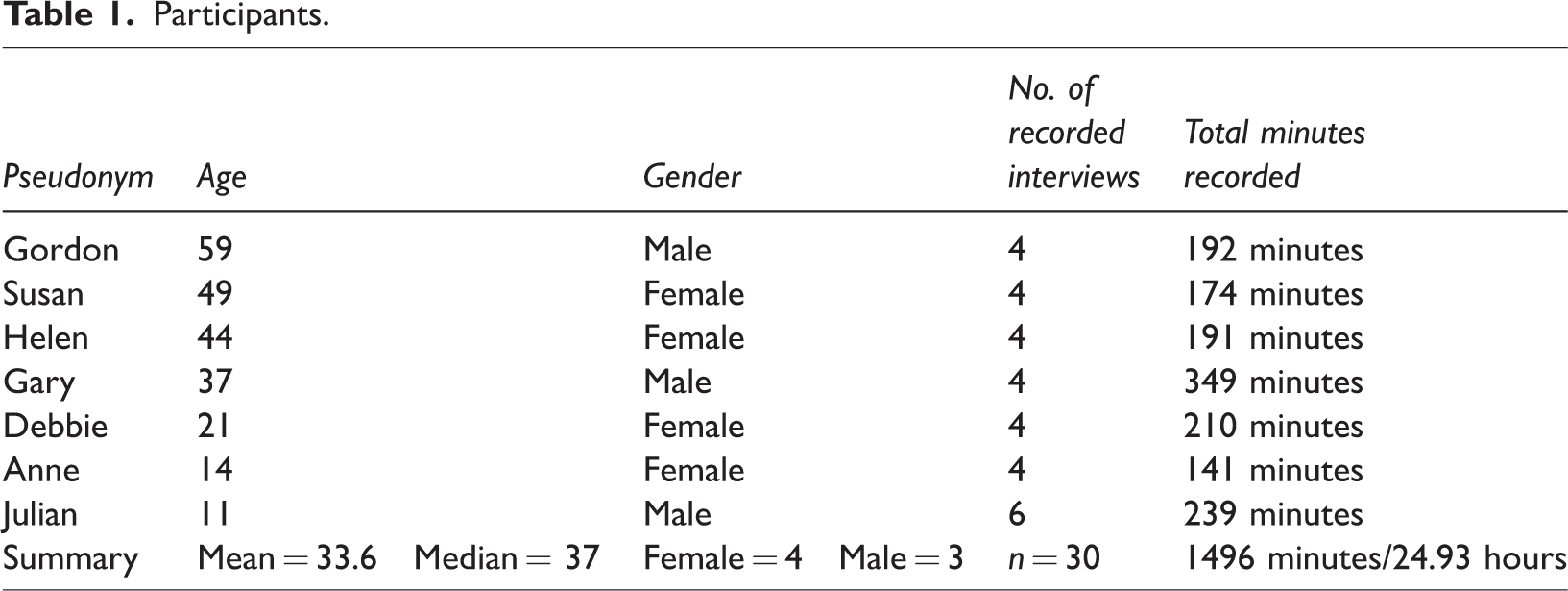
The seven participants were aged 11–59 years old and were living in the South West of England at the time of the study (see Table 1 for further information). All had spent time in foster care during their education years, or were currently in care and in education. The adults each volunteered to participate after hearing about the study from friends, family or colleagues, to whom I had spoken about the project and knew through my own fostering role. The children were recruited following an introduction from a local secondary school. I had approached the head of this school when I first began to consider this project, and they remained interested. I met with the headteacher and produced a flier for the SENCO (Special Educational Needs Coordinator) to share with children in care at the school. Those young people who expressed an interest in taking part were then introduced to me. I explained the project to them individually and gave them information and consent forms, both for them and for their parents or carers to read and complete. Two of these young people returned forms to me via the SENCO.
Participants.
Ethics
Ethical approval was granted by the University of Exeter’s College of Social Sciences and International Studies Ethics Committee.
Researcher reflections
I was aware that my familiarity with the participants’ situations, as both a foster carer and a teacher (with experience in primary schools, further education and higher education) could be problematic. My previous interactions with looked after children led me to this research and my experiences as a researcher, a carer and a teacher informed my interpretation of what I witnessed. To help me remain aware of my positionality, and to support reflexivity, I maintained a reflective journal throughout the study (as per Bourdieu and Wacquant, 1992). In this I recorded thoughts and ideas, which I revisited during the processes of analysis and writing.
To address the researcher–participant power imbalance and devolve as much power as possible to participants, I allowed all participants to choose where and when to meet; all interviews were face-to-face and were also participant-driven as far as possible. This was particularly important for fostering a sense of empowerment, especially among the younger participants.
Interviews
Largely unstructured biographical narrative interviews were used to gather the information, an approach with a successful history in capturing qualitative data on children in care (Holland, 2009). In total 30 interviews were conducted, lasting between 141 and 349 minutes (see Table 1). All participants were interviewed four times; the youngest participant met with me on a further two occasions. They were conducted with each participant separately, following a largely unstructured format. Prior to each interview, adult participants were given a topic for the next encounter, while the younger people were given both a theme and some possible questions to consider. Adult topics were: tell me about you; places; people; and helps and hindrances. The themes given to the young people were: School – the place; School – the people; Schoolwork; Obstacles; Want, need and expect; What is it for? In addition, they had prompts such as: Which places have you been to this week? Do you like some places more than others? This technique allowed participants to frame their memories in the way that suited them best and enabled them to consider in advance how they wished to communicate them.
Analysis
Each interview was audio-recorded, transcribed and analysed by the author, with transcription data stored and coded digitally using NVivo 10 software, providing an ‘audit trail’ for the project. The thematic analysis process was closely aligned to the six-phase model suggested by Braun and Clarke (2006).
Trustworthiness
The quality and rigour of this project were addressed by application of Lincoln and Guba’s(1985) concept of trustworthiness which, they suggest, is a measure of whether findings are worthy of attention. They propose that there are four criteria which can help to establish trustworthiness:
Credibility. This was achieved by obtaining participant feedback on preliminary findings from the study. One of the participants had expressed an interest in reading the outcomes which she subsequently confirmed were based on accurate interpretations of the interviews. This provided reassurance that the interpretation was appropriate. Transferability. This was achieved by using direct quotations and staying close to the participants’ own words when interpreting them. This ideally means that the findings can inform the practice of those working with similar groups of young people. Dependability and confirmability. These have been achieved by creating the digital record and researcher reflections, as noted above, allowing other researchers to assess whether bias has been avoided and, if desired, to replicate the experimental design.
Findings
Social pedagogy
This study counters a mostly negative discourse because it suggests that people who have been in care are surprisingly positive in their comments about learning, growth and development – it just so happens that these have occurred outside of formal education. In other words, previous definitions are too narrow to capture the life lessons that those with care experience themselves report: It’s a process, and it’s only later on in life that you kind of understand that, because you can’t do certain things before you do other things first … I had no driving licence, I had no insurance, I had no MOT, I didn’t know anything … and my parents didn’t seem to sort of say, well, you can’t actually do this, this is what you’ve got to do. (Gordon)
Susan also identified experiences fundamental to her life: I got the bits that I thought were good. And the most loving families are the families that live in council houses who’ve got no money, they’re the most loving families; they fight and argue a lot…and that was another thing I learnt, fighting, arguing isn’t the end of the world you know. The more well-off families teach you a little bit about culture which is good. (Susan)
The following sections will consider the participants’ narratives around their thinking, doing and being.
Thinking
In contrast to claims that vulnerable individuals are not adept at reflexivity, participants in this study evidenced nuanced understandings of their relationships to their environments. They took control of and rewrote their stories, identifying successes and considering the impact of social networks – patterns broadly consistent with Skeggs’ (2005) hypothesis that reflexivity can be used as a tool to refute the sort of limiting and disempowering labelling applied to children in care.
Participants’ reflexivity was evident in their rewriting of their stories. Both 14-year-old Anne and 37-year-old Gary recalled punishments that had been meted out to them which they storied as advantageous to themselves. In the descriptions below, Anne is talking about events that happened recently, while Gary’s story is recalled from two decades previously. The common points in these narratives from different eras add depth to the study in that they effectively allow the research to move across decades.
At Anne’s school there was a room where students were sent when they were in trouble. They were removed from class and had to spend the rest of the day isolated from their classmates and tasked to work on whatever material their teachers had provided. The room had a duty member of staff, so they were not totally alone. Anne admitted that she was often sent to this room but when she talked about this punishment, it became a useful aid to her studies: ‘I get most of my work done in there though, more in there than … in the lesson’ (Anne).
Gary also reflected on both his position and his actions, and the effect of his actions on others. While he felt he had little opportunity as a child to change his outcomes, he could change the way he was perceived by the carers he disliked. He told a story of overcoming adversity by reframing his experiences so that he could come out on top: They [his foster carers] always threatened to leave me as well, but … I know they were doing it to make me sad, but it made me happy that they were threatening to just leave me wherever … I learnt not to smile because I thought if they start picking up that I’m actually happy then they’ll stop doing it. (Gary)
In contrast to the ‘winning’ displayed by Anne and Gary, the youngest participant, Julian, reflexively considered a lack of success when he was trying to help out his friends with some YouTube videos: Sometimes you fail at it, and you know you’ve failed, but you don’t really want to tell your friends that ‘Oh I messed up’ because you know they’ll ask you ‘Could you try again?’ I tried as hard as I can. (Julian)
Susan talked of recognising an early ability to take control through her understanding of the difficulties she could make for the social worker. She realised that it was possible for her to wield power, and she used that knowledge to influence her educational pathway: I was being slightly awkward … I remember she [the social worker] said to me ‘Susan, there’s two roads you can take, the shit road or our road’, and I went ‘I’ll take your road when you get me the right placement’, I said, ‘but if you send me down the shit road, I’ll make your job really difficult’, and you could see her say ‘Oh god’. I can remember saying it to her; I said ‘You’ll have to work really hard if you send me down that road’. (Susan)
Reflexivity was also apparent in the wider social networks which participants discussed. Children in care can find it difficult to navigate relationships with their birth families, as evidenced by differing attitudes to birth mothers in childhood and later life. Before being fostered, Gordon had been adopted but then returned to care by his adoptive parents. He had no recollection of his birth mother whom he first met at around age 20 while he was detained in the borstal: There was no bond, there was no attachment … it was just nothing really, it was all a bit emotionally dead really. I am a bit like that actually myself, you know, that’s just the way I’ve turned out. (Gordon)
The social network outside of immediate family was also highlighted in this study. For example, Susan discussed the stigma she felt both as a neglected child living with her birth mother and later as a foster child: When we were living with her … we looked awful, so that wouldn’t have helped because … kids … go by what you look like, and when we were foster families, I mean you used to turn up in your foster family clan, so that was another thing … So I just remember reading my books and keeping to myself really. And thinking, ‘Well, my time will come when I’ll be able to socialise and be where I want to be, but I’m not going to worry about it at the moment because I’ve got to just survive this bit’. (Susan)
Doing
The life of a looked after child is constrained by structures. While these are established to promote wellbeing or prevent harm, they can also limit or prevent independent action. Despite this, participants in this study storied themselves as agentic, often by taking small actions and despite having little real opportunity for agentic action in their highly structured lives. Susan summed this up when she said: ‘I just thought I’d been dealt a bad hand that I’ve really got to really fight to try and keep going’. In Susan’s story there was no doubt that there was a struggle but that she both could and would ‘fight’; her belief in her agency within the structure of the ‘bad hand’ is clear. Participants talked of creating social networks, seeking personal freedom, identifying ‘critical moments’ in which to act and reacting to the structure surrounding them.
It is challenging for children in care to build and maintain social networks (Rogers, 2015); however, these activities are essential to the development of social capital (Bourdieu, 1986). As well as the reflexivity around social networks explored above, participants discussed the creation of these networks and the calculated decisions they made about when to engage socially, as when both Gordon and Susan discussed their lack of friendships at a young age: [T]here wasn’t really anyone in the village of my own kind of age that I can really remember. I guess there would have been, but they probably didn’t have much to do with me, because … I was always in trouble for one reason or another. I can’t remember what I did so wrong. I spent a lot of time on my own, just wandering around, you know, in the countryside, which I loved. I’d spend a lot of time being on my own, exploring, because when you’re a little boy everything’s … it’s all new and it’s a mystery. And it was lovely. (Gordon) When I came out of boarding school I think I did have an opportunity to go [to college], and … at that age I wasn’t thinking clearly or hadn’t had any sort of real guidance in what you should or shouldn’t do … I just sort of associated it with going back to school again. You know, I didn’t … have the knowledge to understand that … you would actually make … good friends and have a social life and all the rest of it … So that I look back on it sometimes and kind of regret doing that, because I think once I got into it and realised what it was all about, I would have actually done OK. You know I went sort of the other way, sort of the college of crime really, and I was pretty hopeless at it. (Gordon)
Susan, on the other hand, talks about her decision to engage with friendships when she could do so on her own terms at college: I didn’t make friendship groups till I got to college because I didn’t have the opportunities to, because I was always being moved, and even in high school, I think by then looking back on it now, I was probably so traumatised, I just kept my head down and did the best I could, but it was a real struggle because I’d missed so much of my formative years. (Susan)
Freedom was another objective identified by all the participants. This could be sought physically, as when Gordon packed his rucksack and moved to the other end of the country to become an itinerant agricultural worker. Others, more poignantly perhaps, sought the freedom offered by imagination. All participants recalled the books that they read, but Susan’s story of stealing books while she shoplifted for her mother was a particularly clear example of her storying her life to emphasise the choices forced upon her by her experiences: [Mother] used to make us steal. She was horrible like that, if you didn’t do it she’d beat you up, and I then worked out that even though I had to get stuff for her, and I didn’t want to do it, that I could get the books I wanted to read. So I used to get the books from WHSmith. (Susan) It’s just I could go anywhere I like if I could get on the train. I could go anywhere. Like when you see ships, in [the port], I used to see … ferries going in and out. Back then you saw all the frigates going out as well, so I used to think that would be nice. They were happy places … I think it was because you could escape, you know. And anything that wasn’t with them [his foster carers] was actually happy. (Gary)
Other participants spoke of a more time-restricted agency in their narratives. Debbie clearly illustrated the concept of selecting a moment in which to act. I noted that she became quite quiet when she said: I couldn’t do anything about it. You’ve got to kind of pick your battles when you’re in that environment [Debbie was talking about her time in secure residential accommodation]. You can’t just fight everything; you’ve just got to, like, fight the things you’re more likely to win. (Debbie) I always wanted to go to university, like, the goals have changed slightly, like what degree I want to do, but I still wanted to go to university. And I just don’t like failing. The idea of failing an exam probably drew me on more than anything, yes. (Debbie)
Helen also chose her time to return to education, selecting a time in her life when she was ready to re-engage with formal education: I did go back and start doing A levels, but I gave it up. I don’t think I was ready really. But that was me starting to think that I wanted to do something, but it took me [until] when I had kids really to actually … start thinking about education again. (Helen)
Debbie and Helen were the most ‘successful’ study participants, as per the traditional narrow view of education. Helen was qualified to master’s level and intent on pursuing a PhD, while Debbie was an undergraduate student at the time of our meetings. Both individuals had experienced obstacles in their formal education but both selected an optimal time to resume their course of study. Postponement of endeavour was not limited to formal study, however. Susan used postponement to help herself through difficult personal challenges: I used to think to myself, ‘Right, Susan, today is today but tomorrow is tomorrow. And you’re going to feel rough and horrible but there’s nothing you can do to change it. You’ve got to keep your head down and keep going. You’ve got to try and find things to do that will occupy you so that you’re not feeling horrible’. And that’s what I used to do. (Susan)
In addition to the narratives that emphasise the right timing to overcome structural impediments, participants also showed an ability to identify and turn aside from the impositions of structure. Julian, the youngest participant, talks about not wanting his ambitions to be stifled: [O]ur teacher showed us a video that I didn’t really want to see. Like successful people don’t need good grades. She said the creator of Microsoft, he had appalling grades, and now he’s a multimillionaire, she’s saying Lionel Messi, near enough the greatest footballer of all time, got kicked from his local school football club. (Julian)
Being
The participants’ identities were structured by their histories, influencing their sense of otherness and their pursuit of achievement. This focus is important as it informs our understanding of how children in care perceive their identity formation.
Participants carried with them their personal histories and shared small details with me as part of this project. There is a perception that looked after children need to have reminders of their histories, such as in the form of life story books (Watson, Latter and Bellew, 2015); however, this study shows that history does not leave them. Helen reproduced her social history in a humorous way which then seemed to justify her close contact with her birth mother: I said to her, we were talking her getting old, and she said ‘You’ll just put me in a home’, and I said, ‘Well, I will because I’m going to get revenge’, but we both really laughed. ‘I’ll voluntarily put you in a home.’ We were really laughing, but it was the right thing for her to do at the end of the day. (Helen)
It may be that Anne adopts a similar technique, following the counselling which is helping her to repair her relationship with her mother as discussed earlier. Anne is framing her current situation in foster care and undergoing counselling as a positive time in which to rebuild her relationship with her mother. This seemed to be a similar process of coming to terms with history to allow a shared future.
Some stories drew on history to differentiate the participants from their peers. The sense of ‘othering’ that was apparent was quite contrary to the previously discussed need to establish social networks. Participants storied themselves as different, but being ‘in care’ was not the difference. Both Helen and Gary constructed their difference based on their nationality. Gary gloried in his Scottishness: his conversation was peppered with nostalgic reflections about his home nation and related in the Scottish vernacular. He talked of kilt-wearing and proudly showed me a photo of himself in his kilt. As well as this positivity about his nationality, he also attributed negative events in his life to others’ perceptions of it: The confusing bit for me was I spoke Gaelic first, you know, some people they are taught Gaelic, but it was confusing for me because like Gaelic was my first language, then it was Doric [the Scots language, spoken in the northeast of Scotland], you know the northeast for Doric. So, it was so confusing because I didn’t know how to communicate properly, I kept trying to speak to the people in charge [to tell them] that I wanted to go home. (Gary)
While Gary spoke of his pride in his heritage, Helen recalled mixed feelings about her nationality. Helen was of a Mixed ethnic background, having an English mother and an Indian father. She grew up in the Midlands in England and remembered suffering from racial prejudice, which led her to disguise her heritage and invent a different story. Helen talked of a self-loathing and of how she hated her father for being Indian: When I look back, I know that I really, really hated myself, and I hated my dad. I hated my dad for being Indian, even though I didn’t know him. I hated him because of all the stuff over that. And I hated myself because I was half Indian. (Helen)
Anne, at age 14, othered herself from the potential of a university education. She was invited to an open day at a local university but declined: I don’t really want to go when, like, the whole group of people from school go, because not many of my friends are doing it so it’s just like all the popular people and they really, really intimidate me. (Anne)
However, this is not to say that children in care do not story themselves as achievers. In this study, participants valued achievement and perceived themselves as achievers. This achievement could be in sports rather than ‘academic’ subjects. Here, Susan related how she learned to swim as a child: … we taught ourselves to swim in the outdoor swimming pool. We used to climb up onto the roof of the building, because obviously we didn’t get to do anything as kids, and we used to, me and my brother, we used to climb up, go on the [roof] – it’s really dangerous – and go down over the top and go in the swimming pool. (Susan) I wasn’t a brilliant swimmer but what I was good at, I joined the surf lifesaving association in [named town], and I was good at kayaking, and I came first in Great Britain Surf Life Championship. (Susan)
Gary, too, storied himself as successful, despite having learning difficulties, and he considered that he had ‘beaten the odds’: ‘I think I’ve done far better than someone who was born with a normal brain that’s just wasted their life’. He owns the language around his own life here. In overcoming some of the obstacles in his life, Gary is an achiever in his story and he rejects other definitions of normal; they are not normative for him. He defines himself by that which he is not (Stahl, 2017). Gary does not want to fit in; for him achievement was associated with being ‘other’.
Mannay and colleagues found that the young people in their study were aspirational (Mannay et al., 2017). This study adds ‘achievement’ to the aspiration, but with achievement defined within a broader view of education, outside of the traditional classroom.
Discussion
By analysing the narratives that children in care relate about thinking, doing and being, we can clearly see that their learning and development encompass, and are shaped by, far more than what happens within formal school establishments. Especially since many carers cannot adequately support the formal education of the young people they look after, it is important to recognise the many other opportunities and influences available to individuals in the care experience – and to use this information to empower them to reframe their situations and proactively make informed decisions in pursuit of current and future goals. The participants did not limit their understanding of education to the narrow perspective of school qualifications attained; they narrated stories of learning across their whole life experience. Much of what they talked about was unplanned endeavour.
The findings in this study are expressed visually in Figure 1 to provide an empowering tool, the Conditions for Learning model, which enables learning to be identified across the life of the young person. Recognition of this learning could then help to promote a positive view of education, giving opportunities to extend conversations beyond GCSE or A level performance whilst also allowing achievements in one area of learning to foster interest in the more formally measured educational arena.
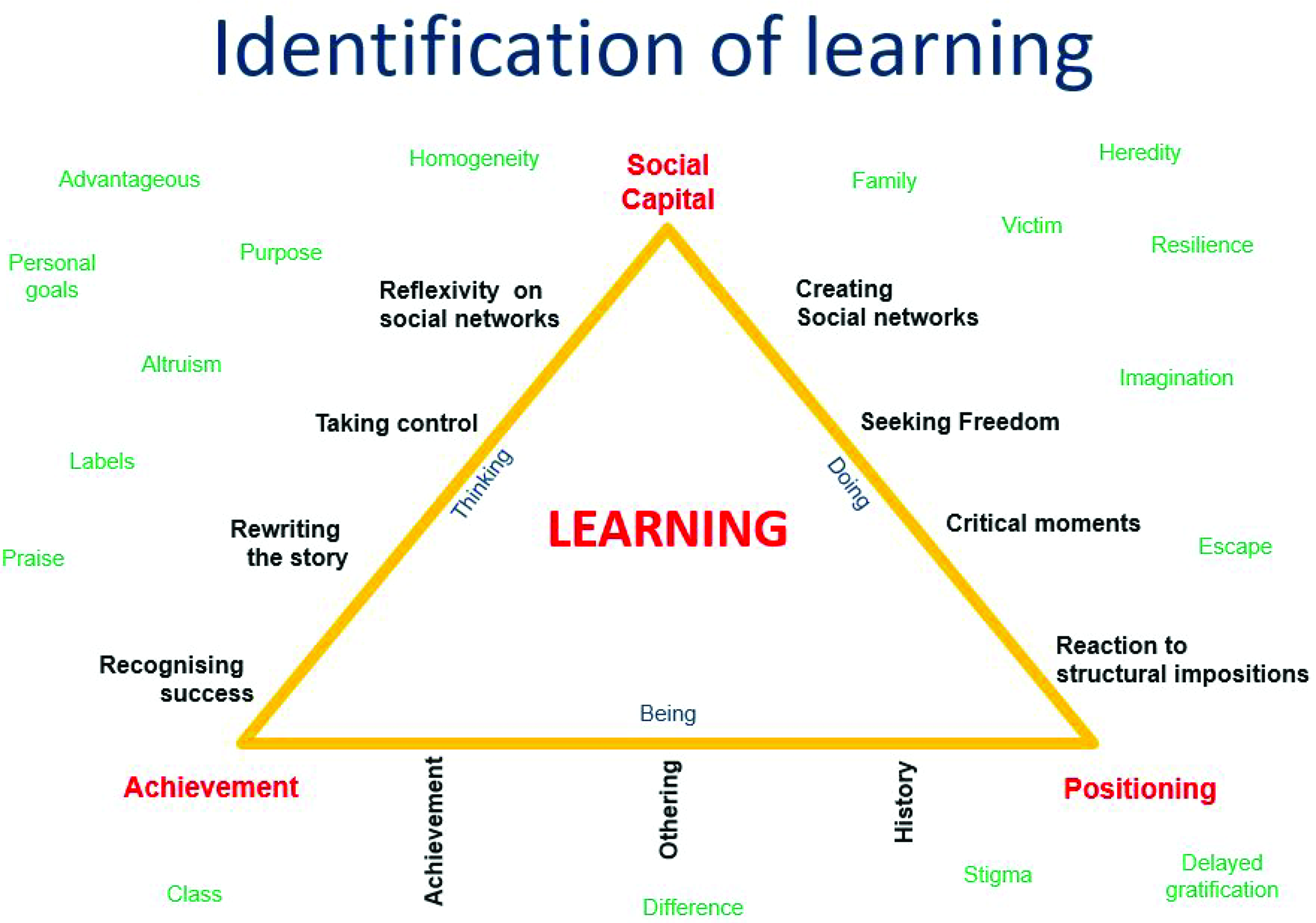
Conditions for Learning model.
This study counters the negative discourse around the education of looked after children which specifically focuses on poor measured outcomes at age 16 (DfE, 2022). The findings show that children in care have a broad definition of education, which includes, but is not limited to, the pursuit of formal qualifications.
Strengths and limitations
Strengths
A key strength of this study has been the ability to hear the voices of children in care and care-experienced adults talking about their education whilst they were in the care of the state in a way that has not been done before. It allowed seven individuals to share their experiences in a manner that suited them. By working across different ages, it has been possible to add a temporal element to the findings: we are learning of experiences from across five decades, from the 1960s to the 2010s.
Limitations
This research was conducted with a small sample of participants in one county in England. The participants volunteered to take part in a project, which they knew would involve several research meetings, suggesting a level of empathy with the research topic, availability of time to meet and a willingness to recall past events. This small scale does not produce findings that are immediately applicable in a different context.
Next steps
Recommendations for future work
This project has identified several areas that would benefit from further research:
The impact of ‘othering’ on social networks
Participants in this study felt a lack of social networks, while at the same time they actively differentiated themselves from others. It may be useful to study this key area of development to reflect upon this apparent contradiction.
Examination of educational priorities
It would be useful to examine the broader view of education suggested by this study; while formal higher educational achievements were delayed, other priorities were apparent. In addition, working with a wider cohort of care-experienced individuals could help to generate a picture of the balance between the formal and informal educational priorities for this group.
Other vulnerable groups
The Conditions for Learning model (Figure 1) could be a useful tool to help to examine the educational experiences of other groups of disadvantaged young people, with a view to confirming or supplementing the model. This approach could centre people’s own stories and use those data to inform decisions.
Social pedagogic approach
The above findings support the implementation of a social pedagogic approach to working with looked after children, such as that outlined in the Head, Heart, Hands study (McDermid et al., 2016). This project established the necessary infrastructure to help carers provide a more holistic educational environment. Young people could be supported in their wider educational journey, potentially allowing them more space to focus on the acquisition of recognised qualifications in a more school-based setting. By writing their own narratives, they could develop their agency over defining what sort of ‘education’ they want to experience and achieve the goals that they have set.
Footnotes
Acknowledgements
I would like to thank the following individuals for their help and support during the research and writing up of this work: Dr Alexandra Allan, University of Exeter; Professor Christopher Boyle, University of Adelaide; Dr Caitlin Kight, University of Exeter; Professor Martin Levinson, Bath Spa University.
Declaration of conflicting interests
The authors declared no potential conflicts of interest with respect to the research/authorship, and/or publication of this article.
Funding
The authors received no financial support for the research, authorship, and/or publication of this article.