




Abstract
This article assesses the significance of generalist and designated schoolteachers for the educational experiences of children in care. Data were gathered from semi-structured interviews with 21 care-experienced individuals aged between 18 and 27 and three senior employees of a children’s services department in an English local authority. Participants discussed the importance of relationships with key adults and peers, the complexity of disclosing their care status and their commitment to education. The results show that generalist teachers offer considerable support to children, far beyond their statutory responsibilities, but that the designated teacher role, although important, is not understood or utilised by their fellow teachers and the majority of pupils who are in care.
Keywords
Introduction
The number of children looked after by local authorities in England has increased steadily over the last decade. At the end of March 2020, there were 80,080 children in care, an increase of 24% since 2010. While this growth has been accompanied by changes in the characteristics of the care population, such as more admissions of unaccompanied asylum seekers, children from different ethnic backgrounds and children with histories of abuse, the age distribution has remained fairly similar. Nearly three–fifths (57%) are of statutory school age (five to 15 years) and many others are in early years and nursery provision, in school post-16 or pursuing further and higher education (Department for Education [DfE], 2010; 2020). Thus, education is, and has always been, central to the lives of most children in care, although this has only been fully acknowledged by the system in the last 25 years.
Recognition does not necessarily guarantee success, however, and the academic achievements of children in care have consistently been below the national average. National statistics show that in 2019, at the end of Key Stage Two (KS2) (pupils aged seven to 11), 37% of children in care obtained the expected level in mathematics, reading and writing compared with 65% of those not in care. Several years later, at the end of Key Stage Four (KS4) (pupils aged 13 to 16), the differences in the average Attainment Eight score were equally great: 19.1 compared with 44.6. The statistics also show that a high proportion of children in care have a Special Educational Need (SEN); at KS2, 52% of children in care have an identified SEN compared with approximately 14% of those not in care.
This enduring underachievement and need for special provision have posed the question of whether they are best explained by inadequacies of the care system, children’s pre-care experiences or both (Berridge, 2007). A recent DfE (2019) report urges caution when interpreting the statistics and paints a complex picture, showing that although, as a group, children in care fare slightly better than those identified as ‘in need’ but not in care, those who are in care and have an Education Health and Care (EHC) plan make less progress than those with similar needs not in care. Nevertheless, whatever qualifications have to be made, four unequivocal facts stand out: children in care face huge difficulties in education; numerous factors influence these results; some sub-groups present extremely complex educational problems; and the care population is immensely varied despite all the children being categorised as ‘in care’.
While these findings about children’s educational difficulties are disturbing, equally worrying is that these contrasts continue with age and by their late teens, one–third of all care leavers are not in further education, employment or training, compared with only 13% of the wider population. Thus, it is clear not only that children in care place extra demands on school resources but also that their need for services continues well into adulthood (DfE, 2016). But in seeking remedies for all of this, one aspect is noticeably absent – the voices of the children and young people at the heart of the statistics (Ridge and Millar, 2000).
This article seeks to address this gap by identifying how children in care might be better supported to fulfil their educational aspirations. It also seeks to honour the contributions of participants by accurately representing their experiences and prioritising their voices (Mannay, et al., 2019). In particular, it explores two key questions:
How do care-experienced young people perceive the support offered by generalist teachers? How do they perceive the support offered by designated teachers (DTs)?
The term ‘generalist’ refers to teachers without managerial responsibilities but with a significant teaching allocation in a mainstream school. The role of DT was introduced in 1994 but made statutory through the Children and Young Persons Act 2008 (Department of Children, Schools and Families [DCSF], 2008). The main duties include working with the Virtual School to oversee provision for pupils who are in care, setting high expectations for them, listening to what they say, determining what they need, harnessing appropriate help and providing information for colleagues. In 2008, the DCSF called on governing bodies to ensure that DTs have sufficient time, training and funding to complete their duties effectively (DCSF, 2008). However, whilst there is a statutory requirement for schools to have a DT, there is no stipulation that this is the only additional responsibility that she or he holds.
Literature review
The role of generalist teachers
The benefits of supportive, high-quality relationships between teachers and pupils have been confirmed in numerous studies (Comfort, 2007; Gilling, 2014; Harker, et al., 2004; Jackson and McParlin, 2006; Rees and Munro, 2019; Sebba, et al., 2015; Selwyn and Briheim-Crookall, 2017; Sugden, 2013). Teachers are regarded as prime motivators in terms of children’s educational success and often act as mentors for those who experience difficulty (Comfort, 2007; Sebba, et al., 2015; Sugden, 2013).
Claessens and colleagues conducted a study of teacher–pupil relationships in the Netherlands and concluded that ‘variance in classroom climate lies at the level of the individual teacher rather than of the nation’ (Claessens, et al., 2017: 480). Particularly important for positive teacher–pupil relationships were interactions outside of the classroom environment as their dynamics were qualitatively different and generally far more supportive.
Twice as many teachers regarded themselves as supporting pupils when not formally teaching and many stressed the benefits of this in terms of reduced levels of confrontation and increased understanding of children’s needs. Relationships outside of the classroom were perceived as more likely to become friend-like in nature, leading, in time, to the development of trust (Comfort, 2007; Gilling, 2014; Jackson and McParlin, 2006; Selwyn and Briheim-Crookall, 2017; Sugden, 2013). One weakness of this study, however, was its focus on relationships as problematic or positive rather than on nurturing underpinned by knowledge about the impact of early childhood trauma (Dann, 2011).
For children from deprived backgrounds, teachers who demonstrate sensitivity to their needs and offer support when it is not strictly within their remit may be the only adults in their lives who are not directly paid to help them. Consequently, their importance should not be underestimated as secure and trusting relationships can help children in care feel equal to their peers (Selwyn and Briheim-Crookall, 2017). Several studies have concluded that a trusting relationship with one key adult can act as a turning-point for disadvantaged children and is strongly associated with resilience, healthy development and recovery from adversity (Gilligan, 2009; Masten and Monn, 2015; Selwyn and Briheim-Crookall, 2017). However, it is also widely recognised that teachers do not receive sufficient training around child development and issues such as separation and loss, attachment, and health difficulties associated with trauma, neglect and poverty.
But putting this support into practice is fraught with difficulties. Mannay and colleagues(2017: 686) warn that ‘special treatment’ may generate unintended harm, and Selwyn and Briheim-Crookall (2017) have shown how mundane, micro-interactions can contribute to children’s sense of stigma and feeling different and devalued (Rogers, 2017). Examples include removal from lessons for Personal Education Plan (PEP) meetings, arriving at school in a taxi and the negotiations surrounding parents’ evenings. Positive relationships between teachers and pupils built on trust and an understanding of child development may therefore be just as beneficial as interventions aimed specifically at children.
The role of designated teachers
The English DfE published revised guidance for DTs in 2018. It states that, as a minimum, they should have two days a year for training opportunities specific to factors that impact the educational attainment of children in care. These include academic progress and attendance and broader concerns such as mental health and the practicalities of trips and visits. The priorities for the role are given as (DfE, 2018: 13):
Work directly with looked after and previously looked after children and their carers, parents or guardians. Support progress by paying particular attention to effective communication with carers, parents or guardians. Ensure carers, parents or guardians understand the potential value of one-to-one tuition and are equipped to engage with it at home. Ensure carers, parents or guardians are aware of how the school teaches key skills, such as reading and numeracy. Encourage high aspirations and work with the child to plan for their future success and fulfilment.
It is pleasing to note that the guidance emphasises that children in care are individuals and not a homogenous group and that respect and sensitivity should be shown towards their care status. However, it is also worth noting that there are only two direct references to working with children in the list outlined above.
The guidance for DTs stresses the importance of them having ‘Appropriate seniority and professional experience to provide leadership, training, information, challenge and advice to others’ (DfE, 2018: 9). While providing advice, support and training for colleagues is clearly central to this role, pages 20–21 of the guidance highlight the crucial nature of building positive relationships with children, stating that this is ‘one of the most important factors’ in supporting educational achievement. But, again, practical issues can confound good intentions. ‘Appropriate seniority’ may allow the DT sufficient managerial influence, but from a child’s perspective, seniority within schools can present difficulties in terms of building an effective relationship. Relationships cannot be manufactured or imposed and, as noted earlier, often develop through daily interactions between teachers and pupils, requiring regular and informal contact repeated over a sustained period of time (Claessens, et al., 2017). This can be difficult for a senior member of staff with limited teaching commitments to achieve.
The DT guidance ends with a series of questions that governing bodies could use to evaluate the effectiveness of the DT role within their school. Twelve areas are covered but there is only one reference to the direct involvement of the child. The importance of communicating effectively with the young people at the heart of this guidance is referred to in separate, discrete sections rather than woven throughout. Lewis (2010) and Berridge (2012) warn against a tokenistic approach to involving children in research and policy designs, and this view seems to be echoed in the DT guidance, raising questions about the extent to which the voices of children in care are valued.
More than 15 years ago, Hibbert (2006) and Harker and colleagues (2004) found that high numbers of care-experienced pupils in their research samples (55 out of 61 and over half respectively) had no knowledge of the DT role and, several years later, Driscoll (2012) noted that very little evaluation of the DT role had taken place. This remains the case. This situation resonates strongly with the aims of this study: that the role requires an evaluation which reflects and embeds the views of the young people whom DTs seek to help.
Methods
A large English city was selected as the location for the research. Twenty-one care experienced young people aged between 18 and 27 were interviewed: 12 individually and nine in two groups of seven and two. Three interviews with childcare professionals were also conducted. The care-experienced participants discussed their educational journeys and aspirations and identified experiences which had been enabling and constraining, giving clear recommendations for change and improvement. To qualify for inclusion the participants had to:
be at least 18 years old; have stayed in care for at least six months; have attended a school in the selected local authority.
In compiling the sample, discussions were held with the local authority’s Rights and Participation Officer (RAPO) to exclude any young person who was currently experiencing (or had recently experienced) significant trauma. In addition, as diverse a group of young people as possible, in terms of personal characteristics and educational experiences, was sought.
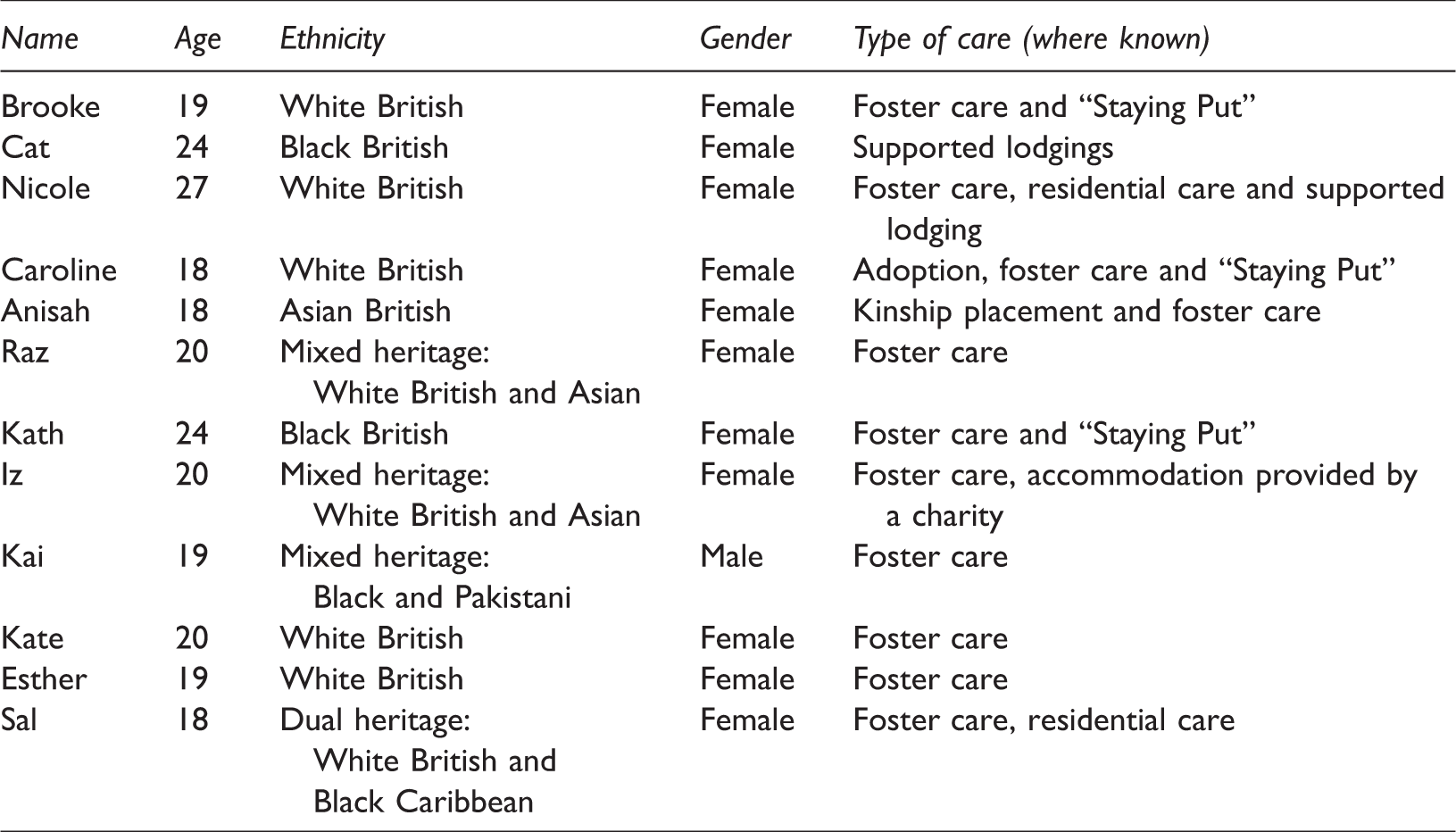
Before proceeding it is important to acknowledge two characteristics of the sample that might have influenced responses. Only 10% of participants were male which is far lower than the percentage in care generally (56%) and in terms of ethnicity, the sample is more varied than the profile for the local authority with only 30% of the sample described as White British compared with 75% for the city’s care population. It is also possible that participants were likely to be those most engaged with care-leaver services.
Tables 1–3 give an overview of the background characteristics and experiences of the care-experienced participants. Ethnicity is as defined by participants, and pseudonyms have been used to protect anonymity. The professional participants were key personnel from children in care provider services, the Virtual School and Rights and Participation.
Individual participant information.
Interview Group A participant information.
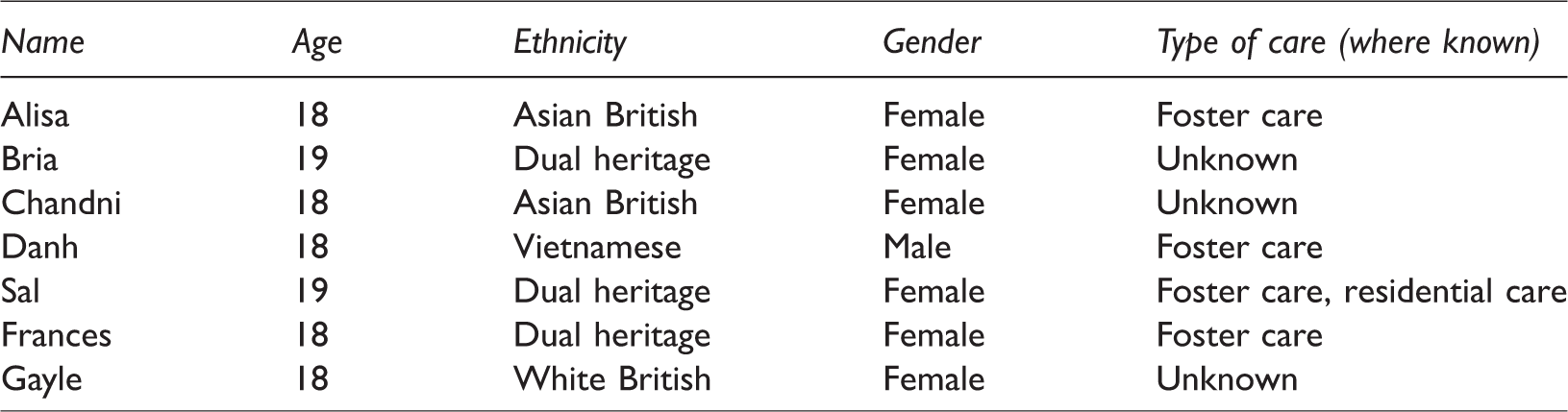
Interview Group B participant information.

The research process followed the ethical principles of the British Educational Research Association (BERA, 2018: 10) and ethical approval was granted by Birmingham City University and the local authority.
Twelve participants were interviewed face-to-face following a semi-structured schedule. This provided a set of insights personal to the individual that could be linked to the wider array of variables shaping their lives. The two sets of group interviews were requested by the RAPO on behalf of nine participants who were more accustomed to discussing sensitive issues collectively and had established a code of conduct for doing so. These revealed a clear consensus around a variety of issues ranging from relationships with social workers and teachers to personal matters like clothing.
All interviews were audio-recorded with permission from participants, and the transcripts were annotated following the procedures for analysing qualitative information specified by Braun and Clarke (2013) and Silverman (2010). Three broad themes emerged; these were associated with key adults, the self and the sense of belonging. Each of these will be discussed under the categories of generalist teachers and DTs.
Findings
Participant comments about generalist teachers
The care-experienced participants made the following comments in their individual interviews about some of the support they had been offered by generalist teachers: My teachers would encourage me. My teachers contributed to my life-story book … they wrote me letters and they said they thought I could achieve a lot. (Sal) My head teacher changed in year 11, I think; she is literally the most down to earth, the most understanding person I’ve ever met. Honestly, I’ve never known a teacher in my entire history of schools so open and honest. She’s straightforward – she’s related her own experiences to mine. Her daughter’s boyfriend is a care-leaver, so she talks to me about that. (Anisah) He taught me science and even now … my younger brother’s at the school and the teacher’s just left and my brother was really upset. He was just a really nice teacher. He was a nice teacher but to me he was really helpful. Like, he helped with my PEP, he would come to my meetings. He was really good. If he saw we were leaving school early he would ask why, not in a patronising way but he would check on us. He was the child protection officer and a teacher. And he attended any LAC [looked after children] meetings. (Alisa) One teacher was friendly – they were the same nationality as me – we got along very well. She helped me a lot, when I first got to the school … I didn’t know anything; she was teaching me in private. So when I went in care, she did everything she could. She sorted out everything me and my brother needed. She was very good. (Danh) I would have support, teachers would come into the class. And I think then, I did focus on the work. And I got along with one of them. I really loved her, she was so nice. (Iz) The main person I would go to was my tutor. I would maintain a very good relationship with her and then with one of the teaching assistants in the class too. I do think teachers are very important because they are your role models really … someone you can trust. (Kai) Esther: … I talked to my year manager … we used to get on quite well. Interviewer: So, you kept yourself to yourself but there were a couple of adults who you talked to? Esther: Yes. Interviewer: How did they become the adults that you talked to? Esther: We just got on the whole way through. We got on … she realised there was something wrong. She asked me what was wrong and I told her everything. Interviewer: And was that talk the thing that prompted you going into care? Esther: Yes. Interviewer: So that significant person … was she a mentor? Esther: No, she was year manager … we had a head of year and a year manager. Interviewer: And is she a teacher? Esther: No, she was on-call … so if you’d be naughty she’d come and get you and because I used to be naughty she would have to come and collect [me]. Bria: … she used to call herself my school mum. She was my form teacher. Well, obviously at sixth form you can wear your own clothes but my foster carer wouldn’t buy me any clothes, so the teacher used to bring in clothes from her daughter. Yeah. She paid for a lot of things. She also taught two of my subjects as well as being my form tutor. Interviewer: How, if you don’t mind my asking, how did it happen that she took such an interest in you … did it just happen gradually? Bria: I think, well when we wore school uniform … my foster mum never used to dress me properly for school and I always used to get bullied for that, my shoes didn’t fit … and she noticed, my form tutor, and she used to talk to me about it. I was friends with every single teacher at school. The school I went to was the most supportive school. I was there for school and sixth form. I would recommend parents, foster parents – one of the teachers there was absolutely amazing – for every young person in that school that was in care. (Frances)
Participant comments about unwelcome support or ‘unintended harms’
The participants raised the ‘unintended harms’ of support from their teachers, as this group discussion demonstrates: Gayle: Basically, when I was in school, I always had my form teacher … when other people went to her with problems she wouldn’t listen to them but she would listen to me. Interviewer: So, would you say you experienced them treating you differently in a positive way? Anybody else experienced that? Frances: Me, but at college. The teachers would always just be watching me. It wasn’t necessarily a bad thing but it was a bit awkward. Alisa: I had that too … every little thing was a big deal. It’s a good thing but … [Lots of comments stating: ‘It’s a bit too much’, ‘It’s awkward’.] Sal: The only thing I didn’t like was that they would let you off with too much. [Lots of agreement.] They would feel sorry for you and that would really annoy me. Alisa: It can be a bit smothering. I don’t need you to feel sorry for me. Shout at me!
Participant comments about DTs
The care-experienced and professional participants made the following remarks about DTs. Some of the comments from the care-experienced participants were positive about the role: Interviewer: Do you have a designated teacher here at school? Do they use that phrase? Aliyah: No, it’s not. We’re more like friends. I had a teacher in Year 10 or 11 who would check up on me and see how I was. Interviewer: When you were at secondary [school], did you have a designated teacher? Sal: I had one, she was so good. And she was … she wasn’t really a teacher, she was more like a counsellor, and she would see me before class and just say ‘How you doing?’ and she wouldn’t say ‘How are things at the children’s home?’ she’d say ‘How are things at home?’ After a while, you do think of it as home so I liked that about her. I felt comfortable with her; I felt like I could tell her everything. Interviewer: Do you know exactly what her role was at school? Sal: She was the school counsellor. I felt like they were interfering. I felt like one of my teachers, when care proceedings started and she kept asking me questions and she’d ask me in front of everyone. She’d ask me questions and then report back to social services. I know it was her job but I felt like she was prying. I never wanted to go school after that. (Sal) The designated teacher … she wasn’t very good. All the other care kids would go and see her every other day with their problems but I just didn’t bother. I don’t think I liked to mix my school life with my care life … Oh God, so she was just really condescending. She tried to be on the same level as the care kids. She’d speak down to you quite a lot, she spoke down to me quite a lot. (Caroline) Interviewer: You know every school has a designated teacher. Did you ever see anything of them? Kate: No, I don’t think so. I think a lot of young people feel that going to see the DT means they’re identified as being in care. You know, that can be a problem. (RAPO)
Discussion
Generalist teachers
Generalist teachers were universally commended by participants. Nine young people shared examples of experiencing strong, positive relationships with them. Nicole clearly articulated the difference that support from one key adult can make to the life of a vulnerable young person: I had a really close relationship with this teacher … she just really looked out for me. She was the cooking teacher actually and she was so kind and so caring. She said, ‘Look Nicole,’ I don’t know what she could see but she said, ‘Nicole, just come and talk to me.’ So I did and she would spend 20 minutes of her lunch just talking to me … I’ve met her a couple of times since and I just say thank you to her every time because she just saved me in a way I suppose.
Further examples of extensive support from teachers were relayed. Frances recalled an example of her teacher’s generosity and kindness: When it came to Prom Day as well, and you worry that your foster parents might not buy you a dress or whatever [lots of ‘Yeahs’ and general agreement from the group]. She took me out and bought me this nice prom dress. You know, those touchy things that touch you because you think: you didn’t have to do that. But she did it because she had the emotion and the empathy – she cared.
Here, Frances not only recognised the empathy displayed by the teacher but also highlighted that the care offered was not part of her professional remit. Indeed, some participants said that, in their experience, teachers demonstrated more understanding of the care system than social workers and even foster carers. A special commendation was reserved for teachers for helping to minimise visible differences between the participants and fellow pupils who were not in care.
Sal described this process further and recalled the way she developed a strong relationship with a teacher at secondary school: … she wouldn’t launch at you with a conversation. We might just sit there and then we [would] just chat, general stuff before she’d ask you how you were. We would talk more like friends … she was a friend to me … I love that woman, she was great.
It is also important to note that the teachers highlighted by participants were not senior members of staff and did not teach ‘high stakes’ subjects such as mathematics or English. All but one of them were female and of an age where they could conceivably act as a parental figure.
The young people explained that the most valued relationships with key adults were co-constructed, occurring outside of the classroom. They emphasised the importance of feeling that the relationship with the teacher was mutual, originating from a sense of genuine concern or affection. A sense of having ‘something in common’ was particularly important in the early stages as were shared nationalities or experiences of separation and loss. All of this confirms and develops findings from previous research (Claessens, et al., 2017; Gilligan, 2009; Masten and Monn, 2015; Selwyn and Briheim-Crookall, 2017).
Designated teachers
The role of the DT, by contrast, was not well understood by participants. As previously explained, while the 2018 guidance for DTs does highlight the importance of the relationship between DT and pupil, more attention needs to be given to how these relationships are developed and sustained. As the interviews demonstrated, young people actively construct relationships with key adults – they cannot be imposed – and this is especially important when considering the role of DTs.
When asked about the DT role, it became apparent that some participants, such as Kath and Anisah, had not encountered their DT. Others confused the DT with other key members of staff, which suggests that little has changed since Hibbert and Harker and colleagues’ earlier studies. For example, Sal described the school counsellor when asked about her DT, and no one recalled receiving personal support from their DT; the young people appeared to prefer to choose a teacher they liked rather than be assigned to an officially appointed person. This preference may be explained, at least in part, by several participants observing that being given, or seen to be given, special attention was socially uncomfortable and could, as Mannay and colleagues (2017) found, lead to unintended harm. Thus, it is possible that the DT role inadvertently contributes to this sense of ‘difference’ and the exposure of a child’s care status.
Only one participant, Caroline, demonstrated a clear understanding of the DT role but, even then, it was evident that she felt the approach adopted was inappropriate: The designated teacher … she wasn’t very good … Oh God, so she was just really condescending. She tried to be on the same level as the care kids. She’d speak down to you quite a lot, she spoke down to me quite a lot.
The two professionals from children’s services who were interviewed stressed the importance of key adults for young people in care and, along with the local authority RAPO, accepted that young people may prefer to develop relationships with teachers they interact with on a regular basis as communicating with the DT risked unwelcome exposure of their care status. As one explained: a number of children seem to go towards a person in a school … someone who will listen. I know there are designated people in the school for children in care so there is someone there for them. I don’t know that that ‘go to’ person is that successful … Often those young people don’t warm to that person specifically because they are in that role. It’s quite a complex issue … It’s got to be dealt with in a more holistic way – that starts when teachers are training.
There is very little published that specifically considers the role of the DT, and this is clearly an area that could be developed in future research. In particular, it is important to note how little of the DfE guidance for DTs (2018) focuses on working directly with children in care. It is conceivable that a more embedded consideration of the children at the heart of this policy may have resulted in their DT being regarded more positively.
Recommendations and conclusions
Three recommendations can be made from this study. Firstly, more research is needed into the DT role. This should consult children in care to establish the role’s purpose, how DTs are selected and how they communicate with young people. It also important to note that while DTs may not relate to individual children, they help set an ethos that encourages supportive teacher–pupil relationships more widely and initiates a process whereby parties can choose with whom they make relationships. In addition, even if they do not enjoy close relationships with children, they remain responsible for indirect work with them, such as supporting other teacher–pupil relationships, pursuing advocacy, harnessing special help and providing staff with specialist knowledge.
Secondly, the Teachers’ Standards guidance should refer directly to an understanding of child development. To further teachers’ work with children in care and other vulnerable groups, the findings from this study suggest that this should form part of initial, postgraduate and in-service teacher training, with DTs having a central role in organising and delivering this.
Thirdly, teachers should be constantly aware of the significance that young people in care place on education. All participants in this study were committed to achieving academic qualifications and any concessions in the expectations of teachers were experienced as extremely harmful.
Despite the limitations of this study, the interviews with participants clearly show that the role of the DT is not fully understood by young people in care or fully utilised by other members of staff. Indeed, little seems to have changed since Hibbert and Harker and colleagues’ earlier research over 15 years ago. This finding is highly relevant to knowledge about the educational experiences of children in care as it shows that well-intentioned reforms may falter at the delivery stage as in this case where they do not match the preferred styles of relationship of the children they are intended to help. Even worse, they may have unintended and harmful consequences. In addition, adding a member of staff with specialist responsibility may not always be the best way forward. Nevertheless, there are still aspects of the DT role that enhance the ethos of the school and the quality of its pastoral care. These conclusions carry significant messages for plans to improve the education and well-being of children in care, such as current plans to appoint a DT for children’s mental health in all schools (DfE, 2018).
Footnotes
Acknowledgements
I offer my thanks to the young people who shared their stories with me, my PhD supervisors, Professor Richard Hatcher and Dr Carolyn Blackburn, and key personnel within the local authority. Additionally, I would like to thank the reviewers who gave constructive feedback on earlier versions of this article, Victoria Walker, Roger Bullock and Miranda Davies who have been incredibly supportive.
Declaration of conflicting interests
The author(s) declared no potential conflicts of interest with respect to the research, authorship, and/or publication of this article.
Funding
The author(s) received no financial support for the research, authorship, and/or publication of this article.