




Abstract
This article explores the decommodification strategies of a collaborative housing project in Vienna, drawing on Karl Polanyi’s socioeconomic principles: market exchange, redistribution and reciprocity. It engages with Polanyi’s foundational contributions, as well as the broader welfare state and housing studies literature to develop an analytical framework for analysing decommodification in collaborative housing. Using this Polanyi-inspired framework, the article conducts an in-depth analysis of decommodification across the entire provisioning process, including the production, distribution and consumption of this collaborative housing initiative. It examines internal strategies – such as alternative financing and hybrid ownership structures – along the initiative’s wider embedding in the Viennese housing system, as well as effects on affordability. The findings demonstrate how the initiative achieves high levels of decommodification by altering the composition of socioeconomic principles on multiple scales, offering insights into the complex mixed economy of collaborative housing in Vienna. This provides a deeper understanding of how decommodification functions in housing provision in general and in collaborative housing forms in particular.
Introduction
The housing crisis is intensifying globally, including across Europe. Although to varying degrees across jurisdictions, housing policies have contributed to this situation by subsidising homeownership (Kohl, 2020; Watson, 2010), privatising formerly public or non-profit housing (Aalbers et al., 2017; Elsinga et al., 2014), (re)introducing market-friendly rental regulations (Hochstenbach and Ronald, 2020; Kadi, 2015) and increasing the exposure to financial markets (Aalbers, 2016; Kohl, 2021; Stephens, 2020. Following these commodification dynamics, and especially since the financial crisis in 2008, housing in Europe has been transformed into an attractive asset class for (institutional) investors (Gabor and Kohl, 2022; van Loon and Aalbers, 2017; Wijburg et al., 2018).
In response, residents across Europe have mobilised and pressured public officials to take action (Coquelin et al., 2022). They put forward diverse claims ranging from better rent control to the expropriation of institutional landlords (Vollmer, 2019). At the same time, citizens have become more active in providing their own housing, often in collaborative arrangements of groups supported by public, third sector and/or private actors (Czischke, 2018; Lang and Stoeger, 2018). Some identify a new wave of collaborative housing unfolding across Europe – referring to an umbrella term that includes different housing forms such as cooperatives, syndicates or different self-building groups – with varying degrees of participation and community engagement (Czischke et al., 2020; Griffith et al., 2024; Lang et al., 2020).
This article investigates the housing initiative Bikes and Rails, a novel collaborative housing form in the Viennese context. It started as a collaborative building group, which can be defined as housing forms that are ‘(co-)initiated, (co-)planned, and (co-)constructed by future residents’ (Lang and Stoeger, 2018: 45). Others describe it as a housing commons ‘associated with communal use and a high level of self-management’ (Hölzl and Hölzl, 2022: 1153). Bikes and Rails follows the housing syndicate model (Gruber and Lang, 2018; Hurlin, 2018), supported by the umbrella organisation habiTAT Austria. Bikes and Rails and similar collaborative housing forms uphold the ‘twin promises of self-governance and decommodification’ (Larsen, 2024). This study focuses on the latter.
This article reflects on the relationship of collaborative housing and decommodification, engaging with the works of Karl Polanyi and Gøsta Esping-Andersen as well as with the interdisciplinary field of housing studies. Polanyi developed an early historical analysis of the interplay between forces of commodification and decommodification (Polanyi, 2001). Instead of viewing the economy as homogenous, Polanyi provided a ‘substantivism’ that engages with actually existing economic forms by utilising socioeconomic principles: market exchange, redistribution and reciprocity (Polanyi, 1977). Inspired by Polanyi, Esping-Andersen (1987) popularised the concept of decommodification, defining it as ‘the extent to which individuals and families can maintain a normal and socially acceptable standard of living regardless of their market performance’ (p. 86). This work facilitated its dissemination across various disciplines, including housing studies.
The decommodification of housing has received growing attention in recent years. On the one hand, ecological economists and environmental activists have become increasingly critical of market-based solutions allegedly addressing the climate crisis (Gerber and Gerber, 2017; Heindl, 2022). On the other hand, housing scholars seek new ways for understanding and tackling the current global housing affordability crisis (Norris and Lawson, 2023; Wetzstein, 2017). Housing decommodification is considered as a potential contribution to a deeper social-ecological transformation of housing systems (in the context of sustainable welfare, see Dukelow and Murphy, 2022), that is, respecting ecological ceilings as well as social floors in housing provision (Novy et al., 2024).
However, decommodification strategies of the new wave of collaborative housing, such as alternative forms of financing, have so far received limited academic attention. This can be attributed, in part, to the complicated relationship between decommodification and collaborative housing. Such housing initiatives pursue a range of aims, not all of which include explicit efforts to decommodify housing (Lang et al., 2020; Sørvoll and Bengtsson, 2020; White and Madden, 2024). Additionally, organisational forms of collaborative housing projects and their interaction with the wider housing system vary greatly across different cases (Griffith et al., 2024; Lang and Stoeger, 2018). Recently, the relationship between collaborative housing and affordability has received more attention (Brysch and Czischke, 2022). However, a theory-led investigation into the relationship between collaborative housing and decommodification is still missing from the existing literature.
The purpose of this paper is twofold: first, to link research on Polanyi’s socioeconomic principles with debates surrounding the decommodification of housing, developing an analytical framework for examining decommodification in housing provision. Second, it applies this framework to a case study – a novel collaborative housing initiative in Vienna, embedded in the Viennese housing system. The article further examines how socioeconomic principles manifest spatially and explores the potential for expanding decommodification strategies. It thereby enables a deeper understanding of how decommodification functions in housing provision in general and in collaborative housing forms in particular. Further, it adds to the growing (Polanyian) literature on decommodification (Bärnthaler et al., 2023; Berndt et al., 2020; Goodwin, 2018, 2024; Hermann, 2021, 2020) by offering a fine-grained and spatially sensitive analysis of the particularly complex mixed-economy of housing in Vienna.
The article is structured as follows: Section two presents a Polanyian perspective on decommodification and introduces his socioeconomic principles. Section three examines the relationship of housing provision and decommodification, as discussed in the welfare state literature and housing studies and presents the analytical framework for understanding decommodification in collaborative housing. Section four discusses the research approach, methods and data selection. Section five presents the case study, which is analysed as embedded in an urban development quarter and the wider Viennese housing system. Section six discusses the findings, including the spatial dimensions of decommodification strategies, their limitations and potential, while the final section provides a summary and conclusion.
Theory: Polanyian perspective on decommodification
In his historical research, Polanyi traces the origins and consequences of our market society, investigating the commodification and decommodification of labour, land and money. For Polanyi, the commodification of labour, land and money constituted a radical rupture with the past organisation of society (Novy, 2022). He writes: all economic systems known to us up to the end of feudalism in Western Europe were organized either on the principles of reciprocity or redistribution, or householding, or some combination of the three. (. . .) Among these motives gain was not prominent (Polanyi, 2001: 57).
In a market economy, the three fictitious commodities or elements of industry – land, labour and money – become integrated into price-making markets operating based on the principle of self-regulation. But treating labour, land and money simply as commodities cannot function for any length of time without threatening the human and non-human substance of society (Polanyi, 2001: 75). Thus, countermovements emerged and ‘the extension of the market organisation in respect to genuine commodities was accompanied by its restriction in respect to fictitious ones’ (Polanyi, 2001: 79). From such a perspective, marketisation and the continuous and contested struggles to contain it (decommodification) are an inherent feature of capitalism (Goodwin, 2018; Novy, 2022; Peck, 2013).
Polanyi focused on the (de)commodification of fictitious commodities 1 and did not place housing provision at the centre of his analysis. However, there are compelling reasons to extend a (Neo-)Polanyian analysis to include it. As a primary good foundational for most other social, economic and political activities, housing is deeply interconnected with the societal organisation of the three fictitious commodities. ‘Landed’ housing is strongly affected by land market dynamics (Ryan-Collins et al., 2017; Shepherd and Wargent, 2024); it provides the site where the reproduction of labour power and care work takes place (Aulenbacher et al., 2018) and is deeply intertwined with financialised capitalism (Aalbers, 2016). In his writings, Polanyi often uses a wide notion of land, stating that it ‘invests man’s life with stability; it is the site of his habitation; it is a condition of his physical safety’ (Polanyi, 2001: 187 in Goodwin, 2024: 2). From such a perspective, housing constitutes a key site of habitation around which the organisation of livelihoods takes place (Novy et al., 2024). The struggle over access and control of housing constitutes a central frontline of contestation in market societies (Madden and Marcuse, 2016).
In his later work, Polanyi came to believe that all economic processes would represent a combination of three socioeconomic principles – market exchange, reciprocity and redistribution – but one would often dominate to ‘institute’ or ‘integrate’ the process or to achieve ‘unity and stability’ (Polanyi, 1977: 286; see also Jessop and Sum, 2019; Jones and Tobin, 2018; Mosar, 2021). 2 These socioeconomic principles describe the fixed and recurring patterns, which constitute the economic process. However, they do not explain why these activities are structured in that way. Polanyi stresses that every combination of socioeconomic principles is dependent on what he calls a ‘supporting structure’ (Polanyi, 1977: 36).
Reciprocity is characterised by ‘institutional patterns of symmetry’ (Polanyi, 2001: 51). It depends on social relationships of mutual obligation, such as those found in kinship, community or other solidarity networks. Its ideal-typical means is the gift. Novy (2024) notes that digital technologies today can sometimes expand reciprocal relations, such as when neighbours use messaging apps or social media to share tools or meals. Redistribution, by contrast, involves the allocation and distribution of resources through a central authority, with ideal-typical mechanisms including storage, taxation and law. Scale matters for redistribution, as Polanyi (2001: 5) observes: ‘The larger the territory and the more varied the produce, the more will redistribution result in an effective division of labor, since it must help to link up geographically differentiated groups of producers’. Market exchange is defined as ‘a two-way movement of goods between persons oriented towards the gain ensuing for each from the resulting terms’ (Polanyi, 1977: 42). It is mediated by trade, money and other quantitative mechanisms (Novy, 2024). Market exchange specifically takes place in ‘price-making markets’ regulated by the ‘market mechanism’ of supply and demand (Polanyi, 1977: 123). Recently, Novy (2024) examined the spatial dimensions of Polanyi’s socioeconomic principles in the context of socio-ecological transformation research, arguing that reciprocal relations tend to be place-based, redistribution is inherently territorial, and networks of market exchange are the most easily globalised. This investigation builds on these insights by spatialising socioeconomic principles in housing provision through an empirical analysis.
Research has traditionally focused on the redistributive capacities of states as the primary means of delivering and safeguarding decommodification (cf. Esping-Andersen, 1990). However, this article broadens that perspective by arguing that reciprocity-based mechanisms can also play a significant role in achieving decommodification (cf. Vitale and Sivini, 2017). Such an understanding is especially relevant for examining collaborative housing, as it offers a more comprehensive view of how reciprocity-based mechanisms of such initiatives interact with state-led redistribution across multiple scales to enhance decommodification. Hence, it recognises that decommodification ‘occurs outside as well as through the state’, adding complexity to the already ‘uneven geography of decommodification’ (Goodwin, 2024: 5). This perspective also aligns with Polanyian thought, who wrote that ‘socialisation should not be synonymous with state economy’ (Polanyi, 2014).
Researchers from a variety of disciplines support Polanyi’s substantivist view of the economy as a complex interplay of different institutions and of socioeconomic principles on multiple scales and reject any essentialising claims about ‘the Market’ as homogenous and universal (Berndt et al., 2020; Goodwin, 2018, 2024; Peck, 2013; see also Gibson-Graham and Dombroski, 2020 for related work on diverse economies). These organisational principles ‘establish the basis for the organisation of (re)productive and (re)distributive capacities in different societies (. . .). In tandem (and really only in tandem), they govern the ways in which real economies work, (. . .)’ (Peck, 2013: 1555). This article analyses the decommodification of housing as a re-organisation of housing provision along the socioeconomic principles of redistribution and reciprocity.
Operationalisation: Decommodification of housing in welfare state research
Inspired by Polanyi, welfare state theorists explicitly started working with the term ‘decommodification’. 3 Esping-Andersen famously constructed a decommodification measure of different European welfare states based on the generosity of social transfers, specifically pensions, sickness and employment benefits. He argues that social democratic welfare states achieve the highest levels of decommodification; conservative regimes hold the middle ground, while liberal regimes rely on market relations the most (Esping-Andersen, 1990). However, Esping-Andersen never suggested how housing fits into his framework. Firstly, his perspective centres on the decommodification of labour, whereas the (de)commodification of land significantly impacts housing provision (Ryan-Collins et al., 2017). Secondly, his decommodification measure was not constructed in relation to goods and services, which must be produced (like housing), but to money transfers, which do not (Doling, 1999). Hence, Esping-Andersen’s operationalisation of decommodification focuses on the dimension of consumption, sidelining the question to what extent markets influence the production and exchange of welfare goods. 4
Housing scholars frequently apply this traditional welfarist focus on the consumption side, that is, affordability, when operationalising decommodification. Dewilde (2017), for example, describes decommodification as ‘the extent that housing for all is realised as a social right – and hence, to the extent that that low-to-moderate-income households have access to both decent and affordable housing’ (p. 387). While affordability is crucial for understanding to what extent households can access housing regardless of market performance, such an approach tends to neglect the production and distribution of housing. It tells us little about how decommodification works in practice, that is, the process of achieving affordable prices. Housing allowances, for example, might make housing more affordable and thus weaken the reliance on market performance for accessing it, but this often goes along with the increasing commodification of housing on the production and distribution side (Haffner and Boelhouwer, 2006). In fact, this has been happening as housing has become increasingly financialised: institutional investors pour capital into housing, pushing prices, while low-income households have been kept in the market with the help of rent subsidies (Gabor and Kohl, 2022).
In housing research, another method for addressing decommodification has been to equate certain tenure forms with decommodifying characteristics. It is roughly possible to make out a continuum ranging from (mortgaged) homeownership and private rental as the most commodified to cooperative and public housing as the most decommodified housing forms (Harloe, 1995). While this is a useful heuristic, a major issue of this approach is that tenure forms are not homogenous with universal characteristics across jurisdictions (Ruonavaara, 1993). Instead, they require contextualisation. For example, private homeownership may facilitate commodification and market interactions (Gerber and Gerber, 2017; Robé, 2020). Inherited homeownership that has been handed down within a family for generations, however, does not carry a mortgage anymore and can be considered as largely decommodified (Bohle and Seabrooke, 2021). The point is that while homeownership, as for private rent with unlimited tenancy contracts for this matter, is often considered the most commodified tenure form, its consumption can be largely detached from market functions.
Furthermore, equating tenure patterns with decommodification characteristics will not work when assessing collaborative housing forms. These initiatives often adopt multiple and innovative organisational structures that uniquely link to the wider housing system they operate in (Gruber and Lang, 2018; Lang et al., 2020). The success of decommodification is, thus, contingent on the given housing forms’ embedding in this system, influenced, for example, by available subsidy schemes or rent regulation, ultimately influencing the composition of socioeconomic principles.
These considerations have culminated in the following analytical framework guiding this study:
The analytical framework highlights that the extent of decommodification is shaped by both internal and external regulations of the collaborative housing initiative.
Internally, initiatives rearrange socioeconomic principles that influence the production and distribution of housing, as illustrated by the smaller boxed area in Figure 1. In terms of production, these strategies affect key inputs such as labour, land and finance. With respect to distribution, decommodification hinges on ownership structures and regulations, with management and income rights playing a crucial role in collaborative housing (Larsen, 2024). These strategies targeting the production and distribution of housing ultimately translate into housing affordability and rental prices on the consumption side, as shown by the arrows in the figure. Additionally, regulations of a given housing system, external to the collaborative initiative, such as rental regulation and other state interventions, impact the combination of socioeconomic principles and are key to determining the degree of decommodification (Goodwin, 2024). These interventions are typical institutional mechanisms through which the state enhances redistribution in housing provision. However, institutional mechanisms of the housing system may also foster reciprocity in the provision process, as discussed below. This aligns with Polanyi’s observation that socioeconomic principles depend on ‘supporting structures’ (1977) to institute an economic process. Overall, this approach of analysing socioeconomic principles in both internal and external regulation offers a comprehensive understanding of decommodification strategies and their impact on novel housing forms. The specific forms that these strategies take remain an empirical question.
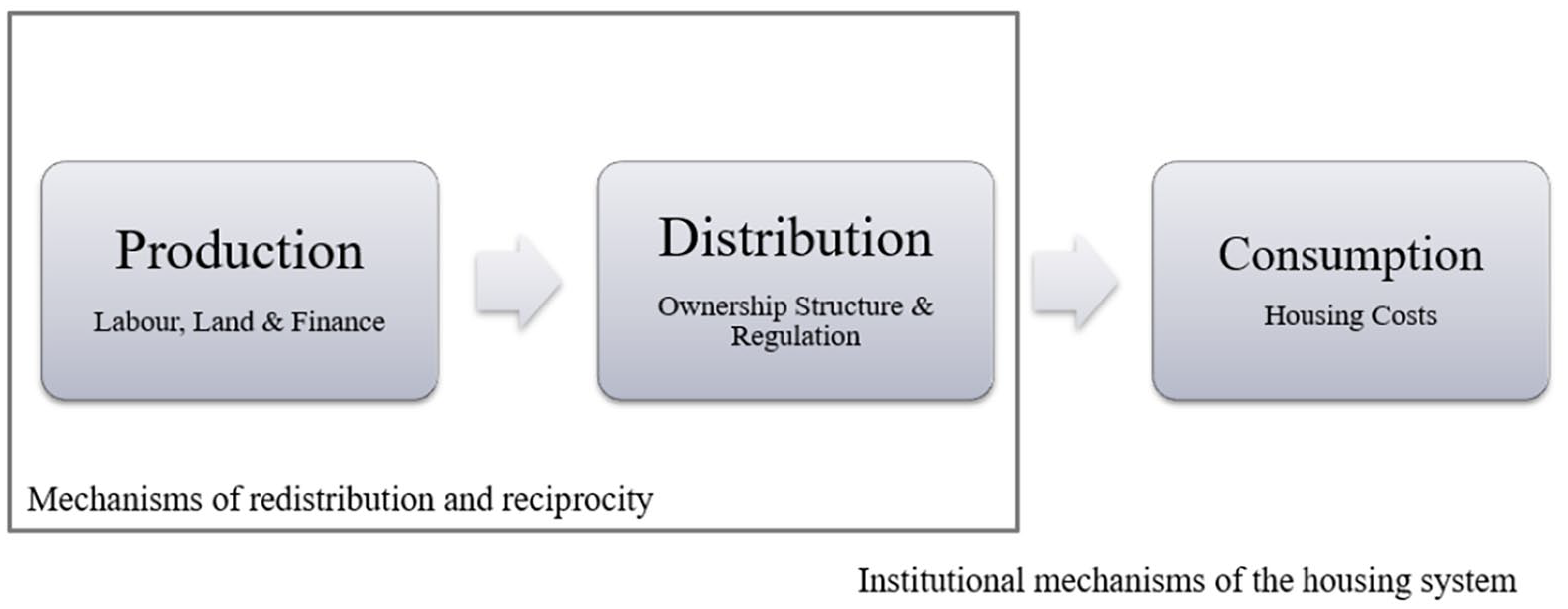
Analytical framework for understanding decommodification in (collaborative) housing.
Research approach and methods
The case study for the research presented here is the collaborative housing initiative Bikes and Rails, the first collaborative housing initiative of the syndicate model in Vienna. It employs a set of qualitative methods, including secondary data analysis, semi-structured expert interviews and informal interviews conducted during ethnographic visits to the housing site (Flick, 2017). This approach is furthermore embedded in an institutional analysis that zooms in on the relevant mechanisms of the Viennese housing system (Matznetter, 2020; Stephens, 2020).
The secondary data analysis (Vartanian, 2010) provides the primary empirical foundation, offering insights into the legal organisation and financial requirements of Bikes and Rails and its embedding in the local housing system. National housing statistics (Statistik Austria, 2020), EU statistics on income and living conditions (Eurostat, 2023), the comprehensive Bikes and Rails website, including their official business plan (Bikes and Rails, 2020) and the Viennese development plan (Wiener Wohnfonds, 2019) serve as the main sources of quantitative data. Additionally, three site visits were conducted, during which four unstructured interviews with residents were carried out (Roulston and Choi, 2017), alongside participating in one externally organised discussion rounds. To verify and complement the collected data, three semi-structured expert interviews (Roulston and Choi, 2017) were conducted with representatives of the housing initiative and habiTAT Austria.
The data was evaluated using qualitative content analysis (Kuckartz, 2019) and deductively organised according to the Polanyian socioeconomic principles, differentiated along the dimensions of production, distribution and consumption. In terms of production, this study focuses on land and finance, which are particularly significant in the context of collaborative housing (Ferreri and Vidal, 2021). However, in other contexts – such as self-built or informal settings – the decommodification of labour and construction materials may be more relevant, as community or family members often contribute directly to construction or provide materials as gifts (Galmarini et al., 2022). On the consumption side, the initiative’s rent levels are compared with those of other segments in the Viennese housing system. Dewilde’s (2017) approach is also applied to assess whether rent levels are affordable for lower- to middle-income groups, defined as households with an average income from the lowest two disposable income quintiles. Unaffordability is operationalised as spending more than 30% or 40% of income on housing.
Supporting structure: The Viennese housing system
The following two sections examine two supporting structures of decommodification strategies. The first section focuses on external regulation – the housing system – while the next explores internal regulation, specifically the organisation of the collaborative housing initiative. Both contribute to the promotion of socioeconomic principles and, in turn, influence the depth of decommodification across production, distribution and consumption.
The Viennese housing system is embedded in a conservative-corporatist Austrian welfare state (Matznetter, 2002). It has been described as a ‘unitary rental system’ in which the decommodified rental segment (public and limited-profit providers) houses a large share of the population, thereby achieving a price-dampening effect by competing with private alternatives (Kemeny, 2006). Within this system, the city of Vienna stands out for its long history of social housing, and its housing policies have been widely praised for social inclusion and affordability (Marquardt and Glaser, 2020). The city, which is administratively also a federal state, maintains a uniquely large stock of municipal housing: 22% of the Viennese population resides in this form of public housing. Limited-profit housing associations (LPHAs) account for another large share (22%), meaning that in total 44% of the city’s residents live in social, decommodified housing 5 . Moreover, ownership rates are comparatively low (20%), and 33% of the Viennese population live in the private rental segment. In Vienna, there exists a broad political consensus and commitment that housing provisioning must remain a key municipal responsibility (Zupan, 2021).
Historically, collaborative elements in housing provision played a prominent role as part of the settler movement 6 and cooperative movement around the turn of the 20th century in Vienna (Novy and Förster, 1991). During the years of the emancipatory municipal project of Red Vienna (1919–34), housing provision developed into an innovative top-down approach centred on municipal housing and close cooperation between LPHAs (such as cooperatives) and city officials (Kadi and Suitner, 2019). Particularly after the Second World War, this managerial approach marginalised collaborative elements in the Viennese housing system (Haderer, 2023a; Lang and Novy, 2014). Since the 1980s, Vienna has increasingly shifted responsibility of direct provision from the public into the hands of LPHAs. Today, these are the main providers of affordable housing in Vienna. Around 50% of these providers are organised as cooperatives, while the other 50% operate either as limited liability or joint-stock companies. As providers professionalised, they gradually lost touch with some of the original cooperative ideas of collective help and self-organisation (Gruber and Lang, 2018). The current wave of collaborative, self-organised housing initiatives can partly be seen as a response to these developments. Still, collaborative housing initiatives in Vienna mostly develop in close cooperation with local authorities, who, for example, make public land available for development.
Today, housing development competitions are a key steering instrument of the city in intervening in housing provision. Most often organised by the Vienna fund for housing construction (wohnfonds_wien), or sometimes larger property owners like the public Austrian Railway Company, it distributes publicly owned land to developers based on a points system with four categories: economic aspects, ecology, architecture and social sustainability. The social sustainability category, among other characteristics, allows the responsible advisory board to consider the benefits of collaborative elements (Gruber and Lang, 2018). Thus, the city of Vienna can actively promote collaborative housing projects through the provision of subsidised land (Lang and Stoeger, 2018; Peverini, 2021).
The primary housing subsidies in Austria consist of long-term, low-interest loans for housing construction and renovations (Kössl, 2022; Mundt and Springler, 2016). The national government of Austria allocates funds for housing-related expenditures via an income-based housing tax and distributes them to the federal states, granting them relative autonomy in directing housing construction (Mundt, 2018). Additionally, revenues come from repayments of existing loans. In Vienna, revenues generated from both sources outweigh housing-related expenditures (Kössl, 2024). Furthermore, housing expenditures are characterised by high levels of supply side (brick-and-mortar) subsidies in Austria. Approximately 0.2% of GDP is invested in housing promotion (supply-side) and 0.11% for demand-side subsidies like housing allowances. The total housing-related public expenditures amount to 0.3% of GDP, only half of the European average (Kössl, 2024), 7 yet considered highly-effective (Wieser and Mundt, 2014).
The subsidised decommodified segment is divided between municipal and limited-profit housing (Kadi and Lilius, 2022). Rents in municipal housing are set by the City in line with federal rent regulation laws. The limited-profit system provides cost-rent: future rents are set on levels to ensure the refinancing of production costs. The scheme defines maximum land and construction prices to ensure relatively low rents (Kössl, 2022). Providers in this system benefit from preferential tax treatments, such as exemptions or reductions in corporate and value-added taxes. However, generated profits must be reinvested into housing development. This system has created a sizable revolving fund: Repaid loans can be used to finance new construction, which decreases the financial burden on the municipality (Mundt, 2018). Consequently, a relatively large decommodified housing stock developed, directed towards lower- and middle-income households (Angel and Mundt, 2024).
To conclude this section, while redistribution is most closely associated with municipal housing, the system also includes a range of mechanisms that further reinforce this socioeconomic principle across other tenure forms and housing models, such as public loans, access to land plots and preferential tax treatment. Notably, some institutions can also foster reciprocity, as in the case of developer competitions that enable support for collaborative housing initiatives.
Supporting structure: The collaborative housing initiative Bikes and Rails
Bikes and Rails 8 is an innovative collaborative housing project embedded in a new urban development quarter (Sonnwendviertel) located close to the main railway station in the 10th district in Vienna. The public Austrian Railway Company owned and provided the building plots for the entire area. 5000 newly-built apartments for around 13,000 inhabitants were completed in 2019 (wohnfonds_wien, 2019). The living environment features a large park dividing the quarter into Sonnenwendviertel-East and Sonnenwendviertel-West. Subsidised housing was established mostly west of the park, while private providers and a large share of collaborative projects were built to the east of the park. Thus, the eastern side holds nine such collaborative initiatives focusing on different societal issues ranging from co-living in old age to a focus on cultural activities. In the whole development quarter, around 1/3 of the total apartments were constructed within the Viennese subsidised housing scheme.
Within this urban development quarter, Bikes and Rails started as a collaborative building group (Baugruppe) that applied for three building plots. The initial group participated in the planning processes by cooperating with an established developer (Resident, Interview 1). The building was constructed within Vienna’s subsidised housing programme and established under the legal tenure form: Dormitory (‘Wohnheim’). Initially created for student housing, this tenure form has been used by various cohousing projects in Austria. It exempts the project from certain building regulations, for example, the strict requirement for building a parking lot for residents and also provides financial benefits when creating larger communal spaces. On the other hand, residents are ineligible to apply for housing allowances under this tenure form (Expert, Interview 2).
During the construction process, the composition of the building group changed. After a new resident group was formed, with the developer hiring a consultancy for facilitating the process, the group successfully purchased the building from the developer once construction was completed (Resident, Interview 2). Regarding decision-making, the group operates with a consent-based governance model, which they also use to decide who moves in when an apartment becomes vacant, with a waiting list of potential residents. Anyone can sign up to move in, provided they do not exceed Vienna’s relatively high income ceiling for affordable housing and are willing to actively participate in various aspects of the management of the project. All apartments are allocated by Bikes and Rails (Expert, Interview 3).
Furthermore, Bikes and Rails decided to join habiTaT Austria. As a member, Bikes and Rails is organised according to the principles of the better-known German (Mietshäuser) syndicate network. The housing model is novel to the city of Vienna. In practice, this means that the building is managed by a housing common (the residents) and bought by a legal entity, co-owned by the residents (51%) and by the habiTaT solidarity network (49%). HabiTaT Austria has no rights to interfere with the project except for a veto on the sale of the building. The underlying rationale being that once all running loans are repaid, the building will be kept out of the housing market forever (Resident, Interview 4).
Bikes and Rail’s funding model followed a unique approach utilising a mix of public and private loans. The city of Vienna granted the public loan as part of the discussed subsidised housing scheme. The private loans are divided into (1) a loan from a bank and (2) direct loans provided by supportive individuals. A crowdfunding campaign assisted in the collection of direct loans. Any individual can contribute between 500 and 50,000 euros in the form of direct loans and decide on an interest rate between 0 and 2% (Bikes and Rails, 2020). Loans usually are repaid after 3–6 months (Expert, Interview 2). Future residents are allowed to contribute, but officially it is not a requirement for participating in the housing project. These direct loans also help as starting capital to back the loan from the bank. Rent levels should cover the repayment instalments and interest on the bank loan (Expert, Interview 2). The total financing amount of €5.4 million was split as follows: bank loan: €2.8 (1.45% interest over 35 years); public loan (1% interest): €1.1 and direct loans 1.5 million (roughly 0.8%–1% based on previous experience; Bikes and Rails, 2020).
Analysing strategies of decommodification: Production, distribution and consumption
The analysis yielded the following results regarding the production, distribution and consumption of the housing initiative.
Moreover, Bikes and Rails received land plots at below-market price, which can be considered as an additional indirect subsidy that enhances redistribution in the production process. This form of inclusive planning, where land is reserved for specific purposes like collaborative projects (Ferreri and Vidal, 2021), demonstrates how the Viennese housing system promotes reciprocity in housing provision. Moreover, developer competitions are another institutional mechanism that fosters reciprocity by valuing collaborative projects as part of the social sustainability category.
In addition to comparing different housing segments, another way to assess decommodification is by evaluating whether rent levels are affordable for lower- to middle-income groups, see Dewilde’s (2017) approach above. In Austria, the average disposable household income for these groups in 2020 amounts to 1756.8 euros per month, making the housing-cost overburdening rate either 703 (40%) or 527 euros (30%). In the Bikes and Rails building, a 75-square-metre apartment – the average size in Vienna – costs 810 euros in rent. This would place households in the bottom two income quintiles above the affordability threshold, meaning they would be overburdened by these costs. However, Bikes and Rails also offers smaller, more affordable single and two-room apartments. Apartments up to 48 square metres (518 euros) remain within the 40% and 30% affordability thresholds. Therefore, Bikes and Rails provides options that are accessible to lower- and middle-income groups. This aligns with the concept behind many collaborative housing projects, as noted by an interviewee, where private spaces are smaller, but high-quality communal areas compensate for the reduced personal living space (Resident, Interview 4).
Bikes and Rails’ internal regulation has two notable effects on the consumption side, both related to affordability and accessibility. 10 First, limited-profit providers require new tenants to contribute towards covering construction costs with an initial lump-sum payment, known as the ‘Finanzierungsbeitrag’. Limited-profit providers can freely choose the size of this payment in accordance with the respective construction costs, but it usually ranges from 5000 to 40,000 euros for an apartment in Vienna (Expert, Interview 3). It is reimbursed when the tenant moves out, albeit with an annual deduction of typically 1%–2%. This required lump-sum payment acts as a significant barrier for entering the limited-profit housing stock for lower-income groups (Kadi, 2015). In contrast, Bikes and Rails manages to cover these costs with the help of their direct loans, effectively lowering the threshold for entering affordable housing. Second, a limitation of the model dampening decommodification is that, due to the use of the tenure form ‘dormitory’ residents are ineligible to apply for housing allowances. As one interview partner pointed out, this poses a barrier for lower-income groups seeking to rent from Bikes and Rails (Expert, Interview 3).
To conclude, Bikes and Rails is instituted by a particularly complex combination of socioeconomic principles, influenced by both internal and external regulations. While the initiative’s strategies enhance redistribution and reciprocity, market exchange continues to play a significant role. This process translates into rent levels on the consumption side: although Bikes and Rails is not the most affordable housing segment in Vienna – municipal housing remains as the most decommodified – it remains relatively affordable compared to other newly built projects. Lower- to middle-income groups, in particular, will find smaller apartments to be viable without becoming cost-overburdened.
Discussion: Scaling socioeconomic principles
Using a Polanyian perspective, this article sheds light on the diversity of socioeconomic forms as they exist empirically in housing provision. The analysis reveals how decommodification strategies in collaborative initiatives target the production and distribution of housing by instituting a complex mix of redistribution and reciprocity. This discussion examines how these strategies operate across spatial scales, addressing their limitations and potential for broader transformations in housing systems.
The analysis shows that reciprocity-oriented strategies remain locally anchored, securing habitation in a specific place and for a specific community. It also highlights that digital technologies can extend reciprocity beyond the immediate surrounding (Novy, 2024), enabling broader participation, as seen in the crowdfunding campaign. These decommodification strategies successfully lower financial barriers to accessing collaborative housing. However, Bikes and Rails does not only want to remain in its local niche; the initiative also includes efforts to scale out by participating in an umbrella organisation with the aim of adding more units to the decommodified housing stock.
Scaling out decommodification involves a notable shift from reciprocity-oriented strategies to those dominated by redistribution. The umbrella organisation pools and distributes resources, as in the case of contribution payments that support other similar projects. However, its ability to financially assist the production of collaborative housing projects remains limited. By contrast, a significant impact on affordability comes from public support by the city of Vienna, which provided land plots and a public loan, integrating the initiative into the redistributive capacity of its subsidised housing scheme. While this demonstrates that redistribution can occur outside the state, it also underscores Polanyi’s assertion that the scale of redistribution is crucial to its effectiveness (Polanyi, 2001: 5).
The umbrella organisation’s primary role lies in addressing decommodification on the distribution side, particularly in relation to property ownership. As discussed above, home ownership can enable commodification. That being said, the publicly owned housing stock has been subjected to wide and rapid privatisation and commodification in the past (Elsinga et al., 2014). Studies have also explored instances of privatisation and marketisation affecting limited or non-profit housing (Aalbers et al., 2017). This partially relativises the role of ownership and the notion that public and communal ownership automatically protects from such tendencies. For this reason, Bikes and Rails has instituted a particularly complex ownership structure to guard against future commodification by transferring ownership to another governance level (Savini and Bossuyt, 2022).
Reciprocity-oriented decommodification strategies are effective on the production and distribution side but remain place-based, targeting local initiatives. This focus on community has been problematised in social-ecological transformation research (Bärnthaler, 2024; Haderer, 2023b) for its limited capacity to build majoritarian coalitions beyond like-minded groups capable of influencing government. It also adds to the wider literature on the limitations of bottom-up initiatives and the need of linking them with top-down strategies to create systematic change (Oosterlynck et al., 2019). Scaling out requires enhanced redistributive capacities and reforms to governance structures to ensure broader support for such initiatives. Bikes and Rails demonstrates that achieving stronger decommodification requires the integration of bottom-up reciprocity with top-down redistributive mechanisms.
Conclusion
This article investigates the decommodification strategies of a collaborative housing initiative in Vienna. For this purpose, it engages with relevant theoretical literature on decommodification, including Polanyi’s contribution, the welfare state and narrower housing studies literature. The article argues for examining decommodification throughout the entire provisioning process, including production, distribution and consumption, by using Polanyi’s socioeconomic principles of market exchange, redistribution and reciprocity. It demonstrates how decommodification strategies alter the composition of these principles in the case of the collaborative housing initiative Bikes and Rails and how this project is embedded in the wider Viennese housing system – both key aspects with respect to decommodification. The article thus interrogates the relationship between collaborative housing and decommodification, connecting it to a wider theoretical debate.
The article does not discuss the relationship between decommodification and the wider collaborative housing segment, including other projects that may pursue very different aims. Future research will have to adopt a more comparative approach, scrutinising decommodification strategies and their effects across different initiatives while considering their embedding in the wider housing systems. Moreover, future research should further incorporate aspects of sociocultural accessibility into the analysis, as the relationship between decommodification and inclusion/exclusion is still underexplored. However, the conducted in-depth analysis offers theoretically guided insights into decommodification strategies in (collaborative) housing provision, their institutional mechanisms, spatial organisation and outcomes. Additionally, it provides a mapping of the empirically existing diversity in the political economy of housing and offers reflections on decommodification strategies in one of the most contested terrains in contemporary capitalism.
Footnotes
Acknowledgements
We would like to express our sincere gratitude to Richard Bärnthaler and Andreas Novy for their valuable feedback. Additionally, we extend our heartfelt thanks to all participants for their time and contributions, which were essential to the success of this research.
Declaration of conflicting interests
The author(s) declared no potential conflicts of interest with respect to the research, authorship, and/or publication of this article.
Funding
The author(s) disclosed receipt of the following financial support for the research, authorship, and/or publication of this article: This work was supported by the Austrian Academy of Sciences (DOC-team 114).
Ethical approval and informed consent statements
Ethics approval for this type of research is not required by the host institution. Informed consent was obtained verbally before participation. The consent was audio-recorded.

Data availability
The data that support the findings of this study are available from the corresponding author, Benjamin Baumgartner, upon reasonable request.