




Abstract
This article argues how a set of educational entrepreneurs are positioning emerging commercial facilities called ‘libraries’ as sites of preparation that can help young people in their attempts for upward mobility in a north Indian city. Commercial libraries largely represent ‘commodified study spaces’ that cater to the non-formal educational needs of educated, unemployed young people such as need for spaces to engage in uninterrupted study, access to internet services, or freedom from domestic chores or social and political projects. The educational entrepreneurs neither make claims of guaranteeing jobs nor provide any skills or competencies to the young people using such facilities. Using diverse place-making strategies, these entrepreneurs curate and commercialise the ‘educational environment’ of libraries, to highlight its significance in catering to the non-formal educational needs of unemployed young people preparing for government jobs. In doing so, these facilities neither ‘shadow’ formal academic processes and institutions nor function as conventional libraries found in formal educational settings. In this context, the article highlights the shifting terrains of geographies of education, especially with the rise of varied commercially driven institutional forms that have emerged in the context of a public crisis of education and un- and under-employment in India.
Introduction
Recent research has documented the shifts in geographies of formal education and the consequent rise of varied formal institutions around the world (Kleibert et al., 2021; Mintz, 2021; Rottleb and Kleibert, 2022; Sidhu et al., 2016). There has also been a focus, albeit recent, on the corresponding rise of private supplementary educational services in the global North (Hall and Appleyard, 2011; Holloway and Pimlott-Wilson, 2020, 2021; Holloway and Kirby, 2020). However, much of the geographical work examining the growing private supplementary educational services has been conducted in advanced capitalist countries (Holloway and Jöns, 2012; Kleibert, 2021; Kraftl et al., 2022). Moreover, the study of private supplementary educational services has predominantly revolved around the theoretical concept of ‘shadow education’ to analyse the types, growth and functioning of such facilities across several countries (Bray, 2017). The monicker ‘shadow’ has been used to highlight the ways in which such facilities simply mimic the formal schooling system including changes in its curriculum or other related developments.
In this context, through an ethnographic analysis of commercial libraries in north India, this article challenges the conceptual understanding of such services as merely shadowing the formal academic processes and institutions. This article shows how a new set of commercial libraries have become a novel feature of the shadow education markets in the north Indian city of Meerut over the last 5 years. Commercial libraries can be defined as spaces of preparation wherein unemployed young people engage in uninterrupted studies to secure public sector jobs of their choice. This article argues that such sites of preparation largely represent ‘commodified study spaces’ that are positioned as facilities that can help young people increase their chances at educational and professional success relative to others. Libraries are simply spaces that cater to the non-formal educational needs of educated, unemployed young people – such as a need for space to engage in self-study – in their attempts to gain upward mobility in their lives. The educational entrepreneurs running libraries neither make claims of guaranteeing jobs nor provide any skills or competencies as tutors to those using such facilities.
In examining the rise of commercial libraries in Meerut, I argue that their successful functioning depends upon the abilities of diverse educational entrepreneurs in providing an ‘educational environment’ within such facilities. Using geographical concepts that engage with the affective dimensions of space and the creation of particular environments (Anderson 2006, 2009; Bosworth, 2023; Duff, 2010), I argue that a set of educational entrepreneurs’ curate, promote and commercialise the mahaul, that is, environment of libraries though diverse place-making strategies, to highlight its significance in catering to the non-formal educational needs of young people vis-à-vis their preparation in Meerut. The spatial aestheticisation of commercial libraries and the production of an ‘educational environment’ further distinguishes such spaces from both formal and shadow educational institutions in the region.
The educational entrepreneurs are generally aware of the deterioration of the provincial education system and the crisis of spaces that a vast section of young people hoping to obtain government jobs face in the region, as documented in various parts of north India as well (Devi and Ray, 2024; Jeffrey, 2010; Jeffery et al., 2006). With an understanding of such a demand for ‘educational environment’, the entrepreneurs position the significance of such spaces in terms of what they do not contain, such as politics, noise, violence, patriarchal expectations and responsibilities of domestic chores especially for young women, and other distractions. The provision of such an ‘educational environment’ within libraries becomes especially significant for young people from diverse social backgrounds in the larger context of social, political and economic precarity, disruptions and violence in western Uttar Pradesh (Jeffrey, 2008; Jeffrey and Young, 2012; Jha, 2024; Mishra and Rayaprol, 2023; Sahay, 2015).
Through the examination of commercial libraries in north India, the article primarily seeks to enhance understanding of the shifts taking place in the geographies of education, especially in the Global South. It will show how the educational entrepreneurs are driving the rise of newer institutional forms that neither function as conventional libraries nor do they offer services available in the private supplementary education market that simply ‘shadow’ formal academic processes and institutions. The study of commercial libraries in Meerut widens geographical understanding of the varied commercially driven economic spaces that have emerged in the context of a public crisis of education and un- and under-employment in India and other parts of the Global South.
To consider the significance of commercial libraries, I conducted 12 months fieldwork with several educational entrepreneurs to examine how they curated and marketised the educational environment of libraries to capitalise on the needs and aspirations of educated, unemployed young people from rural, lower middle classes. 1 The next section engages with the literature on shadow education services and studies on spatial theory and affect to draw out the main conceptual framework of the article. Section ‘Methods and setting’ outlines the methodology and contextual setting of my research. In section ‘Setting up “Commodified study spaces”’, I examine how educational entrepreneurs have been driving the rise of commodified study spaces in the region. The fifth section looks at the ways in which educational entrepreneurs capitalised on the market for ‘educational environment’ in the region and positioned such facilities as useful for young people. Section ‘Capitalising on the demands for educational environment’ highlights the affective elements of libraries and its curation by diverse educational entrepreneurs. The conclusion draws out the wider relevance of this study for further geographical research. All names of participants and commercial libraries have been anonymised.
Shifting geographies of education, commercial libraries and the curation of affect
The growing aspirations of an increasing number of young people seeking to obtain educational capital has been associated with the twin processes of massification of higher education and corresponding marketisation of educational services around the world (Cheng, 2016). With the transformation of educational services as a form of ‘tradable service’ for commercial success (Busch, 2023), these developments have led to the creation of formal and informal institutional spaces that are solely based on the marketing and provision of educational capital across diverse countries (Harrison et al., 2016). Within geography, there have been few studies that have looked at the rise of supplementary educational institutions beyond the formal academic space offering diverse services to increase young people’s positional advantage in their attempts at upward mobility (Hall and Appleyard, 2011; Holloway and Pimlott-Wilson, 2020, 2021; Holloway and Kirby, 2020).
Research conducted on the rise of private supplementary education has used a combination of words to examine its vitality and growth, including private tutorship and shadow education (Bray, 2017; Gupta, 2022). Bray noted three principal features that underline the shadow education industry, notably, supplementation, which relates to the provision of tutoring in subjects already taught in formal institutions, privateness, entailing the provision of additional academic instructions from an individual tutor or for-profit organisation at a particular cost, and academic, involving subjects examined in the formal setup (Bray, 2017; Gupta, 2023). Several scholars have argued that different kinds of institutions have come up such as cram schools, learning centres and tutorship services that provide one-to-one instruction or in groups across diverse kinds of physical or virtual spaces with the growing marketisation of education and its transformation into a ‘marketable’, ‘consumer good’ (Bray and Kobakhidze, 2014).
However, the literature on shadow education has largely centred around the phase of formal schooling and the related supplementary educational settings (Dierkes, 2010; Holloway and Kirby, 2020). Moreover, the interrogation of the shadow education market has largely focused on the problems of quality of education delivered in such spaces (Dierkes, 2010), the subversion of formal schooling processes (Nambissan, 2017), the economic and social factors driving unemployed tutors within the shadow education market (Deuchar and Dyson, 2020), or how they exacerbate educational inequalities due to their steep costs, thus increasing the crisis of accessibility for a wide section of young people, including in India and elsewhere (Holloway and Kirby, 2020; Punjabi, 2020).
Thinking about shadow education or private supplementary services in this way has tended to omit commercial libraries that form the analytical focus of this research. The rise and functioning of commercial libraries beg geographical attention on economic spaces that have come up as a result of sustained privatisation in the education sector in countries in the Global South, much like geographers examined the rise and functioning of other economic spaces such as co-working spaces that came up following the breakdown of the labour market and increasing informalisation of work in advanced capitalist countries in the Global North (Ananian et al., 2024; Merkel, 2019). There has been a limited geographical interrogation of the varied economic spaces that have come up especially in the Global South that cater to the demands of young people vis-à-vis their hopes for upward mobility, employment and related educational growth especially in the higher education sector.
One way of thinking about the significance of such spaces within the supplementary education sector is by attending to the affective intensities or ‘educational environment’ they offer. Geographical research examining the concepts of environment or atmospheres has largely revolved around the study of the affective effects of physical infrastructures in producing particular intensities of feelings and influencing action in diverse situation (Anderson, 2006, 2009; Duff, 2010). While indeterminate, Anderson argued that the affective atmosphere of an object or place is relevant in terms of the intensities of feeling it arouses through its aesthetic elements. The relevance of the work on affective atmospheres lies in understanding how the assemblage of non-human entities and human bodies in a given space creates diverse feelings which have the propensity, to use Bissell’s words, to effect behavioural and psychological change or even influence action (Anderson, 2006, 2009; Bissell, 2010).
Scholars investigating the idea of affective infrastructures have taken this concept forward and studied how certain spaces are engineered by various actors in ways so as to influence the generation of varied intensities of feelings and related practices vis-à-vis healthcare, educational policy and political activism (Bosworth, 2023; Street, 2012; Wilson, 2023; Zembylas, 2023). In the study of affective infrastructures, Bosworth argued that different forms of concrete infrastructures are designed with ‘emotional spectacle in mind’ (Bosworth, 2023). Several scholars have similarly looked at the production or curation of particular atmospheres by a diverse set of individuals such as young people in the creation of spiritual atmospheres in a north Indian village (Dyson, 2019) and work on specialists managing the atmosphere in football matches (Edensor, 2015) among others. Geographers have also examined the ways in which co-working spaces are designed with diverse amenities such as meeting rooms and floating workstations to provide ‘a branded environment of consumer culture’ and ‘sense of a big place’ to its users (Grazian, 2020).
Scholars have further examined the production or curation of affective atmospheres or environments by noting both the designing or staging of particular affects (Adey, 2009) and its co-production through non-human and human elements (Böhme and Thibaud, 2016; Edensor, 2012; Simpson, 2017). These works highlight the possibility of designing ‘material conditions and performative circumstances for the emergence of atmospheres’ (Sumartojo et al., 2019). The emergence of an affect is crucially linked to the coming together of non-human material elements and human entities and their practices which ultimately give a sense of place (Bille et al., 2015) and envelops users (Anderson, 2009). As the design or staging of environments may entail repetition (Bille et al., 2015), scholars also note the limitations of these processes wherein such affective intensities may not be emulated perfectly or produce similar experiences for all users (Paiva and Sánchez-Fuarros, 2021). Building on this varied set of literature on spatial reproduction and affect, this article will contribute to showing how educational entrepreneurs curated the spatial aesthetic category of ‘educational environment’ through the establishment of commercial libraries and capitalised on the needs of aspiring young people in Meerut.
Methods and setting
This article is based on data collected as part of a larger research project examining educational privatisation, youth joblessness and social change in north India. With the objective of examining young people’s attempts at navigating unemployment, I collected material for this study from 117 primary and 23 secondary participants over a year-long ethnographic fieldwork conducted in Meerut district in western Uttar Pradesh in north India from May 2022 to April 2023. Out of the 117 participants, 94 of them were young men and 23 women between 18 and 32 years. Within the primary participants, 17 of them were current students of formal academic institutions such as Chaudhury Charan Singh University (CCSU) and Meerut College, 18 of them were youth politicians, 16 of them included library owners and 66 library users. Out of the 18 youth politicians, six of them had been associated with the setting up of commercial or community libraries themselves. The 23 secondary participants involved a mix of older library owners, professors, tutors in the shadow education facilities and local journalists.
Besides age, young people were recruited for this study if they were residents of Meerut and were actively looking for jobs at the time of the research. All the primary participants belonged to the lower middle-class category. A predominant section of these young people belonged to farming families which also reflects the general background and economic practices of the population in Meerut. The participants hailed from varied social backgrounds as well, representing the diverse nature of the population in the region itself in terms of caste and religious demographics. I worked with a total of 24 upper caste participants, 45 intermediate dominant caste Jats and Gujjars, 29 Dalits and 19 Muslims.
Apart from young people, my research had a twin focus on the emerging spaces that were frequently being used by my participants during their search for secure sources of income. In the initial days of my fieldwork, I had been establishing contacts with potential participants in the formal educational spaces in Meerut city – Chaudhury Charan Singh University (CCSU) and Meerut College, and the private IIMT University to gather material on my research questions on young people’s aspirations for employment, the crisis of educational privatisation, and economic uncertainty in contemporary Meerut. In doing so, several young men and women frequently referred to ‘libraries’ that had come up in key neighbourhoods in the district. My participants referred to these neighbourhoods as ‘educational hubs’ that also comprised various other shadow education facilities.
Through snowball sampling and references from my participants who had been using such facilities across the educational hubs of Meerut, I primarily found two types of libraries that had come up in Meerut since 2016–17. First, a diverse set of new educational entrepreneurs had set up commercial libraries across the different educational hubs in the district. These libraries were privately-owned and set up to commercially benefit from the needs of aspiring young people for a space for preparation. Secondly, another varied set of individuals from the Dalit and Muslim communities, mostly involving educated, unemployed young men or youth political and social leaders or a mix of both, especially set up community libraries in their villages or neighbourhoods that were managed and run by members of the community respectively.
Through my year-long fieldwork, I worked in a total of 16 commercial libraries. This is definitely not an exhaustive list of all libraries that have come up in the district. However, these libraries were broadly indicative of the larger population of libraries in two ways: first of all, based on multiple interviews and verification with a diverse set of young people, professors, journalists and local businesspersons in the educational hubs, I identified the two major types of libraries – commercial and community – that had come up in the district. I was able to cover both types of libraries during my fieldwork across eight educational hubs in the district. These were also the hubs that were being used increasingly by young people for their preparations. Secondly, while I was able to work in these libraries in more detail, I also gathered information specifically on the range of facilities available at different libraries across the district by collecting promotional materials from such libraries during visits to different parts of the district. The larger population of commercial libraries provided similar kinds of facilities as available in the 16 commercial libraries that I worked in.
With the objective of drawing out the commercial purposes of educational entrepreneurs and everyday preparatory practices of unemployed young people, I used ethnographic methods to gather data including semi-structured interviews and participant observation. The 117 primary and 23 secondary participants were interviewed at least once. Among the primary participants, 72 of them were interviewed on more than one occasion. I also conducted 23 group interviews with primary participants across different commercial libraries in the district. Most of these interviews took place either in the educational campuses, educational hubs, on road-side tea stalls, or outside the libraries in the managers’ offices. Apart from interviews, participant observation was a key element of my fieldwork. Taking consent to stay and observe young people, I conducted long-term observations in the 16 commercial libraries across the district. Such periods of participant observation involved sitting inside the libraries and documenting young people’s everyday preparations within such facilities.
The fieldwork had certain challenges too. These especially concerned my positionality as a male, upper caste researcher, studying at an international university on a project concerning youth in contemporary India. It was initially difficult to recruit young women in my study as there were minimal opportunities to approach them directly. I was still an ‘outsider’ in the educational hubs and had to establish my credentials as a researcher and get references that could help me reach out to young women. Additionally, with the contemporary environment of majoritarianism and anti-minority politics in India (Jha, 2021), it was important to build relationships of trust with Muslim participants to understand their aspirations and employment-related practices as well.
The rise of commercial libraries and the commercial practices of educational entrepreneurs need to be situated in broader transformations that have taken place in the region since the early 2000s. Scholars have documented intersecting realities of deteriorating provincial higher education, marginal utility of formal degrees, and dismal state of educational delivery and skilling in public and private universities and colleges of Meerut (Jeffrey et al., 2007; Kumar, 2014). Since the 2000s, Meerut witnessed the rise of a slew of private supplementary educational institutions catering to young people’s hopes for educational capital as well (Kumar, 2014). The latter also grew as means for income generation for educated unemployed young people who failed to obtain secure sources of income (Young et al., 2017).
The educational entrepreneurs driving the rise of libraries capitalised on this template of educational privatisation and profit making in the region. A growing population of aspiring young people, including either a vast section of students formally enrolled in public and private colleges or universities or an even bigger group of young people who had passed out of their formal education journeys, sought to engage in preparation (taiyari) for secure, government jobs in the region. Among the first set of young people enrolled in colleges or universities, several of them did not attend classes on a regular basis. Termed ‘private students’, this set of young people only formally enrolled in colleges or universities and appeared for examinations at the end of the semester. A predominant number of these private students sought spaces to prepare for competitive examinations. This created a market of potential customers looking for a space for preparation. With the advent of COVID-19, the strict lockdown led to a complete shutdown of various supplementary education facilities in the hubs. Several of the tutors had to develop online material, pages on social media platforms and digital course lessons to ensure the retention of a section of the students.
However, the growth of digital modes of teaching provided newer avenues of potential growth in the educational hubs. For a large number of aspiring young people, especially from the rural, lower middle-classes, the pursuit of education through digital platforms required proper and uninterrupted internet services and spaces where they could study without any disruptions or distractions. A new set of educational entrepreneurs gradually positioned commercial libraries as spaces that catered to the newer non-formal educational needs of young people. The promise of environment (mahaul) in a space only dedicated to studying or preparation amassed huge popularity among large sections of young people, few of whom were already reeling from the closure of formal educational institutions and loss of significant years due to COVID-19.
Setting up ‘commodified study spaces’
Educational entrepreneurs running commercial libraries were positioning largely homogeneous facilities as instrumental for the non-formal educational needs of young people while competing with one another in the shadow educational markets of Meerut. Set up generally in huge rooms or halls in the mall-like plazas across the educational hubs of Meerut, the primary components of all privately-owned, commercial libraries included partitioned tables and cushioned, back-supported chairs. They provided a range of facilities that included fully air-conditioned rooms during summers, unlimited Wi-fi, charging points for laptops or mobile phones at each seating point and washrooms for boys and girls.
The commercial libraries lacked the anthropological meaning of a real library (Augé, 1992). Libraries are generally defined as spaces – rooms or buildings – primarily containing vast number of books, periodicals and other materials. The facilities I worked in neither sought to shadow the formal educational institutions or, even, the libraries found in formal educational institutions. They contained no computers, books, or study aids as part of the facility. In fact, several educational entrepreneurs commonly argued that such spaces could be referred to as ‘reading rooms’ or ‘study spaces’ as well. These absences of particular features especially highlight the irony of this genre of libraries in Meerut.
However, these spaces were branded as ‘libraries’ across the district. Honey, a 27-year-old Jat man who was preparing for the state police forces himself and owned the ‘Drishti Library’ (Vision Library) near Meerut College, argued that the designation of such spaces with the term ‘libraries’ lent an ordering principle that pre-necessitated appropriate behaviours and actions within such facilities from those using them. In fact, the educational entrepreneurs additionally crafted the names of their libraries in ways to promote their facilities as spaces for youth development as well. Out of the 16 commercial libraries that I worked in, most of them had names in Hindi or English such as ‘Direction Library’, ‘Blossom Library’, or ‘Success Library’ among others. Signifying a sense of purpose or rejuvenation or eventual attainment of a goal that most users hoped to obtain, these names played on the aspirational objectives of young people.
Unlike shadow education facilities, there was no mimicking of formal educational processes in libraries where professionals took up the role of tutors. The educational entrepreneurs did not make claims of guaranteeing jobs or supplanting or supplementing the educational experiences of those using these spaces. Entrepreneurs simply provided a space to the youth to prepare for diverse examinations and navigate the uncertainty in their lives on their own. One such library owner, Harish, a middle-aged Brahmin man who also ran a tuition facility in rural Meerut, noted, ‘We give a space for preparation to young people who come here. Their success will depend on their hard work’. Such assertions were accompanied with phrases such as ‘The more sugar you add to the sherbet, the sweeter it will be’, thus highlighting the self-responsibilising logic of libraries.
Libraries can best be described spatially as ‘commodified study spaces’, built with commercial profit in mind and devoid of accountability, wherein its users were responsible for their growth and success. Library owners bore no accountability for one’s performance or ability to perform and achieve their goals, especially for those who spent their productive years hoping for a government job. Such a neoliberal ethic of self-responsibilisation was most evident in the statements of Honey who noted during an interview in late December 2022 at his office inside the library, ‘Many young people simply waste their time in libraries and their parents’ hard-earned money. As long as parents keep paying, these people keep preparing’.
A majority of the educational entrepreneurs who ran these commercial facilities included either educated, unemployed young men from the upper caste and dominant intermediate castes of Jats and Gujjars or youth political leaders mostly from the upper and intermediate Jat and Gujjar castes. These young men had loaned money either from their parents or acquaintances to occupy a previously running library or to set up a new space by themselves. Quite often, the youth running such libraries also prepared for government exams themselves while managing the day-to-day affairs of their businesses. With no added responsibilities of teaching or tutoring, libraries served as a temporary source of income in the absence of well-paying secure jobs or lagging government vacancies. They often argued that the setting up of libraires was fairly less cumbersome in comparison to coaching institutes and tuition centres and not too expensive. One such educational entrepreneur, Abhay Khare, a 31-year-old man who had started a commercial library on the outskirts of Meerut city after failing to secure a job in the armed forces, noted: Meerut used to be a sports hub, but now it has become an educational and medical hub. Libraries just need a one-time investment. One does not need specific skill sets to run a business like this as well. We only need to rent a space, arrange the furniture, and set up the Wi-Fi.
The rise of commodified study spaces represents the evolving influence of neoliberalism on India’s educational landscape. The region witnessed the rise of private colleges and universities and shadow education facilities with the decay of formal provincial educational institutions and state push for educational privatisation in the 2000s. Commercial libraries, in a way, represent the logical progression of such processes of educational privatisation in the region. However, what is interesting to note here is that the rise of commercial libraries and the commodification of study spaces is an example of neoliberalism ‘working from below’, as argued by Gago (2017). Rather than being pushed by big corporations or the state, local educational entrepreneurs have been facilitating the rise of such spaces. Such facilitation has been successful owing to the evolving nature of educational and employment-related requirements in the region. Young people need to prepare to pass standardised tests that have a fixed curriculum and are often taught by tutors in coaching institutes. With educational entrepreneurs setting up commercial libraries, they have further cemented processes of neoliberal intensification and privatisation in educational geographies in north India with educational capital and instruction taken outside formal colleges or universities.
Curating an educational environment: Affect, ambience and aesthetics inside a library
The functioning and success of libraries depended on the diverse ways in which educational entrepreneurs invested in spatially curating the ambience and aesthetics of commercial libraries. Noting the intricate relations between atmospheres or environment and aesthetics, Böhme argues that the feeling of a place needs to be simultaneously felt by a subject who can describe it and produced through material elements such as design, sound and light, among other things. Böhme necessarily points to the spatial and emotional angle of atmospheres or environment, noting that the process of aestheticisation entails ‘making atmosphere through work on concrete properties of objects’ (Böhme and Thibaud, 2016).
The new entrepreneurs primarily commercialised and promoted the significance of ‘libraries’ as key spaces that provided a ‘mahaul’, that is, an environment, for preparation and study in the wider urban environment of Meerut. Although devoid of teaching or formal rules normally associated with a schools or colleges, libraries essentially promised ‘silence’ and ‘peaceful environment’ to its customers as a key ingredient for growth. In doing so, they often set up disciplinary rules within such facilities so as to foster a peaceful environment for preparation. The main area within a commercial library that comprised the partitioned benches wherein library users prepared for their examinations was generally earmarked as a ‘silent zone’, incorporating the functional principles of a public library or a similar facility in a formal academic setting. One of the library owners named Ajay, a Jat man in his mid-30s, who ran his facility on the bypass road connecting Meerut city to the Meerut-Delhi Expressway noted, There are young men and women using such facilities. It is normal for them to hang about. But we also have to follow rules so that others are not getting disturbed. If we see people creating nuisance in the libraries, we make them leave.
In a way, the prioritising of silence and a peaceful environment for educational growth in commercial libraries complements, even if partially, the primary functions of conventional libraries as found in formal academic spaces. In almost all banners, posters and pamphlets, this ‘mahaul’ or environment of the library was a key selling point, promoting the material and affective dimensions of the commercial libraries through semiotic imaginaries in the shadow education markets. This resonates, partially, with Rottleb’s work on how material and semiotic elements are used to build imaginaries in the production of educational spaces (Rottleb, 2024). Such promotional material was put up on plazas, streets and hoardings across neighbourhoods in Meerut.
Moreover, I met a couple of educational entrepreneurs near Meerut College who highlighted how they opted for physical spaces, where they could set up their libraries, which were a little far away from the main roads or busy streets of the city. One of them noted, ‘If there’s less noise, the preparation will be better’. I came across several libraries wherein the owners had specially enclosed the hall where young people sat to prepare with fibre-sheeted walls inside their facilities. This was mostly the case with bigger commercial libraries. Although the degree to which such practices cut off noise is questionable as libraries were mostly situated in few of the busiest neighbourhoods in the city, it highlights how the educational entrepreneurs associated with the rise of libraries in Meerut engaged in diverse practices to curate an educational environment in the region.
Besides the promise of ambience as part of an ‘educational environment’, the entrepreneurs also used varied measures to aesthetically make such spaces attractive and present libraries as modern spaces for educational growth in Meerut. From providing locker rooms to overhead desk lights to multiple charging points, entrepreneurs customised individual seating facilities inside their libraries to offer a sense of elite educational service to their users. In few of the bigger commercial libraries in the city, entrepreneurs set up mobile generators so that users would not be affected by loadshedding or sudden electrical mishaps. They also provided a slew of facilities including CCTV Monitored spaces, book banks and lunchrooms. Few of the library owners also created additional spaces as discussion rooms that were then either filled with roundtables and chairs or bean bags to facilitate conversations among young people. Some entrepreneurs with connections in Delhi also highlighted their abilities to provide access to notes and preparatory material from Mukherjee Nagar, the hub of aspirants preparing for government jobs in the national capital.
The curation of the spatial aesthetic category of an ‘educational environment’ can best be explained through the example of Atal Sharma. Atal was an upper caste Brahmin man in his early 30s who had started one of the biggest commercial libraries near CCSU in 2020. During an interview inside his office in the library in late January 2023, he noted, ‘Young people must believe that this is a space for education’. With a capacity of 110 seats, Atal’s library, as shown in Figure 1 attracted huge number of students both from the university and neighbouring areas. He had been preparing for a government job for the past 15 years, with no avail. Having completed his postgraduation from CCSU, he was currently preparing for several teaching-related examinations and the entrance tests for doctoral studies at CCSU when I visited him initially in January 2023. As his family pressured him into marriage, he set up this facility to ensure a temporary source of income and take up his familial responsibilities. He had loaned roughly INR 9 lacs (≈ US$ 10850) from his parents to set up the entire space.
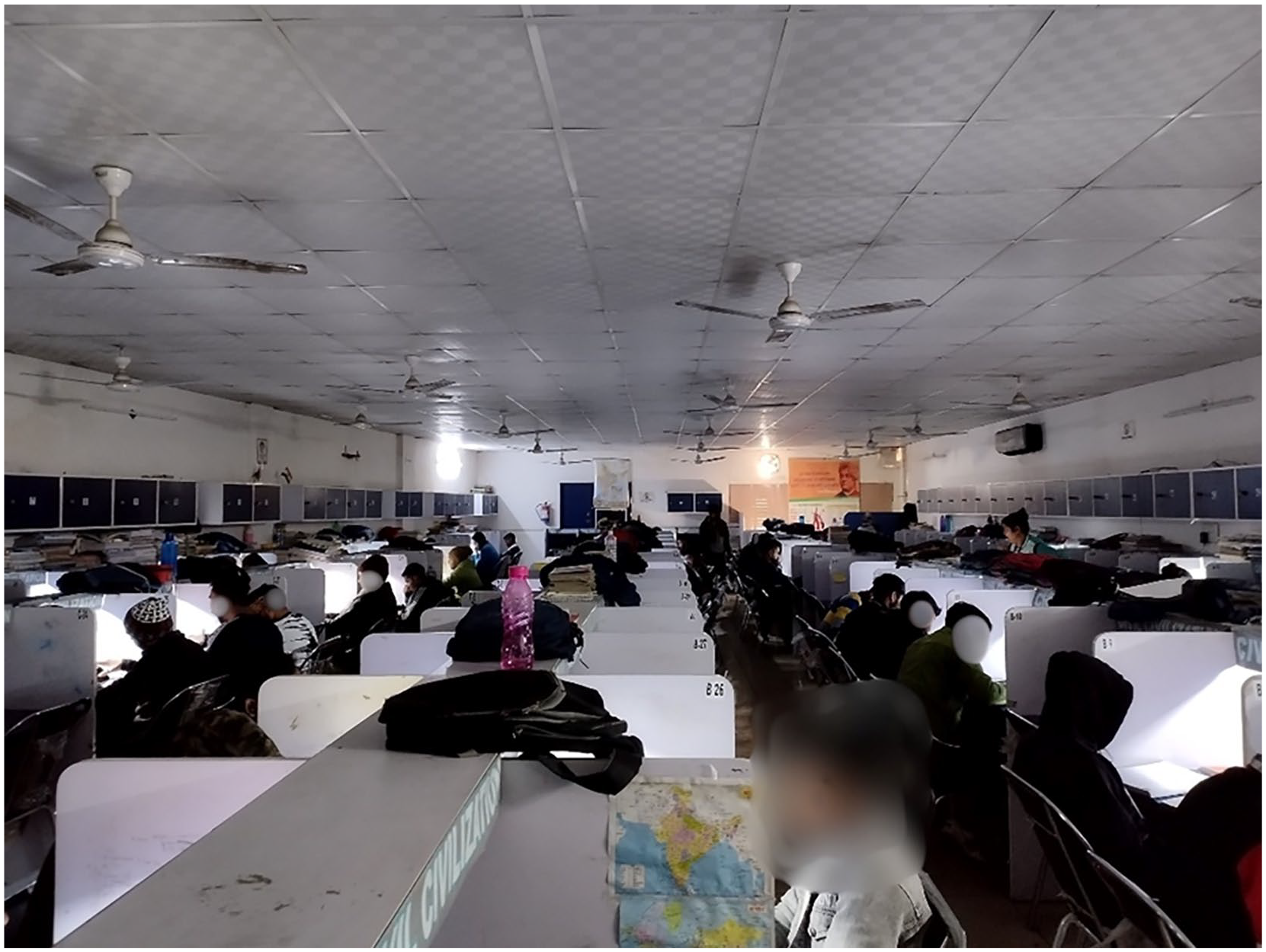
Atal’s library in Meerut city.
With help from his elder brother who had been preparing in Mukherjee Nagar, they sought to include features in their library that would convey the idea of an ‘aspirational educational space’ for young men and women from lower middle classes in Meerut and western Uttar Pradesh. His elder brother had suggested various quotes and names of personalities to him that were used on promotional materials. These quotes and pictures of the library’s facilities were put up both inside the library, outside it, and on various floors of the plaza. Atal’s library banner had the quote: ‘Education has its influence, where it happens and also where it does not’. Atal argued that libraries had to be positioned as spaces where the pursuit of education could be impactful.
He also put a lot of effort on curating a ‘mahaul’ to attract students to his library. In comparison to other commercial libraries, his facility had a more defined logo – a pen and an open book with a rising Sun as its background, again signifying the ‘aspirational’ attributes of his facility. Most libraries generally used logos of piles of books or a silhouette of a person sitting and studying on a desk. On the attached terrace with his library, Atal had set up a makeshift room near the entrance to the library. It served as a lunchroom and discussion spot for young people. Pictures of the library, facilities and designs were put up on the walls of the makeshift room. On one of the sides, a huge picture of Bhagat Singh, a celebrated youth icon of India’s freedom struggle, was put up with a quote, ‘Never lose faith in yourself. You can do anything in this universe.’
Atal had also put-up overhead desk lights on each of the designated seats along with labels for the seats based on a sequentially formatted combination of alphabets and numbers. These were then marked on individual ID cards for each student who used the facility. The back of the ID cards had printed rows detailing the months of the calendar year and an empty column to mark the payment of fees for each student. On the days of the payment, the library users brought the ID cards to Atal, who, in turn, signed at the back of the card as an acknowledgement for the receipt of payment. Much like the supplementary educational facilities, Atal therefore incorporated elements of formal educational processes to provide a sense of formality in the libraries. Moreover, the use of logo, ID cards, designated spaces and special facilities such as lunchrooms and overhead desk lights were instrumental in providing an ‘educational environment’ that a host of aspiring young people coveted in Meerut (Jeffery et al., 2006).
In examining educational entrepreneurs’ curation of an ‘educational environment’ within libraries, I should also add a caveat. During my fieldwork year, I met few educational entrepreneurs who invested in elevating the aesthetics of their facilities in a limited way. Harish noted that the setting up of the commercial libraries often involved a process of imitation of the facilities that had already come up. In one of the interviews in August 2022, he claimed, I went to the commercial libraries in the city and checked out the facilities they were using there. I set up similar partitioned desks and Wi-Fi services on the first floor of my apartment in rural Meerut. My library may not be as big or fancy, but there is high demand for this facility among a large number of unemployed young people from the more rural, interior parts of Meerut and western Uttar Pradesh.
Few commercial libraries, especially in the rural areas of Meerut, often lacked the kind of facilities found in commercial libraries in the city. For example, I worked in one such commercial library in Daurala, a rural township to the north of Meerut city in the district. Owned by an upper caste man named Ashok in his mid-30s, the facility was set up on the first floor of a dilapidated shopping complex. The room where the library functioned, roughly spread over 800 square feet, comprised nearly 50 seats. The partitioned tables were made from recycled plywood timber, with a few worn off on the edges. With only four tube lights and a couple of ceiling fans, the library space came across as dingy, lacking adequate lighting as well.
Used as a retail shop previously, Ashok had simply started off his business without investing many resources on providing new facilities or enhancing the environmental qualities of the room. Ashok noted that the abandoned shops on the same floor, adjacent to the library, functioned as discussion and lunchrooms. These were spaces that remained unused or shops that had been left empty. He had put in two wooden slabs on a pile of bricks that functioned as seating spots during lunch. The library users also had to use a common toilet on the ground floor. During an interview in February 2023, he noted that he would invest in more facilities in the future. Having failed to get a government job despite appearing for roughly a dozen competitive examinations, he needed to set up a commercial library to make a temporary income in the meanwhile.
On being asked about the limited nature of his facilities and lagging aesthetics compared to libraries in the city, much like Harish, Ashok argued that a constant stream of educated unemployed youth in the district cumulatively ensured a steady source of income for his library. He noted, There is no dearth of young people looking for spaces here. There will always be someone looking for vacancies in the library. I charge less than the facilities in the city as well. Young people know what to expect here. Those with limited economic resources will still come here for their want of a space. What is important is that my facility offers a seating spot, unlimited internet, and freedom from interruptions.
Most commercial libraries charged on an average of INR 1000–1200 per month (≈ US$ 12–14) for full day studies (i.e. 12-hour shifts) and INR 500 – 650 (≈ US$ 5–8) for half-day (i.e. 6 to 8-hour shifts) preparation. The commercial libraries in Meerut city or closer to the city charged prices at the higher end of the range owing to its location in the city and availability of varied facilities, in comparison to those that had come up in the rural parts of the district. With a high number of young people from varied economic and social backgrounds looking for a space for preparation, a small section of commercial libraries with limited facilities and aesthetic quotient still functioned in more remote areas of the district.
Capitalising on the demands for educational environment
The educational entrepreneurs were acutely aware of the issues faced by young people during their preparations, especially in formal academic settings. On most occasions, the entrepreneurs had experienced these difficulties themselves during their preparation. Young people looking for government jobs needed to prepare for diverse kinds of standardised competitive examinations. Such a practice entailed studying a variety of subjects such as mathematics, English, reasoning and current affairs among others on an everyday basis, based on the kind of examinations one was preparing for. Educated unemployed young people needed the libraries to study subject lessons, either from their coaching institutes or from digital YouTube-based classes, solve test papers, and engage in mock tests using app-based examination simulations.
The formal academic spaces such as colleges or universities did not provide skills or knowledge to ‘pass’ the gamut of examinations that offered recruitment in the mid- and low-level positions both in the central and state-level public sector institutions. With limited space in college or university libraries, which were themselves frequently affected by everyday political demonstrations, gendered policing, or instances of caste violence, young people looking for government jobs often argued that such spaces did not provide the scope for uninterrupted preparations. As a vast section of young people looking for government jobs included those who had already passed out of their formal academic journeys, they could not use the college or university space either. Most importantly, several young people complained that the formal college or university libraries generally comprised bare-minimum facilities. For example, the libraries in CCSU and Meerut College did not provide any internet services. Young people from the rural, lower middle classes argued that access to Wi-fi services were critical for their preparations with a significant section of learning material available on digital platforms.
The perceived deterioration of educational institutions and its related facilities was a constant theme emerging among young people in contemporary Meerut. Several young people looking for government jobs often resonated these concerns and commonly used the phrase, ‘There is no mahaul (environment) for studies/education here (referring to Meerut)’. While the degree of protests and everyday politicking had partially reduced from the early 2000s (Jeffrey, 2010), I documented several demonstrations and sit-in protests led by youth politicians both in CCSU and Meerut College demanding the rescinding of bans on union elections, protests against fee hikes or absence of teaching faculty in departments, and demonstrations over local, state or national-level political issues among others between 2022 and 23.
With this awareness of the needs of the large section of young people, the educational entrepreneurs betrayed an effective understanding of the shadow education market and the ways in which new institutional forms could provide pathways for income in the region. One of the first libraries in Meerut city was set up by a physics tutor near Meerut College in 2016 who himself had seen such facilities coming up in various neighbourhoods of Delhi that offered private supplementary educational services for government jobs. Post 2016, the commercial libraries came up slowly in Meerut. However, as the demands for spaces of preparation grew exponentially post the COVID-19 pandemic, a growing set of entrepreneurs capitalised on these needs of potential aspirants and started setting up commercial libraries across the district.
The efforts of educational entrepreneurs in setting up libraries was gaining commercial relevance as it seemed to enable diverse forms of behavioural and psychological change and action among sections of aspiring young people using such facilities (Anderson, 2006, 2009; Bissell, 2010; Böhme and Thibaud, 2016). Hinging on the assemblage of human and non-human elements (Bille et al., 2015; Wijngaarden and Hracs, 2024), unemployed young people’s interactions with their material surroundings were yielding commercial benefits for the educational entrepreneurs. During my interviews, several aspiring young people noted, Libraries have only one thing to offer – mahaul – an atmosphere conducive to education and preparation for exams. One can’t study at home properly. There are so many distractions. Moreover, if one doesn’t study in the libraries, you get competitive when you see others preparing diligently.
Several aspiring young men who prepared in such facilities especially highlighted their distinction as ‘struggling aspirants seeking to get a job’, who were not engaged in other forms of social, political, or cultural forms of action usually associated with educational spaces such as universities or via affiliation in varied socio-political organisations outside it. This contrasts the findings of Jeffrey (2010) who noted how vast sections of young men engaged in ‘passing their excessive time’ in street corners or tea stalls in Meerut, due to chronic unemployment in the early- and mid-2010s.
Educational entrepreneurs especially argued that the enclosed, bounded facilities cut off the users from any kind of distractions around them. These absences or distractions included expectations of work at home, noise, politicking, instances of caste-based violence, patriarchal responsibilities of domestic chores especially for young women among others which commonly affected young people’s everyday lives in the larger context of western Uttar Pradesh (Jeffrey, 2008; Jeffrey and Young, 2012; Jha, 2024; Mishra and Rayaprol, 2023; Sahay, 2015). The entrepreneurs argued that aspiring young people could prepare for long hours without any interruptions either from their family members or from those around them. One of the library owners near Meerut College, Jatin, an upper-caste Brahmin in his early 30s, explained, Most young people who study in these libraries come from farming families. If they try to study at home, their parents may ask them to help in the farm or assist in odd jobs through the day.
The library owners especially highlighted the significance of such spaces for young women as well. I came across several young women who used such commercial libraries, often resonating the concerns of their male counterparts highlighting the lack of proper educational services and the deteriorating state of public education in Meerut. Moreover, several young women especially argued how their ability to opt for preparation was limited owing to family-based apprehensions of violence or harassment. In this context, the educational entrepreneurs highlighted the significance of commercial libraries as key spaces where young women could both avoid getting embroiled in domestic chores or other family responsibilities that affected their preparation at home, as well as use commercial enterprises that prioritised women safety in the region. Several entrepreneurs often earmarked a separate space within their libraries for use by young women as well, highlighting how such additional facilities may attract female users who preferred a reserved area for their preparation.
Conclusion
Set up by new sets of educational entrepreneurs, this article has shown how commercial libraries represent ‘commodified study spaces’ devoid of accountability, wherein its users were responsible for their growth and success. Libraries are marketed as sites of purported positional advantage; wherein young people can prepare on their own and gain more skills and competencies and excel professionally in relation to others. Underlined by a neoliberal ethic of self-responsibilisation, educational entrepreneurs neither took up the role of tutors nor made claims of guaranteeing jobs or supplanting or supplementing the educational experiences of those using such spaces. However, libraries served as a temporary source of income in the absence of well-paying secure jobs or lagging government vacancies for such entrepreneurs. My work on commercial libraries and its supplantation of formal and informal educational settings points to the rapid developments happening as a result of educational privatisation in the Global South. Such developments require more attention as formal and informal academic processes and structures fail to meet the demands of young people’s educational needs (Kraftl et al., 2022; Pimlott-Wilson and Holloway, 2021).
This article seeks to make three significant contributions to the literature on geographies of education and curation or staging of affective environments in given spaces. First of all, this article has shown how commercial libraries challenge the conceptual understanding of ‘shadowing’ in the private supplementary educational market in Meerut. Commercial libraries undoubtedly incorporate the aspect of privateness that forms a key element of Bray’s definition of shadow educational services (Bray, 2017). However, there is no attempt to mimic formal academic processes within such facilities nor do any tutors seek to teach academic subjects as is common in shadow education facilities such as tuition centres, coaching institutes and cram schools (Bray, 2017; Gupta, 2022, 2023). As the rise of coaching institutes and tutorship programs led to the supplantation of formal educational processes and settings, the rise of commercial libraries facilitated similar processes of supplantation of shadow educational services itself (Suante and Bray, 2022).
Secondly, the rise of commercial libraries points to rather unique developments vis-à-vis neoliberal influences on the geographies of education, especially in the Global South. Most studies have examined the de-professionalisation of teaching services, rise of private players, introduction of cost cutting processes and user fees, more managerial approach to educational delivery, and other forms of deregulation owing to sustained effects of neoliberal privatisation on education (Connell, 2013; Klees, 2008). Long-term educational privatisation in the context of a public crisis of education and un- and under-employment in north India is generating new, and often at first blush rather idiosyncratic educational services and spaces. Representative of ‘neoliberalism working from below’ in a way, to quote Gago (2017), the rise of such facilities is being facilitated by local educational entrepreneurs.
The region witnessed an increase in private players vis-à-vis educational delivery and growing commercialisation of educational services following a gradual deterioration of public colleges and universities in the 2000s (Jeffrey, 2010; Young et al., 2017). This was evident in the rise of private colleges and universities and various shadow education facilities in Meerut (Kumar, 2014). Commercial libraries logically follow such processes and developments of educational privatisation in the region. However, these new educational services do not take formal education as an inevitable point of reference but often respond to the various non-formal educational needs of young people, for example, the need for freedom from domestic chores or freedom from being enrolled in social and political projects or the demands for spaces for uninterrupted preparation and access to facilities such as internet services with the growing importance of digital modes of learning.
Thirdly, the article has drawn attention to the importance of the affective elements of commercial libraries. In doing so, I have shown how the curation of the spatial aesthetic category of ‘educational environment’ support and add to the growing strand of geographical literature on the designing or staging of affective geographies across the world (Bille et al., 2015; Wijngaarden and Hracs, 2024). Through an interrogation of educational entrepreneurs’ place-making strategies within libraries, the paper looked at how the assemblage of non-human materialities and human bodies in a given space creates particular affective intensities in a given space (Anderson, 2006, 2009; Bissell, 2010). Scholars have increasingly been documenting the rise of facilities such as shopping malls, airports, co-working spaces, or creative workspaces across the world that are designed in a way where spatial aesthetics are elevated to influence the experience of the users (Edensor, 2015; Grazian, 2020; Wijngaarden and Hracs, 2024). I also drew out the limitations of such practices, engaging with works that highlight how emulation of affective atmospheres or environment may not always be perfect (Paiva and Sánchez-Fuarros, 2021).
Educational entrepreneurs invest in the spatial aesthetics of commercial libraires to differentiate itself from the decaying and ineffective provincial formal educational system in Meerut. Although coming up in shadow education markets, commercial libraries function as distinct economic spaces to cater to unemployed young people’s needs for a space for their preparation for jobs. The entrepreneurs incorporate specific facilities and aesthetics that only serve such forms of educational practices vis-à-vis exam-preparation. Moreover, the attempt to cultivate an ‘educational environment’ within libraries becomes especially significant in the wider context of social and political precarity and violence in Meerut and western Uttar Pradesh (Jeffrey, 2008; Jeffrey and Young, 2012; Jha, 2024; Mishra and Rayaprol, 2023; Sahay, 2015).
Footnotes
Acknowledgements
I am grateful to Craig Jeffrey, Jane Dyson, Andrew Deuchar, Ilan Wiesel and Elisabetta Crovara for their kind feedback on earlier drafts of this paper. I am also thankful for the generous suggestions of Suchismita Chattopadhyay and scholars at the School of Liberal Studies, BML Munjal University India. Any errors or omissions are my own. I alone am responsible for the final content.
Declaration of conflicting interests
The author declared no potential conflicts of interest with respect to the research, authorship, and/or publication of this article.
Funding
The author(s) disclosed receipt of the following financial support for the research, authorship, and/or publication of this article: Funding for this research was provided by the Melbourne Research Scholarship, Science Abroad Travelling Scholarship and Riady Scholarship awarded by the University of Melbourne. This research was funded as a part of a grant received by Professor Craig Jeffrey and Professor Jane Dyson from the Australian Research Council (no. DP200102424).
