




Abstract
This paper aims to bring literature on stigma in conversation with Gramsci’s theory of hegemony and to examine the production of territorial stigmatisation beyond the urban sphere, in a local context of socio-spatial struggle for land. I draw on a rich urban geographical scholarship on territorial stigma to examine how regional taint, built around institutional abandonment and the construct of ‘remoteness’, is mobilised to help legitimise and impose large-scale energy and tourism investments as a form of territorial ‘common sense’ in Eastern Crete’s area of Sitia. The paper aims to contribute to the rich body of literature on territorial stigmatisation twofold: by examining the analytical usefulness of the concept to the study of the marginalisation of peripheral regions and the subsequent neoliberal drive for their ‘re-development’ at all costs; and, drawing on Gramsci’s theory of hegemony, by taking a close, critical sociological look at the production and internalisation of stigma within a local context of socio-spatial conflict and struggle.
Introduction
The concept of territorial stigmatisation was formed as part of Loïc Wacquant’s (2007) analysis of advanced marginality, which largely focused on blemished neighbourhoods of the post-industrial city. By drawing attention to urban space as ‘a distinctive anchor of social discredit’ (Wacquant et al., 2014: 1272–1273), territorial stigmatisation ‘advance[s] our grasp of the ways in which noxious representations of space are produced, diffused and harnessed in the field of power, by bureaucratic and commercial agencies, as well as in everyday life in ways that alter social identity, strategy and structure’. Since its conception, territorial stigmatisation has been applied, with few exceptions, to urban contexts across the globe (see Hincks and Powell, 2022; Rudolph and Kirkegaard, 2019). Yet the symbolic vilification of place (Wacquant, 2007), I seek to demonstrate here, can contribute to the marginalisation of entire regions too, thus providing the moral and symbolic grounds for the subsequent dispossession and recapitalisation of land in the name of regional development. Hincks and Powell (2022) have recently applied the concept of territorial stigmatisation to ‘peripheral’ and ‘non-urban deindustrialised’ spaces such as the former coalfield communities of the Welsh Valleys in the UK. In so doing, they offer a critique on the theorisation of terrain and landscape within Wacquant’s work. Drawing on Bürk (2013) and Leibert and Golinski (2017), Rudolph and Kirkegaard (2019: 648) discuss territorial stigma as ‘both a consequence of uneven development and a cause of advanced marginalisation of peripheral areas’. They shed light on how territorial stigma is mobilised by wind farm developers seeking ‘marginal’ land to develop large wind farm projects in Denmark to justify and legitimise the clearance of space. These studies offer useful accounts of how Wacquant’s concept of territorial stigmatisation can be extended beyond the city, but this work can be further developed with attention to the specific social mechanisms that turn spatial taint into an essential engine for imposing hegemonic forms of development in land and how these mechanisms are co-produced and reproduced at the grassroots. Critical urban geographical literature has already made clear how the stigmatisation of place and territory can be strategically mobilised to devalue urban areas before redevelopment to legitimise the revalorisation and recapitalisation of space and push for specific policy (Gray and Porter, 2015; Kallin and Slater, 2014). Adding to this work by engaging a spatial reading of Gramsci’s understanding of hegemony and symbolic power, I am here particularly interested in (i) the relational ways in which the production of territorial stigma upholds spatial normalcy in the form of a territorial ‘common sense’ and (ii) in the specific manners in which territorial stigma is internalised and exercised at the community level.
The paper thus seeks to take a close look at how stigmatisation is produced and put to work within a specific political economic context of socio-spatial conflict around the dispossession of land for large-scale investments. Expanding on Parker and Aggleton’s (2003) work, Tyler and Slater (2018: 721) suggest that research on stigma ‘often side-lines questions about where stigma is produced, by whom and for what purposes’, and that ‘more thoroughly sociological understandings of stigma’ are required (2018: 727). While Wacquant’s concept of territorial stigmatisation draws on Goffman’s concept of stigma and Bourdieu’s concept of symbolic power, it goes beyond the ‘often individualistic, ahistorical and politically anaesthetised conceptualisation[s]’ of the former (Tyler, 2018: 746). Territorial stigmatisation has been political since its conception: by looking at the institutional production of stigmatisation, Wacquant ‘read[s] power back into Goffman’ (Tyler, 2018: 751), and for Wacquant et al. (2014), ‘symbolic dispossession’ becomes all the more potent under neoliberal policies and ideologies. Questions about the social and political production of territorial stigma nevertheless remain: several studies (Hastings, 2004; Slater, 2017) have highlighted the lack of attention on the production of territorial stigmatisation, with most research focussing on the effects rather than the causes of territorial stigma and being of a more ‘confirmative character’ (Larsen and Delica, 2019: 541). Related to the above is the critique that studies of territorial stigmatisation often victimise those affected and scarcely look at how stigmatisation is actively contested (Larsen and Delica, 2019; see also Nayak, 2019). I here wish to suggest that mobilising a spatial reading of Gramsci’s work can help situate stigmatisation within a local terrain of struggle and define its dialectic relationship with the formation of dominant, ‘common sense’ spatial visions. By looking at the interdependent relation between spatial taint and spatial ‘normalcy’ and the ways in which they are jointly mobilised and reproduced at the community level, I aim to analyse the production of territorial stigmatisation as an essential engine in the quest for the imposition of hegemonic forms of development in land.
I explore the interlinked mechanisms of territorial ‘common sense’ and stigmatisation through a case study of land dispossession of rural and semi-rural land in the eastern part of Lasithi, Crete, targeted for two ongoing large-scale investment plans (see Figure 1). Firstly, a €276.5 million ‘hybrid’ power plant by Terna Energy, consisting of a system of pumped-storage hydroelectricity in Potamon Dam (Municipality of Rethymnon) and 27 wind turbines in Sitia’s mountainous inland (Municipality of Lasithi) – it is the latter part of the project that is of interest here. As I have explored elsewhere (Korfiati, 2020), the dispossession of private properties for Terna’s investment plans has been actively facilitated by the state on behalf of investors through the mobilisation of its bureaucratic and normalising powers, which redefine the concept of ‘forest’ and dispossess land through re-classifying it as such. This is a process which relies on the shifting ‘functionality’ of informal land practices: chronic, laisser-faire state practices of neglection and ‘non-regulation’ have contributed to the social and geographical diffusion of rent and the production of often marginalised but dynamic landscapes since the early 19th century (see Mantouvalou, 2005). These landscapes are institutionally vulnerable, however, and the state and investors can actively re-engineer spatial regulation and practice to accommodate capital’s changing needs and accumulate by dispossession (Korfiati, 2020). And secondly, a €267.7 million plan for the ‘Itanos Gaia’ project, Minoan Group’s ‘landmark’ of luxury tourism in Greece: a touristic resort involving five ‘thematic’ hotels, a golf course, conference centres, and marinas over 25,000 stremmata 1 of land on Crete’s north-eastern tip, the Cape Sidero peninsula – a contested property of the powerful Toplou Monastery. Minoan’s investment plan, initially launched in the mid-1990s and since looming over the landscape for 30 years, was characterised as a ‘Strategic Investment’ under ‘fast-track’ legislation (Law 3894/2010) in 2012, in the aftermath of the 2008 financial crisis and the dramatic neoliberal restructuring of spatial (and other) legislation in Greece as part of the country’s ‘fiscal restructuring’ programmes (Korfiati, 2022). Both investment plans are situated at the ‘heart’ of Sitia’s (UNESCO) Geopark, threatening to displace small landowners and destroy their livelihoods, and have been the source of longstanding community conflict.
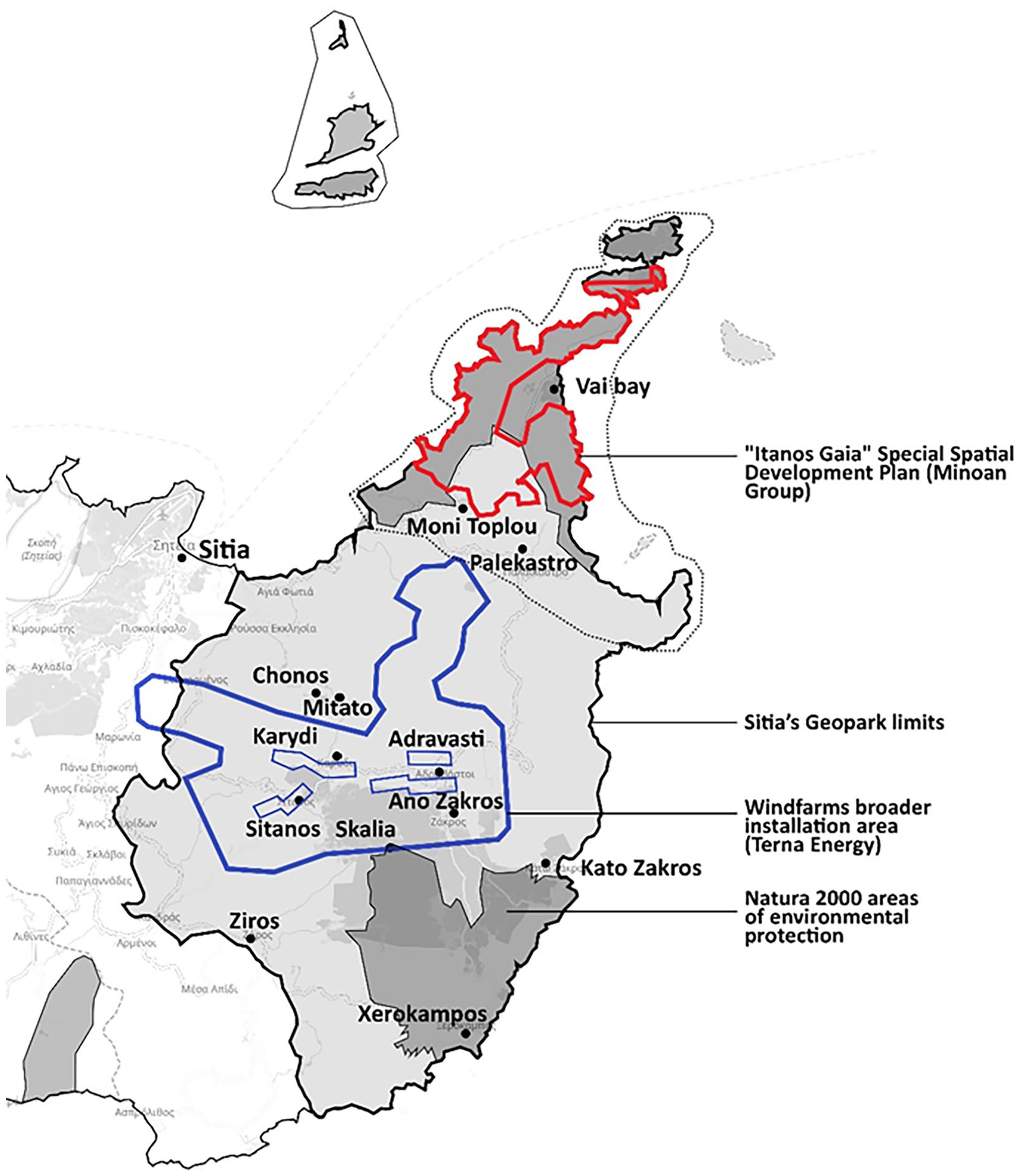
Terna energy’s and minoan group’s investment sites, Municipality of Sitia, Eastern Lasithi.
The research draws on a 7-month study conducted in Sitia in 2017, at the heart of which lie 38 in-depth interviews with a wide range of state and community stakeholders (including representatives from the local and regional governmental administration; local landowners; activist and environmental groups; and company representatives) – I here use direct quotations from selected participants (pseudonymised where needed). Interviews were complemented with a critical analysis of planning documents, relevant policy, council minutes and secondary data, and an ethnographic approach to the study sites.
I begin the remainder of this paper by discussing how Gramsci’s work can be of analytical use to think of territorial stigmatisation as a form of spatial hegemony. The section that follows, looking at territorial stigmatisation through the lens of Sitia’s case, presents three key areas of my analysis: The political and economic manufacturing of remoteness as a form of marginalisation which is directly related to disinvestment and institutional abandonment; the strategic manufacturing of any form of development in land as a systemic necessity (and inevitability), or a form of territorial ‘common sense’; and the internalisation, collective reproduction but also contestation of stigma at the community level. The final section offers some concluding reflections on the usefulness of Gramsci’s work in terms of extending and deepening our understanding of the production or territorial stigmatisation.
Tracing the links between territorial stigmatisation and spatial hegemony
Wacquant’s concept of territorial stigmatisation merges Goffman’s theoretical work on stigma ‘from below’, ‘tracing the effects of procedures of sense-making and techniques of “management of spoiled identity” across encounters and their aggregations into organisations’ (Wacquant et al., 2014: 1273) with Bourdieu’s work ‘from above’, ‘following the flow of efficient representations from symbolic authorities such as state, science, church, the law and journalism, down to their repercussions upon institutional operations, social practices and the self’ (Wacquant et al., 2014: 1272). Importantly, Goffman’s Stigma (1986) situates the production of stigma in interactional settings: as Imogen Tyler (2018: 750, original emphasis) puts it, ‘stigma describes a relation between normal and stigmatised persons [. . .] Goffman’s understanding of stigma, as something produced in social settings, pivots on the existence and social consensus about “what is normal”’. Goffman was, however, not particularly interested in understanding stigma as a social relation that is structured through power, and ‘he expresses little curiosity about where norms come from, what they prescribe, what the effects of these prescriptions might be, or how they might be challenged or transformed’ (Tyler, 2018: 751). As Tyler and Slater note (2018: 729), the historically specific forms that stigma takes as well as the ways in which stigma serves as ‘a means of formal social control’ (Goffman, 1986: 139) are two neglected claims in Goffman’s work (by himself and others); Tyler and Slater thus call for the rethinking of stigma as a form of power and governmentality: put simply, in the words of Link and Phelan (2001: 375), ‘stigma is entirely dependent on social, economic and political power – it takes power to stigmatise’.
Wacquant’s territorial stigmatisation is also based on Bourdieu’s (also relational) theory of symbolic power, defined as ‘a power of constituting the given through utterances, of making people see and believe, of confirming or transforming the vision of the world and, thereby, action on the world and thus the world itself, an almost magical power which enables one to obtain the equivalent of what is obtained through force (whether physical or economic), by virtue of the specific effect of mobilisation’ (Bourdieu, 1991: 170, found in Slater, 2017: 114). Unlike Goffman, Bourdieu is very interested in power. But for him, the exercise of symbolic violence is based on ‘misrecognition’: put simply, the idea that symbolic domination, in a mystifying manner, is too deeply embedded in the unconscious for its subjects to recognise it as such. Symbolic domination is, in this sense, directly related to habitus: Bourdieu’s ‘mediating construct’ that can help capture ‘the ways in which the sociosymbolic structures of society become deposited inside persons in the form of lasting dispositions, or trained capacities and patterned propensities to think, feel and act in determinate ways, which in turn guide them in their creative responses to the constraints and solicitations of their extant milieu’. (Wacquant, 2016: 65). Misrecognition and habitus, in other words, were not designed to capture the conscious and active recognition, negotiation and contestation of imposed forms of power (see also Burawoy, 2019). For Bourdieu, the state, for instance, ‘does not necessarily need to give orders and to exert physical coercion, or disciplinary constraint, to produce an ordered social world, so long as it is able to produce incorporated cognitive structures attuned to the objective structures and secure doxic submission to the established order’. (Bourdieu, 2000[1997]: 178, found in Burawoy, 2019: 69). In Bourdieu’s theory, doxic submission therefore goes beyond Marxist notions of false consciousness and ideology; he dismisses the latter as incapable of explaining the workings of symbolic domination, which are rather a matter of habitus and too deeply embedded in social structures for the majority subjects to be consciously aware of them.
This is where Gramsci’s understanding of hegemony, a much more explicit and overt form of domination, might be of use to further develop our understanding of the production of stigmatising power. Gramsci develops his theory of hegemony in a specific historical context of class struggle, which outlines the development of civil society (made up of the media, political parties, the church, schools, traditional intellectuals and community leaders) in close interrelationship to political society (i.e. the state and its ideological and repressive apparatuses). The concept of hegemony in Gramsci’s work refers to the ability of the ruling class to govern through a combination of material coercion and active or passive consent – an ability which relies upon the elites providing moral and intellectual leadership (see Calvário et al., 2017) and convincing subordinate classes of the universality of the dominant class interests (Gramsci, 1971). Gramsci’s understanding of power is based on a state of equilibrium between two constitutive elements or forms of control: consent is mobilised to secure the hegemonic power of the dominant class through the assimilation of ‘common sense’; and coercion entails the direct use of force. Reaching beyond the influence of elitist ideologies, common sense captures the generalised, popular ways in which hegemonic power is construed at the people’s level as a ‘conception of the world which is uncritically absorbed’ (1971: 769). Even if common sense permeates everyday life in taken-for-granted, subtle and unquestioned ways, ‘[it] is not something rigid and immobile’, stresses Gramsci (1971: 630), ‘but is continually transforming itself, enriching itself with scientific ideas and with philosophical opinions which have entered ordinary life’. While Bourdieu’s symbolic domination seems to leave little room for challenge and contestation, with classificatory impositions and dominant hierarchies being largely imperceptible and fixed for good, change is ingrained in Gramsci’s understanding of symbolic domination: hegemony is up for the take by antagonistic forms of economic and cultural capital competing for dominance.
Gramsci developed these concepts referring to ‘historical blocs’ – relatively stable political alignments between classes or, as Gill and Law (1989: 476) put it, ‘a historical congruence between material forces, institutions and ideologies’ which provided an ‘“organic link” between political and civil society’. The idea of stable political alignments in the form of historical blocs is not directly applicable to the political economic production of the dispossession of and investment in land (see also Levien, 2013). However, the relationship between political and civil society and specifically the ways in which the latter ‘embraces and absorbs subordinate dissent’ but ‘also provides a terrain of struggle’ (Burawoy, 2008) offer a useful analytical terrain for the study of place-based stigmatisation. Gramsci was particularly sensitive to not only the historical but also the spatial specificity of social relations, and a relational understanding of territorial expressions of power and questions of place, space and scale runs across his writings (see Ekers et al., 2013; Jessop, 2005; Kipfer, 2013; Loftus, 2019). From factories to public buildings to streets and neighbourhoods, he was interested in the struggle for control over places and studied their contestability in their relations of interdependency with other places (Jessop, 2005: 424). I here wish to suggest that a spatial reading of Gramsci’s work can therefore be useful to understand territorial stigmatisation as a form of collective representation which is produced, perceived and contested within specific social and economic relations vis-à-vis the struggle for and around land.
Territorial stigmatisation on Crete’s contested edge
‘In the middle of nowhere’: Remoteness and ‘backwardness’ as regional taint
In May 2009, the (then) Minister of Development took part in the inauguration ceremony of a new Steam Power Station constructed by the Public Power Corporation of Greece (PPC) in Lasithi’s area of Atherinolakkos, 20 km south of the city of Sitia. Almost 10 years before, the Station’s location, several problems with the project’s Environmental Impact Assessment (EIA), and serious inconsistencies in the legality of the installation and operation procedure had pushed Sitia’s residents to react strongly against it, ultimately resorting to the Council of State. The latter justified the claimants’ appeal in 2003 and forced the PPC to submit a new EIA. Back in October 2000, from a press conference somewhere across the country, the then Greek Prime Minister Costas Simitis referred to the locals’ reactions with disdain: the power station was to be constructed, after all, ‘in the middle of nowhere’ [στου διαόλου τη μάνα 2 ] (104fm.gr, 2005). The Prime Minister’s saying has since become a catchphrase – a symbol of the unjust and derogatory way the state treats places as ‘remote’ as Sitia. ‘Remoteness’ here functions as a form of territorial taint, internalised and reproduced by the state, local networks of power and part of the local population alike.
Situated at the eastern corner of the Prefecture of Lasithi, the Municipality of Sitia, a total area of 684,075 km2, is the largest Municipality in Crete. Sitia, including the homonymous city, is the second less populated municipality in Lasithi, with a 29.21% rate of population per km2, as opposed to an average of 41.36% in the prefecture of Lasithi, and an average of 74.74% in the Region of Crete (Municipality of Sitia, 2014: 7). Sitia’s low population density, along with indications of a decreasing and ageing population, are interpreted by the local and regional administration as a direct sign of decline, immediately linked to the lack of –and subsequently, the need for– capital investment in the region. As one can read in the Municipality’s ‘Five-Year Business Plan (2014–2019)’, Sitia’s low population density ‘indicates Sitia’s inferiority over other regions of Crete’ (Municipality of Sitia, 2014: 7, emphasis added). Apart from the local government, however, a sense of Sitia’s disadvantage (vis-à-vis the rest of Lasithi and the rest of Crete) was expressed by many participants themselves, as regional taint and external degrading views of the region (‘underdevelopment’, ‘emptiness’ and ‘backwardness’) become internalised by part of the local population. This sense of inferiority mainly stems from a combination of two factors: the lack of big investments in tourism, which are perceived as having positive effects on local and regional development by default; and the abundance of investments in energy, renewable or not, which are seen as turning the area into a depository of disturbing land uses. These two sit against the backdrop of striking neglect, peripheralisation and diachronic disinvestment from the part of the state, especially vis-à-vis infrastructure (such as roads) and access to services (such as administrative, health and educational services).
‘This is where the real tragedy lies’, according to Sophia (Interview, May 02, 2017), an urban and regional planner, and a member of the Technical Chamber of Eastern Crete and the Ecological Group of Heraklion: ‘that this [Sitia] is the best part of Crete, the most cosmopolitan, the people of Sitia are bursting with life [. . .] but they feel they have been excluded from development, precisely because of that myth of development which has prevailed’. This ‘exclusion from development’ is predominantly understood as exclusion from tourist development. Loukas (Interview, June 22, 2017), a small landholder, considers that the broader region has been ‘neglected’ because of tourism investments being directed elsewhere, such as in the neighbouring area of Elounda, or the Prefectures of Rethymnon and Chania. Indeed, Sitia’s tourism is significantly less developed than the rest of Crete, where touristic activity is mainly based on the product ‘sea & sun’ (see Melissourgos, 2008). The latter has been construed as the default pathway to prosperity; ‘underperforming’ in touristic activity, Sitia is considered as one of the most ‘underdeveloped’ and ‘empty’ parts of Crete. Territorial stigmatisation is produced in interactional spatial settings: it describes a relation between ‘normal’ and marginalised places.
Loukas argues that the state, precisely because of the region’s taint as ‘empty’ and ‘remote’, has demarcated Sitia as a ‘depository’ for unwanted, harmful, ‘industrial’ land uses such as power plants, solar power towers and ‘industrial-scale’ windfarms. Territorial stigmatisation is, as Rudolph and Kirkegaard put it (2019: 658), not just the ‘spillover product of unwanted infrastructures’ but a mobilising force for the siting of often extractive energy investments (Rudolph and Kirkegaard, 2019: 658). Not only are existing projects placed inappropriately and inadequately maintained, Loukas stresses, but an overwhelming number of new developments are planned in Sitia. This is immediately related to critical discussions of the relationship between creative destructive green developments and the appropriation and devaluation of landscape and fixed capital, as well as the ways in which green ‘industrial and technological competition plays out as a struggle between places’ (Knuth, 2016: 102). While most participants insisted that they consider renewable energy infrastructure necessary, particularly in light of the ongoing climate devastation, they stressed that the majority of energy investments are inappropriately located due to the lack of proper spatial planning; are overwhelming in scale and number (especially given Sitia’s very limited own needs in energy); and are undermining a landscape which bears a high symbolic value, yields a plethora of use-values, and sustains small-scale but crucially important economic activities directly depending on access to land (such as small-scale tourism, agrotourism, agriculture, stockraising and apiculture).
The geographical unevenness of siting energy production facilities is paired with strikingly insufficient, incomplete, or not properly preserved infrastructure, an issue that contributes directly to the production of territorial stigmatisation. This is widely discussed among locals and frequently preoccupies Sitia’s press. Dimitris (Interview, March 03, 2017), an agriculturalist working for Sitia’s Geopark, stresses that ‘they turned us into a garbage dump. Atherinolakkos [Power Station], industrial-scale renewable energy investments, and no roads’. Manos (Interview, March 12, 2017), a farmer, explains that ‘historically, Sitia has always been cut off’: roads within the Municipality of Sitia are old, badly preserved, and fail to meet basic needs and security standards (see also Municipality of Sitia, 2014: 18). For Themis (Interview, May 02, 2017), an elected member of the Regional Council of Sitia and a member of the PanCretan Network of Environmental Groups (EcoCrete), ‘Sitia is underdeveloped. It is the Epirus 3 of Crete [. . .] the Mountains of Sitia are inaccessible’: the road connecting Sitia to the rest of Crete is narrow, extremely swingy and inadequately preserved. The fact that the Northern Axis Road of Crete runs throughout Crete from Chania to Agios Nikolaos but does not extend as far as Sitia has been a constant source of frustration for the eastern part of Lasithi. Sitia’s hospital, for instance, presents deficiencies in various medical specialities and equipment, forcing patients to travel to Agios Nikolaos or Heraklion for treatment (approximately a 1.5- and 3-hour drive respectively) (Themis, Interview). In the Municipality’s villages and smaller residential settlements, the lack of basic services and infrastructure (such as administrative services, secondary and tertiary health care, upper secondary and higher education, etc.) forces residents to travel to the nearest urban centres (Municipality of Sitia, 2014). Part of Sitia’s coastal road – a vital means of connection to the city for a plethora of villages – was falling apart during my stay in Sitia. This physical as well as produced isolation lies at the root of a widespread sense of ‘underdevelopment’, neglect and poor judgement on the part of the state; seen beyond absolute geographical space, the production of remoteness depends on history and a politics of access and is a construct of improper infrastructure and connectivity. ‘Remote’, ‘empty’ and institutionally abandoned land, a product of spatial differentiation, has become the target of a double-edged frontier of dispossession: ‘green’ energy is taking over the mountains; luxury, ‘exclusive’ tourism is taking over the coasts. In the section that follows I turn to how the internalisation of regional taint is inextricably linked to the hegemonic imposition of a sense of spatial ‘normalcy’: a form of territorial common sense.
The making of investments in land as territorial ‘common sense’
Institutional abandonment ‘cannot but generate’, in the words of Loïc Wacquant (2010: 217), ‘an abiding sense of social inferiority by communicating to [. . .] residents that they are second- or third-class citizens undeserving of the attention of [city] officials and of the care of its agencies’. Territorial stigmatisation can, as Wacquant et al stress elsewhere (2014: 1275, original emphasis), also impact ‘the beliefs, views and decisions of state officials and, through them, the gamut of public policies that, combining with market and other forces, determine and distribute marginality and its burdens’. Sitia’s local government views the improvement of existing infrastructure and the creation of new as the one end of an exchange relationship between Sitia’s people and the state: Marina (Interview, April 11, 2017, emphasis added), the Vice Regional Governor of Lasithi, suggests that we must not shut the door on big investments [. . .] our region has been the receptor of many public investments, there’s the airport, there’s the port, some parts of the road network have been improved. . .this means that the state has invested in this place, so this place is responsible for delivering back. [. . .] This place, the residents, all of us, we are all responsible, and we need to make good use of what has already been done here.
Facilitating investment plans for Sitia’s land becomes, as Marina’s quote suggests, a matter of collective responsibility. This is directly linked to the hegemonic imposition of development as the sole path to prosperity, which presents itself as the only possible (and therefore inevitable) option. Reflecting on the Toplou Monastery’s role in planning the ambitious ‘Itanos Gaia’ touristic development on Cape Sidero’s land, for instance, the Monastery’s Abbot (a figure of great religious and social influence locally) considers that a big tourist unit would ‘on the one hand, help to develop the area, but, above all, act as a lever for the whole region. Because without that, this place did not have any other possibilities’ (Interview, May 11, 2017, emphasis added). For Emilios, a member of the Ecological Group of Sitia and the PanCretan Network of Environmental Groups, the main incentive of the local government and local elites in supporting land deals in Sitia, their motivating force, as well as the source of their influence, is ‘the cohesive fabric of the ideology of “development”. They exist politically because they have this simplistic [. . .] perception that “we, the good guys, are trying to unblock investments while they, the bad guys, are trying to prevent us from doing so”, and “let’s do something in this place, whatever that might be, instead of doing nothing”’ (Interview, March 20, 2017).
Emilios suggests that the manufacturing and naturalisation of this ‘obsession with development’ as the common sense route to employment (and therefore prosperity) needs to be situated historically within the contradictory dynamics of state neglection, disinvestment, deregulation and informality in the Greek countryside (ypaithros [ύπαιθρος]), as well as its contested and dynamic relation with the city and its peripheries (see Hadjimichalis and Vaiou, 2012; Vaiou and Hadjimichalis, 1997) –Gramsci engaged with such dynamics of uneven development throughout his work, and particularly his writings on the Southern Question demonstrate a deep interest in the ‘historical and social specificity of the city-country relationship’, which he viewed as part of the struggle for hegemony (Loftus, 2019: 13; see also Kipfer, 2013). In Sitia, similarly to much of the Greek countryside, multiple and seasonal job-holding and the existence of ‘silent’, undocumented informal labour practices are spread across an equally informal system of property and land-use rights. Such informal land and labour practices do not fall within the strict boundaries of formal analytical categories and are typically overlooked by national statistics, which often underestimate the dynamism and mobility between sectors as well as the lack of a ‘strict’ division of labour in the countryside (Vaiou and Hadjimichalis, 1997). Sitia’s informal land and labour practices are often interpreted as ‘remnants’ of past systems of economic and social organisation (Sophia, Interview): this echoes ‘stagist’ theories of development and ‘historicist/diffusionist’ interpretations that consider informal practices as sign of ‘underdevelopment’ and ‘backwardness’ of entire regions and their populations (Harvey, 2006; see also Fraser, 2014). These negative geographical imaginations are internalised and often actively reproduced by locals and outsiders alike: Sitia is seen as geographically ‘remote’ but also ‘lagging behind’– and therefore in need of ‘catching up’. Importantly, then, this is a form of territorial stigma that acquires an activist role on land, ‘becom[ing] a target and rationale for ‘fixing’ the area’ (see Kallin and Slater, 2014: 1351).
The increasingly prominent role of space as a vehicle for (any kind of) economic development in the geographical imagination of both the state and elites can be traced back historically to a series of transformations in the fields of landownership and construction which have shaped Greek cities and countryside from the 1990s: the changing scale of construction companies, with the merger of technical companies in big construction clusters and the emergence of new, ‘innovative’ business forms, paired with the aggressive intrusion of the banking sector in mortgage lending and property ownership; the changing relationship of the state and local governmental administrations with the private sector (in the form of public-private partnerships, often within the framework of infrastructure support projects funded by the EU); the shifts in tax policies concerning land and the construction sector as part of a new set of fiscal measures (e.g. the imposition of VAT on new buildings, which was contrary to the logic of antiparohi [αντιπαροχή] 4 ); and finally, the increasing dependency of business on the stock market, and the managing of land and property in ways that would favour and empower shareholding (Mantouvalou & Mpalla, 2004, see also Dellatsimas, 2004). The above transformations, fuelled by preparations for the 2004 Athens Olympic Games ‘mega-event’ (Kalatzopoulou and Mpelavilas, 2014), played a catalytic role in shifting the country’s landownership regime –which was so far based around small landownership– increasingly leading to the marketisation and concentration of land in closer alignment to ‘dominant’ western modes of development. The perception of the latter as ‘superior’ to the country’s diachronic ad hoc, fragmented, ‘cumulative’ spatial development is rooted in a form of ‘Mediterranean Orientalism’ which entails the production of ‘asymmetrical relationships of superiority-inferiority’ between the European ‘North’ and ‘South’, painting the latter (among other subaltern imaginations) as ‘problematic’, ‘backwards’ and ‘corrupt’– and therefore in need of ‘modernisation’ (Hadjimichalis, 2018: 81–83; see also Leontidou, 2014).
Such discourse and dynamics of uneven development are similar in Gramsci’s Mezzogiorno (see also Hadjimichalis, 2018): engaging a class-regional approach to the uneven development and antagonistic relations between Italy’s industrialised north and peasant south, Gramsci’s treatise on the ‘Southern Question’ (1978: 444) dissects the mediating role of ideology and intellectuals in propagating a derogatory narrative of the southern peasantry as a ‘lazy, incapable, criminal and barbaric’ mass – which prevents the formation of worker-peasant alliances across the north-south divide and plays a crucial role in subordinating the peasantry to large landowners. While set in very different social, political and economic contexts, Gramsci’s attention ‘not only to capital accumulation but also to the articulation between capital accumulation, politics, political parties, cultural differences, institutions and above all to the role of the state’ (Hadjimichalis, 2018: 11) and specifically his attention to the role of class alliances and regional hegemonic blocs provides useful insights on the manufacturing of geographical imaginings of subordination in crisis-ridden European South.
Sitia’s land might have been demarcated as marginal and ‘underdeveloped’ many years before the crisis burst, but the dominant narrative of development (especially touristic) as the inevitable way out of financial hardship was dramatically reinforced under the country’s aggressive ‘fiscal restructuring’ in the aftermath of the 2008 debt crisis. Drawing on Gramsci’s work, Milonakis et al. (2021: 497) suggest that ‘the restructuring remedy applied to Greece contains elements of a hegemonic project, which mobilises a vast exercise in dispossession premised on a narrative of developmental prospects’: following dominant economic discourse and under the influence of neoliberal doctrines, spatial growth models privilege the specific economic and corporate interests of hegemonic social groups and regions. The financial crisis and the ‘bailout’ programmes imposed on Greece radically transformed spatial planning policies and placed loosely regulated land and property across the country under a new kind of pressure from investors (both local and foreign) (Hadjimichalis, 2014a, 2014b; Klabatsea, 2012). The often-forceful purchase of land under ‘fast-track’ procedures for (among other) touristic real estate as well as ‘green’ and ‘un-green’ developments (Apostolopoulou and Adams, 2015) has since been actively facilitated by the state (see Korfiati, 2020).
On a symbolic level, public debt normalised private investments in land as an inevitable part of restoring financial stability. The undemocratic and increasingly neoliberal governance of the EU across multiple spatial scales, which reproduced the unevenness of trade imbalances, trade flows and debt, not only contributed to the creation of Europe’s crisis but also defined its response to it (Hadjimichalis, 2018). The latter mobilised the reconstruction, in the politically contested realms of discourse and the ‘imaginary’, of a ‘New Southern Question’ (Hadjimichalis, 2018); setting aside its global character and historical causes, the debt crisis in Southern Europe was attributed, by the dominant elites, bureaucrats and institutions, think tanks and mainstream media, to several ‘regional’ particularities such as the hypertrophic public administration, ‘lazy’ employees living ‘beyond their means’, the public universities, the unions’ strikes – anything but the unevenness of development within the EU or the system of salvation of the big multinational companies and the downstreaming banking sector (Hadjimichalis, 2014b, 2018). In Greece, this collectivisation of responsibility (and stigma) for the creation of the public debt was automatically linked to the moral obligation for its collective pay-out, having at the same time a class-homogenising effect (Hadjimichalis, 2014b). The moralistic narrative of the debtor-creditor relationship (see also Lazzarato, 2012) subsequently contributed to the legitimisation of the state’s (and market’s) actions and the government’s authority across a range of spatial scales: the imaginary and discursive construction of guilt and collective responsibility contributed to the activation of a new form of governmentality over social and political behaviour – a form of regulation imposed but equally internalised by the state. From a spatial point of view, this reinforced the naturalisation of any type of investment in land as an inherently positive thing, and the marginalisation of anyone failing to support or going against it. Jumping scales and attaching itself to pre-existing conditions of uneven geographical development at a national scale, the construction of a ‘southern’ peripherality designated large-scale investment as the economically necessary, morally appropriate, and inescapable fate of ‘underdeveloped’ parts of the country.
Legally speaking, both Terna Energy’s and Minoan Group’s investment plans in Sitia were promoted in the name of the national interest. Any kind of ‘green’ investment of land is facilitated since 2001 (Law 2941) as ‘projects of public interest’; ‘large-scale’ investments (of at least 30 MW of power and €30 million budget) are prioritised since 2006 (Law 3468), and they can be implemented ‘literally in every corner of the countryside’ that does not have a Presidential Decree for protection since 2008 (Sfakianaki, 2012): this includes ‘National Parks, protected natural formations, preserved monuments of nature, protected landscapes and areas of eco-development’ (Law 1650/1986, Article 19), and ‘Important Bird Areas’ (IBA 2000 and European Directive 92/43/EC). Energy transitions are profoundly geographical processes (Bridge et al., 2013): the production of energy produces and requires space (Huber and McCarthy, 2017), and rural places in particular are affected more directly by renewable (and other) energy production infrastructures (see Lennon and Scott, 2015). In Sitia, the dispossession of land for ‘green’ purposes in the name of the national interest relies on a legal mechanism of re-classifying private agricultural land to public forestry land (within which investors can install their RES projects) which was facilitated and accelerated during the crisis (Law 3851/2010) (see Korfiati, 2020). This fundamentally altered the meaning of public forestry land and imposed ‘green’ energy investments of all kinds as a new ‘common sense’ policy for state-administered land, gradually becoming the source of widespread community conflict. In a similar vein, Minoan Group’s ‘Itanos Gaia’ luxury tourism project was relaunched as a ‘Strategic Investment’ under Law 3894/2010 (‘Fast-Track Law’) which, paired with a new type of ‘exceptional’ spatial development plans (‘Special Spatial Development Plans for Strategic Investments’, Law 4146/2013), was designed to grant investments plans of ‘supralocal importance’ exceptional powers in derogation of the general spatial law for ‘reasons of overriding public interest’ (Law 3894/2010). This allowed for the creation of ‘spaces of exception’ driven by economic-fiscal parameters alone (see Korfiati, 2020).
While imposed from ‘above’, at a national (and supranational) level, these policy changes transcend state function at all scales, as they are naturalised as inevitable and serving the public interest. This helps explain how facilitating (and attracting) all kinds of investments in land is internalised as an inherently good thing, and is imposed by local governmental officials and employees even if their local interests differ. Orionas (Interview, March 24, 2017), a member of the ‘PanCretan Network Against Industrial-Scale RES’, suggests that the increasing centralisation of decision-making and the local authorities’ limited role in central-state decision-making ended up reinforcing their ‘pro-development’ role on a local scale. They believe in these investments, but ‘the fact that it’s not easy for them to have a say makes them even more compliant. We are dancing to the rhythm of Memoranda, so. . .I don’t think anyone, any local ruler, can say that ‘we are against these investments’. No chance, they’ll get them’. Navigating beyond their structural limitations, local officials exhaust their power in reproducing the spatial taint of ‘emptiness’, ‘underdevelopment’ and ‘backwardness’ and consolidating a local mechanism of control which lays the ground for the imposition of hegemonic developments in land. But ‘territorial stigmatisation’, as Wacquant et al. (2014: 1278, emphasis added) put it, ‘is not a static condition, a neutral process, or an innocuous cultural game, but a consequential and injurious form of action through collective representation fastened on place’. If all investments in land are promoted by the state as a one-way route, the dominance of this view and the marginalisation of any opposition is internalised and reproduced by local elites and ‘quieter registers of power’ (Allen, 2011; Frederiksen and Himley, 2020). In the section that follows I explore the power dynamics vis-à-vis Minoan Group’s and Terna’s investment plans at the grassroots: Sitia’s local community itself.
Stigmatisation in the local: Conflict, hegemonic alliances, and the struggle for symbolic control
If any investment plan for Sitia’s land is normalised as the ‘common sense’ route to prosperity, opposition to investments is automatically painted in a negative light. Wacquant et al’s (2014) work explicitly links territorial stigmatisation and (urban) desolation to the collective demoralisation of those affected. Marina (Interview, April 11, 2017, emphasis added), the Vice Regional Governor of Lasithi, suggests that ‘private investments have a design process behind them, work has been done, money has been invested. We [the local government] cannot be, private investments, and public investments as well, cannot be prey to local interests’. Directly linking the ‘diachronic opposition to private investments’ to the collective responsibility for the public debt, Sitia’s Mayor (Interview, March 28, 2017) takes it a step further: ‘This is where a major cause of our country’s financial situation lies, right? In that we are demonising, we have been demonising the private sector’. The Mayor considers that opposition towards Minoan Group’s touristic investment has contributed towards the ‘defamation [Sitia’s] that now exists to [other] potential investors. Quite frankly, it’s the local community that is missing out’ (Interview). Not only is a form of territorial stigma imposed on Sitia, then, but its causes are collectivised: the territorial taint is internalised and passed on to non-conforming individuals and social groups, who are deemed responsible for actively contesting investments (or just failing to support them). This relies on the activation of a double-edged punitive and disciplinary mechanism of symbolic control which aims to marginalise opposition to dominant spatial plans and reinforce the need for (and inevitability) of these plans. As Themis explains (Interview, original emphasis), in Sitia there is ‘a mechanism of control, of power, which is formed by a group of people who meet, and make decisions’: These people relate to various economic interests. They are the board of the monastery’s Foundation. They are representatives from the Church, the bishop, the Monastery’s abbot, the Mayor of Sitia [. . .] they are people who play a business role, and a political role, and a religious role, they are what we call the ‘authorities’. They are a decision-making board, a group of people who, so to say, ‘set the game’ in their area.
Echoing Gramsci’s understanding of hegemonic blocs, Sitia’s ‘authorities’ is a diverse system of groups and individuals across civil and political society which integrates diverse class ambitions and practices into a unified socioeconomic vision vis-a-vis land. ‘A historical act can only be performed by “collective man”’, wrote Gramsci (1971: 665), ‘and this presupposes the attainment of a ‘cultural-social’ unity through which a multiplicity of dispersed wills, with heterogeneous aims, are welded together with a single aim’. Τhe aim in Sitia is to drive any form of investment in land, at all costs. Strikingly, Sitia’s local political alliance advances two clearly competitive land-related interests in Eastern Crete: the first promoting Cape Sidero’s ‘untouched’, ‘pristine’ landscape (luxury tourism) and the second making use of the area’s portrayal as an unused ‘dump’ (renewable energy projects) – with the latter having disturbing effects on the former. Shedding light on this contradiction, Themis (Interview) suggests that ‘Sitia has a traditional bourgeoisie which is very dynamic, but is small in numbers, and works with different perspectives in mind: different companies, people, personalities, with various plans. In any case, the goal is to develop itself and grow’. The area’s tourist potential comes into clear conflict with energy production investments, and local business circles are not in favour of all investments, but they accept everything to a certain extent because they are all ‘developmental’ investments [. . .] they are the result of alliances between different interest groups, which support one another through the same ‘channels’: same engineering and consultancy companies, same layers, secretaries in ministries, deputies, members of parliament, and agents in politics and society in general. They form alliances, and each tries to manoeuvre things in a way that grows their circle of influence. Many times, these circles overlap. Their products might be competitive, there will be some conflict there but nothing too dramatic, it will not break the alliance between the two (Themis, Interview).
The formation of such political alliances and channels of cooperation is crucial in both the reproduction of the area’s territorial stigmatisation and the imposition of hegemonic developments in land through a combination of consent and coercion. The local opposition against the Presidential Degree authorising the ‘Itanos Gaia’ ‘special’ development plan and the resulting socio-spatial conflict sheds light on some of the ways in which local networks of power operate in Sitia. The process of initiating and carrying out legal procedures against Minoan Group’s investment involved engaging people and organisations into signing an appeal to the Council of State. Apart from the cost and technicalities of the procedure, part of the difficulty is that, if you do sign the appeal, ‘your name is sort of. . .attached to the case with iron nails [. . .] fingers were pointed to the applicants in a very provocative way’: they would publish their names in newspapers, and they would say ‘these are the people who hold the place backwards’, very overtly, on the radio as well. I myself had a radio debate with the Mayor of Sitia. [. . .] And he was telling me publicly, ‘we know who you are’, ‘we will write your names in the paper’, ‘you will see what will happen with you’. . . he was not careful at all . . .the reporter had to tell him, ‘Mr Mayor, be careful with what you say on air’! (Themis, Interview)
Themis suggests that public opinion is strategically cultivated in favour of investments in land by local newspapers and the local investor community through small donations to local organisations (such as the local football team) or through the financing of small-scale environmental or social projects taking place in Sitia: ‘we’re talking about very little money, funny amounts. . .but the news spread. It is commented on by society. . .or, in any case, by the president, the vice president, the secretary of the club, their family, their children, all of them do the job at the grassroots, at the people’s level. [. . .] they make these moves and shape the public opinion in their favour’. This echoes the dialectic relationship between force and consent in Gramsci’s work. ‘The exercise of hegemony’, in Gramsci’s words (1971: 248), is characterised by the combination of force and consent, which balance each other reciprocally, without force predominating excessively over consent. Indeed, the attempt is always made to ensure that force will appear to be based on the consent of the majority, expressed by the so-called organs of public opinion—newspapers and associations—which, therefore, in certain situations, are artificially multiplied.
When the efforts for consensual control are not enough and ‘common sense’ is not assimilated through hegemonic leadership alone, the exercise of coercive control and force becomes necessary. Symbolic violence and the active stigmatisation of opposing locals is one such form of force. According to Themis (Interview), in Sitia these processes ‘are so obvious. . .you can’t read them in a newspaper article, but they’re apparent, society here knows them, the interest groups. . .we call them “mafias”, they’re not exactly mafias, well, they don’t use criminal methods, they don’t do executions. . .but they can execute you financially if needed. And socially, of course’. As part of campaigning for the collection of signatures against the Presidential Decree enabling Minoan Group’s plan, for example, Orionas (Interview, March 24, 2017) invited the members of Sitia’s Professionals’ Association (the Administrative Councils of the Hoteliers, Trade, Hospitality Associations etc.) to sign the appeal: ‘Most of them agreed. But as soon as [. . .] the news reached the Monastery, one of the Abbot’s people [. . .] went nuts, he threatened the professionals, he threatened their shops [. . .] They took their signatures back. [. . .] They are completely under the spell of the Mayor and the Church’. These dynamics are also apparent in Stefanos’ view. He is the former community leader of Palekastro and, according to Orionas (Interview, original emphasis), ‘one of the main defenders of the investments here. He is stirring things up for the company, Minoan Group, he is their protector here, their man, he is in favour of every single investment’. According to Stefanos (Interview, March 24, 2017), We are a very strange area. . .we’ve missed the train with tourism, because of the obsessions of certain people around here. If you ask me, two-three people would do the job, beat the shit out of them, it wouldn’t cost much [. . .] The result is that all these other areas in Crete have been developed except for here. [. . .] Some people here [. . .] only have objections. [. . .] And. . .with the Greek legislation being a freaking nuthouse, whoever is out of their minds can protest, file an appeal, and keep an investment captive for thirty years. 27 years and nothing has been done.
Stefanos’ quote highlights a crucial dimension of the socio-spatial conflict in Sitia which is at the spearhead of the local opposition’s ‘demoralisation’ strategy: the idea that opposing investments results in holding an entire region ‘in captivity’. Nikiforos, Sitia’s Vice Mayor (Interview, April 19, 2017), sees the legal contesting of big investments in the area as an unethical practice: ‘You can’t just appeal to the Council of State because the decisions taken by the whole body, with proper argumentation, are not right for you. And keep the whole area captive [. . .] The legislator does provide you with such right, but it is morally unfair’. The idea of the landscape being held ‘captive’ by the people opposing hegemonic forms of development in land also draws upon a defaming view of how the latter approach issues of environmental protection and sustainability. Themis (Interview) suggests that ‘defending the environment, especially after the outburst of the crisis, has now become everyone’s rhetoric’: Terna Energy insists its ‘hybrid plant’ is ‘good for climate change’; Minoan Group promises to turn Cape Sidero into an ‘ecological paradise’; and local officials suggest ‘they’re doing everything for the environment’.
All you’re left with is a claim that all of the above are faking it and that they’re actually doing business as usual. But [. . .] if you claim that you can’t have that kind of growth and protect land and natural resources, you can’t reach out to many people, whilst if you go around with a green bucket and flowers, ‘Let’s go collect rubbish from the beach! Let’s plant trees! Let’s have a sponsorship event with a refreshments company!’, that’s a hell of a lot easier. Those of us who actually represent a social and ecologic political logic are being increasingly stigmatised.
The authorities’ struggle for symbolic control is therefore based on a double-edged strategy: imposing hegemonic forms of development as ‘common sense’ (necessary in financial terms and good for the environment); and marginalising those opposed by deeming them responsible for disinvestment, stalled development and an unsustainable approach to land and the environment. Wacquant (2010: 217) suggests that people living in tainted places respond to territorial stigma ‘by deploying four strategies of symbolic self-protection’, which are to ‘exit the neighbourhood’ as soon as they can, ‘retreat into the private sphere’, and, of more interest for this article, the ‘mutual distancing and the elaboration of micro-differences’ with people around them as well as ‘lateral denigration’, which entails adopting the defaming representations imposed by outsiders and applying these to neighbours. It is this final point which is of particular relevance to Sitia’s case: the mobilisation of strategic alliances between diverse social groups in the pursuit of a common vision (here hegemonic forms of development in land) entails the active reproduction of a defaming view on both the place and the people who defend an alternative socio-economic future for the land and their livelihoods.
Conclusion
This article seeks to contribute to the study of territorial stigmatisation by paying close attention to the specific ways in which stigmatisation is produced and mobilised to legitimise and forcibly impose hegemonic spatial projects. In particular, I examine the relational links between the symbolic defamation of Eastern Crete’s region of Sitia and the advancement of any kind of investment in land as a form of territorial ‘common sense’. Acting as a distinct socio-spatial imaginary of marginality, the narrative of remote, isolated, and empty land is inextricably linked to what is manufactured as the necessary remedy: large-scale investments. This hegemonic construction of dominant spatial visions vis-a-vis the development of land are not just imposed ‘from above’: they are also internalised and reproduced at the grassroots. If the symbolic defamation of place ‘impacts the residents of defamed districts by corroding their sense of self, warping their social relations, and undercutting their capacity for collective action’ (Wacquant et al., 2014: 1275), then, it can also redirect their individual or collective efforts towards what dominates the public opinion as the necessary (and inevitable) ‘exit strategy’: here the recapitalisation and neoliberal redevelopment of ‘marginal’, ‘underdeveloped’ land.
Gramsci’s understanding of politics and the operation of dominant social groups in the political sphere has always been geographically specific. As Ekers and Loftus put it (2013: 26), his conception of hegemony is ‘unthinkable outside the spatial relations through which leadership is constituted’: the production and contestation of space is therefore part of any hegemonic project. I here wish to suggest that his relational understanding of power and his nuanced analysis of how hegemonic mechanisms form and operate can shed light on the ways in which political alliances seek to advance dominant spatial practices: in this case, the interlinked processes of territorial stigmatisation and the imposition of hegemonic projects in land. In other words, Gramsci’s theorisations of how power is exercised by dominant social groups can help illuminate the micro-processes of stigmatisation and the exercise of symbolic power as it is forged across different scales and at the intersection of civil and political society. In the Prison Notebooks, note Ekers and Loftus (2013: 30), ‘social group’ is clearly used [. . .] not simply as a substitute for class, but rather to identify the different groupings of people that come together politically’. Sitia’s case shows the crucial importance of the formation of hegemonic alliances for the reproduction and instrumentalisation of territorial stigma: not only does the state’s symbolic power permeate the local sphere, then, but territorial taint is in effect co-produced by local governmental officials, local elites, the church and other stakeholders through the formation of solidarities that, often cutting across class, seek to strategically advance and enforce hegemonic spatial projects. The exercise of territorial stigmatisation stands in between Gramsci’s notions of consent and coercion which, always in a state of balance, constitute hegemonic power. In this sense, territorial stigmatisation (i) defines and imposes what the ‘common sense’ route is in social, moral and economic terms. If the blemish of place is relational, always produced in juxtaposition to a ‘normal’ someplace else, it also plays a role in constituting what that someplace else is; and (ii), acting as a specific form of symbolic violence, it enforces this ‘common sense’ route through the derogation of place and the active demoralisation of those who represent a different spatial view.
A spatial reading of Gramsci’s work can also help emphasise the dynamic and contested character of the stigmatisation process and situate it within a terrain of struggle for spatial hegemony. In Sitia, the territorial stigmata of remoteness, backwardness, and emptiness, along with the interlinked vision of large-scale investment as the only way out of financial hardship, are internalised and reproduced by part of the community. But they are resisted and challenged by another: the people who never fail to show up at important council meetings in Sitia and beyond; those who insist on filing appeals against investment plans even if it feels futile; those who seek connections of solidarity across the country; those who dare to imagine a different future for their land and their own lives. In this sense, thinking about the production of territorial stigmatisation through Gramsci’s conception of hegemony gives those who are subjected to stigma their agency back: Crete’s case shows that they are often conscious of stigmatising processes, how they function, by whom they are sustained, and why they are mobilised, and they often seek to disrupt dominant narratives with alternative visions for the land. Perhaps one of the most important parts of thinking about these dynamics with Gramsci’s theory of hegemony is that it can help demystify the workings of territorial stigmatisation and the ‘common sense’ spatial visions they help constitute and advance, and situate the latter within a terrain of competing forces for the future of land – a terrain where there is hope, and where anything is possible.
Finally, this is a struggle for hegemony which needs to be analysed as both a spatial and a historical process. Space is organically integrated within Gramsci’s historicism (Jessop, 2005), and his work could also be particularly useful in thinking about the temporalities of the production and instrumentalisation of territorial stigma. Hincks and Powell (2022: 1406) are correct to point out that accounts of territorial stigmatisation ‘tend to centre on the urban present and often fail to adequately situate analyses and stigmatised communities with their longer-term context and intergenerational trajectories’, or the long durée. Gramsci analysed situations with close attention to both their present specificity and their position in a longer-term understanding of history: drawing from his work, we should view the production of spatial hegemony as an ever-building project, dictated by both specific social and economic circumstances (often linked to specific ‘events’ such as financial crises) and the longer them, diachronic relations of power ingrained in the social landscape. Exacerbated in the aftermath of the financial crisis, Sitia’s symbolic struggle with ‘remoteness’ and marginalisation is nevertheless a process unravelling over decades of disinvestment, peripheralisation and spatial differentiation dictated by the long-standing, historical ways in which uneven development has shaped the Greek cities and countryside.
Footnotes
Acknowledgements
With thanks to Tom Slater and Tahl Kaminer, for their mentorship while conducting the research in Sitia and their continuous support; Isabelle Darmon, for her kindness, generosity and insightful feedback on earlier drafts; three anonymous reviewers for their constructive comments; and all the participants who trusted me with their experiences.
Correction (May 2025):
This article has been updated to correct the in-text citations for Korfiati, 2020, by replacing “xxx” with the appropriate reference citation.
Declaration of conflicting interests
The author declared no potential conflicts of interest with respect to the research, authorship and/or publication of this article.
Funding
The author disclosed receipt of the following financial support for the research, authorship and/or publication of this article: This study was supported by the ESRC, the School of GeoSciences at the University of Edinburgh, and an IASH Postdoctoral Fellowship at the University of Edinburgh.
