




Abstract
Qualitative research in economic geography recognizes the value of accessing business elite perspectives, yet identifying, approaching and interviewing elites present researchers with a set of challenges. Both practical and ethical, these challenges can be particularly acute for research involving ‘contentious’ firms and sectors – those facing increased societal scrutiny due to histories of labour exploitation, bribery and pollution and where there are often strong asymmetries in social power. This paper proposes a systematic approach for managing these challenges and successfully conducting interviews with business elites that we term an interview ‘campaign’. We propose the interview campaign as a strategic, organized and nimble approach designed to achieve a specific goal – an elite encounter. We show how instrumentalism and strategic ambiguity are central to the campaign, and how both can be harnessed to navigate an environment characterized by uncertainty, serendipity and structured relations of power. Our ‘campaign approach’ systematically breaks down a complex process into manageable parts without losing sight of the whole, via clear goals, strategic planning and critical reflection. The need for evidence-based research on corporate strategic action in relation to a wide range of contemporary economic phenomena suggests the campaign approach may have value across many areas of economic geography, business studies and beyond. The paper draws upon established social science literatures on elite interviewing and political campaigning, and on our own experience conducting interviews with senior executives in the oil and gas industry.
Introduction
Qualitative researchers have long recognized the analytical value of interviewing business elites. Research in economic geography, for example, identifies the important role corporate elite interviews can play in understanding firms’ behaviour, competitive strategies and innovation (Clark, 1998; Schoenberger, 1991); and in generating novel research insights (Goldman and Swayze, 2012). At the same time, it is widely acknowledged that accessing elites and conducting interviews with them are not straightforward tasks. Business elite interviewing requires researchers to navigate and resolve a range of methodological and practical issues, including access pathways, time constraints and companies’ perceptions of risk (Harvey, 2010; Liu, 2018; Ma et al., 2021; Welch et al., 2002); while the power asymmetries inherent to ‘studying up’ elites can confront researchers with novel political and ethical challenges (Nader, 1969). There is a consensus, then, that elite interviewing can be a valuable methodological tool in economic geography but that it also presents researchers with a set of challenges (Ma et al., 2021).
Such challenges have prompted researchers to propose a range of interview methods, strategies and techniques to identify, contact and gain access to potential participants; and to cope with the methodological, political and ethical issues elite interviewing presents (Goldman and Swayze, 2012; Harvey, 2010; Liu, 2018; Ma et al., 2021; Schoenberger, 1991; Welch et al., 2002). The problem of access, for example, can be particularly pronounced when undertaking qualitative research into ‘contentious’ firms or sectors associated with strong asymmetries in social power; or where histories of labour exploitation, bribery or pollution have led to increased levels of societal scrutiny including, for example, legal challenges from civil society organizations (Stern, 2005; Vokes, 2012). Knowledge in such settings is often already politicized, with economic actors adopting offensive and defensive positions in ways that can make it difficult to deploy conventional arguments about the objectives of academic inquiry or the role of critical social science in building knowledge to transform society. Polarization of position and scepticism about researcher motives can be inimical to the kind of sustained ‘close dialogue’ with business elites frequently advocated by qualitative economic geographers and others (Clark, 1998, 2007). In the most highly politicized settings, researchers seeking to engage business elites can also experience scepticism from colleagues who challenge the analytical value or social legitimacy of a corporate perspective, and who see the possibility of ‘close dialogue’ as always already a compromise with or capitulation to a corporate worldview. In short, researching corporate elites in contentious firms and sectors challenges conventional approaches that have been honed by economic geographers over time.
In this paper, we present a strategy for approaching, scheduling and conducting elite interviews with companies devised around the notion of an interview ‘campaign’. We show how this ‘campaign approach’ addresses some of the challenges, tensions and compromises required to encounter and conduct interviews with business elites in contentious sectors. We show how instrumentalism and strategic ambiguity are central features of the campaign, and recommend researchers harness both to navigate a research environment characterized by uncertainty, serendipity and structured relations of power. The paper draws inspiration and illustrative examples from our recent experience arranging and conducting interviews with senior executives in the oil and gas industry as part of a multi-year project on the intersection of global hydrocarbon networks with the UK. 1 We think the oil and gas sector is illustrative rather than unique in the challenges it presents and, by critically reflecting on this experience, the paper aims to inform research on other sectors with similar elite profiles and practical and ethical challenges around (the terms of) access.
The main objective of this paper is to outline a systematic approach to support researchers conducting elite business interviews and ease a process that can be overwhelming. We propose the interview campaign as a strategic, organized and nimble approach that is designed to achieve a specific goal – an elite encounter. The campaign approach systematically breaks down a complex process into manageable parts without losing sight of the whole. Specifically, it devises and employs strategies and tactics that hold together five key elements of the interview process: four distinct action phases – (i) planning, (ii) organizing, (iii) gaining access (including preparing, and conducting interviews) and (iv) relaunching – alongside a fifth element of critical reflection/active reflexivity that spans and supports these four action phases. The paper is structured into four further sections. The next section discusses some of the challenges associated with qualitative research on elites. We then introduce the notion of the ‘campaign’ and outline a set of techniques for identifying, gaining access and interviewing elites. In the following section we describe how we implemented an interview campaign targeting corporate elites in the UK oil and gas industry. The final section reflects on this experience and concludes.
The challenges of conducting business elite interviews
We propose the ‘campaign’ as a way of addressing two general challenges on researching business elites: how to gain access, and how to manage power imbalances. While research on elites can be traced back to the early 20th century (Woods, 1998), we draw on recent definitions of business elites as numerical minorities who hold senior management positions, are influential decision-makers with experience and prestige, and enjoy privileged access or control over resources (Goldman and Swayze, 2012; Harvey, 2010; Liu, 2018; Welch et al., 2002; Woods, 1998). 2 Several scholars have discussed the relevance and advantages of interviewing business elites. From a structural perspective – attuned to systemic cycles of capital accumulation and/or to systems of domination – focusing on corporate elites could be considered a ‘category mistake’ in the sense that it attributes structural causes to epiphenomena (companies, corporate strategies). We do not hold this view or think that acknowledging structural characteristics of capitalism requires jettisoning either the company or management as a meaningful unit of organization. Like much of economic geography, we see interviewing corporate elites as a way to understand the concerns, horizons and organizational forces shaping the networks and geographies of the economy. We understand interviewing business elites to be consistent with a broader project of ‘activist intellectualism’ within economic geography that can be traced back to critical work on deindustrialization in the 1980s (Barnes et al., 2007: 4; Bluestone and Harrison, 1982; Lovering, 1989). 3 Addressing the middle and upper end of corporate power structures is a valuable form of ‘studying up’ (Nader, 1972), enabling researchers to examine cultures of power and responsibility from the inside, and to probe and challenge prevailing explanations. Corporate elites are knowledgeable about their business operations and strategies, well-connected, have a broad and contextual perspective of their business activities, and hold information that other employees do not (Goldman and Swayze, 2012; Ma et al., 2021). Clark (1998, 2007) similarly stressed the qualitative insights to be gained from the ‘close dialogue’ of one-to-one corporate interviews, which he describes as a ‘process of accommodation between the empirical world and the theoretical world’ (2007: 192) that can ‘reveal the actual logic of decision making’ (1998: 73). Others have more pragmatically noted the efficiency of interviewing as a mode of data gathering compared to other qualitative methods such as focus groups and questionnaires (Harvey, 2010, 2011).
However, elite interviewing is well-known for being challenging (Ma et al., 2021). Although they are often visible in the public domain, accessing business elites is difficult as they are generally inclined to turn down interview requests because their statements can affect individual and firm reputations (Ma et al., 2021). Businesses often use gatekeepers to filter access and protect senior managers in positions of power from external scrutiny (Harvey, 2010; Hertz and Imber, 1993; Liu, 2018). The ‘Contact Us’ section on firms’ websites typically lacks specific details on senior managers, hindering direct contact through email or cold-calling. As a result, ‘cold’ approaches generally end up with the gatekeepers, resulting in no response or a short decline. Additional issues include firm websites lacking up-to-date information about who holds key positions within the company, and the way business elites are typically time-constrained, in high demand, and conscious of using their time efficiently (Empson, 2018; Harvey, 2011). Glas (2021) adds that elites may simply be disinterested in participating in interviews due to interviewers’ positionality. It is no surprise, then, that ‘business elites have been historically the most difficult settings to gain access to by social scientists’ (Hertz and Imber, 1995: x).
Navigating power imbalances is the second main challenge associated with interviewing business elites (Liu, 2018). Business elites’ position of power can influence their behaviour when interacting with people inside and outside the firm (Ma et al., 2021). Business elites often use their authority and power asymmetry to control the interview agenda, and can patronize interviewers especially if there are gender, experience and age differences with researchers running the risk of losing control (Empson, 2018; Harvey, 2010; Liu, 2018; Ma et al., 2021; Schoenberger, 1991; Welch et al., 2002). For example, elites can modify questions, present themselves solely in an affirmative way, and question an interviewer’s research methods (Goldman and Swayze, 2012). Business elites are often trained to remain ‘on message’ and provide their companies’ views on specific topics rather than their own (Harvey, 2010). 4 Additionally, researchers often attend interviews with business elites in the position of ‘supplicants’, and may be reluctant to ask more critical questions or lack the confidence to maintain control of the interview agenda (Welch et al., 2002). Researchers can also assume business elites know more than they do and overestimate what elites say, or ask overelaborate questions, or approach sensitive topics in insensitive ways (Harvey, 2010; Roulston et al., 2003).
These two broad types of challenge in researching business elites are generalized across a wide range of firms and sectors. They can be accentuated, however, in relation to contentious firms and sectors – that is, those that are increasingly in the public eye, where sustained challenges are being made to corporate strategies and practices by civil society actors (and others), and where a firm’s social function and legitimacy are disputed. ‘Contentious’ here signals how the activities of these firms and sectors have ‘shifted from being a matter of fact to a matter of concern’ (see Gibson-Graham et al., 2019, citing Latour, 2004). Extractive firms, such as upstream oil and gas companies are illustrative of this wider phenomenon: while their business model (extracting and selling oil and gas) exacerbates climate change, there is growing evidence of how lead firms deny the consequences of their activities and delay adequate mitigation. Other prominent examples include the tobacco and junk food industry, where businesses and their representatives often frame smoking-related diseases and obesity as the sole responsibility of end-users to exempt themselves from the responsibility for the related public health costs (Sugarman, 2009). Civil society organizations have sought to challenge business as usual in these sectors via legal challenges, consumer boycotts, public information campaigns and acts of civil disobedience, among others. Not only are challenges of access and power frequently trickier to navigate with these contentious firms, but researchers also face several additional ethical considerations when deciding whether and how to engage in highly politicized sectors (see Weller, 2020). Standard ‘go-to’ solutions for gaining access or managing power relations – such as close dialogue – require some adaptation in these circumstances. Our goal in the remainder of this article is to provide a pragmatic strategy for researching business elites in contentious firms and sectors – what we dub a ‘campaign approach’ – drawing on our experience of researching extractive oil and gas companies. Our discussion combines two general orientations in the literature on qualitative research interviews: we draw upon both ‘instructional texts’ (which outline a suite of techniques and practices, for example, Harvey (2010)) and critical analyses of the power relationships between researchers and interviewees (often discussed in the context of visible markers of social identity, such as gender, age and ethnicity for example, Empson (2018), Harvey (2010), McDowell (1998), Katz (1994), Schoenberger (1991) and Liu (2018)).
A campaign approach: Engaging business elites in contentious firms and sectors
We draw on the notion of ‘campaign’ from political science to develop an approach for accessing business elites and conducting interviews in contentious firms and sectors. ‘Campaign’ here signals a strategic and organized effort over time to achieve an objective within a field of structured power relations: the goal of an interview campaign is to create conditions that make possible sustained research conversations with corporate elites. A campaign involves (i) planning, marked by a simultaneous breadth and focus of scope, that is, a view of the whole without losing sight of its parts; (ii) organization, where the main goal is to carry out a research programme against a time horizon; and (iii) strategy and tactics, in a context characterized by serendipity, uncertainty and uneven terrain of power (Brady et al., 2006; Burton et al., 2015; Shaw, 2010). An interview campaign, then, implies a systematic, integrated and instrumental approach towards identifying and overcoming barriers to accessing and interviewing corporate elites. ‘Instrumental’ here describes how the campaign has a specific purpose: accessing senior decision-makers so as to have a conversation about a company’s strategy, decision-making and actions. The campaign’s planning, organization and tactical phases are designed around this end goal. Rather than approaching each phase as a separate action, an interview campaign explicitly ties the component parts together in a dynamic and recursive process. This fluid approach situates the interview as just one element in a broader, more extensive process of engagement geared instrumentally towards ensuring a research encounter. The recursive character of the campaign involves ongoing, active reflection on whether the strategies and tactics adopted are achieving established goals, with outcomes looping back to inform and adjust previous steps as necessary. The aspiration of the interview campaign, then, is to be organized, strategically focused and nimble in pursuing an elite encounter within a defined period of time, and to anticipate and work with existing distributions of social power to achieve this end. We outline below some generalizable elements of an interview campaign, highlighting four distinct action phases, plus a fifth element of active reflexivity (Soedirgo and Glas, 2020) that spans and subtends these four action phases (see Figure 1).
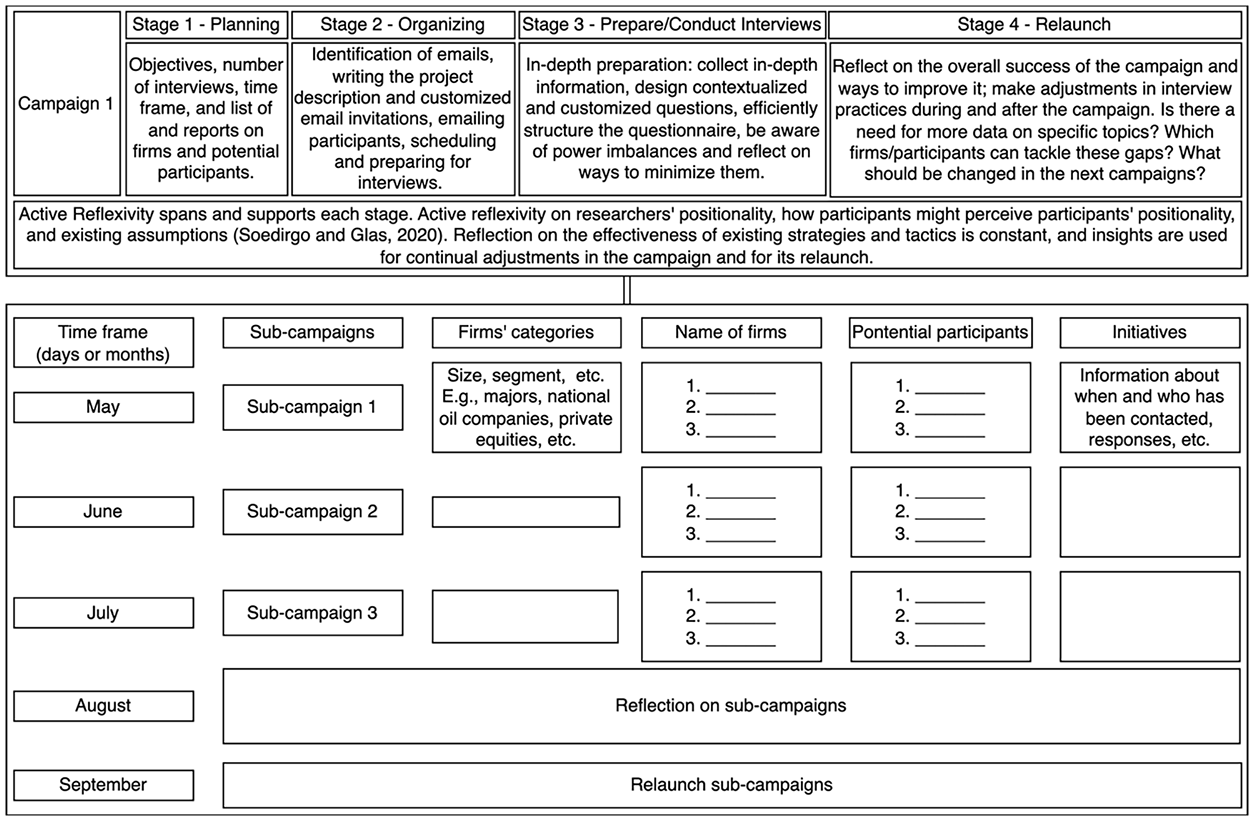
Schematic illustration of an interview campaign.
Planning interview campaigns: Scoping breadth and focus
Campaigns require consideration of objectives, time frame, tactics and communication. Adapting from Burton et al.’s (2015) research on political campaigns, planning an interview campaign requires clarity about the following: What is the objective? What is the time frame for implementing and concluding the campaign? Who are the targets of the campaign and what does a successful outcome look like? What is the existing terrain of power and how might it be leveraged (or negotiated) to further the goals of the campaign? The campaign approach focuses attention not on the short-term logistical goal of scheduling interviews, but on the overall objective which is to create conditions that enable a sustained research conversation. Visualizing the available time frame (Figure 1) helps to decentre the interview itself, situating it as one element in an overall approach while also encouraging active decisions about whether to ‘stick or twist’ – that is, when it was necessary to move on from one phase to the next.
The initial planning phase centres on scoping the campaign’s breadth and focus. It typically involves elaborating a list of candidate companies and categorizing them in light of the guiding research questions (in our case, this meant ownership and market segment). Where a category is sufficiently large, sub-campaigns can be developed (e.g. targeting a particular market segment) with messaging selected and tailored accordingly. Once candidate companies have been scoped, a range of techniques are available for identifying potential participants: researchers have suggested using personal contacts, searching databases and directories and reviewing business listings (Dexter, 2006; Goldman and Swayze, 2012; Odendahl & Shaw, 2002; Thomas, 1995; Yeung, 1995). The instrumentalism of the campaign makes it desirable to identify (and prioritize) two or three names of potential participants for each company based on their job positions. Company websites often list leadership names, job positions and roles within the firm and, for firms with minimal website content, this can be supplemented by searching sector-specific news-sites and LinkedIn (Figure 2). Search outcomes may be systematized in the form of a short report – about individuals’ professional backgrounds, career histories and institutional affiliations (such as participation in other firms’ boards, etc.) – which can be used later when writing customized interview invitations and preparing interview questions.
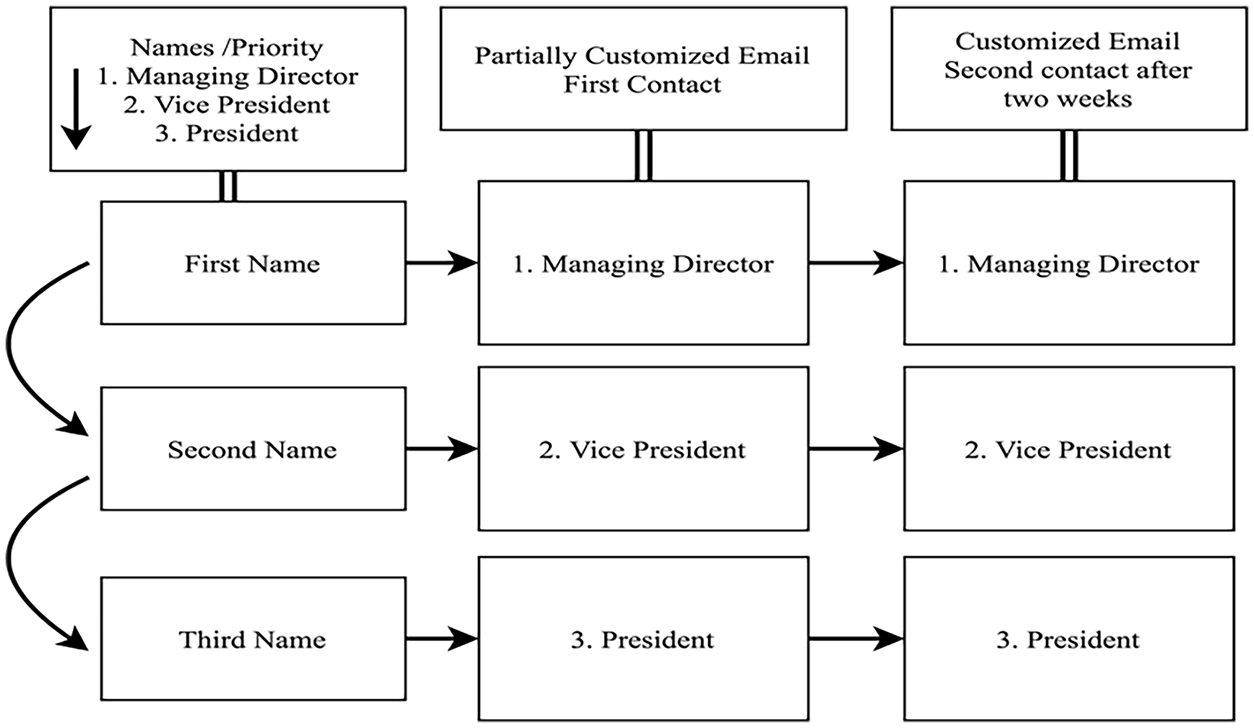
Contacting potential participants.
Ethical considerations are a central element of this planning phase. Elite interviewing, as a qualitative data-gathering technique involving human subjects, will trigger institutional processes of ethical review. These typically require researchers to submit an ethics application to an Institutional Review Board or Departmental Research Ethics Committee (depending on context). Ethical review surfaces a range of ethical considerations, including potential risks and benefits to participants, informed consent procedures and data management. Institutional processes for ethical review in the social sciences are typically adapted from a medical model of research which presupposes a set of ‘interventions’ in the lives of a target group that require their consent. While institutional ethics review boards are typically thorough in their consideration of issues like consent and anonymity, their use of an adapted medical model of research means they can overlook wider structural issues that benefit from some ethical reflection. For example, ethical codes governing research are designed to protect participants and assume a hierarchy of power in which researchers hold power over participants (Lancaster, 2017; Lillie and Ayling, 2021). Elites, by definition, occupy a structurally powerful position in society so that ethical review processes tend to regard them as a class of participants with limited vulnerability. This assumption may be adequate for navigating institutional requirements for ethical review, but it can significantly underplay the concerns elites may have around a potential research encounter. And, for elites working in contentious sectors subjected to public scrutiny and sustained action by civil society, these concerns can be sharply amplified. Assuming elites to be a monolithic class of actors characterized by limited vulnerability can be a practical obstacle to research: not recognizing elites’ perceptions of risk and vulnerability can lead to denials of access or make it more difficult to create the conditions for close dialogue. More fundamentally, assumptions about the power of elites can become an analytical and ethical blind spot: elites may not be vulnerable in the same way as protected populations (children, prisoners), but they are subject to a range of power dynamics – internally and externally to the corporation – that need to be investigated and understood through the research encounter.
A campaign approach, with its instrumental focus on securing a meaningful research encounter and recognition of the dynamic connections between planning and later phases, encourages consideration of these wider dimensions of power and ethics beyond the compliance frameworks of institutional review. Professional guidelines and codes of conduct can be a helpful additional resource here: in the UK, for example, the Research Ethics Framework of the Economic and Social Research Council and the Ethical Guidelines of the Association of Social Anthropologists (ASA) provide a wider, more discursive consideration of research ethics. These are aimed less at securing a threshold needed for approval and more at cultivating a culture of reflexivity, integrity and best practice: the ASA’s guidelines, for example, aim to help researchers ‘reach an equitable and satisfactory resolution of their (potential) dilemmas’ (Association of Social Anthropologists of the UK, 2021: 11).
Organizing: Identifying access pathways
In a classic political campaign, organizers figure out not only the profile and characteristics of their potential voters but also the best ways to communicate with them (Brady et al., 2006; Burton et al., 2015). In this regard, a campaign revolves not only around questions of ‘who’ (to contact) but also the pathway question – ‘how’. A frequent recommendation in the literature is to pursue as many different avenues as possible to contact elites, extending beyond industry events and institutional affiliations, to alumni organizations, personal connections or sponsors to make introductions, and even social clubs (Goldman and Swayze, 2012; Harvey, 2010; Welch et al., 2002). Access via social networks is widely regarded as one of the most effective methods: for Li (2022), for example, personal connections via university professors to national government elites were crucial to their work; Herod (1999: 216) similarly acknowledges the importance of social networks but also notes it depends on ‘having done the basic research to figure out which organizations are connected to each other’. We note, however, that personal networks are frequently not available and, in their absence, a direct approach may be necessary involving ‘cold contact’ via email or LinkedIn (see later section ‘Designing and conducting an interview campaign: Reflections on experience’).
Communication is a crucial element of political campaigns. Attention centres on both message and tone, both of which require an understanding of audience so that information can be targeted and conveyed in convincing ways. The ability of political campaigns to impact public opinion and voters’ choices is linked to how candidates present themselves and communicate information to persuade potential voters (Brady et al., 2006; Denton et al., 2019; Johnston, 1992). The interview campaign similarly requires critical reflection on how researchers present themselves to potential interview participants and how information about the research is transmitted. Choice of language is important: while qualitative researchers are familiar with the term ‘interview’, it has ambiguous meanings outside of social science (and a tendency to conjure up negative associations with either the job market or police custody). We found it helpful to describe what we were looking for as a conversation, deploying a more human register to describe the nature of the ask (rather than a technical one) while also suggesting a flatter/less hierarchical encounter. The first contact is important – too much jargon and/or information can lead participants to decline participation (Dexter, 2006) – and the language used to describe the project needs to ‘land’ with the intended audience. Combining a standardized project description – summarizing research aims, identifying institutional affiliations and research partners and outlining the ‘ask’ in an unambiguous way – with a (partially) customized email can be effective.
Customization aligns with the instrumentalism of an interview campaign, as it seeks to convey knowledge of the firm (or the role of an individual in the wider sector) with the aim of convincing the potential participant that a conversation is worthwhile and presents limited risks. An introductory email can have the following components, for example: a short, standardized opening paragraph summarizing the researchers’ specialization and institutional affiliation; a second paragraph introducing the research aims and scope, perhaps linked to a more detailed online explanation; and a fully customized third paragraph, mirroring the technique of political campaigners who – with knowledge of voters economic, social and cultural backgrounds – tailor their approach to deliver a convincing message (Brady et al., 2006; Burton et al., 2015; Denton et al., 2019). This customized paragraph draws on background research and can deploy ‘coalition signals’ – a tactic used in political campaigns to demonstrate alliances with other politicians to build trust with voters (Bahnsen et al., 2020). This might, for example, reference shared contacts or experiences (e.g. attendance at an industry forum) or other common information to gain participants’ attention, build presence and facilitate trust. Once a first, introductory email has been sent, non-responses can be followed up around 2 weeks later with a shorter, similarly customized email. This can, for example, reference recent activity by the firm – such as presentation at an industry event, an appearance online or report in the industry press – to convey the value of having a conversation. Delaney’s (2007) recommendation to ‘make it obvious that the person whom you wish to interview will bring unique and even essential expertise to the topic [. . .]’ (p. 212) is reasonable advice although this need not involve sycophancy or hyperbole.
A positive response from potential participants triggers the next organizational step in the campaign: scheduling the interview. Recent scholarship confirms how physical and virtual settings can affect interview outcomes but there is no consensus on which is preferable for elite interviewing. The online format is very efficient in terms of time and budgetary resources, but they can also present a range of technical issues (e.g. background noise, buffering, dropped connections) and social distractions when carrying them out as well as difficulties in observing body language and tone (Howlett, 2022). For some, online interviews enable a greater level of comfort that can encourage conversation, leading to longer duration encounters and a greater depth of discussion (Howlett, 2022). More generally, the technological mediation of an online interview – for example, the co-location of interviewee and interviewer in a shared virtual space – can flatten some hierarchies, facilitate participation and create a stronger sense of a shared enterprise. Others, however, have found in-person interviews to be more conversational and capable of generating higher quality data (Johnson et al., 2021), and so favour an embodied research encounter (not least because it can present an opportunity to directly experience an interviewee’s place of work). However, the instrumentalism of the campaign approach is about lowering the barrier to participation and ultimately getting a ‘yes’ to the interview request, so we recommend giving elite participants the option to meet online or in person. Scheduling the interview is also an opportune time to follow through on the ethical commitments made during the planning phase and provide a participant information sheet and consent document describing how information collected during the interview will be used (see Figure 3). Introducing this material to participants once the interview has been scheduled – and contextualizing it for participants as part of the overall ethical framework by which the research process is governed – is advisable. This sequence facilitates the practical task of scheduling (which can become cumbersome if made contingent on review of documents) while ensuring participants have ample opportunity to review the documents, ask questions and – if necessary – withdraw participation.
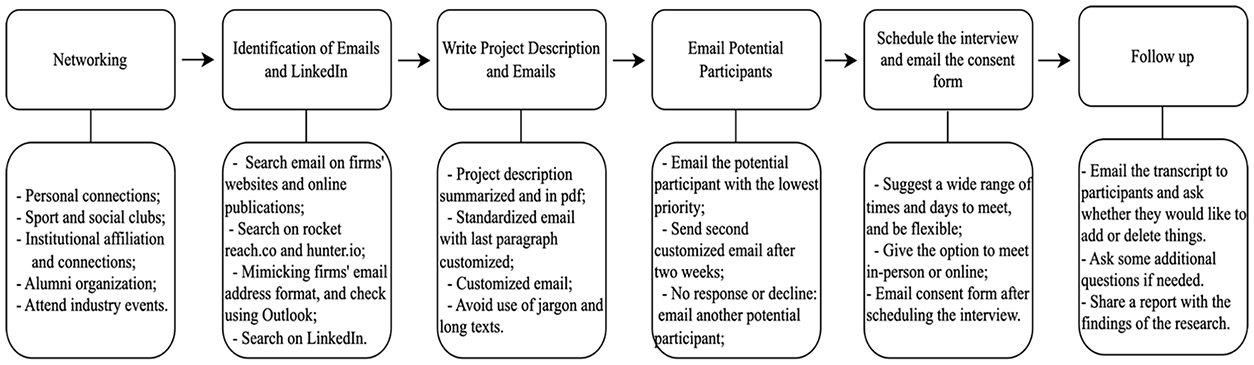
A sequence for contacting corporate elites.
Preparing and conducting interviews with business elites
In a political campaign, a ‘key event’ is the live debate: known in advance, these have a specific duration and are frequently split into thematic rounds. A candidate’s participation in debates is guided by a conscious strategy, and involves tactics to maintain control, manage differences in power, connect to voters, and keep to time (Schroeder, 2016). While the format is known, the content of political debates is often unpredictable. Candidates therefore prepare for debates via rehearsal, simulation and by writing debate briefs that scope themes and other candidates’ histories and positions on key issues (Schroeder, 2016). Elements of this approach can be applied to an interview campaign in ways that buttress conventional advice about preparing for elite interviews by designing thematic, open-ended questions and collecting information about participants such as their career, life history and background (Aberbach and Rockman, 2002; Mikecz, 2012). A broad search on the firm to identify key strategies, actions and alliances of relevance can provide useful context, as does developing a sense of its portfolio, relative size and market position in relation to other firms. A good working knowledge of a firm’s scale of output, market share and significance of different geographies to its overall portfolio can be invaluable: it not only builds confidence ahead of the interview but also helps the interviewer adapt and explore in the interview itself.
Preparing for the interview involves bringing this (detailed) collected information into conversation with interview questions derived from the project’s aims and guiding research questions. This is an iterative process and involves moving between company specifics and top-level themes in a comparative and constructive way. It aims to identify gaps, establish points of difference that may require rethinking or tailoring the questions, and highlight cases or issues for further exploration. It can lead, for example, to redesigning questions, undertaking further research prior to the interview or broaching new themes/topics during the interview itself (see Section 4). Preparation is not only about designing the questions: it can also be valuable to think through anticipated answers ahead of time as having a sense of what a respondent is likely to say, based on prior knowledge of the firm, can help calibrate responses in the interview as well as providing tools for following up. Some respondents may request questions in advance as a condition of access but, where possible, it is better to ask questions in real time so that the style of the encounter approximates a conversation – a fluid and reciprocal exchange, with researchers reacting and tailoring questions based on participants’ responses and taking advantage of momentum by exploring topics as they arise (Dowling and Brown, 2012; Seidman, 1998). Opening with questions that are non-threatening and that allow a conversational approach to be established early on is a good idea (Breeze, 2023). Summary statements can be a useful tactic, particularly if they invite an exploratory response – for example, ‘from our read of the firm, it looks as if . . . what explains this outcome?’ – and can be deployed towards the start of the interview (to set the tone and agenda) or held in reserve in case it becomes necessary to shift topic or facilitate conversation.
In political debates, candidates strategize ways to maintain control of the debate and navigate uneven power relations. There are some parallels here with elite interviews: because elites hold positions of power and authority there is a risk that interviewers will lose control of the conversation or be simply brushed off (Liu, 2018; McDowell, 1998). Yet interactions with elites are not always marked by such starkly defined power relations, and some prior consideration of the dynamics of power that converge on the interviewee and within which they are embedded (rather than only those emanating from them) can facilitate and sustain a productive research conversation. We concur with Glas (2021) that elite positionality is relational and dynamic and, accordingly, that their power relations should not be taken for granted but reflected upon within and across interviews (see later section ‘Reflexivity: Learning, adapting and relaunching interview campaigns’). Being well-prepared, with contextualized and customized questions and some prior anticipation of responses, can help researchers to be nimble in adjusting tack and accommodating different types of elite encounters as they emerge (see the subsection Preparing and conducting interviews with business elites).
Reflexivity: Learning, adapting and relaunching interview campaigns
Although we have emphasized the integrated character of an interview campaign and the sequencing of different elements (planning, organizing, gaining access and preparing/conducting interviews), this does not mean interview campaigns are narrowly linear: reflection, iteration and adjustment are central features of the campaign and underpin each of its different elements. In this respect, interview campaigns exercise the ‘active reflexivity’ proposed by Soedirgo and Glas (2020), which they describe as a ‘posture’ or ‘embodied disposition toward reflexivity as research is conducted—from design to data collection to interpretation’ (p. 527). For Soedirgo and Glas (2020), active reflexivity is a triple process in which researchers: (i) interrogate how their positionality and identity may assist or constrain the cogeneration of knowledge; (ii) consider how participants interpret researchers’ positionality, and consequently how this interpretation may influence interactions before, during and after the interview (see also Mbohou and Tomkinson, 2022); and (iii) foster an active reflexivity throughout the research, even after the potential effects of positionality are taken into consideration. We concur with this perspective and note how the second element is particularly important for a campaign approach, as it involves developing some prior understanding of – and empathy for – the business elites one is seeking to interview. We elaborate this point further in the section ‘Designing and conducting an interview campaign: Reflections on experience’.
Alongside adopting reflexivity as a default disposition underpinning all phases of the research process, a campaign approach to elite interviewing includes a more formal evaluative and relaunch phase. The objective here is to periodically ‘take stock’ of the campaign’s effectiveness and the quality of the data being generated in light of the project’s guiding research questions, and then to relaunch the campaign in an improved or tailored mode. The value of this formalized phase (over and above the ongoing posture of active reflexivity) is the way it centres evaluation against the project’s goals and forces active decisions about whether to continue or adjust the campaign’s existing procedures. It is important to set aside time to reflect on whether procedures in place for planning interviews, gaining access, preparing and conducting interviews are effectively working or whether changes are required. It is also important to assess data that has been collected, identify information that may be missing or require confirmation, review the sufficiency of categories (e.g. types of firms) and other provisional forms of knowledge that frame the campaign, and analyse success or failure. This process of learning and adjustment involves both ongoing reflection as part of a posture of active reflexivity and, just as important, a periodic process of evaluation (against project goals and research questions) that leads to active decisions about relaunching the campaign. The periodic process can benefit from drawing other research colleagues into the reflection to interrogate not only the dynamics of positionality (Soedirgo and Glas, 2020) but also the range and quality of the knowledge being generated.
Designing and conducting an interview campaign: Reflections on experience
In this section we describe how we developed the ‘campaign approach’ and reflect on the types of elite encounters it made possible. Our approach grew out of efforts to navigate some of the power relations that surround oil and gas (O&G) companies in the UK and the limited social networks available to us for accessing this contentious sector. We sought direct access to senior elites in the oil sector for the purpose of holding research conversations about investment and divestment strategy on the UK Continental Shelf. 5 Talking to firms about their strategies was important for the type of knowledge we were seeking to generate, not least because the ‘ecology of knowledge’ surrounding O&G is made up, in the main, of campaigners, pundits and industry organizations. In this context, legitimate questions about practices, strategies and trajectories in oil and gas have increasingly hardened into contending positions and, given the contribution of O&G firms to climate change – and continued state support (in the UK) for hydrocarbon extraction – there is no shortage of opinion about the sector. The distinctiveness of our work, as a piece of academic research based on a formal methodology and research design, relied on securing access to a diversity of firms in the sector. We came to develop and conduct our ‘campaign approach’ in this context, and it lent an instrumentalism and urgency to the task of securing access.
Instrumentalism: Planning for access
Our ultimate objective in designing and conducting elite interviews was to generate knowledge relevant to our research goals. A more immediate objective, however, was to create conditions that would enable an elite encounter – that is, that would enable companies to say yes to our request for access, and on terms that would allow for a free-flowing research conversation. An initial task was to segment the sector into categories of firm sharing broadly similar characteristics, and around which we could then build an access campaign. Based on the project’s research questions, we divided the industry into five different categories and used a table (similar to Figure 1) to plan and visualize our campaign, incorporating sub-campaigns targeting each different category. 6 Our objective was to conduct interviews with senior representatives from at least 20 different O&G firms over a period of 7 months and, within that time frame, to assess the campaign’s results (Stage 3 on Figure 1). We adopted a reflexive posture throughout, in the manner of ‘active reflexivity’ as proposed by Soedirgo and Glas (2020), and also incorporated an episodic phase of ‘review and relaunch’ within our sub-campaigns as a check-point requiring an active decision about continuing, modifying or ceasing our efforts to engage companies (Stage 4 on Figure 1).
Our methodology required access to high-level corporate elites holding positions of responsibility in the UK offshore O&G industry, who could offer a broad view of the company, its strategy and external networks. Because direct access was important to our methodology, we pursued several tactics and access pathways. We sought initially to use a handful of personal and/or institutional connections that could potentially make introductions to respondents. We had relatively few of these to draw on, however, and in practice our requests through these routes were largely unsuccessful. We attended multiple industry events organized by industry trade bodies to build our networks and enhance understanding of industry perspectives. 7 These events were useful in building rapport and creating a shared experiential space which could later be drawn upon, for example, to convey a ‘coalition signal’ to potential respondents. However, building direct networks through these events proved to be more difficult than we initially assumed. Speakers were frequently busy, random seating assignments at breakfast briefings made targeted networking tricky, and the senior figures we hoped to engage often did not attend such events.
Our main route for establishing contact and negotiating access to business elites therefore became the direct approach, via email and LinkedIn. We were initially cautious about the viability of this approach – it was not our first choice for access – but limited success via other routes required us to strategize ways to overcome the barriers to accessing elites. Our targets were senior managers – chief executive officers, vice presidents, managing directors and heads of departments – most of whom have gatekeepers protecting formal channels of access. We therefore chose to directly email potential participants in an effort to cut off potential gatekeepers and avoid being channelled to (and potentially brushed off by) managers responsible for public relations and governmental affairs. We searched for potential interviewees on firms’ official websites and in Annual Reports, supplementing this with LinkedIn and specialized O&G news websites. 8 Searching news reports by year with the name of the firm yielded names of potential participants and their roles within the firm, and we also used it to check whether names/job positions identified elsewhere were accurate and to bolster our understanding of individuals’ career histories, institutional affiliations and participation on corporate or other boards. However, a consistent challenge was finding the email addresses of potential participants. We experimented with mimicking companies’ email address formats (James, 2006) and had a few successes this way, particularly after learning that email addresses of potential participants could be checked. 9 However, the rate of success was insufficient for the scale of our campaign so we adopted some extra tools, using websites like www.rocketreach.co and www.hunter.io to search for potential participants, their job positions within specific firms and email addresses. These sites were the source for most email addresses in our campaign (see Figure 4) and we used the auto-check feature in Outlook to ensure addresses were valid. 10
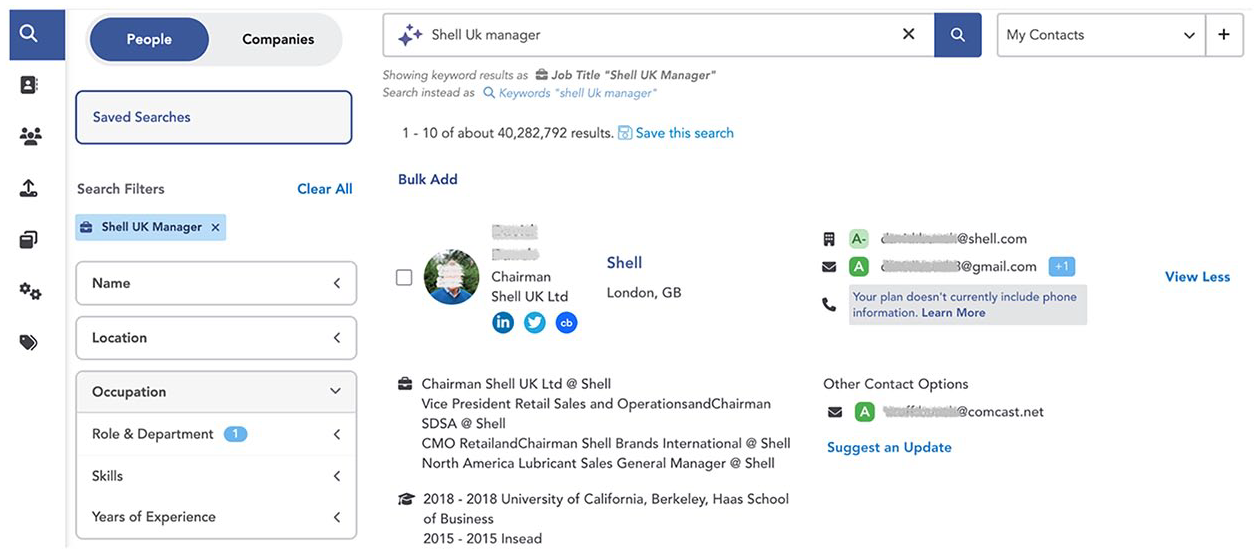
Search for participants’ email and information.
One of the limitations of adopting a direct approach to access a senior manager is its ‘all or nothing’ character. The instrumentalism guiding our campaign led us to try to mitigate this risk in different ways. We sought to reduce the risk of a non-response – that is, that we would be unable to speak to a company because an individual we had selected declined to answer – by identifying several potential participants for each company and adopting a ‘phased’ approach to making contact via email. For each company we identified two or three potential participants and, by researching their roles and thinking about the structural relations of power within the corporation, assigned an order of contact priority to each name. We found it useful not to go in through the very top of the hierarchy but to initiate contact with a manager or executive whose brief closest aligned with our objectives. If they declined participation or did not respond to our invitation, we moved to the next name on the list. This tactic increased our chances of gaining access and allowed us to ‘escalate’ or move sideways in the organization where necessary, recognizing it can be practically difficult (and ethically problematic) to go down the corporate hierarchy after a refusal or lack of response at senior level. For example, in reaching out to a relatively small independent oil firm headquartered in the UK, we identified three people – manager, CFO and CEO – who would be able to potentially discuss our research questions. We first contacted the manager but, as they did not respond to our email, we escalated by contacting the CFO. When the CFO also did not respond we moved sideways, contacting the CEO and successfully securing an interview.
We deployed a mix of standardization and customization when writing to companies in an effort to overcome indifference and achieve some level of engagement. We developed a concise project description using lay language rather than academic terminology which we reduced to a single page, including key details about the funding source, institutional affiliation of project partners, research objective and general methods. We piloted the project description with an academic colleague who had formerly worked in the oil industry at a senior level, and then attached this standardized one-page overview to emails sent to potential participants. We paired this standardized project description with customization in the cover email when writing to companies, following the structure laid out in the previous subsection ‘Organizing: Identifying access pathways’. In customizing the emails, we tried to concisely demonstrate knowledge of the firm and convey some awareness of its activity and relevance for our project. To this end, we watched YouTube videos, lectures and presentations given at industry-related events by potential participants and read industry press interviews and other documents available online. We also used customization as a tool for following up non-respondents, typically waiting a couple of weeks after sending the first round of emails before following up with a second – shorter, but more customized – email to firms that had not responded (Figure 5). And if that did not generate a response, we then moved upwards or sideways within the organization to the next priority name in our list of potential participants. Of the 61 people we contacted, 20 agreed to participate in a recorded interview (a 33% response rate). The majority of these were online – only one participant explicitly requested to meet in-person – and our ability to secure interviews may have been enhanced by the normalization of online meetings during (and in the wake) of the pandemic. Of the 20 people who agreed to be interviewed, seven responded in the first round of emails, and nine agreed to participate after the second round of emails – highlighting the value of a customized follow-up. Over half our emails, however, did not yield a response. In a context where time was limited and achieving access was important, we learned it was critical to take an active decision around such moments of ‘failure’ by, for example, bringing the sub-campaign to an end and ‘moving on’, or retooling the approach and re-launching at a later stage.
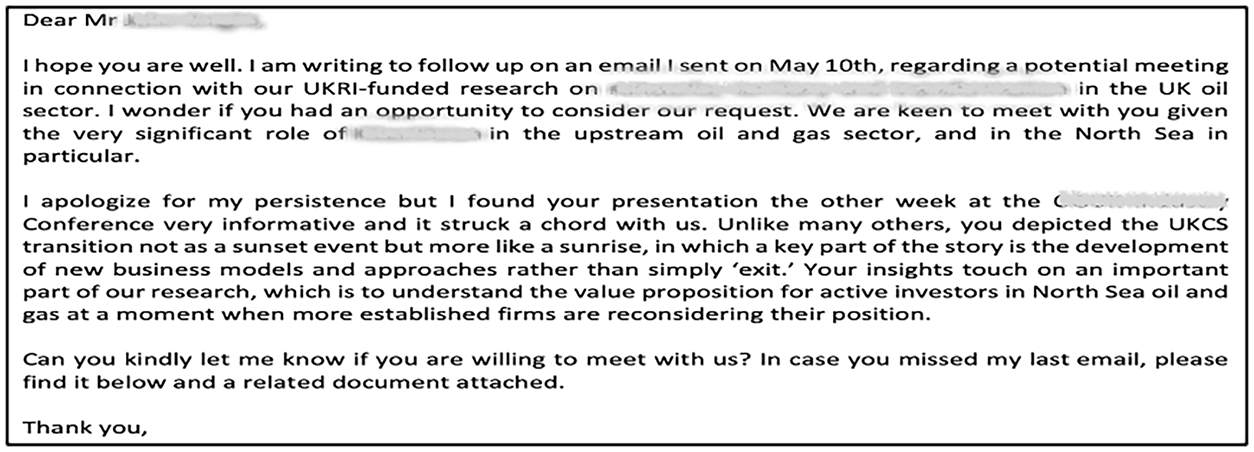
Customized email based on participant’s talk at an industry online event.
Empathy and strategic ambiguity
Our instrumental approach led us to consider how we presented ourselves to potential participants and how they would perceive us, an ongoing process neatly described by Soedirgo and Glas (2020) as active reflexivity. We anticipated encountering a range of barriers from gatekeeping and sensitivity around the topic to disinterest in academic research from potential respondents. We were also aware that many potential participants were highly experienced ‘insiders’ in the O&G industry occupying considerable positions of authority, and many had markers of identity aligned with social privilege (affluent, educated, white). We sought to work within this terrain of power to establish access and create conditions for a sustained, research-based conversation. This involved working with the grain of power where it was advantageous to do so, while also working to mitigate or allay areas of potential concern among those to whom we sought access. For example, we drew when possible on shared connections – the ‘coalition signal’ described earlier (see ‘Organizing: Identifying access pathways’) – such as foregrounding our institutional affiliation when approaching a CEO who graduated from the same university, or noting we had participated in the same industry conference as someone we were seeking to engage. As the campaign started to gain traction, we mentioned when approaching new firms that we had already interviewed several key players in the sector and were keen to hear their perspectives.
Since positionality is context-specific and fluid rather than fixed (Fujii, 2018; Herod, 1999), navigating this terrain of power often required reflection about how to strategically present ourselves in a specific context to establish rapport and gain access. It also required a degree of nimbleness on our part that resonates with Collett’s (2023) observation about the ‘hustle’ for access and its influence on researchers and research design. Although our funding source and institutional affiliation provided visible markers of academic research, we could not rely on this ‘neutral’ positioning alone to overcome some of the obstacles to gaining access. We discovered that ‘academic research’ is not an automatic access ticket when it comes to business elites, as it conveys a problem orientation and time frame removed from the concerns of senior managers. We avoided narrow disciplinary labels, presenting ourselves as social science researchers with experience in the political economy of oil and gas. This distinguished us from engineers and earth scientists, preventing our request from being channelled to technical teams; and it also differentiated our motives and practices from those of journalism. 11 Our explicit reference to social science – and implicitly to the value social science places on evidence and method – was an effort to establish a viable access pathway in a contentious and contested area like oil. 12 We sought to harness the social credibility of university-based research and the mid-range character of ‘social sciences’ as a label – that is, neither the potentially misleading generality of ‘academic knowledge’ nor the rarified specificity of an individual discipline. Front-loading these aspects of our positionality – as university researchers focused on O&G, trained in the social sciences and based in the UK – became significant features of our approach. In discussions with companies, we sought to reinforce credibility by referencing University-based processes of ethical review governing our research. This provided general reassurance as well as highlighting explicit provisions around, for example, consent, anonymity and data management. We had secured the University’s approval to seek verbal consent for interviews and, under that process, we circulated a formal consent document to participants ahead of the interview along with an explanation of the research process. As a research collaboration involving several academic and non-academic partners, our research was also subject to the formal rules of a Collaboration Agreement governing (among other things) confidentiality and ownership of materials. We found it useful to develop a shared understanding of this document among the project team about, for example, how it restricted practices of data sharing and how it supplemented specific undertakings agreed via ethical review.
Although we aligned ourselves with the social sciences, we presented our project via themes and examples that resonated with participants and downplayed the conceptual repertoire of economic geography by which the funded research proposal had been framed. We found it useful to cultivate within ourselves a form of empathy with targeted elites (i.e. imaginative projection), which is not to be confused with sympathy (a shared feeling). Empathy in this context is an exercise in understanding participants’ mindsets and concerns on a cognitive level and does not imply we sought to share the same beliefs or attitudes as our respondents towards topics such as climate change or energy transition. Fujii (2018) has made a similar observation about the interview as a ‘working relationship’, and the need for interviewers and interviewees to develop a mutual understanding and agreement for their interactions. We found that, at a minimum, this required translating conceptual academic concerns into terms, registers and/or phenomena that spoke to the strategic or operational themes occupying our respondents’ horizons. It did not mean rejecting conceptual language completely or fully aligning terms and registers with those being interviewed, but it was about establishing sufficient resonance and relevance to secure and support a conversation. We found that a combination of top-level ideas (e.g. transformation, repurposing, strategic shifts) and grounded examples (e.g. exit of particular firms, introduction of new policies) worked well. In practice, this combination of general and specific created a form of strategic ambiguity, allowing participants to project their concerns and interests onto our project while also leaving the door open for us to evolve questions and themes once an interview had been secured.
Consideration of how we presented ourselves and the project went beyond our direct communications with companies. For example, one of us updated their LinkedIn profile to present personal information in a neutral way and added a description of our research project. This consistency was important given that we visited potential participants’ LinkedIn profiles, as LinkedIn notifies users of profile visits. We also reflected strategically on the value and risks of taking public positions early in the project. For example, while our interview campaign was in motion, one of us was invited by a national broadcaster to participate in an on-air interview about offshore oil and gas in the UK. The opportunity to share some early findings would have provided visibility for the project and facilitated public engagement with our work, but significant aspects of the broadcast would fall outside our control including the overall storyline, edit process and choice of other guests. On balance, we judged participation to be a risk to the ongoing interview campaign and declined to participate. Similarly, we did not develop a project website but relied instead on the formal online project identification created by the funder which we shared with potential participants as part of the initial contact. This minimal site evidenced the scientific credentials of the project, outlined its objectives and identified members of the project team but did not disclose project findings or seek to engage a wider public. Limiting project visibility and public engagement was a strategic choice during the interview campaign, given the contentious character of the sector and the growing politicization of offshore O&G extraction in the UK during the period of research.
Aspiring to be nimble: Preparation, anticipation, adaptation
To prepare for interviews we outlined thematic areas we wanted to cover (based on our research questions and knowledge of company scope and activity) and elaborated a set of standardized, top-level thematic prompts to be used for all participants. We then customized these top-level thematic questions before each interview, often using specific examples (e.g. projects specific to the company, or actions like mergers or acquisitions that our desk research had suggested may be significant) and sometimes adding or deleting questions. To prepare for an interview, we researched and wrote a timeline of relevant actions (5–10 years) undertaken by the company covering, for example, its participation in offshore licencing rounds, ownership stakes in different offshore assets, mergers and acquisitions, and significant shifts in volume of production. We used this to build up a picture of the firm’s role in the North Sea relative to other geographies and, concerning measures like production, to enable some basic comparisons (e.g. orders of magnitude) with other firms. Our preparation also involved anticipating potential concerns respondents may have coming into the interview, practical difficulties linked to initiating and sustaining a conversation, and how our respondents might seek to actively challenge us or disrupt the interview. Our efforts to develop some empathy for elites’ perception of risks from participation was useful here, as it helped bring to the fore their potential vulnerability in an interview context when discussing aspects of corporate strategy.
We typically opened an interview with some general questions regarding the respondent’s background and role within the firm, customizing these questions by drawing on reports we had previously compiled about potential participants’ educational and career history, institutional affiliations and expertise. We sought to project a prepared and knowledgeable tone at the outset, putting interviewees at ease and revealing lines of inquiry we could explore later in the interview. 13 Our goal at this initial point in the conversation was not to probe, but to establish a baseline set of professional and corporate experiences (relevant to interpreting and informing our research questions) to which we could then return in the interview. We anticipated potential challenges around anonymity and confidentiality, about how material gathered during the interview would serve the wider project, and about the role of collaborating partners in the research which included three universities and a UK-based NGO that acts on social and environmental issues. 14 We always disclosed the participation of collaborating partners when sharing information about the research, listing them in the project information sheet as part of the description of the project. We anticipated scrutiny around the involvement of an NGO and developed – and practiced – a narrative response that combined a clear rationale for their involvement in the research (based on their extensive record of relevant research over two decades) with a brief yet robust account of the (internal) processes governing the conduct of the project team concerning custody and integrity of research materials (the Collaboration Agreement described in ‘Empathy and strategic ambiguity’). Overall, we received fewer direct challenges than we anticipated. We were asked infrequently about our worldviews on climate change and in only one encounter did we face robust interrogation about our position on the politically charged topic of oil exploration and production in the North Sea. This was less unnerving than it might had been, had we not anticipated similar challenges and developed lines of response: after a rocky 10 minutes at the start, the interview progressed very engagingly – indeed, it became one of the fullest and most extensive we conducted.
We were also concerned about more mundane dynamics of the interview, such as losing control of our questions and focus. To address this, we developed a basic structure around thematic topics, reflected on priority order and the time required for each topic, and agreed a broad division of labour. We also piloted our approach and ran some interview simulations before the appointment, for example, reading the questions out loud and thinking about potential responses. These helped develop our familiarity and confidence with the materials, enabling us to spend a little more time in each interview listening to responses and reacting flexibly to pick up or probe things that had been said (see Dowling and Brown, 2012). We conducted interviews in pairs, enabling one of us to interject where needed to pick up a thread of conversation or retain the focus on a particular theme. We also provided a brief outline of the interview structure at the outset of the conversation establish the ‘rules of the game’ and demonstrate our intent to ‘steer the boat’ (see Figure 6 below). To improve our capacity to lead the interview and adapt on the fly, we sought to come to interviews well-prepared particularly in relation to the company’s operations in the UK North Sea. Some unexpected logistical issues arose during our interviews, including background noise, technical difficulties and participants arriving late. Basic contingency planning helped mitigate most of the impacts of these disruptions, such as having mobile backups for internet issues, using two recording devices in case one failed, and ensuring one of us also took notes.
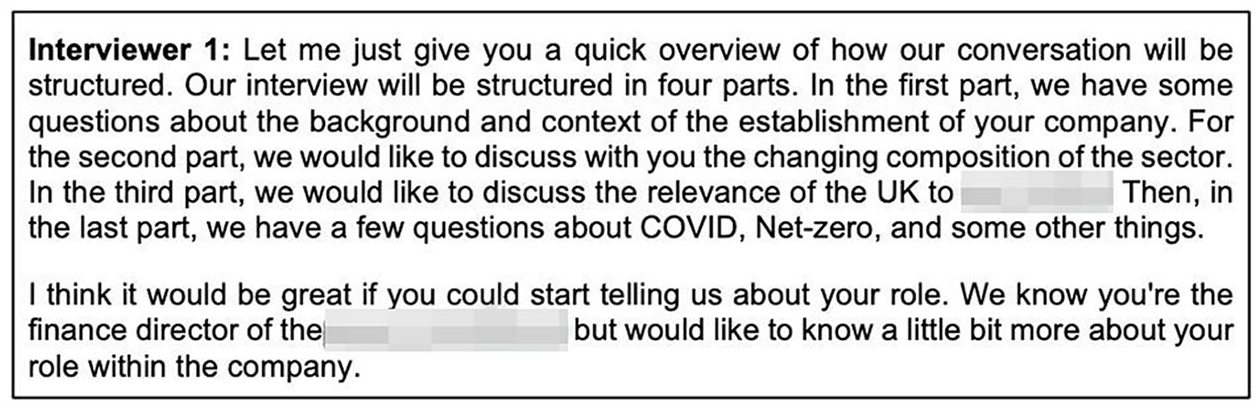
Transcript excerpt from an interview.
We did not face substantial challenges attributable to dramatic power asymmetries during the interviews, although the effects of power were still present (as we outline below). We fully acknowledge how this is, at least in part, a function of aspects of our positionality: we are both white and male, have some prior experience conducting elite business interviews (one of us has done prior research on the O&G sector) and the project was affiliated with a well-known UK university. Additionally, while one of us is Latino (a non-native English speaker), the other is British and fits the definition of a ‘cultural insider’ (Lillie and Ayling, 2021). Yet our elite encounters varied in significant ways and, retrospectively, we can identify three broad types of encounter that, for the purposes of illustration, we term engagement, extension and deflection. Most of our encounters were marked by constructive engagement, with interviewees willing to participate in the interview and to be audio recorded. They demonstrated a high level of interest in our questions, providing detailed accounts and engaging at length in the conversation. Nonetheless, engagement was limited to the conditions we had established for the 1-hour interview, with conversation, knowledge exchange and assistance not extended further. For example, if we invited participants to point us towards other elites whom we might approach, the invitation was declined. While encounters characterized by engagement were very positive in research terms, perhaps we also see here a limitation of the campaign’s instrumentalism: the campaign approach is able to create conditions that produce a meaningful research-based conversation, but the resulting conversation is limited to the event of the interview itself.
The second type of encounter – extension – saw participants going beyond engagement to voluntarily extend their involvement in the research process. This took several forms, from recommending other potential participants, or offering follow-up information and/or editing the interview transcript, to actively inviting us to present our research findings to staff within the corporation. For example, in one interview, we were offered a further meeting with the CFO of the company to discuss matters the participant preferred not to respond to in-depth. Here we see a form of collaboration in knowledge production that is not limited to the interview itself and that appears to transcend the instrumentalism of the campaign approach. The third type of encounter we term deflection and is an instance where the limitations of working with the grain of power come to the fore. In the case of deflection, elites use existing power structures to sustain the appearance of a conversation while also minimizing meaningful exchange. In our research this manifested either as being ‘passed sideways’ and assigned a conversation with a senior manager whose official brief enabled them to claim, with some justification, that they did not have the expertise to answer our questions; or, by participants in an interview changing the subject or offering only brief responses or generalities. For example, we successfully contacted the CEO of an O&G company who tasked a senior manager with the interview. While the manager engaged in conversation, they declined to discuss many of our questions – claiming they fell outside their expertise area – and, as a result, the interview was of limited value.
Variations among these types of elite encounter meant there was a substantial learning component associated with carrying out our interview campaign. Although we both had some prior experience interviewing elites, the UK oil sector was a new terrain, and we needed to find a viable pathway for establishing a research conversation with senior people in the sector. We therefore approached the campaign with a spirit of experimentation and a desire to identify ‘what works’ in the specific context we were researching. Our instrumental orientation and willingness to revise and adapt grew out of necessity, given some early setbacks when anticipated pathways (e.g. via institutional networks, industry event participation) proved less effective than we had hoped. It was by force of circumstance, then, as much as by design that we were compelled towards a process others have described formally as ‘active reflexivity’ (Soedirgo and Glas, 2020). Our efforts to figure out a direct pathway to encountering elites deployed some well-established processes and experimented with others, but also involved adapting and adjusting on the fly based on what worked (or not). Much of this was informal and ongoing, but we also incorporated more formal, episodic moments of review. We would ‘debrief’ after an interview, for example, considering questions that had been effective and others that had not; and we regularly reviewed progress in the campaign, adjusting the targets and approach of sub-campaigns where necessary and, in some cases, deciding to pause or halt. For example, our sub-campaign targeting the oil ‘majors’ initially received no responses, leading us to pause the campaign, reflect on our tactics and then relaunch with invitations more tailored to individual firms. These proved more successful and allowed us to reach several majors with assets in the North Sea that expanded the scope of our qualitative findings. Similarly, we suspended a sub-campaign aimed at senior oil traders as the approach we had developed to access upstream oil producers did not work for this group. We found alternative pathways to reach oil traders, which required dropping the direct approach to work with social networks.
Conclusion
Corporate elite interviews have become a mainstay of economic geography because they are able to generate novel insights about firms’ behaviour, strategies and rationales, and external relations (Goldman and Swayze, 2012; Schoenberger, 1991). Nonetheless, gaining access and conducting meaningful interviews with senior corporate figures can pose several challenges, as elites are in a position of power, frequently time-constrained and, for the most part, are concerned with protecting their company’s reputations (Harvey, 2010; Ma et al., 2021). Moreover, these general difficulties can be intensified in contentious sectors subject to social scrutiny, regular public campaigning and legal challenges concerning prevailing business practices. Oil and gas firms are an illustrative example of this broad class of firms, given their environmental records, highly concentrated forms of capital and centrality of hydrocarbon production and consumption to climate change (Stern, 2005; Vokes, 2012). In this paper, we have developed a ‘campaign approach’ to interviewing business elites, characterized by planning, organization and tactics to achieve a specific goal in the context of a structured field of power. We have borrowed the notion of a campaign from political science, valuing the term’s emphasis on strategic focus and instrumentality, and its capacity for seeing the whole as the organized sum of several interlinked and reciprocating parts. We outlined the essentials of the campaign approach, and identified how it draws on and extends existing knowledge around elite interviewing. We have discussed how it combines elements of strategy, tactics and empathy too, as it requires understanding how the world is seen – the salience of different issues, the balance of risk and opportunity – from a situated elite perspective. We have suggested that simplicity, transparency and a certain amount of strategic ambiguity are valuable in the early phases of an approach, in the interest of gaining attention and achieving resonance with elite agendas.
We have shared some of our experience researching elites in the UK oil sector. It was in this context that we devised the ‘campaign’ approach to address concerns we had about accessing senior managers and executives. We fully acknowledge some advantages of identity and social position, although from the outset we were aware these alone were insufficient to secure meaningful research conversations with multiple oil elites. Our institutional and personal links to the sector were limited – and in practice more prone to deflection and gatekeeping than we had assumed. The context required us to develop a direct approach to elites by figuring out a mode of engagement that would secure their attention and create the conditions for a free-ranging research conversation. To do this we combined some well-established approaches with elements of experimentation, and we harnessed the learning capacity of ongoing active reflection to tailor and adjust our approach on the fly. Along the way we learned some valuable tactics to deal with issues around power imbalances, disruptions and uncertainties. Contingency planning – that is, anticipation, preparation and rehearsal – is the most significant; so too is clarity about our position and ‘function’ as university-based, social science researchers in a landscape of knowledge generation that extends beyond academia to journalism, think tanks and social activism. Having a clear process (and associated narrative) aligned with consent documentation about how and by whom materials would be used was also important, as was active reflection about positionality and how participants might perceive us and their sense of associated risks and vulnerabilities. We found it useful to supplement an ongoing process of ‘active reflexivity’ with periodic moments of more formalized review as, for example, these could focus attention on whether to stay with or drop particular elements of the campaign.
We know first-hand how elite interviewing can be full of uncertainty and, at times overwhelming, and in this paper we have shared our experience developing and conducting an interview campaign with the goal of assisting researchers who may face similar challenges in arranging and conducting elite interviews. We have oriented the paper towards researching elites in contentious sectors and industries where it potentially has wide application, particularly where developing an effective ‘cold’ approach is required. That said, we acknowledge limitations to the approach we have outlined: not least, the fact we developed the campaign to research international firms embedded in the political, economic and cultural context of the UK, and so any effort to translate it, template-like, to other (non-Western) countries with different business cultures may be less effective. The essence of the campaign, however, is to work out which issues, perspectives and concerns have resonance for elites and develop a pathway to reach them as a researcher. We have illustrated how creating the conditions for a research-based conversation with elites requires a combination of empathy, instrumentalism and strategic ambiguity. In that sense, the principle of the interview campaign applies to other contexts, although the strategies and tactics required are likely to be different.
Footnotes
Acknowledgements
The authors thank all those who responded to our requests to meet and who shared their time and experience. We also acknowledge and thank fellow members of the Fraying Ties project team – Alexander Dodge, Nana de Graaff, James Marriott, William Otchere-Darko, Connor Watt, Gisa Weszkalnys - for feedback on an earlier draft, and for conversations during the course of the project that informed the paper. We also extend our gratitude to the reviewers and the editor of the journal for their valuable feedback and support. The authors alone are responsible for the paper’s content.
Declaration of conflicting interests
The author(s) declared no potential conflicts of interest with respect to the research, authorship, and/or publication of this article.
Funding
The author(s) disclosed receipt of the following financial support for the research, authorship, and/or publication of this article: This paper is based on research undertaken as part of Fraying Ties? Networks, Territory and Transformation in the UK Oil Sector (ES/S011080/1). The support of the Economic and Social Research Council (UK) is gratefully acknowledged.
