




Abstract
The most recent phase of services digitalisation in the global South, reflected in the widespread adoption of Internet and smart-phone technologies, has given rise to an emergent gig economy that employs tens of millions of workers across its diverse urban centres. Pre-eminent frames of analysing the global gig economy have thus far focussed significantly on issues related to platform regulation, employment relations and labour organisation. While important, these frames tend to overlook the wider informal, unwaged and self-organised foundations of gig work and labour in the global South. This article addresses the limitations of existing analytical frames by drawing upon the analysis of 55 telephonic interviews with migrant and non-migrant gig workers associated with well-known ride-hailing and home-delivery apps across two Indian cities about their experiences of the COVID-19 crisis. The article offers novel insights into the various uncertainties and challenges that gig workers in India faced during the COVID-19 national lockdown, as well as their attempts to cope with the new post-pandemic realities. Contextualising these experiences through the lens of ‘digitally organised informality’, the article reveals that in the absence of formal and institutionalised systems, India’s gig workers rely significantly on informal socio-spatial networks of care and support that also link internal urban-rural geographies, lives and livelihoods. Conceptualising these informal networks as fundamentally contextual in understanding the development of gig labour and its social reproduction in the global South, the article however also provides a critical evaluation of their partial and contradictory nature.
Introduction
Studies examining recent transformations in work, labour and employment relations in India and in the wider global South have highlighted the changes taking place in the urban services sectors owing to advancements in modern technologies and their integration in everyday organisational and labour processes (see Eichengreen and Gupta, 2011, 2013; Nayyar, 2012; Ray, 2023; Upadhya, 2018; Vira and James, 2012). These studies have underlined how previously dispersed, small-scale actors in the informal economy are being ‘mobilised, recruited and trained in larger numbers for meeting the demands of a growing private sector, through highly organised and institutionalised processes’, giving rise to a regime of ‘organised informality’ (Gooptu, 2013: 10). Ultimately this regime of organised informality, encouraged by the neoliberal state, relies heavily on a sub-contracted, casualised and low-paid workforce, eschewing important concerns around long-term job security, formal social protections and welfare for workers (see for e.g. Guha-Khasnobis et al., 2006; Hung and Ngo, 2019; Mirchandani et al., 2016).
Organised informality, as this paper argues, is witnessing a renewed digital expression in the global South with the emergence of the urban app-based platforms. Today, large venture capital backed multinational platform companies such as Uber and Amazon utilise internet and smart-phone-based apps for algorithmically aggregating millions of individual service providers as ‘independent contractors’, while actively avoiding labour regulations that oblige them to accord workers with formal employee status and associated legal protections (see Bhatt, 2020; Stewart and Stanford, 2017; Vallas and Schor, 2020; Woodcock and Graham, 2019). Recent studies have come to scrutinise this double-edged nature of algorithmic exploitation in the gig economy that promises better incomes, autonomy and flexibility to marginalised workers, yet continues to expose them to similarly high levels of precarity common in the wider informal sector (for e.g. Anwar and Graham, 2021; Chaudhary, 2020; Lata et al., 2023; Prabhat et al., 2019; Wells et al., 2021; Wood and Lehdonvirta, 2019).
Whilst issues pertaining to platform regulation and labour organisation have taken centre stage in existing academic discourse on the ‘global gig economy’, we are still learning about the full range of gig workers’ identities that already exist in diverse urban centres in the global South. More importantly, much remains to be understood about how ordinary gig workers in the global South continue to cope with the absence of formal support from the platforms and the state whilst also contending with widespread socio-spatial inequalities. Through a close examination of gig workers’ own experiences of dealing with challenges that arose following the COVID-19 crisis in India, this paper attempts to address and enlarge extant scholarship beyond its concerns around platform regulation and formal gig labour organisation in the global South by shedding light on the often-invisible socio-spatial networks of care and support among workers which form the informal, unwaged and self-organised foundations of the gig economy.
The rest of the paper is structured as follows. The next section addresses the empirical and conceptual realities that have informed the rise of digital platforms and the gig economy in India’s transport sector in recent times. The discussion puts into perspective the different transformations brought on by ‘platformisation’ of cab-hailing, courier and delivery services. The paper follows this with an elaboration of ‘digitally organised informality’ which has become evident as platforms have expanded in scale and scope in the transport sector in the global South. This discussion further leads to an exploration of a relevant issue at the heart of this paper, namely: How do marginalised migrant and non-migrant gig workers in cities of the global South cope with precarity inherent within digitally organised informality? The succeeding third section describes the methodology of the research project conducted in two cities – Kolkata and Ranchi – following the relaxing of the COVID-19 national lockdown rules in India, between August 2020 and April 2021. The fourth section undertakes a detailed empirical and conceptual examination of cab and delivery platform gig workers’ experiences of being displaced from both platforms and cities and their eventual return to work after the lifting of the lockdown. This discussion evidences not only the precarious impacts of digitally organised informality on migrant and non-migrant gig workers, but also the critical role of informal and unwaged networks that spread across rural-urban spaces in extending care and support to gig workers while also underlining their limits and shortcomings. The conclusion calls for pursuing a broader research agenda that transcends beyond concerns of platform regulation and labour organisation in the global gig economy, to more context-sensitive understanding of workers’ experiences in the global South that uncover intersections between digitally organised informality, migration and social reproduction in the gig economy.
Background and context
Platformisation of India’s informal urban transport systems
Driving, as an independent yet specialised form of self-employment in India, much like in the rest of the world, has existed as a profession since the advent of the motor vehicle. In post-independence India, driving as a profession has come to be framed within the large privately-operated, informal public transport sector that is only partly regulated by the state. This sector includes a variety of vehicles such as taxicabs, tempo trucks, auto-rickshaws and electric-rickshaws, which together play a crucial complementary role to state owned and operated transport systems in Indian cities (Kumar et al., 2016). In recent times, the informal public transport sector, which includes both taxi and courier services, has seen a radical transformation with increasing ‘platformisation’ (Poell et al., 2019) – that is, the introduction of internet and smart-phone enabled apps to consolidate millions of dispersed small-scale providers, under the garb of entrepreneurial self-employment. The core message from platform companies in India is that anyone can be a ‘driver-partner’. In other words, earning a livelihood by driving no longer needs to be reserved for those from a certain group or community of people who see ‘drivery’ as their traditional or main occupational role (see Joshi, 2015).
Presented at first as a more convenient and affordable urban travel alternative for the middle classes in larger metropolitans, cab-hailing platforms such as Uber and Ola have wholly altered mobility options across numerous Indian cities. Within a few years of their introduction, the two platforms have supplanted traditional private transporters across several Indian cities and injected a new service culture that redefines the service provider and consumer relationship through the algorithm and the digital rating systems on the apps (cf. Bhatt, 2020; Chaudhary, 2020). Such has been the gig economy’s impact that within a few years of its introduction, drivers associated with Ola and Uber have become one of the most identifiable transport workforces in India. Ola and Uber today have more than 1 million ‘driver-partners’ across India, adding many first-time cab drivers alongside those who have transitioned from non-app-based driving. In terms of their geographical spread, Ola is estimated to be present in over 169 cities in India (IANS, 2020), whilst Uber is present in 123 cities (Business Standard, 2022). Likewise, the logistics sector in India, which earlier consisted of numerous small and informal organisations operating alongside a few large public and private sector players (for e.g. India Post, DHL, FedEx), has undergone massive change following the introduction of new delivery apps such as Shadowfax and Amazon Flex. Established E-commerce players and small retailers now commonly use these digital platforms to connect with new markets and customers. According to estimates there are now no less than 550,000 sellers associated with online marketplace Amazon-India who use these services (Amazon.in, 2020). Similarly, the restaurants and food delivery sector has expanded and come to be dominated by apps like Zomato and Swiggy, which are now spread out across numerous urban centres and claim to each have over 200,000 active delivery partners operating in these locations (Bhatt, 2020).
‘Digitally organised informality’ and implications for gig workers in the global South
Existing studies on transformations of contemporary work and labour, in India and the global South more widely, have emphasised the complicated nature of new services occupations which have been brought under private corporate control in an organised manner yet continue to display high degrees of precarity and insecurity associated with jobs in the informal economy (cf. Abramo, 2022; AlSayyad and Roy, 2003; Gooptu, 2013; Hung and Ngo, 2019; Sengupta, 2007). Such studies provide examples of both ‘core’ and ‘allied’ roles such as in call centres, retail, hospitality and housekeeping that have been ‘corporatised’ and ‘professionalised’ in the past two decades in countries like India (see also D’Cruz and Noronha, 2009; Gooptu, 2009, 2013; Raval and Pal, 2019; Ray, 2023). These new services roles are instituted by organised private sector firms which hire workers on flexible contracts through third-party recruiters. This way, firms avoid taking on the ‘principal employer’ status and hence responsibility of providing workers with employment security and related social benefits. This model of ‘hyper-outsourcing’ through large scale sub-contracting of casualised workers by modern corporations has been referred to by scholars such as Gooptu (2013) as the new regime of ‘organised informality’ in India which further extends neoliberal forms of economic and labour governance in the global South. While celebrated by the state and the private sector alike, organised informality has been criticised by scholars for merely re-packaging older exploitative forms of work relations in the garb of modern and emancipatory employment (see Mirchandani et al., 2016). Rather than challenging traditional power structures in economic and social relations, organised informality is viewed as reproducing existing social hierarchies of caste, class, race and gender in the contemporary labour market, keeping marginalised working populations confined to precarious, low-paid and dead-end jobs (see Kikon and Karlsson, 2020; Mirchandani et al., 2016; Williams et al., 2017).
The regime of organised informality in new services has found a renewed digital expression in the urban gig economy where large venture capital (VC) backed tech corporations are engaging millions of ‘independent contractors’ through internet and smartphone-based platforms or apps. Built into gig labour are the same neoliberal entrepreneurial logics of flexibility and autonomy, where workers are encouraged by platform companies to work in their own time utilising their own private resources (for e.g. own vehicles or equipment), without the security and benefits associated with those in formal and organised occupations. The most cited examples of ‘digitally organised informality’ in India’s gig economy relate to transport and delivery platforms such as Uber, Ola, Swiggy and Zomato, which have gained a large presence across urban centres in the country. These platforms claim that by identifying hidden demand for personalised services and matching them with independent service providers via a mobile app and algorithm, they have created a digitally dis-intermediated consumer economy in India (Bhatt, 2020; Graham et al., 2017; Ray, forthcoming). Posing as a third-party facilitator between independent service providers and consumers allows these platforms to avoid local labour regulation and shift much of the operational risks on to the drivers, absolving platforms from providing job security and work-based benefits (Lalvani and Seetharaman, 2020).
While acknowledging its outsized expansion in recent years around the globe, critical scholarship on gig work and employment has come to contend with the embellished narratives around economic mobility, autonomy and flexibility on a global scale. Evidence has quickly accumulated around the enormous financial risks and physical dangers that urban gig workers contend with daily without much institutionalised support from the platform companies (Gandini, 2019; Gregory, 2021; Ravenelle, 2019; Ray, 2019; Shipra and Behera, 2020; Wood et al., 2019; Woodcock and Graham, 2019). It has become more clear that regardless of the campaigns run by major platform companies to frame this kind of work as casual, part-time or an ‘additional’ income source; in reality app-based ride-sharing and food-delivery services now attract a large number of socially and economically marginalised workers who do this work full time and as their main or only source of income, especially in the global South (see for e.g. Bala, 2021; Filipetto et al., 2022; Frey, 2020; Shipra and Behera, 2020; Sopranzetti, 2022; Surie and Koduganti, 2016). Empirical studies of workers engaged in driving and beauty platforms in India suggest that app-based gig work has neither provided them formal professional security, nor has it transformed cultural attitudes and social norms that view ‘menial’ labour as inferior, thereby rewarding it extremely poorly (see Lata et al., 2023; Raval and Pal, 2019; Surie and Koduganti, 2016). As a result, workers in these ‘new’ roles continue to be exploited based on their social identities and status. Raval and Lalvani (2022: 147) claim that existing informal social relations are ‘not necessarily challenged or reversed by platformisation, rather are integrated into the formal economic and social spheres’. Ultimately, even as digital platforms may open new livelihood pathways for hitherto excluded and marginalised set of workers in the global South, they also continue to reinforce older informal relations and hierarchies of class, caste and gender in gig work.
Exploring socio-spatial networks of care and support among gig workers in the global South
Having established a clear sense of how ‘digitally organised informality’ operates in the gig economy in countries in the global South, two important questions immediately take shape: How do ordinary gig workers in the global South cope with the exigencies of digitally organised informality? Relatedly, what are the structures of care and support that mediate gig labour’s experiences in the absence of significant formal, legal and institutional assistance from the platform companies and the state?
One key entry point into urban gig workers’ coping practices consequently relates to the external, informal and traditional, urban-rural networks that sustain ordinary marginalised and migrant labour in major urban centres of the global South. While some attention has recently been paid to the social reproduction of workers in major metropolitans of the global North where the gig economy often attracts international migrants – including those on temporary visas (Berger et al., 2019; van Doorn, 2023; van Doorn et al., 2020), research on internal migration and migrant labour chains in the gig economy of the global South is still emerging (see for e.g. Altenried, 2022; Lata et al., 2023; Peters, 2020; Raval and Lalvani, 2022; Surie and Sharma, 2019; Zhou, 2022).
Classical labour studies in large agrarian or ‘agro-dominant’ developing economies of the global South, including India, have long underlined the ‘footloose’ character of ordinary workers that move seasonally and cyclically between rural, peri-urban and urban-industrial locations (Rockenbauch and Sakdapolrak, 2017; Shah and Lerche, 2020). These workers rely greatly on a diverse mesh of traditional social actors or intermediaries, utilising informal community, kinship and caste relationships, to sustain themselves during their departure from their homes and after their arrival in host locations (see for e.g. Breman, 1999, 2019, 2020a, 2021; DeNeve, 2019; Jinnah, 2020). Traditional social intermediaries hence constitute important nodes within extended ‘socio-spatial networks’ of care and support and operate primarily on principles of trust, often remaining hidden in formal labour market analysis. From finding employment opportunities to hosting and organising affordable living spaces in cities, traditional intermediaries extend a broad range of financial, educational, medical, linguistic and psychological assistance for urban migrants’ social reproduction. They enable information sharing on risks, for instance, through information about fraudulent jobs and unhelpful or hostile employers. Ultimately, these extended, unwaged and self-organised socio-spatial networks provide a sense of solidarity and belonging for both new and settled migrants, reducing their isolation, creating social capital and ensuring overall wellbeing in the city. In return, denoting the circularity inherent within migrant networks, they enrich peri-urban and rural areas since migrant workers send money back to their home locations, providing resources for local, family and community development (Breman, 2020b, 2021; Shah and Lerche, 2020).
Much of our established frameworks of understanding traditional socio-spatial networks of care and support among ordinary migrant workers in the global South pre-date the advent of app-based gig work as an ever more apparent employment destination. However, accumulating evidence has suggested that more internal migrants are leaving behind rural and peri-urban livelihoods to arrive in cities and take up digital app-based gig work in cities of the global South due to the ease of entry in the sector (see for e.g. Altenried, 2022; Bala, 2021; Lata et al., 2023; Raval and Lalvani, 2022; Surie and Sharma, 2019; Zhou, 2022). These studies also indicate, however, that having fewer roots in the city means that migrants remain much more susceptible to risks and shocks in the economy, impacting not just how they operate, but also how they cope with precarities of app-based work. Furthermore, while the general level of labour organisation and union participation in the gig economy across global South countries is low (including in India), it is even lower among more marginalised migrant workers (see for e.g. Ghosh and Ramachandran, 2021). These workers, according to recent evidence, come to depend upon actors and networks not associated with the digital platforms or labour unions. This includes their local family and community members as well as peers in the gig economy who become important sources of mutual aid (see also Medappa, 2023).
Alongside extended migrant networks, scholarship on labour markets in global South countries has also highlighted the role of other social intermediaries including local elites that play an important role in mediating mobility of migrant workers in cities (see for e.g. Breman, 1999; Fan, 2002; Naik, 2022). These intermediaries include influential property owners, union bosses and their ‘close confidants’ such as trusted managers and employees who gate-keep new workers’ entry and exit in urban labour markets. When required, they tap into the traditional migrant labour chains based on caste and kinship to recruit new workers but also to rent out or lease properties in urban areas and extend loans often at exaggerated interest rates. In the specific context of the privately organised transport economy in Indian cities, a few studies highlight the role of influential vehicle-owners or ‘Maliks’, who contract out, rent or lease their vehicles on a fixed or flexible commission or wage to workers who cannot immediately afford to buy their own (Kashyap and Bhatia, 2018). This relationship between Maliks and drivers is lopsided and marked by power and patronage. What has been somewhat overlooked in existing literature is that the Maliks can exercise a larger degree of informal control and interference in the lives of ‘leasee’ or ‘contracted’ drivers than digital platforms and their algorithmic logics, making it harder for drivers to negotiate and organise for better wages and working conditions. While there is no record of the proportion and impact of informally ‘contracted’ or ‘lessee’ drivers on some of the largest digital platforms such as Uber and Ola, these drivers are present in large numbers across Indian cities, making it imperative to explore the ways in which vehicle owners (Maliks) ‘socially re-intermediate’ gig work and labour (Ray, forthcoming).
A deeper understanding of the role of extended socio-spatial networks, spread between and across rural, peri-urban and urban areas, in shaping urban gig workers’ experiences remains yet to be adequately achieved. In examining lived experiences of cab and delivery drivers following the COVID-19 crisis across two cities in India, this paper seeks to uncover the wide range of informal, unwaged and self-organised actors and networks that sustain gig labour and, by extension, the gig economy in cities of the global South and shape their ability to cope in routine life as well as during extra-ordinary periods of crisis. It is important to note that while planning this research, the COVID-19 pandemic provided a unique inflection point as it revealed the outsized dependence of the gig economy on marginalised migrant workers and their often-hidden socio-spatial networks that sustained workers from within and beyond the city’s spatial and figurative limits. Elaborating the complexities of extended socio-spatial networks of care and support for gig workers, the analysis in this paper attempts to contribute to influencing emerging debates on marginalisation, migration and social reproduction amongst workers in the Southern gig economies and their experiences of coping with ordinary and extraordinary situations of crisis in the absence of long-term, formal, institutionalised structures of support.
Methodological considerations: Documenting Indian gig workers’ identities and experiences after the pandemic
This paper draws its findings from a broader collaborative research project which collected 55 telephonic interviews, lasting between 32 and 65 minutes, with existing and former app-based ride-hailing and delivery drivers in two cities of India, namely Kolkata in the state of West Bengal and Ranchi in the state of Jharkhand, between August 2020 and April 2021. The participants were recruited with the help of local researchers with established access to gig workers in the two cities. Access was also sought through activists and third-sector workers who were involved in repatriation of migrant workers in the two states back to their homes at the peak of the COVID-19 lockdown. All the participants we accessed were male, which reflected the overwhelming gendered nature of the driving profession in India (cf. Joshi, 2015).
Located in the eastern region of the country, two cities of Kolkata and Ranchi were chosen for the study, based on their distinct demographic profiles and an established or emerging gig economy (respectively). Kolkata is one of India’s largest Tier-1 megacities and a bustling economic hub with a population of about 14 million living in its larger metropolitan area. Like other major metropolitans in India, Kolkata attracts a high number of migrants from neighbouring districts, towns, rural areas and from beyond the state boundaries. Many migrants join the already bustling gig economy in Kolkata as cab drivers, delivery and couriers for food and non-food goods with the numerous app-based digital platforms operating in the city. Ranchi, in contrast to Kolkata, is a smaller ‘Tier-2’ capital city in the state of Jharkhand with a population of about 1.5 million people. The city has seen a gradual growth in the gig economy and slowing down of formal employment in older industrial sectors. Ranchi is an expanding city, which suffers from a similar developmental contradiction as the state of Jharkhand (Kumar and Banik, 2020). Jharkhand, while resource rich in natural minerals and metals, continues to be one of the poorest states in India, with a large indigenous ‘Adivasi’ or scheduled tribe (ST) population and relatively weak socio-economic indicators (Kumar and Banik, 2020). Historically, this has meant that Jharkhand has had the highest levels of out-migration of younger populations to other industrial towns and megacities of the country. While there were several intra-state migrants in Ranch from nearby towns and rural areas, it was much harder to find inter-state migrants in a Tier-2 city like Ranchi as compared to Tier-1 megacities like Kolkata. We did find a few gig workers in Ranchi who were ‘in transition’, that is, who had returned from or aspired to go back to larger megacities after the pandemic.
The period of our research coincided with the considerable relaxing of the national lockdown which was abruptly announced by the government of India on the 24th of March 2020. As was widely reported at the time, the lockdown created a massive migration and unemployment crisis. Large number of low paid urban migrants were stuck in the city without work and basic amenities like food and rent, and were forced to leave in large numbers to rural and peri-urban areas (see Breman, 2020b). By the time this research began, however, many migrant gig workers had begun making their way back to the cities where they ended up facing a much tighter and more competitive labour market than before the lockdown had come into effect (Bala, 2021). Amongst the total 55 workers we interviewed in Kolkata and Ranchi, there were 24 ride-hailing drivers using cars, and 31 delivery and ride-sharing drivers using two-wheelers (see Table 1).
Gig workers’ profile (based on vehicular ownership).
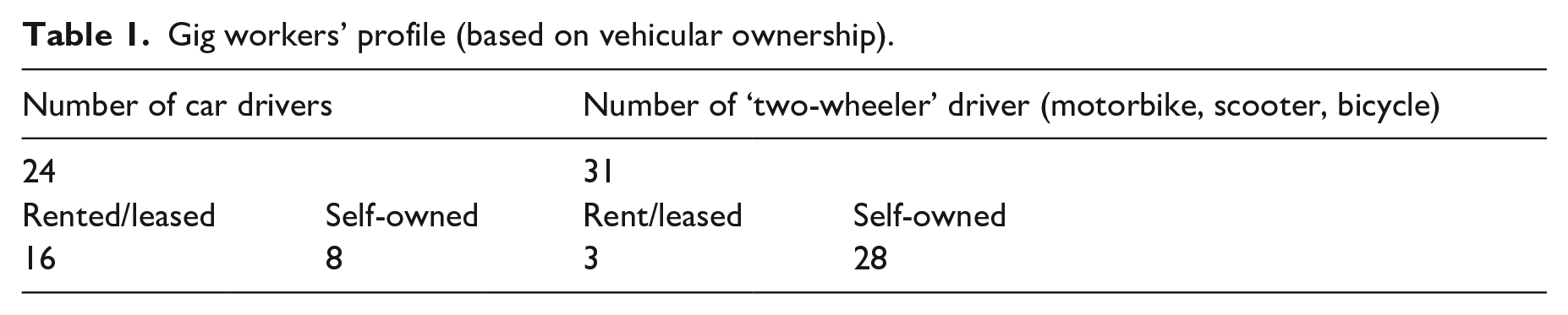
An important aspect to note about the study sample was that about two-thirds of the total cab drivers (16/24) associated with Uber and Ola apps did not own the vehicles they drove. Same was the case with about 10% of those who drove smaller vehicles such as scooters and bikes (3 out of 31) on apps such as Rapido, Big Basket, Zomato, Swiggy, Shadowfax and Amazon Flex. The original owners of these vehicles were referred to as ‘Malik’ by drivers in both Kolkata and Ranchi (or Taxidar in Delhi – see Kashyap and Bhatia, 2018). Drivers had either leased the car from Maliks on a fixed or flexible monthly charge, shared commission or worked on an ‘informal agreement’ and received a wage. Some Maliks in Kolkata and Ranchi dealt in selling used or ‘second-hand’ cars, and had registered these with Ola and Uber, allowing cab drivers to eventually own these vehicles by paying down the price of the car with interest in instalments. This amount was deducted directly from drivers’ earnings periodically. It is important to note that drivers faced an imminent double squeeze during the COVID-19 pandemic, where apart from sharing a proportion of their incomes with the platform (as commission) they shared another part of their earnings with the absentee vehicle owner as rent, while also bearing the overheads costs of fuel and car maintenance.
Additionally, within the larger sample of 55, there were 16 ‘new’ or recent migrant gig workers across the two cities (see Table 2). These new migrants arrived in search of better work opportunities and used to send a substantial part of their earnings back to their homes in rural areas or in peri-urban towns. Many of them lacked their own ‘permanent address’ in the city, living on rent or with a friend or relative, but wished to ‘settle down’ in the future, saving and buying a house. New migrants maintained close engagement with their families ‘back home’, some even partaking in routine household decision-making. This group included young male workers (between the ages of 19 and 25 years) who were pursuing education and did delivery work as a way to earn additional sustenance money. There were also 24 long-term or ‘settled migrants’ in the interview group who had lengthier histories of living and working as drivers in the cities – usually over 10 years. Many among them had started families after settling in the city. Some had invested in a house and their own vehicles. Many continued to nourish an active link with their villages, sending a smaller share of their incomes to their homes in peri-urban or rural areas and still engaging in key family activities and decisions there. Some, though, had sold their lands in the village and brought their immediate families to the city. Their social ties to their ancestral homes and land had weakened considerably and they considered themselves to be more entrenched in their local communities in the city. Fifteen participants considered themselves to be ‘locals’ – belonging mainly to urban lower-middle class or working-class backgrounds as they had grown-up (and remained) in their city since an early age. Some still had extended family networks in rural areas, but only few had very strong links with them.
Gig worker backgrounds.

Findings and discussion
Coping with the exigencies of the pandemic: Migrants, Maliks, Mahajans and (social) media
In both Ranchi and Kolkata, the weeks and months following the India-wide national lockdown announcement on 24th March 2020 brought extreme difficulties for gig workers. With the lockdown came both chaos and confusion, and ultimately alienation from work and livelihoods for millions of gig workers. Digital platforms struggled to cope with the spiralling situation, putting out mixed communications to drivers about their future on the platform and about the nature of help they could extend (see Shipra and Behera, 2020). Drivers we interviewed in both Ranchi and Kolkata, narrated the many difficulties they faced as demand for services in the gig economy in both cities disappeared in the weeks following the first lockdown. Ride-hailing apps like Ola, Uber, Rapido (two-wheeler motorbikes or scooters) were some of the hardest affected, as offices, colleges, schools and recreational spaces closed indefinitely, and commuters were confined to their homes. Given the lack of financial help from the platforms and the state, it was gig workers’ existing savings and assets that inevitably determined how they took the blow from the loss of livelihoods.
It was also apparent that different migrant gig workers in cities were affected relative to the strength and weakness of their local social ties in cities and ‘back home’ in the towns and villages where they originally came from. For instance, recent migrants who had meagre savings as well as weaker ties in the city and in rural areas faced the greatest impact on their livelihoods when compared with settled migrants and locals who could muster up support and assistance from local sources. Thus, migrants such as 33-year-old Sonu who drove with the Uber app in Kolkata found it difficult to survive in the city without a source of income after the lockdown was announced. Sonu had lived in the Kolkata metropolitan area in a small two room rented accommodation for the past 2 years and was the sole earning member of his family and was driving a cab with Uber for the bulk of this period. Like most migrant drivers we interviewed, Sonu did not own the car he drove, rather was informally contracted by a ‘Malik’ – the vehicle owner – with no formal written agreement in place and shared with him around a 40% ‘cut’ from his monthly earnings. Sonu mentioned that before the lockdown he earned between INR 16,000 and INR 20,000 per month through this arrangement, working 10-hour days, 28 days a month and was content with his earnings:
Before the lockdown, the car was on share, so the agreement was 60-40 [with the Malik]. So, whatever was the earning at the end of the month I used to at least get around 15-17 thousand rupees. The Malik was a known man so there was no problem on the payments.
However, following the lockdown, the Malik, who was also active in local union politics, told Sonu that he could only keep driving the car if he bore the fuel and maintenance cost and paid a fixed monthly sum of INR 7000. Having known that there would still be little demand for cab services in the city, Sonu considered this a losing proposition. Sonu had also brought his father to the city for medical treatment and was worried that his ailing father would contract COVID-19 from him if he continued to go out for work. Sonu left employment with the Malik, waiting for the lockdown to ease and conditions to get better. During this time, Sonu’s family depended largely on food rations from the public distribution (PDS) shops in the city, and on his own savings to pay rent and other expenses such as the monthly instalments (‘EMI’) on his TV set and mobile phone. However, his savings were only enough to last for about 2–3 months, that too after ‘cutting corners’ – eating less, and stopping payments of personal loans. Sonu thought about leaving the city to go back to his village in the state of Uttar Pradesh (UP) but found transport to be very expensive due to extremely high demand. Unable to go home and out of money, Sonu was forced to start looking for work during the ongoing pandemic.
A similar story of immiseration was shared by Mohan (29-year-old), a food-delivery worker in Kolkata who lived in a relatively poor area of the city with his family of three and was the sole earning member. In the previous 2 years, Mohan had ridden for four different platform companies in total, first on a bicycle then on a motorbike that he bought on a personal loan to increase his earnings and reduce physical stresses of the work. After his initial stint with the Zomato app delivering restaurant food on his cycle, he shifted to the Big Basket app to deliver groceries in the city. Mohan was now working on the Shadowfax app as a courier for non-food items and on the Rapido app as a ride-share driver on his motorbike. Before the lockdown, Mohan could earn INR 22,000 per month this way, working 12 hours a day. However, after the lockdown, Mohan was forced to use up his savings, going without work until August 2020 and facing acute financial distress. Narratives about the loss of app-based work and incomes after the pandemic were common amongst all workers in our research and were consistent with conclusions drawn from the wider survey of 770 gig workers across India by Flourish Ventures (2020), which showed that 90% of ride-share workers and 75% of delivery riders had lost a substantial part of their earnings during the early COVID crisis and about one third of the total gig workers were making less than INR 5000 per month during its peak (p. 3).
Our interviews also showed that policies introduced by platforms following COVID-19 relating to worker safety and welfare were ineffective in reaching those driving the vehicle (see also ET Online, 2020; Pradeep, 2020). Crucially, both migrant and non-migrant cab and delivery drivers emphasised that they had found themselves helpless in demanding assistance from different platform companies whose apps they used, even though some platforms had announced special medical and accident cover after the pandemic (see Chaturvedi, 2020; Goswami, 2020). In several cases, these policies were not clearly communicated to the driver and/or got blocked by the Malik (the vehicle owner). For instance, most cab-hailing drivers we interviewed in Kolkata did not seem aware of monetary and medical assistance that platforms like Ola and Uber were providing, whereas in Ranchi only a few food-delivery agents had applied for and received a small loan from a private ‘fintech’ (financial-technology) company associated with their delivery platform. Furthermore, many drivers dealt exclusively with the Malik for resolving work-life issues rather than the platforms. Thirty-six-year-old Ahmed, a contracted Ola driver in Ranchi, mentioned that while the platform laid out the rules and the safety precautions for drivers, it was the Malik who dictated whether he could drive the car, for how long and for what share of his monthly earnings. Even as Ahmed hesitated in asking for monetary assistance directly from the Malik, he could not approach Ola for an emergency loan like some other drivers he knew in fear of angering the Malik.
At the mercy of the Malik and with little assistance available from the platform and the state, several migrant drivers looked for help elsewhere. The first line of support for most of these workers came from immediate family members and neighbours in cities they lived and worked in. These ties helped in mitigating the loss of incomes for workers by providing small financial help as well as extending care for workers’ children. However, these local relationships tended to benefit those who had put their roots down in the city and had established themselves in specific urban communities. In Ranchi for instance, wives and mothers of a few drivers we spoke to had secured a loan from the local women’s self-help groups (SHGs) in their community. Similarly, in Kolkata, interviewees like 31-year-old Ola driver Chandra described getting help from unions, sports and rotary clubs in the city that did community and welfare work organising money and rations to help citizens in distress (for e.g. Times Now Digital, 2021).
Aside from some help from the local governments and NGOs in the form of food rations, some drivers in Kolkata mentioned that they had received financial assistance from less well-known sources such as ‘Mahajans’. Mahajans were local money lenders in the city who extended small loans to workers within specific communities and neighbourhoods. Not requiring the same level of paperwork and rigorous financial checks as formal banking institutions, these informal loans were given out by Mahajans through local community networks loosely based on principles of trust and often at very high interest rates. Consequently, recent migrants like 22-year-old food delivery agent Akhil who had arrived in Kolkata from the state of Bihar only about 18 months earlier, had found it extremely difficult to access Mahajans in his area since he ‘did not know someone trustworthy’ in the local community to act as his reference. Having personal connections with local elites and those involved in party-affiliated labour union politics in the city was helpful in such cases, and therefore more likely to benefit those with more established ties in their local communities.
Unlike settled migrants and local workers with established local roots and connections in the city, recent migrant gig workers like Akhil were left dependent on their local peer networks in the gig economy. Both migrant and non-migrant drivers in our research made extensive use of social-media groups, specifically WhatsApp and Facebook, in creating spaces of informal support and solidarity among gig workers in their local areas as well as in the city more widely. New migrant Akhil for instance, reported receiving some monetary and in-kind support from fellow drivers from Ultadanga and South Dumdum areas, all of whom were part of the local delivery agents’ WhatsApp group. Before the pandemic, such WhatsApp groups were being used by drivers to share daily updates and information about a range of things including changes in ‘rate-cards’ on different delivery platforms, the local weather situation, traffic information and driver accidents, and even occasionally to organise local protest action against platforms. During the pandemic, the same WhatsApp group transformed into a virtual helpline for information on how to access medical help and food being distributed by different charities as well as different transport options for those wanting to exit the cities.
Overall, drivers’ experiences during and after the COVID-19 pandemic confirmed the widespread presence of ‘digitally organised informality’ in India’s urban gig economy. Whereas platformisation of urban transport services had enabled a larger segment of marginalised and migrant populations with little or no professional driving background to enter organised app-based work in cities like Kolkata and Ranchi (Bala, 2021; Lata et al., 2023); digital platform companies had been able to continue to avoid taking on responsibilities to address work and income insecurities among workers in these cities, even during periods of heightened crisis (Raval and Lalvani, 2022; Surie and Koduganti, 2016). Furthermore, perceived differences in experiences of local compared to new and long-term migrant gig workers in both Kolkata and Ranchi added a further layer to extant understandings of the inter-connections that exist between workers’ social backgrounds, their spatial rootedness and their differential ability to cope with informality in Southern gig economies, individually or collectively (see for e.g. Frey, 2020; Ghosh and Ramachandran, 2021; Raval and Lalvani, 2022; Surie and Sharma, 2019). Hence, while all workers had sought some form of help and assistance after COVID-19 lockdown, not everyone received it equally. What emerged as important here was the role of ‘horizontal socio-spatial networks’ based on family, community and kinship ties, alongside smaller self-organised peer-driver networks on social media that did not have any affiliations to larger and more organised labour unions yet performed important functions of extending mutual solidarity and support (see also, Dolata and Schrape, 2016; Medappa, 2023). The analysis also emphasised the presence of top-down or ‘vertical socio-spatial networks’ among drivers and powerful local and urban elites such as Maliks and Mahajans that has not been documented in depth thus far. These propelled a specific form of patrimonial intermediation of workers’ access to platforms and to wider livelihood resources such as capital, loans, housing and information in the city. The analysis here supported results from emergent studies which have held that the formalisation of urban gig work in the global South is only partial at best, as what eventually becomes prominent is its socio-spatial ‘re-intermediation’ by informal social actors, relations and networks, that often remain hidden in the mainstream discourse on employment regulation (see Graham et al., 2017; Ray, forthcoming).
Migrant (Im-)mobilities and spatial rootedness: Family, caste, kinship and limits to care in the gig economy
Even as most migrant gig workers found themselves stranded in cities during the pandemic, there were some who managed to travel back to their homes and villages outside the city in the middle of the pandemic, taking their families with them. The severity of the impact of the lockdown became evident as even some long-term migrants who had lived for more than a decade in Kolkata and Ranchi were forced to move back to their villages and homes outside the cities following the lockdown.
While it was difficult to obtain overall numbers of migrant cab drivers and delivery agents working on different platforms apps, journalistic reports at the time had made it evident that thousands of cabs and auto-rickshaw drivers in India had left megacities like Kolkata, driving back to their homes and villages soon after the lockdown were announced – with some of the leading destinations being the poorer states of UP, Bihar and Jharkhand (see Outlook, 2020). Most migrant cab drivers we interviewed had travelled home by private buses and tempos (small trucks), or through transportation organised by their home state governments or NGOs. Thirty-six-year-old cab driver Kunal used his own car to travel to Jharkhand with his family from the city of Kolkata (about 450 km away) during the lockdown, demonstrating just how important family ties in home locations (in villages and towns) were to urban gig workers for their survival.
Migrant gig workers from rural areas spoke of their homes in towns and villages either as ‘safe-havens’ or as destinations of last-resort in times of crisis. Cities were generally viewed as places of better economic opportunities where they had found it very hard to put down roots. The frustrations of not earning enough and being devoid of necessities like food, accommodation and support networks during the pandemic had made city life seem more unpleasant and brutal. Twenty-three-year-old Ramesh, a Zomato delivery driver in Kolkata, spoke about the ‘abundance of farmlands’ in his village in UP and there ‘never being a shortage of food’ unlike in the city. Ramesh, who was also the sole earner, had decided to send his family members back to the village until ‘normalcy’ resumed, while continuing to stay in the city himself in hopes of still earning something:
I think it’s better to live in the village. There are a lot of problems living in the city. In villages there is no shortage of food, but in the city, you need to pay for everything. Most of my family members have gone back to the village - we had some money, so they went. They will all stay in the village and after everything gets back to normal, they will come back to the city.
Migrant workers in both Ranchi and Kolkata emphasised the importance of extended family, kinship and caste networks in not just enabling their original move to the cities but also in maintaining their relationship with homes and villages long after they settled in the city. Young men arriving in cities often called upon a cousin or distant relative from their villages to support them while finding their bearings. These extended kinship networks were crucial to find jobs in the gig economy as well. Rahul, an Ola cab driver who had moved to Ranchi 3 years ago from a neighbouring small town, had started staying with his uncle who put him in touch with a Malik that he worked for. Subsequently, Rahul shared part of his income with his uncle’s family before moving out and getting his own place in the city. During the lockdown however, Rahul moved back in with his uncle since he could not afford to continue to live independently.
While traditional kinship networks were enablers for several gig workers to find employment in the city, maintaining these relationships was not easy for many other workers or indeed a ‘win–win’. The longer migrant workers stayed away from villages and towns to build a life in the city, the weaker their roots and social ties became. The challenges of having weakened social ties became stark for workers who had moved out of their villages several years ago but were forced to move with their entire families back to the village during the lockdown. 35-year-old Rohan, who was an Ola cab driver in Kolkata, had moved with his family back to his village in the state of Uttar Pradesh during the pandemic. Rohan tried looking for work in the farms as a tractor driver but could not find any since he did not share a good relationship with people in the village who owned land (some from his own extended family). Much like other young men from his village, Rohan ultimately returned to Kolkata by July 2020, leaving his wife and two kids behind in the village with his parents. Rohan’s inability to support his family not only meant the breakdown of his care responsibilities but also becoming dependent on his extended family in the village, both matters of personal shame for him:
There was no work [in the village]. You need to know people there – I have lived away from home so long; I don’t know them. So, I had come back [to the city]. I feel so bad that I can’t even feed my family.
New migrant food delivery drivers like 22-year-old Srinjoy in Kolkata and 30-year-old Laxman in Ranchi were slightly more fortunate than interstate migrants during the pandemic. Both Srinjoy and Laxman had moved from villages within the same state (West Bengal and Jharkhand respectively) in the last 6 months and had started working for food delivery apps using their own motorbikes. Given the shorter distance of their original move and its relative recency, both had retained strong ties with their homes and families back in their village and could access them for finances, food and subsistence. It also helped that they did not have to cross state lines to reach their homes unlike interstate migrants such as Ashok, a cab driver in Kolkata, who had to meticulously plan his route to his home state of Uttar Pradesh under fear of adverse police action. Ashok subsequently stayed in quarantine for 14 days, separated from his family and on an exclusive light diet of ‘Khichdi’ (prepared by cooking rice and lentils together) that left him feeling weak and frustrated.
Notably, we found that Ranchi, being a smaller urban location as compared to mega metros like Mumbai and Kolkata, became an alternative destination for a few returning gig workers fleeing expensive metropolitan cities during the pandemic. In Ranchi, we met Raju, a driver who had worked in Mumbai on the Zomato food-delivery app and who had come back to his remote village in Jharkhand during the lockdown as he could not afford to pay rent in the city. Once back in his village, however, Raju had few paid opportunities and had decided almost immediately to move to an extended family member’s place in nearby Ranchi. Using his experience of working as a delivery driver in Mumbai, and a known ‘village contact’ who introduced him to the local team leader at Zomato, Raju was hired quickly and started doing deliveries just as work in the city started picking up again after the lifting of the lockdown.
There was still another important subset of gig workers for whom traditional kinship and community networks were non-existent or non-beneficial during the period of crisis. These were young migrant gig workers, like Sanjeev, from marginalised and landless lower caste communities. Sanjeev had originally moved to Kolkata several years ago from his village in Bihar where he faced both a lack of decent paid opportunities in farm and non-farm jobs, and experienced discrimination and indignities due to his low caste status. Coming from a marginalised social background, Sanjeev had found app-based delivery work in the city much more accessible and with ‘much less hassle’, as he did not have to know anyone influential to start delivering food. During the pandemic however, Sanjeev had felt stuck in the city as earnings on the different apps dried up, but unlike other migrants he could not travel or depend on his family in the village to sustain him as he had ‘no roots’ in the village.
There is nothing for me back in the village. There is no dignity of work. We have no land. I have no roots there. I can’t just go back to the village like other drivers. It is better to stay here in the city and find any other work, even if there is less [work].
Sanjeev’s experiences underlined the significant challenges of social exclusion that marginalised lower caste workers continued to face even after being economically included in the gig economy in large metro cities, and their relatively precarious position vis-à-vis less marginalised migrants and non-migrant drivers who had more support to fall back upon in cities and in rural areas.
Overall experiences of drivers returning to digital platforms after the relaxation of COVID-19 lockdown in both Kolkata and Ranchi revealed how major platform companies simply continued to shift costs of dealing with additional risks arising from the crisis on to drivers themselves. These further reinforced problems related to ‘digitally organised informality’ in the gig economy, where more marginalised and migrant workers not only lacked a formal legal voice but had little autonomy over their own work and time (see also, Anwar and Graham, 2021; Chaudhary, 2020; Raval and Pal, 2019). The increased mobility of gig workers between rural, peri-urban and urban areas, and their frequent movement in and out of gig work during the research period also demonstrated how quickly internal migrants have taken to gig work in India and how their capacity to cope with the exigencies of crisis are therefore inter-connected with wider social and economic realities and their own ability to be spatially mobile (see Altenried, 2022; Bala, 2021; Lata et al., 2023; Surie and Sharma, 2019; Zhou, 2022). Rather than essentialising or lumping together coping practices of different drivers associated with cab and delivery apps, the analysis in this paper has presented a discerning view of the relative differences in experiences of local, settled or recent migrant gig workers, based on the level of their ‘spatial rootedness’ in not just cities but also in smaller towns, and villages. This analysis is important, since scholarship has yet to adequately document the impact of specific dynamics relating to internal worker migration in the global South and their role in sustaining workers’ reproduction in the gig economy through different informal, unwaged and self-organised social and spatial arrangements (for exceptions see Lata et al., 2023; Raval and Lalvani, 2022; Surie and Sharma, 2019).
The analysis in this section has also emphasised the inherent limits and contradictions present within informal, unwaged, trust-based socio-spatial networks of care and support that are available to marginalised and migrant gig workers in the global South. While these networks invariably provide key support for workers at different points of their work-life journeys, they also display severe shortcomings as they are often ad-hoc and partial. Furthermore, even as hitherto socio-economically marginalised workers do feel ‘included’ when entering the gig economy – receiving vital access to starting capital, resources, information and aid; they may still continue to face discrimination and exclusion at the hands of caste and class elites in both cities and rural areas (see also Kashyap and Bhatia, 2018). This analysis, once again, takes us beyond narrow debates around gig labour organisation and formal platform regulation by opening space for more nuanced and context sensitive engagements with both horizontal and vertical socio-spatial networks among gig workers in the global South (see for e.g. Altenried, 2022; Lata et al., 2023; Surie and Sharma, 2019; Zhou, 2022).
Conclusion: Towards an integrative understanding of workers’ experiences in Southern gig economies
Backed by rising middle class demand for personalised services and the widespread adoption of internet app-based smartphone technologies, India’s urban transport sector has become an emblematic example of transformative changes taking place in the wider global South, owing to the introduction of the platform or the gig economy. These changes have, quite expectedly, had huge effects on the experiences of work and employment for a large mass of informal workers hitherto involved in transport and adjacent sectors.
This paper has shown that even as some of the largest global ride-hailing and delivery platforms with presence in India have been put under the scanner for skirting issues related to jobs and livelihoods security for workers, they have continued to impose a silent labour regime that operates alongside the lack of formal regulation by the state. Following from this, the paper has built up the concept of ‘digitally organised informality’ that seeks to highlight that even though the labour of an increasing number of marginalised workers in the global South is being algorithmically aggregated, standardised and controlled via platforms; these workers’ own existence and experiences of dealing with precarity and crisis in the gig economy remains informal and atomised, owing to their ambivalent relationship with platform companies and the state.
This paper has then quite intentionally shed light on the different informal, unwaged and self-organised structures of care and support among workers that form the foundations of the urban gig economy in the global South. Documenting the diverse yet under-explored dynamics of internal migration and the role of family, caste, kinship and community support systems in India has enabled the analysis to demonstrate how ‘horizontal socio-spatial networks’ sustain the gig work and labour in highly informal and insecure settings of the global South. Employing a critical lens, however, this paper has also underlined the often limited and contradictory role of ‘vertical socio-spatial networks’ manifested in elite social intermediaries such as Maliks (vehicles-owner) and Mahajans (informal moneylenders) who practise significant power and patronage, gatekeeping ordinary workers’ mobility and access to platforms and livelihoods. Ultimately, it is also the relative degree of spatial rootedness that shapes greatly how different workers across different contexts utilise socio-spatial networks and cope with exigencies and crises in the gig economy.
In centring workers’ own voices and their diversity, this paper has attempted to avoid essentialising gig workers’ experiences and to instead underline their relative agency. It is hoped that more studies of gig labour in the global South pursue an integrative and context-sensitive agenda that shifts extant analytical focus of scholarship beyond narrow concerns around platform regulation and labour formalisation to further expose the complex interconnections between informality, migration and gig workers’ social reproduction.
Footnotes
Acknowledgements
I would specially like to thank Pallav Karmakar, Kunal Singh, Jay Sharma and Biswajit Prasad, for facilitating remote access to participants in Kolkata and Jharkhand in these unprecedented times, and for providing valuable feedback at different stages of this research. I would also like to extend gratitude to the two delivery drivers, who will remain unnamed, but who provide me with even deeper insights into the realities of gig work during the pandemic and facilitated interviews with their peers and colleagues. Finally, thanks to the academic editors of this special issue for inviting me to write this piece.
Declaration of conflicting interests
The author declared no potential conflicts of interest with respect to the research, authorship, and/or publication of this article.
Funding
The author disclosed receipt of the following financial support for the research, authorship, and/or publication of this article: The research for this article was made possible by the support of the Economic and Social Research Council, grant reference: ES/T009233/1.
