




Abstract
Doing food deliveries while working on multiple platforms at the same time is a common phenomenon amongst couriers, to the point that it has its own moniker: multi-apping. Workers extol the opportunity to earn better money, and also the skills needed to do so. Platforms are turning a blind eye since it allows them to argue in court that riders are self-employed. This entrepreneurial mindset has nevertheless drawbacks for couriers whose accounts can be deactivated if they are late or if customers report them. Understood as resilience against unpaid labour, multi-apping represents, in fact, work intensification. As platforms ‘sub-contract’ the risks and costs resulting from inefficiency in time use, it becomes the couriers’ responsibility to remove unpaid time through multi-apping. Rather than representing a form of resistance or subversion, multi-apping is not only the inevitable result of work intensification. In a vicious circle, it brings about more work intensification.
Adeeb 1 puffs an electronic cigarette, his eyes glued to the phone, whose screen he has been swiping in vain for the last 10 minutes. Laid against the glass wall of a KFC restaurant in central Manchester, with the electric bike and the cubic thermal bag by his side, Adeeb feels the cold and rainy January day slowly getting to his bones. Even though he has put on warm clothes – a turquoise Deliveroo jacket and a thick light blue Manchester City beanie – they do little to protect him against the notoriously rainy weather of Northern England. It is 2021, less than a year since the outbreak of the Covid-19 pandemic and the UK is facing a third national lockdown, implemented barely 2 weeks ago. Despite the British public’s extraordinary reliance on platform food delivery services over the last months, Adeeb and a handful of other couriers in Deansgate have not received an order in a while. It is almost 5PM and, normally, at this time of the day, even during the week, orders are starting to pile up. Yet, with over 15,000 more workers hired by Deliveroo alone in the UK since the beginning of the pandemic, waiting around for orders has become common amongst food couriers.
Between 12.30 pm and 8 pm, Adeeb has had 1 hour and a half lunch break, earned £61 and rejected over 40 orders. The amount is less than half of what he used to earn at the beginning of the pandemic when fewer couriers were on the road and many more lucrative orders were allocated to him. He also counted 61 rejected orders, all of which were prompting him to deliver outside the city centre and go well over the 3 km limit that he finds acceptable for a single delivery. He also prefers the centre as its higher concentration of restaurants allows him to deliver multiple orders at the same time, sometimes using multiple apps, which results in more money earned for a single trip.
For Adeeb, this latter strategy, which couriers call ‘multi-apping’, involves being logged in at the same time on both Deliveroo and Uber Eats and accept orders from one or the other. This is something he has been doing for a few months since none of the two apps are as busy as they used to be. He started doing deliveries in October 2019, long enough to realise that working for Uber Eats alone, as he did at the beginning, no longer pays enough. A few months later, he opened a Deliveroo account and logged in on both apps at the same time, using the same phone. Today, one was busier that the other: he completed 12 orders for Deliveroo against five for Uber Eats.
In most cases, Adeeb turns the other app off as soon as he receives an order, but sometimes he accepts orders on both apps at the same time. This means he picks two different orders, one on Deliveroo, one on Uber Eats, from two different restaurants, which he then delivers to two different customers. To take this chance, experience with the apps, the restaurants and the city is essential. He must be sure that restaurants do not have long waiting times, that they are not far from one another and that customers are in proximity or along the same route. Otherwise, he risks losing the account, as happens to many other couriers: ‘People’s contracts got terminated on Deliveroo a lot because they were taking a long time to deliver the food. When you use two apps and you are new, you don’t know the city very well, so you’re going to rely on Google maps, and you lose a lot of time’. Overall, he thinks that multi-apping is not difficult, especially in the daytime, when none of the apps is too busy. A year and a half later, the fewer and fewer jobs available pushed Adeeb to instal two more apps on his phone (Hungry Panda and Stuart) to earn the same amount of money as before. Despite the increased stress he is facing while multi-apping on four different platforms, he says he is still happy doing food deliveries: ‘£15 per hour is still better pay than elsewhere’.
This ethnographic vignette suggests that multi-apping is a strategy increasingly used by platform food couriers in response to the deteriorating working conditions in the gig economy (see Figure 1). Faced with fewer orders, lower fees per order and a prevailing working arrangement which classifies them as self-employed without a fixed salary, many platform food couriers rely on multi-apping. The multi-apping phenomenon is not exclusively done by platform food couriers, as app taxi drivers and workers using other services mediated by platforms are often juggling with multiple platforms to earn a living. Echoing Adeeb’s take on the practice, a burgeoning online community is extolling the so-called ‘fine art of multi-apping’, with blogs and video tutorials offering tips on how to maximise earnings by using several apps at the same time or intermittently.
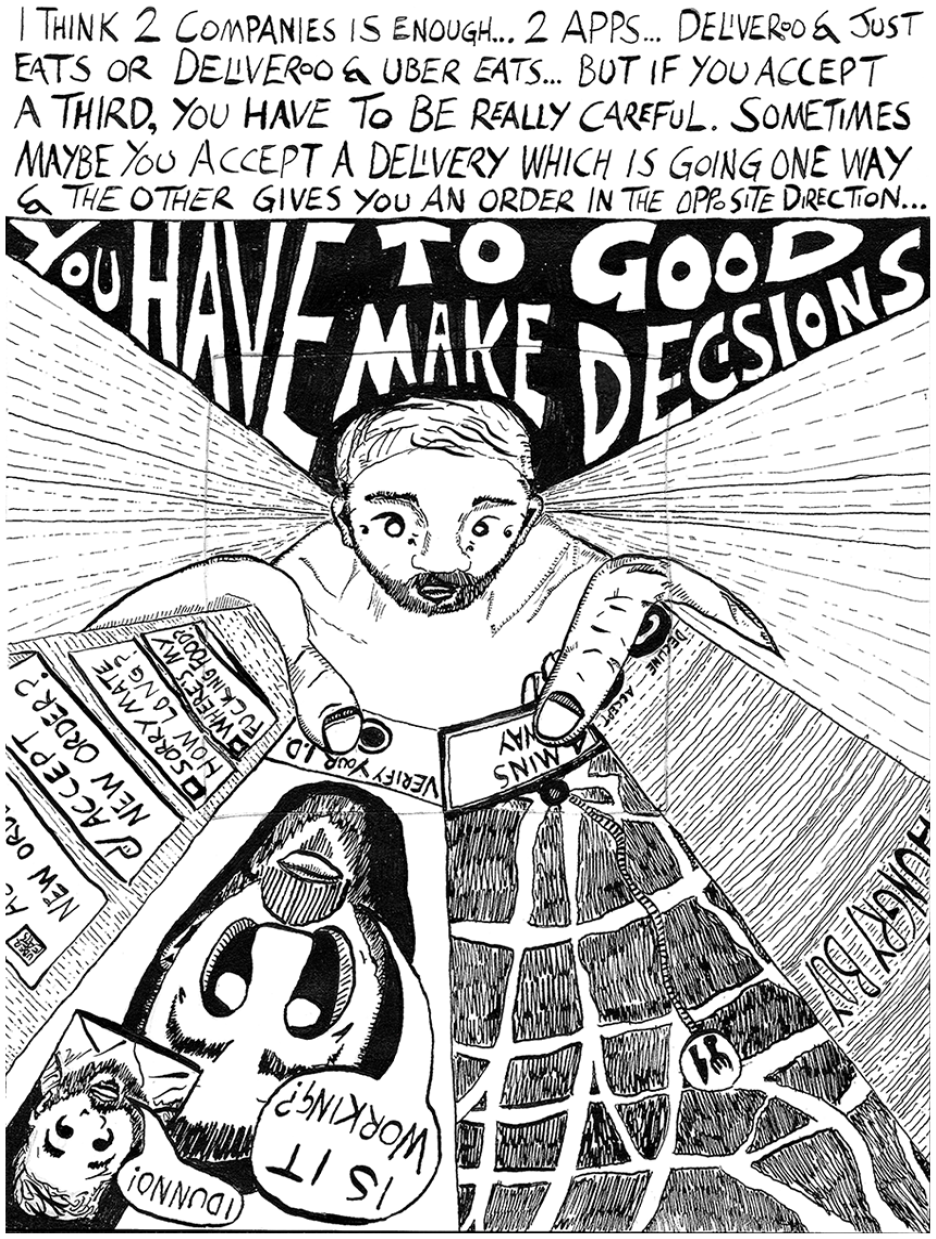
Multi-apping is a current practice amongst food delivery workers. This illustration, which is the result of a collaboration between the author of the article and a visual anthropologist, captures the complexity of multiapping (Credit: José Sherwood González).
Despite the threat of disactivating the accounts, as Adeeb reported, platforms tolerate workers switching between different apps and have even used it as an argument in courts to deny employee status of workers (Central Arbitration Committee, 2016). By classifying couriers as self-employed, the platforms avoid standard employer responsibilities, including paying the minimum wage, respecting limitations on working hours, providing paid sick leave, making social security contributions, and allowing collective bargaining. In this context, the research into the phenomenon of multi-apping remains relatively scarce and mainly describes it as a form of subversive resilience used by platform workers to ‘get by’. This kind of resilience, however, neither changes nor challenges existing exploitative labour relations. Instead, resilience is an attribute and becomes functional to capitalist intensive mode of production.
While multi-apping as a form of resilience is a response to the work intensification in the gig economy, I argue that it actually triggers even more work intensification. To explain this paradox, we must understand the gig economy as a particular type of fragmented-time model of employment (Piasna, 2015). Different from the classical time-centred model of employment, that became widespread in the post-war Western societies, where working time is divided into identical and abstract periods, the fragmented-time model of employment transforms time into an adjustment variable: units of time are no longer all the same and their utility to the employer varies accordingly. Within the fragmented-time model, hourly pay is replaced by piece work, and the risks and costs associated with any inefficiency in time use are shifted on to the workforce. For food couriers, this means that unpaid time in between orders has to be dealt with by workers themselves, who often choose to multi-app. The shift of responsibility from platforms onto workers and their subsequent reliance on multiple apps can be seen as proof of the flexibility afforded by the gig economy. But this flexibility does not amount to workers being independent contractors, as proponents of the gig economy claim. They are, as Marx (1976: 272) would put it, ‘free in a double sense’: free to choose how many platforms they work for, but at the same time they are also ‘free’ from any other way of making a living other than by selling their labour power.
When addressing the capacity of gig workers to resist and ‘bounce back’ from the stress placed upon them by platforms, little attention is given to situations such as account deactivations that Adeeb refers to, which suggests that resilience, even as an individual act, can only partly address work intensification. To conceptualise the multi-apping as an individual coping mechanism with precarious working conditions and low earnings rather than a collective form of resistance that can actually challenge the socio-economic status quo, I draw on Ahmed’s (2017) use of two opposite and complementary concepts: resilience and snapping. Ahmed calls a ‘snap’ the moment when it is no longer possible to accept a relationship, which is experienced as oppressive. Snapping implies thus to begin to talk about this and to envision and enact creative strategies for fighting back.
In the case of platform workers, snapping can be a road accident, as the one narrowly avoided by one of Adeeb’s work colleagues. Abbas switched from an e-bike to a motorcycle so he can be quicker, work more hours and be less tired at the end of the day. He decided nevertheless to continue multi-apping and pick orders from both platforms at the same time, only to realise soon after that this was unsustainable: ‘When you ride an e-bike, you’re not that fast, you can use the phone in one hand and keep an eye on the road. But, on the motorbike, you can’t do that, the police see you and you get 3 or 6 points straight away’. It was not a driving offence that made him reconsider multi-apping, but an accident he barely managed to avoid. He was riding at 40 km/h through an intersection while at the same time checking a notification on Uber Eats prompting him to pick an additional order to the one he was already delivering for Deliveroo. ‘I heard a horn loud, very loud. I could hear the car tyres and I didn’t know if I should stop or accelerate. I pushed the accelerator, went past and I could feel the wind from the car passing by. I stopped at the side of the road, took few minutes to gather myself and turned off my Uber device’. For Abbas, snapping did not lead to fighting back nor quitting platform work altogether. Instead, the near miss prompted him to multi-app less intensively: ‘Now, I turn off my Uber straight away as soon as I get a delivery on Deliveroo, to avoid that temptation’.
This article is grounded on an ethnographic study of platform food couriers in Manchester in the United Kingdom, Cluj in Romania and Lyon in France. The fieldwork I conducted for this article spanned for 2 years and a half (September 2020 to February 2023) and is part of a research project investigating working conditions amongst platform food delivery workers. The ethnographic work involved participant observation as a food courier for three different platforms in each of the cities: Deliveroo in Manchester, Glovo in Cluj and Uber Eats in Lyon. I conducted a total of 45 in-depth semi-structured interviews, and I followed at work (cycling or as a car passenger) for one or more days 15 food couriers.
I begin the article with an overview of what multi-apping is and what are the different types of multi-apping gig workers rely on. At the same time, I also question the entrepreneurial discourses surrounding the practice. I investigate the mushrooming how-to blogs and video tutorials on the internet which praise the opportunities of multi-apping and provide valuable tips on how to maximise one’s earnings. I show as well how platforms are generally tolerant of their workforce switching between different apps. While they want to maintain a good level of service and reduce customers’ waiting times, companies allow workers to multi-app.
I then situate multi-apping within a broader variety of individual forms of agency to which platform food couriers in the three cities I visited resort to face deteriorating working conditions. Amongst them are account renting and buying, vehicle upgrade and using messaging platforms to share various insights about work. I present here as well the three field sites I visited and the significant differences in multi-apping amongst couriers from each city. Acknowledging how most literature dedicated to the gig economy pays little attention to multi-apping, I then begin to unpack the broader implications of this oversight. I thus argue that this paucity resulted in very different and, at the same time, incomplete analysis of what are the social consequences of this ubiquitous phenomenon. Drawing on Katz’s (2004) conceptualisation of worker agency, some authors optimistically see multi-apping as a form of resistance; others, more precautious, describe it as re-working strategy or, more often, as resilience.
I continue by offering a brief overview of resilience, its origin in the field of ecology and its evolution into a popular catchphrase in public and private spheres, while showing that there remains confusion over what it is and what purpose it serves. I follow Ahmed’s (2017) critique of resilience to discuss its counterpoint, snapping. I suggest that for couriers, to snap involves less a conscious decision, yet the resort remains the same: a work situation that they cannot endure anymore.
Multi-apping as entrepreneurship
One day at work, while I was patiently waiting in front of a restaurant to collect an order, a courier rushes in and asks the staff: ‘How much time for order number 529?’ Hearing that he needs to wait at least 10 minutes before it is ready to collect, he leaves in a hurry, but not before confidently telling me: ‘I’ll go deliver this other one in the meantime and then I’ll be back’. The not-yet-ready-to-collect Deliveroo order could thus allow the rider to complete the order for Just Eat, another platform he uses, and also be back on time to still find me there and collect the delayed order. Multi-apping requires, as this encounter with this courier in Manchester demonstrates, important skills such as anticipating and minimising waiting times for orders.
The rider who heartily shared his exploit with me is representative of a significant number of workers who see multi-apping as a great opportunity to earn additional money. Amongst them, self-styled web influencers, most of them from the US, bring this practice to the public attention by recording and posting on YouTube how-to videos describing in detail how to maximise one’s earnings by using multiple platforms. ‘I want to give you a surefire way to make more money as a delivery driver without risk of deactivation’, claims one such video, 2 while another one promises a similarly mindful approach to multi-apping: ‘If you drive for Uber Eats, DoorDash, Postmates or Grubhub did you know you can actually drive for multiple apps at the same time? But just because you can doesn’t mean you should, in this video I go over the very best strategy to drive on multiple apps’. 3
Using dashboard cameras to film themselves at work or, alternatively, at home, in front of whiteboards scribbled with bullet points, thousands of how-to videos, some gathering tens of thousands of visitors, seem to successfully argue that the more you multi-app, the better. The insights passed on to fellow workers through these videos seem to suggest that it is within the couriers’ power to make the most of the opportunities offered by the gig economy. For a bit over 100 dollars, some of these influencers even offer in-depth personalised courses on topics such as: ‘Managing multiple bonuses’, ‘Measuring bonus worth’, ‘Choosing the best app’, ‘Managing multiple apps’, ‘The wrong way to use multiple apps’ or ‘Managing your marketplace’.
There are at least three levels of working multiple apps, each requiring different skills and involving different levels of intensity. One courier in Manchester, Dianka, has three apps, Stuart, Uber Eats and Deliveroo, but she uses them independently of one another. She turned on Stuart for a while, when weekend bonuses were good, but she quickly stopped when these incentives were cancelled and focussed on the other two. She prefers Uber Eats in the morning, between 7 and 9, when there is a bonus, then she switches to Deliveroo for the rest of the day. Abbas, who was mentioned earlier, has both Deliveroo and Uber Eats apps turned on at the same time but, after the near miss, switches the other one off as soon as he gets an order: ‘I can’t leave the Uber device on. Cause it’s just a headache, cause my attention is diverted, to see where that delivery is going. Sometimes it makes you greedy, you are like “Oh, do you know what? Empty road, it’s fine, I’ll check it”’. In doing so, Abbas resorts to a lower intensity form of multi-apping that makes it less likely for him to snap. Finally, Adeeb is experienced and confident enough to accept multiple offers from four different platforms at the same time.
Alongside a string of dedicated blogs encouraging workers to switch platforms as often as needed, these platforms outline a set of essential steps to follow for a successful multi-apping career. Multi-apping can be an ‘art’, as one such blog post (Hammersley, 2022) puts it, if you pay attention to advices such as: ‘Get signed on and experienced with all the delivery companies’, ‘Decide if you want to use one or two phones’, ‘Check what all the different apps are offering in terms of bonus and surge pay’, ‘Make sure you know your market extremely well’, ‘Know how you will evaluate deliveries’, ‘Try tracking every delivery and use it to evaluate’, ‘Record all deductible expenses’ (EntreCourier, 2022; Hammersley, 2022; Multiapp, 2020). The overwhelming consensus of these self-help web pages is that multi-apping is not just the appropriate, but also the necessary response to deteriorating working conditions in the gig economy.
This entrepreneurial outlook on multi-apping is further confirmed by an emerging niche of mobile apps which claim to assist couriers with effectively organising their use of multiple accounts. Gridwise 4 presents itself as ‘the leading business app for helping rideshare and delivery drivers maximise and track earnings, expenses, profitability, and mileage’. Another one, Solo promises to offer couriers ‘the ability to manage your earnings goals across multiple jobs, understand peak pay rates in your city and move more seamlessly between the jobs that fit your schedule’, while Appjobs 5 promises to be a ‘gig work assistant’ that helps workers ‘track data from all your gig work apps in one place’ in order ‘to make choices faster and easier, work smart and make the most out of your time’. Each of these ‘add-ons’ have been downloaded and used by tens of thousands of gig workers, yet they only partly address the work intensification resulting from multi-apping. Through the promise of making multi-apping easier, these mobile apps are further contributing to a neoliberal process where self-exploitation is discursively turned into resilience and entrepreneurship.
While it might seem that delivery platforms are less keen to see couriers switching off one app in favour of another, companies do not seek, in fact, an outright sanction of the practice; for the sake of their businesses, these gig workers must remain classified as self-employed rather than employees. Multi-apping, as pointedly argue Barratt et al. (2020: 1651), ‘gives credence to workers’ independent contractor classification by reducing workers’ dependency on any one platform, often a critical indicator of employment’. The benevolent approach to multi-apping transpired in court cases such as the one in 2021, when one courier sued Deliveroo in Australia. The company lost an unfair dismissal case as the local legislator rejected the company’s claim that riders can work across multiple platforms at the same as evidence for self-employment (Zhou, 2021).
While accounts are often closed by companies in response to the practice, they penalise long delivery times and not the multi-apping per se, as one of the couriers, Adeeb, witnesses. Many of the couriers I worked with in Manchester were, in fact, wearing jackets or carrying thermal boxes purchased from a different company than the one they were working for. In fact, companies do not conduct regular checks amongst the couriers to verify if they wear the proprietary equipment (branded clothes and delivery bags). Yet platforms use incentives regularly to prevent multi-apping from draining their workforce supply, something that companies acknowledge openly. For example, in its registration documents for the London Stock Exchange, Deliveroo states: ‘consumers, partners, and riders frequently “multi-app” and can therefore shift seamlessly to alternative providers . . . [which means that any] . . . efforts by our competitors to increase their appeal to our consumers, partners and riders might compel us to . . . increase the rates or modify the basis on which we pay or engage riders on our network’ (Deliveroo, 2021: 5). In many situations, incentive systems entail a bonus based on completing a certain number of rides within a specified time (e.g. 10 rides in a day or 50 rides in a week) or an increase of the fee paid per delivery (during peak times or in case of bad weather). While this does not necessarily eliminate multi-apping, couriers tend to respond positively and focus their efforts (as Dianka does) on a single ride-hailing company (see also Karn and Hutson, 2019).
A craft amongst others
The interest in workers’ responses to the exploitative working conditions in the gig economy generally focuses on strikes as collective forms of organisation. Research in this area seeks to demonstrate that, despite the ‘geographically tethered’ nature of platform food deliveries (Woodcock and Graham, 2019), couriers find opportunities not only to socialise, but also to form alliances and organise strikes and protests against platforms (Briziarelli, 2019; Cant, 2020; Iazzolino, 2023; Tassinari and Maccarrone, 2017; Woodcock, 2021). More recently, and in the context of the decreasing number of gig workers’ strikes across Europe (Bessa et al., 2022), more individual forms of everyday resistance came to attention. These are considered entrepreneurial rather than solidarity and collective forms of agency (Popan, 2021) since they are aimed at ‘improving individual conditions and aligning them with, rather than challenging, platform business models’ (Barratt et al., 2020: 1643).
Multi-apping is a form of entrepreneurial agency, alongside other mundane everyday actions undertaken by food couriers who carve fissures in the algorithmic power through acts of manipulation, subversion, disruption (Ferrari and Graham, 2021). Other strategies include using third-party software to automatically reject or accept job requests, maximising fares through artificial price surge, inflating fares through the modification of GPS data and using fake GPS apps to receive less or more orders (Anwar and Graham, 2020; Heiland, 2021; Iazzolino and Varesio, 2023; Veen et al., 2020).
During my research, I discovered additional crafts deployed by couriers. One worker who drives a car in Cluj knows the city well enough to use shortcuts that are not registered by the navigation software developed by Glovo, one of the food platforms operating in the area. Thus, he can sometimes reduce the distance he covers for a single order, while earning the same amount of money. Another courier from Manchester postpones the moment he collects the accepted orders in the hope that, by the time he reaches the restaurant, an additional order will be allocated to him, increasing his earnings. Vehicle upgrades, such as Abbas’ switching from e-bike to motorcycle, and account renting or buying are other examples of entrepreneurial agency which I observed frequently during my fieldwork. Alongside multi-apping, these two practices take place outside the digital space of the platforms and are documented in countries both in the global North and South (Altenried, 2021; Boccardo et al., 2022; Mendonça et al., 2023; Tironi and Albornoz, 2022; Veen et al., 2020). An accurate figure of how many food couriers use more than one platform is difficult to estimate, since platforms themselves do not provide such statistics. A study by the International Labour Organisation made across G20 countries states that 58% of platform workers in developing countries and 52% in developed countries use multiple platforms to find sufficient work (ILO, 2021).
Beyond these statistics, which might leave the impression that working on multiple platforms provides a similar experience across the world, my ethnographic work has revealed that multi-apping is instead a heterogenous phenomenon, with different outcomes across the three cities I investigated. In contextualising how multi-apping is done (or, indeed, not done) differently in each of the three cities, I use the concept of embeddedness (Polanyi, 1992) to consider how the economic, the institutional, and the social mutually condition each other. I argue that the differences in multi-apping demonstrate that food delivery platforms are entangled in different local institutions and practices, thus complicating the discourses of seamless operation, uniformisation and capitalist extraction characterising platform functionalities (Gibbings et al., 2022).
In comparison to Manchester and Lyon, where gig workers are classified as self-employed, in Cluj, Romania their status is of employees. This is done through a local network of sub-contracting companies who set up job contracts for individual couriers. In exchange for a monthly fee (set up at 10% of overall earnings), the subcontractors guarantee workers some employment rights, such as entitlement to minimum wage, health and safety protection and social protection. An employment relationship does not necessarily lead to fair working conditions since the complex networks of subcontracting further erode labour standards and deprive workers of basic employment rights (Popan, 2022, see also, Bertolini et al., 2021). Furthermore, the mediating role of subcontracting companies limits, to an extent, the number of couriers working in one city for any single platform.
Additionally, Glovo and Tazz, the most popular platforms in Romania, have a shift booking system, where couriers have to book their working hours in advance, which greatly differ from the free-login model used by Uber Eats and more recently adopted by Deliveroo too. In Cluj, to avoid penalties or temporary deactivations, couriers must commit to attending the time slots booked on each platform and accept all orders. For these two reasons, working on multiple platforms is a very rare phenomenon in Cluj. Multi-apping remains nevertheless a distinctive possibility when couriers, who are also managers of subcontracting companies, forge personal relations with Glovo representatives. Using such an informal connection, as one courier told me, he can use two Glovo accounts at the same time so that he can opt for the most convenient order while rejecting the other one. Glovo algorithms might automatically deactivate his account, but he can have it quickly reinstated through his direct connection with local Glovo managers.
The practice of multi-apping is less common in Lyon than in Manchester, but for different reasons than in Cluj. Since I have begun the project in September 2020, I could observe how the Covid-19 pandemic and an economic crisis in the making have contributed to both deteriorate the working conditions and change the socio-demographic composition of the workforce. Many European countries have, in fact, witnessed a gradual transition from part-time temporary jobs done mostly by students to dependent self-employed male migrants, many undocumented, working excessive and irregular hours (Altenried, 2021; Gomes and Isidro, 2020; Lebas, 2020; Mendonça et al., 2023).
As emerged from conversations and interviews with my informants in Lyon, a local cohort of students, mainly using bicycles to cover the city centres where platforms initially rolled out their operations, represented the bulk of food couriers in early 2010s. Students were gradually replaced by second-generation migrants on motorcycles, working excessive hours as dependent self-employed. In the last few years, most food couriers are extremely precarious and vulnerable undocumented male migrants. According to figures revealed by trade unions and workers’ associations, between a third and half of the couriers in France rent or buy accounts (France Info, 2022; Visseyrias, 2021). The increase of undocumented migrants involved in recent years in food deliveries manifests the embeddedness (Polanyi, 1992) of platforms in local contexts, as the workforce composition in France is substantially determined by national politics and policies. 6 This demographic shift impacts on couriers’ capacity to multi-app. Renting a Deliveroo or Uber account can cost between 120 and 150 euros per week, making the operation of multiple accounts an unsustainable investment.
Multi-apping and workers’ agency
While there is a burgeoning interest in entrepreneurial forms of workers’ agency, the literature on multi-apping continues to remain sparse and often frames multi-apping in positive terms. At the same time, the concepts mobilised to explain it are not only diverse but also divergent. They range from resistance, to reworking, to resilience and follow, explicitly or implicitly, the theorisation of workers’ agency offered by Scott (1987) and Katz (2004). While analysing the lives of Malay peasants, Scott highlights the difference between visible actions to contest oppression and the more hidden everyday acts of low-profile individual resistance. Katz further distinguishes between resistance, which necessitates ‘a critical consciousness to confront and redress historically and geographically specific conditions of oppression and exploitation’ (2004: 251) and the less effective forms of individual agency: re-working and resilience. Re-working consists of pragmatic responses to problematic conditions, while resilience includes the small acts of everyday coping, without necessarily changing existing social relations (Anwar and Graham, 2020; Katz, 2004).
In their investigation of working conditions amongst platform food couriers in Chile, Tironi and Albornoz (2022) discuss account renting and multi-apping as practices of resistance. They suggest that workers confront the control imposed by the platform and highlight ‘the subversive potential’ of these actions (Tironi and Albornoz, 2022: 4). Decat Fonteyne (2021) similarly describes multi-apping as a pragmatic response and a ‘slightly subversive stance’ (p. 62) towards platform control. I suggest that this interpretation of resistance is rather limited since it is only temporarily preventing the control exerted by the platform. Since platforms are not only aware of multi-apping, but partly benefit from it, it becomes difficult to argue that the strategy counts as resistance and even less so as subversion. As the authors acknowledge themselves and as my ethnographic data also shows, Uber Eat and Deliveroo accounts can get deactivated as a result of multi-apping. Furthermore, the resistance mounted by workers is merely against the platform’s functionality; indeed, Tironi and Albornoz do not seem to substantiate their claim regarding the ‘subversive potential’ of multi-apping, nor its capacity to confront what Katz (2004: 251) describes as ‘specific conditions of oppression and exploitation’.
On the contrary, for Badger (2022), who researches food delivery couriers in London, multi-apping has a limited capacity to act as a resistance strategy and is instead undertaken out of financial necessity. He argues that couriers who work on multiple platforms re-work (or ‘game’, as he puts it) the platform functionalities, to create their own ‘personal labour market’. As a result, these workers have ‘greater agency to be selective of the work they accept by putting each platform into competition with one-another’ (Badger, 2022: 258; see also Au-Yeung and Qiu, 2022 for a similar discussion on riders’ ‘marketplace bargaining power’). Multi-apping is thus an example of gamification as couriers are setting platforms against one another ‘to create competition between platforms and earn the best possible wages’ (p. 262). Badger shows nevertheless that multi-apping eventually entails ‘an implicit ‘consent’ to the broader rules of the game, and by extension, the logics of platform capitalism’ (p. 266). Additionally, the author sees multi-apping as a potential tool for collective resistance, arguing that if enough riders ceased working for one of the platforms, this could, in the long term, create lasting organisational change. Multi-apping, he argues, encourages ‘a growing consciousness around the conditions of work and the exploitation of rider labour that comes with it’ (p. 266).
Other critical scholars similarly appreciate that multi-apping is a limited and individual form of entrepreneurial agency (Veen et al., 2020) which, despite increasing workers’ access to ‘pieces’, does so ‘without materially challenging the platforms’ operations’ and ultimately ‘reinforces, the interests of the platforms’(Barratt et al., 2020: 1651). Researching the platform food delivery scene in Australia, where workers’ strikes have been largely absent, these authors frame multi-apping and other strategies such as vehicle upgrades as acts of re-working and resilience rather than resistance. Resilience is presented here as entrepreneurial acts which can have an adverse impact on more collective forms of organisation that ‘need to be carefully identified and understood as facilitators but equally inhibiters of higher-levels of agency within the context of market regimes’ (Barratt et al., 2020: 1651).
In their discussion of African workers in the gig economy, Anwar and Graham consider that some of workers’ labour agency can be seen as resilience. In this context, resilience is often mediated by social networks and consists of buying and selling accounts, sharing strategies on bidding, re-outsourcing jobs or running skills-training classes (Anwar and Graham, 2020: 1282). Anwar and Graham point out that resilience strategies are designed to cope with low wages, exploitative customers and job uncertainty, and claim that resilience can help workers achieve autonomy at work (namely, to control work intensity and working hours) and better bargaining power (to negotiate wages, withdraw from work at will and control employment conditions). Yet, the authors warn that workers’ resilience can be nevertheless impacted by the socio-economic and cultural contexts in which they are embedded (with women and migrants less likely to be similarly resilient), as well as the capital’s agency (platform control, monitoring and opacity, as well as the short-term and fragmented work).
As the story of Abeed and his fellow couriers in Manchester suggest, multi-apping can certainly be considered a mode of resilience that allows couriers to navigate precarious work. Yet, as some scholars seem to imply, multi-apping should be understood in terms of individual entrepreneurial agency. At the same time, my ethnographic material suggests that this coping mechanism offers only limited capacity to provide autonomy for workers or offer them bargaining power. Instead, I claim that multi-apping leads to work intensification, which in turn can result in accidents.
The intensification of work represents, more generally, the result of the significant changes brought about by the incorporation of information and communication technology in the workplace (Chesley, 2014; Green, 2004). In the case of multi-apping, this fast-paced work is the consequence of management strategies deployed by individual platform companies as well as the work arrangements specific of the gig economy. Over the years, most food delivery companies have switched from an hourly pay to a pay-per-drop system and gradually decreased the pay rate, thus pushing couriers to work longer hours and rely on multiple platforms. At a broader level, the gig economy is characterised by low entry barriers which, in turn, have led to an oversupply of labour who cannot make a living using just one platform. Additionally, the overinvestment of financial capital allows competition between food platforms to continue. As illustrated by Dianka’s approach to multi-apping, the bonuses and incentives are important criteria for logging into one platform or another (see also Franke and Pulignano, 2023; van Doorn and Chen, 2021).
By relying on multi-apping as an individual entrepreneurial agency to address precarious working conditions, food delivery workers are ultimately contributing to what classical sociological literature on workplace and industrial relations describe as ‘manufacturing consent’ (Burawoy, 1979). Drawing on his experience as a worker in a piece-rate machine shop in Chicago during the 1970s, Burawoy shows how management controls workers by giving them the ‘illusion of choice’ in an otherwise highly restrictive environment. Companies use strategies such as the piece-rate pay system, the internal labour market and collective bargaining to build consent amongst workers by minimising the potential of class consciousness and labour-management conflict while maximising productivity. More than 40 years later, platform companies rely on some of the same strategies observed by Burawoy while deploying additional ones such as gamification, dynamic delivery fees and the use of information asymmetry and retention (Perrig, 2021).
Existing literature frames multi-apping as resistance, re-working or resilience, yet in most cases this strategy falls short of mobilising couriers in the workplace. Kelly’s (1998) mobilisation theory offers a useful framework to understand why this is the case. His theory of how that collective organisation and action takes place highlights both the internal and external factors providing the conditions under which ‘individuals are transformed into collective actors willing and able to create and sustain collective organisation and engage in collective action against their employer’ (1998: 3). While multi-apping can sometimes become a tool for resistance if couriers decide to collectively boycott one platform, such actions are not capable by themselves to produce effective mobilisation to challenge working conditions within the broader platform food delivery industry. This happens because external factors also play an influencing role in the process of collective organisation and mobilisation: the platform architecture (such as the legal structure, technological apparatus and organisational design) may either enable or hinder workers’ mobilisation (Mendonça and Kougiannou, 2023).
To understand why multi-apping is overwhelmingly and positively framed as a relatively successful strategy to deal with increasingly precarious working conditions, we must turn our attention to dominant discourses on resilience and focus on relative neglect of an important blind spot: snapping. I consider snapping an important concept to understand the limits of resilience or the hidden and often unspoken risks of becoming too resilient which, in fact, often means overworking.
Resilient until it snaps
For the last two decades we have witnessed a ‘spectacular rise’ in the use of the term resilience across the natural and social sciences, in media and policy debates, with a specific focus on the field of global change generally, and global environmental change in particular (Brown, 2014). Today, a prevalent expectation that individuals and communities should learn to become resilient has gained traction around the world. The changing debates in the 1990s about the environment, which increasingly described human-nature entanglements as complex and nonlinear, lead to the rising prominence of the resilience paradigm to highlight ‘the role of community-environment relations in order to develop better, more efficient, and reflexive ways that challenged the linear, top-down and reductionist approaches of modernity’ (Pugh, 2021: 228–229). In the ensuing decades, resilience has nevertheless received several criticisms, particularly for its increasingly narrow understanding as a valuable individual resource or capacity, removed from the broader social context that enables or constrains it (Fassin, 2017).
By presenting multi-apping at best as a coping mechanism and a resilient practice and at worst as a form of resistance, the true scale of vulnerability and precarity faced by food couriers is overlooked, while the traumatic experience it may generate can be seen as an individual plight. A road accident resulting from juggling multiple platforms in hope of a lucrative order can be thus formulated as a personal failure to act in a dynamic work environment, rather than an unsustainable intensification of work. Understood as a ‘subversive’ act, multi-apping as individual resilience is nothing more than ‘a technology of will’, which ‘functions as a command: be willing to bear more; be stronger so you can bear more’ (Ahmed, 2017: 189). Ahmed (2017), who sees resilience as the implicit requirement and acceptance to endure more pressure, argues as well that it is a ‘deeply conservative technique, one especially well suited to governance’ (p. 189).
With a similar critical take, Berlant (2011) suggests that cruel optimism ‘exists when something you desire is actually an obstacle to your flourishing’ (p. 1) and argues that a society or an individual’s optimistic relation to a specific object of desire may turn out to be self-destructive or harmful. In this sense, multi-apping can be seen as a manifestation of cruel optimism: while it can certainly improve one’s finances, it can also have detrimental effects. Following Sara Ahmed’s feminist critique of resilience, I call these negative outcomes resulting from multi-apping a ‘snap’. According to Ahmed, snapping signals the moment when it is no longer possible to accept a relationship which is perceived as oppressive. For Ahmed, snapping implies to begin to talk about oppression and to envision and enact creative strategies for fighting back. 7
A work situation which starts being perceived as unbearable represents the snapping moment for couriers. It is often triggered by sudden, dangerous, or unexpected events rather than coming from a reflexive process. The road collision that Abbas narrowly missed while riding his motorcycle and multi-apping is an illustration of what snapping could look like in the gig economy. Snapping or almost snapping is frequent amongst the couriers from the three cities I visited: the vast majority mentioned a near miss or a road accident at work. Deadly road accidents are regularly reported in the news and road collisions are more likely to occur for riders in the gig economy (Christie and Ward, 2023).
Multi-apping and similar resilient practices amongst food couriers – be they account renting or vehicle upgrade – must be understood as the actual origin of a violent snap. Advertised as entrepreneurial prowess, they are, in fact, extremely exploitative and violent work arrangements, which lead to even more intensive work regimes and road accidents. Renting an account, for example, puts additional pressure on riders to work more hours to be able to pay the rent and also earn money, which often leads to exhaustion and increases the risk of accidents. Similarly, upgrading one’s vehicle from a bicycle or an e-bike to a motorcycle often invites couriers to engage more often in risky behaviour such as speeding or red light running. At the same time, resorting to multiple apps and similar resilient actions can themselves be understood as the direct result of a snap moment caused by the poor conditions and pay of work. In this way, resilience and snapping become part of a cyclical process.
Work intensification begets resilience begets work intensification
In August 2016, hundreds of Deliveroo workers came together outside the company’s headquarters in London in one of the first strikes in the platform economy. For 6 days, couriers protested Deliveroo’s decision to change how the remuneration system works: workers would no longer be paid £7 per hour and £1 per drop, instead receiving only £3.75 per drop (Woodcock, 2016). The company’s switch from hourly paid employment, where couriers booked work shifts in advance, to a ‘free login’ system and a ‘piece-rate’ payment structure had two important consequences: unpaid labour and, as a direct consequence, labour intensification.
Unpaid labour, a systemic feature of platform work (Pulignano et al., 2021), consists, in the case of food couriers, of unpaid overtime, waiting time, time spent searching for tasks, travelling to work and between jobs and unpaid breaks at work. The automatisation and computerisation of the last decades have contributed to work intensification by increasing monitoring and pace, minimising the gaps between tasks and extending work beyond the established workplace and working day (Carbonell, 2022; Wood et al., 2019). Facilitated by the widespread use of algorithmic matching and management methods brough by the gig economy, piecework payment further increased in the last decade work fragmentation and intensification, as the business risk of low demand is completely shifted onto the workers, with all the health and safety risks that this article discusses.
In this article I focussed on the ubiquitous practice of multi-apping as one of the strategies platform food couriers use to cope with work fragmentation and intensification. I argue that the study of multi-apping offers the opportunity to critically examine the concept of resilience and its shortcomings when applied to the gig economy. Despite the apparent flexibility and autonomy that multi-apping affords, simultaneously juggling multiple platforms represents more than an ingenious and effective coping mechanism – or, as proponents of the gig economy argue, an astute entrepreneurial tactic – for gig workers facing deteriorating working conditions. Instead, multi-apping is a form of resilience, which helps one navigate precarious working conditions and poor remuneration. Yet, it does not challenge the structural problems of the gig economy because resilience is an individual disposition rather than a collective mode of resistance. Rather, in the context of the gig economy, resilience has negative consequences at a more personal level with often dramatic economic consequences: multi-apping couriers risk account deactivations, increasing levels of stress and road accidents.
Footnotes
Declaration of conflicting interests
The author declared no potential conflicts of interest with respect to the research, authorship, and/or publication of this article.
Funding
The author disclosed receipt of the following financial support for the research, authorship, and/or publication of this article: This work was supported by the Leverhulme Trust [grant number ECF-2020-523].
