




Abstract
Drawing from neo-Gramscian theory, the paper explores how urban austerity governance mediates crises of neoliberal hegemony. Focusing on the decade after the Global Economic Crisis of 2008–2009, it compares four European cities disclosing five intersecting characteristics of urban political economy that contributed to sustaining and disrupting austere neoliberalism. Austere neoliberalism was sustained through three characteristics: economic rationalism, state revanchism and weak counter-hegemony, but undermined by both weakening hegemony and the combustibility and generativity of urban struggles. Hence, although state revanchism is a prominent feature of urban politics, and novel counter-hegemonic forms are elusive, struggles for equality and solidarity remain contagious, tenacious and vibrant. Urban governance is a crucial arena for studying the interregnum, signposting multiple ways in which neoliberalism survives, mutates and dies.
Introduction
Since the Global Economic Crisis (GEC) of 2008–2009, cities and city regions have been studied as arenas in which austerity is concentrated, as vehicles for economic agglomeration and decline, and as places where struggles against neoliberalism ebb and flow. By exploring the dynamics of austerity governance and resistance comparatively, the paper contributes to understanding the postulated crisis of neoliberalism, from an urban perspective. Read through neo-Gramscian concepts, and drawing from comparative research on urban austerity governance, it reveals how cities variously succumbed, adapted to or challenged austere neoliberalism in the decade after the GEC, when austerity was the official ideology of European states (here called ‘austere neoliberalism’), and cities across the continent became beacons of resistance.
The paper explores the proposition that the period since the GEC marks the emergence of a widening and deepening ‘interregnum’ in the hegemony of neoliberal globalism (Stahl, 2019), echoed in the urban field by concepts including ‘late entrepreneurialism’ (Peck, 2017a, 2017b) and ‘late neoliberalism’ (Enwright and Rossi, 2017). These related concepts point to the incipient exhaustion of neoliberalism as an accumulation regime and hegemony project, and to the intractable turbulence associated with its inability to prevent new crises or produce new fixes. The paper considers what light urban governance casts on the notion of the interregnum, following a decade of intense crises, austerity and resistance.
The paper employs concepts from the Gramscian repertoire focusing on conjunctures, hegemony, passive revolution and crises (e.g., Stahl, 2019; Thomas, 2021). The Gramscian perspective focuses on relations among statal and non-statal actors at multiple scales, the ensemble of forces that Jessop (2022), following Gramsci, termed the (local) state ‘in its inclusive sense’. Urban governance is here framed as processes through which the local state in this inclusive sense is constituted and resisted. Drawing from four case studies in Athens, Barcelona, Dublin and Nantes, the paper discloses five intersecting, multi-tonal characteristics of urban governance that were influential in consolidating, adapting and disrupting austere neoliberalism: economic rationalism, revanchism, weak counter-hegemony, weak hegemony and combustible, generative politicisations. Economic rationalism captures the idea common among municipal leaders that cities had no choice but to follow the two-sided market imperatives of public service retrenchment and attractiveness, or competitiveness (Davies et al., 2020). The research shows the two imperatives combining in perhaps surprising ways across the four cities, with distinctive political outcomes. Revanchism reflects the tendency of national austerity states to re-centralise power and curtail the autonomy of local state actors. Weak counter-hegemony signals the tendency for anti-austerity struggles to ebb and flow without accumulating transformative momentum (Barker et al., 2013). Weak hegemony, conversely, reflects the diminishing political efficacy of neoliberalism in sustaining co-optive governing arrangements. Combustible, generative politicisations capture the openness of the conjuncture, the continuous emergence of anti-systemic struggles and their efficacy in producing new political subjectivities, and sometimes changing policy. The first three characteristics predominantly anchored austere neoliberalism, while the fourth and fifth highlighted its limitations and the potential in struggles against it. The paper concludes that showing how these five characteristics intersect adds analytical and spatial granularity to the notion of the interregnum.
The first section draws on neo-Gramscian theory to position the concept of the interregnum in its relationship with conjunctures, hegemony, passive revolution and crises. The second reviews the development and crisis of neoliberal globalism as a hegemony project with specific urban mediations. The third section discusses empirical research from the four cities, elaborating intersecting characteristics that contribute to reproducing, adapting and disrupting austere neoliberalism. The paper concludes by reassessing the crises of neoliberalism, and their urban forms.
Navigating the conjuncture
Neo-Gramscian theory brings a cluster of tools to bear on the problem of neoliberal hegemony, situated in periodisations of capitalist development through which crises and stabilising mechanisms are analysed. The Gramscian conception of crisis distinguishes conjunctural or transient disturbances from deeper ones constituting an ‘interregnum’, or organic crisis of a political-economic order. The concept refers to periods in which contradictions mature and escalate, a conflictual impasse arising that potentially widens apertures for political change (Gramsci, 1971: 275–6; Q3, §34). The interregnum is a phase in which Gramsci's ‘morbid symptoms’ intensify, prevalent norms are challenged, and new social forces enter the fray (Stahl, 2019). It signifies a ‘radical rupture in the links between representatives and the represented’ (Kouvelakis, 2019: 78), burgeoning crises of authority, state legitimacy and hegemony. With the planet ensnared by economic, ecological and public health crises, crises of governability and rising geo-political tensions, the term has become increasingly resonant (Streeck, 2016).
The concept of passive revolution enriches and reframes the relationship between hegemony, crisis and interregnum. Gramsci depicted the French Revolution as enabling the national bourgeoisie ‘to present itself as an integral “State”, with all the intellectual and moral forces necessary and sufficient for organising a complete and perfect society’ (Thomas, 2009: 142). In its hegemonic phase, a bourgeois integral state integrates ‘subaltern classes into the expansive project of historical development of the leading social group’ (Thomas, 2009: 143). However, Gramsci understood hegemony in this integral sense to be in decline from the mid-19th century, with the rise of the urban proletariat and growing conservatism of bourgeoisies in the face of their new adversary. The concept of passive revolution addresses those conditions, defined as ‘an ideology that tends to enervate the antithesis, to break it up into a long series of moments, i.e. to reduce the dialectic to a process of reformist “revolution-restoration” evolution, in which only the second term has any validity, since it is a question of continually patching up <from outside> an organism which is unable to keep itself healthy’ (Gramsci, 1995: 377, Q10 §41xvi). Gramsci employed the term trasformismo to describe how emerging bourgeois states neutralised contradictions by absorbing individual leaders and fractions of subaltern classes (Gramsci, 1971: 58; Q19, §24). Passive revolution became a crucial mechanism of state modernisation. States do not therefore oscillate between binary conditions of hegemonic rule and organic crises. Extended periods of weakly-hegemonic rule are common, with myriad configurations of coercion, consent and resistance over extended timeframes and spanning multiple scales. The interregnum is as much a crisis of passive-revolutionary restoration, as it is of hegemony.
Hegemony, from this perspective, is less a defining quality of modern capitalism than a political task that falls to its adversaries (Thomas, 2021: 140). Helpful distinctions can be drawn between strong and encompassing hegemonies that might be rare or fleeting, the passive-revolutionary or weakly-hegemonic norm, mounting crises of authority that announce an interregnum in the sense of ‘the political form of an organic crisis’ (Stahl, 2019: 338), the sharp conjunctural crises that erupt in such periods (Clarke, 2010), and the idea that hegemony is more a mission confronting subalterns than a condition of capitalist rule.
Scepticism towards hegemony has been widespread among critical theorists and 21st century movements, influenced by autonomist, anarchist and libertarian socialist currents. For example, Bonefeld (2016: 30) interpreted it as sovereigntist in orientation, demanding ‘government in the interest of the nation’ and thus ‘not a critical concept’ (2016: 29). However, Thomas argued that such interpretations collapse Gramsci's political strategy of hegemony into its passive revolutionary antithesis and by extension into the modernist project of sovereign state closure. In interpreting passive revolution as the dialectic of hegemony, he argues that the latter concept ‘aims to constitute a “real critique” of the sovereign paradigm of modern state power’, through learning from experiments with ‘alternative forms of popular empowerment and socio-political organization’ (Thomas, 2021: 14).
From an anti-sovereigntist perspective on revolution, where political society is re-absorbed into a ‘self-regulating’ society (communism) (Thomas, 2009: 176), the constitution of hegemony depends on the capacity of subaltern classes and allied groups to develop alternative hegemonic projects, concretised in ‘a hegemonic apparatus adequate to it’ (Thomas, 2009: 227). What might be ‘adequate’, of what such apparatuses might consist, at what scales, and where they sit on the spectrum of ‘modern’ and ‘post-modern’ princes (Gill, 2000: 131), is a matter for inquiry into the strengths and limitations of practical struggles in accruing the material, ideational, discursive and institutional resources to transcend capitalism. Rendering hegemony as a scale-sensitive concept by no means dissolves tensions between universal and pluriversal conceptions of post-capitalism, or between interstitial, prefigurative and revolutionary approaches. However, it provides a way of problematising both perspectives, and asking what the urban scale contributes to the endeavour. Employing this conception of hegemony as a strategic endeavour, the paper turns to the rise and decline of neoliberalism as a multi-scalar hegemony project with specific urban forms.
Hegemony and the urban crises of neoliberal globalism
At the turn of the millennium, Anderson (2000: 17) described neoliberalism as ‘the most successful ideology in world history’. In little more than 20 years, it colonised much of the globe, rolled back Keynesian National Welfare Regimes and imposed harsh restructurings on majority world nations and former colonies. Cities became crucibles of neoliberal experimentation, driven by nation states and international organisations mired in crises of accumulation and authority throughout the 1970s and 1980s. For Theodore (2020: 1), ‘the ascendency of the neoliberal paradigm entailed the wholesale discrediting of Keynesian-era managerial urban policies and the concomitant valorization of market-oriented forms of urban governance’. Moreover, it was (in part) ‘through the politico-institutional reorganization of urban economies that the ideological hegemony of neoliberalism has been achieved’ (Theodore, 2020). Neoliberalising urban regimes accumulated a formidable repertoire of powers, projecting and augmenting them through co-optive multi-scalar state, market and civil society governing apparatuses branded in the language of ‘partnerships’ or ‘network governance’ (Davies, 2012). The ‘rollout’ phase marked the zenith of neoliberalism as a globalising hegemony project, spawning new institutional apparatuses and co-optive mechanisms that became a major subject of research in urban studies (Geddes, 2008). The rollback of collaborative state-civil society apparatuses, discussed below, is one marker of its weakening as a ‘rollout’ hegemony project, and the revanchist character of (inter)national austerity regimes.
Despite its potency, neoliberalism was always contested. Inaugurated in Latin America from the late 1980s, a new wave of movements against capitalist globalisation spread northwards, with the ‘Battle of Seattle’ in 1999 considered a re-foundational event for anti-capitalism in the northern hemisphere (Gill, 2000). Seattle heralded a new moment of unity between ‘Teamsters and Turtles’, organised labour and social movements. The 21st century ‘cycle of contention’ (Barker et al., 2013) birthed several waves of struggle: the ‘no-global’ and social forum movements of the early to mid-2000s, with urban anti-austerity struggles centred on Southern Europe inaugurating a second wave after the GEC, alongside uprisings in Africa and the Middle East. A third wave occurred from late 2018 to early 2020, of which the Gilets Jaunes were emblematic. Stymied by COVID-19, global urban protest was soon re-ignited by the second, this time global wave of #BlackLivesMatter following the murder of George Floyd.
With waves of discontent, from the millennium to the present day, questions soon arose about the reach and durability of neoliberalism as a global hegemony project. Arrighi (2005) argued, employing a concept developed by Guha (1998), that by the early 2000s it was already degenerating into a phase of ‘dominance without hegemony’. Granular research into the capillary mechanisms of rollout neoliberalism in cities across the globe suggested similarly that they were often ineffective in co-opting community groups into political-economic apparatuses. The ‘governable subject’ of the neoliberal imaginary often failed to turn up in practice (McKee, 2009: 473–474). The years following the GEC brought neoliberal hegemony further into question, while simultaneously demonstrating its recuperative powers. The ideological turn to austerity after a brief period of faux Keynesianism in 2008–2009 (Evans and McBride, 2017), was uneven but globally widespread and prolonged.
International resistance to austerity peaked with the sovereign debt crises of 2011, marked by the occupied squares movements, Indignados and uprisings in the Middle East and Northern Africa (dubbed the ‘Arab Spring’). However, like the social forums a decade earlier these movements ebbed, were enrolled or in some cases, like Egypt, crushed. The prevalent tone across Europe and North America from 2012 to 2016 was arguably a restored ‘normality’ for this ideologically austere expression of neoliberalism. Anti-austerity rebellions receded, while nativist currents gained ground. The rise of ‘new municipalism’, notably in Spain, provided a counterpoint to these trends, as the movements of 15-M 2011 transitioned into city hall. Bua and Davies (2022) suggest, however, that in the ebbtide of underpinning struggles, with relations between municipalist city hall and grassroots activists deteriorating, and effective counter-organising and disruption by pro-systemic forces, re-normalisation was occurring by stealth even before the widespread retreat of Spanish municipalist platforms in 2019. In 2023, Barcelona en Comú lost the mayoralty. At the international scale, Brexit and the election of Donald Trump in 2016 marked a point of departure from which there was no return to neoliberal normality. The rise of nativism and geo-political tensions combined with repeated social explosions, and then COVID-19, to produce the conjecture that neoliberalism is now in a more intractable political-economic crisis than it was in the GEC: a Gramscian interregnum. Streeck (2016: 16) captured the gravity of this burgeoning crisis, arguing that as a direct outcome of neoliberalisation, the ‘utter destruction of national institutions capable of economic redistribution, and the resultant reliance on monetary and central-bank policy as the economic policy of last resort, have made capitalism increasingly ungovernable, whether by “populist” or technocratic methods’.
Urban theory has made major contributions to understanding these phenomena and their development at the sub-national scale. Peck's (2017a) conception of ‘late entrepreneurialism’ postulates the incipient exhaustion of Harvey's (1989) entrepreneurial city paradigm. His argument, illustrated through a case study of the Atlantic City casino economy, is that the more cities copy and adapt ‘solutions’ from the repertoires of austere neoliberalism or entrepreneurialism, the lower the returns, particularly in the context of anaemic recoveries after the GEC, the threat of renewed global slump in the aftermath of COVID-19 and the war in Ukraine.
If late entrepreneurialism foregrounds the structural and economic faces of the crisis in its contradictory urban form, ‘late neoliberalism’ captures its political face. Enwright and Rossi (2017) highlight contradictory tendencies in cities scarred by austere neoliberalism, arguing that they have demonstrated emergent if ambivalent potentialities for exiting neoliberalism, through both disruptive and constructive endeavours. Though sometimes at a considerable distance from Gramscian perspectives on power, these literatures depict cities as nodal points in an escalating interregnum, peppered with sharpening conjunctural crises.
The paper takes up the challenge of exploring how cities function as nodal points in a multi-scalar crisis-conjuncture, from a Gramscian perspective on urban governance conceived as a mediating process in the production, disruption and displacement of austere neoliberalism. It pivots between statal and insurgent civil society perspectives, casting light on the balance of forces in struggles to redefine the politics of place (Pierce et al., 2011). How do crises of neoliberal hegemony play out in the urban governance arena? What is the significance of urban politics in defining the period? The remainder of the paper addresses these questions.
Methodology
Research was conducted over 3 years (2015–18) and derives from case studies of austerity governance in eight cities: Athens, Baltimore, Barcelona, Dublin, Leicester, Melbourne, Montréal and Nantes. The case studies constituted a de-centred comparative study exploring the dynamics of urban governance in the ‘age of austerity’. It focused on the politics of state-civil society relations and the integrative/disintegrative characteristics of urban governance in varying conditions of fiscal duress. The cities were selected as diverse examples of places subjected to waves of austerity and neoliberal restructuring, and with prominent collaborative traditions (such as the Barcelona, Nantes and Québec Models). The central research question concerned the durability of collaborative governance in the face of erupting crises and austerity. The variable intensity of the crisis, the scalar gearing effects of austerity at the local scale (Hastings et al., 2017) and the role of cities as engines of resistance reinforces the need to study urban austerity governance to attain a granular understanding of the crises of neoliberalism, pivoting between statal and societal perspectives. The discussion here focuses on the four Eurozone cities of Athens, Barcelona, Dublin and Nantes. The research showed these cities to be positioned very differently with respect to the politics of austere neoliberalism but revealed common characteristics that intersected to produce a range of political outcomes.
Each research team applied a common research instrument with adaptations for locality and adopted a snowball approach to sampling (Henderson et al., 2020). This provided the basis for comparative analysis. Local teams undertook up to 40 semi-structured interviews alongside observations, focus groups with stakeholder groups, and feedback events. Respondents included elected politicians, local government and public service officials, business leaders, voluntary and community organisations, faith groups, service users, anti-austerity activists and trade unionists. Local data was coded in the original languages, English, French, Greek and Spanish. A stakeholder facing report, in four languages, was published (Davies, 2017).
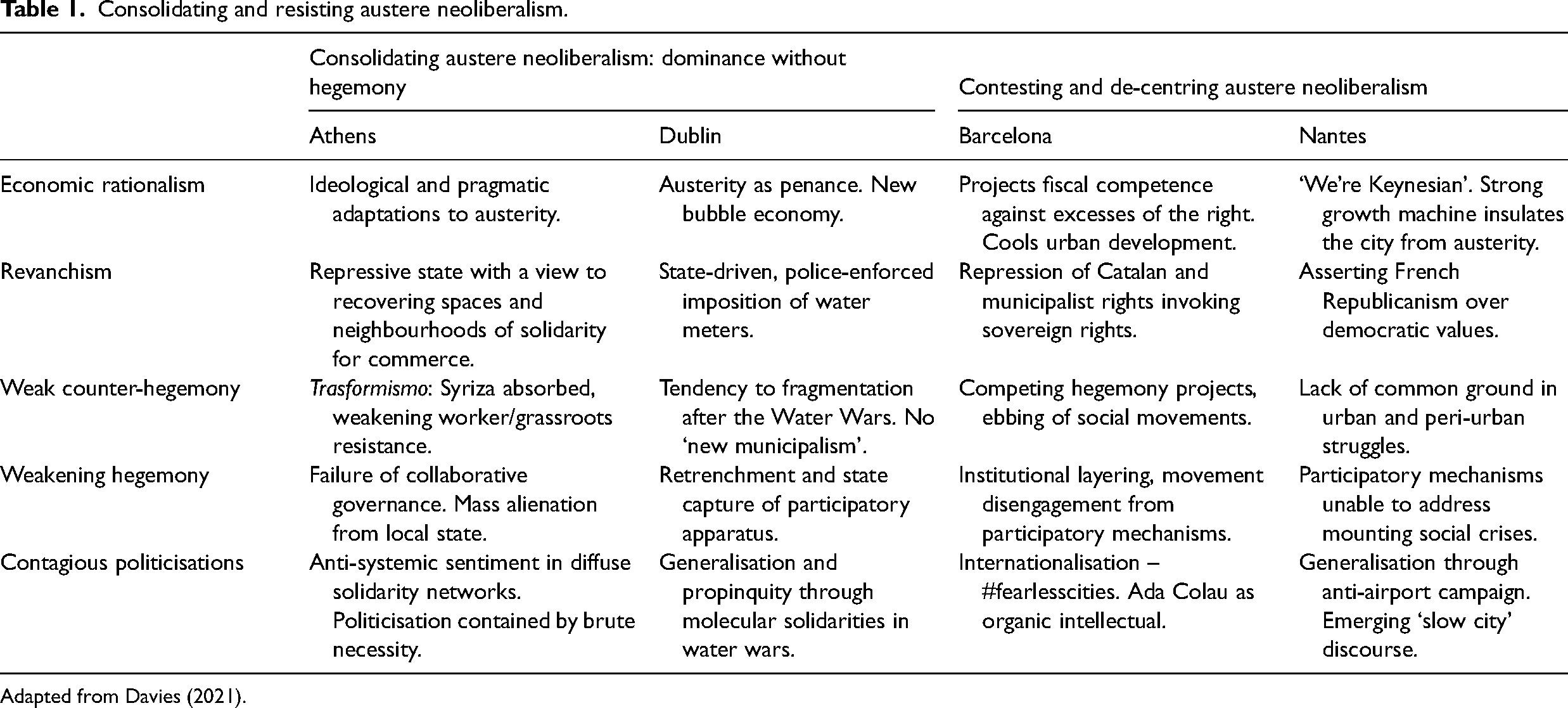
Comparative analysis derives from secondary data: a collection of case-focused papers published in issue 42(1) of the Journal of Urban Affairs and repository of 26 unpublished working papers, in English, reporting case-by-case findings. The Principal Investigator (PI) coded these resources into a meta-analytical NVIVO project, eliciting factors that contributed to stabilising or de-stabilising austere neoliberalism in the period following the GEC and bringing these insights into dialogue with Gramscian concepts. It is from this analysis that the five characteristics of urban governance stabilising, adapting and undermining austere neoliberalism derive (Table 1).
Consolidating and resisting austere neoliberalism.
Adapted from Davies (2021).
Contextualising urban austerity governance
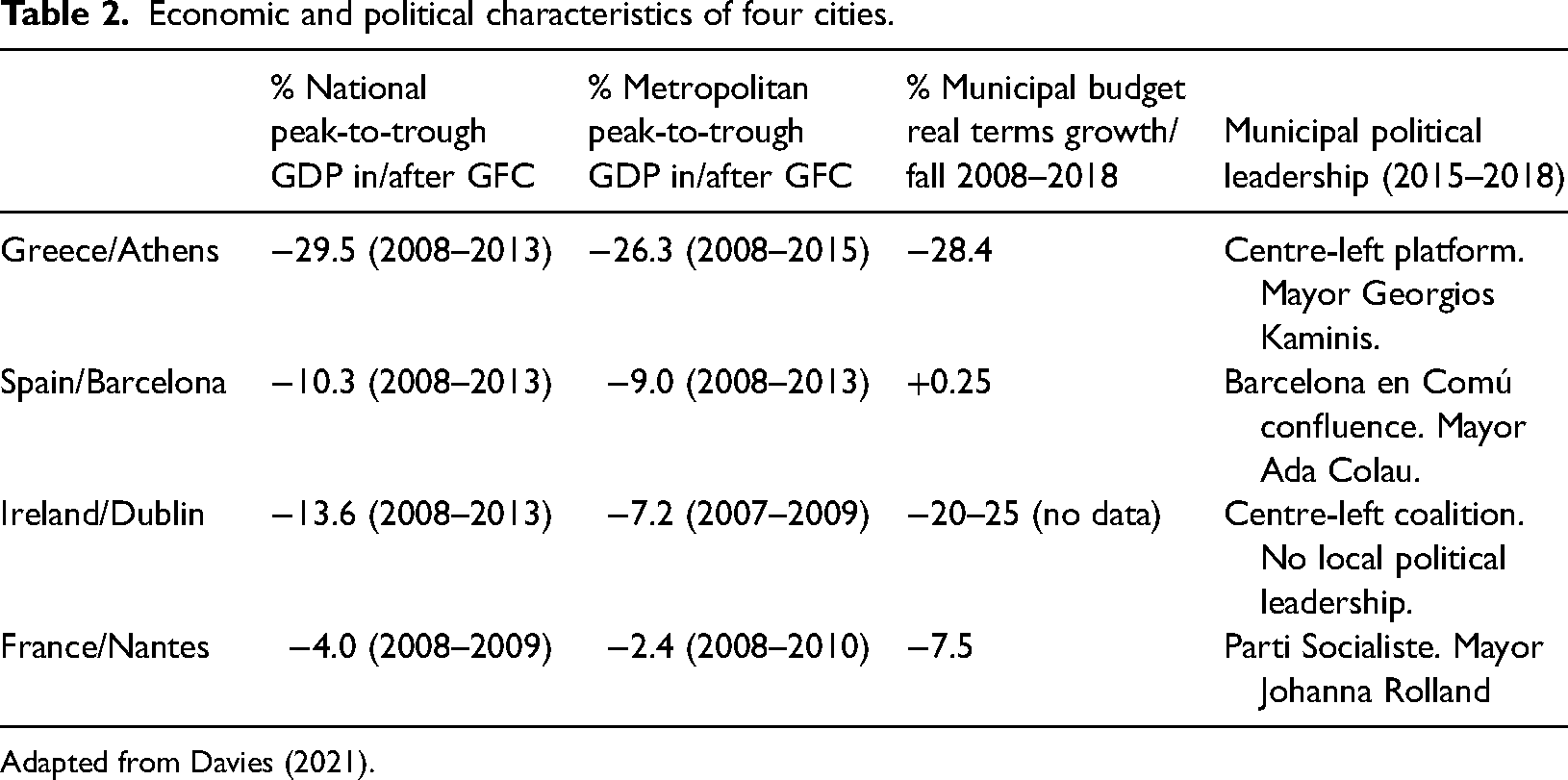
Urban data on austerity is sparse and imprecise. This is partly due to the complexity and subtlety of a phenomenon characterised by a vast repertoire of measures, partly the limits of aggregate data collected by international organisations, and partly the impact of austerity itself on the political will and capacity of local state actors to collect and report data (Gaynor, 2020: 79). Table 2 provides a rough indication of the impact of the GEC, and the squeeze on municipal budgets in the post-2008 period. Austerity in Greece, Ireland and Spain was framed by Eurozone discipline, each country signing memoranda with the ‘Troika’ (European Commission, European Central Bank and International Monetary Fund) promising austerity including public service retrenchment and restructuring of municipal finance and debt in return for bank bailouts. Ireland and Spain exited these restrictions quickly, while Greece endured three memoranda and myriad national austerity initiatives between 2010 and 2017 (Chorianopoulos and Tselepi, 2020). The urban contours of austerity differed markedly in this context. All four cities faced fiscal challenges, although austerity varied in kind, severity and construal. All were governed by putatively left-of-centre coalitions, with a spectrum of responses to, resistance and accommodations with austere neoliberalism. Nantes was not burdened with a bailout, and conditions there were very different.
Economic and political characteristics of four cities.
Adapted from Davies (2021).
Athens, capital of Greece, has a metropolitan population of over 3 million. Its post-GEC economic collapse was unprecedented in modern Europe. Paralleling the national trend, Athens saw a decline of 26.3% in metropolitan Gross Domestic Product (GDP). The municipal budget was cut by 28.4% between 2008 and 2018, including a 60% cut in central government funding (Chorianopoulos and Tselepi, 2019: 87). The city was led by Mayor Giorgos Kaminis (2010–2019), backed as an independent by the pro-austerity social-democratic party, PASOK, which collapsed at the May 2012 national elections. His administration was closely aligned with austerity and the pursuit of partnerships with big business and global non-profits including Bloomberg and Rockefeller (Chorianopoulos and Tselepi, 2020).
Ireland's recession was also unique in post-war history, following the ‘Celtic-Tiger’ growth spurt. The metropolitan economy of Dublin shrank by 7.2%, albeit a shallower recession than nationally. Lacking hard data, respondents estimated that real-terms cuts to municipal budgets amounted to over 20%, with the burden falling heavily on social services (Gaynor, 2020). From 2014, the city was governed by a coalition, with Sinn Fein the largest party for the first time and anti-austerity parties winning 10% of the vote. Ostensibly opposed to austerity, this coalition had marginal impact because local government is very weak, and decision-making mostly controlled by executive management and national ministries.
Barcelona is the capital of Catalunya and Spain's second largest city. The recession in Barcelona amounted to a 9.0% GDP decline peak-to-trough, slightly shallower than the national decline. By 2015, metropolitan output had not recovered to 2008 levels. Barcelona is known for the immense housing crisis and wave of dispossessions that catalysed the mobilisations of 15 May 2011 (15-M). In 2015, it elected an anti-austerity mayor, anti-evictions activist Ada Colau, through the Barcelona en Comú confluence. Holding only 11 of 41 seats, it cooperated with the austerity complicit Partit dels Socialistes de Catalunya (PSC), for which support had collapsed in 2011 (Blanco et al., 2020).
Nantes sits near the Western coast of France and the Loire Valley. It is smaller than the other three but has considerable symbolic capital on the European stage as an award winning ‘green’ growth machine. The French recession was relatively shallow. In Nantes, GDP declined by only 2.4% followed by anaemic recovery. Breaking manifesto commitments, President Hollande's pacte de responsabilité et solidarité in 2014 marked a national return to austerity. Nantes’ municipal budget fell by 7.5% by 2018, mild in juxtaposition with comparators. However, as the study concluded, cuts ‘of an amplitude and speed not experienced before’ were landing (Griggs et al., 2020: 97). The city was led by Socialist Party Mayor, Johanna Rolland (2014–). Whereas the main social-democratic party had declined across much of France, as in Greece and Spain, in Nantes it retained its electoral appeal with Rolland securing comfortable re-election in 2020 and a large majority on the city council.
The following discussion explores how the governance of Athens and Dublin remained closely aligned with austere neoliberalism, despite high levels of resistance, while Barcelona and Nantes produced variations and departures. The analysis revealed five intersecting and variegated characteristics of urban governance and resistance in the four cities, which contribute to understanding how austere neoliberalism persists, is adapted and transformed.
Valences of economic rationalism
What Henderson et al. (2020) call ‘economic rationalism’ intersected the governance of all four cities but with multiple tonalities. Economic rationalism typically provides the warrant for subordinating political considerations to the imperative to balance budgets, particularly to squeeze public spending and refit local states for inter-urban competition in the context of flat or declining revenues. Davies et al. (2020) argue that centre-left municipalities employed economic rationalism, in this sense, to plead political impotence and justify compliance with the austerity mandates of upper tier authorities. However, the research suggested that the valances and political impacts of economic rationalism differed in the four cities.
Two prominent tonalities of economic rationalism were coded: the notion that scarcity warranted restraint, retrenchment and thrift, and the quest for attractiveness to investors. These are familiar themes, but their significance lies in their intersections. In Athens and Dublin, scarcity and attractiveness converged, reinforcing austere neoliberalism. They differed with respect to austerity itself, spanning enthusiasm, guilt, pragmatic adaptation and regret, but with similar efficacy. Mayor Kaminis boasted: ‘in the first year of our administration [2011], we didn’t borrow a single euro. Instead, we reduced our debt to creditors from 47 million euros to 26’ (Chorianopoulos, 2016: 24). Making a virtue of perceived necessity, attaining self-reliance became a central goal of Kaminis's mayoralty (Chorianopoulos and Tselepi, 2020: 45). This logic was further locked into the governance of Greece, and Athens, following SYRIZA's absorption into the international austerity regime in 2015 (Kouvelakis, 2019).
Dublin's justificatory basis for austerity was interwoven with the continuing influence of Catholicism and the inculcation of guilt for supposed excesses. Then Taoiseach Brian Lenihan asserted (2010): ‘Our problems are not just banking problems; we developed a serious problem as a state. We began to spend far more on ourselves than we could afford … Let's be clear about this … we all partied’. This twist on scarcity born of supposed excess, and retrenchment as atonement, constructed a moral justification for austerity that saturated elite and mainstream media discourses (Gaynor, 2020: 79).
Barcelona and Nantes deviated from this pattern, with scarcity and attractiveness coming into conflict and producing distinct political outcomes. Respondents in Nantes avoided the language of austerity, preferring euphemisms like ‘budgetary constraint’. Moreover, they saw themselves approaching municipal finances in a very different way. As one official put it (cited in Griggs and Howarth, 2016: 4): ‘our predecessors have anticipated and carefully managed the finances of the city … Straightaway, that leaves us a little margin of manoeuvre to take on more debt and continue to invest …. It is finally a reasoning which is a little Keynesian’.
The city was able to employ counter-cyclical measures to absorb greater debt over a longer period, mitigating budget cuts and tax reforms; an option closed to cities subjected to fiscal restructuring mandated by the Troika. Alongside claims of budgetary rigour and flexibility, its leaders expressed confidence in green growth to under-write the counter-cyclical approach. The economic rationalities of fiscal competence and green growth pushed back against that of scarcity, such that ‘austerity’ did not grip in elite discourse.
Barcelona en Comú employed the reverse strategy, mobilising scarcity and thrift as progressive values against the dominant growth model. It sought to cool tourism and real estate booms and distanced itself from attractiveness. It mobilised scarcity by making a virtue of thrift. According to a council official, Barcelona ‘worked hard to have a slimline budget’. Ada Colau argued against the revanchism of the Spanish state following bailout conditionalities that ‘municipalities are the administrations that have reduced debt and generated more surplus’ (Blanco, 2017: 8). While ostensibly conducting debate on the austere terms of the neoliberal adversary, contrasting municipalist efficiency with conservative corruption echoed the socialist asceticism of Communist Leader Julio Anguita (2008), who described austerity as ‘a revolutionary lever’ against the excesses of the rich. The valorisation of scarcity therefore had ambivalent connotations in and beyond austere neoliberalism. The juxtapositions of scarcity and attractiveness underpinned different hegemony projects: Nantes accentuating competence and sustainable growth, Barcelona a ‘new municipalism’ rooted in inter-related ethics of curbing neoliberal excess, pragmatism and prudence.
Revanchism
Regressive expressions of state rescaling had a profound impact on the urban governance of austerity, accentuating the drift from hegemonic to authoritarian politics. This took the form of myriad coercive and legal restrictions on municipal political autonomy. In neo-Gramscian parlance, an interregnum can persist in the form of a ‘stable disequilibrium’ (Thomas, 2009: 215) where coercion (defined as direct violence, economic compulsion and administrative or managerial domination) (Davies, 2012) contributes to maintaining disequilibria in the form of a turbulent impasse. State control over austerity governance was projected through familiar increments in the forward march of economic compulsion and administrative domination, undermining the practical decision-making autonomy of municipalities and other local state actors and highlighting the constructive interplay between supra-national and national scales in devising and enforcing austerity (Table 1). The discussion here focuses on the role of coercion in quelling urban rebellion and reorganising state power, with the objective of subsuming urban politics to national sovereignty: ‘de-scaling’, or scalar compression.
In Athens, police violence against street protests and occupations created visceral struggles over the right to urban spaces. Its positioning in southern Europe made Greece a gateway for refugees fleeing conflict and persecution, notably from Syria. Thousands of homeless refugees camped out in Victoria Square facing aggressive policing, but also attracting solidarity. According to a community activist (Chorianopoulos, 2017): The triggering event that mobilized us to occupy this space was the throwing out of the refugees from Victoria Square by the municipality. For us, this was a very political issue […] Our initiative was taken on the premise that you can’t treat a public space like that.
Such episodes occurred repeatedly. Of perhaps greatest symbolic significance was the escalating wave of police raids and evictions in Exarchia, a neighbourhood renowned for anti-systemic politics and providing solidarity and sanctuary to refugees (Cappuccini, 2017). After the election of conservatives at city, regional and national scales in 2019, raids escalated in frequency and intensity. Like Victoria Square, the offensive sought to project sovereign power and control into urban space. The construction of a new metro station in Exarchia reinforced the sense that the state was using revitalisation, backed by exemplary violence, to erase the association between public squares and solidarity struggles (Has, 2022).
In Dublin, police violence against anti-austerity protestors was accompanied by micro-level interventions to establish the writ of Troika-mandated water charges, the trigger for a wider rebellion, the ‘water wars’. Water charging, written into the Irish bailout agreement, required the installation of meters in homes across the country, triggering a mass non-payment movement, discussed below. The company installing them required police support to enforce access, effectively enrolling metering engineers into the ranks of the repressive apparatus (O’Dwyer, 2016). According to a community activist: ‘we were unpatriotic. That was a big spin… Politically, we live with a very authoritarian state … the window for dissent is very small’ (Gaynor, 2017).
The uneven effects of economic crisis in Spain, the rollout of austerity and the rise of the anti-austerity movement coincided with rising pro-independence sentiments in Catalunya, leading to the referendum of October 2017. This was deemed illegal by the Spanish state, which deployed thousands of police attempting to suppress it. Spain invoked its constitutional inviolability to justify the offensive, subsequent suspension of regional governance and arraignment of Catalan leaders, reinforcing the message that Catalunya existed at all only at its behest (Bernat and Whyte, 2020).
A less dramatic, but nonetheless impactful assertion of sovereignty occurred when Barcelona City Council decided to consult citizens annually on key policies. Water re-municipalization was put to the vote in 2018. In response the water company took the decision to court. The court ruled in its favour on the grounds that the council could not hold referenda without approval from the Spanish state. In effect, argued Blanco et al. (2022), the verdict annulled the entire consultation policy and with it a crucial sphere of municipal autonomy.
Each of these instances highlights the dependence of austerity governance on the central state projecting sovereignty into urban space through coercion: on its own behalf, that of supra-national creditors and regulators, and in re-claiming space for accumulation at city, neighbourhood and household scales. The tonalities of repression encompassed: reinforcing the persona ficta of the national state against that of the city (Barcelona and Dublin), the right to control and determine the use-exchange values of urban space (Athens and Barcelona), and to discipline households into accepting charges for basic goods in the name of ‘patriotism’ (Dublin). These actions sought to erase sub-national autonomies by subsuming the quarrelsome ‘urban’ to ‘state’ or ‘sovereign’ authority, with international creditors providing a regulatory backstop, moving in and out of the ‘shadow of hierarchy’ as required to reinforce national austerity regimes (Scharpf, 1994).
From a Gramscian perspective, revanchism highlights the shifting balance in urban governance from consensual or rollout approaches towards domination, characteristic of fading hegemonies. State and supra-state coercion made cities ‘governable’ to the extent that it positioned them in closer alignment with the priorities of upper tier authorities, emasculating fiscal and revenue autonomies and reinforcing the sense that the age of austerity was also a period of accelerating dominance without hegemony. Coupled with multi-valent economic rationalism, the projection and amplification of claims on national state sovereignty reconfigured and reinforced austere neoliberalism and attested to the importance of controlling the urban arena. Nantes also witnessed violent struggles between statal forces and insurgent civil society over (peri-)urban space, but with different outcomes discussed below.
Resisting austerity: weak counter-hegemony
Although the concept of hegemony traditionally references the national or international scales, Gramsci highlighted the distinctiveness of the political-economic formations in Italian cities, from the perspective of their revolutionary potential (Kipfer, 2012: 87). Moreover, the contemporary salience of urban struggles against austerity poses the question of whether proto-hegemonic forms could emerge and proliferate from that scale. Following the understanding of hegemony discussed earlier, the political power of a social bloc is conceived as the capacity to cultivate ‘institutional forms adequate to the differentia specifica of its own particular hegemonic project’ (Thomas, 2009: 227). Relatedly, but at a critical distance from hegemony, it is reflected in the ‘transformative strategies through which a new socio-political spatialization becomes imagined, practiced and universalized’ (Dikeç and Swyngedouw, 2017: 14). From either perspective, the accretion of anti-systemic resources through urban struggles tended to be transient, and fragmentation was commonplace across the productive and reproductive spheres.
Athenian struggles were at the forefront of the European anti-austerity movement, spanning trade unions and grassroots community organisations at the frontline in the battle against poverty, most influenced respectively by communist and anarchist traditions. One respondent argued that the unions had suffered a ‘strategic defeat’ in the prolonged campaign of general strikes. At the same time, anti-austerity activists working through grassroots solidarity networks could not consolidate or amplify their struggles. Said a respondent from the voluntary sector, ‘when the “what can we do” issue comes up, the answer is “small things, small acts”, and the reason is a very pragmatic one. We don’t have the time and the energy for anything more’ (Chorianopoulos, 2017: 10).
Workplace and community struggles ebbed and flowed in parallel, due partly to battle fatigue, partly the brute necessity of focusing on subsistence and partly the chilling effects of SYRIZA's co-option into the austerity apparatus. Kouvelakis (2018: 30–31) defined the ‘capitulation and rapid absorption by the neo-colonial regime’ as an exemplary case of passive-revolutionary trasformismo, and as ‘an index of “dominance without hegemony”’ (Kouvelakis, 2018), leading to electoral defeats nationally in 2019 and 2023, the latter decisive and devastating.
The new municipalist coalition in Barcelona struggled to extend its ‘political and cultural hegemony’ for several reasons. First, it conflicted with both left and right wings of the Catalan independence movement, which sought to portray Barcelona en Comú as an impediment (Blanco et al., 2020: 31–2): According to this narrative, the kind of social, political, and economic transformations that Barcelona en Comú seeks will only be possible when Catalonia’ s independence is achieved. Hence, by raising doubts regarding this process, Barcelona en Comú has become a reactionary political force, whose ambiguity on the national question ends up feeding the status quo.
The 2019 municipal election was won, narrowly, by the left-wing Catalan independence party Esquerra. However, Ada Colau retained the mayoralty supported by previous coalition partners, the anti-independence PSC. Barcelona en Comú stated that it was committed to resolving the independence question democratically. However, viewed from a strategic perspective on hegemony this performatively conservative alliance foreclosed the potential for coalition building with other forces opposed to the Spanish austerity regime.
Second, anti-austerity struggles subsided from the peaks of 15-M. Spanish trade unions held general strikes in 2010 and 2012, but they were seen as subordinate to the social partnership between unions and the PSOE/PSC. Unemployed and precarious workers gravitated to neighbourhood and movement-based campaigns. Despite mass strikes early on, the organised working class had a low profile in anti-austerity struggles throughout the study (Blanco et al., 2020: 25). At the same time, the energy and mobilisation of the movements also ebbed, adding to the difficulty of sustaining an organic relationship between electoral platforms and the grassroots. This became a widespread problem for Spanish municipalism, contributing to electoral setbacks (Bua and Davies, 2022).
Like Barcelona, the social partnership tradition had a chilling effect on organised working-class resistance in Ireland. Unions focused on negotiations with government, conceding recruitment freezes and no-strike agreements in return for guarantees against compulsory redundancies, an instance of what Gaynor (2011: 519) described as ‘cosy relations’. This approach left unions exposed, unable to resist austerity and discredited with (often female) anti-austerity activists new to struggle. This was not articulated as an aspiration, but the feeble character of local government in Ireland meant that the movement could not translate into anything resembling a New Municipalist platform (Gaynor, 2020). Accordingly, no challenge to austerity was mounted from within the state at any scale.
Nantes saw a successful campaign against neoliberal development, blocking the international airport at Notre-Dames-Des-Landes (NDDL). This was located some 23 km to the northwest of metropolitan Nantes. Contentious politics was organised around the airport campaign on the one hand, and deprivation and marginalisation within the city's neighbourhoods on the other, lacking common political and geographical grounds through which they could communicate. The struggle against the airport development was spearheaded by a coalition of middle-class environmentalists, anarchists and small farmers. Urban neighbourhoods reflected class and racial inequalities, and the sense that they had been decoupled from the Nantes growth machine. Griggs, Howarth and Feandeiro concluded (2020: 102) that diverse expressions of resistance had ‘not become a counterpower or counterproject, because they represent fleeting and sporadic forms of mobilization that have not gelled into a viable counterhegemonic discourse’.
Forces undermining the constitution of counter-hegemony, understood in Thomas’s (2009) terms as the elevation of subalterns to power through self-regulating (multi-scalar) apparatuses, thus encompassed scepticism towards hegemony-as-strategy, the attritional and fragmentary character of struggles facing in different directions, respectively towards workplaces and communities, or towards cities and peripheries: differences in the character of goals, miscommunication and vulnerability to co-option. Hill's (1977: 89) depiction of urban struggles mired in factionalism, what he called the ‘bucket of crabs’ comprising organised workers, taxpayer alliances and insurgent community groups, captures part of the experience. Together with economic rationalism and revanchism, weak counter-hegemony constituted a third characteristic of urban political economy sustaining austere neoliberalism. The paper now discusses the characteristics that undermined it.
The weakening hegemony of neoliberalism
Counterpoints to these three intersecting characteristics were firstly the eroding hegemonic grip of neoliberalism itself, and second, the combustible and generative character of political mobilisations. Weakening hegemony had multiple locally differentiated features including the erosion of participatory governance and related socio-spatial distancing processes as well as retrenchment in the voluntary and community sectors. Where the erosion of union-based social partnerships resulted from the austere neoliberal offensive, the decline of social partnerships between state and communities reflected the waning co-optive power of neoliberalism in its ‘rollout’ phase.
From the 1980s to the 2000s, cities across Europe sought to construct partnerships between public, private, voluntary and community sectors. These ‘partnerships’ were invested with ideological significance, particularly by centre-left politicians, and resourced by higher tiers of government and international organisations. Some cities also developed their own partnership traditions over decades. El Modelo Barcelona (Barcelona Model) and Jeu à la Nantaise (Nantes Game) exemplified collaborative traditions emerging from post-war urban politics, influenced by social democratic ideas. In contrast, the ideological value attached to partnerships in the 1990s and 2000s formed part of what (Davies, 2011: 114) called the ‘visionary regulative ideal’ of rollout neoliberalism; based not on social solidarity but the contributory principle that all sectors of society should bring resources to the table in a shared endeavour. A key goal of the research was to consider how durable collaborative institutions would be in the face of austerity and resistance (Davies et al, 2022).
In Dublin, collaborative mechanisms created after EU accession were rationalised and re-absorbed into the state. A local politician explained the Irish government's approach to partnerships, arguing that it explicitly sought to ‘“clip our wings” … And they did’ (Gaynor, 2016: 16). This experience further reinforced the sense that Ireland was an aggressively revanchist austerity state, in retreat from the ‘inclusive’ hegemony project of the Celtic Tiger years.
The Barcelona Model sought to align developmental and participatory goals after Spain emerged from dictatorship, with a dense network of collaborative mechanisms built from the 1980s and rooted in traditions of neighbourhood organising that survived the Franco regime underground. However, Barcelona en Comú (2015) criticised the degeneration of the Barcelona Model, which ‘beyond its democratic beginnings, has ended transforming Barcelona into the Mediterranean paradise for neoliberal urban policies’ (cited in Blanco et al., 2020: 27). The city's collaborative institutions were marginalised by pro-business Mayor Trias (2011–15): not through the outright retrenchment seen in Dublin, but institutional layering, which weakened links between participatory apparatuses and political-economic decisions. At the same time, participatory institutions lost credibility with anti-austerity activists, meaning that they were eroded from both top-down and bottom-up (Davies and Blanco, 2017).
Nantes ostensibly bucked the trend towards retrenchment by enhancing participatory infrastructures after the GEC, conceived as a response to multiple social crises construed as a mounting crisis of the French Republic. However, instead of resolving these contradictions, the expanding collaborative infrastructure tended to reproduce them. Where conflict prevailed, state actors asserted their role as educators and arbiters of the general will, invoking the Republican and sovereigntist theory of the state. Griggs et al. (2020: 91) concluded that collaboration functioned ‘as a doctrinal abridgement, leading to a growing managerialization in an increasingly codified system of community participation’ at a growing distance from ‘practical know-how’ (2020: 105).
Athens, with weaker collaborative traditions, also sought to develop a participatory apparatus after the GEC. It established city and regional deliberation committees as invited spaces for approved civil society groups, part of a national programme. However, the institutions struggled for credibility, and were widely rejected by activists (Davies and Chorianopoulos, 2018: 363): ‘there's this growing realization that we’re on our own, under no protective umbrella of any formal authority or institution. Not only that, but that we’re actually against them’.
These examples highlight four ways in which the co-optive rollout apparatuses of neoliberalism were eroding: revanchism (Dublin and Nantes), marginalisation (Barcelona), activist disengagement (Athens and Barcelona) and managerialisation (Nantes). From the perspective of weak hegemony, the rollback or abridgment of state-civil society partnerships signalled a retreat from hegemonic ambitions. It placed demands on other stabilising mechanisms, such as economic rationalism and revanchism. Crucially, weakening hegemony also created space for insurgency.
Resisting austerity: political combustibility and generativity
Using Raymond Williams’ vocabulary of ‘militant particularism’, Harvey (2001: 173–174) problematised the relationship between place-based struggles on the one hand, and the possibility of universalisation through bridging concepts fomenting common understandings of means and ends, on the other. How can universalisation be achieved through abstractions, connecting disparate struggles and translating intensity to extensity, without losing the affective quality of place-specific events? This question resonates with the problematic of counter-hegemonies emerging from the urban scale.
The anti-austerity struggles studied in Athens, Barcelona, Dublin and Nantes suggested that militant particularisms could indeed be translated through political abstraction, propinquity and geographical extensity: extrapolation from local struggles to wider systemic critique, and outwards to the inter-urban scale. These connectivities were found particularly in Barcelona, Dublin and Nantes. The proliferation of grassroots solidarity networks was a notable feature of Athenian politics, straddling assistance and resistance. However, as was explained earlier, the scale of the human emergency was an inhibiting factor to political links between networks and a more organised revolt. While always a source of inspiration and respect, grassroots solidarity networks in Athens were more about survival than (re)politicisation.
Pre-austerity Ireland was considered to have been politically quiescent. However, anti-austerity struggles transformed the Irish polity. The proximate cause was the introduction of residential water charging through the Irish bailout agreement. Water charging triggered a mass movement in 2014 (Hearne et al., 2020). The ‘Water Wars’ brough a new stratum of society into political activity, especially women, their politicisations anchored in household and community resistance to austerity.
The struggle amplified wider and deeper grievances. The most significant vector of generalisation in Dublin was the reconstruction, through struggle, of an open and inclusive sense of community. According to one anti-austerity activist, ‘The extraordinary thing about the water charges movement I think is the very organic … level at which people got involved in it. And I think that fed their own sense of confidence about it. … I mean at the act of being able to sit on or stand over their water meter … saying “no, you’re not going to put that meter in here”’ (Gaynor, 2017: 11). Developing the point, a second anti-austerity activist added ‘And then what started to happen was people started to kind of just talk to each other? People got to know each other. People that would’ve only nodded to each other … who are now actually sharing stories …’. Moreover, ‘the amazing thing is after a few weeks of doing this, businesses started to drop up food to us…. The local chippers got involved, they started dropping up pizzas to us. The Chinese dropped up with chicken curries and …and you know, local supermarkets would bring us scones’ (Gaynor, 2020: 86–7).
The water charges were withdrawn in 2016, a major victory, and the movement wound down. However, the solidaristic ethos cultivated in the struggle persisted, a durably militant particularism, with the lessons of community organising channelled into new campaigns to address the housing crisis that re-ignited as the city's property bubble began to reflate (Hearne, 2020).
Anti-austerity struggles similarly gave neighbourhood associations in Barcelona a new lease of life. One contrast between the two cities was the scaling of their politicisations. Recognising its responsibilities as a beacon to anti-austerity movements, Barcelona en Comú established an International Committee (see @BComuGlobal) and convened the global municipalist congress #FearlessCities in June 2017, repeated in 2021. The speeches of Mayor Colau sought to articulate and amplify principled internationalism. She declared, for example: ‘We are ashamed that thousands of people die at the borders of Europe. It's not appropriate for cities and states that want to be the First World and examples of democracy and human rights. If Europe wants to remain an international benchmark for human rights and democracy, it must radically change its policy’ (cited in Davies, 2021: 138–139). A huge pro-refugee demonstration followed in February 2017. While other political forces were pivotal in organising this mobilisation, Colau's leadership highlights the constructive interplay between organic intellectual and movement. Blanco (2017: 12) argued that such interventions generated a ‘very inclusive’ sense of ‘us’ and formed a strong barrier to nativism.
Nantes was governed by a longstanding urban regime committed to a growth model that included support for the new airport at NDDL. The long-term struggle triumphed when the project was cancelled by President Macron in 2018. Further echoing Dublin, proximate grievances became ‘nodal issues’ that translated into wider anti-systemic claims among the heterodox alliance of anti-airport protestors. Victory did not end the struggle, however, and NDDL became a site of pitched battles between riot police and activists seeking to preserve the space for alternative modes of living, the so-called zone à défendre. The continuing movement was positioned as negating the ‘green’ boosterism of Nantes Metropole. Griggs and Howarth (2020) explained how the struggle generated an alternative ‘slow city’ discourse. They found evidence that this was beginning to influence the urban interior, presenting the possibility of an emerging counter-hegemonic discourse across an extended urban arena translating the airport experience into a language potentially capable of capturing common demands from periphery to centre and shifting the relational politics of the city-region against the old boosterish model.
In different ways, each of these struggles addresses the problem of ‘militant particularism’. The water wars in Dublin accentuated a politicised propinquity, where neighbourhood subsistence struggles fomented an inclusive sense of community solidarity, drew support from many spheres of society, and in which anti-systemic generalisations were made. Anti-austerity struggles in Barcelona linked to internationalisation, and rooted in place, highlighted a generative juxtaposition of implicit organic intellectualism with a place-inspired vision of planetary scope. The global weight of #FearlessCities should not be exaggerated but it demonstrates one vector through which ‘militant particularisms’ could be globalised through international solidarity networks. Nantes demonstrated a third vector for moving beyond militant particularism, through the incipient percolation of a putatively counter-hegemonic discourse from periphery to centre, potentially challenging Hill's ‘bucket of crabs’. Where revanchism sought to erase urban political rights, these practices sought, at least implicitly, to defend, redefine and amplify them. Where pro-austerity forces sought to suppress urban political power, anti-austerity forces sought to valorise it at multiple scales, from the household and street to the city and transnational urban networks.
Conclusion
Five conclusions follow for conjunctural urban research. First, while Anderson (2000) might have been correct to argue that neoliberalism was the most successful ideology in world history, the study of urban austerity governance suggests that its interlude as a powerful hegemony project was brief compared with its durability under weakening hegemony. The widespread hollowing, rollback and politicisation of co-optive mechanisms, curtailment of municipal powers, marginalisation and alienation of grassroots civil society organisations, and dominance through state rescaling were all indicators of weakening hegemony.
Second, although weakening hegemony undermined neoliberal globalism and the power of austerity as a governing ideology, it has not yet been the augur of transformation. Economic rationalism, influential well beyond the ranks of elites, was a potent de-politicising factor. In instrumental terms, these practices reinforced the sovereignty of national austerity states in their cities. At the same time, forces disorganising and impeding the development of alternatives retained their potency, even in more auspicious counter-political scenarios like Barcelona. They included political scepticism towards counter-hegemonic (properly hegemonic) organisation, the inability to shift the balance decisively between contending forces (Athens and Barcelona), and the fragmentation among forces battling austerity (Athens, Dublin and Nantes), including ‘subcultural discourses’ that made it difficult for subaltern groups to grasp common concerns and construct solidarities (Carroll, 2006: 13). Coupled with revanchism and economic rationalism, weak counter-hegemony created space for pro-austerity forces to sustain and adapt neoliberalism.
These intersecting characteristics reinforce the insight from the concept of passive revolution, that capitalist governing arrangements can be reproduced in the face of waning hegemonic leadership. As Peck (2017a: 25) concluded of ‘late entrepreneurialism’, it would be premature to suggest that austere neoliberalism is necessarily on the fast-track to obsolescence, even if its ideology of ‘globalisation’ is in disrepute and the ‘free market’ a mirage. In the absence of concerted political challenge, the history of passive revolutionary ‘empty time within empty time’ (Thomas, 2009: 154) points to the resilience of ‘stable disequilibria’ (Stahl, 2019). Historical development is characterised by advances and disruptions, crises and hegemonies, but also by impasse and stagnation.
Third, however, ‘dominance without hegemony’ is itself riven with contradictions. Though it contributed to anchoring austere neoliberalism, it also left swathes of civil society ‘ungoverned’, in the sense of being situated in a hegemonic vacuum. It is into this vacuum that both reactionary and radically contagious politicisations have erupted. The vitality, intensity, extensity and frequency of social explosions continue to prefigure the possible shift from impasse into sharpening conflict, with positive feedback-loops, in which militant particularisms scale outwards across extended urban areas, between cities and upwards.
Fourth, the research casts light on how urban governance functions as the terrain and stakes of continuing struggles to enforce, adapt and oppose austere neoliberalism. Austerity struggles were in a real sense about defining and controlling urban space and the framing of place (Pierce et al., 2011). Whereas the revanchism of central austerity states sought to de-legitimise the city and neighbourhoods as spheres of democratic politics and community, resistance sought to reassert and revalorise them. From the interstices of the fight against water metering in Dublin and the reframing of the city-region in Nantes, to the urban internationalism proclaimed by Barcelona, the politics of austere neoliberalism and its insurgents struck directly at the city itself (Beveridge and Koch, 2022: 116).
This struggle to govern the political economics of austerity, finally, shows the utility of the term ‘interregnum’ in stimulating enquiry into the balance of political-economic forces across state and civil society. Austere neoliberalism was cemented into the local state apparatuses of Athens and Dublin, albeit at the cost of considerable turbulence and alienation in civil society, while the political economics of Barcelona and Nantes were situated in ambivalent and conflictual relationships with it. Contagious political eruptions reached for universalising connections and provided poles of attraction for other groups. They tended to be transient from the standpoint of building hegemony in, or from, the urban scale meaning that 25 years after the Battle in Seattle, the question of what self-regulating apparatuses might be ‘adequate’ to resolving urban and planetary crises remains to be answered. Nevertheless, the study of urban politics reveals myriad clues and possibilities.
Footnotes
Acknowledgements
The research was generously funded by the UK Economic and Social Research Council under the title Collaborative Governance under Austerity: An Eight-case Comparative Study (ES/L012898/1). Immense gratitude is owed to the team of investigators, who researched the case studies and wrote the articles and working papers upon which the comparative analysis in this paper is based. They are Dr Ismael Blanco, Autonomous University of Barcelona, Dr Ioannis Chorianopoulos, University of the Aegean, Dr Niamh Gaynor, Dublin City University, Professor Brendan Gleeson, University of Melbourne, Professor Steven Griggs, De Montfort University, Professor David Howarth, University of Essex, Professor Pierre Hamel, University of Montreal, Professor Roger Keil, York University Toronto, Dr Madeleine Pill, University of Sheffield and Professor Helen Sullivan, Australian National University. An earlier phase of research involving two of the cities discussed in this volume, Barcelona and Leicester, was funded by the Spanish Government's Ministry of Economy and Competitiveness under its National Development Plan (Ref: CSO2012-32817) as part of a larger study of austerity governance in Spain and the UK: Transformations of Urban Governance in the Context of the Crisis (TRANSGOB). The research discussed here was inspired by TRANSGOB and the outstanding leadership of its Principal Investigator, Dr Ismael Blanco. Many thanks are also due to Professor Ioannis Chorianopoulos, Dr Tino Petzold and Dr Matthew Thompson who commented insightfully and thoroughly on earlier drafts of the manuscript. I am also very grateful, finally, to anonymous reviewers and editors for their work in bringing the paper up to a publishable standard.
Declaration of conflicting interests
The author(s) declared no potential conflicts of interest with respect to the research, authorship, and/or publication of this article.
Funding
The author(s) disclosed receipt of the following financial support for the research, authorship, and/or publication of this article: This work was supported by the Economic and Social Research Council (grant number ES/L012898/1).
