




Abstract
Local politics in Spain has triggered iconic shifts over the last few years, and the electoral success of new ‘movement parties’ in particular has dramatically challenged the political establishment. Between 2015 and 2019, many municipalities – including, crucially, the two biggest cities, Madrid and Barcelona – were governed by coalitions originating from anti-austerity, anti-eviction and pro-democracy struggles. This has significantly affected hegemonic and widely normalised discourses supporting the neoliberalisation of urban politics, and to some extent has also prompted novel governance approaches. Based on empirical research undertaken with local councillors, officials, consultants and activists, the article develops an in-depth analysis of governance transformations in the Spanish capital of Madrid. By doing so, it evaluates the ambiguities and contradictions that the government coalition Ahora Madrid was facing during the 2015–2019 legislative term. The debate stimulates critical reflections for academics, practitioners and movements on the transformative capacities that new municipalisms may enact, as well as the constraints faced by established multi-level urban governance regimes.
Introduction
The neoliberalisation of the political domain has now been determining for nearly four decades the institutional, operational and ideological premises of urban development in the North Atlantic hemisphere (Brenner and Theodore, 2002; Peck et al., 2013). As a global system of governance (Rustin and Massey, 2015) and a performative discourse (Springer, 2012), it has also significantly shaped the policy responses to the shockwaves of the 2008 economic crisis (Higgins and Larner, 2017; Newman, 2014). Since then, the dominant mechanism to restructure public policies was defined by austerity, which was supposed to be the only possible means of crisis management (Davies and Blanco, 2017; Tonkiss, 2013). Yet at the same time, and similar to previous rounds of neoliberalisation, widespread opposition and resistance to austerity governance were witnessed, with grassroots activism substantially reframing political discourse and action over time (Arampatzi, 2017; Featherstone, 2015; Fuller and West, 2017).
In many European cities, the resulting contestation to austerity, neoliberal governance and the lack of responsiveness of democratic institutions has altered local governments, transforming ‘street politics’ into ‘party politics’ (Ordoñez et al., 2018: 85). This has modelled local political experiments under the umbrella of ‘new municipalisms’ (Russell, 2019; Vollmer, 2017), especially in Spain. For the countrywide local elections in 2015, the claims formulated by activists from anti-austerity movements, anti-eviction struggles and other social movements merged successfully with the electoral strategies of new political parties, especially Podemos, into common ‘municipalist bids’ (García, 2017). The resulting coalitions connected with the general dissatisfaction about crisis management and austerity governance, gaining substantial support from the electorate. As a result, many mid-size municipalities – plus, crucially, the two biggest cities, Madrid and Barcelona – were governed for four years by political actors that epitomise at least symbolically a rupture with previous austerity governance regimes (Blanco et al., 2020; Eizaguirre et al., 2017; Piñeira Mantiñán et al., 2019). This unique situation allows us to explore how and to what extent political change altered local governance regimes and triggered innovative policies. But it also evokes reflections on what lessons can be learned by academics, practitioners and social movements from the Spanish new municipalism in action.
In this vein, the article pursues three major goals. Firstly, we aim to enquire into the limits, constraints and contradictions of the existing multi-level governance arrangements faced in the self-proclaimed Spanish ‘Cities of Change’. We do this by examining Madrid, which was governed during the 2015–2019 legislative term by the Ahora Madrid (‘Madrid Now’) electoral coalition. Secondly, we analyse the scope of governance transformations effectively taking place during this period. This leads us ultimately to critically reflect on how political alternatives ‘in, against and beyond the state’ (Cumbers, 2015: 62) can be fashioned while playing an integral part in institutional power structures. Our approach provides nuanced considerations about how new municipalisms in action navigate more or less successfully in a complex field comprising social, political, legal and economic pressures to further reload urban neoliberalisation on the one hand, and how much new municipalisms are able to transform and challenge the roots of neoliberalism through radical political action on the other hand. This is especially relevant considering the backlash suffered by most municipal coalitions during the 2019 local elections, including the takeover of the Madrid council by a liberal-conservative government backed by the neo-fascist party Vox.
This is the first article to use original qualitative research to analyse the transformations under the Ahora Madrid government. In a collaborative research project, 95 semi-structured interviews with local councillors, officials and consultants in five Spanish cities (22 in Madrid), 55 semi-structured interviews with social movement activists (18 in Madrid) and 11 focus groups with activists and experts (eight in Madrid) were carried out. Furthermore, our findings are also informed by an analysis of print and online media and a critical policy analysis of local budgets, regulations and other policy-relevant documents.
From austerity governance to new municipalisms: Conceptual reflections on post-crisis policy shifts
As an ideology that has become the hegemonic driver of capitalism across the world, neoliberalism has provoked market-orientated economic, political and social restructuring of our lives over the last decades (Alexandri and Janoschka, 2019). Austerity has long been implicitly part of the repertoire to roll back the frontiers of the state and expose citizens to more market competition (Peck, 2012). However, it was explicitly utilised in the aftermath of the 2008 economic crisis to implement the next round of ideologically-based cuts to the state (Fuller and West, 2017; Theodore, 2020). This is why austerity governance should be considered in the wider context of emergency management, including increasing fiscal supervision that suspends or dissolves local democratic arrangements. Correspondingly, the post-2008 adaptions to a financial crisis that subsequently transformed into a social, fiscal and local state crisis have advanced a new regulatory order and moral economy redefining state–city relations and the broader conditions of policy making (Peck, 2017). While coercion was always an integral part of neoliberalisation, marginalising deliberative practices has made urban governance in times of austerity more hierarchical (Bayırbağ et al., 2017). This is especially the case in Southern Europe, where austerity plans requested by EU institutions have reshaped central government agendas and their approaches to sub-national entities (Lippi and Tsekos, 2018).
Following the political thought of the French philosopher Jacques Rancière (2014), austerity governance may be considered as a powerful and widely naturalised order of domination within consensual democracy, capable of displacing the conflictive nature of ‘the political’. Referring to Rancière’s dialectics between ‘politics’ and the ‘police’– with the latter conceived as the institutions and processes that govern the representation of communities, the exercise of power, the way social roles are distributed and the techniques to legitimise this distribution – allows questioning of the visible and invisible relations of austerity discourses, as well as the material and discursive spaces of allegedly aseptic and technical processes of austerity governance. But beyond this, Rancière’s thought also provides conceptual underpinnings of how political change may be conceived through the conflictive nature of protest (Dikeç and Swyngedouw, 2017). The resulting moments of dissent or, following his terminology, ‘political moments’, may actively challenge the status quo, and also shift durable political positions. In this sense, ‘politics’ only emerges through establishing dissent with the existing police order. Such dissent means not only a confrontation of interests and opinions, but also the interruption of the ‘natural order of domination’, whenever a body changes its assigned position in the social hierarchy (Rancière, 2010). Hence, the counter-hegemonic struggles originating as a reaction to austerity urbanism may be evaluated as an attempt, by those excluded from the decision-making processes in neoliberal capitalism, to convert their position into an emerging political voice.
While the collusion between economic and political powers became more apparent during the crisis, anti-austerity movements initially mirrored the crisis in democratic legitimacy of austerity and the lack of responsiveness of politics towards citizens’ demands (Della Porta, 2015). In this regard, the resulting prefigurative politics materialised in the emblematic camps occupying central city squares, as democratic experiments characterised by popular assemblies, horizontal self-organisation and decentralised networks for mutual aid (Hardt and Negri, 2011). Importantly, such plural self-organisation shifted public discourses about the crisis and austerity. But the emerging solidarity practices also established novel processes of subjectivation capable of subverting the existing ‘natural order of domination’ by austerity, producing manifold ruptures to the ‘post-political’ consensus (Arampatzi, 2017; Featherstone and Karaliotas, 2018).
Across cities in Spain, the anti-austerity movement was weaving dense networks of emancipatory political practice between neighbourhood assemblies and autonomous social centres, and feminist, migrant and other grassroots initiatives (Hou and Knierbein, 2017). But it was the escalating housing crisis, with hundreds of thousands of repossessions across the country, that substantially converted insurgent practices, triggering the surge of the Platform for People Affected by Mortgages (PAH) and laying out the foundations for discourses appealing to the right to housing (García Lamarca, 2017). Manifold housing-related struggles, such as direct action to stop evictions, emerged as part of a wider repertoire to politicise housing. Over time, practices like appropriating empty properties owned by financial institutions became an increasingly normalised way to recover the social function of housing (Di Feliciantonio, 2017; Janoschka, 2015). Similarly, policies aiming at squeezing and privatising municipal services were challenged by so-called mareas (‘tides’), i.e. citizen platforms defending public services against austerity.
However, it became increasingly evident that protests were insufficient to halt the austerity applied by the liberal-conservative government, in office since December 2011 with an unprecedented power concentration on the national, regional and local scale. This provoked debates about how a prospective ‘assault’ on the institutions could be attempted (Rubio-Pueyo, 2017). One strategy was the foundation of the progressive party Podemos, challenging the bi-partisan political system in the 2014 European elections. However, at the local level, discussions about how to counteract austerity urbanism were chiefly inspired by more emancipatory discourses relating to practices of commoning, proximity, the social, solidarity, caring economies and the right to the city (Observatorio Metropolitano, 2014; Subirats, 2016). By mid-2014, an increasingly large number of activists related to the Indignados movement, neighbourhood associations, the PAH and other self-organised initiatives, such as activist-research collectives and social centres, supported an incipient electoral turn towards the 2015 local elections.
In this political climate, and similar to processes taking place in many other cities, the platform ‘Municipalia’ emerged for negotiating the strategy to ‘take back the institutions’ and ‘put them at the service of the majority and for the common good’ (Ordoñez et al., 2018: 89). Municipalia was soon re-named Ganemos Madrid (‘Let’s Win Madrid’), and later Ahora Madrid. It gained the support of Podemos and decided to merge with them. As in other cities, this open space horizontally prepared an electoral programme based on reclaiming social rights and services, in sharp contrast to austerity governance. A new urban agenda was proposed, focusing on the right to the city, radically transforming the public sphere in dimensions like urban ecology, popular economies, housing and, more generally speaking, the organisational bases of local welfare (Gomá and Blanco, 2017). The case of Madrid will demonstrate if and to what extent this has been possible in real politics, and also what lessons can be learned for new municipalisms in action.
Institutionalised municipalisms: Challenging the urban governance model in Madrid
A Pyrrhic victory? The legacies of neoliberalisation and austerity urbanism
The 2015 local elections saw a political landslide in Spain, with municipalist coalitions winning cities of different sizes, from Madrid, Barcelona, Zaragoza, A Coruña and Cádiz to Santiago de Compostela, to name only a few. Sustained by 31.85 per cent of the electoral turnout, the Ahora Madrid coalition achieved leadership of the progressive political spectrum in the country’s capital. Drawing on the support of the Socialist Party, this allowed the former judge Manuela Carmena and her team to oust the liberal-conservative Partido Popular after 24 years of uninterrupted government.
During that period, the city council had established a growth regime resulting in strong policy convergence between municipal and regional governments, likewise governed by the same party. Until the economic crisis, this model had focused primarily on a laissez-faire approach to real estate, which was flanked by massive infrastructure development such as a new airport, several ring roads, high-speed train connections and substantial improvement in public transport facilities (López and Rodríguez, 2010). This created opportunities for private investors and local economic elites to realise high capital gains (Janoschka, 2015), while consolidating a political, financial and corporate pro-growth coalition tracing back to the late Franco dictatorship of the 1960s and 1970s (Díaz-Orueta, 2015). In this vein, the provision of public services chiefly aspired to create private business opportunities. Following paradigms of New Public Management and Private Finance Initiatives copied from UK blueprints employed by the Blair administration (CAS Madrid, 2010), nearly all public services (the only significant exception being the local public transport company, EMT) were successively outsourced and privatised. Examples are: street cleaning, park conservation, waste collection, childcare, sports halls, the bike rental scheme, bus shelter maintenance and parking space management (Eneva and Abellán, 2018).
With the outbreak of the economic crisis, the policies came under pressure simultaneously from two sides. On the one hand, the real estate crackdown fractured the common interests of the pro-growth coalition. On the other hand, new and increasingly powerful demands emerged in opposition to the practices of austerity urbanism. In this scenario, debt management also played a crucial role. As a consequence of cost increases between 2003 and 2011 of more than €6 billion for tunnelling the inner ring road M30, municipal debt escalated to €7.43 billion in 2012, with the repayment totalling more than a quarter of annual spending – thus immobilising the city council. Accordingly, austerity meant cutting down services, but also the application of a further round of privatisation and outsourcing, supporting the business interests of private actors after the collapse of the real estate sector. For instance, a major tender transferred public housing units to Fidere, a local branch of the transnational investment corporation Blackstone, thus reducing the social housing stock to less than 0.75 per cent (Janoschka et al., 2020). Public tenders for street cleaning and park conservation aimed chiefly to reduce costs, staff and level of investment, while tenders to provide municipal childcare favoured low-cost proposals over the educative project (Eneva and Abellán, 2018). The latter meant that companies such as Clece (a facility management company) and Eulen (a private security company) were managing half of the city’s childcare institutions.
The austerity governance policies were key ingredients for discontent, overt protest and strike actions – establishing what Rancière terms ‘political moments’, which interrogate and challenge the ‘post-political’ condition of austerity governance by triggering illusions about prospective political change. However, the case of Madrid may illustrate to some extent a Pyrrhic victory for the Ahora Madrid coalition, and demonstrate the inherent power of post-political policy dispositions and governance regimes.
Dreams of change: Novel vocabularies for tackling existing challenges
To provide a better understanding of the novel governance approach pursued by Ahora Madrid, including the political ethos that it appeals to, we will refer first to the electoral manifesto. The document aims at establishing novel vocabularies about the social and economic challenges in the city, while proposing structural change and a profound reorientation of economic governance. Similar to electoral manifestoes in other Cities of Change, Ahora Madrid was inspired by the collaborative models of urban governance. It aspired to apply participatory methods targeting territorial cohesion, environmental transformation, gender equality, the inclusion of minorities and, more generally, the recovery of welfare for all citizens (see Table 1).
Content analysis of the electoral manifesto of the Ahora Madrid coalition.
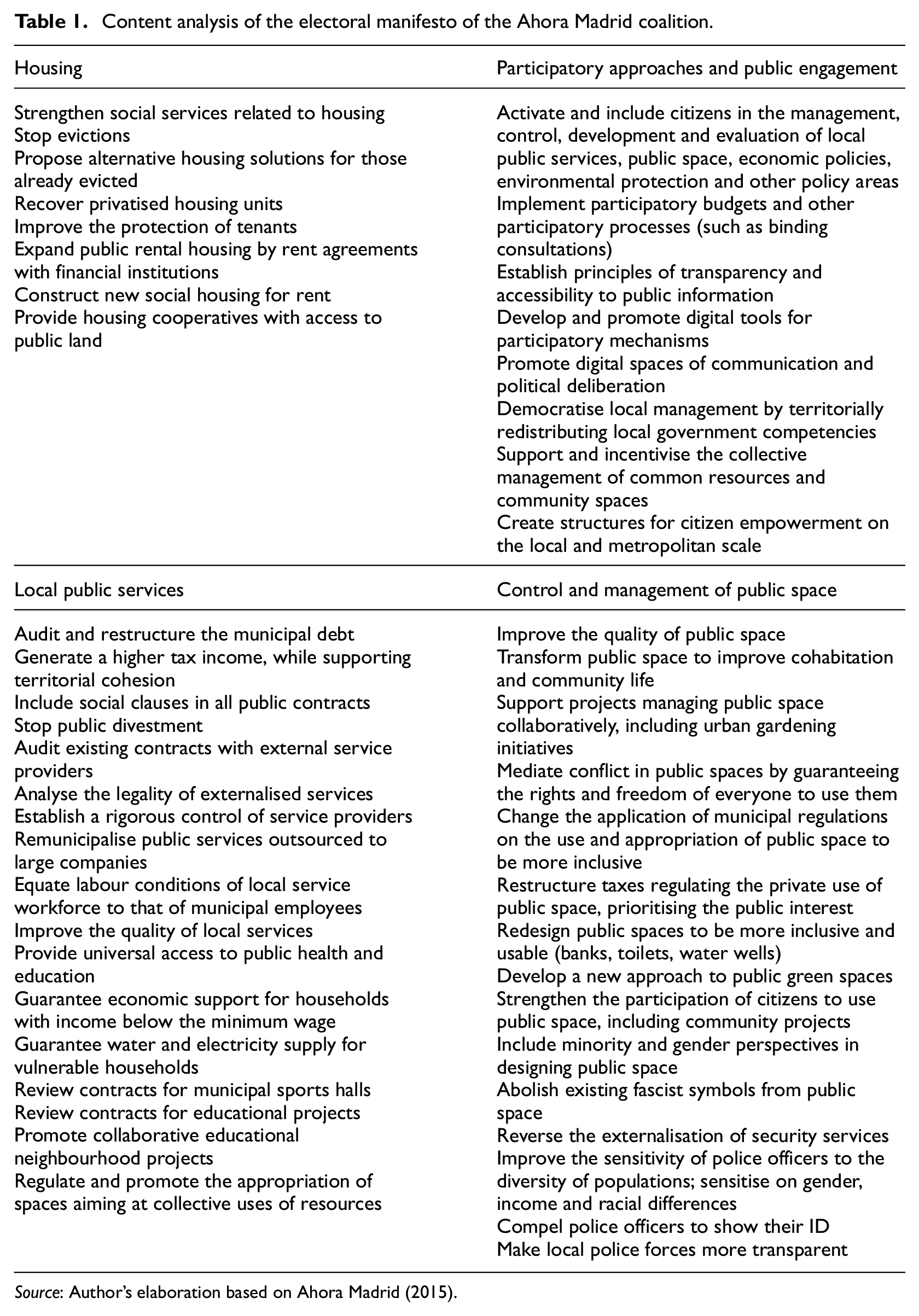
Source: Authors’ elaboration based on Eneva and Abellán (2018) and Ahora Madrid (2015).
However, the manifesto aspires also to transform political discourses more generally. By doing so, it tackles the assumed corruption and nepotism of the previous government, proposing for instance an audit of local debt and the reversing of privatisation. In this regard, analysis of the electoral manifesto demonstrates how deeply it is rooted in a language proposing radical ruptures with previous urban policies. For instance, it condemns the mechanisms of neoliberal accumulation in an attempt to break up the ‘post-political’ condition in fields like housing and public services, and it establishes a different vocabulary for the control and management of public space and the meaning of local democracy. However, the manifesto was only the starting point for the new government, and the government was rapidly faced with structural constraints to their intended political changes, which we address below.
Clashing with reality: Limits and constraints of local political change
The 2015 elections created high expectations in Madrid, especially among social movements, which seemingly became institutionally represented. The new mayor also inaugurated a symbolically different phase, e.g. by using the metro and restricting councillors’ salaries to a maximum of three times the minimum wage. However, it did not take long to grasp the complexity of governing Madrid. Only four days after taking his oath, the councillor for Culture and Sports, a prominent figure in the forming of Ahora Madrid and overtly committed to tackling the commodification of cultural institutions, was forced to resign because of inappropriate tweets he had published in 2011. This demonstrates the hostility the new government was experiencing, and how the conservative media sought to maintain its hegemony in public discourse in an attempt to retain the previously conceived post-democratic city (Swyngedouw, 2019).
Against this example of the new government clashing with the status quo of autocratic entrepreneurial governance, our analysis will demonstrate the structural limits and constraints the government was facing. It quickly became clear that the radical agenda of the electoral manifesto could not serve as common political ground, and was unable to substantially challenge the existing ‘police order’ (Rancière, 2014) and hence to overcome austerity governance. In this regard, we subsequently differentiate three types of limitations that mutually reinforce the small scope of change: economic, politico-institutional and legal-administrative.
At a first sight,
In other words, financial control was effectively centralised and scaled up to the national level, while the costs and risks associated with fiscal adjustment were devolved and scaled down. Consequently, local governments faced tight restrictions from the central state on hiring new employees, expanding the budget for investment in urban infrastructure and implementing social policies that would reverse austerity. This situation provoked frequent clashes between the local and national governments. But even worse, in autumn 2017, the national government escalated the political conflict with the council by exercising for the first time since democracy had been re-established a direct intervention into local accounts. In a scenario where debt repayment was one of the priorities of Ahora Madrid and against an annual budget surplus of €1.12 billion in 2017, this intervention exemplifies austerity rule against political adversaries. As a consequence, the local Treasury Secretary was forced to resign in December 2017 to avoid further legal consequences.
All in all, the rigorous approach to debt management has reduced the municipal debt to one third of its 2012 peak. But this has come at the expense of proscribing the most ambitious plans proposed in the electoral manifesto. However, beyond the financial limitations, there are also considerable
However, further politico-institutional constraints stem from the relatively weak position of a minority government that requires strategic agreements and alignments with other political groups. Furthermore, Ahora Madrid has also had to cope with internal conflicts deriving from the initial configuration of the ‘movement party’. For instance, the citizen platform Ganemos Madrid developed crucial parts of the electoral manifesto, while Podemos appointed an independent, strong and charismatic leader for the candidacy – then-mayor Manuela Carmena. Indeed, and contrasting with Barcelona – where the mayor Ada Colau managed to articulate a political organisation from the local to the national level – Ahora Madrid was only an electoral label, and not a party. Over time, this has triggered a successive marginalisation of the most radical voices, inclining the balance increasingly towards moderate positions. In other words, discourse and action were increasingly losing political momentum and falling back to what Rancière addresses as the ‘post-political’ consensus.
Beyond this, the government was also suffering a series of
We can look to administrative law to understand the legal-administrative restraints Ahora Madrid was facing, in the sense of what Brabazon (2016) termed ‘neoliberal legality’. For instance, municipal bodies in Spain are bound to the strict regulations of the public sector. An example regarding housing policies may clarify what this means practically. Different to local governments in Paris or Berlin that have the right to effect compulsory purchases over private properties to alleviate the housing market, in Madrid there: … is no possibility [for the municipality] to intervene in this sense. It is not even a possibility. In other words, there are certain processes that are not part of the local powers […] and would have to be regulated differently by the national government. Hence, this cannot even be discussed. (Interview M-VIV-03)
This example demonstrates strikingly how many proposals of more or less radical political change have come under severe pressure, mainly from a legal framework underpinning an economic model diametrically opposed to the aims of the government coalition. Additionally, since the role of nationally appointed controllers and auditors was strengthened by recent legislative reforms, new control mechanisms further restricted the political mandate of the government.
There are additional constraints regarding specific policies. For instance, most policies affecting housing and evictions – one of the most important topics of the public sphere – are mainly allocated to regional and national bodies. But at these levels, all political decisions tackling the increasing unaffordability of rents and the increase in evictions have been diametrically opposed to the proposals of Ahora Madrid – a political and ideological conflict impossible to be resolved at the local scale. For instance, while the local government aims to promote social housing and is willing to negotiate with banks and investment funds to reach agreements over the temporary use of empty properties, the central government has been privatising the acquired stock of housing from the massive foreclosure crisis to investors like Blackstone, favouring the conditions for rent appropriation and speculation by providing specific legislative frameworks and tax breaks for Real Estate Investment Trusts (Janoschka et al., 2020). Furthermore, the financial control by the central government also means insufficient resources for significant change in policies to tackle the housing crisis. And after two decades of despoliation, the municipal housing company EMVS lacks the land or the technical expertise to rapidly uptake the construction of new housing units, as promised pre-electorally: The problem is that the Municipality of Madrid only has land for 4000 housing units, no more. As I said earlier, there is no way, at least until there is a normative change that allows preferential or compulsory purchase of land and flats. It does not matter how much money I have available, even if I had a billion euros. The problem is that there is no way to spend a billion euros in public housing. (Interview M-VIV-03)
Similarly, the attempts to re-municipalise local services have also faced severe legal and financial limitations. Particularly, it has proved extremely difficult to terminate existing contracts, especially those with a duration longer than the political mandate of the government. Additionally, the nationally imposed restrictions on the replacement rate for public sector employees have not allowed an expansion of the municipal workforce, rendering the re-municipalisation of larger services de facto impossible. Moreover, as an example of pressures to maintain the status quo of a quasi-natural order of (neoliberal) domination, there are also conflicts with trade unions, who oppose the prospective intake of new workers from re-municipalised services, since this would bypass the officially regulated channels to becoming employed by the municipality.
Concerning participatory approaches and decentralisation of governance, the council is also facing limitations. Following the 1985 Local Government Regulatory Law, and the 2004 Local Organic Regulations Concerning Citizen Participation, the scope of consultations must be limited to the municipal jurisdiction and have no financial effects. Moreover, consultations must be authorised by the central government. However, the former institutional and legal restrictions could be overcome according to the legal tradition that since the 1980s has considered local citizen consultations to be distinctive from local law. In this regard, the Local Councillor for Transparency, Citizen Participation and Open Government expresses that: … the battles are political [rather than legal]. The battle that has been released in Madrid for the last two years is whether to transfer the day-to-day government decisions into the hands of the people. And then, it is up to the experts to indicate what the legal way is. Obviously, the Popular Party will object to this approach and intend to block the process. (Interview M-PC-02)
In summary, the previous analysis demonstrates that the restrictions are stronger in political realms that embody the material and symbolic hegemony of neoliberalisation, for instance with regard to actions challenging the benefits of private companies. In the post-political city, police order apprehends the local state as an actor that primarily organises, administrates and pays local services, instead of providing them directly. This may explain the existing limits to re-municipalising services and to changing the accumulation regime in the housing sector. Contrary to this, restrictions are less severe when it comes to participatory approaches, as we will discuss in the next section.
The scope of the possible: Local political change in Madrid
Local political change began with a series of well-planned and symbolically important aspects. For instance, among the first actions of the government were renaming and consolidating its internal governance structure. Importantly, each councillor was assigned the responsibility of two districts of different social stratification. This was to strengthen their commitment to design politics transversally across the social fractures in the city. Moreover, the role of the districts was upgraded, promoting a noticeable decentralisation in decision-making processes. Soon, some actions like the auditing of externalised municipal services and of the debt incurred by the previous government followed. Some changes were almost immediately noticeable in the city, for example the reconnection of several springs to provide fresh water in parks and squares, the installation of gender-equal and inclusive pedestrian crossings depicting same-sex couples and free-of-charge access to some of the summer concerts organised by the council. However, most transformations took substantially longer and were more complex to achieve. This complexity will guide our subsequent analysis, addressing the scope of the local political change the government could achieve and the adverse economic, politico-institutional and legal-administrative situations it encountered.
For this, we begin by analysing how the municipal budget transformed over time. Firstly, the latest budget provides a little more of a financial margin, as debt interest and repayments have diminished significantly and compromise ‘only’ 10.2 per cent of the annual budget, against 25.9 per cent in 2014. This single condition allows additional annual spending of nearly €600 million for the government. But the municipal income has also grown by more than €400 million, chiefly as a consequence of restructuring property-related taxes by better taking into consideration property values and removing tax exemptions for wealthy households and companies. The resulting room for manoeuvre was used to expand the budget in line with some of the pre-electoral promises in strategic policy realms, for instance social services, housing and urbanism, environmental policies and transport. Moreover, money was also invested in transversal actions such as citizen participation, open government, territorial coordination, socio-public collaboration as well as gender and diversity policies. However, how far-reaching have political transformations been beyond the statistics? This will be addressed by comparing two different policy arenas – housing and participatory policies.
Participatory policies may be considered a chief aspect of government transformation, even if departing from a starting point that was: … non-existent. The only known processes of citizen participation were surveys, and aspects such as suggestion and reclamation boxes. In other words, there was no policy to include the citizenship in the municipal decision-making processes. (Interview M-PC-02)
Participatory policies were devised strategically by two government departments directed by prominent former activists, one related to the free digital culture and the other to the local neighbourhood movement. Both departments were collaborating to decentralise local democracy by transferring competences to the districts, enhancing innovative mechanisms of citizen engagement and ensuring the effective participation of civic associations through novel forms of co-management. To this effect, four main innovations are noteworthy:
The online platform Decide Madrid (‘Madrid Decides’), which was created on an open programme code. The platform has become the IT vehicle for administrations across the country and internationally, and allows all residents to partake in different participatory processes, which include citizen propositions and local consultations, participatory budgeting, online voting and commenting on regulations elaborated by the government – all of which were newly established.
Local forums for participation aiming to promote the direct engagement of citizens in policy-making processes. These forums are open to individuals and collectives, thus fostering dialogue between citizens, civic associations and district councils.
The co-management of public services and common spaces, chiefly responding to demands from social movements to recognise and support activities constructing common spaces, for instance in collectively managed social centres and urban gardening initiatives. A novel regulation acknowledges explicitly the possibility of informal and unregistered groups to participate in the co-management of social and common spaces.
1
As expressed by an officer of the Area for Territorial Coordination and Public–Social Cooperation of the council: … we understand that it is impossible to exclude collectives and sectors that have proposals for different activities for the benefit of everyone, [… and we want to] transform this into a tool for cooperation. Since it is not a public service but a citizen-led initiative, we will treat this from a perspective of public-social cooperation. This is where many possibilities appear for what has been named as ‘the commons’, and we understand it like a realm for collaboration between the public administration and citizen initiatives. This is to say, we do not want to replace public services with non-profit organisations; public–social cooperation must be something different. (Interview M-PC-03)
The innovative design of participatory processes that facilitate specific forms of deliberation (such as the Observatory of the City, a permanent body of participation in which 49 randomly selected inhabitants monitor policies) encourages ideas to improve policies and to propose consultations on specific issues. Similarly, the so-called G-1000 participatory process resulted in an experiment in which 1000 randomly selected participants representing the aggregate population of the city formed 100 different panels to discuss participatory budgets, allocating over €100 million to specific neighbourhood projects.
These examples epitomise the new political ethos and participatory approach of the government, chiefly focusing on novel forms of social cooperation and self-government, implementing against the backlash to existing regulatory frameworks and the political opposition. However, the situation is clearly different with regard to housing policies. While the housing crisis started during previous legislative terms and was subsequently triggered mainly by national policies targeting the ‘clearing up of the toxic real estate assets’ (Alexandri and Janoschka, 2018: 125), it was exacerbated during the 2015–2019 term of Ahora Madrid by an extraordinary tourism boom, the resulting pressure exercised by tourist rentals as well as speculation by private landlords (Janoschka, 2018). Hence, all attempts to significantly intervene into the housing market have widely failed, making the relationship between local authorities and housing movements increasingly conflictual and antagonistic.
[They] have not really understood the role of the municipality. I think they have an idea that the municipality should act like an anti-eviction platform, be on the barricades. Hence, I keep telling them that the municipality is an institution, and that therefore I have to follow specific norms and regulations. […] In other words, the platforms are fundamental, but right now we do not have a very friendly relationship. In reality, I have to convene a serious meeting with them, because there are agreements [with banks] that have been ruined by the platform. (M-VIV-01)
This statement relates to the attempts of the City Council to negotiate social rents with financial entities to enable relocation of families who have been evicted. However, this conflicts with the view of activists involved in neighbourhood assemblies, especially in the poorest urban districts. For them, the failure of housing policies: … has also to do with [government] prejudices, since the banks were willing to hand over flats to the government, but these flats were squatted, and the Municipality of Madrid does not want to accept them, which reinforces the problem. Families who have seen themselves obliged to occupy a flat to get a roof over their heads, and who are those most in need, are unable to access social rented housing. (M2-VIV-04)
As mentioned previously, the local government does not have the capacity to react to the housing crisis either in legislative terms or on the supply side. For instance, despite policy changes applied to the Municipal Housing Corporation EMVS and the initiation of 3500 new public rental housing units, the slow advance of these projects has been widely criticised not as a technical restriction but as a lack of political will: although the government has a majority in the Board of Directors, those who really run the EMVS are from the Socialist Party, including the Director. (Interview M2-VIV-04)
The Socialist Party is considered the incarnation of the ‘natural order of domination’ (Rancière, 2014) that provoked the housing crisis. In this regard, the widespread dissatisfaction is a sign of how several, even well-intended, policy proposals have failed in scope. For instance, the waiting lists for public housing have not ceased to increase, exceeding 24,000 households. Rents have gone up on average by 40 per cent (Janoschka et al., 2019), triggering a crisis with ever more households facing eviction and displacement.
New municipalisms or urban neoliberalism reloaded? Final reflections
Novel political experiments challenging austerity urbanism and, more generally speaking, the dominant neoliberalisation of urban governance have recently triggered stimulating social, political and academic debates, habitually sharing blueprints and ideas for socially and spatially more just cities. There are extensive reflections on how municipal services and housing could be organised alternatively beyond the traditional state versus market dilemma, and we have witnessed a wide range of solidarity initiatives constructing daily practices and routines towards yet-uncertain and contested transitions to post-capitalist urban commons (Chatterton, 2016). The underlying intellectual project to construct common spaces for acting in, against and beyond neoliberalism as articulated through the modern state has been significantly shaping the agenda of new municipalisms emerging in post-crisis scenarios. In this regard, experiences from Madrid as discussed in this article can be considered a practical exercise in stretching the limits of the possible in a world organised by and through economic elites promoting ever more rampant neoliberalisation and pursuing, in Rancière’s terms, an increasing naturalisation of the dominant order.
Our analysis of the scope and extent of local political change in Madrid under the Ahora Madrid government confirms the existence of a wide range of at times contradictory yet contested transitions taking place. For instance, political and societal discourses have shifted during the term of this government, making a return to the privatisation of local service provision currently seem unfeasible. In this regard, the reorganisation of local governance has pursued novel pathways through transversal actions such as citizen participation, open government, territorial coordination, socio-public collaboration as well as gender and diversity policies. This coincides with Russell’s (2019) comparative analysis of new municipalisms and the ‘fearless cities’, especially with regard to the politics of proximity, the transformation of institutions and the feminisation of politics.
However, it also confirms the fragility of the individualised participatory model propelled by Ahora Madrid. The change of government in June 2019 has demonstrated that the channels with organised collectives and associations who would have acted in defense of participatory mechanisms in adverse conditions were not sufficiently strengthened. Moreover, the participation in neighbourhood-oriented decision-making processes does not automatically mean the construction of a new urban model tackling the roots of neoliberal urban governance. On the contrary, it may justify and legitimise political decisions reproducing social and territorial inequality, thus effectively providing the framework for reloading neoliberalism. In this regard, participatory and collaborative governance is shown to be insufficient to trigger by itself an alternative. In the words of a neighbourhood activist: It is not enough; it is not really participation. If you stand for election with the promise of reversing the privatisation of urban services and space, and you do not do it, then, if you later propose a public consultation about building a sports centre here or there, this is secondary. You have disregarded the electoral mandate. How can I rely on participation if, after voting for you, you have ignored my vote? Why do you ask me, if I already told you not to allow the city to become a brand, a commodity? (Interview M-PCS-03)
This quotation relates to crucial understandings of the reasons for institutional change over time as related to path dependencies. It demonstrates that history matters, and past events critically shape the present and future governance of a city like Madrid, as well as the possible options of future evolution. In this regard, the absorption of Madrid’s urban movements of the 1960s and 1970s into the emerging democratic governance of the 1980s is a warning example for today’s new municipalisms in action. Contrasting with discourses appraising the local level as the starting point of deeper political change that could then be scaled up (Russell, 2019), multi-scalar governance and neoliberal legality result in powerful mechanisms frustrating ideas to reverse the privatisation of public services and construct the common ground for a more inclusive and just city. As Sánchez Mato and Garzón Espinosa (2020) express in line with our analysis, the local authority is constrained by a range of structural, institutional, ideological and cultural limitations; while the potential for the fearless to overcome the multiple huge pressures to maintain the status quo lies elsewhere. This is exactly what Rancière understands as the naturalised ‘police’ order of domination, and it appears to have frustrated, at least in Madrid, what could be understood as the ‘empirical window of a possibility of transforming the social relationships that compose the State’ (Russell, 2019: 1008). Such a transformation would have necessarily included a profound reorganisation of the housing market and the elaboration and implementation of a new model of public services adapted to the 21st century and tackling the benefits of private providers. However, both aspects were beyond the capacities or political willingness of the Ahora Madrid administration.
Comparing this to more positive appraisals of the initiated governance changes in the iconic Catalan city of Barcelona (Blanco et al., 2020; Russo and Scarnato, 2018), the example from Madrid shows us that alternative approaches would have strongly benefitted from a different set of horizontal relations, for instance by truly involving the citizenship and social movements in a broad coalition taking up permanently the demands from solidarity movements and housing struggles. The interaction of the Ahora Madrid government with the existing universe of social movements has resulted in fractions, disagreements and obstructions, and this is certainly very different to what has been analysed by Blanco et al. (2020) for Barcelona. However, as Castells (1977: 225) already noticed with regard to the neighbourhood movements of the 1970s, ‘the logic of struggle and the logics of government may create tensions and conflicts. […] But conflict is the natural state of life and societies’.
Nonetheless, the experience from Madrid has crucially compromised the long-term sustainability of initiated changes. Social movements and factions of the collaborative economy would have been foundational to implementing other ways to socially manage housing, public space and services, and for testing novel methods to construct politically and socially viable alternatives. Taking into consideration the strong capacity of neoliberalism to integrate dissident discourses and critique to renovate its hegemony and domination, the return of a liberal-conservative local government in June 2019 threatens the sustainability of most of the measures introduced by Ahora Madrid. Unfortunately, this predicts further shifts towards incremental policies that avoid tackling the underlying principal causes of urban injustice.
Footnotes
Acknowledgements
The authors wish to acknowledge the contribution of the participants of the PROTO_LOCAL research project, and especially Jacobo Abellán and Stoyanka Andreeva Eneva, to the study design and data collection for this article.
Declaration of conflicting interests
The author(s) declared no potential conflicts of interest with respect to the research, authorship, and/or publication of this article.
Funding
The authors disclosed receipt of the following financial support for the research, authorship, and/or publication of this article: This research was supported by the Spanish Ministry of Economy and Competitiveness under the Grant number CSO2015-68314-P.
