




Abstract
This article analyzes the geographies of the German coal exit by looking at the spatial dimensions of coal devaluation. It argues that while the Energiewende has been described as having a national origin, central triggers of the national coal exit agreement have to do with devaluation pressures created by the combination of global relations in the fuel markets, the territorial bordering of electricity and carbon markets at the European Union level, and place-based and multiscalar anticoal networks. The role of place-based resistance to the past, relational, expected, and imaginary concomitant forms of devaluation in lignite regions is also described as a key spatial barrier to the German coal phase-out. It will be shown that the emergence of a coal exit agreement, which represents a national fix to address not only existing market devaluation forces, but also a double legitimacy crisis for the government, was based on spatially uneven relations. The German case is relevant for the geographies of energy transitions for showing how multispatial strategies, the spatial organization of energy markets, and the territorial regulation of energy systems shape the possibilities for the devaluation needed to accelerate the pace of the fossil fuels phase-out.
Introduction
In 2020, Germany enacted the Coal Exit Law, which set 2038 as the final possible date for the extraction of coal and its use in power production. The coal exit represents a new moment of the Energiewende, Germany's energy transition, which prioritized the phase-out of nuclear power and phase-in of renewables but is now increasingly focused on coal. Although energy geographers have analyzed the Energiewende by emphasizing the spatial dimensions of new renewable energies (Becker et al., 2017; Faller, 2016; Gailing, 2019; Gailing et al., 2020; Paul, 2018), the coal phase-out has not been equally examined. This is a major gap for the geographic understanding of the German energy transition given the necessary role of phase-out processes for genuine decarbonization.
This article examines the geographies of the German coal exit from the perspective of moral devaluation, which emphasizes the embeddedness of political-economic forces and forms of regulating the devaluation of fixed capital in fossil fuel industries (Furnaro, 2021, 2022). These geographies are analyzed by looking at the interaction of spatial dimensions as well as conditions and practices associated with the shutdown of fossil fuel infrastructure. It describes how changing combinations of sociospatialities shape and are shaped by the devaluation of coal.
It will be argued that although the German coal exit plan represents a national arrangement, it was not primarily driven at the national scale. Rather, central devaluation pressures that triggered the plan were created by place-based anticoal networks and international energy and carbon market relations. Although the emergence of a national scale “fix” was important to regulate not only existing economic devaluation forces but also a double legitimacy crisis for the government, the spatially uneven character of this fix was also key.
The rest of this article is organized as follows: Spatialities of devaluation section presents the theoretical framework. The third section provides an overview of the methodology employed. The German coal exit: geohistorical overview section describes the history of the German coal phase-out. Geographies of the German coal exit section presents the results and main arguments of this article in three subsections, which describe the sociospatial dimensions of key forms of promoting, resisting, and regulating the final devaluation of German coal. Finally, a discussion around the implications of this case is presented.
Spatialities of devaluation
Decarbonization will increasingly lead to the devaluation of infrastructure and other fixed capital associated with fossil fuel industries, including mines, wells, power stations, refineries, and pipes (Carton, 2019; McCarthy, 2015; Smith, 2017). Drawing on theories of capital devaluation, fixed capital devaluation corresponds to the process through which still-operative fossil fuel infrastructure loses value (Harvey, 1982). According to Smith (2017), common types of devaluation in capitalist economies are “progressive” (i.e., the ceaseless process of devaluation because of market and technological competition) and “periodic” (i.e., devaluation taking place during economic crises). To better account for the social dynamics and moral claims that shape the devaluation of fixed capital in fossil fuel industries, the concept of moral devaluation accentuates the socially embedded character of energy markets as well as the relationality between economic and extra-economic practices to promote, resist, and regulate how fixed capital loses value (Furnaro, 2021). The notion of “moral devaluation” expands the term “moral wear and tear,” used by Marx (1992) to differentiate fixed capital devaluation brought about by social causes, especially economic competition, from devaluation caused by material depletion. The notion of moral devaluation includes other social drivers of devaluation beyond the market and recognizes, as energy geographers have for some time, that technologies, and therefore technical depletion, are always sociotechnical (Bridge, 2018). This notion resonates with Sayer's (2019) view of critical political economy as an endeavor concerning the moral economy, that is, the economy as shaped by norms beyond pure self-interests and economic valuation. From this perspective, devaluation in the German coal industry cannot be fully grasped without considering issues of political legitimacy, memories, and ecological values.
The moral devaluation of fossil fuels involves complex sociospatial processes. According to Harvey (1982: 387), fixed capital devaluation is always place-specific and its location is defined in large part by the anarchic forces of industrial competition. This is also the case with fossil fuels. Techno-economic and political factors help to understand where devaluation materializes first. In terms of vertical spatial organizations, devaluation depends on the scales on which energy markets operate (e.g., global fossil fuel markets, domestic electricity markets) in combination with practices of territorial bordering that define their regulation (cf. Nciri and Miller, 2017). In terms of networks, or the horizontal relationality of spaces, devaluation depends on processes happening somewhere else (e.g., diffusion of technologies or policies) (Brauers et al., 2020; Rentier et al., 2019).
Decarbonization policies, such as carbon taxes and emission caps, are territorially defined devaluation forces. Antifossil fuel campaigns have promoted these policies as well as more direct forms of devaluation by targeting specific infrastructures through legal and reputational tactics organized by local, national, and international networks (Gürtler et al., 2021; Rootes, 2013). Rescaling litigation to international courts and relocating it to different jurisdictions are common spatial tactics of devaluation (Osofsky, 2005). In fossil fuel industries, devaluation that affects specific firms or operations, what Smith (2017) describes as “individual” capital, is a common place-based strategy to create revaluation in the whole industry of a country or region (or “general” capital) in times of oversupply (Huber, 2011). Processes of revaluation have led to “carbon leakages,” a spatial concept that signals how devaluation in certain places lead to the revaluation of fixed fossil fuel capital in less environmentally regulated jurisdictions (Kama, 2014).
Regulating devaluation involves practices of resistance and the governance of devaluation forces, which are all spatial processes. Fossil fuel workers and capitalists have resisted devaluation through multiscalar lobbying (Seto et al., 2016). Resistance is often rescaled to the national level, given not only the national influence of antidevaluation interests but also the roles of the state in reducing the pace of devaluation (Harvey, 1982) and devolving to internal political processes the constraints of world market competition (Hirsch, 1994). In the case of fossil fuels, this is also related to the strategic role of these industries for energy security and government revenues, and of their fixed capital in practices of territorialization (Bouzarovski et al., 2015; Bridge, 2010). Fossil fuel exit plans represent a relatively new form of regulating devaluation in which the total shutdown of infrastructure is organized rather than avoided. Up until now, most of these plans have been enacted at the national level and focused on coal and the power sector (Diluiso et al., 2021). These policies share a gradual phase-out approach but different financing mechanisms, based on paying-out, pushing-out, and selling-out models, which tend to be coherent with domestic styles of economic governance (Rentier et al., 2019; Furnaro, 2021). Many cities and regions, through for example, stronger climate policies or carbon markets, have their own exit plans or shape the national ones (Furnaro and Kay, 2022).
The costs of fixed capital devaluation are also spatial phenomena, including the distribution of losses for operators and owners. Variegated forms of attending to these costs (e.g., by transferring them to ratepayers in some states of the United States or to taxpayers in Germany) depend on different modes of regulating devaluation in the energy sector (e.g., through bankruptcy laws) (Caldecott and McDaniels, 2014). Concomitant impacts of devaluation, particularly unemployment, economic decline, and environmental degradation, disproportionally affect regions economically dependent on fossil fuel industries, potentially creating new forms of spatial inequality driven by decarbonization policies (Garvey et al., 2022).
Methodology
This article is based on an in-depth case study of the German coal phase-out. A case study is a research approach that employs multiple methodologies and sources of evidence to investigate a contemporary phenomenon (Noor, 2008). Case studies emphasize processes and meanings rather than measurements and quantifications, being especially useful to understanding how and why things happen (Mabry, 2008). Therefore, this approach was useful in understanding how and why the German coal phase-out has been spatially organized. The study was based on 90 interviews conducted between 2019 and 2022. Interviewees included members of the Coal Commission, energy experts, climate activists, representatives of nongovernmental organizations (NGOs), public institutions, trade unions, utility companies, political parties, energy-intensive industries, and business associations. The institutions of each interviewee are not disclosed to protect their identities. Purposive sampling was used to achieve maximum information and variation possible (cf. Kemper et al., 2003). The study was also based on the review of policy documents, press releases, company reports, and news articles. The qualitative software Atlas TI was used to organize and analyze the large quantity of material collected. An open-axial-selective coding process was employed. Coding played a key role not only for controlling evidence but also in generating theoretical reflections.
The German coal exit: geohistorical overview
The current coal phase-out process in Germany started many years before the recent Coal Exit Law. International forces were the main drivers of devaluation in 20th century Germany. In the case of hard coal, before the 1960s, periodic forms of devaluations were predominant, caused by overproduction crises affecting the global economy (Kitchen, 1978). During the two world wars, geopolitical factors became relevant, creating fixed capital devaluation associated with excessive demand and overuse (Fay et al., 1941; Gillingham, 1982: 641). It was not until the late 1950s that the progressive devaluation of the hard coal industry was triggered by international competition (Brauers et al., 2018). Geopolitical relations were important through the incorporation of Germany into the European Coal and Steel Community, which meant the suspension of coal price regulations (Storchmann, 2005).
Given the importance that the coal and steel industry had in the national economy, many practices to resist devaluation took place at the national scale through protectionist policies such as tariffs, quotas, and import taxes (Oei et al., 2020; Storchmann, 2005). From 1967 to 1987, the national government and coal federal state of North Rhine-Westphalia (NRW), provided decommissioning premiums for individual coal investments to vitalize the industry in general (Storchmann, 2005). Programs to assist hard coal regions by promoting modernization also contributed to this resistance. These were financed by the national government and the coal Länder of NRW and Saarland, and later, by the European Community and European Union (EU) as well (Furnaro et al., 2021). This approach was part of a Keynesian crisis management strategy to subsidize growth in lagging areas, predominant in post-war Germany until the 1980s (Brenner, 2000). By addressing these devaluation pressures at the national scale, Germany was able to reduce concomitant labor impacts, offering support to virtually all affected coal workers (Goch, 2002). Lobbying by networks of local politicians (especially from the Social Democratic Party or SPD), unions, and capitalists served to upscale devaluation pressures from coal regions into Länder and national responses (Goch, 2002; Leipprand and Flachsland, 2018).
A different force of devaluation emerged in the 1990s, prompting the decline in lignite production after the reterritorialization of the national market by reunification. With the industrial decline in Eastern Germany, less lignite, which was the main fuel of the German Democratic Republic, was mined and consumed (Michel, 2008). Reunification also meant the privatization of the lignite industry in Eastern Germany (largely acquired by West German investors), with massive shutdown of less profitable operations (Bose et al., 2019). In this case, a national devaluation force strongly affected the regions of Lusatia and Central Germany rather than the general industry (see Figures 1 and 2). In the 1990s, devaluation was less subsidized, and massive economic decline and unemployment were created. In contrast to the developmentalist model to promote a balanced growth of the national economy, in the 1990s, more distinctive and competitive spatial development trajectories unfolded (Brenner, 2000). In this new form of regulating devaluation, national policies were “incapable of and/or unwilling to raise the economic standard of the east to that of western Germany” (Förtner et al., 2021).
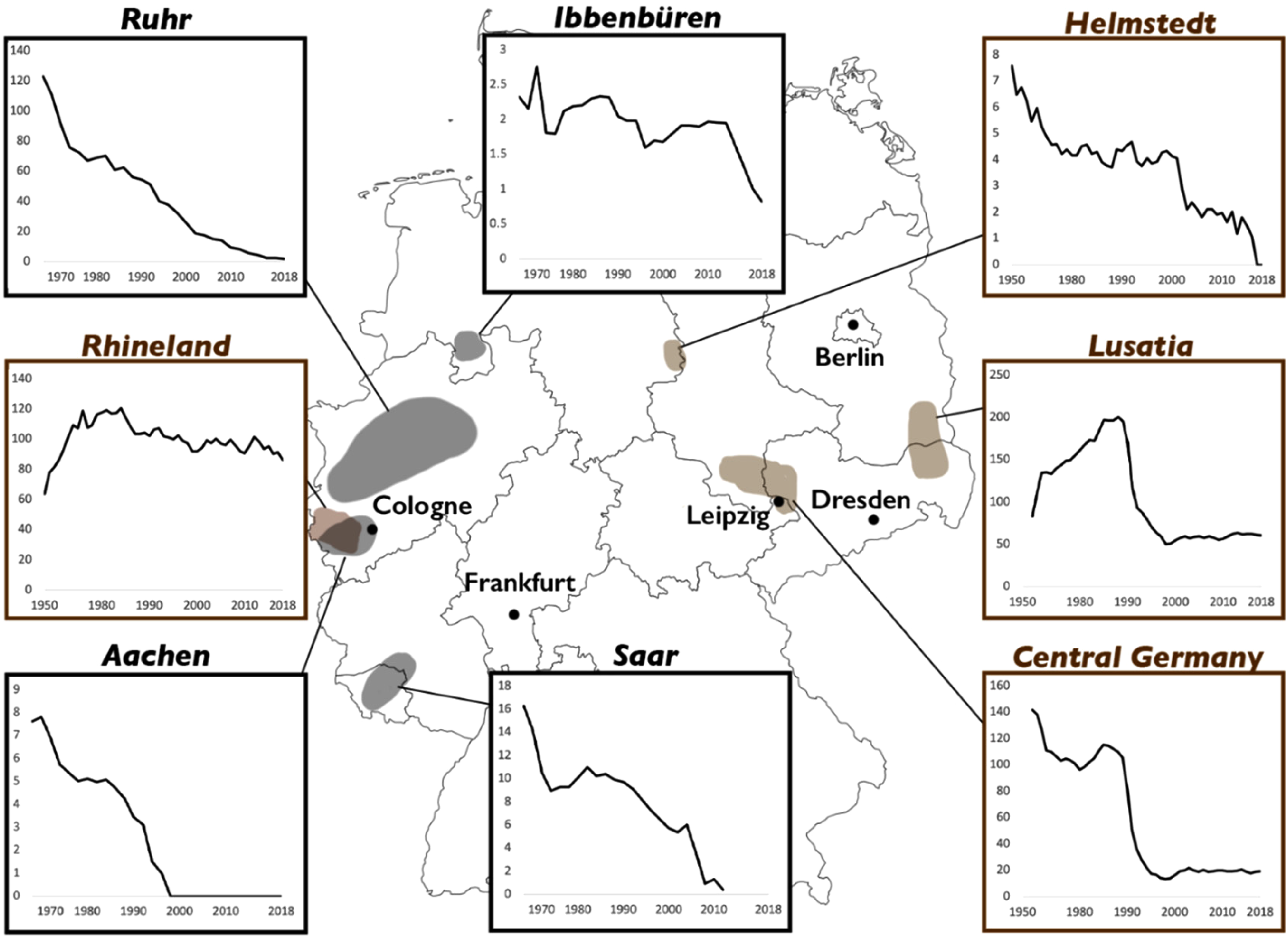
Coal and lignite production in Germany by regions (1) and (2). (1) Data expressed in 1000 t and (2) this figure does not include the smaller lignite regions of Bayern and Hessen, where extraction practically disappeared in the 1980s and 1990s, respectively. Source: made by the author with data from kohlenstatistik.de.
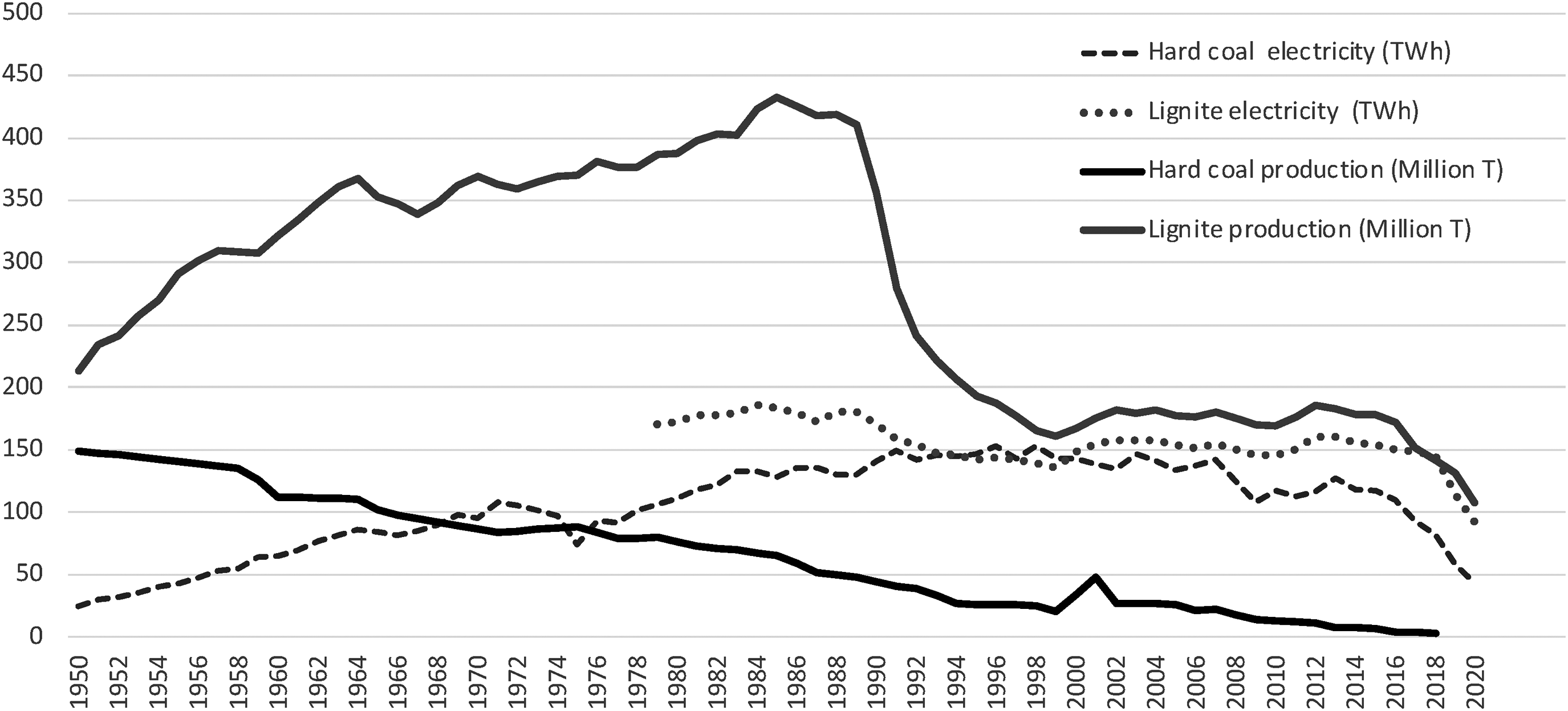
Coal and lignite extraction and power production in Germany. Data from 1950 to 1990 corresponds to the sum of East and West Germany. Information on lignite electricity in East Germany is only available from 1980 onwards. Source: Statistik der Kohlenwirtschaft e.V., 2022.
Initial debates around the Energiewende during the 1980s focused on the need to replace nuclear energy for safety reasons and oil for energy security reasons, especially through renewable power, while coal was seen as a bridge fuel for this goal (Hirschhausen, 2018). Although the expansion of renewables since the 1990s gradually decreased wholesale power prices, making coal-fired generation less competitive, it was unable to push coal out of the market given the 2011 decision to phase out nuclear power by 2021, existing overcapacities, and subsidies (Oei et al., 2020; Van Der Burg and Pickard, 2015). The nuclear exit decision was part of the Energiewende in a strict sense, that is, Chancellor Angela Merkel's 2011 energy policy for the transition toward “a renewables-based energy system with no nuclear energy and little coal” (Hirschhausen, 2018: 34).
Pressure to phase out coal mounted since the mid-2010s (Brauers et al., 2020; Oei et al., 2020). In 2007, a law to phase-out hard coal subsidies was enacted; this drove the final devaluation of hard coal mines, the last one of which closed in 2018. However, Germany kept importing hard coal and producing and burning lignite in three regions: Lusatia, Central Germany, and the Rhineland. The future of coal became a central political debate in the late 2010s. In 2019, the federal government convened the Coal Commission, a multistakeholder group in charge of recommending a coal exit plan. One year later, a Coal Exit Law was enacted, defining 2038 as the last possible date for coal extraction and burning (Gürtler et al., 2021). This plan included abundant financial compensation to the two lignite companies Lausitz Energie Bergbau AG (LEAG) (1.75 billion) and Rheinisch-Westfälisches Elektrizitätswerk (RWE) (2.6 billion) (under assessment by the EU competition policy at the time of writing) and a tendering process for hard coal power stations that will grant decommissioning premiums until 2027.
The following section presents some of the main spatial features of this exit plan organized in three subsections, each of which is related to three key moments of moral devaluation: devaluation forces, forms of resistance, and regulatory responses.
Geographies of the German coal exit
Devaluation forces
The Energiewende has commonly been described as having a national origin (Gailing and Röhring, 2016: 13). This section will show that central triggers of the coal phase-out have to do with international markets and place-based political networks.
In terms of international markets, the EU is an especially relevant scale of devaluation by increasingly regulating the operation of European energy and carbon markets, as physical and commercial networks in which the German coal industry is embedded. For example, new EU competition rules led to the decision in Germany to phase-out hard coal mining subsidies in 2007 (Oei et al., 2020). In the case of coal-fired stations, most interviewees agreed that one of the most powerful forces of devaluation was the rise in carbon prices in the late 2010s, after the strengthening of the European Emission Trading System (EU ETS). Secondly, the decline in prices of imported natural gas reduced the role of hard coal in the electricity mix since 2017 (Agora-Energiewende, 2020). Other international forces of coal devaluation were not mediated by market mechanisms but by political ones. This is the case of inter-scalar pressures created by global climate commitments, particularly the Paris Agreement, which Germany was failing to meet by 2020, as well as horizontal pressures created by announcements of coal exit plans by other European countries. 1 Regulatory changes at the EU level, especially in terms of pollution standards, are additional vertical devaluation forces for German coal. However, their enactment and enforcement have been strongly resisted by the German coal industry (Brauers et al., 2020).
The pressure exerted by the anticoal network represents a place-based political force of devaluation that gained relevance at the end of the 1990s (Sander, 2016). This network is formed by activists, NGOs, local communities, and scholars, among other actors. Internal differences are common in this network, particularly between more radical fractions and “professional” NGOs (both with differences within) (Kalt, 2021; Krüger, 2021). The first anticoal campaigns against lignite in NRW during the 1990s were led by regional organizations. 2 The investment boom in coal-fired stations in the 2000s triggered more coordinated campaigns all over Germany, including those against lignite in the Rhineland and Lusatia (Morton and Müller, 2016). The place-based character of this network was accentuated once the climate movement started to emphasize the local scale in the late 2000s (Sander, 2016) to bypass not only the global scale, after frustrating attempts in the 2000s, but also the national scale: “At the domestic level, there was no chance to get this addressed.” 3 Networking with national organizations also became a scalar strategy sought by local organizations to gain financial, legal, and organizational support. 4
Local embeddedness has also been key for litigation, one of the prominent strategies to devalue individual coal capital by the anticoal network. Legal claims, normally by NGOs in cooperation with environmental law organizations, have been filed with local and national courts related to environmental, health, administrative, and property rights issues (Mez, 2021). Local embeddedness is key in this strategy given locus standi, an admissibility criterion that challenges public interest litigants due to the requirement, in many issues, that claims need to concern the rights of natural persons (Peel and Markey-Towler, 2021). In the case of lignite, networks connecting different villages and NGOs across Germany legally defended properties at risk of expropriation by the expansion of open-pit mines. 5
Local sabotage organized by networks of activists has devalued individual coal capital, although often only temporarily (Scherhaufer et al., 2021). More important forces of general devaluation have been massive demonstrations held in cities or coal regions, which attracted media presence and helped legitimize the movement. Mobility by commuter activists, often students from larger cities such as Cologne or Berlin, has been a key spatial strategy in this regard. Place-based NGOs and grassroots initiatives helped create alliances with local communities, necessary to legitimize the movement (Sander, 2016), a task that has been more difficult in Lusatia given greater support for the coal industry and less presence of civil society organizations (see also Morton and Müller, 2016). The production of specific places as national symbols of the anticoal movement has been a powerful force of general devaluation (cf. Gailing, 2019). One of the most notorious cases is the Hambach Forest, where activists have protested against the expansion of one of the RWE's lignite mines since 2012, a conflict that escalated in 2018 (Brock and Dunlap, 2018). This forest represented “a symbol of the phase-out of lignite”
6
(see also Liersch and Stegmaier, 2022). The dispute surrounding the expansion of the mine strongly influenced discussions in the Coal Commission
7
(Mohr and Smits, 2022). However, this case's overwhelming symbolic role limited the devaluation of other lignite operations by reducing attention on other villages at risk that, in contrast to the Hambach Forest, were not protected by the Coal Exit Law. About this, two members of the Commission observed: With this insistence on always pushing Hambach Forest to the fore, it didn't do justice to the magnitude of the task” / “I also tried very hard to keep the issue [of the villages at risk of displacement] on the agenda, which was only more difficult because the tens of thousands of people demonstrated at the Hambach Forest and not in the villages.
8
Resisting devaluation
Pro-coal national networks have been central spatial formations in the resistance against coal devaluation: networks of unions, coal companies, energy-intensive industries, and politicians. These networks have been able to build strong coalitions to influence policy decisions at the Länder and national scales since at least the 1950s (Brauers et al., 2020; Leipprand and Flachsland, 2018; for more details on the spatialities of the German coal lobby see Gürtler et al. 2021). Beyond these spatial political strategies, resistance to coal devaluation has also been based on spatialized market dynamics. Market integration at the EU level provided a key source of devaluation and also a space to scale up domestic devaluation pressures created by renewables through an increase in electricity exports. Germany has been a net exporter of electricity since 2003 and became the world's largest exporter in 2009 (OEC, 2021). As an electricity trade expert explains, “as soon as you open borders for electricity, then it just makes so much sense for Germany to be a net exporter because of the cheapness of lignite.” 14
The integrated character of the EU's grid has been present in spatial representations used to resist coal devaluation, especially by energy-intensive industries. They have accentuated the risks of carbon leakages either by coal-fired electricity imports or by the liberation for other EU countries of carbon allowances not used in Germany.
15
The pro-coal industrial sector has also raised concerns about the grid operation capacities of other European countries: “they don't trust French capacity,”
16
as more physical integration means that disruptions in one node can impact the whole network: Interdependence has grown historically. Some people say this is the main guarantee for peace in Europe. This is not a theory. Seven or eight years ago, there was a huge blackout for almost 244 hours, a catastrophe and it was trigged by a tree that cut a line in Switzerland (…) This has been used in the political arena as a populistic way of making the case against a coal phase-out.
17
In the Western parts of Germany, when coal production went down it was with a lot of gratitude to the workers. People got medals and stuff like this because they worked for creating a new Germany after the Second World War. And in the eastern part of Germany, you not only had the break in 1990, but you also have the break now, and since there's no such tradition here, it is like OK, your job is gone. Goodbye.
19
This narrative, common in Eastern German coal regions, highlights the geohistorical relational character of a devalued sense of place, associated not only with the level of concomitant devaluation, but also with the contrast of how in the Ruhr area before, the state prevented larger impacts. Another dimension of this relationality is the fact that current workers in the lignite industry have better working conditions than much of the rest of the population in lignite-producing regions, making the risk of having to change jobs more impactful. This risk can be especially felt by the minority of younger coal workers or those who have recently begun working in the industry and have recently been trained. Declining working conditions in Germany since the 2000s make this contrast evident (Belina, 2013; Kalt, 2021). Given the good retirement conditions for coal workers, the concern of local residents refers to the concomitant impacts for people not directly employed in the industry as well as to the future of younger generations in the region (Bose et al., 2020). Many of these problems are accentuated in Eastern Germany given less availability of skilled workers, higher rurality, and lower economic dynamism (Miggelbrink, 2020). Political populism has increased in eastern coal regions, with pro-coal narratives common in the right-wing populist Alternative für Deutschland party (AfD). 20
With less political power nationally than the traditional pro-coal network, representatives of AfD have used more radical anticoal phase-out narratives in their campaigns across Germany, and especially through digital social networks (Matlach and Janulewicz, 2021). Although these two pro-coal networks do not formally cooperate, given substantial political differences, there have been sporadic and implicit forms of collaboration. For example, members of the SPD and christian democratic union (CDU) in Brandenburg aligned with AfD against protests by the activist group Ende Gelände. A more implicit collaboration among coal workers, members of trade unions (IGBCE and Verdi), and the SPD and CDU, was seen in demonstrations in NRW against protests in the Hambach Forest in 2018 (Rose, 2018). Both networks have implicitly cooperated to avoid stronger decarbonization policies. Moreover, although the coal workforce seems to show low levels of support for AfD, news of members of coal unions starting to vote for and convert to AfD began to appear in the mid-2010s. In this context, unions warn against the risks of AfD gaining power from stronger coal phase-out policies as well as of negative local impacts represented important narratives to resist devaluation. 21
Regulating devaluation: a national fix
The emergence of a national arrangement to deal with the future of coal, through the formation of the Coal Commission and the enactment of the Coal Exit Law, has to do with different aspects of the German political economy. First, it is related to the role of the national state in regulating individual devaluation in times of oversupply. Like the decommissioning premiums that started in the 1960s, the Coal Exit Law, with the auctioning system for coal-fired stations, provided a rapid subsidized devaluation of individual capital to improve profitability (if only temporarily) for the coal and power sectors in general. 22 Abundant compensations for lignite companies provided by the Coal Exit Law also reproduce the longer role of the German state subsidizing devaluation. Second, a national “fix,” in the regulationist sense of an institutional response to address a crisis of accumulation and legitimacy (Jessop, 2006), is justified, given the importance of the national coordination of the grid to ensuring energy security. 23 The relevance of the Federal Network Agency (FNA), the national regulatory body for electricity, in deciding when decommissioning plans are acceptable or not is illustrative of this. For example, the city of Munich created its own exit plan after a referendum in 2017 resulted in a majority vote (60.2%) for a phase-out by 2022. The FNA overruled this decision, giving high electricity demand from industrial agglomerations in the south, already affected by supply concerns. Similar bans are a potential risk for phase-out plans in other cities (Straw, 2019).
The emergence of a national coal exit plan also responded to more conjunctural reasons. The double crisis of legitimation faced by the federal government, related to lower environmental credibility and the increasing popularity of the AfD, especially in Eastern Germany, concerned the ruling parties before the 2019 elections in Brandenburg and Saxony.
24
A national response based on the Coal Commission as a consensual strategy was key in this context. In the end, most of the Commission's deliberations focused on the issue of structural change in coal regions, and the Coal Exit Law primarily represented a mechanism to provide a preventive subsidy for devaluation rather than an agenda in line with the Paris Agreement (Furnaro, 2022). The so-called “trauma” of lignite devaluation in the 1990s was a regular topic for the Commission, and the need for a more active state was widely shared by its members: “this should not be repeated”
25
; “It was clear: [the state] must never again act as it did then.”
26
The coal exit agreement, based on abundant
27
compensations for coal regions, shows that the equalizing (redistributive) spatial role of the German state is still in place in order to improve legitimacy. In this context, field trips of the Commission to lignite regions represented a local re-embeddedness strategy: The field trips had an important function in themselves, namely that the Commission went to the coalfields to show the flag, to make it clear that we're talking about concrete issues here. We are talking about people in the coalfields, the future of the coalfields, and socially relevant issues.
28
Several interviewees observed that this was the case with the Coal Commission. Difficulties in addressing the coal issue were related to disputes among and within the ruling parties (Coggio and Gustafson, 2019). Some representatives from parties that supported a rapid coal phase-out at a national level took a more conservative position in coal Länder, including the Green Party.
29
A national consensus could help avoid the repoliticization of the coal debate in the parliament: There were decisions that the politicians didn't want to make, but the point was that a consensus emerged throughout society and also provided the framework for legislation. (…) It helps the legislative process if the thorny issues are actually decided by the Commission, because if they're just passed on, then it just doesn't get done.
30
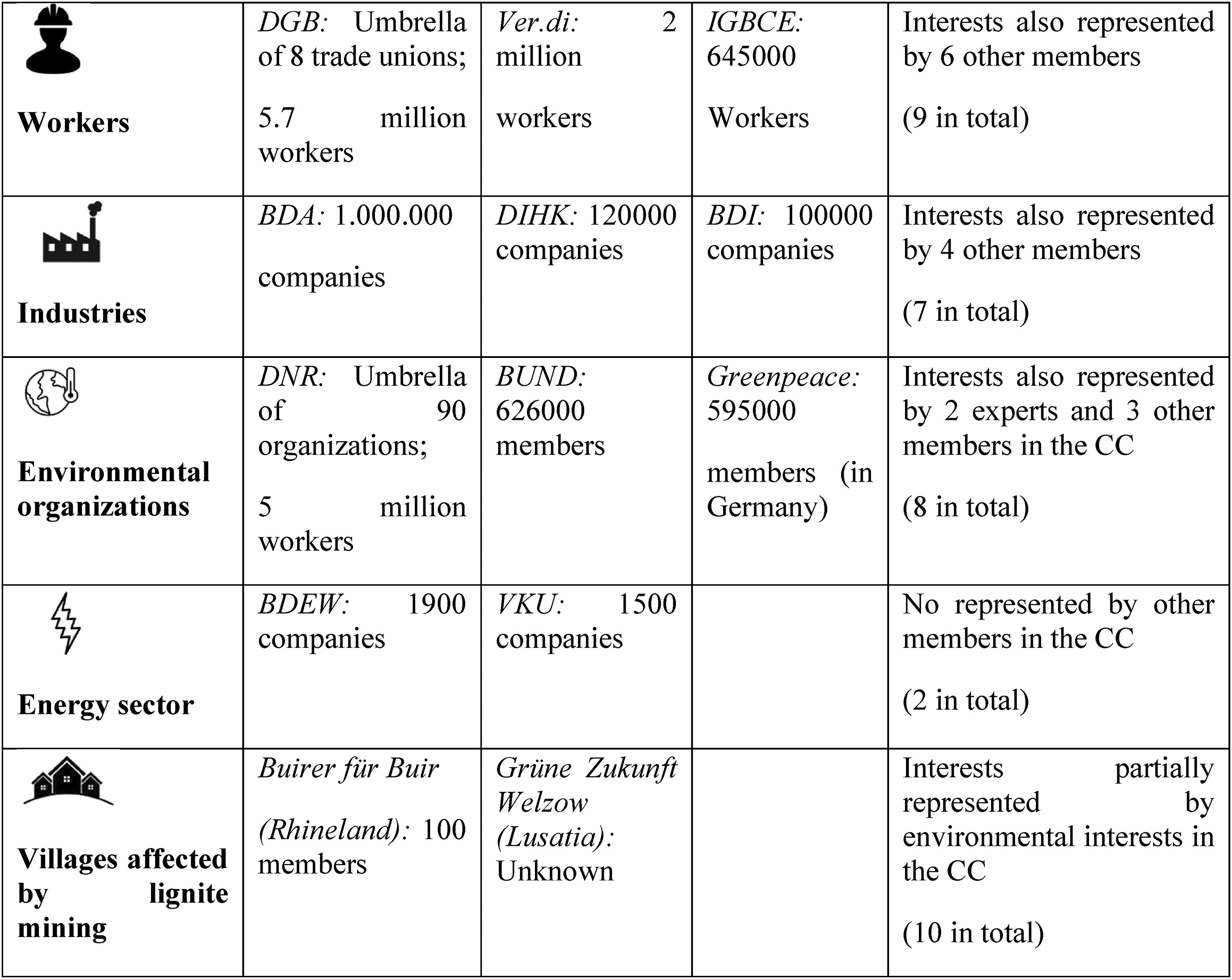
Private interest organizations represented in the Coal Commission. Source: the author.
Several opportunities for repoliticization have been opened after the Commission, especially given the non-Paris aligned phase-out date. Moreover, the Coal Exit Law did not incorporate some of the main contributions of the anticoal sector to the Commission's agreement: a linear phase-out, the ban on the new coal-fired station Datteln 4, and the annulment of the Garzweiler mine expansion (the final decision of the latter, however, being in charge of NRW). After the law was enacted, many organizations and research institutes switched to other topics. The Commission also intensified internal divisions in the anticoal network, especially with the loss of confidence against the NGOs that signed the agreement from the more radical factions of the anticoal movement. Irrespective of whether the double legitimation crisis was resolved (the political rise of the AfD stalled, but the CDU's bad results in the 2021 elections left it out of the federal government), the agreement reached limited the possibilities for further regulations to accelerate the coal exit. The Coal Exit Law restricts the option of amendment without additional financial compensation. However, it does not limit the possibility of a national minimum price of carbon for a phase-out by 2030. 32
Discussion
This case study contributes to the geographic literature on energy transitions by showing some of the spatial dimensions of coal devaluation, a necessary but less studied aspect of the energy transition (Bridge, 2018). In contrast to the general spatialities of capital devaluation, which is always place-specific but whose locations are anarchically defined (Harvey, 1982), the German case shows that the geographies of coal devaluation can be better understood from the perspective of the moral devaluation of coal (Furnaro, 2021). Through this lens, the location of devalued fixed capital in the coal sector depends on a combination of anarchic geographies of market competition, the territorial demarcations of regulations affecting energy markets, and the spatial strategies of anticoal and pro-coal coalitions.
The German case also shows the importance of differentiating the devaluation of upstream and downstream fixed capital in the coal sector to better understand these geographies. The specific characteristics of electricity capital, including its integrated and regulated character (Luke and Huber, 2022) and its relevance in terms of energy security, makes electricity capital devaluation difficult by pure market forces, and in some cases, even by regional phase-out policies that can be banned by national regulatory bodies. The spatial embeddedness of electricity systems (Dahlmann et al., 2016), which varies according to the materiality of resources with, for example, lignite, creating localized vertical integration, should also be considered to better understand at what scales devaluation is more effectively promoted and resisted.
The description of the spatial strategies to promote and resist devaluation in Germany, such as multiscalar lobbying practices or local embeddedness by the pro-coal sector, adds more examples to the literature of rescaling and other spatial strategies to promote and resist the energy transition (Bridge, 2018), especially by emphasizing the less recognized role of spatial narratives and imaginations of the past, present, and future (see also Kuchler and Bridge, 2018). More needs to be said about the differences between these strategies when comparing coal devaluation with the resistance and promotion of renewables.
Not all countries will organize a national, politically negotiated, and generously subsidized coal exit process as Germany is doing. The geographies of the German coal exit shed some light on understanding why this is the case, considering the peculiarities of the country's political geography requiring cooperation from major parties at a national scale, of its spatial repertoire of crisis management practices where devaluation costs tend to be transferred to the national state, and of the relevance of national networks of labor and business lobby in regulating industrial relations.
Conclusions
This article contributes to the literature on the geographies of low-carbon energy transitions by analyzing the German coal phase-out. This case shows that the geographies of phasing out fossil fuels can be understood by looking at the spatialities of moral devaluation. From this perspective, some of the most important spatial forces of coal devaluation in Germany have been associated with the introduction of competition by transformations in the spatial organization of energy markets as networks of commodity and commercial exchange. Territorial regulations have been central in promoting these transformations. Territorially based environmental regulations, especially the reformulated EU ETS, add a new element to the regulation of the energy market that became a key force of devaluation domestically.
The role of the state in addressing these forces of devaluation varies in line with broader political-economic tendencies, showing the importance of understanding the spatial regulation of fossil fuels in the context of the changing spatialities of state power. While a developmentalist model of regulating devaluation is key to explaining the role of the West German state in subsidizing coal regions in the 1960s, the rupture with the equalizing state in the 1990s helps explain (at least in part) a less contained and subsidized devaluation of lignite in East Germany by the state. Without looking at these spatial trajectories, it is hard to fully grasp the legitimacy crisis that unfolded in the late 2010s. The crisis for Germany's reputation as a climate leader, is associated with the multiple spatialities of the forces of devaluation promoted by anticoal networks. A double legitimacy crisis created by the incapacity of the state to deal with two elements of coal devaluation on time, its concomitant costs locally (past and expected), and the need to accelerate it to meet its climate targets, made a national fix based on network governance the preferred approach to restoring legitimacy (independently of whether or not it was successful).
Spatial strategies to promote, resist, and regulate devaluation are central components of the phase-out of fossil fuels. In Germany, the national anticoal network embedded itself in coal-producing regions and litigated and influenced political and regulatory processes at different scales. The spatial strategies of this network have promoted individual and general devaluation, the latter especially by the production of places as national symbols. On the other side, pro-coal networks influenced these different scales to resist devaluation for years. Coal devaluation has also been resisted through spatial market strategies, as well as through spatial narratives.
More empirical research to understand the geographies of moral devaluation is needed. This includes comparative analyses to show what spatial strategies are more effective in promoting and resisting devaluation in countries where different political–economic relations predominate. Case studies that improve understanding of the geographies of devaluation among different fossil fuels and fractions of the energy sector (upstream, midstream, and downstream) are also important to avoid hiding these differences under the general devaluation umbrella. Finally, the geographies of processes of revaluation should be examined carefully, including the ways that fixed capital in German coal regions is being repurposed, processes that should be understood in connection to, rather than as fully independent of, devaluation, as they can represent important path-dependent strategies to deal with devaluation impacts.
Footnotes
Acknowledgments
I would like to thank Kelly Kay, Paula Walk, Chris Hauenstein, and Marius Koepchen for their useful comments and suggestions.
Declaration of conflicting interests
The authors declared no potential conflicts of interest with respect to the research, authorship, and/or publication of this article.
Funding
The authors received no financial support for the research, authorship, and/or publication of this article.