




Abstract
This paper aims to expand and refine our understanding of infrastructure’s multifaceted roles in the African post-independence context. It does so through the study of the TAZAMA pipeline built to overcome the “oil crisis” that affected Zambia after Southern Rhodesia’s Unilateral Declaration of Independence in 1965. The new infrastructure effectively put an end to the “oil crisis” and contributed to Zambia’s emancipation from colonial infrastructural and territorial constrains. However, it also created new dependencies and bolstered the extractive industry both locally and globally. Drawing upon archival material and a series of interviews conducted along the pipeline, this paper explores TAZAMA’s longue durée geopolitical, financial, and labor history, the ways in which the project was mobilized as a tool of propaganda but also individual and collective expectations and lived experiences associated with it. While acknowledging the role of infrastructure as tools of domination and exploitation, the paper foregrounds local agencies and aspirations, pan-African struggles, and state-led decolonization processes. This approach allows for a deeper comprehension of the varying degrees of ambition underlying the project while also elucidating the constraints and interests that perpetuate the reproduction of extractive and neo-colonial dynamics.
Introduction
This pipeline is not going to be an ordinary pipeline. It is a pipeline born out of the determination of Africa, to fight out and defy Neo-colonialism. It is going to be a line that will bring out the ugly truth to free Africa, namely that in order to march ahead to the total economic liberation of the continent, Africa must re-arrange its commercial and communication lines. (Ng’ombo, 1967)
The TAZAMA (acronym of Tanzania and Zambian Mafuta (oil in Swahili) Authority) pipeline was built to overcome the Zambian oil crisis that emerged with the United Nation’s embargo that followed the unilateral declaration of independence of Southern Rhodesia’s white minority in 1965. Zambia, known in the colonial era as Northern Rhodesia, was inextricably linked to Southern Rhodesia and South Africa because of their shared colonial infrastructural past. After the Unilateral Declaration of Independence (UDI) and the embargo that followed, Zambia had to find an alternative route to export copper – its main nationalized source of revenue – and import fossil fuels avoiding its colonial neighbor states. The TAZAMA pipeline, sometimes also referred to as the freedom pipeline, carried petroleum products from the port of Dar es Salaam in Tanzania to the landlocked Zambian Copperbelt mining region and was built in 1968 by the Italian national oil company Ente Nazionale Idrocarburi (ENI). The new project, necessarily networked with its colonial predecessor and still depending on foreign technology and funding, also served to materialize visions and reinforce narratives of freedom, emancipation, and self-determination. Retracing the history of the TAZAMA from a plurality of scales and perspectives, this paper has the aim of complicating our understanding of infrastructure and its ability to become tools of empowerment and decolonization and simultaneously of neocolonial subjugation and dependency making. The paper explores the TAZAMA pipeline’s long history as well as the ways in which it was represented and used as a tool of propaganda. It does so through various archival explorations, the direct observation of the current state of the project, and a series of interviews collected along the pipeline.
Recent critical scholarship on infrastructure expanded its temporal focus to reconnect the neoliberal present with its colonial prehistory thus revealing not only infrastructure’s role in global extractive capitalism but also its ability to oppress – often racialized – others (Chua et al., 2018; Cowen, 2020). In the African context, scholars have been exploring the colonial visions and “discursive scaffoldings” that predicted – almost one by one – current infrastructural development (Enns and Bersaglio, 2020; Kimari and Ernstson, 2020). These works have the fundamental role of revealing the hidden nature of infrastructure but, I claim, are not entirely helpful to understand the intricate dynamics taking place in early post-independence Africa when infrastructure were also seen, perhaps naively, as a means of emancipation from the near colonial past. The post-colonial era was an era of constrain but also of possibility in many ways (Cooper, 2008). We cannot speak today of the projects imagined and constructed in those years as doomed to failure (Lal, 2015); we must instead understand their initial ambitions and the multiple reasons that led them to reproduce colonial dynamics. As Cupers and Meier suggest, this paper traces not only a history of the TAZAMA pipeline in the longue durée, but also a history of its intentions and “reception” (Cupers and Meier, 2020). To further explore the coloniality of this specific infrastructural episode, I will – as suggested by Davies (2021) – delve into its financial and labour-related aspects in more detail.
The paper initiates by delineating the geo-political context of Zambia and the entire Central and South African region in the post-independence era to better understand the oil crisis of 1965, its significance, and its entanglements with colonially inherited territorial, transport, and industrial structures. This introduction aims to elucidate the rationale behind the decision of the Tanzanian and Zambian governments to address the oil crisis through the construction of new transport infrastructure, while also exploring the underlying territorial visions driving these ambitious projects. Subsequently, the paper recounts the tense negotiations between Zambia, Tanzania and their future industrial partners. These negotiations were undertaken in pursuit of overcoming colonial impositions, yet also entailed the establishment of new and enduring dependencies. After discussing the complex process of TAZAMA’s construction, the paper recounts the subsequent phases of operation but also the sabotages, the reparations, and how these too were instrumentalized to support various political claims. In the concluding section – to demonstrate the political ambitions behind the project – I will discuss the pipeline’s structural inability to generate profit and thus compete with the liberal oil-industry market.
The Zambian “oil crisis”, enduring colonial legacies
The “Zambian oil crisis” started in 1965 when the white minority of Southern Rhodesia declared its independence from the United Kingdom. This unilateral resolution provoked a United Nation’s oil embargo to and through Southern Rhodesia that caused Zambia’s economic system – highly dependent on the copper mining sector and on Southern Rhodesia’s infrastructural support – to stall and highlighted its dependency on colonial infrastructures.
Zambia had reached independence from Britain just one year earlier, in 1964. At that point, it was the third larger copper producer in the world and exported between 50,000 and 60,000 tonnes of copper a month. Copper constituted 95% of its export and almost 50% of government revenues (Roberts, 1981). Kenneth Kaunda, former leader of the independentist movement, became president of the independent state and put in place a series of socialist-oriented policies that led to the creation of a state monopoly for manufacturing and trading companies and the acquisition of 51% of the mining companies’ shares (De Roche, 2008). Alongside promoting development, humanism, and equality, the new government aimed to eliminate colonialism, racialism, imperialism, and discrimination while also working towards the realization of African Unity (Shaw, 1976). Thanks to the high price of copper, Zambia was rated one of the most prosperous countries of Sub-Saharan Africa but its little-diversified economy depended heavily on copper price fluctuation and on the government’s ability to negotiate favourable trading agreements with neighbouring states in order to maintain the flow of copper and fuel (De Roche, 2008).
Throughout colonial domination and during the first year of Kaunda’s government, all of the copper export and 95% of Zambia’s imports had been shipped via railway through the British-controlled territories and the ports of South Africa. The whole history and territorial structure of Zambia had been strongly affected by colonial infrastructure, in particular by the Rhodesia Railway. Built by the British entrepreneur Cecil Rhodes and his British South Africa Company (BSAC), the railway was initially deployed as a means of conquest for the region and became later a tool of extraction and export of metal ores and diamonds toward South Africa’s ports. The oddly-shaped landlocked territory of Northern Rhodesia was the result of colonial infrastructural expansionism, the capacity to resist and negotiate of the Lozi and Bemba empires – who inhabited the land before the arrival of the BSAC – and the discovery of copper deposits (Lunn, 1992). Once the BSAC discovered the abundant underground resources of what is now the Zambian Copperbelt region, the railway became their main exporting tool (Roberts, 1981). The trains of the Rhodesia Railway, departing from Port Elizabeth or Durban, in South Africa, would stop in Southern Rhodesia to collect coal, and then proceed to the north. Once they reached the Copperbelt, coal was unloaded and used to activate the mining engines while copper was loaded and shipped southward to South Africa and Mozambique and from there to the whole world. The mining industry of the Copperbelt flourished and the railway line became the geographic backbone of Northern Rhodesia. Most urban settlements, industries, and economic activities developed along the rail line while a sparse population lived of subsistence agriculture in the less accessible provinces (Roberts, 1981) 1
After independence, the railway that linked Zambia’s mining region to the ports of South Africa remained the main export–import infrastructure but after Southern Rhodesia’s UDI, Zambia was forced to secure a new outlet to the sea. The UDI – condemned unanimously by the UN members – entailed a complete oil embargo to and through the Rhodesian territory (United Nations: Security Council, 1966). The trading ban, established to affect Southern Rhodesia, instead revealed Zambia’s dependency on fuel imports and on colonial infrastructure that reinforced its physical connections with Southern Rhodesia and South Africa (Griffiths, 1969).
Following the UDI, the border between Zambia and Southern Rhodesia became an iron curtain between independent Africa in the north, and the white, colonial south (Southern Rhodesia, South Africa, Mozambique). 2 In other words, only one year after independence, Zambia found itself surrounded by enemy territories. Once the passage to the south was blocked, the only accessible route toward the sea were: the Benguela railway that crossed the Congo and Angola toward the Atlantic Ocean, and the “Great North Road” (GNR), a dirt track that passed through Tanzania toward the Indian Ocean (Griffiths, 1969) (see Figure 1). After Lumumba’s assassination, the Republic of the Congo was undergoing a brutal civil war and Angola was still under Portuguese colonial control (Griffiths, 1969). The only possibility of exporting and importing raw materials without crossing occupied territories was Tanzania. 3 Tanzania had gained independence in 1961 and, after guiding the independence movement, Julius Kambarage Nyerere was elected president of the new state. Nyerere was one of the most convinced and enlightened exponents of African socialism and a source of inspiration for Kaunda’s policies of nationalization, development, and self-reliance. Even though both Tanzania and Zambia had been British colonies since the First World War, the only physical connection between the two was the GNR, that had been built in 1917 to convey British troops from Northern Rhodesia to the German East African front (Griffiths, 1969). Contrary to what the name suggests, the GNR was a neglected, unpaved, and seasonally unpassable link. At independence, the two countries found themselves “back to back, looking south and east respectively” (Shaw, 1976). However, their newly established diplomatic relationship had to become rapidly operational.
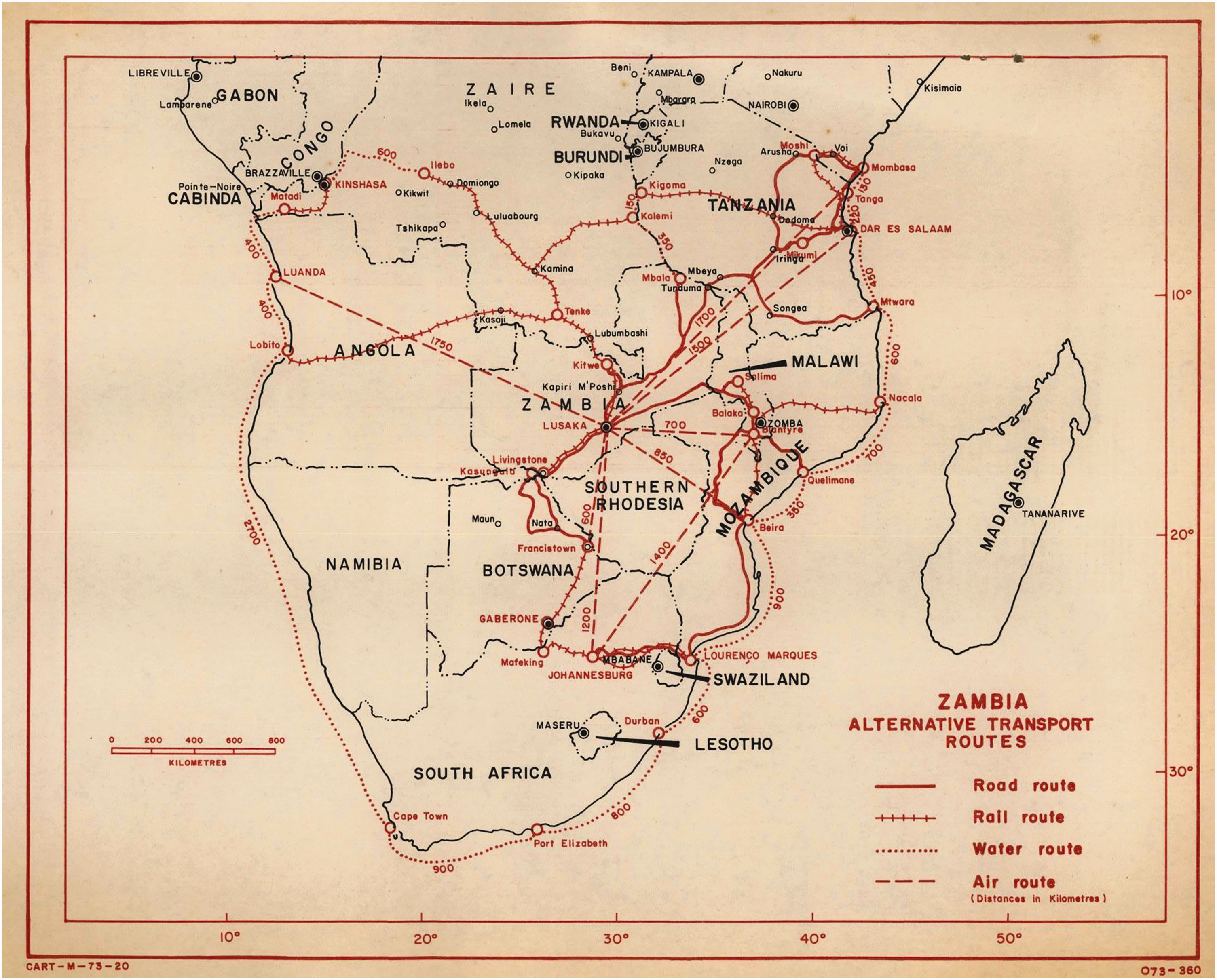
Zambia’s alternative transport routes after Southern Rhodesia’s Unilateral Declaration of Independence. The Great North Road connects Lusaka to Dar es Salaam. Source: United Nations Economic Commission for Africa, 1973.
In 1966, oil airlift was organised by the British, American, and Canadian air forces to overcome UDI and the UN embargo. Military cargo planes started flowing oil to Zambia from Dar es Salaam and Nairobi. Simultaneously, 450 heavy trucks offered by FIAT, the Italian car manufacturer, imported oil and exported copper via the GNR. This temporary and emergency solution proved inefficient: the cost of the airlift was too high, and the heavily loaded planes and trucks consumed large quantities of fuel (Cohen, 2014). 4 Furthermore, only a few months after the UDI, the poorly engineered GNR – that had meanwhile earned the evocative name of “Hells Run” – became impassable causing stoppage and delays to copper export (Griffiths, 1969). The lasting and continuous lack of fuel and the stack of copper waiting to be shipped out of the country required a prompt and durable solution. Kaunda and his new ally Nyerere envisioned a two-part long-term answer to Zambia’s isolation: the construction of an oil pipeline and a railway. The two projects would run almost parallel to the existing GNR and connect Zambia to the Indian Ocean through Tanzania. The pipeline would supply oil to the mines while the railway would guarantee the export flow of copper. The envisioned multimodal corridor can be seen as a direct consequence of colonial domination, arbitrary land subdivision, and territorial administration through infrastructure. It was the colonial power that established the copper mining industry of Zambia, that shaped its territory, and that imposed specific infrastructural routes and allies. From this perspective, we should acknowledge the colonial origin of the new project but, at the same time, we cannot deny that the new pipeline embodied the independent government’s wish to emancipate from its colonial past and reorganize the national territory in the direction of a newly established pan-African cooperation.
New alliances
In 1966, neither Zambia nor Tanzania could count on sufficient capital or knowledge to undertake the construction of such large-scale infrastructure and had to rely on foreign investors. 5 In order to avoid and overcome enduring colonial dependencies, the political elites of the two countries had to establish new alliances that, as we will now see, will also lead to the creation of new dependencies.
To assign the contract for the construction of the pipeline, Kaunda and Nyerere invited two actors to make an engineering and economic offer. The first one was the British company LONRHO (London and Rhodesian Mining and Land Company), which had built most infrastructure of the two Rhodesias during the colonial era. The other was the Italian national oil company, ENI, which had recently become the oil-sector partner of Tanzania. The LONRHO group was an “ubiquitous” (Arrighi and Saul, 1973: 101) presence in central and east Africa during and immediately after the colonial era. It owned diverse businesses ranging from mining to brewing and was operating the Beira-Umtali pipeline shipping oil from Mozambique to Southern Rhodesia. In Zambia, the group was also controlling the press – publishing two of the main Zambian newspapers (Cohen, 2014). ENI, on the other hand, had been operating in Tanzania since 1961. Here, in partnership with the local government, ENI’s commercial branch Agip was building and managing a growing network of gas stations, and SNAM Progetti – ENI’s engineering subsidiary – was finalizing the construction of the TIPER (Tanzanian Italian Petroleum Refining and Co.) refinery of Dar es Salaam (Scotto, 2022).
After months of tense negotiation, on 28 October 28 1966, the Zambian Minister of Commerce and Industry announced that the Italian SNAM Progetti was the winner of the commission for the pipeline construction. The news provoked a “particularly felt” disappointment among the British entrepreneurs who had taken their victory for granted (Cohen, 2014). The contract signed by the Tanzanian, Zambian, and Italian governments involved SNAM Progetti as the engineering contractor and a consortium of Italian banks as funding institutions granting a soft-term loan of 29 million of Italian lire (around 20 million US dollars) to be paid back in 29 semesters with an interest rate of six percent per year (TAZAMA Pipelines, 2016). This advantageous package was made possible by ENI’s legal status as a state-owned company able to finance big-scale infrastructure projects through state loans. Another key aspect of the winning proposal of ENI was that the contract guaranteed Tanzania and Zambia immediate ownership of the pipeline, of which ENI ensured both the construction and the initial technical assistance (Il Giorno, 1966).
The decision in favour of the Italian company was sold by Zambian and Tanzanian political leaders as an anticolonial move and indeed, the cutting of “Britain’s apron strings” – as this decision was described in a The Financial Times article – was received with surprise and disappointment by those who could not expect to lose their colonial privileges (The Financial Times, 1969). This episode shows that for some, the early postcolonial era could be seen as a “window of opportunity”; a phase when political autonomy was desired, possible and often achieved (Cohen, 2014: 759). Indeed, the two independent governments demonstrated autonomy of decision-making and a strong will to shape their future alliances. Acknowledging Zambia’s and Tanzania’s autonomy of choice, however, should not shift the focus away from ENI whose expansionist goals were not very different from those of LONRHO and of other international multinationals aiming at expanding their market and acquiring new commissions in post-independence Africa. Furthermore, Italy also had a colonial past – albeit not in central and south Africa – and was shiftily on the path to achieving a neo-colonial future as one of the dominating market forces of the oil-sector in the continent. The abstract notion of neo-colonialism as the persistence of former colonizer-colonized dependencies often favoured Italy who, in the many African territories ruled as British or France colonial possessions, could present itself as a non-colonial and seemingly neutral economic partner. In this way, ENI managed to avoid coming across as a neo-colonial threat and instead managed to be welcomed as a manifestation of a newly achieved commercial and diplomatic freedom. 6 ENI’s propaganda successfully used decolonial and pan-African narratives to its advantage. This is evident in a bold statement made in a 1972 press release regarding ENI’s operations in Zambia, portraying the pipeline as a ground-breaking milestone in the history of large-scale infrastructure development in Africa. The release declared that “For the first time a large scale infrastructure was built for the ‘reverse flow’ transport of petroleum product, i.e. from the coast inland” while “up to then, the great majority of African products, especially in the energy and mining sectors, had always moved one way only – from the production areas to the coast where the products were sent on to the industrialized countries” (‘ENI in Zambia’, 1969). However, when considering the pipeline from a broader scale of time and space, as advocated by infrastructure scholar Paul Edwards (2003), it becomes apparent that its main purpose was to facilitate the extraction and export of copper from Zambian mines. Meanwhile, ENI’s true aim was to access the Zambian market, having already established a significant presence in Tanzania. Indeed, the pipeline was key to ENI’s penetration into central Africa, a penetration that started with the construction of the refinery in Dar es Salaam and ended with the construction of a second refinery at the Zambian end of the TAZAMA in 1971. In other words, the pipeline embodied ENI’s strategy of progressive territorial conquest through material and long-lasting infrastructural artefacts justified as a “decolonizing” mission in support of independent governments. While the Italian company may not have been explicitly viewed as a neo-colonial actor in Zambia and Tanzania, its operations were fundamentally rooted in a neo-colonial modus operandi. Despite Kaunda and Nyerere’s efforts to break away from historical British industrial partners, they found themselves in a comparable situation of power imbalance with the Italian company. As observed by the pan-Africanist political theorist Walter Rodney, instead of condemning or favour one country, donor or investor above others, we should see “the capitalists of Western Europe” as those “who actively extended their exploitation from inside Europe to cover the whole of Africa” (Rodney, 1974). For him, escaping the thread of neo-colonialism, or the “last stage of imperialism” as Nkrumah famously defined it, should rather be achieved through breaking “with the vicious circle of dependence and exploitation which characterises imperialism” (Rodney, 1974). Nyerere and Kaunda understood the threat of neo-colonialism embedded in global capitalism and tried – as far as they could – to establish a different kind of state and society based on collective ownership and cooperation. However, their ambitions of socialism and self-reliance clashed with the difficulty to overcome the colonial inheritance of the low value-added extractive industry and the lack of skills and capital (Wallerstein, 2004). Two of the heaviest legacies inherited from the colonial era.
The making of the pipeline, race, and class
The construction of the pipeline started in Dar es Salaam in May 1967 and ended in the Zambian Copperbelt, where the terminal tank and a distribution system were finalized in September 1968. To ensure the flow of oil, five pumping stations were assembled in Kurasini (near Dar es Salaam’s port), Morogoro, Elphon’s Pass, and Iringa in Tanzania and Chinsali in Zambia. At each station was built a small headquarter with a control unit, offices, workshops and accommodation for the fix personal – around 20 people per station (TAZAMA Pipelines, 2016).
The 13 months of operations are epically narrated in the video documentary “From the Indian Ocean to the Heart of Africa: The Oil Pipeline Dar es Salaam–Ndola” (De l’océan indien au coeur de l’Afrique: L’oléoduc Dar es Salaam–Ndola, 1968), directed by Raoul Brunlinger for SNAM Progetti (see Figure 2). This is one of many industrial propaganda documentaries that ENI commissioned to shape the company’s public image and to communicate its often-invisible work in a highly aestheticized manner. Brunlinger’s film follows the 45,000 tons of steel pipes from their arrival in Dar es Salaam to the Zambian Copperbelt. The ducts, through which oil normally flows unseen became the protagonists of the film, which highlights the various steps necessary to assemble, secure, and bury the pipeline. The narration of the movie stresses the workers’ determination and effective cooperation, the advanced technological means offered by SNAM, and simultaneously the creative solutions deployed to overcome geographic and environmental complexities. By highlighting the difficulties encountered during the enterprise, the film aims to convey the heroic endeavor. At the same time, the daring tales of the pipeline construction also reveal the company’s inadequate knowledge of the context and its limited experience with similar operations, especially in the tropical environment. The pipeline construction, as emerges from Brunlinger’s documentary, oscillated between a work of precision engineering and an experimental – almost amateur – endeavour. In one scene, we see a helicopter supervising the construction team while in the following one, a tractor slowly pulls a shaky cart out of the mud (De l’océan indien au coeur de l’Afrique: L’oléoduc Dar es Salaam–Ndola, 1968). Indeed, despite the propaganda, the operation was not devoid of challenges, especially for a relatively small and inexperienced engineering company. The inland transport through Tanzania and Zambia of supplies, machinery (200 items of heavy equipment and 300 vehicles), and the workforce previously shipped to the port of Dar es Salaam was complicated by the lack of viable roads. The previously mentioned GNR was mostly impassable and already congested with oil and copper-carrying trucks trying to ease Zambia’s isolation. To bypass the “hell run” the decision was made to build the pipeline in two sections, one starting from Dar es Salaam and the other from Mbeya, at the Zambian–Tanzanian border. The shipment of pipes and machinery to the second section was achieved by rail (from Dar to Kigoma) and by ferry across Lake Tanganyika (from Kigoma to Mpulungu, Zambia) (Griffiths, 1969). However, the greatest challenges were posed by the complex topography of the riff valley system of southern Tanzania, which abruptly climbs up to over 1000 meters above sea level and the numerous marshes and rivers of the northern part of Zambia. In addition to emphasizing the difficulties and thus the technical skills and the motivation of the company’s “pionieri”, 7 “From the Indian Ocean to the Heart of Africa” also displays clear patterns of racialized division of labor. For the construction, a core team of Italian engineers and technicians collaborate with around 1200 locals temporarily hired in Tanzania and Zambia. While local workers took care of the heavy labour and the tasks that could not be done by machines, Italians controlled and supervised them. As Davies observed, “infrastructure plays an intimate role in the coloniality of power and the international racial division of labour” (Davies, 2021). Davies also highlighted how “there is an association between engineering knowledge and whiteness” that becomes visible the moment we look at infrastructure through the lens of labour (Davies, 2021). Indeed, the way infrastructure played an intimate role in reinforcing the racial and international division of labor emerges clearly in the documentary.
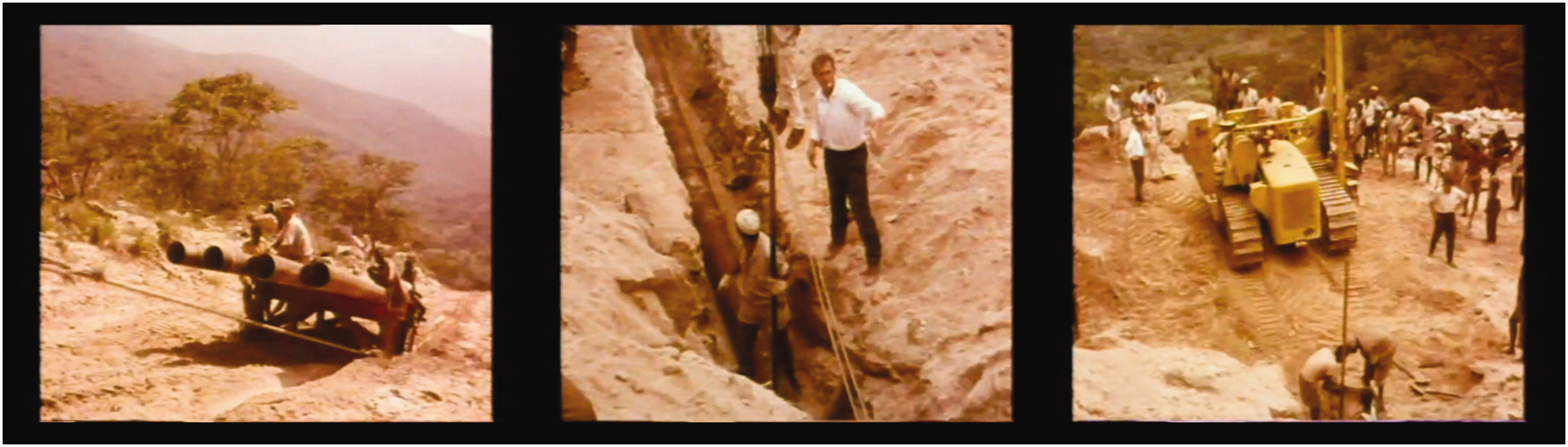
Scenes of the pipeline construction from “From the Indian Ocean to the heart of Africa: The oil pipeline Dar es Salaam–Ndola”, Raoul Brunlinger, 1969. Source: Eni Historical Archive.
However, if we look at the labour history of TAZAMA on the longue durée, we will also be able to see how these dynamics have been appropriated and transformed. “After 15 years, Italians handed in the management to Tanzanians and Zambians in the process of Africanization”,
8
tells proudly TAZAMA Regional Manager A.S. interviewed in August 2019 in his office in Dar es Salaam. . recalls that at the beginning operation managers were all wazungu,
9
nobody was holding high positions, it was only white people, but slowly they were training locals and handed over (…) only after thirty years the group of expatriates was kicked out and from then to now – twenty years now – there are no expatriates, all technicians, electricians, engineers, chief executive, regional manager are all Indigenous people.
10
Indeed, the racial division of labor that was evident during construction and in the first 15 years of ENI’s co-management of the pipeline has slowly disappeared. Knowledge exchange and the creation of new jobs and skilled workers were aspects very dear to the African governments and were part of the contract’s negotiation clauses. Tanzanian and Zambian leaders saw the pipeline as a goal but also as a means to acquire technical knowledge in a specific industrial sector. Most of the people who worked for SNAM Progetti during the construction and for TAZAMA were trained by ENI’s technicians both in Italy, Zambia, or Tanzania to acquire new skills that ranged from truck driving to operating pumps along the pipeline. 11 These skills allowed them to become part of an elite group of salaried workers, who are a living testimony of the ambitious social policies of the postcolonial developmental era (Cooper, 2010). 12 Among them is M.M., who worked for TAZAMA between 1969 and 1995. I met M.M.y at his house, a small villa in the “TAZAMA village” of Kurasini in Dar es Salaam. In the living room hang the pictures of his seven children of whom he is very proud – “all of them attended university” he explained. On the television set rested two flower pots adorned with a Tanzanian and a Zambian flag, part of his retirement present from the company. 13 During our conversation, M.M. recounted that he had attended technical school and was selected by the “Italians” who further trained him in engineering, physic, and chemistry for six months. “The training was harsh but well paid” he stated. After the training, around 50 Tanzanians (and Zambians across the border) were hired and assigned different jobs at the pumping stations along the pipeline. M.M. started working as a simple station operator but was later promoted to shift leader, deputy station supervisor, and ultimately station supervisor. 14 A similar account was offered by A.K. who explained that the salary at TAZAMA was high because it had to match with the Zambian ones, but also because the work was dangerous and demanding; “I got a life-long medical allowance and now I get a very good pension. I have a car, my kids go to university, so I live above standards.” 15 Thanks to TAZAMA relations with the Tanzanian and Zambian states, employees of TAZAMA have been supported by the company to purchase cars and homes; they still enjoy life-long access to private health care and are entitled to a retirement pension. These benefits – just like the pipeline itself – can be considered a remnant of the historical era of development when both the Zambian and Tanzanian socialist states pursued a series of state-led projects with the aim of increasing economic growth and higher standards of living (Cooper, 2010). In practice, most developmental projects improved the lives of a selected few, thus contributing to the formation of a new elite of technicians and salaried workers. Supporting the establishment of a new local class of consumers – to which M.M. and A.K. belong – was part of the developmental project as much as it was part of ENI’s ambitions. In reality, despite claiming to promote an upward levelling of all people’s living standards, development did not result in the creation of an egalitarian society as Nyerere and Kaunda wished (Cooper, 2010). In the postcolonial era, exploitation persisted alongside sporadic possibilities of emancipation – accessible only to a portion of the local population. The longue durée labor histories of TAZAMA illustrates how knowledge and knowledge transfer can perpetrate racial division while also reshaping existing social structures to define new hierarchies and classes.
Pan-African and decolonizing visions
The first shipment of refined fuel was delivered to the Zambian Copperbelt on September 2nd, 1968 – 30 days after it departed from Dar es Salaam (Times of Zambia, 1968). Although the main goal of the pipeline was to supply fossil fuels to the mining industry of the Copperbelt, its completion was received by Zambians as an important step towards real economic and energy independence. TAZAMA came to embody expectations of Pan-African cooperation and decolonization in relation to the white-controlled south and the binding colonial infrastructural network. This might sound like mere propaganda and surely a bit naïve, but it is important to situate aspirations, decisions, and operations within their historical and geographical contexts. In the 1960s, “petro-progressive” narratives – the belief that oil and technology would bring an improvement in living conditions without significant drawbacks – were widely shared, and Italians, Tanzanians, and Zambians were no exceptions. 16 Today, we are aware of the disastrous environmental outcomes resulting from the unfettered reliance on technology and the false belief in infinite growth that shaped those choices. However, for African leaders in the early post-independence era, obtaining access to oil and its associated technologies was deemed a fundamental right worth striving for. Developing a domestic oil industry was an integral part of their project of self-determination and self-reliance.
During the opening celebration, in front of ministers, foreign ambassadors, ENI representatives, and thousands of school children, President Kaunda insisted on the role of the new infrastructure as an anticolonial tool reflecting “the declared policy of the Government to disengage from the South, to which Zambia had been deliberately wedded in an incompatible partnership.” (Times of Zambia, 1968). With the re-routing of import–export through Tanzania, the government aimed primarily at maintaining the flow of copper and oil, but it also hoped to “decolonize” its territory. Indeed, the pipeline redefined time and distances thus affecting spatial relations of proximity and dependence. The new infrastructure reoriented Zambia’s territorial structure away from colonial infrastructures and materialized the new “directional priority” of Zambia’s foreign relations. The new geography defined by the pipeline did indeed alter the territorial structure that was subjecting Zambia to southern Africa and strengthened its physical connection with Tanzania, its new ally.
On the same occasion, Nyerere declared that the pipeline was the result of a successful “convention between two independent African states” and a “symbol of our unity which will strengthen the fight for our real independence and self-reliance” (Times of Zambia, 1968). He also added that “the opening of the pipeline was a happy day not only for Tanzania and Zambia but for all those who support the fight against colonialism and racialism” (Times of Zambia, 1968). This was a key point of the Pan-Africanist agenda born at the beginning of the 20th century as an ideology of resistance to white supremacist, colonial domination, and imperialism. The same ideology became – in the post-colonial phase – a state narrative mainly focusing on the development of international infrastructural projects and economic communities (Shivji, 2021). 17 Behind this idea laid the conviction that the arbitrary fragmentation of the continent during the colonial era was the cause of its underdevelopment and therefore that connecting African states among them would spur development and economic growth (Bailey, 1976).
Despite not being as prevalent as during the early years of independence, Pan-African narratives endure, at least for those working for the TAZAMA pipeline. For Tanzania’s regional director A.S., the pipeline is a remnant of what he idealizes as “a time when politics was true love,” based on ideals rather than on profit. 18 During his interview, he repeatedly stressed that the project was conceived by “true politicians, with true love for the others” while “the politicians we have now, they keep on asking; what is the profit Tanzania is getting?” 19 Indeed, the pipeline is not a profitable project; it was not built to produce revenues, but to supply oil to landlocked Zambia. Therefore, the cost of shipping was kept below standards to ensure affordable fuel prices to Zambian customers. Moreover, TAZAMA has one single client; the INDENI refinery on the Zambian Copperbelt that is experiencing periodic breakdowns, thereby forcing TAZAMA to undergo long shutdowns as well (TAZAMA Pipelines, 2016). A project like the TAZAMA pipeline, which structurally fails to generate profit, would be unconceivable outside the precise historical moment and ideological context in which it was built. Nowadays, the pipeline’s structural incapacity to make a profit is a constant threat to its own existence, especially given competition from private transport companies. These companies indeed, capitalize on driving tanker trucks filled with diesel and gasoil to Zambia in a business that, despite the pipeline maintenance and leakage problems, often proves more dangerous and deadly than the pipeline itself. 20
Long-lasting dependencies
TAZAMA’s inevitable low profits have resulted in significant long-term consequences. Since the early stages of the operation, the precarious financial situation of the company hindered regular maintenance efforts and made it even more necessary to resort to extraordinary maintenance and repair. This, in turn, had required additional funding. As stated in one of TAZAMA’s reports, fees and therefore revenues remained too low to fully support the requisite preventive maintenance programs needed to keep the pipeline at internationally acceptable standards of operational condition. As a result of this, the first pipeline leak occurred hardly five years after pipeline inception (in 1973) and by 1983 over hundred leaks were being recorded and repaired annually.
Extraordinary maintenance operations such as the replacement of corroded pipes became increasingly necessary and reinvigorated TAZAMA’s dependency on SNAM Progetti’s technology and expertise. Traces of this reliance stretched in time up to today and are still evident both physically and immaterially. As I visited the pipeline in the summer of 2019, works to replace the over 50-year-old Italian pumps were ongoing. At the Morogoro pumping station, on the tidy lawn in front of the plant, the imposing old FIAT machinery produced by the Italian car manufacturer in the 1960s stood parked like relics of industrial archaeology (see Figure 3). A.K. remembered with frustration that “the old engines needed Italian spares. Each and every part was from Italy, even the valves were from Italy. Everything was Italian, Italian, Italian.” 21 The binding relationship with the Italian company lasted for decades creating ever closer ties of dependence. Indeed, the work of ENI was not limited to the construction of the first duct and pumping stations. In 1970, the ENI group was appointed to build INDENI, Zambia’s first refinery. Before the plant was completed, the Italians were contracted to increase the capacity of the pipeline and adapt the duct and the machinery to the new conditions, i.e. the flow of more viscous crude oil instead of refined products. The cost of the partial doubling of the pipeline, the conversion of the existing machinery, and the addition of two pumping stations were estimated to be 19 million of Italian lire, two thirds of the overall pipeline construction cost, originally amounting to 28 million lire. 22 In 1976, SNAM was contracted once again to increase the pipeline’s capacity. 23 The written exchange between ENI and the Italian government on this occasion offers a precious insight into the company’s expansionist strategy through the construction of infrastructure. In January 1976, Guido Pasetti of ENI wrote to the foreign minister and to the minister of treasury that the
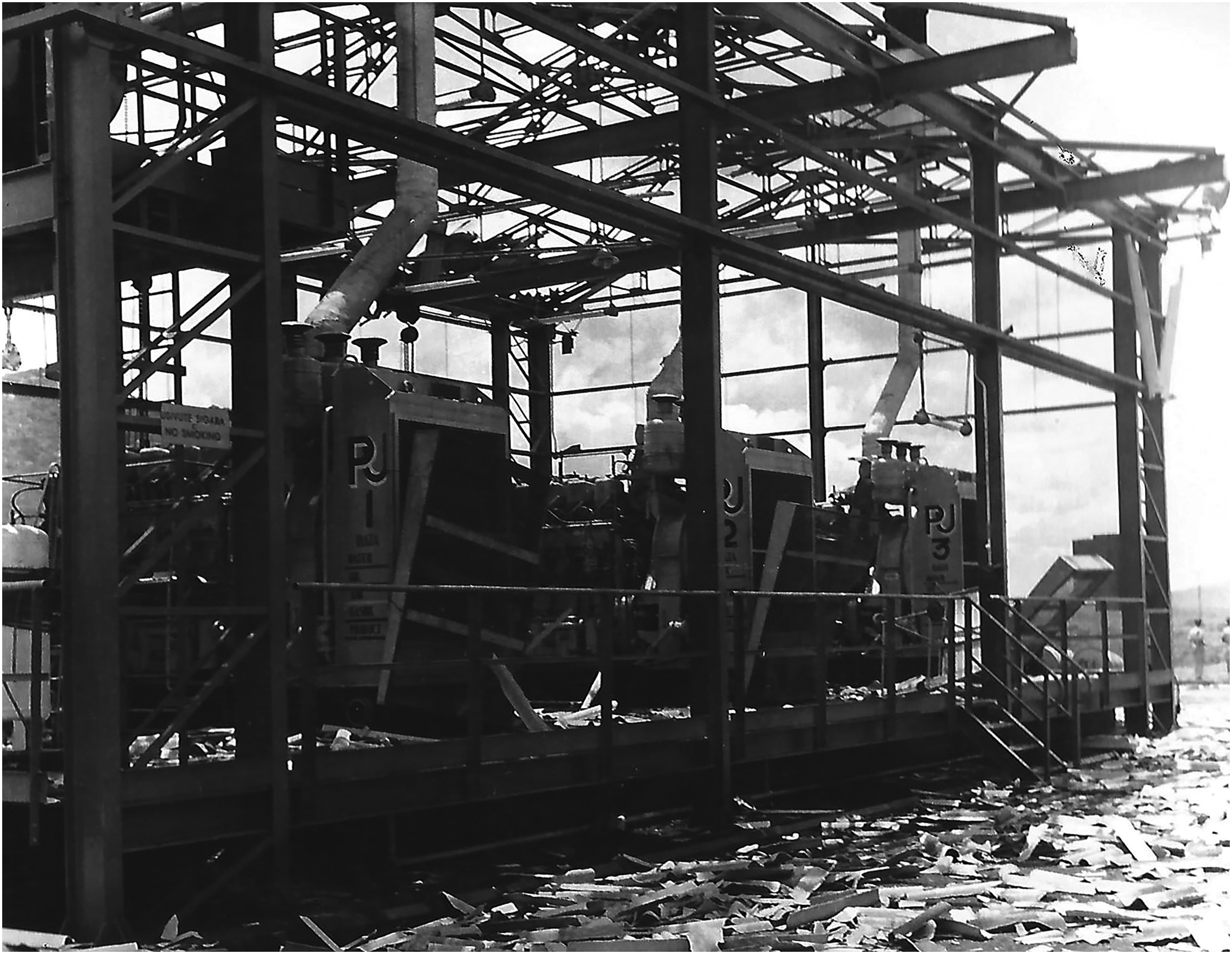
Old FIAT (Fabbirca Italian Automobili Torino) pump engines parked on the lawn of the Morogoro pumping stations. Photo credits: The author, August 2019.
Zambian and Tanzanian governments have so far given preference to SNAM Progetti for all their oil plants and it is now necessary that the completion of the system be built by SNAM Progetti for reasons of technical uniformity, continuity and above all not to introduce other international competitors in the market. 24
This communication highlights the opportunity that “technology uniformity” represented for the Italian company that was able to impose a long lasting dependency based on its skills and knowledge.
However, Italians have not been the only financial supporters of the pipeline. In order to be able to carry out ordinary and extraordinary maintenance work over the years, TAZAMA has received loans from the World Bank (WB), the European Bank and the African Development Bank. The financial situation of the pipeline is revealing of the complex conditions and constraints in which the pipeline exists and operates. On the one hand, the no-profit project developed to deliver oil to landlocked Zambia is reflecting the pan-Africanist narratives of cooperation and mutual aid between Zambia and Tanzania. On the other hand, the debt incurred by Tanzania and Zambia with the Italian engineering company for construction, and with other foreign donors for maintenance and repair, sheds light on the ability of infrastructure projects to establish dependency and perpetuate long-lasting conditions of coloniality.
Histories of sabotage
If the pipeline is the savior, then are its saboteurs the villains? The pipeline was attacked, only a few months after the inauguration of the duct. On the night of 24 December 1968, the Tanzanian pumping station of Iringa was bombed by “expert hands” as reported in a telegram sent by Cosentino of the Italian embassy in Dar es Salaam to the Italian foreign ministry (see Figure 4). 25 The bombing did not cause fatalities, but it seriously damaged the pumping unit and the diesel deposits, requiring the interruption of the oil flow. The perpetrators of the sabotage were never identified. Although B.L., a former worker of SNAM Progetti, said truck drivers who lost their jobs with the implementation of the pipeline were responsible for the attack, 26 official suspicion fell on Southern Rhodesian guerrilla troops aiming at “disrupting vital communication and supply routes to Zambia” as reported in the Tanzanian newspaper The Standard (1969). The official account of the incident reinforced the narrative of the two nation-states that promoted the pipeline as a savior to Zambia, a tool of liberation and pan-African cooperation.
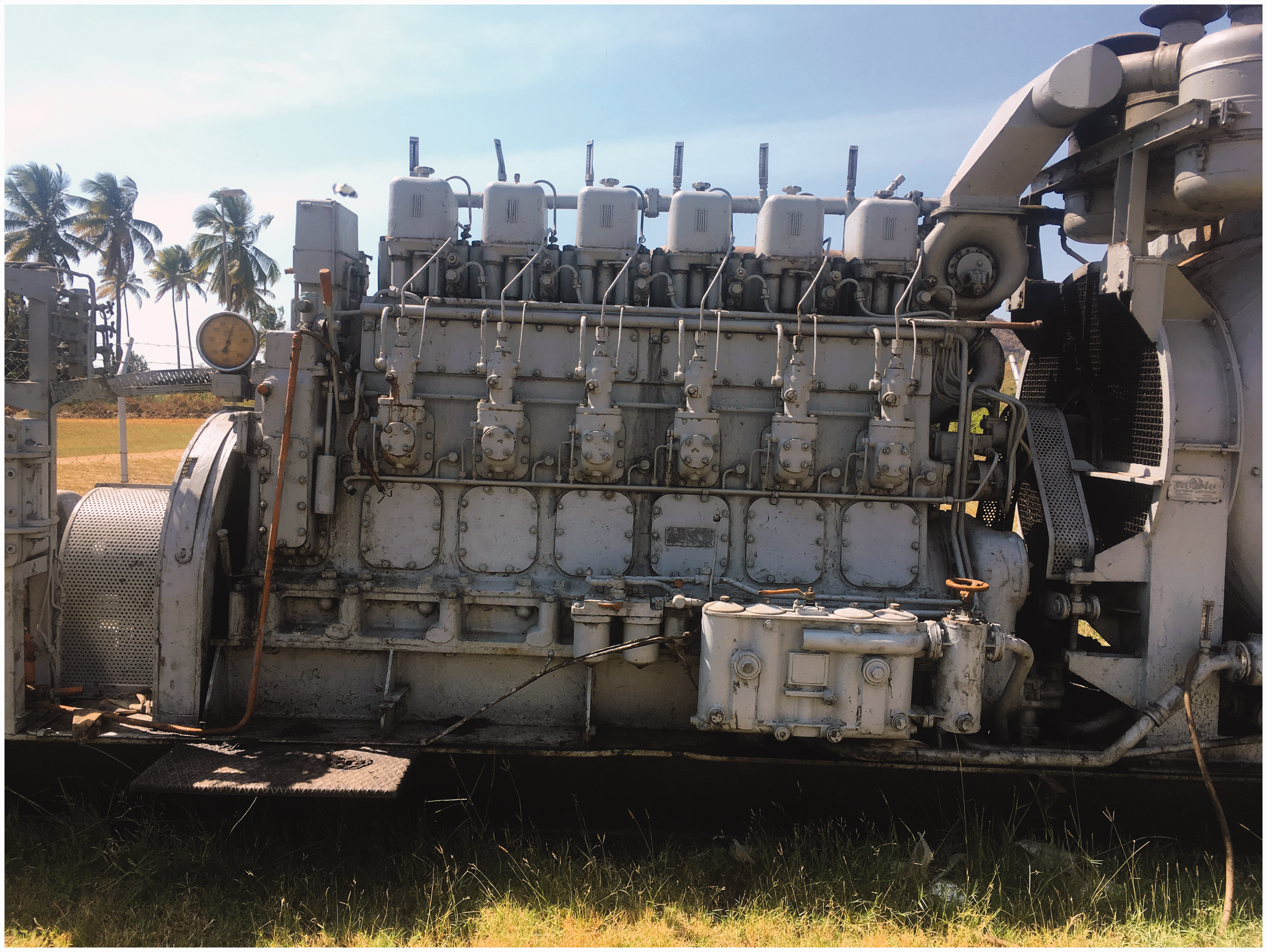
The pumping station of Iringa (Tanzania) after the bombing of 24 December 1968. As reported in The Standard Tanzania on 27 December 1969: “The explosion which ripped through the building blasted off the asbestos walls and roof leaving only a metal skeleton standing”. Source: F.L.i private collection.
Very often, the voices collected during field research differ and – like in the case of the TAZAMA bombing – offer antithetical explanations of the same event. All interviews I conducted aimed primarily at collecting factual information and gaining an understanding of how infrastructure operated, but I soon discovered that inconsistencies made it difficult to build precise histories of infrastructures. On several occasions, oral accounts were not consistent with each other or with archival sources and they were rich of unconfirmed – and impossible to confirm – rumors. Nonetheless, all my interviewees ended up revealing personal truths and interpretations of what given infrastructures and episodes meant to each of them as individuals and as members of various social groups. Political ethnographer Lisa Björkman already questioned the very possibility of “infrastructure’s knowability” as she observed that even “official” infrastructure knowledge can be “multiple, conflicting and based on speculations”(Björkman, 2015). This is particularly true when discussing global infrastructures such as the TAZAMA pipeline, which has embodied – and continues to embody – multiple geopolitical and ideological meanings that further complicate a linear understanding of its role. The bombing incident we just discussed is not the sole threat to the pipeline. During the early years of operations, it was not uncommon for some people to drill holes in the pipeline to steal fossil fuels for their own use. Attacks decreased when – after the refinery was built in Zambia – the pipeline was converted to crude-oil that is more difficult to use directly than its refined products (TAZAMA Pipelines, 2016). Feminist theorist Doreen Massey observed how the time and space compression of globalization’s flows and connections affects social groups differently and reorganizes uneven “power geometries” able to determine who and what is allowed to move and who is not (Massey, 1993). 27 The latter group, the group of the excluded, comprises people who endure and allow the flow of other people and goods. This is the case of the people who live along the pipeline who surveil and maintain it but who have no direct access to the good flowing in the ducts. Indeed, the pipeline does not directly serve the people living along it, for whom it is rather a constant threat. The people living along the line are asked to take care of the duct, to report damages and acts of sabotage while they bear the constant risk of explosion, leakages, loss of agricultural land, and pollution of their water reservoirs (Athumani, 2019). In exchange, TAZAMA offers to villagers seasonal jobs and occasional corporate responsibility projects – usually materialized after “accidents” caused by the pipeline. 28 We now see clearly how different social groups experience the pipeline in radically different ways. To the Zambian industrial elite, the pipeline provided a “vital” supply, also ENI, and most of the TAZAMA workers benefited materially from the project. To those who lived and still live along the pipeline, the pipeline is delivering little more than a constant threat; for them it is mainly a conduit of pollution and death.
The striking contrast between the grand narratives of development and the everyday life along the pipeline suggests that attacks on the infrastructure – both the bombing and the thefts of the 1970s – may be seen as a deliberate interruption of the flow of oil and of oil-related benefits normally flowing below villagers’ feet and beyond their reach.
Conclusion
During the last half of the 1970s, a series of local and global factors determined the beginning of a serious economic crisis that affected both the Zambian and Tanzanian economies. 29 To provide fuel and foodstuff, the governments had no other choice than to request additional assistance from the International Monetary Fund (IMF) (Boesen, 1986; Simutanyi, 1996). In exchange for financial assistance, the IMF imposed on Tanzania and Zambia a series of highly unpopular and controversial liberalization measures. The economic recovery programs, approved after long negotiations during the 1980s, increased the role of the private sector and forced the two governments to drastically reduce public services (Maliyamkono and Bagachwa, 1990). The austerity measures materialized into cuts to government expenses and limits to the budget for education and health-care. In addition, they imposed the sell-off of various infrastructural projects developed by the post-colonial government with the aim of increasing self-reliance and strengthening the power of the central state. The Enhanced Structural Adjustment study prepared by the Tanzanian Authorities in collaboration with the staff of the IMF and the WB in 1999 recommended the Tanzanian government to “enhance the capacity and efficiency of the petroleum industry, increase private sector participation in the sector, and encourage oil and gas exploration”. 30 This led to the closure of the Dar es Salaam refinery – the departing point of TAZAMA – that had been evaluated by the above-mentioned study as a “modest facility, inefficient, and unable to generate satisfactory profits”. 31 The conditions imposed by the IMF had a strong impact on national politics and marked the end of the developmental era. The TAZAMA pipeline was not impacted by the structural adjustment because it was still considered an infrastructure of strategic importance. However, the adjustments did affect the whole petroleum industry sector as they laid the groundwork for the emergence of private logistic companies that eventually entered into competition with TAZAMA.
Although the pipeline cannot be considered merely as the result of a “politic of true love” – as it was described by TAZAMA manager A.S. – its primary objective was not to generate immediate profit but rather to fulfill the aspirations of African politicians to uphold pan-Africanist principles and promote self-determination. The foreign construction company and the mining sector of the Zambian Copperbelt did profit from its construction but the economic return for the Tanzanian state that had participated – even financially – in its construction was certainly not its main priority. This stands in stark contrast to the directives later imposed by international financial institutions, advocating for a mode of development based on the free market and private entrepreneurial initiative.
As we have seen, the pipeline also represented the materialization of an emancipatory vision aiming to transform territorial structures and infrastructures imposed by former colonial regimes. The decision to build a pipeline in response to this given situation can be questioned but we should also acknowledge that it represents the desire and need to break with a past of oppression, readable through the existing colonial structures and infrastructure. It remains evident that the postcolonial Zambian state failed to conceive a fundamentally different economic system from the extractive economy imposed by the colonial administration, that stood as one of the heaviest legacies of the colonial era (Shaw, 1976). Rerouting export and import did little to alter this reality. None the less, as suggested by historian Priya Lal (2015), we need to take the agencies and “emancipatory intentions” (Pollio and Cirolia, 2022) of local actors seriously and judge their historical decision in their own terms and not as projects destined to recreate dependencies and colonial power structure imbalances. Only in this way can we recognize the serious efforts made during the post-independence era to envision a decolonial and pan-African future. Though this envisioned future never materialized, its intentions and aspirations – however idealistic and naïve they may have been – deserve to be explored and acknowledged.
Footnotes
Declaration of conflicting interests
The author(s) declared no potential conflicts of interest with respect to the research, authorship, and/or publication of this article.
Funding
The author(s) received no financial support for the research, authorship, and/or publication of this article.
