




Abstract
Research on the impact of decentralisation has generally overlooked the fact that the economic returns of transferring powers and resources to subnational tiers of government greatly depend on the quality of the devolved government. Scholarly literature has also neglected that these returns may be similarly affected by the autonomy of neighbouring areas and their government quality. In this paper, we use panel data fixed effects analyses and spatial Durbin econometric models to assess the extent to which the economic returns of political and fiscal decentralisation in the European Union between 2000 and 2015 are mediated by local government quality and that of neighbouring regions. The results suggest that the economic benefits of regional autonomy are greater in regions with a better government quality, while regions with a low quality of government grow less, regardless of their level of decentralisation. The gains of decentralisation mainly accrue through indirect effects, as regions grow more if surrounded by other, more decentralised regions than through their own level of decentralisation. In all cases, local government quality is a powerful driver of growth, irrespective of whether a region is considered individually or in relationship to its neighbours.
Introduction
Over the last few decades, decentralised governments have sprung across Europe. Many previously centralised countries, such as France, Italy, Poland, Spain, or the United Kingdom, have engaged in successive waves of decentralisation, while others that had decentralised earlier, such as Austria, Belgium, or Germany, intensified the transfer of powers and resources to subnational tiers of government (Hooghe et al., 2016; Marks et al., 2008).
One reason behind this decentralisation drive has been the deep-held belief that decentralisation delivers considerable economic benefits. Yet, the literature is highly divided on whether this is the case. The lack of any conclusive verdict about whether decentralisation increases economic efficiency is related to two factors. The first is that the returns of decentralisation depend on the quality of the government to which powers and resources are devolved. Transfers of authority and resources to efficient regional and local governments will lead to a better adaptation of public policies to local needs and, as a consequence, be more efficient. In contrast, if the devolved local authority is less capable than national governments, overall economic efficiency may suffer.
Similarly, the level of autonomy and government quality in neighbouring regions may affect the overall economic efficiency of decentralisation. Regions surrounded by others with efficient and dynamic decentralised governments may, on the one hand, lose out as individuals and firms vote with their feet (Tiebout, 1956), seeking better policies and service delivery. On the other, the competition among decentralised governments can lead to local governments responding to the demands of residents in a more efficient and effective way. This will improve the overall quality of service delivery and prevent the flight of capital, talent, and firms (Iimi, 2005: 45; Tiebout, 1956).
This paper is among the first to link the potential growth impact of decentralisation to the variations in the quality of devolved governments. It is the first one to consider levels of decentralisation and government quality in neighbouring regions as a driver of economic performance. We analyse the extent to which decentralisation processes in the EU are affected by a combination of a) the degree of decentralisation in a particular region; b) variations in quality of government across European regions; and c) the level of decentralisation and institutional capacity of neighbouring areas.
To do that, we have compiled a large dataset, combining both the variation and changes in the level of decentralisation of the regions of the EU (Hooghe et al., 2016) as well as the differences in government quality in European regions (Charron et al., 2014, 2019). We apply econometric methods: from panel data fixed effects analyses to spatial autoregressive models and, more specifically, Spatial Durbin Models (SDM).
The results of the analysis highlight that the economic returns of decentralisation are greater in places with more efficient local governments and that being surrounded by other regions with high levels of decentralisation and with high government quality stimulates the positive effects of transferring powers and resources to subnational tiers of government. This effect can even be greater than that of the direct transfer of authority and resources to local governments and that of their quality.
The paper proceeds as follows. In the next section, we present the theory and scholarly literature on the role of decentralisation and government quality for economic growth at a subnational level. We delve into the theoretical arguments explaining whether the efficiency of more decentralised governments is dependent on the quality of subnational governments and on how decentralised and how efficient neighbouring governments are. This is followed by a section on the differences in levels of decentralisation and government quality across regions of the EU. The model, the method, and the data are introduced in Section “Method, model, and data.” Section “Results of the econometric analysis” presents and discusses the results of the econometric analysis. The final section sums up what we have learnt about how differences in the decentralisation process and in quality of government in the EU contribute to determine regional growth trajectories and considers the policy implications.
Decentralisation and quality of government: The theory
The belief that decentralisation delivers significant economic benefits has been grounded on the classical fiscal federalism literature. The work of Tiebout (1956) and Oates (1972) underlined two main advantages of decentralisation. First, the local government capacity to match public spending more efficiently to the preferences of individuals living in different territories. Second, the supposedly higher efficiency of mobilising underused resources due to competition among subnational governments (Oates, 1996; Rodríguez-Pose and Ezcurra, 2010).
Consequently, local and regional governments are often considered more efficient at providing a whole raft of public goods and services than the more remote central governments, as they reflect “the preferences of the population more adequately than they can be reflected at national level” (Tiebout, 1956: 416). Especially in contexts where needs and wants vary from one place to another, local and regional governments are perceived as more capable of identifying these needs and more efficient at tailoring public policies. Hence, by decentralising it is expected that an “economic dividend” will emerge (Morgan, 2002): decentralised countries and regions will produce better public policies, adapted to the requirements of heterogeneous areas, mobilising the overall potential of the territory, and generating substantial aggregate economic benefits.
However, much of the research on the supposed benefits of decentralisation has struggled to clearly identify this economic dividend (Davoodi and Zou, 1998; Lago-Peñas et al., 2020; Lessmann and Markwardt, 2012; Martínez-Vázquez and McNab, 2003; Muringani et al., 2019; Rodríguez-Pose and Ezcurra, 2010, 2011). More decentralised countries have often failed to perform better than more centralised ones or witnessed a significant economic boost after decentralising (Davoodi and Zou, 1998; Rodríguez-Pose and Ezcurra, 2011).
The mixed economic returns of decentralisation can be explained because the whole gamut of factors that may increase the efficiency of autonomous government is countered by an equally strong array of explanations as to why decentralisation could trigger suboptimal economic outcomes. Decentralisation can lead to tax competition among jurisdictions, resulting in a race to the bottom (Oates and Schwab, 1988) and, ultimately, in inefficiently low tax levels (Brueckner 2004; Keen, 1998). Moreover, decentralising can entail potential scale diseconomies (Prud’homme, 1995). Decentralisation may also exacerbate the risk of soft budget constraints and raise tricky coordination issues both horizontally—among different local actors and jurisdictions—and vertically—among different tiers of government (Bolton and Farrell, 1990). Decentralisation can also provoke funding inequalities. Richer regions with a larger tax-base will be able to raise more financial resources and finance local public goods at lower rates than poorer ones (Prud’homme 1995; Rodríguez-Pose and Ezcurra, 2010). This would lead to an unequal provision of public goods and services and in rising territorial tensions (Rodríguez-Pose, 2018). In addition, while some firms and start-ups may decide to move to a particular region for fiscal reasons or for the specific policy incentives granted by local and regional governments, the reality is that the decisions to locate and develop economic activity in one place and not in another are fundamentally the result of long-term locational advantages and rigidities in capital mobility and migration. This implies that the reaction to changes in decentralisation levels are likely to be a long-run phenomenon, not necessarily driven by short-term changes in devolution.
However, two key factors behind the relative economic failure of decentralised governments have generally been overlooked in past scholarly literature. First, the relatively low government capacity of some devolved governments can represent an economic drag (Prud’homme, 1995; Tanzi, 1998). With very few exceptions (e.g. Jong et al., 2021; Muringani et al., 2019), it is generally assumed that the quality of subnational governments is equal to that of central governments and that subnational government quality variations are limited. Hence, the benefits of decentralisation are expected to be almost immediate and widespread. However, as measurements of subnational government have expanded and improved (e.g. Charron et al., 2015, 2019), it has become evident that government quality not only varies widely across EU countries, but also within many of them. The Quality of Government Index (Charron et al., 2015, 2019; Charron and Lapuente, 2018) has brought to light not only the contrasts in subnational government quality between what are far more efficient subnational governments in the Nordic countries, Germany, the Netherlands, and Austria, and far less efficient, transparent, accountable, and more corrupt ones in south eastern Europe—from the South of Italy, to Croatia, Greece, Bulgaria, and Romania. Internal differences in government quality in countries such as Bulgaria, Italy, and Romania are also considerable. Devolving powers and resources to tiers of government whose quality is well below the European average, and often that of the national governments of the countries they belong to, will yield limited or no economic benefits.
Many local and regional governments in Europe are likely to be less capable than national governments to adequately design and implement policies to address the needs of locals. Corruption and subnational government quality may undermine any benefits of decentralisation. Decentralisation also facilitates a greater discretion on the part of local officials and frequently limits the oversight and monitoring of the central government (Kyriacou et al., 2015; Prud’homme, 1995). In weak government quality contexts, there is also a risk of more pervasive rent-seeking behaviour (Cai and Treisman, 2005; Ezcurra and Rodríguez-Pose, 2014; Kyriacou et al., 2015). The resulting devolved public policies are likely to be suboptimal, possibly below the standards of those implemented by the national government. Hence, the supposed economic benefits of decentralisation will not always materialise (Baskaran et al., 2016; Hooghe et al., 2016; Muringani et al., 2019; Oates, 1972; Rodríguez-Pose and Ezcurra, 2011).
Second, research on the economic impact of decentralisation has mainly focused on individual territories, disregarding the spatial context in which local governments operate. However, the capacity to design adequate policies is intrinsically related to the social and economic ecosystem in which governments function. How decentralised are surrounding territories, how good is their government quality, and how effective and efficient are their policies, matter for the capacity of different government tiers to deliver economic benefits. Being surrounded by more decentralised governments, used to designing and implementing their own policies and/or by territories with better—or worse—local governments can affect policy delivery.
Different competition mechanisms shape this effect. Having decentralised governments in close proximity can trigger competition among them. In some cases, this competition can generate a race to the bottom between jurisdictions. In others, it may generate growth-enhancing competition. Decentralised governments can vie to deliver better and more efficient public policies and services (Donohue, 1997; Martínez-Vázquez and McNab, 2003). The need to prevent citizens and firms from “voting with their feet” can mobilise local resources to a greater extent than in centralised contexts (Rodríguez-Pose and Ezcurra, 2010) and provide a better matching of investment and public expenditure to local preferences. These factors put together may improve allocative efficiency and trigger greater economic growth, both in each region and on aggregate (Tiebout, 1956). In addition, decentralised government can produce greater policy innovation (Martínez-Vázquez and McNab, 2003; Oates, 1996).
Decentralisation can thus create the type of positive competition between territories that results in better and more efficient use of local resources and in greater policy experimentation and innovation (Rodríguez-Pose and Ezcurra, 2010).
Hence, being surrounded by other autonomous regions may both stir up a growth-enhancing competition and offer learning opportunities to territories in bordering regions with a lower independent capacity to develop custom-made policies or with subpar and inefficient institutions (Ezcurra and Rios, 2020). The impact of this competition will be greater if the decentralised jurisdictions are geographically closer, rather than far away.
Overall, when putting the arguments for and against decentralisation on a balance, the weight of positive and negative economic aspects of decentralisation is almost equal. What may tip the scale in any direction is the quality of the institutions to which powers have been devolved as well as the policy efficiency of neighbouring regions. Poor local institutions and not efficient neighbours can prevent devolved governments from generating a greater economic dividend (Muringani et al., 2019). In particular, differences in government quality are bound to have far greater effects in countries with greater levels of government quality polarisation. The North-South divide in government quality among Italian regions will have non-negligible effects on the performance of regions on both sides of the country's territorial divide, leading to effects that will differ from those found in, for example, France or Spain, where regions with high government quality coexist with others with a lower quality, without a clear spatial pattern. In any case, and as mentioned above, these mechanisms have been often overlooked in decentralisation research, which has mainly focused just on the degree of decentralisation within, rather than outside the region.
Decentralisation and quality of government: The evidence
The winding road towards decentralisation in Europe
Europe is not new to decentralisation. However, until the 1970s regional autonomy remained confined to a few countries. In Austria and Germany, for example, decentralisation was partly imposed in the post-war period by the Allied Forces (Renzsch, 1989). The rest of Europe, despite coping with considerable and often increasing subnational tensions, remained mostly centralised. In recent decades, however, the process of decentralisation has taken off. The transfer of authority and resources to subnational government has been widespread, but highly uneven across countries and, in some cases (Italy, Portugal, Spain, or the UK) also within them.
According to Marks et al. (2008) and Hooghe et al. (2016), regional autonomy 1 in Europe started accelerating in the 1950s and took off during 1970s and 1980s, before peaking in 1989. During the 1990s, the expansion of the decentralising trend came to a halt. A renewed, albeit more modest, wave of decentralisation coincided with the beginning of 21st century. Overall, after 1950, 21 of 27 EU member states (plus UK) executed decentralisation reforms, adding 20 new levels of regional government (Schakel et al., 2015). 2 The post-2007 crisis brought the decentralisation drive to a halt. In sum, the decentralisation process has been far from linear. Factors such as the size of the country, the objectives of sub-national and national governments, and a raft of other political, social, economic, and cultural characteristics, have determined the diversity of decentralisation trajectories. The relationship between the process of decentralisation and regional growth in Europe is therefore bound to vary considerably from one country to another, from one region to another (Filippetti and Sacchi, 2016).
Regional differences in government quality
To what extent is this association mediated by the quality of the devolved subnational governments? There is a long tradition of recognising that economic practice is shaped by the institutions that govern individual behaviour (e.g. Veblen, 1919). During the last decade of the 20th century, the interest on institutional quality, in general, and on the quality of local governments, in particular, increased and considerable progress was made. Since North (1990), the role of institutions has been recognised as fundamental for economic performance. Countries with better and more transparent institutions are also considered to be in a far better position for economic progress (Gertler, 2010; Holmberg et al., 2009).
More important for the sake of this article is the mounting interest about how this relationship pans out at the subnational level (Ezcurra and Rodríguez-Pose, 2014; Gertler, 2010; Kyriacou et al., 2015; Rodríguez-Pose, 2013). Regions with weaker institutions are bound to find more obstacles in their development path (Ketterer and Rodríguez-Pose, 2018). Hence, the consensus that subnational government quality matters for economic development is growing (Charron et al., 2015; Charron and Lapuente, 2018; Rodríguez-Pose and Garcilazo 2015; Tabellini 2010). However, the mechanisms about how to improve institutional quality are far less clear (Rodríguez-Pose, 2013). Muringani et al. (2019) argue for a post-functionalist perspective on multilevel governance proposed by Hooghe et al. (2016), indicating that is not only important what a government does but also how it does it.
Measuring institutional quality remains highly controversial. However, in recent years, considerable progress has been made. The Quality of Government Institute of Gothenburg University has developed the European Quality of Government Index (EQI), an increasingly popular measure of institutional quality available at the regional level in the EU (Charron et al., 2015; Charron and Lapuente, 2018). The data provided by the first three waves of EQI (2010, 2013, and 2017) offer interesting insights into government quality at regional level in the EU.
First comes the relative stability in government quality across Europe. Imaginary dividing lines in quality of government exist both between Northern and Southern Europe and between Western and Eastern Europe. Second, these divides are relatively stable. Only 16.5% of the regions included in the EQI have had a significant (positive or negative) change in score over the period 2010–2017. Third, there has been some decline in the government quality gap over the period 2010–2017. This has fundamentally been the result of the improvement in subnational government quality in Central and Eastern Europe—in 2017 two regions in the Czech Republic as well as Estonia had government quality scores that were above the EU28 mean. Many regions in parts of Western Europe—and, especially, in Italy, Spain, and Greece—have experienced, by contrast, noticeable declines in their government quality. However, the heterogeneity in regional quality of government remains high. In particular, the gap between the best performers in the index in the Nordic countries, Germany, the Netherlands, and Austria, and most regions in the rest of Europe is still pronounced (Charron and Lapuente, 2018).
Decentralisation, government quality, and spatial interdependence
How does decentralisation combine with variations in regional government quality and levels of development across Europe? In general, more decentralised regions enjoy a better government quality (Figure A1 in appendix). Does spatial dependence play a role in this relationship? This question remains a black box. Although empirical research on spatial externalities has thrived recently (e.g. Abreu et al., 2004; Ertur and Koch, 2007; Sanso-Navarro et al., 2020), decentralisation and government quality have been mostly bypassed in spatial econometrics. There are some exceptions. Recently, De Siano and D’Uva, (2016), Bubbico et al. (2017), and Ezcurra and Rios (2020) have delved into how government performance in one region may be affected by government performance in neighbouring ones. This can happen through the impact of public services offered by neighbouring local governments or through competitive learning (De Siano and D’Uva, 2016; Ezcurra and Rios, 2020).
Method, model, and data
Method
The empirical analysis tests, first, whether the effect on economic growth per capita of decentralisation is mediated by differences in the quality of regional government across regions. Second, it assesses whether this connection is affected by not just the quality of the subnational governments designing and implementing the policy, but also by the level of decentralisation and government quality in neighbouring areas. Two econometric methods are used.
The first method addresses the former question. It involves using panel data with fixed effects, following the traditional approach of the majority of the scholarly work on decentralisation conducted previously, but including a quality of government indicator alongside the Regional Authority Index (RAI) index—as a proxy for overall decentralisation—as well as the degree of fiscal decentralisation, and their interaction. Here, the aim is to assess the extent to which the economic returns of decentralisation are conditioned by the government quality of decentralised territories—hence the introduction of the interaction term.
The second assesses the spatial dependency of variations in government quality as a shaper of the economic returns of decentralisation. It has been frequently advocated that regional economic outcomes are spatially dependent and exhibit persistence (e.g. Annoni et al., 2019). Moreover, there is evidence that physical location and geographical spillovers contribute more to economic growth than traditional macroeconomic factors (e.g. Abreu et al., 2004; Rey and Janikas, 2005). More recently, there has been a growing interest in how the government performance of one region is affected by that of its neighbours (e.g. Bubbico et al., 2017; Ezcurra and Rios, 2020). Ezcurra and Rios (2020) propose that the mechanism through which this takes place is competitive learning: regions neighbouring others with efficient governments have enhanced opportunities to learn and copy the successful policies adopted elsewhere.
We posit that the impact of decentralisation on growth depends both on the government quality of the decentralised authorities and on the conditions of surrounding regions.
The spatial econometric literature suggests several model specifications to deal with the possible presence of biased or inefficient estimation coefficients and account for spatial dependence across spatially correlated data (LeSage and Pace, 2009). Elhorst (2017) considers that the two more promising approaches include the Bayesian comparison approach (LeSage, 2014a) and taking the spatial lag of X as the first step (Halleck Vega and Elhorst, 2015).
Within the Bayesian approach, two choices of models emerge: that between the spatial Durbin model (SDM) and the spatial Durbin error model (SDEM) (LeSage, 2014a). The former covers global spatial spillovers; the latter local spatial ones. LeSage (2014a, 2014b) suggests that the SDM model is preferable. Halleck Vega and Elhorst (2015) are in favour of taking the spatial lag of X (SLX) as a starting point. This model does not require a spatial multiplier matrix and, for that reason, generates only local spillovers. Both approaches have considerable empirical pros and cons. SDM models have the advantage of involving global spillovers. These spillover effects are flexible, allowing SDM to detect both direct (own-region) and indirect (other-region spillover) effects (LeSage, 2014b). This has made them popular with spatial econometricians (e.g. Ertur and Koch, 2007; Rey and Le Gallo, 2009; Santolini, 2020). The capacity of these models to consider global spillovers has been greatly appreciated, as local effects are not always sufficient to capture the full set of spillover effects influencing a particular phenomenon. Ezcurra and Rios (2020), for example, have used this approach to demonstrate that, across European regions, the global spillover specification of the government quality is a fundamental driver of improvements in government efficiency through competition effects. Their work underlines the importance of considering both local and global spillovers, signalling that government quality is affected not just by direct effects but also that indirect spillover effects.
Bringing together global and local spillovers makes SDM highly versatile. It can discriminate between how developments in any particular region affect economic performance (the direct effects), while controlling for the influence of what is happening in neighbouring areas (the indirect effects), and the combination of both (total effects) (LeSage & Pace, 2009; LeSage, 2014b). Moreover, SDM have two additional advantages. They can deal with the presence of spatial dependence in the error terms of the Ordinary Least Square (OLS) regressions and compensate for the existence of omitted spatially dependent variables correlated with an included variable. The fact that SDM nest many of the other spatial econometric models is a reason, as indicated by Gibbons and Overman (2012: 176), of their preferability.
Finally, potential endogeneity issues concerning decentralisation and government quality can raise some additional concerns. Although decentralisation can certainly influence economic activity, growth trends may affect political decisions to decentralise. Decentralisation levels are far more stable across the sample considered than regional growth rates. This means that the nature of decisions about whether to decentralise or not is far more dependent on other type of dynamics—and, fundamentally, politics—than on short-term changes in growth. Furthermore, our use of panel data allows us to reduce the risks of endogeneity, particularly by enabling the inclusion of time lags and controlling for lagged dependent variables. Ezcurra and Rios (2020), when controlling for endogeneity, have provided empirical evidence that, in the short term, the direction of causality runs from decentralisation to economic growth, not vice versa.
Model
To assess the extent to which the economic performance of a region in the EU28 is affected by the level of decentralisation and the quality of governments to which powers and resources are devolved, we use the following model:

Data
To answer the two main research questions of the paper, we construct a regional dataset for level 2 of the Nomenclature of territorial units for statistics (NUTS 2), covering the period between 2000 and 2015. 4 This leaves a total of 266 regions in 28 countries: the 27 members of the EU plus the UK. The dependent variable is GDP per capita growth 5 at the regional level, using data from Eurostat Regio.
Decentralisation across the EU is rated by means of two proxies. Fiscal decentralisation is measured by subnational (local and regional) government revenue on regional GDP (Eurostat Regio). Political decentralisation is measured through the Regional Authority Index (RAI), developed by Marks et al. (2008) and Hooghe et al. (2016). The RAI considers a wide range of different indicators of regional autonomy, creating what is widely acknowledged as the most comprehensive composite index of political decentralisation. It covers different elements, including the authority of a regional government over those living in the region—or self-rule—and the authority a regional government co-exercises in the country as a whole—or shared-rule. Overall, the RAI represents a more adequate measure for “who delivers the resources” (Hooghe et al., 2016). 6
Government quality is measured using the European Quality of Government Index (EQI) developed by the Quality of Government Institute at the University of Gothenburg. The introduction of this measure assesses not only what a government does (already proxied by the introduction of the two decentralisation variables), but also how capable it is of doing it (Charron et al., 2015, 2019). The EQI traditionally considered four dimensions of government quality: (i) fight against corruption; (ii) rule of law; (iii) government effectiveness and bureaucracy; and (iv) government accountability. The index was built by reproducing the World Bank's country-level “World Governance Indicators” (WGI) (Kaufmann et al., 2009). We use information from the 2010, 2013, and 2017 EU-wide regional surveys (Charron et al., 2015; Charron and Lapuente, 2018). We transform these data into a panel for the whole period of the analysis using the national levels of change of the World Bank's WGI, following the method employed by Rodríguez-Pose and Di Cataldo (2015) and Rodríguez-Pose and Garcilazo (2015). 7
Since few studies have considered whether the returns to decentralisation depend on regional government quality (e.g. Jong et al., 2021; Muringani et al., 2019), we introduce interactions between the decentralisation variables and government quality indicator to give a fuller picture of how government quality mediates the returns of transferring power and resources to subnational tiers of government.
As other factors can affect regional growth, we control for some of the main structural and socioeconomic features behind economic growth, taking into account important sources of regional heterogeneity. We include proxies for human capital, labour market structure, and transport infrastructure (e.g. Crescenzi et al., 2016). Human capital in region is proxied using the share of the population with tertiary education (ISCED 5–8). For labour market conditions, we resort to the share of employed among adults (15–64). Finally, transport infrastructure accessibility is measured, as in Crescenzi et al. (2016), by the kilometres of roads normalised by thousand inhabitants. 8 This latter variable is introduced with a time lag of two years.
The within and between variation of the main variables considered (in their standardised version, to facilitate interpretation) and the correlation matrix of all variables used is included in the Appendix (Tables A1 and A2).
Results of the econometric analysis
Panel data analysis without spatial effects
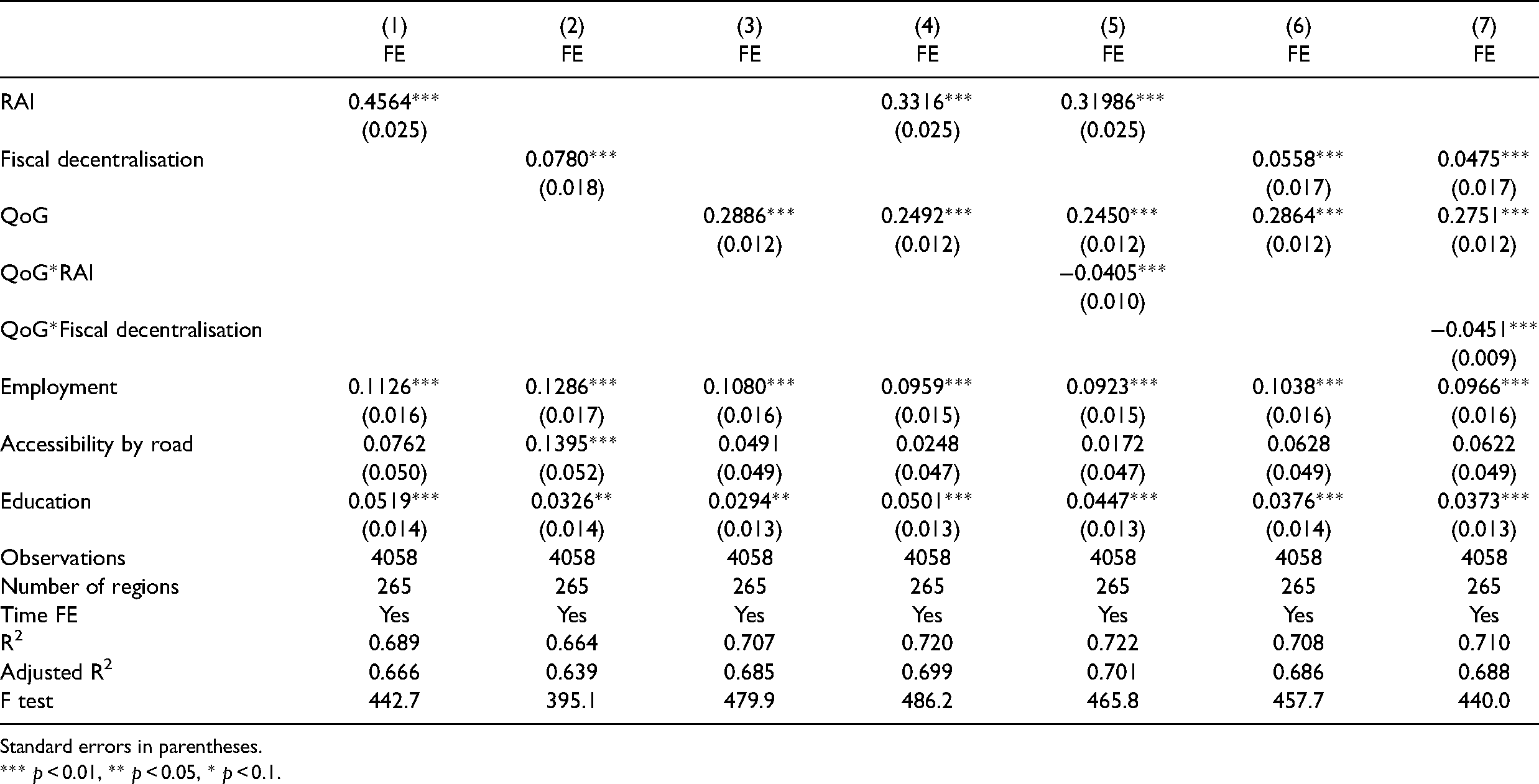
The results of the panel data analysis using fixed effects are presented in Table 1. This approach reproduces what is traditionally used by most research on decentralisation to date.
Decentralisation and quality of government (QoG) on GDP per capita growth.
Standard errors in parentheses.
*** p < 0.01, ** p < 0.05, * p < 0.1.
Table 1 presents the results for four different estimations. The first three columns estimate model (1) using the regional authority index (RAI), fiscal decentralisation, and quality of government (QoG) separately. The fourth and sixth columns reproduce the results of assessing both RAI and fiscal decentralisation jointly with QoG. Finally, columns (5) and (7) consider the interaction between RAI and fiscal decentralisation, on the one hand, and QoG, on the other.
There is a positive and significant association between government quality and regional growth, reinforcing results from previous studies (e.g. Charron et al., 2015; Charron and Lapuente, 2018; Rodríguez-Pose and Garcilazo 2015). Similarly, the positive and significant sign of the decentralisation coefficients is in line with some of the literature on the economic effects of decentralisation (Martínez-Vázquez and McNab, 2003) (Table 1, Columns 1 and 2). This may be a consequence of decentralisation spurring greater inter-jurisdictional competition and public sector efficiency (Ezcurra and Rios, 2020).
For regions with an exceptionally low government quality (three standard deviations below the EU average), decentralisation is not connected with economic growth. Those regions grow less, regardless of their level of decentralisation. Even at levels of decentralisation two standard deviations above the EU average, regions with low government quality are unlikely to grow. By contrast, having a relatively high government quality (e.g. three standard deviations above the EU average) always yields above-average growth. This impact increases with the level of decentralisation. On the whole, for a typical European region in terms of government quality, greater decentralisation increases growth. These results support the idea that “one-size-fits-all” regional development strategies can be counterproductive (Iammarino et al., 2019; Rodríguez-Pose, 2013). They also underscore how variations in government quality affect the impact of decentralisation on regional economic trajectories. Especially, it sends a warning about the need to consider government quality as a fundamental factor in the process of political decentralisation.
Regions with above-average fiscal decentralisation levels grow faster, while greater fiscal decentralisation represents a limited solution for regions with low government quality. Increases in fiscal decentralisation lead to lower economic growth returns—regardless of the regional quality of government—than improvements in political autonomy.
The controls go along with expectations. Higher levels of employment and education propel economic growth, which is not the case for accessibility by road (Rodríguez-Pose and Ketterer, 2020).
Spatial econometric analysis
The standard approach, however, overlooks how geographical proximity influences the potential impact of decentralisation and government quality on regional economic performance. As mentioned, decentralisation can trigger learning and competition effects that can enhance the economic returns of decentralisation. This would be the case when competition among decentralised jurisdictions leads to more efficiency and greater policy experimentation and innovation, resulting in better delivery of public services and policies. Hence, geographical decentralisation and government quality spillovers can shape regional growth (Bubbico, et al., 2017; Ezcurra and Rios, 2020). The use of spatial econometric models—and, in particular, of spatial Durbin models (SDM)—offers new insights into the modelling of decentralisation effects on growth. In other words, the use of spatial econometric models unveils potentially new associations among decentralisation, government quality, and economic growth, establishing whether the results of Table 1 stand when the conditions in neighbouring areas are considered.
The basic SDM model discriminates between direct, indirect, and total effects. It adopts the following form:
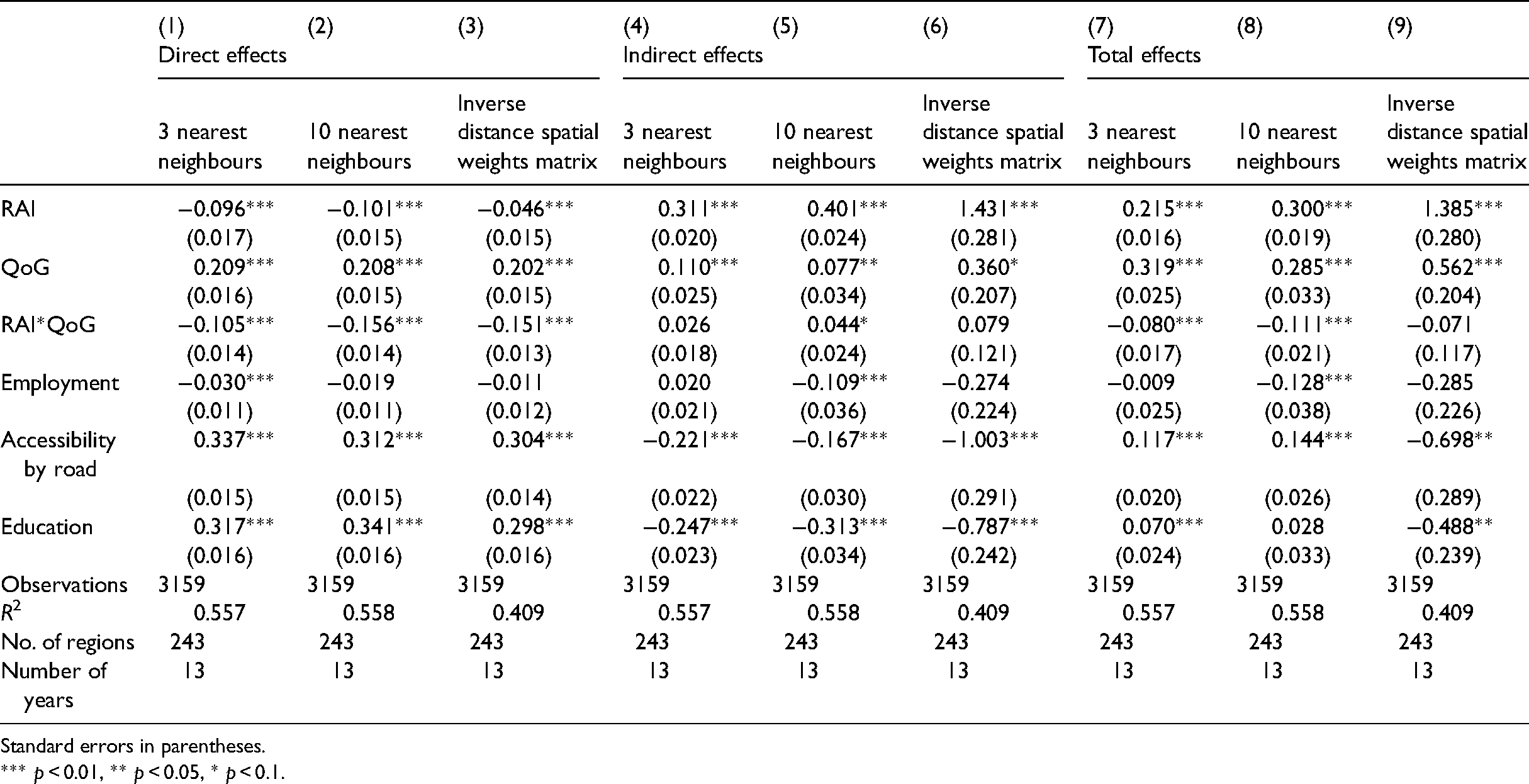
Table 2 presents the results of the econometric analysis using SDM (Columns 1–9) and controlling—in order to check the robustness of the results—for feedback effects from neighbouring regions through three types of spatially lagged approaches: a) considering only the three nearest neighbours by distance; b) the 10 nearest neighbours by distance; and c) using an inverse distance spatial weights matrix.
Spatial econometric models for political decentralisation.
Standard errors in parentheses.
*** p < 0.01, ** p < 0.05, * p < 0.1.
The results presented in Table 2 highlight the importance of the degree of decentralisation and government quality of neighbouring areas for economic performance. They differ from those presented in Table 1, depending on whether changes in levels of decentralisation or government quality happen in a particular region or in neighbouring areas. The total effects for the variables of interest are relatively similar to those in the basic panel data analysis, although some interesting differences emerge. Both decentralisation and quality of government are positively connected to economic growth, reinforcing results from previous studies (e.g. Martínez-Vázquez and McNab, 2003, for growth; Charron et al., 2015; Charron and Lapuente, 2018; Rodríguez-Pose and Garcilazo 2015, for government quality).
However, the SDM econometric analysis highlights that competition among decentralised governments, vying for better delivery of public policies and services, brings about considerable economic benefits. In contrast to the widespread belief that the benefits from decentralisation arise from the simple transfer of power and resources to subnational tiers of government, our results show that the economic benefits of decentralisation mainly accrue through indirect effects, rather than through direct effects. Regions grow more if surrounded by other, more decentralised regions than through their own level of decentralisation. They also grow faster if surrounding regions have a higher government quality. Indeed, looking just at the internal effects, more decentralised regions in the EU have generally grown less, not more (Rodríguez-Pose and Ezcurra, 2011). Hence, decentralisation per se is not a driver of regional growth. Only when it encompasses broader territories that compete with one another to deliver better and more efficient policies an economic benefit materialises. Why? Transferring power and resources to subnational tiers of government stimulates competition among regions that strive to produce better policies (Ezcurra and Rios, 2020). The outcome is greater in efficiency and mobilisation of underused resources (Oates, 1996; Rodríguez-Pose and Ezcurra, 2010). The economic impact of decentralisation is, thus, greatest when involving competition among neighbouring regions. More precisely, regional authorities may be motivated to perform more efficiently when under pressure from neighbouring decentralised regions with higher government quality. This pressure could be due to the risk of residents and firms voting with their feet. Inefficient decentralised governments may push citizens and firms away to locations with more effective policies or more competitive tax regimes. And said citizens may become aware of the policies, taxation, and economic dynamism of neighbouring regions and compare them to those provided by their region. However, this process may not be immediate. It can take time to permeate into variations in regional economic dynamism. Moreover, residents can benefit from public services supplied by surrounding regional authorities (e.g. De Siano & D’Uva, 2016).
Quality of government remains a powerful driver of growth regardless of whether we consider individual regions on their own or in relationship to the neighbours. European regions benefit from having high quality local governments, but also from being surrounded by other areas with equally good, if not better, government efficiency, low corruption, greater voice and accountability, and better rule of law. Moreover, decentralisation in areas with a low government quality is, as in the case of the panel data analysis, insufficient to overcome the deficiencies that mar the economic performance of these regions. These results remind us of the crucial role of institutions for economic development (e.g. Charron et al., 2015; Charron and Lapuente, 2018; Rodríguez-Pose, 2013; Rodríguez-Pose and Garcilazo, 2015; Tabellini 2010). They also indicate that, if neighbouring regions have better accessibility and human capital, the region considered is likely to lose out. Hence, since the overall effect of these two factors greatly depends on the balance between internal and external endowments and on the spatial weights matrix used (i.e. the number of neighbours being considered in the analysis), the results in Table 2 emphasise the need for sound, integrated, place-specific approaches (Iammarino et al., 2019). They also indicate that, as a whole, regions cannot free-ride on the accessibility or human capital of their neighbours.
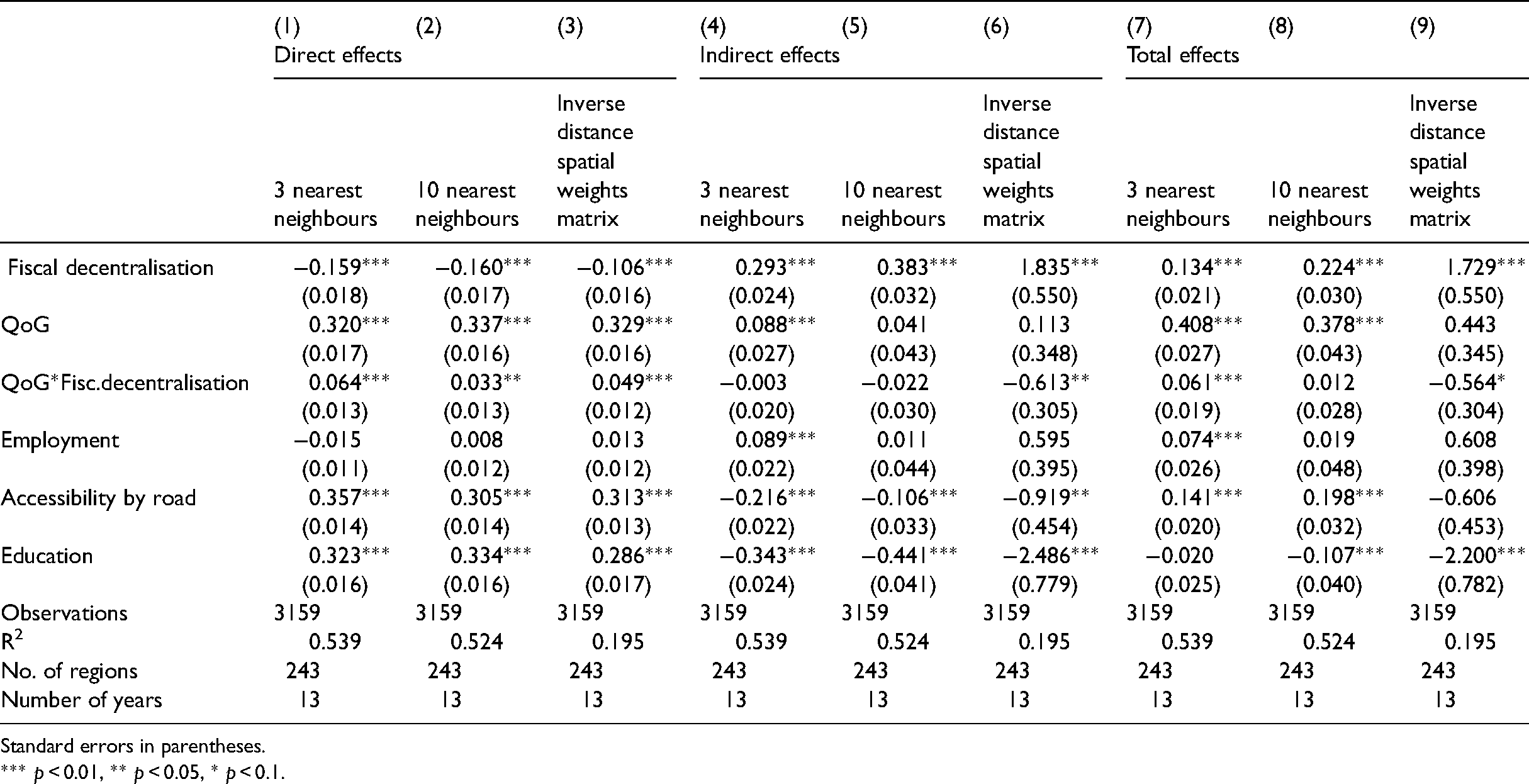
Finally, we test whether resource transfer (fiscal decentralisation)—without considering the transfer of power (political decentralisation)—has a similar contribution on regional economic outcomes. The results for fiscal decentralisation, presented in Table 3, support most of the previous findings. There most significant change concerns the interaction term. At similar levels of government quality, fiscal decentralisation yields greater economic returns than greater political decentralisation. This is a warning against unfunded mandates. Transferring more powers and resources—which tends to be the norm in decentralisation processes (e.g. Brueckner, 2004; Kyriacou et al., 2015; Oates and Schwab, 1988; Prud’homme, 1995)—can be detrimental for growth, especially in low government quality areas. Transferring more resources may lead to marginally better outcomes as a result of problems primarily linked to the transfer of power.
Spatial econometric models for fiscal decentralisation.
Standard errors in parentheses.
*** p < 0.01, ** p < 0.05, * p < 0.1.
Conclusion
Research on decentralisation has generally neglected the fact that the economic success or failure of decentralisation processes depends not only on the level and type of decentralisation of a region but also on the quality of the government the powers and resources are devolved to. They are also related to the level of decentralisation and government quality government of the broader geographical area where an individual region is inserted. Widespread decentralisation processes can trigger growth-enhancing competition effects in terms of public policy and service delivery and innovation.
In this paper, we have addressed this gap in our knowledge by implementing two econometric methods—a panel data fixed effects analysis, reproducing traditional approaches to the economic impact of decentralisation, and spatial autoregressive models, considering the competition effect from other decentralised jurisdictions—at a regional level in Europe. We found that regional government quality is a powerful driver mediating the economic returns of decentralisation. The economic returns of decentralisation improve when the quality of devolved administrations is high (or, at least, as high as that of the national government) and when it improves. Regions with better local governments reap significantly higher benefits from decentralisation than when powers and resources are transferred to regions with low government quality. In the context of reforms of regional government at national and supra-national levels (Iammarino et al., 2019), the results provide support for prioritising horizontal coordination and improvements in administrative capacity as a way to make the most from decentralisation.
The economic returns of decentralisation also depend on being surrounded by regions with high government quality. Decentralisation works best when regions with autonomous powers are encircled by other regions with relatively high levels of government quality. This triggers competition learning processes, resulting in policy innovation and in more efficient delivery of public goods and services.
Overall, the analysis supports the idea that more decentralisation is not necessarily connected to better economic outcomes, unless the transfers of powers and resources are conducted to governments with the capacities to implement adequate public policies (Muringani et al., 2019). Improving local government quality is thus a fundamental precondition for decentralisation. Making sure that the improvements in government quality not only concern one specific region but also its neighbours also guarantee greater economic returns from decentralisation. Decentralisation processes also need to avoid unfunded mandates, which represent a significant drag on any potential economic benefits of the transfer of powers and resources to subnational tiers of government. And decentralisation works best when it covers whole swathes of territory. Any process of decentralisation needs to take into consideration conditions in government quality in surrounding areas to maximise its economic impact.
As a whole, for decentralisation to work a holistic approach needs to be adopted, involving relatively large geographical scales—at the national or supranational level. This would facilitate greater horizontal and vertical coordination, the establishment of common goals, prevent unfair competition, and, perhaps more importantly, ensure that the transfer of powers and resources to subnational tiers of government yields the best economic outcomes. Only in this way can the expected “economic dividend” of decentralisation be delivered while, at the same time, avoiding the potential pitfalls which have besieged many decentralisation processes across the world involving territories that were ill-prepared in terms of government capacities to deal with greater transfers of powers.
Supplemental Material
sj-docx-1-epn-10.1177_0308518X221118913 - Supplemental material for The economic returns of decentralisation: Government quality and the role of space
Supplemental material, sj-docx-1-epn-10.1177_0308518X221118913 for The economic returns of decentralisation: Government quality and the role of space by Andrés Rodríguez-Pose and Vinko Muštra in Environment and Planning A: Economy and Space
Footnotes
Acknowledgements
We are grateful to the editor in charge, Jessie Poon, and to the three anonymous reviewers for their carefully crafted comments and suggestions, which greatly contributed to improving the paper. The usual disclaimer applies.
Declaration of conflicting interests
The authors declared no potential conflicts of interest with respect to the research, authorship, and/or publication of this article.
Funding
The author(s) received no financial support for the research, authorship, and/or publication of this article.

Supplemental material
Supplemental material for this article is available online.
Notes
References
Supplementary Material
Please find the following supplemental material available below.
For Open Access articles published under a Creative Commons License, all supplemental material carries the same license as the article it is associated with.
For non-Open Access articles published, all supplemental material carries a non-exclusive license, and permission requests for re-use of supplemental material or any part of supplemental material shall be sent directly to the copyright owner as specified in the copyright notice associated with the article.
