




Abstract
The critical platform studies literature has built a compelling picture of how techniques like worker (mis)classification, algorithmic management and workforce atomisation lie at the heart of how ‘work on-demand via apps’ actively restructure labour. Much of this emerging scholarship identifies that platform workforces are predominantly comprised of migrant and racially minoritised workers. However, few studies theorise migration and race as structuring logics of the platform model and the precarity it engenders. This paper addresses this gap by exploring how the platform economy – specifically work on-demand via apps – both shapes and is shaped by historically contingent contexts of racialisation, and their constitutive processes such as embodiment and immigration policy/rhetoric. Beyond identifying the over-representation of racial minorities in the platform economy, it argues that processes of racialisation have been crucial at every stage of the platform economy's rise to dominance, and therefore constitutes a key organising principle of platform capitalism – hence the term ‘racial platform capitalism’. In doing so, this paper draws on the racial capitalism literature, to situate key platform techniques such as worker (mis)classification and algorithmic management as forms of racial practice, deployed to (re-)organise surplus urban labour-power following the 2008 financial crisis. This framework will be explored through an ethnographic study of Uber's rise in London. Through this, the paper demonstrates a co-constitutive relationship, where the conditions of minoritised workers in a global city like London post-2008, and the political economy of platform companies can be said to have co-produced one another.
Introduction
The growth of the digitally mediated gig economy is having transformative effects on urban labour markets globally. Critical labour scholars have built a compelling picture of how ‘platform capitalism’ (Srnicek, 2017) actively restructures the labour market through regulatory, technological and political strategies that engender platform-based forms of urban precarity (De Stefano, 2016; Rosenblat, 2018; van Doorn, 2017). For many, platformisation constitutes a form of class composition (Aloisi, 2015; Srnicek, 2017) towards a generalised ‘precariat’ (Standing, 2014). This scholarship broadly acknowledges that most platform workers are migrants and/or racialised minorities. Nonetheless, race and migration have yet to be considered a central analytic category of platform capitalism as an unfolding process; the platform worker is implicitly treated as a deraced and citizened subject, despite the empirical reality suggesting otherwise. This article redresses this by exploring how the platform economy – specifically ‘work on-demand via apps’ – shapes and is shaped by historically contingent racial politics. Using a racial capitalism framework, it highlights intersections between the hierarchical (yet dynamic) categorisations of workers and bodies through racialisation, and the proliferation of new, undermined categories of worker under platformisation.
To do this, the paper departs from Artioli's observation that ‘platforms are an urban phenomenon’ (2018: 2) and outlines how the racial character of post-2008 urban sites where the on-demand platform economy is emerging provides crucial but understudied context for understanding platformisation. Indeed, both literatures are concerned with how capital re-organises urban labour-power in times of crisis; platforms absorb surplus populations unable to access formal, standard employment following the financial crisis (Croce, 2020; Rosenblat, 2018), while racial capitalism scholars situate racialisation as a process through which capital (re)draws boundaries around surplus populations via their coding as expendable and less-than-human, despite being essential to urban growth. The question therefore becomes: how do platformisation and racialisation processes constitute one another in organising post-2008 urban labour-power?
The paper takes Uber in London as its case study. It explores how the constitution of London's Uber drivers as disposable and dangerous – through and alongside their racialisation as ‘brown’ migrant outsiders – is ‘coded’ into the legal, technological and social dynamics of the platform's model. As a global city, London has been a key strategic site of experimentation and development for both the platform economy and the reproduction of racial capitalism, making it pertinent for the study of the racial dynamics of platform capitalism. Yet, the intention is not to develop a metatheory of how such dynamics unfold; at different spatio-temporal locations, processes of social differentiation that facilitate platform exploitation will be articulated differently. Rather, this paper looks to introduce concepts of social differentiation to the platform labour literature and establish racialisation as central to this global story. Indeed, whilst the conditions outlined are particular to London, the findings provide insight into how the making of platforms at grounded sites shapes how the model moves throughout the world; the ‘conjunctural geographies of platform urbanism’ (Graham, 2020) both tether and untether platforms to space. Crucially, platform labour is not an abstract model concocted in Silicon Valley; it is a grounded phenomenon, whose norms are being developed through and alongside existing social relations. This includes racial and migrant divisions of labour that shape and are shaped by key urban sites in which platforms are developing. Unpacking how platformisation interacts with these racialised labour relations is therefore crucial to understanding ‘actually existing platformisation’ (van Doorn et al., 2021).
The paper begins by summarising how the literature situates platformisation as a ‘fix’ following the 2008 global financial crisis (GFC) through the production of ‘on-demand’ workforces. It will demonstrate how platforms subsume surplus populations produced through and alongside the 2008 crisis, organising them into a cheap, disposable workforce in ways that generate fresh sites of accumulation. It will then explore how the racial capitalism scholarship illuminates the racialised and racialising processes underpinning the production of surplus populations. In proposing a relationship between the ‘platform fix’ and the ‘racial fix’ post-2008, this paper argues that platformisation is deeply invested in the social constitution of surplus populations as disposable, dangerous and less-than-human – and therefore in the racialisation processes that govern these dynamics (particularly in major cities). The paper therefore goes beyond extant contributions that focus on race and platforms through a discrimination framework. Racialisation and its constitutive processes (like migration and embodiment) are instead framed as an organising principle of platform capitalism; platformisation itself is situated as an innovation of racial capitalism. The claim, therefore, is that there is something distinctly racial about how platform capitalism is re-organising urban labour workforces.
The paper expands upon these provocations by demonstrating how the race and migration politics of post-2008 London produces the social and political-economic context for platformisation. It begins by outlining how the racialised shrinking of the welfare state through immigration policy and neoliberal restructuring produces the surplus populations from which Uber draws its on-demand workforce. This will be situated within a broader history of in/exclusion of South-Asian men from the formal labour market and welfare provisions. The paper then unpacks how the disciplinary deployment of Uber's management algorithms shapes and is shaped by how South-Asian men are racialised, as outlined in Silva (2016) and Bhattacharyya’s (2008) work on ‘brown’ as a racial formation. Particular attention is paid to the specific modes through which ‘brownness’ is deployed as a racial category, and how this dovetails with racial formation in data-driven systems.
The on-demand platform fix: Organising surplus populations in the post-2008 global city
Critical platform labour scholarship situates platformisation as a form of class composition; a way of re-organising urban labour in ways that generate fresh sites of accumulation following the 2008 GFC (Rosenblat, 2018; van Doorn, 2017). Under this rubric, the creation of platform workforces, with their specific technical, political and social formation, exist as part of a broader political economic ‘fix’ post-crisis (Hodson et al., 2020). This structural shift is captured by Srnicek's term ‘platform capitalism’ (2017). On-demand work via apps are a subset of the platform economy, which involves allocating ‘local, service-oriented tasks’ on-demand through location-based apps (ILO, n.d.). As this paper focuses on work on-demand via apps, the use of terms like ‘platforms’ and ‘platform economy’ will henceforth exclusively refer to this model.
Central to the ‘platform fix’ is the production of a digitally-mediated ‘on-demand workforce’ (De Stefano, 2016), subject to particular modes of organisation. The platform fix is an example of a spatial fix that depends on technological innovation (Harvey, 2001); geolocation apps like Uber deploy algorithmic technologies to organise worker mobility to provide on-demand services. This entails compressing time and space; platform technologies allow more services – from taxi driving to childcare – to be delivered more frequently, more immediately and in more territories than before. This model engenders ‘dual value production’: the ‘monetary value associated with the service transaction’ and ‘the more speculative and volatile types of value associated with the data generated through service provision’ (Badger and van Doorn, 2020: 2). Scale is therefore central to the survival of a platform: generating the greatest number of interactions requires having as many workers and users on the platform as possible at any one time.
As heavily networked, intensified sites of world-making (Sassen, 2010), global cities hold strong significance for the growth of the data-driven platform economy. London, this paper's case study, was the eleventh city Uber entered, 17 months after launching in San Francisco. Then-CEO Travis Kalanick identified London as integral to the company's growth, declaring at the time: ‘we’re just trying to strap ourselves into this rocket ship’ (Sawers, 2012). In turn, the availability of an on-demand, digitally accessible service workforce has become key to urban competitiveness in the post-2008 global economy (Taylor-Buck and While, 2015). The reliance of platforms on sizeable venture capital, pre-existing infrastructure, a large service sector and rapidly scale-able network effects creates a co-constitutive relationship between the post-2008 global city and the global platform (Sadowski, 2020). As this paper will demonstrate, the availability of a racialised and/or migrant service workforce in global cities is a central, but undertheorised part of this story.
The composition of an ‘on-demand’ workforce through platformisation is therefore intimately tied to the post-2008 urban contexts in which the platform economy has emerged. For capital, platformisation is a ‘fragile spatial fix,’ unlocking new sources of value through data-driven accumulation (Hodson et al., 2020). This dovetails with the gap created by austerity-driven deficits in government funding of urban services like transport, allowing for platforms to integrate into the fabric of major cities. In turn, the failure of traditional financial and political institutions to protect livelihoods and shrinking availability of standard employment saw workers turn to platforms to supplement or replace lost income. As Marčeta (2021) argues, having a low barrier of entry situates platforms as a site of subsumption of workers unable to find employment in the standard labour market. Marčeta draws on the Marxist concept of relative surplus population or the ‘disposable industrial reserve army’ (Marx, 1976: 784) to describe the populations from which platforms draw. This includes those who are both excluded and/or have precarious access to standard employment and welfare state provision (Greer, 2016). These populations are strategically included and excluded from standardised wage-labour according to the needs of capital, and their systemically engendered low standard of living creates ‘a mass of human material always ready for exploitation by capital in the interests of capital's own changing valorisation requirements’ (Marx, 1976: 784). The constant production of this pool of cheap unemployed and underemployed population is therefore a ‘necessary product of accumulation’ (784), as it ‘enables capitalists to maintain wage discipline and inhibit working-class solidarity’ (Farris, 2019: 112).
The rise of the on-demand platform economy in the urban context must therefore be understood in relation to the unemployment crisis following the 2008 GFC, which created and recomposed the relative surplus populations from which labour platforms now draw. Indeed, the platform model relies on maintaining a seemingly endless stream of workers available to accept, within minutes, ‘gigs’ requested by consumers. To function, this requires more workers being ‘plugged in’ to the app than ‘gigs’ available at any given time and location. The worker is not paid for time spent waiting, ‘plugged in,’ despite this waiting being central to the platform's promise of an on-demand service. The model therefore relies on maintaining and managing a constantly available pool of surplus labour in its operative locations. The uncertain promise of a potential ‘gig’ and lack of opportunity elsewhere, keeps the worker attentive to the platform, even while unpaid. For this dynamic to function, workers must be insecure, flexible and easily interchangeable (Altenried, 2021).
The production of an ‘on-demand’ workforce is facilitated through two, related processes: worker (mis)classification and algorithmic management. Through these legal and technological strategies, platforms keep labour and operational costs low without compromising on scale, whilst maintaining the availability of more workers than jobs at any one time and location. Worker (mis)classification involves the legal classification of platform workers as self-employed, independent contractors rather than employees. This engenders a ‘worst of both worlds’ model where workers are considered self-employed when shouldering operational costs and being denied worker protections, yet the degree of management control often exceeds standard employer/employee models. In turn, algorithmic management allows large-scale workforces to be structured remotely, with minimal use of human supervisors. Worker behaviour and performance is constantly ‘tracked and evaluated’ to inform ‘automatic implementation of algorithmic decisions’ (Möhlmann and Zalmanson, 2017: 5). Algorithmic management depends on the legal denial of employment protections through worker (mis)classification; without the right to a fair dismissal, workers can be ‘frictionlessly’ disposed of from the platform (Rogers, 2016). Algorithmic management and worker (mis)classification are therefore key to making the platform workforce cheap, precarious and interchangeable – and therefore, ‘on-demand’. As this paper will demonstrate, both strategies are deeply invested in how the platform workforce is racialised. However, the paper will first turn to the racial capitalism literature to draw its analytic terms.
The racial fix: Racial capitalism and the production of surplus populations
Racial capitalism scholars situate social differentiation as a central structuring principle of capitalist modernity and class-making. Drawing on Marxist traditions of combined and uneven development, modern colonialism is situated as ‘integral to capitalism's beginnings, expansion and ultimate global entrenchment’ (Parry, 2013: 10). Processes of racialisation produced and consolidated by these historical moments provide(d) the ‘disposable labour’ required by capitalist modernity; here, race functions as a necessary ‘categorical system in terms of which disposable life could be legitimised’ (Goodrich and Bombardella, 2016: 5). At the heart of differentiation under racial capitalism is the need to create historically contingent hierarchies of labour-power (Roediger, 2017; Virdee, 2019).
Here, ‘race’ does not rely on static notions of racial difference (Omi and Winant, 2014). The ‘racial’ refers to an active process – the ‘constitution of difference through assigning particular characteristics and value to visible “Others”’, mediated ‘through discourses and practices that operate across different spatial scales’ (McDowell, 2009: 74). It describes a ‘set of techniques and a formation, and in both registers the disciplining and ordering of bodies through gender, sexuality, dis/ability and age (Bhattacharyya, 2018: x). Indeed, the ‘racial’ shapes and is shaped by multiple techniques of embodied othering which, together, hierarchically organise labour-power and unevenly distribute precarity, vulnerability, resources and rights throughout populations (Gilmore, 2007; Strauss, 2017). These processes of differentiation are always animated and (re-)constituted by local spatio-temporal contexts; whilst differentiation techniques are experienced across social and spatial scales, they are always articulated (Hall, 1983) through and alongside the local. This is while tying populations together in an interdependent, interconnected world system of accumulation (Robinson, 2005).
The organisation of labour-power therefore becomes both a racialised and racialising process. To justify organising particular populations into particular kinds of work, racialised characteristics associated with visible ‘Others’ are ‘mapped on’ to ideas about the suitability of particular ‘working bodies’ for different kinds of work (McDowell, 2009: 74). Different kinds of labour become associated with racialised bodies that perform them, which shapes how labour is socially valued, regulated and managed. Racialisation itself is engendered through a repertoire of discourses and images that help confer material conditions; these discourse and images, and their association with particular bodies/labour is consolidated through processes ranging from moral panics to the construction of legal form (Hall, 1997). Therefore, the racialisation of labour is not just about workforce demographics, but about how labour is socially and culturally represented; there exists a ‘complex recursivity between material and epistemic forms of racialised violence, which are executed in and by core capitalist states with seemingly infinite creativity’ (Melamed, 2015: 77).
In this vein, a key contribution of racial capitalism scholarship has been towards understanding how surplus populations are produced through and alongside processes of racialisation. If, as Marx argued, ‘disposability’ is a key feature of the reserve army (1976: 784), racial capitalism contends that such disposability is culturally, socially and politically inscribed into particular bodies through racialisation. Rooted in colonial and slave legacies, race has therefore historically served, and continues to serve ‘as a mark of membership in the surplus labouring population’ (McIntyre, 2011: 1489). Through intersecting cultural and material processes that mark certain bodies as disposable, dangerous, burdensome or sub-human, racialisation creates the conditions for certain groups to be strategically included in and excluded from standard economic activity – and defines the terms on which they are in/excluded. These racialisation processes are often tied with migration politics, particularly in colonial cores. Here, the state uses racialised/ing techniques of categorisation, bordering, enclosure and displacement to ‘regulate populations it deems surplus’ and ‘create new opportunities to extract profit’ (Bird and Schmid, 2022). Indeed, as well as helping create surplus populations, race shapes how surplus populations are organised and disciplined through these techniques. Race therefore becomes a central organising principle of capitalism itself (Farris, 2019; Gilmore, 2007).
Racialisation/ing processes are particularly called upon during economic crisis. The reanimation of boundaries around populations deemed worthy and disposable, deserving and undeserving and productive and unproductive becomes a ‘fix’ through which new sites of accumulation by dispossession are generated (Gilmore, 2007; Melamed, 2015). Racialised/ing discourses provide justificatory logics through which dispossessing processes take place: from state abandonment and/or violence, to displacement and bordering; from economic exclusion to enforcement of predatory debt. The politics of scarcity that accompany crises of capital particularly intensifies racial boundary-making around socially differentiated populations. Here, global cities are a key strategic site through which racial capitalism is reproduced; with large migrant and racial minority populations, and the presence of complex systems of racialised violence, exploitation, dispossession and discipline (Sassen, 2010; Simone, 2016), global cities both produce and rely upon the pools of racialised, cheap labour provided by surplus populations (Picker et al., 2019).
Race therefore becomes a means through which surplus populations are re-organised across and within borders, restructuring space in ways that generate newly exploitable formations of labour-power. The (dis)engagement of surplus populations through racialised processes therefore becomes a ‘racial fix’ employed following crises (Knox, 2020; Mumm, 2017). In post-2008 context, as access to standard employment shrinks, and racialised populations become subject to an increasingly brutal matrix of state and capital-driven exclusions (like hostile immigration regimes, gentrification and increased policing), an expanded pool of exploitable labour becomes available to be absorbed into new labour regimes (Bhattacharyya, 2018). This includes the predatory platform labour model (Dubal, 2021).
Connecting the racial fix and platform fix
The platform and racial capitalism literatures strongly echo one another: both are preoccupied with how capital (re-)organises labour during crisis through processes of (re-)categorisation. Critical platform scholars situate platformisation as a response to capitalist crisis through renegotiating worker categories and subsuming surplus populations. Relatedly, racial capitalism scholars situate racialisation as a ‘fix or an amplification’ (Bhattacharyya, 2018: 9) through differential exploitation of labour-power and the marking of surplus populations. In turn, the global cities that provide key strategic sites for the growth of the platform economy are often marked by sharp racial and migrant divisions of labour and infrastructures of racial violence; indeed, the urban sectors being platformised, such as domestic work and taxi driving, are those historically dominated by migrant and/or racialised workers.
Yet, the role of race and migration politics in producing platform workforces remains underdeveloped in the platformisation story (van Doorn et al., 2020). When addressed, race is analysed through ‘discrimination’ frameworks; for example, unpacking racially uneven experiences of algorithmic management (Rosenblat et al., 2017; Edelman et al., 2017) and highlighting the impotence of anti-discrimination law in protecting platform workers (Belzer and Leong, 2017). There is less focus on how platformisation itself relies on and engenders racial and migration politics in its transformation of work. This is despite the growing literature on the centrality of race in establishing how labour is situated, regulated and valued. Notable exceptions to this include recent works by McMillan Cottom (2020), Dubal (2021) and Altenried (2021).
This theoretical underdevelopment is continuous with how both technology and capitalism are conceptualised in academic and popular imaginations. In Orthodox Marxist scholarship, accounts of capitalist modernity and class composition efface the inherently racialised/ing mechanisms that exist within them (Virdee, 2019). This erasure has been critiqued by Marxist-Feminist (Davis, 1983; Federici, 2004; Mies, 1998) and Black Marxist (Kelley, 2017; Melamed, 2015; Robinson, 2005) literatures as a problem of epistemological Eurocentrism (Anievas and Nişancioğlu, 2015), resulting in problematically ‘race blind’ historicisations of actually-existing capitalism. Here, race and racialisation are situated as epiphenomenal, rather than co-constitutive of, capitalist formations. The underemphasis of race in the platform capitalism literature is therefore rooted in a longer history of capitalism being deracialised in Orthodox Marxist scholarship.
In public imaginaries, technology is also conceptualised as a deracialised space (Crawford, 2021). Technological fixes are associated with neutrality – they purported to remove the ‘human’, and therefore human bias, from decision-making processes. Indeed, Uber capitalises upon this techno-solutionist promise; Ben Jealous, former CEO of the National Association for the Advancement of Colored People (NAACP) and partner at Kapor Capital, an early investor in Uber praised ‘ridesharing companies’ as ‘more colour-blind’ (Jealous, 2015) than traditional taxi services. This exemplifies the logic that racial thinking can be ‘designed out’ of algorithmic technologies. Scholars of race and technology have critiqued this assumption (Benjamin, 2019; Noble, 2018; Wang, 2018), demonstrating how data-driven technologies are shaped by the social values in which they are financed, designed, developed and deployed – and vice-versa. This includes racial hierarchies, categories and formations, which are not only reflected and reproduced but also can be recreated by technology. Yet, data-driven systems are perceived as ‘more objective of progressive than the discriminatory systems of a previous era’ (Benjamin, 2019: 23), concealing their racialised and racialising effects.
The race-neutrality of technology is shored up by what racism is understood to be and look like in public imaginaries – typically as highly mediatised, visual spectacles of racial violence and stereotyping. Racism is conceived to exist when racist imagery or language can be seen or heard – or, when an action or decision is traceable to an individual's racial prejudices. Within these parameters, the ways race co-constitutes technology – through ‘proxies, correlations, inferences’ (Phan and Wark, 2021: 4) – are not intuitively legible as racial. In these ways, dominant framings of concepts central to this paper – ‘racial’, ‘technology’ (by extension, ‘platform’) and ‘capitalism’ – converge to create theoretical blockages between them.
Case study: Uber in London
The empirical part of this paper will explore the racial dynamics of platform capitalism through a study of Uber in London. London's taxi economy comprises two segments: private hire vehicles (PHV) and taxicabs. Taxicabs – ‘black cabs’ – can be hailed from the street, whereas PHVs must be pre-booked. PHVs have historically offered a more affordable, locally available service compared to taxicabs, which tend to operate largely in Central London. When Uber entered London in 2012 it specifically transformed the PHV sector, which had previously largely been run by locally owned minicab firms – several participants in my research had been working at minicab firms and moved to Uber as clients shifted towards the platform. As it stands, all app-based drivers are PHVs, but not all PHVs are app-based drivers; although dwindling, a small number of locally run minicab firms are still in operation. Indeed, much of the PHV sector in London is now mediated via apps, of which Uber is the largest player 1 .
The PHV workforce, much of which is now represented by Uber and other app-based drivers, predominantly comprises racialised minority men 2 – mainly ‘Asian or Asian-British 3 ,’ whereas the taxicab industry is 67.9% white British. This racial division of labour has historically existed in London's cab economy due to differing barriers to entry; a PHV licence takes twelve weeks to acquire, whereas taxicab drivers take two years to pass the topographical ‘Knowledge Test’ and spend around £45,000 purchasing a black cab (Skok and Tissut, 2003). This need for time and upfront capital makes taxicab driving less viable for migrant and racially minoritised workers (Lyon et al., 2011). (Figures 1 and 2)
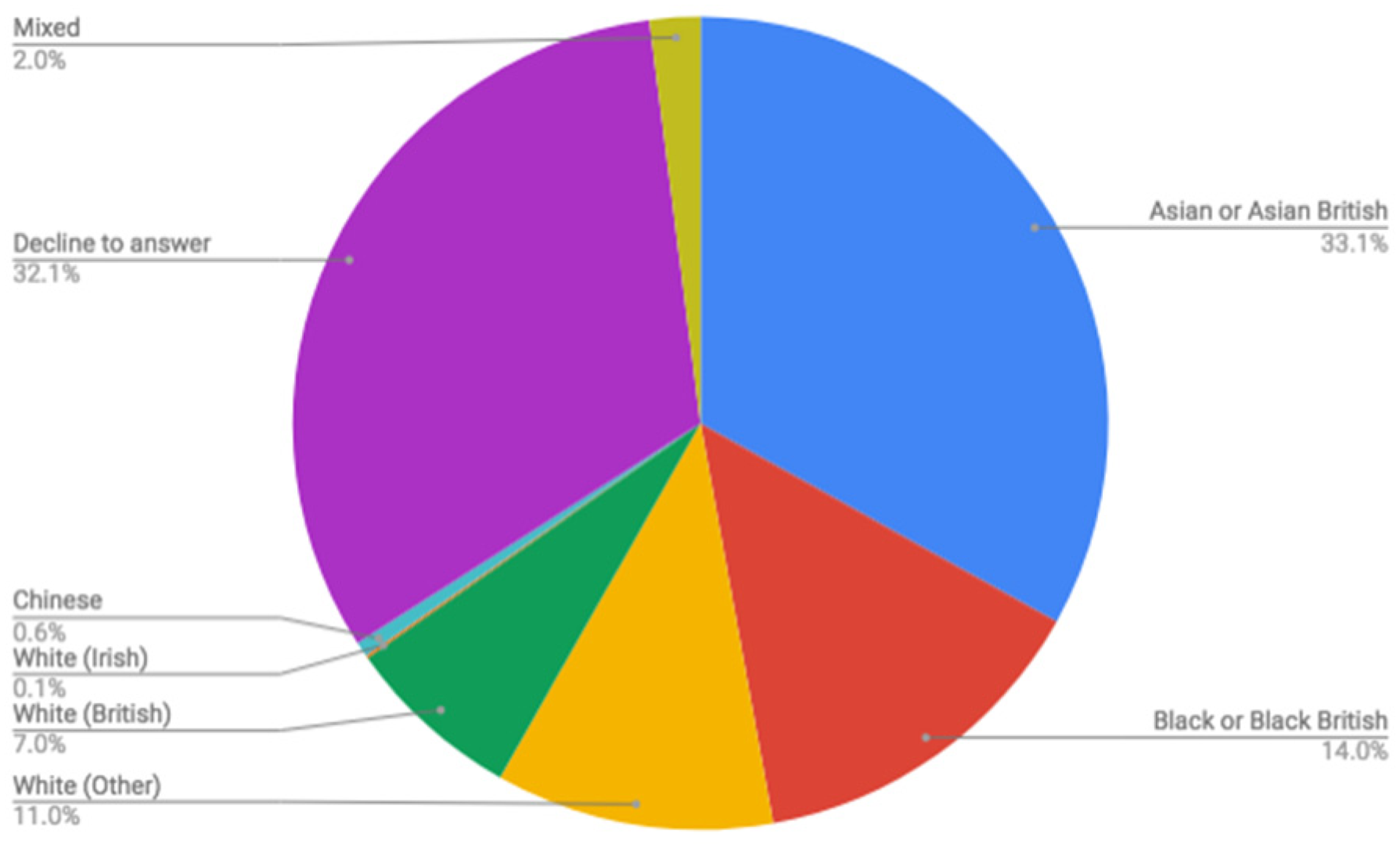
Composition of London’s PHV drivers (TfL, 2018).
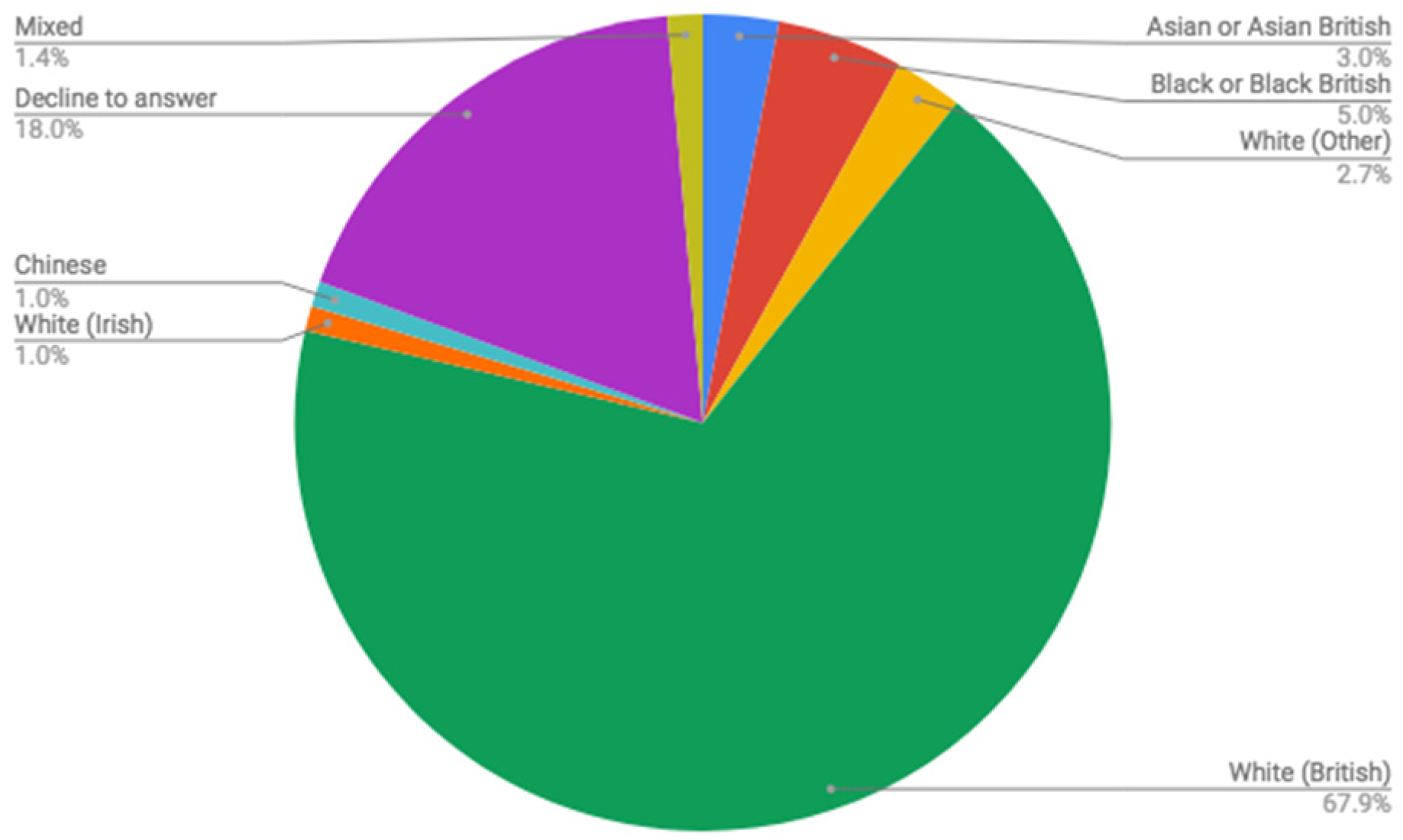
Composition of London’s taxicab drivers (TfL, 2018).
The case study analysis will demonstrate how Uber's transformation of the PHV sector shapes and is shaped by these racial histories and the contemporary racial character of London post-2008. It begins by exploring how the deployment of worker (mis)classification constitutes a form of racial practice that relies upon and engenders racialised labour segmentation. It then explores how this is inflected by the rise of hostile immigration policy following the 2008 GFC. Finally, it explores how the racialisation of Uber drivers as ‘brown’ through a series of moral panics informs the deployment of algorithmic management as a racialised disciplinary practice.
The findings of this paper are drawn from semi-structured interviews with 30 drivers, conducted over six months through ‘ride-alongs’ (Rosenblat, 2018), and whilst undertaking observation at a geo-fenced PHV car park by Heathrow Airport, where Uber drivers must wait for airport work. Ethnographic notes were also generated whilst volunteering as a caseworker for UPHD, a trade union representing app-based drivers in London. As a volunteer, I took on dozens of driver cases, most of whom had been ‘deactivated’ by Uber. This process provided unique insight into the compounding racialised vulnerabilities Uber drivers experience – including difficulties with immigration documentation, lack of employment protections and ruthless ‘management’ by a punitive algorithmic technology. The final part of this section also uses discourse and image analysis to unpack how Uber drivers are racialised as ‘brown’ through moral panic.
Worker (mis)classification as racial practice
The (mis)classification of platform workers as independent contractors is central to producing on-demand labour, as it facilitates the maintenance of a cheap, easily disposable/interchangeable workforce. The evasion of standard labour regulations through (mis)classification has been shown to cut labour costs by 30% (van Doorn, 2017: 902), by denying entitlements like sick pay and pensions. Worker (mis)classification also exempts platforms from paying the full cost of employing every worker for time ‘plugged in’ to the app, despite ‘log-in time’ being central to the platform model. Instead, workers are compensated only whilst completing an assigned task. (Mis)classification also makes hiring (‘onboarding’) and firing (‘deactivating’) workers easier – ‘onboarding’ bureaucracy is minimal, and workers are not entitled to lengthy and costly disciplinary/dismissals processes of standard employment.
Some elements of worker (mis)classification have been successfully challenged in the UK Supreme Court (Uber BV v Aslam 2021), which granted Uber drivers limb-b worker status, entitling them to some rights like holiday pay and minimum wage. However, Uber's ability to embed itself in London's transport landscape has relied on (mis)classifying workers for almost a decade – this legal formation is therefore integral to understanding Uber's rise in London. Furthermore, key elements of worker (mis)classification remain intact: Uber continues to ‘taskify’ labour, paying only for time transporting passengers, despite the ruling stating otherwise, and drivers still have no fair dismissal rights. Finally, at the time of writing, this ruling applies only to Uber and Addison Lee in the UK – the rest of the on-demand platform economy remains reliant upon workers being classified as self-employed contractors.
Drawing on a US context, Dubal (2021) connects the denial of employment rights to platform workers through legal (mis)classification with the historic exclusion of Black workers from New Deal labour protections. Such measures enabled early 20th century industrialists to retain the cheap, disposable Black labour upon which they relied, despite the formal end of slavery. The racialised effects of these measures were achieved by using sectoral and geographical proxies, with the concentration Black workers in domestic and agricultural labour in Southern states itself being an inherited legacy of US slavery.
In London, a similarly iterative relationship exists between historic racial carve-outs from employment protections, and contemporary (mis)classification of racialised platform workforces. However, this relationship is not driven by the settler-slavery dynamic of US racial capitalism Dubal outlines. Rather, it is inflected by Britain's colonial history, which shapes the racialised reserve army of labour powering London's urban growth. This colonial history is a key driver of racialised surplus populations moving from colony to metropolitan centres – indeed, London's global city status, primed for entry by platforms wishing to achieve such ‘global’ status, continues from its history as a colonial core (King, 2015). In this vein, platform worker (mis)classification draws on a legacy of state and market collaboration to strategically include (and often actively recruit) racialised workers during economic boom and exclude those same workers during economic crisis. This strategic in/exclusion is marked by the racialised mediation of access to the welfare state via immigration regimes, the scarcity logic of neoliberal austerity and survival strategies employed by racialised workers in response to their conditions.
While its demographics have varied, London's working class has historically been marked by its multiracial character and racial division of labour (Wills et al., 2009) – a racial labour politic that has always been constituted through and alongside migration politics (McDowell, 2009; Tilley and Shilliam, 2018); from early 1800s Irish migration, to labour-based recruitment from former colonies during Windrush, to the expansion of free movement to include Central and Eastern-European workers in 2004 (Virdee, 2019). Immigration controls and discourses have historically functioned as a ‘tap regulating the flow of labour,’ and a ‘mould shaping certain forms of labour’ (Anderson, 2010: 301) constituted through and alongside the race-migration nexus. These racialised workers populate London's reserve army of labour – doing the poorest conditioned work during economic boom, while facing labour market exclusion during economic crisis (Cross, 1992; Miles, 1982). Furthermore, the neoliberal scarcity logic and heightened racist populism that emerges during financial crisis typically lead not only to a shrunken welfare state overall but also specifically reduced access for non-citizens through immigration law, reducing social safety nets available to migrant workers.
Consequently, London's racialised workers have turned to varying forms of self-employment and informal work as a survival strategy during periods of crisis (Jones et al., 2012; Ramdin, 1987). Virdee (2006) charts this in the context of self-employment amongst South-Asian men – particularly of Bangladeshi and Pakistani descent. Pakistani and Bangladeshi communities in the UK occupy a particular racialised class position – data from the Institute of Employment Relations shows their access to the formal economy to be not only consistently lower than other ethnic groups, but marked by fluctuation (Hogarth et al., 2009). This oscillating in/exclusion from the labour market is a key marker of surplus population status.
Virdee connects the shift of Pakistani and Bangladeshi workers ‘from textile mills to taxi ranks’ (Kalra, 2000) to the racialised fallout of 1970s deindustrialisation. The collapse of their post-war manual and factory-based employers led Pakistani and Bangladeshi men to ‘disproportionately occupy the ranks of the new service sector workforce, including as insecure, self-employed, sub-contracted workers’ (Virdee, 2006: 611) – sectors such as minicab and courier work that would eventually be subsumed into the platform economy. Since the 1970s, a disproportionately high percentage of Pakistani and Bangladeshi men have occupied the ‘secondary labour market’ – in self-employed, low paid, part time and temporary work (Mason, 2003: 71). Here, the shift from employment to self-employment does not imply economic independence or upward social mobility. Rather, it constitutes a creative but ‘desperate move’ to ‘accommodate the ravages wrought by industrial re-structuring and continued racist exclusion from the wider labour market’ (Virdee, 2006: 612). Workers in these communities have subsequently found themselves working longer hours, with lower wages and in dangerous, physically exhausting conditions – all without standard employment protections they may have previously had.
The UK's longue durée of racialised in/exclusion from the labour market and distribution of precarity amongst its working-class dovetails with the rise of platform labour as a racialised phenomenon. Following the GFC, racialised minorities were the most likely to experience persistent poverty and be made unemployed, and less likely to have a financial safety net (Dorling, 2009; Khan, 2008). As has historically been true, the post-crisis shift to precarious work has been racialised: minority millennials in the UK are 47% more likely to be on a zero-hours contract (Bowyer and Henderson, 2020). For Pakistani and Bangladeshi men, this has again resulted in reliance on low-paid self-employment in sectors with low progression possibilities (Broughton, 2015). The work histories of interviewees in my research varied from informal sectors to low-wage service and construction work. However, common across their experiences was unstable access to waged labour.
Within this context, the deployment of independent contractor status in the platform economy continues a legacy of racial carve outs of minoritised workers from the post-war social contract. Indeed, the normative model of standard employment relationship itself is ‘premised on white male employment in the primary labour market’ (Ashiagbor, 2021: 525). However, under platformisation, this turn to survival-based self-employment is particularly harsh, because the workers are not actually self-employed. Not only is surplus value extracted from their labour by platform companies but also the technological capabilities of algorithmic management puts them under a degree of worker control and surveillance not possible in previous iterations of the same trend. Platform companies therefore exploit the racialised processes of inclusion and abandonment of workers endemic to the UK economy, sucking them into a model in which they function as employed, and yet are denied employment rights. The deployment of (mis)classification is therefore part of a longer history of co-constitution between racial differences and legal frameworks governing labour. Yet, the illegibility within the legal form of structural forces shaping actually-existing labour, allows for the racial practice of worker (mis)classification to be invisibilised.
Essential but unwanted: Immigration regimes and the platform labour model
The constitution of platform workers as racialised subjects is further marked by immigration regimes that carve out racialised populations from the welfare state, particularly during periods of austerity. Such strategies have made migrant workers reliant upon exploitative labour models like the platform and normalised the denial of collective responsibility for the embodied welfare needs of racialised workers. Exclusion from the welfare state and standard employment engenders systemic vulnerability to exploitation; many drivers I spoke to reported pushing their physical and mental well-being to its limit to survive due to lack of support. This included regularly working 10-h days, foregoing toilet breaks, and working with an impairing injury (including injuries sustained because of overwork).
The racialised carving out of migrants from the UK welfare state has been underway for decades; immigration checks have been embedded in social service provision since the 1990s (Slaven et al., 2021). This has been driven by scarcity logics, propagated by politicians and the press, which frame migrants as undesirable, illegitimate exploiters of limited welfare state resources; as such, ‘those seeking to establish their family life in the UK must do so on a basis that prevents burdens on the State and UK taxpayer’ (Home Office News Team, 2020). Consequently, migrant job seekers have restricted access to universal credit and housing benefits, and, particularly if self-employed, must prove they are in ‘genuine and effective work’ before accessing certain welfare provisions (Kennedy, 2015: 23).
This ‘welfare-immigration policy link’ (Slaven et al., 2021) reached its apex in the 2012 Hostile Environment framework, which expanded ‘no recourse to public funds’ (NRPF) to include anyone without indefinite leave to remain. Here, those without settled status are cut from state services such as healthcare, housing and childcare, even if required to pay taxes (Goodfellow, 2019). Brexit then expanded the legal and conceptual boundaries of NRPF, as EU citizens became subject to the same visa process as non-EU citizens, making them more likely to be excluded from the welfare state based on immigration status. The ideological work of the ‘Leave EU’ campaign reinforced this ‘welfare chauvinism’ (Donoghue and Kuisma, 2021), framing the continued free movement of EU migrants as a ‘threat to public services’ (Gove, 2016). This had a racialising effect on Eastern-European migrants in particular, whose racial difference was constituted through a ‘race-migration nexus’ (Drnovšek Zorko and Debnár, 2021). Classified as ‘White(Other)’, this community represents a sizeable portion – 11% -of London's Uber drivers.
NRPF involves the institutional unrecognition of migrants as populations with embodied, social reproductive needs – people who get sick or old, need housing or have families with care needs. For migrants, these needs are considered negligible and/or the responsibility of individuals, not the state. Migrants are conceptualised as a strain on the UK economy, despite historical and continuing reliance on low-paid migrant workers for urban growth (Bryson and White, 2019). Indeed, whilst publicly advocating for anti-migrant policies like the Hostile Environment and Brexit, the state has been forced to consider temporary job mobility schemes to fill labour shortages in crucial logistical sectors (CBI, 2021). Here, the labour of migrant workers is understood as essential, but their existence as people is undesirable, unwanted and burdensome. The state seeks out embodied migrant labour, whilst abdicating responsibility for the reproduction of that body, carving them out from the post-war settlement.
This logic of being essential but unwanted is mirrored in the platform worker model, which also extracts value from their workers as employees, yet denies responsibility for subsidising the corporeal needs of those workers through sick and holiday pay, and health and safety protection. Workers in my interview sample saw this logic in the taskification of their work. Drivers argued this relied on erasing their bodily needs – such as using the bathroom, eating or taking rest breaks – despite attendance to these needs being essential for them to work. This is compounded by urban planning decisions that hamper their ability to park and take breaks; PHV drivers cannot use any of London's 600 taxi ‘rest and refreshment’ ranks reserved for the majority-White taxicab workforce (TfL, 2021). Drivers told me they resorted to paying parking fees to use the toilet or eat, buying items to use café bathrooms and urinating in cups in their car. Here, exists a continual logic between the state and the platform, of simultaneous extraction and abstraction of racialised workers, whereby particular bodies are required to perform particular kinds of labour, and yet embodied needs are abstracted from the bodies conducting that labour.
This is not to suggest conspiratorial collusion between platforms and the British state. Rather, it shows how the context producing one also produces the other; the broader context being the racialised making of surplus populations as essential but unwanted and dehumanised through material, legal and cultural processes. These populations are ‘unable to gain recognition or secure entry to the terms of capitalist citizenship’ under neoliberal austerity (Bhattacharyya, 2018: 26). Furthermore, the denial of social protections ostensibly provided by the state and/or employer produces a highly exploitable workforce, as it creates conditions whereby expulsion from the platform can mean expulsion from the means of life not provided for elsewhere. This not only creates a workforce willing to work long, arduous hours under worsening conditions, but makes them less likely to be disruptive. Interviewees registered this; ‘I must provide [for my family]. I can't be a troublemaker’ (12). The platform model therefore relies on the material and cultural conditions produced by draconian immigration policy, which itself is engendered by the racialised production of surplus populations.
Algorithmic management as racialised discipline
The racialisation of Uber driving as work done by brown men shapes and is shaped by how this workforce is socially and culturally represented – and therefore (algorithmically) managed. Through their racialisation and gendering as brown men, Uber drivers are portrayed by media and state institutions as potential threats to ‘public safety’. This racialisation process is constituted through moral panics that have become particularly animated in global cities like London during the War on Terror. The concept of moral panics as racialised and racialising is drawn from Hall (2013), who argues that racialised groups are often constituted through their representation as threats to social norms and security. Drawing on Cohen (2002), Hall contends that racialised groups come into being through their association with particular threatening behaviours – they become ‘folk devils. These behaviours are portrayed as exceptional to the minority, generating racialised fear often disproportionate to the scale of crisis (Ben-Yehuda and Goode, 2009). Becoming a ‘folk devil’ lays the groundwork for surveillance, discipline and criminalisation of entire communities (Moore, 2013). In this way, moral panics have historically produced racialised populations as risks to be disciplined and then disposed of, helping mark them as surplus populations.
For Bhattacharyya (2008), ‘brown men’ as a racialised, gendered category comes into being through two related moral panics: terrorism and sexual violence. Here, ‘brown’ refers to those perceived as Muslim – including but not limited to North-African, Eastern-European and South-Asian communities. Silva (2016) extends this, conceptualising ‘brown’ as a post-9/11 identificatory strategy not reducible to geographic background or even visible characteristics; it denotes racialisation articulated through security and terror discourses. Indeed, slipperiness is part of the term's power; ‘not knowing what brown is exactly becomes an important political weapon’ (Sharma, 2010: 188). Given the fluid visual boundaries of ‘brownness’, it is through moral panics, rather than physical markers like skin colour, that bodies are brought into being as ‘brown’ (Sharma, 2010). The portrayal of Uber drivers as potential terrorists and sex predators therefore marks them in the repertoire of discourses and images of ‘brownness’. This dovetails neatly with the ‘post-visual’ ways in which race typically manifests in data-driven systems – less through classification of ‘bodily difference’, imagined as singular and coherent entities, but rather through disembodied, ‘shifting clusters of data’ (Phan and Wark, 2021: 2).
The racialisation of Uber drivers as ‘brown’ has underpinned a fraught relationship between Uber and the regulator. Throughout the platform's history in London, threats to revoke Uber's license have been framed through racialised discourses of ‘public safety’ (TfL, 2019). This struggle has shaped how the model has unfolded in London, as Uber has had to consistently demonstrate what measures they are implementing to protect the public from perceived risks associated with Uber drivers. While this conflict is publicly positioned as between TfL and Uber, its outcomes have been consolidated in the deteriorating working conditions of drivers, who are subjected to extreme worker surveillance and ruthless, opaque management algorithms, as a consequence of moral panics that racially encode them.
Uber driver as terrorist
Uber's introduction into London triggered the biggest regulatory overhaul of PHVs since 1998 (TfL, 2015). The automatic display and availability of PHVs facilitated by the app disrupted the two-tier system previously maintained between PHVs and taxicabs, as it infringed on the territory of instant ‘hailing’ previously held by taxicabs (Jones et al., 2014). This resulted in PHVs driving around the city to be visible on the app, rather than being based in minicab offices. This spatial disruption instigated moral panics surrounding the increased mobility of the majority Black and South-Asian PHVs, with images of Uber drivers ‘hanging around’ in public space being positioned as a terrorism threat. Prominent politician and ex-mayoral candidate Sian Berry called for anti-terror legislation to be used to stop Uber drivers waiting outside King's Cross station – a key pick-up hotspot. These restrictions were proposed ‘for the purpose of avoiding or reducing the likelihood of danger connected with terrorism’ (Berry, 2015: 5). The Chair of London's Transport Committee in 2015 argued in a public meeting that Ubers crowding by nightclubs represented potential terror threat: We all went to the 7/7 memorial service yesterday. We know nightclubs can be terrorist targets…It worries me seeing [Ubers] hanging around…It would look legal to the police officer walking down the street thinking, ‘well they are earning a living. We will leave them be’ (London Transport Committee, 2015: 15).
These interventions draw on ‘histories of association’ (Ahmed, 2004: 13) between brown men ‘hanging around’ in public spaces and perceptions of criminality; a trope that has intensified in post-9/11 Britain (Alexander, 2004). Indeed, the constitution of cabs as ‘brown space’ (Sharma, 2010) has featured heavily in discussions around the right to the post-9/11 city (Mitchell, 2003); while Ubers are part of the ‘vision’ of a thriving metropolis, ‘the driver as potential terrorist, becomes sub-human, a monster and a threat to be eradicated’ (Sharma, 2010: 189). This also manifests institutionally; the LPHCA – a trade association representing local (i.e. non-Uber) PHV operators – formally requested having a UK-based bank account be a condition for PHV licenses, on the basis it ‘ensures traceability of transactions, thereby mitigating potential risks of funds supporting foreign terrorist organisations’ (LPHCA, 2015: 18).
These associations with terrorism racialises Uber drivers – and their labour – as brown. This lays the groundwork for the punitive logic underpinning the management algorithm, and Uber's policy of automatically deactivating drivers based on ratings and ‘flagged’ behavioural data. Drivers I spoke to registered this moral panic, connecting it to their treatment as workers. I went to one [TfL] consultation. They mentioned about us being terrorists. There's a lot of discrimination. Not every Muslim are[sic] terrorists[sic] but that's what media highlights most It's hard to be represented when we are Pakistani-majority industry (2)
Most drivers aren't criminal or terrorist We get the same security check as [taxicabs], but we get treated worse (12)
Here, drivers situated their racialised representation as central to how their industry is perceived, and as justification for poor treatment. Interviewees, without provocation, felt obliged to defend themselves against their portrayal as ‘criminals’ and ‘terrorists’ during discussions about broader working conditions. For them, this association was a compounding vulnerability, and deeply connected to their experience of precarity.
Uber driver as sex predator
Another moral panic projected onto Uber drivers is that of the sexual predator. Conservative MP Nick De Bois publicly argued that ‘vulnerable members of the public’ are being ‘put in the hands of thieves, murderers and rapists’ (Shelter, 2015). Extensive media coverage similarly declared that ‘Uber allows convicted rapists to be drivers’ (Evans, 2015) and ‘Rapists and paedophiles [are] among 70,000 criminals who tried to become Uber drivers’ (Wilkins, 2017). This draws on a legacy of ‘racialised and deviant constructions of the Asian taxi driver’ in Britain (Tufail, 2015), leading to excessive policing and media demonisation.
Much of this has been articulated through a racialised culture war between Uber drivers and the majority-white taxicab industry (Ghosh, 2017; Momin, 2017). This was heightened by the cultural politics of the EU referendum, which drew on a history of migrant and racialised workforces being blamed for falling socio-economic conditions of white British workers (Share, 2018). This is despite Uber having a much stronger effect on the minority-owned minicab industry than on taxicab drivers. Yet, media coverage routinely described Uber's introduction to London as ‘a war between white working-class cabbies and non-white immigrants’ (Ghosh, 2017). Here, taxicab driving, with its long-standing iconographic association with ‘notions of ethnic nationalism’, is racialised as a ‘white working-class’ trade (Moncrieffe and Moncrieffe, 2019).
The ‘Uber rapist’ folk-devil was heavily mobilised in this ‘war.’ The Licensed Taxi Drivers’ Association (LTDA) – the main taxicab union – relied on this trope in its campaign to encourage taxicab use by the public and get Uber's London license revoked:
Both LTDA-run ‘advans’ mobilise cultural notions that Uber drivers represent unique sexual threats to passengers. The vulnerable passenger is projected as a white woman (Figure 3), and the sexually threatening Uber driver, a brown man (Figure 4). This draws on a legacy of brown male sexuality being portrayed as dysfunctional and threatening to white womanhood (Bhattacharyya, 2009; Tufail, 2015). This racialised dynamic is frequently shored up by LTDA General Secretary Steve McNamara:
The places where [Uber drivers] come from, these third world countries….they’re all corrupt. You can't rely on [them] to do the checks we do. Getting into [an Uber] is like getting in a sea of sharks – one day you’re going to get bitten
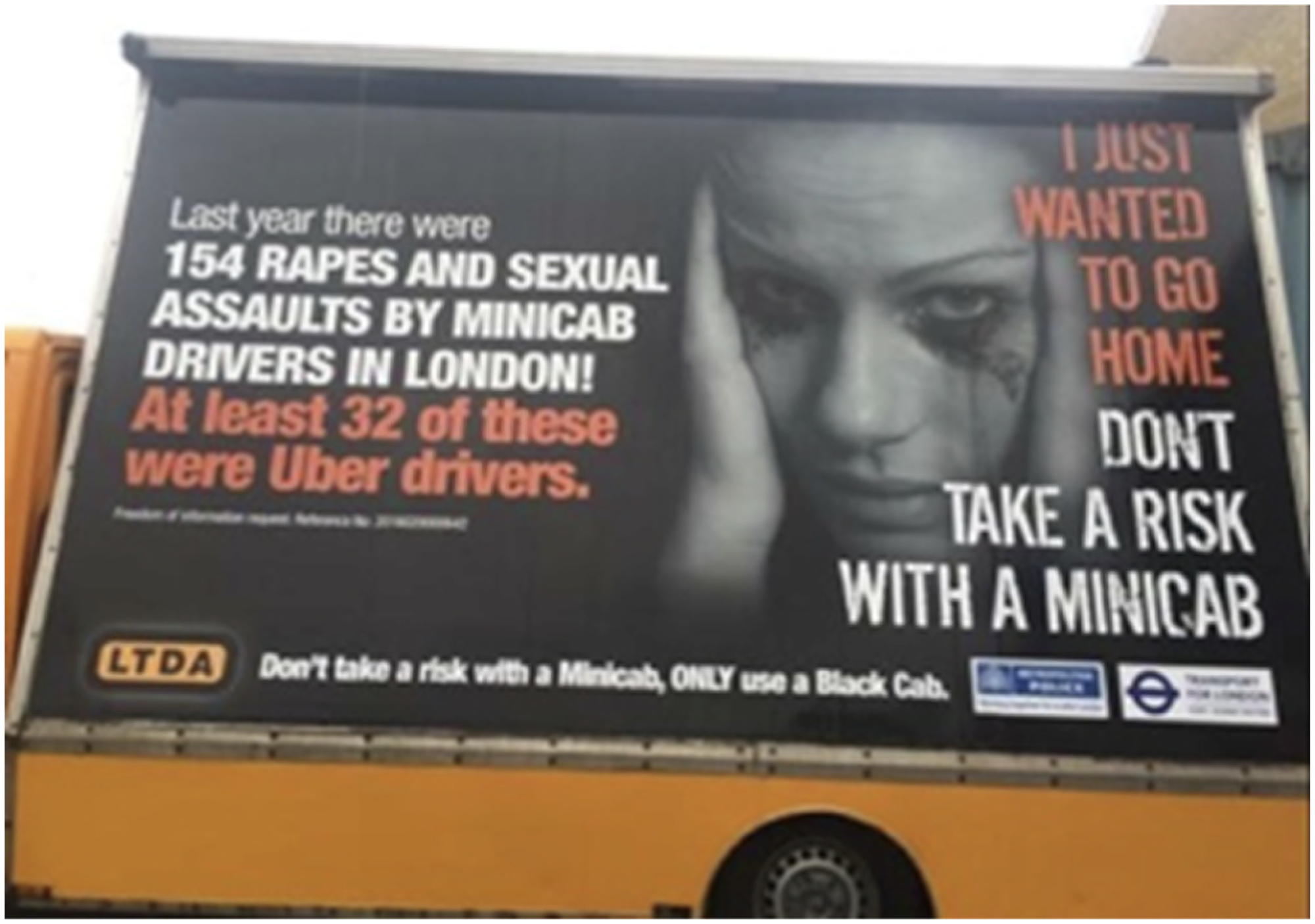
LTDA ‘Advan’ (2017) retrieved 20 January 2021 (https://twitter.com/TheLTDA/status/929440832742096897).
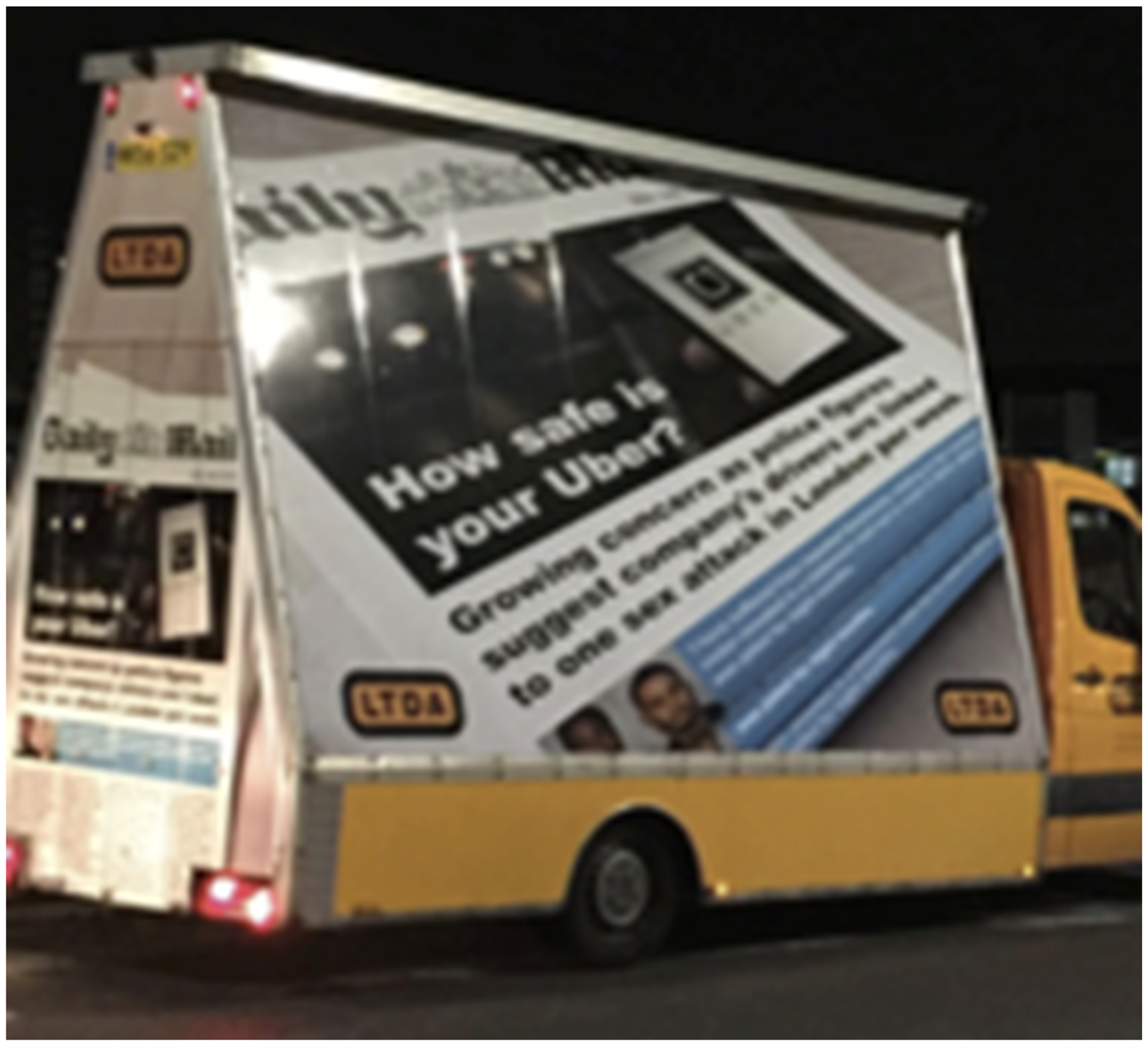
LTDA ‘Advan’ (2017) retrieved 20 January 2021 (https://twitter.com/theltda/status/900828419742736386).
There is no conclusive evidence that Uber drivers are more likely to engage in unsafe behaviour than taxicabs. TfL only provides data breakdown of journey-related sexual offences for taxicabs, Uber and other PHVs for 2016. Of journey-related assaults, five were Uber drivers – amounting to 41%, which equates to the proportion of Uber drivers in the sector that year (Department for Transport, 2015). Furthermore, taxicab drivers are harder to charge as they are less traceable than Ubers, who are always booked through the app. Uber and taxicab drivers are also both subject to the same enhanced security checks before gaining a license (TfL, 2018). This is not to argue that there is no problem of sexual assault in London's cab/taxi industry; rather, it demonstrates that based on available data, it cannot be conclusively claimed Uber drivers are more likely to commit sexual assault than other drivers. The Uber rapist folk-devil is therefore not based on data, but on broader sexualised racial politics. This distorted risk perception, engendered by moral panics, is both racialised and racialising and has historically constructed racialised masculinities in the Global North (Davis, 1978; Wriggins, 1983).
The binary dynamic of passengers being considered at risk and drivers being considered risk(y) is legible in Uber's ‘deactivation’ policy, which relies on informationally asymmetric algorithms to automatically discipline/suspend workers. Drivers can be temporarily or permanently ‘deactivated’ if their rating falls below an undisclosed threshold, a passenger makes a complaint or their behavioural data is algorithmically flagged as problematic. The design of these processes is concealed; the drivers I interviewed were entirely unclear of Uber's rating and disciplinary policy. It is unclear what behaviours are flagged as problematic, and how; online worker forums are rife with drivers pooling their experiences of deactivation, attempting to decode the management algorithm. This replaces typical employee disciplinary processes, where workers can present their case, be told why they are being disciplined, seek union representation, and be compensated throughout the disciplinary process.
The power given by the rating system to customer ‘whims’ is a manifestation of the racialised disposability of drivers: as potential risks that must be proactively managed, passengers are given power to assess their right to work. Drivers frequently told me passengers are always believed over drivers (2, 3, 21); drawing on racialised politics of prefigured innocence, guilt and credibility (Murakawa and Beckett, 2010; Wang, 2018). While passengers can be rated and reported by drivers, this mostly does not result in deactivation (Uber UK, 2017a, 2017b), despite elevated risk of passengers acting abusively (Menendez, 2017). A UPHD survey found 51% of UK Uber drivers have been threatened or assaulted while working (Networked Rights & UPHD, 2017: 8); an internal Uber report found 42% of sexual assaults during US Uber rides were committed against drivers (Uber, 2019). This is not reflected in app design or platform policy, which instead mobilises fixed, racialised dynamics of Uber drivers as threat and passengers as threatened to justify the fungibility of its workforce. Drivers described the difficulty of getting an abusive passenger deactivated – despite reporting them on the app, or directly contacting Uber. Uber simply refers them to the police, who operate under similar racialised frameworks of risk perception: ‘if it's your word against the passenger, the police take the passenger more seriously’ (19).
Uber relies on this punitive algorithmic management system in its dispute with TfL. The ‘swift’ identification and deactivation of drivers, based on concealed algorithmic management techniques or passenger ratings, is used to counter TfL's claims that Uber does not prioritise passenger safety (Uber UK, 2017a, 2017b). The construction of drivers as public safety threats provides pre-conditions for Uber's heavy-handed deactivation policy; it is situated as necessary to manage a workforce inherently inclined to be harmful. Here, the racial making of surplus populations and the political economy of platform companies intersect; the driver is not a worker, because he is – returning to Sharma's ‘brown space’ – ‘sub-human, a monster’ and a ‘threat’ to be surveilled and readily ‘eradicated’ (2010: 189). Interviewees registered this dynamic: I guess Uber wants to seem like they’re taking action because everyone's saying we’re unsafe. So, they deactivate us for the tiniest thing knowing there’ll be a queue of drivers waiting to replace us (26)
My friend was murdered while cabbing. But no one [cares] because people see us as animals (21).
The design and operation of ratings-based algorithmic management resolve a contradiction embedded in the spatial quality of on-demand platforms. The kinds of work undergoing platformisation have a distinct spatial character; they ‘involve the crossing of spatial boundaries – between public and private spaces, but also crossing spaces segregated by class, race and gender’ (Anderson, 2017: 59). Uber's model requires and creates constant mobility of racialised populations throughout the city, and an expanded encountering of bodies in the somewhat intimate space of a taxi (Eytan, 2018). This proximity and mobility contradict the biopolitical construction of Uber drivers as bodies that arouse ‘fear, disgust, discomfort’ – and therefore ‘must be removed from social space’ (Wark, 2020: 89). The presupposed ‘guilt’ of racialised bodies provides justification for a model that automatically severs people from their livelihood if algorithmically ‘flagged’.
The struggle between TfL and Uber has led to institutionalised data sharing between Uber, and police and regulatory bodies. Indeed, the court's decision to re-license Uber was partly informed by its willingness to share data with the Metropolitan Police, including counterterrorism units (Elvidge, 2017; Hamilton, 2020); the National Police Chiefs Council described the ‘data and support’ offered by Uber as ‘the forefront’ of urban policing (Hamilton, 2020). Data from my casework showed how data sharing with regulators informs processes of probation and punishment. When a driver is ‘deactivated’, Uber informs TfL, which then reviews the driver's right to be licensed as a PHV under any operator, compromising the driver's ability to seek PHV work through other means, such as alternative apps or local firms. The driver typically receives a letter from TfL informing them an investigation is underway, which lists every act flagged as a transgression during their time at Uber – of which Uber provides many to demonstrate a ‘pattern’ of behaviour. Drivers then have 7–14 days to respond to allegations made. These letters typically take drivers by surprise – they are often unaware of complaints against them, or that behavioural data had been algorithmically flagged as infractions. The regulator nonetheless uses this data to evaluate whether the driver is a ‘fit and proper person’ to hold a license (TfL, 2013). Here, data extraction and surveillance embedded in platforms is predicated on the logic that the day-to-day behaviour of drivers must be quantified and made available for constant scrutiny by policing and regulatory bodies; as inherent public safety threats, their minute behavioural patterns are of public interest This resonates with Wang's assertion that as technologies of racialised control are developed and perfected, ‘carcerality will bleed into society’ (2018: 40).
Indeed, there are parallels between the use of data-extractive algorithms to police racialised urban populations, and the algorithmic management of racialised urban workers. Wang’s (2018) analysis of predictive policing software PredPol identifies how working-class racialised communities are coded as ‘pre-criminal’ (Mantello, 2016) – i.e., likely to commit future ‘crime’, and therefore as ‘calculable risks that must be pre-emptively managed’ (Wang, 2018: 29). This involves collecting ‘mundane data details of an individual's daily life’ to ‘facilitate easier identification of ‘criminal signatures’’ (Mantello, 2016: 7). It also involves concealing algorithmic design from those whose data are being collected, and whose livelihood relies on its outcomes, engendering precarity and discipline. Here, despite the terms of algorithmic governance being embedded in racialised ideas of who is at risk and who is risk, automation provides a veil of neutrality; ‘these new forms of power create the illusion of freedom and flexibility, while actually being more totalizing in their diffuseness’ (Wang, 2018: 22).
This strongly echoes the deployment of Uber's management algorithm. As an interviewee summarised: ‘They want to make us out as criminals before we’ve done anything, so they can have their boot on our necks’ (22). The sense of being made ‘criminals before we’ve done anything’ makes drivers hyper-aware of their own fungibility in the platform (Chandler and Malin, 2016). This generates the worker docility, and practices of emotional and aesthetic labour underpinning Uber's promise of providing ‘always the trip you want’ (‘Request trips 24/7’, n.d.). Drivers described labour-intensive strategies they deploy to create comfort and overcompensate for how they are perceived – such as providing sweets, water, music choice and fragrance. This particularly manifests as emotional management – of suppressing emotional responses to abuse. These forms of immaterial labour are all deployed in response to the rating system, and the drivers’ awareness of themselves as disposable through their racialisation: I could be a good driver – but maybe people don't like me because I’m Muslim…and I can't appeal that rating system. Uber keeps it there because it controls me – now I’m putting sweets in my car because I’m scared passengers will rate me down and I’ll lose my livelihood. It's like a sword on top of my head (20).
I can tell when someone gets in my car, looks at me and goes ‘ew’ (18)
Because of [ratings] if someone is being aggressive, I just put my head down, drive and watch the timer go down (14)
This resonates with what McDowell identifies as the ‘deferential performance’ of migrant-driven service labour. The internalisation of one's identity as disliked or suspicious creates an urge to overcompensate with ‘servile docility’ to keep precarious jobs. Interviewee 20 demonstrates how ‘forms of social regulation,’ including ‘self-discipline,’ manifest themselves in everyday social practices, to ‘produce and reproduce’ (McDowell, 2009: 198) the docile racialised, migrant worker. This not only creates political subjectivities where workers are less inclined to disrupt (Tufts, 2006) but it also facilitates the contradiction underpinning platformisation, whereby Uber is legally disentangled from its ‘independent’ workforce yet promises customers a uniform user experience. This contradiction is maintained by the over-compensatory, self-disciplinary labour of the workforce engendered by their status as algorithmically managed, racialised surplus populations. Uber does not officially demand this labour – which it relies upon and does not compensate – yet it is demanded, due to the conditions of its racialised workforce and the related design and policy of its algorithmic management model. The simultaneous distancing of responsibility, yet proximity of coercive control is facilitated through and alongside the dynamics of racial capitalism.
Conclusion
This paper has brought together the platform labour and racial capitalism literatures to propose a systemic relationship between the ‘platform’ and ‘racial’ fix following the 2008 crisis. In connecting these literatures, it has argued that the political economy of racialised migrant labour markets in global cities provides essential context for understanding how major platforms are developing their working models. It has shown the potential of this theoretical framework through an empirical case study of Uber's development in London, and its relationship to the city's post-2008 racial and migration labour politics. Within this case study, the paper demonstrated how three key strategies at the heart of Uber's growth – worker (mis)classification, denial of social protections and algorithmic management – are deeply invested in the carving out of racialised populations from post-war labour and welfare settlements, and in the racialised and racialising work of moral panics. Through these theoretical and empirical contributions, this paper argues that far from being limited to issues of ‘discrimination’, processes of racialisation have been crucial at every level of Uber's move to dominance. Such processes – employed by state and non-state institutions – have created racialised surplus populations, ready to be subsumed into the platform model. In turn, racialised tropes and the long structural history of racialisation, have been mediated through technological mediums to render this workforce easily amenable to data-driven labour discipline, and to exclude from labour protections available to others. This operates co-constitutively; whereby the conditions of racialised workers in global cities like London, and the political economy of platform companies have co-produced one another. In this way, racialisation is a structuring principle of the platform economy; platform capitalism itself is racial.
Yet, the aim of this paper has not been to provide a meta-theory of platform labour in all times and all places or to universalise the conditions identified within Uber or London. Rather, it is to provide platform scholars with a framework through which the oft-observed relationship between the composition of the platform workforce, and its emerging norms can be engaged with theoretically. Such sensitivity to the dynamics of race and migration is, in turn, essential for building policy frameworks that respond to the holistic social and political realities of platform workers. As well as contributing to the platform capitalism literature, this contribution also seeks to enhance the racial capitalism literature, both by bringing in the insights of data-driven capitalism to this growing scholarship and by expanding its geographical and conceptual frameworks beyond US-specific racial formations of Black-American and Latinx-American experiences (Christian, 2019). At its core, this theoretical intervention aims to provoke further empirical work that unpacks how racial and migration politics shape the unfolding of platform work in different spatio-temporal contexts. Future work must also integrate the concerns introduced to these dynamics by the COVID-19 crisis.
Supplemental Material
sj-docx-1-epn-10.1177_0308518X221115439 - Supplemental material for Racial platform capitalism: Empire, migration and the making of Uber in London
Supplemental material, sj-docx-1-epn-10.1177_0308518X221115439 for Racial platform capitalism: Empire, migration and the making of Uber in London by Dalia Gebrial in Environment and Planning A: Economy and Space
Footnotes
Declaration of conflicting interests
The author(s) declared no potential conflicts of interest with respect to the research, authorship, and/or publication of this article.
Funding
The author(s) received no financial support for the research, authorship, and/or publication of this article.

Supplemental material
Supplemental material for this article is available online.
Notes
References
Supplementary Material
Please find the following supplemental material available below.
For Open Access articles published under a Creative Commons License, all supplemental material carries the same license as the article it is associated with.
For non-Open Access articles published, all supplemental material carries a non-exclusive license, and permission requests for re-use of supplemental material or any part of supplemental material shall be sent directly to the copyright owner as specified in the copyright notice associated with the article.
