




Abstract
Canada boasts some of the most highly educated migrants in the world, but it is well recognised that these migrants face many labour market barriers to gainful employment despite their experience and qualification. Administrative data indicate that the proportion of gig workers is considerably higher among migrants, yet little is known about the various perceived and desired pathways of migrants who choose to pursue platform work. In this inductive, qualitative study, we interviewed 35 platform workers in Canada regarding why and how they turned to such forms of work and how it fits their overall plans for integrating into the Canadian labour market. Adopting a grounded theory approach, we found six pathways into platform work ranging from those who feel in control of the situation as a means to an end, to those who feel trapped in it, unable to find alternatives. We question how these pathways relate to macro factors (e.g. immigration status, professional status), meso factors (e.g. education and skills, networks) or micro factors (e.g. stage in life cycle, aspirations). In our analysis, we consider the critical insights offered by scholars on racial and platform capitalism in understanding the factors impacting migrants’ pathways into platform work in Canada. Our findings suggest that these structural inequalities are further perpetuated within platform work, even though in theory Canada's immigration system is merit-based with emphasis on high human capital. Migrants’ engagement in platform work is a piece of a larger puzzle of segmented labour markets.
Introduction
The growth of non-standard working arrangements has influenced scholars to examine its impact on the labour market (e.g. De Stefano, 2017; Lewchuk and Lafleche, 2014). Non-standard work can be defined as any variation away from standard employment (Broschak and Davis-Blake, 2006), with standard employment characterised as work with a fixed schedule, place of business, under an employer's control and continued employment (Kalleberg et al., 2000). The specific focus of this paper is on one such non-standard working arrangement that is mediated through intermediary digital platform organisations, which we refer to as ‘platform work’ (De Stefano, 2016; Van Doorn, 2017). We study person-to-person (p2p) forms of platform work (Frenken and Schor, 2017) that uses an online platform to connect end-users to services on a short-term or by-task basis without an employment relationship (Meijerink and Keegan, 2019), and tasks are performed offline (e.g. ride-hailing, food delivery services). These particular forms of platform work provide a fertile ground for research studying migrants’ growing prominence in non-standard work in Canada. Such work is often viewed by migrants as a ‘stepping stone’ towards better labour market integration as it comes with low barriers to entry and perceived as work that can be engaged in regardless of credentials and qualifications recognition (Lam and Triandafyllidou, 2021). Yet platforms reorganise precarious work by obfuscating the role of the employer and offloading responsibilities of safety to the worker (Fabo et al., 2017).
Over 20% of Canada's population are foreign-born (Government of Canada, 2020a) and lofty immigration admission targets are part of Canada's economic plan (Government of Canada, 2020b), forecasted to be the primary source in driving Canada's population and labour force growth (Dinç and Dennler, 2021). As one of the highest migrant-receiving countries in the global north (Hiebert, 2016), Canada also faces significant migrant overqualification in jobs with high job skill mismatch (Lu and Hou, 2020). Despite their education and experience, many migrants face critical barriers in entering the Canadian labour market (e.g. Goldberg, 2001; Reitz et al., 2014) and non-standard jobs have provided a point of entry for many new migrants into the Canadian labour market (Lamb et al., 2021). Yet critically, these labour market barriers did not simply emerge out of nowhere; it is within a system of exclusion that Canada's process of treating migrants was built upon (Sharma, 2006; Thobani, 2007). With this context in mind, we ask: what are the pathways that lead migrants to enter platform work, despite its burdens of precarity and insecurity? How can we understand such a choice within the context of blocked mobility and segmented labour markets? How do the migrants’ goals and aspirations interact with structural barriers and meso- or micro factors in shaping their path?
To answer these questions, we consider the critical insights offered by scholars on racial and platform capitalism and their intersections (McMillan Cottom, 2020; Robinson, 2000) as well as work on ‘home economics’ by Sharma (2006). We adopt a migrant perspective in our empirical analysis investigating the interaction between the macro- meso- and micro factors, and the ways in which migrants develop their agency. We define agency as the capacity to shape one's life and exploit opportunities, opening up new possibilities for one's self and their family. Following Katz (2004: 242) we consider three types of agency: recuperation, the autonomous initiative of the individual that aims at solving their own problem and addressing their own situation without necessarily changing the overall context; resilience, which includes not only changing one's own situation but also attempting at reworking one's circumstances opening up new possibilities; and resistance which is an action that seeks to subvert and disrupt the conditions under which one finds oneself. These different types of agency have been studied in relation to migrant workers’ capacity to negotiate their employment conditions and relations in low-skilled jobs (Berntsen, 2016).
Our study concentrates on highly skilled migrants who have come to Canada through various immigration visas, but the majority of them entered through a points-based system rewarding education and professional skills. While highly skilled, they face important barriers which we operationalise at three levels: macro factors (immigration status, professional status), meso factors (education levels, ethnic networks and overall social circumstances) and micro factors related to an individual's emotional and cognitive features and their specific family and biographic situation at a particular juncture in their life when migration and engagement in platform work occurs. We thus develop a typology of pathways based on the interaction among the migrants’ objectives, their level of agency and the different levels of barriers they encounter. Our study provides a better understanding of the role that the platform economy plays in a wider context of migrant worker dependency and exploitation. It analyses how platform work becomes the new form of self-employment (Li, 2000
The paper is organised into four sections. The following section reviews literature and theoretical frameworks on Canada's labour market for migrants. We then present our research design and methodological approach. Next, we introduce our typology of migrants’ pathways into platform work highlighting the interaction between structural barriers (at macro, meso and micro levels) and migrant objectives and level of agency. The last section offers a discussion of how our insights into migrants’ engagement with platform work sheds new light on the dynamics of post-colonial ‘home economics’ (Sharma, 2006) revitalised by platform capitalism that favours predatory inclusion obfuscated by algorithmic control and the formal absence of a direct employer.
The Canadian labour market's impact on migrants into platform work
The entry of migrants into platform work stems from the interaction between structural barriers migrants face within Canada's immigration regime and the deregulation of the workplace and erosion of the standard employment relationship.
Canada accepts permanent residents through three main avenues: economic, family and refugee/asylum. Non-permanent residents are individuals who are in Canada on a temporary basis under the authority of a temporary resident permit – such as work permit or study permit (Statistics Canada, 2016). Within each avenue, different channels exist based on admission criteria such as human capital factors, level of work experience in Canada, or nominations provincially or territorially (Hiebert, 2016). Since the introduction of a merit-based points system in the 1960s, Canada has favoured individuals with high human and financial capital (ibid). Despite the high regard for human capital in migrant selection, many migrants often end up in precarious, non-standard jobs (Bauder, 2003; Bhuyan et al., 2017; Wilkinson and Garcea, 2017). Despite having similar skills and education attainment levels compared to native-born Canadians, migrants are more likely to be employed in low-wage, entry-level jobs or middle-level jobs that require several years of work experience, with significant underrepresentation in the knowledge sector (Cornelissen and Turcotte, 2020; Zhang and Zuberi, 2017). Such underemployment has important psychological and emotional costs beyond the obvious socio-economic disadvantage that it entails (Frank and Hou, 2017). Labour market inequalities faced by migrants can be seen as the result of a segmented labour market – Doeringer and Piore (1970) theorised a dual labour market where labour markets are segmented between ‘primary’ sectors containing well-paid jobs with stable, standard work arrangements and ‘secondary’ sectors with low-wage, non-standard jobs with little stability or security. These segmented labour market arrangements can lead to blocked mobility in jobs and careers (Aldrich and Waldinger, 1990) and while facing these barriers, migrants consider self-employment as an ‘escape strategy’ when confronted with covert or overt discrimination in the labour market (Clark and Drinkwater, 1998; Hou and Wang, 2011). While macro-level analysis of labour market trends has provided important insights into the state of migrant and refugee employment in Canada, less is known about the processes in which individuals navigate the labour market (see also Ellis and Triandafyllidou, 2022).
Platform work can be viewed as being inscribed within the wider dynamics of ‘home economics’, a nation-led process where groups of people are organised hierarchically through differential categories of belonging ‘based in the relationship between ideas of nation and those of race, gender, and class’ (Sharma, 2006: 4) that are part of a broader post-colonial world order (Sharma, 2020). Tangentially, migrant platform work reproduces global racialised hierarchies through ‘predatory inclusion’ in the labour market, whereby marginalised citizens are included in waged labour, but on extractive terms by masking the power relations behind a platform (McMillan Cottom, 2020: 444–445). Thus, the relationship between platform capitalism becomes an apt demonstration of the historical connection between capitalism and racism as theorised by Robinson (2000). Capitalist structures actively entrench racial hierarchies and practices (Toews, 2018: 18). Platform work comes with perils of algorithmic control over workers (e.g. Frenken and Schor, 2017; Schor, 2020; Stewart and Stanford, 2017), a dearth of employment rights and social security arrangements (e.g. Zwick, 2018), and precarious labour arrangements repackaged as ‘flexibility’ (Cano et al., 2021). According to administrative data in Canada between 2005 and 2016, the percentage of gig 1 workers increased from 5% to over 8%, with sharp increases during the 2008 global recession that corresponds with declining employment prospects. Notably, the proportion of gig workers is considerably higher among migrants, especially recent migrants compared to Canadian-born populations (Jeon et al., 2019). Algorithmic control is an engrained element of platforms that build contingency by making demands of workers’ space and time which paradoxically, enables flexibility for workers (Richardson, 2020). This paradoxical relationship appears frequently in migrants’ decision to choose platform work and in their search for employment. Platform work appears to be readily available and offers autonomy yet as acknowledged by workers, they must succumb to the platforms’ demands and lack of control within an opaque compensation structure and information asymmetry (Lam and Triandafyllidou, 2021; Shapiro, 2018; Van Doorn and Badger, 2020).
Our study carriers further the work of Myhill et al. (2021) and Peticca-Harris et al. (2020) exploring the complex nature of work arrangements and the lived experiences of workers in the platform economy.
Research design and methodology
A constructivist grounded theory approach (Charmaz, 2006; Glaser et al., 1967) was selected for our study because of its foundational epistemological underpinnings to ensure the participants’ presence is integrated into the final text. Both researcher and participants are viewed as contributors to the grounded theory model (Charmaz, 2011; Mills et al., 2006). Both authors have personal experiences of migration. The first author shared with participants her personal lived experiences of struggles in the Canadian labour market, creating dialogue and engagement, which is part of the grounded theory methodology of recognising bias in relation to participants and data (Birks and Mills, 2015).
We conducted qualitative, semi-structured interviews that explored the subjective experiences of people's overall immigration trajectory, before delving into their interactions with the Canadian labour market. Semi-structured interviews allowed for building rapport with participants, and enabled the collection of detailed rich participant stories (Myhill et al., 2021; Ravenelle, 2019). We obtained research ethics approval from our research institution prior to recruitment. We used purposive sampling, recruiting for participants that fit our inclusion criteria: migrants who are landed immigrants in Canada and that they had worked in the platform economy for at least 6 months in aggregate.
In our recruitment materials, platform work was broadly defined to avoid technical jargon, with an open-ended description of ‘work that connects services/goods exchanges through a platform’ and we provided a list of common platform work intermediaries (e.g. Uber, Lyft, DoorDash, Instacart, etc.) by way of example. While this definition could have included workers that performed services online (on freelancing platforms such as Upwork or Fiverr, we did not have participants that worked from those platforms. This can be due to the phrasing and interpretation of our recruitment materials that rendered only participants providing services offline to contact us.
Our participants were recruited from Canada's urban centres around the Greater Toronto Area and Metro Vancouver, in the provinces of Ontario and British Columbia, respectively. We specifically chose these two major metropolitan areas of anglophone Canada because they attract (together with Montreal, i.e. French-speaking) the major concentration of migrants. The two metropolitan areas share specific attributes as being important service sector powerhouses with a strong settlement and post-secondary education sector supporting migrants in their transition to the new country. The two urban areas offered an ideal for our study on migrant pathways into platform work.
Due to the COVID-19 pandemic, we conducted our interviews through video or phone, ranging from 30 to 90 min; each interview was later transcribed verbatim. Due to the inability to conduct in-person interviews, there were some additional comprehension and communication barriers with non-native English speakers. The researcher conducting the interviews sought to remedy these barriers by asking clarifications or reframing questions. Prior to each interview, a demographic questionnaire was asked of participants to collect information regarding their immigration category, duration of stay in Canada, age range, length of time working on platforms and educational background.
Due to the iterative process of our study, interviews partly evolved based on new information that emerged throughout each conversation. Per grounded theory, the interviews provide a conceptualisation of the data through the themes that emerge (Corbin and Strauss, 1990). We began with an initial open coding of data (Charmaz, 2006) that created broad concepts and overarching categories around our participants’ driving motivations that led them to enter platform work.
In total, we conducted 35 interviews. We had 25 participants who identified their gender as men and 10 women-identifying participants (29% of all participants). This difference in gender representation aligns with ongoing research that while gender discrepancy in gig work needs further exploration (Hunt and Samman, 2019), the gender breakdown varies by sector, with men being overrepresented in the transportation and delivery platform sectors (Farrell et al., 2018). Two-thirds (N = 22) of the participants use platforms as part-time work, and 13 use platforms in a full-time capacity. Some of the participants had reduced or changed their work (e.g. preferring Uber Eats to Uber or Lyft) because of COVID-19 health concerns.
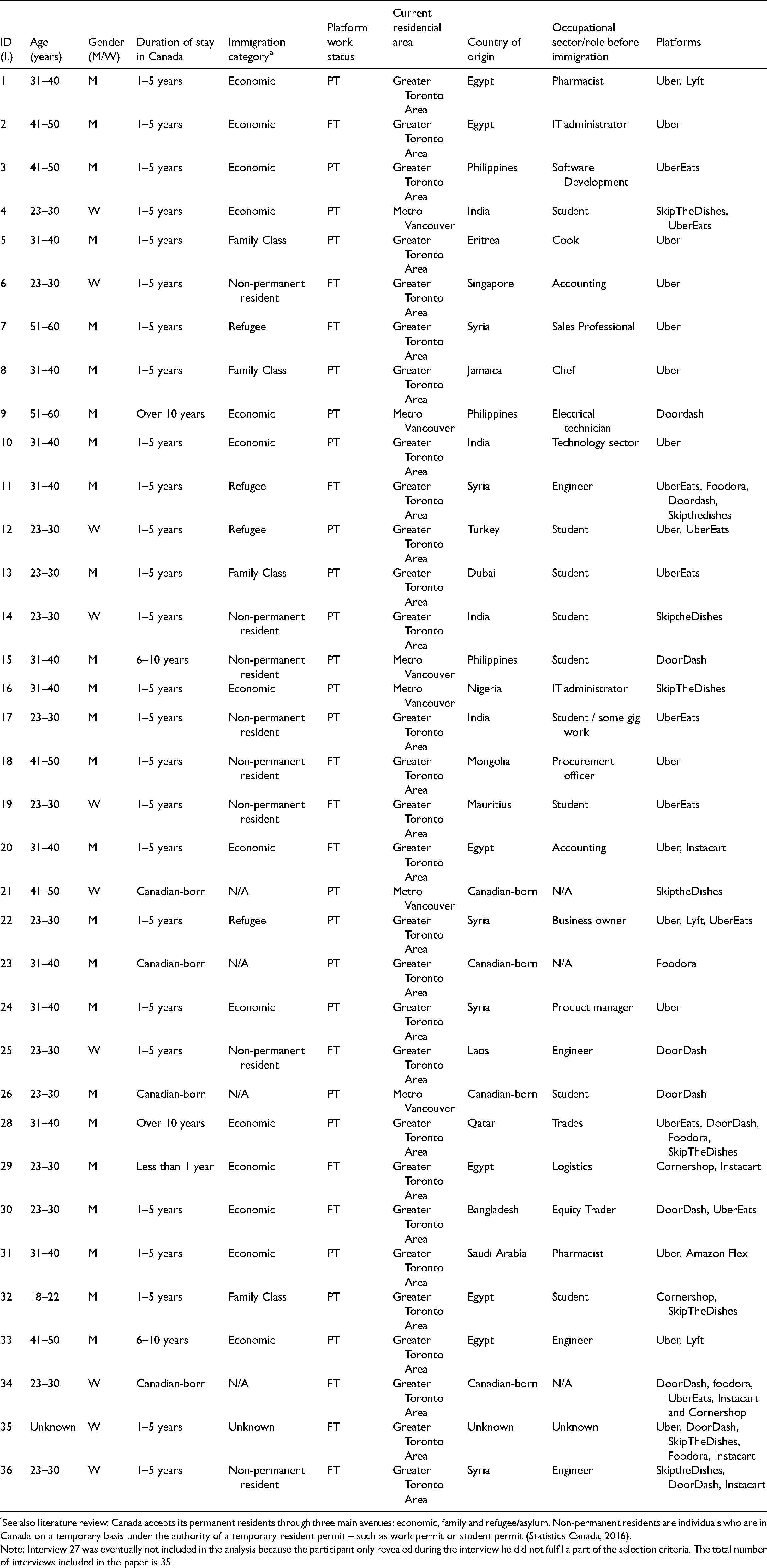
Our interviews included four Canadian-born platform workers as a small control group, and these interviews supported internal verification (Vickers et al., 2019) that formed a comparison for us to observe the differences in how work and career pathways emerge when compared to their migrant counterparts. The full list of participants and their main socio-demographic characteristics including time spent in Canada, place of origin, type of migration status, profession and current employment is provided in the Appendix.
Analysis: A typology of migrant pathways entering platform work
Table 1 reveals the grounded model of pathways that lead migrants to enter platform work. These pathways reflect on one hand the structural barriers that migrants face in the labour market, at macro-, meso- and micro levels, and on the other hand, their objectives (what they want to achieve) and the ways in which they exercise agency (see Katz, 2004) to overcome the barriers through platform work. We identify six different pathways of engagement with platform work.
Main structural labour market integration barriers.
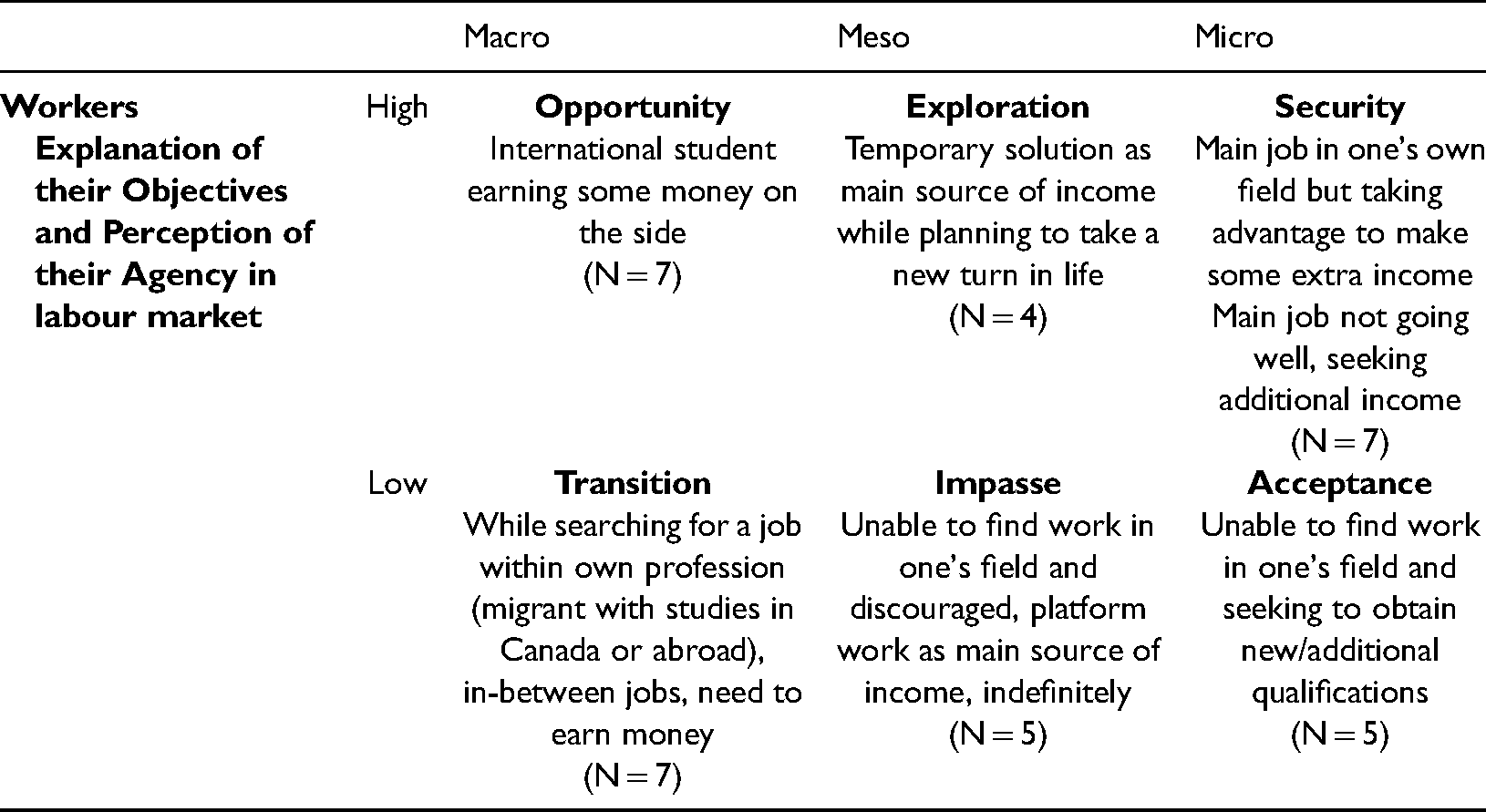
In the nominal scale of agency, we interpret ‘high’ and ‘low’ based on migrants’ subjective experience, while acknowledging that agency is a dynamic process. A high level of agency reflects the migrant's feeling of being in control of their situation while a low level of agency expresses the participant's perception that they are rather prey of circumstances than shaping their own situation.
While our study is inductive and not representative in a quantitative sense, given the relative high number of qualitative interviews that we conducted, we felt that it is important to count how frequently these different objectives were expressed and how they related to the different levels of barriers (Table 1).
Macro-level factors
We first categorised macro-level factors as those shaped by governmental policies and regulations that can influence workers at a societal level such as citizenship or residence status and related work/study permit. This was typically the case of international students who can normally work up to 20 hours a week (and longer hours outside of the school term). The second macro-level barrier identified was the lack of recognition of qualifications and previous professional experience because of degrees earned abroad. This scenario was representative of relatively recent migrants who had permanent residency status but who did not have ‘Canadian experience’, a common barrier migrants encounter that masks exclusion as non-racial (Ku et al., 2019).
Participants who expressed a high level of agency engage in platform work part-time on evenings or weekends to garner income. The international students interviewed mostly saw platform work as an opportunity rather than as a consequence of their limited rights under their study permit status. They expressed positive feelings seeing it as a means to an end while they seek to obtain their degree. I know other jobs were also an option, but I needed something that was working with my schedule, kind of making my own shifts. So with this one, each week you can pick which one you want to work (..) you have a lot of freedom to do because you are working by yourself, and no one is kind of hovering over you or keeping track of you. (I. 25)
Some had additional jobs and were particularly dynamic in terms of their employment plans. The story of a young man from India is particularly telling of this pathway into platform work as he switched areas of studies from music to marketing to the culinary sector, works part time at a restaurant and engages with platform work on the side: My employment does seem all over the place because back home in India, I used to do music. I used to teach music initially (..) when I made the move to come to Canada, that took a back seat for a while. Initially all I wanted to do was music but then over here it's pretty competitive (..) and in the meantime I did my marketing program. And while I was studying my marketing I worked part time at this restaurant [name of restaurant] and there I found out that I have a big passion for food. (..) [Platform work] is something that will always just be on the side. It's not my main source of income and I don't intend it to be. It's just something that I would like to do if I have some extra time because the nice thing about it is you can just turn on the app and clock on go (..) (I. 17)
While it appears that due to their limitations to working hour constraints that platform work becomes a necessity for students, this group of participants still perceive that they are able to exercise freedom and control. Some said that even after achieving their study and professional goals, they will continue their engagement in platform work as it suits their needs I think depending on my salary with my new job…it will be an entry level position. So I don't think it will be a very high salary. (..) I will continue Uber maybe on the weekends, 10 hours. So I can still have some side income (..) because Toronto is not cheap. (I.12)
While showing agency and control, these insights also invite us to think on how racial capitalism operates both through inequality and through the mobilisation of desire (Bhattacharyya, 2018).
Meanwhile, those that we classified as having a ‘low’ level of agency while confronting macro-level barriers were predominately those who faced issues with licensing or challenges in navigating professional regulatory bodies and hence their socio-economic mobility was blocked (Collins, 2015). They saw this phase as a transition – platform work became the in-between space to earn money. There were seven participants in this category who took up platform work because of underemployment or inability to find a qualified job. (..) the normal economy pushed me to platform economy, that's the reason why I’m working with a platform economy like Uber. Even though it's okay, the good and first opportunity for any newcomer (..) because it's easy (..) until I find what I want until I fulfil my goals, I will stick with Uber because there is no other option in front of me. Either to stick with Uber or to go working like before in retail with the minimum wage. (I. 7)
This participant, a sales manager with supply chain management experience from the Middle East has a clear analysis of his situation; he had tried to obtain career mobility through finding entry level employment and additional training but was disillusioned by his chances to find relevant and well-paid employment in Canada. He was aware that his age (in his mid-50 s) was militating against him – he often passed as overqualified and too old for a job even if no prospective employer would tell him upfront. Compared with other forms of entry-level precarious work, platform work was deemed an opportunity; our participant glossed over the exploitative and precarious nature of platform work, attributing barriers faced as structural rather than personal (Altenried, 2021). While most participants are aware of the caveats of platform work (e.g. wear and tear of one's car, lack of social security such as sick pay), they also appreciated the low barriers of entry (as several pointedly remarked one only needs a driver's license and car) and the short time needed to apply and start working. This immediacy and the freelance nature of the job were also experienced as an ‘addiction’. Sara (a pseudonym) is in her 20 s, on a temporary work permit, civil engineer by profession and currently waiting for her permanent residency application to go through, she wanted to work during this waiting period. Her story is particularly interesting because while she went into platform work out of necessity, she feels that she is hooked to the immediacy of earnings: Whenever I tried to apply for jobs, they asked for Canadian experience, so that's why programs like ACCES Employment [a migrant employment agency] are very helpful. (..) but I could not apply for it [because she was not a permanent resident] (..) but I didn't give up. I didn't stay at home. I started working as a courier because it's an easy job to get. There is no interview. (..) it's a temporary job for me. (..) Honestly, I see myself working as a courier because let me tell you, working as a courier is like an addiction, you would never stop. Even if I got to work in my field, I would keep working as a courier, as a second job. I don't know how to tell you but whenever you start, you cannot stop. And sometimes I would be tired (..) and I end up working for 10 hours and because I can't stop. When I get an order, I see money coming to me. I would never refuse it. (I.36)
Sara's testimony is particularly worrying because it shows how the worker becomes individualised, stripped of their rights, and even willingly engaging in exploitative work (Altenried, 2021). Looking at the socio-demographic profile of those who resort to platform work to help them transition and overcome macro-level barriers of entry includes both single individuals and those with familial obligations. They are all highly skilled, with important previous work experience, often in third countries (not their countries of origin) and are between their mid-30 s and mid-50 s. They face high barriers as their experience is not recognised in the Canadian labour market while confronted with high living expenses. We find that these macro factors made participants feel less in control and hence this leads us to question that the problem is not platform work itself, but rather, the manifestation of the ‘hierarchical ordering’ of the labour market (Sharma, 2006) where migrants can only find low-skill, entry-level jobs that involve long hours, low pay and limited career prospects.
Meso-level factors
We define meso-level factors as those barriers that stemmed between macro- and micro levels, driven by community and group-level social structures and their interaction with an individual. Key themes that emerged under meso-level factors were barriers of lacking social capital (e.g. networks and connections) and employer or organisationally driven dearth of human capital recognition.
Five of our participants had given up on seeking a job in their profession and reluctantly settled with platform work – we categorised this group as those facing an ‘impasse’. Similar to the previous macro-level analysis, ‘low’ level of agency here is based on what is perceived by migrants as their ability to pursue opportunities. This was clearly experienced as a choice pushed by the circumstances and several clearly mentioned the need ‘to pay the bills’ as the main reason. Surprisingly, these participants are permanent residents in Canada through economic or refugee/asylum immigration channels – they are not bound by work permit restrictions. These participants gave very vivid accounts of their disappointment and feeling of being trapped in platform work: I tried a lot here and there. I didn't stop. And even more once everything gets closed in my face, I didn't stop. I tried to do a career change. I was doing a licensing in the life insurance. But also I was waiting for an exam [when Covid hit and the exam was postponed]. (..) You know you have to keep going. This is the thing, just don't stop. (..) I am a human being, I faced some disappointing time, some depression time, but you have to stand up again, do whatever you can do. (I. 24)
The meso-level barriers speak to the migrant's desire to interact with their community and while they also faced to some extent macro-level barriers, we noted that this group of individuals actively described their decision-making process in relation to the greater community they live in. I have a lot of friends here with me. We went to the companies we worked for in Syria and also in Saudi Arabia [but to no avail in terms of finding a job] I just recommend them, don't stay at home. To give you the chance. It's also about connection. This is the thing everyone is telling us in Canada (..) it's giving you the opportunity to meet people. I met CEOs using Uber, commuting. (I. 24).
Participants who encounter meso-level labour market barriers but show ‘high’ agency see platform work as a ‘stopgap’ measure, while they seek a new turn in life. They expressed confidence that platform work is a way to jumpstart their next life project as they experience challenges in navigating their social and community environment. Back in Bangladesh, I was the trader for the American big mutual funds, so my plan is still in some way to get back to Wall Street (…)It's not like that I’m going to learn new stuff, because I actually have a bachelor's and master's in finance back home. But what I want to learn here…better networking. Because in my line of work, networking is really, really, really important. So I think that's why I want to go to school for this thing (…) If you’re at a point of life like me, transitioning, you’re looking to get into your field of work and you want something part-time that pays enough, yeah, definitely I would say go for it [working on platforms] (…)(I.30)
This participant – Raz – makes a temporary choice to engage in platform work for a specific limited experience. We caution that this is often a luxury for many migrant workers, especially among the majority of our participants, but interestingly, we found that three of our Canadian-born workers (used as a small control group) shared similarities in this pathway. For them, it was a way to make extra income during the pandemic while ultimately planning to take time off and move to Mexico (I. 21), repaying debts and bills (I. 34) and for the artist (I. 23) who has already begun to phase out platform work to make way for new endeavours. They presented platform work as a specific temporary step in their working lives that they willingly opted for.
Looking more closely into this pathway that we labelled as ‘exploration’ and comparing the differences between Raz and the Canadian-born participants, we note that the Canadian-born participants had only secondary education (contrary to all other participants in this study who had post-secondary degrees or higher) and took up the job as a (belated) ‘gap year’. These three participants had no dependents and were in their 30 s and 40 s. Despite a small comparison group, we noted that half of the Canadian-born participants engaged in efforts to unionise platform workers and had been particularly entrepreneurial in connecting with other workers but in contrast, only two of our 31 migrant participants were involved in unionisation in any way. These Canadian-born participants showed a different type of agency compared to our migrant participants – they engaged in strategies of resistance (seeking to change the overall conditions of work) rather than resilience (seeking to change one's own circumstances) (Berntsen, 2016). For instance, in collaboration with other riders, they worked around the app by liaising with each other to trade shifts, pointing to the problem of isolation in the job and the need for and importance of connecting. They held no resentment towards about being overqualified and not able to break through the labour market but rather recognised that because of a specific conjuncture in their working lives they settled into platform work as the only option. This pathway is particularly telling of the ways in which racial and platform capitalism intersect in creating unequal chances in the labour market (McMillan Cottom, 2020; Sharma, 2006). While this is a small comparison group between migrants and Canadian-born participants, their stories demonstrate the further need to understand how the racialised, national order of the country impacts migrants differently in how they shape their experience with platform work and how they are constantly being shaped by inequalities that they encounter through platform work.
Micro-level factors
Micro-level barriers to the labour market relate to an individual's emotional and cognitive features and their specific family and biographic situation. We identified five participants who were driven by micro-level barriers with perceived ‘low’ agency, expressing a significant level of resilience but also a sense of giving up on actively seeking their dream job. While not vocalising discouragement, these interviewees were similar to the ‘impasse’ pathway that we discussed previously in relation to the meso factors. However, instead of expressing disappointment or a feeling of being trapped, they voiced acceptance. One apt example was a full-time platform economy worker who mentioned that he would like to be a small business owner eventually but did not explain any concrete steps to aid in the process, there was no sense of urgency. There was a tension and contradiction noted in this participant's story with regards to how he viewed platform work; he acknowledges that ‘a job is a job’ and notes the benefits he brings to others through his service, yet immediately thereafter commenting that ‘It's not a good job’ (see also Peticca-Harris et al., 2020): “You know, coronavirus exist, all the businesses are still out, Uber is like some opportunity to find essential work here” (I.2)
This participant did see the benefits of what he was bringing for other people, while another part of him knew that this current work arrangement might not be the best, with him referring to his business goals as his ‘dream’. Interviewees in this pathway, expressed emotional resilience, but their actions (based on their accounts) did not follow suit. They created ‘stories’ regarding the circumstances of their employment and use sensemaking to interpret their career paths and trajectories to date (Manolchev, 2020).
The research participants who accepted platform work without deploring nor idealising it, were typically in their 30 s and 40 s, highly skilled professionals (e.g. engineers, managers, pharmacists) with familial obligations and hence had to provide for them while studying or retraining. While they were still subjected to the country's labour market policies which could be deemed as macro factors, we found these participants were motivated more by their individual sense of responsibility. Their sense of responsibility and obligation shaped platform work as an acceptable choice even if not desirable, nor their final objective. I was an accounting manager. (..) When I came I know that it will be hard to be a manager. But I did not expect to have a problem even to have a job at entry level. (..) I got shocked when I start applying (..) everybody is telling me because you don't have the Canadian experience. And maybe because you are overqualified. As I told you I have 15 years of experience (..) so from January I started working hard on Uber, as well as I took a course. Eight [months] in class and then six month volunteer placement in a company. (..) I don't like driving too much. But I have a family, so I have to. I don't have any other option. (I. 20)
There were seven participants that encountered micro-level barriers yet expressed a ‘high’ perception of agency (‘security’ pathway). A key difference between the ‘acceptance’ and the ‘security’ pathway lies in the participants’ use of platform work as the main source of income or as a financial security valve. In the ‘security’ pathway, even when they had achieved a relatively comfortable financial position with a job in their own field and secure citizenship status, they sought platform work to supplement their earnings. Typically, these were participants in their 30 s or 40 s with family obligations for whom some extra income came in handy, like their counterparts in the ‘acceptance’ pathway. But these participants emphasised that platform work was something on the side, done seldomly when it suited them and assessed carefully about the cost versus profit from the work: (..) what I have learned throughout the years in Canada [is] that I need to have a supplemental income. And that it's very hard to maintain the same standard of living that I had in Egypt, where everything was much cheaper and as I had burnt a lot of my savings. (..) it is not very clear on the total [how much] you will be making from the trip (..) you can only see the distance for example and sometimes the distance is very far and the amount is very small (..) yeah that's basically the downside of it (I.33)
For these participants, platform work seems to offer a flexible, alternative form of employment when it comes on the side of one's main occupation and as it may suit their career and family circumstances. While this group of migrants might share similar citizenship or work statuses as others, the ability to use platform work at one's own discretion perpetuates notions of ‘differential inclusion’ characterised by different migrant statues and positions upon which the platform economy hinges upon (Altenried, 2021). This also points to how differences in inclusion can shape migrants’ aspirations within a neoliberal economy, migrants are depicted as solely and individually responsible for their successes and failures (Schinkel and Van Houdt, 2010).
Discussion and conclusion
Migrants in platform work in Canada: Symptom or cause?
This study has sought to highlight the interplay between the structural barriers to the labour market integration of migrants and the ways in which migrants turn to platform work to overcome these barriers. We have distinguished between macro factors that are seen as largely externally determined; meso factors that relate to the human and social capital that serves as the connecting tissue that structures the migration experience; and micro factors that are specific to each individual, notably personal aspirations, capacity for resilience and particular stage in the life cycle in which the person ‘encounters’ platform work.
Our participants show important degrees of agency and resilience in that they actively manage their time and employment situation – seeking constantly to improve their socio-economic and professional situation while expressing strong feelings of hope, ambition, but also disappointment, disillusionment and fatigue. Yet rarely did we note among our migrant sample engaging in strategies of resistance seeking to modify the overall conditions of work, rather than just their personal circumstances. This is indeed a finding that merits further research to ascertain whether such a divide exists in Canada among platform workers that are foreign-born compared to those native-born and to also explore why is this the case: is it about the human and social capital that each type of platform worker enjoys or is it a question of awareness of rights or feelings of legitimacy and belonging? We see opportunities for future research to build on our typology of motivations to extend to other forms of platform work, such as crowdwork and capital platform work (Duggan et al., 2020).
Platform work emerges as a symptom of a segmented labour market – migrants’ choice to enter platform work comes as a result of labour market barriers they face, manifested within a system of a hierarchical organisation and ordering within the nation state. This produces highly competitive labour markets that allow for the state and employers to continually exploit workers (Sharma, 2020), built upon a foundation of discrimination that ‘can be done discreetly’ that is a ‘hallmark of Canadian discrimination’ (Mensah and Williams, 2017: 80). When migrants face these barriers and discrimination in the labour market, platform work becomes viewed as and shaped into possible pathways. Canada's immigration system and resulting barriers give access to digital technologies to enable ‘platform capture’ within a sociopolitical regime that transforms workers into independent contractors (McMillan Cottom, 2020), while simultaneously transforming the notion of job and worker. When the structures, policies and practices of a nation state are seen to grant more access to capital than to migrants, platform labour is enabled to thrive, reorganise and expand (Sharma, 2020: 22). Our study reveals that platform work exists within unequal power relations that are highly racialised and ethicised and historically traceable to the exploitative and exclusionary practices of the state. These relations are not only exploitative but also function to contain and manage migrants’ belonging and subsequently, their labour. A secure migration status does not seem to suffice to overcome or bypass exploitative ‘nonjob’ work arrangements. Rather, platform work comes to be modelled on the basis of pre-existing inequalities that relate both to being foreign-born or foreigner but also to coming from a country of the ‘global South’ (see Table A1 in the Appendix). Racial capitalism acts as hand in glove with new forms of platform capitalism reproducing inequality and exploitation. The intermediary of the digital platform and algorithmic control renders these mechanisms less palpable and invisible, masked in providing flexibility and control when compared to a standard low-waged, entry-level exploitative job.
Having said this, our study highlights how migrants engaging in platform work are neither passive nor hopeless victims of exploitation. They seek to negotiate their options not only figuratively (see Peticca-Harris et al., 2020) but also in practice by seeking to use rather than only be used by the platform economy. We note here a complex interplay of micro, meso and macro elements. Thus platform work comes in as an
Platform work often comes advertised as autonomy and control, yet researchers have observed that it has simply shifted the characteristics to inadequate and fragmented working conditions (Macdonald et al., 2018). Many of our participants emphasised notions of freedom and flexibility, but it might be truly applicable for a privileged few. Given the precarious nature of platform work, ‘flexibility’ is not for the benefit of workers but disproportionately benefits platform companies (Cano et al., 2021). This study exposes how platform and racial capitalism combine to perpetuate structures of inequality and blocked mobility even though in theory the Canadian immigration system is merit-based with high human capital. Within structures and processes that have generated consequential labour market inequalities for migrants, they exercise agency within some margins of negotiating their participation in such precarious work. Platform work is characterised by ‘compulsion by necessity’ not because there is no choice, but because there is ‘no real and acceptable alternative’ (Lewis et al., 2015). More work is needed to understand how platform work affects the employment trajectory of migrants and how it can be shaped in ways that empower and protect (migrant) workers.
Footnotes
Acknowledgements
The authors would like to thank Dominik Formanowicz, Maggie Perzyna and anonymous reviewers for their helpful comments and suggestions.
Declaration of conflicting interests
The author(s) declared no potential conflicts of interest with respect to the research, authorship, and/or publication of this article.
Funding
We would like to acknowledge ongoing research funding from the Canada Excellence Research Chair in Migration and Integration program, Social Sciences and Humanities Research Council (SSHRC).

Notes
Appendix
List of participants.
| ID (I.) | Age | Gender | Duration of stay in Canada | Immigration category a | Platform work status | Current residential area | Country of origin | Occupational sector/role before immigration | Platforms |
|---|---|---|---|---|---|---|---|---|---|
| (years) | (M/W) | ||||||||
| 1 | 31–40 | M | 1–5 years | Economic | PT | Greater Toronto Area | Egypt | Pharmacist | Uber, Lyft |
| 2 | 41–50 | M | 1–5 years | Economic | FT | Greater Toronto Area | Egypt | IT administrator | Uber |
| 3 | 41–50 | M | 1–5 years | Economic | PT | Greater Toronto Area | Philippines | Software Development | UberEats |
| 4 | 23–30 | W | 1–5 years | Economic | PT | Metro Vancouver | India | Student | SkipTheDishes, UberEats |
| 5 | 31–40 | M | 1–5 years | Family Class | PT | Greater Toronto Area | Eritrea | Cook | Uber |
| 6 | 23–30 | W | 1–5 years | Non-permanent resident | FT | Greater Toronto Area | Singapore | Accounting | Uber |
| 7 | 51–60 | M | 1–5 years | Refugee | FT | Greater Toronto Area | Syria | Sales Professional | Uber |
| 8 | 31–40 | M | 1–5 years | Family Class | PT | Greater Toronto Area | Jamaica | Chef | Uber |
| 9 | 51–60 | M | Over 10 years | Economic | PT | Metro Vancouver | Philippines | Electrical technician | Doordash |
| 10 | 31–40 | M | 1–5 years | Economic | PT | Greater Toronto Area | India | Technology sector | Uber |
| 11 | 31–40 | M | 1–5 years | Refugee | FT | Greater Toronto Area | Syria | Engineer | UberEats, Foodora, Doordash, Skipthedishes |
| 12 | 23–30 | W | 1–5 years | Refugee | PT | Greater Toronto Area | Turkey | Student | Uber, UberEats |
| 13 | 23–30 | M | 1–5 years | Family Class | PT | Greater Toronto Area | Dubai | Student | UberEats |
| 14 | 23–30 | W | 1–5 years | Non-permanent resident | PT | Greater Toronto Area | India | Student | SkiptheDishes |
| 15 | 31–40 | M | 6–10 years | Non-permanent resident | PT | Metro Vancouver | Philippines | Student | DoorDash |
| 16 | 31–40 | M | 1–5 years | Economic | PT | Metro Vancouver | Nigeria | IT administrator | SkipTheDishes |
| 17 | 23–30 | M | 1–5 years | Non-permanent resident | PT | Greater Toronto Area | India | Student / some gig work | UberEats |
| 18 | 41–50 | M | 1–5 years | Non-permanent resident | FT | Greater Toronto Area | Mongolia | Procurement officer | Uber |
| 19 | 23–30 | W | 1–5 years | Non-permanent resident | FT | Greater Toronto Area | Mauritius | Student | UberEats |
| 20 | 31–40 | M | 1–5 years | Economic | FT | Greater Toronto Area | Egypt | Accounting | Uber, Instacart |
| 21 | 41–50 | W | Canadian-born | N/A | PT | Metro Vancouver | Canadian-born | N/A | SkiptheDishes |
| 22 | 23–30 | M | 1–5 years | Refugee | PT | Greater Toronto Area | Syria | Business owner | Uber, Lyft, UberEats |
| 23 | 31–40 | M | Canadian-born | N/A | PT | Greater Toronto Area | Canadian-born | N/A | Foodora |
| 24 | 31–40 | M | 1–5 years | Economic | PT | Greater Toronto Area | Syria | Product manager | Uber |
| 25 | 23–30 | W | 1–5 years | Non-permanent resident | FT | Greater Toronto Area | Laos | Engineer | DoorDash |
| 26 | 23–30 | M | Canadian-born | N/A | PT | Metro Vancouver | Canadian-born | Student | DoorDash |
| 28 | 31–40 | M | Over 10 years | Economic | PT | Greater Toronto Area | Qatar | Trades | UberEats, DoorDash, Foodora, SkipTheDishes |
| 29 | 23–30 | M | Less than 1 year | Economic | FT | Greater Toronto Area | Egypt | Logistics | Cornershop, Instacart |
| 30 | 23–30 | M | 1–5 years | Economic | FT | Greater Toronto Area | Bangladesh | Equity Trader | DoorDash, UberEats |
| 31 | 31–40 | M | 1–5 years | Economic | PT | Greater Toronto Area | Saudi Arabia | Pharmacist | Uber, Amazon Flex |
| 32 | 18–22 | M | 1–5 years | Family Class | PT | Greater Toronto Area | Egypt | Student | Cornershop, SkipTheDishes |
| 33 | 41–50 | M | 6–10 years | Economic | PT | Greater Toronto Area | Egypt | Engineer | Uber, Lyft |
| 34 | 23–30 | W | Canadian-born | N/A | FT | Greater Toronto Area | Canadian-born | N/A | DoorDash, foodora, UberEats, Instacart and Cornershop |
| 35 | Unknown | W | 1–5 years | Unknown | FT | Greater Toronto Area | Unknown | Unknown | Uber, DoorDash, SkipTheDishes, Foodora, Instacart |
| 36 | 23–30 | W | 1–5 years | Non-permanent resident | FT | Greater Toronto Area | Syria | Engineer | SkiptheDishes, DoorDash, Instacart |
See also literature review: Canada accepts its permanent residents through three main avenues: economic, family and refugee/asylum. Non-permanent residents are individuals who are in Canada on a temporary basis under the authority of a temporary resident permit – such as work permit or student permit (Statistics Canada, 2016).
Note: Interview 27 was eventually not included in the analysis because the participant only revealed during the interview he did not fulfil a part of the selection criteria. The total number of interviews included in the paper is 35.