




Abstract
Tanzania led the wave of land reform in sub-Saharan Africa, promoting ‘institutional fixes’ of property rights to stimulate urban development and poverty alleviation. Since 2005, the Residential Licence programme has offered short-term leases to around 180,000 households in the unplanned settlements of Dar es Salaam. However, the rate of title acquisition has been moderate to low, as in much of urban Africa. To understand the demand for land titles, this paper adopts an institutional approach and a novel analytic framework examining social expectations around the Residential Licence and their effects on choices of formalisation. Primary data was collected through a two-round survey with 1363 and 243 respondents, respectively. The paper finds that landholders have conditional preferences for formalisation based on the behaviour of their neighbours and the advice of other landholders, local leaders and higher-level government. Interactions between state and non-state actors generate social expectations that compliance with the programme is low and the government is not committed to enforcing interim property rights. These beliefs discourage choices of formalisation and transform the Residential Licence into an ‘empty’ institution, which fails to embed in social practice. The study contributes to the literature on land tenure formalisation by examining the interaction of state and social forces in the implementation of land reform and by proposing a complex understanding of the demand for tenure formalisation, underpinned by collective choice considerations. Additionally, the paper offers a methodological contribution by adopting a novel method for institutional analysis with further potential applications in urban studies and geographic research.
Introduction
Urban theory from the Global North has informed a developmental approach that understands cities of the Global South as ‘lacking’ and ‘in need of fixing’. This view has justified a transfer of policies as one-size-fits-all solutions to issues of urban development (Robinson, 2002). Against a notion that foreign policies and interests can be imposed top-down, recent scholarship undescores that contextual factors affect the design, implementation and outcomes of policies depending on the agency of multiple actors like local governments and ordinary people who are not passive receivers of ‘institutional fixes’ (Parnell and Robinson, 2012). For example, theorisations of urban neoliberalism and social-constructivist understandings of policy mobility-and-mutation propose that policies are ‘embedded’ and ‘domesticated’ in their ‘downstream’ sites of adoption through local processes ‘in conversation with’ macro political agendas (e.g. Peck, 2011, 2013; Peck and Theodore, 2012). Understanding how policies unravel and transform through the agency of local actors and interests will help illuminate how they produce real effects in specific urban contexts.
Since the 1990s, sub-Saharan countries have promoted land tenure reform, under the auspices of international organisations, donors, and national governments (Manji, 2006). Certainly, this ‘institutional fix’ underpins the neoliberal tenets that secure, legally enforceable and marketable land rights designed on the Western model of property can spur urban development and poverty alleviation by enhancing land and credit markets (De Soto, 2000). Critiques underscore that formal property is the ‘wrong prescription for the wrong malady’ (Bromley, 2008), imposed by supranational actors for the homogenisation of the international land market, producing land grabs, dispossession and displacement of the poor in much of the Global South (Ghertner, 2014). However, in some contexts, vulnerable landholders advocate statutory rights against market forces. In others, the women seek protection from patriarchal and unequal tenure relations (Boone, 2019). Indeed, Boone (2019) has noted that formalisation policies are controversial and complex precisely because they embody a multiplicity of conflicting interests, which inevitably produce winners and losers, and intended and unintended outcomes.
Given this multiplicity of actors and interests, recent contributions highlight the need for more empirical research exploring formalisation policies in specific spatial-temporal contexts (Ho, 2016a). As institutions, property rights emerge, exist and evolve through the interaction of state and social forces (Boone, 2018). From this perspective, formal property rights cannot be designed and implemented top-down: instead, they emerge endogenously through the interactions of multiple actors within and outside states. Individuals (in this case, landholders) are not passive recipients of ‘institutional fixes’. For example, they will consider the general level of compliance before they decide to adhere to some newly proposed institution. Landholders will ignore, resist, or even contest the new institution if there are common perceptions that statutory property rights are scarcely enforced by the government or provide undesirable functions. Thus, both state and social actors impact the way in which formal property rights embed in the local context, translating from the text of the law or the policy paper to an institution with real effects on behaviour.
In fact, government-led land titling initiatives have found low uptake in much of sub-Saharan Africa. This is also the case of urban Tanzania (e.g. Kusiluka and Chiwambo, 2018, 2019). Since 2005, about 180,000 landholders have been eligible to obtain an interim short-term lease – Residential Licence – in the saturated unplanned settlements of Dar es Salaam (Figure A1). While almost half of the eligible plot holders acquired this interim land title in the first 2 years of the programme, many have stopped renewing their licence and the rate of new acquisition has drastically dropped. Thus, less than 20% of the eligible plots are currently registered with interim property rights. Understanding this pattern of uptake and renewal is both timely and policy-relevant, as the same programme will be extended to another 1 million plots, including 130,000 plots in Dar es Salaam, over the next few years (Figure A2).
Fifteen years into the programme, this paper explores the unravelling of the Residential Licence policy in Dar es Salaam through the interaction of state and social forces. I adopt a novel methodological framework that uses hypothetical scenarios and vignettes to elicit the social expectations of landholders and examine their effects on choices of formalisation (Bicchieri, 2017). Data was collected through a survey in two rounds with 1363 and 243 respondents, respectively. The paper finds that social expectations are important determinants of the observed pattern of formalisation. The Residential Licence is a credible institution with commonly perceived and socially supported functions. However, interactions between state and non-state actors generate social expectations that compliance with the programme is low and the government is not committed to enforcing interim property rights. These beliefs discourage choices of formalisation and transform the Residential Licence into an ‘empty’ institution (Ho, 2014): a symbolic institution that does not embed in social practice. Thus, we see both state and social forces steering the implementation of land reform.
This paper's contribution is to analyse the interaction of multiple actors and interests in the domestication of development projects and trajectories. It appears clear that cities of the Global South will follow context-specific and diverse paths of land reform, negotiating the pace and outcomes of this ‘institutional fix’ at the local level. Furthermore, this paper advances existing studies on the demand for formal property by demonstrating how complex drivers impact collective choices of formalisation. Influenced by their social expectations, landholders are not homo economicus making independent and rational choices, based on mere calculations of the costs and benefits arising from formal property. Instead, social expectations can produce collective choices of formalisation. Finally, the paper offers a methodological contribution by adopting a novel framework with potential applications for the study of institutions and institutional change in geography and allied disciplines. While geography reiterates that ‘institutions matter’, scholars underscore the need for new empirical methods to study how institutions emerge and matter in real places (e.g. Gertler, 2018; Rodríguez-Pose, 2013).
The paper proceeds as follows: section two presents the background of land tenure reform in Tanzania and the Residential Licence programme of Dar es Salaam. Section three discusses the institutional approach and analytic framework of the paper. Section four provides details on data collection, including survey design, sampling strategy and a short description of the areas where the survey was conducted. Results are discussed in section five. Section six articulates the paper's conclusions and main contributions.
Background
Property rights reform in Tanzania
At independence and for almost 30 years, Tanzania retained the land administration system of the colonial era. In the 1990s, it paved the way for a new wave of land reforms in sub-Saharan Africa, under the strong influence of international organisations, donors and consultants promoting the privatisation, formalisation and marketisation of land as necessary ‘institutional fixes’ for urban development and poverty alleviation in the Global South (Manji, 2006). 1 In fact, there are different interpretations as to whose agenda was being followed. While the World Bank, the UK’s DFID and De Soto's Institute for Liberty and Democracy were instrumental to champion formal property in Tanzania (Briggs, 2011), the national government also played a major role in the process of land reform (Pedersen, 2016), most notably through its Presidential Commission and the Ministry of Lands, Housing and Human Settlements Development (hereafter, MLHHSD) (Sundet, 1997). It was noted that the Tanzanian land reform exemplifies well the coexistence of multiple – sometimes conflicting – interests (Boone, 2019). On the one hand, it incorporates a neoliberal model of development (Green, 2014) by making provisions on sales, leases, and mortgages to enable the operations of land markets (McAuslan, 2013). On the other, it also promotes the centralisation of government control by concentrating the authority of land administration in the MLHHSD (ibidem).
The Tanzania land reform culminated in the 1995 National Land Policy declaring that, ‘residents in unplanned settlements shall have their rights recorded and maintained by the relevant land allocating authority’ (URT, 1995: 19). Crucially, the 1999 Land Acts established diverse types of property rights in urban and rural areas (e.g. Gastorn, 2010). In urban areas, landholders can hold full statutory rights by applying for a Certificate of Right of Occupancy (hereafter, CRO), corresponding to a leasehold of 33, 66, or 99 years. Furthermore, they may obtain interim statutory rights through a short-leasehold or Residential Licence (hereafter, RL). In rural areas, the state recognises customary rights under the Customary Certificate of Right of Occupancy providing a high level of protection compared to many other countries (Alden Wily, 2018). Indeed, according to Knight (2010), the Village Land Act is ‘in the balance (…) one of the best in Africa in its careful, solid and repeated protections of the land rights of vulnerable groups’ (211).
Regulated by the Land Act (URT, 1999, Section 23), the RL embodies the principles of an incremental and pro-poor land recordation system (Manara and Pani, 2022a). On paper, the RL offers the same benefits as long-term leasehold (CRO): compensation in case of eviction, 2 and statutory protection in case of ownership, boundary and inheritance disputes with third parties. Further, it enables the legal transfer and the collateralisation of land with mainstream banks. However, the RL is an interim property right presenting important differences with the CRO. First, the RL has a shorter temporal validity currently limited to 5 years (renewable). Second, it is considerably easier and cheaper to obtain. Since plots are identified with low-cost technology and community participation, the RL is relatively affordable (currently, the first acquisition costs 20,000 TSh, a 5-year renewal costs 10,000 TSh, and the annual land rent is 24 TSh/sqm). Conversely, the costs for planning, surveying and acquiring the CRO can be ten times higher or more. Furthermore, the RL can be obtained in saturated unplanned areas, where high levels of density are incompatible with planning standards. Finally, the RL provides administrative recognition by the municipal level of government unlike the CRO, which is granted by the MLHHSD. Thus, in alignment with the country's Poverty Reduction Strategy (1998), the RL programme pursues three main objectives: to widen access to tenure security, to provide a collateral to the lower-income residents, and to collect revenues and information to enable the future upgrade of these settlements (Kironde, 2006).
More recently, the government of the late president Magufuli steered the country's land policy. Tenure regularisation was integrated within larger efforts to strengthen state authority and legitimacy, thereby raising compliance with state institutions and the rule-of-law. For instance, in fighting against corruption and inefficiencies in the state apparatus, the government restructured its street-level bureaucracy. Many functions that were typically executed by the elected sub-ward chairpersons are now undertaken by government-appointed officers, while the Minister of Lands keeps warning landholders against transacting land through their elected local leaders and the unregistered proof of ownership (sale agreement), which they typically witness. Furthermore, since 2016, the government has initiated a massive campaign to encourage regularisation with long-term leaseholds (CRO). A series of policy measures made regularisation increasingly more attainable, also in the densest unplanned settlements already under the RL programme (Manara and Pani, 2022a). Certainly, both the anti-corruption campaign and the land regularisation campaign – accompanied by promises of tenure security and urban development – have won substantial political consensus to the government and continue to loom large in the collective imagination, raising confidence in the state and its statutory institutions.
Following on from Magufuli's agenda, currently, land tenure formalisation remains a chief government priority enshrined in the National Five Year Development Plan (2021–2026). Setting a target to reduce unplanned settlements from 70% to 25%, this plan proposes the planning, surveying, and titling of land as key policy interventions (URT, 2021: 118). Interestingly, the preface to this document states the ‘inseparability of freedom and development’ stressing that freedom can be best protected through self-reliance and independence in defining and seeking development objectives. It is worth noting that increasing finance through land rents and property tax is an important strategy towards the government objective of self-reliance. At the same time, the government signed off a 150 million USD loan from the World Bank to invest in land registration delivering 1 million CRO and 1 million RL over the next few years (Stanley, 2020). On the one hand, these latest developments demonstrate that national actors and interests domesticate and steer the agenda of land tenure registration. On the other, there is continuous involvement of international actors in the delivery of the land reform.
Unplanned settlements and land tenure formalisation in Dar es Salaam
Founded in the second half of the 19th century as an administrative and commercial centre under German rule, Dar es Salaam is a relatively young city, characterised by a rapidly increasing urbanisation rate and a pattern of sprawling low-density development (Brennan et al., 2007; Kironde, 1994; Lupala, 2002). Colonial and post-independence governments adopted explicitly anti-urban policies and systematically under-supplied housing and infrastructure, thereby causing the uncontrolled growth of unplanned settlements in Dar es Salaam. This led to the development of an informal land management system, compensating for the deficit of formally registered and serviced land by providing housing to the urban poor and the incoming migrants (Kombe and Kreibich, 2000, 2001). During the 1960s, the first post-independence government attempted a slum clearance strategy in Dar es Salaam through the eviction and resettlement of squatters occupying settlements inconsistent with the 1968 master plan. This strategy was hardly implemented due to popular resistance and the government decided to recognise and upgrade the unplanned settlements incorporating them in the new 1979 masterplan. Whilst this spurred numerous upgrading schemes, they were not scaled up to meet the demand. Thus, unplanned settlements continued to shape the city's development, accommodating some 400,000 housing units by the early 2000s, equivalent to 80% of all residential buildings (Kironde, 2006: 83).
It is important to note that local authorities have had relatively little autonomy in the implementation of land reform. While the Urban Planning Act (2007) establishes that local authorities (city, municipal and town councils) are responsible for the activities of town planning and land regularisation, until recently, most initiatives were planned and conducted directly by the MLHHSD. By the early 2000s, Dar es Salaam region was composed of a city council and three districts/municipal councils: Ilala, Kinondoni and Temeke. In 2015/2016, these became five including Kigamboni and Ubungo, while in 2021 the president dissolved Dar es Salaam city council converting Ilala council from a district into a city. 3 With regard to land tenure formalisation, the MLHHSD took care of financing, designing and initiating the RL programme, which was meant to become a pilot for the entire country. Thereafter, in accordance with the Land Act (1999), each municipality became responsible for administering the RL programme, most importantly, by issuing and renewing licences, collecting land rent fees, and recording ownership transfers.
Since 2005, the first phase of the programme targeted about 220,000 plots in the saturated unplanned settlements between 2 and 20 km from the city centre, which tend to have high-density dwellings and poor-quality infrastructure (Figure A1). A massive exercise of community mapping enabled the MLHHSD to identify about 180,000 landholders occupying plots in non-hazardous areas. These were offered the possibility to acquire a RL document. In fact, administrative records show that the programme had moderate uptake, approximately 50%, concentrated in the first 2 years (Table A1, column 1). A minority kept renewing their RL and the rate of new acquisition decreased over time, so that only 12.5% of plot owners currently have an active RL (this figure refers to Temeke municipality, while our survey data suggest that the rate of active RL is 17.5% across all municipalities). Due to scarce success and limited financial returns, the second phase of the programme did not roll out as planned (Sheuya, 2010). However, this was recently revived in 2019 through the identification of another 130,000 plots in Dar es Salaam (Figure A2).
Observing moderate to low uptake of both interim and full property rights in much of urban Tanzania, a growing literature studies factors affecting choices of formalisation with RL (Kusiluka and Chiwambo, 2019; Manara and Pani, 2022a; Parsa et al., 2011; Sheuya and Burra, 2016) and regularisation with CRO (Andreasen et al., 2020; Kusiluka and Chiwambo, 2018; Magina et al., 2020; Wankogere and Alananga, 2020; Zakayo et al., 2019). Crucially, these studies agree that the expected benefits from formal property rights are high and many landholders are keen on both land titles. Most importantly, these are deemed to provide essential tenure security and access to credit. The motivations for low uptake and renewal of RL can be summarised in three points. First, landholders lack awareness and essential information on the programme. Second, some worry about committing to paying long-term renewal fees and land rents. Third, while landholders expect substantial benefits from the RL, other tenure options might be more appealing: indeed, many wish to acquire full property rights (CRO). While more expensive and cumbersome, these are deemed to provide the highest benefits (Manara and Pani, 2022a).
Furthermore, recent work demonstrates that choices of formalisation with RL are also impacted by social forces. For instance, Collin (2020) proposes that landholders belonging to ethnic enclaves are less likely to formalise because ethnic ties generate perceptions of tenure security even in the absence of land titles. In a companion paper to this, I find spatial patterns of uptake and renewal suggesting that adjacent neighbours influence each other's choices of formalisation in the initial stages of the programme (Manara, 2020). Finally, in the context of regularisation with CRO, some studies argue that when the local government campaigns and provides information through public meetings and door-to-door, more landholders participate in regularisation programmes adopting processes of land negotiation and adjustment (Magina et al., 2020; Zakayo et al., 2019). Demonstrating that choices of formalisation are not solely based on the individual rational calculation of expected costs and benefits, these studies underscore the importance of examining wider factors affecting the demand for formal property rights, particularly through the interaction of state and social forces in the local context.
An institutional approach to property rights reform
Interaction of state and social forces during institutional transition
‘Land tenure regimes are property regimes that define the manner and terms under which rights in land are granted, held, enforced, contested, and transferred. In all political economies, property rights lie at the confluence of the political legal order and the economic order’ (Boone, 2014: 4).
Understood as systems of rules, norms, and strategies of behaviour (Ostrom, 2005), property rights are institutions regulating social life by defining social expectations about other people's behaviour (Bicchieri, 2017). Specifically, property rights establish and regulate social relations of access and use of resources, economic relations of production and distribution of wealth, and political relations between the claimers and the enforcers of rights (Boone, 2014: 5). In much of urban Africa, unplanned settlements (often called informal settlements) exist in the shadow of state law and lack ‘familiar property institutions’ (Boone, 2018: 65). However, they are not ‘institutionless’ since institutions exist in a variety of forms (ibidem). For example, literature refers to the ‘social contract’ (Stacey and Lund, 2016) or ‘social regulation’ (Kombe and Kreibich, 2000) of unplanned settlements, based on oral traditions and unregistered documents, which can grant informal property rights and significant levels of de facto tenure security (Payne, 2001). This implies that ‘institutional fixes’ do not occur in a vacuum: instead, land reform is best understood as an institutional transition from an old to a new system of tenure relations.
During processes of institutional transition, land tenure institutions emerge and evolve endogenously through forces inherent to both state and society in given spatial-temporal contexts (Boone, 2018; Ho, 2016a). According to Ho (2016a), formal property rights cannot be designed and enforced top-down by some external agents, like a donor or a government. Instead, the newly proposed institutions must ‘materialise’ in the endogenous interactions of actors within and outside the state apparatus. Similarly, Boone (2018) noted that new land tenure institutions are the product of conflict and negotiation between central rulers, elites and ordinary people. Therefore, in response to any intended ‘institutional fix’: ‘[the] context will go far in shaping the practical meanings, uses and effectiveness of new regulatory structures and laws’ (216). From this perspective, we see multiple actors and interests involved in the implementation of land reform, including international organisations and donors, complex and polycentric governance of national and local actors (Pedersen, 2012, 2016), and the policy end-users. Especially where governments do not impose formal property rights by force (like in Tanzania), landholders mediate the pace and outcomes of institutional transition by choosing if they want to acquire and use the newly proposed title deeds.
Exploring why titling programmes typically encounter low demand and fail to deliver their expected outcomes in much of urban and rural Africa, some scholars noted that property rights are locally embedded and not easily transferable across contexts (Sikor and Müller, 2009). As Peters (2009: 1322) famously put it, land tenure cannot be separated from its social, cultural and political-economic matrices. Thus, private property rights imported from the West may not embed in other contexts. Instead, according to the credibility thesis (see special issues Cities, 2020; LUP, 2018; TJPS, 2016), informal property rights persist over time because they are functionally adapted to contexts and therefore perceived as ‘credible’ by actors on the ground. Crucially, credibility does not refer to the individuals’ acceptance of an institution, but to the individuals’ social expectations that other actors support that institution (consensus) and will act accordingly (compliance). Credible institutions perform functions that are collectively perceived and socially supported. Thus, there are social expectations that the institution is jointly shared and practised. Conversely, new institutions with no or little credibility will be characterised by social contestation and conflict. They will not become operational or will disappear over time, for example, due to limited uptake and use of formal property rights.
On the other hand, formal property rights might not embed in social practice because they are ‘empty’ institutions (Ho, 2014, 2016a). In this case, landholders have common perceptions that the government is not committed to enforcing the newly proposed institution. Therefore, they expect low compliance from other actors (e.g. their fellow landholders). In sum, empty institutions might be ‘socially accepted, little contested and, in effect, to a certain degree credible’ (Ho, 2016b: 1147, emphasis in original). However, they will remain ‘symbolic’, ‘ineffective’ or ‘ignored’: ‘a paper agreement or a hollow shell with little or even negative impact on the behaviour of social actors’ (Ho, 2014: 14–15). It follows that, for statutory property rights to embed from the policy paper into effective institutions, there must be common perceptions that they are enforced by the government and deliver positive functions. In sum, social expectations of enforcement, consensus, and compliance are essential to encourage choices of formalisation, making the new institution operational and persistent.
An analytic framework for the empirical study of institutions
Whilst a growing scholarship convincingly articulates the importance of social expectations for the emergence of property rights, there is a need to experiment and consolidate methods to ‘unpack institutions’ (Ho, 2016a). The same issue appears in the geographic literature, where scholars argue that a major challenge of institutional analysis is making theoretical notions operational for empirical research (e.g. Gertler, 2018; Rodríguez-Pose, 2013). In this paper, I adopt the analytic framework developed by the philosopher of social sciences Bicchieri (2017), which allows the researcher to elicit and examine social expectations through survey and interview data, for example by asking closed and open questions in conjunction with vignettes and hypothetical scenarios, as will be explained below. This framework was applied to study the motives for child marriage (Bicchieri et al., 2014) and sanitation practices (Bicchieri et al., 2018) in developing contexts.
According to a common definition, institutions are social constructs crafted to create predictability and order in social life by regulating expectations of other people's behaviour and beliefs. Bicchieri (2017) explains that individuals conforming to institutions make choices based on their social expectations of what others do (empirical expectations) or think ought to be done (normative expectations). Such interdependencies can have multiple causes. First, individuals imitate others as they learn what is beneficial and in their best interest. Second, individuals may fear sanctions associated with deviations: for example, social sanctions like shame or guilt, or regulated sanctions like penalties or fines. These interdependencies generate collective choices resulting in patterns of behaviour. Thus, conditional preferences and social expectations are the ‘building blocks’ of institutions. Individuals conform to an institution if their social expectations fulfil their conditions of compliance.
This suggests that the observed pattern of formalisation might have complex motivations beyond the individual rational calculation of the expected costs and benefits from the RL, which have already been explored in the literature (see section above Unplanned settlements and land tenure formalisation in Dar es Salaam). For example, one landholder might think that they will acquire the RL when all their neighbours have it (threshold of compliance). If they expect that only half of their neighbours have the licence (social expectation) they will not formalise. In fact, there are various instances where social expectations of compliance might be low, as seen above. On the one hand, the RL might lack credibility: if there are collective perceptions that the institution does not provide positive functions, landholders will expect few others to take up and renew. In this case, we may find that choices of formalisation raise dissent or conflict. Alternatively, choices of formalisation might be approved or even encouraged within relevant social networks. On the other hand, the RL might be an empty institution: if there are collective perceptions of scarce commitment and enforcement by the government, landholders will expect low uptake and renewal among their peers.
To understand the demand for RL, I will examine whether plot owners’ preferences for formalisation are conditional on social expectations about the prevailing behaviour and beliefs of a relevant network, composed of state and non-state actors. If that is the case, what are the conditions of compliance and social expectations of respondents? Can these explain moderate uptake and renewal of RL? Why do landholders refer to other people's behaviour and advice (i.e. why are they sensitive to social expectations)? Finally, is the RL a non-credible or empty institution? As anticipated, it is possible to operationalise these concepts through empirical research by adopting some techniques proposed in Bicchieri (2017). For instance, vignettes enquiring into the behaviour of a fictional character can be instrumental in exploring conditional preferences and thresholds of compliance. Will a fictional character choose to formalise when they realise that half of their neighbours have the licence? Why? Out of 100 plot owners in the same neighbourhood, how many must acquire and renew the RL before the fictional character decides to formalise?
Methods
Survey design
We conducted a survey in two rounds to elicit plot owners’ conditional preferences, social expectations, and wider beliefs around the RL. As explained above, we utilised vignettes and hypothetical scenarios following Bicchieri (2017), but we adopted a combination of closed and open questions enabling respondents to follow-up and elaborate on their responses. This informed a more precise and nuanced interpretation of the findings. In the first survey round, between October and December 2018, we interviewed 1363 plot owners with a short format questionnaire including pilot vignettes. In August 2019, we conducted a second survey administering a longer questionnaire to a subsample of 243 respondents. The scripts of the vignettes are found in the Appendix.
Both questionnaires were delivered in Swahili by local university students. Several strategies were adopted to ensure the highest quality data collection: pilot questionnaires were tested in the field prior to both survey rounds, surveyors received extensive training, they worked in pairs and moved in groups under the supervision of the principal investigators (myself and another colleague) who attended every day of the fieldwork. Furthermore, we made several contacts with the local government authorities before and on the day of the survey. To ensure rigour, random back-checks of questionnaires were done by telephone.
When appropriate, we utilised a reward system assigning points to correct answers to incentivise accurate responses and address concerns typical of survey techniques, such as social desirability bias, experimenter demand effect or self-image maintenance. For example, respondents were rewarded if they could estimate how many neighbours have or approve of the RL (as according to our empirical data), which encouraged them to reflect carefully on their social expectations. Respondents received an allowance to compensate for their time on the second questionnaire, which took between 1 and 2 hours to complete.
Sampling strategy
Our sampling strategy ensured that our sample is representative of the whole area eligible for the RL programme across four of Dar es Salaam's five municipalities: Ilala, Kinondoni, Temeke and Ubungo (Figure 1). As illustrated in Figures A3–A5 in the Appendix, we generated twenty-four geographical strata corresponding to buffers around meridians. By randomly selecting a fixed number of plots per buffer, we pulled a total of 138 plots. During preliminary site visits, we identified the selected plot owners and formed clusters of 10 respondents composed of the selected plot owner, the most proximate plot owners eligible for the RL and their local leader. 4 This cluster (sometimes referred to as ‘survey cluster’ in the empirical section of this paper) is one of the reference networks proposed in the questionnaire when eliciting social expectations. The other is the mtaa, or sub-ward, that is, an administrative unit comprising up to several thousand plots.
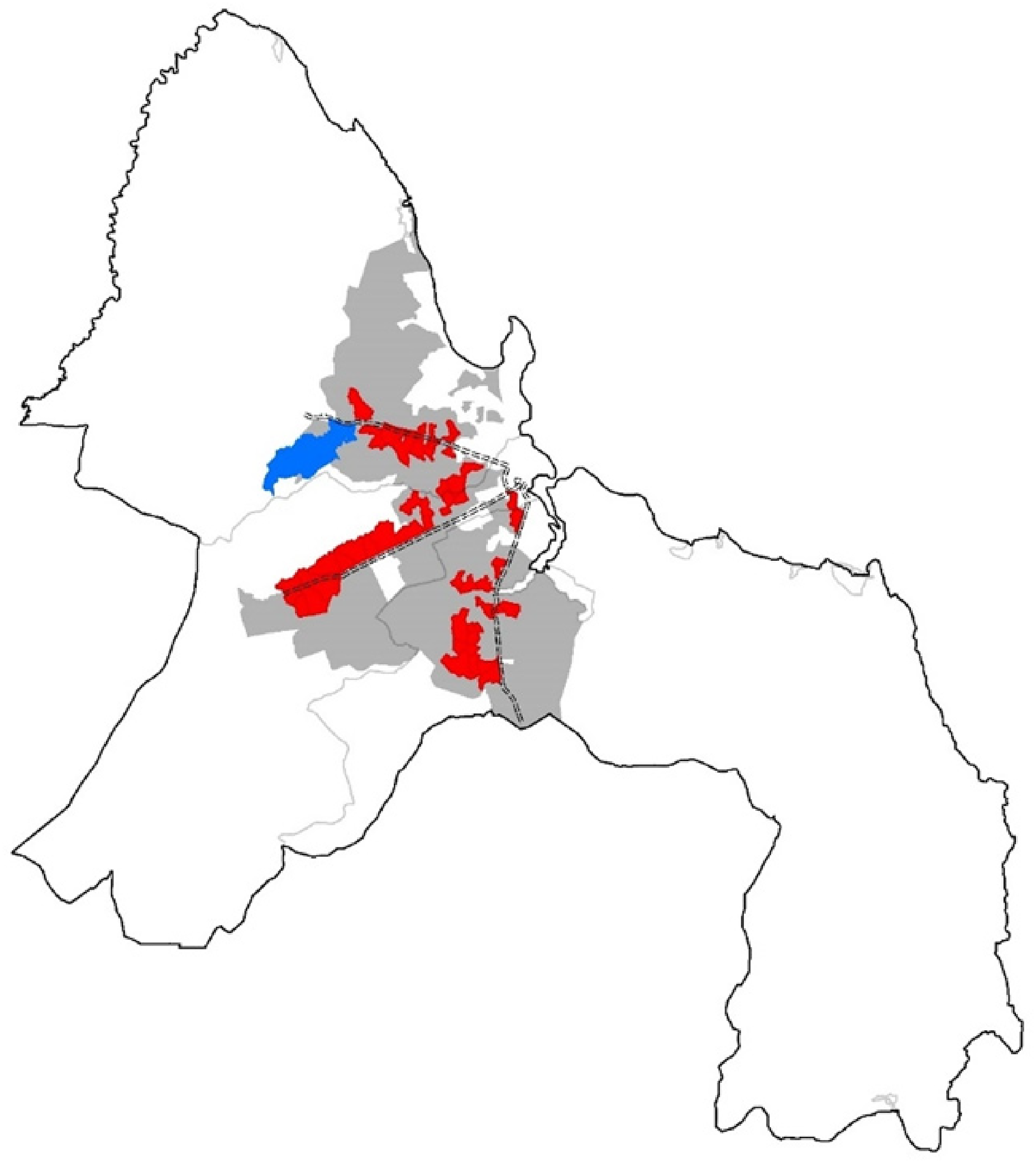
Study areas. The outer boundary is Dar es Salaam divided into three municipalities: Kinondoni (west), Ilala (central), and Temeke (east). This division reflects the administrative structure from the early 2000s, when the RL programme was implemented, until 2015/2016 (nowadays there are five municipalities). They are crossed by three main roads (dashed lines): from top to bottom, Morogoro, Nyerere and Kilwa roads, which we used to access the study areas. About 160 mitaa or sub-wards (grey) were included in the Residential Licence programme phase I, from 2 to 20 km from the city centre. We collected survey data in the red sub-wards. The blue area is Kimara, a ward where the government conducted a pilot programme of regularisation with Certificates of Right of Occupancy.
Summary statistics in Table A1 show that the sample is representative of the population eligible for the RL concerning the rates of uptake and renewal. In terms of demographics, almost 48% of our respondents are female; 5% are 30 years old or younger, whilst 35% are 60 or older; 64% have primary education, whilst only 8% studied above secondary level. Concerning basic economic characteristics, 58% work in the informal economy; 12% have household monthly incomes in the lowest category (50,000 TSh or lower) while an equal share is in the highest category (500,000 TSh or higher). Furthermore, almost 39% arrived on their plot after the 2000s, that is, relatively close to the start of the RL programme.
For the second questionnaire, we set out to draw a random subsample of two plot owners per cluster (276). A subsample was selected only if it was balanced (t-test < 1.96) alongside key characteristics of the original sample as listed in Table A2. Otherwise, it was disregarded, and the computer proceeded with another draw until a balanced subsample was found. Because of time constraints, there were few opportunities to reschedule interviews for the second survey round. We, therefore, needed to replace the unavailable respondents with suitable reserves. After attrition, 243 respondents undertook the second questionnaire. Nonetheless, the final subsample is representative of the original population's state of uptake and renewal, gender, year of arrival on plot, education and household monthly income, although it includes a higher proportion of leaders (+4%) and a relatively older population (Table A2, column 2).
Dar es Salaam
The settlements in our sample present a wide variety of characteristics. As shown in Figure 1, they are situated in distinct municipalities and at various distances from the CBD (from 2 to 20 km), thereby reflecting the diversity of settlements under the RL programme. In the inner locations, Manzese (Kinondoni municipality) is one of the city's most saturated areas. This is visible in the dense, overcrowded, and low-quality building construction, lack of open space, and very limited infrastructure provision. Keko Mwanga and Keko Machungwa (Temeke municipality) represent pockets of informality amidst highly developed industrial land. Here, the expectation of imminent acquisition by the formal sector influences land investment and attitudes to formalisation. Indeed, some areas of Temeke are not far from Kigamboni municipality, where the vision of a satellite city is turning much farmland into re-developments, with some government expropriation and a lively land market. Ilala municipality is crossed by the Nyerere Road, which connects the city centre and the airport. Inner locations like Malapa have relatively high rates of multi-storey buildings and a lively rental market. A little further from the CBD, Kombo and Miembeni were involved in the City Infrastructure Upgrade Programme, 5 receiving infrastructure and service upgrades. Instead, along the Msimbazi River, which causes frequent and devastating flooding, the quality of housing and infrastructure is very poor. Houses are built of mud bricks and corrugated iron sheets. Dirt roads are severely impaired. Further away from the CBD, Mogo, Stakishari, Uwanja wa Ndege and other settlements along the Nyerere Road are relatively richer. Plots are larger, with lower density housing and some green space. Moving towards the peri-urban, it is possible to find walled or fenced properties, with beautiful habitations and internal courtyards, like in Gongolamboto. These traits are typical of the rising middle class, who relocate from the city centre to the expanding suburbs in search of their rural idyll and investment opportunities (Mercer, 2017).
This diversity of settlements is reflected in different land values and market access, plot density and size, housing and infrastructure quality, occupation, tenure, and socio-economic profile of landholders. These and other contextual factors (e.g. proximity to hazardous land) may have a sizable impact on choices of formalisation, as I explore in companion work. However, all geographical reference is omitted in the empirical discussion of this paper because my evidence suggests that social expectations affect choices of uptake and renewal, despite of – or alongside – a variety of settlement, plot and landholder characteristics.
Another important consideration concerns the generalisability and transferability of this paper's results. In this respect, I note that Dar es Salaam is one of the fastest urbanising cities in Africa. Land markets and urban investments are livelier here than in other areas, and so there are relatively higher and increasing land values. At the same time, concerns over land expropriation, repeated sale, encroachment, and boundary disputes are growing. For example, Wolff et al. (2018) report of one plot that was sold to over thirty different buyers in the Kigamboni area. Contextual dynamics of urbanisation, urban development and land access certainly influence responses to formalisation policies. Thus, some of my findings will be – necessarily – context-specific. It might be difficult to generalise or transfer those across rural settings, other cities, or other countries.
Results
Conditional preferences for formalisation
With the use of vignettes (see Appendix), we asked respondents to imagine the behaviour of a fictional character who lives in the respondent's mtaa, is eligible for the RL, can afford the fees and has no pending land disputes. They attend a public meeting that raises the issue of formalisation. Would they acquire and renew the RL after finding out that most plot owners in the mtaa (defined as 50% or above) have or have not got an active RL (vignettes A1–A2), approve or disapprove of formalisation with RL (vignettes B1–B2)? As illustrated in Table 1 (below), columns 1–4, one in three respondents think that the fictional character will follow the majority: he will formalise only if at least half in the neighbourhood do so (30%) or approve of the RL (34%). This suggests that a large share of the population have conditional preferences for uptake and renewal based on their social empirical and normative expectations of other people's behaviour and beliefs.
Vignettes.
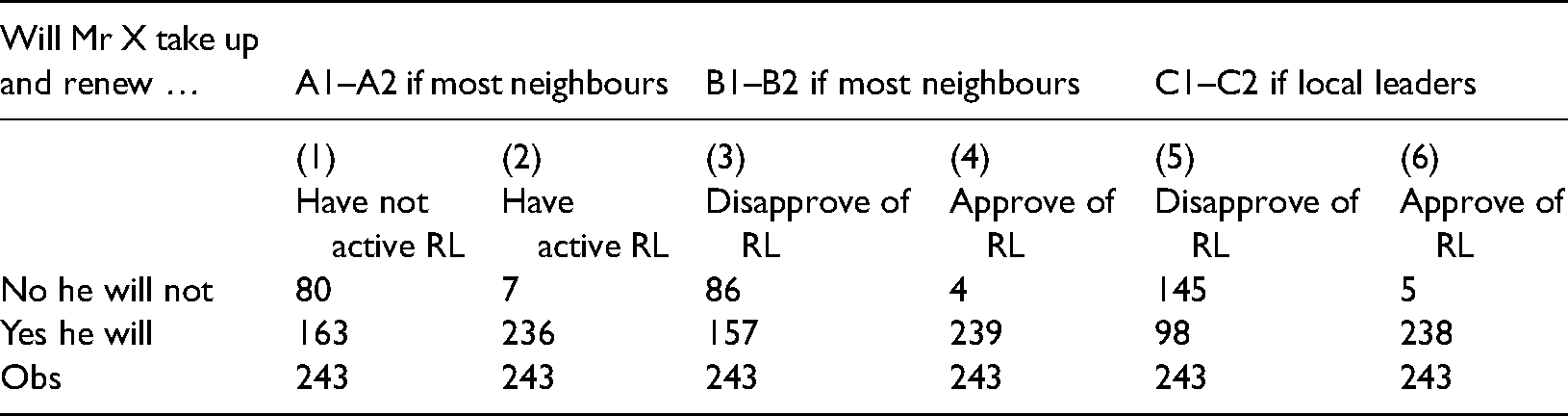
To further investigate the impact of social expectations on choices of formalisation, we asked what the fictional character will choose to do when his local leaders either disapprove or approve of the RL (vignettes C1–C2). According to the local government structure, local leaders are prominent figures in a community. Each household normally refers to their elected mtaa leaders (street leaders) and wajumbe (sub-street leaders) for a variety of reasons, including verifying the personal identity of residents and their ownership of land for the purposes of issuing and renewing the RL, sorting land disputes, selling or collateralising land formally and informally (see Manara and Pani, 2022b). Results in Table 1, columns 5–6, show that a staggering 58% of respondents think that the fictional character will formalise only if approved by local leaders, described as ‘those who lead’, ‘the point of reference’, and ‘the most influential’.
Table 2 presents data from another set of vignettes administered to a larger sample of respondents in the first survey round. This evidence confirms that both neighbours and local leaders form a relevant social network generating social expectations that influence choices of formalisation. According to most respondents, the fictional character will acquire or renew their RL when they realise that (i) the number of neighbours with an active RL is higher than originally thought (column 1), (ii) the number of neighbours with an active RL is very low, but local leaders advise that residents should have an active RL (column 2) and (iii) the number of neighbours with an active RL is low and local leaders do not typically talk much about the importance of the RL in public meetings, however, the government starts a campaign on the RL recommending that all residents in unplanned areas should have an active RL (column 3). Here, it emerges that landholders’ choices of formalisation are also sensitive to normative inputs from the higher-level government. To summarise, landholders have conditional preferences for formalisation based on the behaviour of their neighbours (social empirical expectations), the advice of other landholders, local leaders and higher-level government (social normative expectations).
Vignettes.
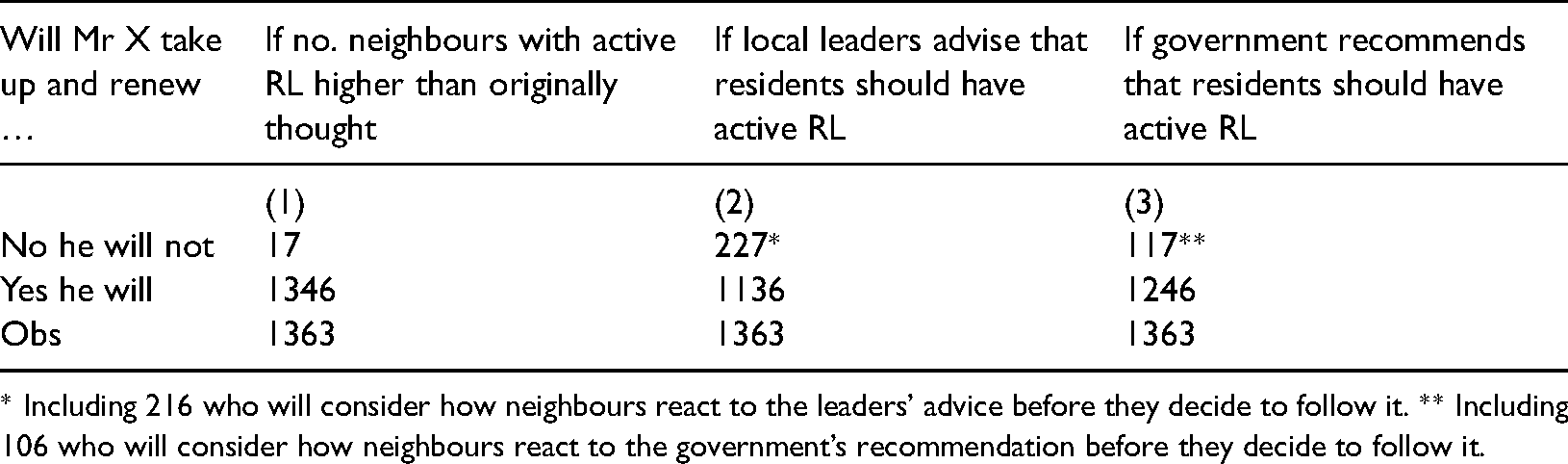
* Including 216 who will consider how neighbours react to the leaders’ advice before they decide to follow it. ** Including 106 who will consider how neighbours react to the government’s recommendation before they decide to follow it.
Social expectations of compliance
As this evidence indicates a strong link between social expectations and choices of formalisation, we then turn to examine the social expectations of our respondents. There are scarce social interactions around the RL at the neighbourhood level. Landholders rarely discuss with one another their choices of formalisation. For example, 37% of respondents have never heard of a fellow landowner acquiring or renewing their RL, while 50% have heard of three people or less, during the 15 years of the programme. These practices affect social expectations of compliance. In the first survey round we presented respondents with a list of their nine closest neighbours (eligible for the RL) in the same survey cluster. We asked them to estimate how many have ever taken up the licence and have a valid licence (renewed or recently acquired). It emerged that landholders expect low compliance with the RL programme: there is a tendency to severely underestimate the rate of first uptake (Figure 2), while respondents’ expectations reflect more closely the current rate of valid RL, between 0% and 20% (Figure 3).
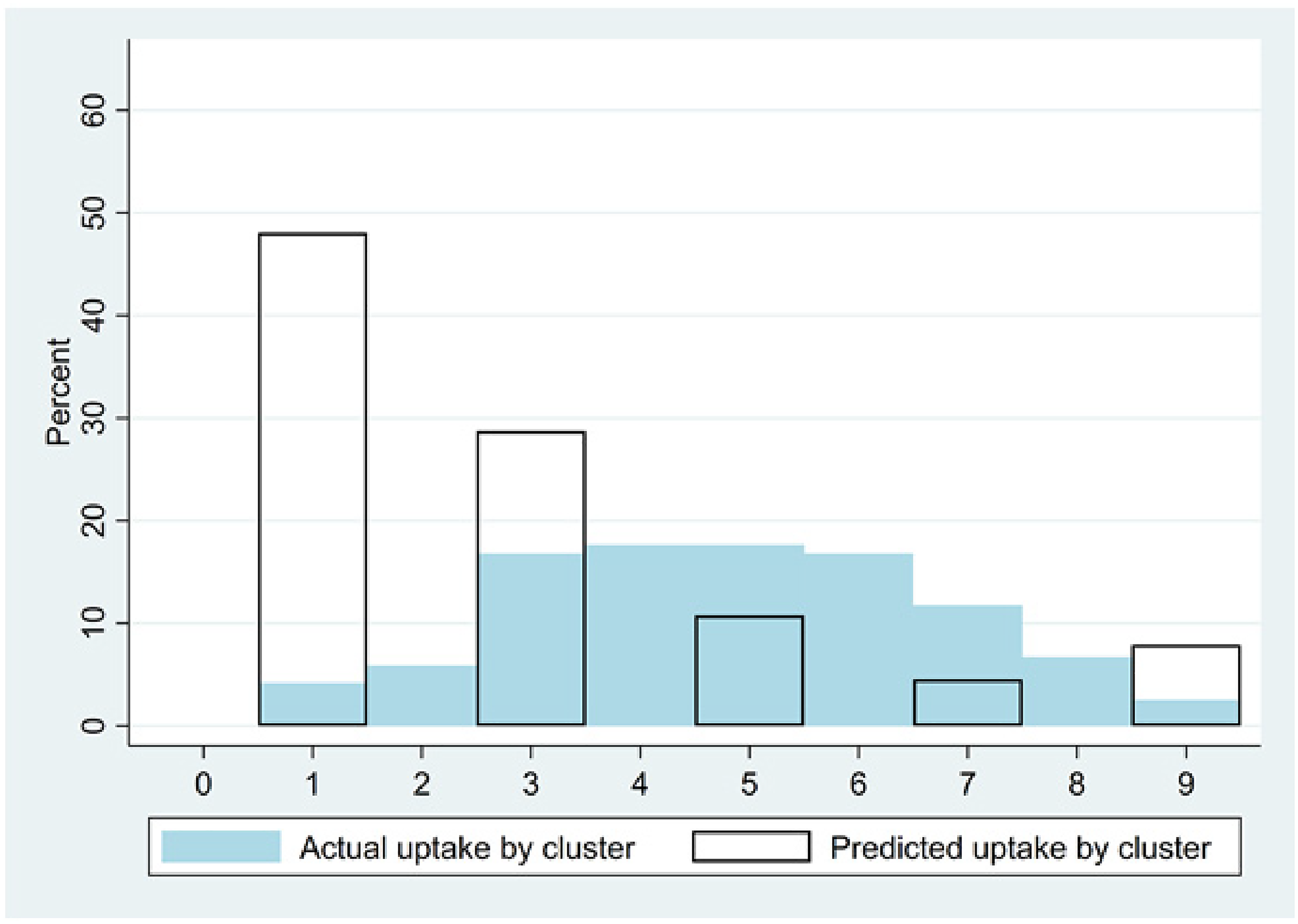
Rate of uptake by cluster: actual versus predicted rate (social expectation). Constructed using a subsample of 1190 respondents interviewed in clusters of 10 (87% of the total sample). Actual rates are continuous variables from 0 to 9. Predicted rates are in bins from ‘hardly any: around 10%' to ‘almost all: around 90%’.
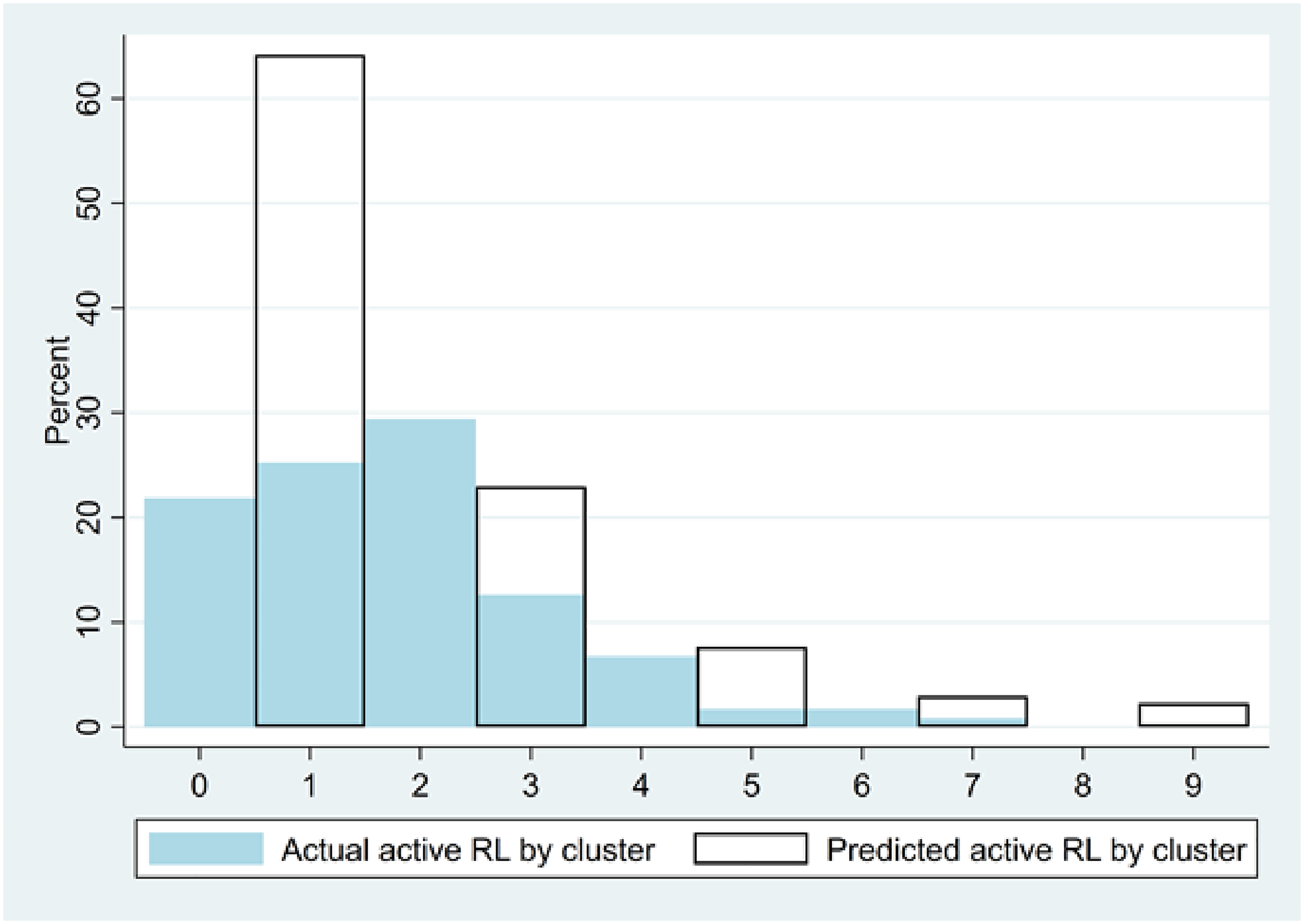
Rate of active RL by cluster: actual versus predicted rate (social expectation). Constructed using a subsample of 1190 respondents interviewed in clusters of 10 (87% of the total sample). Actual rates are continuous variables from 0 to 9. Predicted rates are in bins from ‘hardly any: around 10%’ to ‘almost all: around 90%’.
To better understand the impact of conditional preferences on choices of formalisation in our sample, we conduct another exercise comparing the social expectations of compliance of respondents with their thresholds of compliance, which represent their sensitivity to social expectations. First, we elicit social expectations by asking how many plot owners they think have an active RL (out of 100 plot owners in the same mtaa). Expected compliance is relatively low, around 28%. Although this is slightly higher than the actual rate of active RL (17.5%), over half of our respondents think that the share of neighbours with an active RL is between 0% and 20%. A full 90% of respondents think that compliance does not exceed 50%.
Second, we measure the respondents’ thresholds of compliance by asking how many plot owners need to formalise with RL before a fictional character decides to do likewise (out of 100 plot owners in the same mtaa). In Figure 4, threshold values below 0 or above 100 represent unconditional preferences: 34% of respondents think that the fictional character will always take up (left bar), while 3% of respondents think that the fictional character will never take up (right bar), regardless of others. However, 64% (roughly two respondents in three) have conditional preferences for formalisation. For example, about 12% of respondents have threshold values between 50 and 60, meaning that they will choose to formalise only if between 50% and 60% of other landholders have already done so.
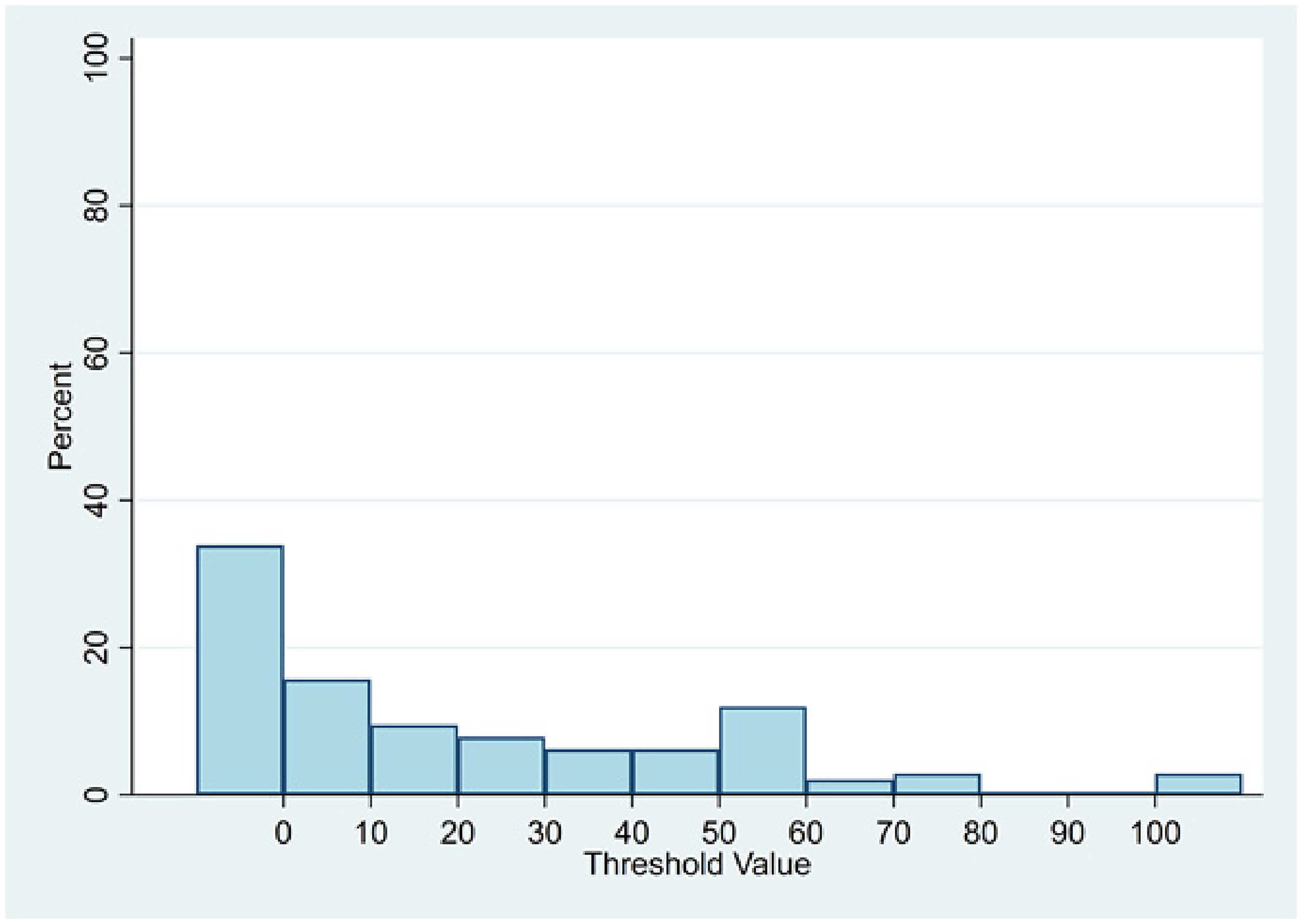
Thresholds of compliance or sensitivity to social expectations.
Finally, Figure 5 compares – for respondents with conditional preferences for formalisation – their social empirical expectations (vertical axis) and their thresholds of compliance (horizontal axis). Each observation in the scatterplot represents one respondent with a conditional preference for formalisation. I note that about half of the observations fall on the line or below (52%). When they fall below the line, thresholds of compliance are higher than social expectations; thus, the respondents’ conditions of compliance are unfulfilled. To reiterate, this exercise suggests that a large group of landholders in this sample may not formalise because the number of neighbours who they expect to have an active RL is lower than the threshold beyond which they would acquire or renew the licence.
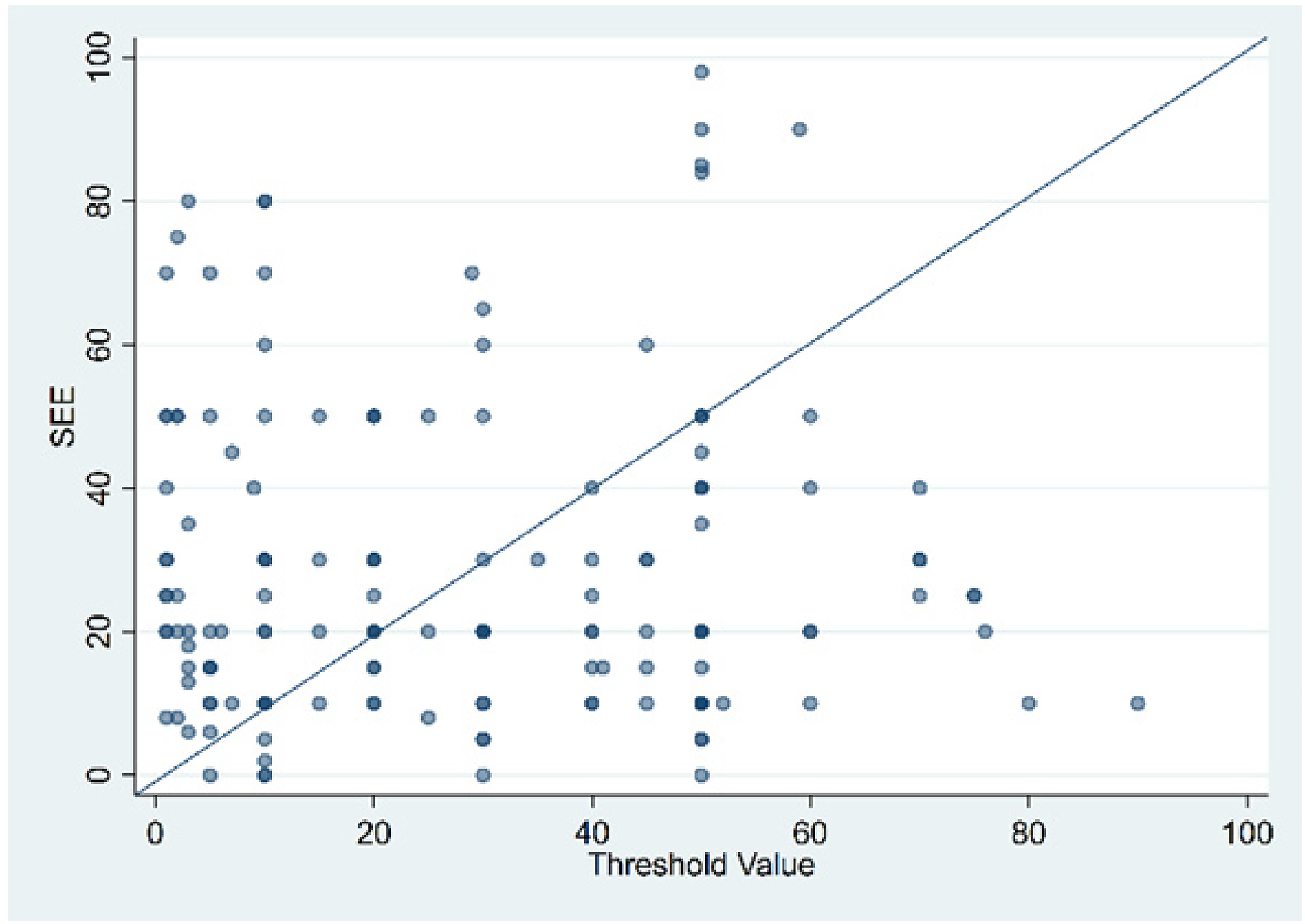
Threshold values and social empirical expectations of respondents with conditional preferences for formalisation.
Social expectations of consensus: A credible institution?
Thus far, the paper has argued that landholders have conditional preference for formalisation based on the behaviour of their neighbours, the advice of other landholders, local leaders and higher-level government authorities. Further, it was suggested that social expectations of low compliance (empirical expectations) discourage choices of formalisation at the neighbourhood level. This section and the next one turn to investigate the social normative expectations of landholders. To what extent do they expect that key actors approve or disapprove of the RL? And how do these expectations impact choices of formalisation?
The first hypothesis is that landholders expect scarce social support for the RL (consensus). For example, if landholders think that choices of formalisation raise disapproval, dissent or conflict at the neighbourhood level (normative expectation), they will expect low compliance from their neighbours (empirical expectation), and they will be reluctant to formalise. In this case, there might be common perceptions that the RL provides poor functions vis-à-vis the institutional status quo (e.g. informal tenure), and therefore it is not beneficial or not needed. Thus, the RL is not a credible institution.
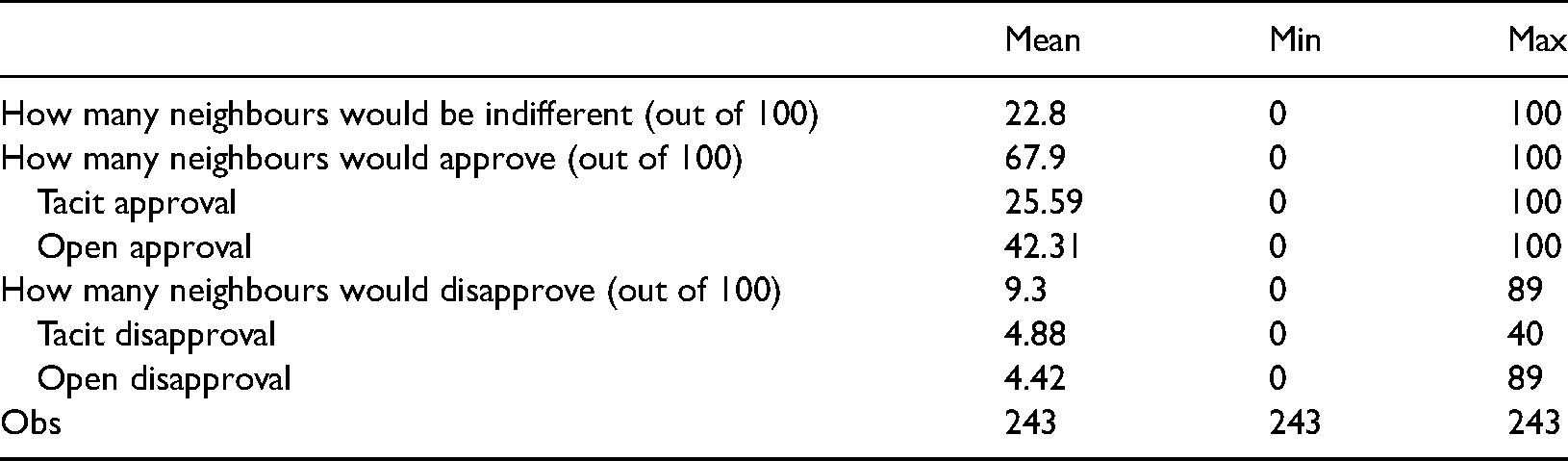
However, our evidence demonstrates the opposite. To measure social consensus, first we elicited the personal and social normative expectations of respondents. The vast majority (91%) – including those who do not hold active licences – suggested that landholders who are eligible for the RL programme should acquire and renew this title document. Furthermore, 83% think that this is the prevailing belief in their mtaa. Thus, there is a large consistency of normative expectations in favour of formalisation, despite of limited uptake and renewal. Second, we proposed hypothetical scenarios. How would the respondent react if they found out that one neighbour landholder has just acquired the licence? What would be the prevailing reaction in the neighbourhood? Crucially, it emerged that choices of formalisation encounter positive social sanctions at the community level. Almost all respondents would approve of this choice, either tacitly (10%) or openly (88%), for example by congratulating the holder of the licence. They believe that most neighbours would also react in a positive way. In fact, as illustrated in Table 3, respondents expect that choices of formalisation would not raise any significant disapproval, dissent or open conflict among their neighbours (below 10%) suggesting that the RL is a credible institution. 6
Hypothetical scenario. Expected reactions to formalisation by neighbours.
Indeed, there are common perceptions that the RL provides important functions over and above informal tenure and other unregistered proofs of ownership (e.g. sale agreement). Elaborating on the motivations for which the RL is good and should be taken up, respondents explained that this document provides ‘legal recognition’, ‘the right to own’, leading to lower land conflicts, fair compensation in case of government-led eviction, and access to loans. Formalisation generates feelings of ‘security’ and ‘freedom’. Many suggested that, if they were to acquire or renew their licence, their household members would express ‘happiness’, ‘gratitude’ and ‘relief’ for securing the ‘family property’, their ‘home’, and their ‘future’. These words echo other evidence in the literature, where plot owners in Dar es Salaam described the RL as a ‘shield’ and ‘saviour’ (Sheuya and Burra, 2016: 454). For several decades, informal institutions of tenure have provided good levels of de facto security in the unplanned settlements of Dar es Salaam (e.g. Kombe and Kreibich, 2000). However, informal institutions alone cannot cope with the increasing urban density, competition for land and rising prices (ibidem). This is reflected, for example, in growing land conflicts. In this context, vis-à-vis the current dynamics of urban development, formal property rights are deemed more functional than informal tenure, which explains substantial consensus for formalisation.
Social expectations of enforcement: An empty institution?
The second hypothesis is that landholders expect scarce government support for the RL. For example, if landholders think that the government does not consider the RL as a valuable proof of ownership (normative expectation), they will expect low compliance from their neighbours (empirical expectation), and they will be reluctant to formalise. In this case, there might be common perceptions that the RL is poorly enforced while the government tolerates the institutional status quo or – as we find in this case – supports other formal proofs of ownership. Thus, the RL is an empty institution.
When the RL programme started, local leaders were involved in raising awareness at the community level (43% of landholders stated that they were the most influential source of information), but several generations of leaders have passed by and a full 67% of the current chairpersons and executive officers admitted that they no longer endorse the RL during public meetings. Although each mtaa office holds four public meetings per year discussing important issues including land tenure, the RL typically receives scarce attention. Some leaders explained that they have little knowledge regarding the RL programme; thus, they cannot provide any ‘meaningful advice’ to landholders (TMK/YDV). Others added that it would not make sense to continue promoting the RL since ‘the government focus is now on regularisation with full property rights’ (UBG/UMS). Indeed, most mtaa chairpersons do believe that ‘the government does not give priority to the RL’ (KND/KGM) and they were surprised to find out – from this research – that the government has initiated a second phase of the RL programme. In fact, it is interesting to note that some chairpersons have stopped renewing their own RL and wajumbe (sub-street leaders) in our survey sample present slightly lower rates of uptake and renewal compared to the wider population. “For many years the people have ignored the processes of the RL” explained one chairman “they did not renew and did not pay the land rent and the government has also ignored these issues!” (KND/MBO) “If the government had taken it seriously” suggested another “an order to promote this programme would come from the top down to us. That is the first thing that I see … themselves [the government] do not consider the RL important.” (TMK/KGG)
Certainly, the higher-level authorities do not provide any normative inputs suggesting that the RL is a valuable proof of ownership. As explained above, municipalities are responsible for administering the RL programme, but they no longer campaign to sensitise residents (most campaigns stopped after 2005, except for a few locations close to the city centre). Since 2016, the MLHHSD has emphasised the need to secure private property rights in unplanned areas. However, it conducted campaigns underscoring the importance of obtaining long-term leaseholds (CRO). Recent government policies enabled a private market of planning and surveying services, pushing private companies to approach several communities already involved in the RL programme to carry out regularisation schemes. On the one hand, the government emphasis on statutory property rights contributed to crafting social support for formalisation by creating expectations that the institutional functions of formal land titles outperform the informal proofs of ownership. This might help to explain the perceived consensus around the RL, which was described in the last section. On the other hand, increased government emphasis on long-term leaseholds generated doubts regarding the benefits of interim property rights and the government commitment to preserve the RL in the future.
Motivations for conditional preferences: Why social expectations matter
Given the limited promotion of the RL described above, many landholders suggested that the main reason why they did not acquire or renew the RL is because they lack vital awareness and information on the programme. First, is this programme still enforced or was it revoked by the government? Second, is the RL beneficial compared to long-term leaseholds? In fact, over 85% of our respondents declared that they would like to join a regularisation programme, survey their plot, and attain long-term leaseholds. Lastly, what are the current prices of RL acquisition and renewal? Are interim property rights still affordable? Will there be fines for those who did not renew and pay the land rent for many years? What are the processes of acquisition and renewal? Today, most landholders cannot answer these questions. Therefore, they are sensitive to the behaviour and advice of others because these provide essential information on the importance, benefits and costs of formalisation.
Returning to the vignettes of Table 1, respondents explained that, if local leaders endorse the RL in public meetings, the fictional character will consider that ‘they are the link’ between the people and the central government. The approval of local leaders must signal that the government is committed to enforcing the RL. Moreover, the fictional character will trust that local leaders ‘stand for the people’: they want their best and know how to achieve it, exactly as parental figures or role models. If leaders suggest that the RL is important and beneficial, the fictional character will be ‘one hundred percent sure that it is good’ and he will not ‘waste his money’ (TMK/KBG/B1). Similarly, if the majority have an active RL, the fictional character will realise that the government is now doing ‘enforcement’ and ‘follow-up’. Moreover, he ‘would be strongly motivated by seeing that many people have taken up. This will prove that the RL is important’ (TMK/KNY/A5).
While social learning is the main motivation for conditional preferences, some respondents added that the fictional character will follow the behaviour and advice of others also to please their fellow landholders and local leaders. For instance, ‘Mr X will not want to be different from the majority’ (KND/MNM/B8), ‘feel stupid’, ‘guilty’, ‘weird’ or ‘isolated’, ‘as a betrayer’. If the majority have an active RL, ‘Mr X will take up in order to be socially acknowledged in the mtaa as one amongst those contributing to the development of the neighbourhood’ (TMK/KZG/A2). This evidence confirms that formalisation is associated with positive social sanctions (as in Table 3), which might also motivate conditional preferences for formalisation. However, landholders are sensitive to the behaviour and advice of others primarily because they are the vehicle of relevant information.
This underscores that social expectations do not affect choices of formalisation in isolation from other causes, such as limited awareness and information on the RL programme. Indeed, the actual benefits from interim property rights cannot be observed in a context where few landholders hold and use the licence. As said before, announcements by the central government generate doubts concerning the continuation of the RL programme and certainly do not provide important details on the process and price of title acquisition. Other channels to gain information are time and money-consuming (e.g. travelling to the municipality). Thus, my findings are consistent with prior studies identifying a severe lack of awareness and information amongst the key causes of moderate uptake and renewal of RL (Kusiluka and Chiwambo, 2019; Wolff et al., 2018). However, this paper adds to the existing literature by demonstrating that this situation triggers mechanisms of social learning. Landholders refer to their social expectations to learn about the level of government enforcement and the effectiveness of interim property rights. This produces collective choices of formalisation.
Conclusion
Since 2005, the RL programme has offered an affordable interim land title to around 180,000 landholders in the most saturated and the poorest informal settlements of Dar es Salaam. While around 50% of eligible landholders acquired the land title at the beginning of the programme, many did not renew their documents, and the pace of new acquisitions has drastically dropped. Today, less than 20% have an active RL. To understand the demand for land titles, the paper adopted an institutional approach and a novel analytic framework examining social expectations around the RL and their effects on choices of formalisation. The empirical analysis demonstrated that landholders have conditional preferences for formalisation based on their social expectations regarding the behaviour of their neighbours and the advice of other landholders, local leaders and higher-level government. Landholders expect there to be high social support for formalisation. There are common perceptions that the RL provides positive functions over and above informal tenure, and the RL is a credible institution. However, interactions between state and non-state agents generate social expectations that compliance with the programme is low and the government is not committed to enforcing interim property rights. These beliefs discourage choices of formalisation. In conclusion, both state and social forces steer the implementation of land reform and transform the RL into an ‘empty’ institution that fails to embed in social practice. Indeed, the RL is not resisted or contested; however, it remains ‘symbolic’ and ‘ineffective’ (see Ho, 2016a, 2016b, in the context of ‘non-credible’ and ‘empty’ institutions).
Through the case study of Dar es Salaam, the paper has contributed to the literature on the demand for land titles, which is a recurrent issue in urban Africa. First, it demonstrated that state and social forces interact in the implementation of formalisation policies. As seen, landholders are not passive receivers of the formalisation policy. Instead, endogenous interactions between state and non-state actors mediate the pace of institutional transition. Second, the paper developed a complex understanding of the demand for formalisation. On the one hand, it illuminated the impact of social expectations driving collective choices of formalisation in conjunction with other rational and individual motivations for uptake and renewal (or lack thereof), such as a severe lack of information on the RL programme. On the other, the paper showed that the credibility of certain property rights or the social support they rally at the local level cannot be inferred from observed behaviour. In the case of Dar es Salaam, there is a high consensus for formalisation, while the actual rate of formalisation with RL is low. This underscores the need for refined methods to elicit and examine social expectations around newly proposed institutions. Thus, the paper has offered an additional contribution by implementing a novel method for the study of institutions and institutional change in field settings. I envisage several potential applications of this method in geography, as the discipline is increasingly interested in the empirical study of institutions to understand how institutions emerge and matter in real places.
More generally, the paper has contributed to demonstrating that cities of the Global South domesticate and steer their own trajectories of development. While the land reform of Tanzania originates from an international macro-political agenda with neoliberal underpinnings, it appears clear that a multiplicity of actors and interests shape the emergence of formal property rights in specific contexts. As noted in the section Property rights reform in Tanzania, the Tanzanian Government made consistent efforts to strengthen state authority and legitimacy. The anti-corruption campaign and the land tenure regularisation campaign emphasised promises of state efficiency, tenure security and urban development, which loom large in the collective imagination and contribute to raising demand for statutory property rights. Furthermore, in Dar es Salaam, the local dynamics of land access and land tenure make informal tenure and unregistered proofs of ownership progressively less secure. Thus, landholders are genuinely interested in achieving stronger land institutions. They believe that statutory property rights will provide private protection and infrastructural improvements, while the government might pursue these objectives in conjunction with others (e.g. financial and political returns).
Understanding how national politics filters down to the local level in shaping the demand and the outcomes of land reform could be the subject of further research. However, the key point that this paper has demonstrated is that state and social forces steer the process of institutional transition by affecting the social expectations of landholders. The government’s emphasis on other proofs of ownership, the scarce enforcement of municipalities, the disengagement of local leaders, and the consequent expectations of low compliance all contribute to transforming the RL into an ‘empty’ institution. Given a multiplicity of interests and actors, it is rather difficult to either promote or condemn land reforms a priori. As other scholars have suggested, there is a need for more empirical studies exploring what is formal property, how formalisation processes unravel and the drivers of observed patterns of formalisation in specific spatial temporal contexts.
Supplemental Material
sj-docx-1-epn-10.1177_0308518X221107380 - Supplemental material for From policy to institution: Implementing land reform in Dar es Salaam’s unplanned settlements
Supplemental material, sj-docx-1-epn-10.1177_0308518X221107380 for From policy to institution: Implementing land reform in Dar es Salaam’s unplanned settlements by Martina Manara in Environment and Planning A: Economy and Space
Footnotes
Acknowledgements
I would like to thank Nancy Holman, Claire Mercer, Erica Pani, and Olmo Silva for their helpful advice and comments on earlier versions of this paper. The paper was presented at the Writing the World seminar series in the Department of Geography and Environment at the LSE and the Norms and Behavioural Change Workshop at the University of Pennsylvania. I thank all participants for providing feedback and Cristina Bicchieri for her kind attention. I am sincerely grateful to Erica Pani for her invaluable support during data collection activities. In the field, we have been assisted by a team of students from Ardhi University, whom we thank sincerely. During my fieldwork, I was affiliated with the Institute for Human Settlements Studies at Ardhi University where I received generous support. Finally, I would like to thank the editor of EPA and two anonymous reviewers for their important input in the editing process. The manuscript has much benefitted from their insightful comments. Any errors or omissions are my own.
Declaration of conflicting interests
The authors declared no potential conflicts of interest with respect to the research, authorship, and/or publication of this article.
Funding
The authors disclosed receipt of the following financial support for the research, authorship, and/or publication of this article: This research was supported by the International Growth Center (grant number TZA-19071), the Oram Travel Fund, the Royal Geographic Society-IBG Slawson Award (SLAW14/18), the World Bank Group (Urbanisation in Africa Project). The author acknowledges the ESRC Postdoctoral Fellowship (grant reference ES/W005719/1) for support at the time of publishing the paper.
Supplemental material
Supplemental material for this article is available online.
Notes
References
Supplementary Material
Please find the following supplemental material available below.
For Open Access articles published under a Creative Commons License, all supplemental material carries the same license as the article it is associated with.
For non-Open Access articles published, all supplemental material carries a non-exclusive license, and permission requests for re-use of supplemental material or any part of supplemental material shall be sent directly to the copyright owner as specified in the copyright notice associated with the article.
